Prepared by-Nazmul Hasan, Senior Judicial Magistrate at 11th
BJS. (Prime Minister Gold Medalist)
Page1
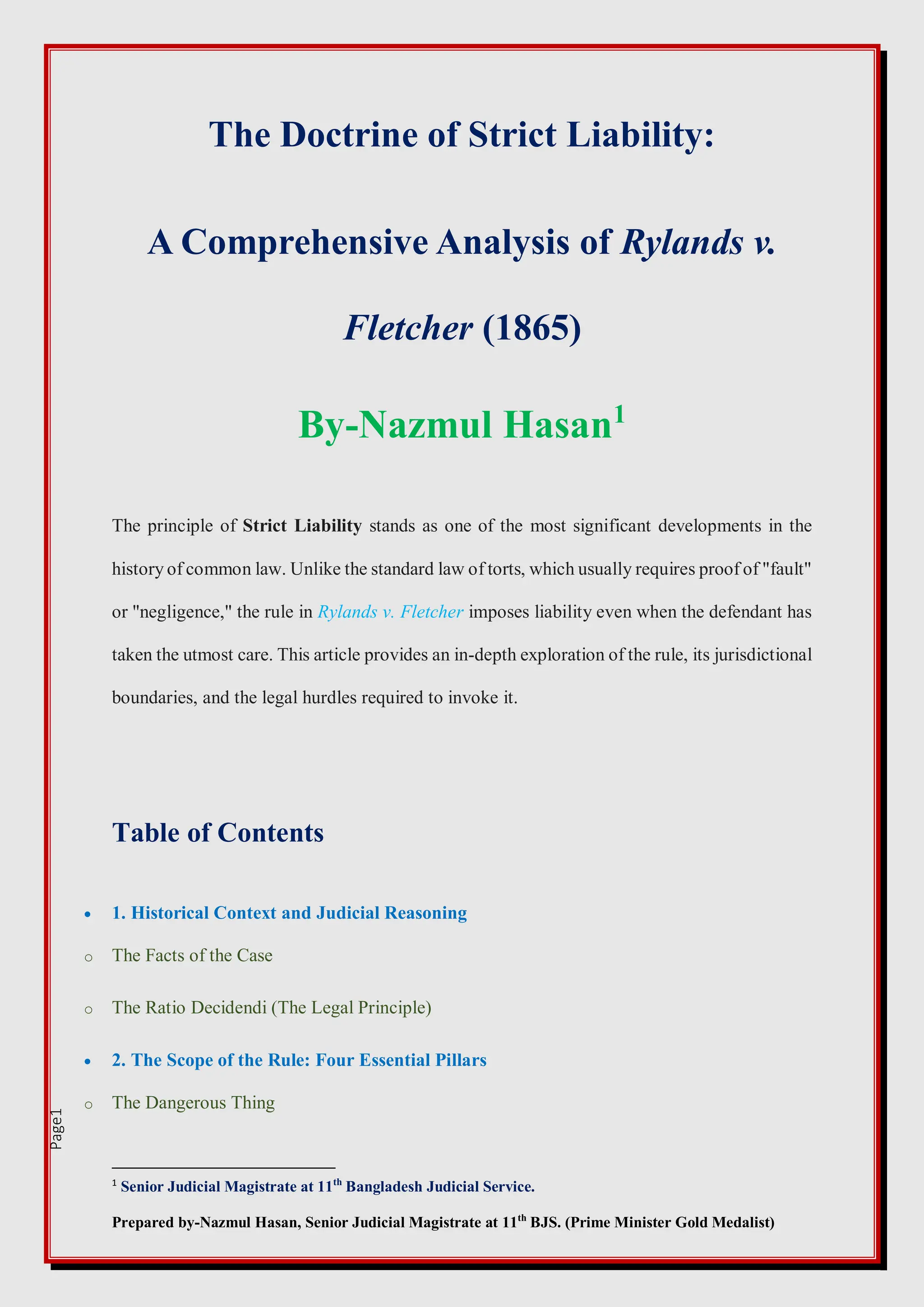
The Doctrine of Strict Liability:
A Comprehensive Analysis of Rylands v.
Fletcher (1865)
By-Nazmul Hasan1
The principle of Strict Liability stands as one of the most significant developments in the
history of common law. Unlike the standard law of torts, which usually requires proof of "fault"
or "negligence," the rule in Rylands v. Fletcher imposes liability even when the defendant has
taken the utmost care. This article provides an in-depth exploration of the rule, its jurisdictional
boundaries, and the legal hurdles required to invoke it.
Table of Contents
 1. Historical Context and Judicial Reasoning
o The Facts of the Case
o The Ratio Decidendi (The Legal Principle)
 2. The Scope of the Rule: Four Essential Pillars
o The Dangerous Thing
1
Senior Judicial Magistrate at 11th
Bangladesh Judicial Service.
Prepared by-Nazmul Hasan, Senior Judicial Magistrate at 11th
BJS. (Prime Minister Gold Medalist)
Page2
o The Element of "Escape"
o Non-Natural Use of Land
o Foreseeability of Damage
 3. Comprehensive List of Exceptions
o Plaintiff’s Own Fault
o Act of God (Vis Major)
o Act of a Stranger
o Common Benefit and Consent
o Statutory Authority
 4. Evolution: From Strict to Absolute Liability
 5. Conclusion: The Enduring Legacy of Rylands v. Fletcher
1. Historical Context and Judicial Reasoning
The Facts of the Case
The case involved John Rylands, who constructed a reservoir on his land to power his mill.
He employed competent independent engineers for the task. However, the engineers failed to
notice abandoned coal mine shafts under the site. When the reservoir was filled, the weight of
the water broke through these shafts, flowed through interconnected passages, and flooded the
neighboring mine belonging to Thomas Fletcher.
Rylands was not personally negligent, nor was he vicariously liable for his contractors under
the laws of that time. Nevertheless, the court sought a way to compensate Fletcher for his loss.
Prepared by-Nazmul Hasan, Senior Judicial Magistrate at 11th
BJS. (Prime Minister Gold Medalist)
Page3
The Legal Principle
Justice Blackburn, in the Court of Exchequer Chamber, formulated a rule that shifted the focus
from the behavior of the defendant to the risk created by their activity. He argued that if you
bring something onto your land that is not naturally there, you do so at your own peril.
"The person who for his own purposes brings on his lands and collects and keeps there anything
likely to do mischief if it escapes, must keep it in at his peril."
2. The Scope of the Rule: Four Essential Pillars
For a plaintiff to succeed in a claim under Rylands v. Fletcher, four specific criteria must be
satisfied. If any one of these is missing, the case must be argued under standard negligence or
nuisance laws.
I. The Dangerous Thing
The rule applies to anything that is "likely to do mischief if it escapes." While water was the
catalyst in the original case, the scope has expanded to include:
 Gas and Electricity
 Explosives and Fire
 Toxic Waste and Chemicals
 Sewage
II. The Element of "Escape"
Prepared by-Nazmul Hasan, Senior Judicial Magistrate at 11th
BJS. (Prime Minister Gold Medalist)
Page4
There must be an "escape" from a place where the defendant has occupation or control to a
place which is outside his occupation or control. In the case of Read v. Lyons (1947), an
explosion within a munitions factory that injured an inspector did not trigger the rule because
the "thing" (the explosion/shrapnel) never left the defendant's property.
III. Non-Natural Use of Land
This is perhaps the most complex aspect of the scope. The courts distinguish between "natural"
uses (like growing trees or installing domestic pipes) and "non-natural" uses.
 Natural Use: Ordinary enjoyment of land, such as residential gardening or standard plumbing.
 Non-Natural Use: Some special use bringing with it increased danger to others, such as
industrial chemical storage or large-scale reservoirs.
IV. Foreseeability of Damage
Modern interpretations (following the case of Cambridge Water Co. v. Eastern Counties
Leather, 1994) have clarified that while the escape does not need to be foreseeable, the type
of damage caused by the escape must be reasonably foreseeable.
3. Comprehensive List of Exceptions
The rule is "strict," not "absolute." There are five primary defenses a defendant can use to avoid
liability:
I. Default of the Plaintiff
Prepared by-Nazmul Hasan, Senior Judicial Magistrate at 11th
BJS. (Prime Minister Gold Medalist)
Page5
If the damage is caused by the plaintiff’s own action—for instance, if the plaintiff meddles
with the defendant's property or builds their own structure in a way that invites the damage—
the defendant is not liable.
II. Act of God (Vis Major)
This refers to circumstances which no human foresight can provide against. In Nichols v.
Marsland (1876), an extraordinary rainfall, described as "greater than any in living memory,"
caused ornamental lakes to burst. The court held this was an Act of God, and the defendant
was not liable.
III. Act of a Stranger
If the escape is caused by the unforeseen act of a third party (a stranger) over whom the
defendant has no control, the rule does not apply. For example, if a saboteur breaks into a
facility and opens a valve, the owner is generally not held strictly liable.
IV. Common Benefit and Consent
If the plaintiff has consented to the dangerous thing being on the defendant’s land, or if the
"thing" is maintained for the common benefit of both (like a shared water tank in an apartment
complex), the defendant is only liable if they were negligent.
V. Statutory Authority
When a statute (a law passed by the legislature) directs or authorizes a body to carry out an
activity, that body is usually exempt from strict liability. They can only be sued if the plaintiff
proves they carried out their legal duty negligently.
Prepared by-Nazmul Hasan, Senior Judicial Magistrate at 11th
BJS. (Prime Minister Gold Medalist)
Page6
4. Evolution: From Strict to Absolute Liability
While the Rule in Rylands v. Fletcher provides several defenses (exceptions), some modern
legal systems have moved toward Absolute Liability.
In India, for example, the Supreme Court in M.C. Mehta v. Union of India (1987) ruled that in
cases involving inherently dangerous or hazardous industries, there are no exceptions. If a
hazardous substance escapes, the enterprise is strictly and absolutely liable, regardless of Acts
of God or third-party interference. This represents the modern evolution of the 1865 rule to
meet the demands of a high-tech, industrial society.
5. Conclusion: The Enduring Legacy of Rylands v. Fletcher
The rule established in Rylands v. Fletcher (1865) remains one of the most transformative
milestones in the history of the Common Law. By shifting the legal focus from "fault"
(negligence) to "risk" (the inherent danger of an activity), the judiciary acknowledged a
fundamental reality of the industrial age: that individuals and enterprises who introduce
extraordinary risks into society must bear the responsibility for the consequences, regardless
of how careful they may have been.
As we have explored, the scope of the rule is carefully balanced by the requirement of a "non-
natural use" of land and the necessity of an actual "escape." These parameters prevent the rule
from becoming an unreasonable burden on ordinary domestic life while ensuring that large-
scale industrial hazards are strictly monitored. Furthermore, the exceptions—ranging from
Acts of God to the intervention of third parties—provide a necessary "safety valve" that
prevents the rule from being one of absolute, unbending punishment in the face of truly
unforeseeable events.
Prepared by-Nazmul Hasan, Senior Judicial Magistrate at 11th
BJS. (Prime Minister Gold Medalist)
Page7
Today, while the rule has been integrated into the broader law of private nuisance in some
jurisdictions, its core philosophy lives on. It serves as the direct ancestor to modern
environmental laws and the doctrine of Absolute Liability, ensuring that as our technology
becomes more complex and potentially hazardous, the law remains a robust shield for the rights
of the neighbor.
Prepared by-Nazmul Hasan, Senior Judicial Magistrate at 11th
BJS. (Prime Minister Gold Medalist)
Page8
About the Author
Nazmul Hasan
Senior Judicial Magistrate
Professional Highlights
 Senior Judicial Magistrate, 11th Bangladesh Judicial Service (BJS)
 Merit Position: 7th in the 11th BJS
Prepared by-Nazmul Hasan, Senior Judicial Magistrate at 11th
BJS. (Prime Minister Gold Medalist)
Page9
Academic Qualifications
 LL.B. (Hons.) – First Class First, University of Rajshahi
 LL.M. – First Class, University of Rajshahi
Honors & Achievements
 Prime Minister Gold Medalist – 2017
 Agrani Bank Gold Medalist for Academic Excellence – 2023
Page10

The Doctrine of Strict Liability-A Comprehensive Analysis of Rylands v. Fletcher (1865)-by Judge Nazmul Hasan.pdf

  • 1.
    Prepared by-Nazmul Hasan,Senior Judicial Magistrate at 11th BJS. (Prime Minister Gold Medalist) Page1 The Doctrine of Strict Liability: A Comprehensive Analysis of Rylands v. Fletcher (1865) By-Nazmul Hasan1 The principle of Strict Liability stands as one of the most significant developments in the history of common law. Unlike the standard law of torts, which usually requires proof of "fault" or "negligence," the rule in Rylands v. Fletcher imposes liability even when the defendant has taken the utmost care. This article provides an in-depth exploration of the rule, its jurisdictional boundaries, and the legal hurdles required to invoke it. Table of Contents  1. Historical Context and Judicial Reasoning o The Facts of the Case o The Ratio Decidendi (The Legal Principle)  2. The Scope of the Rule: Four Essential Pillars o The Dangerous Thing 1 Senior Judicial Magistrate at 11th Bangladesh Judicial Service.
  • 2.
    Prepared by-Nazmul Hasan,Senior Judicial Magistrate at 11th BJS. (Prime Minister Gold Medalist) Page2 o The Element of "Escape" o Non-Natural Use of Land o Foreseeability of Damage  3. Comprehensive List of Exceptions o Plaintiff’s Own Fault o Act of God (Vis Major) o Act of a Stranger o Common Benefit and Consent o Statutory Authority  4. Evolution: From Strict to Absolute Liability  5. Conclusion: The Enduring Legacy of Rylands v. Fletcher 1. Historical Context and Judicial Reasoning The Facts of the Case The case involved John Rylands, who constructed a reservoir on his land to power his mill. He employed competent independent engineers for the task. However, the engineers failed to notice abandoned coal mine shafts under the site. When the reservoir was filled, the weight of the water broke through these shafts, flowed through interconnected passages, and flooded the neighboring mine belonging to Thomas Fletcher. Rylands was not personally negligent, nor was he vicariously liable for his contractors under the laws of that time. Nevertheless, the court sought a way to compensate Fletcher for his loss.
  • 3.
    Prepared by-Nazmul Hasan,Senior Judicial Magistrate at 11th BJS. (Prime Minister Gold Medalist) Page3 The Legal Principle Justice Blackburn, in the Court of Exchequer Chamber, formulated a rule that shifted the focus from the behavior of the defendant to the risk created by their activity. He argued that if you bring something onto your land that is not naturally there, you do so at your own peril. "The person who for his own purposes brings on his lands and collects and keeps there anything likely to do mischief if it escapes, must keep it in at his peril." 2. The Scope of the Rule: Four Essential Pillars For a plaintiff to succeed in a claim under Rylands v. Fletcher, four specific criteria must be satisfied. If any one of these is missing, the case must be argued under standard negligence or nuisance laws. I. The Dangerous Thing The rule applies to anything that is "likely to do mischief if it escapes." While water was the catalyst in the original case, the scope has expanded to include:  Gas and Electricity  Explosives and Fire  Toxic Waste and Chemicals  Sewage II. The Element of "Escape"
  • 4.
    Prepared by-Nazmul Hasan,Senior Judicial Magistrate at 11th BJS. (Prime Minister Gold Medalist) Page4 There must be an "escape" from a place where the defendant has occupation or control to a place which is outside his occupation or control. In the case of Read v. Lyons (1947), an explosion within a munitions factory that injured an inspector did not trigger the rule because the "thing" (the explosion/shrapnel) never left the defendant's property. III. Non-Natural Use of Land This is perhaps the most complex aspect of the scope. The courts distinguish between "natural" uses (like growing trees or installing domestic pipes) and "non-natural" uses.  Natural Use: Ordinary enjoyment of land, such as residential gardening or standard plumbing.  Non-Natural Use: Some special use bringing with it increased danger to others, such as industrial chemical storage or large-scale reservoirs. IV. Foreseeability of Damage Modern interpretations (following the case of Cambridge Water Co. v. Eastern Counties Leather, 1994) have clarified that while the escape does not need to be foreseeable, the type of damage caused by the escape must be reasonably foreseeable. 3. Comprehensive List of Exceptions The rule is "strict," not "absolute." There are five primary defenses a defendant can use to avoid liability: I. Default of the Plaintiff
  • 5.
    Prepared by-Nazmul Hasan,Senior Judicial Magistrate at 11th BJS. (Prime Minister Gold Medalist) Page5 If the damage is caused by the plaintiff’s own action—for instance, if the plaintiff meddles with the defendant's property or builds their own structure in a way that invites the damage— the defendant is not liable. II. Act of God (Vis Major) This refers to circumstances which no human foresight can provide against. In Nichols v. Marsland (1876), an extraordinary rainfall, described as "greater than any in living memory," caused ornamental lakes to burst. The court held this was an Act of God, and the defendant was not liable. III. Act of a Stranger If the escape is caused by the unforeseen act of a third party (a stranger) over whom the defendant has no control, the rule does not apply. For example, if a saboteur breaks into a facility and opens a valve, the owner is generally not held strictly liable. IV. Common Benefit and Consent If the plaintiff has consented to the dangerous thing being on the defendant’s land, or if the "thing" is maintained for the common benefit of both (like a shared water tank in an apartment complex), the defendant is only liable if they were negligent. V. Statutory Authority When a statute (a law passed by the legislature) directs or authorizes a body to carry out an activity, that body is usually exempt from strict liability. They can only be sued if the plaintiff proves they carried out their legal duty negligently.
  • 6.
    Prepared by-Nazmul Hasan,Senior Judicial Magistrate at 11th BJS. (Prime Minister Gold Medalist) Page6 4. Evolution: From Strict to Absolute Liability While the Rule in Rylands v. Fletcher provides several defenses (exceptions), some modern legal systems have moved toward Absolute Liability. In India, for example, the Supreme Court in M.C. Mehta v. Union of India (1987) ruled that in cases involving inherently dangerous or hazardous industries, there are no exceptions. If a hazardous substance escapes, the enterprise is strictly and absolutely liable, regardless of Acts of God or third-party interference. This represents the modern evolution of the 1865 rule to meet the demands of a high-tech, industrial society. 5. Conclusion: The Enduring Legacy of Rylands v. Fletcher The rule established in Rylands v. Fletcher (1865) remains one of the most transformative milestones in the history of the Common Law. By shifting the legal focus from "fault" (negligence) to "risk" (the inherent danger of an activity), the judiciary acknowledged a fundamental reality of the industrial age: that individuals and enterprises who introduce extraordinary risks into society must bear the responsibility for the consequences, regardless of how careful they may have been. As we have explored, the scope of the rule is carefully balanced by the requirement of a "non- natural use" of land and the necessity of an actual "escape." These parameters prevent the rule from becoming an unreasonable burden on ordinary domestic life while ensuring that large- scale industrial hazards are strictly monitored. Furthermore, the exceptions—ranging from Acts of God to the intervention of third parties—provide a necessary "safety valve" that prevents the rule from being one of absolute, unbending punishment in the face of truly unforeseeable events.
  • 7.
    Prepared by-Nazmul Hasan,Senior Judicial Magistrate at 11th BJS. (Prime Minister Gold Medalist) Page7 Today, while the rule has been integrated into the broader law of private nuisance in some jurisdictions, its core philosophy lives on. It serves as the direct ancestor to modern environmental laws and the doctrine of Absolute Liability, ensuring that as our technology becomes more complex and potentially hazardous, the law remains a robust shield for the rights of the neighbor.
  • 8.
    Prepared by-Nazmul Hasan,Senior Judicial Magistrate at 11th BJS. (Prime Minister Gold Medalist) Page8 About the Author Nazmul Hasan Senior Judicial Magistrate Professional Highlights  Senior Judicial Magistrate, 11th Bangladesh Judicial Service (BJS)  Merit Position: 7th in the 11th BJS
  • 9.
    Prepared by-Nazmul Hasan,Senior Judicial Magistrate at 11th BJS. (Prime Minister Gold Medalist) Page9 Academic Qualifications  LL.B. (Hons.) – First Class First, University of Rajshahi  LL.M. – First Class, University of Rajshahi Honors & Achievements  Prime Minister Gold Medalist – 2017  Agrani Bank Gold Medalist for Academic Excellence – 2023
  • 10.