Draft version December 12, 2011
                                               Preprint typeset using L TEX style emulateapj v. 5/2/11
                                                                      A


                                                             DWARFS GOBBLING DWARFS: A STELLAR TIDAL STREAM AROUND NGC 4449
                                                                  AND HIERARCHICAL GALAXY FORMATION ON SMALL SCALES
                                             David Mart´ ınez-Delgado1,13 , Aaron J. Romanowsky2 , R. Jay Gabany3 , Francesca Annibali4 , Jacob A. Arnold2 ,
                                               ¨ rgen Fliri5,6 , Stefano Zibetti7 , Roeland P. van der Marel8 , Hans-Walter Rix1 , Taylor S. Chonis9 , Julio A.
                                              Ju
                                             Carballo-Bello10 , Alessandra Aloisi8 , Andrea V. Maccio1 , J. Gallego-Laborda11 , Jean P. Brodie2 , Michael R.
                                                                                                          `
                                                                                                 Merrifield12
                                                                                               (Received; Accepted)
                                                                                                  Draft version December 12, 2011
arXiv:1112.2154v1 [astro-ph.CO] 9 Dec 2011


                                                                                                     ABSTRACT
                                                        We map and analyze a stellar stream in the halo of the nearby dwarf starburst galaxy NGC 4449,
                                                      detecting it in deep integrated-light images using the Black Bird Observatory 0.5-meter telescope,
                                                      and resolving it into red giant branch stars using Subaru/Suprime-Cam. The properties of the stream
                                                      imply a massive dwarf spheroidal progenitor, which will continue to disrupt and deposit an amount
                                                      of stellar mass that is comparable to the existing stellar halo of the main galaxy. The ratio between
                                                      luminosity or stellar-mass between the two galaxies is ∼ 1:50, while the dynamical mass-ratio when
                                                      including dark matter may be ∼ 1:10–1:5. This system may thus represent a “stealth” merger,
                                                      where an infalling satellite galaxy is nearly undetectable by conventional means, yet has a substantial
                                                      dynamical influence on its host galaxy. This singular discovery also suggests that satellite accretion can
                                                      play a significant role in building up the stellar halos of low-mass galaxies, and possibly in triggering
                                                      their starbursts.

                                                                   1. INTRODUCTION                                  Boylan-Kolchin et al. 2011; Ferrero et al. 2011).
                                                A fundamental characteristic of the modern cold dark                   To date there has been relatively little work on sub-
                                             matter (ΛCDM) cosmological paradigm (Mo et al. 2010)                   structure and merging in the halos around low-mass,
                                             is that galaxies undergo hierarchical assembly under                   “dwarf” galaxies. Many cases of extended stellar halos
                                             the influence of gravity, continually accreting smaller                 around dwarfs have been identified observationally (see
                                             DM halos up until the present day. If those ha-                        review in Stinson et al. 2009), but it is not clear if these
                                             los contain stars, then they will be visible as satel-                 stars were accreted, or formed in situ. Star formation in
                                             lites around their host galaxies, eventually disrupting                dwarf galaxies is thought to occur in stochastic episodes
                                             through tidal forces into distinct streams and shells be-              (Tolstoy et al. 2009; Weisz et al. 2011), which could in
                                             fore phase-mixing into obscurity (Cooper et al. 2010).                 principle be triggered by accretion events.
                                             This picture seems to explain the existence of satel-                     An iconic galaxy in this context is NGC 4449, a dwarf
                                             lites and substructures around massive galaxies in the                 irregular in the field that has been studied intensively as
                                             nearby Universe (Arp 1966; Schweizer & Seitzer 1988;                   one of the strongest galaxy-wide starbursts in the nearby
                                             McConnachie et al. 2009; Mart´  ınez-Delgado et al. 2010).             Universe. Its absolute magnitude of MV = −18.6 makes
                                             However, a quantitative confirmation of this aspect of                  it an LMC-analogue (and not formally a dwarf by some
                                             ΛCDM has been more elusive, while there are some                       definitions), except that its star formation rate is ∼ 10
                                             lingering doubts about the consonance with ΛCDM of                     times higher. It is strongly suspected to have recently
                                             small-scale substructure observations (Lovell et al. 2011;             interacted with another galaxy based on various signa-
                                                                                                                    tures including peculiar kinematics in its cold gas and
                                                 1 Max-Planck-Institut fur Astronomy, Heidelberg, Germany           HII regions (Hartmann et al. 1986; Hunter et al. 1998),
                                                 2 University of California Observatories, Santa Cruz, CA           but the nature of this interaction is unknown.
                                              95064, USA                                                               An elongated dwarf galaxy or stream candidate near
                                                 3 Black Bird Observatory, Mayhill, New Mexico, USA
                                                 4 Osservatorio Astronomico di Bologna, INAF, Via Ranzani 1,        NGC 4449 was first noticed by Karachentsev et al.
                                              I-40127 Bologna, Italy                                                (2007) based on Digitized Sky Survey (POSS-II) plates
                                                 5 LERMA, CNRS UMR 8112, Observatoire de Paris, 61 Av-
                                                                                                                    (object d1228+4358), which is also visible in archival
                                              enue de l’Observatoire, 75014 Paris, France                           images from the Sloan Digital Sky Survey (SDSS;
                                                 6 GEPI, CNRS UMR 8111, Observatoire de Paris, 5 Place
                                              Jules Janssen, 92195 Meudon, France                                   Abazajian et al. 2009). Here we present deep, wide-field
                                                 7 Dark Cosmology Centre, Niels Bohr Institute - University         optical imaging that supplies the definitive detection of
                                              of Copenhagen, Juliane Maries Vej 30, DK-2100 Copenhagen,             this ongoing accretion event involving a smaller galaxy,
                                              Denmark                                                               leading to interesting implications about the evolution of
                                                 8 Space Telescope Science Institute, 3700 San Martin Drive,
                                              Baltimore, MD 21218                                                   this system and of dwarf galaxies in general.
                                                 9 Department of Astronomy, University of Texas at Austin,
                                              Texas, USA
                                                                                                                            2. OBSERVATIONS AND DATA REDUCTION
                                                 10 Instituto de Astrofisica de Canarias, Tenerife, Spain
                                                 11 Fosca Nit Observatory, Montsec Astronomical Park, Ager,
                                                                                                                      Our observations of NGC 4449 and its surroundings
                                              Spain
                                                                                                                    consist of two main components. The first is imaging
                                                 12 School of Physics and Astronomy, University of Notting-         from a small robotic telescope to confirm the presence
                                              ham, University Park, Nottingham NG7 2RD, England                     of a low-surface-brightness substructure in the halo of
                                                 13 Alexander von Humboldt Fellow for Advanced Research
                                                                                                                    NGC 4449 and to provide its basic characteristics (sim-
2

ilar techniques were used to study substructures around                        3. STREAM MORPHOLOGY
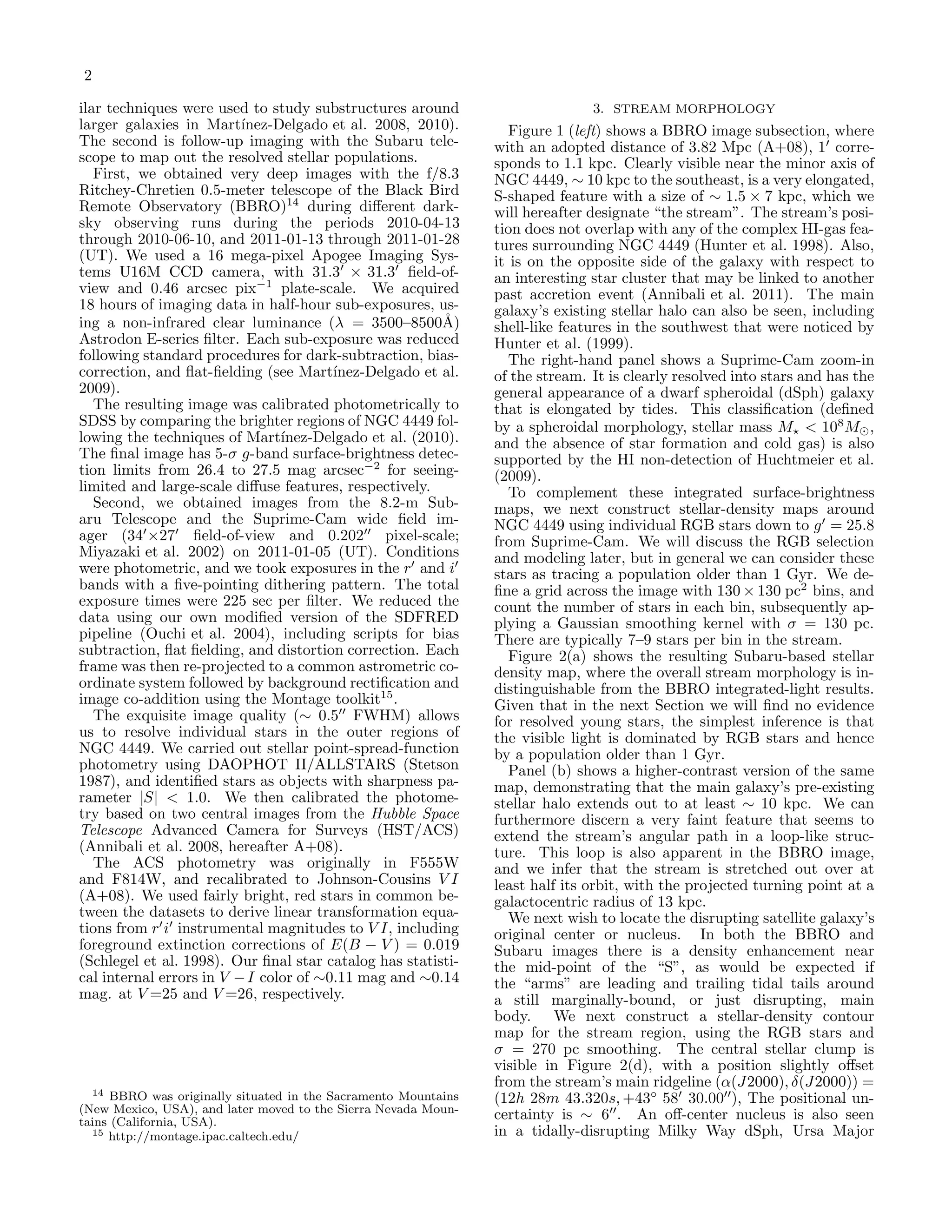
larger galaxies in Mart´  ınez-Delgado et al. 2008, 2010).         Figure 1 (left) shows a BBRO image subsection, where
The second is follow-up imaging with the Subaru tele-           with an adopted distance of 3.82 Mpc (A+08), 1′ corre-
scope to map out the resolved stellar populations.              sponds to 1.1 kpc. Clearly visible near the minor axis of
   First, we obtained very deep images with the f/8.3           NGC 4449, ∼ 10 kpc to the southeast, is a very elongated,
Ritchey-Chretien 0.5-meter telescope of the Black Bird          S-shaped feature with a size of ∼ 1.5 × 7 kpc, which we
Remote Observatory (BBRO)14 during different dark-               will hereafter designate “the stream”. The stream’s posi-
sky observing runs during the periods 2010-04-13                tion does not overlap with any of the complex HI-gas fea-
through 2010-06-10, and 2011-01-13 through 2011-01-28           tures surrounding NGC 4449 (Hunter et al. 1998). Also,
(UT). We used a 16 mega-pixel Apogee Imaging Sys-               it is on the opposite side of the galaxy with respect to
tems U16M CCD camera, with 31.3′ × 31.3′ field-of-               an interesting star cluster that may be linked to another
view and 0.46 arcsec pix−1 plate-scale. We acquired             past accretion event (Annibali et al. 2011). The main
18 hours of imaging data in half-hour sub-exposures, us-        galaxy’s existing stellar halo can also be seen, including
ing a non-infrared clear luminance (λ = 3500–8500˚)     A       shell-like features in the southwest that were noticed by
Astrodon E-series filter. Each sub-exposure was reduced          Hunter et al. (1999).
following standard procedures for dark-subtraction, bias-          The right-hand panel shows a Suprime-Cam zoom-in
correction, and flat-fielding (see Mart´  ınez-Delgado et al.     of the stream. It is clearly resolved into stars and has the
2009).                                                          general appearance of a dwarf spheroidal (dSph) galaxy
   The resulting image was calibrated photometrically to        that is elongated by tides. This classification (defined
SDSS by comparing the brighter regions of NGC 4449 fol-         by a spheroidal morphology, stellar mass M⋆ < 108 M⊙ ,
lowing the techniques of Mart´  ınez-Delgado et al. (2010).     and the absence of star formation and cold gas) is also
The final image has 5-σ g-band surface-brightness detec-         supported by the HI non-detection of Huchtmeier et al.
tion limits from 26.4 to 27.5 mag arcsec−2 for seeing-          (2009).
limited and large-scale diffuse features, respectively.             To complement these integrated surface-brightness
   Second, we obtained images from the 8.2-m Sub-               maps, we next construct stellar-density maps around
aru Telescope and the Suprime-Cam wide field im-                 NGC 4449 using individual RGB stars down to g ′ = 25.8
ager (34′ ×27′ field-of-view and 0.202′′ pixel-scale;            from Suprime-Cam. We will discuss the RGB selection
Miyazaki et al. 2002) on 2011-01-05 (UT). Conditions            and modeling later, but in general we can consider these
were photometric, and we took exposures in the r′ and i′        stars as tracing a population older than 1 Gyr. We de-
bands with a five-pointing dithering pattern. The total          fine a grid across the image with 130 × 130 pc2 bins, and
exposure times were 225 sec per filter. We reduced the           count the number of stars in each bin, subsequently ap-
data using our own modified version of the SDFRED                plying a Gaussian smoothing kernel with σ = 130 pc.
pipeline (Ouchi et al. 2004), including scripts for bias        There are typically 7–9 stars per bin in the stream.
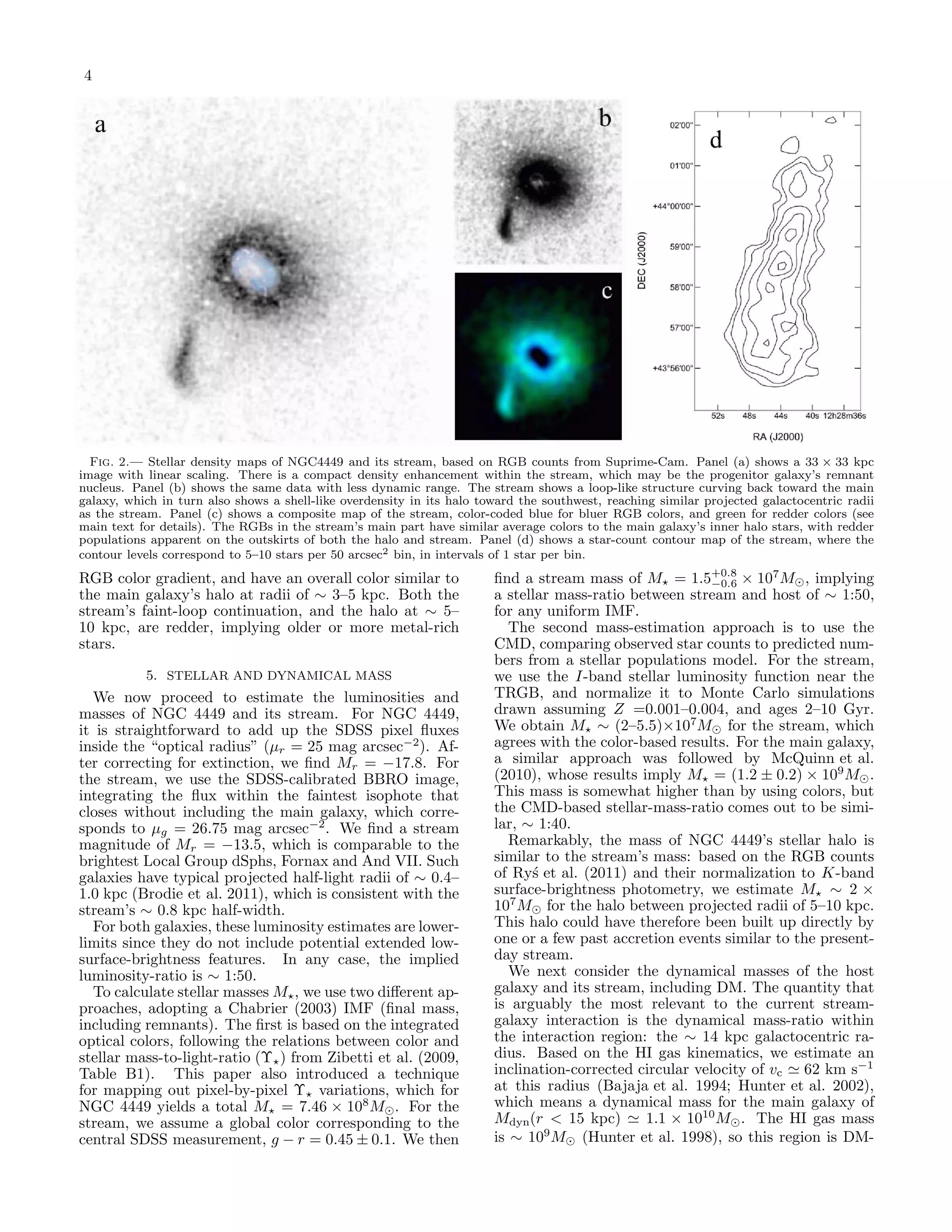
subtraction, flat fielding, and distortion correction. Each          Figure 2(a) shows the resulting Subaru-based stellar
frame was then re-projected to a common astrometric co-         density map, where the overall stream morphology is in-
ordinate system followed by background rectification and         distinguishable from the BBRO integrated-light results.
image co-addition using the Montage toolkit15 .                 Given that in the next Section we will find no evidence
   The exquisite image quality (∼ 0.5′′ FWHM) allows            for resolved young stars, the simplest inference is that
us to resolve individual stars in the outer regions of          the visible light is dominated by RGB stars and hence
NGC 4449. We carried out stellar point-spread-function          by a population older than 1 Gyr.
photometry using DAOPHOT II/ALLSTARS (Stetson                      Panel (b) shows a higher-contrast version of the same
1987), and identified stars as objects with sharpness pa-        map, demonstrating that the main galaxy’s pre-existing
rameter |S| < 1.0. We then calibrated the photome-              stellar halo extends out to at least ∼ 10 kpc. We can
try based on two central images from the Hubble Space           furthermore discern a very faint feature that seems to
Telescope Advanced Camera for Surveys (HST/ACS)                 extend the stream’s angular path in a loop-like struc-
(Annibali et al. 2008, hereafter A+08).                         ture. This loop is also apparent in the BBRO image,
   The ACS photometry was originally in F555W                   and we infer that the stream is stretched out over at
and F814W, and recalibrated to Johnson-Cousins V I              least half its orbit, with the projected turning point at a
(A+08). We used fairly bright, red stars in common be-          galactocentric radius of 13 kpc.
tween the datasets to derive linear transformation equa-           We next wish to locate the disrupting satellite galaxy’s
tions from r′ i′ instrumental magnitudes to V I, including      original center or nucleus. In both the BBRO and
foreground extinction corrections of E(B − V ) = 0.019          Subaru images there is a density enhancement near
(Schlegel et al. 1998). Our final star catalog has statisti-     the mid-point of the “S”, as would be expected if
cal internal errors in V − I color of ∼0.11 mag and ∼0.14       the “arms” are leading and trailing tidal tails around
mag. at V =25 and V =26, respectively.                          a still marginally-bound, or just disrupting, main
                                                                body. We next construct a stellar-density contour
                                                                map for the stream region, using the RGB stars and
                                                                σ = 270 pc smoothing. The central stellar clump is
                                                                visible in Figure 2(d), with a position slightly offset
                                                                from the stream’s main ridgeline (α(J2000), δ(J2000)) =
  14 BBRO was originally situated in the Sacramento Mountains
                                                                (12h 28m 43.320s, +43◦ 58′ 30.00′′), The positional un-
(New Mexico, USA), and later moved to the Sierra Nevada Moun-   certainty is ∼ 6′′ . An off-center nucleus is also seen
tains (California, USA).
  15 http://montage.ipac.caltech.edu/                           in a tidally-disrupting Milky Way dSph, Ursa Major
3


  Fig. 1.— NGC 4449 and its halo stream. Left: image from the BBRO 0.5-m telescope, showing a 21 × 27 kpc field. Right: 6 × 9.5 kpc
subsection of the Subaru/Suprime-Cam data, showing the stream resolved into stars. In both panels, shallower BBRO exposures in
red/green/blue filters are used to provide indicative colors.

(Mart´
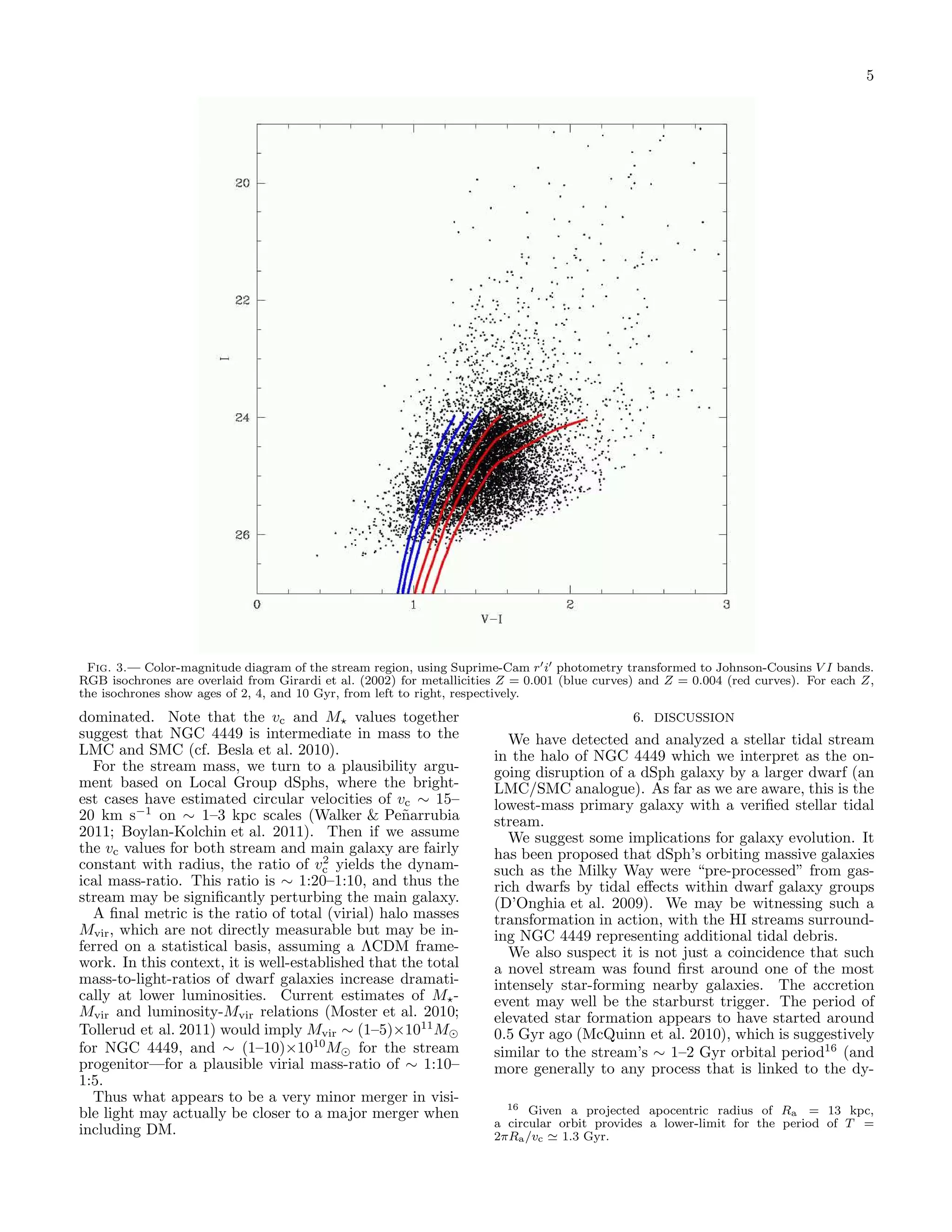
     ınez-Delgado et al. 2001).                                    both Z = 0.004 and Z = 0.001. For Z = 0.004 the 2–4
                                                                   Gyr isochrones trace the data reasonably well, while all
                4. STELLAR POPULATIONS
                                                                   Z = 0.001 models are too blue (by 0.13 mag: our sys-
  Figure 3 shows the color-magnitude diagram (CMD)                 tematic color uncertainties are 0.1 mag). Presumably
for point sources in the stream region. The RGB                    a 10 Gyr model with Z ∼ 0.002 would also be consistent
stars are the dominant feature, along with a few                   with the data, while perhaps providing a better match
brighter, redder stars that may be oxygen- or carbon-rich          to the observed CMD slope. We thus find the stream
thermally-pulsating asymptotic giant branch stars from             to have an intermediate-to-old age (∼ 2–10 Gyr) and a
an intermediate-age or old population (Marigo et al.               metallicity of [Z/H] ∼ −0.9 to −0.6.
2003). There are no blue stars evident that would trace               These results are comparable to the RGB analysis
recent star formation.                                             of the main body of NGC 4449 by A+08 (their fig-
  The detection of the tip of the RGB (TRGB) permits               ure 17; see also Ry´ et al. 2011). Therefore both the main
                                                                                       s
a distance estimate for the stream. We use the same ap-            galaxy and the stream contain similar old, intermediate-
proach described in A+08 and Cioni et al. (2000), and              metallicity populations, although the main galaxy also
find a TRGB magnitude of ITRGB = 24.06 ± 0.04 (ran-                 contains very young stars, as well as more metal-poor
dom) ±0.08 (systematic). The random error was esti-                stars as inferred from its globular clusters (Strader et al.
mated using bootstrapping techniques; the systematic               2011).
error is dominated by the magnitude transformation un-                It is outside the scope of this Letter to investigate
certainties. The main body of NGC 4449 was found by                spatial stellar population variations in the stream and
A+08 to have ITRGB = 24.00 ± 0.01 (random) ±0.04                   surrounding regions in detail, but we provide a basic
(systematic). Thus the stream is at the same distance              overview by splitting the RGBs into color-based sub-
as the main body, to within ∼ 180 kpc, and we conclude             populations, using the 4 Gyr, Z = 0.004 model as a
that there is a physical association rather than a chance          boundary. We then create stellar density maps as be-
superposition.                                                     fore, for the two subpopulations separately. Using blue
  The RGB photometry can also constrain the stream                 and green color-coding to represent the subpopulations
age and metallicity, despite some age-metallicity degen-           left and right of the model boundary, we show the results
eracy. In Figure 3 we overplot the Padua isochrones                in Figure 2(c). The stream’s bright parts have no visible
(Girardi et al. 2002) for ages of 2, 4, and 10 Gyr, for
4


  Fig. 2.— Stellar density maps of NGC4449 and its stream, based on RGB counts from Suprime-Cam. Panel (a) shows a 33 × 33 kpc
image with linear scaling. There is a compact density enhancement within the stream, which may be the progenitor galaxy’s remnant
nucleus. Panel (b) shows the same data with less dynamic range. The stream shows a loop-like structure curving back toward the main
galaxy, which in turn also shows a shell-like overdensity in its halo toward the southwest, reaching similar projected galactocentric radii
as the stream. Panel (c) shows a composite map of the stream, color-coded blue for bluer RGB colors, and green for redder colors (see
main text for details). The RGBs in the stream’s main part have similar average colors to the main galaxy’s inner halo stars, with redder
populations apparent on the outskirts of both the halo and stream. Panel (d) shows a star-count contour map of the stream, where the
contour levels correspond to 5–10 stars per 50 arcsec2 bin, in intervals of 1 star per bin.
RGB color gradient, and have an overall color similar to                find a stream mass of M⋆ = 1.5+0.8 × 10⁷ M⊙ , implying
                                                                                                          −0.6
the main galaxy’s halo at radii of ∼ 3–5 kpc. Both the                  a stellar mass-ratio between stream and host of ∼ 1:50,
stream’s faint-loop continuation, and the halo at ∼ 5–                  for any uniform IMF.
10 kpc, are redder, implying older or more metal-rich                      The second mass-estimation approach is to use the
stars.                                                                  CMD, comparing observed star counts to predicted num-
                                                                        bers from a stellar populations model. For the stream,
           5. STELLAR AND DYNAMICAL MASS                                we use the I-band stellar luminosity function near the
  We now proceed to estimate the luminosities and                       TRGB, and normalize it to Monte Carlo simulations
masses of NGC 4449 and its stream. For NGC 4449,                        drawn assuming Z =0.001–0.004, and ages 2–10 Gyr.
it is straightforward to add up the SDSS pixel fluxes                    We obtain M⋆ ∼ (2–5.5)×107M⊙ for the stream, which
inside the “optical radius” (µr = 25 mag arcsec−2). Af-                 agrees with the color-based results. For the main galaxy,
ter correcting for extinction, we find Mr = −17.8. For                   a similar approach was followed by McQuinn et al.
the stream, we use the SDSS-calibrated BBRO image,                      (2010), whose results imply M⋆ = (1.2 ± 0.2) × 109 M⊙ .
integrating the flux within the faintest isophote that                   This mass is somewhat higher than by using colors, but
closes without including the main galaxy, which corre-                  the CMD-based stellar-mass-ratio comes out to be simi-
sponds to µg = 26.75 mag arcsec−2 . We find a stream                     lar, ∼ 1:40.
magnitude of Mr = −13.5, which is comparable to the                        Remarkably, the mass of NGC 4449’s stellar halo is
brightest Local Group dSphs, Fornax and And VII. Such                   similar to the stream’s mass: based on the RGB counts
galaxies have typical projected half-light radii of ∼ 0.4–              of Ry´ et al. (2011) and their normalization to K-band
                                                                              s
1.0 kpc (Brodie et al. 2011), which is consistent with the              surface-brightness photometry, we estimate M⋆ ∼ 2 ×
stream’s ∼ 0.8 kpc half-width.                                          107 M⊙ for the halo between projected radii of 5–10 kpc.
  For both galaxies, these luminosity estimates are lower-              This halo could have therefore been built up directly by
limits since they do not include potential extended low-                one or a few past accretion events similar to the present-
surface-brightness features. In any case, the implied                   day stream.
luminosity-ratio is ∼ 1:50.                                                We next consider the dynamical masses of the host
  To calculate stellar masses M⋆ , we use two different ap-              galaxy and its stream, including DM. The quantity that
proaches, adopting a Chabrier (2003) IMF (final mass,                    is arguably the most relevant to the current stream-
including remnants). The first is based on the integrated                galaxy interaction is the dynamical mass-ratio within
optical colors, following the relations between color and               the interaction region: the ∼ 14 kpc galactocentric ra-
stellar mass-to-light-ratio (Υ⋆ ) from Zibetti et al. (2009,            dius. Based on the HI gas kinematics, we estimate an
Table B1). This paper also introduced a technique                       inclination-corrected circular velocity of vc ≃ 62 km s−1
for mapping out pixel-by-pixel Υ⋆ variations, which for                 at this radius (Bajaja et al. 1994; Hunter et al. 2002),
NGC 4449 yields a total M⋆ = 7.46 × 10⁸ M⊙ . For the                    which means a dynamical mass for the main galaxy of
stream, we assume a global color corresponding to the                   Mdyn(r < 15 kpc) ≃ 1.1 × 10¹⁰ M⊙ . The HI gas mass
central SDSS measurement, g − r = 0.45 ± 0.1. We then                   is ∼ 109 M⊙ (Hunter et al. 1998), so this region is DM-
5


 Fig. 3.— Color-magnitude diagram of the stream region, using Suprime-Cam r ′ i′ photometry transformed to Johnson-Cousins V I bands.
RGB isochrones are overlaid from Girardi et al. (2002) for metallicities Z = 0.001 (blue curves) and Z = 0.004 (red curves). For each Z,
the isochrones show ages of 2, 4, and 10 Gyr, from left to right, respectively.
dominated. Note that the vc and M⋆ values together                                            6. DISCUSSION
suggest that NGC 4449 is intermediate in mass to the                      We have detected and analyzed a stellar tidal stream
LMC and SMC (cf. Besla et al. 2010).                                   in the halo of NGC 4449 which we interpret as the on-
  For the stream mass, we turn to a plausibility argu-                 going disruption of a dSph galaxy by a larger dwarf (an
ment based on Local Group dSphs, where the bright-                     LMC/SMC analogue). As far as we are aware, this is the
est cases have estimated circular velocities of vc ∼ 15–               lowest-mass primary galaxy with a verified stellar tidal
20 km s−1 on ∼ 1–3 kpc scales (Walker & Pe˜arrubia n                   stream.
2011; Boylan-Kolchin et al. 2011). Then if we assume                      We suggest some implications for galaxy evolution. It
the vc values for both stream and main galaxy are fairly               has been proposed that dSph’s orbiting massive galaxies
                                       2
constant with radius, the ratio of vc yields the dynam-                such as the Milky Way were “pre-processed” from gas-
ical mass-ratio. This ratio is ∼ 1:20–1:10, and thus the               rich dwarfs by tidal effects within dwarf galaxy groups
stream may be significantly perturbing the main galaxy.                 (D’Onghia et al. 2009). We may be witnessing such a
  A final metric is the ratio of total (virial) halo masses             transformation in action, with the HI streams surround-
Mvir , which are not directly measurable but may be in-                ing NGC 4449 representing additional tidal debris.
ferred on a statistical basis, assuming a ΛCDM frame-                     We also suspect it is not just a coincidence that such
work. In this context, it is well-established that the total           a novel stream was found first around one of the most
mass-to-light-ratios of dwarf galaxies increase dramati-               intensely star-forming nearby galaxies. The accretion
cally at lower luminosities. Current estimates of M⋆ -                 event may well be the starburst trigger. The period of
Mvir and luminosity-Mvir relations (Moster et al. 2010;                elevated star formation appears to have started around
Tollerud et al. 2011) would imply Mvir ∼ (1–5)×1011 M⊙                 0.5 Gyr ago (McQuinn et al. 2010), which is suggestively
for NGC 4449, and ∼ (1–10)×1010M⊙ for the stream                       similar to the stream’s ∼ 1–2 Gyr orbital period16 (and
progenitor—for a plausible virial mass-ratio of ∼ 1:10–                more generally to any process that is linked to the dy-
1:5.
  Thus what appears to be a very minor merger in visi-
                                                                         16 Given a projected apocentric radius of R
ble light may actually be closer to a major merger when                                                                 a = 13 kpc,
                                                                       a circular orbit provides a lower-limit for the period of T =
including DM.                                                          2πRa /vc ≃ 1.3 Gyr.
6

namical time on ∼ 30 kpc scales).                                     as dSphs would have been missed.
  One would now like to know how frequent such ac-                      Regardless of the implications for starbursts, dSph ac-
cretion events are among other dwarf galaxies in recent               cretion appears to be an increasingly viable avenue for
epochs. We suspect that exact analogues to this stream                direct assembly of dwarf galaxies’ stellar halos—as wit-
are not very common, or they would have been noticed                  nessed by NGC 4449, and by Fornax, which shows traces
already in DSS/SDSS images. However, if the stream                    of swallowing an even smaller dSph (Coleman et al.
had been only a bit fainter, more diffuse, or at a larger              2005). Future observational determinations of dwarf
radius, it could have been missed, and thus there may be              stream frequency in combination with theoretical models
many more dwarf-hosted stellar streams awaiting detec-                may provide clues to the general substructure problem.
tion.
  In theory, the history of DM halo assembly should be
fairly scale-free, and ∼ 1:10 mergers are expected to be                We thank Jay Strader for a preview of his paper and
the most generally dominant contributors to mass growth               Monica Tosi for comments. Based on data collected at
(Stewart et al. 2008). It is also increasingly recognized             Subaru Telescope (operated by the National Astronomi-
that such relatively minor mergers can have important                 cal Observatory of Japan), via Gemini Observatory time
effects on the larger galaxies, such as inciting global disk           exchange (GN-2010B-C-204). FA received partial finan-
instabilities (Purcell et al. 2011).                                  cial support from ASI, through contracts COFIS ASI-
  If streams as in NGC 4449 are common in dwarfs, they                INAF I/016/07/0 and I/009/10/0. The Dark Cosmology
re-ignite classic ideas about galaxy interactions trigger-            Centre is funded by the Danish National Research Foun-
ing starbursts. Given the high rates of star formation in             dation. Work supported by the National Science Founda-
dwarf galaxies, it is natural to ask if satellites are respon-        tion (Grants AST-0808099, AST-0909237, AST-1109878,
sible. Surveys along these lines have produced mixed                  Graduate Research Fellowship), by NASA/Spitzer grant
results (Noeske et al. 2001; Brosch et al. 2004; Li et al.            JPL-1310512, and by the UCSC-UARC Aligned Re-
2008), but until now, low-surface-brightness objects such             search Program.
                                                              REFERENCES
Abazajian, K. N., Adelman-McCarthy, J. K., Ag¨eros, M. A., et
                                                    u                 Lovell, M., Eke, V., Frenk, C., et al. 2011, MNRAS, submitted,
  al. 2009, ApJS, 182, 543                                              arXiv:1104.2929
Annibali, F., Aloisi, A., Mack, J., Tosi, M., van der Marel, R. P.,   Marigo, P., Girardi, L., & Chiosi, C. 2003, 403, 225
  Angeretti, L., Leitherer, C., & Sirianni, M. 2008, AJ, 135, 1900    Mart´ ınez-Delgado, D., Alonso-Garc´ J., Aparicio, A., &
                                                                                                           ıa,
  (A+08)                                                                G´mez-Flechoso, M. A. 2001, ApJ, 549, L63
                                                                           o
Annibali, F., Tosi, M., Aloisi, A., van der Marel, R. P., &           Mart´ ınez-Delgado, D., Pe˜arrubia, J., Gabany, R.J., Trujillo, I.,
                                                                                                 n
  Martinez-Delgado, D. 2011, ApJL, in press, arXiv:1111.5861            Majewski, S.R., & Pohlen, M. 2008, ApJ, 689, 184
Arp, H. 1966, ApJS, 14, 1                                             Mart´ ınez-Delgado, D., Pohlen, M., Gabany, R. J., et al. 2009,
Bajaja, E., Huchtmeier, W. K., & Klein, U. 1994, A&A, 285, 385          ApJ, 692, 955
Besla, G., Kallivayalil, N., Hernquist, L., van der Marel, R. P.,     Mart´ ınez-Delgado, D., Gabany, R. J., Crawford, K., et al. 2010,
  Cox, T. J., Keres, D. 2010, ApJ, 721, L97                             AJ, 140, 962
Boylan-Kolchin, M., Bullock, J. S., & Kaplinghat, M. 2011,            McConnachie, A. W., Irwin, M. J., Ibata, R. A., et al. 2009,
  MNRAS, submitted, arXiv:1111.2048                                     Nature, 461, 66
Brodie, J. P., Romanowsky, A. J., Strader, J., & Forbes, D. A.        McQuinn, K. B. W., et al. 2010, ApJ, 724, 49
  2011, AJ, 142, 199                                                  Miyazaki, S., et al. 2002, PASJ, 54, 833
Brosch, N., Almoznino, E., & Heller, A. B. 2004, MNRAS, 349,          Mo, H., van den Bosch, F. C., & White, S. 2010, Galaxy
  357                                                                   Formation and Evolution. Cambridge University Press,
Chabrier G., 2003, PASP, 115, 763                                       2010. ISBN: 9780521857932,
Cioni, M.-R. L., van der Marel, R. P., Loup, C. & Habing, H. J.       Moster, B. P., Somerville, R. S., Maulbetsch, C., et al. 2010, ApJ,
  2000, A&A, 359, 601                                                   710, 903
Coleman, M. G., Da Costa, G. S., Bland-Hawthorn, J., &                Noeske, K. G., Iglesias-P´ramo, J., V´
                                                                                                a            ılchez, J. M., Papaderos, P.,
  Freeman, K. C. 2005, AJ, 129, 1443                                    & Fricke, K. J. 2001, A&A, 371, 806
Cooper, A. P., Cole, S., Frenk, C. S., et al. 2010, MNRAS, 406,       Ouchi, M., et al. 2004, ApJ, 611, 660
  744                                                                 Purcell, C. W., Bullock, J. S., & Zentner, A. R. 2007, ApJ, 666, 20
D’Onghia, E., Besla, G., Cox, T. J., & Hernquist, L. 2009,            Purcell, C. W., Bullock, J. S., Tollerud, E. J., Rocha, M., &
  Nature, 460, 605                                                      Chakrabarti, S. 2011, Nature, 477, 301
Ferrero, I., Abadi, M. G., Navarro, J. F., Sales, L. V., &            Ry´, A., Grocholski, A. J., van der Marel, R. P., Aloisi, A., &
                                                                         s
  Gurovich, S. 2012, MNRAS, submitted, arXiv:1111.6609                  Annibali, F. 2011, A&A, 530, A23
Girardi, L., Bertelli, G., Bressan, A., Chiosi, C., Groenewegen, M.   Schweizer, F., & Seitzer, P. 1988, ApJ, 328, 88
  A. T., Marigo, P., Salasnich, B., & Weiss, A. 2002, A&A, 391,       Schlegel, D. J., Finkbeiner, D. P., & Davis, M. 1998, ApJ, 500,
  195                                                                   525
Hartmann, L. W., Geller, M. J., & Huchra, J. P. 1986, AJ, 92,         Stetson, P. B. 1987, PASP, 99, 191
  1278                                                                Stewart, K. R., Bullock, J. S., Wechsler, R. H., Maller, A. H., &
Huchtmeier, W. K., Karachentsev, I. D., & Karachentseva, V. E.          Zentner, A. R. 2008, ApJ, 683, 597
  2009, A&A, 506, 677                                                 Stinson, G. S., Dalcanton, J. J., Quinn, T., et al. 2009, MNRAS,
Hunter, D. A., Wilcots, E. M., van Woerden, H., Gallagher, J. S.,       395, 1455
  & Kohle, S. 1998, ApJ, 495, L47                                     Strader, J., Seth, A. C., & Caldwell, N. 2011, submitted
Hunter, D. A., van Woerden, H., & Gallagher, J. S. 1999, AJ,          Tollerud, E. J., Bullock, J. S., Graves, G. J., & Wolf, J. 2011,
  118, 2184                                                             ApJ, 726, 108
Hunter, D. A., Rubin, V. C., Swaters, R. A., Sparke, L. S., &         Tolstoy, E., Hill, V., & Tosi, M. 2009, ARA&A, 47, 371
  Levine, S. E. 2002, ApJ, 580, 194                                   Walker, M. G., & Pe˜arrubia, J. 2011, ApJ, 742, 20
                                                                                             n
Karachentsev, I. D., Karachentseva, V. E., & Huchtmeier, W. K.        Weisz, D. R., Dalcanton, J. J., Williams, B. F., et al. 2011, ApJ,
  2007, Astronomy Letters, 33, 512                                      739, 5
Li, C., Kauffmann, G., Heckman, T. M., Jing, Y. P., & White,           Zibetti S., Charlot S., Rix H., 2009, MNRAS, 400, 1181
  S. D. M. 2008, MNRAS, 385, 1903

Dwarfs gobbling dwarfs

  • 1.
    Draft version December12, 2011 Preprint typeset using L TEX style emulateapj v. 5/2/11 A DWARFS GOBBLING DWARFS: A STELLAR TIDAL STREAM AROUND NGC 4449 AND HIERARCHICAL GALAXY FORMATION ON SMALL SCALES David Mart´ ınez-Delgado1,13 , Aaron J. Romanowsky2 , R. Jay Gabany3 , Francesca Annibali4 , Jacob A. Arnold2 , ¨ rgen Fliri5,6 , Stefano Zibetti7 , Roeland P. van der Marel8 , Hans-Walter Rix1 , Taylor S. Chonis9 , Julio A. Ju Carballo-Bello10 , Alessandra Aloisi8 , Andrea V. Maccio1 , J. Gallego-Laborda11 , Jean P. Brodie2 , Michael R. ` Merrifield12 (Received; Accepted) Draft version December 12, 2011 arXiv:1112.2154v1 [astro-ph.CO] 9 Dec 2011 ABSTRACT We map and analyze a stellar stream in the halo of the nearby dwarf starburst galaxy NGC 4449, detecting it in deep integrated-light images using the Black Bird Observatory 0.5-meter telescope, and resolving it into red giant branch stars using Subaru/Suprime-Cam. The properties of the stream imply a massive dwarf spheroidal progenitor, which will continue to disrupt and deposit an amount of stellar mass that is comparable to the existing stellar halo of the main galaxy. The ratio between luminosity or stellar-mass between the two galaxies is ∼ 1:50, while the dynamical mass-ratio when including dark matter may be ∼ 1:10–1:5. This system may thus represent a “stealth” merger, where an infalling satellite galaxy is nearly undetectable by conventional means, yet has a substantial dynamical influence on its host galaxy. This singular discovery also suggests that satellite accretion can play a significant role in building up the stellar halos of low-mass galaxies, and possibly in triggering their starbursts. 1. INTRODUCTION Boylan-Kolchin et al. 2011; Ferrero et al. 2011). A fundamental characteristic of the modern cold dark To date there has been relatively little work on sub- matter (ΛCDM) cosmological paradigm (Mo et al. 2010) structure and merging in the halos around low-mass, is that galaxies undergo hierarchical assembly under “dwarf” galaxies. Many cases of extended stellar halos the influence of gravity, continually accreting smaller around dwarfs have been identified observationally (see DM halos up until the present day. If those ha- review in Stinson et al. 2009), but it is not clear if these los contain stars, then they will be visible as satel- stars were accreted, or formed in situ. Star formation in lites around their host galaxies, eventually disrupting dwarf galaxies is thought to occur in stochastic episodes through tidal forces into distinct streams and shells be- (Tolstoy et al. 2009; Weisz et al. 2011), which could in fore phase-mixing into obscurity (Cooper et al. 2010). principle be triggered by accretion events. This picture seems to explain the existence of satel- An iconic galaxy in this context is NGC 4449, a dwarf lites and substructures around massive galaxies in the irregular in the field that has been studied intensively as nearby Universe (Arp 1966; Schweizer & Seitzer 1988; one of the strongest galaxy-wide starbursts in the nearby McConnachie et al. 2009; Mart´ ınez-Delgado et al. 2010). Universe. Its absolute magnitude of MV = −18.6 makes However, a quantitative confirmation of this aspect of it an LMC-analogue (and not formally a dwarf by some ΛCDM has been more elusive, while there are some definitions), except that its star formation rate is ∼ 10 lingering doubts about the consonance with ΛCDM of times higher. It is strongly suspected to have recently small-scale substructure observations (Lovell et al. 2011; interacted with another galaxy based on various signa- tures including peculiar kinematics in its cold gas and 1 Max-Planck-Institut fur Astronomy, Heidelberg, Germany HII regions (Hartmann et al. 1986; Hunter et al. 1998), 2 University of California Observatories, Santa Cruz, CA but the nature of this interaction is unknown. 95064, USA An elongated dwarf galaxy or stream candidate near 3 Black Bird Observatory, Mayhill, New Mexico, USA 4 Osservatorio Astronomico di Bologna, INAF, Via Ranzani 1, NGC 4449 was first noticed by Karachentsev et al. I-40127 Bologna, Italy (2007) based on Digitized Sky Survey (POSS-II) plates 5 LERMA, CNRS UMR 8112, Observatoire de Paris, 61 Av- (object d1228+4358), which is also visible in archival enue de l’Observatoire, 75014 Paris, France images from the Sloan Digital Sky Survey (SDSS; 6 GEPI, CNRS UMR 8111, Observatoire de Paris, 5 Place Jules Janssen, 92195 Meudon, France Abazajian et al. 2009). Here we present deep, wide-field 7 Dark Cosmology Centre, Niels Bohr Institute - University optical imaging that supplies the definitive detection of of Copenhagen, Juliane Maries Vej 30, DK-2100 Copenhagen, this ongoing accretion event involving a smaller galaxy, Denmark leading to interesting implications about the evolution of 8 Space Telescope Science Institute, 3700 San Martin Drive, Baltimore, MD 21218 this system and of dwarf galaxies in general. 9 Department of Astronomy, University of Texas at Austin, Texas, USA 2. OBSERVATIONS AND DATA REDUCTION 10 Instituto de Astrofisica de Canarias, Tenerife, Spain 11 Fosca Nit Observatory, Montsec Astronomical Park, Ager, Our observations of NGC 4449 and its surroundings Spain consist of two main components. The first is imaging 12 School of Physics and Astronomy, University of Notting- from a small robotic telescope to confirm the presence ham, University Park, Nottingham NG7 2RD, England of a low-surface-brightness substructure in the halo of 13 Alexander von Humboldt Fellow for Advanced Research NGC 4449 and to provide its basic characteristics (sim-
  • 2.
    2 ilar techniques wereused to study substructures around 3. STREAM MORPHOLOGY larger galaxies in Mart´ ınez-Delgado et al. 2008, 2010). Figure 1 (left) shows a BBRO image subsection, where The second is follow-up imaging with the Subaru tele- with an adopted distance of 3.82 Mpc (A+08), 1′ corre- scope to map out the resolved stellar populations. sponds to 1.1 kpc. Clearly visible near the minor axis of First, we obtained very deep images with the f/8.3 NGC 4449, ∼ 10 kpc to the southeast, is a very elongated, Ritchey-Chretien 0.5-meter telescope of the Black Bird S-shaped feature with a size of ∼ 1.5 × 7 kpc, which we Remote Observatory (BBRO)14 during different dark- will hereafter designate “the stream”. The stream’s posi- sky observing runs during the periods 2010-04-13 tion does not overlap with any of the complex HI-gas fea- through 2010-06-10, and 2011-01-13 through 2011-01-28 tures surrounding NGC 4449 (Hunter et al. 1998). Also, (UT). We used a 16 mega-pixel Apogee Imaging Sys- it is on the opposite side of the galaxy with respect to tems U16M CCD camera, with 31.3′ × 31.3′ field-of- an interesting star cluster that may be linked to another view and 0.46 arcsec pix−1 plate-scale. We acquired past accretion event (Annibali et al. 2011). The main 18 hours of imaging data in half-hour sub-exposures, us- galaxy’s existing stellar halo can also be seen, including ing a non-infrared clear luminance (λ = 3500–8500˚) A shell-like features in the southwest that were noticed by Astrodon E-series filter. Each sub-exposure was reduced Hunter et al. (1999). following standard procedures for dark-subtraction, bias- The right-hand panel shows a Suprime-Cam zoom-in correction, and flat-fielding (see Mart´ ınez-Delgado et al. of the stream. It is clearly resolved into stars and has the 2009). general appearance of a dwarf spheroidal (dSph) galaxy The resulting image was calibrated photometrically to that is elongated by tides. This classification (defined SDSS by comparing the brighter regions of NGC 4449 fol- by a spheroidal morphology, stellar mass M⋆ < 108 M⊙ , lowing the techniques of Mart´ ınez-Delgado et al. (2010). and the absence of star formation and cold gas) is also The final image has 5-σ g-band surface-brightness detec- supported by the HI non-detection of Huchtmeier et al. tion limits from 26.4 to 27.5 mag arcsec−2 for seeing- (2009). limited and large-scale diffuse features, respectively. To complement these integrated surface-brightness Second, we obtained images from the 8.2-m Sub- maps, we next construct stellar-density maps around aru Telescope and the Suprime-Cam wide field im- NGC 4449 using individual RGB stars down to g ′ = 25.8 ager (34′ ×27′ field-of-view and 0.202′′ pixel-scale; from Suprime-Cam. We will discuss the RGB selection Miyazaki et al. 2002) on 2011-01-05 (UT). Conditions and modeling later, but in general we can consider these were photometric, and we took exposures in the r′ and i′ stars as tracing a population older than 1 Gyr. We de- bands with a five-pointing dithering pattern. The total fine a grid across the image with 130 × 130 pc2 bins, and exposure times were 225 sec per filter. We reduced the count the number of stars in each bin, subsequently ap- data using our own modified version of the SDFRED plying a Gaussian smoothing kernel with σ = 130 pc. pipeline (Ouchi et al. 2004), including scripts for bias There are typically 7–9 stars per bin in the stream. subtraction, flat fielding, and distortion correction. Each Figure 2(a) shows the resulting Subaru-based stellar frame was then re-projected to a common astrometric co- density map, where the overall stream morphology is in- ordinate system followed by background rectification and distinguishable from the BBRO integrated-light results. image co-addition using the Montage toolkit15 . Given that in the next Section we will find no evidence The exquisite image quality (∼ 0.5′′ FWHM) allows for resolved young stars, the simplest inference is that us to resolve individual stars in the outer regions of the visible light is dominated by RGB stars and hence NGC 4449. We carried out stellar point-spread-function by a population older than 1 Gyr. photometry using DAOPHOT II/ALLSTARS (Stetson Panel (b) shows a higher-contrast version of the same 1987), and identified stars as objects with sharpness pa- map, demonstrating that the main galaxy’s pre-existing rameter |S| < 1.0. We then calibrated the photome- stellar halo extends out to at least ∼ 10 kpc. We can try based on two central images from the Hubble Space furthermore discern a very faint feature that seems to Telescope Advanced Camera for Surveys (HST/ACS) extend the stream’s angular path in a loop-like struc- (Annibali et al. 2008, hereafter A+08). ture. This loop is also apparent in the BBRO image, The ACS photometry was originally in F555W and we infer that the stream is stretched out over at and F814W, and recalibrated to Johnson-Cousins V I least half its orbit, with the projected turning point at a (A+08). We used fairly bright, red stars in common be- galactocentric radius of 13 kpc. tween the datasets to derive linear transformation equa- We next wish to locate the disrupting satellite galaxy’s tions from r′ i′ instrumental magnitudes to V I, including original center or nucleus. In both the BBRO and foreground extinction corrections of E(B − V ) = 0.019 Subaru images there is a density enhancement near (Schlegel et al. 1998). Our final star catalog has statisti- the mid-point of the “S”, as would be expected if cal internal errors in V − I color of ∼0.11 mag and ∼0.14 the “arms” are leading and trailing tidal tails around mag. at V =25 and V =26, respectively. a still marginally-bound, or just disrupting, main body. We next construct a stellar-density contour map for the stream region, using the RGB stars and σ = 270 pc smoothing. The central stellar clump is visible in Figure 2(d), with a position slightly offset from the stream’s main ridgeline (α(J2000), δ(J2000)) = 14 BBRO was originally situated in the Sacramento Mountains (12h 28m 43.320s, +43◦ 58′ 30.00′′), The positional un- (New Mexico, USA), and later moved to the Sierra Nevada Moun- certainty is ∼ 6′′ . An off-center nucleus is also seen tains (California, USA). 15 http://montage.ipac.caltech.edu/ in a tidally-disrupting Milky Way dSph, Ursa Major
  • 3.
    3 Fig.1.— NGC 4449 and its halo stream. Left: image from the BBRO 0.5-m telescope, showing a 21 × 27 kpc field. Right: 6 × 9.5 kpc subsection of the Subaru/Suprime-Cam data, showing the stream resolved into stars. In both panels, shallower BBRO exposures in red/green/blue filters are used to provide indicative colors. (Mart´ ınez-Delgado et al. 2001). both Z = 0.004 and Z = 0.001. For Z = 0.004 the 2–4 Gyr isochrones trace the data reasonably well, while all 4. STELLAR POPULATIONS Z = 0.001 models are too blue (by 0.13 mag: our sys- Figure 3 shows the color-magnitude diagram (CMD) tematic color uncertainties are 0.1 mag). Presumably for point sources in the stream region. The RGB a 10 Gyr model with Z ∼ 0.002 would also be consistent stars are the dominant feature, along with a few with the data, while perhaps providing a better match brighter, redder stars that may be oxygen- or carbon-rich to the observed CMD slope. We thus find the stream thermally-pulsating asymptotic giant branch stars from to have an intermediate-to-old age (∼ 2–10 Gyr) and a an intermediate-age or old population (Marigo et al. metallicity of [Z/H] ∼ −0.9 to −0.6. 2003). There are no blue stars evident that would trace These results are comparable to the RGB analysis recent star formation. of the main body of NGC 4449 by A+08 (their fig- The detection of the tip of the RGB (TRGB) permits ure 17; see also Ry´ et al. 2011). Therefore both the main s a distance estimate for the stream. We use the same ap- galaxy and the stream contain similar old, intermediate- proach described in A+08 and Cioni et al. (2000), and metallicity populations, although the main galaxy also find a TRGB magnitude of ITRGB = 24.06 ± 0.04 (ran- contains very young stars, as well as more metal-poor dom) ±0.08 (systematic). The random error was esti- stars as inferred from its globular clusters (Strader et al. mated using bootstrapping techniques; the systematic 2011). error is dominated by the magnitude transformation un- It is outside the scope of this Letter to investigate certainties. The main body of NGC 4449 was found by spatial stellar population variations in the stream and A+08 to have ITRGB = 24.00 ± 0.01 (random) ±0.04 surrounding regions in detail, but we provide a basic (systematic). Thus the stream is at the same distance overview by splitting the RGBs into color-based sub- as the main body, to within ∼ 180 kpc, and we conclude populations, using the 4 Gyr, Z = 0.004 model as a that there is a physical association rather than a chance boundary. We then create stellar density maps as be- superposition. fore, for the two subpopulations separately. Using blue The RGB photometry can also constrain the stream and green color-coding to represent the subpopulations age and metallicity, despite some age-metallicity degen- left and right of the model boundary, we show the results eracy. In Figure 3 we overplot the Padua isochrones in Figure 2(c). The stream’s bright parts have no visible (Girardi et al. 2002) for ages of 2, 4, and 10 Gyr, for
  • 4.
    4 Fig.2.— Stellar density maps of NGC4449 and its stream, based on RGB counts from Suprime-Cam. Panel (a) shows a 33 × 33 kpc image with linear scaling. There is a compact density enhancement within the stream, which may be the progenitor galaxy’s remnant nucleus. Panel (b) shows the same data with less dynamic range. The stream shows a loop-like structure curving back toward the main galaxy, which in turn also shows a shell-like overdensity in its halo toward the southwest, reaching similar projected galactocentric radii as the stream. Panel (c) shows a composite map of the stream, color-coded blue for bluer RGB colors, and green for redder colors (see main text for details). The RGBs in the stream’s main part have similar average colors to the main galaxy’s inner halo stars, with redder populations apparent on the outskirts of both the halo and stream. Panel (d) shows a star-count contour map of the stream, where the contour levels correspond to 5–10 stars per 50 arcsec2 bin, in intervals of 1 star per bin. RGB color gradient, and have an overall color similar to find a stream mass of M⋆ = 1.5+0.8 × 10⁷ M⊙ , implying −0.6 the main galaxy’s halo at radii of ∼ 3–5 kpc. Both the a stellar mass-ratio between stream and host of ∼ 1:50, stream’s faint-loop continuation, and the halo at ∼ 5– for any uniform IMF. 10 kpc, are redder, implying older or more metal-rich The second mass-estimation approach is to use the stars. CMD, comparing observed star counts to predicted num- bers from a stellar populations model. For the stream, 5. STELLAR AND DYNAMICAL MASS we use the I-band stellar luminosity function near the We now proceed to estimate the luminosities and TRGB, and normalize it to Monte Carlo simulations masses of NGC 4449 and its stream. For NGC 4449, drawn assuming Z =0.001–0.004, and ages 2–10 Gyr. it is straightforward to add up the SDSS pixel fluxes We obtain M⋆ ∼ (2–5.5)×107M⊙ for the stream, which inside the “optical radius” (µr = 25 mag arcsec−2). Af- agrees with the color-based results. For the main galaxy, ter correcting for extinction, we find Mr = −17.8. For a similar approach was followed by McQuinn et al. the stream, we use the SDSS-calibrated BBRO image, (2010), whose results imply M⋆ = (1.2 ± 0.2) × 109 M⊙ . integrating the flux within the faintest isophote that This mass is somewhat higher than by using colors, but closes without including the main galaxy, which corre- the CMD-based stellar-mass-ratio comes out to be simi- sponds to µg = 26.75 mag arcsec−2 . We find a stream lar, ∼ 1:40. magnitude of Mr = −13.5, which is comparable to the Remarkably, the mass of NGC 4449’s stellar halo is brightest Local Group dSphs, Fornax and And VII. Such similar to the stream’s mass: based on the RGB counts galaxies have typical projected half-light radii of ∼ 0.4– of Ry´ et al. (2011) and their normalization to K-band s 1.0 kpc (Brodie et al. 2011), which is consistent with the surface-brightness photometry, we estimate M⋆ ∼ 2 × stream’s ∼ 0.8 kpc half-width. 107 M⊙ for the halo between projected radii of 5–10 kpc. For both galaxies, these luminosity estimates are lower- This halo could have therefore been built up directly by limits since they do not include potential extended low- one or a few past accretion events similar to the present- surface-brightness features. In any case, the implied day stream. luminosity-ratio is ∼ 1:50. We next consider the dynamical masses of the host To calculate stellar masses M⋆ , we use two different ap- galaxy and its stream, including DM. The quantity that proaches, adopting a Chabrier (2003) IMF (final mass, is arguably the most relevant to the current stream- including remnants). The first is based on the integrated galaxy interaction is the dynamical mass-ratio within optical colors, following the relations between color and the interaction region: the ∼ 14 kpc galactocentric ra- stellar mass-to-light-ratio (Υ⋆ ) from Zibetti et al. (2009, dius. Based on the HI gas kinematics, we estimate an Table B1). This paper also introduced a technique inclination-corrected circular velocity of vc ≃ 62 km s−1 for mapping out pixel-by-pixel Υ⋆ variations, which for at this radius (Bajaja et al. 1994; Hunter et al. 2002), NGC 4449 yields a total M⋆ = 7.46 × 10⁸ M⊙ . For the which means a dynamical mass for the main galaxy of stream, we assume a global color corresponding to the Mdyn(r < 15 kpc) ≃ 1.1 × 10¹⁰ M⊙ . The HI gas mass central SDSS measurement, g − r = 0.45 ± 0.1. We then is ∼ 109 M⊙ (Hunter et al. 1998), so this region is DM-
  • 5.
    5 Fig. 3.—Color-magnitude diagram of the stream region, using Suprime-Cam r ′ i′ photometry transformed to Johnson-Cousins V I bands. RGB isochrones are overlaid from Girardi et al. (2002) for metallicities Z = 0.001 (blue curves) and Z = 0.004 (red curves). For each Z, the isochrones show ages of 2, 4, and 10 Gyr, from left to right, respectively. dominated. Note that the vc and M⋆ values together 6. DISCUSSION suggest that NGC 4449 is intermediate in mass to the We have detected and analyzed a stellar tidal stream LMC and SMC (cf. Besla et al. 2010). in the halo of NGC 4449 which we interpret as the on- For the stream mass, we turn to a plausibility argu- going disruption of a dSph galaxy by a larger dwarf (an ment based on Local Group dSphs, where the bright- LMC/SMC analogue). As far as we are aware, this is the est cases have estimated circular velocities of vc ∼ 15– lowest-mass primary galaxy with a verified stellar tidal 20 km s−1 on ∼ 1–3 kpc scales (Walker & Pe˜arrubia n stream. 2011; Boylan-Kolchin et al. 2011). Then if we assume We suggest some implications for galaxy evolution. It the vc values for both stream and main galaxy are fairly has been proposed that dSph’s orbiting massive galaxies 2 constant with radius, the ratio of vc yields the dynam- such as the Milky Way were “pre-processed” from gas- ical mass-ratio. This ratio is ∼ 1:20–1:10, and thus the rich dwarfs by tidal effects within dwarf galaxy groups stream may be significantly perturbing the main galaxy. (D’Onghia et al. 2009). We may be witnessing such a A final metric is the ratio of total (virial) halo masses transformation in action, with the HI streams surround- Mvir , which are not directly measurable but may be in- ing NGC 4449 representing additional tidal debris. ferred on a statistical basis, assuming a ΛCDM frame- We also suspect it is not just a coincidence that such work. In this context, it is well-established that the total a novel stream was found first around one of the most mass-to-light-ratios of dwarf galaxies increase dramati- intensely star-forming nearby galaxies. The accretion cally at lower luminosities. Current estimates of M⋆ - event may well be the starburst trigger. The period of Mvir and luminosity-Mvir relations (Moster et al. 2010; elevated star formation appears to have started around Tollerud et al. 2011) would imply Mvir ∼ (1–5)×1011 M⊙ 0.5 Gyr ago (McQuinn et al. 2010), which is suggestively for NGC 4449, and ∼ (1–10)×1010M⊙ for the stream similar to the stream’s ∼ 1–2 Gyr orbital period16 (and progenitor—for a plausible virial mass-ratio of ∼ 1:10– more generally to any process that is linked to the dy- 1:5. Thus what appears to be a very minor merger in visi- 16 Given a projected apocentric radius of R ble light may actually be closer to a major merger when a = 13 kpc, a circular orbit provides a lower-limit for the period of T = including DM. 2πRa /vc ≃ 1.3 Gyr.
  • 6.
    6 namical time on∼ 30 kpc scales). as dSphs would have been missed. One would now like to know how frequent such ac- Regardless of the implications for starbursts, dSph ac- cretion events are among other dwarf galaxies in recent cretion appears to be an increasingly viable avenue for epochs. We suspect that exact analogues to this stream direct assembly of dwarf galaxies’ stellar halos—as wit- are not very common, or they would have been noticed nessed by NGC 4449, and by Fornax, which shows traces already in DSS/SDSS images. However, if the stream of swallowing an even smaller dSph (Coleman et al. had been only a bit fainter, more diffuse, or at a larger 2005). Future observational determinations of dwarf radius, it could have been missed, and thus there may be stream frequency in combination with theoretical models many more dwarf-hosted stellar streams awaiting detec- may provide clues to the general substructure problem. tion. In theory, the history of DM halo assembly should be fairly scale-free, and ∼ 1:10 mergers are expected to be We thank Jay Strader for a preview of his paper and the most generally dominant contributors to mass growth Monica Tosi for comments. Based on data collected at (Stewart et al. 2008). It is also increasingly recognized Subaru Telescope (operated by the National Astronomi- that such relatively minor mergers can have important cal Observatory of Japan), via Gemini Observatory time effects on the larger galaxies, such as inciting global disk exchange (GN-2010B-C-204). FA received partial finan- instabilities (Purcell et al. 2011). cial support from ASI, through contracts COFIS ASI- If streams as in NGC 4449 are common in dwarfs, they INAF I/016/07/0 and I/009/10/0. The Dark Cosmology re-ignite classic ideas about galaxy interactions trigger- Centre is funded by the Danish National Research Foun- ing starbursts. Given the high rates of star formation in dation. Work supported by the National Science Founda- dwarf galaxies, it is natural to ask if satellites are respon- tion (Grants AST-0808099, AST-0909237, AST-1109878, sible. Surveys along these lines have produced mixed Graduate Research Fellowship), by NASA/Spitzer grant results (Noeske et al. 2001; Brosch et al. 2004; Li et al. JPL-1310512, and by the UCSC-UARC Aligned Re- 2008), but until now, low-surface-brightness objects such search Program. REFERENCES Abazajian, K. N., Adelman-McCarthy, J. K., Ag¨eros, M. A., et u Lovell, M., Eke, V., Frenk, C., et al. 2011, MNRAS, submitted, al. 2009, ApJS, 182, 543 arXiv:1104.2929 Annibali, F., Aloisi, A., Mack, J., Tosi, M., van der Marel, R. P., Marigo, P., Girardi, L., & Chiosi, C. 2003, 403, 225 Angeretti, L., Leitherer, C., & Sirianni, M. 2008, AJ, 135, 1900 Mart´ ınez-Delgado, D., Alonso-Garc´ J., Aparicio, A., & ıa, (A+08) G´mez-Flechoso, M. A. 2001, ApJ, 549, L63 o Annibali, F., Tosi, M., Aloisi, A., van der Marel, R. P., & Mart´ ınez-Delgado, D., Pe˜arrubia, J., Gabany, R.J., Trujillo, I., n Martinez-Delgado, D. 2011, ApJL, in press, arXiv:1111.5861 Majewski, S.R., & Pohlen, M. 2008, ApJ, 689, 184 Arp, H. 1966, ApJS, 14, 1 Mart´ ınez-Delgado, D., Pohlen, M., Gabany, R. J., et al. 2009, Bajaja, E., Huchtmeier, W. K., & Klein, U. 1994, A&A, 285, 385 ApJ, 692, 955 Besla, G., Kallivayalil, N., Hernquist, L., van der Marel, R. P., Mart´ ınez-Delgado, D., Gabany, R. J., Crawford, K., et al. 2010, Cox, T. J., Keres, D. 2010, ApJ, 721, L97 AJ, 140, 962 Boylan-Kolchin, M., Bullock, J. S., & Kaplinghat, M. 2011, McConnachie, A. W., Irwin, M. J., Ibata, R. A., et al. 2009, MNRAS, submitted, arXiv:1111.2048 Nature, 461, 66 Brodie, J. P., Romanowsky, A. J., Strader, J., & Forbes, D. A. McQuinn, K. B. W., et al. 2010, ApJ, 724, 49 2011, AJ, 142, 199 Miyazaki, S., et al. 2002, PASJ, 54, 833 Brosch, N., Almoznino, E., & Heller, A. B. 2004, MNRAS, 349, Mo, H., van den Bosch, F. C., & White, S. 2010, Galaxy 357 Formation and Evolution. Cambridge University Press, Chabrier G., 2003, PASP, 115, 763 2010. ISBN: 9780521857932, Cioni, M.-R. L., van der Marel, R. P., Loup, C. & Habing, H. J. Moster, B. P., Somerville, R. S., Maulbetsch, C., et al. 2010, ApJ, 2000, A&A, 359, 601 710, 903 Coleman, M. G., Da Costa, G. S., Bland-Hawthorn, J., & Noeske, K. G., Iglesias-P´ramo, J., V´ a ılchez, J. M., Papaderos, P., Freeman, K. C. 2005, AJ, 129, 1443 & Fricke, K. J. 2001, A&A, 371, 806 Cooper, A. P., Cole, S., Frenk, C. S., et al. 2010, MNRAS, 406, Ouchi, M., et al. 2004, ApJ, 611, 660 744 Purcell, C. W., Bullock, J. S., & Zentner, A. R. 2007, ApJ, 666, 20 D’Onghia, E., Besla, G., Cox, T. J., & Hernquist, L. 2009, Purcell, C. W., Bullock, J. S., Tollerud, E. J., Rocha, M., & Nature, 460, 605 Chakrabarti, S. 2011, Nature, 477, 301 Ferrero, I., Abadi, M. G., Navarro, J. F., Sales, L. V., & Ry´, A., Grocholski, A. J., van der Marel, R. P., Aloisi, A., & s Gurovich, S. 2012, MNRAS, submitted, arXiv:1111.6609 Annibali, F. 2011, A&A, 530, A23 Girardi, L., Bertelli, G., Bressan, A., Chiosi, C., Groenewegen, M. Schweizer, F., & Seitzer, P. 1988, ApJ, 328, 88 A. T., Marigo, P., Salasnich, B., & Weiss, A. 2002, A&A, 391, Schlegel, D. J., Finkbeiner, D. P., & Davis, M. 1998, ApJ, 500, 195 525 Hartmann, L. W., Geller, M. J., & Huchra, J. P. 1986, AJ, 92, Stetson, P. B. 1987, PASP, 99, 191 1278 Stewart, K. R., Bullock, J. S., Wechsler, R. H., Maller, A. H., & Huchtmeier, W. K., Karachentsev, I. D., & Karachentseva, V. E. Zentner, A. R. 2008, ApJ, 683, 597 2009, A&A, 506, 677 Stinson, G. S., Dalcanton, J. J., Quinn, T., et al. 2009, MNRAS, Hunter, D. A., Wilcots, E. M., van Woerden, H., Gallagher, J. S., 395, 1455 & Kohle, S. 1998, ApJ, 495, L47 Strader, J., Seth, A. C., & Caldwell, N. 2011, submitted Hunter, D. A., van Woerden, H., & Gallagher, J. S. 1999, AJ, Tollerud, E. J., Bullock, J. S., Graves, G. J., & Wolf, J. 2011, 118, 2184 ApJ, 726, 108 Hunter, D. A., Rubin, V. C., Swaters, R. A., Sparke, L. S., & Tolstoy, E., Hill, V., & Tosi, M. 2009, ARA&A, 47, 371 Levine, S. E. 2002, ApJ, 580, 194 Walker, M. G., & Pe˜arrubia, J. 2011, ApJ, 742, 20 n Karachentsev, I. D., Karachentseva, V. E., & Huchtmeier, W. K. Weisz, D. R., Dalcanton, J. J., Williams, B. F., et al. 2011, ApJ, 2007, Astronomy Letters, 33, 512 739, 5 Li, C., Kauffmann, G., Heckman, T. M., Jing, Y. P., & White, Zibetti S., Charlot S., Rix H., 2009, MNRAS, 400, 1181 S. D. M. 2008, MNRAS, 385, 1903