DVB-I Webinar Series
Part 1 of 3
1 April 2020
Introduction
Paul Higgs – TM-I Chair - Huawei
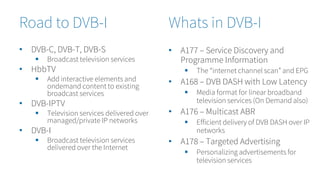
• DVB-C, DVB-T, DVB-S
 Broadcast television services
• HbbTV
 Add interactive elements and
ondemand content to existing
broadcast services
• DVB-IPTV
 Television services delivered over
managed/private IP networks
• DVB-I
 Broadcast television services
delivered over the Internet
Road to DVB-I
• A177 – Service Discovery and
Programme Information
 The “internet channel scan” and EPG
• A168 – DVB DASH with Low Latency
 Media format for linear broadband
television services (On Demand also)
• A176 – Multicast ABR
 Efficient delivery of DVB DASH over IP
networks
• A178 – Targeted Advertising
 Personalizing advertisements for
television services
Whats in DVB-I
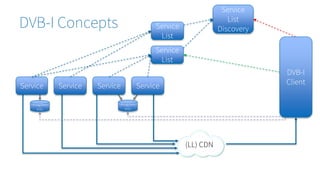
DVB-I Concepts
Program
Info
Program
Info
Service
List
Service
List
(LL) CDN
Service Service Service Service
Service
List
Discovery
DVB-I
Client
Part 1: Encoding & Packaging
Rufael Mekuria - Unified Streaming
Dirk Griffioen - Unified Streaming
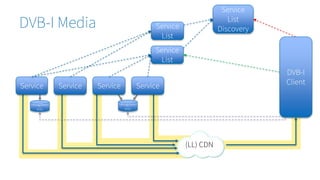
DVB-I Media
Program
Info
Program
Info
Service
List
Service
List
(LL) CDN
Service Service Service Service
Service
List
Discovery
DVB-I
Client
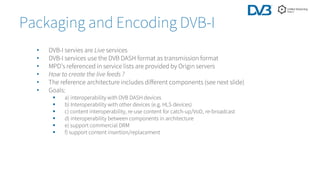
• DVB-I servies are Live services
• DVB-I services use the DVB DASH format as transmission format
• MPD’s referenced in service lists are provided by Origin servers
• How to create the live feeds ?
• The reference architecture includes different components (see next slide)
• Goals:
 a) interoperability with DVB DASH devices
 b) Interoperability with other devices (e.g. HLS devices)
 c) content interoperability, re-use content for catch-up/VoD, re-broadcast
 d) interoperability between components in architecture
 e) support commercial DRM
 f) support content insertion/replacement
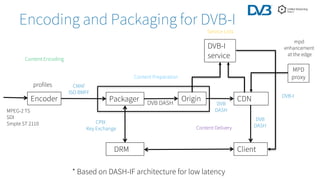
Packaging and Encoding DVB-I
Encoder Origin CDN
Packager
DRM Client
DVB-I
service
Content Encoding
Content Preparation
Content Delivery
Service Lists
CMAF
ISO BMFF
CPIX
Key Exchange
DVB-I
DVB
DASH
DVB
DASH
MPD
proxy
MPEG-2 TS
SDI
Smpte ST 2110
mpd
enhancement
at the edge
profiles
DVB DASH
Encoding and Packaging for DVB-I
* Based on DASH-IF architecture for low latency
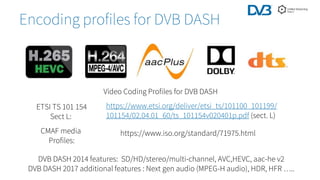
https://www.etsi.org/deliver/etsi_ts/101100_101199/
101154/02.04.01_60/ts_101154v020401p.pdf (sect. L)
ETSI TS 101 154
Sect L:
Video Coding Profiles for DVB DASH
CMAF media
Profiles:
https://www.iso.org/standard/71975.html
Encoding profiles for DVB DASH
DVB DASH 2014 features: SD/HD/stereo/multi-channel, AVC,HEVC, aac-he v2
DVB DASH 2017 additional features : Next gen audio (MPEG-H audio), HDR, HFR …..
• Input could be an other DVB broadcast feed
• For mezannine, SDI, Zixi, SRT or other inputs could be used
• SMPTE ST 2110
• For ABR delivery, encoders should output CMAF based
fragmented MP4 content for best results
Live ABR Encoder input output
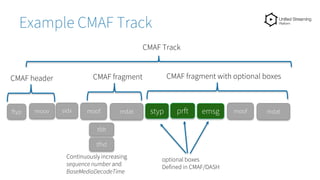
styp prft emsg
moof mdat
moov
tfdt
tfhd
Continuously increasing
sequence number and
BaseMediaDecodeTime
optional boxes
Defined in CMAF/DASH
moof mdat
CMAF header CMAF fragment CMAF fragment with optional boxes
CMAF Track
ftyp sidx
Example CMAF Track
• Live encoder feed with CMAF tracks must be ingested to origin
servers/packagers
• It is recommended to use the HTTP POST method for this
• The detailed protocol was specified in collaboration with companies in the
DASH-IF and published as a DASH-IF technical specification
• The CMAF ingest of tracks is defined in section 5 of:
 https://dashif-documents.azurewebsites.net/Ingest/master/DASH-IF-
Ingest.html
Specification for live uplink/ingest
• Can be used by different manifest formats
• Common format for VoD and Live
• Features like chunking Segments can achieve lower latency in workflows
• CMAF allows signalling track role, language, bit-rate, etc. in a commonly accepted
standard
• By not yet publishing the manifest, late binding can be applied, i.e. Selecting the
relevant tracks for the presentation
• Live support through DASH-IF ingest specification
• Support for common encryption (CENC)
Benefits of using CMAF as ingest
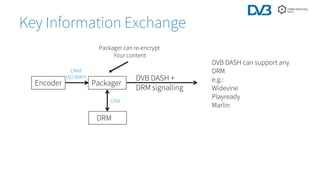
Key Information Exchange
Encoder Packager
DRM
CMAF
ISO BMFF
CPIX
Packager can re-encrypt
Your content
DVB DASH +
DRM signalling
DVB DASH can support any
DRM
e.g.:
Widevine
Playready
Marlin
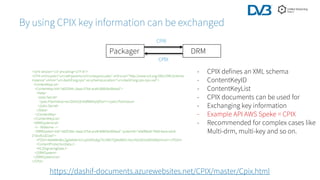
By using CPIX key information can be exchanged
Packager DRM
CPIX
CPIX
- CPIX defines an XML schema
- ContentKeyID
- ContentKeyList
- CPIX documents can be used for
- Exchanging key information
- Example API AWS Speke = CPIX
- Recommended for complex cases like
Multi-drm, multi-key and so on.
<?xml version='1.0' encoding='UTF-8'?>
<CPIX xmlns:pskc="urn:ietf:params:xml:ns:keyprov:pskc" xmlns:xsi="http://www.w3.org/2001/XMLSchema-
instance" xmlns="urn:dashif:org:cpix" xsi:schemaLocation="urn:dashif:org:cpix cpix.xsd">
<ContentKeyList>
<ContentKey kid="e82f184c-3aaa-57b4-ace8-606b5e3febad">
<Data>
<pskc:Secret>
<pskc:PlainValue>wvr2bihSzExKdR8KKpQf2w==</pskc:PlainValue>
</pskc:Secret>
</Data>
</ContentKey>
</ContentKeyList>
<DRMSystemList>
<!-- Widevine -->
<DRMSystem kid="e82f184c-3aaa-57b4-ace8-606b5e3febad" systemId="edef8ba9-79d6-4ace-a3c8-
27dcd51d21ed">
<PSSH>AAAAMnBzc2gAAAAA7e+LqXnWSs6jyCfc1R0h7QAAABIiCnVzcHd2dGVzdDNI49yVmwY=</PSSH>
<ContentProtectionData />
<HLSSignalingData/>
</DRMSystem>
</DRMSystemList>
</CPIX>
https://dashif-documents.azurewebsites.net/CPIX/master/Cpix.html
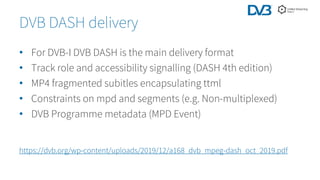
• For DVB-I DVB DASH is the main delivery format
• Track role and accessibility signalling (DASH 4th edition)
• MP4 fragmented subitles encapsulating ttml
• Constraints on mpd and segments (e.g. Non-multiplexed)
• DVB Programme metadata (MPD Event)
DVB DASH delivery
https://dvb.org/wp-content/uploads/2019/12/a168_dvb_mpeg-dash_oct_2019.pdf
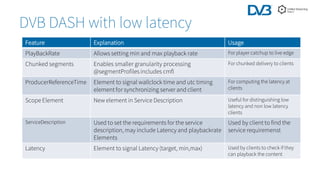
DVB DASH with low latency
Feature Explanation Usage
PlayBackRate Allows setting min and max playback rate For player catchup to live edge
Chunked segments Enables smaller granularity processing
@segmentProfiles includes cmfl
For chunked delivery to clients
ProducerReferenceTime Element to signal wallclock time and utc timing
element for synchronizing server and client
For computing the latency at
clients
Scope Element New element in Service Description Useful for distinguishing low
latency and non low latency
clients
ServiceDescription Used to set the requirements for the service
description, may include Latency and playbackrate
Elements
Used by client to find the
service requiremenst
Latency Element to signal Latency (target, min,max) Used by clients to check if they
can playback the content
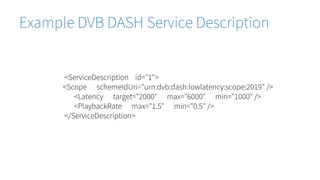
Example DVB DASH Service Description
<ServiceDescription id="1">
<Scope schemeIdUri="urn:dvb:dash:lowlatency:scope:2019" />
<Latency target="2000" max="6000" min="1000" />
<PlaybackRate max="1.5" min="0.5" />
</ServiceDescription>
Program information in live streams
<?xml version="1.0" encoding="UTF-8"?>
<MPD
xmlns:xsi="http://www.w3.org/2001/XMLSchema-instance"
xmlns="urn:mpeg:dash:schema:mpd:2011"
xsi:schemaLocation="urn:mpeg:dash:schema:mpd:2011 DASH-MPD.xsd"
... etc ...>
<BaseURL>http://cdn1.example.com/</BaseURL>
<BaseURL>http://cdn2.example.com/</BaseURL>
<Period id="1">
<EventStream schemeIdUri="urn:dvb:iptv:cpm:2014" value="1">
<Event presentationTime="300" duration="1500" id="0"><![CDATA[<BroadcastEvent>
<Program crid="crid://broadcaster.example.com/ABCDEF"/>
<InstanceDescription>
<Title xml:lang="en">The title</Title>
<Synopsis xml:lang="en" length="medium">The description</Synopsis>
<ParentalGuidance>
<mpeg7:ParentalRatinghref="urn:dvb:iptv:rating:2014:15"/>
<mpeg7:Region>GB</mpeg7:Region>
</ParentalGuidance>
A168 (Oct 2019)
58
</InstanceDescription>
</BroadcastEvent>]]></Event>
</EventStream>
<AdaptationSet>
... etc ...
</AdaptationSet>
</Perio
If not in MPD it could
be in the Service List
Desciption
MPD Events
Are used to carry meta
information in DVB
DASH
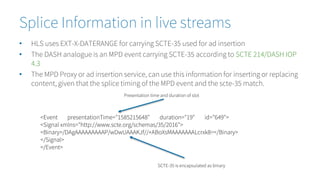
Splice Information in live streams
• HLS uses EXT-X-DATERANGE for carrying SCTE-35 used for ad insertion
• The DASH analogue is an MPD event carrying SCTE-35 according to SCTE 214/DASH IOP
4.3
• The MPD Proxy or ad insertion service, can use this information for inserting or replacing
content, given that the splice timing of the MPD event and the scte-35 match.
<Event presentationTime="1585215648" duration="19" id="649">
<Signal xmlns="http://www.scte.org/schemas/35/2016">
<Binary>/DAgAAAAAAAAAP/wDwUAAAKJf//+ABoXsMAAAAAAALcrxk8=</Binary>
</Signal>
</Event>
Presentation time and duration of slot
SCTE-35 is encapsulated as binary
MPD Proxy
• Some features are manifest only changes, and can be handled by an
MPD proxy
• The MPD proxy changes the manifest, but not the segments
 Single to Multi period
 Adding supplemental descriptors (e.g. Adaptationset switching)
 Adding metadata
 Changing the ServiceDescription Elements
 Content insertion of stitching (based on segments already in the CDN)
Origin Server Tips
• Challenge of origin server is handling scale
• Errors (404) can be problematic as they can mitigate through to CDN
• For live streaming CDN offloading is rather effective
• Per channel dimensioning of servers is sometimes deployed, making
a small virtual server for each channel.
• This way channels will be isolated in case of failures
DVB-I Service and play list
• Reference the mpd’s
• In case of live mpd’s only, channels could be fixed running on
different origins 24x7
• It may be necessary to have some more methods for
notification of changes/updates (TBD)
Summary
• Distributed Workflow for encoding and packaging
• Reference architecture with standardized interfaces
• Encoder can produce CMAF and media encoded with the DVB profile
• Packager creates DVB-DASH and commercial encryption
• Origin is used for Distribution via CDN
• Splice information is carried in MPD Event
• Programme metadata is carried in MPD event
• Proxy can add MPD properties and/or insert/replace content based on MPD Event or HLS
DateRange tags
• Proxy could also make specific geo-specific localization changes for DVB-I to the manifest
End

DVB-I masterclass introductions-packaging-encoding-v2

  • 1.
    DVB-I Webinar Series Part1 of 3 1 April 2020
  • 2.
    Introduction Paul Higgs –TM-I Chair - Huawei
  • 3.
    • DVB-C, DVB-T,DVB-S  Broadcast television services • HbbTV  Add interactive elements and ondemand content to existing broadcast services • DVB-IPTV  Television services delivered over managed/private IP networks • DVB-I  Broadcast television services delivered over the Internet Road to DVB-I • A177 – Service Discovery and Programme Information  The “internet channel scan” and EPG • A168 – DVB DASH with Low Latency  Media format for linear broadband television services (On Demand also) • A176 – Multicast ABR  Efficient delivery of DVB DASH over IP networks • A178 – Targeted Advertising  Personalizing advertisements for television services Whats in DVB-I
  • 4.
    DVB-I Concepts Program Info Program Info Service List Service List (LL) CDN ServiceService Service Service Service List Discovery DVB-I Client
  • 5.
    Part 1: Encoding& Packaging Rufael Mekuria - Unified Streaming Dirk Griffioen - Unified Streaming
  • 6.
    DVB-I Media Program Info Program Info Service List Service List (LL) CDN ServiceService Service Service Service List Discovery DVB-I Client
  • 7.
    • DVB-I serviesare Live services • DVB-I services use the DVB DASH format as transmission format • MPD’s referenced in service lists are provided by Origin servers • How to create the live feeds ? • The reference architecture includes different components (see next slide) • Goals:  a) interoperability with DVB DASH devices  b) Interoperability with other devices (e.g. HLS devices)  c) content interoperability, re-use content for catch-up/VoD, re-broadcast  d) interoperability between components in architecture  e) support commercial DRM  f) support content insertion/replacement Packaging and Encoding DVB-I
  • 8.
    Encoder Origin CDN Packager DRMClient DVB-I service Content Encoding Content Preparation Content Delivery Service Lists CMAF ISO BMFF CPIX Key Exchange DVB-I DVB DASH DVB DASH MPD proxy MPEG-2 TS SDI Smpte ST 2110 mpd enhancement at the edge profiles DVB DASH Encoding and Packaging for DVB-I * Based on DASH-IF architecture for low latency
  • 9.
    https://www.etsi.org/deliver/etsi_ts/101100_101199/ 101154/02.04.01_60/ts_101154v020401p.pdf (sect. L) ETSITS 101 154 Sect L: Video Coding Profiles for DVB DASH CMAF media Profiles: https://www.iso.org/standard/71975.html Encoding profiles for DVB DASH DVB DASH 2014 features: SD/HD/stereo/multi-channel, AVC,HEVC, aac-he v2 DVB DASH 2017 additional features : Next gen audio (MPEG-H audio), HDR, HFR …..
  • 10.
    • Input couldbe an other DVB broadcast feed • For mezannine, SDI, Zixi, SRT or other inputs could be used • SMPTE ST 2110 • For ABR delivery, encoders should output CMAF based fragmented MP4 content for best results Live ABR Encoder input output
  • 11.
    styp prft emsg moofmdat moov tfdt tfhd Continuously increasing sequence number and BaseMediaDecodeTime optional boxes Defined in CMAF/DASH moof mdat CMAF header CMAF fragment CMAF fragment with optional boxes CMAF Track ftyp sidx Example CMAF Track
  • 12.
    • Live encoderfeed with CMAF tracks must be ingested to origin servers/packagers • It is recommended to use the HTTP POST method for this • The detailed protocol was specified in collaboration with companies in the DASH-IF and published as a DASH-IF technical specification • The CMAF ingest of tracks is defined in section 5 of:  https://dashif-documents.azurewebsites.net/Ingest/master/DASH-IF- Ingest.html Specification for live uplink/ingest
  • 13.
    • Can beused by different manifest formats • Common format for VoD and Live • Features like chunking Segments can achieve lower latency in workflows • CMAF allows signalling track role, language, bit-rate, etc. in a commonly accepted standard • By not yet publishing the manifest, late binding can be applied, i.e. Selecting the relevant tracks for the presentation • Live support through DASH-IF ingest specification • Support for common encryption (CENC) Benefits of using CMAF as ingest
  • 14.
    Key Information Exchange EncoderPackager DRM CMAF ISO BMFF CPIX Packager can re-encrypt Your content DVB DASH + DRM signalling DVB DASH can support any DRM e.g.: Widevine Playready Marlin
  • 15.
    By using CPIXkey information can be exchanged Packager DRM CPIX CPIX - CPIX defines an XML schema - ContentKeyID - ContentKeyList - CPIX documents can be used for - Exchanging key information - Example API AWS Speke = CPIX - Recommended for complex cases like Multi-drm, multi-key and so on. <?xml version='1.0' encoding='UTF-8'?> <CPIX xmlns:pskc="urn:ietf:params:xml:ns:keyprov:pskc" xmlns:xsi="http://www.w3.org/2001/XMLSchema- instance" xmlns="urn:dashif:org:cpix" xsi:schemaLocation="urn:dashif:org:cpix cpix.xsd"> <ContentKeyList> <ContentKey kid="e82f184c-3aaa-57b4-ace8-606b5e3febad"> <Data> <pskc:Secret> <pskc:PlainValue>wvr2bihSzExKdR8KKpQf2w==</pskc:PlainValue> </pskc:Secret> </Data> </ContentKey> </ContentKeyList> <DRMSystemList> <!-- Widevine --> <DRMSystem kid="e82f184c-3aaa-57b4-ace8-606b5e3febad" systemId="edef8ba9-79d6-4ace-a3c8- 27dcd51d21ed"> <PSSH>AAAAMnBzc2gAAAAA7e+LqXnWSs6jyCfc1R0h7QAAABIiCnVzcHd2dGVzdDNI49yVmwY=</PSSH> <ContentProtectionData /> <HLSSignalingData/> </DRMSystem> </DRMSystemList> </CPIX> https://dashif-documents.azurewebsites.net/CPIX/master/Cpix.html
  • 16.
    • For DVB-IDVB DASH is the main delivery format • Track role and accessibility signalling (DASH 4th edition) • MP4 fragmented subitles encapsulating ttml • Constraints on mpd and segments (e.g. Non-multiplexed) • DVB Programme metadata (MPD Event) DVB DASH delivery https://dvb.org/wp-content/uploads/2019/12/a168_dvb_mpeg-dash_oct_2019.pdf
  • 17.
    DVB DASH withlow latency Feature Explanation Usage PlayBackRate Allows setting min and max playback rate For player catchup to live edge Chunked segments Enables smaller granularity processing @segmentProfiles includes cmfl For chunked delivery to clients ProducerReferenceTime Element to signal wallclock time and utc timing element for synchronizing server and client For computing the latency at clients Scope Element New element in Service Description Useful for distinguishing low latency and non low latency clients ServiceDescription Used to set the requirements for the service description, may include Latency and playbackrate Elements Used by client to find the service requiremenst Latency Element to signal Latency (target, min,max) Used by clients to check if they can playback the content
  • 18.
    Example DVB DASHService Description <ServiceDescription id="1"> <Scope schemeIdUri="urn:dvb:dash:lowlatency:scope:2019" /> <Latency target="2000" max="6000" min="1000" /> <PlaybackRate max="1.5" min="0.5" /> </ServiceDescription>
  • 19.
    Program information inlive streams <?xml version="1.0" encoding="UTF-8"?> <MPD xmlns:xsi="http://www.w3.org/2001/XMLSchema-instance" xmlns="urn:mpeg:dash:schema:mpd:2011" xsi:schemaLocation="urn:mpeg:dash:schema:mpd:2011 DASH-MPD.xsd" ... etc ...> <BaseURL>http://cdn1.example.com/</BaseURL> <BaseURL>http://cdn2.example.com/</BaseURL> <Period id="1"> <EventStream schemeIdUri="urn:dvb:iptv:cpm:2014" value="1"> <Event presentationTime="300" duration="1500" id="0"><![CDATA[<BroadcastEvent> <Program crid="crid://broadcaster.example.com/ABCDEF"/> <InstanceDescription> <Title xml:lang="en">The title</Title> <Synopsis xml:lang="en" length="medium">The description</Synopsis> <ParentalGuidance> <mpeg7:ParentalRatinghref="urn:dvb:iptv:rating:2014:15"/> <mpeg7:Region>GB</mpeg7:Region> </ParentalGuidance> A168 (Oct 2019) 58 </InstanceDescription> </BroadcastEvent>]]></Event> </EventStream> <AdaptationSet> ... etc ... </AdaptationSet> </Perio If not in MPD it could be in the Service List Desciption MPD Events Are used to carry meta information in DVB DASH
  • 20.
    Splice Information inlive streams • HLS uses EXT-X-DATERANGE for carrying SCTE-35 used for ad insertion • The DASH analogue is an MPD event carrying SCTE-35 according to SCTE 214/DASH IOP 4.3 • The MPD Proxy or ad insertion service, can use this information for inserting or replacing content, given that the splice timing of the MPD event and the scte-35 match. <Event presentationTime="1585215648" duration="19" id="649"> <Signal xmlns="http://www.scte.org/schemas/35/2016"> <Binary>/DAgAAAAAAAAAP/wDwUAAAKJf//+ABoXsMAAAAAAALcrxk8=</Binary> </Signal> </Event> Presentation time and duration of slot SCTE-35 is encapsulated as binary
  • 21.
    MPD Proxy • Somefeatures are manifest only changes, and can be handled by an MPD proxy • The MPD proxy changes the manifest, but not the segments  Single to Multi period  Adding supplemental descriptors (e.g. Adaptationset switching)  Adding metadata  Changing the ServiceDescription Elements  Content insertion of stitching (based on segments already in the CDN)
  • 22.
    Origin Server Tips •Challenge of origin server is handling scale • Errors (404) can be problematic as they can mitigate through to CDN • For live streaming CDN offloading is rather effective • Per channel dimensioning of servers is sometimes deployed, making a small virtual server for each channel. • This way channels will be isolated in case of failures
  • 23.
    DVB-I Service andplay list • Reference the mpd’s • In case of live mpd’s only, channels could be fixed running on different origins 24x7 • It may be necessary to have some more methods for notification of changes/updates (TBD)
  • 24.
    Summary • Distributed Workflowfor encoding and packaging • Reference architecture with standardized interfaces • Encoder can produce CMAF and media encoded with the DVB profile • Packager creates DVB-DASH and commercial encryption • Origin is used for Distribution via CDN • Splice information is carried in MPD Event • Programme metadata is carried in MPD event • Proxy can add MPD properties and/or insert/replace content based on MPD Event or HLS DateRange tags • Proxy could also make specific geo-specific localization changes for DVB-I to the manifest
  • 25.