12/12/2014
1
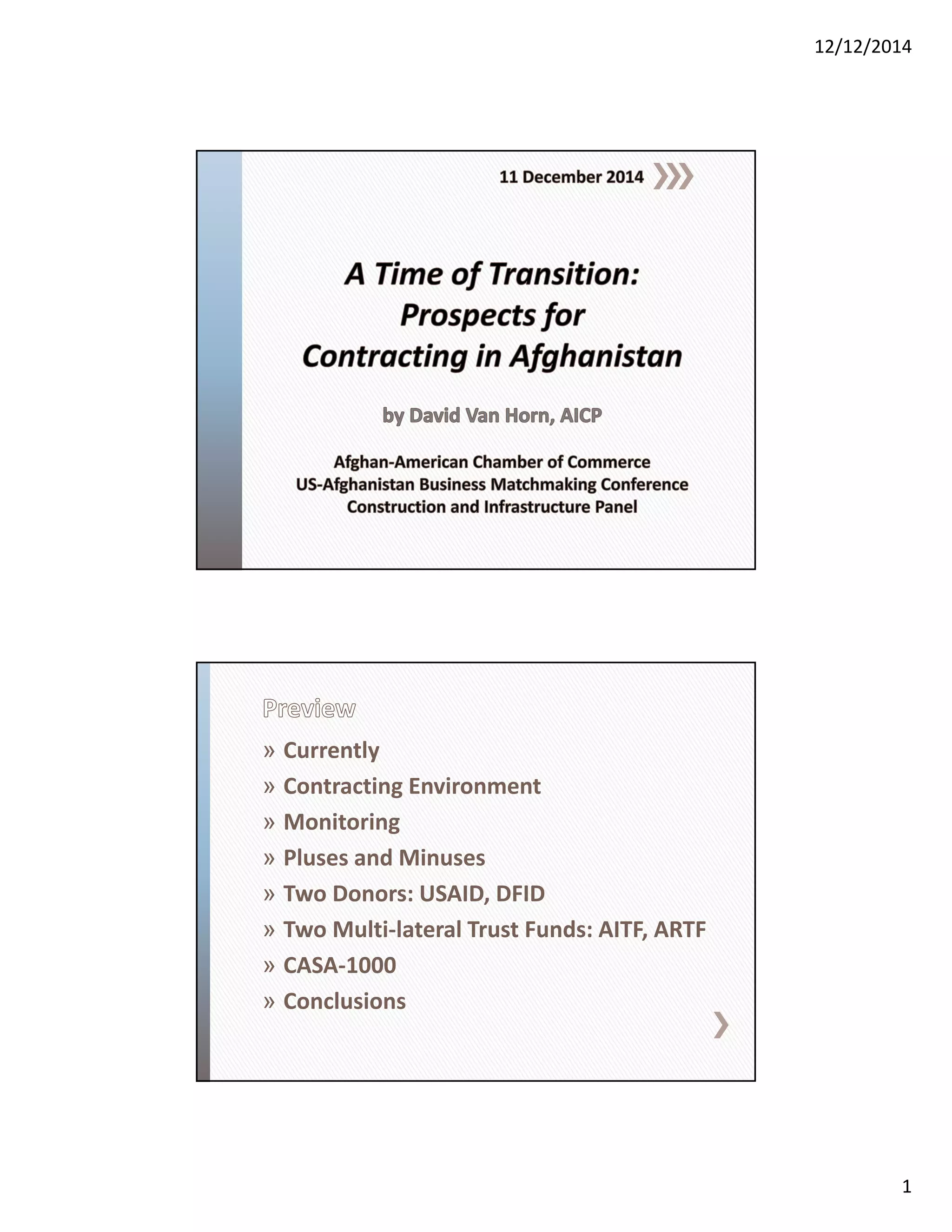
» Currently
» Contracting Environment
» Monitoring
» Pluses and Minuses
» Two Donors: USAID, DFID
» Two Multi‐lateral Trust Funds: AITF, ARTF
» CASA‐1000
» Conclusions
12/12/2014
2
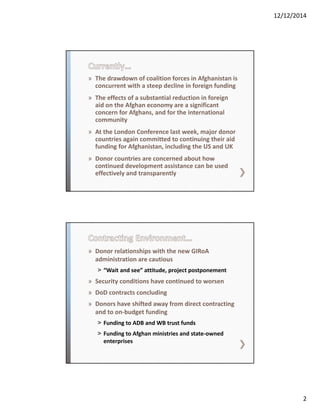
» The drawdown of coalition forces in Afghanistan is 
concurrent with a steep decline in foreign funding 
» The effects of a substantial reduction in foreign 
aid on the Afghan economy are a significant 
concern for Afghans, and for the international 
community
» At the London Conference last week, major donor 
countries again committed to continuing their aid 
funding for Afghanistan, including the US and UK
» Donor countries are concerned about how 
continued development assistance can be used 
effectively and transparently
» Donor relationships with the new GIRoA
administration are cautious
˃ “Wait and see” attitude, project postponement
» Security conditions have continued to worsen
» DoD contracts concluding
» Donors have shifted away from direct contracting 
and to on‐budget funding
˃ Funding to ADB and WB trust funds
˃ Funding to Afghan ministries and state‐owned 
enterprises
12/12/2014
3
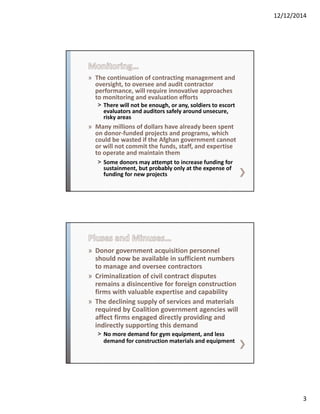
» The continuation of contracting management and 
oversight, to oversee and audit contractor 
performance, will require innovative approaches 
to monitoring and evaluation efforts  
˃ There will not be enough, or any, soldiers to escort 
evaluators and auditors safely around unsecure, 
risky areas
» Many millions of dollars have already been spent 
on donor‐funded projects and programs, which 
could be wasted if the Afghan government cannot 
or will not commit the funds, staff, and expertise 
to operate and maintain them  
˃ Some donors may attempt to increase funding for 
sustainment, but probably only at the expense of 
funding for new projects
» Donor government acquisition personnel 
should now be available in sufficient numbers 
to manage and oversee contractors
» Criminalization of civil contract disputes 
remains a disincentive for foreign construction 
firms with valuable expertise and capability
» The declining supply of services and materials 
required by Coalition government agencies will 
affect firms engaged directly providing and 
indirectly supporting this demand
˃ No more demand for gym equipment, and less 
demand for construction materials and equipment
12/12/2014
4
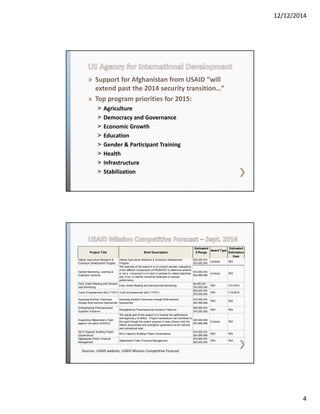
» Support for Afghanistan from USAID “will 
extend past the 2014 security transition…”
» Top program priorities for 2015:
˃ Agriculture
˃ Democracy and Governance
˃ Economic Growth
˃ Education
˃ Gender & Participant Training
˃ Health
˃ Infrastructure
˃ Stabilization
Project Title Brief Description
Estimated
$ Range
Award Type
Estimated
Solicitation
Date
Afghan Agriculture Research &
Extension Development Program
Afghan Agriculture Research & Extension Development
Program
$25,000,001-
$75,000,000
Contract TBD
Gender Monitoring, Learning &
Evaluation Services
The objective of this award is to to conduct periodic evaluations
of the different components of PROMOTE to determine whether
or not a component is on track to achieve its stated objectives
and, if not, to identify corrective measures to improve
performance.
$10,000,001-
$24,999,999
Contract TBD
Early Grade Reading and Demand-
side Monitoring
Early Grade Reading and Demand-side Monitoring
$4,000,001-
$10,000,000
TBD 1/21/2015
Youth Empowerment (BELT-TVET) Youth Empowerment (BELT-TVET)
$25,000,001-
$75,000,000
TBD 1/15/2015
Improving Nutrition Outcomes
through Multi-sectoral Approaches
Improving Nutrition Outcomes through Multi-sectoral
Approaches
$10,000,001-
$24,999,999
TBD TBD
Strengthening Pharmaceutical
Systems Follow-on
Strengthening Pharmaceutical Systems Follow-on
$25,000,001-
$75,000,000
TBD TBD
Supporting Afghanistan’s Fight
against Corruption (SAFAC)
The overall goal of this project is to improve the performance
and legitimacy of GIRoA. Project interventions will contribute to
this goal through the project purpose to have citizens hold the
GIRoA accountable and strengthen governance at the national
and subnational level.
$25,000,000-
$74,999,999
Contract TBD
IDLG Capacity Building Project
(Governance)
IDLG Capacity Building Project (Governance)
$10,000,001-
$24,999,999
TBD TBD
Afghanistan Public Financial
Management
Afghanistan Public Financial Management
$10,000,001-
$25,000,000
TBD TBD
Sources: USAID website, USAID Mission Competitive Forecast
12/12/2014
5
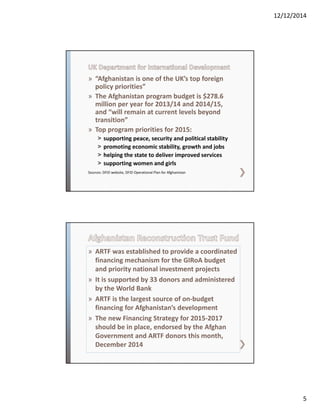
» “Afghanistan is one of the UK’s top foreign 
policy priorities”  
» The Afghanistan program budget is $278.6 
million per year for 2013/14 and 2014/15, 
and “will remain at current levels beyond 
transition”
» Top program priorities for 2015:
˃ supporting peace, security and political stability 
˃ promoting economic stability, growth and jobs
˃ helping the state to deliver improved services
˃ supporting women and girls
Sources: DFID website, DFID Operational Plan for Afghanistan
» ARTF was established to provide a coordinated 
financing mechanism for the GIRoA budget 
and priority national investment projects
» It is supported by 33 donors and administered 
by the World Bank
» ARTF is the largest source of on‐budget 
financing for Afghanistan’s development
» The new Financing Strategy for 2015‐2017 
should be in place, endorsed by the Afghan 
Government and ARTF donors this month, 
December 2014
12/12/2014
6
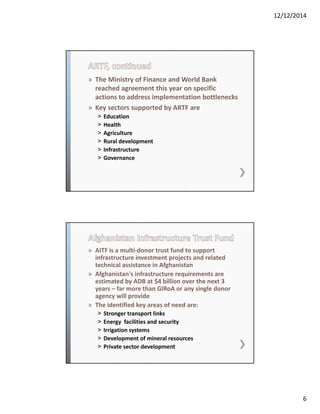
» The Ministry of Finance and World Bank 
reached agreement this year on specific 
actions to address implementation bottlenecks
» Key sectors supported by ARTF are 
˃ Education 
˃ Health 
˃ Agriculture
˃ Rural development
˃ Infrastructure
˃ Governance
» AITF is a multi‐donor trust fund to support 
infrastructure investment projects and related 
technical assistance in Afghanistan
» Afghanistan's infrastructure requirements are 
estimated by ADB at $4 billion over the next 3 
years – far more than GIRoA or any single donor 
agency will provide
» The identified key areas of need are:
˃ Stronger transport links
˃ Energy  facilities and security
˃ Irrigation systems
˃ Development of mineral resources
˃ Private sector development
12/12/2014
7
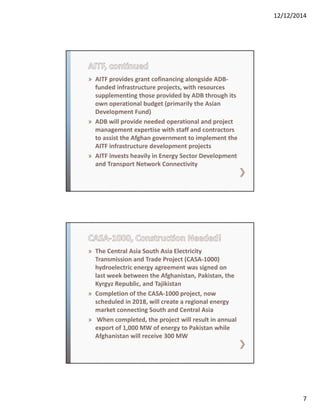
» AITF provides grant cofinancing alongside ADB‐
funded infrastructure projects, with resources 
supplementing those provided by ADB through its 
own operational budget (primarily the Asian 
Development Fund) 
» ADB will provide needed operational and project 
management expertise with staff and contractors 
to assist the Afghan government to implement the 
AITF infrastructure development projects
» AITF invests heavily in Energy Sector Development 
and Transport Network Connectivity
» The Central Asia South Asia Electricity 
Transmission and Trade Project (CASA‐1000)  
hydroelectric energy agreement was signed on 
last week between the Afghanistan, Pakistan, the 
Kyrgyz Republic, and Tajikistan 
» Completion of the CASA‐1000 project, now 
scheduled in 2018, will create a regional energy 
market connecting South and Central Asia
» When completed, the project will result in annual 
export of 1,000 MW of energy to Pakistan while 
Afghanistan will receive 300 MW 
12/12/2014
8
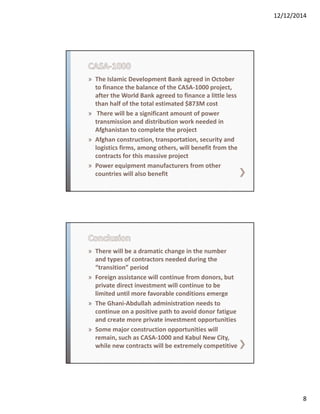
» The Islamic Development Bank agreed in October 
to finance the balance of the CASA‐1000 project, 
after the World Bank agreed to finance a little less 
than half of the total estimated $873M cost
» There will be a significant amount of power 
transmission and distribution work needed in 
Afghanistan to complete the project
» Afghan construction, transportation, security and 
logistics firms, among others, will benefit from the 
contracts for this massive project
» Power equipment manufacturers from other 
countries will also benefit
» There will be a dramatic change in the number 
and types of contractors needed during the 
“transition” period
» Foreign assistance will continue from donors, but 
private direct investment will continue to be 
limited until more favorable conditions emerge
» The Ghani‐Abdullah administration needs to 
continue on a positive path to avoid donor fatigue 
and create more private investment opportunities
» Some major construction opportunities will 
remain, such as CASA‐1000 and Kabul New City, 
while new contracts will be extremely competitive
12/12/2014
9
Thank You

dvanhorn AACC 11dec14 pres 2perpg