Inclusive Savings
for Remittance
Clients
A Practical Framework
Contents
About the Remittances & Savings Working Group 6
1. Context and Challenges for Remittances and Savings
Background 10
Challenges to savings for remittance clients 12
2. A Framework for Developing Innovations in Remittances and Savings
Designing products 18
Design products that incentivize continual use over time and encourage
clients to keep money in their accounts and draw down balances slowly.
Understanding clients’ financial lives 24
Help clients make lasting changes in the way they manage their household
budgets to create opportunities for saving.
Building access 28
Keep accounts active by bringing the ability to transact—such as cashing
out remittances or making deposits—closer to remittance clients.
Diversifying revenue 32
Develop financially sustainable savings services for remittance recipients.
Conclusion 36
Bibliography 38
Author
Elisabeth Burgess
Program Coordinator
Rebecca Rouse
Leadership
Fermín Vivanco and María Luisa Hayem
Team
Avril Pérez, Juan David Reyes, Claudia Gutiérrez,
Georg Neumann, and Shoshana Grossman-Crist
This report is based on a meeting of the Working Group on
Remittances and Savings, which was held at the Multilateral
Investment Fund’s headquarters on July 10, 2014. The opinions
expressed in this publication are those of the author and do not
necessarily reflect the views of Working Group participants or
their institutions, the Multilateral Investment Fund, the Inter-
American Development Bank, its Board of Directors, nor the
countries they represent.
Copyright © [2014] Inter-American Development Bank. All rights
reserved; may be freely reproduced for any non-commercial purpose.
The unauthorized commercial use of Bank documents is prohibited
and may be punishable under Bank's policies and/or applicable laws.
Remittances and Savings Program
www.remittancesandsavings.org
Multilateral Investment Fund
1300 New York Avenue, N.W.
Washington, D.C. 20577
www.fomin.org
mifcontact@iadb.org
December 2014
| Inclusive Savings for Remittance Clients6
OnJuly10,2014,theRemittancesandSavingsProgramoftheMultilateral
Investment Fund convened a day-long working group meeting on the
topic of remittances and savings. The Working Group bought together
leading experts from across the remittances and financial services
industry in the U.S. and Latin America and the Caribbean to discuss
savings promotion among international migrants and their families.
The group consisted of representatives from money transfer operators,
banks and non-bank financial institutions, non-profit organizations,
foundations, universities and research institutes, and other companies
that work with transnational households.
The Working Group discussion began by analyzing the primary
challenges that participants have encountered in promoting savings
accounts among remittance senders and recipients. Next, the group
identified promising opportunities for innovation to help address these
challenges. This report is based on the results of the Remittances and
Savings Working Group meeting and is meant to serve as a framework
for future work in the remittances and savings space.
About
the Remittances
& Savings
Working Group
7About the Remittances & Savings Working Group |
The meeting’s participants included:
Natasha Bajuk
Multilateral Investment Fund
Elisabeth Burgess
Independent Consultant
Julissa Camasta Zorob
Banco Adopem
Nancy Castillo
Center for Financial Services Innovation
Katherine Devine
Grameen Foundation
Paul Dwyer
Viamericas Corporation
Rocío González del Rey
Banco Unión
Claudia Gutiérrez
Multilateral Investment Fund
María Luisa Hayem
Multilateral Investment Fund
Aaron Henry
MoneyGram International
Trang Ho
Multilateral Investment Fund
Maria Jaramillo
Microfinance Opportunities
Dee Kalasa
Wells Fargo
Rishabh Khosla
Accion International
Barbara Magnoni
EA Consultants
Juan Navarrete
Independent Consultant
Timothy Ogden
Financial Access Initiative
Manuel Orozco
Inter-American Dialogue
Aishwarya Ratan
Innovations for Poverty Action
Mamta Rodrigues
Visa Inc.
Rebecca Rouse
Multilateral Investment Fund
Barbara Span
Western Union
Fermín Vivanco
Multilateral Investment Fund
Dean Yang
University of Michigan
Context
and Challenges
for Remittances
and Savings
Context
and Challenges
for Remittances
and Savings
| Inclusive Savings for Remittance Clients10
Background
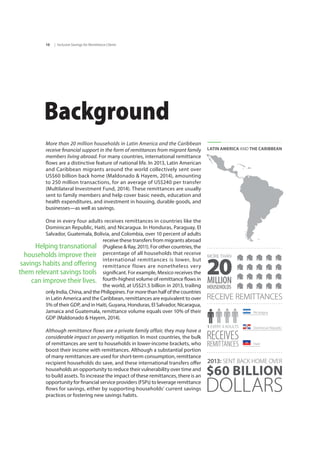
More than 20 million households in Latin America and the Caribbean
receive financial support in the form of remittances from migrant family
members living abroad. For many countries, international remittance
flows are a distinctive feature of national life. In 2013, Latin American
and Caribbean migrants around the world collectively sent over
US$60 billion back home (Maldonado & Hayem, 2014), amounting
to 250 million transactions, for an average of US$240 per transfer
(Multilateral Investment Fund, 2014). These remittances are usually
sent to family members and help cover basic needs, education and
health expenditures, and investment in housing, durable goods, and
businesses—as well as savings.
One in every four adults receives remittances in countries like the
Dominican Republic, Haiti, and Nicaragua. In Honduras, Paraguay, El
Salvador, Guatemala, Bolivia, and Colombia, over 10 percent of adults
receive these transfers from migrants abroad
(Pugliese & Ray, 2011). For other countries, the
percentage of all households that receive
international remittances is lower, but
remittance flows are nonetheless very
significant. For example, Mexico receives the
fourth-highest volume of remittance flows in
the world, at US$21.5 billion in 2013, trailing
only India, China, and the Philippines. For more than half of the countries
in Latin America and the Caribbean, remittances are equivalent to over
5% of their GDP, and in Haiti, Guyana, Honduras, El Salvador, Nicaragua,
Jamaica and Guatemala, remittance volume equals over 10% of their
GDP (Maldonado & Hayem, 2014).
Although remittance flows are a private family affair, they may have a
considerable impact on poverty mitigation. In most countries, the bulk
of remittances are sent to households in lower-income brackets, who
boost their income with remittances. Although a substantial portion
of many remittances are used for short-term consumption, remittance
recipient households do save, and these international transfers offer
households an opportunity to reduce their vulnerability over time and
to build assets. To increase the impact of these remittances, there is an
opportunity for financial service providers (FSPs) to leverage remittance
flows for savings, either by supporting households’ current savings
practices or fostering new savings habits.
$60 BILLION
DOLLARS
2013: SENT BACK HOME OVER
RECEIVE REMITTANCES
LATIN AMERICA AND THE CARIBBEAN
20MILLION
MORE THAN
HOUSEHOLDS
RECEIVES
REMITTANCES
1 EVERY 4 ADULTS
Haiti
Nicaragua
Dominican Republic
Helping transnational
households improve their
savings habits and offering
them relevant savings tools
can improve their lives.
11Context and Challenges for Remittances and Savings | Background |
Remittance clients and savings
The practice of saving is an essential means by which low-income
populations can accumulate lump sums to make large expenditures,
confront emergencies, and take advantage of investment opportunities
(Rutherford 2000). Savings enable households to accumulate assets
such as financial capital and durable goods, or to make investments in
human capital such as education. These in turn help cushion families
against economic shocks such as loss of income or illness, and help lift
them out of poverty (Moser 2007). As such, helping families improve
their ability to save and offering appropriate tools for both short- and
long-term savings can significantly improve their lives.
There is evidence that remittances have a significant and positive
impact on bank deposits in recipient countries (Aggarwal et al., 2006).
However, many remittance recipients still
lack access to formal savings tools. In the
absence of formal savings accounts, there
are a variety of informal tools that many
people in the region use to save, but many
people, especially low-income individuals,
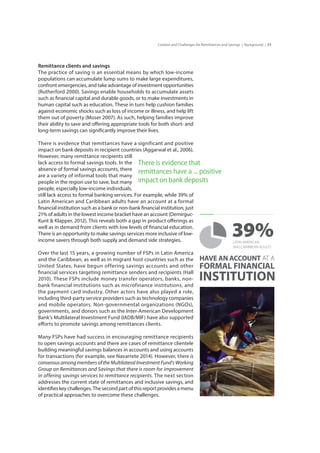
still lack access to formal banking services. For example, while 39% of
Latin American and Caribbean adults have an account at a formal
financial institution such as a bank or non-bank financial institution, just
21% of adults in the lowest income bracket have an account (Demirguc-
Kunt & Klapper, 2012). This reveals both a gap in product offerings as
well as in demand from clients with low levels of financial education.
There is an opportunity to make savings services more inclusive of low-
income savers through both supply and demand side strategies.
Over the last 15 years, a growing number of FSPs in Latin America
and the Caribbean, as well as in migrant host countries such as the
United States, have begun offering savings accounts and other
financial services targeting remittance senders and recipients (Hall
2010). These FSPs include money transfer operators, banks, non-
bank financial institutions such as microfinance institutions, and
the payment card industry. Other actors have also played a role,
including third-party service providers such as technology companies
and mobile operators. Non-governmental organizations (NGOs),
governments, and donors such as the Inter-American Development
Bank’s Multilateral Investment Fund (IADB/MIF) have also supported
efforts to promote savings among remittances clients.
Many FSPs have had success in encouraging remittance recipients
to open savings accounts and there are cases of remittance clientele
building meaningful savings balances in accounts and using accounts
for transactions (for example, see Navarrete 2014). However, there is
consensus among members of the Multilateral Investment Fund’s Working
Group on Remittances and Savings that there is room for improvement
in offering savings services to remittance recipients. The next section
addresses the current state of remittances and inclusive savings, and
identifies key challenges. The second part of this report provides a menu
of practical approaches to overcome these challenges.
There is evidence that
remittances have a ... positive
impact on bank deposits
HAVE AN ACCOUNT AT A
FORMAL FINANCIAL
INSTITUTION
39%LATIN AMERICAN
AND CARIBBEAN ADULTS
| Inclusive Savings for Remittance Clients12
Challenges
to savings
for remittance
clients
Many financial service providers have successfully sold savings and
checkingaccountstoremittanceclients,butmanystillgrapplewithvarying
levels of account dormancy. The reasons for account dormancy include
challenges common to any savings service for low-income clients, as
well as challenges that are particular to remittance clients.
When designing savings and transactional accounts for any traditionally
excluded low-income customer segment, FSPs face challenges such
as earning the trust of previously unbanked clients; overcoming
regulatory hurdles in some contexts, especially with regards to Know
Your Customer requirements; and	finding low-cost delivery models
to service low-balance accounts.
Moreover, institutions must learn
to work within the constraints of
an overarching predicament of
many low-income populations—
that their incomes are small, 	
irregular, and unpredictable	
(Collins et al., 2009).
However, the experience of the
MIF suggests that remittance
transfers can be leveraged for	
savings by FSPs, which improves
the business case for providing
savings products to this segment.
Moreover, the regularity of	
remittances income (see Orozco
& Jewers, 2014) relative to some
otherincomesources,suchasfrom
a small business or agricultural
activities, can make remittances a
good source of funds for accounts.
13Context and Challenges for Remittances and Savings | Challenges to savings for remittance clients |
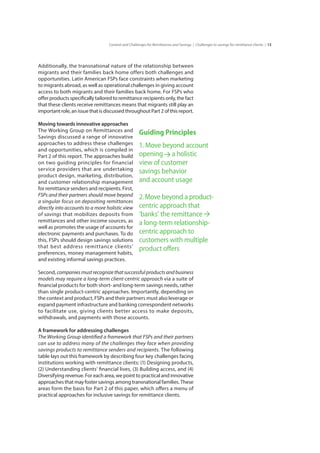
Additionally, the transnational nature of the relationship between
migrants and their families back home offers both challenges and
opportunities. Latin American FSPs face constraints when marketing
to migrants abroad, as well as operational challenges in giving account
access to both migrants and their families back home. For FSPs who
offer products specifically tailored to remittance recipients only, the fact
that these clients receive remittances means that migrants still play an
important role, an issue that is discussed throughout Part 2 of this report.
Moving towards innovative approaches
The Working Group on Remittances and
Savings discussed a range of innovative
approaches to address these challenges
and opportunities, which is compiled in
Part 2 of this report. The approaches build
on two guiding principles for financial
service providers that are undertaking
product design, marketing, distribution,
and customer relationship management
for remittance senders and recipients. First,
FSPs and their partners should move beyond
a singular focus on depositing remittances
directly into accounts to a more holistic view
of savings that mobilizes deposits from
remittances and other income sources, as
well as promotes the usage of accounts for
electronic payments and purchases. To do
this, FSPs should design savings solutions
that best address remittance clients’
preferences, money management habits,
and existing informal savings practices.
Second, companies must recognize that successful products and business
models may require a long-term client-centric approach via a suite of
financial products for both short- and long-term savings needs, rather
than single product-centric approaches. Importantly, depending on
the context and product, FSPs and their partners must also leverage or
expand payment infrastructure and banking correspondent networks
to facilitate use, giving clients better access to make deposits,
withdrawals, and payments with those accounts.
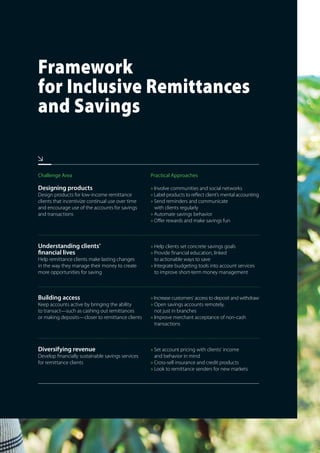
A framework for addressing challenges
The Working Group identified a framework that FSPs and their partners
can use to address many of the challenges they face when providing
savings products to remittance senders and recipients. The following
table lays out this framework by describing four key challenges facing
institutions working with remittance clients: (1) Designing products,
(2) Understanding clients’ financial lives, (3) Building access, and (4)
Diversifying revenue. For each area, we point to practical and innovative
approaches that may foster savings among transnational families. These
areas form the basis for Part 2 of this paper, which offers a menu of
practical approaches for inclusive savings for remittance clients.
Guiding Principles
1. Move beyond account
opening a holistic
view of customer
savings behavior
and account usage
2.Move beyond a product-
centric approach that
‘banks’ the remittance
a long-term relationship-
centric approach to
customers with multiple
product offers
Challenge Area
Designing products
Design products for low-income remittance
clients that incentivize continual use over time
and encourage use of the accounts for savings
and transactions
Understanding clients’ 		
financial lives
Help remittance clients make lasting changes 	
in the way they manage their money to create 	
more opportunities for saving
Building access
Keep accounts active by bringing the ability 		
to transact—such as cashing out remittances 	
or making deposits—closer to remittance clients
Diversifying revenue
Develop financially sustainable savings services 	
for remittance clients
Practical Approaches
» Involve communities and social networks
» Label products to reflect client’s mental accounting
» Send reminders and communicate
with clients regularly
» Automate savings behavior
» Offer rewards and make savings fun
» Help clients set concrete savings goals
» Provide financial education, linked
to actionable ways to save
» Integrate budgeting tools into account services
to improve short-term money management
» Increase customers’ access to deposit and withdraw
» Open savings accounts remotely,
not just in branches
» Improve merchant acceptance of non-cash 	
transactions
» Set account pricing with clients’ income 		
and behavior in mind
» Cross-sell insurance and credit products
» Look to remittance senders for new markets
Framework
for Inclusive Remittances
and Savings
“The goal is to expand
the use of savings products,
not just open accounts…”
Fermín Vivanco
MIF
A Framework
for Developing
Innovations in
Remittances
and Savings
A Framework
for Developing
Innovations in
Remittances
and Savings
| Inclusive Savings for Remittance Clients18
Designing
products
Design products that incentivize continual use over time
and encourage use of the accounts for savings and transactions
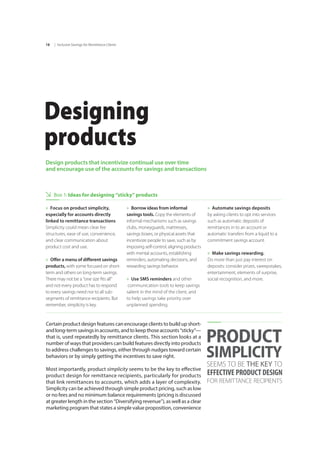
Box 1: Ideas for designing “sticky” products
Certain product design features can encourage clients to build up short-
andlong-termsavingsinaccounts,andtokeepthoseaccounts“sticky”—
that is, used repeatedly by remittance clients. This section looks at a
number of ways that providers can build features directly into products
to address challenges to savings, either through nudges toward certain
behaviors or by simply getting the incentives to save right.
Most importantly, product simplicity seems to be the key to effective
product design for remittance recipients, particularly for products
that link remittances to accounts, which adds a layer of complexity.
Simplicity can be achieved through simple product pricing, such as low
or no fees and no minimum balance requirements (pricing is discussed
at greater length in the section “Diversifying revenue”), as well as a clear
marketing program that states a simple value proposition, convenience
PRODUCT
SIMPLICITY
SEEMS TO BE THE KEY TO
EFFECTIVE PRODUCT DESIGN
FOR REMITTANCE RECIPIENTS
»» Focus on product simplicity,
especially for accounts directly
linked to remittance transactions
Simplicity could mean clear fee
structures, ease of use, convenience,
and clear communication about
product cost and use.
»» Offer a menu of different savings
products, with some focused on short-
term and others on long-term savings.
There may not be a “one size fits all”
and not every product has to respond
to every savings need nor to all sub-
segments of remittance recipients. But
remember, simplicity is key.
»» Borrow ideas from informal
savings tools. Copy the elements of
informal mechanisms such as savings
clubs, moneyguards, mattresses,
savings boxes, or physical assets that
incentivize people to save, such as by
imposing self-control, aligning products
with mental accounts, establishing
reminders, automating decisions, and
rewarding savings behavior.
»» Use SMS reminders and other	
communication tools to keep savings
salient in the mind of the client, and	
to help savings take priority over	
unplanned spending.
»» Automate savings deposits 	
by asking clients to opt into services
such as automatic deposits of
remittances in to an account or
automatic transfers from a liquid to a
commitment savings account.
»» Make savings rewarding.		
Do more than just pay interest on
deposits: consider prizes, sweepstakes,
entertainment, elements of surprise,
social recognition, and more.
19A Framework for Developing Innovations in Remittances and Savings | Designing products |
to make deposits and withdrawals, and simple account transactional
capability. The ability to withdraw is a particularly important aspect of
savings product design, and is discussed at greater length in the section
“Building access.” In addition, to achieve simplicity, a human-centered
design approach can help make products both simple and intuitive.
Involve communities and social networks
Often, the biggest challenge in designing formal savings products
for remittance senders and recipients is not competing with other
providers but rather rivaling cash-based informal savings tools. Many
of these tools involve communities and have developed over time to
address a variety of barriers to savings. Research shows that the poor
use a variety of financial tools, and that formal and informal products
are usually complementary, not substitutes (Collins et al., 2009). Informal
savings tools can offer valuable lessons about the features that clients
most care about in their savings products.
Perhaps the best example of an effective community-based savings
tool are savings clubs, or rotating savings and credit associations
(ROSCAs) and accumulating savings and credit associations (ASCAs).
Savings clubs are known by different names in different countries,
such as a san in the Dominican Republic, partners in Jamaica, and
tandas in Mexico. The groups encourage people to make contributions
to a shared pot on a regular basis, with one member taking the
balance of the pot during each meeting. In the case of ASCAs, some
of the funds accumulate, and can be stored or on-lent to members or
invested elsewhere. The design of savings groups, where everyone
must contribute, creates a number of incentives to save; for one, they
create a collective mechanism for individuals to practice self-control
in order attain their savings goals (Gugerty 2005).
Some financial service providers are incorporating this element of
collective self-control or social pressure into formal product design. For
example, Banco Azteca in Mexico has a product called the guardadito
tanda, in which a group of people each open an account and commit
to a certain savings target. Users earn a special interest rate on their
deposits only if every member keeps depositing. Otherwise, the
accounts automatically convert to basic savings accounts with a lower
interest rate (Martin 2014). In addition, many NGOs around the world
are now helping communities form savings groups, replicating ROSCAs
at greater scale and providing them with training in record-keeping
and group governance, as well as teaching best practices in on-lending
group funds for local investments (see Ashe 2012). Some NGOs are
starting to help link savings groups to financial institutions as a safer
place to store funds and gain access to other financial services.
Another way to boost savings is to encourage clients to make a public
commitment to save, replicating the social accountability mechanism
that works in groups, but in a non-binding way. For example, in an
experiment in Colombia, a researcher asked individuals in randomly
chosen savings clubs to name a specific purpose for their savings out
loud to other group members, while in other groups the members
also set a goal but only shared it privately with the researcher. It was a
soft commitment, but nonetheless the authors found that those who
SAVING CLUBS
EXAMPLE OF AN EFFECTIVE
COMMUNITY-BASED SAVINGS TOOL
| Inclusive Savings for Remittance Clients20
made a public commitment ended up accumulating 35% larger savings
balances than those who stated their savings goal privately, and were
21 percentage points more likely to achieve their savings goals (Salas
2014).1
Financial service providers and their partners could replicate this
sort of social accountability by helping clients share progress toward
their goals with friends and family—in group settings, through accounts
with shared access to online banking platforms for both migrants and
remittance recipients, text message reminders sent to friends or family,
linkages with social media, and more.
Label products to reflect clients’ mental accounting
Research in behavioral psychology suggests that our consumption and
savings decisions are not perfectly rational, but that we have a variety
of “behavioral biases” that influence us. One such bias is that we often
depend on our own “mental accounts” that we create for different
sources of income and spending (Thaler 1990). Specifically, we may
attach “labels” to different income or asset accounts, and spend or save
accordingly. The lesson for financial service providers is that they may
be able to incentivize clients to keep savings in an account by labeling
it with names that match mental accounts.
For example, many financial institutions in Latin America and the
Caribbean offer “commitment savings” accounts that are often labeled
according to specific client goals, such as Christmas savings, investment
in housing, or a child’s education expenses. These accounts require
clients to make regular deposits toward a target amount on a pre-
established schedule, such as $10 every month for a year, for a goal of
$120. When their goal is reached, the client is usually rewarded with
an incentive, such as a preferential interest rate, and can withdraw his
savings if he chooses. The name of the account may help to mirror
clients’ own mental accounting (for more on this topic, see Martin 2014).
For example, if the account is called the “housing savings” account, this
will help the client remember that they have earmarked that money
for home improvement. In this way, the account name may encourage
client not to withdraw the funds for unnecessary spending.
In another labeling example, a Filipino bank experimented with
renaming a traditional remittance product with a label that suggested
the use of the remittance was for their children’s education. By calling
the product “EduPay,” the average value of remittances sent increased
by 15 percent. When the bank enabled senders to make tuition
payments directly via remittances, average values increased by an
additional 2 percent (De Arcangelis et al., 2014).
Send reminders and communicate with clients regularly
Research has shown that SMS messages and other communication can
be effective in increasing clients’ savings balances and their attainment
of savings goals (Karlan et al., 2012). People have a finite amount of
1  The researcher did find that her intervention was not significant for individuals who only
purchased 0-2 shares in the first meeting (while others purchased many more), who she assumed
to be people with greater financial constraints. Making a public commitment to save was very
effective for those able to save 3 or more shares in the first meeting, for whom she concluded
the primary barrier to building up savings over the group savings cycle was not economic, but
instead behavioral or something else.
THAN THOSE WHO STATED THEIR SAVINGS GOAL PRIVATELY
CLIENTS WHO MADE PUBLIC COMMITMENT
35%LARGER SAVINGS
BALANCES
ACCUMULATED
INCENTIVIZE CLIENTS
TO KEEP SAVINGS
IN AN ACCOUNT
BY LABELING IT WITH NAMES
THAT MATCH MENTAL ACCOUNTS
WHEN SENT TO AN ACCOUNT
THAT WAS LABELED FOR A SPECIFIC USE
THE AVERAGE VALUE
OF REMITTANCES SENT
INCREASED
15%
21A Framework for Developing Innovations in Remittances and Savings | Designing products |
attention that we can devote to any given task. This “limited attention”
problem in human psychology often means that we forget to do things
(such as make savings deposits), even if we think they are important.
Reminders can bring our savings plans back to the forefront of our minds
and encourage savings behavior.
For example, in a series of experiments with savings clients at banks
in Bolivia, Peru, and the Philippines, researchers found that simple
reminders delivered by letter or text message, especially those that
mentioned clients’ specific savings goals and the benefits of savings
(either the goal attainment itself or a financial incentive offered by the
bank), were effective in increasing depositors’ savings balances by 6%
on average across all countries (Karlan et al., 2012).
The possibilities for message content are endless, and given the low cost
of SMS messages, individual institutions can test the effectiveness of
different content, timing, frequency, and degree of personalization by
randomly assigning different treatments to different groups of clients,
and then tracking changes in those clients’ savings and transaction
patterns. A few ideas for content include motivational messages about
an individual’s goals, or goals shared by migrants and other family
members, updates on progress toward a goal, and reminders about
any rewards linked to goal attainment.
In addition, messages could contain instructional content that
encourages clients to use accounts for transactions, and to make
withdrawals. Savings behavior is not just about depositing, but also
about the ability to withdraw in a convenient, trustworthy, and private
way. To support clients in their account usage, messages could contain
information about bill payment and withdraw rules and pricing, deposit
and withdraw locations, or how to receive remittances in an account, as
well as relevant “just-in-time” reminders that pop up on a client’s cell
phone just after making a transaction (such as a reminder to save just
after a client receives a remittance or alerts when balances fall below
a certain threshold).
Automate savings behaviors
Some people may place more value on present consumption than
future consumption, a phenomenon known as hyperbolic discounting,
meaning that they get more satisfaction spending a dollar today versus
saving it and receiving a larger payoff in the future. Even if a client has
made the decision to save, savings plans require constant attention
and regular actions that are often hard to maintain over time. When
financial service providers automate certain savings habits for clients,
they help clients overcome some of these potential barriers to saving.
For example, employers often automate contributions to retirement
funds for employees, deducting the savings from employees’ paychecks
before they even see it, which relieves employees of the tasks of
remembering to make their savings contributions, and of prioritizing
their savings goals over current consumption each month.
The success of automated retirement fund contributions has led many
financial service providers to try to capture remittances and other non-
employment income sources in accounts. For example, Banco Union
| Inclusive Savings for Remittance Clients22
in the Dominican Republic offers an account to clients where they can
receive remittances via direct deposit. Then, the bank asks clients to
opt into a service whereby 10% of their remittance account balance is
transferred to their savings account every month.
Savings product designers could also automate deposits by linking
them to other small and frequent payments, such as bill payment or
airtime purchases. Many microinsurance products around the world
have done this successfully. The challenge is to ensure transparency
and client knowledge about how to opt in, opt out, and check savings
balances, and to enable the client to have access to their savings.
An Open Debate:
Should remittances be deposited into accounts 		
to facilitate the automation of savings?
When marketing savings products to remittance recipients, financial service providers in Latin America
and the Caribbean often focus on promoting the direct deposit of remittance payments into accounts. The
benefits of receiving international remittances directly in a bank account, with an accompanying card or
mobile money account, can be enormous for both the institution and the client. However, the experience of
many institutions indicates that a singular focus on what we might call “banking the remittance” is misguided,
and that a holistic approach to “banking the person” can be more fruitful.
For the customer, the benefits of receiving remittances—or other payments, such as salaries or social welfare
payments—directly in an account include privacy and the opportunity to automatically set aside a portion
of that income for savings before it becomes cash. FSPs, on the other hand, would like to ensure a reliable
stream of deposits and high average balances. However, remittances have unique characteristics that make
their management different from automatic deposits of salary or government payments.
There are several hurdles to automating remittance deposits into accounts, including: (1) the fact that migrant
remittance senders have a wide range of sending options and are not always loyal to one channel, (2)
the possibility that remittance transfers can be lumpy and irregular, and (3) challenges in working with
multiple partners to integrate IT platforms to make the mechanics of an automatic deposit possible. It
appears that remittances originating in accounts, such as online-based account-to-account remittances,
can help automate the process further, by storing recipient account information for future transfers, but the
problem of channel loyalty still holds.
Moreover, there is evidence that the savings balances of remittance recipients do not come entirely from
remittances. For example, Banco Familiar in Paraguay has been very successful in capturing savings deposits
frombothremittancesendersandrecipients,andwhilemigrantsfundtheiraccountsentirelywithremittances
sent from abroad, their families back home make deposits in other ways, with only 30% of their deposits
coming from remittances (Navarrete 2014). To help remittance recipients save, FSPs and their partners may
need to develop approaches that consider that many of their clients have multiple income sources as well
stocks of savings they have built up elsewhere, whatever the original source.
Should Latin American and Caribbean FSPs find innovative ways around these challenges, promoting
account-based transfers on the send side that make automation a little easier—or should they focus instead
on building remittance recipients’ savings in other ways that don’t require direct deposit?
23A Framework for Developing Innovations in Remittances and Savings | Designing products |
Offer rewards and make savings fun
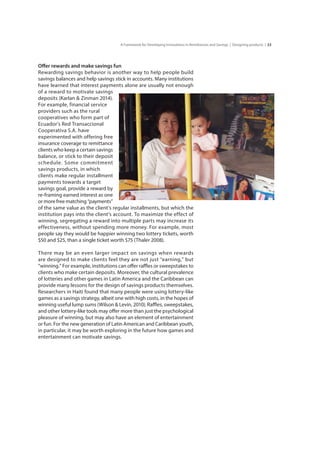
Rewarding savings behavior is another way to help people build
savings balances and help savings stick in accounts. Many institutions
have learned that interest payments alone are usually not enough
of a reward to motivate savings
deposits (Karlan & Zinman 2014).
For example, financial service	
providers such as the rural	
cooperatives who form part of	
Ecuador’s Red Transaccional	
Cooperativa S.A. have	
experimented with offering free
insurance coverage to remittance
clients who keep a certain savings
balance, or stick to their deposit
schedule. Some commitment
savings products, in which	
clients make regular installment
payments towards a target 	
savings goal, provide a reward by
re-framing earned interest as one
or more free matching “payments”
of the same value as the client’s regular installments, but which the
institution pays into the client’s account. To maximize the effect of
winning, segregating a reward into multiple parts may increase its
effectiveness, without spending more money. For example, most
people say they would be happier winning two lottery tickets, worth
$50 and $25, than a single ticket worth $75 (Thaler 2008).
There may be an even larger impact on savings when rewards
are designed to make clients feel they are not just “earning,” but
“winning.” For example, institutions can offer raffles or sweepstakes to
clients who make certain deposits. Moreover, the cultural prevalence
of lotteries and other games in Latin America and the Caribbean can
provide many lessons for the design of savings products themselves.
Researchers in Haiti found that many people were using lottery-like
games as a savings strategy, albeit one with high costs, in the hopes of
winning useful lump sums (Wilson & Levin, 2010). Raffles, sweepstakes,
and other lottery-like tools may offer more than just the psychological
pleasure of winning, but may also have an element of entertainment
or fun. For the new generation of Latin American and Caribbean youth,
in particular, it may be worth exploring in the future how games and
entertainment can motivate savings.
| Inclusive Savings for Remittance Clients24
Understanding
clients’financial lives
Help clients make lasting changes in the way they manage
their household budgets to create opportunities for saving
By definition, saving money requires that households adjust their
cash flows so that expenditures are less than income. But, for most
people, this is easier said than done. Building up lump sums of
money over time requires changes in the ways that households
manage their money, and constant attention to setting aside
savings and avoiding impulse purchases. While there is a lot that
a well-designed savings product can do to incentivize savings
behaviors (described in the previous section), product design can
only go so far. The client has the ultimate responsibility to save, but
humans face multiple behavioral biases that may make it difficult
to maintain regular savings habits (see Box 2). Financial service
providers can integrate different tools or interventions into the
design and delivery of financial products which may be effective in
helping clients to develop household budgets that include savings,
and stick to those budgets over time.
Box2:Addressing behavioral biases that may impact savings
Focus on product simplicity,
especially for accounts directly
linked to remittance transactions.
Simplicity could mean clear fee
structures, ease of use, convenience,
and clear communication about
product cost and use.
»» Overvaluing the present,
rather than saving for the future.
Help clients set concrete savings 	
goals, which help overcome this bias
toward today’s spending.
Giving into temptations easily,	
spending instead of saving. 	
Help clients impose self-control by
designing products that involve peer
pressure to save, and give clients tools
to track spending and goal progress.
»» Gravitating towards inaction
when there are many alternatives.
Help clients reduce savings “decision
fatigue” by automating savings
deposits, and motivating clients
through financial education linked with
actionable ways to save.
»» Treating money as if it were not
convertible, using “mental accounts"
in which certain income goes to
certain expenses without ear-
marking for savings – Help clients
save by labeling accounts for
specific purposes to discourage early
withdrawal.
Source: Xavier Martin, Inclusive Commitment Savings in Latin America and the Caribbean
(Washington, D.C.: Multilateral Investment Fund, Inter-American Development Bank, March 2014).
25A Framework for Developing Innovations in Remittances and Savings | Understanding clients’financial lives |
Help clients set concrete savings goals
Research suggests that when consumers set concrete goals, they are
more likely to perform the tasks required to achieve them. Helping
clients set goals for their savings can lead to behavior modification and
savings mobilization (see Ashraf et al., 2006).
There are several ways that an FSP can build in goal setting as a product
feature. For example, CARD Bank in the Philippines found that adding
visualiconsrepresentingasetofpre-definedsavingsgoalstoanaccount
enrollment form led to a 34% increase in savings balances (Grameen
Foundation 2014). Staff encouraged clients to establish a savings goal,
check the corresponding goal on the enrollment form, and sign a non-
binding commitment to the goal. This, along with other product tweaks,
led to initial deposits that were 15% higher for a randomly selected
group of branches than a control group. Moreover, these clients made
more frequent subsequent deposits and smaller withdrawals.
To keep moving towards goal achievement, an individual must stay
committed and receive feedback on progress toward the goal (Locke
& Latham 2006). To help its remittance recipient clients do this, Banco
Union in the Dominican Republic integrated clients’ savings goals into
its core management information system. This helps customer service
representatives remind clients about their goals, and enables the bank
to send text message reminders to clients about goal progress. Around
theworld,onlinebankingapplicationsalsoprovidegoal-settingtoolsfor
clients to track progress on their own, and some mobile applications are
making these tools more widely available to clients via SMS messaging
on basic mobile phones.
To be most effective in modifying behavior, goals must be concrete
and attainable. The commitment savings products described in the
previous section help clients set and achieve measureable savings
goals that are concrete. Clients must specify the target amount and
the amount and frequency of deposits, concrete measures of the
goal. Moreover, commitment savings products enable clients to track
progress toward a goal very easily, as the entire balance of the account
is intended for the goal, as opposed to a multi-purpose savings account
that may contain some short- and some long-term savings. Here, there
is an opportunity to work transnationally, engaging both migrants and
remittance recipients in setting and tracking savings goals (see page
35, “Look to remittance senders for new markets.”)
Provide financial education, linked to actionable ways to save
The concept of financial education is broad, referring to programs
as diverse as classroom-based training sessions, one-on-on advisory
services, mass media campaigns, “edutainment” such as soap opera
episodes with financial lessons, and content delivered to individual
clientsthroughtechnologylikeSMStextmessages(Perez2012).Financial
education appears to be most effective in boosting formal savings when
linked with a product offer, such as an actionable opportunity to open
an account and set up savings goals (Deb & Kubzansky 2012).
Avarietyoffinancialeducationmodelshavebeenusedtoreachmigrants
and remittance recipients. For example, the Inter-American Dialogue’s
| Inclusive Savings for Remittance Clients26
“remittance intercept” model provides one-on-one financial advisory
services from financial institution staff to remittance recipients when
they sendorpickuptheirmoney.Thelocationandtimingofthefinancial
educationprovidestherecipientwiththeopportunitytoactimmediately,
such as by inquiring about product features, opening an account, or
saving a portion of their remittance. Similarly, another organization,
Microfinance Opportunities, has developed programs that educate
customers through encounters they have with frontline staff who exist
primarily for non-educational purposes, leveraging existing consumer
contact points and “teachable moments” to deliver financial education.
Programs need not only target remittance recipients, but can also focus
on migrants abroad. For example, in Indonesia, researchers found that
a pre-departure financial education program targeted both to migrant
domestic workers and their family members who would stay behind led
to increased savings when the worker had migrated and was sending
remittances (Doi et al., 2012).2
Promoting the financial education of transnational households is
important, and there is space for both socially-motivated NGO- or
government-led models as well as for-profit models delivered by MTOs,
financial service providers, and other companies. There remains much
to learn about what makes financial education work and which models
are most cost-effective (see Box 3).
2  Interestingly, in their experiment, providing financial education to just the migrant or just their
family did not have a noticeable impact on savings. Instead, only a combined education session
had a statistically significant effect on savings.
»» Conduct market research on
remittance senders and recipients’
demand for financial education,
delivery preferences, and what content
they want and need to learn. Engage
both sides of transnational households
in financial education, reaching out to
family members in Latin America and
the Caribbean as well as migrants.
»» Analyze the cost-effectiveness of
various financial education models
»» Specify measures 		
of effectiveness in areas such as:
»» Higher savings balances
and/or other asset building
»» Positive debt management
»» More informed customers,
knowledge of financial products
»» Customer loyalty and retention,
and product cross-sales
»» Usage of electronic payments
»» Other measures of effectiveness
»» Tease out what causal 		
mechanisms make financial 	
education effective:
»» Is it the content of instruction?
»» Motivation from an inspiring
authority or role model?
»» Facilitating an action step,
such as account opening or opting
in to automated savings deposits?
»» Peer or other social pressures?
»» Empowerment or practice 	
asserting one’s rights?
»» Ability to put into practice
information received?
Box 3: Future steps for financial education research and delivery
Integrate budgeting tools into account services 			
to improve short-term money management
To prioritize future savings goals over today’s needs and temptations,
one must either set aside savings first when wages, remittances, or other
money comes in, or have the discipline to keep other spending under
control to leave a surplus for savings. Limiting spending to prioritize
savings is difficult, but there are a variety of ways that financial service
27A Framework for Developing Innovations in Remittances and Savings | Understanding clients’financial lives |
providers can help households do
so. Specifically, tools that assist
clients in tracking where they are
spending money and help them
set their own budget, monitor
their adherence to the budget,
and stick to it, can help clients to
save more income.
For example, online banking	
platforms and independent	
websites such as Guia Bolso in	
Brazil offer tools to establish a	
budget, track spending, and	
provide feedback on adherence
to the budget. For clients without
Internet access, there are some
simple services that can also be
delivered to clients who own
a basic mobile phone, such as
sending text message updates to
clients about their expenditures
in different categories, but results on the effectiveness of these tools
are not yet in.3
Another way to help clients save more money is to help them avoid
unnecessary fees by carefully managing their financial obligations, such
as loan payments, utility bills, and other regular payments. For example,
providers can send reminders about bill due dates, with information
about late fees and bill pay modalities. For savings accounts that may
have usage limits (such as a minimum balance requirement, maximum
transaction size limits, or a limited number of ATM withdrawals
permitted per month), institutions can help clients avoid punitive fees
by sending reminders about their specific account usage and limits.
Budgeting tools are very important for helping accustom clients to
using formal liquid deposit accounts, especially for clients who are
used to managing their money in cash. Cash has a number of features
which enable budgeting, such as the fact that it can be counted,
touched, and stored in different places, such as in colored envelopes,
under the mattress, or in different pockets of a wallet, according to
different spending categories and limits. While these devices have
their drawbacks for savings, they certainly provide tangible reminders
for budgeting purposes. To help clients manage money in formal
accounts, financial service providers have the opportunity to provide
budgeting tools that mimic or improve upon the convenience of cash
for budgeting purposes.
3  At the very least, financial service providers ought to make balance inquiries and transaction
records readily available to clients; this is essential to helping clients with short-term money
management. These can be available via a text message interface, online, or at branch or agent
locations. Budgeting innovations need not be entirely tech-based. For examples, many banks in
well-developed financial markets in East Asia still offer clients printed savings passbooks, but have
added passbook update machines in ATMs, so clients can print updated transaction line items in
their passbook without congesting branch offices.
| Inclusive Savings for Remittance Clients28
Building access
Keep accounts active by bringing the ability to transact
—such as cashing out remittances or making deposits—
closer to remittance clients
The agents of remittance payout institutions in Latin America and
the Caribbean have deepened their reach exponentially over the last
decade, but clients’ ability to make savings account transactions such
as depositing or withdrawing money from an account has until recently
been limited to traditional banking channels, such as branches and
ATMs. One of the biggest challenges facing financial service providers
(FSPs) in Latin America and the Caribbean who offer savings accounts
to remittance recipients and other low-income customers has been
providing convenient, affordable, and secure means to deposit,
withdraw, and transact with those accounts. Moreover, there is the
geographic challenge of providing branch and ATM infrastructure in
sparsely populated rural areas. As a case in point, there are only 14.5
bank branches per 100,000 people in Latin America and the Caribbean,
compared to 35.7 branches in the United States (Armijo et al., 2013). Even
where banking channels are available in close geographic proximity,
however, serving low-income clientele was not the traditional focus of
many commercial banks in the region for many years.
This section focuses on innovations in customer acquisition and service
delivery that enable FSPs to better provide services to low-income
customers, including remittance recipients, by bringing down the costs
of these accounts as well as by bringing services closer to the client.
Box 4: Action steps to deepen cash-in and cash-out access
»» Partner with other financial
services providers, or agent
network managers, to develop
banking correspondent or agent
networks.
»» Link into existing banking
correspondent and/or mobile
money agent networks.
»» Test different models for
compensating agents, to align their
incentives with the savings goals of
clients and financial service providers.
»» Help agents with best practices
in liquidity management.
»» Consider innovations that bring
deposit services closer to clients in
the cash economy,
such as by collecting clients’ savings 	
deposits at home or by partnering 	
with savings clubs.
29A Framework for Developing Innovations in Remittances and Savings | Building access |
Increase customer access to deposit 				
and withdrawal services via correspondent agents
No matter how much an institution does to provide remittance
recipients with training or incentives to save, if clients don’t have
access to their accounts, they will not save in them. One solution to the
access problem is the development of banking correspondent models.
Many countries in Latin America and the Caribbean are now enabling
traditional branch- and ATM-based services to be performed at small
neighborhood shops, large retailers, supermarkets, pharmacies, and
other stores that are affiliated into a bank’s network. From a financial
services provider’s perspective, these correspondent networks are a
business model that can reduce the costs of providing savings accounts
to low-income customers, reducing per-transaction costs from US$1.00
to as low as US$0.30 (Armijo et al., 2013). Savings accounts accessible
via these correspondent networks can enable remittance recipients to
manage their accounts in a more convenient way. Even customers who
do live near a bank branch may be more conveniently served through
the stores where they already shop, and which may have extended
hours of service. In Latin America and the Caribbean, these networks
typically use cards as the form of payment. A small but increasing
number of correspondent agent networks are associated with a mobile
operator, or with both card- and mobile-based payments.
Much remains to be done for banking correspondent networks to
grow and to incentivize customers to use them. For example, some
networks still have limited services available and offer certain payments
but do not permit savings deposits or withdrawals through an agent
yet (Armijo et al., 2013). Moreover, network managers are still figuring
out how to best align agent incentives with those of the bank and the
customer, to promote savings account transactions.
Open savings accounts remotely, not just in branches
Institutions based in Latin America and the Caribbean face a number
of hurdles to marketing formal savings accounts to remittance senders
and recipients. Customer acquisition can be a complex and costly
exercise, but there are innovations that can bring down costs and
simplify the process.
Box 5: Ideas for smooth client onboarding
through alternative distribution channels
»» Create a “frictionless”
onboarding experience for
customers, leveraging partnerships,
technology, and regulatory regimes
to reduce requirements for account
opening.
»» Establish a one-stop shop 	
for account opening, distributing
prepaid cards or debit cards through
staff or agents at the time of account
opening, rather than delivering the
payment instrument later.
»» Take care when choosing
minimum deposit amounts, basing
decisions on market research to
determine how high is too high, with
the caveat that a low value could
mentally “anchor” customers to a low
savings target.
»» Leverage the “teachable
moments” that happen across
channels, such as when a customer
sends or receives a remittance, to
market other products and services
or reinforce information about
existing ones.
| Inclusive Savings for Remittance Clients30
Often, local regulations on account opening, such as who can open
accounts and Know Your Customer documentation requirements,
present barriers to opening accounts for remittance recipients. Like
many low-income customers, many remittance recipients have a hard
time providing proof of income (other than remittances) that some
banks require, letters of reference, or other requirements. Regulatory
environments that allow relaxed requirements for Know Your Customer
(KYC) documentation may be helpful, especially to allow accounts to be
opened via a mobile phone, or in a “remittance intercept” model that
seizes the opportunity to sell an account when a customer comes in
to receive a cash remittance. To better reach traditionally unbanked
customers, some countries have introduced regulations that permit
financial institutions to open certain types of accounts (known as
simplified accounts, basic accounts, and other names in different
countries) with fewer KYC requirements but strict transaction limits and
maximum balances. Some regulations stipulate several tiers of accounts,
with higher transaction and balance allowances when customers
provide additional KYC information (Armijo et al., 2013). These accounts
do imply their own challenges to overcome, however, such as collecting
additional KYC documents when a client is ready to graduate to the next
tier of account activity and ensuring that clients understand transaction
limits and don’t incur punitive charges if they exceed them.
Often, the lowest tiers of these simplified accounts can be opened
through non-traditional channels, such as through banking
correspondent agents or on a mobile phone. Opening accounts at
correspondents such as pharmacies, supermarkets, retailers and
convenience stores, can bring down costs and facilitate marketing.
To provide further access to savings services to remittance recipients,
regulations that permit a range of non-bank financial institutions to
capture savings can go a long way toward bringing savings accounts
closer to customers.
Improve merchant acceptance of non-cash transactions
Without widespread merchant acceptance of electronic payments,
there will be little incentive for remittance senders or recipients to
deposit short-term savings into accounts. Or, when remittances are
sent directly to accounts, recipients will withdraw them in cash quickly.
The expansion of merchant acceptance of cards and other non-cash
payments can enable all customers, including remittance recipients, to
maintain short-term account balances and make electronic payments
instead of converting remittances to cash.
Building out merchant acceptance and incentivizing clients to use card-
based and other non-cash payments has often been a challenging
endeavor. Incentivizing remittance recipients to transact with cards or
electronic money rather than with cash requires much more than just
making points of sale more convenient. The following section begins by
looking at how pricing affects customer behavior. Getting the pricing,
such as transaction fees, right for all players (financial service providers,
merchants and customers) is essential to make non-cash payments
more attractive than cash payments.
Consumer preferences also have an impact on the conversion from
cash payments to electronic payments. For example, Microfinance
Opportunities (MFO) found that customers were not comfortable
making the transition from paying bills such as utilities and loan
installmentsinpersontopayingthemwithelectronicmoney.Customers
wanted a paper receipt as proof of payment, as recourse to resolve
potential grievances. As a response, MFO developed an automated text
message response with content that contained many of the features of
a receipt – date of payment, name of customer, amount, thank you, etc.
that helped create trust and reduce perceptions of risk. Innovations like
this are needed to win customers’ trust in non-cash channels.
Rewards for using non-cash payments need not require much spending
on the part of the financial service provider. For example, in the United
States, Bank of America’s “Keep the Change” program was designed to
incentivize debit card use by automatically rounding up all debit card
purchases to the nearest dollar and transferring the difference (less than
$1) from a client’s checking and savings account. This program adds
value for the client by helping to automate savings behaviors, which are
triggered by everyday transactions. This, in turn, encourages clients to
use their card to make payments instead of using cash, thus increasing
interchange fee revenue for the bank.
| Inclusive Savings for Remittance Clients32
Diversifying
revenue
Develop financially sustainable savings services
for remittance clients
Many of the innovations in account access described in the previous
section, such as banking correspondent networks, can greatly reduce
the cost of providing savings accounts to remittance recipients and
other low-income customers, helping to improve the profitability of
low-balance savings accounts for financial service providers. Moreover,
these lower-cost channels provide the foundation upon while savings
services can be scaled to a wider number of clients, bringing down the
marginal costs of transactions.
Beyond cost reductions, there are a number of revenue generation
opportunities that financial service providers can look to when
providing savings accounts to remittance recipients. Box 6 lists a
number of potential revenue streams, and the following sections focus
on important considerations for setting account pricing for products
targeted to transnational households, cross-selling to remittance
recipients, and selling services to migrants abroad.
Box 6: Potential revenue streams
An all-in costing and revenue
model, rather than a product-centric
approach, looks at the lifetime value
and costs of serving a customer.
Possible revenue sources from
remittance and savings clients include:
»» Fees and commissions on
transfers, airtime purchases, and bill
payments (as well as possibly on
deposits and withdrawals)
»» Revenue from card interchange
fees or other commissions on
purchases
»» Account maintenance fees
(with caution that high fees 		
can discourage use)
»» Premiums from cross-selling
insurance products to remittance
customers
»» Revenue from cross-selling credit
products to remittance customers
»» Commissions from referring
customers to other businesses
»» Interest income through financial
intermediation (lending out savings
deposits to other clients)
33A Framework for Developing Innovations in Remittances and Savings | Diversifying revenue |
Set account pricing with clients’ income and behavior in mind
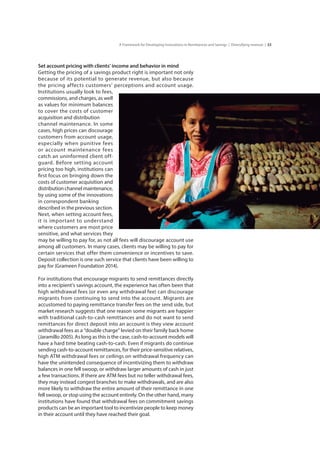
Getting the pricing of a savings product right is important not only
because of its potential to generate revenue, but also because
the pricing affects customers’ perceptions and account usage.
Institutions usually look to fees,
commissions, and charges, as well
as values for minimum balances
to cover the costs of customer
acquisition and distribution 	
channel maintenance. In some
cases, high prices can discourage
customers from account usage,
especially when punitive fees
or account maintenance fees
catch an uninformed client off-
guard. Before setting account
pricing too high, institutions can
first focus on bringing down the
costs of customer acquisition and
distribution channel maintenance,
by using some of the innovations
in correspondent banking	
described in the previous section.
Next, when setting account fees,
it is important to understand
where customers are most price
sensitive, and what services they
may be willing to pay for, as not all fees will discourage account use
among all customers. In many cases, clients may be willing to pay for
certain services that offer them convenience or incentives to save.
Deposit collection is one such service that clients have been willing to
pay for (Grameen Foundation 2014).
For institutions that encourage migrants to send remittances directly
into a recipient’s savings account, the experience has often been that
high withdrawal fees (or even any withdrawal fee) can discourage
migrants from continuing to send into the account. Migrants are
accustomed to paying remittance transfer fees on the send side, but
market research suggests that one reason some migrants are happier
with traditional cash-to-cash remittances and do not want to send
remittances for direct deposit into an account is they view account
withdrawal fees as a “double charge” levied on their family back home
(Jaramillo 2005). As long as this is the case, cash-to-account models will
have a hard time beating cash-to-cash. Even if migrants do continue
sending cash-to-account remittances, for their price-sensitive relatives,
high ATM withdrawal fees or ceilings on withdrawal frequency can
have the unintended consequence of incentivizing them to withdraw
balances in one fell swoop, or withdraw larger amounts of cash in just
a few transactions. If there are ATM fees but no teller withdrawal fees,
they may instead congest branches to make withdrawals, and are also
more likely to withdraw the entire amount of their remittance in one
fell swoop, or stop using the account entirely. On the other hand, many
institutions have found that withdrawal fees on commitment savings
products can be an important tool to incentivize people to keep money
in their account until they have reached their goal.
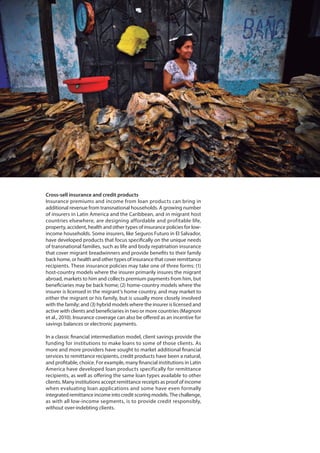
Cross-sell insurance and credit products
Insurance premiums and income from loan products can bring in
additional revenue from transnational households. A growing number
of insurers in Latin America and the Caribbean, and in migrant host
countries elsewhere, are designing affordable and profitable life,
property, accident, health and other types of insurance policies for low-
income households. Some insurers, like Seguros Futuro in El Salvador,
have developed products that focus specifically on the unique needs
of transnational families, such as life and body repatriation insurance
that cover migrant breadwinners and provide benefits to their family
back home, or health and other types of insurance that cover remittance
recipients. These insurance policies may take one of three forms: (1)
host-country models where the insurer primarily insures the migrant
abroad, markets to him and collects premium payments from him, but
beneficiaries may be back home; (2) home-country models where the
insurer is licensed in the migrant’s home country, and may market to
either the migrant or his family, but is usually more closely involved
with the family; and (3) hybrid models where the insurer is licensed and
active with clients and beneficiaries in two or more countries (Magnoni
et al., 2010). Insurance coverage can also be offered as an incentive for
savings balances or electronic payments.
In a classic financial intermediation model, client savings provide the
funding for institutions to make loans to some of those clients. As
more and more providers have sought to market additional financial
services to remittance recipients, credit products have been a natural,
and profitable, choice. For example, many financial institutions in Latin
America have developed loan products specifically for remittance
recipients, as well as offering the same loan types available to other
clients. Many institutions accept remittance receipts as proof of income
when evaluating loan applications and some have even formally
integrated remittance income into credit scoring models. The challenge,
as with all low-income segments, is to provide credit responsibly,
without over-indebting clients.
35A Framework for Developing Innovations in Remittances and Savings | Diversifying revenue |
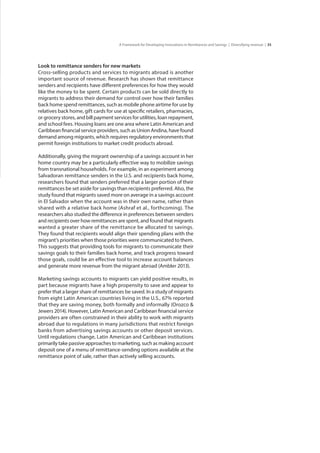
Look to remittance senders for new markets
Cross-selling products and services to migrants abroad is another
important source of revenue. Research has shown that remittance
senders and recipients have different preferences for how they would
like the money to be spent. Certain products can be sold directly to
migrants to address their demand for control over how their families
back home spend remittances, such as mobile phone airtime for use by
relatives back home, gift cards for use at specific retailers, pharmacies,
or grocery stores, and bill payment services for utilities, loan repayment,
and school fees. Housing loans are one area where Latin American and
Caribbean financial service providers, such as Union Andina, have found
demand among migrants, which requires regulatory environments that
permit foreign institutions to market credit products abroad.
Additionally, giving the migrant ownership of a savings account in her
home country may be a particularly effective way to mobilize savings
from transnational households. For example, in an experiment among
Salvadoran remittance senders in the U.S. and recipients back home,
researchers found that senders preferred that a larger portion of their
remittances be set aside for savings than recipients preferred. Also, the
study found that migrants saved more on average in a savings account
in El Salvador when the account was in their own name, rather than
shared with a relative back home (Ashraf et al., forthcoming). The
researchers also studied the difference in preferences between senders
and recipients over how remittances are spent, and found that migrants
wanted a greater share of the remittance be allocated to savings.
They found that recipients would align their spending plans with the
migrant’s priorities when those priorities were communicated to them.
This suggests that providing tools for migrants to communicate their
savings goals to their families back home, and track progress toward
those goals, could be an effective tool to increase account balances
and generate more revenue from the migrant abroad (Ambler 2013).
Marketing savings accounts to migrants can yield positive results, in
part because migrants have a high propensity to save and appear to
prefer that a larger share of remittances be saved. In a study of migrants
from eight Latin American countries living in the U.S., 67% reported
that they are saving money, both formally and informally (Orozco &
Jewers 2014). However, Latin American and Caribbean financial service
providers are often constrained in their ability to work with migrants
abroad due to regulations in many jurisdictions that restrict foreign
banks from advertising savings accounts or other deposit services.
Until regulations change, Latin American and Caribbean institutions
primarily take passive approaches to marketing, such as making account
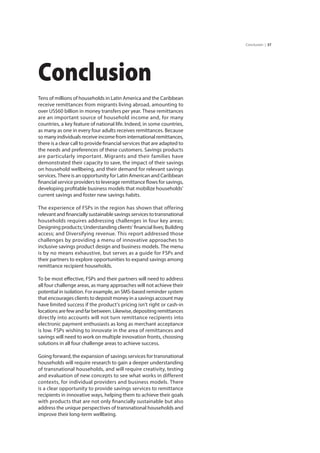
deposit one of a menu of remittance-sending options available at the
remittance point of sale, rather than actively selling accounts.
37Conclusion |
Conclusion
Tens of millions of households in Latin America and the Caribbean
receive remittances from migrants living abroad, amounting to
over US$60 billion in money transfers per year. These remittances
are an important source of household income and, for many
countries, a key feature of national life. Indeed, in some countries,
as many as one in every four adults receives remittances. Because
so many individuals receive income from international remittances,
there is a clear call to provide financial services that are adapted to
the needs and preferences of these customers. Savings products
are particularly important. Migrants and their families have
demonstrated their capacity to save, the impact of their savings
on household wellbeing, and their demand for relevant savings
services. There is an opportunity for Latin American and Caribbean
financial service providers to leverage remittance flows for savings,
developing profitable business models that mobilize households’
current savings and foster new savings habits.
The experience of FSPs in the region has shown that offering
relevantandfinanciallysustainablesavingsservicestotransnational
households requires addressing challenges in four key areas;
Designing products; Understanding clients’ financial lives; Building
access; and Diversifying revenue. This report addressed those
challenges by providing a menu of innovative approaches to
inclusive savings product design and business models. The menu
is by no means exhaustive, but serves as a guide for FSPs and
their partners to explore opportunities to expand savings among
remittance recipient households.
To be most effective, FSPs and their partners will need to address
all four challenge areas, as many approaches will not achieve their
potential in isolation. For example, an SMS-based reminder system
that encourages clients to deposit money in a savings account may
have limited success if the product’s pricing isn’t right or cash-in
locationsarefewandfarbetween.Likewise,depositingremittances
directly into accounts will not turn remittance recipients into
electronic payment enthusiasts as long as merchant acceptance
is low. FSPs wishing to innovate in the area of remittances and
savings will need to work on multiple innovation fronts, choosing
solutions in all four challenge areas to achieve success.
Going forward, the expansion of savings services for transnational
households will require research to gain a deeper understanding
of transnational households, and will require creativity, testing
and evaluation of new concepts to see what works in different
contexts, for individual providers and business models. There
is a clear opportunity to provide savings services to remittance
recipients in innovative ways, helping them to achieve their goals
with products that are not only financially sustainable but also
address the unique perspectives of transnational households and
improve their long-term wellbeing.
| Inclusive Savings for Remittance Clients38
Bibliography
Aggarwal, Reena, Asli Demirguc-Kunt, and Maria Soledad Martinez Peria. Do Workers’ Remittances Promote
Financial Development?, World Bank Policy Research Working Paper No. 3957 (The World Bank Development
Research Group Finance and Private Sector Development Team, July 2006) (July 1, 2006).
Ambler, Kate. Don’t Tell on Me: Experimental Evidence of Asymmetric Information in Transnational Households.
International Food Policy Research Institute, October 2013.
Armijo de Vega, Rodrigo et al. Banca Corresponsal E Inclusión Financiera: Modelos de Negocio En América
Latina. Washington, D.C.: Multilateral Investment Fund, Inter-American Development Bank, September 2013.
Ashe, Jeffrey. Deep Outreach Financial Inclusion: Savings Groups for Those Microfinance Cannot Reach.
Boston: Oxfam America, November 2012.
Ashraf, Nava, Diego Aycinena, Claudia Martínez A., and Dean Yang. Savings in Transnational Households: A
Field Experiment among Migrants from El Salvador, forthcoming.
Ashraf, Nava, Dean Karlan, and Wesley Yin. Tying Odysseus to the Mast: Evidence from a Commitment Savings
Product in the Philippines. The Quarterly Journal of Economics (2006) 121 (2): 635-672.
Collins, Daryl, Jonathan Morduch, Rutherford Stuart, and Orlanda Ruthven. Portfolios of the Poor: How the
World’s Poor Live on $2 a Day. Princeton: Princeton University Press, 2009.
De Arcangelis, Giuseppe, Majlinda Joxhe, David McKenzie, Erwin Tiongson, and Dean Yang. Directing
Remittances to Education with Soft and Hard Commitments: Evidence from a Lab-in-the-Field Experiment and
New Product Take-up among Filipino Migrants in Rome. Policy Research Working Paper. Washington, D.C.:
The World Bank Development Research Group Finance and Private Sector Development Team, May 2014.
Deb, Anamitra, and Mike Kubzansky. Bridging the Gap: The Business Case for Financial Capability. Monitor
Inclusive Markets and Citi Foundation, March 2012.
Demirguc-Kunt, Asli, and Leora Klapper. Measuring Financial Inclusion: The Global Findex Database. Policy
Research Working Paper. The World Bank Development Research Group Finance and Private Sector
Development Team, April 2012.
Grameen Foundation. Applying Behavioral Economics to Improve Microsavings Outcomes, February 2014.
Gugerty, M. You Can’t Save Alone: Commitment in Rotating Savings and Credit Associations in Kenya. Seattle,
WA: University of Washington, January 2005.
Hall, Joan. “Ten Years of Innovation in Remittances: Lessons Learned and Models for the Future.” Multilateral
Investment Fund, Inter-American Development Bank, January 2010.
Jaramillo, Maria. "Leveraging the Impact of Remittances through Microfinance Products: Perspectives from
Market Research." Beyond Small Change: Making Migrant Remittances Count, Ed. Terry, Donald and Steven
Wilson. Washington DC: Inter-American Development Bank, 2005.
Karlan, Dean et al. Getting to the Top of Mind: How Reminders Increase Saving, New Haven: Innovations for
Poverty Action, March 2012.
39Bibliography |
Karlan, Dean and Jonathan Zinman. Price and Control Elasticities of Demand for Savings. New Haven:
Innovations for Poverty Action, January 2014.
Locke, Edwin A., and Gary P. Latham. “New Directions in Goal-Setting Theory.” Current Directions In
Psychological Science 15, no. 5 (2006): 265–68.
Magnoni, Barbara, Annette Lavoi, Julia Brown, and Rebecca Thornton. “Risks across Borders: A Study of
the Potential of Microinsurance Products to Help Migrants Cope with Cross Border Risks.” Inter-American
Development Bank, September 2010.
Maldonado, René, and Maria Luisa Hayem. Remittances to Latin America and the Caribbean in 2013: Still Below
Pre-Crisis Levels. Washington, D.C.: Multilateral Investment Fund, Inter-American Development Bank, 2014.
Martin, Xavier. Inclusive Commitment Savings in Latin America and the Caribbean. Washington, D.C.:
Multilateral Investment Fund, Inter-American Development Bank, March 2014.
Moser, Caroline O. N., ed. Reducing Global Poverty: The Case for Asset Accumulation. Washington, D.C.:
Brookings Institution Press, 2007.
Multilateral Investment Fund. “Remittances to Latin America and the Caribbean.” Accessed August 28, 2014.
http://www.fomin.org/en-us/home/knowledge/developmentdata/remittances.aspx.
Navarrete, Juan. Remittances and Savings: The Case of Banco Familiar. Washington, D.C.: Multilateral
Investment Fund, Inter-American Development Bank, July 2014.
Orozco, Manuel, and Mariellen Jewers. Economic Status and Remittance Behavior Among Latin American
and Caribbean Migrants in the Post-Recession Period. Washington, D.C.: Multilateral Investment Fund, Inter-
American Development Bank, April 2014.
Perez, Avril. Financial Education: A Path Towards Inclusion. Washington, D.C.: Multilateral Investment Fund,
Inter-American Development Bank, November 2012.
Pugliese, Anita, and Julie Ray. “Three Percent Worldwide Get International Remittances; In 35 Countries,
10% of More Report This Type of Help.” Gallup World. May 6, 2011.
“Remittances to Latin America and the Caribbean.” Multilateral Investment Fund, Inter-American
Development Bank. Accessed August 28, 2014. http://www.fomin.org/en-us/home/knowledge/
developmentdata/remittances.aspx.
Rutherford, Stuart. The Poor and Their Money. New Delhi: Oxford University Press, 2000.
Salas, Luz Magdalena. Public vs. Private Mental Accounts: Experimental Evidence from Savings Groups in
Colombia. Graduate Center, City University of New York. Accessed July 29, 2014. http://www.pro-savings.
org/sites/default/files/Paper%20-%20Luz%20Salas.pdf.
Thaler, Richard H. “Anomalies: Saving, Fungibility, and Mental Accounts.” Journal of Economic Perspectives 4,
no. 1 (Winter 1990): 193–205.
———. “Mental Accounting and Consumer Choice.” Marketing Science 27, no. 1 (February 2008): 15–25.
Tufano, Peter. “Saving Whilst Gambling: An Empirical Analysis of U.K. Premium Bonds,” 2008.
Wilson, Kim, and Mariah Levin. Savings and Chance: Learning from the Lottery to Improve Financial Services in
Haiti. Washington, D.C.: Feinstein International Center, Tufts University, July 2010.
pÁg./40
LAS REMESAS A AMÉRICA LATINA Y EL CARIBE EN 2013: AÚN SIN ALCANZAR NIVELES DE PRE-CRISIS
MULTILATERAL INVESTMENT FUND
1300 New York Avenue, N.W., Washington, D.C. 20577
www.fomin.org
www.twitter.com/fominbid
www.facebook.com/fominbid
mifcontact@iadb.org

LR144_2015Abr_InclusiveSavings

  • 1.
  • 3.
    Contents About the Remittances& Savings Working Group 6 1. Context and Challenges for Remittances and Savings Background 10 Challenges to savings for remittance clients 12 2. A Framework for Developing Innovations in Remittances and Savings Designing products 18 Design products that incentivize continual use over time and encourage clients to keep money in their accounts and draw down balances slowly. Understanding clients’ financial lives 24 Help clients make lasting changes in the way they manage their household budgets to create opportunities for saving. Building access 28 Keep accounts active by bringing the ability to transact—such as cashing out remittances or making deposits—closer to remittance clients. Diversifying revenue 32 Develop financially sustainable savings services for remittance recipients. Conclusion 36 Bibliography 38
  • 5.
    Author Elisabeth Burgess Program Coordinator RebeccaRouse Leadership Fermín Vivanco and María Luisa Hayem Team Avril Pérez, Juan David Reyes, Claudia Gutiérrez, Georg Neumann, and Shoshana Grossman-Crist This report is based on a meeting of the Working Group on Remittances and Savings, which was held at the Multilateral Investment Fund’s headquarters on July 10, 2014. The opinions expressed in this publication are those of the author and do not necessarily reflect the views of Working Group participants or their institutions, the Multilateral Investment Fund, the Inter- American Development Bank, its Board of Directors, nor the countries they represent. Copyright © [2014] Inter-American Development Bank. All rights reserved; may be freely reproduced for any non-commercial purpose. The unauthorized commercial use of Bank documents is prohibited and may be punishable under Bank's policies and/or applicable laws. Remittances and Savings Program www.remittancesandsavings.org Multilateral Investment Fund 1300 New York Avenue, N.W. Washington, D.C. 20577 www.fomin.org mifcontact@iadb.org December 2014
  • 6.
    | Inclusive Savingsfor Remittance Clients6 OnJuly10,2014,theRemittancesandSavingsProgramoftheMultilateral Investment Fund convened a day-long working group meeting on the topic of remittances and savings. The Working Group bought together leading experts from across the remittances and financial services industry in the U.S. and Latin America and the Caribbean to discuss savings promotion among international migrants and their families. The group consisted of representatives from money transfer operators, banks and non-bank financial institutions, non-profit organizations, foundations, universities and research institutes, and other companies that work with transnational households. The Working Group discussion began by analyzing the primary challenges that participants have encountered in promoting savings accounts among remittance senders and recipients. Next, the group identified promising opportunities for innovation to help address these challenges. This report is based on the results of the Remittances and Savings Working Group meeting and is meant to serve as a framework for future work in the remittances and savings space. About the Remittances & Savings Working Group
  • 7.
    7About the Remittances& Savings Working Group | The meeting’s participants included: Natasha Bajuk Multilateral Investment Fund Elisabeth Burgess Independent Consultant Julissa Camasta Zorob Banco Adopem Nancy Castillo Center for Financial Services Innovation Katherine Devine Grameen Foundation Paul Dwyer Viamericas Corporation Rocío González del Rey Banco Unión Claudia Gutiérrez Multilateral Investment Fund María Luisa Hayem Multilateral Investment Fund Aaron Henry MoneyGram International Trang Ho Multilateral Investment Fund Maria Jaramillo Microfinance Opportunities Dee Kalasa Wells Fargo Rishabh Khosla Accion International Barbara Magnoni EA Consultants Juan Navarrete Independent Consultant Timothy Ogden Financial Access Initiative Manuel Orozco Inter-American Dialogue Aishwarya Ratan Innovations for Poverty Action Mamta Rodrigues Visa Inc. Rebecca Rouse Multilateral Investment Fund Barbara Span Western Union Fermín Vivanco Multilateral Investment Fund Dean Yang University of Michigan
  • 9.
    Context and Challenges for Remittances andSavings Context and Challenges for Remittances and Savings
  • 10.
    | Inclusive Savingsfor Remittance Clients10 Background More than 20 million households in Latin America and the Caribbean receive financial support in the form of remittances from migrant family members living abroad. For many countries, international remittance flows are a distinctive feature of national life. In 2013, Latin American and Caribbean migrants around the world collectively sent over US$60 billion back home (Maldonado & Hayem, 2014), amounting to 250 million transactions, for an average of US$240 per transfer (Multilateral Investment Fund, 2014). These remittances are usually sent to family members and help cover basic needs, education and health expenditures, and investment in housing, durable goods, and businesses—as well as savings. One in every four adults receives remittances in countries like the Dominican Republic, Haiti, and Nicaragua. In Honduras, Paraguay, El Salvador, Guatemala, Bolivia, and Colombia, over 10 percent of adults receive these transfers from migrants abroad (Pugliese & Ray, 2011). For other countries, the percentage of all households that receive international remittances is lower, but remittance flows are nonetheless very significant. For example, Mexico receives the fourth-highest volume of remittance flows in the world, at US$21.5 billion in 2013, trailing only India, China, and the Philippines. For more than half of the countries in Latin America and the Caribbean, remittances are equivalent to over 5% of their GDP, and in Haiti, Guyana, Honduras, El Salvador, Nicaragua, Jamaica and Guatemala, remittance volume equals over 10% of their GDP (Maldonado & Hayem, 2014). Although remittance flows are a private family affair, they may have a considerable impact on poverty mitigation. In most countries, the bulk of remittances are sent to households in lower-income brackets, who boost their income with remittances. Although a substantial portion of many remittances are used for short-term consumption, remittance recipient households do save, and these international transfers offer households an opportunity to reduce their vulnerability over time and to build assets. To increase the impact of these remittances, there is an opportunity for financial service providers (FSPs) to leverage remittance flows for savings, either by supporting households’ current savings practices or fostering new savings habits. $60 BILLION DOLLARS 2013: SENT BACK HOME OVER RECEIVE REMITTANCES LATIN AMERICA AND THE CARIBBEAN 20MILLION MORE THAN HOUSEHOLDS RECEIVES REMITTANCES 1 EVERY 4 ADULTS Haiti Nicaragua Dominican Republic Helping transnational households improve their savings habits and offering them relevant savings tools can improve their lives.
  • 11.
    11Context and Challengesfor Remittances and Savings | Background | Remittance clients and savings The practice of saving is an essential means by which low-income populations can accumulate lump sums to make large expenditures, confront emergencies, and take advantage of investment opportunities (Rutherford 2000). Savings enable households to accumulate assets such as financial capital and durable goods, or to make investments in human capital such as education. These in turn help cushion families against economic shocks such as loss of income or illness, and help lift them out of poverty (Moser 2007). As such, helping families improve their ability to save and offering appropriate tools for both short- and long-term savings can significantly improve their lives. There is evidence that remittances have a significant and positive impact on bank deposits in recipient countries (Aggarwal et al., 2006). However, many remittance recipients still lack access to formal savings tools. In the absence of formal savings accounts, there are a variety of informal tools that many people in the region use to save, but many people, especially low-income individuals, still lack access to formal banking services. For example, while 39% of Latin American and Caribbean adults have an account at a formal financial institution such as a bank or non-bank financial institution, just 21% of adults in the lowest income bracket have an account (Demirguc- Kunt & Klapper, 2012). This reveals both a gap in product offerings as well as in demand from clients with low levels of financial education. There is an opportunity to make savings services more inclusive of low- income savers through both supply and demand side strategies. Over the last 15 years, a growing number of FSPs in Latin America and the Caribbean, as well as in migrant host countries such as the United States, have begun offering savings accounts and other financial services targeting remittance senders and recipients (Hall 2010). These FSPs include money transfer operators, banks, non- bank financial institutions such as microfinance institutions, and the payment card industry. Other actors have also played a role, including third-party service providers such as technology companies and mobile operators. Non-governmental organizations (NGOs), governments, and donors such as the Inter-American Development Bank’s Multilateral Investment Fund (IADB/MIF) have also supported efforts to promote savings among remittances clients. Many FSPs have had success in encouraging remittance recipients to open savings accounts and there are cases of remittance clientele building meaningful savings balances in accounts and using accounts for transactions (for example, see Navarrete 2014). However, there is consensus among members of the Multilateral Investment Fund’s Working Group on Remittances and Savings that there is room for improvement in offering savings services to remittance recipients. The next section addresses the current state of remittances and inclusive savings, and identifies key challenges. The second part of this report provides a menu of practical approaches to overcome these challenges. There is evidence that remittances have a ... positive impact on bank deposits HAVE AN ACCOUNT AT A FORMAL FINANCIAL INSTITUTION 39%LATIN AMERICAN AND CARIBBEAN ADULTS
  • 12.
    | Inclusive Savingsfor Remittance Clients12 Challenges to savings for remittance clients Many financial service providers have successfully sold savings and checkingaccountstoremittanceclients,butmanystillgrapplewithvarying levels of account dormancy. The reasons for account dormancy include challenges common to any savings service for low-income clients, as well as challenges that are particular to remittance clients. When designing savings and transactional accounts for any traditionally excluded low-income customer segment, FSPs face challenges such as earning the trust of previously unbanked clients; overcoming regulatory hurdles in some contexts, especially with regards to Know Your Customer requirements; and finding low-cost delivery models to service low-balance accounts. Moreover, institutions must learn to work within the constraints of an overarching predicament of many low-income populations— that their incomes are small, irregular, and unpredictable (Collins et al., 2009). However, the experience of the MIF suggests that remittance transfers can be leveraged for savings by FSPs, which improves the business case for providing savings products to this segment. Moreover, the regularity of remittances income (see Orozco & Jewers, 2014) relative to some otherincomesources,suchasfrom a small business or agricultural activities, can make remittances a good source of funds for accounts.
  • 13.
    13Context and Challengesfor Remittances and Savings | Challenges to savings for remittance clients | Additionally, the transnational nature of the relationship between migrants and their families back home offers both challenges and opportunities. Latin American FSPs face constraints when marketing to migrants abroad, as well as operational challenges in giving account access to both migrants and their families back home. For FSPs who offer products specifically tailored to remittance recipients only, the fact that these clients receive remittances means that migrants still play an important role, an issue that is discussed throughout Part 2 of this report. Moving towards innovative approaches The Working Group on Remittances and Savings discussed a range of innovative approaches to address these challenges and opportunities, which is compiled in Part 2 of this report. The approaches build on two guiding principles for financial service providers that are undertaking product design, marketing, distribution, and customer relationship management for remittance senders and recipients. First, FSPs and their partners should move beyond a singular focus on depositing remittances directly into accounts to a more holistic view of savings that mobilizes deposits from remittances and other income sources, as well as promotes the usage of accounts for electronic payments and purchases. To do this, FSPs should design savings solutions that best address remittance clients’ preferences, money management habits, and existing informal savings practices. Second, companies must recognize that successful products and business models may require a long-term client-centric approach via a suite of financial products for both short- and long-term savings needs, rather than single product-centric approaches. Importantly, depending on the context and product, FSPs and their partners must also leverage or expand payment infrastructure and banking correspondent networks to facilitate use, giving clients better access to make deposits, withdrawals, and payments with those accounts. A framework for addressing challenges The Working Group identified a framework that FSPs and their partners can use to address many of the challenges they face when providing savings products to remittance senders and recipients. The following table lays out this framework by describing four key challenges facing institutions working with remittance clients: (1) Designing products, (2) Understanding clients’ financial lives, (3) Building access, and (4) Diversifying revenue. For each area, we point to practical and innovative approaches that may foster savings among transnational families. These areas form the basis for Part 2 of this paper, which offers a menu of practical approaches for inclusive savings for remittance clients. Guiding Principles 1. Move beyond account opening a holistic view of customer savings behavior and account usage 2.Move beyond a product- centric approach that ‘banks’ the remittance a long-term relationship- centric approach to customers with multiple product offers
  • 15.
    Challenge Area Designing products Designproducts for low-income remittance clients that incentivize continual use over time and encourage use of the accounts for savings and transactions Understanding clients’ financial lives Help remittance clients make lasting changes in the way they manage their money to create more opportunities for saving Building access Keep accounts active by bringing the ability to transact—such as cashing out remittances or making deposits—closer to remittance clients Diversifying revenue Develop financially sustainable savings services for remittance clients Practical Approaches » Involve communities and social networks » Label products to reflect client’s mental accounting » Send reminders and communicate with clients regularly » Automate savings behavior » Offer rewards and make savings fun » Help clients set concrete savings goals » Provide financial education, linked to actionable ways to save » Integrate budgeting tools into account services to improve short-term money management » Increase customers’ access to deposit and withdraw » Open savings accounts remotely, not just in branches » Improve merchant acceptance of non-cash transactions » Set account pricing with clients’ income and behavior in mind » Cross-sell insurance and credit products » Look to remittance senders for new markets Framework for Inclusive Remittances and Savings
  • 16.
    “The goal isto expand the use of savings products, not just open accounts…” Fermín Vivanco MIF
  • 17.
    A Framework for Developing Innovationsin Remittances and Savings A Framework for Developing Innovations in Remittances and Savings
  • 18.
    | Inclusive Savingsfor Remittance Clients18 Designing products Design products that incentivize continual use over time and encourage use of the accounts for savings and transactions Box 1: Ideas for designing “sticky” products Certain product design features can encourage clients to build up short- andlong-termsavingsinaccounts,andtokeepthoseaccounts“sticky”— that is, used repeatedly by remittance clients. This section looks at a number of ways that providers can build features directly into products to address challenges to savings, either through nudges toward certain behaviors or by simply getting the incentives to save right. Most importantly, product simplicity seems to be the key to effective product design for remittance recipients, particularly for products that link remittances to accounts, which adds a layer of complexity. Simplicity can be achieved through simple product pricing, such as low or no fees and no minimum balance requirements (pricing is discussed at greater length in the section “Diversifying revenue”), as well as a clear marketing program that states a simple value proposition, convenience PRODUCT SIMPLICITY SEEMS TO BE THE KEY TO EFFECTIVE PRODUCT DESIGN FOR REMITTANCE RECIPIENTS »» Focus on product simplicity, especially for accounts directly linked to remittance transactions Simplicity could mean clear fee structures, ease of use, convenience, and clear communication about product cost and use. »» Offer a menu of different savings products, with some focused on short- term and others on long-term savings. There may not be a “one size fits all” and not every product has to respond to every savings need nor to all sub- segments of remittance recipients. But remember, simplicity is key. »» Borrow ideas from informal savings tools. Copy the elements of informal mechanisms such as savings clubs, moneyguards, mattresses, savings boxes, or physical assets that incentivize people to save, such as by imposing self-control, aligning products with mental accounts, establishing reminders, automating decisions, and rewarding savings behavior. »» Use SMS reminders and other communication tools to keep savings salient in the mind of the client, and to help savings take priority over unplanned spending. »» Automate savings deposits by asking clients to opt into services such as automatic deposits of remittances in to an account or automatic transfers from a liquid to a commitment savings account. »» Make savings rewarding. Do more than just pay interest on deposits: consider prizes, sweepstakes, entertainment, elements of surprise, social recognition, and more.
  • 19.
    19A Framework forDeveloping Innovations in Remittances and Savings | Designing products | to make deposits and withdrawals, and simple account transactional capability. The ability to withdraw is a particularly important aspect of savings product design, and is discussed at greater length in the section “Building access.” In addition, to achieve simplicity, a human-centered design approach can help make products both simple and intuitive. Involve communities and social networks Often, the biggest challenge in designing formal savings products for remittance senders and recipients is not competing with other providers but rather rivaling cash-based informal savings tools. Many of these tools involve communities and have developed over time to address a variety of barriers to savings. Research shows that the poor use a variety of financial tools, and that formal and informal products are usually complementary, not substitutes (Collins et al., 2009). Informal savings tools can offer valuable lessons about the features that clients most care about in their savings products. Perhaps the best example of an effective community-based savings tool are savings clubs, or rotating savings and credit associations (ROSCAs) and accumulating savings and credit associations (ASCAs). Savings clubs are known by different names in different countries, such as a san in the Dominican Republic, partners in Jamaica, and tandas in Mexico. The groups encourage people to make contributions to a shared pot on a regular basis, with one member taking the balance of the pot during each meeting. In the case of ASCAs, some of the funds accumulate, and can be stored or on-lent to members or invested elsewhere. The design of savings groups, where everyone must contribute, creates a number of incentives to save; for one, they create a collective mechanism for individuals to practice self-control in order attain their savings goals (Gugerty 2005). Some financial service providers are incorporating this element of collective self-control or social pressure into formal product design. For example, Banco Azteca in Mexico has a product called the guardadito tanda, in which a group of people each open an account and commit to a certain savings target. Users earn a special interest rate on their deposits only if every member keeps depositing. Otherwise, the accounts automatically convert to basic savings accounts with a lower interest rate (Martin 2014). In addition, many NGOs around the world are now helping communities form savings groups, replicating ROSCAs at greater scale and providing them with training in record-keeping and group governance, as well as teaching best practices in on-lending group funds for local investments (see Ashe 2012). Some NGOs are starting to help link savings groups to financial institutions as a safer place to store funds and gain access to other financial services. Another way to boost savings is to encourage clients to make a public commitment to save, replicating the social accountability mechanism that works in groups, but in a non-binding way. For example, in an experiment in Colombia, a researcher asked individuals in randomly chosen savings clubs to name a specific purpose for their savings out loud to other group members, while in other groups the members also set a goal but only shared it privately with the researcher. It was a soft commitment, but nonetheless the authors found that those who SAVING CLUBS EXAMPLE OF AN EFFECTIVE COMMUNITY-BASED SAVINGS TOOL
  • 20.
    | Inclusive Savingsfor Remittance Clients20 made a public commitment ended up accumulating 35% larger savings balances than those who stated their savings goal privately, and were 21 percentage points more likely to achieve their savings goals (Salas 2014).1 Financial service providers and their partners could replicate this sort of social accountability by helping clients share progress toward their goals with friends and family—in group settings, through accounts with shared access to online banking platforms for both migrants and remittance recipients, text message reminders sent to friends or family, linkages with social media, and more. Label products to reflect clients’ mental accounting Research in behavioral psychology suggests that our consumption and savings decisions are not perfectly rational, but that we have a variety of “behavioral biases” that influence us. One such bias is that we often depend on our own “mental accounts” that we create for different sources of income and spending (Thaler 1990). Specifically, we may attach “labels” to different income or asset accounts, and spend or save accordingly. The lesson for financial service providers is that they may be able to incentivize clients to keep savings in an account by labeling it with names that match mental accounts. For example, many financial institutions in Latin America and the Caribbean offer “commitment savings” accounts that are often labeled according to specific client goals, such as Christmas savings, investment in housing, or a child’s education expenses. These accounts require clients to make regular deposits toward a target amount on a pre- established schedule, such as $10 every month for a year, for a goal of $120. When their goal is reached, the client is usually rewarded with an incentive, such as a preferential interest rate, and can withdraw his savings if he chooses. The name of the account may help to mirror clients’ own mental accounting (for more on this topic, see Martin 2014). For example, if the account is called the “housing savings” account, this will help the client remember that they have earmarked that money for home improvement. In this way, the account name may encourage client not to withdraw the funds for unnecessary spending. In another labeling example, a Filipino bank experimented with renaming a traditional remittance product with a label that suggested the use of the remittance was for their children’s education. By calling the product “EduPay,” the average value of remittances sent increased by 15 percent. When the bank enabled senders to make tuition payments directly via remittances, average values increased by an additional 2 percent (De Arcangelis et al., 2014). Send reminders and communicate with clients regularly Research has shown that SMS messages and other communication can be effective in increasing clients’ savings balances and their attainment of savings goals (Karlan et al., 2012). People have a finite amount of 1  The researcher did find that her intervention was not significant for individuals who only purchased 0-2 shares in the first meeting (while others purchased many more), who she assumed to be people with greater financial constraints. Making a public commitment to save was very effective for those able to save 3 or more shares in the first meeting, for whom she concluded the primary barrier to building up savings over the group savings cycle was not economic, but instead behavioral or something else. THAN THOSE WHO STATED THEIR SAVINGS GOAL PRIVATELY CLIENTS WHO MADE PUBLIC COMMITMENT 35%LARGER SAVINGS BALANCES ACCUMULATED INCENTIVIZE CLIENTS TO KEEP SAVINGS IN AN ACCOUNT BY LABELING IT WITH NAMES THAT MATCH MENTAL ACCOUNTS WHEN SENT TO AN ACCOUNT THAT WAS LABELED FOR A SPECIFIC USE THE AVERAGE VALUE OF REMITTANCES SENT INCREASED 15%
  • 21.
    21A Framework forDeveloping Innovations in Remittances and Savings | Designing products | attention that we can devote to any given task. This “limited attention” problem in human psychology often means that we forget to do things (such as make savings deposits), even if we think they are important. Reminders can bring our savings plans back to the forefront of our minds and encourage savings behavior. For example, in a series of experiments with savings clients at banks in Bolivia, Peru, and the Philippines, researchers found that simple reminders delivered by letter or text message, especially those that mentioned clients’ specific savings goals and the benefits of savings (either the goal attainment itself or a financial incentive offered by the bank), were effective in increasing depositors’ savings balances by 6% on average across all countries (Karlan et al., 2012). The possibilities for message content are endless, and given the low cost of SMS messages, individual institutions can test the effectiveness of different content, timing, frequency, and degree of personalization by randomly assigning different treatments to different groups of clients, and then tracking changes in those clients’ savings and transaction patterns. A few ideas for content include motivational messages about an individual’s goals, or goals shared by migrants and other family members, updates on progress toward a goal, and reminders about any rewards linked to goal attainment. In addition, messages could contain instructional content that encourages clients to use accounts for transactions, and to make withdrawals. Savings behavior is not just about depositing, but also about the ability to withdraw in a convenient, trustworthy, and private way. To support clients in their account usage, messages could contain information about bill payment and withdraw rules and pricing, deposit and withdraw locations, or how to receive remittances in an account, as well as relevant “just-in-time” reminders that pop up on a client’s cell phone just after making a transaction (such as a reminder to save just after a client receives a remittance or alerts when balances fall below a certain threshold). Automate savings behaviors Some people may place more value on present consumption than future consumption, a phenomenon known as hyperbolic discounting, meaning that they get more satisfaction spending a dollar today versus saving it and receiving a larger payoff in the future. Even if a client has made the decision to save, savings plans require constant attention and regular actions that are often hard to maintain over time. When financial service providers automate certain savings habits for clients, they help clients overcome some of these potential barriers to saving. For example, employers often automate contributions to retirement funds for employees, deducting the savings from employees’ paychecks before they even see it, which relieves employees of the tasks of remembering to make their savings contributions, and of prioritizing their savings goals over current consumption each month. The success of automated retirement fund contributions has led many financial service providers to try to capture remittances and other non- employment income sources in accounts. For example, Banco Union
  • 22.
    | Inclusive Savingsfor Remittance Clients22 in the Dominican Republic offers an account to clients where they can receive remittances via direct deposit. Then, the bank asks clients to opt into a service whereby 10% of their remittance account balance is transferred to their savings account every month. Savings product designers could also automate deposits by linking them to other small and frequent payments, such as bill payment or airtime purchases. Many microinsurance products around the world have done this successfully. The challenge is to ensure transparency and client knowledge about how to opt in, opt out, and check savings balances, and to enable the client to have access to their savings. An Open Debate: Should remittances be deposited into accounts to facilitate the automation of savings? When marketing savings products to remittance recipients, financial service providers in Latin America and the Caribbean often focus on promoting the direct deposit of remittance payments into accounts. The benefits of receiving international remittances directly in a bank account, with an accompanying card or mobile money account, can be enormous for both the institution and the client. However, the experience of many institutions indicates that a singular focus on what we might call “banking the remittance” is misguided, and that a holistic approach to “banking the person” can be more fruitful. For the customer, the benefits of receiving remittances—or other payments, such as salaries or social welfare payments—directly in an account include privacy and the opportunity to automatically set aside a portion of that income for savings before it becomes cash. FSPs, on the other hand, would like to ensure a reliable stream of deposits and high average balances. However, remittances have unique characteristics that make their management different from automatic deposits of salary or government payments. There are several hurdles to automating remittance deposits into accounts, including: (1) the fact that migrant remittance senders have a wide range of sending options and are not always loyal to one channel, (2) the possibility that remittance transfers can be lumpy and irregular, and (3) challenges in working with multiple partners to integrate IT platforms to make the mechanics of an automatic deposit possible. It appears that remittances originating in accounts, such as online-based account-to-account remittances, can help automate the process further, by storing recipient account information for future transfers, but the problem of channel loyalty still holds. Moreover, there is evidence that the savings balances of remittance recipients do not come entirely from remittances. For example, Banco Familiar in Paraguay has been very successful in capturing savings deposits frombothremittancesendersandrecipients,andwhilemigrantsfundtheiraccountsentirelywithremittances sent from abroad, their families back home make deposits in other ways, with only 30% of their deposits coming from remittances (Navarrete 2014). To help remittance recipients save, FSPs and their partners may need to develop approaches that consider that many of their clients have multiple income sources as well stocks of savings they have built up elsewhere, whatever the original source. Should Latin American and Caribbean FSPs find innovative ways around these challenges, promoting account-based transfers on the send side that make automation a little easier—or should they focus instead on building remittance recipients’ savings in other ways that don’t require direct deposit?
  • 23.
    23A Framework forDeveloping Innovations in Remittances and Savings | Designing products | Offer rewards and make savings fun Rewarding savings behavior is another way to help people build savings balances and help savings stick in accounts. Many institutions have learned that interest payments alone are usually not enough of a reward to motivate savings deposits (Karlan & Zinman 2014). For example, financial service providers such as the rural cooperatives who form part of Ecuador’s Red Transaccional Cooperativa S.A. have experimented with offering free insurance coverage to remittance clients who keep a certain savings balance, or stick to their deposit schedule. Some commitment savings products, in which clients make regular installment payments towards a target savings goal, provide a reward by re-framing earned interest as one or more free matching “payments” of the same value as the client’s regular installments, but which the institution pays into the client’s account. To maximize the effect of winning, segregating a reward into multiple parts may increase its effectiveness, without spending more money. For example, most people say they would be happier winning two lottery tickets, worth $50 and $25, than a single ticket worth $75 (Thaler 2008). There may be an even larger impact on savings when rewards are designed to make clients feel they are not just “earning,” but “winning.” For example, institutions can offer raffles or sweepstakes to clients who make certain deposits. Moreover, the cultural prevalence of lotteries and other games in Latin America and the Caribbean can provide many lessons for the design of savings products themselves. Researchers in Haiti found that many people were using lottery-like games as a savings strategy, albeit one with high costs, in the hopes of winning useful lump sums (Wilson & Levin, 2010). Raffles, sweepstakes, and other lottery-like tools may offer more than just the psychological pleasure of winning, but may also have an element of entertainment or fun. For the new generation of Latin American and Caribbean youth, in particular, it may be worth exploring in the future how games and entertainment can motivate savings.
  • 24.
    | Inclusive Savingsfor Remittance Clients24 Understanding clients’financial lives Help clients make lasting changes in the way they manage their household budgets to create opportunities for saving By definition, saving money requires that households adjust their cash flows so that expenditures are less than income. But, for most people, this is easier said than done. Building up lump sums of money over time requires changes in the ways that households manage their money, and constant attention to setting aside savings and avoiding impulse purchases. While there is a lot that a well-designed savings product can do to incentivize savings behaviors (described in the previous section), product design can only go so far. The client has the ultimate responsibility to save, but humans face multiple behavioral biases that may make it difficult to maintain regular savings habits (see Box 2). Financial service providers can integrate different tools or interventions into the design and delivery of financial products which may be effective in helping clients to develop household budgets that include savings, and stick to those budgets over time. Box2:Addressing behavioral biases that may impact savings Focus on product simplicity, especially for accounts directly linked to remittance transactions. Simplicity could mean clear fee structures, ease of use, convenience, and clear communication about product cost and use. »» Overvaluing the present, rather than saving for the future. Help clients set concrete savings goals, which help overcome this bias toward today’s spending. Giving into temptations easily, spending instead of saving. Help clients impose self-control by designing products that involve peer pressure to save, and give clients tools to track spending and goal progress. »» Gravitating towards inaction when there are many alternatives. Help clients reduce savings “decision fatigue” by automating savings deposits, and motivating clients through financial education linked with actionable ways to save. »» Treating money as if it were not convertible, using “mental accounts" in which certain income goes to certain expenses without ear- marking for savings – Help clients save by labeling accounts for specific purposes to discourage early withdrawal. Source: Xavier Martin, Inclusive Commitment Savings in Latin America and the Caribbean (Washington, D.C.: Multilateral Investment Fund, Inter-American Development Bank, March 2014).
  • 25.
    25A Framework forDeveloping Innovations in Remittances and Savings | Understanding clients’financial lives | Help clients set concrete savings goals Research suggests that when consumers set concrete goals, they are more likely to perform the tasks required to achieve them. Helping clients set goals for their savings can lead to behavior modification and savings mobilization (see Ashraf et al., 2006). There are several ways that an FSP can build in goal setting as a product feature. For example, CARD Bank in the Philippines found that adding visualiconsrepresentingasetofpre-definedsavingsgoalstoanaccount enrollment form led to a 34% increase in savings balances (Grameen Foundation 2014). Staff encouraged clients to establish a savings goal, check the corresponding goal on the enrollment form, and sign a non- binding commitment to the goal. This, along with other product tweaks, led to initial deposits that were 15% higher for a randomly selected group of branches than a control group. Moreover, these clients made more frequent subsequent deposits and smaller withdrawals. To keep moving towards goal achievement, an individual must stay committed and receive feedback on progress toward the goal (Locke & Latham 2006). To help its remittance recipient clients do this, Banco Union in the Dominican Republic integrated clients’ savings goals into its core management information system. This helps customer service representatives remind clients about their goals, and enables the bank to send text message reminders to clients about goal progress. Around theworld,onlinebankingapplicationsalsoprovidegoal-settingtoolsfor clients to track progress on their own, and some mobile applications are making these tools more widely available to clients via SMS messaging on basic mobile phones. To be most effective in modifying behavior, goals must be concrete and attainable. The commitment savings products described in the previous section help clients set and achieve measureable savings goals that are concrete. Clients must specify the target amount and the amount and frequency of deposits, concrete measures of the goal. Moreover, commitment savings products enable clients to track progress toward a goal very easily, as the entire balance of the account is intended for the goal, as opposed to a multi-purpose savings account that may contain some short- and some long-term savings. Here, there is an opportunity to work transnationally, engaging both migrants and remittance recipients in setting and tracking savings goals (see page 35, “Look to remittance senders for new markets.”) Provide financial education, linked to actionable ways to save The concept of financial education is broad, referring to programs as diverse as classroom-based training sessions, one-on-on advisory services, mass media campaigns, “edutainment” such as soap opera episodes with financial lessons, and content delivered to individual clientsthroughtechnologylikeSMStextmessages(Perez2012).Financial education appears to be most effective in boosting formal savings when linked with a product offer, such as an actionable opportunity to open an account and set up savings goals (Deb & Kubzansky 2012). Avarietyoffinancialeducationmodelshavebeenusedtoreachmigrants and remittance recipients. For example, the Inter-American Dialogue’s
  • 26.
    | Inclusive Savingsfor Remittance Clients26 “remittance intercept” model provides one-on-one financial advisory services from financial institution staff to remittance recipients when they sendorpickuptheirmoney.Thelocationandtimingofthefinancial educationprovidestherecipientwiththeopportunitytoactimmediately, such as by inquiring about product features, opening an account, or saving a portion of their remittance. Similarly, another organization, Microfinance Opportunities, has developed programs that educate customers through encounters they have with frontline staff who exist primarily for non-educational purposes, leveraging existing consumer contact points and “teachable moments” to deliver financial education. Programs need not only target remittance recipients, but can also focus on migrants abroad. For example, in Indonesia, researchers found that a pre-departure financial education program targeted both to migrant domestic workers and their family members who would stay behind led to increased savings when the worker had migrated and was sending remittances (Doi et al., 2012).2 Promoting the financial education of transnational households is important, and there is space for both socially-motivated NGO- or government-led models as well as for-profit models delivered by MTOs, financial service providers, and other companies. There remains much to learn about what makes financial education work and which models are most cost-effective (see Box 3). 2  Interestingly, in their experiment, providing financial education to just the migrant or just their family did not have a noticeable impact on savings. Instead, only a combined education session had a statistically significant effect on savings. »» Conduct market research on remittance senders and recipients’ demand for financial education, delivery preferences, and what content they want and need to learn. Engage both sides of transnational households in financial education, reaching out to family members in Latin America and the Caribbean as well as migrants. »» Analyze the cost-effectiveness of various financial education models »» Specify measures of effectiveness in areas such as: »» Higher savings balances and/or other asset building »» Positive debt management »» More informed customers, knowledge of financial products »» Customer loyalty and retention, and product cross-sales »» Usage of electronic payments »» Other measures of effectiveness »» Tease out what causal mechanisms make financial education effective: »» Is it the content of instruction? »» Motivation from an inspiring authority or role model? »» Facilitating an action step, such as account opening or opting in to automated savings deposits? »» Peer or other social pressures? »» Empowerment or practice asserting one’s rights? »» Ability to put into practice information received? Box 3: Future steps for financial education research and delivery Integrate budgeting tools into account services to improve short-term money management To prioritize future savings goals over today’s needs and temptations, one must either set aside savings first when wages, remittances, or other money comes in, or have the discipline to keep other spending under control to leave a surplus for savings. Limiting spending to prioritize savings is difficult, but there are a variety of ways that financial service
  • 27.
    27A Framework forDeveloping Innovations in Remittances and Savings | Understanding clients’financial lives | providers can help households do so. Specifically, tools that assist clients in tracking where they are spending money and help them set their own budget, monitor their adherence to the budget, and stick to it, can help clients to save more income. For example, online banking platforms and independent websites such as Guia Bolso in Brazil offer tools to establish a budget, track spending, and provide feedback on adherence to the budget. For clients without Internet access, there are some simple services that can also be delivered to clients who own a basic mobile phone, such as sending text message updates to clients about their expenditures in different categories, but results on the effectiveness of these tools are not yet in.3 Another way to help clients save more money is to help them avoid unnecessary fees by carefully managing their financial obligations, such as loan payments, utility bills, and other regular payments. For example, providers can send reminders about bill due dates, with information about late fees and bill pay modalities. For savings accounts that may have usage limits (such as a minimum balance requirement, maximum transaction size limits, or a limited number of ATM withdrawals permitted per month), institutions can help clients avoid punitive fees by sending reminders about their specific account usage and limits. Budgeting tools are very important for helping accustom clients to using formal liquid deposit accounts, especially for clients who are used to managing their money in cash. Cash has a number of features which enable budgeting, such as the fact that it can be counted, touched, and stored in different places, such as in colored envelopes, under the mattress, or in different pockets of a wallet, according to different spending categories and limits. While these devices have their drawbacks for savings, they certainly provide tangible reminders for budgeting purposes. To help clients manage money in formal accounts, financial service providers have the opportunity to provide budgeting tools that mimic or improve upon the convenience of cash for budgeting purposes. 3  At the very least, financial service providers ought to make balance inquiries and transaction records readily available to clients; this is essential to helping clients with short-term money management. These can be available via a text message interface, online, or at branch or agent locations. Budgeting innovations need not be entirely tech-based. For examples, many banks in well-developed financial markets in East Asia still offer clients printed savings passbooks, but have added passbook update machines in ATMs, so clients can print updated transaction line items in their passbook without congesting branch offices.
  • 28.
    | Inclusive Savingsfor Remittance Clients28 Building access Keep accounts active by bringing the ability to transact —such as cashing out remittances or making deposits— closer to remittance clients The agents of remittance payout institutions in Latin America and the Caribbean have deepened their reach exponentially over the last decade, but clients’ ability to make savings account transactions such as depositing or withdrawing money from an account has until recently been limited to traditional banking channels, such as branches and ATMs. One of the biggest challenges facing financial service providers (FSPs) in Latin America and the Caribbean who offer savings accounts to remittance recipients and other low-income customers has been providing convenient, affordable, and secure means to deposit, withdraw, and transact with those accounts. Moreover, there is the geographic challenge of providing branch and ATM infrastructure in sparsely populated rural areas. As a case in point, there are only 14.5 bank branches per 100,000 people in Latin America and the Caribbean, compared to 35.7 branches in the United States (Armijo et al., 2013). Even where banking channels are available in close geographic proximity, however, serving low-income clientele was not the traditional focus of many commercial banks in the region for many years. This section focuses on innovations in customer acquisition and service delivery that enable FSPs to better provide services to low-income customers, including remittance recipients, by bringing down the costs of these accounts as well as by bringing services closer to the client. Box 4: Action steps to deepen cash-in and cash-out access »» Partner with other financial services providers, or agent network managers, to develop banking correspondent or agent networks. »» Link into existing banking correspondent and/or mobile money agent networks. »» Test different models for compensating agents, to align their incentives with the savings goals of clients and financial service providers. »» Help agents with best practices in liquidity management. »» Consider innovations that bring deposit services closer to clients in the cash economy, such as by collecting clients’ savings deposits at home or by partnering with savings clubs.
  • 29.
    29A Framework forDeveloping Innovations in Remittances and Savings | Building access | Increase customer access to deposit and withdrawal services via correspondent agents No matter how much an institution does to provide remittance recipients with training or incentives to save, if clients don’t have access to their accounts, they will not save in them. One solution to the access problem is the development of banking correspondent models. Many countries in Latin America and the Caribbean are now enabling traditional branch- and ATM-based services to be performed at small neighborhood shops, large retailers, supermarkets, pharmacies, and other stores that are affiliated into a bank’s network. From a financial services provider’s perspective, these correspondent networks are a business model that can reduce the costs of providing savings accounts to low-income customers, reducing per-transaction costs from US$1.00 to as low as US$0.30 (Armijo et al., 2013). Savings accounts accessible via these correspondent networks can enable remittance recipients to manage their accounts in a more convenient way. Even customers who do live near a bank branch may be more conveniently served through the stores where they already shop, and which may have extended hours of service. In Latin America and the Caribbean, these networks typically use cards as the form of payment. A small but increasing number of correspondent agent networks are associated with a mobile operator, or with both card- and mobile-based payments. Much remains to be done for banking correspondent networks to grow and to incentivize customers to use them. For example, some networks still have limited services available and offer certain payments but do not permit savings deposits or withdrawals through an agent yet (Armijo et al., 2013). Moreover, network managers are still figuring out how to best align agent incentives with those of the bank and the customer, to promote savings account transactions. Open savings accounts remotely, not just in branches Institutions based in Latin America and the Caribbean face a number of hurdles to marketing formal savings accounts to remittance senders and recipients. Customer acquisition can be a complex and costly exercise, but there are innovations that can bring down costs and simplify the process. Box 5: Ideas for smooth client onboarding through alternative distribution channels »» Create a “frictionless” onboarding experience for customers, leveraging partnerships, technology, and regulatory regimes to reduce requirements for account opening. »» Establish a one-stop shop for account opening, distributing prepaid cards or debit cards through staff or agents at the time of account opening, rather than delivering the payment instrument later. »» Take care when choosing minimum deposit amounts, basing decisions on market research to determine how high is too high, with the caveat that a low value could mentally “anchor” customers to a low savings target. »» Leverage the “teachable moments” that happen across channels, such as when a customer sends or receives a remittance, to market other products and services or reinforce information about existing ones.
  • 30.
    | Inclusive Savingsfor Remittance Clients30 Often, local regulations on account opening, such as who can open accounts and Know Your Customer documentation requirements, present barriers to opening accounts for remittance recipients. Like many low-income customers, many remittance recipients have a hard time providing proof of income (other than remittances) that some banks require, letters of reference, or other requirements. Regulatory environments that allow relaxed requirements for Know Your Customer (KYC) documentation may be helpful, especially to allow accounts to be opened via a mobile phone, or in a “remittance intercept” model that seizes the opportunity to sell an account when a customer comes in to receive a cash remittance. To better reach traditionally unbanked customers, some countries have introduced regulations that permit financial institutions to open certain types of accounts (known as simplified accounts, basic accounts, and other names in different countries) with fewer KYC requirements but strict transaction limits and maximum balances. Some regulations stipulate several tiers of accounts, with higher transaction and balance allowances when customers provide additional KYC information (Armijo et al., 2013). These accounts do imply their own challenges to overcome, however, such as collecting additional KYC documents when a client is ready to graduate to the next tier of account activity and ensuring that clients understand transaction limits and don’t incur punitive charges if they exceed them. Often, the lowest tiers of these simplified accounts can be opened through non-traditional channels, such as through banking correspondent agents or on a mobile phone. Opening accounts at correspondents such as pharmacies, supermarkets, retailers and convenience stores, can bring down costs and facilitate marketing. To provide further access to savings services to remittance recipients, regulations that permit a range of non-bank financial institutions to capture savings can go a long way toward bringing savings accounts closer to customers. Improve merchant acceptance of non-cash transactions Without widespread merchant acceptance of electronic payments, there will be little incentive for remittance senders or recipients to deposit short-term savings into accounts. Or, when remittances are sent directly to accounts, recipients will withdraw them in cash quickly. The expansion of merchant acceptance of cards and other non-cash payments can enable all customers, including remittance recipients, to maintain short-term account balances and make electronic payments instead of converting remittances to cash. Building out merchant acceptance and incentivizing clients to use card- based and other non-cash payments has often been a challenging endeavor. Incentivizing remittance recipients to transact with cards or electronic money rather than with cash requires much more than just making points of sale more convenient. The following section begins by looking at how pricing affects customer behavior. Getting the pricing, such as transaction fees, right for all players (financial service providers, merchants and customers) is essential to make non-cash payments more attractive than cash payments.
  • 31.
    Consumer preferences alsohave an impact on the conversion from cash payments to electronic payments. For example, Microfinance Opportunities (MFO) found that customers were not comfortable making the transition from paying bills such as utilities and loan installmentsinpersontopayingthemwithelectronicmoney.Customers wanted a paper receipt as proof of payment, as recourse to resolve potential grievances. As a response, MFO developed an automated text message response with content that contained many of the features of a receipt – date of payment, name of customer, amount, thank you, etc. that helped create trust and reduce perceptions of risk. Innovations like this are needed to win customers’ trust in non-cash channels. Rewards for using non-cash payments need not require much spending on the part of the financial service provider. For example, in the United States, Bank of America’s “Keep the Change” program was designed to incentivize debit card use by automatically rounding up all debit card purchases to the nearest dollar and transferring the difference (less than $1) from a client’s checking and savings account. This program adds value for the client by helping to automate savings behaviors, which are triggered by everyday transactions. This, in turn, encourages clients to use their card to make payments instead of using cash, thus increasing interchange fee revenue for the bank.
  • 32.
    | Inclusive Savingsfor Remittance Clients32 Diversifying revenue Develop financially sustainable savings services for remittance clients Many of the innovations in account access described in the previous section, such as banking correspondent networks, can greatly reduce the cost of providing savings accounts to remittance recipients and other low-income customers, helping to improve the profitability of low-balance savings accounts for financial service providers. Moreover, these lower-cost channels provide the foundation upon while savings services can be scaled to a wider number of clients, bringing down the marginal costs of transactions. Beyond cost reductions, there are a number of revenue generation opportunities that financial service providers can look to when providing savings accounts to remittance recipients. Box 6 lists a number of potential revenue streams, and the following sections focus on important considerations for setting account pricing for products targeted to transnational households, cross-selling to remittance recipients, and selling services to migrants abroad. Box 6: Potential revenue streams An all-in costing and revenue model, rather than a product-centric approach, looks at the lifetime value and costs of serving a customer. Possible revenue sources from remittance and savings clients include: »» Fees and commissions on transfers, airtime purchases, and bill payments (as well as possibly on deposits and withdrawals) »» Revenue from card interchange fees or other commissions on purchases »» Account maintenance fees (with caution that high fees can discourage use) »» Premiums from cross-selling insurance products to remittance customers »» Revenue from cross-selling credit products to remittance customers »» Commissions from referring customers to other businesses »» Interest income through financial intermediation (lending out savings deposits to other clients)
  • 33.
    33A Framework forDeveloping Innovations in Remittances and Savings | Diversifying revenue | Set account pricing with clients’ income and behavior in mind Getting the pricing of a savings product right is important not only because of its potential to generate revenue, but also because the pricing affects customers’ perceptions and account usage. Institutions usually look to fees, commissions, and charges, as well as values for minimum balances to cover the costs of customer acquisition and distribution channel maintenance. In some cases, high prices can discourage customers from account usage, especially when punitive fees or account maintenance fees catch an uninformed client off- guard. Before setting account pricing too high, institutions can first focus on bringing down the costs of customer acquisition and distribution channel maintenance, by using some of the innovations in correspondent banking described in the previous section. Next, when setting account fees, it is important to understand where customers are most price sensitive, and what services they may be willing to pay for, as not all fees will discourage account use among all customers. In many cases, clients may be willing to pay for certain services that offer them convenience or incentives to save. Deposit collection is one such service that clients have been willing to pay for (Grameen Foundation 2014). For institutions that encourage migrants to send remittances directly into a recipient’s savings account, the experience has often been that high withdrawal fees (or even any withdrawal fee) can discourage migrants from continuing to send into the account. Migrants are accustomed to paying remittance transfer fees on the send side, but market research suggests that one reason some migrants are happier with traditional cash-to-cash remittances and do not want to send remittances for direct deposit into an account is they view account withdrawal fees as a “double charge” levied on their family back home (Jaramillo 2005). As long as this is the case, cash-to-account models will have a hard time beating cash-to-cash. Even if migrants do continue sending cash-to-account remittances, for their price-sensitive relatives, high ATM withdrawal fees or ceilings on withdrawal frequency can have the unintended consequence of incentivizing them to withdraw balances in one fell swoop, or withdraw larger amounts of cash in just a few transactions. If there are ATM fees but no teller withdrawal fees, they may instead congest branches to make withdrawals, and are also more likely to withdraw the entire amount of their remittance in one fell swoop, or stop using the account entirely. On the other hand, many institutions have found that withdrawal fees on commitment savings products can be an important tool to incentivize people to keep money in their account until they have reached their goal.
  • 34.
    Cross-sell insurance andcredit products Insurance premiums and income from loan products can bring in additional revenue from transnational households. A growing number of insurers in Latin America and the Caribbean, and in migrant host countries elsewhere, are designing affordable and profitable life, property, accident, health and other types of insurance policies for low- income households. Some insurers, like Seguros Futuro in El Salvador, have developed products that focus specifically on the unique needs of transnational families, such as life and body repatriation insurance that cover migrant breadwinners and provide benefits to their family back home, or health and other types of insurance that cover remittance recipients. These insurance policies may take one of three forms: (1) host-country models where the insurer primarily insures the migrant abroad, markets to him and collects premium payments from him, but beneficiaries may be back home; (2) home-country models where the insurer is licensed in the migrant’s home country, and may market to either the migrant or his family, but is usually more closely involved with the family; and (3) hybrid models where the insurer is licensed and active with clients and beneficiaries in two or more countries (Magnoni et al., 2010). Insurance coverage can also be offered as an incentive for savings balances or electronic payments. In a classic financial intermediation model, client savings provide the funding for institutions to make loans to some of those clients. As more and more providers have sought to market additional financial services to remittance recipients, credit products have been a natural, and profitable, choice. For example, many financial institutions in Latin America have developed loan products specifically for remittance recipients, as well as offering the same loan types available to other clients. Many institutions accept remittance receipts as proof of income when evaluating loan applications and some have even formally integrated remittance income into credit scoring models. The challenge, as with all low-income segments, is to provide credit responsibly, without over-indebting clients.
  • 35.
    35A Framework forDeveloping Innovations in Remittances and Savings | Diversifying revenue | Look to remittance senders for new markets Cross-selling products and services to migrants abroad is another important source of revenue. Research has shown that remittance senders and recipients have different preferences for how they would like the money to be spent. Certain products can be sold directly to migrants to address their demand for control over how their families back home spend remittances, such as mobile phone airtime for use by relatives back home, gift cards for use at specific retailers, pharmacies, or grocery stores, and bill payment services for utilities, loan repayment, and school fees. Housing loans are one area where Latin American and Caribbean financial service providers, such as Union Andina, have found demand among migrants, which requires regulatory environments that permit foreign institutions to market credit products abroad. Additionally, giving the migrant ownership of a savings account in her home country may be a particularly effective way to mobilize savings from transnational households. For example, in an experiment among Salvadoran remittance senders in the U.S. and recipients back home, researchers found that senders preferred that a larger portion of their remittances be set aside for savings than recipients preferred. Also, the study found that migrants saved more on average in a savings account in El Salvador when the account was in their own name, rather than shared with a relative back home (Ashraf et al., forthcoming). The researchers also studied the difference in preferences between senders and recipients over how remittances are spent, and found that migrants wanted a greater share of the remittance be allocated to savings. They found that recipients would align their spending plans with the migrant’s priorities when those priorities were communicated to them. This suggests that providing tools for migrants to communicate their savings goals to their families back home, and track progress toward those goals, could be an effective tool to increase account balances and generate more revenue from the migrant abroad (Ambler 2013). Marketing savings accounts to migrants can yield positive results, in part because migrants have a high propensity to save and appear to prefer that a larger share of remittances be saved. In a study of migrants from eight Latin American countries living in the U.S., 67% reported that they are saving money, both formally and informally (Orozco & Jewers 2014). However, Latin American and Caribbean financial service providers are often constrained in their ability to work with migrants abroad due to regulations in many jurisdictions that restrict foreign banks from advertising savings accounts or other deposit services. Until regulations change, Latin American and Caribbean institutions primarily take passive approaches to marketing, such as making account deposit one of a menu of remittance-sending options available at the remittance point of sale, rather than actively selling accounts.
  • 37.
    37Conclusion | Conclusion Tens ofmillions of households in Latin America and the Caribbean receive remittances from migrants living abroad, amounting to over US$60 billion in money transfers per year. These remittances are an important source of household income and, for many countries, a key feature of national life. Indeed, in some countries, as many as one in every four adults receives remittances. Because so many individuals receive income from international remittances, there is a clear call to provide financial services that are adapted to the needs and preferences of these customers. Savings products are particularly important. Migrants and their families have demonstrated their capacity to save, the impact of their savings on household wellbeing, and their demand for relevant savings services. There is an opportunity for Latin American and Caribbean financial service providers to leverage remittance flows for savings, developing profitable business models that mobilize households’ current savings and foster new savings habits. The experience of FSPs in the region has shown that offering relevantandfinanciallysustainablesavingsservicestotransnational households requires addressing challenges in four key areas; Designing products; Understanding clients’ financial lives; Building access; and Diversifying revenue. This report addressed those challenges by providing a menu of innovative approaches to inclusive savings product design and business models. The menu is by no means exhaustive, but serves as a guide for FSPs and their partners to explore opportunities to expand savings among remittance recipient households. To be most effective, FSPs and their partners will need to address all four challenge areas, as many approaches will not achieve their potential in isolation. For example, an SMS-based reminder system that encourages clients to deposit money in a savings account may have limited success if the product’s pricing isn’t right or cash-in locationsarefewandfarbetween.Likewise,depositingremittances directly into accounts will not turn remittance recipients into electronic payment enthusiasts as long as merchant acceptance is low. FSPs wishing to innovate in the area of remittances and savings will need to work on multiple innovation fronts, choosing solutions in all four challenge areas to achieve success. Going forward, the expansion of savings services for transnational households will require research to gain a deeper understanding of transnational households, and will require creativity, testing and evaluation of new concepts to see what works in different contexts, for individual providers and business models. There is a clear opportunity to provide savings services to remittance recipients in innovative ways, helping them to achieve their goals with products that are not only financially sustainable but also address the unique perspectives of transnational households and improve their long-term wellbeing.
  • 38.
    | Inclusive Savingsfor Remittance Clients38 Bibliography Aggarwal, Reena, Asli Demirguc-Kunt, and Maria Soledad Martinez Peria. Do Workers’ Remittances Promote Financial Development?, World Bank Policy Research Working Paper No. 3957 (The World Bank Development Research Group Finance and Private Sector Development Team, July 2006) (July 1, 2006). Ambler, Kate. Don’t Tell on Me: Experimental Evidence of Asymmetric Information in Transnational Households. International Food Policy Research Institute, October 2013. Armijo de Vega, Rodrigo et al. Banca Corresponsal E Inclusión Financiera: Modelos de Negocio En América Latina. Washington, D.C.: Multilateral Investment Fund, Inter-American Development Bank, September 2013. Ashe, Jeffrey. Deep Outreach Financial Inclusion: Savings Groups for Those Microfinance Cannot Reach. Boston: Oxfam America, November 2012. Ashraf, Nava, Diego Aycinena, Claudia Martínez A., and Dean Yang. Savings in Transnational Households: A Field Experiment among Migrants from El Salvador, forthcoming. Ashraf, Nava, Dean Karlan, and Wesley Yin. Tying Odysseus to the Mast: Evidence from a Commitment Savings Product in the Philippines. The Quarterly Journal of Economics (2006) 121 (2): 635-672. Collins, Daryl, Jonathan Morduch, Rutherford Stuart, and Orlanda Ruthven. Portfolios of the Poor: How the World’s Poor Live on $2 a Day. Princeton: Princeton University Press, 2009. De Arcangelis, Giuseppe, Majlinda Joxhe, David McKenzie, Erwin Tiongson, and Dean Yang. Directing Remittances to Education with Soft and Hard Commitments: Evidence from a Lab-in-the-Field Experiment and New Product Take-up among Filipino Migrants in Rome. Policy Research Working Paper. Washington, D.C.: The World Bank Development Research Group Finance and Private Sector Development Team, May 2014. Deb, Anamitra, and Mike Kubzansky. Bridging the Gap: The Business Case for Financial Capability. Monitor Inclusive Markets and Citi Foundation, March 2012. Demirguc-Kunt, Asli, and Leora Klapper. Measuring Financial Inclusion: The Global Findex Database. Policy Research Working Paper. The World Bank Development Research Group Finance and Private Sector Development Team, April 2012. Grameen Foundation. Applying Behavioral Economics to Improve Microsavings Outcomes, February 2014. Gugerty, M. You Can’t Save Alone: Commitment in Rotating Savings and Credit Associations in Kenya. Seattle, WA: University of Washington, January 2005. Hall, Joan. “Ten Years of Innovation in Remittances: Lessons Learned and Models for the Future.” Multilateral Investment Fund, Inter-American Development Bank, January 2010. Jaramillo, Maria. "Leveraging the Impact of Remittances through Microfinance Products: Perspectives from Market Research." Beyond Small Change: Making Migrant Remittances Count, Ed. Terry, Donald and Steven Wilson. Washington DC: Inter-American Development Bank, 2005. Karlan, Dean et al. Getting to the Top of Mind: How Reminders Increase Saving, New Haven: Innovations for Poverty Action, March 2012.
  • 39.
    39Bibliography | Karlan, Deanand Jonathan Zinman. Price and Control Elasticities of Demand for Savings. New Haven: Innovations for Poverty Action, January 2014. Locke, Edwin A., and Gary P. Latham. “New Directions in Goal-Setting Theory.” Current Directions In Psychological Science 15, no. 5 (2006): 265–68. Magnoni, Barbara, Annette Lavoi, Julia Brown, and Rebecca Thornton. “Risks across Borders: A Study of the Potential of Microinsurance Products to Help Migrants Cope with Cross Border Risks.” Inter-American Development Bank, September 2010. Maldonado, René, and Maria Luisa Hayem. Remittances to Latin America and the Caribbean in 2013: Still Below Pre-Crisis Levels. Washington, D.C.: Multilateral Investment Fund, Inter-American Development Bank, 2014. Martin, Xavier. Inclusive Commitment Savings in Latin America and the Caribbean. Washington, D.C.: Multilateral Investment Fund, Inter-American Development Bank, March 2014. Moser, Caroline O. N., ed. Reducing Global Poverty: The Case for Asset Accumulation. Washington, D.C.: Brookings Institution Press, 2007. Multilateral Investment Fund. “Remittances to Latin America and the Caribbean.” Accessed August 28, 2014. http://www.fomin.org/en-us/home/knowledge/developmentdata/remittances.aspx. Navarrete, Juan. Remittances and Savings: The Case of Banco Familiar. Washington, D.C.: Multilateral Investment Fund, Inter-American Development Bank, July 2014. Orozco, Manuel, and Mariellen Jewers. Economic Status and Remittance Behavior Among Latin American and Caribbean Migrants in the Post-Recession Period. Washington, D.C.: Multilateral Investment Fund, Inter- American Development Bank, April 2014. Perez, Avril. Financial Education: A Path Towards Inclusion. Washington, D.C.: Multilateral Investment Fund, Inter-American Development Bank, November 2012. Pugliese, Anita, and Julie Ray. “Three Percent Worldwide Get International Remittances; In 35 Countries, 10% of More Report This Type of Help.” Gallup World. May 6, 2011. “Remittances to Latin America and the Caribbean.” Multilateral Investment Fund, Inter-American Development Bank. Accessed August 28, 2014. http://www.fomin.org/en-us/home/knowledge/ developmentdata/remittances.aspx. Rutherford, Stuart. The Poor and Their Money. New Delhi: Oxford University Press, 2000. Salas, Luz Magdalena. Public vs. Private Mental Accounts: Experimental Evidence from Savings Groups in Colombia. Graduate Center, City University of New York. Accessed July 29, 2014. http://www.pro-savings. org/sites/default/files/Paper%20-%20Luz%20Salas.pdf. Thaler, Richard H. “Anomalies: Saving, Fungibility, and Mental Accounts.” Journal of Economic Perspectives 4, no. 1 (Winter 1990): 193–205. ———. “Mental Accounting and Consumer Choice.” Marketing Science 27, no. 1 (February 2008): 15–25. Tufano, Peter. “Saving Whilst Gambling: An Empirical Analysis of U.K. Premium Bonds,” 2008. Wilson, Kim, and Mariah Levin. Savings and Chance: Learning from the Lottery to Improve Financial Services in Haiti. Washington, D.C.: Feinstein International Center, Tufts University, July 2010.
  • 40.
    pÁg./40 LAS REMESAS AAMÉRICA LATINA Y EL CARIBE EN 2013: AÚN SIN ALCANZAR NIVELES DE PRE-CRISIS MULTILATERAL INVESTMENT FUND 1300 New York Avenue, N.W., Washington, D.C. 20577 www.fomin.org www.twitter.com/fominbid www.facebook.com/fominbid mifcontact@iadb.org