i
NOTTINGHAM TRENT UNIVERSITY
Displacement Behaviours shown towards Juvenile Male
Livingstone Fruit Bat (Pteropus livingstonii), M3186, by
Livingstone and Rodrigues Fruitbats (Pteropus rodricensis) at
Durrell Wildlife Park, Jersey.
N0362426
Samantha Bremner-Harrison
Animal Industry Project
ANIM22106
ii
Abstract
Displacementbehaviours during feedtimes atDurrell Wildlife Parkwere observedbetweenthe two
sub-species,Livingstone’s, PteropuslivingstoniiandRodriguesFruitBats, Pteropus rodricensis.
Observations of individualsfeedingonthe floorof the enclosure have beennotedby the publicand
keepers.Captivitycanhave negative effectsonpopulationsremovinginnatebehavioursand making
stereotypical behaviours.Thisinvestigationwascarriedouttosee if two sub-speciesof batsat
Durrell cause negative effectson eachotherandif more interactions occurfromone species.The
wayin whichthiswascarriedout was continuous focal samplingfocussingonone Livingstone
individual‘M3186’. All interactions toandfromthisindividualwere writtendownwiththe particular
behavioursandhowlongitlastedandwhichspeciesitoccurredfrom.Resultfoundthatinteraction
fromboth sub-speciesoccurredbuta greaternumberwere from Livingstone’s.Noconclusive
evidence canbe giventowardswhysome individualsfeedonthe floorbuttheoriescanbe put
forward.Asthiswas undertakenaspart of a weeklongcourse at Durrell Wildlife Parkthere are a
fewlimitationstothe studyandtherefore manyfuture recommendationsforthisareaof study.
iii
Acknowledgement
I would like tothankthe staff at Durrell Wildlife Park,withparticularthanksto SusanBrayshaw and
Gale Glendewarformakingme feel welcome andalwaysofferinghelpwheneveritwasrequired.
AlsoTimwrightat Durrell whoheldthe weekcourse forusand gave us the opportunitytocarry out
our projectsand gave us feedback.
I wouldalsolike tothank Graham Shelbourne andNicoleRuedesueli for all theirsupportand
encouragementinJersey;aswell asSamanthaBremner-HarrisonandFrankRuedesueli fortheirhelp
withthe projectat university.
Additional thanksshouldbe giventomyfriendsinthirdyearfortheirhelpandsupportas well as
enrichmentduringthe periodof writingthisproject.
iv
Contents
Abstract.......................................................................................................................................i
Acknowledgement ....................................................................................................................iii
Contents ....................................................................................................................................iv
List of Figures .............................................................................................................................v
List of Tables..............................................................................................................................vi
1. Introduction ........................................................................................................................1
1.1. Aims and Objectives....................................................................................................2
1.2. Hypotheses..................................................................................................................2
2. Literature Review................................................................................................................3
2.1. Dominance-Hierarchy .................................................................................................3
2.1.1. Displacement Behaviours ....................................................................................3
2.2. Feeding Behaviour.......................................................................................................4
2.2.1. Terrestrial Feeding ...............................................................................................4
2.3. Rationale for Study......................................................................................................5
3. Materials and Methods ......................................................................................................6
3.1. Materials .....................................................................................................................6
3.1.1. Individual..............................................................................................................6
3.1.2. Study site..............................................................................................................7
3.1.3. Feeding Management ..........................................................................................7
3.2. Methodology...............................................................................................................9
3.2.1. Pilot Study ............................................................................................................9
3.2.2. Experimental Method and Collection..................................................................9
3.2.3. Ethical Considerations and Risk Assessment.................................................... 10
3.2.4. Statistical Analysis............................................................................................. 10
4. Results.............................................................................................................................. 12
4.1. Total Occurrences of Displacement Behaviours ...................................................... 12
4.2. Feeding Sites ............................................................................................................ 14
4.3. Time on each activity ............................................................................................... 14
5. Discussion ........................................................................................................................ 17
5.1. Displacement behaviours......................................................................................... 17
5.2. Behaviours Occurred................................................................................................ 18
5.3. Bottom Feeding........................................................................................................ 18
5.4. Displacement to and from M3186 ........................................................................... 19
6. Limitations ....................................................................................................................... 20
7. Further Study and Recommendations............................................................................. 21
8. Conclusion........................................................................................................................ 22
References............................................................................................................................... 23
Appendices..................................................................................................................................I
v
List of Figures
Page
Figure 1 M3186 also known as Ishaka 1
Figure 2 Layout ofthe Bat enclosure at Durrell Wildlife Park 2
Figure 3 Means of DisplacementBehavioursover the five days for each 12
Sub-speciesoffruitbat with standard deviationerror bars
Figure 4 Ratio of Displacementsshowntowards the Juvenile Male by the two 13
sub-speciesofbats Livingstone’sandRodrigues FruitBats each day
Figure 5 The Difference DisplacementBehavioursshownby the Livingstone’s 13
and Rodrigues towards the Juvenile
Figure 6 Numberof timesthat the Juvenile male M3186 feedsat each feedingsite 14
Figure 7 Comparisonof the differentactivitiesobservedoverthe five days and 15
how much time was spenton each by the juvenile male M3186
Figure 8 Time Spenton the activity against the numberof occurrencesover the 16
five days
Figure 9 Rate in secondsspent on each activity 16
Figure 10 Interventioninthe birthingof a lamb as the elbowsofthe lamb was stuck IV
therefore intervention wasnecessary.
Figure 11 Reference fromHayley Upham to confirmdates of attendance. VI
Figure 12 The feedingofthe sting rays inthe main tank and cleaningthe displays VI
Figure 13 Signs around the aquarium that educatedthe publicas well as questions VII
that were put up around the aquarium that the public couldanswer mostly
for the benefitofchildren.
Figure 14 A fewslidesfrom the presentationgivento the keepersand staff at Durrell. VIII
Figure 15 Reference fromthe bar manager. X
Figure 16 Reference fromSarah Johnsonin charge of the StudentMentoringscheme XI
Figure 17 Resultsfrom first year showingthe abilityto prioritise and remainorganised XI
to achieve good standards.
vi
List of Tables
Page
Table 1 DisplacementBehavioursthat couldbe seeninthe interactionsby 9
the two sub-speciesoffruitbats.
Table 2 Placementsundertakenwith the dates they were undertakenon and I
the amount of hours out of the 150 hours neededtoundertake
1
1. Introduction
The Order Chiropterahas approximately 910 species;of whichcanbe managedinto two suborders
megachiropteraandmicrochiroptera (InternationalUnionforConservationof Nature andNatural
Resources(IUCN),1992). The sub-ordermegachiroptera,includes the family Pteropodidaeof which
Rodrigues(Pteropusrodricensis) andLivingstone FruitBats(Pteropuslivingstonii) belongto.Fruit
bats eat;fruit,flowers,leaves,bark,shootsandbudsas well as insectsforprotein (Dempsey etal.,
2004; Courts, 1998b). Bats are vital forforestregenerationasthey pollinateanddisperseseedsover
a large area (Kunzand Diaz,1994; IUCN,1992; Marshall,1983). This isnecessaryforeconomic
reasonssuchas foodand medicine production. BothRodriguesandLivingstone’sfruitbatsare the
focusof thisstudy.Livingstone’sbatscome fromAnjouanandMoheli of the Comores islandsinthe
Indianocean,theyare endangered andwere firstbroughttoDurrell in1992 (Glendewar,2012;
Brayshaw,2012; Cheke andDahl,2009). Rodrigues fruitbats originate fromthe islandof Rodrigues,
they are criticallyendangeredandhave beenkeptincaptivity atDurrell since 1976. Durrell Wildlife
ConservationPark aimstoaidconservation bykeepingasafetynetpopulation (Wright,2012). The
educational centre onthe premises holdsweeklongcoursesonconservation;whichwasundertaken
and supplied40of the 150 hours needed.Anevaluationof thisandfourotherplacementscanbe
foundinAppendix III. Captivitycanhave adverse effectsonpopulationscausing;the suppressionof
innate behaviours, stereotypical/copingbehaviourstooccurand unsuitable behavioursthatwould
not favourthemin-situ(BassettandBuchanan-Smith,2007; Mason, 2006; Clubband Mason,2003).
Aggressive behaviours have beenobservedbetween the twosub-speciesRodriguesand
Livingstone’s,which are keptinthe same enclosure;aswell as some individuals regularly feeding
uponthe floor(Fry,2011). This maybe formany reasons, one couldbe due to negative afflictions
captivityhave onspecies. Therefore thisprojectisdesignedtounderstandwhytheseactivitiesare
occurringby focussingonone particularindividual,M3186.
2
1.1. Aims and Objectives
Aims: - Findoutwhythe individual are feedingonthe floor.
- Whichsub-speciesof batisaffectingthe individual,if any.
Objectives: - Reviewrelatedliterature.
- Collectdatausingcontinuousfocal sampling.
- Analyse the datausingstatistics.
1.2. Hypotheses
The hypothesesof thisstudywere tosee if the twosub-speciesinthe enclosurewere havingan
effectonthe feedingof one individual inthe group. The hypothesesare;
 H0 = Livingstone’sandRodriguesFruitBats will notdisplace the individual,M3186, at feeding
times.
 H1 = Livingstone’sandRodriguesFruitBats will displace the individual M3186, at feeding
times.
Alternative Hypotheses
 H1 = Livingstone’sFruitBats will show agreateramountof displacementbehaviours towards
M3186 thanRodriguesFruitBats.
 H1 = Rodrigues FruitBatswill show agreateramountof displacementbehaviours towards
M3186 thanLivingstone’sFruitBats.
It ispredictedthatRodriguesfruitbatswouldhave agreatereffectonthe individualthan
Livingstone’sfruitbats.
3
2. Literature Review
2.1. Dominance-Hierarchy
Bats live incoloniesof whichthere isadefinite dominance-hierarchy, withdominate andsubmissive
membersof bothsexes(Reederetal.,2006; Schuttet al., 1999; Uiedaet al., 1992). In these colonies
there are also smallerharemsthatbelongtoindividual dominantmales (Courts,1998a; Courts,
1997; Carroll et al., 1979). These harems normally consistof eightadultfemalesof whichthe males
mate with,as well as infantfemales. Reederetal., 2006, foundthatthere isa trendbetweensex
segregationbetweenthe twosexes.Resultsshowedthatfemaleswill spend more time withother
females,yetmaleswilldistance themselvesfromothermales.Apartfromduringmatingseasons
whenproximityisless.Inthe wild, afterconceptionof apup,adultmalesand femaleshave limited
contact witheachotheruntil the pup can fly.Therefore the adultmalesare unlikelytoencountera
neonates(Courts,1998a).Juvenile malesare normallyweanedoff the motherata youngage and
excludedfromthe harem (Courts,1997).,at whichtime juvenile maleswillgrouptogetherforsocial
(Courts, 1998a). Differentharemshave theirownterritories,of whichcanbe categorisedintotwo
groups;roostingandfeeding.Feedingterritoriestendtooverlapslightlywhereasroostingterritories
do not(Carroll et al., 1979). Knowingthe differentharemsinacaptive populationcanbe usedto
determine where specificterritories lieandthereforehelptoidentifyindividualsand understand
whyaggressive behavioursoccur.
2.1.1. DisplacementBehaviours
Displacementbehavioursare purposely carriedoutbyan individual(s),tostopanotherachievingor
carryingout a certainactivity. Thisprojectwill note downanyindividualpreventing M3186 feeding.
Fry (2011) identifieddifferentdisplacementbehaviours inanobservational studyonfeeding
behaviourstobe cuffing,biting,vocalisation,chasingandwingshake.Ithasbeen suggestedthat
4
these behavioursoccurdue to an imbalance of male sex ratio,whichcanleadto social conflict
(LeBlanc,2013).
2.2. FeedingBehaviour
In-situbatsspendalot of theirtime finding,processingandeatingfood(LeBlanc,2013),in captivity
thiscan be dramatically reduced,due tothe lackof feedingenrichmentandspace available for
economic,husbandry andnutritionalrequirements.
Feedingbehaviourcan be influencedbythe presenceof predators (IUCN,1992). In-situ,batshave
limitedpredatorsbutthose theydohave are;birdsof prey,carnivorousmammals, snakesandlarge
lizards.Asfruitbatsare arboreal and occur mainlyindense forest,the predatorsthatare successful
do notcause greatlossestothe population(Marshall,1983).In the past decade,the restorationof
the Brown tree snake (Boiga irregularis) andCalubridsnake (Lycodon aulicuscapucinus) couldpose
seriousproblemstothe populations.Ithasbeenobservedthatthe Browntree snake,preyon
juvenilebatscausingadramatic decrease inthe population(IUCN,1992). Due to the lossof innate
behaviours incaptivity,Shepherdson(1997) statesthat predatoravoidance behavioursshouldbe
promotedincaptivity.Moodie andChamove (1990) suggesta methodtodo this is byexposingthe
captive populationtoabrief periodof stress. Lubee foundationinAmerica have already
implementedthisbyintroducing acornsnake (Elapheguttata) intothe enclosure briefly;bats have
respondedbyfreezing,surroundingandmobbingthe snake showingnatural behaviourstowardsa
predator(LeBlanc,2013)
2.2.1. Terrestrial Feeding
In an observationalstudycarriedoutbyUieda et al., (1992) on feedingbehaviours, onlyone
observationof terrestrialfeeding wasdetected.Itwasconcluded,thatterrestrial feedingoccurred
rarelyinfruitbats due to the riskof predationbyterrestrial animals.Fry(2011), carriedouta project
5
at Jerseyzoo,basedupon feedingbehavioursanddescribedoccurrenceswhere the batsfed onthe
floor. Noconclusive evidence wasgiventothisbehaviour, butexplanationinclude; the floorisnota
territory andso lessdominantmalescould feedthere;alsothatthere was notenough feeding
locationsforthe bats.This studywasundertaken before the enclosure was redesigned butitcannot
be confirmedthatthese findingwerethe reasonforthe remodelling.
2.3. Rationale for Study
Publichave noticedthat some individuals inthe enclosurehave beenfeedingonthe bottomof the
enclosure aswell askeepersconfirmingthat these individualsweremainly.Itistherefore of interest
to the keeperstounderstandwhythisbehaviourisoccurring. Theoriesputforwardare thatthere
are notenoughfeedingtraysor,theyare beingdisplacedbyotherindividualsinthe group.If it isthe
latterthenit isimportanttoknowwhichsub-speciesiscausingthisbehaviourforthe healthand
welfare of the animals.
6
3. Materialsand Methods
3.1. Materials
3.1.1. Individual
The study focusedonone male Livingstonebatnamed‘Ishaka’ (Fig.1) withthe identification
number‘M3186’. M3186 isin an enclosure withtwosubspeciesof bats,Livingstone’sand
Rodrigues,of whichinteractionswithbothsub-speciesare observed.
Figure 1 – M3186 also known as ‘Ishaka’ has been captive breed and part of the group since 28th December
2011.He is classified as a juvenilemalewho has a small triangular patch of gold on his back and specks of gold
on his belly side. Apart from these there are no distinguishing features. M3186 has been seen to go back to
gain shelter from his mother, M1861 who arrived at Durrell on 4th September 1992, on cold mornings. There
are eight Livingstone’s, four juvenile, and twenty Rodrigues, four juveniles, in the enclosure at the time of
October 2012. Recently, five Rodrigues bats were sent from Durrell to Drusilla zoo in South Anglia due to
aggressive injuries to Livingstone’s (Brayshaw, 2012). Source - Author
7
3.1.2. Study site
In captive populations,the enclosure shouldreplicate,asmuchas possible,theirin-situenvironment
withadequate space.The enclosure wasredesignedin2011, whichenlargeditandmade it a tropical
environmentusingabiomassheaterandrecycledtyres,winebottle andstraw bales forinsulation
(Durrell Wildlife ConservationTrust,2012). The enclosure isdesignedinthe shape of atunnel,with
the floordug outfor extradepth,this promotes natural behaviours, asbatswill flyformilesadayin-
situ.It alsoincludesnettingtopreventinjuryfromharshlandingsand ropesfromthe bottomof the
enclosure tothe middle of the enclosureare supplied,creatinga locationforlessdominantbatsto
roost.
3.1.3. FeedingManagement
There are twofeedingtimes,one at11.30, where fruitisput intoeach tray and anotherat 15.30,
whichisthe focus of thisstudy.The 15.30 feedgivesopportunitiesforkeeperstocarryout health
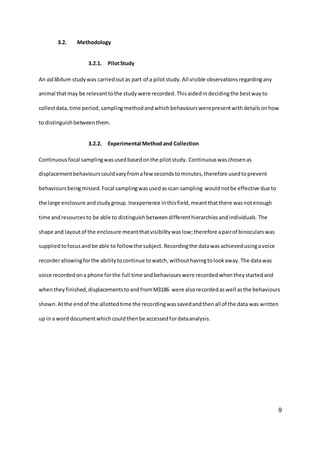
checksand give medicationtothose thatneedit.Eachfeedingsite (Fig.2), isgivenasetamountof
fooddependentonthe individualsthatfeedthere.
8
Figure 2 – Layout of the Bat enclosureat Durrell Wildlife Park with a key for colours on the diagram. There are
17 feeding sites, labelled A-Q so there can easily be identified. Due to dominance in bats sub-species and
individuals each have separate feeding sites which are known by the keepers, but unknown in this project.
Source – Author
9
3.2. Methodology
3.2.1. PilotStudy
An ad libitum studywas carriedout as part of a pilotstudy. All visible observations regardingany
animal thatmay be relevanttothe study were recorded.Thisaidedin decidingthe bestwayto
collectdata, time period, samplingmethodand whichbehaviourswerepresentwith detailsonhow
to distinguishbetweenthem.
3.2.2. Experimental Methodand Collection
Continuousfocal samplingwasusedbasedonthe pilotstudy.Continuouswaschosenas
displacementbehaviourscouldvaryfromafew secondstominutes,therefore usedtoprevent
behavioursbeingmissed. Focal samplingwasusedasscan sampling wouldnotbe effective due to
the large enclosure andstudygroup.Inexperience inthisfield,meantthatthere was notenough
time andresourcesto be able to distinguish betweendifferenthierarchiesandindividuals. The
shape and layoutof the enclosure meantthatvisibilitywas low;therefore apairof binocularswas
supplied tofocusand be able to followthe subject.Recordingthe datawas achievedusingavoice
recorderallowingforthe abilitytocontinue towatch,withouthavingtolookaway.The datawas
voice recordedona phone forthe full time andbehaviourswere recordedwhentheystartedand
whentheyfinished,displacementstoandfromM3186 were alsorecordedaswell asthe behaviours
shown.Atthe endof the allottedtime the recordingwassavedandthenall of the data was written
up ina word document whichcouldthenbe accessedfordataanalysis.
10
3.2.2.1. Displacementbehaviours
A description(Table 1) of the differenttypesof displacementbehaviourswasnecessarytodistinguish
betweenthe behaviours.
Table 1 – Displacementbehavioursthatcouldbe seeninthe interactionsbythe twosub-speciesof
fruitbat.
Behaviour Definition
Cuffing(Cu) Extendingone orbothlimbstowardsan individual looksasif theyare
graspingforanother.
Chasing(Ch) One individualmovesanotherawayfroma territory or object, either
throughflightorcrawlingacross the mesh.
Vocalisation (V) Expressionwiththe use of soundor the openingof the mouthbut no
noise seemstooccur.Staringat the individual thatitisvocalisingatbut
no othermovementoraggressiontowardsthe other.
Biting(B) Grippingor attemptingtogripanotherindividual withitsmouth.Seems
to be justa warningandnot to cause injuryor woundbutcannot be
confirmed.
WingShake (WS) Headand thumbspointthe directionof the individual andwingsopennot
fullybutshake theirwingsinthe directionof the individual. Often
accompaniedwith vocalization.
3.2.3. Ethical Considerationsand Risk Assessment
The projectwas carriedout purelyasan observational study.Therefore itdidnotpose anyethical
issueskeepingtothe five needs andwassubjecttoNottinghamTrentUniversity’s ethical approval,
see AppendixI.Observationsseemedtohave noeffectonthe existing managementsystemoron
the bats behaviours. Yet,itmustbe notedthatanimalsmayappearto be habituated,butslightbias
may still arise (MartinandBateson,2007). A riskassessmentwasalsocarriedoutand can be found
inAppendix II.
3.2.4. Statistical Analysis
The Pearson’sChi-Squaredtestfordifferences wasused see if there were anyassociations between
the two categorical variables,displacementbehavioursandthe sub-species Livingstone’s and
Rodrigues.WhenusingChi-Squaredtwoassumptionshave tobe made whichare;the two variables
11
beingmeasuredare of ordinal ornominal levelandthe twovariablesshouldconsistortwoor more
categorical independentgroups (MartinandBateson,2007). Chi-squared determines pvaluesthat
indicate significantdifferences.Theseare established onthe following statements;
 P<0.05 = There isa 95% confidence level andthe null canbe rejected.
Differencesare classedassignificant.
 P>0.05 = Differencesare classedasnotsignificant.
The programme SPSSwas usedto calculate the valuesforthe chi-squaredtest.Thisanalysiswas
usedforthe numberof occurrencesof displacementbehaviours.Itcannotbe usedfor the
significance of the individual displacementbehaviours,assome of the behaviourshave zero
occurrences therefore resultswouldnotbe reliable.Incaseswhere statisticstestsare inappropriate,
descriptive statisticswereusedtocompare andanalyse. These were made availableinthe formof
graphs and usedto evaluate the effectsthe twosub-species hadonthe individual.Where necessary
all figureswere roundedto2 decimal places.
12
4. Results
4.1. Total Occurrences of DisplacementBehaviours
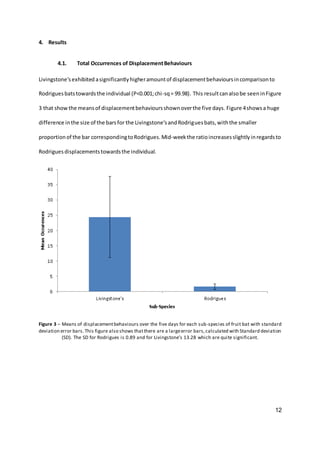
Livingstone’sexhibited asignificantlyhigheramountof displacementbehavioursincomparisonto
Rodriguesbatstowardsthe individual (P<0.001;chi-sq= 99.98). This resultcanalsobe seeninFigure
3 that show the meansof displacementbehavioursshownoverthe five days. Figure 4showsa huge
difference inthe size of the barsfor the Livingstone’sandRodriguesbats,withthe smaller
proportionof the bar correspondingtoRodrigues. Mid-weekthe ratioincreasesslightlyinregardsto
Rodriguesdisplacementstowardsthe individual.
Figure 3 – Means of displacementbehaviours over the five days for each sub-species of fruit bat with standard
deviation error bars. This figure also shows thatthere are a largeerror bars,calculated with Standard deviation
(SD). The SD for Rodrigues is 0.89 and for Livingstone’s 13.28 which are quite significant.
13
Figure 4 –Ratio of displacements shown towards the Juvenile Male ‘M3186’ by the two sub-species of bats
Livingstone’s and Rodrigues Fruit Bat each day.
Figure 5 showsthat Livingstone’scarriedoutall five typesof displacementbehaviourswhereasthe
Rodriguesonlyshowtwo of the five. The twobehavioursshownby Rodriguesare the mostcommon
behavioursshownbythe Livingstone’s.
Figure 5 – The different displacement behaviours shown by the Livingstone’s and Rodrigues towards the
juvenile.
14
4.2. FeedingSites
The juvenile stayedaroundthe same areaforthe durationof the project. The individualmainly fed
fromTray C (Fig.6) and occasionallyattray B and D, whichadjacentto Tray C. The secondlargest
feedingsite is the bottomof the enclosure. M3186 nevertravelledfurtherthanthisarea,exceptto
escape displacementbehaviours.Asthe weekwentonhighernumberof displacementsoccurredat
differentfeedingsites,whereasatthe startM3186 mainlyfeedfromtrayC and the bottomof the
enclosure.
Figure 6 – Number of times that the juvenile male M3186 feeds at each feeding site.
4.3. Time on each activity
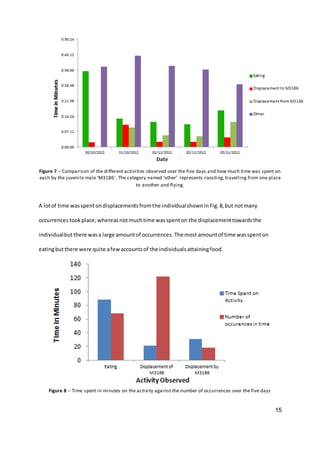
Figure 7 shows four categories of activities over the five days. The largest is ‘Other’ then eating,
followed by displacement from M3186, then displacements to M3186. This is the common trend
apart from day one when no displacements from M3186 occurred and day two, where a greater
amount of time was spent on displacements to the individual instead of from the individual.
15
Figure 7 – Comparison of the different activities observed over the five days and how much time was spent on
each by the juvenile male ‘M3186’. The category named ‘other’ represents roosting, travelling from one place
to another and flying.
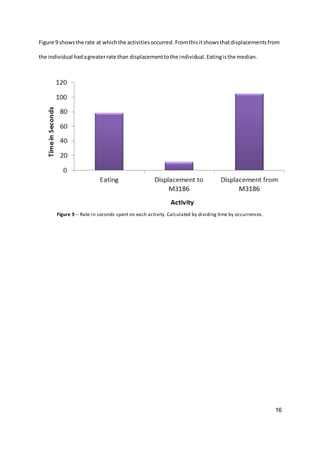
A lotof time wasspentondisplacementsfromthe individualshownin Fig.8,but notmany
occurrences tookplace;whereasnotmuchtime wasspenton the displacementtowardsthe
individualbutthere wasa large amountof occurrences.The most amountof time wasspenton
eatingbutthere were quite afewaccountsof the individualsattainingfood.
Figure 8 – Time spent in minutes on the activity against the number of occurrences over the five days
16
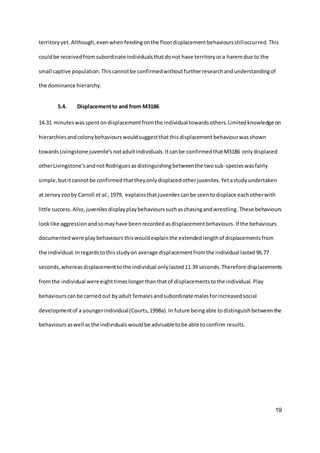
Figure 9 showsthe rate at whichthe activitiesoccurred. Fromthisitshowsthatdisplacementsfrom
the individual hadagreaterrate than displacementtothe individual.Eatingisthe median.
Figure 9 – Rate in seconds spent on each activity. Calculated by dividing time by occurrences.
17
5. Discussion
5.1. Displacementbehaviours
It was predictedthat agreateramount of occurrencesof displacementbehavioursbyRodriguesfruit
bats.This isbasedupon the pilotstudy,as lookingfromthe frontof the enclosure displacements
fromRodriguestoLivingstone’s were witnessed. Anotherreasonwasthat five Rodrigueshad
recentlybeen transferredtoDrusillaZoodue toaggressiontowardsLivingstone’s.The results prove
that displacementbehavioursdooccur, of whichmainlycame fromLivingstone’ssub-specieswhich
isthe same speciesasthe individual. Fromthisthe null hypothesiscanbe rejectedandthe
alternative hypothesis; Livingstone’sFruitBatswill show agreateramountof displacement
behaviourstowards M3186 than RodriguesFruitBats,can be accepted.Thismaybe a resultof the
dominance hierarchyinthe colony.If afeedingtray isa dominantmalesterritory,thenthe juvenile
male will be chasedoutof the territory(Carroll et al., 1979) bythat male,or adultfemalesinthe
dominantsharem.Little isknownaboutthe hierarchiesinthe enclosurebetweenthe Livingstone’s
sub-speciesandthereforeunable toknow whichindividualswere chased the juvenileaway.
Little interactionscame fromthe Rodriguesandonlyoccurredwhen M3186 enteredavicinityof
Tray B. It couldbe arguedthat thisisdue to Tray B beingaRodriguesterritoryandnotLivingstone’s.
Althoughthisisputforwardit cannotbe confirmedwithoutknowingthe feedingterritoriesof all the
bats,thiscouldbe discoveredbyfurtherresearchor contactingthe keepers. The pilotstudy
focussedonall individuals,therefore whendisplacements fromRodriguestoLivingstone’s were
shownat the frontof the enclosure thismayhave beendue tothe Livingstone’stakingfoodfrom
Rodriguesterritory.
A theoryof whydisplacementsoccurredputforwardisthe lack of roostingand feedinglocations.
Thistheorycan be rejectedasthe individual didnotutilise all the trays,of whichthey were 17,but
18
onlya maximumof 3 before feedingoff the floor. Alsothiswouldinvolve redesigningalarger
enclosure of whichitwasnewlyrebuiltin2011.
5.2. BehavioursOccurred
The differentbehaviours were notall showninbothsub-species, yetthe mostcommonwere Cuand
Ch. These twobehavioursmaybe linkedto social playinyoungindividuals. They maybe more
commonas these play behavioursare usedtodevelopattackbehavioursandtherefore commonly
used.The presence of otherbehavioursmay be downto the juvenile notbackingoff afterCuandCh
were shownandcouldbe seenas more aggressive behaviours. A reason whyonlyCuand Ch
occurredin Rodrigues towards the individual,maybe due tohighlevelsof intra-sub-species
intimidation receivedbythe juvenile. V wasseenonlyinLivingstone’sthismay be due tothe fact
that thisbehaviourisnormallypairedwithWS(Carroll etal., 1979) whichwas notshownby the
Rodriguesfruitbats.
5.3. Bottom Feeding
The secondreasonthisstudywas carriedout wasto try to differentiateareasonwhythe individual
and othersfeedfromthe bottomof the enclosure.Throughoutthe study ad libitumobservations
were noted, whichshowedthatnotonlyLivingstone’s individualsbutalsoRodrigues were feeding
off the floor. It couldbe suggestedthat thisbehaviourhasdirectly resultedfromcaptive condition.
So a way to escape aggressionfrom others, alocation sofinddroppedfoodortheyhave landedon
the floorand are notforaging. If it occurs due to foodbeingdroppedonthe floor,in-situthis
behaviourwouldbe preventeddue to riskof predation. If releasedintothe wild,thisbehaviour
may decrease the populationrapidly.Future studyshouldbe carriedoutto decipherif predator
avoidance needsto be usedinzoos.Anabilitytoidentifyindividuals,agesandsexes wouldhave
beenbeneficial.If itwasonlyjuveniles observed thenitcouldbe suggested,andwithmore research,
proventhatthe floorisbeingused asan escape fromaggressionforjuvenilesthatdonot have a
19
territoryyet.Although,evenwhenfeedingonthe floordisplacementbehavioursstilloccurred.This
couldbe receivedfrom subordinateindividuals thatdonot have territoryora haremdue to the
small captive population.Thiscannotbe confirmedwithoutfurtherresearchandunderstandingof
the dominance hierarchy.
5.4. Displacementto and from M3186
14.31 minuteswasspentondisplacementfromthe individual towardsothers.Limitedknowledge on
hierarchiesandcolonybehaviourswouldsuggestthatthisdisplacementbehaviourwasshown
towardsLivingstone juvenile’s notadultindividuals.Itcanbe confirmedthatM3186 onlydisplaced
otherLivingstone’sandnotRodriguesasdistinguishingbetweenthe twosub-specieswasfairly
simple, butitcannotbe confirmedthattheyonlydisplacedotherjuveniles.Yetastudyundertaken
at Jerseyzooby Carroll et al., 1979, explainsthatjuvenilescanbe seentodisplace eachotherwith
little success.Also,juvenilesdisplayplaybehaviourssuchaschasingandwrestling.These behaviours
looklike aggressionandsomayhave beenrecordedasdisplacementbehaviours.If the behaviours
documentedwere playbehaviours thiswouldexplainthe extendedlengthof displacementsfrom
the individual. Inregardstothisstudyon average displacementfromthe individual lasted96.77
seconds,whereasdisplacementtothe individual onlylasted11.39 seconds.Therefore displacements
fromthe individual wereeighttimeslongerthanthatof displacementstothe individual. Play
behaviourscan be carriedout by adult femalesandsubordinate malesforincreasedsocial
developmentof a youngerindividual(Courts,1998a).In future beingable todistinguish betweenthe
behavioursaswell asthe individualswouldbe advisabletobe able toconfirm results.
20
6. Limitations
Thisstudywas conductedaspart of a weeklongcourse at Durrell Wildlife Park.Thislimitedthe time
spentcollectingdataasthis couldonlyoccur whenthere were nolectures. Therefore the datawas
not sufficientenoughtogainreliable results forconclusive evidence.Italsomeantthatdata could
onlybe collectedat one pointinthe day so otherfactorscouldhave influencedthe individual
bottomfeeding. Datawascollectedfrom3.30pmtill close,butbecause the enclosure wasinside it
had to be lockedeverynight.The time thisoccurredwas dependentonwholockedup,this
sometimesmeantitwasbefore 6pm. Thisthereforeledtoaninconsistentamountof time collected
each day.
The collectionof datawas reliantonthe keepersidentifyingthe individual eachdaydue to
inexperience.Bythe endof the weekitwaseasiertospot whichindividual wasM3186 itcouldnot
be confirmeduntil the keeperscame. Usingbinocularsforcontinuousdatafora longperiodof time
causedstrainof the eyes andso concentrationwasdifficult.If the investigationwasrepeated then
the use of a videorecordermaybe a bettermethod.Withonlyaccesstothe publicviewingarea
meantthat distractions were prevalent.Distractionscame inthe form of children runningaround
questionsfrom the public,peoplestandinginthe wayandloudvoicesandtalkingleadtothe
recordingbeinghardto hearin some pointswhenwritingthe datadown.
21
7. Further Study and Recommendations
A longerperiodof studyneedstobe completedof maybe twoorthree weeks;of whichdatawould
be collectedfrombothfeedingtimestounderstandif any otherfactorsare influencingthe results.It
couldalsobe usedtosee if a greaternumberof displacementbehavioursare shownfromone sub-
speciesorif there are equal amountsof displacements fromboth.Thiswouldhave ledtomore
comparable dataand a clearerpicture of the trendsshown. Withmore time more dataanalysisand
manipulationcouldhave beenattainedbutdue tothe limitsof thisprojectthere isnot enoughroom
to expanduponit.Therefore descriptive analysiswasusedforalotof the data.
Regardingdatacollectionabettervoice recordershouldbe usedif repeatedasusingavoice
recorderon a phone isnot sufficientenoughasmemorycapabilityislow.Thismeantthatrecordings
couldbe storedso theycouldbe viewedagain. Alsoabettermethodwouldbe togeta recorderthat
couldthentransferitstraightintoword insteadof havingtowrite itup manuallyasitis a verylong
process. Before the studywasstarted8 Rodrigueswere removedfromthe group.A study
beforehandwouldhave beengoodtosee the differenceonthe individual andgroupasa whole and
be able to compare data before andafter.Repeatingthe study inafew monthswouldbe a good
ideato see if the groupwere ina transitional stage fromthe translocation the Rodrigues batsorif
thisresembledthe settled group.
22
8. Conclusion
From the evidence providedfromthisstudyitisclearthat interactions of the twosub-speciesdo
occur. These interactionsmainlyoccurbetweenthe same sub-speciesand lessfromdifferentsub-
species. Therefore thisstudyrejectedthe nullhypothesisandacceptedthe alternative hypothesis.
As forthe secondaim of thisstudyit isnot conclusive why individualsare feedingonthe bottomof
the enclosure,buttheorieshave beenputforwardbasedonadlibobservations.The theorythat
seemsmostsuitedtothisinvestigation, whichwassuggestedbyFry(2011), is that the bottomof the
enclosure hasnoterritoryandtherefore juvenilesare able toescape aggressionfeedingonthe floor
away fromdisplacementbehaviours. Withoutfurtherinvestigationintothismatternodefinite
answercan be given. Thisinvestigationhashelpedkeeperstounderstandmore clearlythe
interactionsbetweenthe twosub-speciesatfeedingtimesandhow juvenilestendtofeedtofinda
territory.Ithas proventhat territories are veryimportantinbatspeciesandwithoutthisinformation
it becomesveryhardto gain clarity insuch a short period. Itisadvisedthatmore workis to be done
on the interactionsof these andall batsincaptivity, regardingdisplacementbehavioursandsub-
speciesinteractionsas little researchhasbeendone inthisarea.Aswell as lookingatthe negative
effectsfeedingonthe floormay have onthe species,suchasincreasingpredatorrisksdue to
terrestrial feedingandmaybe input waysinwhichpromote predatoravoidance inthe species.
23
References
BASSETT,L., BUCHANAN-SMITH,H.M.,2007. Effectof Predictabilityonthe Welfare of Captive
Animals. Applied AnimalBehaviourScience,102(3), pp.223-245.
BRAYSHAW,S.,2012 (Personal Communications). Conservation with Sarah Brayshaw,Durrell
WildlifePark,29 October.
CARROLL,J.B.,1979. The General BehaviourRepertoire of the RodriguesFruitBat. Pteropus
rodricensis,In Captivityatthe JerseyWildlifePreservationTrust. Dodo:Journalof theJersey Wildlife
Perservation Trust,16, pp.51-58.
CHEKE, A.S.,DHAL,J.F.,2009. The Status of bats on westernIndianOceanislands,withspecial
reference to Pteropus.Mammalia,45(2),pp.205-238.
CLUBB, R., MASON,G., 2003. Animal Welfare:CaptivityEffects onWide-RangingCarnivores. Nature,
425, pp. 473-474.
COURT, S.E.,1997. General behaviourandsocial interactionsinagroupof Livingstone’sFruitBats,
Pteropuslivingstonii,at JerseyWildlife PreservationTrust. Dodo:Journalof Jersey Wildlife
Preservation Trusts,33, p. 154.
COURTS, S.E.,1998a. Investigationof InfantDevelopmentandJuvenile Social InteractionsIn
Livingstone FruitBats, Pteropuslivingstonii,atJerseyWildlife PreservationTrust. Dodo:Journalof
the Jersey Wildlife Preservation Trust, 34, pp. 166-167
24
COURTS, S. 1998b. Dietarystrategiesof OldWorldfruitbats(Megachiroptera,Pteropodidae):how
do theyobtainsufficientprotein? MammalReview,28(4),pp. 185-194.
COURTS, S.E.,1999. Dietarystudiesof Livingstone’sFruitBats Pteropuslivingstonii:Feeding
Behaviour,dietevaluationandmodification. Dodo:Journalof Jersey Wildlife Preservation Trust,35,
pp.26-47.
DEMPSEY, J.L., BERNARD,J.B.,CRISSEY,S.,DIERENFELD, E.S.,SEYJAGAT,J., ULLREY, D.E., 2004. Fruit
Bats:Nutrition and dietary Husbandry. [Online] Available at:
http://www.nagonline.net/Technical%20Papers/NAG%20FS014%20FRUIT%20BATS%20AUG%20200
4.pdf.[Accessedon14 April 2013]
DURRELL WILDLIFE CONSERVATION TRUST,2012. New Heating systemWarmsBats and Protectsthe
Environment[Online].Availableat:http://www.durrell.org/latest/news-bites/new-heating-system-
warms-bats-and-protects-the-environment/[Accessedon16 April 2013]
FRY, A.,2011. Effectsof Environmentonthe Behaviourof alarge group of RodriguesfruitBats,
Pteropusrodricensis,atJerseyZoo.Placementstudentfromthe Universityof EastLondon.
GLENDEWAR, G., 2012 (Personal Communications). Conservation with GaleGlendewar,Durrell
WildlifePark,2November.
INTERNATIONALUNION FORCONSERVATIONOFNATUREANDNATURAL RESOURCES (IUCN), 1992.
Old World Fruit Bats:An Action Plan fortheir Conservation.IUCN:Switzerland.
25
KUNZ,T., DIAZ,C. 1994. Folivoryinfruit-eatingbats,withnew evidencefrom Artibeusjamaicensis
(Chiroptera:Phyllostomidae). Biotropica.
LEBLANC,D., 2013. Fruit BatEnrichment atThe Lubee Foundation,Incorporation. The Lubee
Foundation,Incorporation:USA,Florida.
MARTIN,P., BATESON.,P.,2007. Measuring Behaviour:An Introductory Guide. Cambridge:
Cambridge UniversityPress.
MARSHALL, A.1983. Bats, flowers andfruit:evolutionaryrelationshipsinthe OldWorld. Biological
Journalof the Linnean Society,20:115-135.
MASON,G., 2006. Chapter11: Stereotypicbehavioursin CaptiveAnimals:Fundamentaland
ImplicationsforWelfare and Beyond.IN:Mason,G., Rushen,J.,(Ed.). StereotypicAnimalBehaviour:
Fundamentalsand Applicationsto Welfare(2nd
Ed.). CABI:Oxfordshire,pp.325-356.
MOODIE, E.M., CHAMOVE,A.S.1990. Brief ThreateningEventsBeneficial forCaptive Tamarins? Zoo
Biology, 9, pp. 275-286.
REEDER, D.M., KOSTECZKO,N.S.,KUNZ,T.H.,WILDMAIER, E.P.,2006. The hormonal andbehavioural
response togroupformation,seasonal changes,andrestraintstressinthe highlysocial Malayan
FlyingFox (Pteropusvampyrus) andthe lesssocial LittleGolden-mantledFlyingFox (Pteropus
pumilus) (Chiroptera:Pteropodidae). Hormoneand Behaviour,49 (4),pp.484-500.
26
SCHUTT, JR., W.A.,MURADALI,F., MONDOL,N., JOSEPH,K.,BROCKMAN,K., 1999. Behaviourand
Maintenance of Captive white wingedvampire bats,Diaemusyoungi. Journalof Mammalogy,80(1),
pp.71-81.
SHEPHERDSON,D. 1997. The animal’sperspective:Developingstrategiesforsuccessful enrichment.
AZA Annualconferenceproceedings.pp.486-489. IN:LEBLANC,D., 2013. Fruit Bat EnrichmentatThe
Lubee Foundation,Incorporation.The Lubee Foundation,Incorporation:USA,Florida.
Wright,T., 2012 (Personal Communications).Conservation with Tim Wright,Durrell Wildlife
ConservationPark,1November.
UIEDA, W., BUCK,S., SAZIMA,I.,1992. FeedingBehaviourof the Vampire Bats,Diaemusyoungi and
Diphyllaecaudata,onsmallerbirdsinCaptivity. Gencia eCultura,44, pp.410-412.
I
Appendices
AppendixI – Ethical Form
II
III
AppendixIII– RiskAssessment
IV
AppendixIII- Reportof IndustryPlacements
As part of the two yearuniversitycourse 150 hoursin industryhadto be achieved (Table 2).These
hourscouldbe undertakenat one or more differentplacementsanddue toundecidedcareer
prospectsplacementsweretakeninfive differentplaces.Thiswascarriedouttoensure the most
out of the hours and to decipherwhichcareerpathwaywould suitbest.
Table 2 – Placementsundertakenwiththe datestheywere undertakenonandthe amountof hours
out of the 150 hoursneededtoundertake. Source –Author
Placement Location Date Hours
Lambing Home Farm
NottinghamTrent
University
6th and 10th March
2012
16
Seaquarium Weston-Super-Mare 10th – 14th September
2012
30
Durrell Wildlife
ConservationTrust
Jersey 27th October– 4th
November2012
40
PoultryTrials Home Farm
NottinghamTrent
University
12th November–6th
December2012
25
Canine Hydrotherapy Chapel Farm,
Pensford,Bristol
10th – 15th December
2012
40
1. Lambing on Home Farm - Evaluation
Duringthe 16 hours,the jobsthat neededtobe undertakenwere;observingthe healthof the ewes
and lambs, clearingall pathways,toppingupwater, observingbirthingsignssuchas;lipcurling,
pacing,makingnests,lookingup'stargazing', interventionof the lambing(Fig.10), ensuringall
lambswere feeding,checkingthe fields,bottle feeding,andcheckingtemperatures.
Figure 10 – Intervention in the birthing of a lamb as the elbows of the lamb was stuck therefore
intervention was necessary. Source – Author
Everyday on the farm hadnewchallenges;thismeantthatadaptationstosituationswere necessary.
Interventionis notalwaysnecessaryduringlambingbut knowingwhenitisappropriate isimportant
and can save the livesof the lambsandewes. Makingsure that all the stepsafterbirthingwere
V
carriedout, suchas dipdyingthe umbilical cord, colostrumintake andensure thatthe ewe was
caring forthe lambincludinglickingit.Howeveritdidnotexplainthe bigpicture of farmingandhow
it isrun fromday to day.This aspectwill be taughton the course module vocational sciences,farm
management.
Whilstworkingonthe farmsomeone neededtotake charge and ensure thatall jobswere takencare
of anddone on a regularbasis.The first8 hoursundertakenwere done byworkinginateamwith
the otherstakinginstructionfromthe more experiencedperson. Onthe secondshiftamore
managerial role wastaken,prioritisingjobs, andgivinginstruction tothe national diplomastudents,
as concentration andfocuscouldbe losteasily.
Adaptingcommunicationwasnecessarysothat theyknew exactlywhatneededtobe done. Aswell
as ensuringthateveryone waspullingtheirweight equally, makingsure everyone gainedsomething
fromthe experience.
Duringthisexperience the skillsdevelopedandshownwere initiative,goodcommunication, team
workand motivation. Anareathatcouldbe developed isthe abilitytoaskmore questions toaidmy
progression.A waytoimprove thisisto start askingquestions withjustone otherpersonandtotry
not to overthinkquestionthiscanthenbe increasedtoaskquestions infrontof people inadifficult
environment.
2. Seaquariumat Westonsuper-mare,Bristol - Evaluation
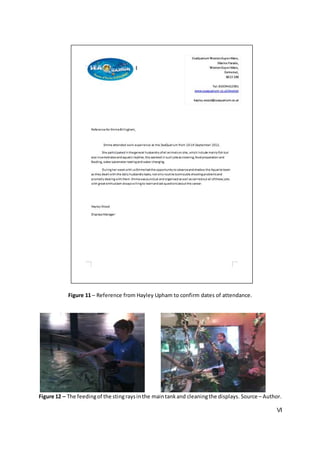
For the durationof thisplacement,confirmedbyHayleyUpham(Fig. 11), activitieswere under
taken, shadowingone of twopeople during theirdailyroutinesof checkingpHand temperaturesof
all of the tanks,feeding (Fig. 12),waterchanges,cleaningandtalkingtothe public. Thisisa small
aquariumwhichmeantthatsome of the jobscarriedout had nothingtodo withthe careeryetthese
were done withanenthusiastattitude.
VI
Figure 11 – Reference from Hayley Upham to confirm dates of attendance.
Figure 12 – The feedingof the stingraysinthe maintankand cleaningthe displays. Source – Author.
VII
The importance of the publicand economics isthe same ina small aquariumasit wouldbe ina
largeraquariumor ina zoo.The reasonitis importantisfor maintenance of the establishmentasit
doesnotreceive anyotherfinancial support. Waysinwhichitkeptpublicinterestedwasto
entertain andeducate.Thiswasachievedwith activitiessuchastalks,shows, quiz’s,thingstodo
aroundthe aquarium (Fig. 13) and interactive activitiestokeepthe publicinvolvedwere important.
Figure 13 – Signs around the aquarium that educated the public as well as questions that were put
up around the aquarium that the public could answer mostly for the benefit of children. Dr. Cod’s
interactive areawasusedfortalks for the publicwhere theycouldlearnaboutthreatsto the sea life
and also hold crabs. Source – Author.
There isa nation/worldwidesystemof communicationbetween aquariumswheretheycanshare
informationaboutspecies,advertisethe needforspeciesorto remove a speciesfromtheir
collection.Thiswasusedforconservationneedsandcancontribute togeneticdiversityincaptive
species.
More responsibilitymayhave beengainedduringalongerplacementaswell asgreaterlearning.To
be able to talkto the publicaboutthe aquariumandthe species meantthatself-directedstudy was
essential aswell asthe informationgainedfromthe people whoworkedthere. The capabilityto
manage and organise mytime was crucial to make a goodimpressionandgainanetworkof people
that can helpinthe future.
3. Durrell Wildlife ConservationTrust,Jersey - Evaluation
A week’splacementwasundertakenatDurrell Wildlife ConservationTrustwhichincludedaweek’s
course run by TimWright on the Importance of Zoosand Conservation. Thisplacementled to
VIII
understandingof howzoosare run withmanagementincludingnutrition,breeding,trainingand
differentzoocommunicationtechniques.Conservationwasamassive elementof the weekand
understandingthat economicshasagreat influence buteducationisjustasimportant.If people in
the same environmentdonotunderstandthe negative effecthumanscanhave andare educatedin
waysto reduce thiseffectthenspecieswill continuetodecline.
The course involved 9-5lectureswhich meantindividual andteamworkactivities.Anactivitythat
was carriedoutinvolved analysisof information,comingtoa decisionasa teamand then voicingour
viewsandargumenttothe rest of the group.
Anotheraspectof the week wasto attaina project,whichthisreportisbasedon,itusedskillsthat
will benefitdissertationnextyearincludingliterature reviews,methodology,analysingresults and
presentingthe reporttolecturers andcolleagues.Attainingaunique andindividual projectthatno
one else carriedout leadto difficultiesforexample all the questionsthoughtof neededextensive
knowledge of the bats whichwasunable to be learntina short periodof time. Thiswasresolvedby
talkingtothe keeperswhoexplainedanaspectthat theywere interestedin andthe questionand
projectwasbuiltaroundthis.Curingthisweekthe abilitytoknow whentoaskfor help, andthata
task doesnothave to be accomplishedbyjustone person wasa massive hurdle asthishave always
beenthe mindset.Tocomplete the task resourcesfromthe librarywhichhadjournalsonall the
animalsinthe zoo collectionaswell asgoingbehindthe scenesandtalkingtothe keepersandstaff
that workedthere. Keepersandleadersinthe fieldsatinonthe presentation (Fig. 14) andrelayed
feedbackandcriticismswhichwasusedconstructivelyandallowedself-judgement.
Figure 14 – A few slides from the presentation given to the keepers and staff at Durrell.
ICT skills were alsoexpandedasthe findingsof the reporthadto be efficientlycommunicated. On
the whole beingconfidentandnotunderestimatingyourself will leadtoothersbeingconfidentin
your abilitytoo.
IX
4. PoultryTrails on Home Farm - Evaluation
Thisplacementwascompletedmore forthe educational purpose than forthe sake of hours, itwas
to learnhowa how to setup andrun a researchproject andfindoutif thiswas an area of interest
for a future career.
The firstfewshifts consistedof basicmanlabourjobsthat neededtobe done, theywere done
enthusiasticallywithdetermination.These jobs gave realisationtothe factthat all lengthswouldbe
takento complete the tasksneeded evenwithsacrificessuchasworkingextrahours,working
throughtea,lunchor breaksor sleep deprivation.Althoughthisisagoodthingit can alsobe a
disadvantage asitcouldaffecttime managementandorganisingof otherareasinlife.
Whenthe trialsstarted the needto be objective andnotemotional wasnecessaryas the research
beingundertaken instudy isessential. Economicsisamassive influence inthe farmindustryandthis
mustbe consideredif tryingtoinputlegislationorchange anaspect inregards to animal welfare.
Workingalongside lecturers’ enhanced learning,astheywouldaskquestionsandexplainunknown
answers includinganatomyandphysiology,law,healthandsafety,nutritionand ethicsinsociety
duringthe shifts. Workingasa team towardsa commongoal meantusingtime management,
prioritising,university,workandbuildingof confidence inanew environment.
5. Canine Hydrotherapy at Chapel Farm, Pensford,Bristol - Evaluation
Thisplacementwasa canine hydrotherapyandphysiotherapists withacrèche on the premises toit.
It was quite alarge place withall the equipmentonsite withalarge networkof clientsfromthe
average petownerto breedersand show dogowners.
Although thisisbriefly discussedonthe course itwasnot covered ina lot of detail.Thiswas
arrangedto linkalreadylearntknowledgeto gaingreaterunderstandingon;the processesinvolved,
recommendationsfromvets,whatkindof diseaseswere commonandhow the equipmentwas
used.
A keyaspectto thisprofessionwasto caterfor the client’s needssotheywouldbe openlate atnight
for sessionsandonweekends.Itwasalsoa verypersonal professionwhere itwasimportantto
maintaina rapportwiththe clientsandbuildasolidtrustingrelationship.Connectionswithvetsand
othersinthe animal profession wereimportantsobuildanetworkof people forincreasingbusiness
by wordof mouth.
Thisplacementwasonlya weeklongtherefore wasunable toshow alotof responsibilityor
leadership, butitwasan importantplacementas the people thatworkedthere hadgone through
manypathwaysinlife fromattainingdegreesinartand not goingto college yettheymanagedto
finda wayto get intotheirchosen careeraftera lot of hard workand determinationshowingthat
puttinginthe effortif youwant itbad enoughandnot givenupwill helpyougetwhere youwantto
be.
X
6. Graduate Attributes
6.1. Intellectual Agility
Beingable tonot onlyattainthe placementbutunderstandthe methodsandhow the professionis
run withregardsto ethics shouldbe learntandnotonlytake on the informationbeingtaughtatthe
placementbuttodo the backgroundresearch beforehandand more readingduringandafterthe
placementtoensure the mostislearntaboutthe placement.Atthe placementscarriedout
understandingof the industrywerelearnt.If there wasanaspectthat wasunclearthenfurther
researchwascarried out such as at Chapel Farmunderstandingdifferentwaysthata hydrotherapy
centre couldbe run was learntandthen questionswere askedof the ownerwhytheircentre was
run a certainway.
An overall understandingof the animal industryislearntwithinthe course moduleswhichconsistof
law,physiologyandanatomy,reproductionandgenetics,management,ecology,nutrition, research
and ethicsinsociety.The differenttypesof assessments have allowedforindependentlearningwith
a needto be able to analyse andcriticallythinkaboutsituationstocome toan educateddecision.
The assessmentsare inthe formsof presentations,assignments,reports,posters, practical’s,team
assessments,testsanddebates. Notonlyhasthe course andplacementsaidedthese characteristics
but alsootheractivities undertakenatthe university.Suchasbeingelected ascourse repmeansthat
course committee meetingsmustbe attended whichinvolvetakinganissue relatingtothe
universityoracertaincourse and rationallythinking aboutitwithothersandcomingto a decision
that will affectthe studentsandlecturersatthe university.
Adaptabilitytoachangingenvironmentisimportantbecause evenif someone possessesall the skills
necessaryforthe chosencareerif they cannot adaptthese fordifferentcircumstancesthen they
become uselessskills. Thisadaptabilitycanbe showninthe numberof differentplacementscarried
out as well asworking inlabs,onthe farm, independently,inateam, at the universitybar,asa
studentmentor,studentambassadorevidence of thiscanbe shownbythe referencesfromthe bar
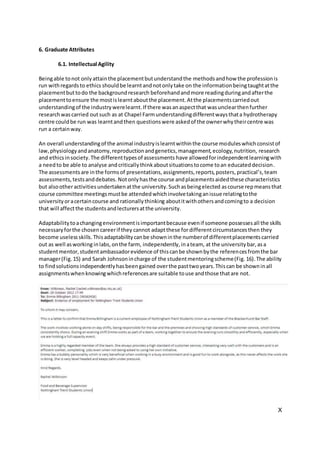
manager(Fig. 15) and Sarah Johnsonincharge of the studentmentoringscheme(Fig. 16).The ability
to findsolutionsindependentlyhasbeengained overthe pasttwoyears.Thiscan be showninall
assignmentswhenknowingwhichreferencesare suitable touse andthose thatare not.
XI
Figure 15 – Reference from the bar manager.
Figure 16 – Reference from Sarah Johnson in charge of the Student Mentoring scheme.
The placementscarriedoutwere notjustfor the sake of gainingthe numberof hoursnecessaryfor
the completionof the course butalsoto aidlearning,mainlylambingandpoultryare the main
examplesof thisandthatevenjobssuchas man labourwere takenwithenthusiasmandmeantthat
self-directstudyhadtobe undertakenaswell.
6.2. Information,Communicationand Organisational Skills
The basisto be successful inmostprofessionsisthe needtogatherinformation,use thisinformation
for a specificpurpose whereitisputina waythat it can thenbe communicatedtoothersto inform
themof the situationsorinformation gathered. Therefore isbe successfulthe needtobe organised
withtime andmanagement isessential.Thisisevidentin the grades attainedfromthe firstyearof
study (Fig. 17) and beingable to organise several aspectsof universitylife suchas; social life,work
and universitywork ensuringthatuniversitywork doesnotsuffer.
Figure 17 – Resultsfromfirstyearshowingthe ability to prioritise and remain organised to achieve
good standards.
XII
Use of ICT efficiently isamustin today’ssociety andevidence of thiscanbe seeninthe emailsto
placements,lecturers, toasksomeone toattendthe university,forsocialsforphotographysociety,
presentations,assignmentsandresearch.All of these have tobe coherent tobe able to
communicate withothersespeciallyinformsof communicationsuchaspresentingresearch,course
committee meetings,mentoringwhenexplainingtasksoran idea.
Everydayinvolvesprioritising certaintaskstherefore involvesplanning,organisingandmanaging
workand time inuniversity life thisisaconstantissue asit involves prioritisinguniversitywork,bar
work, mentoring,course committee,photographysociety,International Leadershipand
Managementaward,placements,tripe.g.Mauritiusandnetball.All contribute skillstolife asa
student’s enrichingthe skillsleftwiththerefore veryimportantto prioritisetherefore evidenceof
thisabilitycanbe seeninthe highgradesattainedinthe modulesandreferencesfromleadersin
thisfield.
As mentionedindescriptionsof placementsinJerseythe skillsof dataanalysisandcollectionas well
as abilitytoacceptconstructive criticismandself-judgmentisshowninthisplacementaswell asin
the course to take onfeedback/feedforwardfromlecturerstoinputintootherassignments.
6.3. Global Citizenship
Beingable tounderstandaspectsthataffecta career isimportant,notjust factors thatare local but
alsointernationallyandbe able tosee thatit isin turneffectsothers asa personal,economic,
cultural,environmentalandsocial level. Publicdiscourse canbe observedin beingastudent
ambassadorand informingthe publicaboutthe universityandcoursesrunat Brackenhurst.
At Jerseythe importance of internationalawarenesswasshowntobe a critical issue aswhentrying
to resolve anissue all those involvedmustbe includedtobe able tomake an impact and also
aspectsmustbe takenseriouslyandnotunderestimated. The poultrytrailsare a goodexample of
economicsustainabilityasif itwere notdown to tryingto reduce the cost of farmingthe trialswould
not be run. Inthe course andplacementsthere have beenlimitedopportunitiestoshow leadership
exceptinthe role appointedof course rep.Butinthe two yearsit hasbeenshowninworkingatthe
bar and becomingteamleaderwhilstundertakingthe international leadership andinthe
organisationof the photography society.

Durrell Wildlife Park Project

  • 1.
    i NOTTINGHAM TRENT UNIVERSITY DisplacementBehaviours shown towards Juvenile Male Livingstone Fruit Bat (Pteropus livingstonii), M3186, by Livingstone and Rodrigues Fruitbats (Pteropus rodricensis) at Durrell Wildlife Park, Jersey. N0362426 Samantha Bremner-Harrison Animal Industry Project ANIM22106
  • 2.
    ii Abstract Displacementbehaviours during feedtimesatDurrell Wildlife Parkwere observedbetweenthe two sub-species,Livingstone’s, PteropuslivingstoniiandRodriguesFruitBats, Pteropus rodricensis. Observations of individualsfeedingonthe floorof the enclosure have beennotedby the publicand keepers.Captivitycanhave negative effectsonpopulationsremovinginnatebehavioursand making stereotypical behaviours.Thisinvestigationwascarriedouttosee if two sub-speciesof batsat Durrell cause negative effectson eachotherandif more interactions occurfromone species.The wayin whichthiswascarriedout was continuous focal samplingfocussingonone Livingstone individual‘M3186’. All interactions toandfromthisindividualwere writtendownwiththe particular behavioursandhowlongitlastedandwhichspeciesitoccurredfrom.Resultfoundthatinteraction fromboth sub-speciesoccurredbuta greaternumberwere from Livingstone’s.Noconclusive evidence canbe giventowardswhysome individualsfeedonthe floorbuttheoriescanbe put forward.Asthiswas undertakenaspart of a weeklongcourse at Durrell Wildlife Parkthere are a fewlimitationstothe studyandtherefore manyfuture recommendationsforthisareaof study.
  • 3.
    iii Acknowledgement I would liketothankthe staff at Durrell Wildlife Park,withparticularthanksto SusanBrayshaw and Gale Glendewarformakingme feel welcome andalwaysofferinghelpwheneveritwasrequired. AlsoTimwrightat Durrell whoheldthe weekcourse forusand gave us the opportunitytocarry out our projectsand gave us feedback. I wouldalsolike tothank Graham Shelbourne andNicoleRuedesueli for all theirsupportand encouragementinJersey;aswell asSamanthaBremner-HarrisonandFrankRuedesueli fortheirhelp withthe projectat university. Additional thanksshouldbe giventomyfriendsinthirdyearfortheirhelpandsupportas well as enrichmentduringthe periodof writingthisproject.
  • 4.
    iv Contents Abstract.......................................................................................................................................i Acknowledgement ....................................................................................................................iii Contents ....................................................................................................................................iv Listof Figures .............................................................................................................................v List of Tables..............................................................................................................................vi 1. Introduction ........................................................................................................................1 1.1. Aims and Objectives....................................................................................................2 1.2. Hypotheses..................................................................................................................2 2. Literature Review................................................................................................................3 2.1. Dominance-Hierarchy .................................................................................................3 2.1.1. Displacement Behaviours ....................................................................................3 2.2. Feeding Behaviour.......................................................................................................4 2.2.1. Terrestrial Feeding ...............................................................................................4 2.3. Rationale for Study......................................................................................................5 3. Materials and Methods ......................................................................................................6 3.1. Materials .....................................................................................................................6 3.1.1. Individual..............................................................................................................6 3.1.2. Study site..............................................................................................................7 3.1.3. Feeding Management ..........................................................................................7 3.2. Methodology...............................................................................................................9 3.2.1. Pilot Study ............................................................................................................9 3.2.2. Experimental Method and Collection..................................................................9 3.2.3. Ethical Considerations and Risk Assessment.................................................... 10 3.2.4. Statistical Analysis............................................................................................. 10 4. Results.............................................................................................................................. 12 4.1. Total Occurrences of Displacement Behaviours ...................................................... 12 4.2. Feeding Sites ............................................................................................................ 14 4.3. Time on each activity ............................................................................................... 14 5. Discussion ........................................................................................................................ 17 5.1. Displacement behaviours......................................................................................... 17 5.2. Behaviours Occurred................................................................................................ 18 5.3. Bottom Feeding........................................................................................................ 18 5.4. Displacement to and from M3186 ........................................................................... 19 6. Limitations ....................................................................................................................... 20 7. Further Study and Recommendations............................................................................. 21 8. Conclusion........................................................................................................................ 22 References............................................................................................................................... 23 Appendices..................................................................................................................................I
  • 5.
    v List of Figures Page Figure1 M3186 also known as Ishaka 1 Figure 2 Layout ofthe Bat enclosure at Durrell Wildlife Park 2 Figure 3 Means of DisplacementBehavioursover the five days for each 12 Sub-speciesoffruitbat with standard deviationerror bars Figure 4 Ratio of Displacementsshowntowards the Juvenile Male by the two 13 sub-speciesofbats Livingstone’sandRodrigues FruitBats each day Figure 5 The Difference DisplacementBehavioursshownby the Livingstone’s 13 and Rodrigues towards the Juvenile Figure 6 Numberof timesthat the Juvenile male M3186 feedsat each feedingsite 14 Figure 7 Comparisonof the differentactivitiesobservedoverthe five days and 15 how much time was spenton each by the juvenile male M3186 Figure 8 Time Spenton the activity against the numberof occurrencesover the 16 five days Figure 9 Rate in secondsspent on each activity 16 Figure 10 Interventioninthe birthingof a lamb as the elbowsofthe lamb was stuck IV therefore intervention wasnecessary. Figure 11 Reference fromHayley Upham to confirmdates of attendance. VI Figure 12 The feedingofthe sting rays inthe main tank and cleaningthe displays VI Figure 13 Signs around the aquarium that educatedthe publicas well as questions VII that were put up around the aquarium that the public couldanswer mostly for the benefitofchildren. Figure 14 A fewslidesfrom the presentationgivento the keepersand staff at Durrell. VIII Figure 15 Reference fromthe bar manager. X Figure 16 Reference fromSarah Johnsonin charge of the StudentMentoringscheme XI Figure 17 Resultsfrom first year showingthe abilityto prioritise and remainorganised XI to achieve good standards.
  • 6.
    vi List of Tables Page Table1 DisplacementBehavioursthat couldbe seeninthe interactionsby 9 the two sub-speciesoffruitbats. Table 2 Placementsundertakenwith the dates they were undertakenon and I the amount of hours out of the 150 hours neededtoundertake
  • 7.
    1 1. Introduction The OrderChiropterahas approximately 910 species;of whichcanbe managedinto two suborders megachiropteraandmicrochiroptera (InternationalUnionforConservationof Nature andNatural Resources(IUCN),1992). The sub-ordermegachiroptera,includes the family Pteropodidaeof which Rodrigues(Pteropusrodricensis) andLivingstone FruitBats(Pteropuslivingstonii) belongto.Fruit bats eat;fruit,flowers,leaves,bark,shootsandbudsas well as insectsforprotein (Dempsey etal., 2004; Courts, 1998b). Bats are vital forforestregenerationasthey pollinateanddisperseseedsover a large area (Kunzand Diaz,1994; IUCN,1992; Marshall,1983). This isnecessaryforeconomic reasonssuchas foodand medicine production. BothRodriguesandLivingstone’sfruitbatsare the focusof thisstudy.Livingstone’sbatscome fromAnjouanandMoheli of the Comores islandsinthe Indianocean,theyare endangered andwere firstbroughttoDurrell in1992 (Glendewar,2012; Brayshaw,2012; Cheke andDahl,2009). Rodrigues fruitbats originate fromthe islandof Rodrigues, they are criticallyendangeredandhave beenkeptincaptivity atDurrell since 1976. Durrell Wildlife ConservationPark aimstoaidconservation bykeepingasafetynetpopulation (Wright,2012). The educational centre onthe premises holdsweeklongcoursesonconservation;whichwasundertaken and supplied40of the 150 hours needed.Anevaluationof thisandfourotherplacementscanbe foundinAppendix III. Captivitycanhave adverse effectsonpopulationscausing;the suppressionof innate behaviours, stereotypical/copingbehaviourstooccurand unsuitable behavioursthatwould not favourthemin-situ(BassettandBuchanan-Smith,2007; Mason, 2006; Clubband Mason,2003). Aggressive behaviours have beenobservedbetween the twosub-speciesRodriguesand Livingstone’s,which are keptinthe same enclosure;aswell as some individuals regularly feeding uponthe floor(Fry,2011). This maybe formany reasons, one couldbe due to negative afflictions captivityhave onspecies. Therefore thisprojectisdesignedtounderstandwhytheseactivitiesare occurringby focussingonone particularindividual,M3186.
  • 8.
    2 1.1. Aims andObjectives Aims: - Findoutwhythe individual are feedingonthe floor. - Whichsub-speciesof batisaffectingthe individual,if any. Objectives: - Reviewrelatedliterature. - Collectdatausingcontinuousfocal sampling. - Analyse the datausingstatistics. 1.2. Hypotheses The hypothesesof thisstudywere tosee if the twosub-speciesinthe enclosurewere havingan effectonthe feedingof one individual inthe group. The hypothesesare;  H0 = Livingstone’sandRodriguesFruitBats will notdisplace the individual,M3186, at feeding times.  H1 = Livingstone’sandRodriguesFruitBats will displace the individual M3186, at feeding times. Alternative Hypotheses  H1 = Livingstone’sFruitBats will show agreateramountof displacementbehaviours towards M3186 thanRodriguesFruitBats.  H1 = Rodrigues FruitBatswill show agreateramountof displacementbehaviours towards M3186 thanLivingstone’sFruitBats. It ispredictedthatRodriguesfruitbatswouldhave agreatereffectonthe individualthan Livingstone’sfruitbats.
  • 9.
    3 2. Literature Review 2.1.Dominance-Hierarchy Bats live incoloniesof whichthere isadefinite dominance-hierarchy, withdominate andsubmissive membersof bothsexes(Reederetal.,2006; Schuttet al., 1999; Uiedaet al., 1992). In these colonies there are also smallerharemsthatbelongtoindividual dominantmales (Courts,1998a; Courts, 1997; Carroll et al., 1979). These harems normally consistof eightadultfemalesof whichthe males mate with,as well as infantfemales. Reederetal., 2006, foundthatthere isa trendbetweensex segregationbetweenthe twosexes.Resultsshowedthatfemaleswill spend more time withother females,yetmaleswilldistance themselvesfromothermales.Apartfromduringmatingseasons whenproximityisless.Inthe wild, afterconceptionof apup,adultmalesand femaleshave limited contact witheachotheruntil the pup can fly.Therefore the adultmalesare unlikelytoencountera neonates(Courts,1998a).Juvenile malesare normallyweanedoff the motherata youngage and excludedfromthe harem (Courts,1997).,at whichtime juvenile maleswillgrouptogetherforsocial (Courts, 1998a). Differentharemshave theirownterritories,of whichcanbe categorisedintotwo groups;roostingandfeeding.Feedingterritoriestendtooverlapslightlywhereasroostingterritories do not(Carroll et al., 1979). Knowingthe differentharemsinacaptive populationcanbe usedto determine where specificterritories lieandthereforehelptoidentifyindividualsand understand whyaggressive behavioursoccur. 2.1.1. DisplacementBehaviours Displacementbehavioursare purposely carriedoutbyan individual(s),tostopanotherachievingor carryingout a certainactivity. Thisprojectwill note downanyindividualpreventing M3186 feeding. Fry (2011) identifieddifferentdisplacementbehaviours inanobservational studyonfeeding behaviourstobe cuffing,biting,vocalisation,chasingandwingshake.Ithasbeen suggestedthat
  • 10.
    4 these behavioursoccurdue toan imbalance of male sex ratio,whichcanleadto social conflict (LeBlanc,2013). 2.2. FeedingBehaviour In-situbatsspendalot of theirtime finding,processingandeatingfood(LeBlanc,2013),in captivity thiscan be dramatically reduced,due tothe lackof feedingenrichmentandspace available for economic,husbandry andnutritionalrequirements. Feedingbehaviourcan be influencedbythe presenceof predators (IUCN,1992). In-situ,batshave limitedpredatorsbutthose theydohave are;birdsof prey,carnivorousmammals, snakesandlarge lizards.Asfruitbatsare arboreal and occur mainlyindense forest,the predatorsthatare successful do notcause greatlossestothe population(Marshall,1983).In the past decade,the restorationof the Brown tree snake (Boiga irregularis) andCalubridsnake (Lycodon aulicuscapucinus) couldpose seriousproblemstothe populations.Ithasbeenobservedthatthe Browntree snake,preyon juvenilebatscausingadramatic decrease inthe population(IUCN,1992). Due to the lossof innate behaviours incaptivity,Shepherdson(1997) statesthat predatoravoidance behavioursshouldbe promotedincaptivity.Moodie andChamove (1990) suggesta methodtodo this is byexposingthe captive populationtoabrief periodof stress. Lubee foundationinAmerica have already implementedthisbyintroducing acornsnake (Elapheguttata) intothe enclosure briefly;bats have respondedbyfreezing,surroundingandmobbingthe snake showingnatural behaviourstowardsa predator(LeBlanc,2013) 2.2.1. Terrestrial Feeding In an observationalstudycarriedoutbyUieda et al., (1992) on feedingbehaviours, onlyone observationof terrestrialfeeding wasdetected.Itwasconcluded,thatterrestrial feedingoccurred rarelyinfruitbats due to the riskof predationbyterrestrial animals.Fry(2011), carriedouta project
  • 11.
    5 at Jerseyzoo,basedupon feedingbehavioursanddescribedoccurrenceswherethe batsfed onthe floor. Noconclusive evidence wasgiventothisbehaviour, butexplanationinclude; the floorisnota territory andso lessdominantmalescould feedthere;alsothatthere was notenough feeding locationsforthe bats.This studywasundertaken before the enclosure was redesigned butitcannot be confirmedthatthese findingwerethe reasonforthe remodelling. 2.3. Rationale for Study Publichave noticedthat some individuals inthe enclosurehave beenfeedingonthe bottomof the enclosure aswell askeepersconfirmingthat these individualsweremainly.Itistherefore of interest to the keeperstounderstandwhythisbehaviourisoccurring. Theoriesputforwardare thatthere are notenoughfeedingtraysor,theyare beingdisplacedbyotherindividualsinthe group.If it isthe latterthenit isimportanttoknowwhichsub-speciesiscausingthisbehaviourforthe healthand welfare of the animals.
  • 12.
    6 3. Materialsand Methods 3.1.Materials 3.1.1. Individual The study focusedonone male Livingstonebatnamed‘Ishaka’ (Fig.1) withthe identification number‘M3186’. M3186 isin an enclosure withtwosubspeciesof bats,Livingstone’sand Rodrigues,of whichinteractionswithbothsub-speciesare observed. Figure 1 – M3186 also known as ‘Ishaka’ has been captive breed and part of the group since 28th December 2011.He is classified as a juvenilemalewho has a small triangular patch of gold on his back and specks of gold on his belly side. Apart from these there are no distinguishing features. M3186 has been seen to go back to gain shelter from his mother, M1861 who arrived at Durrell on 4th September 1992, on cold mornings. There are eight Livingstone’s, four juvenile, and twenty Rodrigues, four juveniles, in the enclosure at the time of October 2012. Recently, five Rodrigues bats were sent from Durrell to Drusilla zoo in South Anglia due to aggressive injuries to Livingstone’s (Brayshaw, 2012). Source - Author
  • 13.
    7 3.1.2. Study site Incaptive populations,the enclosure shouldreplicate,asmuchas possible,theirin-situenvironment withadequate space.The enclosure wasredesignedin2011, whichenlargeditandmade it a tropical environmentusingabiomassheaterandrecycledtyres,winebottle andstraw bales forinsulation (Durrell Wildlife ConservationTrust,2012). The enclosure isdesignedinthe shape of atunnel,with the floordug outfor extradepth,this promotes natural behaviours, asbatswill flyformilesadayin- situ.It alsoincludesnettingtopreventinjuryfromharshlandingsand ropesfromthe bottomof the enclosure tothe middle of the enclosureare supplied,creatinga locationforlessdominantbatsto roost. 3.1.3. FeedingManagement There are twofeedingtimes,one at11.30, where fruitisput intoeach tray and anotherat 15.30, whichisthe focus of thisstudy.The 15.30 feedgivesopportunitiesforkeeperstocarryout health checksand give medicationtothose thatneedit.Eachfeedingsite (Fig.2), isgivenasetamountof fooddependentonthe individualsthatfeedthere.
  • 14.
    8 Figure 2 –Layout of the Bat enclosureat Durrell Wildlife Park with a key for colours on the diagram. There are 17 feeding sites, labelled A-Q so there can easily be identified. Due to dominance in bats sub-species and individuals each have separate feeding sites which are known by the keepers, but unknown in this project. Source – Author
  • 15.
    9 3.2. Methodology 3.2.1. PilotStudy Anad libitum studywas carriedout as part of a pilotstudy. All visible observations regardingany animal thatmay be relevanttothe study were recorded.Thisaidedin decidingthe bestwayto collectdata, time period, samplingmethodand whichbehaviourswerepresentwith detailsonhow to distinguishbetweenthem. 3.2.2. Experimental Methodand Collection Continuousfocal samplingwasusedbasedonthe pilotstudy.Continuouswaschosenas displacementbehaviourscouldvaryfromafew secondstominutes,therefore usedtoprevent behavioursbeingmissed. Focal samplingwasusedasscan sampling wouldnotbe effective due to the large enclosure andstudygroup.Inexperience inthisfield,meantthatthere was notenough time andresourcesto be able to distinguish betweendifferenthierarchiesandindividuals. The shape and layoutof the enclosure meantthatvisibilitywas low;therefore apairof binocularswas supplied tofocusand be able to followthe subject.Recordingthe datawas achievedusingavoice recorderallowingforthe abilitytocontinue towatch,withouthavingtolookaway.The datawas voice recordedona phone forthe full time andbehaviourswere recordedwhentheystartedand whentheyfinished,displacementstoandfromM3186 were alsorecordedaswell asthe behaviours shown.Atthe endof the allottedtime the recordingwassavedandthenall of the data was written up ina word document whichcouldthenbe accessedfordataanalysis.
  • 16.
    10 3.2.2.1. Displacementbehaviours A description(Table1) of the differenttypesof displacementbehaviourswasnecessarytodistinguish betweenthe behaviours. Table 1 – Displacementbehavioursthatcouldbe seeninthe interactionsbythe twosub-speciesof fruitbat. Behaviour Definition Cuffing(Cu) Extendingone orbothlimbstowardsan individual looksasif theyare graspingforanother. Chasing(Ch) One individualmovesanotherawayfroma territory or object, either throughflightorcrawlingacross the mesh. Vocalisation (V) Expressionwiththe use of soundor the openingof the mouthbut no noise seemstooccur.Staringat the individual thatitisvocalisingatbut no othermovementoraggressiontowardsthe other. Biting(B) Grippingor attemptingtogripanotherindividual withitsmouth.Seems to be justa warningandnot to cause injuryor woundbutcannot be confirmed. WingShake (WS) Headand thumbspointthe directionof the individual andwingsopennot fullybutshake theirwingsinthe directionof the individual. Often accompaniedwith vocalization. 3.2.3. Ethical Considerationsand Risk Assessment The projectwas carriedout purelyasan observational study.Therefore itdidnotpose anyethical issueskeepingtothe five needs andwassubjecttoNottinghamTrentUniversity’s ethical approval, see AppendixI.Observationsseemedtohave noeffectonthe existing managementsystemoron the bats behaviours. Yet,itmustbe notedthatanimalsmayappearto be habituated,butslightbias may still arise (MartinandBateson,2007). A riskassessmentwasalsocarriedoutand can be found inAppendix II. 3.2.4. Statistical Analysis The Pearson’sChi-Squaredtestfordifferences wasused see if there were anyassociations between the two categorical variables,displacementbehavioursandthe sub-species Livingstone’s and Rodrigues.WhenusingChi-Squaredtwoassumptionshave tobe made whichare;the two variables
  • 17.
    11 beingmeasuredare of ordinalornominal levelandthe twovariablesshouldconsistortwoor more categorical independentgroups (MartinandBateson,2007). Chi-squared determines pvaluesthat indicate significantdifferences.Theseare established onthe following statements;  P<0.05 = There isa 95% confidence level andthe null canbe rejected. Differencesare classedassignificant.  P>0.05 = Differencesare classedasnotsignificant. The programme SPSSwas usedto calculate the valuesforthe chi-squaredtest.Thisanalysiswas usedforthe numberof occurrencesof displacementbehaviours.Itcannotbe usedfor the significance of the individual displacementbehaviours,assome of the behaviourshave zero occurrences therefore resultswouldnotbe reliable.Incaseswhere statisticstestsare inappropriate, descriptive statisticswereusedtocompare andanalyse. These were made availableinthe formof graphs and usedto evaluate the effectsthe twosub-species hadonthe individual.Where necessary all figureswere roundedto2 decimal places.
  • 18.
    12 4. Results 4.1. TotalOccurrences of DisplacementBehaviours Livingstone’sexhibited asignificantlyhigheramountof displacementbehavioursincomparisonto Rodriguesbatstowardsthe individual (P<0.001;chi-sq= 99.98). This resultcanalsobe seeninFigure 3 that show the meansof displacementbehavioursshownoverthe five days. Figure 4showsa huge difference inthe size of the barsfor the Livingstone’sandRodriguesbats,withthe smaller proportionof the bar correspondingtoRodrigues. Mid-weekthe ratioincreasesslightlyinregardsto Rodriguesdisplacementstowardsthe individual. Figure 3 – Means of displacementbehaviours over the five days for each sub-species of fruit bat with standard deviation error bars. This figure also shows thatthere are a largeerror bars,calculated with Standard deviation (SD). The SD for Rodrigues is 0.89 and for Livingstone’s 13.28 which are quite significant.
  • 19.
    13 Figure 4 –Ratioof displacements shown towards the Juvenile Male ‘M3186’ by the two sub-species of bats Livingstone’s and Rodrigues Fruit Bat each day. Figure 5 showsthat Livingstone’scarriedoutall five typesof displacementbehaviourswhereasthe Rodriguesonlyshowtwo of the five. The twobehavioursshownby Rodriguesare the mostcommon behavioursshownbythe Livingstone’s. Figure 5 – The different displacement behaviours shown by the Livingstone’s and Rodrigues towards the juvenile.
  • 20.
    14 4.2. FeedingSites The juvenilestayedaroundthe same areaforthe durationof the project. The individualmainly fed fromTray C (Fig.6) and occasionallyattray B and D, whichadjacentto Tray C. The secondlargest feedingsite is the bottomof the enclosure. M3186 nevertravelledfurtherthanthisarea,exceptto escape displacementbehaviours.Asthe weekwentonhighernumberof displacementsoccurredat differentfeedingsites,whereasatthe startM3186 mainlyfeedfromtrayC and the bottomof the enclosure. Figure 6 – Number of times that the juvenile male M3186 feeds at each feeding site. 4.3. Time on each activity Figure 7 shows four categories of activities over the five days. The largest is ‘Other’ then eating, followed by displacement from M3186, then displacements to M3186. This is the common trend apart from day one when no displacements from M3186 occurred and day two, where a greater amount of time was spent on displacements to the individual instead of from the individual.
  • 21.
    15 Figure 7 –Comparison of the different activities observed over the five days and how much time was spent on each by the juvenile male ‘M3186’. The category named ‘other’ represents roosting, travelling from one place to another and flying. A lotof time wasspentondisplacementsfromthe individualshownin Fig.8,but notmany occurrences tookplace;whereasnotmuchtime wasspenton the displacementtowardsthe individualbutthere wasa large amountof occurrences.The most amountof time wasspenton eatingbutthere were quite afewaccountsof the individualsattainingfood. Figure 8 – Time spent in minutes on the activity against the number of occurrences over the five days
  • 22.
    16 Figure 9 showstherate at whichthe activitiesoccurred. Fromthisitshowsthatdisplacementsfrom the individual hadagreaterrate than displacementtothe individual.Eatingisthe median. Figure 9 – Rate in seconds spent on each activity. Calculated by dividing time by occurrences.
  • 23.
    17 5. Discussion 5.1. Displacementbehaviours Itwas predictedthat agreateramount of occurrencesof displacementbehavioursbyRodriguesfruit bats.This isbasedupon the pilotstudy,as lookingfromthe frontof the enclosure displacements fromRodriguestoLivingstone’s were witnessed. Anotherreasonwasthat five Rodrigueshad recentlybeen transferredtoDrusillaZoodue toaggressiontowardsLivingstone’s.The results prove that displacementbehavioursdooccur, of whichmainlycame fromLivingstone’ssub-specieswhich isthe same speciesasthe individual. Fromthisthe null hypothesiscanbe rejectedandthe alternative hypothesis; Livingstone’sFruitBatswill show agreateramountof displacement behaviourstowards M3186 than RodriguesFruitBats,can be accepted.Thismaybe a resultof the dominance hierarchyinthe colony.If afeedingtray isa dominantmalesterritory,thenthe juvenile male will be chasedoutof the territory(Carroll et al., 1979) bythat male,or adultfemalesinthe dominantsharem.Little isknownaboutthe hierarchiesinthe enclosurebetweenthe Livingstone’s sub-speciesandthereforeunable toknow whichindividualswere chased the juvenileaway. Little interactionscame fromthe Rodriguesandonlyoccurredwhen M3186 enteredavicinityof Tray B. It couldbe arguedthat thisisdue to Tray B beingaRodriguesterritoryandnotLivingstone’s. Althoughthisisputforwardit cannotbe confirmedwithoutknowingthe feedingterritoriesof all the bats,thiscouldbe discoveredbyfurtherresearchor contactingthe keepers. The pilotstudy focussedonall individuals,therefore whendisplacements fromRodriguestoLivingstone’s were shownat the frontof the enclosure thismayhave beendue tothe Livingstone’stakingfoodfrom Rodriguesterritory. A theoryof whydisplacementsoccurredputforwardisthe lack of roostingand feedinglocations. Thistheorycan be rejectedasthe individual didnotutilise all the trays,of whichthey were 17,but
  • 24.
    18 onlya maximumof 3before feedingoff the floor. Alsothiswouldinvolve redesigningalarger enclosure of whichitwasnewlyrebuiltin2011. 5.2. BehavioursOccurred The differentbehaviours were notall showninbothsub-species, yetthe mostcommonwere Cuand Ch. These twobehavioursmaybe linkedto social playinyoungindividuals. They maybe more commonas these play behavioursare usedtodevelopattackbehavioursandtherefore commonly used.The presence of otherbehavioursmay be downto the juvenile notbackingoff afterCuandCh were shownandcouldbe seenas more aggressive behaviours. A reason whyonlyCuand Ch occurredin Rodrigues towards the individual,maybe due tohighlevelsof intra-sub-species intimidation receivedbythe juvenile. V wasseenonlyinLivingstone’sthismay be due tothe fact that thisbehaviourisnormallypairedwithWS(Carroll etal., 1979) whichwas notshownby the Rodriguesfruitbats. 5.3. Bottom Feeding The secondreasonthisstudywas carriedout wasto try to differentiateareasonwhythe individual and othersfeedfromthe bottomof the enclosure.Throughoutthe study ad libitumobservations were noted, whichshowedthatnotonlyLivingstone’s individualsbutalsoRodrigues were feeding off the floor. It couldbe suggestedthat thisbehaviourhasdirectly resultedfromcaptive condition. So a way to escape aggressionfrom others, alocation sofinddroppedfoodortheyhave landedon the floorand are notforaging. If it occurs due to foodbeingdroppedonthe floor,in-situthis behaviourwouldbe preventeddue to riskof predation. If releasedintothe wild,thisbehaviour may decrease the populationrapidly.Future studyshouldbe carriedoutto decipherif predator avoidance needsto be usedinzoos.Anabilitytoidentifyindividuals,agesandsexes wouldhave beenbeneficial.If itwasonlyjuveniles observed thenitcouldbe suggested,andwithmore research, proventhatthe floorisbeingused asan escape fromaggressionforjuvenilesthatdonot have a
  • 25.
    19 territoryyet.Although,evenwhenfeedingonthe floordisplacementbehavioursstilloccurred.This couldbe receivedfromsubordinateindividuals thatdonot have territoryora haremdue to the small captive population.Thiscannotbe confirmedwithoutfurtherresearchandunderstandingof the dominance hierarchy. 5.4. Displacementto and from M3186 14.31 minuteswasspentondisplacementfromthe individual towardsothers.Limitedknowledge on hierarchiesandcolonybehaviourswouldsuggestthatthisdisplacementbehaviourwasshown towardsLivingstone juvenile’s notadultindividuals.Itcanbe confirmedthatM3186 onlydisplaced otherLivingstone’sandnotRodriguesasdistinguishingbetweenthe twosub-specieswasfairly simple, butitcannotbe confirmedthattheyonlydisplacedotherjuveniles.Yetastudyundertaken at Jerseyzooby Carroll et al., 1979, explainsthatjuvenilescanbe seentodisplace eachotherwith little success.Also,juvenilesdisplayplaybehaviourssuchaschasingandwrestling.These behaviours looklike aggressionandsomayhave beenrecordedasdisplacementbehaviours.If the behaviours documentedwere playbehaviours thiswouldexplainthe extendedlengthof displacementsfrom the individual. Inregardstothisstudyon average displacementfromthe individual lasted96.77 seconds,whereasdisplacementtothe individual onlylasted11.39 seconds.Therefore displacements fromthe individual wereeighttimeslongerthanthatof displacementstothe individual. Play behaviourscan be carriedout by adult femalesandsubordinate malesforincreasedsocial developmentof a youngerindividual(Courts,1998a).In future beingable todistinguish betweenthe behavioursaswell asthe individualswouldbe advisabletobe able toconfirm results.
  • 26.
    20 6. Limitations Thisstudywas conductedaspartof a weeklongcourse at Durrell Wildlife Park.Thislimitedthe time spentcollectingdataasthis couldonlyoccur whenthere were nolectures. Therefore the datawas not sufficientenoughtogainreliable results forconclusive evidence.Italsomeantthatdata could onlybe collectedat one pointinthe day so otherfactorscouldhave influencedthe individual bottomfeeding. Datawascollectedfrom3.30pmtill close,butbecause the enclosure wasinside it had to be lockedeverynight.The time thisoccurredwas dependentonwholockedup,this sometimesmeantitwasbefore 6pm. Thisthereforeledtoaninconsistentamountof time collected each day. The collectionof datawas reliantonthe keepersidentifyingthe individual eachdaydue to inexperience.Bythe endof the weekitwaseasiertospot whichindividual wasM3186 itcouldnot be confirmeduntil the keeperscame. Usingbinocularsforcontinuousdatafora longperiodof time causedstrainof the eyes andso concentrationwasdifficult.If the investigationwasrepeated then the use of a videorecordermaybe a bettermethod.Withonlyaccesstothe publicviewingarea meantthat distractions were prevalent.Distractionscame inthe form of children runningaround questionsfrom the public,peoplestandinginthe wayandloudvoicesandtalkingleadtothe recordingbeinghardto hearin some pointswhenwritingthe datadown.
  • 27.
    21 7. Further Studyand Recommendations A longerperiodof studyneedstobe completedof maybe twoorthree weeks;of whichdatawould be collectedfrombothfeedingtimestounderstandif any otherfactorsare influencingthe results.It couldalsobe usedtosee if a greaternumberof displacementbehavioursare shownfromone sub- speciesorif there are equal amountsof displacements fromboth.Thiswouldhave ledtomore comparable dataand a clearerpicture of the trendsshown. Withmore time more dataanalysisand manipulationcouldhave beenattainedbutdue tothe limitsof thisprojectthere isnot enoughroom to expanduponit.Therefore descriptive analysiswasusedforalotof the data. Regardingdatacollectionabettervoice recordershouldbe usedif repeatedasusingavoice recorderon a phone isnot sufficientenoughasmemorycapabilityislow.Thismeantthatrecordings couldbe storedso theycouldbe viewedagain. Alsoabettermethodwouldbe togeta recorderthat couldthentransferitstraightintoword insteadof havingtowrite itup manuallyasitis a verylong process. Before the studywasstarted8 Rodrigueswere removedfromthe group.A study beforehandwouldhave beengoodtosee the differenceonthe individual andgroupasa whole and be able to compare data before andafter.Repeatingthe study inafew monthswouldbe a good ideato see if the groupwere ina transitional stage fromthe translocation the Rodrigues batsorif thisresembledthe settled group.
  • 28.
    22 8. Conclusion From theevidence providedfromthisstudyitisclearthat interactions of the twosub-speciesdo occur. These interactionsmainlyoccurbetweenthe same sub-speciesand lessfromdifferentsub- species. Therefore thisstudyrejectedthe nullhypothesisandacceptedthe alternative hypothesis. As forthe secondaim of thisstudyit isnot conclusive why individualsare feedingonthe bottomof the enclosure,buttheorieshave beenputforwardbasedonadlibobservations.The theorythat seemsmostsuitedtothisinvestigation, whichwassuggestedbyFry(2011), is that the bottomof the enclosure hasnoterritoryandtherefore juvenilesare able toescape aggressionfeedingonthe floor away fromdisplacementbehaviours. Withoutfurtherinvestigationintothismatternodefinite answercan be given. Thisinvestigationhashelpedkeeperstounderstandmore clearlythe interactionsbetweenthe twosub-speciesatfeedingtimesandhow juvenilestendtofeedtofinda territory.Ithas proventhat territories are veryimportantinbatspeciesandwithoutthisinformation it becomesveryhardto gain clarity insuch a short period. Itisadvisedthatmore workis to be done on the interactionsof these andall batsincaptivity, regardingdisplacementbehavioursandsub- speciesinteractionsas little researchhasbeendone inthisarea.Aswell as lookingatthe negative effectsfeedingonthe floormay have onthe species,suchasincreasingpredatorrisksdue to terrestrial feedingandmaybe input waysinwhichpromote predatoravoidance inthe species.
  • 29.
    23 References BASSETT,L., BUCHANAN-SMITH,H.M.,2007. EffectofPredictabilityonthe Welfare of Captive Animals. Applied AnimalBehaviourScience,102(3), pp.223-245. BRAYSHAW,S.,2012 (Personal Communications). Conservation with Sarah Brayshaw,Durrell WildlifePark,29 October. CARROLL,J.B.,1979. The General BehaviourRepertoire of the RodriguesFruitBat. Pteropus rodricensis,In Captivityatthe JerseyWildlifePreservationTrust. Dodo:Journalof theJersey Wildlife Perservation Trust,16, pp.51-58. CHEKE, A.S.,DHAL,J.F.,2009. The Status of bats on westernIndianOceanislands,withspecial reference to Pteropus.Mammalia,45(2),pp.205-238. CLUBB, R., MASON,G., 2003. Animal Welfare:CaptivityEffects onWide-RangingCarnivores. Nature, 425, pp. 473-474. COURT, S.E.,1997. General behaviourandsocial interactionsinagroupof Livingstone’sFruitBats, Pteropuslivingstonii,at JerseyWildlife PreservationTrust. Dodo:Journalof Jersey Wildlife Preservation Trusts,33, p. 154. COURTS, S.E.,1998a. Investigationof InfantDevelopmentandJuvenile Social InteractionsIn Livingstone FruitBats, Pteropuslivingstonii,atJerseyWildlife PreservationTrust. Dodo:Journalof the Jersey Wildlife Preservation Trust, 34, pp. 166-167
  • 30.
    24 COURTS, S. 1998b.Dietarystrategiesof OldWorldfruitbats(Megachiroptera,Pteropodidae):how do theyobtainsufficientprotein? MammalReview,28(4),pp. 185-194. COURTS, S.E.,1999. Dietarystudiesof Livingstone’sFruitBats Pteropuslivingstonii:Feeding Behaviour,dietevaluationandmodification. Dodo:Journalof Jersey Wildlife Preservation Trust,35, pp.26-47. DEMPSEY, J.L., BERNARD,J.B.,CRISSEY,S.,DIERENFELD, E.S.,SEYJAGAT,J., ULLREY, D.E., 2004. Fruit Bats:Nutrition and dietary Husbandry. [Online] Available at: http://www.nagonline.net/Technical%20Papers/NAG%20FS014%20FRUIT%20BATS%20AUG%20200 4.pdf.[Accessedon14 April 2013] DURRELL WILDLIFE CONSERVATION TRUST,2012. New Heating systemWarmsBats and Protectsthe Environment[Online].Availableat:http://www.durrell.org/latest/news-bites/new-heating-system- warms-bats-and-protects-the-environment/[Accessedon16 April 2013] FRY, A.,2011. Effectsof Environmentonthe Behaviourof alarge group of RodriguesfruitBats, Pteropusrodricensis,atJerseyZoo.Placementstudentfromthe Universityof EastLondon. GLENDEWAR, G., 2012 (Personal Communications). Conservation with GaleGlendewar,Durrell WildlifePark,2November. INTERNATIONALUNION FORCONSERVATIONOFNATUREANDNATURAL RESOURCES (IUCN), 1992. Old World Fruit Bats:An Action Plan fortheir Conservation.IUCN:Switzerland.
  • 31.
    25 KUNZ,T., DIAZ,C. 1994.Folivoryinfruit-eatingbats,withnew evidencefrom Artibeusjamaicensis (Chiroptera:Phyllostomidae). Biotropica. LEBLANC,D., 2013. Fruit BatEnrichment atThe Lubee Foundation,Incorporation. The Lubee Foundation,Incorporation:USA,Florida. MARTIN,P., BATESON.,P.,2007. Measuring Behaviour:An Introductory Guide. Cambridge: Cambridge UniversityPress. MARSHALL, A.1983. Bats, flowers andfruit:evolutionaryrelationshipsinthe OldWorld. Biological Journalof the Linnean Society,20:115-135. MASON,G., 2006. Chapter11: Stereotypicbehavioursin CaptiveAnimals:Fundamentaland ImplicationsforWelfare and Beyond.IN:Mason,G., Rushen,J.,(Ed.). StereotypicAnimalBehaviour: Fundamentalsand Applicationsto Welfare(2nd Ed.). CABI:Oxfordshire,pp.325-356. MOODIE, E.M., CHAMOVE,A.S.1990. Brief ThreateningEventsBeneficial forCaptive Tamarins? Zoo Biology, 9, pp. 275-286. REEDER, D.M., KOSTECZKO,N.S.,KUNZ,T.H.,WILDMAIER, E.P.,2006. The hormonal andbehavioural response togroupformation,seasonal changes,andrestraintstressinthe highlysocial Malayan FlyingFox (Pteropusvampyrus) andthe lesssocial LittleGolden-mantledFlyingFox (Pteropus pumilus) (Chiroptera:Pteropodidae). Hormoneand Behaviour,49 (4),pp.484-500.
  • 32.
    26 SCHUTT, JR., W.A.,MURADALI,F.,MONDOL,N., JOSEPH,K.,BROCKMAN,K., 1999. Behaviourand Maintenance of Captive white wingedvampire bats,Diaemusyoungi. Journalof Mammalogy,80(1), pp.71-81. SHEPHERDSON,D. 1997. The animal’sperspective:Developingstrategiesforsuccessful enrichment. AZA Annualconferenceproceedings.pp.486-489. IN:LEBLANC,D., 2013. Fruit Bat EnrichmentatThe Lubee Foundation,Incorporation.The Lubee Foundation,Incorporation:USA,Florida. Wright,T., 2012 (Personal Communications).Conservation with Tim Wright,Durrell Wildlife ConservationPark,1November. UIEDA, W., BUCK,S., SAZIMA,I.,1992. FeedingBehaviourof the Vampire Bats,Diaemusyoungi and Diphyllaecaudata,onsmallerbirdsinCaptivity. Gencia eCultura,44, pp.410-412.
  • 33.
  • 34.
  • 35.
  • 36.
    IV AppendixIII- Reportof IndustryPlacements Aspart of the two yearuniversitycourse 150 hoursin industryhadto be achieved (Table 2).These hourscouldbe undertakenat one or more differentplacementsanddue toundecidedcareer prospectsplacementsweretakeninfive differentplaces.Thiswascarriedouttoensure the most out of the hours and to decipherwhichcareerpathwaywould suitbest. Table 2 – Placementsundertakenwiththe datestheywere undertakenonandthe amountof hours out of the 150 hoursneededtoundertake. Source –Author Placement Location Date Hours Lambing Home Farm NottinghamTrent University 6th and 10th March 2012 16 Seaquarium Weston-Super-Mare 10th – 14th September 2012 30 Durrell Wildlife ConservationTrust Jersey 27th October– 4th November2012 40 PoultryTrials Home Farm NottinghamTrent University 12th November–6th December2012 25 Canine Hydrotherapy Chapel Farm, Pensford,Bristol 10th – 15th December 2012 40 1. Lambing on Home Farm - Evaluation Duringthe 16 hours,the jobsthat neededtobe undertakenwere;observingthe healthof the ewes and lambs, clearingall pathways,toppingupwater, observingbirthingsignssuchas;lipcurling, pacing,makingnests,lookingup'stargazing', interventionof the lambing(Fig.10), ensuringall lambswere feeding,checkingthe fields,bottle feeding,andcheckingtemperatures. Figure 10 – Intervention in the birthing of a lamb as the elbows of the lamb was stuck therefore intervention was necessary. Source – Author Everyday on the farm hadnewchallenges;thismeantthatadaptationstosituationswere necessary. Interventionis notalwaysnecessaryduringlambingbut knowingwhenitisappropriate isimportant and can save the livesof the lambsandewes. Makingsure that all the stepsafterbirthingwere
  • 37.
    V carriedout, suchas dipdyingtheumbilical cord, colostrumintake andensure thatthe ewe was caring forthe lambincludinglickingit.Howeveritdidnotexplainthe bigpicture of farmingandhow it isrun fromday to day.This aspectwill be taughton the course module vocational sciences,farm management. Whilstworkingonthe farmsomeone neededtotake charge and ensure thatall jobswere takencare of anddone on a regularbasis.The first8 hoursundertakenwere done byworkinginateamwith the otherstakinginstructionfromthe more experiencedperson. Onthe secondshiftamore managerial role wastaken,prioritisingjobs, andgivinginstruction tothe national diplomastudents, as concentration andfocuscouldbe losteasily. Adaptingcommunicationwasnecessarysothat theyknew exactlywhatneededtobe done. Aswell as ensuringthateveryone waspullingtheirweight equally, makingsure everyone gainedsomething fromthe experience. Duringthisexperience the skillsdevelopedandshownwere initiative,goodcommunication, team workand motivation. Anareathatcouldbe developed isthe abilitytoaskmore questions toaidmy progression.A waytoimprove thisisto start askingquestions withjustone otherpersonandtotry not to overthinkquestionthiscanthenbe increasedtoaskquestions infrontof people inadifficult environment. 2. Seaquariumat Westonsuper-mare,Bristol - Evaluation For the durationof thisplacement,confirmedbyHayleyUpham(Fig. 11), activitieswere under taken, shadowingone of twopeople during theirdailyroutinesof checkingpHand temperaturesof all of the tanks,feeding (Fig. 12),waterchanges,cleaningandtalkingtothe public. Thisisa small aquariumwhichmeantthatsome of the jobscarriedout had nothingtodo withthe careeryetthese were done withanenthusiastattitude.
  • 38.
    VI Figure 11 –Reference from Hayley Upham to confirm dates of attendance. Figure 12 – The feedingof the stingraysinthe maintankand cleaningthe displays. Source – Author.
  • 39.
    VII The importance ofthe publicand economics isthe same ina small aquariumasit wouldbe ina largeraquariumor ina zoo.The reasonitis importantisfor maintenance of the establishmentasit doesnotreceive anyotherfinancial support. Waysinwhichitkeptpublicinterestedwasto entertain andeducate.Thiswasachievedwith activitiessuchastalks,shows, quiz’s,thingstodo aroundthe aquarium (Fig. 13) and interactive activitiestokeepthe publicinvolvedwere important. Figure 13 – Signs around the aquarium that educated the public as well as questions that were put up around the aquarium that the public could answer mostly for the benefit of children. Dr. Cod’s interactive areawasusedfortalks for the publicwhere theycouldlearnaboutthreatsto the sea life and also hold crabs. Source – Author. There isa nation/worldwidesystemof communicationbetween aquariumswheretheycanshare informationaboutspecies,advertisethe needforspeciesorto remove a speciesfromtheir collection.Thiswasusedforconservationneedsandcancontribute togeneticdiversityincaptive species. More responsibilitymayhave beengainedduringalongerplacementaswell asgreaterlearning.To be able to talkto the publicaboutthe aquariumandthe species meantthatself-directedstudy was essential aswell asthe informationgainedfromthe people whoworkedthere. The capabilityto manage and organise mytime was crucial to make a goodimpressionandgainanetworkof people that can helpinthe future. 3. Durrell Wildlife ConservationTrust,Jersey - Evaluation A week’splacementwasundertakenatDurrell Wildlife ConservationTrustwhichincludedaweek’s course run by TimWright on the Importance of Zoosand Conservation. Thisplacementled to
  • 40.
    VIII understandingof howzoosare runwithmanagementincludingnutrition,breeding,trainingand differentzoocommunicationtechniques.Conservationwasamassive elementof the weekand understandingthat economicshasagreat influence buteducationisjustasimportant.If people in the same environmentdonotunderstandthe negative effecthumanscanhave andare educatedin waysto reduce thiseffectthenspecieswill continuetodecline. The course involved 9-5lectureswhich meantindividual andteamworkactivities.Anactivitythat was carriedoutinvolved analysisof information,comingtoa decisionasa teamand then voicingour viewsandargumenttothe rest of the group. Anotheraspectof the week wasto attaina project,whichthisreportisbasedon,itusedskillsthat will benefitdissertationnextyearincludingliterature reviews,methodology,analysingresults and presentingthe reporttolecturers andcolleagues.Attainingaunique andindividual projectthatno one else carriedout leadto difficultiesforexample all the questionsthoughtof neededextensive knowledge of the bats whichwasunable to be learntina short periodof time. Thiswasresolvedby talkingtothe keeperswhoexplainedanaspectthat theywere interestedin andthe questionand projectwasbuiltaroundthis.Curingthisweekthe abilitytoknow whentoaskfor help, andthata task doesnothave to be accomplishedbyjustone person wasa massive hurdle asthishave always beenthe mindset.Tocomplete the task resourcesfromthe librarywhichhadjournalsonall the animalsinthe zoo collectionaswell asgoingbehindthe scenesandtalkingtothe keepersandstaff that workedthere. Keepersandleadersinthe fieldsatinonthe presentation (Fig. 14) andrelayed feedbackandcriticismswhichwasusedconstructivelyandallowedself-judgement. Figure 14 – A few slides from the presentation given to the keepers and staff at Durrell. ICT skills were alsoexpandedasthe findingsof the reporthadto be efficientlycommunicated. On the whole beingconfidentandnotunderestimatingyourself will leadtoothersbeingconfidentin your abilitytoo.
  • 41.
    IX 4. PoultryTrails onHome Farm - Evaluation Thisplacementwascompletedmore forthe educational purpose than forthe sake of hours, itwas to learnhowa how to setup andrun a researchproject andfindoutif thiswas an area of interest for a future career. The firstfewshifts consistedof basicmanlabourjobsthat neededtobe done, theywere done enthusiasticallywithdetermination.These jobs gave realisationtothe factthat all lengthswouldbe takento complete the tasksneeded evenwithsacrificessuchasworkingextrahours,working throughtea,lunchor breaksor sleep deprivation.Althoughthisisagoodthingit can alsobe a disadvantage asitcouldaffecttime managementandorganisingof otherareasinlife. Whenthe trialsstarted the needto be objective andnotemotional wasnecessaryas the research beingundertaken instudy isessential. Economicsisamassive influence inthe farmindustryandthis mustbe consideredif tryingtoinputlegislationorchange anaspect inregards to animal welfare. Workingalongside lecturers’ enhanced learning,astheywouldaskquestionsandexplainunknown answers includinganatomyandphysiology,law,healthandsafety,nutritionand ethicsinsociety duringthe shifts. Workingasa team towardsa commongoal meantusingtime management, prioritising,university,workandbuildingof confidence inanew environment. 5. Canine Hydrotherapy at Chapel Farm, Pensford,Bristol - Evaluation Thisplacementwasa canine hydrotherapyandphysiotherapists withacrèche on the premises toit. It was quite alarge place withall the equipmentonsite withalarge networkof clientsfromthe average petownerto breedersand show dogowners. Although thisisbriefly discussedonthe course itwasnot covered ina lot of detail.Thiswas arrangedto linkalreadylearntknowledgeto gaingreaterunderstandingon;the processesinvolved, recommendationsfromvets,whatkindof diseaseswere commonandhow the equipmentwas used. A keyaspectto thisprofessionwasto caterfor the client’s needssotheywouldbe openlate atnight for sessionsandonweekends.Itwasalsoa verypersonal professionwhere itwasimportantto maintaina rapportwiththe clientsandbuildasolidtrustingrelationship.Connectionswithvetsand othersinthe animal profession wereimportantsobuildanetworkof people forincreasingbusiness by wordof mouth. Thisplacementwasonlya weeklongtherefore wasunable toshow alotof responsibilityor leadership, butitwasan importantplacementas the people thatworkedthere hadgone through manypathwaysinlife fromattainingdegreesinartand not goingto college yettheymanagedto finda wayto get intotheirchosen careeraftera lot of hard workand determinationshowingthat puttinginthe effortif youwant itbad enoughandnot givenupwill helpyougetwhere youwantto be.
  • 42.
    X 6. Graduate Attributes 6.1.Intellectual Agility Beingable tonot onlyattainthe placementbutunderstandthe methodsandhow the professionis run withregardsto ethics shouldbe learntandnotonlytake on the informationbeingtaughtatthe placementbuttodo the backgroundresearch beforehandand more readingduringandafterthe placementtoensure the mostislearntaboutthe placement.Atthe placementscarriedout understandingof the industrywerelearnt.If there wasanaspectthat wasunclearthenfurther researchwascarried out such as at Chapel Farmunderstandingdifferentwaysthata hydrotherapy centre couldbe run was learntandthen questionswere askedof the ownerwhytheircentre was run a certainway. An overall understandingof the animal industryislearntwithinthe course moduleswhichconsistof law,physiologyandanatomy,reproductionandgenetics,management,ecology,nutrition, research and ethicsinsociety.The differenttypesof assessments have allowedforindependentlearningwith a needto be able to analyse andcriticallythinkaboutsituationstocome toan educateddecision. The assessmentsare inthe formsof presentations,assignments,reports,posters, practical’s,team assessments,testsanddebates. Notonlyhasthe course andplacementsaidedthese characteristics but alsootheractivities undertakenatthe university.Suchasbeingelected ascourse repmeansthat course committee meetingsmustbe attended whichinvolvetakinganissue relatingtothe universityoracertaincourse and rationallythinking aboutitwithothersandcomingto a decision that will affectthe studentsandlecturersatthe university. Adaptabilitytoachangingenvironmentisimportantbecause evenif someone possessesall the skills necessaryforthe chosencareerif they cannot adaptthese fordifferentcircumstancesthen they become uselessskills. Thisadaptabilitycanbe showninthe numberof differentplacementscarried out as well asworking inlabs,onthe farm, independently,inateam, at the universitybar,asa studentmentor,studentambassadorevidence of thiscanbe shownbythe referencesfromthe bar manager(Fig. 15) and Sarah Johnsonincharge of the studentmentoringscheme(Fig. 16).The ability to findsolutionsindependentlyhasbeengained overthe pasttwoyears.Thiscan be showninall assignmentswhenknowingwhichreferencesare suitable touse andthose thatare not.
  • 43.
    XI Figure 15 –Reference from the bar manager. Figure 16 – Reference from Sarah Johnson in charge of the Student Mentoring scheme. The placementscarriedoutwere notjustfor the sake of gainingthe numberof hoursnecessaryfor the completionof the course butalsoto aidlearning,mainlylambingandpoultryare the main examplesof thisandthatevenjobssuchas man labourwere takenwithenthusiasmandmeantthat self-directstudyhadtobe undertakenaswell. 6.2. Information,Communicationand Organisational Skills The basisto be successful inmostprofessionsisthe needtogatherinformation,use thisinformation for a specificpurpose whereitisputina waythat it can thenbe communicatedtoothersto inform themof the situationsorinformation gathered. Therefore isbe successfulthe needtobe organised withtime andmanagement isessential.Thisisevidentin the grades attainedfromthe firstyearof study (Fig. 17) and beingable to organise several aspectsof universitylife suchas; social life,work and universitywork ensuringthatuniversitywork doesnotsuffer. Figure 17 – Resultsfromfirstyearshowingthe ability to prioritise and remain organised to achieve good standards.
  • 44.
    XII Use of ICTefficiently isamustin today’ssociety andevidence of thiscanbe seeninthe emailsto placements,lecturers, toasksomeone toattendthe university,forsocialsforphotographysociety, presentations,assignmentsandresearch.All of these have tobe coherent tobe able to communicate withothersespeciallyinformsof communicationsuchaspresentingresearch,course committee meetings,mentoringwhenexplainingtasksoran idea. Everydayinvolvesprioritising certaintaskstherefore involvesplanning,organisingandmanaging workand time inuniversity life thisisaconstantissue asit involves prioritisinguniversitywork,bar work, mentoring,course committee,photographysociety,International Leadershipand Managementaward,placements,tripe.g.Mauritiusandnetball.All contribute skillstolife asa student’s enrichingthe skillsleftwiththerefore veryimportantto prioritisetherefore evidenceof thisabilitycanbe seeninthe highgradesattainedinthe modulesandreferencesfromleadersin thisfield. As mentionedindescriptionsof placementsinJerseythe skillsof dataanalysisandcollectionas well as abilitytoacceptconstructive criticismandself-judgmentisshowninthisplacementaswell asin the course to take onfeedback/feedforwardfromlecturerstoinputintootherassignments. 6.3. Global Citizenship Beingable tounderstandaspectsthataffecta career isimportant,notjust factors thatare local but alsointernationallyandbe able tosee thatit isin turneffectsothers asa personal,economic, cultural,environmentalandsocial level. Publicdiscourse canbe observedin beingastudent ambassadorand informingthe publicaboutthe universityandcoursesrunat Brackenhurst. At Jerseythe importance of internationalawarenesswasshowntobe a critical issue aswhentrying to resolve anissue all those involvedmustbe includedtobe able tomake an impact and also aspectsmustbe takenseriouslyandnotunderestimated. The poultrytrailsare a goodexample of economicsustainabilityasif itwere notdown to tryingto reduce the cost of farmingthe trialswould not be run. Inthe course andplacementsthere have beenlimitedopportunitiestoshow leadership exceptinthe role appointedof course rep.Butinthe two yearsit hasbeenshowninworkingatthe bar and becomingteamleaderwhilstundertakingthe international leadership andinthe organisationof the photography society.