Learning Quest:
An Interactive Gradebook Application


      Concept Presentation by
    Justin Blinder and Dara Ross
KEY QUESTIONS:

   How can students document and visualize
their learning progress over time?

   How can we assist students with diverse
educational backgrounds, learning styles, and
cultures develop relational and collaborative
approaches to learning, reflection, goal setting and
personal growth?

   How can teachers and students work together
to set goals and chart progress?
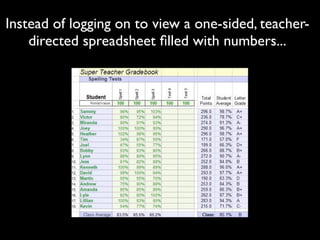
Instead of logging on to view a one-sided, teacher-
    directed spreadsheet filled with numbers...
...what if students had the opportunity to
become the main character in the story of their
                own learning quest?
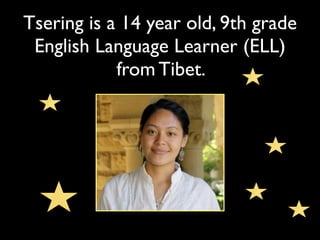
Tsering is a 14 year old, 9th grade
 English Language Learner (ELL)
            from Tibet.
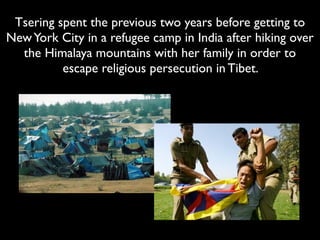
Tsering spent the previous two years before getting to
New York City in a refugee camp in India after hiking over
  the Himalaya mountains with her family in order to
          escape religious persecution in Tibet.
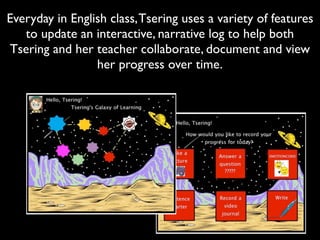
Everyday in English class, Tsering uses a variety of features
   to update an interactive, narrative log to help both
Tsering and her teacher collaborate, document and view
                 her progress over time.
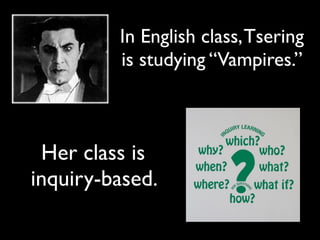
In English class, Tsering
         is studying “Vampires.”


 Her class is
inquiry-based.
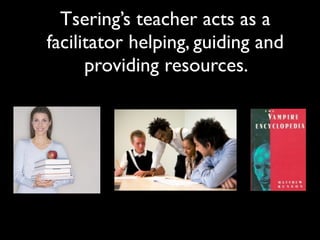
Tsering’s teacher acts as a
facilitator helping, guiding and
      providing resources.
Tsering and her teacher have
conversations about what learning
goals, objectives and skills Tsering
 would like to target during this
              project.
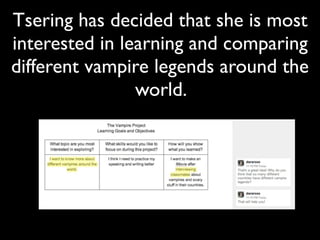
Tsering has decided that she is most
interested in learning and comparing
different vampire legends around the
                world.
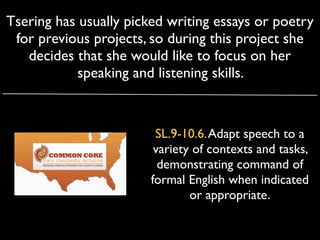
Tsering has usually picked writing essays or poetry
 for previous projects, so during this project she
   decides that she would like to focus on her
            speaking and listening skills.


                         SL.9-10.6. Adapt speech to a
                         variety of contexts and tasks,
                          demonstrating command of
                        formal English when indicated
                                or appropriate.
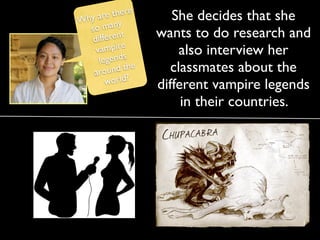
there       She decides that she
W hy are
   s o many
    dif ferent      wants to do research and
     v ampire            also interview her
      legends
    arou   nd the      classmates about the
         world?     different vampire legends
                         in their countries.
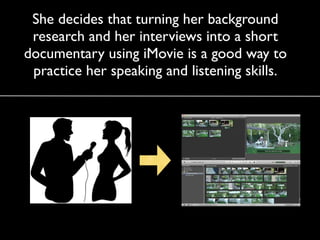
She decides that turning her background
 research and her interviews into a short
documentary using iMovie is a good way to
 practice her speaking and listening skills.
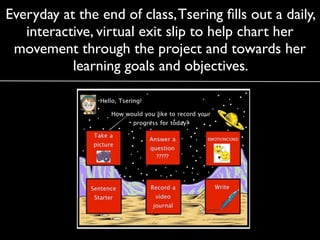
Everyday at the end of class, Tsering fills out a daily,
   interactive, virtual exit slip to help chart her
 movement through the project and towards her
           learning goals and objectives.
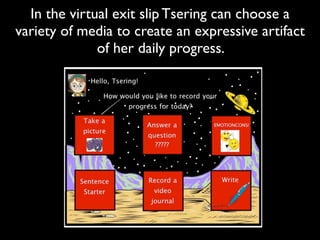
In the virtual exit slip Tsering can choose a
variety of media to create an expressive artifact
              of her daily progress.
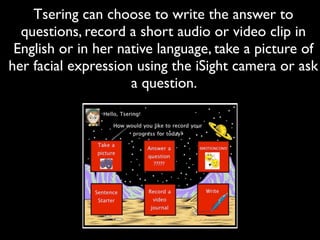
Tsering can choose to write the answer to
  questions, record a short audio or video clip in
 English or in her native language, take a picture of
her facial expression using the iSight camera or ask
                     a question.
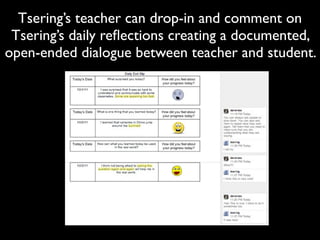
Tsering’s teacher can drop-in and comment on
 Tsering’s daily reflections creating a documented,
open-ended dialogue between teacher and student.
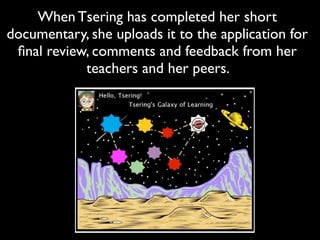
When Tsering has completed her short
documentary, she uploads it to the application for
 final review, comments and feedback from her
            teachers and her peers.
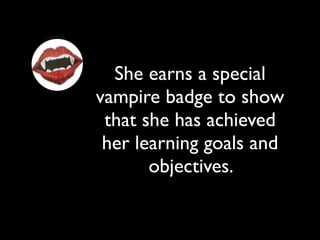
She earns a special
vampire badge to show
 that she has achieved
 her learning goals and
       objectives.
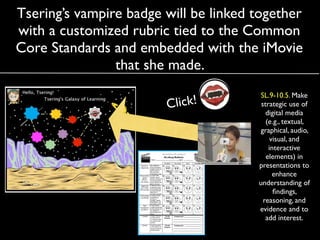
Tsering’s vampire badge will be linked together
with a customized rubric tied to the Common
Core Standards and embedded with the iMovie
                that she made.  
                                        SL.9-10.5. Make
                        Click!          strategic use of
                                          digital media
                                          (e.g., textual,
                                        graphical, audio,
                                            visual, and
                                           interactive
                                          elements) in
                                       presentations to
                                             enhance
                                       understanding of
                                             findings,
                                         reasoning, and
                                       evidence and to
                                          add interest.
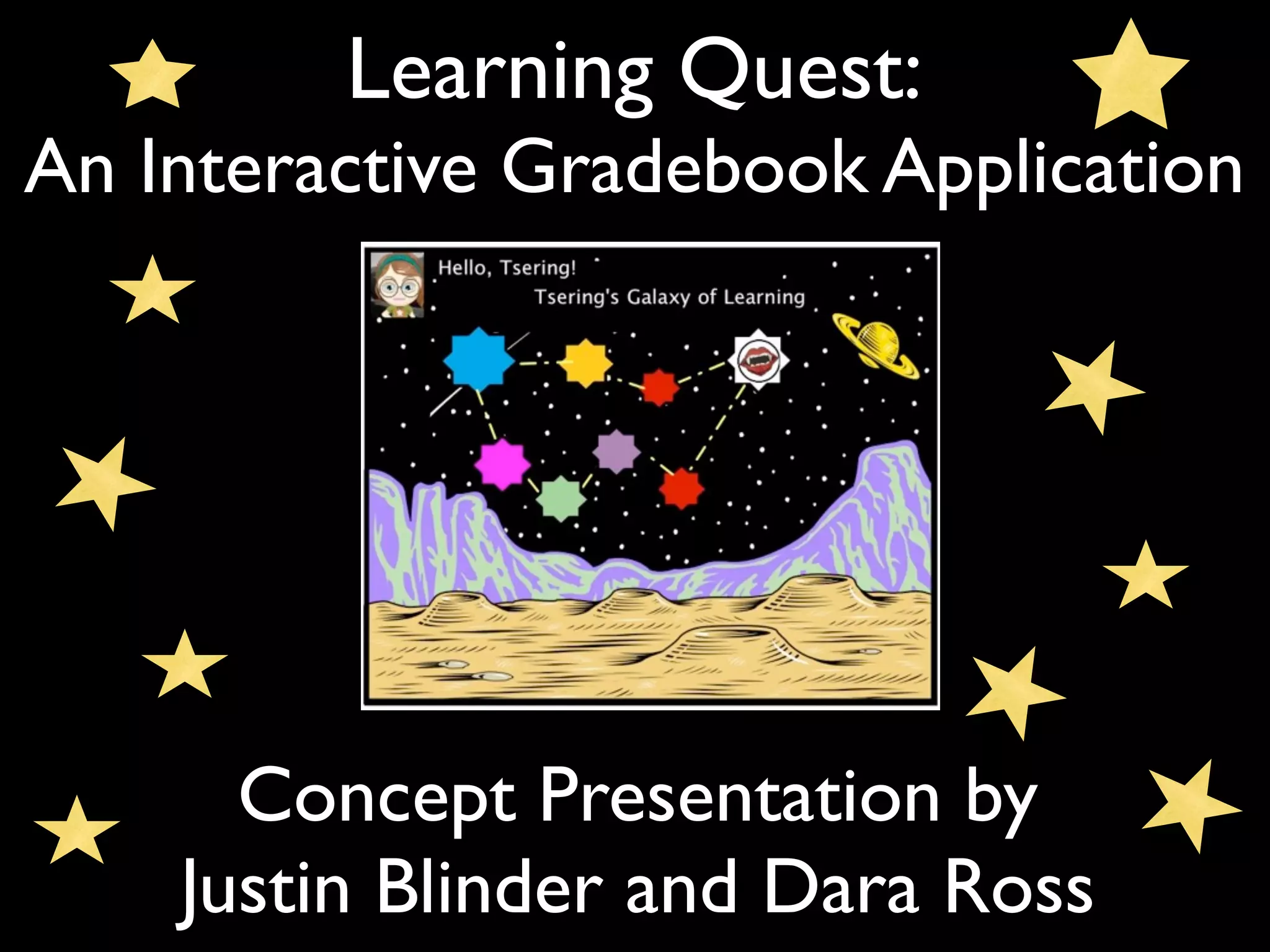
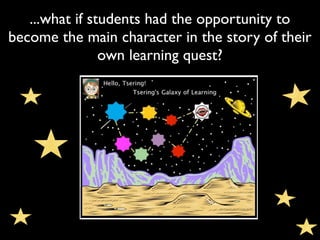
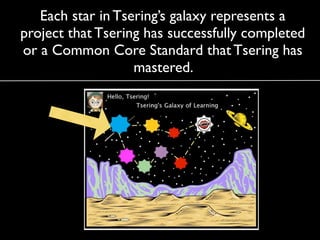
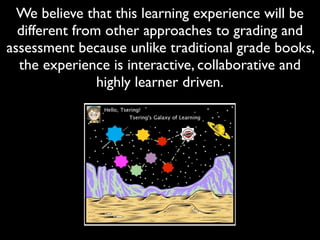
Each star in Tsering’s galaxy represents a
project that Tsering has successfully completed
or a Common Core Standard that Tsering has
                   mastered.
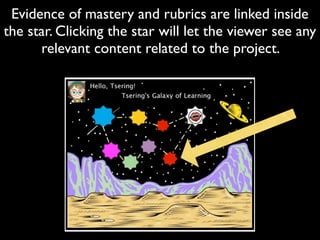
Evidence of mastery and rubrics are linked inside
the star. Clicking the star will let the viewer see any
      relevant content related to the project.
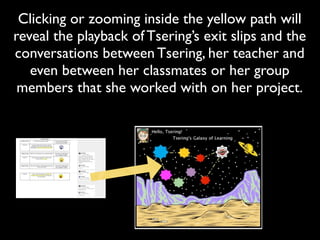
Clicking or zooming inside the yellow path will
reveal the playback of Tsering’s exit slips and the
conversations between Tsering, her teacher and
   even between her classmates or her group
 members that she worked with on her project.
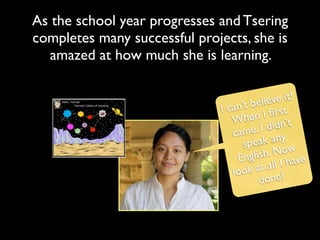
As the school year progresses and Tsering
completes many successful projects, she is
   amazed at how much she is learning.

                                              ve it!
                                      t belie t
                               I can’      I firs
                                  W   hen
                                    ame, I  didn’t
                                  c
                                     spea  k any
                                      nglish . Now
                                    E           I have
                                  look   at all
                                          done!
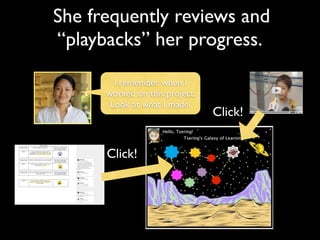
She frequently reviews and
“playbacks” her progress.

        I remember when I
      worked on this project.
       Look at what I made.
                                Click!


      Click!
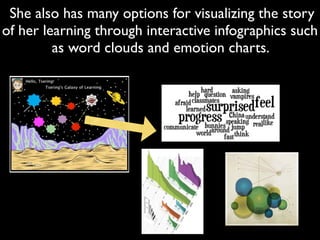
She also has many options for visualizing the story
of her learning through interactive infographics such
         as word clouds and emotion charts.
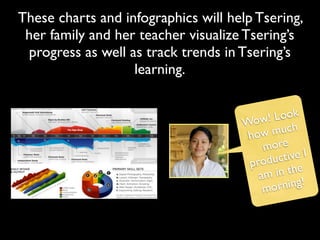
These charts and infographics will help Tsering,
 her family and her teacher visualize Tsering’s
 progress as well as track trends in Tsering’s
                   learning.


                                       ow!  Look
                                     W
                                     how   much
                                          more
                                        roduc tive I
                                      p
                                         am in the
                                          mo rning!
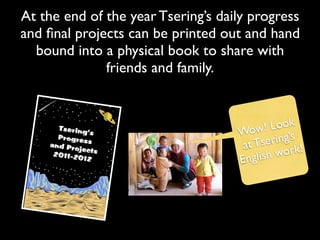
At the end of the year Tsering’s daily progress
and final projects can be printed out and hand
  bound into a physical book to share with
              friends and family.


                                    Wow    ! Look
                                     at Ts ering’s
                                        lish w ork!
                                    Eng
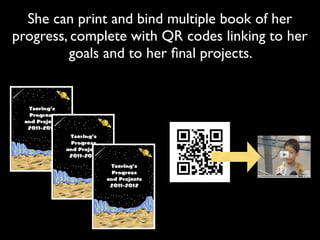
She can print and bind multiple book of her
progress, complete with QR codes linking to her
         goals and to her final projects.
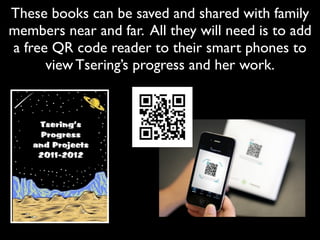
These books can be saved and shared with family
members near and far. All they will need is to add
a free QR code reader to their smart phones to
      view Tsering’s progress and her work.
We believe that this learning experience will be
  different from other approaches to grading and
assessment because unlike traditional grade books,
  the experience is interactive, collaborative and
                highly learner driven.

DTC Concept Keynote

  • 1.
    Learning Quest: An InteractiveGradebook Application Concept Presentation by Justin Blinder and Dara Ross
  • 2.
    KEY QUESTIONS: How can students document and visualize their learning progress over time? How can we assist students with diverse educational backgrounds, learning styles, and cultures develop relational and collaborative approaches to learning, reflection, goal setting and personal growth? How can teachers and students work together to set goals and chart progress?
  • 3.
    Instead of loggingon to view a one-sided, teacher- directed spreadsheet filled with numbers...
  • 4.
    ...what if studentshad the opportunity to become the main character in the story of their own learning quest?
  • 5.
    Tsering is a14 year old, 9th grade English Language Learner (ELL) from Tibet.
  • 6.
    Tsering spent theprevious two years before getting to New York City in a refugee camp in India after hiking over the Himalaya mountains with her family in order to escape religious persecution in Tibet.
  • 7.
    Everyday in Englishclass, Tsering uses a variety of features to update an interactive, narrative log to help both Tsering and her teacher collaborate, document and view her progress over time.
  • 8.
    In English class,Tsering is studying “Vampires.” Her class is inquiry-based.
  • 9.
    Tsering’s teacher actsas a facilitator helping, guiding and providing resources.
  • 10.
    Tsering and herteacher have conversations about what learning goals, objectives and skills Tsering would like to target during this project.
  • 11.
    Tsering has decidedthat she is most interested in learning and comparing different vampire legends around the world.
  • 12.
    Tsering has usuallypicked writing essays or poetry for previous projects, so during this project she decides that she would like to focus on her speaking and listening skills. SL.9-10.6. Adapt speech to a variety of contexts and tasks, demonstrating command of formal English when indicated or appropriate.
  • 13.
    there She decides that she W hy are s o many dif ferent wants to do research and v ampire also interview her legends arou nd the classmates about the world? different vampire legends in their countries.
  • 14.
    She decides thatturning her background research and her interviews into a short documentary using iMovie is a good way to practice her speaking and listening skills.
  • 15.
    Everyday at theend of class, Tsering fills out a daily, interactive, virtual exit slip to help chart her movement through the project and towards her learning goals and objectives.
  • 16.
    In the virtualexit slip Tsering can choose a variety of media to create an expressive artifact of her daily progress.
  • 17.
    Tsering can chooseto write the answer to questions, record a short audio or video clip in English or in her native language, take a picture of her facial expression using the iSight camera or ask a question.
  • 18.
    Tsering’s teacher candrop-in and comment on Tsering’s daily reflections creating a documented, open-ended dialogue between teacher and student.
  • 19.
    When Tsering hascompleted her short documentary, she uploads it to the application for final review, comments and feedback from her teachers and her peers.
  • 20.
    She earns aspecial vampire badge to show that she has achieved her learning goals and objectives.
  • 21.
    Tsering’s vampire badgewill be linked together with a customized rubric tied to the Common Core Standards and embedded with the iMovie that she made.   SL.9-10.5. Make Click! strategic use of digital media (e.g., textual, graphical, audio, visual, and interactive elements) in presentations to enhance understanding of findings, reasoning, and evidence and to add interest.
  • 22.
    Each star inTsering’s galaxy represents a project that Tsering has successfully completed or a Common Core Standard that Tsering has mastered.
  • 23.
    Evidence of masteryand rubrics are linked inside the star. Clicking the star will let the viewer see any relevant content related to the project.
  • 24.
    Clicking or zoominginside the yellow path will reveal the playback of Tsering’s exit slips and the conversations between Tsering, her teacher and even between her classmates or her group members that she worked with on her project.
  • 25.
    As the schoolyear progresses and Tsering completes many successful projects, she is amazed at how much she is learning. ve it! t belie t I can’ I firs W hen ame, I didn’t c spea k any nglish . Now E I have look at all done!
  • 26.
    She frequently reviewsand “playbacks” her progress. I remember when I worked on this project. Look at what I made. Click! Click!
  • 27.
    She also hasmany options for visualizing the story of her learning through interactive infographics such as word clouds and emotion charts.
  • 28.
    These charts andinfographics will help Tsering, her family and her teacher visualize Tsering’s progress as well as track trends in Tsering’s learning. ow! Look W how much more roduc tive I p am in the mo rning!
  • 29.
    At the endof the year Tsering’s daily progress and final projects can be printed out and hand bound into a physical book to share with friends and family. Wow ! Look at Ts ering’s lish w ork! Eng
  • 30.
    She can printand bind multiple book of her progress, complete with QR codes linking to her goals and to her final projects.
  • 31.
    These books canbe saved and shared with family members near and far. All they will need is to add a free QR code reader to their smart phones to view Tsering’s progress and her work.
  • 32.
    We believe thatthis learning experience will be different from other approaches to grading and assessment because unlike traditional grade books, the experience is interactive, collaborative and highly learner driven.