Disability Services Office
Handbook
1000 Holt Ave, Box 2772
Winter Park FL, 32789
Phone: (407) 646-2345
Fax: (407) 691-1269
Website: http://www.rollins.edu/disability-services/index.html
Created May 28, 2015 Edited July 14, 2015
P a g e | 2
Table of Contents
Our Promise 3
How to Apply 4 – 5
Student Rights and Responsibilities 6 – 7
Faculty Rights and Responsibilities 8 – 9
Institutional Rights and Responsibilities 10
Accommodations 11 – 13
Audio Recording of Classroom Lecture/Presentation Agreement 14
Medical Condition Affecting Attendance Procedure 15 - 17
Note-taker/Tutor Agreement Accommodation 18
Rules for Students Receiving Note-taker Services 19
Request Process for Alternative Format Textbooks 20
Returning Students Semesterly Instructions 21
Scheduling Exams on Accommodate 22 – 23
Steps for Requesting General Education Substitution 24 – 25
Service & Support Animals Procedure / Nutrition Policy Procedure 26
Housing Requests Based on Medical Need 27
Foreign Language/Math/PE Substitution Request Procedure 28
Grievance Policy 29 – 31
ADA Q&A 32 – 39
OUR PROMISE TO YOU
P a g e | 3
Equal Access
Rollins College is committed to equal access and does not discriminate unlawfully
against persons with disabilities in its policies, procedures, programs, or employment
processes. The College recognizes its obligations under the Rehabilitation Act of 1983
and the Americans with Disabilities Act to provide an environment that does not
discriminate against persons with disabilities. According to the Americans with
Disabilities Act, a “person with a disability” includes any person who:
(i) has a physical or mental impairment which substantially limits one or more of
such person’s major life activities,
(ii) has a record of such impairment, or
(iii) is regarded as having an impairment.
Mission
In an effort to provide equal access to all students who have been admitted to Rollins
College, the Disabilities Services Office will work to ensure that students with disabilities
are availed the necessary services and support to maintain a level playing field.
All students with disabilities must meet the same academic standards as all other
students.
HOW TO APPLY
P a g e | 4
Rollins College does not have a separate admission process or criteria for students with
disabilities; students are admitted through the regular admission process and must be
qualified for admission according to the College admission criteria. Documentation is
not required at the time of application, but should be sent to the Disability Services
Office soon after acceptance and the decision to attend is made.
Students who have turned in appropriate documentation must meet with the Disability
Services Director at the beginning of each semester to determine eligibility for
accommodations.
Rollins College offers disability services for students attending College of Arts &
Sciences, Hamilton Holt School, and Crummer Graduate School of Business.
To get the process started an accepted student will need to fill out their information in
our Web-based system, Accommodate.
Appropriate accommodations are provided on an individual basis after:
Sending suitable documentation of the disability from a professional to the Disability
Services Office
• Eligibility is based on the existence of an identified physical or mental
impairment in a disability that substantially limits a major life activity.
• Comprehensive disability documentation should include the following six
components:
 Evidence of existing impairment,
 Background information (e.g., interview, review of records),
 Relevant testing,
 Specific diagnosis,
 Rule-out of alternative diagnoses or explanations, and
 Integrated summary.
• Professionals conducting assessment, rendering diagnoses of specific
disabilities, and making recommendations for appropriate accommodations
must be qualified to do so. This professional may not be a family member.
P a g e | 5
• Students must have appropriate documentation on file with the college before
a faculty member should provide any accommodations.
• Documentation should be current, or no older than 5 years.
A face-to-face interview with the student applying for accommodations.
• Students must meet with the Disability Services Director at the beginning of
the semester to determine eligibility for accommodations which will vary from
course to course.
• Classroom accommodations are determined through consultation with the
student regarding his/her past success with various accommodations as well
as documented needs and the demands of the course.
Faxes can be sent to Disability Services at: (407) 691-1269
STUDENT
RIGHTS AND RESPONSIBILITIES
P a g e | 6
Rollins College desires that all students have equal access to the programs, services
and benefits of the college. To that end, the College recognizes that, in accordance with
the Rehabilitation Act of 1973 and the Americans with Disabilities Act (as amended),
Rollins must provide services and support to students with disabilities that will ensure
such access. Students with disabilities have both rights and responsibilities under
Federal law, as is true for faculty and administration of Rollins College.
Students with disabilities have the right to:
1. Full and equal participation in the educational programs, services and activities at
Rollins College.
2. Request reasonable accommodations and/or auxiliary aids and services, ensuring
such access by contacting the Disability Services office.
3. Privacy and confidential treatment of personal information.
4. Reasonable alterations in those aspects of the course (or program) to accommodate
the disability, as long as it does not fundamentally alter the nature of the program or
activity, lower academic standards, present an undue financial or administrative burden
to the college, or pose a threat to personal or public safety.
5. Expect that requested and agreed upon accommodations will be provided in a
reasonable fashion.
6. Be evaluated based on ability, not disability. If the disability affects the outcome of an
evaluation method, students are entitled to an evaluation by alternate/modified means.
7. Information reasonably available in accessible format, as needed.
8. File an appeal or complaint if they believe that they have been denied an
accommodation or been subjected to discrimination within a College environment. For
information on the Rollins College Student Grievance process, please review the Rollins
College Code of Community Standards.
Students with disabilities have the responsibility to:
P a g e | 7
1. Meet the Rollins College qualifications and essential institutional standards for
courses, programs, services, jobs and other campus activities. This includes but is not
limited to: Student Code of Conduct, residence hall standards, all academic
requirements as written in a syllabus, degree requirements, general education
requirements and essential functions of student employment.
2. Students are not required to disclose their disability status; however, if they are
seeking consideration or accommodations (academic adjustments) relative to their
disability, they are responsible for identifying themselves to the Disability Services
Office; such identification/requests must come from the student, not a parent or third
party acting on their behalf.
3. Provide current and appropriate documentation that demonstrates or documents how
the disability limits participation in courses, programs, services, jobs and activities.
4. Identify themselves as needing accommodations in a timely fashion to the Director of
Disability Services and to faculty.
5. Actively participate in the identification of appropriate accommodations and auxiliary
aids.
6. Follow published procedures for obtaining reasonable accommodations, auxiliary
aids or requesting barrier removal.
7. Communicate requests for accommodations to instructors by providing a letter of
identification describing the reasonable accommodations assigned by the Disability
Services Office as early in the semester as possible.
8. Notify the Disability Services Office of any issues, concerns, or delays in receiving
requested accommodations; the Disability Services Office relies on student notification
to identify problems in service delivery.
9. Provide for one's own personal independent living needs or other personal disability-
related or health needs. For example, coordinating services of personal care attendants,
executive function coaches, administration of medication, or acquiring homework
assistance are the student's responsibilities and are not the responsibilities of
Rollins College.
FACULTY
P a g e | 8
RIGHTS AND RESPONSIBILITIES
Faculty has the right to:
1. Identify and establish essential elements of their courses and evaluate students on
that basis.
2. Expect the student to initiate accommodation requests.
3. If the student is taking tests at the Disability Services Office, expect that the Testing
supervisor administer exams in a secure and monitored environment.
4. Request verification of a student's eligibility for any requested academic adjustments
and/or accommodations. Such verification will be in the form of a letter written by
Disability Services Office (Accommodate approval letter). Typically, the
memorandum will be delivered by the qualified student. The Disability Services
Office is the only office designated to review disability documentation and determine
eligibility for reasonable academic adjustments and/or accommodations.
Faculty has the responsibility to:
1. Evaluate students on the basis of their abilities not their disabilities.
2. Provide accommodations to students who are registered with the Disability Services
Office and have provided notice of their assigned accommodation needs. There is
no responsibility to provide accommodations to students who are not registered with
the Disability Services Office, or to students who have not followed established and
published policy regarding their approved accommodations.
3. Use a syllabus statement and class announcements to invite students to disclose
their needs and to assist in the provision of accommodation (for example, the
recruitment of note takers).
4. Respond to requests in a timely fashion. This includes both student request for
accommodation (as established by a letter from the Disability Services Office) and
requests from the Disability Services Office directly for information necessary in
order to allow ample time for arrangements/accommodations to be put in place.
(such as ISBN numbers, course packets other course materials for conversion to
alternate format, information necessary to plan for secure monitored testing
environment, or inform the DS office when request cannot be fulfilled.
5. Work to ensure that all audio-visual materials used in class are accessible to all
students in the class.
6. Treat and protect all disability-related information as confidential information.
7. Advise students with disabilities when medical absences from class cannot be
reasonably accommodated, based on class competency requirements.
P a g e | 9
8. Contact the Disability Services office with any questions or concerns.
Syllabus Statement for Faculty
Rollins College is committed to equal access and does not discriminate unlawfully
against persons with disabilities in its policies, procedures, programs or employment
processes. The College recognizes its obligations under the Rehabilitation Act of 1973
and the Americans with Disabilities Act of 1990 to provide an environment that does not
discriminate against persons with disabilities.
If you are a person with a disability on this campus and anticipate needing any type of
academic/medical accommodations in order to participate in your classes, please make
timely arrangements by disclosing this disability in writing to the Disability Services
Office at (Box 2772) – Mills Building, 1000 Holt Ave., Winter Park, FL, 32789.
Appointments can be scheduled by calling 407-646-2354 or by emailing:
gridgeway@rollins.edu
Helpful Suggestions for Faculty!
Faculty should begin as early as the first day of class to solicit trained or capable note
takers in your classes. Students who have served as note-takers, before will inform you
if they would like to serve in this capacity again, and do not have to be retrained to do
so. They should present their Certificate of Note-taker Training to you on the first day of
class. If you do not have a trained note-taker in the class, you should email the class to
see if a capable volunteer would like to serve in this capacity. Once a student with a
disability submits their accommodation form to you, and discloses that they need a
note-taker, fill out the note-taker agreement form attached to this email, and send the
student note-taker with a copy of their notes to the Disability Services Office on the third
floor of Mills Building (302). Note-taker request should be implemented within one week
of the accommodation forms delivery to you. Please contact Gail Ridgeway if you need
to be assisted with this process at 407-975-6463.
Thank you so much for your continuous cooperation, because timely equal
access can assure greater academic success for students with disabilities at
Rollins College.
INSTITUTIONAL
P a g e | 10
RIGHTS AND RESPONSIBILITIES
Rollins College, through its Director of Disability Services, has the right to:
1. Confirm disability status and request and receive current, relevant documentation that
supports requests for accommodations, academic adjustments and/or auxiliary aids and
services.
2. Request current documentation from a student completed by an appropriate
professional source to verify the need for reasonable accommodations, academic
adjustments, and/or auxiliary aids.
3. Make the determination as to what accommodations are to be provided to assure
equal access for students with disabilities at Rollins College. Recommendations for
accommodations from third parties or diagnosticians are helpful in making this
determination, but are not binding on the institution.
4. Have appropriate discussion with institutional personnel regarding students and their
responsibilities in order to implement requested accommodations (particularly
instructional accommodations).
5. Deny a request for accommodations or auxiliary aides and services, and/or barrier
removal in facilities if the documentation does not demonstrate that the request is
warranted, or if the individual fails to provide appropriate documentation.
6. Select among equally effective accommodations, academic adjustments and/or
auxiliary aids and services.
Rollins College, through its Director of Disability Services, has the responsibility
to:
1. Provide information regarding policies and procedures to students with disabilities in
an unambiguous and readily available format.
2. Ensure that courses, programs, services and activities, when viewed in their entirety,
are available and usable in the most integrated and appropriate settings.
3. Provide reasonable and appropriate accommodations, academic adjustments, and/or
auxiliary aids for students with disabilities upon a timely request by a student.
4. Maintain appropriate confidentiality of records and communication concerning
students with disabilities except where disclosure is required by law or authorized by the
student.
P a g e | 11
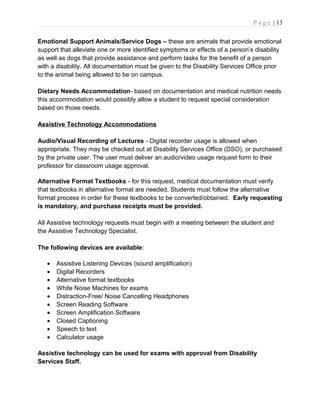
ACCOMMODATIONS
Academic Accommodation Approval Emails - These are the accommodation emails
sent to the student to provide to each of their professors, when the student with a
disability is in their class. The request must be submitted through the Accommodate
Portal, approved by the office and then either forwarded or printed and hand delivered
to professors as close to the first day of class as possible.
General Academic Accommodations
Foreign Language/Math/PE Substitution Request - Medical documentation must be
submitted that substantiates that the student has a disability that will not allow them to
master any one of the general education courses listed above. A letter must be
forwarded to Disability Services Officer to request the substitution be granted by the
student. The letter is then forwarded to the Dean of Faculty for final approval. The
student will receive a letter indicating the class/classes that should be utilized to fulfill
the substitution once the request has been approved.
Medical Condition Affecting Attendance Policy - This accommodation is granted to
students with medically documented conditions that could affect their ability to attend
class regularly. The student must inform the Disability Services Officer and the faculty
immediately when these absences occur, and they (the student) must submit written
medical documentation to the Disability Services Office and professor to validate that
they were in medical treatment when the absence(s) occurred.
The professor and the student should solidify the missed work make up
procedure at the time that the accommodation approval letter is delivered.
Note-taker Usage - Trained student note-takers are assigned to students who have a
documented disability that hampers them from listening to spoken information and
transcribing that information completely and correctly onto paper. The note-taker is paid
for this service, and must return the completed notes to the receiver within 24 hours of
that class. Note receivers (DS student) must take notes in the class also, unless they
have a disability that will not allow them to do so.
Preferential Seating - When a patron/student has a disability that requires that they sit
in a particular location in the classroom - this is an appropriate accommodation.
P a g e | 12
Weekly Planning Sessions - Students must make an appointment with the Graduate
Assistant (GA) on staff at DSO (via phone; 407-646-2354). The GA can assist you with
organizational strategies, study strategies, or test-taking strategies.
Testing Accommodations
Distraction Free Testing Environment - Disability Services testing rooms are now
housed on the second floor and in the basement of the Mills building. They are
designed to remove as much distraction as possible from testing. Private testing rooms
are available for students needing to utilize scribes, readers, or other assistive devices
for test completion. Private room requests must be submitted as early as possible.
White noise headsets are also available upon request. The over-flow test room will
accommodate up to eight students needing only paper, pencils, word-
processor/calculator’s and double time distraction reduces testing environments.
Extended Test time – is double the amount of time granted in a regular classroom
setting. This can be administered in a regular classroom or at the DSO at the
professor’s discretion.
Limiting of Exams per Day - This is an appropriate accommodation when a person
with a disability has a long or short-term memory deficit that will not allow the student to
retain large volumes of information for long periods of time.
Word Processors Usage for Test Taking - Computers in testing rooms are available
with Word only and Excel only. This is an appropriate request for students with
disabilities in written language/spelling deficiencies. Excel is utilized for economics
/math examinations.
Scribes and readers (for tests) - Scribes or readers are appropriate when the student
has a disability that will not allow them to write or read for themselves. Early requests
must be made so the times of the test can be coordinated with the time that
scribes/readers are available.
Housing Accommodations
Medical Conditions Affecting Residential Life, Bathroom, single occupancy - This
can include any of the following: single occupancy room placement, carpet free rooms,
rooms near bathrooms. These accommodations are granted based on documented
medical needs.
P a g e | 13
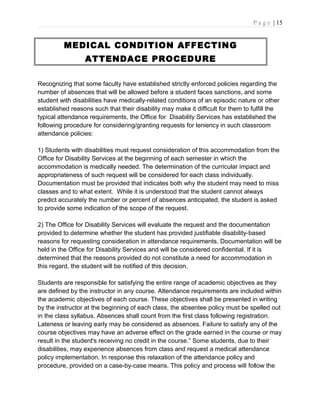
Emotional Support Animals/Service Dogs – these are animals that provide emotional
support that alleviate one or more identified symptoms or effects of a person’s disability
as well as dogs that provide assistance and perform tasks for the benefit of a person
with a disability. All documentation must be given to the Disability Services Office prior
to the animal being allowed to be on campus.
Dietary Needs Accommodation- based on documentation and medical nutrition needs
this accommodation would possibly allow a student to request special consideration
based on those needs.
Assistive Technology Accommodations
Audio/Visual Recording of Lectures - Digital recorder usage is allowed when
appropriate. They may be checked out at Disability Services Office (DSO), or purchased
by the private user. The user must deliver an audio/video usage request form to their
professor for classroom usage approval.
Alternative Format Textbooks - for this request, medical documentation must verify
that textbooks in alternative format are needed. Students must follow the alternative
format process in order for these textbooks to be converted/obtained. Early requesting
is mandatory, and purchase receipts must be provided.
All Assistive technology requests must begin with a meeting between the student and
the Assistive Technology Specialist.
The following devices are available:
• Assistive Listening Devices (sound amplification)
• Digital Recorders
• Alternative format textbooks
• White Noise Machines for exams
• Distraction-Free/ Noise Cancelling Headphones
• Screen Reading Software
• Screen Amplification Software
• Closed Captioning
• Speech to text
• Calculator usage
Assistive technology can be used for exams with approval from Disability
Services Staff.
P a g e | 14
AUDIO/VIDEO RECORDING OF CLASSROOM
LECTURE/PRESENTATION PROCEDURE
Students/Patrons wishing to use audio devices to record classroom/workshops/lectures
or discussions must obtain written permission from the professor /presenter.
Such recordings are to be used solely for the purposes of individual, or group study,
note-taking, or transcription for students enrolled in the class/workshop. They may not
be reproduced, shared with those not in the class, or uploaded to publicly accessible
web environments.
Students found in violation of this procedure may be subject to disciplinary actions
under Code of Conduct. Patrons violating this procedure may be subject to dismissal
from the program.
Audio /video recording will serve as an alternate means for satisfying a note-taker
request, when a timely note-taker cannot be recruited.
 Forms can be obtained from the Disability Services Office.
P a g e | 15
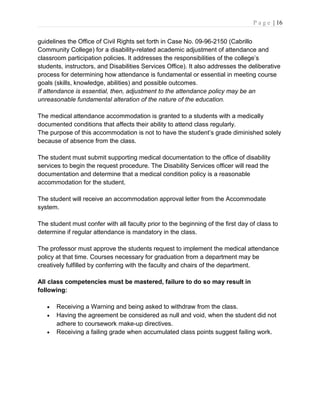
MEDICAL CONDITION AFFECTING
ATTENDACE PROCEDURE
Recognizing that some faculty have established strictly enforced policies regarding the
number of absences that will be allowed before a student faces sanctions, and some
student with disabilities have medically-related conditions of an episodic nature or other
established reasons such that their disability may make it difficult for them to fulfill the
typical attendance requirements, the Office for Disability Services has established the
following procedure for considering/granting requests for leniency in such classroom
attendance policies:
1) Students with disabilities must request consideration of this accommodation from the
Office for Disability Services at the beginning of each semester in which the
accommodation is medically needed. The determination of the curricular impact and
appropriateness of such request will be considered for each class individually.
Documentation must be provided that indicates both why the student may need to miss
classes and to what extent. While it is understood that the student cannot always
predict accurately the number or percent of absences anticipated, the student is asked
to provide some indication of the scope of the request.
2) The Office for Disability Services will evaluate the request and the documentation
provided to determine whether the student has provided justifiable disability-based
reasons for requesting consideration in attendance requirements. Documentation will be
held in the Office for Disability Services and will be considered confidential. If it is
determined that the reasons provided do not constitute a need for accommodation in
this regard, the student will be notified of this decision.
Students are responsible for satisfying the entire range of academic objectives as they
are defined by the instructor in any course. Attendance requirements are included within
the academic objectives of each course. These objectives shall be presented in writing
by the instructor at the beginning of each class, the absentee policy must be spelled out
in the class syllabus. Absences shall count from the first class following registration.
Lateness or leaving early may be considered as absences. Failure to satisfy any of the
course objectives may have an adverse effect on the grade earned in the course or may
result in the student's receiving no credit in the course.” Some students, due to their
disabilities, may experience absences from class and request a medical attendance
policy implementation. In response this relaxation of the attendance policy and
procedure, provided on a case-by-case means. This policy and process will follow the
P a g e | 16
guidelines the Office of Civil Rights set forth in Case No. 09-96-2150 (Cabrillo
Community College) for a disability-related academic adjustment of attendance and
classroom participation policies. It addresses the responsibilities of the college’s
students, instructors, and Disabilities Services Office). It also addresses the deliberative
process for determining how attendance is fundamental or essential in meeting course
goals (skills, knowledge, abilities) and possible outcomes.
If attendance is essential, then, adjustment to the attendance policy may be an
unreasonable fundamental alteration of the nature of the education.
The medical attendance accommodation is granted to a students with a medically
documented conditions that affects their ability to attend class regularly.
The purpose of this accommodation is not to have the student’s grade diminished solely
because of absence from the class.
The student must submit supporting medical documentation to the office of disability
services to begin the request procedure. The Disability Services officer will read the
documentation and determine that a medical condition policy is a reasonable
accommodation for the student.
The student will receive an accommodation approval letter from the Accommodate
system.
The student must confer with all faculty prior to the beginning of the first day of class to
determine if regular attendance is mandatory in the class.
The professor must approve the students request to implement the medical attendance
policy at that time. Courses necessary for graduation from a department may be
creatively fulfilled by conferring with the faculty and chairs of the department.
All class competencies must be mastered, failure to do so may result in
following:
• Receiving a Warning and being asked to withdraw from the class.
• Having the agreement be considered as null and void, when the student did not
adhere to coursework make-up directives.
• Receiving a failing grade when accumulated class points suggest failing work.
P a g e | 17
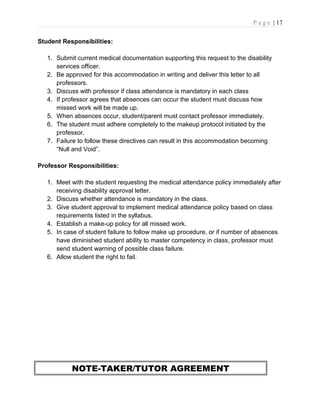
Student Responsibilities:
1. Submit current medical documentation supporting this request to the disability
services officer.
2. Be approved for this accommodation in writing and deliver this letter to all
professors.
3. Discuss with professor if class attendance is mandatory in each class
4. If professor agrees that absences can occur the student must discuss how
missed work will be made up.
5. When absences occur, student/parent must contact professor immediately.
6. The student must adhere completely to the makeup protocol initiated by the
professor.
7. Failure to follow these directives can result in this accommodation becoming
“Null and Void”.
Professor Responsibilities:
1. Meet with the student requesting the medical attendance policy immediately after
receiving disability approval letter.
2. Discuss whether attendance is mandatory in the class.
3. Give student approval to implement medical attendance policy based on class
requirements listed in the syllabus.
4. Establish a make-up policy for all missed work.
5. In case of student failure to follow make up procedure, or if number of absences
have diminished student ability to master competency in class, professor must
send student warning of possible class failure.
6. Allow student the right to fail.
NOTE-TAKER/TUTOR AGREEMENT
P a g e | 18
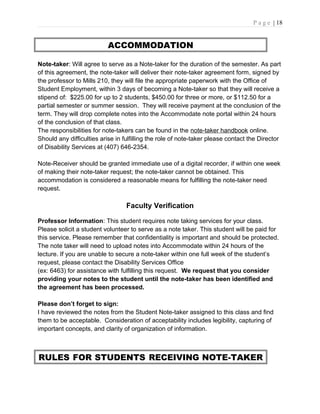
ACCOMMODATION
Note-taker: Will agree to serve as a Note-taker for the duration of the semester. As part
of this agreement, the note-taker will deliver their note-taker agreement form, signed by
the professor to Mills 210, they will file the appropriate paperwork with the Office of
Student Employment, within 3 days of becoming a Note-taker so that they will receive a
stipend of: $225.00 for up to 2 students, $450.00 for three or more, or $112.50 for a
partial semester or summer session. They will receive payment at the conclusion of the
term. They will drop complete notes into the Accommodate note portal within 24 hours
of the conclusion of that class.
The responsibilities for note-takers can be found in the note-taker handbook online.
Should any difficulties arise in fulfilling the role of note-taker please contact the Director
of Disability Services at (407) 646-2354.
Note-Receiver should be granted immediate use of a digital recorder, if within one week
of making their note-taker request; the note-taker cannot be obtained. This
accommodation is considered a reasonable means for fulfilling the note-taker need
request.
Faculty Verification
Professor Information: This student requires note taking services for your class.
Please solicit a student volunteer to serve as a note taker. This student will be paid for
this service. Please remember that confidentiality is important and should be protected.
The note taker will need to upload notes into Accommodate within 24 hours of the
lecture. If you are unable to secure a note-taker within one full week of the student’s
request, please contact the Disability Services Office
(ex: 6463) for assistance with fulfilling this request. We request that you consider
providing your notes to the student until the note-taker has been identified and
the agreement has been processed.
Please don’t forget to sign:
I have reviewed the notes from the Student Note-taker assigned to this class and find
them to be acceptable. Consideration of acceptability includes legibility, capturing of
important concepts, and clarity of organization of information.
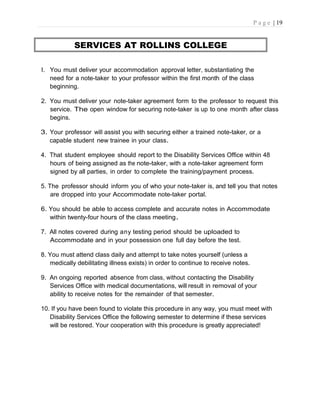
RULES FOR STUDENTS RECEIVING NOTE-TAKER
P a g e | 19
SERVICES AT ROLLINS COLLEGE
I. You must deliver your accommodation approval letter, substantiating the
need for a note-taker to your professor within the first month of the class
beginning.
2. You must deliver your note-taker agreement form to the professor to request this
service. The open window for securing note-taker is up to one month after class
begins.
3. Your professor will assist you with securing either a trained note-taker, or a
capable student new trainee in your class.
4. That student employee should report to the Disability Services Office within 48
hours of being assigned as the note-taker, with a note-taker agreement form
signed by all parties, in order to complete the training/payment process.
5. The professor should inform you of who your note-taker is, and tell you that notes
are dropped into your Accommodate note-taker portal.
6. You should be able to access complete and accurate notes in Accommodate
within twenty-four hours of the class meeting.
7. All notes covered during any testing period should be uploaded to
Accommodate and in your possession one full day before the test.
8. You must attend class daily and attempt to take notes yourself (unless a
medically debilitating illness exists) in order to continue to receive notes.
9. An ongoing reported absence from class, without contacting the Disability
Services Office with medical documentations, will result in removal of your
ability to receive notes for the remainder of that semester.
10. If you have been found to violate this procedure in any way, you must meet with
Disability Services Office the following semester to determine if these services
will be restored. Your cooperation with this procedure is greatly appreciated!
P a g e | 20
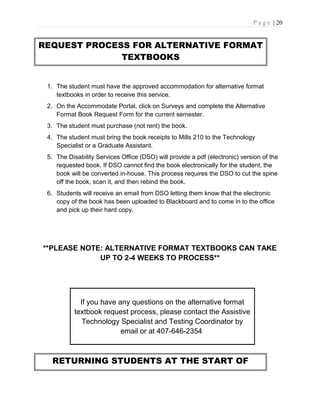
REQUEST PROCESS FOR ALTERNATIVE FORMAT
TEXTBOOKS
1. The student must have the approved accommodation for alternative format
textbooks in order to receive this service.
2. On the Accommodate Portal, click on Surveys and complete the Alternative
Format Book Request Form for the current semester.
3. The student must purchase (not rent) the book.
4. The student must bring the book receipts to Mills 210 to the Technology
Specialist or a Graduate Assistant.
5. The Disability Services Office (DSO) will provide a pdf (electronic) version of the
requested book. If DSO cannot find the book electronically for the student, the
book will be converted in-house. This process requires the DSO to cut the spine
off the book, scan it, and then rebind the book.
6. Students will receive an email from DSO letting them know that the electronic
copy of the book has been uploaded to Blackboard and to come in to the office
and pick up their hard copy.
**PLEASE NOTE: ALTERNATIVE FORMAT TEXTBOOKS CAN TAKE
UP TO 2-4 WEEKS TO PROCESS**
If you have any questions on the alternative format
textbook request process, please contact the Assistive
Technology Specialist and Testing Coordinator by
email or at 407-646-2354
RETURNING STUDENTS AT THE START OF
P a g e | 21
EVERY SEMESTER
Accommodate: https://rollins-accommodate.symplicity.com/students/
1. Log into Accommodate through the link above with your fox ID.
2. Click on the Accommodations tab located on the top left of the page.
3. Select “Semester Request” and scroll down to the bottom. Select the button on
the left that says “Request Accommodation”.
4. Students may only request accommodations that they have previously been
approved for (if you need new accommodations you must speak with the Director
of Disability Services to be approved for the new accommodation).
5. Click on the Accommodation type drop down menu and select the first
accommodation on the list.
6. Select the semester you would like to use your accommodations (for example, if
you want the accommodations for Fall 2015, select it).
7. After you select your semester courses will appear, please check all the courses
that you want your accommodations to be applied to.
8. If there are multiple Accommodations to be selected, click on “request additional”
and then follow steps 5 – 7 above.
9. Once all the accommodations you want to request have been selected click
submit.
10.You will receive your accommodation approval letter in your Rollins email. Once
you’ve received this letter you must make an appointment with the Disability
Services Director and a separate appointment your professor.
11.If a face to face meeting with your professor has not occurred each semester,
your request process is not complete, and the accomodations will not be
implemented.
INSTRUCTIONS FOR SCHEDULING EXAMS ON
P a g e | 22
ACCOMMODATE
All exams must be requested a minimum of 72 hours prior to the exam. It is your
responsibility to schedule your exams, not the professor or this office. We will contact
your professors for approval and you will be notified via email when your test has been
approved. If you have any issues, please the Assistive Technology Specialist.
Click on this link and bookmark it: https://rollins-accommodate.symplicity.com
1. Log in with your Fox ID and Password.
2. Click on the Testing Room tab at the top of the home page.
3. On the left side, under Pending Book Request, click on New Booking
Request.
4. Click on the Length drop down menu.
5. Select double the length of your class time. For example, if your class is 50
minutes long, you would select 100 minutes for your exam.
6. You can select the date range you want to book the exam.
7. Click Refine Results.
8. On the right side, click on the time and room you want to schedule your exam.
9. Fill in the information in the pop-up box.
10.Click Submit Request.
 We are only the testing site; your professors set the parameters/directives for the
actual exams.
IMPORTANT:
P a g e | 23
If you need to reschedule an exam, please follow the steps below:
Exam Rescheduling Process:
• You MUST contact your professor and get the change approval
in writing
• CC the Assistive Technology Specialist on your request to your
professor.
• Once the response is received we will make the change.
 You MUST take your exams when the class is scheduled. The exceptions are if
you have a class before and/or after the exam that prohibits you from utilizing
your full extended time or an extraneous situation. Informing DSO and the
professor must be done.
 If you are going to be late or miss an exam please contact your professor and
testing supervisor as soon as possible.
 Exams being scheduled on Mondays must be scheduled no later than the
Thursday prior by 5pm. We do not access our email on the weekend.
 Continued failure to abide by the testing parameters could result in losing DS
testing privileges and exams would be taken with the professor.
P a g e | 24
STEPS FOR REQUESTING A GENERAL
EDUCATION SUBSTITUTION BASED UPON
A DOCUMENTED DISABILITY
The law does not require institutions to waive specific courses or academic
requirements considered essential to a particular program or degree and the Rollins
College procedure is not to grant such waivers. However, recognizing that the nature
and severity of specific disabilities may preclude learning in the quantitative or foreign
language areas even with reasonable accommodations, the College may permit
substitutions in Math or Foreign Language on a case-by-case basis. For students with
mobility or stamina-related disabilities, Physical Education substitution may be granted.
Possible examples include (but are not limited to):
• Math substitution may be granted for Dyscalculia or another specific math-related
learning disorder
• Foreign Language substitution may be granted for Dyslexia, processing
disorders, or other specific learning disorders
• Physical Education substitution may be granted for mobility disorders or physical
disorders affecting stamina
Please follow these steps to make your request:
1. Consult your faculty advisor about academic requirements for graduation,
including general education and major requirements. Print and bring a copy of
your advising transcript for an informed discussion with your advisor. (This
transcript may be accessed and printed from the appropriate student tab on the
FoxLink homepage.)
2. Schedule an appointment with the Director of Disability Services in the Mills
Building by email or call 407-646-2354 to discuss your individual situation and to
determine required documentation. If medical documentation has not already
been submitted, it must be provided at this appointment and must have been
signed by the authorizing professional within the past 5 years.
3. The student must provide the Director of Disability Services with current,
relevant, and comprehensive documentation and assessment data from certified
P a g e | 25
professionals. This documentation must substantiate a severe disability and its
specific impact upon the student's ability in the area of mathematics, foreign
language learning, or physical education. Students without a history of a disability
prior to attending Rollins must present a complete psychological evaluation from
a licensed psychologist to be considered for a course substitution.
4. Submit your written request to the Director of Disability Services .This letter must
provide a one to two page explanation of why you would like to receive a general
education substitution based upon your documented disability. Explain what
attempts, if any, you have made to meet this general education requirement and
state the challenges you encountered. If you have not attempted to satisfy the
requirement, explain why you have not done so. Tell you major, proposed
graduation date, and state the positive affect this accommodation will have on
your academic performance at Rollins College.
5. It is recommended that students carefully proofread their request.
P a g e | 26
FOREIGN LANGUAGE/MATH/PE
SUBSTITUTION REQUEST PROCEDURE
Medical documentation must be submitted that substantiates that the student has a
disability that will not allow him/her to master any one of the general education courses
listed above. A letter must be forwarded to Disability Services Officer to request the
substitution be granted by the student. The letter is then forwarded to the Dean of Arts
and Sciences for final approval. The student will receive a letter indicating the
class/classes that should be utilized to fulfill the substitution once the request has been
approved. This process is not designed to eliminate, remove, or improve a grade.
1. The student must submit current medical documentation that supports the need
for this academic accommodation.
2. The approval for this accommodation will be stated as approved, in the
Accommodate approval letter.
3. The initial approval is the first step in completing the substitution request process.
4. The student must submit a formal letter of request to the DS officer by the end of
their sophomore year at Rollins College
5. The Dean of Arts and Science will send an official letter of approval to the
student, listing the substitutionary course possibilities.
6. The student must satisfactorily pass these courses.
7. Students majoring in International Business may not request a foreign language
substitution.
8. The student requesting a PEA or Math Substitution, must meet with the chair of
that department to receive directives on the substitutionary class or project
needed to complete this request.
Faculty advisors should:
P a g e | 27
Encourage their advisees who historically have been exempt from the above general
education courses and have not completed these request, to contact the DS officer
immediately, to determine if they qualify for this accommodation.
SERVICE AND SUPPORT ANIMALS PROCEDURE
Service/Support Animal in Residential Housing Requirements:
1. Submit formal request to the office of disability services, stating medical
reason for service /support animal usage.
2. Present well animal certificate for the year of the request.
3. Wait for approval from the DS office before bringing your animal into
residential facilities.
To view the full service animal policies please click here.
NUTRITION POLICY IMPLEMENTATION
PROCEDURE
Student Responsibility:
1. Submit a letter from your diagnosing medical professional to disclose medical
rationale for this request.
2. Submit a letter disclosing your specific medical nutrition needs, listing how
they impact your ability to follow the regular nutrition plan.
3. You will receive an email from the disability services office that states that you
are approved to begin the medical nutrition request process. Click on the
Accommodate public link and complete the application process.
4. You will receive an Accommodate approval letter, read, and complete every
step in the listed process.
P a g e | 28
5. Make an appointment with the Sodexo nutrition specialist (within five days of
letter’s receipt), to discuss your medical needs. Failure to adhere to this five day
rule may result in your request being denied
6. The Sodexo nutritionist will create a specialized meal plan for you.
7. Re-Enter the Accommodate system portal, read the prescribed meal plan, and
accept, reject, or appeal this plan.
8. Based on your response to this question, a determination letter will be sent to
you to communicate your nutrition request outcome.
Institutional Responsibility:
1. In case of an appeal, the Appeals committee will make a final determination.
HOUSING REQUESTS BASED ON MEDICAL
NEEDS
If you have housing requests related to medical needs, please follow the steps below:
1. Documentation of the condition or need that is the basis of the request;
2. A clear description of the desired housing configuration;
3. An explanation of how the request relates to the impact of the condition;
4. An indication of the level of need for the recommended configuration (and the
consequences of not receiving);
5. Possible alternatives if the recommended configuration is not possible.
To see the full housing request process and find deadlines, please click here.
P a g e | 29
GRIEVANCE POLICY
Discrimination grievance procedure:
Student reporting discrimination/harassment by faculty or staff
A discrimination grievance is a complaint or report of an injury, injustice or wrong in
which the grounds for complaint are based on of sex, disability, race, age, religion,
color, national or ethnic origin, ancestry, marital status, veteran status, sexual
orientation, gender identity, gender expression, or genetic information.
Rollins College is committed to creating and maintaining a community in which
students, faculty, and staff can work together in an atmosphere free of all forms of
harassment, exploitation or intimidation. Specifically, every member of the College
community should be aware that Rollins is strongly opposed to discrimination, sexual
misconduct and harassment; and that such behavior is prohibited both by law and by
College policy. It is the intention of the College to take whatever action may be
necessary to prevent, correct, and, if necessary, discipline for behavior, which violates
this policy.
Eligibility and Time for Filing
All students may use this procedure for discrimination related grievances against faculty
or staff members. The procedures outlined in the Code of Community Standards are to
be used in cases involving student complaints against other students.
Grievances should be reported immediately upon occurrence of the events leading to
the complaint, injury or wrong, and in any event must be reported within 180 days of
such event unless the College determines that good cause for an extension has been
P a g e | 30
established. However there is no time limit for invoking this policy in cases of alleged
sexual misconduct. Students are encouraged to report alleged sexual misconduct
immediately in order to maximize the College’s ability to respond promptly and
effectively.
Overview
Upon receipt of a complaint, the Assistant Vice President of Human Resources and
Risk Management (AVP) will notify the Dean/Department Head and Vice President over
the respondent’s department, as well as Vice President for Student Affairs.
Should the College determine that a formal investigation is necessary, the investigation
will be conducted jointly by the AVP and Dean/Department Head, or their respective
designees? The AVP (or designee) will act as an information resource for the student
and be available to answer questions. Should the AVP, Dean/Department Head, or Vice
President have a conflict of interest or for any reason be unable to carry out their
responsibilities under this policy in an impartial manner, the College may designate
alternate officials to preside over the investigation.
The College cannot guarantee confidentiality. However, all reasonable efforts will be
made to protect the privacy of the complainant and of the process. No student shall be
disciplined for filing a good faith grievance or report of discrimination or inappropriate
behavior.
If a student exercises his/her rights to file a complaint with a government agency or files
a court action, the College reserves the right to terminate the grievance process. In the
event that a student has already commenced his/her grievance procedure at the time
the student files a complaint with any governmental agency including a state or federal
court, the student shall notify the AVP. If the College chooses to terminate the grievance
process, the AVP will notify all parties involved.
Note: if the complaint involves allegations of sexual misconduct or harassment,
the College will continue the internal investigation regardless of whether the
student files a complaint with the police department or an outside agency.
Mediation
A. Students may elect to utilize the Mediation Program. This program is designed to
help resolve disputes in a more informal way than through the grievance process. It
facilitates solutions without having to file a formal grievance. A mediation does not
impose any solution but helps parties reach a mutually agreed upon solution. Mediation
is a non-adversarial process that does not guarantee a resolution but is a good way to
P a g e | 31
discuss disputes. Participation in a mediation process does not mean that an individual
gives up any rights to file a grievance or any other formal procedure. Further, both
parties must agree to mediate a dispute. No one can be forced into mediation.
Mediation is not a process that imposes punishment, determines facts or decides who is
right or wrong. Mediation is a process whereby miscommunication can be cleared up,
individuals agree on solutions and people are empowered to make changes.
B. If Mediation between the parties is (a) not appropriate or (b) not possible, or (c) does
not lead to resolution, the AVP and the Dean shall proceed to investigate the report or
complaint. Mediation does not preclude the College from conducting an investigation of
a complaint or taking such disciplinary action as it determines is appropriate or
necessary.
Note: Mediation is not an available option if the student’s complaint is related to
sexual assault.
Grievance Investigation
Both Complainant and Respondent shall have the option of assistance by an advisor of
their choice from the College faculty, staff, student body or parent (complainant’s only)
during all portions of the Grievance procedure, provided that the chosen faculty, staff,
student or parent is willing to participate in the process. The advisor’s role is to provide
support and assistance during the process but not to speak on behalf of the
complainant or respondent or in any way interfere with the process. Third parties shall
not be allowed to participate in the process. When a grievance is filed (verbally or in
writing), the AVP will notify the respondent and provide him/her with the information
regarding the complaint. The respondent may submit a written response to the AVP
within seven (7) working days.
The AVP and the Dean, or an individual(s) appointed by the AVP, will initiate an
investigation of the complaint and where possible, attempt to reach conciliation between
the parties. During this period, the AVP and the Dean will have access to all information
pertinent to the case, and may meet with any individual with information related to the
case. Upon the conclusion of the investigation, the AVP and the Dean will present a
report to the appropriate VP. The Dean and the AVP shall make a recommendation for
resolution to the VP who will make a final determination within twenty (20) working days.
All the time limits here may be extended at the discretion of the AVP. Decisions will be
made using the preponderance of evidence standard (i.e. it is more likely than not that
the alleged conduct occurred).
Appeals
P a g e | 32
If the VP’s determination is not acceptable to either the Complainant or Respondent, the
decision may be appealed within seven (7) working days to the VP. The VP will then
convene an appeals committee.
The appeals committee shall be formed as follows. The VP, with the assistance of the
AVP, will select a list of 10 faculty, staff or student members. A list of these 10
individuals will be provided to the Complainant and Respondent. The appeals
committee shall consist of one individual chosen by the Complainant, one individual
chosen by the Respondent, and a third chosen by mutual agreement of the two parties.
If mutual agreement is not reached, the VP will select the third member of the grievance
committee. The grievance committee shall review the complaint, any response, any
documents provided by Complainant or Respondent, and all other documents it deems
appropriate. The grievance committee shall also have the option, but not the obligation,
to schedule a hearing and/or take testimony from the parties and other witnesses.
Upon conclusion of its review and/or investigation, the appeals committee will deliberate
and shall make a written report, including its conclusions and recommendations to the
VP. The VP shall then have the option of amending his/her determination based on the
recommendations of the grievance committee. The VP determination shall then be final.
P a g e | 33
ADA Q & A: SECTION 504 & POSTSECONDARY
EDUCATION
By: Deborah Leuchovius, PACER ADA Specialist
Many parents of students with disabilities have learned the basics of the Individuals with
Disabilities Education Act (IDEA). However, as students and their families prepare for
the transition from secondary school to postsecondary options they often find they are
less familiar with the protections provided by the Americans with Disabilities Act (ADA)
and Section 504 of the Rehabilitation Act.
It is crucial that students and their advocates become knowledgeable about their rights
and responsibilities in postsecondary education because, although protections exist, the
student has considerably more responsibility to request and design their own
accommodations. And this responsibility is ongoing. For many students with disabilities,
good self-advocacy skills will be key to success, and knowing your rights is one
essential element of effective self-advocacy.
The following questions reflect those most commonly asked of PACER staff regarding
the ADA and postsecondary institutions.
Q. How does the ADA affect postsecondary schools?
A. Title II of the ADA covers state funded schools such as universities, community
colleges and vocational schools. Title III of the ADA covers private colleges and
vocational schools. If a school receives federal dollars regardless of whether it is private
or public it is also covered by the regulations of Section 504 of the Rehabilitation Act
requiring schools to make their programs accessible to qualified students with
disabilities.
P a g e | 34
Q. What are the differences between the ADA and Section 504?
A. For most postsecondary schools, there are not many practical differences. Although
Section 504 only applies to schools that receive federal financial assistance, the reality
is that most postsecondary schools do receive federal dollars. In addition, the ADA Title
II requirements affecting state funded schools were modeled on Section 504. Only
private postsecondary institutions that do not receive government funds are not covered
by the broader 504 or ADA Title II requirements. Under Title III of the ADA these
schools have a lower standard of burden in other words, assuming their resources are
less, they wouldn't have to do as much as government-funded schools. But they are still
required to accommodate students with disabilities in similar ways.
Q. How does the ADA and Section 504 affect admissions requirements?
A. The postsecondary program cannot have eligibility requirements that screen out
people with physical or mental disabilities. Application forms cannot ask applicants if
they have a history of mental illness or any other disability. Institutions may impose
criteria that relate to safety risks but these criteria must be based on actual risk and not
on stereotypes or assumptions. It is also illegal for an institution to serve students with
disabilities differently because it believes its insurance costs will be increased. (It is
illegal for insurance companies to refuse to insure, continue to insure, or limit the
amount of insurance solely because individuals with disabilities are to be included in a
program unless the practice is based on sound actuarial principles or actual
experience.)
Q. What do postsecondary programs generally have to do for students with
disabilities?
A. A school may not discriminate on the basis of disability. It must insure that the
programs it offers, including extracurricular activities, are accessible to students with
disabilities. Postsecondary schools can do this in a number of ways: by providing
architectural access, providing aids and services necessary for effective
communication, and by modifying policies, practices and procedures.
Q. What are the architectural accessibility requirements that affect postsecondary
educational programs?
A. Buildings constructed or altered after June 3, 1977, must comply with the relevant
accessibility code required by Section 504 and, after Jan. 26, 1992, the ADA. Buildings
P a g e | 35
constructed before the 1977 date need not be made accessible if the college or school
can ensure that its students with disabilities enjoy the full range of its programs through
other means such as relocating classes to an accessible building. All programs and
services, however, must be provided in an integrated setting. In some instances,
architectural access may be the only way to make a program accessible.
Q. Does the college that accepted me into its program have to provide me with an
accessible dorm room?
A. Yes, if that is what they provide to students without disabilities. A school that
provides housing to its students must provide comparable accessible housing to
students with disabilities at the same cost as to others. This housing should be available
in sufficient quantity and variety so that the housing options available to students with
disabilities are equivalent to those without disabilities.
Q. What kinds of aids and services must postsecondary institutions provide to
insure effective communication?
A. Qualified interpreters, assistive listening systems, captioning, TTYs, qualified
readers, audio recordings, taped texts, Braille materials, large print materials, materials
on computer disk, and adapted computer terminals are examples of auxiliary aids and
services that provide effective communication. Such services must be provided unless
doing so would result in a fundamental alteration of the program or would result in
undue financial or administrative burdens. [Note: According to a 1992 publication on the
ADA and postsecondary education by the Association on Higher Education and
Disability (AHEAD), the Department of Education has never accepted an argument for
undue financial burden under Section 504.] Public entities must give primary
consideration to the individual with a disability's preferred form of communication unless
it can be demonstrated that another equally effective means of communication exists.
Q. How would postsecondary programs modify their policies, practices or
procedures to make programs accessible?
A. The most challenging aspect of modifying classroom policies or practices for
students with disabilities is that it requires thought and some prior preparation. The
difficulty lies in the need to anticipate needs and be prepared in advance. The actual
modifications themselves are rarely substantive or expensive. Some examples are
P a g e | 36
rescheduling classes to an accessible location; early enrollment options for students
with disabilities to allow time to arrange accommodations; substitution of specific
courses required for completion of degree requirements; allowing service animals in the
classroom; providing students with disabilities with a syllabus prior to the beginning of
class; clearly communicating course requirements, assignments, due dates, grading
criteria both orally and in written form; providing written outlines or summaries of class
lectures, or integrating this information into comments at the beginning and end of class;
and allowing students to use notetakers or tape record lectures. Modifications will
always vary based on the individual student's needs. Modifications of policies and
practices are not required when it would fundamentally alter the nature of the service,
program, or activity.
Q. I am planning to attend a college that provides transportation to classes on the
campuses of other colleges in a local consortium. Do they have to provide me
with wheelchair accessible transportation?
A. Yes, under the ADA, the college is obligated to provide equivalent transportation for
its students with disabilities.
Q. Can a school charge me for the cost of providing an accommodation?
A. No.
Q. Do I have to provide documentation of my disability to request
accommodations?
A. Schools may request current documentation of a disability. If a person obviously
uses a wheelchair or is blind or deaf, no further documentation may be necessary. For
those with hidden disabilities, however, such as learning disabilities, psychiatric
disabilities or a chronic health impairment, it is reasonable and appropriate for a school
to request documentation to establish the validity of the request for accommodations,
and to help identify what accommodations are required.
Q. What kind of documentation might be necessary?
A. Documentation should be completed and signed by a professional familiar with the
applicant and the applicant's disability such as a physician, psychologist or rehabilitation
counselor. It should verify the disability and suggest appropriate accommodations. If
P a g e | 37
previous documentation exists, it will likely be sufficient unless it is not current (usually
no more than three years old). If no current documentation is available, it is the
responsibility of the student to have new documentation prepared. This can mean
paying to have an appropriate professional conduct a new evaluation. It would be
prudent to get an evaluation the year before you leave high school. This information is
confidential and not a part of the student's permanent record.
Q. Are students with disabilities required to disclose their disability?
A. If you do not require any accommodations, you can choose to keep this information
private. If you do need accommodations because of your disability, however, you must
disclose in order to receive them. A school cannot provide any service, modification or
accommodation when it does not know one is required. It is a student's responsibility to
make their needs known in advance. This process is often facilitated by an Office for
Students with Disabilities. It is then the school's responsibility to work with the student to
make reasonable modifications or provide appropriate services in a timely way.
Q. Are schools required to make testing accommodations for students with
disabilities?
A. Yes. Schools must establish a process for making their tests accessible to people
with disabilities. Schools can do this by providing appropriate accommodations to
students with disabilities. Remember, each student's needs are individual, but examples
of accommodations include allowing a student extended time to complete a test or
providing a distraction-free space, sign language interpreters, readers, or alternative
test formats. [Note: Testing accommodations are also required of agencies which
administer college entrance exams, the agencies or businesses that administer
licensure and certification tests that establish one's professional credentials such as bar
exams, etc., and the businesses that offer classes to help individuals prepare to take
these exams.]
Q. What is the purpose of testing accommodations?
A. The purpose of providing testing accommodations is to enable individuals with
disabilities to demonstrate their mastery of the subject matter being tested not to
provide lesser academic or professional standards for people with disabilities.
Accommodations may affect how a test is taken, but not what it measures.
P a g e | 38
Q. What should I do if my instructor refuses or neglects to make the
accommodations I requested?
A. Sometimes individual instructors are not familiar with the requirements of ADA or
Section 504, or the purpose of accommodating students with disabilities. It is not
unusual to encounter instructors who feel classroom or testing accommodations give
students with disabilities an unfair advantage over other students. It is a school's
responsibility, however, to educate their faculty about the purpose of accommodations
and their legal obligations, and to assist them with the logistics of providing
accommodations. Many postsecondary schools have an Office of Services for Students
with Disabilities that serves as a liaison between students and faculty, and can advocate
for reasonable accommodations. If your school does not have such an office,
government-funded programs are required by law to have an ADA/504 Coordinator.
You can contact this person at your school to get help to resolve the situation or file an
internal complaint if necessary.
Q. What if informal attempts to resolve the problem are unsuccessful?
A. If your situation cannot be resolved informally, you can follow an institution's internal
grievance procedure. All government-funded educational institutions are required to
have an internal grievance procedure. You also have the right to file an ADA or 504
complaint with the Office of Civil Rights (OCR) of the U.S. Department of Education.
You have only 180 days after the date of a discriminatory action to file a complaint.
Such complaints can take considerable time for the OCR to investigate. You may opt to
file a private lawsuit in federal court. If you are successful in your suit, the ADA provides
for "injunctive relief" (this means providing the access that was denied or not provided)
and attorney's fees. Damages are generally not available unless it can be established
that the discrimination was intentional.
Q. How do the ADA and Section 504 affect my options for postsecondary
education?
A. Because these laws require both private and government-funded postsecondary
programs to make their programs accessible, they should widen the number of options
that are available to students with disabilities. If you are interested in a specialized field
of study that is not widely offered, it is empowering to know that as long as you meet a
program's requirements, you cannot be discriminated against on the basis of disability.
You cannot be excluded from a program because an institution does not have
experience in accommodating students with disabilities.
P a g e | 39
On the other hand, from a practical perspective, students with disabilities would be well
advised to consider this very factor. All postsecondary programs may be affected by the
ADA, but not all have integrated its provisions or adopted a welcoming attitude.
Students should not need to spend excessive time practicing their self-advocacy skills
at the expense of acquiring an academic education. Consider what accommodations
you require, your comfort level as a self-advocate, and the services and supports
currently in place at the academic or vocational institution you are considering in
addition to the reputation of the program and the convenience of the school's
geographic location.
Does the school have an office serving students with disabilities? Have they appointed
an ADA/504 Coordinator? Do they have a grievance procedure established? Have they
published a notice of nondiscrimination? Have faculty received any disability awareness
training? How does one request accommodations? Can you enroll in classes early to
allow you a chance to locate your classroom, identify barriers and discuss
accommodations with your instructors?
Q. Does the ADA provide funding for students with disabilities?
A. No. The ADA is a civil rights law and does not provide any direct services or funding
to students with disabilities. Students with disabilities are eligible for the same
scholarships and loans as other students. However, some students with disabilities who
do not qualify for specific financial aid programs because their disability prevents them
from taking the full course-load required, can be accommodated by adapting the full-
time or part-time course-load requirements to a level appropriate to the individual's
capacity. Students with disabilities may also be eligible for funding from other special
programs.
If you qualify for vocational rehabilitation services through your state vocational
rehabilitation program, you may be eligible to receive tuition support as part of your plan
of services. To find out more, contact Project PRIDE at PACER (952-838-9000),
Minnesota State Services for the Blind (612-642-0500), or the Division of Rehabilitation
Services (612-296-5616).
For more financial aid information, contact the HEATH Resource Center (address
below).
P a g e | 40
Q. Where can I get more information on this subject?
A. Other organizations which publish helpful information on postsecondary education for
students with disabilities are:
HEATH Resource Center
The George Washington University
2121 K Street, NW Suite 220
Washington, DC 20037
Voice/TTY: 202-973-0904 or Toll Free 1-800-544-3284
Fax: 202-973-0908
Web: http://www.heath.gwu.edu/
E-mail: askheath@heath.gwu.edu
AHEAD
107 Commerce Center Drive, Suite 204
Huntersville, NC 28078 USA
PHONE: (704) 947-7779
FAX: (704) 948-7779
Web: http://www.ahead.org/
E-mail: AHEAD@ahead.org

DSO Handbook Draft 9

  • 1.
    Disability Services Office Handbook 1000Holt Ave, Box 2772 Winter Park FL, 32789 Phone: (407) 646-2345 Fax: (407) 691-1269 Website: http://www.rollins.edu/disability-services/index.html Created May 28, 2015 Edited July 14, 2015
  • 2.
    P a ge | 2 Table of Contents Our Promise 3 How to Apply 4 – 5 Student Rights and Responsibilities 6 – 7 Faculty Rights and Responsibilities 8 – 9 Institutional Rights and Responsibilities 10 Accommodations 11 – 13 Audio Recording of Classroom Lecture/Presentation Agreement 14 Medical Condition Affecting Attendance Procedure 15 - 17 Note-taker/Tutor Agreement Accommodation 18 Rules for Students Receiving Note-taker Services 19 Request Process for Alternative Format Textbooks 20 Returning Students Semesterly Instructions 21 Scheduling Exams on Accommodate 22 – 23 Steps for Requesting General Education Substitution 24 – 25 Service & Support Animals Procedure / Nutrition Policy Procedure 26 Housing Requests Based on Medical Need 27 Foreign Language/Math/PE Substitution Request Procedure 28 Grievance Policy 29 – 31 ADA Q&A 32 – 39 OUR PROMISE TO YOU
  • 3.
    P a ge | 3 Equal Access Rollins College is committed to equal access and does not discriminate unlawfully against persons with disabilities in its policies, procedures, programs, or employment processes. The College recognizes its obligations under the Rehabilitation Act of 1983 and the Americans with Disabilities Act to provide an environment that does not discriminate against persons with disabilities. According to the Americans with Disabilities Act, a “person with a disability” includes any person who: (i) has a physical or mental impairment which substantially limits one or more of such person’s major life activities, (ii) has a record of such impairment, or (iii) is regarded as having an impairment. Mission In an effort to provide equal access to all students who have been admitted to Rollins College, the Disabilities Services Office will work to ensure that students with disabilities are availed the necessary services and support to maintain a level playing field. All students with disabilities must meet the same academic standards as all other students. HOW TO APPLY
  • 4.
    P a ge | 4 Rollins College does not have a separate admission process or criteria for students with disabilities; students are admitted through the regular admission process and must be qualified for admission according to the College admission criteria. Documentation is not required at the time of application, but should be sent to the Disability Services Office soon after acceptance and the decision to attend is made. Students who have turned in appropriate documentation must meet with the Disability Services Director at the beginning of each semester to determine eligibility for accommodations. Rollins College offers disability services for students attending College of Arts & Sciences, Hamilton Holt School, and Crummer Graduate School of Business. To get the process started an accepted student will need to fill out their information in our Web-based system, Accommodate. Appropriate accommodations are provided on an individual basis after: Sending suitable documentation of the disability from a professional to the Disability Services Office • Eligibility is based on the existence of an identified physical or mental impairment in a disability that substantially limits a major life activity. • Comprehensive disability documentation should include the following six components:  Evidence of existing impairment,  Background information (e.g., interview, review of records),  Relevant testing,  Specific diagnosis,  Rule-out of alternative diagnoses or explanations, and  Integrated summary. • Professionals conducting assessment, rendering diagnoses of specific disabilities, and making recommendations for appropriate accommodations must be qualified to do so. This professional may not be a family member.
  • 5.
    P a ge | 5 • Students must have appropriate documentation on file with the college before a faculty member should provide any accommodations. • Documentation should be current, or no older than 5 years. A face-to-face interview with the student applying for accommodations. • Students must meet with the Disability Services Director at the beginning of the semester to determine eligibility for accommodations which will vary from course to course. • Classroom accommodations are determined through consultation with the student regarding his/her past success with various accommodations as well as documented needs and the demands of the course. Faxes can be sent to Disability Services at: (407) 691-1269 STUDENT RIGHTS AND RESPONSIBILITIES
  • 6.
    P a ge | 6 Rollins College desires that all students have equal access to the programs, services and benefits of the college. To that end, the College recognizes that, in accordance with the Rehabilitation Act of 1973 and the Americans with Disabilities Act (as amended), Rollins must provide services and support to students with disabilities that will ensure such access. Students with disabilities have both rights and responsibilities under Federal law, as is true for faculty and administration of Rollins College. Students with disabilities have the right to: 1. Full and equal participation in the educational programs, services and activities at Rollins College. 2. Request reasonable accommodations and/or auxiliary aids and services, ensuring such access by contacting the Disability Services office. 3. Privacy and confidential treatment of personal information. 4. Reasonable alterations in those aspects of the course (or program) to accommodate the disability, as long as it does not fundamentally alter the nature of the program or activity, lower academic standards, present an undue financial or administrative burden to the college, or pose a threat to personal or public safety. 5. Expect that requested and agreed upon accommodations will be provided in a reasonable fashion. 6. Be evaluated based on ability, not disability. If the disability affects the outcome of an evaluation method, students are entitled to an evaluation by alternate/modified means. 7. Information reasonably available in accessible format, as needed. 8. File an appeal or complaint if they believe that they have been denied an accommodation or been subjected to discrimination within a College environment. For information on the Rollins College Student Grievance process, please review the Rollins College Code of Community Standards. Students with disabilities have the responsibility to:
  • 7.
    P a ge | 7 1. Meet the Rollins College qualifications and essential institutional standards for courses, programs, services, jobs and other campus activities. This includes but is not limited to: Student Code of Conduct, residence hall standards, all academic requirements as written in a syllabus, degree requirements, general education requirements and essential functions of student employment. 2. Students are not required to disclose their disability status; however, if they are seeking consideration or accommodations (academic adjustments) relative to their disability, they are responsible for identifying themselves to the Disability Services Office; such identification/requests must come from the student, not a parent or third party acting on their behalf. 3. Provide current and appropriate documentation that demonstrates or documents how the disability limits participation in courses, programs, services, jobs and activities. 4. Identify themselves as needing accommodations in a timely fashion to the Director of Disability Services and to faculty. 5. Actively participate in the identification of appropriate accommodations and auxiliary aids. 6. Follow published procedures for obtaining reasonable accommodations, auxiliary aids or requesting barrier removal. 7. Communicate requests for accommodations to instructors by providing a letter of identification describing the reasonable accommodations assigned by the Disability Services Office as early in the semester as possible. 8. Notify the Disability Services Office of any issues, concerns, or delays in receiving requested accommodations; the Disability Services Office relies on student notification to identify problems in service delivery. 9. Provide for one's own personal independent living needs or other personal disability- related or health needs. For example, coordinating services of personal care attendants, executive function coaches, administration of medication, or acquiring homework assistance are the student's responsibilities and are not the responsibilities of Rollins College. FACULTY
  • 8.
    P a ge | 8 RIGHTS AND RESPONSIBILITIES Faculty has the right to: 1. Identify and establish essential elements of their courses and evaluate students on that basis. 2. Expect the student to initiate accommodation requests. 3. If the student is taking tests at the Disability Services Office, expect that the Testing supervisor administer exams in a secure and monitored environment. 4. Request verification of a student's eligibility for any requested academic adjustments and/or accommodations. Such verification will be in the form of a letter written by Disability Services Office (Accommodate approval letter). Typically, the memorandum will be delivered by the qualified student. The Disability Services Office is the only office designated to review disability documentation and determine eligibility for reasonable academic adjustments and/or accommodations. Faculty has the responsibility to: 1. Evaluate students on the basis of their abilities not their disabilities. 2. Provide accommodations to students who are registered with the Disability Services Office and have provided notice of their assigned accommodation needs. There is no responsibility to provide accommodations to students who are not registered with the Disability Services Office, or to students who have not followed established and published policy regarding their approved accommodations. 3. Use a syllabus statement and class announcements to invite students to disclose their needs and to assist in the provision of accommodation (for example, the recruitment of note takers). 4. Respond to requests in a timely fashion. This includes both student request for accommodation (as established by a letter from the Disability Services Office) and requests from the Disability Services Office directly for information necessary in order to allow ample time for arrangements/accommodations to be put in place. (such as ISBN numbers, course packets other course materials for conversion to alternate format, information necessary to plan for secure monitored testing environment, or inform the DS office when request cannot be fulfilled. 5. Work to ensure that all audio-visual materials used in class are accessible to all students in the class. 6. Treat and protect all disability-related information as confidential information. 7. Advise students with disabilities when medical absences from class cannot be reasonably accommodated, based on class competency requirements.
  • 9.
    P a ge | 9 8. Contact the Disability Services office with any questions or concerns. Syllabus Statement for Faculty Rollins College is committed to equal access and does not discriminate unlawfully against persons with disabilities in its policies, procedures, programs or employment processes. The College recognizes its obligations under the Rehabilitation Act of 1973 and the Americans with Disabilities Act of 1990 to provide an environment that does not discriminate against persons with disabilities. If you are a person with a disability on this campus and anticipate needing any type of academic/medical accommodations in order to participate in your classes, please make timely arrangements by disclosing this disability in writing to the Disability Services Office at (Box 2772) – Mills Building, 1000 Holt Ave., Winter Park, FL, 32789. Appointments can be scheduled by calling 407-646-2354 or by emailing: gridgeway@rollins.edu Helpful Suggestions for Faculty! Faculty should begin as early as the first day of class to solicit trained or capable note takers in your classes. Students who have served as note-takers, before will inform you if they would like to serve in this capacity again, and do not have to be retrained to do so. They should present their Certificate of Note-taker Training to you on the first day of class. If you do not have a trained note-taker in the class, you should email the class to see if a capable volunteer would like to serve in this capacity. Once a student with a disability submits their accommodation form to you, and discloses that they need a note-taker, fill out the note-taker agreement form attached to this email, and send the student note-taker with a copy of their notes to the Disability Services Office on the third floor of Mills Building (302). Note-taker request should be implemented within one week of the accommodation forms delivery to you. Please contact Gail Ridgeway if you need to be assisted with this process at 407-975-6463. Thank you so much for your continuous cooperation, because timely equal access can assure greater academic success for students with disabilities at Rollins College. INSTITUTIONAL
  • 10.
    P a ge | 10 RIGHTS AND RESPONSIBILITIES Rollins College, through its Director of Disability Services, has the right to: 1. Confirm disability status and request and receive current, relevant documentation that supports requests for accommodations, academic adjustments and/or auxiliary aids and services. 2. Request current documentation from a student completed by an appropriate professional source to verify the need for reasonable accommodations, academic adjustments, and/or auxiliary aids. 3. Make the determination as to what accommodations are to be provided to assure equal access for students with disabilities at Rollins College. Recommendations for accommodations from third parties or diagnosticians are helpful in making this determination, but are not binding on the institution. 4. Have appropriate discussion with institutional personnel regarding students and their responsibilities in order to implement requested accommodations (particularly instructional accommodations). 5. Deny a request for accommodations or auxiliary aides and services, and/or barrier removal in facilities if the documentation does not demonstrate that the request is warranted, or if the individual fails to provide appropriate documentation. 6. Select among equally effective accommodations, academic adjustments and/or auxiliary aids and services. Rollins College, through its Director of Disability Services, has the responsibility to: 1. Provide information regarding policies and procedures to students with disabilities in an unambiguous and readily available format. 2. Ensure that courses, programs, services and activities, when viewed in their entirety, are available and usable in the most integrated and appropriate settings. 3. Provide reasonable and appropriate accommodations, academic adjustments, and/or auxiliary aids for students with disabilities upon a timely request by a student. 4. Maintain appropriate confidentiality of records and communication concerning students with disabilities except where disclosure is required by law or authorized by the student.
  • 11.
    P a ge | 11 ACCOMMODATIONS Academic Accommodation Approval Emails - These are the accommodation emails sent to the student to provide to each of their professors, when the student with a disability is in their class. The request must be submitted through the Accommodate Portal, approved by the office and then either forwarded or printed and hand delivered to professors as close to the first day of class as possible. General Academic Accommodations Foreign Language/Math/PE Substitution Request - Medical documentation must be submitted that substantiates that the student has a disability that will not allow them to master any one of the general education courses listed above. A letter must be forwarded to Disability Services Officer to request the substitution be granted by the student. The letter is then forwarded to the Dean of Faculty for final approval. The student will receive a letter indicating the class/classes that should be utilized to fulfill the substitution once the request has been approved. Medical Condition Affecting Attendance Policy - This accommodation is granted to students with medically documented conditions that could affect their ability to attend class regularly. The student must inform the Disability Services Officer and the faculty immediately when these absences occur, and they (the student) must submit written medical documentation to the Disability Services Office and professor to validate that they were in medical treatment when the absence(s) occurred. The professor and the student should solidify the missed work make up procedure at the time that the accommodation approval letter is delivered. Note-taker Usage - Trained student note-takers are assigned to students who have a documented disability that hampers them from listening to spoken information and transcribing that information completely and correctly onto paper. The note-taker is paid for this service, and must return the completed notes to the receiver within 24 hours of that class. Note receivers (DS student) must take notes in the class also, unless they have a disability that will not allow them to do so. Preferential Seating - When a patron/student has a disability that requires that they sit in a particular location in the classroom - this is an appropriate accommodation.
  • 12.
    P a ge | 12 Weekly Planning Sessions - Students must make an appointment with the Graduate Assistant (GA) on staff at DSO (via phone; 407-646-2354). The GA can assist you with organizational strategies, study strategies, or test-taking strategies. Testing Accommodations Distraction Free Testing Environment - Disability Services testing rooms are now housed on the second floor and in the basement of the Mills building. They are designed to remove as much distraction as possible from testing. Private testing rooms are available for students needing to utilize scribes, readers, or other assistive devices for test completion. Private room requests must be submitted as early as possible. White noise headsets are also available upon request. The over-flow test room will accommodate up to eight students needing only paper, pencils, word- processor/calculator’s and double time distraction reduces testing environments. Extended Test time – is double the amount of time granted in a regular classroom setting. This can be administered in a regular classroom or at the DSO at the professor’s discretion. Limiting of Exams per Day - This is an appropriate accommodation when a person with a disability has a long or short-term memory deficit that will not allow the student to retain large volumes of information for long periods of time. Word Processors Usage for Test Taking - Computers in testing rooms are available with Word only and Excel only. This is an appropriate request for students with disabilities in written language/spelling deficiencies. Excel is utilized for economics /math examinations. Scribes and readers (for tests) - Scribes or readers are appropriate when the student has a disability that will not allow them to write or read for themselves. Early requests must be made so the times of the test can be coordinated with the time that scribes/readers are available. Housing Accommodations Medical Conditions Affecting Residential Life, Bathroom, single occupancy - This can include any of the following: single occupancy room placement, carpet free rooms, rooms near bathrooms. These accommodations are granted based on documented medical needs.
  • 13.
    P a ge | 13 Emotional Support Animals/Service Dogs – these are animals that provide emotional support that alleviate one or more identified symptoms or effects of a person’s disability as well as dogs that provide assistance and perform tasks for the benefit of a person with a disability. All documentation must be given to the Disability Services Office prior to the animal being allowed to be on campus. Dietary Needs Accommodation- based on documentation and medical nutrition needs this accommodation would possibly allow a student to request special consideration based on those needs. Assistive Technology Accommodations Audio/Visual Recording of Lectures - Digital recorder usage is allowed when appropriate. They may be checked out at Disability Services Office (DSO), or purchased by the private user. The user must deliver an audio/video usage request form to their professor for classroom usage approval. Alternative Format Textbooks - for this request, medical documentation must verify that textbooks in alternative format are needed. Students must follow the alternative format process in order for these textbooks to be converted/obtained. Early requesting is mandatory, and purchase receipts must be provided. All Assistive technology requests must begin with a meeting between the student and the Assistive Technology Specialist. The following devices are available: • Assistive Listening Devices (sound amplification) • Digital Recorders • Alternative format textbooks • White Noise Machines for exams • Distraction-Free/ Noise Cancelling Headphones • Screen Reading Software • Screen Amplification Software • Closed Captioning • Speech to text • Calculator usage Assistive technology can be used for exams with approval from Disability Services Staff.
  • 14.
    P a ge | 14 AUDIO/VIDEO RECORDING OF CLASSROOM LECTURE/PRESENTATION PROCEDURE Students/Patrons wishing to use audio devices to record classroom/workshops/lectures or discussions must obtain written permission from the professor /presenter. Such recordings are to be used solely for the purposes of individual, or group study, note-taking, or transcription for students enrolled in the class/workshop. They may not be reproduced, shared with those not in the class, or uploaded to publicly accessible web environments. Students found in violation of this procedure may be subject to disciplinary actions under Code of Conduct. Patrons violating this procedure may be subject to dismissal from the program. Audio /video recording will serve as an alternate means for satisfying a note-taker request, when a timely note-taker cannot be recruited.  Forms can be obtained from the Disability Services Office.
  • 15.
    P a ge | 15 MEDICAL CONDITION AFFECTING ATTENDACE PROCEDURE Recognizing that some faculty have established strictly enforced policies regarding the number of absences that will be allowed before a student faces sanctions, and some student with disabilities have medically-related conditions of an episodic nature or other established reasons such that their disability may make it difficult for them to fulfill the typical attendance requirements, the Office for Disability Services has established the following procedure for considering/granting requests for leniency in such classroom attendance policies: 1) Students with disabilities must request consideration of this accommodation from the Office for Disability Services at the beginning of each semester in which the accommodation is medically needed. The determination of the curricular impact and appropriateness of such request will be considered for each class individually. Documentation must be provided that indicates both why the student may need to miss classes and to what extent. While it is understood that the student cannot always predict accurately the number or percent of absences anticipated, the student is asked to provide some indication of the scope of the request. 2) The Office for Disability Services will evaluate the request and the documentation provided to determine whether the student has provided justifiable disability-based reasons for requesting consideration in attendance requirements. Documentation will be held in the Office for Disability Services and will be considered confidential. If it is determined that the reasons provided do not constitute a need for accommodation in this regard, the student will be notified of this decision. Students are responsible for satisfying the entire range of academic objectives as they are defined by the instructor in any course. Attendance requirements are included within the academic objectives of each course. These objectives shall be presented in writing by the instructor at the beginning of each class, the absentee policy must be spelled out in the class syllabus. Absences shall count from the first class following registration. Lateness or leaving early may be considered as absences. Failure to satisfy any of the course objectives may have an adverse effect on the grade earned in the course or may result in the student's receiving no credit in the course.” Some students, due to their disabilities, may experience absences from class and request a medical attendance policy implementation. In response this relaxation of the attendance policy and procedure, provided on a case-by-case means. This policy and process will follow the
  • 16.
    P a ge | 16 guidelines the Office of Civil Rights set forth in Case No. 09-96-2150 (Cabrillo Community College) for a disability-related academic adjustment of attendance and classroom participation policies. It addresses the responsibilities of the college’s students, instructors, and Disabilities Services Office). It also addresses the deliberative process for determining how attendance is fundamental or essential in meeting course goals (skills, knowledge, abilities) and possible outcomes. If attendance is essential, then, adjustment to the attendance policy may be an unreasonable fundamental alteration of the nature of the education. The medical attendance accommodation is granted to a students with a medically documented conditions that affects their ability to attend class regularly. The purpose of this accommodation is not to have the student’s grade diminished solely because of absence from the class. The student must submit supporting medical documentation to the office of disability services to begin the request procedure. The Disability Services officer will read the documentation and determine that a medical condition policy is a reasonable accommodation for the student. The student will receive an accommodation approval letter from the Accommodate system. The student must confer with all faculty prior to the beginning of the first day of class to determine if regular attendance is mandatory in the class. The professor must approve the students request to implement the medical attendance policy at that time. Courses necessary for graduation from a department may be creatively fulfilled by conferring with the faculty and chairs of the department. All class competencies must be mastered, failure to do so may result in following: • Receiving a Warning and being asked to withdraw from the class. • Having the agreement be considered as null and void, when the student did not adhere to coursework make-up directives. • Receiving a failing grade when accumulated class points suggest failing work.
  • 17.
    P a ge | 17 Student Responsibilities: 1. Submit current medical documentation supporting this request to the disability services officer. 2. Be approved for this accommodation in writing and deliver this letter to all professors. 3. Discuss with professor if class attendance is mandatory in each class 4. If professor agrees that absences can occur the student must discuss how missed work will be made up. 5. When absences occur, student/parent must contact professor immediately. 6. The student must adhere completely to the makeup protocol initiated by the professor. 7. Failure to follow these directives can result in this accommodation becoming “Null and Void”. Professor Responsibilities: 1. Meet with the student requesting the medical attendance policy immediately after receiving disability approval letter. 2. Discuss whether attendance is mandatory in the class. 3. Give student approval to implement medical attendance policy based on class requirements listed in the syllabus. 4. Establish a make-up policy for all missed work. 5. In case of student failure to follow make up procedure, or if number of absences have diminished student ability to master competency in class, professor must send student warning of possible class failure. 6. Allow student the right to fail. NOTE-TAKER/TUTOR AGREEMENT
  • 18.
    P a ge | 18 ACCOMMODATION Note-taker: Will agree to serve as a Note-taker for the duration of the semester. As part of this agreement, the note-taker will deliver their note-taker agreement form, signed by the professor to Mills 210, they will file the appropriate paperwork with the Office of Student Employment, within 3 days of becoming a Note-taker so that they will receive a stipend of: $225.00 for up to 2 students, $450.00 for three or more, or $112.50 for a partial semester or summer session. They will receive payment at the conclusion of the term. They will drop complete notes into the Accommodate note portal within 24 hours of the conclusion of that class. The responsibilities for note-takers can be found in the note-taker handbook online. Should any difficulties arise in fulfilling the role of note-taker please contact the Director of Disability Services at (407) 646-2354. Note-Receiver should be granted immediate use of a digital recorder, if within one week of making their note-taker request; the note-taker cannot be obtained. This accommodation is considered a reasonable means for fulfilling the note-taker need request. Faculty Verification Professor Information: This student requires note taking services for your class. Please solicit a student volunteer to serve as a note taker. This student will be paid for this service. Please remember that confidentiality is important and should be protected. The note taker will need to upload notes into Accommodate within 24 hours of the lecture. If you are unable to secure a note-taker within one full week of the student’s request, please contact the Disability Services Office (ex: 6463) for assistance with fulfilling this request. We request that you consider providing your notes to the student until the note-taker has been identified and the agreement has been processed. Please don’t forget to sign: I have reviewed the notes from the Student Note-taker assigned to this class and find them to be acceptable. Consideration of acceptability includes legibility, capturing of important concepts, and clarity of organization of information. RULES FOR STUDENTS RECEIVING NOTE-TAKER
  • 19.
    P a ge | 19 SERVICES AT ROLLINS COLLEGE I. You must deliver your accommodation approval letter, substantiating the need for a note-taker to your professor within the first month of the class beginning. 2. You must deliver your note-taker agreement form to the professor to request this service. The open window for securing note-taker is up to one month after class begins. 3. Your professor will assist you with securing either a trained note-taker, or a capable student new trainee in your class. 4. That student employee should report to the Disability Services Office within 48 hours of being assigned as the note-taker, with a note-taker agreement form signed by all parties, in order to complete the training/payment process. 5. The professor should inform you of who your note-taker is, and tell you that notes are dropped into your Accommodate note-taker portal. 6. You should be able to access complete and accurate notes in Accommodate within twenty-four hours of the class meeting. 7. All notes covered during any testing period should be uploaded to Accommodate and in your possession one full day before the test. 8. You must attend class daily and attempt to take notes yourself (unless a medically debilitating illness exists) in order to continue to receive notes. 9. An ongoing reported absence from class, without contacting the Disability Services Office with medical documentations, will result in removal of your ability to receive notes for the remainder of that semester. 10. If you have been found to violate this procedure in any way, you must meet with Disability Services Office the following semester to determine if these services will be restored. Your cooperation with this procedure is greatly appreciated!
  • 20.
    P a ge | 20 REQUEST PROCESS FOR ALTERNATIVE FORMAT TEXTBOOKS 1. The student must have the approved accommodation for alternative format textbooks in order to receive this service. 2. On the Accommodate Portal, click on Surveys and complete the Alternative Format Book Request Form for the current semester. 3. The student must purchase (not rent) the book. 4. The student must bring the book receipts to Mills 210 to the Technology Specialist or a Graduate Assistant. 5. The Disability Services Office (DSO) will provide a pdf (electronic) version of the requested book. If DSO cannot find the book electronically for the student, the book will be converted in-house. This process requires the DSO to cut the spine off the book, scan it, and then rebind the book. 6. Students will receive an email from DSO letting them know that the electronic copy of the book has been uploaded to Blackboard and to come in to the office and pick up their hard copy. **PLEASE NOTE: ALTERNATIVE FORMAT TEXTBOOKS CAN TAKE UP TO 2-4 WEEKS TO PROCESS** If you have any questions on the alternative format textbook request process, please contact the Assistive Technology Specialist and Testing Coordinator by email or at 407-646-2354 RETURNING STUDENTS AT THE START OF
  • 21.
    P a ge | 21 EVERY SEMESTER Accommodate: https://rollins-accommodate.symplicity.com/students/ 1. Log into Accommodate through the link above with your fox ID. 2. Click on the Accommodations tab located on the top left of the page. 3. Select “Semester Request” and scroll down to the bottom. Select the button on the left that says “Request Accommodation”. 4. Students may only request accommodations that they have previously been approved for (if you need new accommodations you must speak with the Director of Disability Services to be approved for the new accommodation). 5. Click on the Accommodation type drop down menu and select the first accommodation on the list. 6. Select the semester you would like to use your accommodations (for example, if you want the accommodations for Fall 2015, select it). 7. After you select your semester courses will appear, please check all the courses that you want your accommodations to be applied to. 8. If there are multiple Accommodations to be selected, click on “request additional” and then follow steps 5 – 7 above. 9. Once all the accommodations you want to request have been selected click submit. 10.You will receive your accommodation approval letter in your Rollins email. Once you’ve received this letter you must make an appointment with the Disability Services Director and a separate appointment your professor. 11.If a face to face meeting with your professor has not occurred each semester, your request process is not complete, and the accomodations will not be implemented. INSTRUCTIONS FOR SCHEDULING EXAMS ON
  • 22.
    P a ge | 22 ACCOMMODATE All exams must be requested a minimum of 72 hours prior to the exam. It is your responsibility to schedule your exams, not the professor or this office. We will contact your professors for approval and you will be notified via email when your test has been approved. If you have any issues, please the Assistive Technology Specialist. Click on this link and bookmark it: https://rollins-accommodate.symplicity.com 1. Log in with your Fox ID and Password. 2. Click on the Testing Room tab at the top of the home page. 3. On the left side, under Pending Book Request, click on New Booking Request. 4. Click on the Length drop down menu. 5. Select double the length of your class time. For example, if your class is 50 minutes long, you would select 100 minutes for your exam. 6. You can select the date range you want to book the exam. 7. Click Refine Results. 8. On the right side, click on the time and room you want to schedule your exam. 9. Fill in the information in the pop-up box. 10.Click Submit Request.  We are only the testing site; your professors set the parameters/directives for the actual exams. IMPORTANT:
  • 23.
    P a ge | 23 If you need to reschedule an exam, please follow the steps below: Exam Rescheduling Process: • You MUST contact your professor and get the change approval in writing • CC the Assistive Technology Specialist on your request to your professor. • Once the response is received we will make the change.  You MUST take your exams when the class is scheduled. The exceptions are if you have a class before and/or after the exam that prohibits you from utilizing your full extended time or an extraneous situation. Informing DSO and the professor must be done.  If you are going to be late or miss an exam please contact your professor and testing supervisor as soon as possible.  Exams being scheduled on Mondays must be scheduled no later than the Thursday prior by 5pm. We do not access our email on the weekend.  Continued failure to abide by the testing parameters could result in losing DS testing privileges and exams would be taken with the professor.
  • 24.
    P a ge | 24 STEPS FOR REQUESTING A GENERAL EDUCATION SUBSTITUTION BASED UPON A DOCUMENTED DISABILITY The law does not require institutions to waive specific courses or academic requirements considered essential to a particular program or degree and the Rollins College procedure is not to grant such waivers. However, recognizing that the nature and severity of specific disabilities may preclude learning in the quantitative or foreign language areas even with reasonable accommodations, the College may permit substitutions in Math or Foreign Language on a case-by-case basis. For students with mobility or stamina-related disabilities, Physical Education substitution may be granted. Possible examples include (but are not limited to): • Math substitution may be granted for Dyscalculia or another specific math-related learning disorder • Foreign Language substitution may be granted for Dyslexia, processing disorders, or other specific learning disorders • Physical Education substitution may be granted for mobility disorders or physical disorders affecting stamina Please follow these steps to make your request: 1. Consult your faculty advisor about academic requirements for graduation, including general education and major requirements. Print and bring a copy of your advising transcript for an informed discussion with your advisor. (This transcript may be accessed and printed from the appropriate student tab on the FoxLink homepage.) 2. Schedule an appointment with the Director of Disability Services in the Mills Building by email or call 407-646-2354 to discuss your individual situation and to determine required documentation. If medical documentation has not already been submitted, it must be provided at this appointment and must have been signed by the authorizing professional within the past 5 years. 3. The student must provide the Director of Disability Services with current, relevant, and comprehensive documentation and assessment data from certified
  • 25.
    P a ge | 25 professionals. This documentation must substantiate a severe disability and its specific impact upon the student's ability in the area of mathematics, foreign language learning, or physical education. Students without a history of a disability prior to attending Rollins must present a complete psychological evaluation from a licensed psychologist to be considered for a course substitution. 4. Submit your written request to the Director of Disability Services .This letter must provide a one to two page explanation of why you would like to receive a general education substitution based upon your documented disability. Explain what attempts, if any, you have made to meet this general education requirement and state the challenges you encountered. If you have not attempted to satisfy the requirement, explain why you have not done so. Tell you major, proposed graduation date, and state the positive affect this accommodation will have on your academic performance at Rollins College. 5. It is recommended that students carefully proofread their request.
  • 26.
    P a ge | 26 FOREIGN LANGUAGE/MATH/PE SUBSTITUTION REQUEST PROCEDURE Medical documentation must be submitted that substantiates that the student has a disability that will not allow him/her to master any one of the general education courses listed above. A letter must be forwarded to Disability Services Officer to request the substitution be granted by the student. The letter is then forwarded to the Dean of Arts and Sciences for final approval. The student will receive a letter indicating the class/classes that should be utilized to fulfill the substitution once the request has been approved. This process is not designed to eliminate, remove, or improve a grade. 1. The student must submit current medical documentation that supports the need for this academic accommodation. 2. The approval for this accommodation will be stated as approved, in the Accommodate approval letter. 3. The initial approval is the first step in completing the substitution request process. 4. The student must submit a formal letter of request to the DS officer by the end of their sophomore year at Rollins College 5. The Dean of Arts and Science will send an official letter of approval to the student, listing the substitutionary course possibilities. 6. The student must satisfactorily pass these courses. 7. Students majoring in International Business may not request a foreign language substitution. 8. The student requesting a PEA or Math Substitution, must meet with the chair of that department to receive directives on the substitutionary class or project needed to complete this request. Faculty advisors should:
  • 27.
    P a ge | 27 Encourage their advisees who historically have been exempt from the above general education courses and have not completed these request, to contact the DS officer immediately, to determine if they qualify for this accommodation. SERVICE AND SUPPORT ANIMALS PROCEDURE Service/Support Animal in Residential Housing Requirements: 1. Submit formal request to the office of disability services, stating medical reason for service /support animal usage. 2. Present well animal certificate for the year of the request. 3. Wait for approval from the DS office before bringing your animal into residential facilities. To view the full service animal policies please click here. NUTRITION POLICY IMPLEMENTATION PROCEDURE Student Responsibility: 1. Submit a letter from your diagnosing medical professional to disclose medical rationale for this request. 2. Submit a letter disclosing your specific medical nutrition needs, listing how they impact your ability to follow the regular nutrition plan. 3. You will receive an email from the disability services office that states that you are approved to begin the medical nutrition request process. Click on the Accommodate public link and complete the application process. 4. You will receive an Accommodate approval letter, read, and complete every step in the listed process.
  • 28.
    P a ge | 28 5. Make an appointment with the Sodexo nutrition specialist (within five days of letter’s receipt), to discuss your medical needs. Failure to adhere to this five day rule may result in your request being denied 6. The Sodexo nutritionist will create a specialized meal plan for you. 7. Re-Enter the Accommodate system portal, read the prescribed meal plan, and accept, reject, or appeal this plan. 8. Based on your response to this question, a determination letter will be sent to you to communicate your nutrition request outcome. Institutional Responsibility: 1. In case of an appeal, the Appeals committee will make a final determination. HOUSING REQUESTS BASED ON MEDICAL NEEDS If you have housing requests related to medical needs, please follow the steps below: 1. Documentation of the condition or need that is the basis of the request; 2. A clear description of the desired housing configuration; 3. An explanation of how the request relates to the impact of the condition; 4. An indication of the level of need for the recommended configuration (and the consequences of not receiving); 5. Possible alternatives if the recommended configuration is not possible. To see the full housing request process and find deadlines, please click here.
  • 29.
    P a ge | 29 GRIEVANCE POLICY Discrimination grievance procedure: Student reporting discrimination/harassment by faculty or staff A discrimination grievance is a complaint or report of an injury, injustice or wrong in which the grounds for complaint are based on of sex, disability, race, age, religion, color, national or ethnic origin, ancestry, marital status, veteran status, sexual orientation, gender identity, gender expression, or genetic information. Rollins College is committed to creating and maintaining a community in which students, faculty, and staff can work together in an atmosphere free of all forms of harassment, exploitation or intimidation. Specifically, every member of the College community should be aware that Rollins is strongly opposed to discrimination, sexual misconduct and harassment; and that such behavior is prohibited both by law and by College policy. It is the intention of the College to take whatever action may be necessary to prevent, correct, and, if necessary, discipline for behavior, which violates this policy. Eligibility and Time for Filing All students may use this procedure for discrimination related grievances against faculty or staff members. The procedures outlined in the Code of Community Standards are to be used in cases involving student complaints against other students. Grievances should be reported immediately upon occurrence of the events leading to the complaint, injury or wrong, and in any event must be reported within 180 days of such event unless the College determines that good cause for an extension has been
  • 30.
    P a ge | 30 established. However there is no time limit for invoking this policy in cases of alleged sexual misconduct. Students are encouraged to report alleged sexual misconduct immediately in order to maximize the College’s ability to respond promptly and effectively. Overview Upon receipt of a complaint, the Assistant Vice President of Human Resources and Risk Management (AVP) will notify the Dean/Department Head and Vice President over the respondent’s department, as well as Vice President for Student Affairs. Should the College determine that a formal investigation is necessary, the investigation will be conducted jointly by the AVP and Dean/Department Head, or their respective designees? The AVP (or designee) will act as an information resource for the student and be available to answer questions. Should the AVP, Dean/Department Head, or Vice President have a conflict of interest or for any reason be unable to carry out their responsibilities under this policy in an impartial manner, the College may designate alternate officials to preside over the investigation. The College cannot guarantee confidentiality. However, all reasonable efforts will be made to protect the privacy of the complainant and of the process. No student shall be disciplined for filing a good faith grievance or report of discrimination or inappropriate behavior. If a student exercises his/her rights to file a complaint with a government agency or files a court action, the College reserves the right to terminate the grievance process. In the event that a student has already commenced his/her grievance procedure at the time the student files a complaint with any governmental agency including a state or federal court, the student shall notify the AVP. If the College chooses to terminate the grievance process, the AVP will notify all parties involved. Note: if the complaint involves allegations of sexual misconduct or harassment, the College will continue the internal investigation regardless of whether the student files a complaint with the police department or an outside agency. Mediation A. Students may elect to utilize the Mediation Program. This program is designed to help resolve disputes in a more informal way than through the grievance process. It facilitates solutions without having to file a formal grievance. A mediation does not impose any solution but helps parties reach a mutually agreed upon solution. Mediation is a non-adversarial process that does not guarantee a resolution but is a good way to
  • 31.
    P a ge | 31 discuss disputes. Participation in a mediation process does not mean that an individual gives up any rights to file a grievance or any other formal procedure. Further, both parties must agree to mediate a dispute. No one can be forced into mediation. Mediation is not a process that imposes punishment, determines facts or decides who is right or wrong. Mediation is a process whereby miscommunication can be cleared up, individuals agree on solutions and people are empowered to make changes. B. If Mediation between the parties is (a) not appropriate or (b) not possible, or (c) does not lead to resolution, the AVP and the Dean shall proceed to investigate the report or complaint. Mediation does not preclude the College from conducting an investigation of a complaint or taking such disciplinary action as it determines is appropriate or necessary. Note: Mediation is not an available option if the student’s complaint is related to sexual assault. Grievance Investigation Both Complainant and Respondent shall have the option of assistance by an advisor of their choice from the College faculty, staff, student body or parent (complainant’s only) during all portions of the Grievance procedure, provided that the chosen faculty, staff, student or parent is willing to participate in the process. The advisor’s role is to provide support and assistance during the process but not to speak on behalf of the complainant or respondent or in any way interfere with the process. Third parties shall not be allowed to participate in the process. When a grievance is filed (verbally or in writing), the AVP will notify the respondent and provide him/her with the information regarding the complaint. The respondent may submit a written response to the AVP within seven (7) working days. The AVP and the Dean, or an individual(s) appointed by the AVP, will initiate an investigation of the complaint and where possible, attempt to reach conciliation between the parties. During this period, the AVP and the Dean will have access to all information pertinent to the case, and may meet with any individual with information related to the case. Upon the conclusion of the investigation, the AVP and the Dean will present a report to the appropriate VP. The Dean and the AVP shall make a recommendation for resolution to the VP who will make a final determination within twenty (20) working days. All the time limits here may be extended at the discretion of the AVP. Decisions will be made using the preponderance of evidence standard (i.e. it is more likely than not that the alleged conduct occurred). Appeals
  • 32.
    P a ge | 32 If the VP’s determination is not acceptable to either the Complainant or Respondent, the decision may be appealed within seven (7) working days to the VP. The VP will then convene an appeals committee. The appeals committee shall be formed as follows. The VP, with the assistance of the AVP, will select a list of 10 faculty, staff or student members. A list of these 10 individuals will be provided to the Complainant and Respondent. The appeals committee shall consist of one individual chosen by the Complainant, one individual chosen by the Respondent, and a third chosen by mutual agreement of the two parties. If mutual agreement is not reached, the VP will select the third member of the grievance committee. The grievance committee shall review the complaint, any response, any documents provided by Complainant or Respondent, and all other documents it deems appropriate. The grievance committee shall also have the option, but not the obligation, to schedule a hearing and/or take testimony from the parties and other witnesses. Upon conclusion of its review and/or investigation, the appeals committee will deliberate and shall make a written report, including its conclusions and recommendations to the VP. The VP shall then have the option of amending his/her determination based on the recommendations of the grievance committee. The VP determination shall then be final.
  • 33.
    P a ge | 33 ADA Q & A: SECTION 504 & POSTSECONDARY EDUCATION By: Deborah Leuchovius, PACER ADA Specialist Many parents of students with disabilities have learned the basics of the Individuals with Disabilities Education Act (IDEA). However, as students and their families prepare for the transition from secondary school to postsecondary options they often find they are less familiar with the protections provided by the Americans with Disabilities Act (ADA) and Section 504 of the Rehabilitation Act. It is crucial that students and their advocates become knowledgeable about their rights and responsibilities in postsecondary education because, although protections exist, the student has considerably more responsibility to request and design their own accommodations. And this responsibility is ongoing. For many students with disabilities, good self-advocacy skills will be key to success, and knowing your rights is one essential element of effective self-advocacy. The following questions reflect those most commonly asked of PACER staff regarding the ADA and postsecondary institutions. Q. How does the ADA affect postsecondary schools? A. Title II of the ADA covers state funded schools such as universities, community colleges and vocational schools. Title III of the ADA covers private colleges and vocational schools. If a school receives federal dollars regardless of whether it is private or public it is also covered by the regulations of Section 504 of the Rehabilitation Act requiring schools to make their programs accessible to qualified students with disabilities.
  • 34.
    P a ge | 34 Q. What are the differences between the ADA and Section 504? A. For most postsecondary schools, there are not many practical differences. Although Section 504 only applies to schools that receive federal financial assistance, the reality is that most postsecondary schools do receive federal dollars. In addition, the ADA Title II requirements affecting state funded schools were modeled on Section 504. Only private postsecondary institutions that do not receive government funds are not covered by the broader 504 or ADA Title II requirements. Under Title III of the ADA these schools have a lower standard of burden in other words, assuming their resources are less, they wouldn't have to do as much as government-funded schools. But they are still required to accommodate students with disabilities in similar ways. Q. How does the ADA and Section 504 affect admissions requirements? A. The postsecondary program cannot have eligibility requirements that screen out people with physical or mental disabilities. Application forms cannot ask applicants if they have a history of mental illness or any other disability. Institutions may impose criteria that relate to safety risks but these criteria must be based on actual risk and not on stereotypes or assumptions. It is also illegal for an institution to serve students with disabilities differently because it believes its insurance costs will be increased. (It is illegal for insurance companies to refuse to insure, continue to insure, or limit the amount of insurance solely because individuals with disabilities are to be included in a program unless the practice is based on sound actuarial principles or actual experience.) Q. What do postsecondary programs generally have to do for students with disabilities? A. A school may not discriminate on the basis of disability. It must insure that the programs it offers, including extracurricular activities, are accessible to students with disabilities. Postsecondary schools can do this in a number of ways: by providing architectural access, providing aids and services necessary for effective communication, and by modifying policies, practices and procedures. Q. What are the architectural accessibility requirements that affect postsecondary educational programs? A. Buildings constructed or altered after June 3, 1977, must comply with the relevant accessibility code required by Section 504 and, after Jan. 26, 1992, the ADA. Buildings
  • 35.
    P a ge | 35 constructed before the 1977 date need not be made accessible if the college or school can ensure that its students with disabilities enjoy the full range of its programs through other means such as relocating classes to an accessible building. All programs and services, however, must be provided in an integrated setting. In some instances, architectural access may be the only way to make a program accessible. Q. Does the college that accepted me into its program have to provide me with an accessible dorm room? A. Yes, if that is what they provide to students without disabilities. A school that provides housing to its students must provide comparable accessible housing to students with disabilities at the same cost as to others. This housing should be available in sufficient quantity and variety so that the housing options available to students with disabilities are equivalent to those without disabilities. Q. What kinds of aids and services must postsecondary institutions provide to insure effective communication? A. Qualified interpreters, assistive listening systems, captioning, TTYs, qualified readers, audio recordings, taped texts, Braille materials, large print materials, materials on computer disk, and adapted computer terminals are examples of auxiliary aids and services that provide effective communication. Such services must be provided unless doing so would result in a fundamental alteration of the program or would result in undue financial or administrative burdens. [Note: According to a 1992 publication on the ADA and postsecondary education by the Association on Higher Education and Disability (AHEAD), the Department of Education has never accepted an argument for undue financial burden under Section 504.] Public entities must give primary consideration to the individual with a disability's preferred form of communication unless it can be demonstrated that another equally effective means of communication exists. Q. How would postsecondary programs modify their policies, practices or procedures to make programs accessible? A. The most challenging aspect of modifying classroom policies or practices for students with disabilities is that it requires thought and some prior preparation. The difficulty lies in the need to anticipate needs and be prepared in advance. The actual modifications themselves are rarely substantive or expensive. Some examples are
  • 36.
    P a ge | 36 rescheduling classes to an accessible location; early enrollment options for students with disabilities to allow time to arrange accommodations; substitution of specific courses required for completion of degree requirements; allowing service animals in the classroom; providing students with disabilities with a syllabus prior to the beginning of class; clearly communicating course requirements, assignments, due dates, grading criteria both orally and in written form; providing written outlines or summaries of class lectures, or integrating this information into comments at the beginning and end of class; and allowing students to use notetakers or tape record lectures. Modifications will always vary based on the individual student's needs. Modifications of policies and practices are not required when it would fundamentally alter the nature of the service, program, or activity. Q. I am planning to attend a college that provides transportation to classes on the campuses of other colleges in a local consortium. Do they have to provide me with wheelchair accessible transportation? A. Yes, under the ADA, the college is obligated to provide equivalent transportation for its students with disabilities. Q. Can a school charge me for the cost of providing an accommodation? A. No. Q. Do I have to provide documentation of my disability to request accommodations? A. Schools may request current documentation of a disability. If a person obviously uses a wheelchair or is blind or deaf, no further documentation may be necessary. For those with hidden disabilities, however, such as learning disabilities, psychiatric disabilities or a chronic health impairment, it is reasonable and appropriate for a school to request documentation to establish the validity of the request for accommodations, and to help identify what accommodations are required. Q. What kind of documentation might be necessary? A. Documentation should be completed and signed by a professional familiar with the applicant and the applicant's disability such as a physician, psychologist or rehabilitation counselor. It should verify the disability and suggest appropriate accommodations. If
  • 37.
    P a ge | 37 previous documentation exists, it will likely be sufficient unless it is not current (usually no more than three years old). If no current documentation is available, it is the responsibility of the student to have new documentation prepared. This can mean paying to have an appropriate professional conduct a new evaluation. It would be prudent to get an evaluation the year before you leave high school. This information is confidential and not a part of the student's permanent record. Q. Are students with disabilities required to disclose their disability? A. If you do not require any accommodations, you can choose to keep this information private. If you do need accommodations because of your disability, however, you must disclose in order to receive them. A school cannot provide any service, modification or accommodation when it does not know one is required. It is a student's responsibility to make their needs known in advance. This process is often facilitated by an Office for Students with Disabilities. It is then the school's responsibility to work with the student to make reasonable modifications or provide appropriate services in a timely way. Q. Are schools required to make testing accommodations for students with disabilities? A. Yes. Schools must establish a process for making their tests accessible to people with disabilities. Schools can do this by providing appropriate accommodations to students with disabilities. Remember, each student's needs are individual, but examples of accommodations include allowing a student extended time to complete a test or providing a distraction-free space, sign language interpreters, readers, or alternative test formats. [Note: Testing accommodations are also required of agencies which administer college entrance exams, the agencies or businesses that administer licensure and certification tests that establish one's professional credentials such as bar exams, etc., and the businesses that offer classes to help individuals prepare to take these exams.] Q. What is the purpose of testing accommodations? A. The purpose of providing testing accommodations is to enable individuals with disabilities to demonstrate their mastery of the subject matter being tested not to provide lesser academic or professional standards for people with disabilities. Accommodations may affect how a test is taken, but not what it measures.
  • 38.
    P a ge | 38 Q. What should I do if my instructor refuses or neglects to make the accommodations I requested? A. Sometimes individual instructors are not familiar with the requirements of ADA or Section 504, or the purpose of accommodating students with disabilities. It is not unusual to encounter instructors who feel classroom or testing accommodations give students with disabilities an unfair advantage over other students. It is a school's responsibility, however, to educate their faculty about the purpose of accommodations and their legal obligations, and to assist them with the logistics of providing accommodations. Many postsecondary schools have an Office of Services for Students with Disabilities that serves as a liaison between students and faculty, and can advocate for reasonable accommodations. If your school does not have such an office, government-funded programs are required by law to have an ADA/504 Coordinator. You can contact this person at your school to get help to resolve the situation or file an internal complaint if necessary. Q. What if informal attempts to resolve the problem are unsuccessful? A. If your situation cannot be resolved informally, you can follow an institution's internal grievance procedure. All government-funded educational institutions are required to have an internal grievance procedure. You also have the right to file an ADA or 504 complaint with the Office of Civil Rights (OCR) of the U.S. Department of Education. You have only 180 days after the date of a discriminatory action to file a complaint. Such complaints can take considerable time for the OCR to investigate. You may opt to file a private lawsuit in federal court. If you are successful in your suit, the ADA provides for "injunctive relief" (this means providing the access that was denied or not provided) and attorney's fees. Damages are generally not available unless it can be established that the discrimination was intentional. Q. How do the ADA and Section 504 affect my options for postsecondary education? A. Because these laws require both private and government-funded postsecondary programs to make their programs accessible, they should widen the number of options that are available to students with disabilities. If you are interested in a specialized field of study that is not widely offered, it is empowering to know that as long as you meet a program's requirements, you cannot be discriminated against on the basis of disability. You cannot be excluded from a program because an institution does not have experience in accommodating students with disabilities.
  • 39.
    P a ge | 39 On the other hand, from a practical perspective, students with disabilities would be well advised to consider this very factor. All postsecondary programs may be affected by the ADA, but not all have integrated its provisions or adopted a welcoming attitude. Students should not need to spend excessive time practicing their self-advocacy skills at the expense of acquiring an academic education. Consider what accommodations you require, your comfort level as a self-advocate, and the services and supports currently in place at the academic or vocational institution you are considering in addition to the reputation of the program and the convenience of the school's geographic location. Does the school have an office serving students with disabilities? Have they appointed an ADA/504 Coordinator? Do they have a grievance procedure established? Have they published a notice of nondiscrimination? Have faculty received any disability awareness training? How does one request accommodations? Can you enroll in classes early to allow you a chance to locate your classroom, identify barriers and discuss accommodations with your instructors? Q. Does the ADA provide funding for students with disabilities? A. No. The ADA is a civil rights law and does not provide any direct services or funding to students with disabilities. Students with disabilities are eligible for the same scholarships and loans as other students. However, some students with disabilities who do not qualify for specific financial aid programs because their disability prevents them from taking the full course-load required, can be accommodated by adapting the full- time or part-time course-load requirements to a level appropriate to the individual's capacity. Students with disabilities may also be eligible for funding from other special programs. If you qualify for vocational rehabilitation services through your state vocational rehabilitation program, you may be eligible to receive tuition support as part of your plan of services. To find out more, contact Project PRIDE at PACER (952-838-9000), Minnesota State Services for the Blind (612-642-0500), or the Division of Rehabilitation Services (612-296-5616). For more financial aid information, contact the HEATH Resource Center (address below).
  • 40.
    P a ge | 40 Q. Where can I get more information on this subject? A. Other organizations which publish helpful information on postsecondary education for students with disabilities are: HEATH Resource Center The George Washington University 2121 K Street, NW Suite 220 Washington, DC 20037 Voice/TTY: 202-973-0904 or Toll Free 1-800-544-3284 Fax: 202-973-0908 Web: http://www.heath.gwu.edu/ E-mail: askheath@heath.gwu.edu AHEAD 107 Commerce Center Drive, Suite 204 Huntersville, NC 28078 USA PHONE: (704) 947-7779 FAX: (704) 948-7779 Web: http://www.ahead.org/ E-mail: AHEAD@ahead.org