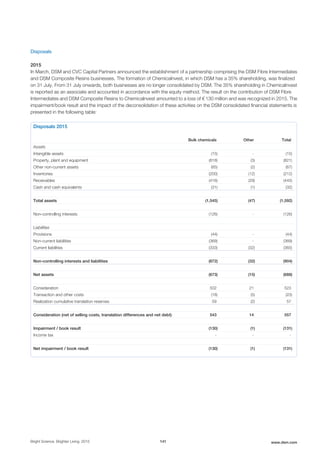
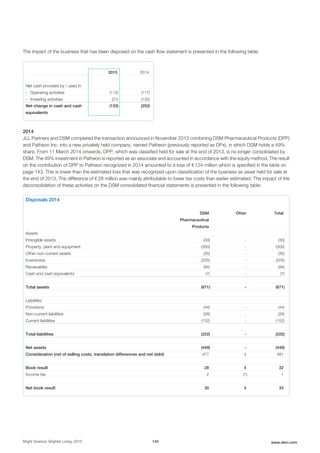
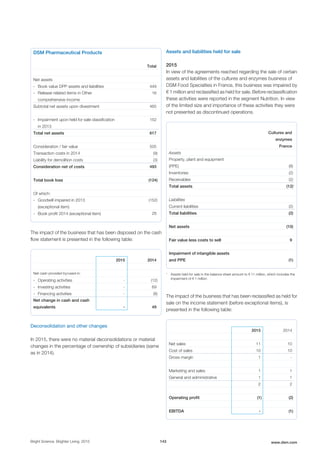
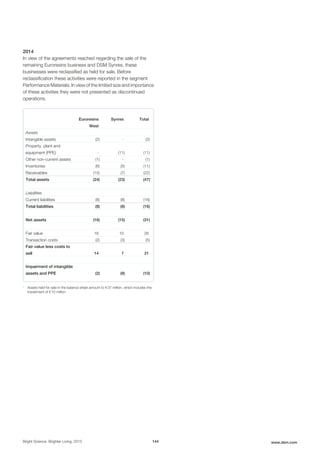
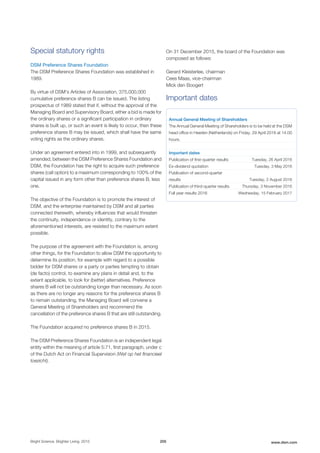
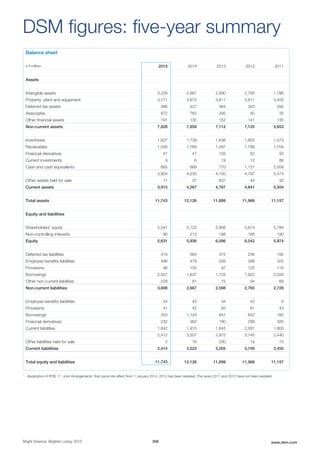
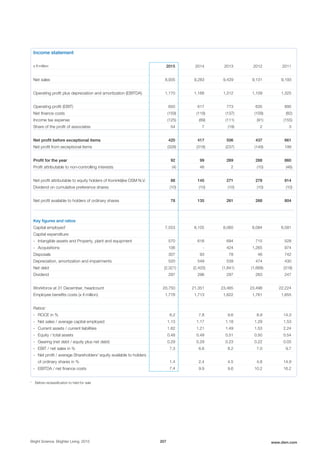
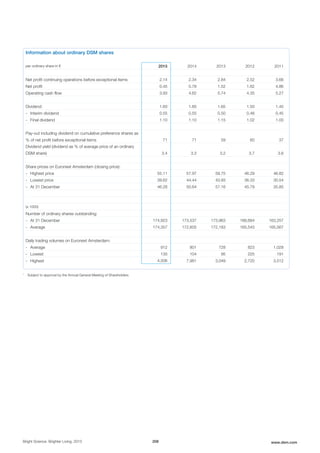
Royal DSM Integrated
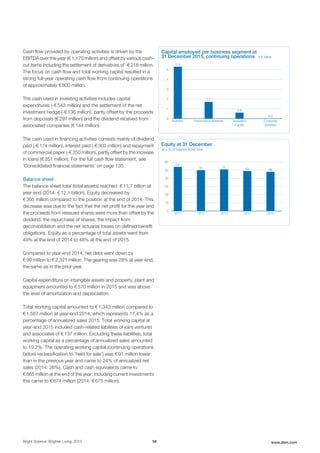
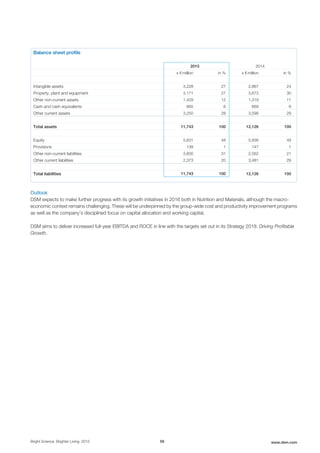
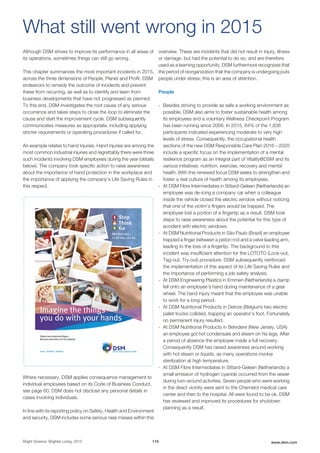
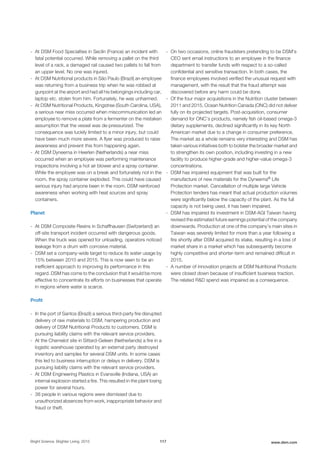
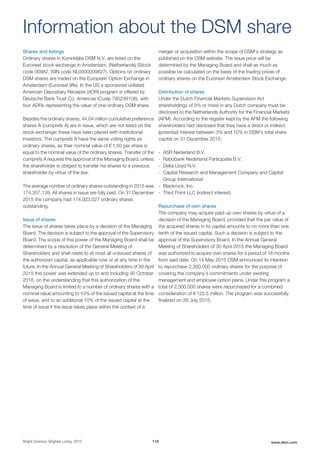
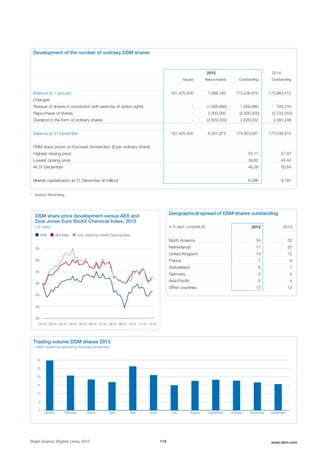
Annual Report 2015
Nutrition
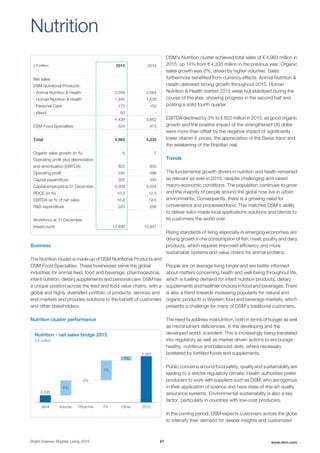
The Nutrition cluster comprises DSM Nutritional Products and
DSM Food Specialties.These businesses serve the global
industries for animal feed, food and beverage, pharmaceutical,
infant nutrition, dietary supplements and personal care.
DSM Nutritional Products is one of the world’s leading
producers of essential nutrients such as vitamins, carotenoids,
nutritional lipids and other ingredients to the feed, food,
pharmaceutical and personal care industries. Among its
customers are the world’s largest food and beverage
companies. DSM is uniquely positioned thanks to the
combination of its broad portfolio of active ingredients, maximum
differentiation through formulation, local presence, a global
premix network, and a strong focus on innovation. DSM
Nutritional Products consists of the following business units:
Animal Nutrition & Health addresses the nutritional additives
segment of the global feed ingredients market. DSM is active in
vitamins, feed enzymes, carotenoids, minerals and eubiotics.
Human Nutrition & Health primarily addresses the nutritional
ingredients markets, but is also active in coloration and
preservation in the global food ingredients market.
Personal Care focuses on active and performance ingredients
such as vitamins, UV-filters and bio-actives for the skin care, sun
care and hair care market segments.
DSM Food Specialties is a leading global supplier of food
enzymes, cultures, yeast extracts, savory flavors, hydrocolloids
and other specialty ingredients for the food and beverage
industries. DSM Food Specialties’ advanced ingredients make a
considerable contribution to the success of the world’s favorite
brands for the dairy, baking, beverages and savory segments.
Performance Materials
The Performance Materials cluster consists of DSM
Engineering Plastics, DSM Dyneema and DSM Resins &
Functional Materials. These business groups are active in
technologically sophisticated high-quality products and offer
specialized value propositions. In future this cluster will be
referred to as Materials.
DSM Engineering Plastics is a global player in developing,
manufacturing and marketing specialty plastics used in
components for the electrical and electronics, automotive,
flexible food packaging and consumer goods industries.
DSM Dyneema is the inventor, manufacturer and marketer of
Dyneema®, the world’s strongest fiber™. This product, based
on ultra high molecular weight polyethylene, is produced by
means of DSM’s proprietary processes. The Dyneema® brand
enjoys very high recognition in the value chains served.
DSM Resins & Functional Materials is a global player in
developing, manufacturing and marketing high-quality resins
solutions for paints, industrial coatings and fiber-optic coatings.
Continuous innovation means that customers can meet
regulatory needs and respond better to consumer demands for
more sustainable materials.
Innovation Center
DSM Innovation Center serves as an enabler and accelerator
of innovation within DSM as well as providing support to the
clusters. With its Emerging Business Areas, the Business
Incubator and DSM Venturing & Licensing, the DSM Innovation
Center has a general business development role, focusing on
areas outside the current scope of the business groups.
DSM’s Emerging Business Areas provide strong long-term
growth platforms based on the company’s core competences
in life sciences and materials sciences. The company has three
Emerging Business Areas:
DSM Biomedical supplies innovative biomedical materials that
enable medical device manufacturers to make less-invasive
devices. These can speed up recovery, shorten hospital stays
and minimize reoperations, lowering health costs and helping
people to lead longer, healthier and more active lives.
DSM Bio-based Products & Services is at the forefront of
building a more sustainable, bio-based economy with solutions
for clean fuel from agricultural residue and for renewable
chemical building blocks such as bio-based succinic acid.
DSM Advanced Surfaces develops and provides solutions to
increase the yield of solar materials – Same sun. More power™.
Partnerships
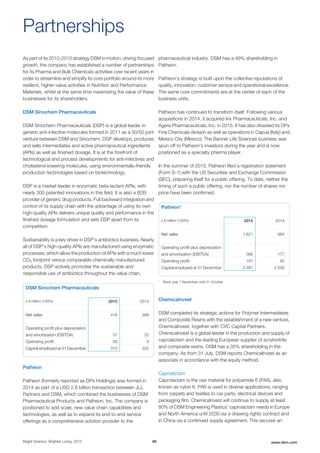
DSM Sinochem Pharmaceuticals (DSP), a 50-50 joint venture
formed in 2011, is the global market leader in beta-lactam active
pharmaceutical ingredients (APIs) such as semi-synthetic
penicillins (SSPs) and semi-synthetic cephalosporins (SSCs),
which represent the biggest class of APIs in anti-infectives. It is
also a leader in other active ingredients such as nystatin and next
generation statins.
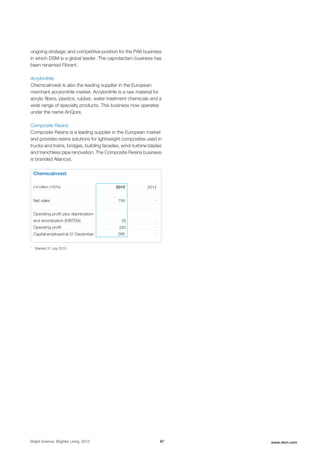
Patheon (formerly reported as DPx Holdings) is a global leader
in contract development and manufacturing services established
in 2014 and 49%-owned by DSM, with customers across the
pharmaceutical industry.
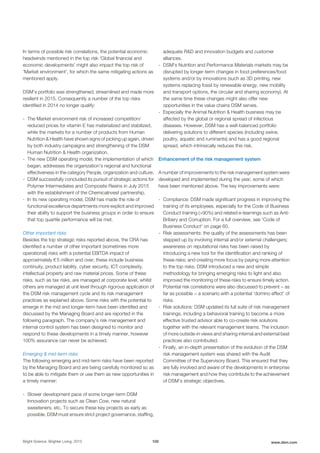
ChemicaInvest is a joint venture established in 2015 in which
DSM has a 35% shareholding and comprises the former DSM
Fibre Intermediates (caprolactam and acrylonitrile) and DSM
Composite Resins businesses.
DSM at a glance
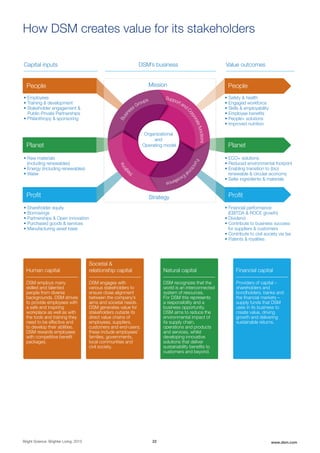
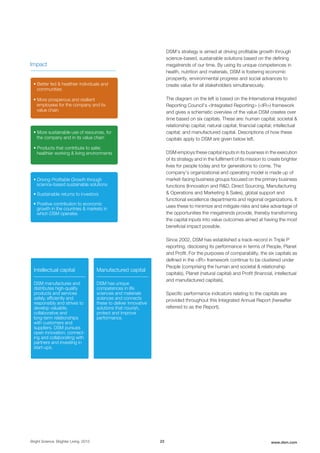
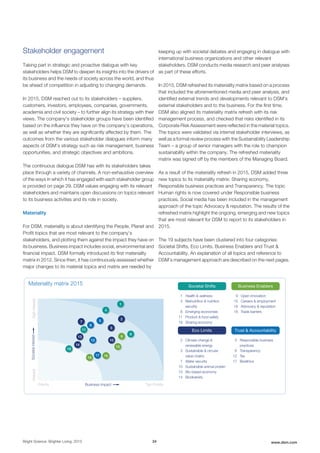
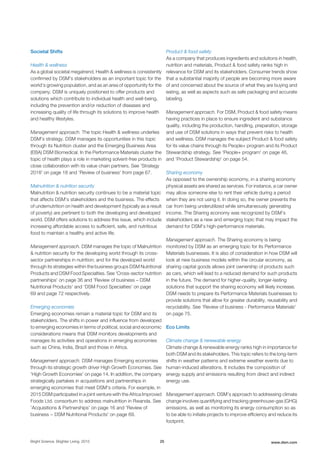
Driving Profitable Growth through science-based, sustainable
solutions
Our purpose is to create brighter lives for people today and generations to come. We use our unique competences in health,
nutrition and materials to create solutions that nourish, protect and improve performance.
DSM uses its Bright Science to create Brighter Living for people today and generations to come. Based on a deep understanding
of key global trends that are driving societies, markets and customers, DSM creates solutions to some of the world’s biggest
challenges, thus adding to both its own and its customers’ success.
DSM believes that its continued success will be driven by its ability to create shared value for all stakeholders, now and in the future.
It creates sustainable shared value by innovating in ways that allow its customers to provide solutions to the challenges facing
society, the environment and end-users. In this way, DSM’s customers derive value from being able to offer end-users improved
products and services; society and the planet derive value from the impact of more sustainable, longer-lasting, safer, healthier and
more nutritious alternatives; and, as a result, DSM and its shareholders derive value from stronger growth and profitability. Finally,
DSM’s employees feel engaged and motivated both through the contribution they make to a better world and the success this
creates for the company in which they work. More information on how DSM creates value for its stakeholders can be found on
page 22.
DSM – Bright Science. Brighter Living.™
Royal DSM is a global science-based company active in health, nutrition and materials. By connecting its unique competences in life sciences and materials sciences
DSM is driving economic prosperity, environmental progress and social advances to create sustainable value for all stakeholders simultaneously. DSM delivers innovative
solutions that nourish, protect and improve performance in global markets such as food and dietary supplements, personal care, feed, medical devices, automotive,
paints, electrical and electronics, life protection, alternative energy and bio-based materials. DSM and its associated companies deliver annual net sales of about
€ 10 billion with approximately 25,000 employees. The company is listed on Euronext Amsterdam. More information can be found at www.dsm.com.
© 2016 Royal DSM. All rights reserved.
Bright Science. Brighter Living. 2015 www.dsm.com
6 Key data
8 Letter from the CEO
12 Report by the Managing Board
12 Strategy 2010-2015, DSM in motion: driving focused
growth
17 Strategy 2018: Driving Profitable Growth
22 How DSM creates value for its stakeholders
24 Stakeholder engagement
39 People in 2015
47 Planet in 2015
55 Profit in 2015
60 DSM Code of Business Conduct
64 Review of business in 2015
66 Nutrition
74 Performance Materials
80 Innovation Center
85 Corporate Activities
86 Partnerships
88 Financial and reporting policy
88 Financial policy
89 Reporting policy
91 Corporate governance and risk management
91 Introduction
93 Dutch corporate governance code
93 Governance framework
96 Risk management
101 Statements of the Managing Board
102 Report by the Supervisory Board
102 Supervisory Board report
107 Remuneration policy for the Managing Board
114 Supervisory Board and Managing Board Royal DSM
116 What still went wrong in 2015
118 Information about the DSM share
122 Sustainability statements
124 Consolidated financial statements
124 Summary of significant accounting policies
130 Consolidated statements
137 Notes to the consolidated financial statements of Royal
DSM
188 Parent company financial statements
189 Notes to the parent company financial statements
199 Other information
199 Independent auditor's report
203 Independent auditor's assurance report
204 Profit appropriation
205 Special statutory rights
205 Important dates
206 DSM figures: five-year summary
209 Explanation of some concepts and ratios
212 List of abbreviations
Forward-looking statements
This document may contain forward-looking statements with respect to DSM's future (financial) performance and position. Such statements are based on current
expectations, estimates and projections of DSM and information currently available to the company. Examples of forward-looking statements include statements made
or implied about the company’s strategy, estimates of sales growth, financial results, cost savings and future developments in its existing businesses as well as the
impact of future acquisitions, and the company’s financial position. These statements can be management estimates based on information provided by specialized
agencies or advisors.
DSM cautions readers that such statements involve certain risks and uncertainties that are difficult to predict and therefore it should be understood that many factors
can cause the company's actual performance and position to differ materially from these statements. These factors include, but are not limited to, macro-economic,
market and business trends and conditions, (low-cost) competition, legal claims, the company's ability to protect intellectual property, changes in legislation, changes
in exchange and interest rates, changes in tax rates, pension costs, raw material and energy prices, employee costs, the implementation of the company’s strategy,
the company’s ability to identify and complete acquisitions and to successfully integrate acquired companies, the company’s ability to realize planned divestments,
savings, restructuring or benefits, the company’s ability to identify, develop and successfully commercialize new products, markets or technologies, economic and/or
political changes and other developments in countries and markets in which DSM operates. Additional factors that could cause results to differ materially from those
described in the forward-looking statements can be found in the 'Risk Management' chapter.
As a result, DSM’s actual future performance, position and/or financial results may differ materially from the plans, goals and expectations set forth in such forward-
looking statements. DSM has no obligation to update the statements contained in this document, unless required by law. The English language version of this document
is leading.
Table of contents
Bright Science. Brighter Living. 2015 5 www.dsm.com
Key data
Key data1
20152
2014
People
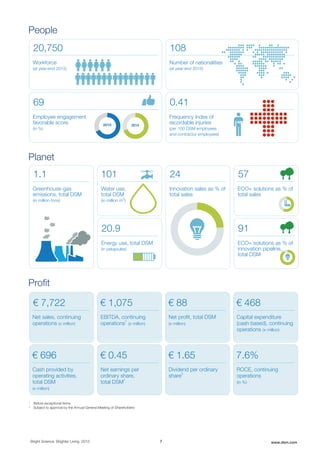
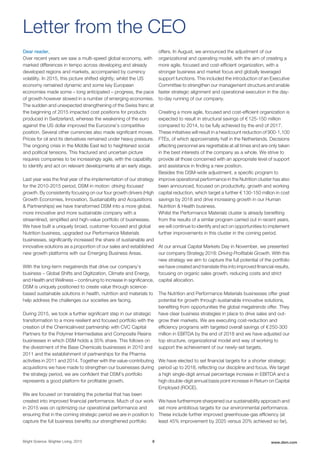
Workforce at 31 December (headcount) 20,750 21,351
Female/male ratio 28/72 27/73
Total employee benefits costs (in € million) 1,778 1,713
Frequency Index of recordable injuries (per 100 DSM employees and contractor employees) 0.41 0.47
Employee engagement - favorable score (in %) 69 70
Planet
Energy use (in petajoules) 20.9 39.1
Greenhouse-gas emissions in CO2-equivalents (x million tons) 1.1 4.2
Emission of volatile organic compounds (x 1000 tons) 3.1 4.2
COD (Chemical Oxygen Demand) discharges (x 1000 tons) 2.1 3.9
Water use (x million m3) 101 118
ECO+ solutions as % of innovation pipeline 91 95
ECO+ solutions as % of running business 57 49
Profit (in € million, unless otherwise indicated)
Net sales, continuing operations 7,722 7,051
Operating profit plus depreciation and amortization, continuing operations (EBITDA)3
1,075 1,038
Operating profit, continuing operations (EBIT)3
573 587
Net profit attributable to equity holders of Koninklijke DSM N.V. 88 145
Cash provided by operating activities 696 808
Capital expenditure, cash based 536 628
Dividend for DSM shareholders 297 296
Net debt 2,321 2,420
Shareholders' equity 5,541 5,723
Total assets 11,743 12,126
Capital employed, continuing operations 7,553 7,431
Market capitalization at 31 December4
8,396 9,187
Per ordinary share in €
Net earnings 0.45 0.78
Dividend 1.655
1.65
Ratios (%)
Sales to high growth economies / net sales 44 42
Innovation sales / net sales 24 18
EBITDA / net sales (continuing operations) 13.9 14.7
Operating working capital / annualized fourth quarter net sales (continuing operations) 23.5 26.3
ROCE (continuing operations) 7.6 8.2
Gearing (net debt / equity plus net debt) 29.2 29.0
Equity / total assets 48.0 49.0
Cash provided by operating activities / EBITDA 59.5 69.3
1
For definitions see 'Explanation of some concepts and ratios' on page 209
2
Key data presented relate to total DSM (= continuing operations + discontinued operations), unless explicitly stated otherwise
3
Before exceptional items
4
Source: Bloomberg
5
Subject to approval by the Annual General Meeting of Shareholders
Bright Science. Brighter Living. 2015 6 www.dsm.com
Bright Science. Brighter Living. 2015 7 www.dsm.com
People
Planet
Net sales, continuing
operations (x million)
€ 1,075€ 7,722
20,750
Workforce
(at year-end 2015)
EBITDA, continuing
operations1
(x million)
€ 88
Net profit, total DSM
(x million)
€ 468
Capital expenditure
(cash based), continuing
operations (x million)
€ 696
Cash provided by
operating activities,
total DSM
(x million)
€ 0.45
Net earnings per
ordinary share,
total DSM1
€ 1.65
Dividend per ordinary
share2
7.6%
ROCE, continuing
operations
(in %)
Profit
2015
69
Employee engagement
favorable score
(in %)
PlanetPl t
P fit
1.1
Greenhouse-gas
emissions, total DSM
(in million tons)
101
Water use,
total DSM
(in million m3
)
20.9
Energy use, total DSM
(in petajoules)
108
Number of nationalities
(at year-end 2015)
0.41
Frequency Index of
recordable injuries
(per 100 DSM employees
and contractor employees)
24
Innovation sales as % of
total sales
of
57
ECO+ solutions as % of
total sales
91
ECO+ solutions as % of
innovation pipeline,
total DSM
2014
1
Before exceptional items
2
Subject to approval by the Annual General Meeting of Shareholders
Dear reader,
Over recent years we saw a multi-speed global economy, with
marked differences in tempo across developing and already
developed regions and markets, accompanied by currency
volatility. In 2015, this picture shifted slightly; whilst the US
economy remained dynamic and some key European
economies made some – long anticipated – progress, the pace
of growth however slowed in a number of emerging economies.
The sudden and unexpected strengthening of the Swiss franc at
the beginning of 2015 impacted cost positions for products
produced in Switzerland, whereas the weakening of the euro
against the US dollar improved the Eurozone’s competitive
position. Several other currencies also made significant moves.
Prices for oil and its derivatives remained under heavy pressure.
The ongoing crisis in the Middle East led to heightened social
and political tensions. This fractured and uncertain picture
requires companies to be increasingly agile, with the capability
to identify and act on relevant developments at an early stage.
Last year was the final year of the implementation of our strategy
for the 2010-2015 period, DSM in motion: driving focused
growth. By consistently focusing on our four growth drivers (High
Growth Economies, Innovation, Sustainability and Acquisitions
& Partnerships) we have transformed DSM into a more global,
more innovative and more sustainable company with a
streamlined, simplified and high-value portfolio of businesses.
We have built a uniquely broad, customer-focused and global
Nutrition business, upgraded our Performance Materials
businesses, significantly increased the share of sustainable and
innovative solutions as a proportion of our sales and established
new growth platforms with our Emerging Business Areas.
With the long-term megatrends that drive our company’s
business – Global Shifts and Digitization, Climate and Energy,
and Health and Wellness – continuing to increase in significance,
DSM is uniquely positioned to create value through science-
based sustainable solutions in health, nutrition and materials to
help address the challenges our societies are facing.
During 2015, we took a further significant step in our strategic
transformation to a more resilient and focused portfolio with the
creation of the ChemicaInvest partnership with CVC Capital
Partners for the Polymer Intermediates and Composite Resins
businesses in which DSM holds a 35% share. This follows on
the divestment of the Base Chemicals businesses in 2010 and
2011 and the establishment of partnerships for the Pharma
activities in 2011 and 2014. Together with the value-contributing
acquisitions we have made to strengthen our businesses during
the strategy period, we are confident that DSM’s portfolio
represents a good platform for profitable growth.
We are focused on translating the potential that has been
created into improved financial performance. Much of our work
in 2015 was on optimizing our operational performance and
ensuring that in the coming strategic period we are in position to
capture the full business benefits our strengthened portfolio
offers. In August, we announced the adjustment of our
organizational and operating model, with the aim of creating a
more agile, focused and cost-efficient organization, with a
stronger business and market focus and globally leveraged
support functions. This included the introduction of an Executive
Committee to strengthen our management structure and enable
faster strategic alignment and operational execution in the day-
to-day running of our company.
Creating a more agile, focused and cost-efficient organization is
expected to result in structural savings of € 125-150 million
compared to 2014, to be fully achieved by the end of 2017.
These initiatives will result in a headcount reduction of 900-1,100
FTEs, of which approximately half in the Netherlands. Decisions
affecting personnel are regrettable at all times and are only taken
in the best interests of the company as a whole. We strive to
provide all those concerned with an appropriate level of support
and assistance in finding a new position.
Besides this DSM-wide adjustment, a specific program to
improve operational performance in the Nutrition cluster has also
been announced, focused on productivity, growth and working
capital reduction, which target a further € 130-150 million in cost
savings by 2018 and drive increasing growth in our Human
Nutrition & Health business.
Whilst the Performance Materials cluster is already benefiting
from the results of a similar program carried out in recent years,
we will continue to identify and act on opportunities to implement
further improvements in this cluster in the coming period.
At our annual Capital Markets Day in November, we presented
our company Strategy 2018: Driving Profitable Growth. With this
new strategy we aim to capture the full potential of the portfolio
we have created and translate this into improved financial results,
focusing on organic sales growth, reducing costs and strict
capital allocation.
The Nutrition and Performance Materials businesses offer great
potential for growth through sustainable innovative solutions,
benefiting from opportunities the global megatrends offer. They
have clear business strategies in place to drive sales and out-
grow their markets. We are executing cost-reduction and
efficiency programs with targeted overall savings of € 250-300
million in EBITDA by the end of 2018 and we have adjusted our
top structure, organizational model and way of working to
support the achievement of our newly-set targets.
We have elected to set financial targets for a shorter strategic
period up to 2018, reflecting our discipline and focus. We target
a high single-digit annual percentage increase in EBITDA and a
high double-digit annual basis point increase in Return on Capital
Employed (ROCE).
We have furthermore sharpened our sustainability approach and
set more ambitious targets for our environmental performance.
These include further improved greenhouse-gas efficiency (at
least 45% improvement by 2025 versus 20% achieved so far),
Letter from the CEO
Bright Science. Brighter Living. 2015 8 www.dsm.com
increased energy efficiency (over 10% improvement in the next
10 years) and a big step-up in the use of renewable electricity
(50% by 2025), as well as continuing to drive the proportion of
ECO+ and People+ solutions we provide to our customers.
Moreover, we have key innovation projects in place to drive
earnings growth beyond 2018.
We expect to extract significant value from the Pharma and Bulk
Chemicals partnerships in the coming years, providing further
financial headroom. We do not expect to engage in large
acquisitions in the near future as we continue to integrate recent
acquisitions, which have made a strong contribution to earnings.
DSM achieved solid financial results in 2015, broadly in line with
our expectations for the year. We delivered net sales of € 7.7
billion and an EBITDA (before exceptional items) of € 1,075
million. Whilst currency developments showed a mixed picture,
they had an overall positive effect on our results. Organic sales
growth for the year was 1%, with 3% growth in volumes and a
2% decline in price-mix as a result of lower raw material prices.
Our focus on emerging economies has taken the proportion of
total sales generated in these countries to 44% at the end of
2015, up from 32% in 2010. The pace of growth slowed in a
number of these economies in the year. The largest, the Chinese
economy, continues to grow, if at lower absolute rates than in
recent years. The fundamentals driving end-use markets
relevant to DSM in China remain unchanged. In 2015, higher-
margin innovation sales increased to 24% of total sales, fulfilling
the strategic aspiration we set in 2010, when they made up 12%
of sales. Innovation is also linked with our sustainability efforts.
Our ECO+ solutions, which offer customers more value with less
environmental impact than mainstream alternatives, now
account for 57% of sales, ahead of the targets we set ourselves
five years ago, when the proportion was 34%. We apply similar
lifecycle assessments to the impact products have on peoples’
lives with the People+ methodology we have developed, and use
these insights in steering product innovation.
In Nutrition, we have built a unique, global and broad as well as
customer-focused portfolio in nutritional ingredients and have
increased our capability to offer full nutritional solutions,
extending DSM’s offering over the value chain. This resilience
proved its worth for the cluster as headwinds that we had
previously signaled indeed materialized in 2015, in particular
price pressure in vitamin E, mainly in our animal nutrition
business, and the unfavorable development of the Swiss franc,
which considerably reduced the overall positive effect from the
strengthening of the US dollar. Despite these headwinds, Animal
Nutrition & Health had a very good year. Human Nutrition &
Health, which continued to be confronted with ongoing
weakness in the North American markets for dietary
supplements and omega-3, did not perform as well as we would
have liked. We have taken action to get back on the front foot
and started to see the benefit of this in the second half of the
year. In 2015, organic sales growth for the cluster was strong at
6% and the EBITDA margin was lower at 16.6%, mainly caused
by the appreciation of the Swiss franc and lower vitamin E
pricing. EBITDA for Nutrition amounted to € 822 million in 2015,
down 3% on the previous year for the same reasons.
In Performance Materials, we pursue a differentiated approach
to our businesses and their segments, and have created a high-
quality portfolio with a higher growth and returns profile. We tailor
the approach our businesses take depending on the dynamics
and potential of the market and segment in question, focusing
on maximized returns, growth or accelerated growth
accordingly. During 2015, the cluster continued to upgrade its
product portfolio towards innovative, more sustainable and
higher-margin solutions. Whilst organic growth for the cluster
was down as a consequence of lower input prices on steady
volumes, there was a step-up in both EBITDA (at € 384 million a
19% increase) and in the EBITDA margin, which was 15.2%,
above the targets we had set.
Our Emerging Business Areas are promising platforms for
growth outside the current scope of the business groups. The
largest, DSM Biomedical, continued its development over the
year and made a positive contribution to our EBITDA. In DSM
Bio-based Products & Services, the start-up process for the
Project LIBERTY facility to produce advanced cellulosic ethanol
from crop residues, which we officially opened in the US in 2014
together with our partner POET, is progressing, although there
are still some hurdles to overcome. DSM Advanced Surfaces
provides solutions to boost the power solar panels produce and
continued to strengthen its position in this market. When taken
together, they already make a positive contribution to EBITDA,
reducing the overall costs of the DSM Innovation Center.
Although business conditions in Bulk Chemicals remained
tough, steps have been taken to improve the competitiveness of
the ChemicaInvest businesses together with CVC.
Following the creation of the Pharma partnerships and therewith
the completion of DSM’s Pharma strategy, Stefan Doboczky left
the company at the beginning of June. We would like to thank
him for his contribution to DSM and wish him every success as
CEO of Lenzing Group.
Bright Science. Brighter Living. 2015 9 www.dsm.com
Safety and Health is of paramount importance to all of us at DSM
and we have set ourselves the ambition of having an injury and
incident-free working environment. While we made progress in
improving occupational safety in 2015, with a reduction in the
Frequency Index of Recordable Injuries from 0.47 in 2014 to 0.41
last year, more incidents still occur than we would like,
regrettably. Our focus on safety is unwavering and we strive to
bring this number down further. For more information on these
and other incidents, see ‘What still went wrong’ on page 116.
Successfully assimilating a high-performance culture will be
crucial to realizing the full potential of our new operating model
and our portfolio and to achieving our targets. During the year,
we continued to implement the ONE DSM Culture Agenda in
conjunction with our Leadership Model. We look to achieve a
representative balance in gender and also in nationality in DSM’s
leadership group, in line with the geographical distribution of our
business. The number of women in executive positions showed
a pleasing development, up three percentage points to 15% at
the end of the year, with a significant increase in representation
at all top levels across the organization. We did not make the
same level of progress in increasing the proportion of non-
European executives, however, and this has our attention.
Overall, the company-wide Inclusion Index increased from 70%
to 72% at the end of the year, reflecting our efforts in this regard.
We held an Employee Engagement Pulse Survey last year, which
78% of the employees completed. The overall Employee
Engagement Index was 69% in 2015, down very slightly from
70% a year earlier. This is understandable given that the survey
was held after the announcement of the organizational
adjustments and before the presentation of our updated
strategy. Our resolve to see this rating improve is undiminished.
It was a significant year for the worldwide societal and
sustainability agenda. The UN General Assembly agreed upon
17 Global Goals to be achieved by 2030 (the so-called
Sustainable Development Goals), including eradicating hunger
and addressing climate change. Leaders from government, civil
society and business also came together at the COP21 summit
in Paris. Although there is still much to be gained, the
agreements and measures to tackle climate change on a global
level established there were unprecedented. The sense of
urgency to develop and implement newer, more sustainable and
impactful solutions at scale has never been more manifest. There
is a crucial – and rewarding – contribution for businesses to make
in helping to achieve this, which we at DSM champion.
In December, we signed an extension to our strategic
partnership with the United Nations’ World Food Programme
(WFP) for another three years. It is a humbling and at the same
time empowering feeling to realize that through this partnership,
DSM now reaches over 25 million WFP beneficiaries annually
with improved nutrition. DSM was also invited by the
Government of Rwanda to participate in the Africa Improved
Foods Ltd. joint venture to improve the nutritional status of the
country’s population and help address malnutrition.
We are pleased to report that we made further progress in our
efforts to reduce the company's environmental footprint, among
other things by improving our energy efficiency and greenhouse-
gas efficiency by around 20%, as well as by reducing our
absolute greenhouse-gas emissions (down by 75% versus
2008, with a big impact from the (partial) divestment of Polymer
Intermediates). The new, sharpened targets we have set for the
coming period will build on these achievements and continue to
stretch the organization. We are proud to once again be named
among the leaders in the Dow Jones Sustainability World Index.
We also take pride in the external recognition, including awards,
that our achievements in our integrated sustainability approach
continue to receive. Our integrated reporting continues to
develop; besides implementing G4, the fourth generation of
sustainability reporting guidelines from the Global Reporting
Initiative, this report also follows the <Integrated Reporting>
framework of the International Integrated Reporting Council. We
remain committed to aligning our strategy and operations with
the principles of the United Nations Global Compact, as well as
contributing to the realization of the Global Goals for Sustainable
Development through our businesses and competences.
We have many reasons to be confident about our future at DSM
thanks above all to the tremendous efforts of many people; our
employees, customers, shareholders, and suppliers and other
partners, as well as civil society and the communities we engage
with. We extend our most sincere thanks and appreciation to all
those who have contributed to DSM’s success.
At the start of an exciting and inspiring new period for DSM, we
can be very proud that together we have made DSM a global
company with a portfolio of high-quality businesses, well-
positioned for growth. We apply our sustainable innovation to
continually develop and bring to market improved products and
solutions in health, nutrition and materials. Our focus for the
coming period is on improving financial returns while building for
further growth in the future. Our ability to leverage unique
opportunities in our businesses for the benefit of People, Planet
and Profit enables us to deliver on our mission of creating
brighter lives for people today and for generations to come.
Feike Sijbesma
CEO/Chairman Managing Board Royal DSM
Bright Science. Brighter Living. 2015 10 www.dsm.com
Bright Science. Brighter Living. 2015 11 www.dsm.com
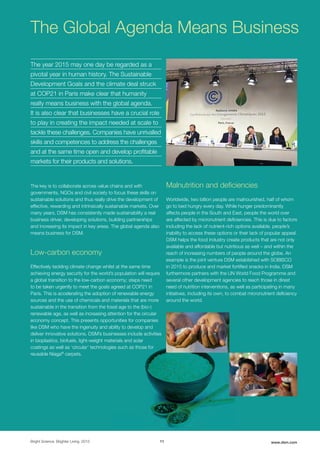
The year 2015 may one day be regarded as a
pivotal year in human history. The Sustainable
Development Goals and the climate deal struck
at COP21 in Paris make clear that humanity
really means business with the global agenda.
It is also clear that businesses have a crucial role
to play in creating the impact needed at scale to
tackle these challenges. Companies have unrivalled
skills and competences to address the challenges
and at the same time open and develop profitable
markets for their products and solutions.
The Global Agenda Means Business
Effectively tackling climate change whilst at the same time
achieving energy security for the world’s population will require
a global transition to the low-carbon economy; steps need
to be taken urgently to meet the goals agreed at COP21 in
Paris. This is accelerating the adoption of renewable energy
sources and the use of chemicals and materials that are more
sustainable in the transition from the fossil age to the (bio-)
renewable age, as well as increasing attention for the circular
economy concept. This presents opportunities for companies
like DSM who have the ingenuity and ability to develop and
deliver innovative solutions. DSM’s businesses include activities
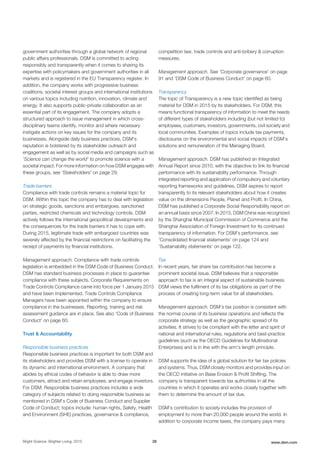
in bioplastics, biofuels, light-weight materials and solar
coatings as well as ‘circular’ technologies such as those for
reusable Niaga®
carpets.
Low-carbon economy
Worldwide, two billion people are malnourished, half of whom
go to bed hungry every day. While hunger predominantly
affects people in the South and East, people the world over
are affected by micronutrient deficiencies. This is due to factors
including the lack of nutrient-rich options available, people’s
inability to access these options or their lack of popular appeal.
DSM helps the food industry create products that are not only
available and affordable but nutritious as well – and within the
reach of increasing numbers of people around the globe. An
example is the joint venture DSM established with SOBISCO
in 2015 to produce and market fortified snacks in India. DSM
furthermore partners with the UN World Food Programme and
several other development agencies to reach those in direst
need of nutrition interventions, as well as participating in many
initiatives, including its own, to combat micronutrient deficiency
around the world.
Malnutrition and deficienciesThe key is to collaborate across value chains and with
governments, NGOs and civil society to focus these skills on
sustainable solutions and thus really drive the development of
effective, rewarding and intrinsically sustainable markets. Over
many years, DSM has consistently made sustainability a real
business driver, developing solutions, building partnerships
and increasing its impact in key areas. The global agenda also
means business for DSM.
Strategy 2010-2015, DSM in motion: driving
focused growth
Last year was the fifth and final year of the strategy DSM in
motion: driving focused growth, which the company launched in
2010 to become a global leader in health, nutrition and materials.
This strategy has provided DSM with the framework to drive
sustainable and profitable growth in the company’s core
activities.
In 2015, DSM’s focus was on improving the operational
performance of its Nutrition and Performance Materials
businesses, while pursuing strategic actions for Polymer
Intermediates and Composite Resins. These were delivered in
March with the establishment of the ChemicaInvest partnership
with CVC Capital Partners. In August, the company announced
adjustments to its organizational and operating model to support
its growth, creating a more agile, focused and cost-efficient
organization. The final major development of the year was
announced in November, when DSM presented its Strategy
2018: Driving Profitable Growth at its Capital Markets Day,
details of which are given on page 17.
Results 2015
Financial results
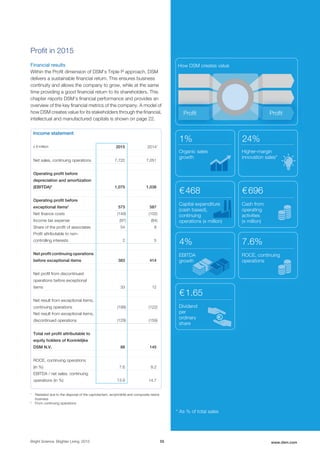
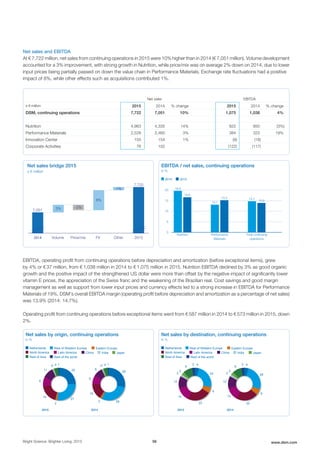
DSM delivered solid results in 2015, posting net sales of
€ 7,722 million, up 10% on 2014 (€ 7,051 million). Overall organic
sales growth for the year amounted to 1%, as a 3% increase in
volumes, with strong growth in Nutrition, was largely off-set by
2% lower price/mix, due to lower input prices being partially
passed on down the value chain in Performance Materials.
Exchange rate fluctuations had a positive impact of 8%, while
other effects such as acquisitions contributed 1%.
EBITDA, operating profit from continuing operations before
depreciation and amortization (before exceptional items), grew
by 4% or € 37 million, from € 1,038 million in 2014
to € 1,075 million in 2015. Nutrition EBITDA declined by 3% as
good organic growth and the positive impact of the strengthened
US dollar were more than offset by the negative impact of
significantly lower vitamin E prices, the appreciation of the Swiss
franc and the weakening of the Brazilian real. Cost savings and
good margin management as well as support from lower input
prices and currency effects led to a strong increase in EBITDA
for Performance Materials of 19%. DSM's overall EBITDA margin
(operating profit before depreciation and amortization as a
percentage of net sales) was 13.9% (2014: 14.7%). In 2015,
Return on Capital Employed (ROCE) was 7.6% compared to
8.2% in 2014.
Sales in emerging economies amounted to 44% of total sales in
2015, up from 43% in 2014. Innovation sales, defined as sales
from products and solutions introduced within the last five years,
made up 24% of total sales in 2015 (2014: 18%).
DSM’s Emerging Business Areas (EBAs) DSM Biomedical, DSM
Bio-based Products & Services and DSM Advanced Surfaces
continued to make steady progress during the year. Collectively
they made a positive EBITDA contribution, reducing the overall
costs of the DSM Innovation Center.
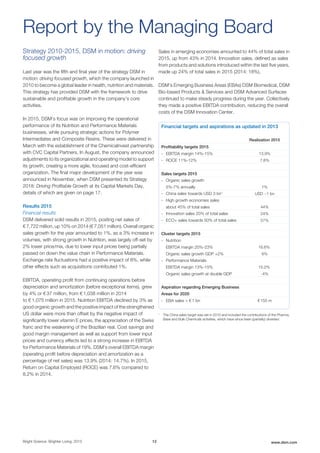
Financial targets and aspirations as updated in 2013
Realization 2015
Profitability targets 2015
- EBITDA margin 14%-15% 13.9%
- ROCE 11%-12% 7.6%
Sales targets 2015
- Organic sales growth
5%-7% annually 1%
- China sales towards USD 3 bn1
USD ~1 bn
- High growth economies sales
about 45% of total sales 44%
- Innovation sales 20% of total sales 24%
- ECO+ sales towards 50% of total sales 57%
Cluster targets 2015
- Nutrition
EBITDA margin 20%-23%
Organic sales growth GDP +2%
16.6%
6%
- Performance Materials
EBITDA margin 13%-15%
Organic sales growth at double GDP
15.2%
-4%
Aspiration regarding Emerging Business
Areas for 2020
- EBA sales > € 1 bn € 155 m
1
The China sales target was set in 2010 and included the contributions of the Pharma,
Base and Bulk Chemicals activities, which have since been (partially) divested
Report by the Managing Board
Bright Science. Brighter Living. 2015 12 www.dsm.com
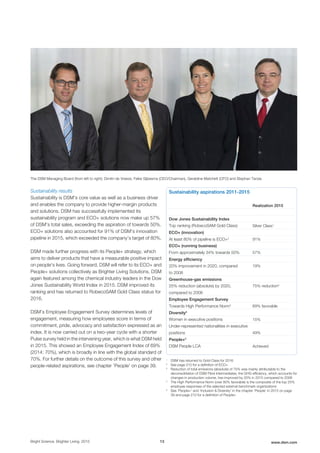
The DSM Managing Board (from left to right): Dimitri de Vreeze, Feike Sijbesma (CEO/Chairman), Geraldine Matchett (CFO) and Stephan Tanda
Sustainability results
Sustainability is DSM's core value as well as a business driver
and enables the company to provide higher-margin products
and solutions. DSM has successfully implemented its
sustainability program and ECO+ solutions now make up 57%
of DSM’s total sales, exceeding the aspiration of towards 50%.
ECO+ solutions also accounted for 91% of DSM’s innovation
pipeline in 2015, which exceeded the company’s target of 80%.
DSM made further progress with its People+ strategy, which
aims to deliver products that have a measurable positive impact
on people's lives. Going forward, DSM will refer to its ECO+ and
People+ solutions collectively as Brighter Living Solutions. DSM
again featured among the chemical industry leaders in the Dow
Jones Sustainability World Index in 2015. DSM improved its
ranking and has returned to RobecoSAM Gold Class status for
2016.
DSM’s Employee Engagement Survey determines levels of
engagement, measuring how employees score in terms of
commitment, pride, advocacy and satisfaction expressed as an
index. It is now carried out on a two-year cycle with a shorter
Pulse survey held in the intervening year, which is what DSM held
in 2015. This showed an Employee Engagement Index of 69%
(2014: 70%), which is broadly in line with the global standard of
70%. For further details on the outcome of this survey and other
people-related aspirations, see chapter 'People' on page 39.
Sustainability aspirations 2011-2015
Realization 2015
Dow Jones Sustainability Index
Top ranking (RobecoSAM Gold Class) Silver Class1
ECO+ (innovation)
At least 80% of pipeline is ECO+2
91%
ECO+ (running business)
From approximately 34% towards 50% 57%
Energy efficiency
20% improvement in 2020, compared
to 2008
19%
Greenhouse-gas emissions
25% reduction (absolute) by 2020,
compared to 2008
75% reduction3
Employee Engagement Survey
Towards High Performance Norm4
69% favorable
Diversity5
Women in executive positions 15%
Under-represented nationalities in executive
positions 49%
People+5
DSM People LCA Achieved
1
DSM has returned to Gold Class for 2016
2
See page 210 for a definition of ECO+
3
Reduction of total emissions (absolute) of 75% was mainly attributable to the
deconsolidation of DSM Fibre Intermediates; the GHG efficiency, which accounts for
changes in production volume, has improved by 20% in 2015 compared to 2008
4
The High Performance Norm (over 80% favorable) is the composite of the top 25%
employee responses of the selected external benchmark organizations
5
See 'People+' and 'Inclusion & Diversity' in the chapter 'People' in 2015 on page
39 and page 210 for a definition of People+
Bright Science. Brighter Living. 2015 13 www.dsm.com
Growth Drivers
Over the last five years, DSM has utilized the strategic growth
drivers High Growth Economies, Innovation, Sustainability and
Acquisitions & Partnerships to leverage its unique position and
capitalize on the business opportunities created by key global
megatrends.
In doing so, DSM has successfully increased its global presence,
became more innovative and more sustainable, and built a
streamlined and simplified portfolio of high-value businesses.
High Growth Economies
One of the key elements of the company strategy has been the
successful expansion of DSM’s global presence to be better
placed to capture opportunities arising from the megatrends in
economies such as Brazil, Russia, India and China as well as in
more mature economies of the West. The share of sales in these
economies as a proportion of DSM’s total sales has increased
significantly, giving the company a well-balanced global
footprint. In 2015, sales to emerging economies accounted for
44% of total sales. In 2010, this was 32%.
In China, domestic consumption is playing an increasingly
important role in re-balancing the economy to the so-called 'New
Normal'. During the year, there was a change in the pace of
economic growth in the country, in particular in the second half
of the year. Overcapacity, low global commodity prices and
weak demand impacted industrial production. However, the
fundamental drivers resulting from the megatrends remain as
valid as ever. In terms of DSM's end-user segments, this could
be seen in a noticeable slowdown in automotive and
construction-related industries, whilst the service sector and
food industry segments developed well. DSM's sales in China
for its continuing operations came to € 937 million in 2015, up
12% from € 833 million in 2014. During the year DSM finalized
the acquisition of vitamin C producer Aland and began the
expansion of a site in Tongxiang with the aim of establishing a
world-class development center for hydrocolloids including
gellan gum.
DSM’s business in India showed double-digit growth. DSM
focuses in particular on locally made products for markets in the
country, for example partnering with SOBISCO in the year to
produce and market fortified biscuits and snacks.
Growth in Latin America was 11% in 2015, despite a very
challenging overall economic picture in the region that has
impacted consumption in various markets. DSM has established
a robust platform in particular for its Animal Nutrition & Health
business in the region and will leverage this as it expands the
animal health capabilities it acquired with Tortuga outside Brazil.
Sales in Russia remained on par with 2014, despite the severe
recession in the country, supported by particularly strong
performance in Animal Nutrition & Health, which also performed
well in DSM’s other key markets in the region.
With their rapidly expanding urban populations and burgeoning
middle classes, it is clear that emerging economies will remain
important growth engines for the world economy in the future.
Moreover, increasing attention for environmental concerns and
related legislation to tackle them presents further opportunities.
Over recent years it has become evident that rates of economic
growth in these economies are both divergent and changeable.
In future, DSM will refer to the economies themselves by the
commonly-used term ‘emerging economies’ rather than ‘high
growth economies’. The capitalized term High Growth
Economies relates specifically to DSM’s strategic growth driver.
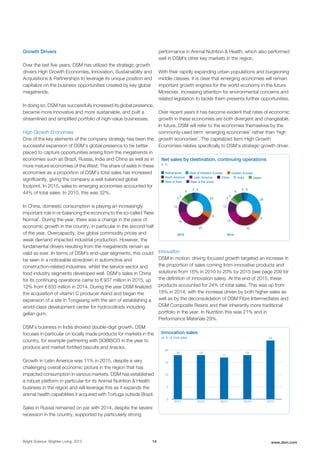
Net sales by destination, continuing operations 
in % 
■Netherlands ■Rest of Western Europe ■Eastern Europe
■North America ■Latin America ■China ■India ■Japan
■Rest of Asia ■Rest of the world
4
24
6
23
14
12
2
3
9
3
2015
4
26
6
22
13
12
2
3
9
3
2014
Innovation
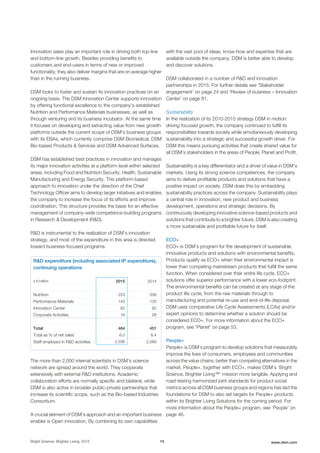
DSM in motion: driving focused growth targeted an increase in
the proportion of sales coming from innovative products and
solutions from 16% in 2010 to 20% by 2015 (see page 209 for
the definition of innovation sales). At the end of 2015, these
products accounted for 24% of total sales. This was up from
18% in 2014, with the increase driven by both higher sales as
well as by the deconsolidation of DSM Fibre Intermediates and
DSM Composite Resins and their inherently more traditional
portfolio in the year. In Nutrition this was 21% and in
Performance Materials 29%.
Innovation sales 
as % of total sales 
0
5
10
15
20
18
2011
18
2012
17
2013
18
2014
24
2015
Bright Science. Brighter Living. 2015 14 www.dsm.com
Innovation sales play an important role in driving both top-line
and bottom-line growth. Besides providing benefits to
customers and end-users in terms of new or improved
functionality, they also deliver margins that are on average higher
than in the running business.
DSM looks to foster and sustain its innovation practices on an
ongoing basis. The DSM Innovation Center supports innovation
by offering functional excellence to the company’s established
Nutrition and Performance Materials businesses, as well as
through venturing and its business incubator. At the same time
it focuses on developing and extracting value from new growth
platforms outside the current scope of DSM’s business groups
with its EBAs, which currently comprise DSM Biomedical, DSM
Bio-based Products & Services and DSM Advanced Surfaces.
DSM has established best practices in innovation and manages
its major innovation activities at a platform level within selected
areas, including Food and Nutrition Security, Health, Sustainable
Manufacturing and Energy Security. This platform-based
approach to innovation under the direction of the Chief
Technology Officer aims to develop larger initiatives and enables
the company to increase the focus of its efforts and improve
coordination. This structure provides the basis for an effective
management of company-wide competence-building programs
in Research & Development (R&D).
R&D is instrumental to the realization of DSM’s innovation
strategy, and most of the expenditure in this area is directed
toward business-focused programs.
R&D expenditure (including associated IP expenditure),
continuing operations
x € million 2015 2014
Nutrition 223 206
Performance Materials 143 135
Innovation Center 82 82
Corporate Activities 16 28
Total 464 451
Total as % of net sales 6.0 6.4
Staff employed in R&D activities 2,036 2,089
The more than 2,000 internal scientists in DSM’s science
network are spread around the world. They cooperate
extensively with external R&D institutions. Academic
collaboration efforts are normally specific and bilateral, while
DSM is also active in broader public-private partnerships that
increase its scientific scope, such as the Bio-based Industries
Consortium.
A crucial element of DSM’s approach and an important business
enabler is Open innovation. By combining its own capabilities
with the vast pool of ideas, know-how and expertise that are
available outside the company, DSM is better able to develop
and discover solutions.
DSM collaborated in a number of R&D and innovation
partnerships in 2015. For further details see 'Stakeholder
engagement' on page 24 and 'Review of business – Innovation
Center' on page 81.
Sustainability
In the realization of its 2010-2015 strategy DSM in motion:
driving focused growth, the company continued to fulfill its
responsibilities towards society while simultaneously developing
sustainability into a strategic and successful growth driver. For
DSM this means pursuing activities that create shared value for
all DSM’s stakeholders in the areas of People, Planet and Profit.
Sustainability is a key differentiator and a driver of value in DSM's
markets. Using its strong science competences, the company
aims to deliver profitable products and solutions that have a
positive impact on society. DSM does this by embedding
sustainability practices across the company. Sustainability plays
a central role in innovation, new product and business
development, operations and strategic decisions. By
continuously developing innovative science-based products and
solutions that contribute to a brighter future, DSM is also creating
a more sustainable and profitable future for itself.
ECO+
ECO+ is DSM’s program for the development of sustainable,
innovative products and solutions with environmental benefits.
Products qualify as ECO+ when their environmental impact is
lower than competing mainstream products that fulfill the same
function. When considered over their entire life cycle, ECO+
solutions offer superior performance with a lower eco-footprint.
The environmental benefits can be created at any stage of the
product life cycle, from the raw materials through to
manufacturing and potential re-use and end-of-life disposal.
DSM uses comparative Life Cycle Assessments (LCAs) and/or
expert opinions to determine whether a solution should be
considered ECO+. For more information about the ECO+
program, see 'Planet' on page 53.
People+
People+ is DSM’s program to develop solutions that measurably
improve the lives of consumers, employees and communities
across the value chains, better than competing alternatives in the
market. People+, together with ECO+, makes DSM’s ‘Bright
Science, Brighter Living™’ mission more tangible. Applying and
road-testing harmonized joint standards for product social
metrics across all DSM business groups and regions has laid the
foundations for DSM to also set targets for People+ products
within its Brighter Living Solutions for the coming period. For
more information about the People+ program, see 'People' on
page 46.
Bright Science. Brighter Living. 2015 15 www.dsm.com
Acquisitions & Partnerships
During the 2010-2015 strategy period for DSM in Motion: driving
focused growth, acquisitions have been a key vehicle for DSM
to add new growth platforms, especially in emerging economies
and in North America. The company also established a number
of value-enhancing partnerships in this time, most notably for the
Pharma activities in 2011 (DSP) and 2014 (Patheon), details of
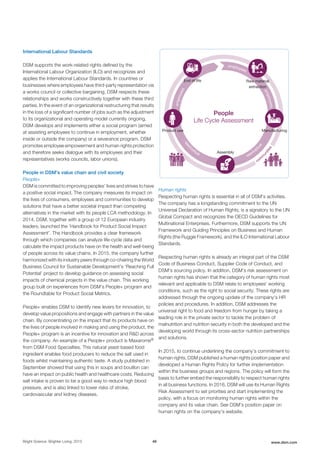
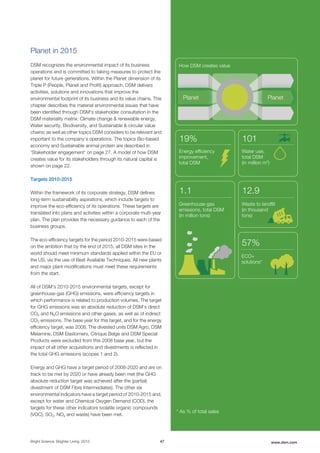
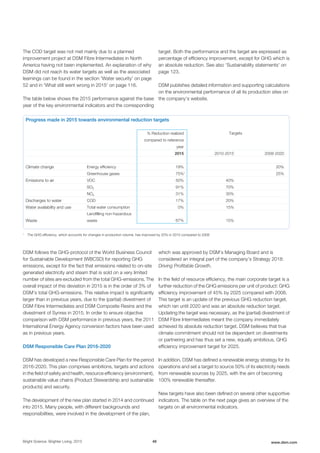
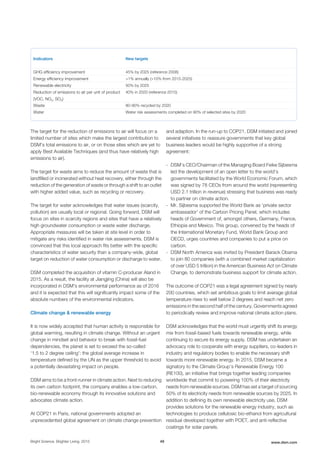
which can found in 'Review of business – Partnerships'
on page 86.
The four most significant acquisitions during the period, which
are all in the Nutrition cluster, have strengthened DSM’s portfolio,
boosted growth and already made strong contributions to
earnings, with further potential for the future. Collectively, the
Martek (2010), Ocean Nutrition Canada (2012), Tortuga (2012)
and Fortitech (2012) businesses added € 210 million in EBITDA
at the time of acquisition. DSM has since successfully grown this
contribution by 11% per year and in 2015 these acquisitions
delivered a total of over € 300 million in EBITDA. The profitability
of Ocean Nutrition Canada has however declined somewhat
over the period, impacted by a sharp increase in the price of fish
oil and weakness in the US market for fish oil-based omega-3
dietary supplements.
Acquisitions & Partnerships in 2015
In 2015, DSM engaged in partnerships that serve clear strategic
and financial objectives. These business partnerships
sometimes involve long-term supply agreements and are
material to DSM's business performance.
The most significant partnership of 2015 was entered into in
March, when DSM and CVC Capital Partners announced the
establishment of a partnership comprising the DSM Fibre
Intermediates and DSM Composite Resins businesses. The
formation of ChemicaInvest, in which DSM has a 35%
shareholding, was finalized at the end of July. The transaction
delivered on the strategic actions DSM said it would pursue for
the businesses in order to simplify its portfolio and reduce
cyclicality in the Performance Materials cluster, whilst effectively
maintaining DSM Engineering Plastics’ backward integration
through a long-term purchasing agreement. See also 'Review of
business – Partnerships' on page 86.
DSM entered into or completed a number of other business-
related acquisitions and partnerships during the year, details
of which can be found in 'Review of business – Nutrition' on page
67, 'Review of business – Performance Materials'
on page 75 and 'Review of business – Innovation Center' on
page 81.
In the summer of 2015, Patheon filed a registration statement
(Form S-1) with the US Securities and Exchange Commission
(SEC), preparing itself for a public offering. To date, neither the
timing of such a public offering, nor the number of shares, nor
the price have been confirmed.
Bright Science. Brighter Living. 2015 16 www.dsm.com
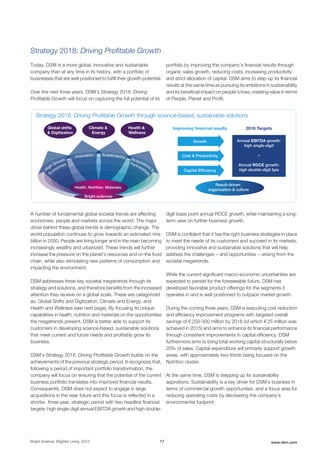
Strategy 2018: Driving Profitable Growth
Today, DSM is a more global, innovative and sustainable
company than at any time in its history, with a portfolio of
businesses that are well positioned to fulfill their growth potential.
Over the next three years, DSM’s Strategy 2018: Driving
Profitable Growth will focus on capturing the full potential of its
portfolio by improving the company’s financial results through
organic sales growth, reducing costs, increasing productivity
and strict allocation of capital. DSM aims to step-up its financial
results at the same time as pursuing its ambitions in sustainability
and its beneficial impact on people’s lives, creating value in terms
of People, Planet and Profit.
Health &
Wellness
Climate &
Energy
Global shifts
& Digitization
Improving financial results 2018 Targets
Annual EBITDA growth:
high single-digit
–
Annual ROCE growth:
high double-digit bps
Health. Nutrition. Materials.
Result-driven
organization & culture
Bright sciences
Innovation Sustainability
High Growth
Economies
Acquisitions
&
Partnership
s
Strategy 2018: Driving Profitable Growth through science-based, sustainable solutions
Capital Efficiency
Growth
Cost & Productivity
A number of fundamental global societal trends are affecting
economies, people and markets across the world. The major
driver behind these global trends is demographic change. The
world population continues to grow towards an estimated nine
billion in 2050. People are living longer and in the main becoming
increasingly wealthy and urbanized. These trends will further
increase the pressure on the planet’s resources and on the food
chain, while also stimulating new patterns of consumption and
impacting the environment.
DSM addresses three key societal megatrends through its
strategy and solutions, and therefore benefits from the increased
attention they receive on a global scale. These are categorized
as: Global Shifts and Digitization; Climate and Energy; and
Health and Wellness (see next page). By focusing its unique
capabilities in health, nutrition and materials on the opportunities
the megatrends present, DSM is better able to support its
customers in developing science-based, sustainable solutions
that meet current and future needs and profitably grow its
business.
DSM’s Strategy 2018: Driving Profitable Growth builds on the
achievements of the previous strategic period. It recognizes that,
following a period of important portfolio transformation, the
company will focus on ensuring that the potential of the current
business portfolio translates into improved financial results.
Consequently, DSM does not expect to engage in large
acquisitions in the near future and this focus is reflected in a
shorter, three-year, strategic period with two headline financial
targets: high single-digit annual EBITDA growth and high double-
digit basis point annual ROCE growth, while maintaining a long-
term view on further business growth.
DSM is confident that it has the right business strategies in place
to meet the needs of its customers and succeed in its markets,
providing innovative and sustainable solutions that will help
address the challenges − and opportunities − arising from the
societal megatrends.
While the current significant macro-economic uncertainties are
expected to persist for the foreseeable future, DSM has
developed favorable product offerings for the segments it
operates in and is well positioned to outpace market growth.
During the coming three years, DSM is executing cost reduction
and efficiency improvement programs with targeted overall
savings of € 250-300 million by 2018 (of which € 25 million was
achieved in 2015) and aims to enhance its financial performance
through consistent improvements in capital efficiency. DSM
furthermore aims to bring total working capital structurally below
20% of sales. Capital expenditure will primarily support growth
areas, with approximately two-thirds being focused on the
Nutrition cluster.
At the same time, DSM is stepping up its sustainability
aspirations. Sustainability is a key driver for DSM’s business in
terms of commercial growth opportunities, and a focus area for
reducing operating costs by decreasing the company's
environmental footprint.
Bright Science. Brighter Living. 2015 17 www.dsm.com
Safety remains of paramount importance and DSM aspires to
further reduce injuries and incidents over time with the ultimate
aim of providing an injury and incident-free workplace.
In support of its targets, DSM is adjusting its organizational and
operating model and way of working, fostering a results-driven,
high-performance culture. It has furthermore strengthened its
top structure with the establishment of an Executive Committee,
which enables more rapid strategic alignment and operational
execution across the company.
As part of its strategic transformation and its move away from
more commoditized and cyclical areas, DSM has established
partnerships for its Pharma activities (DSM Sinochem
Pharmaceuticals (DSP) for Anti-Infectives in 2011 and Patheon
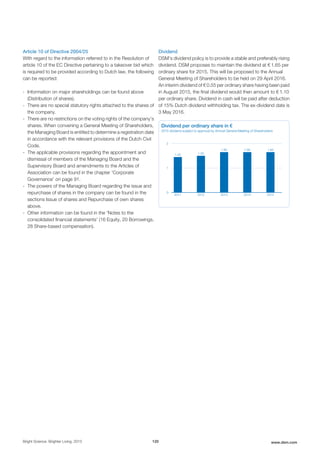
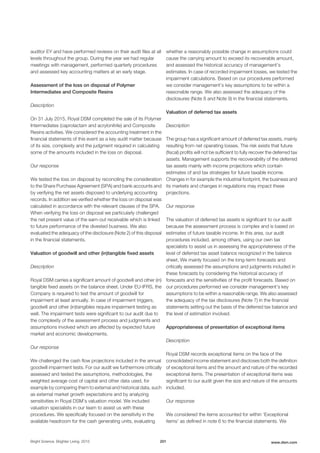
for contract development and manufacturing services in 2014)
and for the remaining Bulk Chemical businesses in Polymer
Intermediates and Composite Resins (ChemicaInvest in 2015).
These partnerships have been created with a view to ultimately
exiting these businesses and DSM expects to extract significant
value from these partnerships in the coming years.
Nutrition
DSM is one of the world’s leading producers of specialty
nutritional ingredients. DSM’s Nutrition cluster has unrivalled
capabilities, with a global presence and an unparalleled network
for local solutions as well as a complete portfolio of nutritional
ingredients for food and feed and an extended offering over the
value chain. This ranges from the production of active ingredients
through their incorporation into sophisticated forms and tailored
premixes, as well as nutrition end-products such as its i-Health
range of dietary supplements.
The Nutrition cluster has clear strategies in place to drive both
top and bottom-line growth across its businesses. Taken
together, they can be summarized as:
(I) expanding proven and successful core competences,
bringing them to more of the markets and territories it serves
and maximizing their value;
(II) adding new products and solutions to its offerings, making
full use of DSM's capabilities in sustainable innovation;
(III) growing in underpenetrated categories and regions and
accessing new segments; and
(IV) developing new business models to complement its
positions across its value chains.
The Animal Nutrition & Health business will further expand its
unique global premix footprint. In addition, the business aims to
grow through new solutions in feed enzymes and eubiotics that
are tailored to meet the specific local needs of animal protein
producers in the territories it serves. It will drive growth in
underpenetrated species such as ruminants, aqua and pets as
well as enter new customer segments with new channels.
Bright Science. Brighter Living. 2015 18 www.dsm.com
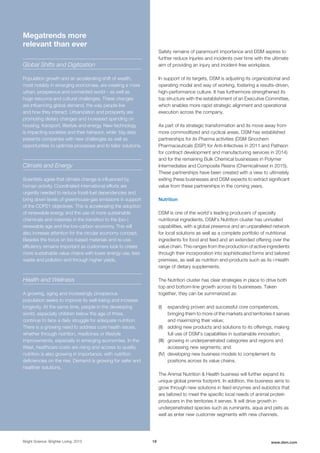
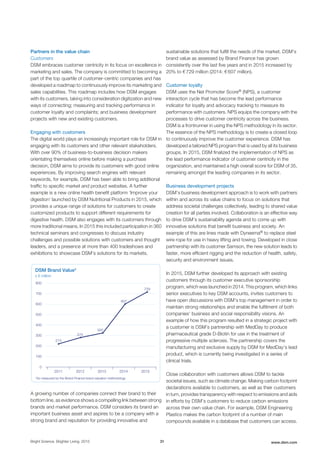
Megatrends more
relevant than ever
Global Shifts and Digitization
Population growth and an accelerating shift of wealth,
most notably in emerging economies, are creating a more
urban, prosperous and connected world – as well as
huge resource and cultural challenges. These changes
are influencing global demand, the way people live
and how they interact. Urbanization and prosperity are
promoting dietary changes and increased spending on
housing, transport, lifestyle and energy. New technology
is impacting societies and their behavior, while ‘big data’
presents companies with new challenges as well as
opportunities to optimize processes and to tailor solutions.
Climate and Energy
Scientists agree that climate change is influenced by
human activity. Coordinated international efforts are
urgently needed to reduce fossil-fuel dependencies and
bring down levels of greenhouse-gas emissions in support
of the COP21 objectives. This is accelerating the adoption
of renewable energy and the use of more sustainable
chemicals and materials in the transition to the (bio-)
renewable age and the low-carbon economy. This will
also increase attention for the circular economy concept.
Besides the focus on bio-based materials and re-use,
efficiency remains important as customers look to create
more sustainable value chains with lower energy use, less
waste and pollution and through higher yields.
Health and Wellness
A growing, aging and increasingly prosperous
population seeks to improve its well-being and increase
longevity. At the same time, people in the developing
world, especially children below the age of three,
continue to face a daily struggle for adequate nutrition.
There is a growing need to address core health issues,
whether through nutrition, medicines or lifestyle
improvements, especially in emerging economies. In the
West, healthcare costs are rising and access to quality
nutrition is also growing in importance, with nutrition
deficiencies on the rise. Demand is growing for safer and
healthier solutions.
After the recent slowdown in some of its end-markets, Human
Nutrition & Health aspires to return to more vigorous growth
through new initiatives focused on the expansion of its premix
activities and new products and solutions, for example in dietary
supplements. DSM is paying particular attention to its Human
Nutrition & Health operations in North America, where, following
a recent reshuffle, it is resolved to deliver growth with disciplined
sales and marketing execution.
DSM Food Specialties aims to leverage its leading cultures and
enzymes platform to drive further growth in attractive markets
and segments, as well as through new products and solutions.
The business aims to further develop the positions it has built in
savory ingredients.
Excellence in execution
3 4
2
1
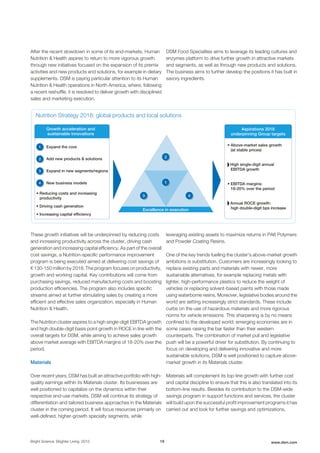
Nutrition Strategy 2018: global products and local solutions
Growth acceleration and
sustainable innovations
2 Add new products & solutions
3 Expand in new segments/regions
4 New business models
• Reducing costs and increasing
productivity
• Driving cash generation
• Increasing capital efficiency
1 Expand the core
Aspirations 2018
underpinning Group targets
• Above-market sales growth
(at stable prices)
High single-digit annual
EBITDA growth
• EBITDA margins:
18-20% over the period
Annual ROCE growth:
high double-digit bps increase
These growth initiatives will be underpinned by reducing costs
and increasing productivity across the cluster, driving cash
generation and increasing capital efficiency. As part of the overall
cost savings, a Nutrition-specific performance improvement
program is being executed aimed at delivering cost savings of
€ 130-150 million by 2018. The program focuses on productivity,
growth and working capital. Key contributions will come from
purchasing savings, reduced manufacturing costs and boosting
production efficiencies. The program also includes specific
streams aimed at further stimulating sales by creating a more
efficient and effective sales organization, especially in Human
Nutrition & Health.
The Nutrition cluster aspires to a high single-digit EBITDA growth
and high double-digit basis point growth in ROCE in line with the
overall targets for DSM, while aiming to achieve sales growth
above market average with EBITDA margins of 18-20% over the
period.
Materials
Over recent years, DSM has built an attractive portfolio with high-
quality earnings within its Materials cluster. Its businesses are
well positioned to capitalize on the dynamics within their
respective end-use markets. DSM will continue its strategy of
differentiation and tailored business approaches in the Materials
cluster in the coming period. It will focus resources primarily on
well-defined, higher-growth specialty segments, while
leveraging existing assets to maximize returns in PA6 Polymers
and Powder Coating Resins.
One of the key trends fuelling the cluster's above-market growth
ambitions is substitution. Customers are increasingly looking to
replace existing parts and materials with newer, more
sustainable alternatives, for example replacing metals with
lighter, high-performance plastics to reduce the weight of
vehicles or replacing solvent-based paints with those made
using waterborne resins. Moreover, legislative bodies around the
world are setting increasingly strict standards. These include
curbs on the use of hazardous materials and more rigorous
norms for vehicle emissions. This sharpening is by no means
confined to the developed world; emerging economies are in
some cases raising the bar faster than their western
counterparts. The combination of market pull and legislative
push will be a powerful driver for substitution. By continuing to
focus on developing and delivering innovative and more
sustainable solutions, DSM is well positioned to capture above-
market growth in its Materials cluster.
Materials will complement its top-line growth with further cost
and capital discipline to ensure that this is also translated into its
bottom-line results. Besides its contribution to the DSM-wide
savings program in support functions and services, the cluster
will build upon the successful profit improvement programs it has
carried out and look for further savings and optimizations.
Bright Science. Brighter Living. 2015 19 www.dsm.com
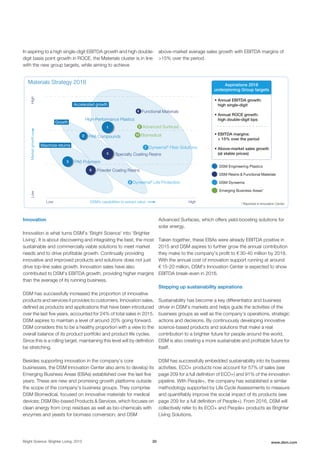
In aspiring to a high single-digit EBITDA growth and high double-
digit basis point growth in ROCE, the Materials cluster is in line
with the new group targets, while aiming to achieve
above-market average sales growth with EBITDA margins of
>15% over the period.
Growth
Maximize returns
Accelerated growth
Low HighDSM’s capabilities to extract value
Materials Strategy 2018
Marketgrowth
High-Performance Plastics
PA6 Compounds
PA6 Polymers
Functional Materials
Specialty Coating Resins
Powder Coating Resins
Dyneema®
Fiber Solutions
Dyneema®
Life Protection
Advanced Surfaces
Biomedical
HighLow
DSM Engineering Plastics
DSM Resins & Functional Materials
DSM Dyneema
* Reported in Innovation Center
Emerging Business Areas*
1
2
3
5
6
9
10
7
8
4
Aspirations 2018
underpinning Group targets
• Annual EBITDA growth:
high single-digit
• Annual ROCE growth:
high double-digit bps
• EBITDA margins:
> 15% over the period
• Above-market sales growth
(at stable prices)
Innovation
Innovation is what turns DSM’s ‘Bright Science’ into ‘Brighter
Living’. It is about discovering and integrating the best, the most
sustainable and commercially viable solutions to meet market
needs and to drive profitable growth. Continually providing
innovative and improved products and solutions does not just
drive top-line sales growth. Innovation sales have also
contributed to DSM’s EBITDA growth, providing higher margins
than the average of its running business.
DSM has successfully increased the proportion of innovative
products and services it provides to customers. Innovation sales,
defined as products and applications that have been introduced
over the last five years, accounted for 24% of total sales in 2015.
DSM aspires to maintain a level of around 20% going forward.
DSM considers this to be a healthy proportion with a view to the
overall balance of its product portfolio and product life cycles.
Since this is a rolling target, maintaining this level will by definition
be stretching.
Besides supporting innovation in the company’s core
businesses, the DSM Innovation Center also aims to develop its
Emerging Business Areas (EBAs) established over the last five
years. These are new and promising growth platforms outside
the scope of the company’s business groups. They comprise
DSM Biomedical, focused on innovative materials for medical
devices; DSM Bio-based Products & Services, which focuses on
clean energy from crop residues as well as bio-chemicals with
enzymes and yeasts for biomass conversion; and DSM
Advanced Surfaces, which offers yield-boosting solutions for
solar energy.
Taken together, these EBAs were already EBITDA positive in
2015 and DSM aspires to further grow the annual contribution
they make to the company’s profit to € 30-40 million by 2018.
With the annual cost of innovation support running at around
€ 15-20 million, DSM’s Innovation Center is expected to show
EBITDA break-even in 2016.
Stepping up sustainability aspirations
Sustainability has become a key differentiator and business
driver in DSM’s markets and helps guide the activities of the
business groups as well as the company’s operations, strategic
actions and decisions. By continuously developing innovative
science-based products and solutions that make a real
contribution to a brighter future for people around the world,
DSM is also creating a more sustainable and profitable future for
itself.
DSM has successfully embedded sustainability into its business
activities. ECO+ products now account for 57% of sales (see
page 209 for a full definition of ECO+) and 91% of the innovation
pipeline. With People+, the company has established a similar
methodology supported by Life Cycle Assessments to measure
and quantifiably improve the social impact of its products (see
page 209 for a full definition of People+). From 2016, DSM will
collectively refer to its ECO+ and People+ products as Brighter
Living Solutions.
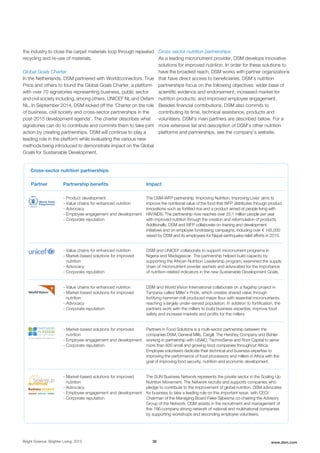
Bright Science. Brighter Living. 2015 20 www.dsm.com
For the coming period, DSM is stepping up its aspirations once
again. DSM will increase the proportion of Brighter Living
Solutions to 65% of sales by 2020 (2015: 60%). It will improve
its greenhouse-gas efficiency − in other words, reduce its relative
emissions − by 45% by 2025, compared to the reference year
2008 (2015: 20%). This will be supported by energy efficiency
improvements of >1% per year and by sourcing at least 50% of
its electricity from renewable sources by 2025. Increasing
greenhouse-gas efficiency will also drive down costs. To support
this targeted improvement and foster an appropriate sense of
urgency to achieve these changes, DSM will apply an internal
carbon price of € 50 per ton CO2-equivalent to large investment
decisions. In addition, the company works with suppliers and
customers to improve the overall footprint of the value chains in
which it operates.
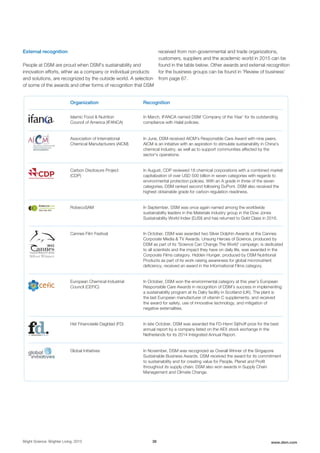
Stepping up sustainability aspirations
Dow Jones Sustainability Index
Sustainability aspirations 2020
Gold Class
GHG efficiency improvement 45% (by 2025)
Brighter Living Solutions
ECO+/People+ (running business) 65%
Employee Engagement Survey Towards 75%
Safety
(Frequency Index Recordables)
Diversity
Female executives
Executives from under-represented
nationalities
0.25
25%
60%
There is a strong link between DSM’s competences and
business plans with key items on the global sustainable
development agenda, namely malnutrition, and climate change
and energy. DSM is in a position to be able to make a
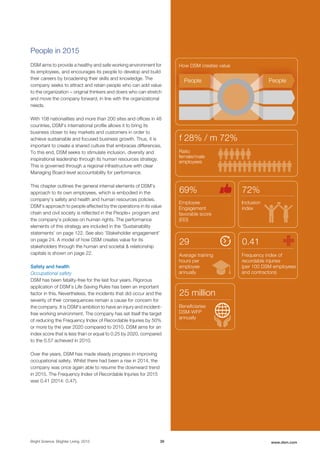
contribution to addressing these topics through its businesses.
By developing innovative business solutions and engaging its
value chains, networks and partnerships, DSM is driving
sustainable markets that can have a beneficial impact at scale
for all participants. At the end of 2015, DSM reaffirmed its
strategic partnership with the UN World Food Programme,
which currently reaches more than 25 million beneficiaries per
year with improved nutrition, extending the partnership to 2018.
Organization and culture
DSM is adjusting its organizational and operating model to
support the company's growth, creating a more agile, focused
and cost-efficient organization, with a stronger business and
market focus and globally leveraged support functions. The
organizational adjustments DSM is implementing are intended to
achieve far more than cost savings alone. DSM has
strengthened its management structure by establishing an
Executive Committee, which enables faster alignment and
operational execution on finance, business, innovation, strategy
and people.
The members of the Executive Committee are the Managing Board members Feike
Sijbesma (CEO/Chairman), Geraldine Matchett (CFO), Stephan Tanda (Nutrition)
and Dimitri de Vreeze (Materials), as well as Chris Goppelsroeder (Nutritional
Products), Philip Eykerman (Strategy and M&A), Peter Vrijsen (People &
Organization) and Rob van Leen (R&D and Innovation)
Furthermore, the company is establishing a new way of working,
driving a change in mindset and culture aimed at establishing
DSM as a results-driven, high-performance organization, both in
terms of top-line and bottom-line growth and talent
development.
DSM began adjusting its organizational and operating model in
2015 and is optimizing cross-company supporting functions in
areas including HR, Indirect Sourcing, Communications,
Finance, Legal and ICT, thus freeing up capacity at its business
groups to focus on their primary functions: Innovation and R&D,
Direct Sourcing, Manufacturing & Operations and Marketing &
Sales. By globally leveraging its support functions and shared
services organization as well as improving the ability of functional
excellence departments to support the business groups, DSM
aims to achieve structural cost savings of € 125-150 million
versus 2014. These savings are targeted to be achieved by the
end of 2017.
Building for earnings growth beyond 2018
DSM has set itself strategic targets for the period to 2018. This
shorter three-year period is intended to channel the
organization’s focus and forcefully drive achievement of the
step-up in financial performance at which the company aims. At
the same time, DSM is also preparing for longer-term growth; its
business cycles are typically longer than the three-year period to
2018. The company has a range of key business and innovation
projects across the clusters that will drive earnings growth
beyond 2018 and will continue to develop more initiatives in light
of market dynamics.
Bright Science. Brighter Living. 2015 21 www.dsm.com
How DSM creates value for its
stakeholders
Bright Science. Brighter Living. 2015 22 www.dsm.com
How DSM creates value for its stakeholders
Profit
People
Planet
Profit
People
Planet
Busin
ess Groups Support and C
orporatefunctions
Functon
alExcellence
Mission
Organizational
and
Operating model
Strategy
• Financial performance
(EBITDA & ROCE growth)
• Dividend
• Contribute to business success
for suppliers & customers
• Contribute to civil society via tax
• Patents & royalties
• Safety & health
• Engaged workforce
• Skills & employability
• Employee benefits
• People+ solutions
• Improved nutrition
• ECO+ solutions
• Reduced environmental footprint
• Enabling transition to (bio)
renewable & circular economy
• Safer ingredients & materials
Value outcomesCapital inputs
• Shareholder equity
• Borrowings
• Partnerships & Open innovation
• Purchased goods & services
• Manufacturing asset base
• Employees
• Training & development
• Stakeholder engagement &
Public-Private Partnerships
• Philanthropy & sponsoring
• Raw materials
(including renewables)
• Energy (including renewables)
• Water
DSM’s business
Human capital
DSM employs many
skilled and talented
people from diverse
backgrounds. DSM strives
to provide employees with
a safe and inspiring
workplace as well as with
the tools and training they
need to be effective and
to develop their abilities.
DSM rewards employees
with competitive benefit
packages.
Societal &
relationship capital
DSM engages with
various stakeholders to
ensure close alignment
between the company’s
aims and societal needs.
DSM generates value for
stakeholders outside its
direct value chains of
employees, suppliers,
customers and end-users;
these include employees’
families, governments,
local communities and
civil society.
Natural capital
DSM recognizes that the
world is an interconnected
system of resources.
For DSM this represents
a responsibility and a
business opportunity.
DSM aims to reduce the
environmental impact of
its supply chain,
operations and products
and services, whilst
developing innovative
solutions that deliver
sustainability benefits to
customers and beyond.
Financial capital
Providers of capital –
shareholders and
bondholders, banks and
the financial markets –
supply funds that DSM
uses in its business to
create value, driving
growth and delivering
sustainable returns.
Re
gions
Profit
People
Planet
Profit
People
Planet
Busin
ess Groups Support and C
orporatefunctions
Functon
alExcellence
Mission
Organizational
and
Operating model
Strategy
• Financial performance
(EBITDA & ROCE growth)
• Dividend
• Contribute to business success
for suppliers & customers
• Contribute to civil society via tax
• Patents & royalties
• Safety & health
• Engaged workforce
• Skills & employability
• Employee benefits
• People+ solutions
• Improved nutrition
• ECO+ solutions
• Reduced environmental footprint
• Enabling transition to (bio)
renewable & circular economy
• Safer ingredients & materials
Value outcomesCapital inputs
• Shareholder equity
• Borrowings
• Partnerships & Open innovation
• Purchased goods & services
• Manufacturing asset base
• Employees
• Training & development
• Stakeholder engagement &
Public-Private Partnerships
• Philanthropy & sponsoring
• Raw materials
(including renewables)
• Energy (including renewables)
• Water
DSM’s business
Human capital
DSM employs many
skilled and talented
people from diverse
backgrounds. DSM strives
to provide employees with
a safe and inspiring
workplace as well as with
the tools and training they
need to be effective and
to develop their abilities.
DSM rewards employees
with competitive benefit
packages.
Societal &
relationship capital
DSM engages with
various stakeholders to
ensure close alignment
between the company’s
aims and societal needs.
DSM generates value for
stakeholders outside its
direct value chains of
employees, suppliers,
customers and end-users;
these include employees’
families, governments,
local communities and
civil society.
Natural capital
DSM recognizes that the
world is an interconnected
system of resources.
For DSM this represents
a responsibility and a
business opportunity.
DSM aims to reduce the
environmental impact of
its supply chain,
operations and products
and services, whilst
developing innovative
solutions that deliver
sustainability benefits to
customers and beyond.
Financial capital
Providers of capital –
shareholders and
bondholders, banks and
the financial markets –
supply funds that DSM
uses in its business to
create value, driving
growth and delivering
sustainable returns.
Re
gions
DSM’s strategy is aimed at driving profitable growth through
science-based, sustainable solutions based on the defining
megatrends of our time. By using its unique competences in
health, nutrition and materials, DSM is fostering economic
prosperity, environmental progress and social advances to
create value for all stakeholders simultaneously.
The diagram on the left is based on the International Integrated
Reporting Council’s <Integrated Reporting> (<IR>) framework
and gives a schematic overview of the value DSM creates over
time based on six capitals. These are: human capital; societal &
relationship capital; natural capital; financial capital; intellectual
capital; and manufactured capital. Descriptions of how these
capitals apply to DSM are given below left.
DSM employs these capital inputs in its business in the execution
of its strategy and in the fulfilment of its mission to create brighter
lives for people today and for generations to come. The
company’s organizational and operating model is made up of
market-facing business groups focused on the primary business
functions (Innovation and R&D, Direct Sourcing, Manufacturing
& Operations and Marketing & Sales), global support and
functional excellence departments and regional organizations. It
uses these to minimize and mitigate risks and take advantage of
the opportunities the megatrends provide, thereby transforming
the capital inputs into value outcomes aimed at having the most
beneficial impact possible.
Since 2002, DSM has established a track-record in Triple P
reporting, disclosing its performance in terms of People, Planet
and Profit. For the purposes of comparability, the six capitals as
defined in the <IR> framework continue to be clustered under
People (comprising the human and societal & relationship
capitals), Planet (natural capital) and Profit (financial, intellectual
and manufactured capitals).
Specific performance indicators relating to the capitals are
provided throughout this Integrated Annual Report (hereafter
referred to as the Report).
Bright Science. Brighter Living. 2015 23 www.dsm.com
• Better fed & healthier individuals and
communities
• More prosperous and resilient
employees for the company and its
value chain
• More sustainable use of resources, for
the company and in its value chain
• Products that contribute to safer,
healthier working & living environments
• Driving Profitable Growth through
science-based sustainable solutions
• Sustainable returns to investors
• Positive contribution to economic
growth in the countries & markets in
which DSM operates
Impact
Intellectual capital
DSM manufactures and
distributes high-quality
products and services
safely, efficiently and
responsibly and strives to
develop valuable,
collaborative and
long-term relationships
with customers and
suppliers. DSM pursues
open innovation, connect-
ing and collaborating with
partners and investing in
start-ups.
Manufactured capital
DSM has unique
competences in life
sciences and materials
sciences and connects
these to deliver innovative
solutions that nourish,
protect and improve
performance.
• Better fed & healthier individuals and
communities
• More prosperous and resilient
employees for the company and its
value chain
• More sustainable use of resources, for
the company and in its value chain
• Products that contribute to safer,
healthier working & living environments
• Driving Profitable Growth through
science-based sustainable solutions
• Sustainable returns to investors
• Positive contribution to economic
growth in the countries & markets in
which DSM operates
Impact
Intellectual capital
DSM manufactures and
distributes high-quality
products and services
safely, efficiently and
responsibly and strives to
develop valuable,
collaborative and
long-term relationships
with customers and
suppliers. DSM pursues
open innovation, connect-
ing and collaborating with
partners and investing in
start-ups.
Manufactured capital
DSM has unique
competences in life
sciences and materials
sciences and connects
these to deliver innovative
solutions that nourish,
protect and improve
performance.
Stakeholder engagement
Taking part in strategic and proactive dialogue with key
stakeholders helps DSM to deepen its insights into the drivers of
its business and the needs of society across the world, and thus
be ahead of competition in adjusting to changing demands.
In 2015, DSM reached out to its stakeholders – suppliers,
customers, investors, employees, companies, governments,
academia and civil society – to further align its strategy with their
views. The company's stakeholder groups have been identified
based on the influence they have on the company's operations,
as well as whether they are significantly affected by them. The
outcomes from the various stakeholder dialogues inform many
aspects of DSM’s strategy such as risk management, business
opportunities, and strategic objectives and ambitions.
The continuous dialogue DSM has with its stakeholders takes
place through a variety of channels. A non-exhaustive overview
of the ways in which it has engaged with each stakeholder group
is provided on page 29. DSM values engaging with its relevant
stakeholders and maintains open discussions on topics relevant
to its business activities and its role in society.
Materiality
For DSM, materiality is about identifying the People, Planet and
Profit topics that are most relevant to the company’s
stakeholders, and plotting them against the impact they have on
its business. Business impact includes social, environmental and
financial impact. DSM formally introduced its first materiality
matrix in 2012. Since then, it has continuously assessed whether
major changes to its material topics and matrix are needed by
keeping up with societal debates and engaging in dialogue with
international business organizations and other relevant
stakeholders. DSM conducts media research and peer analyses
as part of these efforts.
In 2015, DSM refreshed its materiality matrix based on a process
that included the aforementioned media and peer analysis, and
identified external trends and developments relevant to DSM’s
external stakeholders and to the business. For the first time,
DSM also aligned its materiality matrix refresh with its risk
management process, and checked that risks identified in its
Corporate Risk Assessment were reflected in the material topics.
The topics were validated via internal stakeholder interviews, as
well as a formal review process with the Sustainability Leadership
Team – a group of senior managers with the role to champion
sustainability within the company. The refreshed materiality
matrix was signed off by the members of the Managing Board.
As a result of the materiality refresh in 2015, DSM added three
new topics to its materiality matrix: Sharing economy,
Responsible business practices and Transparency. The topic
Human rights is now covered under Responsible business
practices. Social media has been included in the management
approach of the topic Advocacy & reputation. The results of the
refreshed matrix highlight the ongoing, emerging and new topics
that are most relevant for DSM to report to its stakeholders in
2015.
The 19 subjects have been clustered into four categories:
Societal Shifts, Eco Limits, Business Enablers and Trust &
Accountability. An explanation of all topics and reference to
DSM’s management approach are described on the next pages.
Societal Shifts
Eco Limits
Business Enablers
Trust & Accountability
Priority Top Priority
InterestHighinterestSocietalinterest
Business impact
1 Health & wellness
4 Malnutrition & nutrition
security
8 Emerging economies
11 Product & food safety
19 Sharing economy
9 Open innovation
15 Careers & employment
16 Advocacy & reputation
18 Trade barriers
2 Climate change &
renewable energy
3 Sustainable & circular
value chains
7 Water security
10 Sustainable animal protein
13 Bio-based economy
14 Biodiversity
5 Responsible business
practices
6 Transparency
12 Tax
17 Bioethics
Materiality matrix 2015
1
25
10
16
15
17
19
14
18
11
6
4
3
8
7
9
12
13
Bright Science. Brighter Living. 2015 24 www.dsm.com
Societal Shifts
Health & wellness
As a global societal megatrend, Health & wellness is consistently
confirmed by DSM's stakeholders as an important topic for the
world's growing population, and as an area of opportunity for the
company. DSM is uniquely positioned to offer products and
solutions which contribute to individual health and well-being,
including the prevention and/or reduction of diseases and
increasing quality of life through its solutions to improve health
and healthy lifestyles.
Management approach. The topic Health & wellness underlies
DSM's strategy. DSM manages its opportunities in this topic
through its Nutrition cluster and the Emerging Business Area
(EBA) DSM Biomedical. In the Performance Materials cluster the
topic of health plays a role in marketing solvent-free products in
close collaboration with its value chain partners. See 'Strategy
2018' on page 18 and 'Review of business' from page 67.
Malnutrition & nutrition security
Malnutrition & nutrition security continues to be a material topic
that affects DSM’s stakeholders and the business. The effects
of undernutrition on health and development (typically as a result
of poverty) are pertinent to both the developing and developed
world. DSM offers solutions to address this issue, which include
increasing affordable access to sufficient, safe, and nutritious
food to maintain a healthy and active life.
Management approach. DSM manages the topic of Malnutrition
& nutrition security for the developing world through its cross-
sector partnerships in nutrition; and for the developed world
through its strategies within the business groups DSM Nutritional
Products and DSM Food Specialties. See 'Cross-sector nutrition
partnerships' on page 36 and 'Review of business – DSM
Nutritional Products' and 'DSM Food Specialties' on page
69 and page 72 respectively.
Emerging economies
Emerging economies remain a material topic for DSM and its
stakeholders. The shifts in power and influence from developed
to emerging economies in terms of political, social and economic
considerations means that DSM monitors developments and
manages its activities and operations in emerging economies
such as China, India, Brazil and those in Africa.
Management approach. DSM manages Emerging economies
through its strategic growth driver High Growth Economies. See
'High Growth Economies' on page 14. In addition, the company
strategically partakes in acquisitions and partnerships in
emerging economies that meet DSM's criteria. For example, in
2015 DSM participated in a joint venture with the Africa Improved
Foods Ltd. consortium to address malnutrition in Rwanda. See
'Acquisitions & Partnerships' on page 16 and 'Review of
business − DSM Nutritional Products' on page 69.
Product & food safety
As a company that produces ingredients and solutions in health,
nutrition and materials, Product & food safety ranks high in
relevance for DSM and its stakeholders. Consumer trends show
that a substantial majority of people are becoming more aware
of and concerned about the source of what they are buying and
eating, as well as aspects such as safe packaging and accurate
labeling.
Management approach. For DSM, Product & food safety means
having practices in place to ensure ingredient and substance
quality, including the production, handling, preparation, storage
and use of DSM solutions in ways that prevent risks to health
and wellness. DSM manages the subject Product & food safety
for its value chains through its People+ program and its Product
Stewardship strategy. See 'People+ program' on page 46,
and 'Product Stewardship' on page 54.
Sharing economy
As opposed to the ownership economy, in a sharing economy
physical assets are shared as services. For instance, a car owner
may allow someone else to rent their vehicle during a period
when they are not using it. In doing so, the owner prevents the
car from being underutilized while simultaneously generating
income. The Sharing economy was recognized by DSM’s
stakeholders as a new and emerging topic that may impact the
demand for DSM’s high-performance materials.
Management approach. The Sharing economy is being
monitored by DSM as an emerging topic for its Performance
Materials businesses. It is also of consideration in how DSM will
look at new business models within the circular economy, as
sharing capital goods allows joint ownership of products such
as cars, which will lead to a reduced demand for such products
in the future. The demand for higher-quality, longer-lasting
solutions that support the sharing economy will likely increase.
DSM needs to prepare its Performance Materials businesses to
provide solutions that allow for greater durability, reusability and
recyclability. See 'Review of business - Performance Materials'
on page 75.
Eco Limits
Climate change & renewable energy
Climate change & renewable energy ranks high in importance for
both DSM and its stakeholders. This topic refers to the long-term
shifts in weather patterns and extreme weather events due to
human-induced alterations. It includes the composition of
energy supply and emissions resulting from direct and indirect
energy use.
Management approach. DSM’s approach to addressing climate
change involves quantifying and tracking greenhouse-gas (GHG)
emissions, as well as monitoring its energy consumption so as
to be able to initiate projects to improve efficiency and reduce its
footprint.
Bright Science. Brighter Living. 2015 25 www.dsm.com
Where feasible, projects are initiated that benefit the
environment, and also have other positive consequences, such
as internal cost savings. DSM discloses its impact through the
Carbon Disclosure Project.
Climate change is also an area of opportunity for DSM to offer
products and solutions to help enable the transition to a low-
carbon economy. DSM furthermore advocates climate action in
support of this transition. For a detailed description of DSM’s
management approach for Climate change & renewable energy,
and 2015 performance, see 'Planet' on page 49 and
'Sustainability statements' on page 123, as well as 'Review of
business' from page 67.
Sustainable & circular value chains
Sustainable & circular value chains remains a material topic for
DSM's stakeholders as it is becoming ever clearer that real
sustainability can only be achieved when all parts of the value
chain work together. DSM's suppliers, customers and peers are
also becoming increasingly aware of the importance of the
circular economy as a concept which can improve the
environmental impact of the value chain. For DSM, Sustainable
& circular value chains mean low environmental and positive
societal impact value chains for its product and system design,
which emphasizes use and re-use of materials enabled by the
circular economy. The circular economy helps DSM to overcome
its impact in relation to resource constraints and move to lower-
impact business models, and is most relevant for seeking
opportunities within DSM’s Performance Materials businesses.
Management approach. DSM’s approach to Sustainable &
circular value chains is through environmental and social Life
Cycle Assessments (LCA) of its products and solutions, and
collaborating with its partners in the value chain. See 'People+'
and 'ECO+' on page 46 and page 53 and 'Planet' on page
52.
Water security
Water security is defined as the capacity of a population to
safeguard sustainable access to adequate quantities of
acceptable quality water for sustaining livelihoods, human well-
being, and socio-economic development. Due to its effect on
ecosystems services and political stability, it is a material topic
for both DSM and its stakeholders around the world. DSM
commits to the responsible use of water resources in light of the
long-term decline in water supply as compared to water demand
around the world.
Management approach. DSM has been a signatory to the UN
CEO Water Mandate since 2009. In addition, it has voluntarily
reported its water policy and performance via the Carbon
Disclosure Project since 2011. For DSM’s performance in 2015
and its target on water for the period 2016-2020 see 'Planet' on
page 47, and 'Sustainability statements' on page 123.
Bright Science. Brighter Living. 2015 26 www.dsm.com
Open innovation is the future
The Chemelot Institute for Science &
Technology (InSciTe) is a public-private
institute for biomedical materials and
bio-based materials founded by DSM,
Maastricht University and University
Medical Center, Eindhoven University of
Technology and the Provincie Limburg.
Managing Director Emiel Staring explains
how InSciTe uses open innovation to
help DSM – among others – bring new
ideas to market faster and with a greater
chance of commercial success.
“Our mission at InSciTe is to make materials smarter
by enabling top scientists and ambitious entrepreneurs
to address the societal challenges and economic
opportunities of sustainable healthcare and sustainable
bio-based production.
InSciTe is a unique institute. We have our own facilities,
where people from different organizations and fields of
expertise come together and collaborate at the workbench.
They aren’t in their own labs and then having project
meetings to exchange updates, they are working side-by-
side. This really is new. It allows us to increase the level of
interaction and exchange, thereby accelerating the pace at
which innovations can be brought to market.
We are here to ‘de-risk’ R&D and innovation efforts;
pooling resources and linking competences in our
unique setting enables participants to lower their financial
outlay and risks while at the same time increasing the
probability of success. It’s about more than the science,
it’s also about ensuring that the science can make an
impact on the market.
Open innovation is the future. I strongly believe that
sharing know-how and knowledge has a multiplier effect
and I encourage DSM – and all our other participants – to
open up further. Trust is the basis of open innovation, and
it goes without saying that we have very clear protocols
and assurances on who owns project outcomes and
intellectual property.”
Sustainable animal protein
The topic Sustainable animal protein is an emerging topic of
importance for DSM's stakeholders. With the world population
set to reach nine billion by 2050, one of the biggest concerns for
governments worldwide is food security at an affordable price.
The demand for high-quality protein from diverse sources
including meat, fish, eggs and dairy is also increasing. Added to
that, the adverse effects of climate change on natural resources
means that sustainable animal protein production is becoming
an increasingly important subject for the world to feed a larger,
more urban and richer population in the future without
endangering fragile ecosystems. DSM is uniquely positioned to
respond to this topic by making more efficient use of feed,
providing alternatives to antibiotic growth promoters, improving
animal health and welfare with the aid of micronutrients and
reducing the environmental impact of animal farming in terms of,
for example, GHG emissions, air quality in stables and land use.
Management approach. DSM manages its opportunities in
Sustainable animal protein through its largest business group
DSM Nutritional Products, contributing to reducing the
environmental footprint of animal husbandry. See 'Review of
business – DSM Nutritional Products' on page 69. See also
DSM's position paper on Sustainable animal protein production
on its website.
Bio-based economy
A Bio-based economy remains an important topic to DSM's
stakeholders as the world moves toward a low-carbon economy
and away from a fossil-based economy. In a Bio-based
economy, production will rely on the use of natural inputs as is
the case with renewable energy, biofuels and bio-based
chemicals. By ensuring the renewability of raw materials, a bio-
based economy makes a circular economy possible. The EBA
DSM Bio-based Products & Services focuses on pioneering
advances in biomass conversion and seeks to demonstrate the
commercial viability of renewable technologies in collaboration
with strategic partners in the value chain.
Management approach. DSM manages the topic of Bio-based
economy through the strategy and activities of its EBA DSM Bio-
based Products & Services. See 'Review of business – DSM Bio-
based Products & Services' on page 82.
Biodiversity
Biodiversity and healthy ecosystems are among the conditions
necessary for a sustainable world. Biodiversity is the term given
to the variety of life on earth and the natural patterns it forms.
Changes can influence the supply of ecosystem services − the
benefits people obtain from ecosystems. These include services
such as food, water, and clean air; regulating services such as
flood and disease control; cultural services such as spiritual,
recreational and cultural benefits; and supporting services, such
as nutrient cycles, that maintain the conditions for life on earth.
Management approach. DSM supports the ambitions of the
Convention on Biological Diversity and actively contributes to the
preservation of biodiversity wherever possible. The company
does this by building awareness about natural capital,
biodiversity and ecosystems; assessing and monitoring DSM’s
impact on protected areas within its vicinity; developing impact
assessments with stakeholders; and developing measures that
help mitigate this impact. In 2015, DSM published a position
paper on Biodiversity on its website. For further detailed
information on DSM's approach to Biodiversity, see 'Planet' on
page 52.
Business Enablers
Open innovation
Open innovation is an important element of DSM's approach to
innovation and a business enabler. By combining its own
capabilities with the vast pool of ideas, know-how and expertise
that are available outside the company, DSM is better able to
discover and develop solutions. Open innovation is of particular
importance to DSM's suppliers, customers and partners, as it
helps to contribute to their and the company's profitable growth.
Management approach. DSM actively manages an Open
innovation policy and collaborates with suppliers, customers and
academic institutions in the name of innovation. See 'Review of
business − Innovation Center' on page 81 and 'Stakeholders'
on page 29.
Careers & employment
The topic of Careers & employment is important to DSM and its
stakeholders − both within and outside of the company. DSM
aims to provide rewarding career opportunities, engaged staff,
a healthy work-life balance and a diverse workforce where
individual differences are respected.
Management approach. DSM’s approach to addressing careers
& employment, includes managing the topics Safety and Health,
ONE DSM Culture Agenda, Talent Development & Attraction,
Mentoring, Organizational Learning and compliance with the
International Labour Standards of the International Labour
Organization (ILO). See 'People' on page 46.
Advocacy & reputation
For DSM, Advocacy & reputation means supporting the
company's sustainable business interests and core values. DSM
interacts with government, policymakers, industry associations
and societal interest groups on areas of mutual interest to create
a receptive environment for its solutions. It encourages
legislators to promote competitiveness, sustainability and
innovation. DSM’s reputation underpins its license to operate
with stakeholders both within and outside its direct value chains.
Management approach. DSM considers dialogues with
government authorities a constructive part of the legislative
decision-making process. It manages its relationship with
Bright Science. Brighter Living. 2015 27 www.dsm.com
government authorities through a global network of regional
public affairs professionals. DSM is committed to acting
responsibly and transparently when it comes to sharing its
expertise with policymakers and government authorities in all
markets and is registered in the EU Transparency register. In
addition, the company works with progressive business
coalitions, societal interest groups and international institutions
on various topics including nutrition, innovation, climate and
energy. It also supports public-private collaboration as an
essential part of its engagement. The company adopts a
structured approach to issue management in which cross-
disciplinary teams identify, monitor and where necessary
instigate actions on key issues for the company and its
businesses. Alongside daily business practices, DSM's
reputation is bolstered by its stakeholder outreach and
engagement as well as by social media and campaigns such as
'Science can change the world' to promote science with a
societal impact. For more information on how DSM engages with
these groups, see 'Stakeholders' on page 29.
Trade barriers
Compliance with trade controls remains a material topic for
DSM. Within this topic the company has to deal with legislation
on strategic goods, sanctions and embargoes, sanctioned
parties, restricted chemicals and technology controls. DSM
actively follows the international geopolitical developments and
the consequences for the trade barriers it has to cope with.
During 2015, legitimate trade with embargoed countries was
severely affected by the financial restrictions on facilitating the
receipt of payments by financial institutions.
Management approach. Compliance with trade controls
legislation is embedded in the DSM Code of Business Conduct.
DSM has standard business processes in place to guarantee
compliance with these subjects. Corporate Requirements on
Trade Controls Compliance came into force per 1 January 2015
and have been implemented. Trade Controls Compliance
Managers have been appointed within the company to ensure
compliance in the businesses. Reporting, training and risk
assessment guidance are in place. See also 'Code of Business
Conduct' on page 60.
Trust & Accountability
Responsible business practices
Responsible business practices is important for both DSM and
its stakeholders and provides DSM with a license to operate in
its dynamic and international environment. A company that
abides by ethical codes of behavior is able to draw more
customers, attract and retain employees, and engage investors.
For DSM, Responsible business practices includes a wide
category of subjects related to doing responsible business as
mentioned in DSM’s Code of Business Conduct and Supplier
Code of Conduct; topics include: human rights, Safety, Health
and Environment (SHE) practices, governance & compliance,
competition law, trade controls and anti-bribery & corruption
measures.
Management approach. See 'Corporate governance' on page
91 and 'DSM Code of Business Conduct' on page 60.
Transparency
The topic of Transparency is a new topic identified as being
material for DSM in 2015 by its stakeholders. For DSM, this
means functional transparency of information to meet the needs
of different types of stakeholders including (but not limited to)
employees, customers, investors, governments, civil society and
local communities. Examples of topics include tax payments,
disclosures on the environmental and social impacts of DSM’s
solutions and remuneration of the Managing Board.
Management approach. DSM has published an Integrated
Annual Report since 2010, with the objective to link its financial
performance with its sustainability performance. Through
integrated reporting and application of compulsory and voluntary
reporting frameworks and guidelines, DSM aspires to report
transparently to its relevant stakeholders about how it creates
value on the dimensions People, Planet and Profit. In China,
DSM has published a Corporate Social Responsibility report on
an annual basis since 2007. In 2015, DSM China was recognized
by the Shanghai Municipal Commission of Commerce and the
Shanghai Association of Foreign Investment for its continued
transparency of information. For DSM’s performance, see
'Consolidated financial statements' on page 124 and
'Sustainability statements' on page 122.
Tax
In recent years, fair share tax contribution has become a
prominent societal issue. DSM believes that a responsible
approach to tax is an integral aspect of sustainable business.
DSM views the fulfilment of its tax obligations as part of the
process of creating long-term value for all stakeholders.
Management approach. DSM’s tax position is consistent with
the normal course of its business operations and reflects the
corporate strategy as well as the geographic spread of its
activities. It strives to be compliant with the letter and spirit of
national and international rules, regulations and best-practice
guidelines (such as the OECD Guidelines for Multinational
Enterprises) and is in line with the arm’s length principle.
DSM supports the idea of a global solution for fair tax policies
and systems. Thus, DSM closely monitors and provides input on
the OECD initiative on Base Erosion & Profit Shifting. The
company is transparent towards tax authorities in all the
countries in which it operates and works closely together with
them to determine the amount of tax due.
DSM’s contribution to society includes the provision of
employment to more than 20,000 people around the world. In
addition to corporate income taxes, the company pays many
Bright Science. Brighter Living. 2015 28 www.dsm.com
other taxes including payroll taxes and social security
contributions on the wages of its employees, value added taxes,
customs duties, property taxes, etc. All these taxes are a
significant source of funding of public services by governmental
institutions at several levels worldwide. DSM sees it as its
responsibility to contribute to this.
DSM’s Managing Board is responsible for establishing the
approach to taxation under the supervision of the Audit
Committee of the Supervisory Board. Proper organization,
procedures and processes are in place at DSM between Group
Taxation, the business, and other support functions and
functional excellence departments. The aim is to create a strong
interconnection in order to keep everyone aware of relevant tax
legislation and to ensure compliance. Compliance with both
direct and indirect tax matters is monitored through a Tax
Control Framework in order to achieve an effective, efficient and
transparent tax function. The Tax Control Framework is a tax risk
management and control system, which ensures that Group
Taxation is aware of the worldwide tax risks for the company.
Group Taxation possesses sufficient insights to adequately
manage these risks. The key stakeholders in the Tax Control
Framework are well-established and include the Supervisory
Board, Managing Board, Executive Committee, Group Taxation,
business, external auditors, as well as the tax authorities in
countries where DSM is operating. For further detailed
information see ‘Taxation at DSM' on the company's website.
Bioethics
Bioethics relates to responsible practice concerning the
environmental, ethical and moral implications of new genetically
modified organisms, biological discoveries and biomedical
advances, as in the fields of genetic engineering and drug
research. Biotechnology is a field of applied biology that involves
the use of cells and proteins derived from these cells in
bioprocesses for a broad range of applications such as
pharmaceuticals, food, agricultural products, bio-based
chemicals and materials, as well as fuels. Genetically Modified
Micro-organisms (GMMs) are organisms with genetic material
that has been altered via biotechnological means that are
industrially used by definition in contained use (closed steel
vessels). DSM’s latest consultations with stakeholders show that
the debate now focuses on the role GMMs can play in nourishing
the world's population by 2050. New or unfamiliar technologies
like genetic modification often raise concerns in society about
their possible implications for public health or the environment,
and may trigger ethical discussions. DSM is aware that
consumer acceptance of new technologies cannot be taken for
granted, and so makes addressing safety and other concerns a
top priority.
Management approach. DSM manages the topic of Bioethics by
continuously engaging in an open dialogue on the benefits and
risks with its stakeholders, including the scientific community,
industry, NGOs, governments and the general public. The
company adheres to applicable regulations and legislation and
applies the highest standards. It is transparent about its
practices and uses science-based safety assessments, thus
enabling the competent authorities to assess and approve its
use of innovative strain development technologies and the
resulting GMMs, which are for contained use in its production
processes. DSM believes biotechnology can offer unique
solutions to global challenges related to a growing and aging
population and the depletion of fossil resources. See DSM's
position paper on biotechnology on the company's website.
Stakeholders
DSM engages in an ongoing dialogue with its key stakeholders
to share thoughts and views, and to deepen the company’s
insights in order to respond to their needs and create shared
value. More information on how DSM engages with its
employees on topics such as safety and health, talent
development and labor rights can be found in 'People' on page
39. For more information on how DSM engages with civil
society on topics such as human rights, see page 46. DSM’s
engagement with customers and suppliers is described in the
following section 'Partners in the value chain'. A model of how
DSM creates value for its stakeholders through its capital inputs
and value outcomes can be found on page 22.
Governments NGOs & Civil society
CommunitiesEmployees
DSM Value Chain
Science
institutions
Investors
Suppliers DSM Customers End users
Stakeholders
Bright Science. Brighter Living. 2015 29 www.dsm.com
Stakeholders
Stakeholder group How DSM engages Examples 2015
Employees − create value for
DSM's stakeholders by
helping them provide solutions
to some of the world’s
greatest challenges
Surveys, engagement events,
intranet, internal campaigns
- In October, DSM employees answered the Employee
Engagement Pulse Survey with a response rate of 78% and
an engagement score of 69%. Local management teams will
work with employees to improve on focus areas, such as
valuing employees’ diverse perspectives more.
- DSM's young professionals network, DSM NEXT is
committed to share knowledge and gain insight into DSM’s
businesses through many activities. In 2015, this included
site visits, workshops, and webinars.
Investors - DSM aims to
provide an attractive financial
return to its shareholders
Annual General Meeting,
Capital Markets Day,
conference calls, road shows,
investor indices (e.g. DJSI),
surveys
- In November, DSM organized a Capital Markets Day for
financial analysts to discuss strategic progress and the
improvement of financial performance.
- DSM defined a renewable energy strategy for its operations
in the next strategic period taking into account concerns
from Eumedion and VBDO. DSM also participates annually
in socially responsible investment indices such as DJSI,
FTSE4Good and Sustainalytics.
Science research institutes -
DSM openly cooperates with
renowned universities and
science institutes
Financial support, knowledge
& research, sharing facilities,
lectures
- Led by the Circularity Center, DSM, together with Lankhorst
Ropes, Van Gansewinkel and the Port of Rotterdam,
investigated end-of-life solutions for maritime ropes, fishing
nets and gloves made with Dyneema®.
- Founded by DSM with Dutch universities and Provincie
Limburg, the Chemelot Institute for Science & Technology
(InSciTe) opened a biomedical facility at Brightlands
Chemelot Campus in September. This collaborative
workspace will advance proven biomedical concepts to
clinical applications through open innovation.
NGOs and civil society - DSM
works together with other
organizations to jointly find
solutions to societal
challenges
Meetings, discussion panels,
philanthropic events
- DSM’s involvement in Climate Week NYC included an event
on nutrition and the Sustainable Development Goals hosted
by GAIN, SUN Business Network and Devex. DSM CEO/
Chairman of the Managing Board Feike Sijbesma took part
in a panel discussion on ways to create successful multi-
stakeholder partnerships.
- Through its co-chair advisory role in the SUN Business
Network, DSM’s advocacy helped lead to 186 companies
making public commitments to improving nutrition and
tracking progress annually.
Communities - a good
relationship with parties that
are geographically close to
DSM's operations is important
to maintain the company's
license to operate
Open days, news bulletins,
social media, education,
support through local
initiatives
- DSM Food Specialties in Delft (Netherlands) publishes a
twice-yearly news bulletin which keeps the community up to
date on developments at the site.
- In India, DSM partners with a local community radio station
to raise awareness of health issues among adolescents and
couples in Gurgaon. The region also provides educational
support to girls living close to DSM facilities.
Governments - DSM engages
with governments individually,
as part of a coalition or through
its memberships in relevant
trade associations
Meetings with officials,
publications, position papers
on DSM website, case
studies, letters, reviewing
proposed legislation,
engagements in trade
associations
- DSM led an initiative in which 78 companies formed a
coalition and signed a joint letter urging the world’s leaders
to reach an ambitious climate deal at COP21 in Paris.
- DSM formed an ad hoc coalition with industry peers on the
topic of the circular economy. A position paper was sent to
a wide range of stakeholders in Brussels (Belgium) to
encourage the European Commission to design an
ambitious circular economy legislative package.
Bright Science. Brighter Living. 2015 30 www.dsm.com
Partners in the value chain
Customers
DSM embraces customer centricity in its focus on excellence in
marketing and sales. The company is committed to becoming a
part of the top quartile of customer-centric companies and has
developed a roadmap to continuously improve its marketing and
sales capabilities. This roadmap includes how DSM engages
with its customers, taking into consideration digitization and new
ways of connecting; measuring and tracking performance in
customer loyalty and complaints; and business development
projects with new and existing customers.
Engaging with customers
The digital world plays an increasingly important role for DSM in
engaging with its customers and other relevant stakeholders.
With over 90% of business-to-business decision makers
orientating themselves online before making a purchase
decision, DSM aims to provide its customers with good online
experiences. By improving search engines with relevant
keywords, for example, DSM has been able to bring additional
traffic to specific market and product websites. A further
example is a new online health benefit platform ‘Improve your
digestion’ launched by DSM Nutritional Products in 2015, which
provides a unique range of solutions for customers to create
customized products to support different requirements for
digestive health. DSM also engages with its customers through
more traditional means. In 2015 this included participation in 360
technical seminars and congresses to discuss industry
challenges and possible solutions with customers and thought
leaders, and a presence at more than 400 tradeshows and
exhibitions to showcase DSM’s solutions for its markets.
DSM Brand Value*
x € million
2011 2012 2014 20152013
400
300
200
100
500
600
700
800
0
*As measured by the Brand Finance brand valuation methodology
213
275
320
607
729
A growing number of companies connect their brand to their
bottom line, as evidence shows a compelling link between strong
brands and market performance. DSM considers its brand an
important business asset and aspires to be a company with a
strong brand and reputation for providing innovative and
sustainable solutions that fulfill the needs of the market. DSM's
brand value as assessed by Brand Finance has grown
consistently over the last five years and in 2015 increased by
20% to € 729 million (2014: € 607 million).
Customer loyalty
DSM uses the Net Promoter Score® (NPS), a customer
interaction cycle that has become the lead performance
indicator for loyalty and advocacy tracking to measure its
performance with customers. NPS equips the company with the
processes to drive customer centricity across the business.
DSM is a frontrunner in using the NPS methodology in its sector.
The essence of the NPS methodology is to create a closed loop
to continuously improve the customer experience. DSM has
developed a tailored NPS program that is used by all its business
groups. In 2015, DSM finalized the implementation of NPS as
the lead performance indicator of customer centricity in the
organization, and maintained a high overall score for DSM of 35,
remaining amongst the leading companies in its sector.
Business development projects
DSM’s business development approach is to work with partners
within and across its value chains to focus on solutions that
address societal challenges collectively, leading to shared value
creation for all parties involved. Collaboration is an effective way
to drive DSM’s sustainability agenda and to come up with
innovative solutions that benefit business and society. An
example of this are lines made with Dyneema® to replace steel
wire rope for use in heavy lifting and towing. Developed in close
partnership with its customer Samson, the new solution leads to
faster, more efficient rigging and the reduction of health, safety,
security and environment issues.
In 2015, DSM further developed its approach with existing
customers through its customer executive sponsorship
program, which was launched in 2014. This program, which links
senior executives to key DSM accounts, invites customers to
have open discussions with DSM’s top management in order to
maintain strong relationships and enable the fulfilment of both
companies' business and social responsibility visions. An
example of how this program resulted in a strategic project with
a customer is DSM’s partnership with MedDay to produce
pharmaceutical grade D-Biotin for use in the treatment of
progressive multiple sclerosis. The partnership covers the
manufacturing and exclusive supply by DSM for MedDay’s lead
product, which is currently being investigated in a series of
clinical trials.
Close collaboration with customers allows DSM to tackle
societal issues, such as climate change. Making carbon footprint
declarations available to customers, as well as their customers
in turn, provides transparency with respect to emissions and aids
in efforts by DSM’s customers to reduce carbon emissions
across their own value chain. For example, DSM Engineering
Plastics makes the carbon footprint of a number of main
compounds available in a database that customers can access.
Bright Science. Brighter Living. 2015 31 www.dsm.com
DSM also engages with customers and organizations across
multiple sectors to combat malnutrition and to find solutions to
treat diseases. As a strategic partner in the supply of
micronutrient powders and supplements, DSM not only
distributes these products through its partnerships (such as the
UN World Food Programme), but also through other commercial
channels. For example, the South African Department of Health
distributes DSM’s Mi-Vitamin™ and i-care™ ranges for use by
patients in its national health system. In Asia, DSM focused its
product and business development on consumers to develop
fortified rice kernels with the look and taste of normal rice. DSM
can now bring this concept to a wider market and contribute to
addressing micronutrient deficiencies with this solution.
Customer complaints
In 2015, DSM continued its integrated complaint management
process, which stimulates relevant continuous improvements in
products, processes and services for the benefit of customers.
As a learning and customer centric organization, DSM sees
every customer complaint as an opportunity to further improve
on the solutions it provides, as well as the corresponding
processes. For this, DSM recognizes the importance of an
effective customer dialogue.
An example of DSM’s open handling of complaints is by DSM
Food Specialties, concerning the specifications of one of DSM's
preservation ingredients for a large beverage producing
company. DSM’s efforts to solve the issues through open
communication and the optimization of quality test methods led
to nomination by this beverage producer as a top-10 preferred
supplier in 2015. The customer team was awarded a 'Hall of
Fame' award and valued by the customer for their open and
positive attitude and support.
Another example is at DSM Nutritional Products, which has
found that its average investigation response time for product-
related complaints can be reduced by 38%. This business has
set targets for its operational teams to drive swifter responses
and these are followed up on a weekly basis. Complaint
investigators give incoming complaints their highest priority, and
start immediate actions together with customer service agents
and account managers. Close and active communication with
customers enables DSM to better understand the issues and
their impact for the customer, as well as to come up with
satisfactory solutions.
Suppliers
DSM needs to be smart in how it engages with its 40,000
suppliers. DSM does this through a Supplier Sustainability
Program (SSP), which is implemented through annual Supplier
Sustainability Plans and Sustainability Roadmaps. Progress
towards targets is shared on a monthly basis within Sourcing
and on a quarterly basis with the Managing Board. The Supplier
Sustainability Plan 2015 addressed a number of relevant topics
for the materiality matrix: Sustainable & circular value chains, Bio-
based economy, Responsible business practices and Climate
change & renewable energy.
DSM Supplier Sustainability Program
Supplier Relationship Management
ECO+
People+
Requirements to do business with DSM
Low Risk – Opportunity for value creation
High Risk – Mandatory Corrective
Action Plan / Opportunity
Medium Risk – Recommended
Corrective Action Plan /Opportunity
Better
Business
Supplier Code
of Conduct
SolutionsCompliance
TfS
Assessments
& Audits
Supplier Sustainability Program (SSP) strategy
In 2015, DSM assessed the maturity level of its SSP along four
dimensions: Strategy/Plan; Supply Risk & Opportunity; People,
Infrastructure & Measurements; and Processes. The maturity
assessment was used to indicate areas of improvement to meet
the ambition level for 2020. The SSP was also benchmarked
against the practices of other leading sustainable companies.
The results of the benchmark and the maturity assessment were
incorporated in the Sustainable Purchasing Roadmap
2016-2020, which aims to anchor sustainability even more firmly
in DSM’s daily sourcing activities. More information about the
maturity assessment of DSM's SSP can be found on the
company's website.
Internal skills and capabilities
Good progress was made in 2015 in internal capability building.
By the end of 2015, more than 300 employees in the sourcing
community had participated in sustainability trainings. These
trainings underpin the importance of sustainability, and provide
practical tools to make it an integral part of daily work in sourcing.
DSM once again organized an internal Strategic Sourcing Award
and Key Supplier Management Award in 2015, in which
sustainability was a key criterion for selecting the winners in both
categories.
Collaboration
DSM works with external partners to enhance collaboration in
the supply chain. These include the Roundtable for Sustainable
Palm Oil (RSPO), Together for Sustainability (TfS) and
Solidaridad. DSM joined RSPO as it is conscious of potential
risks to the environment, human rights and labor practices in the
palm oil supply chain, and palm oil is an ingredient that is used,
albeit on a very limited scale, in DSM’s human nutrition activities.
Bright Science. Brighter Living. 2015 32 www.dsm.com
DSM has been sourcing sustainable palm oil derivatives for the
DSM Nutritional Products Human Nutrition & Health business
since 2014. Two key production sites were awarded RSPO
Mass Balance Certification in 2015 and the ambition is for all
remaining sites to achieve the same certification by 2017. DSM
also anticipated and reacted to questions from the World Wide
Fund for Nature (WWF) and SOMO on the use of palm oil and
mica respectively in DSM processes or products, sharing
information openly and transparently.
Compliance
DSM uses its Supplier Code of Conduct (SCoC) and carries out
assessments and audits to check suppliers' compliance with the
norms and values for doing business with DSM. In cases where
risks or breaches are identified, DSM engages with the supplier
to set up and execute an improvement plan. Should the breach
or non-conformity persist, DSM will take measures to mitigate
the risks or ultimately terminate the relationship with the supplier
in question. The proportion of DSM's spend covered by its SCoC
remained at a high level of 95% in 2015.
DSM focuses on approximately 1,000 critical suppliers. Critical
suppliers include those that are providing critical components,
are located in potentially high-risk countries, supply a high
volume of products or services, are non-substitutable, or have
the potential to create shared value in areas of innovation and
sustainability.
In 2015, DSM began actively collaborating with TfS. The purpose
of this initiative is to develop and implement a global assessment
and audit program to screen and improve sustainability practices
within chemical industry supply chains. DSM benefits from
access to the higher standard and the larger number of
assessments and audits which are executed by other TfS
members and shared on the TfS platform. Since the start of the
initiative, the collective (potential) supply base of the TfS
members has been rated by 4,600 EcoVadis assessments and
446 TfS audits. In 2015, a total of 2,580 sustainability
assessments were shared among TfS members and 179 new
TfS audit reports were received by the initiative.
Supplier Sustainability Program results
2015 2014 2013
Target Achieved
Leverage
TfS pool1
Target Achieved Target Achieved
Spend coverage SCoC 91% 95% - 91% 94% 91% 95%
Sustainability assessments 200 252 690 59 41 - 3
Sustainability audits2
20 10 27 40 42 40 40
Quality audits - 251 - - 294 - 299
Solutions 30 46 - 30 30 30 31
1
Total number of DSM suppliers assessed by TfS members
2
The lower target set for Sustainability audits in 2015 resulted from DSM’s membership of TfS
Using this collaborative approach in 2015, DSM was able to
screen more than 3,300 suppliers from its total base in 2015, of
which 2% were identified as ‘risk suppliers’ with regard to
environment, impact on society, human rights and labor
conditions. In line with internal follow-up guidelines,
investigations were initiated with these suppliers. In one case this
resulted in an audit in 2015. The assessments that were
performed by other TfS members will be followed up in due
course. DSM was able to screen 6% of new suppliers with regard
to their environmental performance, impact on society, human
rights and labor practices.
In 2015, sustainability compliance was also integrated into the
standard supply risk management approach and the new
supplier onboarding process. While compliance remains the
cornerstone for DSM to achieve a sustainable supply base,
procurement activities will increasingly focus on so-called ‘better
business’.
Better business
As part of its drive to foster better business through its supplier
solution projects, Sourcing engages in proactive dialogue with
suppliers in order to drive the business agenda on topics such
as climate change, food & nutrition security, health and the
circular economy. In this context, Sourcing pursues initiatives to
create joint value, awareness and engagement in areas related
to ECO+ and People+.
China Triple P Project
DSM has run the ‘China Triple P Supplier Engagement and
Capability Building’ project since 2013. The project, which aims
to engage suppliers to jointly create a more sustainable supply
chain in China, is run in partnership with Solidaridad, a global
non-governmental organization specialized in sustainability
audits. Participating Chinese suppliers are provided with the
knowledge, experience and tools to set up their own supplier
sustainability programs.
Bright Science. Brighter Living. 2015 33 www.dsm.com
Phase 2 of the project was successfully executed from July 2014
to August 2015. Sustainability, productivity and human rights
experts organized workshops and offered in-house technical
support to factories interested in making genuine improvements.
The project supported DSM’s suppliers with their own SHE
programs, energy efficiency improvements and footprint
reductions, as well as communications between employees and
management. In this phase, approximately each € 1,000
invested by DSM triggered initiatives that resulted in an
estimated € 60,000 in efficiency improvements at the
participating suppliers. The five participating suppliers
completed 38 improvement projects.
"We are very honored to be part of the China Triple P
Project. With the help of DSM, we have improved a lot in
safety, environment, and health. We will keep up the good
work and continue to work with DSM on sustainability." –
Song Xiang Zhe, General Manager Hebei Chengxin Co.,
Ltd.
ECO+
As part of its ECO+ approach, DSM continued to engage in joint
initiatives with suppliers that led to environmental benefits in the
value chain, such as projects in packaging, logistics, and
reduction in raw materials and carbon emissions. Via the CO2
Emission Reduction Initiative, the physical distribution team
investigates suppliers’ footprints in road transportation, marine
and packaging to explore opportunities for improvement. This is
a continuation of the Green Tender Initiative that began in 2012
with the aim of achieving a 20% reduction in emissions
associated with logistics and packaging. Since 2012, over 25%
of global spend on physical distribution has been covered by the
Green Tender Initiative. The cumulative CO2 emission reduction
per unit of measure compared to 2010 reached 14% at the end
of 2015.
DSM considers GHG impact in its global sourcing selection
process. Based on the insights of an LCA for supply of nitrogen,
DSM understands the impact of scope 2 and 3 GHG emissions
for each supply option. This has enabled a sourcing process that
includes supply guarantee, quality and cost, as well as GHG
impact. For example, the DSM Dyneema plant in Heerlen
(Netherlands) will annually reduce 42% of its GHG emissions
associated with nitrogen supply.
In another initiative, DSM scientists and suppliers facilitated by
Sourcing delivered a process improvement for the production of
vitamin E. This resulted in the use of fewer raw materials, which
enabled DSM to annually reduce 800 tons of CO2-equivalent
emissions and improved the commercial agreement with the
supplier, demonstrating that sustainability can be a real business
driver for DSM. In 2015, Sourcing also helped shape DSM's
Renewable energy strategy. See 'Planet' on page 49.
People+
Suppliers play an important role in achieving DSM's People+
ambitions. DSM actively engages with its suppliers to build their
capabilities, enhance working conditions and make safety
improvements, an example of which is the China Triple P project
described above. DSM is also keen to improve the working
conditions of its own employees and the surrounding
community. In North America, DSM Nutritional Products
collaborated with one of its suppliers on Safety, Health,
Environment and Quality to improve working conditions for its
employees.
In China, DSM and catering service supplier Sodexo worked
together on several programs to improve the provision of healthy
meals and waste management, which was welcomed by DSM
employees. In the Netherlands, DSM and an energy supplier
provided the Ronald McDonald House for the families of
seriously ill children in Maastricht with solar electricity. These
savings on the energy bill mean that more can be spent on
providing care and support to families with hospitalized children.
Collaboration in the value chain
DSM’s ECO+ and People+ programs are instrumental for
identifying and marketing DSM’s sustainable solutions, and also
support engagement with key external stakeholders, such as
suppliers, customers, NGOs and sector associations.
Discussing today’s environmental and societal challenges and
possible solutions brings in new perspectives and opportunities
to the existing dialogues with business partners. Collaboration in
the value chain has contributed to new innovations, value
proposition development, advancement of sustainability metrics
and to DSM being given preferred business partner status.
In 2015, DSM and Nestlé joined forces to measure the
environmental, social and health impacts of a fortified milk
product in the Asian market. The project resulted in insights and
recommendations for the development of products with a better
sustainability impact and for integrating sustainability into
innovation and communication.
"The collaboration supports a mutual cross-fertilization of
ways of working in the area of sustainability and innovation,
beneficial for the early identification of new opportunities as
well as mitigation of areas of risk." – Anne Roulin, Global
R&D Sustainability Manager Nestlé
In another collaboration to tackle health issues, reducing salt
intake has been identified as an important and cost-effective
measure to improve public health outcomes. Unilever and DSM
collaborated on a modeling case study to assess the public
health benefit from salt reduction in soup. The study
demonstrated that small actions, such as reducing salt in soup,
can make a difference to human health.
Bright Science. Brighter Living. 2015 34 www.dsm.com
A further example is a cooperation between DSM and Praxis.
Praxis is one of the biggest DIY chains in the Netherlands. In
October 2015, DSM and Praxis together launched a new high-
performance paint for which DSM provided Decovery®, a bio-
based component, which has no toxic emissions. This
collaboration and joint marketing effort are new means to
support DSM’s market development.
Collaborative platforms and networks
DSM collaborates with like-minded peers from other sectors to
create social and environmental measurement and performance
standards. Together with cross-sector companies and business
organizations, DSM has been an advocate on urgent themes like
climate change, nutrition and the pricing of externalities.
World Economic Forum (WEF)
DSM is a strategic partner of the WEF and is involved in initiatives
including the New Vision on Agriculture platform and the Global
Agenda Council on Food & Nutrition Security. At the Annual
Meeting of the WEF in Davos (Switzerland) in 2015, DSM
sponsored the UN World Food Programme (WFP) tent as in
previous years, and organized events and discussions on
hunger, malnutrition and climate change. The company was also
represented at various regional meetings, including the Annual
Meeting of the New Champions in Dalian (China).
World Business Council for Sustainable Development (WBCSD)
DSM is a member of the WBCSD, a business platform aiming to
develop solutions that contribute to environmental and social
challenges. DSM takes a leading role in various projects. The
company co-chairs the ‘Reaching Full Potential’ project to
develop guidance on assessing the social impact of chemical
projects in the value chain. This working group builds on
experiences from DSM’s People+ program and the Roundtable
for Product Social Metrics. It is also active in the chemical sector
working groups on the Low Carbon Technology Partnerships
Initiative Framework and Low Carbon Transport Fuels. In
November DSM announced, alongside AkzoNobel, Evonik,
Solvay, and Mitsubishi Chemicals, a commitment to reduce
emissions within the chemical industry by an additional 1.4
gigatons of CO2-equivalents by 2030 through advanced
innovation and faster deployment of solutions at scale. DSM is
closely involved in setting new standards for valuation
methodologies in the multi-industry working groups ‘Natural
Capital’ and ‘Social Capital’, bringing in its experiences with
ECO+, People+ and internal valuation pilots.
Accounting for Sustainability (A4S)
DSM's CFO Geraldine Matchett takes an active role in the A4S
Chief Financial Officer Leadership Network, launched by HRH
The Prince of Wales in December 2013. The Network brings
together leading CFOs from large businesses seeking to embed
the management of environmental and social issues into
business processes and strategy. DSM shares its own
experiences and case studies on integrating People, Planet and
Profit so that practical guidance can be provided for the finance
and accounting community. Building on its 2014 contribution to
the A4S guides 'CAPEX: a practical guide to embedding
sustainability into capital investment appraisal' and 'Enhancing
investor engagement', DSM participated in the project
'Integrated Management reporting' in 2015. This project focuses
on embedding environmental and social considerations into
management reporting to enhance business decision making.
Learnings from the Network's activities have led to further
integration of sustainability considerations into DSM's business
processes. For example, as a result of participation in the CAPEX
project, DSM is starting to address specific criteria related to the
environment and people for large capital investment projects.
DSM's CFO Geraldine Matchett and HRH The Prince of Wales
Valuing natural and social capital
DSM supports the movement towards greater transparency
through valuing environmental and social impacts. In 2014, DSM
signed a Green Deal with the Dutch Government, which is a
collaboration on transparency of natural and social capital. An
initiative of the nature conservation organization IUCN
Netherlands, MVO Nederland and True Price, its purpose is to
share and develop knowledge on the topic. In line with this
commitment, DSM has been exploring the valuation of positive
and negative environmental impacts at a product level. Over
2014 and 2015, DSM extended its study to valuing social
impacts, with the product OatWell® from DSM Nutritional
Products. DSM will use this case study to officially pilot test the
Natural Capital Protocol in 2016. See also
'Review of business – DSM Nutritional Products' on page 69.
Dutch Sustainable Growth Coalition (DSGC)
The DSGC brings together a group of large Dutch multinational
enterprises: AkzoNobel, DSM, Friesland Campina, Heineken,
KLM, Philips, Shell and Unilever. They are recognized for their
leading role in sustainable business development and seek to
develop innovative strategies, business models and products
that overcome societal challenges. In December 2015, the
DSGC published its fourth report, which focused on the circular
economy. DSM contributed product cases including its joint
venture on the Niaga® technology, an innovation that enables
Bright Science. Brighter Living. 2015 35 www.dsm.com
the industry to close the carpet materials loop through repeated
recycling and re-use of materials.
Global Goals Charter
In the Netherlands, DSM partnered with Worldconnectors, True
Price and others to found the Global Goals Charter, a platform
with over 70 signatories representing business, public sector
and civil society including, among others, UNICEF NL and Oxfam
NL. In September 2014, DSM kicked off the 'Charter on the role
of business, civil society and cross-sector partnerships in the
post-2015 development agenda'. The charter describes what
signatories can do to contribute and commits them to take joint
action by creating partnerships. DSM will continue to play a
leading role in the platform while evaluating the various new
methods being introduced to demonstrate impact on the Global
Goals for Sustainable Development.
Cross-sector nutrition partnerships
As a leading micronutrient provider, DSM develops innovative
solutions for improved nutrition. In order for these solutions to
have the broadest reach, DSM works with partner organizations
that have direct access to beneficiaries. DSM’s nutrition
partnerships focus on the following objectives: wider base of
scientific evidence and endorsement; increased market for
nutrition products; and improved employee engagement.
Besides financial contributions, DSM also commits to
contributing its time, technical assistance, products and
volunteers. DSM’s main partners are described below. For a
more extensive list and description of DSM’s other nutrition
platforms and partnerships, see the company's website.
Partnership benefitsPartner Impact
- Product development
- Value chains for enhanced nutrition
- Advocacy
- Employee engagement and development
- Corporate reputation
The DSM-WFP partnership ‘Improving Nutrition, Improving Lives’ aims to
improve the nutritional value of the food that WFP distributes through product
innovations such as fortified rice and a product aimed at people living with
HIV/AIDS. The partnership now reaches over 25.1 million people per year
with improved nutrition through the creation and reformulation of products.
Additionally, DSM and WFP collaborate on training and development
initiatives and on employee fundraising campaigns, including over € 145,000
raised by DSM and its employees for Nepal earthquake relief efforts in 2015.
- Value chains for enhanced nutrition
- Market-based solutions for improved
nutrition
- Advocacy
- Corporate reputation
DSM and UNICEF collaborate to support micronutrient programs in
Nigeria and Madagascar. The partnership helped build capacity by
supporting the African Nutrition Leadership program, examined the supply
chain of micronutrient powder sachets and advocated for the importance
of nutrition-related indicators in the new Sustainable Development Goals.
- Value chains for enhanced nutrition
- Market-based solutions for improved
nutrition
- Advocacy
- Corporate reputation
DSM and World Vision International collaborate on a flagship project in
Tanzania called Miller’s Pride, which creates shared value through
fortifying hammer-mill produced maize flour with essential micronutrients,
reaching a largely under-served population. In addition to fortification, the
partners work with the millers to build business expertise, improve food
safety and increase markets and profits for the millers.
- Market-based solutions for improved
nutrition
- Employee engagement and development
- Corporate reputation
Partners in Food Solutions is a multi-sector partnership between the
companies DSM, General Mills, Cargill, The Hershey Company and Bühler
working in partnership with USAID, TechnoServe and Root Capital to serve
more than 600 small and growing food companies throughout Africa.
Employee volunteers dedicate their technical and business expertise to
improving the performance of food processors and millers in Africa with the
goal of improving food security, nutrition and economic development.
- Market-based solutions for improved
nutrition
- Advocacy
- Employee engagement and development
- Corporate reputation
The SUN Business Network represents the private sector in the Scaling Up
Nutrition Movement. The Network recruits and supports companies who
pledge to contribute to the improvement of global nutrition. DSM advocates
for business to take a leading role on this important issue, with CEO/
Chairman of the Managing Board Feike Sijbesma co-chairing the Advisory
Group of the Network. DSM assists in the recruitment and management of
this 186-company strong network of national and multinational companies
by supporting workshops and seconding employee volunteers.
Cross-sector nutrition partnerships
Bright Science. Brighter Living. 2015 36 www.dsm.com
Philanthropy and sponsorships
DSM supports causes and initiatives that relate to its mission of
using Bright Science to create Brighter Living. It does so by
providing products, expertise and funding. In 2015, DSM
donated more than € 3.5 million to a range of initiatives. DSM
makes no political donations, as outlined in its Code of Business
Conduct. See the company's website.
China
As a global partner of the WFP, DSM in China has been taking
part in the Walk the World fundraising event since 2007. With a
theme of “Hunger is Solvable: Bright Experience”, this year’s
event in September attracted 2,000 DSM employees and their
families, as well as partners at 13 sites in 12 cities. Employees
from DSM joined with WFP and China Foundation for Poverty
Alleviation (CFPA) staff to raise funds.
Donations were given to WFP’s School Feeding Programmes
worldwide and the CFPA’s school meal program in impoverished
areas of China. In all, DSM and its partners were able to provide
more than 50,000 nutritious meals with milk and eggs to children
in poor areas of Yunnan and Sichuan provinces.
"In China, people in less-developed areas still need help;
hunger and malnutrition remain key issues. As one of the
global leaders in health and nutrition, we at DSM are
responsible for leveraging our unique scientific expertise to
develop micronutrient innovations to help address the
issue.” – Weiming Jiang, Regional President DSM China
Europe
Fundraising in support of the Nepal earthquake relief effort raised
over € 145,000 from DSM employees (of which € 50,000 was
matched by DSM) for nutrition programming by WFP. In addition,
DSM donated € 50,000 for emergency assistance by the Dutch
Red Cross in Nepal. In December, DSM also supported the
Dutch Red Cross in the national annual fundraising campaign
Serious Request 2015. Together with its employees, the
company raised over € 125,000 for the campaign in support of
education for children from conflict areas.
Sight & Life
Through its continued support of the now independent (since
2015), non-profit humanitarian nutrition foundation Sight & Life
(which became independent in 2015), DSM contributes to the
body of knowledge and awareness of malnutrition & nutrition
security. Sight & Life’s main research topics are in the field of
implementation science and leadership capacity development in
nutrition.
Bright Science. Brighter Living. 2015 37 www.dsm.com
External recognition
People at DSM are proud when DSM's sustainability and
innovation efforts, either as a company or individual products
and solutions, are recognized by the outside world. A selection
of some of the awards and other forms of recognition that DSM
received from non-governmental and trade organizations,
customers, suppliers and the academic world in 2015 can be
found in the table below. Other awards and external recognition
for the business groups can be found in 'Review of business'
from page 67.
Organization Recognition
Islamic Food & Nutrition
Council of America (IFANCA)
In March, IFANCA named DSM ‘Company of the Year’ for its outstanding
compliance with Halal policies.
Association of International
Chemical Manufacturers (AICM)
In June, DSM received AICM's Responsible Care Award with nine peers.
AICM is an initiative with an aspiration to stimulate sustainability in China's
chemical industry, as well as to support communities affected by the
sector's operations.
Carbon Disclosure Project
(CDP)
In August, CDP reviewed 18 chemical corporations with a combined market
capitalization of over USD 500 billion in seven categories with regards to
environmental protection policies. With an A grade in three of the seven
categories, DSM ranked second following DuPont. DSM also received the
highest obtainable grade for carbon regulation readiness.
RobecoSAM In September, DSM was once again named among the worldwide
sustainability leaders in the Materials industry group in the Dow Jones
Sustainability World Index (DJSI) and has returned to Gold Class in 2016.
Cannes Film Festival In October, DSM was awarded two Silver Dolphin Awards at the Cannes
Corporate Media & TV Awards. Unsung Heroes of Science, produced by
DSM as part of its 'Science Can Change The World' campaign, is dedicated
to all scientists and the impact they have on daily life, was awarded in the
Corporate Films category. Hidden Hunger, produced by DSM Nutritional
Products as part of its work raising awareness for global micronutrient
deficiency, received an award in the Informational Films category.
European Chemical Industrial
Council (CEFIC)
In October, DSM won the environmental category at this year’s European
Responsible Care Awards in recognition of DSM’s success in implementing
a sustainability program at its Dalry facility in Scotland (UK). The plant is
the last European manufacturer of vitamin C supplements, and received
the award for safety, use of innovative technology, and mitigation of
negative externalities.
Het Financieele Dagblad (FD) In late October, DSM was awarded the FD-Henri Sijthoff prize for the best
annual report by a company listed on the AEX stock exchange in the
Netherlands for its 2014 Integrated Annual Report.
Global Initiatives In November, DSM was recognized as Overall Winner of the Singapore
Sustainable Business Awards. DSM received the award for its commitment
to sustainability and for creating value for People, Planet and Profit
throughout its supply chain. DSM also won awards in Supply Chain
Management and Climate Change.
Bright Science. Brighter Living. 2015 38 www.dsm.com
People in 2015
DSM aims to provide a healthy and safe working environment for
its employees, and encourages its people to develop and build
their careers by broadening their skills and knowledge. The
company seeks to attract and retain people who can add value
to the organization − original thinkers and doers who can stretch
and move the company forward, in line with the organizational
needs.
With 108 nationalities and more than 200 sites and offices in 48
countries, DSM’s international profile allows it to bring its
business closer to key markets and customers in order to
achieve sustainable and focused business growth. Thus, it is
important to create a shared culture that embraces differences.
To this end, DSM seeks to stimulate inclusion, diversity and
inspirational leadership through its human resources strategy.
This is governed through a regional infrastructure with clear
Managing Board-level accountability for performance.
This chapter outlines the general internal elements of DSM's
approach to its own employees, which is embodied in the
company's safety and health and human resources policies.
DSM’s approach to people affected by the operations in its value
chain and civil society is reflected in the People+ program and
the company’s policies on human rights. The performance
elements of this strategy are included in the 'Sustainability
statements' on page 122. See also 'Stakeholder engagement'
on page 24. A model of how DSM creates value for its
stakeholders through the human and societal & relationship
capitals is shown on page 22.
Safety and health
Occupational safety
DSM has been fatality-free for the last four years. Rigorous
application of DSM’s Life Saving Rules has been an important
factor in this. Nevertheless, the incidents that did occur and the
severity of their consequences remain a cause for concern for
the company. It is DSM's ambition to have an injury and incident-
free working environment. The company has set itself the target
of reducing the Frequency Index of Recordable Injuries by 50%
or more by the year 2020 compared to 2010. DSM aims for an
index score that is less than or equal to 0.25 by 2020, compared
to the 0.57 achieved in 2010.
Over the years, DSM has made steady progress in improving
occupational safety. Whilst there had been a rise in 2014, the
company was once again able to resume the downward trend
in 2015. The Frequency Index of Recordable Injuries for 2015
was 0.41 (2014: 0.47).
Bright Science. Brighter Living. 2015 39 www.dsm.com
People PeoplePeople People
f 28% / m 72%
Ratio
female/male
employees
How DSM creates value
25 million
Beneficiaries
DSM-WFP
annually
25 million
29
Average training
hours per
employee
annually
0.41
Frequency index of
recordable injuries
(per 100 DSM employees
and contractors)
Employee
Engagement
favorable score
(EEI)
69%
Inclusion
index
72%
The Frequency Index measures Lost Workday Cases, Restricted
Workday Cases, Medical Treatment Cases and fatalities. For a
full description of the Index see 'Explanation of some concepts
and ratios' on page 209. The Frequency Index of Lost Workday
Cases for DSM employees was 0.13 (2014: 0.15).
Frequency Index of Recordable Injuries
12-month moving average
REC-rate DSM all Rate for Lost Workday Cases (LWC), DSM-own
1.00
0.80
0.60
0.40
1.20
0.13
LWC-rate DSM Own
REC-rate DSM ALL
2005 2008 2011 2012 2014 201520132010200920072006
0.00
DSM Target FI REC All 2020: 0.25
0.41
0.20
In 2015, DSM’s change in portfolio again influenced its resulting
Safety and Health performance. DSM Fibre Intermediates and
DSM Composite Resins were (partially) divested and their
contribution will be phased out from the safety and health
statistics. Most recently acquired units showed significant
improvement in their safety records and DSM is confident that
they will achieve the high level of safety at those sites that have
belonged to DSM for a longer time.
Recently acquired units accounted for 32% of the total of 109
recordable injuries in 2015 (2014: 40%). These units account for
18.5% of the workforce.
See also 'What Still Went Wrong in 2015' on page 116.
DSM Responsible Care Plan 2016 - 2020
In 2015, a new five-year plan was approved to guide DSM's
Responsible Care® priorities and to define indicators and internal
targets. With regards to safety (occupational safety and process
safety), the overall ambition remained unchanged: DSM's
ambition is to have an injury and incident-free workplace. The
targets in support of this ambition also remain valid. These are:
a Total Recordable Injury rate (TRI rate) of 0.25 by 2020 and a
75% reduction in the Process Safety Incident rate in 2020
compared to 2010 (2015: 0.41).
DSM's focus on preventing serious accidents and potential
fatalities was strengthened with the introduction of the Life
Saving Rules in 2011, which has resulted in a significant
improvement in safety performance in recent years. This was
further sharpened with the introduction of the Serious Injury and
Fatalities (SIF) concept in 2014, which was rolled out in 2015.
This concept uses a decision tree approach to identify all
incidents and near-misses with the potential for severe injury, so
that improvement efforts can be concentrated on the prevention
of such incidents.
After the successful introduction of the mandatory LOTOTO
(Lock-out, Tag-out, Try-out) and 'Confined Space Entry'
procedures in 2014, a new company-wide ‘permit-to-work’
standard was implemented in 2015, as a result of audits done
by the DSM Corporate Operational Audit department. This new
practice focuses on improving the existing work permit
requirements within DSM by fostering better cooperation and
communication between DSM and contractors in the execution
of work. The ‘permit-to-work’ standard allows flexibility on details
depending on the local situation.
Furthermore, DSM will prioritize improvements to its behavioral
systems, supported by the Safety, Health and Environment
(SHE) leadership team and SHE competence trainings.
With regards to occupational health, the new plan comprises
objectives and targets in the areas of ensuring healthy working
conditions (foundation) and driving healthy business (growth
driver):
- In terms of healthy working conditions, actions have been
defined to keep exposure to chemical, physical and biological
factors below limit values, to ensure the availability and use of
industrial hygiene competence, and to have an industrial
hygiene control strategy in place on all sites. A key
performance indicator measuring the quality and
completeness of sites’ Health Risk Assessments will be used
to monitor progress.
- As regards driving healthy business, actions have been
defined to deploy a vitality policy, to assess vitality and work
performance, and to implement a mental resilience program.
The key performance indicators used to measure progress will
include the participation rate in the Vitality@DSM program as
well as the Employee Engagement Index score.
Contractor safety
Contractors that work at DSM are about two times more likely
to suffer a work-related accident than DSM employees. Almost
half the fatalities that have occurred at DSM over the past 14
years have involved contractors. This can partly be explained by
the fact that contractors sometimes carry out more hazardous
activities.
For this reason, DSM pays special attention to contractor safety.
The company strives for long-term partnerships with its
contractors as it sees this as the foundation for good safety and
health performance. Contractors must be well informed about
the applicable rules and adequately trained, which is only
Bright Science. Brighter Living. 2015 40 www.dsm.com
possible when contractors and DSM employees work closely
together over a long period.
The number of contractor incidents remained at the level of the
past few years. One highlight in 2015 was the building of a new
vitamin B6 plant in Xinghuo (China), which was completed
without any recordable contractor safety incidents.
SHE integration of new sites
In 2015, DSM completed the acquisition of Aland, a producer of
vitamin C located in Jingjiang (China). The SHE integration
program started immediately after the acquisition and will
continue in 2016. The other new sites acquired from 2012 have
finalized or are in the finalization stage of the SHE integration
process.
Process safety
Until now, DSM has followed the European Chemical Industry
Council (CEFIC) guidance to define which incidents qualify as
Process Safety Incidents (PSI). The total number of PSIs
reported in 2015 was 109 (2014: 118).
Translated into a Frequency Index, PSIs totaled 0.41 in the year
(2014: 0.40). The target is to reduce the index to 0.34 by 2015
and 0.17 by 2020. These targets represent improvements of
50% and 75% respectively compared to 2010, when the PSI
Frequency Index was 0.68. Whilst performance up to 2015 has
shown improvement, the targeted intermediate reduction of
50% by 2015 was not met. DSM will step-up its efforts in order
to reach its 2020 goal of a 75% reduction.
Frequency Index of Process Safety Incidents
PSIrate
0
0.1
0.2
0.3
0.4
0.5
0.6
0.7
0.8
2010 2011 2012 2013 2014 2015
PSI Target 2015: 0.34
0.41
DSM participated in efforts from the International Council of
Chemical Associations (ICCA) to define a harmonized global
standard for process safety performance reporting. A proposal
defining a process safety event rate metric was approved by the
ICCA Responsible Care Leadership Group and by the ICCA
Board in 2015. Chemical Associations and companies will
transition to the ICCA standard for performance data in the
coming years. For DSM this will be implemented starting in 2016,
thus replacing the current CEFIC guidance.
SHE leadership development
DSM works to continuously improve leadership skills in SHE. In
2015, a new leadership program, Mindful Collaboration, was
added to the SHE leadership training portfolio. The Mindful
Collaboration training provides participants insights to improve
progress towards common team and company goals. ‘Mindful’
stands for being constantly alert and aware, being vigilant
towards everything related to SHE and quality, and always
striving for operational excellence and continuous improvement.
This ultimately leads to a safer and healthier workplace, better
performance, more efficiency and less stress.
Employee health management
DSM recognizes that healthy working conditions make a
significant contribution to employee health and well-being and
also have a significant positive impact on employee engagement
and productivity. Both employees and the company benefit from
healthy working conditions in today's increasingly fast-paced,
challenging and competitive world. DSM has implemented
policies and initiatives to safeguard employee health by
controlling workplace risks (prevention) and to promote and
support employee health and well-being.
With a view to prevention, in 2015, DSM reviewed its health risk
assessment practices. This included a focus on creating more
transparency and consistency on the rating of workplace health
risks and emphasis on the implementation of control measures
around occupational hygiene. Dedicated regional health risk
assessment training programs were also organized; these were
aimed at ensuring adequate competence in industrial hygiene
and ergonomics. Industrial hygiene was further specifically
addressed in training programs for managers and engineers.
Potential health-related consequences of social and
demographic trends (e.g. an aging workforce) were specifically
addressed in the health module of DSM's SHE leadership
programs.
DSM aims to foster a true culture of health among its employees.
Vitality@DSM is a global health management program that
provides employees with insights into their own lifestyle profile
and explains the consequences of unhealthy lifestyle habits. It
also stimulates them to take responsibility for changing their
habits. To maximize engagement, cultural and regional
differences are taken into account.
Over the last eight years, more than 15,000 employees
worldwide have participated in the Vitality@DSM program, in line
with the target the company had set. Vitality@DSM is based on
the HealthyRoads (designed to be used in alignment with the
health care system in the US) and Vitality Checkpoint (rest of the
world) health programs.
Participating Vitality@DSM employees receive a general health
check-up and fill in a self-assessment questionnaire to evaluate
their profile across the dimensions of Nutrition, Recovery,
Exercise and Mental health. A personal risk score and action plan
Bright Science. Brighter Living. 2015 41 www.dsm.com
is provided so that employees benefit from awareness of their
own health-related risks. Results from the self-assessments
employees have completed since the start of the program show
that 54% have moderate to very high stress risk; 38% have
moderate to very high risk of poor eating habits; 27% seldom or
never exercise; and 27% are overweight or obese.
Knowing the health risks its employees face allows DSM to better
support them with targeted health programs. For example, for
the period 2013-2015, DSM has been able to lower the overall
stress risk of participants in the US to below 30%, which is
significantly lower than in other regions due to 92% of the
participants having participated in stress coaching during this
period.
In 2015, the Vitality@DSM tool was upgraded to enable
improved tracking of changes over time for groups of
participants. Because this improved functionality directly
impacts the calculation of productivity gain, the 2015 data for
the total rise in productivity cannot be directly compared with the
data published by DSM in previous years. Recalculating the
2014 figure with the current method shows a productivity gain
of approximately € 102,500. In 2015, this came to approximately
€ 172,500. This is based on self-reported changes in lifestyle
health-risk factors (alcohol consumption, eating habits, lack of
exercise, smoking, stress and obesity) for participating
employees in Europe, North America and Asia.
Occupational health cases
A total of five occupational health cases were reported in
2015. DSM continued to increase employee awareness of
occupational health issues and to further improve the reporting
of all occupational health cases the company encounters
(2014: 11).
New organizational and operating model
As described on page 21, in 2015, DSM began implementing
adjustments to its organizational and operating model to support
its growth ambitions and create a more agile, focused and cost-
efficient organization, with a stronger business and market focus
and globally leveraged support functions. By becoming more
agile and focused, the company will be better able to respond
to market dynamics, capture opportunities and deliver on its
aspirations. Furthermore, the company is establishing a new way
of working in support of its strategic targets, driving a change in
mindset and culture aimed at establishing DSM as a results-
driven, high-performance organization, both in terms of top-line
and bottom-line growth and talent development.
Cross-company supporting functions in areas including HR,
Indirect Sourcing, Communications, Finance, Legal and ICT are
being optimized, thus freeing up capacity at DSM's business
groups to focus on their primary functions: Innovation and R&D,
Direct Sourcing, Manufacturing & Operations and Marketing &
Sales.
Globally leveraging support functions is allowing DSM to capture
scale-benefits and deliver high-quality professional support at
lower costs, among others via further standardization of
processes, delayering, and elimination of duplications, resulting
in a more efficient pooling of resources with clearer
accountability for performance. This is leading to a reduction in
size of the support functions, also in view of the transfer into
partnerships of the Pharma, Polymer Intermediates and
Composite Resins businesses.
These initiatives will result in a reduction in headcount of
900-1,100 FTEs, of which approximately half in the Netherlands,
with the remainder spread proportionally across the other
countries where DSM operates, to be fully implemented by the
end of 2017.
In implementing the adjustments, DSM is actively applying its
‘work-to-work’ philosophy by supporting redundant employees
in finding new employment. This happens differently in each
country, according to local legislation and proven practices.
Examples are outplacement services by an external partner or
active support through an internally managed mobility center.
DSM provides employees with a fair severance compensation
allowing them to bridge the period until their next employment.
In this process, DSM honors the good relationship with
employee representation bodies and actively seeks the
endorsement of works councils in those countries where an FTE
reduction applies.
DSM is implementing a culture and change program alongside
the ONE DSM Culture Agenda to give managers and employees
specific support in making the transition to the new operating
model and new way of working. DSM recognizes that the period
of reorganization that the company is undergoing puts
employees under stress, which continues to be an area of
attention.
ONE DSM Culture Agenda
The ONE DSM Culture Agenda was designed in 2012 in
conjunction with DSM’s Leadership Model and aims to support
the company’s strategic alignment with the needs of an ever-
changing world by focusing on four themes: External Orientation;
Accountability for Performance (and learning); Collaboration with
Speed and Trust; and Inclusion & Diversity. This focus seeks to
create a common language across the organization, and
enhance ONE DSM. Through its implementation, DSM aims to
become a high-performance organization.
Building on the progress made since its introduction, in 2015,
the emphasis was on the need for line managers to visibly role
model and champion behaviors in support of the four themes.
This is particularly important with a view to DSM's new operating
model. Successful implementation and adoption of these
themes and behaviors will be instrumental to achieving the
company's strategic goals.
Bright Science. Brighter Living. 2015 42 www.dsm.com
ONE DSM Culture Agenda themes
External Orientation
DSM recognizes that in order to execute its growth
strategy and adapt to changing customer and
industry requirements, its employees must be
aligned with the realities of a rapidly changing
world. External Orientation also helps to broaden DSM’s
networks and engage with stakeholder groups.
Accountability for Performance (and learning)
DSM expects its employees to set themselves
ambitious targets and to deliver on these.
Accountability for Performance (and learning) is
about people taking responsibility for their actions
and for the performance of their teams. It also means recognizing
and celebrating successes, while viewing problems and
mistakes as individual and collective learning opportunities.
Collaboration with Speed and Trust
In an ever more connected world, collaboration has
become an important competitive advantage. DSM
encourages employees to actively (co-)create, and
to share and build on the ideas, information,
knowledge and expertise of their colleagues and the outside
world.
Inclusion & Diversity
Fostering an inclusive culture that embraces
differences is consistent with DSM’s corporate
values and helps it create the high-performance
organization it requires as a truly global company.
DSM Employee Engagement Survey
An engaged workforce is critical for DSM to achieve its
ambitions. The DSM Employee Engagement Survey, which the
company has conducted since 2007, is an effective tool for
understanding what employees need to feel engaged. The goal
is to create a company in which employees feel proud to work,
and where they feel they can excel. Its use is instrumental to
becoming a high-performing company. Since 2015, DSM has
moved this survey into a two-year cycle with a full survey in one
year and a shorter pulse survey the next, in order to have more
time to follow up on results and actions and achieve meaningful
change. The next full survey will take place in 2016.
The Employee Engagement Pulse Survey 2015 was a short,
focused survey that gave the company essential information
about safety, engagement, inclusion and other key topics, such
as 'Purpose and Inspiration in the Job' and 'Part of a Winning
Team'. The data from the pulse survey are crucial to measuring
progress on DSM’s strategic priorities. In business units and
teams, the results of the pulse survey can be used to check
progress on Employee Engagement Survey action plans.
In 2015, a total of 14,452 employees, including 222 contractor
employees, completed the questionnaire, which was distributed
online and on paper in 21 languages to all DSM employees. This
represents a very high response rate of 78%. The main element
in the survey is the measurement of DSM’s Employee
Engagement Index, which is the percentage of employees
scoring favorably on a combination of four attributes:
commitment, pride, advocacy and satisfaction. The Employee
Engagement Index measured in 2015 was 69% (2014: 70%).
This is broadly in line with the overall global norm of 70%. For the
highest-performing companies around the globe, the
benchmark number is 81%. This is the league DSM aspires to
be part of.
Talent management
DSM Leadership Model
DSM has clear ambitions for the future supported by its new
organizational and operating model. To meet these future
ambitions, the organization needs a strong ONE DSM Culture
and excellent leaders to shape this culture, develop talents, and
create an environment of collaboration and high performance.
Talent management is consequently one of DSM's key focuses
in support of its strategic targets for 2018.
The DSM Leadership Model specifies the characteristics
expected from leaders now and in the future in a simple,
understandable and compelling way. It provides a common
vision and language regarding the leadership that DSM requires
to succeed. The model sets out the expectation for leaders to
be role models and developers of a sustainable and successful
organization for the future. It is the basis for DSM’s processes to
hire, grow and develop talent and build high-performing teams.
Deliver
Shape
Insight
Connect
Develop
© 2012 Royal DSM
DSM Leadership Model: capabilities and expectations
The further roll-out of the model to all employees in senior
management roles commenced at the end of 2014 and
continued throughout 2015. The goal is to train 50% of the target
group by end of 2015 and to finalize the roll-out by mid-2016.
Bright Science. Brighter Living. 2015 43 www.dsm.com
DSM uses the Leadership Model behaviors in its recruitment
processes while attracting new talents for the company. In
performance management, the company assesses what and
how employees perform in terms of the behaviors. Elements of
the model are already integrated in the Performance
Development Review (PDR) of executives; as of 2016 this will be
rolled out further within DSM's management population.
Individual development starts with awareness workshops and
continues with 360 degree feedback. In addition, the Leadership
Model intranet site has been renewed so that leaders can refresh
their understanding of the model, watch inspiring leadership
videos, learn from the most frequently asked questions and
develop themselves and others by using an online toolkit. In team
development, DSM uses the Leadership Model to review the
strengths and weaknesses of its management teams as it looks
to build high-performance teams.
Using the Leadership Model for career management helps to
drive the organization forward and ensure that DSM finds and
develops the right people for the organization. In September,
DSM’s top management was given an update on how DSM has
been rolling out the model and how it is embedded in talent
development processes. Their feedback is being used to
improve the implementation of the Leadership Model going
forward into 2016.
Talent attraction
DSM adopted a new recruitment model in 2015 to outsource the
recruitment of all permanent hires below executive level across
the globe. This process better serves DSM’s businesses through
increased professionalism in recruitment, reduced ‘time to fill’,
better market information and delivery of the best talent.
Improved assessment and selection is necessary to attract
tomorrow’s leaders. In addition to state-of-the-art recruitment
tools and technology, an enhanced employer brand experience
and improved transparency of the recruiting process, the new
recruitment model is anticipated to deliver annual savings of
€ 6 million through improved processes and reduced headcount.
Inclusion & Diversity
In order to better reflect the company's global presence, DSM
continues to engage in a targeted Inclusion & Diversity
strategy. For Diversity, the immediate focus is to increase the
number of women and under-represented nationalities in
DSM's executive positions. The number of female executives
has been increasing steadily, and reached 15% in 2015, up from
12% in 2014. The current composition of the Supervisory Board
is well balanced and in line with Dutch legislation. More than one
third of the members are women (of the seven members, three
are female and four are male). The current composition of the
Managing Board with one female and three male members
comes very close to the aspired composition of the Managing
Board in terms of gender balance. Furthermore, in the
Bright Science. Brighter Living. 2015 44 www.dsm.com
Improving nutrition for
vulnerable communities
DSM employee Grace Kuo talks about
her voluntary assignment with the World
Food Programme.
“On my assignment, I was given the
opportunity to help improve the nutrition of
vulnerable communities. My task was to
support the establishment of the Scaling Up
Nutrition (SUN) Business Network in Zambia.
In addition to setting up a multi-stakeholder
event to kick-off the Network, I also helped to
build up the local Network’s knowledge and
market intelligence around food in the country.
As part of this, I conducted a worldwide review of food
fortification practices and the lessons learned. This will
be further used in advice and advocacy material to help
the Zambian government design and implement policy.
I also executed a market study of food consumption
and purchasing behavior among the urban population
in Zambia. Together with a small team, we visited
600 households and 50 small-scale retailers to better
understand consumers in the Zambian food market,
to provide better consumer understanding to producers
about nutritious food products.
It has been very motivating to see how our work at DSM
has an impact on improving nutrition and changing lives.
I came to appreciate even more than before that what we
do as an organization – and together in our partnership
with the WFP – helps people to live brighter lives.”
Supervisory Board of DSM Nederland B.V., a subsidiary of
Koninklijke DSM N.V., one of the three members is female.
Gender balance will continue to require attention going forward.
DSM's CEO/Chairman of the Managing Board Feike Sijbesma
has signed the CEO Statement of Support for the United Nations
Women's Empowerment Principles, signaling the company's
support for gender equality and the guidance provided by the
principles. The company is taking concrete steps to realize these
principles through its Inclusion & Diversity strategy. In addition to
recruiting female executives from external talent pools, DSM also
focuses on developing female executives from its internal pool
of candidates, and engages in various activities that foster new
ways of working and changes in mindsets.
The expansion of the executive population from emerging
economies equally demands continued attention. There was a
decline in the proportion of BRIC+ nationals (from 12% in 2014
to 10% in 2015) and North Americans (from 13% in 2014 to 10%
in 2015) in executive positions as a percentage of the total
number of executives. This development is being addressed.
The number of 'other nationals' in the executive population
increased to 29% in 2015, and the number of Dutch executives
went from 50% to 51% of the executive population. See also
'Sustainability statements' on page 122.
DSM's inclusion efforts are reflected in an improving
Inclusion Index, which has continued to increase year on year,
reaching 72% in 2015 (2014: 70%). The consistent improvement
of this index suggests that sustained progress is being made in
creating and maintaining inclusive environments across the
company. Going forward, DSM continues to address the
geographical distribution of executives and other key functions,
with a keen eye on gender and nationality balance, as these
remain, at this stage, the key diversity aspects to foster.
At the end of 2014, new diversity targets were set for 2015
and 2016 to accelerate progress. DSM aspires to reach an
incremental growth of 2% for both gender and under-
represented nationalities for the executive population. The DSM
Inclusion & Diversity Council, chaired as of 2015 by Managing
Board member Stephan Tanda, plays a leading role in driving the
achievement of the Inclusion & Diversity targets at DSM, and in
supporting all DSM businesses in creating an inclusive
environment in which diversity is embraced.
Mentoring
Mentoring forms an integral part of DSM’s learning and
development programs. In 2015 a number of successful
mentoring programs continued to run in different regions,
businesses and functions. All programs provide trainings for
mentors and mentees, have a matching procedure and an
evaluation that takes place at the end of the mentoring
relationship. In 2015, 183 mentees and 159 mentors
participated in various mentoring programs around the
globe. DSM is currently reviewing these mentoring programs to
capture the best practices from each individual program to
combine with external best practices in an open global
mentoring platform. This online platform will allow all DSM
employees to become either a mentor or mentee (or both) and
will be launched in 2016.
Organizational learning
DSM fosters a culture of continuous learning, discovery and
improvement. The organization strongly believes in the need to
invest in the knowledge, skills and experience of its employees
to ensure their long-term employability and to achieve its
strategic objectives. It is vital for strengthening the talent pipeline
and for developing inspiring and collaborative leaders.
At DSM learning goes far beyond the classroom. The most
valuable lessons are often learned by employees on the job, from
other co-workers or from mentors and coaches. Learning
together allows DSM to create communities across the breadth
of the organization, foster collaboration and promote an inclusive
working environment.
The DSM learning architecture consists of four program clusters:
executive programs, management programs, functional
programs and e-learning programs. These are designed and
delivered in close cooperation with leading international business
schools and global training providers including the Wharton
School of Business of the University of Pennsylvania (USA),
Babson College (Massachusetts, USA) and Erasmus University
(Netherlands), and are supported by a diverse internal faculty,
primarily consisting of DSM’s top management.
Program portfolio
Available in
2015
Available in
2014
Executive programs 8 11
Management programs 90 66
Functional programs 40 60
e-Learning programs 16 14
Total 154 151
In 2015, the company organized DSM Leadership Model
workshops and rolled out the Bright Talent Program. In order to
better serve regional learning and development needs, a Global
Learning and Development Portal was launched in the year.
DSM employees can now access all programs from a single
point. The Global Learning and Development center of expertise
provides consistent content for all the regions where DSM offers
learning and development programs.
Bright Science. Brighter Living. 2015 45 www.dsm.com
International Labour Standards
DSM supports the work-related rights defined by the
International Labour Organization (ILO) and recognizes and
applies the International Labour Standards. In countries or
businesses where employees have third-party representation via
a works council or collective bargaining, DSM respects these
relationships and works constructively together with these third
parties. In the event of an organizational restructuring that results
in the loss of a significant number of jobs such as the adjustment
to its organizational and operating model currently ongoing,
DSM develops and implements either a social program (aimed
at assisting employees to continue in employment, whether
inside or outside the company) or a severance program. DSM
promotes employee empowerment and human rights protection
and therefore seeks dialogue with its employees and their
representatives (works councils, labor unions).
People in DSM's value chain and civil society
People+
DSM is committed to improving peoples’ lives and strives to have
a positive social impact. The company measures its impact on
the lives of consumers, employees and communities to develop
solutions that have a better societal impact than competing
alternatives in the market with its people LCA methodology. In
2014, DSM, together with a group of 12 European industry
leaders, launched the 'Handbook for Product Social Impact
Assessment'. The Handbook provides a clear framework
through which companies can analyze life-cycle data and
calculate the impact products have on the health and well-being
of people across its value chains. In 2015, the company further
harmonized with its industry peers through co-chairing the World
Business Council for Sustainable Development's ‘Reaching Full
Potential’ project to develop guidance on assessing social
impacts of chemical projects in the value chain. This working
group built on experiences from DSM’s People+ program and
the Roundtable for Product Social Metrics.
People+ enables DSM to identify new levers for innovation, to
develop value propositions and engage with partners in the value
chain. By concentrating on the impact that its products have on
the lives of people involved in making and using the product, the
People+ program is an incentive for innovation and R&D across
the company. An example of a People+ product is Maxarome®
from DSM Food Specialties. This natural yeast-based food
ingredient enables food producers to reduce the salt used in
foods whilst maintaining authentic taste. A study published in
September showed that using this in soups and bouillon can
have an impact on public health and healthcare costs. Reducing
salt intake is proven to be a good way to reduce high blood
pressure, and is also linked to lower risks of stroke,
cardiovascular and kidney diseases.
employees
em
ployees
employees
employees
emplo
yees
com
m
unities
Product use
Raw material
extraction
End of life
Assembly
Manufacturing
People
Life Cycle Assessment
Human rights
Respecting human rights is essential in all of DSM’s activities.
The company has a longstanding commitment to the UN
Universal Declaration of Human Rights, is a signatory to the UN
Global Compact and recognizes the OECD Guidelines for
Multinational Enterprises. Furthermore, DSM supports the UN
Framework and Guiding Principles on Business and Human
Rights (the Ruggie Framework), and the ILO International Labour
Standards.
Respecting human rights is already an integral part of the DSM
Code of Business Conduct, Supplier Code of Conduct, and
DSM's sourcing policy. In addition, DSM’s risk assessment on
human rights has shown that the category of human rights most
relevant and applicable to DSM relate to employees' working
conditions, such as the right to social security. These rights are
addressed through the ongoing update of the company's HR
policies and procedures. In addition, DSM addresses the
universal right to food and freedom from hunger by taking a
leading role in the private sector to tackle the problem of
malnutrition and nutrition security in both the developed and the
developing world through its cross-sector nutrition partnerships
and solutions.
In 2015, to continue underlining the company’s commitment to
human rights, DSM published a human rights position paper and
developed a Human Rights Policy for further implementation
within the business groups and regions. The policy will form the
basis to further embed the responsibility to respect human rights
in all business functions. In 2016, DSM will use its Human Rights
Risk Assessment to set priorities and start implementing the
policy, with a focus on monitoring human rights within the
company and its value chain. See DSM's position paper on
human rights on the company's website.
Bright Science. Brighter Living. 2015 46 www.dsm.com
Planet in 2015
DSM recognizes the environmental impact of its business
operations and is committed to taking measures to protect the
planet for future generations. Within the Planet dimension of its
Triple P (People, Planet and Profit) approach, DSM delivers
activities, solutions and innovations that improve the
environmental footprint of its business and its value chains. This
chapter describes the material environmental issues that have
been identified through DSM's stakeholder consultation in the
DSM materiality matrix: Climate change & renewable energy,
Water security, Biodiversity, and Sustainable & circular value
chains; as well as other topics DSM considers to be relevant and
important to the company’s operations. The topics Bio-based
economy and Sustainable animal protein are described in
'Stakeholder engagement' on page 27. A model of how DSM
creates value for its stakeholders through its natural capital is
shown on page 22.
Targets 2010-2015
Within the framework of its corporate strategy, DSM defines
long-term sustainability aspirations, which include targets to
improve the eco-efficiency of its operations. These targets are
translated into plans and activities within a corporate multi-year
plan. The plan provides the necessary guidance to each of the
business groups.
The eco-efficiency targets for the period 2010-2015 were based
on the ambition that by the end of 2015, all DSM sites in the
world should meet minimum standards applied within the EU or
the US, via the use of Best Available Techniques. All new plants
and major plant modifications must meet these requirements
from the start.
All of DSM's 2010-2015 environmental targets, except for
greenhouse-gas (GHG) emissions, were efficiency targets in
which performance is related to production volumes. The target
for GHG emissions was an absolute reduction of DSM’s direct
CO2 and N2O emissions and other gases, as well as of indirect
CO2 emissions. The base year for this target, and for the energy
efficiency target, was 2008. The divested units DSM Agro, DSM
Melamine, DSM Elastomers, Citrique Belge and DSM Special
Products were excluded from this 2008 base year, but the
impact of all other acquisitions and divestments is reflected in
the total GHG emissions (scopes 1 and 2).
Energy and GHG have a target period of 2008-2020 and are on
track to be met by 2020 or have already been met (the GHG
absolute reduction target was achieved after the (partial)
divestment of DSM Fibre Intermediates). The other six
environmental indicators have a target period of 2010-2015 and,
except for water and Chemical Oxygen Demand (COD), the
targets for these other indicators (volatile organic compounds
(VOC), SO2, NOx and waste) have been met.
Bright Science. Brighter Living. 2015 47 www.dsm.com
* As % of total sales
People People
Planet Planet
f 28% / m 72%
Ratio
female/male
employees
How DSM creates value
Planet Planet
How DSM creates value
25 million
Beneficiaries
DSM-WFP
annually
29
Average training
hours per
employee
annually
0.41
Frequency index of
recordable injuries
(per 100 DSM employees
and contractors)
Energy efficiency
improvement,
total DSM
19%
Water use,
total DSM
(in million m3
)
101
1.1
Greenhouse-gas
emissions, total DSM
(in million tons)
57%
ECO+
solutions*
12.9
Waste to landfill
(in thousand
tons)
Employee
Engagement
favorable score
(EEI)
69%
Inclusion
index
72%
The COD target was not met mainly due to a planned
improvement project at DSM Fibre Intermediates in North
America having not been implemented. An explanation of why
DSM did not reach its water targets as well as the associated
learnings can be found in the section 'Water security' on page
52 and in 'What still went wrong in 2015' on page 116.
The table below shows the 2015 performance against the base
year of the key environmental indicators and the corresponding
target. Both the performance and the target are expressed as
percentage of efficiency improvement, except for GHG which is
an absolute reduction. See also 'Sustainability statements' on
page 123.
DSM publishes detailed information and supporting calculations
on the environmental performance of all its production sites on
the company's website.
Progress made in 2015 towards environmental reduction targets
% Reduction realized
compared to reference
year
Targets
2015 2010-2015 2008-2020
Climate change Energy efficiency 19% 20%
Greenhouse gases 75%1
25%
Emissions to air VOC 50% 40%
SO2 91% 70%
NOx 31% 30%
Discharges to water COD 17% 20%
Water availability and use Total water consumption 0% 15%
Waste
Landfilling non-hazardous
waste 67% 15%
1
The GHG efficiency, which accounts for changes in production volume, has improved by 20% in 2015 compared to 2008
DSM follows the GHG-protocol of the World Business Council
for Sustainable Development (WBCSD) for reporting GHG
emissions, except for the fact that emissions related to on-site
generated electricity and steam that is sold on a very limited
number of sites are excluded from the total GHG-emissions. The
overall impact of this deviation in 2015 is in the order of 3% of
DSM’s total GHG-emissions. This relative impact is significantly
larger than in previous years, due to the (partial) divestment of
DSM Fibre Intermediates and DSM Composite Resins and the
divestment of Synres in 2015. In order to ensure objective
comparison with DSM performance in previous years, the 2011
International Energy Agency conversion factors have been used
as in previous years.
DSM Responsible Care Plan 2016-2020
DSM has developed a new Responsible Care Plan for the period
2016-2020. This plan comprises ambitions, targets and actions
in the field of safety and health, resource efficiency (environment),
sustainable value chains (Product Stewardship and sustainable
products) and security.
The development of the new plan started in 2014 and continued
into 2015. Many people, with different backgrounds and
responsibilities, were involved in the development of the plan,
which was approved by DSM’s Managing Board and is
considered an integral part of the company’s Strategy 2018:
Driving Profitable Growth.
In the field of resource efficiency, the main corporate target is a
further reduction of the GHG emissions per unit of product: GHG
efficiency improvement of 45% by 2025 compared with 2008.
This target is an update of the previous GHG reduction target,
which ran until 2020 and was an absolute reduction target.
Updating the target was necessary, as the (partial) divestment of
DSM Fibre Intermediates meant the company immediately
achieved its absolute reduction target. DSM believes that true
climate commitment should not be dependent on divestments
or partnering and has thus set a new, equally ambitious, GHG
efficiency improvement target for 2025.
In addition, DSM has defined a renewable energy strategy for its
operations and set a target to source 50% of its electricity needs
from renewable sources by 2025, with the aim of becoming
100% renewable thereafter.
New targets have also been defined on several other supportive
indicators. The table on the next page gives an overview of the
targets on all environmental indicators.
Bright Science. Brighter Living. 2015 48 www.dsm.com
Indicators New targets
GHG efficiency improvement 45% by 2025 (reference 2008)
Energy efficiency improvement >1% annually (>10% from 2015-2025)
Renewable electricity 50% by 2025
Reduction of emissions to air per unit of product
(VOC, NOx, SO2)
40% in 2020 (reference 2015)
Waste 80-90% recycled by 2020
Water Water risk assessments completed on 90% of selected sites by 2020
The target for the reduction of emissions to air will focus on a
limited number of sites which make the largest contribution to
DSM’s total emissions to air, or on those sites which are yet to
apply Best Available Techniques (and thus have relatively high
emissions to air).
The target for waste aims to reduce the amount of waste that is
landfilled or incinerated without heat recovery, either through the
reduction of the generation of waste or through a shift to an outlet
with higher added value, such as recycling or recovery.
The target for water acknowledges that water issues (scarcity,
pollution) are usually local or regional. Going forward, DSM will
focus on sites in scarcity regions and sites that have a relatively
high groundwater consumption or waste water discharge.
Appropriate measures will be taken at site level in order to
mitigate any risks identified in water risk assessments. DSM is
convinced that this local approach fits better with the specific
characteristics of water security than a company-wide, global
target on reduction of water consumption or discharge to water.
DSM completed the acquisition of vitamin C-producer Aland in
2015. As a result, the facility at Jiangjing (China) will also be
incorporated in DSM's environmental performance as of 2016
and it is expected that this will significantly impact some of the
absolute numbers of the environmental indicators.
Climate change & renewable energy
It is now widely accepted that human activity is responsible for
global warming, resulting in climate change. Without an urgent
change in mindset and behavior to break with fossil-fuel
dependencies, the planet is set to exceed the so-called
‘1.5 to 2 degree ceiling’: the global average increase in
temperature defined by the UN as the upper threshold to avoid
a potentially devastating impact on people.
DSM aims to be a front-runner in climate action. Next to reducing
its own carbon footprint, the company enables a low-carbon,
bio-renewable economy through its innovative solutions and
advocates climate action.
At COP21 in Paris, national governments adopted an
unprecedented global agreement on climate change prevention
and adaption. In the run-up to COP21, DSM initiated and joined
several initiatives to reassure governments that key global
business leaders would be highly supportive of a strong
agreement:
- DSM’s CEO/Chairman of the Managing Board Feike Sijbesma
led the development of an open letter to the world's
governments facilitated by the World Economic Forum, which
was signed by 78 CEOs from around the world (representing
USD 2.1 trillion in revenue) stressing that business was ready
to partner on climate action.
- Mr. Sijbesma supported the World Bank as 'private sector
ambassador' of the Carbon Pricing Panel, which includes
heads of Government of, amongst others, Germany, France,
Ethiopia and Mexico. This group, convened by the heads of
the International Monetary Fund, World Bank Group and
OECD, urges countries and companies to put a price on
carbon.
- DSM North America was invited by President Barack Obama
to join 80 companies (with a combined market capitalization
of over USD 5 trillion) in the American Business Act on Climate
Change, to demonstrate business support for climate action.
The outcome of COP21 was a legal agreement signed by nearly
200 countries, which set ambitious goals to limit average global
temperature rises to well below 2 degrees and reach net zero
emissions in the second half of the century. Governments agreed
to periodically review and improve national climate action plans.
DSM acknowledges that the world must urgently shift its energy
mix from fossil-based fuels towards renewable energy, while
continuing to secure its energy supply. DSM has undertaken an
advocacy role to cooperate with energy suppliers, co-leaders in
industry and regulatory bodies to enable the necessary shift
towards more renewable energy. In 2015, DSM became a
signatory to the Climate Group’s Renewable Energy 100
(RE100), an initiative that brings together leading companies
worldwide that commit to powering 100% of their electricity
needs from renewable sources. DSM has set a target of sourcing
50% of its electricity needs from renewable sources by 2025. In
addition to defining its own renewable electricity use, DSM
provides solutions for the renewable energy industry, such as
technologies to produce cellulosic bio-ethanol from agricultural
residual developed together with POET, and anti-reflective
coatings for solar panels.
Bright Science. Brighter Living. 2015 49 www.dsm.com
DSM’s approach to addressing climate change involves
quantifying and tracking GHG emissions, as well as monitoring
its energy consumption. Where feasible, projects are initiated
that benefit both the environment and financial performance.
In 2015, DSM joined the UN ‘Caring for Climate’ initiative and
became a so-called Carbon Pricing Champion. To identify the
risks and opportunities emerging from increased carbon pricing
in many countries, DSM has set an internal carbon price of € 50
per ton CO2 for reviewing large investment decisions. Last year,
DSM was amongst the highest scoring companies in the Carbon
Disclosure Project Leadership Index, which demonstrates the
company’s leading approach with respect to climate change
disclosure practices.
Energy
In determining energy efficiency, DSM measures its energy
consumption in relation to the production volume of each
production site. In 2015, DSM’s energy efficiency performance
improvement reached 19%, which was 2% above the 2014 level,
and well on track to meet the 20% target in 2020. The main
energy efficiency improvements were realized at the DSM
Nutritional Products sites in Belvidere (New Jersey, USA) and in
Sisseln (Switzerland). In Belvidere the installation of a new chiller
(see description on the left) and the full utilization of a combined
heat and power unit (cogen) were the main contributors for the
efficiency improvements. In Sisseln the change in product mix
towards less energy-intensive products, as well as several
technical improvements in the infrastructure, contributed to the
energy efficiency improvements.
In 2015, DSM executed a variety of investment projects with the
aim of increasing energy efficiency in its own operations. These
projects included the replacement of an air compressor at DSM
Resins & Functional Materials in Parets (Spain), improved heat
recovery and several other measures at DSM Nutritional
Products in Dalry (UK), the new chiller in Belvidere and lighting
replacement on several sites. These projects with 2015
investments totaling € 2.4 million will not just improve the
company's energy efficiency but also lead to annual cost savings
of approximately € 1.7 million.
DSM’s total annual energy consumption decreased from 39.1 to
20.9 petajoules. The main reason for the sharp decrease is the
(partial) divestment of DSM Fibre Intermediates and, to a lesser
extent, of DSM Composite Resins and the divestment of Synres.
Greenhouse-gas (GHG) emissions
There is scientific consensus that certain gases (e.g. carbon
dioxide, methane, nitrous oxide) have contributed significantly to
human-induced climate change. These gases, which are emitted
during the course of a wide range of human activities, magnify
the planet's natural greenhouse effect and cause the
atmosphere to retain more heat than it otherwise would. This in
turn results in a series of wide-ranging and inter-linked changes
Bright Science. Brighter Living. 2015 50 www.dsm.com
Energy-efficient chillers
Energy conservation has become a key
business focus for many companies
across the globe including DSM. Reducing
energy usage not only helps the environment
but helps the bottom line as well.
The DSM Nutritional Products facility at Belvidere (New
Jersey, USA) produces, among other things, arachidonic
acid, natural beta-carotene and trienol for customers
in North America and other markets. The fermentation
processes involved in production require a continuous
supply of chilled water in order to maintain them at
design temperatures.
One of the projects at the site to reduce energy
consumption and associated costs analyzed the chiller
systems used in this process. The evaluation showed that
considerable gains could be made by switching to new
higher-efficiency units.
In an initial deployment in 2015, one new chiller unit was
installed, which assumed part of the loads of four existing
units. The new chiller provides a 25% reduction in energy
consumption as compared to the existing units. The
resulting energy cost savings allow for pay-back in roughly
four years and will reduce CO2
emissions by over 850 tons
per year as well as provide a more reliable operation.
A second new unit is being installed to complete the
upgrade and will bring similar benefits, thereby doubling
the CO2
reduction, improving reliability and further
reducing operating costs.
to the earth's climate, with negative consequences for human
health and well-being.
Greenhouse-gas emissions in DSM’s value chain
≈ 9 million tons, CO2
eq
≈ 5.9 million tons, CO2
eq
CO2
0.6 million tons
CO2
eq
0.5 million tons
CO2
eq
Upstream activities Royal DSM Downstream
activities
scope scope scope scope
indirect indirect direct indirect
Purchased
goods and
services Investments
End-of-life-
treatment of
sold products
Purchased
electricity
and steam
© 2016 Royal DSM
Since 2008, DSM has applied the Greenhouse Gas Protocol’s
standards for reporting GHG emissions (scopes 1, 2 and 3).
DSM does not yet follow the latest (2015) GHG Protocol scope
2 guidance, an amendment to the GHG Protocol's corporate
standard. DSM’s target was to achieve a 25% reduction in scope
1 and 2 GHG emissions by 2020, compared to its 2008 emission
levels.
GHG emissions scope 1 & 2
In 2015, DSM emitted a total of 1.1 million tons of CO2-
equivalents, which is a reduction of 75% compared to its
emissions in 2008 (the total reduction target was 25% in 2020),
which is almost fully attributable to the (partial) divestment of
DSM Fibre Intermediates.
GHG emissions scope 3
The Greenhouse Gas Protocol Corporate Value Chain
Standard defines scope 3 emissions as ‘all other indirect
emissions that occur in a company’s value chain’. DSM has
reported on its scope 3 emissions since 2012. Scope 3 reporting
can be considered as complementary to reporting on scope 1
and 2 emissions. Taken together, they reflect all the GHG
emissions associated with DSM’s business activities. Inevitably,
the calculation of scope 3 emissions is largely based on
estimates, extrapolations and assumptions. In 2015, in keeping
with the WBCSD 'Guidance for Accounting & Reporting
Corporate GHG emissions in the Chemical Sector Value Chain',
DSM prioritized reporting on three scope 3 categories that are
most relevant and applicable to DSM's business, and for which
data are available. In 2016, DSM will focus on designing a
relevant and useful scope 3 reporting process for DSM going
forward, which will focus on the material areas where the biggest
improvements are possible.
The main difference between the scope 3 emissions of DSM in
2014 and 2015 is the effect of the (partial) divestment of DSM
Fibre Intermediates and DSM Composite Resins. As other
changes are assumed to be relatively minor and within the limits
of scope 3 reporting accuracy, the scope 3 emissions for 2015
have been derived from the 2014 Report, correcting for the
deconsolidation of these two businesses. The purchased goods
and services category accounted for DSM’s highest scope 3
emissions in 2015, but declined by approximately 18%
compared to 2014 due to the (partial) divestment. On the other
hand, scope 3 emissions in the investments category were more
than 16 times higher due to DSM’s 35% shareholding in
ChemicaInvest, which now comprises these businesses.
DSM’s greenhouse-gas emissions (scope 3)
8,000
6,000
4,000
2,000
10,000
12,000
CO2
eq,kilotons
9,090
11,112
3,491
2,450
141
6,049
2015 2014
Investments
End-of-life-treatment of sold products
Purchased goods and services
0
DSM strives to achieve a sustained reduction of its carbon
footprint across the value chain, for example through the DSM
Supplier Sustainability Program. See also 'Stakeholder
engagement − Suppliers' on page 32.
Avoided emissions
With a strong contribution from DSM, in 2013 the WBCSD and
International Council of Chemical Associations (ICCA) published
guidelines on reporting of avoided emissions for companies in
the chemicals sector. According to these guidelines, avoided
emissions are defined as the difference between the life cycle
GHG emissions from the solution of the reporting company, and
the comparable solution (i.e. a conventional product or market
average).
DSM supports the guidelines and is starting to apply them
through its ECO+ program in order to credibly capture the effects
Bright Science. Brighter Living. 2015 51 www.dsm.com
of its products in the value chain. Applicable DSM products and
solutions for which avoided GHG emissions may be evaluated
include advanced surfaces for solar panels, cellulosic bio-
ethanol and enzymes. An example where DSM helps its
customers avoid emissions are in jeans blended with
Dyneema®, which can result in 50% added strength and a 30%
lifetime decrease in carbon (and ecological) footprint.
Water security
Water and waste water
DSM had previously set a company-wide target to reduce its
water usage by 15% between 2010 and 2015. DSM has come
to the conclusion that it would be more effective to concentrate
its improvement efforts on businesses that operate in regions
where water is scarce.
DSM implemented a number of water-saving projects during the
period. These had relatively little effect on the overall water-
efficiency performance, as the improvements were largely
realized at sites that contribute very little to the total water
consumption. That notwithstanding, a small improvement was
achieved in 2015. The main contribution came from the DSM
Nutritional Products site in Sisseln where, besides operational
improvements, a collaboration with two external partners on
acidic waste water treatment resulted in a reduction in water
consumption of about 300,000 m3 per year and a net saving of
€ 90,000. At the DSM Nutritional Products site in Lalden
(Switzerland), water consumption went up due to increased
once-through cooling; this did however contribute to a reduction
in energy consumption.
DSM supports UN CEO Water Mandate
"Water availability is a worldwide concern. Many areas in
the world are increasingly facing water scarcity, water
pollution and water damages by natural disasters. A more
sustainable management of water is therefore a must in our
society. Individual and collective actions are necessary to
mitigate adverse effects on water quality and availability in
the regions and businesses where we operate. DSM truly
values initiatives like the United Nations Global Compact
CEO Water Mandate and its principles. The topic of water
and sustainable water management has our continued full
attention."
Feike Sijbesma, CEO/Chairman Managing Board
DSM’s water pollution reduction programs aim to reduce total
water pollution, mainly through reductions in COD. Performance
on this measure decreased during 2015, mainly as a result of
product mix changes and extremely high summer temperatures
at the DSM Nutritional Products site in Sisseln. In addition, a
planned improvement project at the DSM Fibre Intermediates
site in Augusta (Georgia, USA) was not implemented.
Consequently, DSM did not meet its targeted 20% improvement
in COD discharge by 2015, ending the year on a 17% overall
improvement.
Waste
DSM had set itself a target of 15% efficiency improvement in
terms of waste to landfill. In 2014, it had already made a relative
improvement of 54%; in 2015, this was further increased to 67%.
The main improvements came from the DSM Nutritional
Products sites at Dalry, where two main waste streams were
recycled for use in land restoration and agriculture, and at
Kingstree (South Carolina, USA), where the shift to alternative
waste outlets was completed. DSM has set a new target for
waste and aims to recycle 80-90% by 2020, which reflects the
ambitions in the field of the circular economy. The aim is to
reduce the amount of waste that is landfilled or incinerated
without heat recovery, either by reducing the amount of waste
generated or through a shift to an outlet with a higher added
value, such as recycling or recovery.
Other emissions to air
DSM was again able to improve its efficiency in terms of VOC in
2015. The company had achieved an improvement of 50%
versus 2008 by year-end, up from 35% in 2014 and clearly
ahead of its 40% target. The further improvement in 2015 was
largely due to the fact that an abatement system to reduce the
emissions of dichloromethane (DCM) at the Laiwu (China) site
became operational.
For NOx, the efficiency improvement at year-end 2015 was 31%,
meaning that the target of 30% was achieved. This figure did
however come down during the year (2014: 42%), mainly as a
consequence of a change in the law in Germany, which affected
the way in which emissions from on-site energy generation are
accounted for. This was relevant to the DSM Nutritional Products
site in Grenzach (Germany) as there is a power station on its
property, which is operated on behalf of a consortium with other
partners. At the Dalry site, an increase in the amount of electricity
produced on site using gas led to a reduction in NOx efficiency.
The 70% target for SO2 reduction had already been realized in
2012 and since then, the performance improvement was at or
above 90%, without significant changes at the DSM sites.
Biodiversity
In its bid to protect biodiversity − the variety of life on earth −
DSM identifies and monitors protected areas in the vicinity of its
sites and the impact that it has on them. Some 58% of sites have
been identified as being located in or adjacent to high biodiversity
value areas. In all cases, production sites are operating within
applicable limits, as defined by local authorities. DSM's
Biodiversity position paper can be found on the company's
website.
Sustainable & circular value chains
True sustainability can only occur when all parts of the value
chain work together towards the same goals. To this end, DSM
Bright Science. Brighter Living. 2015 52 www.dsm.com
seeks to develop and promote products and solutions that help
reduce GHG emissions and energy usage across its value chains
through its ECO+ program. DSM requires its suppliers to meet
its sustainability standards and minimize their own environmental
footprints so that all downstream players, from customers to
end-users, can improve their environmental footprints as well.
See also 'Stakeholder engagement − Suppliers' on page 32.
ECO+
ECO+ is DSM’s program for the development of sustainable,
innovative products and solutions with environmental benefits.
Products qualify as ECO+ when their environmental impact is
lower than competing mainstream products that fulfill the same
function. When considered over their entire life cycle, ECO+
solutions offer superior performance with a lower eco-footprint.
The ecological benefits can be created at any stage of the
product life cycle, from the raw materials through to
manufacturing and potential re-use and end-of-life disposal.
DSM uses comparative Life Cycle Assessments (LCAs) and/or
expert opinions to determine whether a solution should be
considered ECO+.
Environmental
Life Cycle Assessment
Raw material extraction
Material processing
Assembly
Product use
End of life
transportation
Manufacturing
tr
ansportation
transportation
transportation
transportati
on
To this end, the company is chairing the work of the WBCSD
Chemical Sector working group. In 2015, DSM and a number of
other players in the chemical sector began consistently applying
the harmonized LCA methodology set out in the guidance ‘Life
Cycle Metrics for Chemical Products’, which DSM published
together with nine industry peers in 2014. This is setting a new
standard and creating additional transparency to the benefit of
the chemical sector, its business partners and consumers.
ECO+ solutions can be found across all of DSM's business
groups with many more under development. They now account
for 57% of total sales, exceeding the company's ECO+ sales
target of towards 50% of the running business by 2015. In 2015,
52% of ECO+ innovation launches were supported by
comparative LCAs as was 30% of the ECO+ running business.
An example of an ECO+ solution is Maxiren®, an enzyme-based
coagulant ingredient for cheese making. By using this product,
less of this type of ingredient is needed, and the cheese has a
longer textural shelf life. Another ECO+ example is DSM’s anti-
reflective coating for solar panels. Whenever glass meets air, a
portion of light hitting the glass is reflected; wasted sunlight
means wasted energy. The innovative coating applied on solar
panels minimizes reflection and enables a power gain of up to
4% over uncoated modules. Its smooth closed structure and
surface enable solar panels to withstand most extreme weather
conditions, contributing to longer durability.
Circular economy
A circular economy is a system in which resources in the value
cycle can be used and re-used again and again. This requires a
different way of thinking compared to linear value chains. For
example, resource use, production and end-of-life waste
management would all be taken into account in the ingredient
and material design stage. DSM is strategically positioned and
committed to increase durability of products, and to enable the
recovery of valuable materials after use. By using safer and bio-
based ingredients in the design phase, DSM can positively
influence the circular economy of its customers and consumers.
Circular economy
Produce & assemble
products
Renewable
energy
Collect & disassemble
products
Biosphere
(decomposition
& enrichment)
Technosphere
(recycle & re-use)
In addition, DSM is a member of the Ellen MacArthur Foundation
CE100, a group of companies working together to create
solutions for the circular economy. DSM's CEO/Chairman of the
Managing Board Feike Sijbesma is a member of the steering
committee of Project Mainstream, an initiative of the Ellen
MacArthur Foundation and the World Economic Forum (WEF)
aimed at accelerating cross-sector engagement for a circular
economy.
The company adopts a multi-faceted approach to sustainable
and circular value chains. In 2015, DSM developed a circular
economy roadmap, detailing the role of all business groups and
Bright Science. Brighter Living. 2015 53 www.dsm.com
identifying relevant key products that can facilitate DSM's
customers in pursuing their ambitions as regards the circular
economy. DSM's major complementary initiatives, in addition to
the ECO+ program and its contribution to the bio-based
economy through its activities in its Emerging Business Area
DSM Bio-based Products & Services, are discussed below.
Renewable raw materials
To maintain continuity of DSM’s operations, company-wide
aspirations are in place to secure future availability of resources.
This not only reduces DSM’s exposure to supply chain risks, it
also contributes to the preservation of biodiversity on the planet.
Securing future availability of resources can partly be achieved
by relying on renewable energy rather than fossil fuels. DSM is
exploring ways to gain access to renewable raw materials with
a lower carbon footprint than the fossil equivalents they replace.
Membership of the Ellen MacArthur Foundation CE100 provides
DSM with valuable insights into ways to incorporate renewable
raw material usage in the company’s operations.
DSM is also carefully selecting renewable raw materials suppliers
as a technology provider to support the establishment of new
value chains based on biomass feedstocks. These include waste
coming from operations in the agricultural industry, and are key
ingredients for fuels such as bio-ethanol. Bio-based fuels emit
significantly less carbon dioxide, supporting DSM’s efforts in
reducing climate change. In 2015, approximately 16% of DSM’s
total spend on raw materials related to renewable raw materials.
This represents an increase compared to 2014 (11%), which is
mainly due to the deconsolidation of DSM Fibre Intermediates
and DSM Composite Resins. See also DSM's position paper on
sustainable biomass on the company's website.
Product Stewardship
DSM recognizes both the impact and the benefit of a Product
Stewardship strategy as part of its own responsibility in the full
value chain, in line with the principles of Responsible Care®. This
strategy is embedded in the company’s Safety, Health and
Environment (SHE) requirements, sustainability programs
(ECO+ and People+), and is closely linked to LCA activities to
evaluate toxicological profiles throughout the value chain. This
strategy provides for the longer-term management of risks and
opportunities in the area of chemicals management.
In 2015, DSM sharpened its own ambitions in Product
Stewardship to address societal requirements and expectations.
The overall ambition for the period 2016-2020 is detailed in a
five-year plan which defines DSM’s vision and major objectives,
drawing together existing programs and initiatives:
- implementing a continuous improvement program to control
Substances of Very High Concern (SVHC) in DSM products
and the supply chain;
- promoting active connections between Product Stewardship
and Direct Sourcing, Innovation and Marketing & Sales in the
business groups; and
- anticipating upcoming regulation and societal needs.
The progress of the multi-year plan is monitored by DSM's
‘Product Safety Network’, which is being transformed into a
‘Product Stewardship Network’ by expanding its scope and
members to properly drive Product Stewardship competence.
In the control of SVHCs, DSM has started to assess, before the
end of 2020, all substances of which more than 1 ton per year
is used in its processes to identify and monitor long-term human
and environmental hazards. Identified SVHCs need to be
reported in a DSM Priority Substance List and their use
challenged by an internal justification process by a
multidisciplinary team. The final goal is the phase-out of toxic
substances, not only from DSM’s own portfolio but from the full
life cycle of its products, in line with the company's commitment
to bringing more sustainable alternatives to the market. Where
substitution is not currently possible, a risk assessment is
performed following industry standard procedures. If safe use
cannot be shown, the SVHC is prohibited from further use or
production within DSM.
DSM is committed to delivering high-quality products to the
market while complying with global and local product safety
regulations (e.g. ARECS, K-REACH and Turkey REACH), in line
with the Responsible Care® principles. DSM supports the UN
initiative to implement a Globally Harmonized System of
classification and labeling of chemicals (GHS), for which an
internal e-learning has been developed. DSM closely follows
developments on health exposure scenarios for mixtures that
need to be implemented in the industry’s product safety
systems.
In 2015, regulatory changes meant that DSM had to adjust its
automated systems to ensure that all products are accompanied
by mandatory information in the form of compliant Safety Data
Sheets and Labels. These were successfully implemented. The
most significant changes related to the implementation of GHS
in Brazil and in the US and the implementation of the new
European directive on the Classification, Labeling and Packaging
(CLP) for mixtures.
DSM is working to meet the 2018 deadline of the EU
regulation on the Registration, Evaluation, Authorization and
Restriction of Chemical substances (REACH), by registering all
substances of which between 1 and 100 metric tons per year is
produced. At the same time, DSM continuously updates existing
dossiers and supports authorities in EU member states in
evaluating an increasing number of substances. DSM is in
continuous dialogue with its raw materials suppliers to guarantee
sustainable business through REACH compliance along the
value chain.
Bright Science. Brighter Living. 2015 54 www.dsm.com
Profit in 2015
Financial results
Within the Profit dimension of DSM’s Triple P approach, DSM
delivers a sustainable financial return. This ensures business
continuity and allows the company to grow, while at the same
time providing a good financial return to its shareholders. This
chapter reports DSM’s financial performance and provides an
overview of the key financial metrics of the company. A model of
how DSM creates value for its stakeholders through the financial,
intellectual and manufactured capitals is shown on page 22.
Income statement
x € million 2015 20141
Net sales, continuing operations 7,722 7,051
Operating profit before
depreciation and amortization
(EBITDA)2
1,075 1,038
Operating profit before
exceptional items2
573 587
Net finance costs (149) (102)
Income tax expense (97) (84)
Share of the profit of associates 54 8
Profit attributable to non-
controlling interests 2 5
Net profit continuing operations
before exceptional items 383 414
Net profit from discontinued
operations before exceptional
items 33 12
Net result from exceptional items,
continuing operations (199) (122)
Net result from exceptional items,
discontinued operations (129) (159)
Total net profit attributable to
equity holders of Koninklijke
DSM N.V. 88 145
ROCE, continuing operations
(in %) 7.6 8.2
EBITDA / net sales, continuing
operations (in %) 13.9 14.7
1
Restated due to the disposal of the caprolactam, acrylonitrile and composite resins
business
2
From continuing operations
Bright Science. Brighter Living. 2015 55 www.dsm.com
* As % of total sales* As % of total sales
Planet Planet
Profit Profit
How DSM creates value
Profit Profit
How DSM creates value
Organic sales
growth
1%
€468
Capital expenditure
(cash based),
continuing
operations (x million)
€1.65
Dividend
per
ordinary
share
Higher-margin
innovation sales*
24%
Energy efficiency
improvement,
total DSM
19%
Water use,
total DSM
(in million m3
)
101
1.1
Greenhouse-gas
emissions, total DSM
(in million tons)
57%
ECO+
solutions*
12.9
Waste to landfill
(in thousand
tons)
€696
Cash from
operating
activities
(x million)(x million)(x million)
7.6%
ROCE, continuing
operations
operations (x million)
€
(x million)
7.6%7.6%
ROCE, continuing
operations
4%
EBITDA
growth
Net sales and EBITDA
At € 7,722 million, net sales from continuing operations in 2015 were 10% higher than in 2014 (€ 7,051 million). Volume development
accounted for a 3% improvement, with strong growth in Nutrition, while price/mix was on average 2% down on 2014, due to lower
input prices being partially passed on down the value chain in Performance Materials. Exchange rate fluctuations had a positive
impact of 8%, while other effects such as acquisitions contributed 1%.
Net sales EBITDA
x € million 2015 2014 % change 2015 2014 % change
DSM, continuing operations 7,722 7,051 10% 1,075 1,038 4%
Nutrition 4,963 4,335 14% 822 850 (3%)
Performance Materials 2,528 2,460 3% 384 323 19%
Innovation Center 155 154 1% (9) (18)
Corporate Activities 76 102 (122) (117)
Net sales bridge 2015
x € million
2014
7,051 3% -2%
8%
1%
7,722
Volume FX Other 2015Price/mix
EBITDA / net sales, continuing operations 
in % 
■2014 ■2015
0
5
10
15
20 19.6
16.6
Nutrition
13.1
15.2
Performance
Materials
14.7
13.9
Total continuing
operations
EBITDA, operating profit from continuing operations before depreciation and amortization (before exceptional items), grew
by 4% or € 37 million, from € 1,038 million in 2014 to € 1,075 million in 2015. Nutrition EBITDA declined by 3% as good organic
growth and the positive impact of the strengthened US dollar were more than offset by the negative impact of significantly lower
vitamin E prices, the appreciation of the Swiss franc and the weakening of the Brazilian real. Cost savings and good margin
management as well as support from lower input prices and currency effects led to a strong increase in EBITDA for Performance
Materials of 19%. DSM's overall EBITDA margin (operating profit before depreciation and amortization as a percentage of net sales)
was 13.9% (2014: 14.7%).
Operating profit from continuing operations before exceptional items went from € 587 million in 2014 to € 573 million in 2015, down
2%.
Net sales by origin, continuing operations 
in % 
■Netherlands ■Rest of Western Europe ■Eastern Europe
■North America ■Latin America ■China ■India ■Japan
■Rest of Asia ■Rest of the world
25
27
2
19
9
11
11 4 1
2015
28
292
16
9
9
11 4 1
2014
Net sales by destination, continuing operations 
in % 
■Netherlands ■Rest of Western Europe ■Eastern Europe
■North America ■Latin America ■China ■India ■Japan
■Rest of Asia ■Rest of the world
4
24
6
23
14
12
2
3
9
3
2015
4
26
6
22
13
12
2
3
9
3
2014
Bright Science. Brighter Living. 2015 56 www.dsm.com
Net sales by business segment, continuing operations 
in % 
■Nutrition ■Performance Materials ■Innovation Center ■Corporate Activities
64
33
21
2015
62
35
21
2014
Net sales by end-use market, continuing operations 
in % 
■Health and nutrition ■Metal/building and construction
■Automotive/transport ■Textiles ■Electrical & electronics
■Packaging ■Other
66
6
7
1
5
7
8
2015
646
7
1
5
7
10
2014
Net profit
Net profit from continuing operations attributable to shareholders DSM (before exceptional items) decreased by € 31 million
to € 383 million. Expressed per ordinary share, net earnings from continuing operations before exceptional items amounted to
€ 2.14 in 2015 (2014: € 2.34).
Net finance costs rose by € 47 million compared to the previous year to € 149 million. This was mainly the consequence of
unfavorable hedge results and higher interest expenses.
The effective tax rate (before exceptional items) for 2015 was 23% (2014: 17%), with a limited cash outflow impact. The increase
was due amongst others to a one-time tax settlement related to the internal transfer of a business and a somewhat less favorable
geographical mix.
Total net profit for the full year came to € 88 million compared to € 145 million in 2014. This decrease was mainly caused by € 47
million higher net finance costs and € 47 million higher exceptional items, partly offset by a € 46 million higher share of the profit of
associates.
Exceptional items
Total exceptional items from consolidated companies for the full year amounted to a loss of € 361 million (€ 304 million after tax)
consisting of a € 130 million book result on the deconsolidation of the caprolactam, acrylonitrile and composite resins business,
€ 102 million restructuring costs related to the cost-reduction programs announced in the year, € 92 million impairments and
€ 37 million acquisition-related and other costs.
Cash flow statement
x € million 2015 2014
Cash and cash equivalents at 1 January 669 770
Cash flow provided by operating activities 696 808
of which provided by continuing operations 800 660
Cash from / used in investing activities (275) (515)
Cash used in financing activities (440) (419)
Effect of exchange differences 15 25
Cash and cash equivalents at 31 December 665 669
Bright Science. Brighter Living. 2015 57 www.dsm.com
Cash flow provided by operating activities is driven by the
EBITDA over the year (€ 1,170 million) and offset by various cash-
out items including the settlement of derivatives of -€ 218 million.
The focus on cash flow and total working capital resulted in a
strong full-year operating cash flow from continuing operations
of approximately € 800 million.
The cash used in investing activities includes capital
expenditures (-€ 543 million) and the settlement of the net
investment hedge (-€ 136 million), partly offset by the proceeds
from disposals (€ 297 million) and the dividend received from
associated companies (€ 144 million).
The cash used in financing activities consists mainly of dividend
paid (-€ 174 million), interest paid (-€ 303 million) and repayment
of commercial paper (-€ 250 million), partly offset by the increase
in loans (€ 351 million). For the full cash flow statement, see
'Consolidated financial statements' on page 135.
Balance sheet
The balance sheet total (total assets) reached € 11.7 billion at
year-end (2014: € 12.1 billion). Equity decreased by
€ 305 million compared to the position at the end of 2014. This
decrease was due to the fact that the net profit for the year and
the proceeds from reissued shares were more than offset by the
dividend, the repurchase of shares, the impact from
deconsolidation and the net actuarial losses on defined benefit
obligations. Equity as a percentage of total assets went from
49% at the end of 2014 to 48% at the end of 2015.
Compared to year-end 2014, net debt went down by
€ 99 million to € 2,321 million. The gearing was 29% at year-end,
the same as in the prior year.
Capital expenditure on intangible assets and property, plant and
equipment amounted to € 570 million in 2015 and was above
the level of amortization and depreciation.
Total working capital amounted to € 1,343 million compared to
€ 1,587 million at year-end 2014, which represents 17.4% as a
percentage of annualized sales 2015. Total working capital at
year-end 2015 included cash-related liabilities of joint ventures
and associates of € 137 million. Excluding these liabilities, total
working capital as a percentage of annualized sales amounted
to 19.2%. The operating working capital (continuing operations
before reclassification to 'held for sale') was € 91 million lower
than in the previous year and came to 24% of annualized net
sales (2014: 26%). Cash and cash equivalents came to
€ 665 million at the end of the year; including current investments
this came to € 674 million (2014: € 675 million).
Capital employed per business segment at
31 December 2015, continuing operations  x € billion 
0
1
2
3
4
5
5.3
Nutrition
1.7
Performance Materials
0.6
Innovation
Center
0.0
Corporate
Activities
Equity at 31 December 
as a % of balance sheet total 
0
10
20
30
40
50
60
54
2011
50
2012
51
2013
49
2014
48
2015
Bright Science. Brighter Living. 2015 58 www.dsm.com
Balance sheet profile
2015 2014
x € million in % x € million in %
Intangible assets 3,228 27 2,867 24
Property, plant and equipment 3,171 27 3,673 30
Other non-current assets 1,429 12 1,319 11
Cash and cash equivalents 665 6 669 6
Other current assets 3,250 28 3,598 29
Total assets 11,743 100 12,126 100
Equity 5,631 48 5,936 49
Provisions 139 1 147 1
Other non-current liabilities 3,600 31 2,562 21
Other current liabilities 2,373 20 3,481 29
Total liabilities 11,743 100 12,126 100
Outlook
DSM expects to make further progress with its growth initiatives in 2016 both in Nutrition and Materials, although the macro-
economic context remains challenging. These will be underpinned by the group-wide cost and productivity improvement programs
as well as the company’s disciplined focus on capital allocation and working capital.
DSM aims to deliver increased full-year EBITDA and ROCE in line with the targets set out in its Strategy 2018: Driving Profitable
Growth.
Bright Science. Brighter Living. 2015 59 www.dsm.com
DSM Code of Business Conduct
Business principles
The DSM Code of Business Conduct ('the Code'), as introduced
and rolled out from 2010, contains the company’s business
principles across the three dimensions of People (11 principles),
Planet (5 principles), and Profit (15 principles). These principles
translate DSM’s mission and core value − sustainability − into
daily practice across its business operations. All DSM employees
are expected to act in accordance with the Code, and the
Managing Board holds DSM’s unit management accountable for
compliance with the Code. The Code is now available to
employees in 19 languages and the full text of the Code can be
found on the company's website.
DSM Code of Business Conduct
Certification via
e-learning for:
All employees Code of Business
Conduct
Basic Course
Responsible Care
Privacy
Specific target
audiences
To come ‘alive’ via
dilemma discussions
Competition
Law
Anti-Bribery
& Corruption
Global Trade
Controls
Unlawful Harassment
Prevention
Dilemma Workshops
(e.g. using UN Global Compact Dilemma Game)
Mission
Core Value:
Sustainability (3P)
Code of Business Conduct:
31 principles along 3P-dimensions
Key Security
Behaviors
Life Saving
Rules
Umbrella function
The Code serves as an umbrella for several other DSM
regulations and together form the basis for the company's ethical
business behavior. These regulations are often supported by
e-learning programs to train relevant people within the company.
Integration and compliance plans, comprising amongst others
risk management and training on values, are being rolled-out for
DSM's new acquisitions in Latin America and China. Depending
on the subject, this concerns all employees or selected
employees with a specific role in the organization. DSM
regulations cover the three dimensions of People, Planet and
Profit, of which the most important are listed below:
People: To support DSM’s ambition to create an incident-free
and injury-free workplace, the Life Saving Rules specify the 12
most important rules that must be followed by all employees to
prevent serious or fatal incidents. In 2015, the Human Rights
project further elaborated the business principles on diversity
and non-discrimination, forced labor and child labor, fair
remuneration and standards of business partners. An
overarching Human Rights position paper bringing together
existing human rights-related policies and procedures has been
published on the company's website. For more information, see
'Human Rights' on page 46.
The Unlawful Harassment Prevention e-learning emphasizes the
importance of the cultural, diversity and non-discrimination
aspects of the Code and focuses on effective employee
relations, communications, and non-discriminatory practices in
the workplace.
The DSM Privacy Code for Employee Data and the DSM Privacy
Code for Customer, Supplier and Business Partner Data came
into force during 2014. These codes prescribe a mandatory
training for Privacy Officers, human resources employees, legal
counsels and employees who work with personal data on a
regular basis. DSM began to roll out the related Privacy
e-learning in 2015.
Planet: The Basic Course Responsible Care® addresses the
elements of the Responsible Care® Program: Safety, Health and
Environment, Product Stewardship, Security and Sustainability.
Because of the importance of the Responsible Care® principles
for all functions and roles within the company, this course is
Bright Science. Brighter Living. 2015 60 www.dsm.com
mandatory for all DSM employees, as well as for selected
contractor employees.
Profit: DSM uses the e-learning trainings Global Competition
Law Principles and Practices and Global Trade Controls.
Compliance with these subjects is structurally embedded in
DSM’s systems and processes. As part of the global trade
controls compliance process, DSM master data is screened to
check customers and suppliers against embargoes and lists of
sanctioned parties.
The DSM Anti-Bribery and Corruption (ABC) Policy and
Compliance Manual has been communicated to targeted
employees in commercial and business roles since 2014.
Supporting classroom training and an ABC e-learning was
further rolled out in 2015. Special attention has been given to
DSM’s employees and businesses in China, including the
provision of a Chinese translation of the DSM ABC Policy and
Compliance Manual, an easy-to-use ABC checklist for business
people, and ABC classroom trainings in addition to the
Competition Law classroom program.
The Security e-learning covers all key security topics relevant to
DSM’s business, including DSM’s seven Key Security Behaviors.
To complete the e-learning, participants are required to read and
sign-off on the DSM Code of Conduct for Information Security.
A classroom version of the training is available for locations
without access to e-learning facilities.
DSM also has rules in place on the holding of and execution of
transactions in DSM financial instruments and certain other
financial instruments related to trading in DSM shares, and if
applicable, shares and related financial instruments in other
companies, which apply to all relevant DSM employees,
including the members of the Managing Board and the
Supervisory Board.
Value chain
The business principles most relevant for the supply chain are
brought together in the Supplier Code of Conduct and also
structured along the three sustainability dimensions of People,
Planet, and Profit. The Supplier Code of Conduct (available on
the Company’s website in eight languages) is signed-off by
suppliers in framework contracts, whereby they confirm their
commitment to sustainability amongst other things. For
distributors' and agents' contracts, the ABC Policy is being
translated into terms and conditions to ensure ethical business
conduct when these third parties are acting on behalf of DSM or
dealing with DSM’s products further down the value chain.
Training and awareness
DSM employees must refresh their training on the Code every
two years. The implementation of this training program continues
to progress well. The Code training was rolled-out within a
number of acquisitions (e.g. Latin America) for the first time in
2015, meaning that all regions are now covered. At year-end well
over 90% of all DSM employees had completed (or refreshed)
their training, excluding employees of some businesses acquired
recently. The training program is also offered by the business
units to selected contractor employees as well as to employees
in DSM's joint ventures. A Code Review Team, chaired by the
Vice President Risk Management, monitors implementation of
the values training program as well as internal and external
developments concerning corporate ethics to promote and
safeguard the Company’s values and reputation. In 2015, the
Code Review Team initiated a project to apply global monitoring
and reporting − already in place for the Code training since
2014 − to all of the values trainings in DSM’s learning
management system.
People: At the end of 2015, well over 90% of all DSM employees
had completed the Life Saving Rules training, underlining the
importance of safety within DSM.
Planet: The Basic Course Responsible Care® has now been
successfully followed by over 90% of the employee population.
Profit: Further implementation of the ABC program also
progressed well in 2015. Employees within the ABC target group
have been identified and invited to complete the ABC e-learning;
over 90% had already done so by year-end. The training for
Global Trade Controls and Security has been in place for longer
and implementation levels remain good at 90% and 93%
respectively. Additional training on Trade Controls Compliance
has been given to zoom-in on various business specific aspects
of this topic.
Those employees for whom competition laws are most relevant
must complete an annual statement to confirm their compliance
with the rules set forth in the DSM Competition Law Compliance
Manual. In this statement they confirm that they are not aware
of any violation of competition laws by DSM. Sign-off levels are
excellent. Alleged breaches are reported to and discussed with
Group Legal Affairs. In 2015, no breaches were reported and
DSM was not subject to any investigation by competition
authorities related to potential anti-competitive behavior.
Dilemmas
Living the Code can sometimes result in dilemmas that do not
have a quick or clear answer. Dilemma workshops are held to
prepare for these cases using the UN Global Compact Dilemma
Game as a tool. The workshops build on DSM’s company
culture, which is based on openness, fairness and trust. The aim
is to create an open-minded atmosphere in which dilemmas can
be discussed. These discussions are used to calibrate 'what is
right' and 'what is wrong' in order to continuously improve
business integrity in daily operations.
Bright Science. Brighter Living. 2015 61 www.dsm.com
Letter of Representation
At the end of each year, the management of all 33 operational
units directly reporting to the Managing Board (business groups,
regions, others) sign-off on a Letter of Representation. With this
they confirm the compliance of the unit and its employees with
applicable laws and regulations, the Code and related values
training as well as corporate policies and requirements.
Consequence management
DSM applies zero-tolerance consequence management to
violations of the Code. Most Code incidents are reported to, and
dealt with by, local line management. If reporting to line
management is not considered possible, the whistleblower
procedure (DSM Alert) is used. Complaints received by DSM
Alert are dealt with via the DSM Alert Officer. In all cases,
consequence management practices are in place (e.g. official
warning, temporary suspension, dismissal) to support
compliance with the Code. The DSM Alert Officer reports to the
Managing Board and is invited to report independently to the
Supervisory Board at least once a year. As of 2014, people who
are not DSM employees but wish to raise a concern regarding a
violation of the Code can also contact the DSM Alert Officer via
the company's website. In 2015, one external report of a
potential violation was received.
The table on the next page gives an overview of all reported Code
violations, with a breakdown per Triple P dimension and per
region. Proven serious violations of the Code can result in
dismissal or other forms of consequence management. In line
with this policy, 38 employees were dismissed in 2015 as a result
of breaches of the Code or other legal or local company
regulations. In addition, 51 cases were reported that have led to
other kinds of consequence management (official warning or
suspension). Overall this is a decrease compared to 2014, to
which portfolio changes have also contributed.
People: Most of the cases in the People dimension are related
to violations of the Life Saving Rules or inappropriate behavior.
Safety and health in the workplace has a priority for the company
and incident-reporting channels are well-known.
Planet: There were no violations of the Code reported in the
Planet dimension. Investigations of serious environmental
incidents have shown that none of these occurred due to
seriously negligent or irresponsible behavior by employees. More
details on serious environmental incidents are provided in the
chapter 'What still went wrong in 2015' on page 116.
Profit: There were fewer violations of the Code reported in the
Profit dimension in 2015 compared to 2014. The cases that were
reported related to matters including a number of fraud and
falsification of time records cases.
Bright Science. Brighter Living. 2015 62 www.dsm.com
Code of Business Conduct 2015 2014
Training and awareness e-learning:
% of targeted employees trained
General
- Code of Business Conduct 96% 91%
People
- Life Saving Rules 96% -1
Planet
- Basic Course Responsible Care® 93% -1
Profit
- Global Trade Controls 90% -1
- Anti-Bribery and Corruption (introduced 2014) 94% 71%
- Security 93% -1
DSM Competition Law:
% of targeted employees signed-off
- DSM Competition Law compliance annual statement 100% 100%
Violations of the Code:
Number of dismissals/other consequence management
Triple P breakdown
- People 26/45 32/64
- Planet 0/0 3/2
- Profit 12/6 27/10
Regional breakdown
- Europe & Africa 5/19 10/38
- Americas 27/30 30/26
- Asia-Pacific 6/2 22/12
Total 38/51 62/76
Alert cases (whistleblower procedure):
Number substantiated/not substantiated/under investigation
Triple P breakdown
- People 3/9/1 6/12/0
- Planet 0/0/0 0/0/0
- Profit 2/0/1 0/5/0
Regional breakdown
- Europe & Africa 2/1/0 2/6/0
- Americas 3/5/2 2/7/0
- Asia-Pacific 0/3/0 2/4/0
Total 5/9/2 6/17/0
1
No overall global data available for this period
Bright Science. Brighter Living. 2015 63 www.dsm.com
In 2015, DSM's activities were grouped into three clusters: Nutrition, Performance Materials and Innovation Center. In addition,
DSM reports separately on Corporate Activities. Results presented in this section (and elsewhere in the management report) are
before exceptional items, and are relating to consolidated activities only (therefore non-consolidated Partnerships are excluded).
Net sales
x € million 2015 2014
Nutrition 4,963 4,335
Performance Materials 2,528 2,460
Innovation Center 155 154
Corporate Activities 76 102
Total continuing operations 7,722 7,051
Discontinued operations 1,213 2,232
Total DSM 8,935 9,283
EBITDA
x € million 2015 2014
Nutrition 822 850
Performance Materials 384 323
Innovation Center (9) (18)
Corporate Activities (122) (117)
Total continuing operations 1,075 1,038
Discontinued operations 95 128
Total DSM 1,170 1,166
EBITDA / net sales
in % 2015 2014
Nutrition 16.6 19.6
Performance Materials 15.2 13.1
Total continuing operations 13.9 14.7
Discontinued operations 7.8 5.7
Total DSM 13.1 12.6
Operating profit (EBIT)
x € million 2015 2014
Nutrition 535 596
Performance Materials 250 204
Innovation Center (43) (45)
Corporate Activities (169) (168)
Total continuing operations 573 587
Discontinued operations 77 30
Total DSM 650 617
Capital employed at 31 December
x € million 2015 2014
Nutrition 5,309 5,034
Performance Materials 1,723 1,744
Innovation Center 560 523
Corporate Activities (39) 130
Total continuing operations 7,553 7,431
Discontinued operations - 674
Total DSM 7,553 8,105
ROCE
in % 2015 2014
Nutrition 10.3 12.5
Performance Materials 14.4 11.9
Total continuing operations 7.6 8.2
Discontinued operations 19.0 3.8
Total DSM 8.2 7.8
Review of business in 2015
Bright Science. Brighter Living. 2015 64 www.dsm.com
Capital expenditure
x € million 2015 2014
Nutrition 322 330
Performance Materials 98 71
Innovation Center 34 27
Corporate Activities 24 49
Total continuing operations 478 477
Discontinued operations 92 139
Total, accounting based 570 616
Non-cash items (27) 37
Customer funding (7) (25)
Total, cash based 536 628
R&D expenditure (including associated IP expenditure)
x € million as % of net sales
2015 2014 2015 2014
Nutrition 223 206 4.5 4.8
Performance
Materials 143 135 5.7 5.5
Innovation Center 82 82 52.9 53.2
Corporate Activities 16 28 21.1 27.5
Total continuing
operations 464 451 6.0 6.4
Workforce at 31 December
headcount 2015 2014
Nutrition 12,930 10,857
Performance Materials 4,477 4,496
Innovation Center 556 675
Corporate Activities 2,787 2,999
Total continuing operations 20,750 19,027
Discontinued operations - 2,324
Total DSM 20,750 21,351
Bright Science. Brighter Living. 2015 65 www.dsm.com
Nutrition
Bright Science. Brighter Living. 2015 66 www.dsm.com
One of DSM’s key strengths in Animal Nutrition & Health is its
unique global premix network, which enable the company to
locally produce precisely-tailored formulations of its products
and deliver solutions to customers – ranging from feed-mills to
farmers – exactly when they need them. DSM will further expand
this core network of 44 plants to tap into increasing demand
for specialty products, in particular in Asia, North America,
Russia and also Africa. Bringing these advanced capabilities
closer to customers will also open new channels and new
segments; DSM is currently developing a dedicated new brand
of premix for mid-sized pig farms in China, a segment which it
has previously not directly served. It will provide farmers with
solutions for animal productivity and health, including support
and service, under a dedicated brand.
Bringing Nutrition Solutions Closer
to the Mouths that Need Them
DSM is also developing and opening new channels and
segments in Human Nutrition & Health. i-Health is DSM’s
fast-growing business-to-consumer unit, which over recent
years has established market-leading brands in North America
in probiotics, urinary health, menopause symptom relief and
vegetarian omega-3. The company is also broadening its
reach with additional forward solutions to support customers
in providing high-quality solutions tailored to local consumer
preferences. These include retail-ready solutions for both
brands and white-label products and complete premix product
solutions with micro- and macronutrients, flavors, textures,
sweeteners and colors in a variety of packaging options.
Unique global premix network New channels and segments
Based on a deep understanding of customer
and market needs, DSM has built up a unique
position in its Nutrition businesses. With the broadest
portfolio of specialty nutritional ingredients, a global
presence and an unparalleled local network, DSM is
developing forward solutions throughout its Nutrition
value chains, bringing tailored products and services
closer to the mouths that need them and capturing
a greater share of value.
x € million 2015 2014
Net sales:
DSM Nutritional Products:
- Animal Nutrition & Health 2,359 2,084
- Human Nutrition & Health 1,845 1,626
- Personal Care 172 152
- Aland 63 -
4,439 3,862
DSM Food Specialties 524 473
Total 4,963 4,335
Organic sales growth (in %) 6 2
Operating profit plus depreciation
and amortization (EBITDA) 822 850
Operating profit 535 596
Capital expenditure 322 330
Capital employed at 31 December 5,309 5,034
ROCE (in %) 10.3 12.5
EBITDA as % of net sales 16.6 19.6
R&D expenditure 223 206
Workforce at 31 December
(headcount) 12,930 10,857
Business
The Nutrition cluster is made up of DSM Nutritional Products and
DSM Food Specialties. These businesses serve the global
industries for animal feed, food and beverage, pharmaceutical,
infant nutrition, dietary supplements and personal care. DSM has
a unique position across the feed and food value chains, with a
global and highly diversified portfolio of products, services and
end-markets and provides solutions to the benefit of customers
and other stakeholders.
Nutrition cluster performance
Nutrition - net sales bridge 2015
x € million
2014
4,335
0%
6%
7%
4,963
Volume FX Other 2015Price/mix
1%
Nutrition
DSM's Nutrition cluster achieved total sales of € 4,963 million in
2015, up 14% from € 4,335 million in the previous year. Organic
sales growth was 6%, driven by higher volumes. Sales
furthermore benefited from currency effects. Animal Nutrition &
Health delivered strong growth throughout 2015. Human
Nutrition & Health started 2015 weak but stabilized during the
course of the year, showing progress in the second half and
posting a solid fourth quarter.
EBITDA declined by 3% to € 822 million in 2015, as good organic
growth and the positive impact of the strengthened US dollar
were more than offset by the negative impact of significantly
lower vitamin E prices, the appreciation of the Swiss franc and
the weakening of the Brazilian real.
Trends
The fundamental growth drivers in nutrition and health remained
as relevant as ever in 2015, despite challenging and varied
macro-economic conditions. The population continues to grow
and the majority of people around the globe now live in urban
environments. Consequently, there is a growing need for
convenience and processed food. This matches DSM’s ability
to deliver tailor-made local applications solutions and blends to
its customers the world over.
Rising standards of living especially in emerging economies are
driving growth in the consumption of fish, meat, poultry and dairy
products, which requires improved efficiency and more
sustainable systems and value chains for animal proteins.
People are on average living longer and are better informed
about matters concerning health and well-being throughout life,
which is fuelling demand for infant nutrition products, dietary
supplements and healthier choices in food and beverages. There
is also a trend towards increasing popularity for natural and
organic products in Western food and beverage markets, which
presents a challenge for many of DSM’s traditional customers.
The need to address malnutrition, both in terms of hunger as well
as micronutrient deficiencies, in the developing and the
developed world, is evident. This is increasingly being translated
into regulatory as well as market-driven actions to encourage
healthy, nutritious and balanced diets, where necessary
bolstered by fortified foods and supplements.
Public concerns around food safety, quality and sustainability are
leading to a stricter regulatory climate. Health authorities prefer
producers to work with suppliers such as DSM, who are rigorous
in their application of science and have state-of-the-art quality
assurance systems. Environmental sustainability is also a key
factor, particularly in countries with low-cost producers.
In the coming period, DSM expects customers across the globe
to intensify their demand for deeper insights and customized
Bright Science. Brighter Living. 2015 67 www.dsm.com
solutions, increasingly tailored to local consumer preferences
and market and channel structures.
Sustainability
Sustainability is one of the key business drivers in DSM’s nutrition
markets, with demand continuing to increase for solutions that
are more efficient and have distinct environmental advantages.
Appreciation is also beginning to grow for products that offer
benefits to individual people or communities. DSM’s Nutrition
cluster contributes to the development of ECO+ and People+
solutions, helping to drive the uptake of these Brighter Living
Solutions.
DSM is convinced that good nutrition is fundamental to the
realization of the full physical, mental and economic potential of
everyone on the planet. It views the elimination of malnutrition as
a key societal priority and a shared global responsibility. DSM
wholeheartedly supports the fact that ‘zero hunger’ is the
second of the United Nations’ 17 Global Goals for Sustainable
Development between now and 2030. The company uses its
leading position to help address malnutrition, both in terms of
advancing understanding of the intrinsic relationship between
nutrition and health as well as by helping customers improve the
nutritional content of their products.
Since 2007, DSM has been proud to be a strategic partner of
the UN World Food Programme, the largest provider of food aid
to the world’s hungry. Through the partnership, which was
renewed for a further three years in December 2015, DSM
reaches more than 25 million people per year with improved
nutrition. See 'Cross-sector nutrition partnerships' on page 36.
Strategy
The Nutrition cluster’s unique business model aims to capture
opportunities arising from global megatrends by combining
global production capabilities with customized local
formulations. DSM delivers the broadest portfolio of high quality
and competitive active ingredients and formulations at a global
scale while offering maximum differentiation through industry
and segment-specific formulations. As a local solutions provider
with strong market intimacy, its focus is on customer-driven
solutions.
DSM has grown into one of the strongest players in the industry
by addressing growth opportunities through expanding and
extending its offering across the value chain. The Nutrition cluster
has operations in over 60 countries, with unparalleled customer
access, a complete product portfolio and advanced skills and
capabilities. It has significantly expanded its premix footprint, in
particular in emerging economies, and will continue to do so.
Over recent years, the cluster has further built-out its product
portfolio, adding capabilities in cultures, textures, trace minerals,
marine and microbial polyunsaturated fatty acids on top of its
unrivalled position in vitamins, carotenoids, eubiotics, enzymes
and yeasts.
Established a unique business in Nutrition
+
Broad portfolio providing resilience
2015 2015
■
■
■
■
■
■
■
■
■
■
■
■
Pure Actives Formulations
Global products
Access & InsightsPremixes & Solutions
Local solutions
Broadest portfolio of ingredients
Fat soluble vitamins (e.g. A,D,E)
Water soluble vitamins (e.g. B,C)
Carotenoids
Marine PUFAs
Microbial PUFAs
Enzymes & Cultures
Minerals & DCP
Savory / yeast extracts
Nutraceutical ingredients
Aroma intermediates
Other blend ingredients
Other
Sales, split over value chain steps
■ Active ingredients
■ Forms
■ Premixes
■ i-Health/B2C
The combination of its strong global position and integrated
business model has enabled DSM to become a leader in quality
and innovation, with deep regulatory, technical and sustainability
expertise and a clear understanding of customer and consumer
needs as well as regular investment in quality management.
Whilst successful acquisitions have been the main vehicle for
adding new growth platforms over recent years, going forward
the cluster aims to drive profitable growth by leveraging the
position that has been created. It will expand its core capabilities,
bringing them to more of the markets and territories it serves.
Bright Science. Brighter Living. 2015 68 www.dsm.com
DSM will continue to add new products and solutions to its
portfolio, making full use of the company's expertise in
sustainable innovation. The Nutrition cluster will also expand in
segments and markets in which it is currently under-represented
such as in ruminants. It aims to continue to develop and further
implement new business models to complement its positions
across its value chains.
The Nutrition cluster’s business strategy to accelerate organic
sales growth will be supported by cost savings and operational
excellence measures which will boost efficiency and productivity
and drive cash generation. The cluster has started implementing
a performance improvement program with the aim of delivering
cost savings versus 2015 of € 130-150 million by 2018. It will
also benefit from the DSM-wide adjustment of the organizational
and operating model, allowing it to focus more on serving its
customers and markets. Together with increased capital
efficiency, the cluster will deliver improved financial returns.
DSM Nutritional Products
DSM Nutritional Products has three market-facing entities:
Animal Nutrition & Health, Human Nutrition & Health and
Personal Care. DSM Nutritional Products achieved total sales of
€ 4,439 million in 2015; in 2014 this was € 3,862 million.
Animal Nutrition & Health
Highlights 2015
- Strong organic sales growth, despite adverse impact of
vitamin E
- Good progress in specialty portfolio
- Entered development partnership with Evonik for
innovative algae-based omega-3 fatty acids
The Animal Nutrition & Health business achieved sales of € 2,359
million in 2015 compared to € 2,084 million in 2014.
This business addresses the global feed ingredients markets for
poultry, swine, aquaculture, ruminants and pets. In all these
species, DSM is a full value chain player, providing active
ingredients, delivery systems, and nutritional and premix
solutions globally and at a local level. Its focus is on the nutritional
ingredients and additives segments of these markets.
Animal Nutrition & Health was able to deliver strong growth in
2015, despite lower prices in vitamin E; the effects of headwinds
in certain currencies, which to an extent off-set the benefit of the
strengthened US dollar; and challenging macro-economic
conditions in a number of markets. Nevertheless, the societal
megatrends including population growth and rising standards of
living continued to drive this business in the year.
DSM continued to see demand for its tailored nutritional
solutions increase, as the market sought to further improve the
efficiency of animal production as well as to bolster producer
profitability. This led to strong growth, particularly in the specialty
portfolio. Moreover, there was an increased focus on alternatives
to antibiotic growth promoters. This has created new business
opportunities that DSM, with its broad portfolio and application
knowledge, is well positioned to capture.
DSM’s strong focus on customer-led innovation continued to
bear fruit during the year and its enzyme and lipid alliances
strengthened this. In July, DSM entered into a joint development
agreement with Evonik for algae-based omega-3 fatty acid
products for animal nutrition, in particular for use in aquaculture
and pet food applications.
The Tortuga business continued to perform well. New nutritional
programs and product launches enabled DSM to continue
delivering greater value to its Brazilian beef and dairy customers.
DSM is expanding these capabilities beyond Brazil into other
markets in Latin America.
During the year, DSM was able to benefit from the world-class
capabilities of its new R&D center in China. Further investments
were also made in the premix business in Asia, including in India
and Indonesia.
In 2015, DSM successfully developed and launched the first feed
enzyme for the ruminant segment. RONOZYME® RumiStar™ is
an amylase that increases the utilization of the starch in cow feed,
leading to increased milk efficacy (the volume of milk produced
for a given amount of feed) in dairy cows.
DSM has made a breakthrough discovery in developing an
innovative product that persistently decreases methane
emission in cows - Clean Cow. Since methane is the second
most important human-induced greenhouse gas after carbon
dioxide, this innovation has the potential to help reduce the
impact of methane emissions to the environment, as well as
benefiting the animals themselves. In 2015, an international team
of researchers led by academics from Pennsylvania State
University, published a successful study together with DSM
describing the effect of the Clean Cow compound on the
reduction of methane emissions from enteric fermentation in
dairy cows in the Proceedings of the National Academy of
Sciences of the United States. It was the largest and longest trial
of its type in lactating cows.
Bright Science. Brighter Living. 2015 69 www.dsm.com
Human Nutrition & Health
Highlights 2015
- Progressive improvement of organic growth
- Strong performance of i-Health dietary supplements
business
- Acquisition of Aland, further strengthening position in
vitamin C
Human Nutrition & Health reported 2015 sales of € 1,845 million
compared to € 1,626 million in 2014.
This business provides nutritional solutions for the food and
beverage, dietary supplements and early-life nutrition markets,
with an additional focus on pharmaceutical and aroma
ingredients. The business also strives to help eliminate
micronutrient deficiencies amongst the four billion people at the
Base of the Pyramid. Its fundamental drivers are the link between
nutrition and health, supported by a number of global
megatrends.
DSM continued to encounter headwinds that had a negative
impact on performance in the year, with North and Latin America
in particular providing challenging market environments in some
segments, whilst the Asia-Pacific and EMEA regions performed
robustly, as did the i-Health and aroma ingredients businesses.
The US market for fish oil-based omega-3 dietary supplements
contracted further, although as the year progressed, DSM was
able to increase its market share somewhat. Outside the US, the
segment performed well in 2015, particularly in Europe and Asia.
Multivitamin consumption in the US showed some growth during
the year with consumers increasingly favoring new delivery
formats such as gummies.
Food and beverage markets remained relatively weak in the US
and elsewhere in the Americas, with the economic downturn in
Latin America being felt in low consumer spending and a
consequent prioritizing of more basic products and formulations
by both customers and consumers. DSM has launched a multi-
stakeholder engagement initiative in the region to reinforce the
value of fortification.
DSM’s i-Health dietary supplements consumer business again
performed strongly, recording double-digit growth during the
year. This is being supported by the high aspirations held by
increasing numbers of consumers around topics such as
immunity and gut-health. The i-Health business is predominantly
based in the US where its now highly-regarded consumer
brands such as Culturelle®, AZO™ and Estroven® were first
launched. Its strong performance was driven by expanded
Bright Science. Brighter Living. 2015 70 www.dsm.com
True value creation of OatWell®
True value creation of 1 kg OatWell®
replacing wheat flour in cereal
OatWell®
production
Avoided wheat
production
Avoided food
production Sum
Effects decreased
cholesterol levels
Truevalue(€/kgOatWell®
)
Environmental EconomicSocial
Exploring the natural and social
capital of OatWell®
DSM carries out pilot studies to assess its
impact upon natural and social capital, assigning
an economic value to the environmental and
social impacts across the value chain for specific
product and market applications.
In this pilot, DSM teamed up with True Price to quantify the
environmental costs and benefits associated with OatWell®
,
including the effect on the occurrence of cardiovascular
diseases. OatWell®
is an active ingredient derived from
oatmeal that helps lower cholesterol levels and control
blood glucose. A complimentary social capital study linked
with DSM’s People+ program was also carried out.
Results show that the positive environmental and social
effects are substantially higher than the environmental costs
associated with OatWell®
’s value chain. Producing OatWell®
incurs environmental costs, mainly in water, energy and land
use. A part of that cost is compensated because OatWell®
replaces wheat that no longer has to be produced. Further
significant environmental benefits are expected as a result
of reduced food production, since research suggests that
people eat considerably less when OatWell®
is part of a
healthy diet. The final effect is the expected social and
economic benefit of reduced cardiovascular diseases,
a specific health benefit of OatWell®
.
Additional positive economic values were calculated in
the People+ areas of Better Health (reduction in other
diseases); Working Conditions (safety and health, as well
as remuneration); and Community Development (local
employment, local sourcing, and education).
This comprehensible presentation of combined
environmental and social impacts allow comparison
with economic costs, and encourages thinking about
business models that capture societal value.
distribution and new innovations, as well as by international
expansion to China, South Korea, Malaysia and the UK.
DSM has seen a positive trend toward higher dosage vitamins
for pharma applications alongside the already significant
omega-3 active pharmaceutical ingredient (API) market. DSM
has targeted the Pharma segment as one the priorities for the
Human Nutrition & Health business; this will be supported
amongst other things by a new facility in Mulgrave (Canada)
offering advanced omega-3 refinement capabilities from both
fish and algal sources, which is scheduled to come on stream in
the first half of 2016.
Also planned to begin operations in the first half of 2016, is a new
vitamin B6 facility in Xinghuo (China), which was mechanically
completed at the end of 2015. This will complement DSM's
global manufacturing footprint and support growth in the region.
DSM furthermore opened a state-of-the-art Nutrition Innovation
Center in Singapore in March. The month also saw the
finalization of DSM's acquisition of Aland, a producer of vitamin
C in China; this business has subsequently been renamed DSM
Jiangshan.
The Human Nutrition & Health business engaged in a number of
innovations during the year, both in terms of the development of
new products as well as in establishing and growing new
business models. In June, DSM entered into a partnership and
co-investment with MedDay, a bio-technology company
focused on the treatment of nervous system disorders, for the
manufacture of pharmaceutical grade D-biotin for use in the
treatment of multiple sclerosis. The company also made further
progress with its retail-ready solutions. This is an example of an
area in which DSM is leveraging its full value chain presence to
provide a one-stop shop for ready to sell products for use by
both established brands and private labels.
In October, the government of Rwanda announced that it had
invited DSM to participate with the Africa Improved Foods Ltd.
consortium in a joint venture to improve the nutritional status of
the Rwandan population and help address malnutrition. The joint
venture partners are investing in a factory to be built in the capital
Kigali to produce fortified foods for pregnant and breastfeeding
women and for older infants and young children. The Africa
Improved Foods Ltd. business will create 230 direct jobs while
offering 9,000 local farmers a stable, sustainable income for a
proportion of their harvest. By 2017, Africa Improved Foods Ltd.
aims to reach more than one million people annually with
effective nutrition interventions through its products.
Personal Care
Sales in Personal Care came to € 172 million in 2015, up from
€ 152 million in 2014.
Personal Care provides ingredients and innovative solutions for
some of the world’s best-selling beauty products. DSM’s
extensive portfolio of key ingredients includes peptides, natural
bio-actives, UV filters, hair polymers and vitamins; this is
complemented by a range of services. The business is driven by
global megatrends, local consumer beauty regime insights and
tapping growth opportunities in emerging economies.
In 2015, DSM took a number of measures to boost its position
in the UV sun-filters category, focusing in particular on higher
value specialty filters. As a result, there was a steady
improvement in performance in this segment, despite some
price pressure in the market for non-specialty filters.
DSM’s ability to deliver regional innovations based on local
consumer insights fuelled significant growth in the skin care
category, in particular in emerging economies, with tailored
products such as SYN®-COLL for the Chinese market
performing very well. Increased demand for locally-tailored
solutions was also noticeable in hair care.
Overall, market conditions in Europe were challenging, whilst
consumer demand in North America recovered in the year,
fuelling improved performance. Growth continued to be strong
in many emerging economies, especially China, although the
fragile economic environment in various countries in Latin
America hampered growth in that region.
During the year, Personal Care moved the production of
synthetic peptides from a site in Switzerland to a larger facility in
Village-Neuf (France) to make it possible to scale up production
of new and existing peptides while maintaining high quality and
service to customers around the globe.
Bright Science. Brighter Living. 2015 71 www.dsm.com
DSM Food Specialties
Highlights 2015
- Solid organic sales growth
- Strong performance in enzymes and cultures
- New hydrocolloids product platform performed well
In 2015, sales for DSM Food Specialties amounted to € 524
million, compared to € 473 million in 2014.
DSM Food Specialties is a leading global supplier of food
enzymes, cultures, yeast extracts, flavors and other specialties
for many of the leading global and local dairy, baking, beverages
and savory food brands. It aims to enable the production of
better foods, helping to make diets healthier and more
sustainable. Its advanced ingredients and applied knowledge
help to make better food available and affordable to more people
across the world.
The food industry increasingly requires sustainable, higher value-
added products that are healthier, better tasting and more
appealing to customers. Producers are also looking to improve
processes and reduce costs. Specialty food ingredients can
have a significant, direct impact on the efficiency of the
production process and the end-product itself.
The enzymes business focuses on the food and beverage
industry, where DSM enables customers to innovate products
and production processes. Sales in enzyme solutions were
supported by surging global demand for reduced-sugar
products in dairy such as DSM's Maxilact®. This growth was
further supported by continued take-up of DSM’s beer
stabilization solution as well as by the introduction of a new
baking enzyme.
Cultures provides the dairy industry with a unique toolkit to
create the desired texture, surface and flavor for their products
while increasing yields from the milk used. The segment is driven
by new product developments including advanced cultures for
thick, indulgent and high-protein yoghurts as global demand for
fermented milk products increased.
In Savoury Ingredients, DSM offers a range of yeast extracts and
process flavors that allow for authentic, intense, natural-tasting
savory foods with the possibility of reduced salt. A key driver in
this segment is demand for healthier alternative ingredients.
The video 'DSM in 3 minutes' introduces DSM and its portfolio of science-based, sustainable solutions that nourish, protect and improve performance
Bright Science. Brighter Living. 2015 72 www.dsm.com
DSM has established a new growth platform in hydrocolloids
following the acquisition of a stake in Andre Pectin and its
grouping with DSM’s gellan gum assets. Based in China, the
unit, which provides DSM with new texturing capabilities,
progressed very well during the year. In October, work began on
a significant expansion of its facility in Tongxiang (China), with the
aim of establishing a world-class development center for
hydrocolloids including gellan gum.
All regions contributed to DSM Food Specialties' growth, with
Latin America in particular performing well, posting double-digit
growth for the fourth year in succession.
DSM Food Specialties focuses its innovation efforts with market-
led innovation projects driven by sound market, customer and
consumer insights. Healthier options are an important driver in
the food industry and sugar reduction is one of the key elements
in this respect. This is an area in which DSM Food Specialties is
uniquely positioned to leverage the breadth of its portfolio to offer
solutions for taste and texture as well as salt and sugar reduction.
In addition, DSM Food Specialties continued to make progress
with the development of its fermentative stevia platform in 2015
and with several other innovative concepts to enhance product
appeal or quality.
Bright Science. Brighter Living. 2015 73 www.dsm.com
Performance Materials
Bright Science. Brighter Living. 2015 74 www.dsm.com
Praxis, one of the leading chains of DIY stores in the
Netherlands, was looking for a sustainable solution for its
premium range of private-label decorative paints. In close
cooperation with DSM, Praxis was able to further improve
quality and sustainability using Decovery®
. Decovery®
plant-
based resins are based on a novel process of converting
renewable materials into a durable polymer. It is free of Volatile
Organic Compounds (VOCs) and has an extremely low odor,
as well as offering additional benefits for end-products.
The Substitution Effect
One of the key trends that will continue to fuel
growth in the Performance Materials cluster is
substitution. Customers are increasingly looking
to replace existing parts and materials with
newer, more sustainable alternatives, for example
replacing metals with lighter, high-performance
plastics to reduce the weight of vehicles;
replacing heavy and high-maintenance steel
cables with Dyneema®
; or using waterborne
resins instead of those based on solvents.
With its strong focus on sustainable innovation
and collaborative development, DSM is using the
substitution effect to drive the uptake of new
applications that offer advantages for all,
helping to power growth in the cluster.
The BMW i8 is a plug-in hybrid with the appearance and the
breathtaking performance of a sports car, which at the same
time exhibits the consumption and emissions of a compact car.
The performance of the i8 required a high-heat thermoplastic
solution for its air intake manifold with integrated liquid-
cooled charged air cooler (AIM/CAC). DSM’s Stanyl®
Diablo
offered superior performance as well as thermal stability and
stiffness, leading to the world’s first high-heat plastic AIM/CAC
combination. Stanyl®
Diablo enabled BMW to come up with
a revolutionary lightweight design without the use of metals.
With a weight reduction of up to 40% compared to aluminum,
it helped BMW create a higher-performing engine while still
meeting new emission limits.
Stanyl®
Diablo – high performance
at 250°C
Decovery®
: a new standard in
sustainable decorative paints
x € million 2015 2014
Net sales:
DSM Engineering Plastics 1,378 1,324
DSM Dyneema 284 264
DSM Resins & Functional
Materials 866 872
Total 2,528 2,460
Organic sales growth (in %) (4) 3
Operating profit plus depreciation
and amortization (EBITDA) 384 323
Operating profit 250 204
Capital expenditure 98 71
Capital employed at 31 December 1,723 1,744
ROCE (in %) 14.4 11.9
EBITDA as % of net sales 15.2 13.1
R&D expenditure 143 135
Workforce at 31 December
(headcount) 4,477 4,496
Business
The Performance Materials cluster is made up of DSM
Engineering Plastics, DSM Dyneema and DSM Resins &
Functional Materials. DSM Engineering Plastics is a global player
in specialty plastics. These materials are used in components for
the electrical and electronics, automotive, flexible food
packaging and consumer goods industries. DSM Dyneema is
the inventor, manufacturer and marketer of Dyneema®, the
world’s strongest fiber™. DSM Resins & Functional Materials is
a global player in innovative, sustainable resins solutions for
paints and industrial and optical fiber coatings.
In 2015, total sales for the Performance Materials cluster were
up by 3% from € 2,460 million to € 2,528 million. This was driven
by a positive 7% currency effect on overall flat volumes, while
lower input costs led to a 4% decrease in prices.
Total EBITDA for the full year 2015 increased by 19% to € 384
million from € 323 million in 2014. The cluster benefitted from the
efficiency and cost-saving programs that have successfully been
implemented over recent years, as well as good margin
management. This positive development was further supported
by lower input costs and currency developments.
Performance Materials
Performance Materials - net sales bridge 2015
x € million
2014
2,460
0%
-4%
7%
–
2,528
Volume FX Other 2015Price/mix
Trends
Resource scarcity and climate change have become key drivers
in the materials industry. In nearly every market, customers
demand products and solutions that help to reduce energy
consumption and harmful emissions, both within their operations
and across the value chain. Legislators are increasingly driving
this agenda with more stringent regulatory requirements. DSM
addresses these needs through innovative materials that offer
the same or better functionalities whilst being lighter and more
versatile with a lower environmental footprint than metals and
other conventional materials. These include high-performance
plastics; waterborne resins; and bio-based and renewable
plastics and resins.
The use of hazardous substances is a further topic of concern
for consumers and regulators, which is driving demand for safer
alternatives. In response, DSM Engineering Plastics and DSM
Resins & Functional Materials offer products and solutions that
eliminate or reduce the use of substances including halogens
and volatile organic compounds (VOC).
Substitution of existing materials through better performing
alternatives is therefore a major growth driver in the Performance
Materials cluster’s businesses, alongside the overall
development of their respective markets and segments.
Sustainability
DSM delivers innovative solutions that make a positive difference
to people’s lives and reduce the environmental footprint.
Sustainability is a significant driver of new business and
innovations in Performance Materials.
Sustainable innovation is consequently one of the cluster’s
cornerstones and leads to the development of new applications
that address key challenges. DSM has shifted its materials
portfolio to a higher added-value mix by introducing innovative
and more sustainable solutions, some examples of which are
described elsewhere in this chapter and the Report.
Bright Science. Brighter Living. 2015 75 www.dsm.com
Strategy
DSM applies a differentiated strategy in its Performance
Materials portfolio based on its positions in various market
segments. In the period 2010-2015, this strategy aimed to
restructure, strengthen or accelerate its businesses. This
approach has enabled the cluster to successfully upgrade its
portfolio and DSM will continue to differentiate its Performance
Materials business strategies in the coming years, focusing on
well-defined, higher-growth specialty segments, while
maximizing returns in PA6 Polymers and Powder Coating
Resins. See 'Strategy 2018' on page 17.
In 2015, the company completed the strategic actions it was
pursuing for Composite Resins, which became part of the
ChemicaInvest partnership with CVC Capital Partners alongside
the Polymer Intermediates businesses, thereby finalizing the
restructuring aspect of its strategy for the period.
Whilst not part of the cluster, the Emerging Business Areas of
DSM Biomedical and DSM Advanced Surfaces are also related
to Performance Materials and represent promising growth
platforms for the longer term.
Growth
Maximize returns
Accelerated growth
Low High
Marketgrowth
DSM’s capabilities to extract value
DSM Resins & Functional Materials
4 Functional materials
5 Specialty coating resins
6 Powder coating resins
DSM Engineering Plastics
1 High-performance plastics
2 PA6 compounds
3 PA6 polymers
7 Dyneema®
Fiber Solutions
8 Dyneema®
Life Protection
9 Advanced Surfaces
10 Biomedical
Materials Strategy 2010-2015
DSM Dyneema Emerging Business Areas*
* Reported in Innovation Center
High
1
2
3
5
6
9
10
7
8
4
Low
DSM Engineering Plastics
Highlights 2015
- Specialty portfolio upgraded with PPS and PA66
compounds
- Stanyl®ForTii™ selected for new USB-Type C
connectors
- New office on US West Coast to support growth in
consumer electronics
DSM Engineering Plastics booked full-year sales of
€ 1,378 million in 2015 compared to € 1,324 million in 2014.
The markets for engineering plastics increasingly require
sustainable, innovative solutions that make people’s lives safer,
more convenient and healthier, while addressing climate change
and food waste. DSM aims to create shared value by providing
high-performance materials and solutions to help lower carbon
footprints over the life cycle, eliminate the use of substances of
concern, use recycled content or offer improved recyclability,
and use content that is entirely or partly bio-based.
DSM Engineering Plastics targets three key industries:
automotive; electrical and electronics; and flexible food
packaging. It has a focused portfolio with global leadership
positions in many of its products in the areas of high-
performance plastics such as Stanyl®, Arnite® and Akulon®.
DSM seeks to continually shift its portfolio towards higher-value,
specialty materials, introducing more advanced grades to its
offering.
In automotive, vehicle and parts manufacturers seek to lower fuel
consumption and emissions by reducing weight and friction as
well as through the use of alternative energy systems such as
electric and hybrid technologies. They also look to fulfill
regulations on end-of-life vehicles and reduce vehicle footprints
with the use of bio-based or recycled materials, while improving
safety and comfort. Furthermore, vehicles are becoming
increasingly 'connected', enhancing the use of electronics.
DSM’s expertise and broad portfolio of advanced and
sustainable solutions enable customers to meet these
requirements, reduce vehicle footprints and drive downstream
innovation.
Bright Science. Brighter Living. 2015 76 www.dsm.com
DSM’s high-performance plastics are being used in an
increasing number of innovative applications by vehicle
manufacturers. DSM’s Diablo range of high-temperature
resistant Stanyl® and Akulon® polyamides are aimed at
applications in automotive engine compartments. Diablo has
been used in the world’s first high-heat plastic air-intake manifold
on BMW’s electric i8 vehicle. Together with its partner ZKW
Group, DSM also developed a new lightweight LED lighting
module for the Audi Q7 using DSM’s Arnite® XL-T, which is able
to withstand the intense heat the prisms used in these modules
can generate.
The electronics industry is particularly dynamic and continually
demands improvements in terms of functionality, miniaturization
and process efficiency, for example for use in smartphones,
tablets and ultrabooks, as well as looking for ways to address
the issue of e-waste, which is also relevant for producers of
electrical goods. DSM offers a unique portfolio of materials and
technical expertise and assistance to support these
developments. At the end of 2015, DSM opened an office on the
US West Coast to be able to give closer support to major
consumer electronics customers and brands in and around
Silicon Valley.
Introduced in 2014, DSM’s Stanyl®ForTii™ has been selected
for use by customers in key applications such as in the new
generation of USB connectors; USB Type-C will become the
universal standard connector in consumer electronics.
Stanyl®ForTii™ offers an unparalleled combination of strength,
durability and aesthetics in miniature applications and during the
year it was selected by Xiaomi, the world’s fastest growing
manufacturer of mobile handsets, for the antenna splitters used
in its Mi4 device.
In November, DSM announced a capacity expansion for
production of the Akulon® XS polyamide at its facility in Emmen
(Netherlands) to meet strong-growing market demand for this
material, which has been specifically developed for blown films
used in flexible food packaging. Demand is rising in response to
the growing need to reduce food waste and longer shelf-life.
Akulon® XS was also introduced in the Chinese market during
the year.
DSM’s 70% bio-based engineering plastic EcoPaXX® found a
novel application in 2015 in a range of innovative mountaineering
footwear. The material’s properties give climbers more stability
on smaller stances coupled with improved comfort when
walking.
DSM formed partnerships during the year to strengthen its
position in polymer compounds. It entered a global strategic
alliance with Ascend for the supply of compounds based on
polyamide 66 and announced the formation of a joint venture
with NHU in China for the development and manufacture of high
performance plastic compounds based on polyphenylene
sulfide (PPS compounds). These additional capabilities
complement DSM Engineering Plastics' existing range of
materials, particularly for use in the automotive and electrical and
electronics segments.
DSM Dyneema
Highlights 2015
- Strong growth Force Multiplier Technology
- Strong growth in Dyneema® Diamond Technology
- Acquisition of Cubic Tech expanded portfolio in
Performance Apparel
DSM Dyneema reported total sales of € 284 million in 2015
compared to € 264 million in 2014.
Dyneema® is the world’s strongest and lightest fiber. It is
15 times stronger than steel on a weight-for-weight basis and
40 times stronger than aramid. Yet it can float on water. This
combination of extreme strength and low weight makes it
suitable for a wide and expanding range of applications such as
commercial fishing and aquaculture nets; ropes, slings and
synthetic chains; vehicle and personal multi-threat protection;
radomes; high-performance fabrics in apparel; cut-resistant
gloves; as well as medical sutures. Applications with
Dyneema® push the boundaries of light-weight strength, offer
comfort and safety and are inherently more sustainable than the
materials they substitute. Products with Dyneema® weigh less,
use less material, need less energy to process and deploy in their
final application, and have longer lifetimes.
DSM Dyneema has a well-established Fiber Solutions business
serving the high-protection textiles and commercial marine &
sports segments. It has also started entering and forward
integrating into new segments in performance apparel, synthetic
chains and radomes. The Fiber Solutions business is driven by
customers’ needs for light-weight, sustainable solutions offering
extreme durability coupled with improved safety and
ergonomics. DSM is well positioned to address these demands.
It has global product leadership with the lightest, strongest fiber
available; unique, IP-protected technology platforms; and an
increasing range of end-use applications for its segments, often
developed in collaboration with industry partners.
The Dyneema® Diamond Technology platform, which offers
maximum protection with no loss of comfort in applications like
cut-resistant gloves, showed strong sales growth in the year.
Good progress was also made with developing solutions based
on Dyneema® Max Technology; this technology has for example
been applied in the offshore market to provide best-in-class
permanent subsea anchoring for a major floating production
storage and offloading vessel.
Bright Science. Brighter Living. 2015 77 www.dsm.com
In 2015, Black Dyneema® was introduced to the market. The
Fiber Solutions portfolio was further boosted during the year with
the acquisition of Cubic Tech, a company specialized in the
custom design, development and production of innovative high-
performance ultra-lightweight flexible fabrics. This acquisition
accelerates DSM Dyneema’s entry into the performance apparel
market and is also expected to enable additional developments
and revenue streams in existing markets. In 2015, there were
also initial sales in the new markets for radomes and synthetic
chains.
The Life Protection business provides personal and vehicle
protection solutions to the law-enforcement, peace-keeping and
defense sectors. One of the key drivers in personal protection is
wearability. DSM’s Force Multiplier Technology offers the lightest
and most flexible solution on the market, without compromising
protection for the user. This technology platform delivered strong
sales growth during 2015. The company furthermore expanded
its portfolio in the year by bringing the innovative Dyneema® Anti
Stab technology to market.
DSM Dyneema increased its cooperation with key value chain
partners in sustainability-related programs, an example being
the Circular Ropes project, addressing end-of-life solutions for
mooring ropes. DSM Dyneema was also granted membership
of the Sustainable Apparel Coalition during 2015.
During the year, brand licensing partnerships expanded
significantly in both existing as well as new markets.
DSM Resins & Functional Materials
Highlights 2015
- Growth in China in sustainable coatings, both waterborne
and powder
- Capacity expansion for waterborne urethane resins at
Wilmington (Massachusetts, USA) facility
- DSM and Dutch DIY-retailer Praxis launch high-quality
paint with plant-based resins
DSM Resins & Functional Materials reported sales of
€ 866 million in 2015 compared to € 872 million in 2014.
The key trend in coatings markets worldwide is the shift away
from traditional solvent-based coatings that contain hazardous
materials to the use of more sustainable coating technologies.
Besides end-user preference, legislation on the reduction of
substances such as VOC will continue to be an important driver
for this substitution world-wide.
DSM is a global leader in the coatings industry in the
development and production of waterborne coating resins and
Bright Science. Brighter Living. 2015 78 www.dsm.com
A helping hand for safety
and business
Protective Industrial Products Inc. is
a leading supplier of Hand Protection
and Personal Protective Equipment in
North America, and aims to provide the
highest value safety products available
to workers in the Industrial, Construction
and Electrical industry. Amy Taft is the
Hand Protection Product Manager at PIP.
“PIP is the first licensing partner to offer cut-resistant
products with Dyneema®
Diamond Technology in the
North American market. Using the Dyneema®
Diamond
Technology fiber in our 3GX line gives us the ability to
offer superior cut-resistant products that also provide
excellent fit, feel and function, without adding bulk,
which is a major plus over competitive materials.
Statistics from the US Occupational Safety and Health
Administration on hand injuries in the workplace show
that 70% of injured workers report not wearing gloves at
the time of the incident. Injuries to the other 30% often
involve gloves that are inadequate, damaged, or the
wrong type for the hazard present.
It is essential that all personal protection products provide
the wearer with all day comfort. This is especially true for
hand protection products that are typically used in a wide
variety of environmental conditions. If the product fits well
and is comfortable, the user will continue to wear it.
By offering products made with Dyneema®
Diamond
Technology, we provide our customers with hand
protection that is 40% lighter than traditional aramid
products with greatly improved cut performance.
We wish to be the number 1 supplier of hand protection
to the industrial market in North America. We now offer
the widest selection of cut-resistant products made with
Dyneema®
materials in the market and we will continue to
enhance our cut-resistant product line with new offerings
made with Dyneema®
and Dyneema®
Diamond Technology.”
powder coating resins with clear sustainability advantages. In
functional materials, DSM is the global leader in fiber-optic
coatings. In additive manufacturing, DSM offers highly efficient
and effective prototyping technologies, and supports the
industry in accelerating the pace at which new products are
designed and brought to market.
DSM finalized the divestments of Euroresins and the solvent-
based coatings business Synres during the year, whilst the
Composite Resins business became part of the ChemicaInvest
partnership.
DSM Coating Resins
DSM Coating Resins focuses on products for three types of
sustainable coatings: waterborne coatings, powder coatings
and UV-curable coatings. These resins are used in a wide range
of applications, such as architectural, industrial wood, flooring,
graphic arts, can, coil and powder coating applications.
In China, the trend towards increased attention for reduction of
the environmental impact of paint and coatings manufacturing
has accelerated, supported by the introduction of new standards
and legislation in this area. Having anticipated these changes,
DSM was able to capture growth in all segments.
In the US, vigorous commercial efforts resulted in above-average
market growth. The business is well-positioned to capture
further growth with its innovation portfolio, which has been
developed together with customers.
The European market for building and construction remained
relatively weak in 2015.
DSM Coating Resins measures the carbon footprint of its
innovations and conducts multiple Life Cycle Assessments
(LCAs), using the data generated to stimulate cooperation
across the value chain. One example in 2015 was an LCA study
for Uralac® Ultra, a powder coating technology that enables fast
curing at low temperatures. This technology has a significantly
lower environmental footprint by reducing processing steps,
avoiding waste by regaining overspray and using less energy for
curing.
In February, driven by its commitment to grow the sustainable
coatings market, DSM announced an investment in its
manufacturing facility in Wilmington (Massachusetts, USA),
allowing for production of an extensive portfolio of state-of-the-
art waterborne resins for ink and coatings. These resins are used
in a wide range of applications, from packaging, textiles and
flooring to automotive, adhesive and general industry segments.
DSM’s joint venture with Niaga entered a new phase in the
development of sustainable carpet technology in the year.
Successful tests were held at scale with leading industry partners
and the Niaga® technology is now ready for full-scale
implementation. Based on proprietary and complementary
technologies, the venture will enable carpets to be created and
re-created from waste to close the carpet materials loop.
In October, DSM and the Dutch retail organization Praxis
introduced a quality paint with DSM’s Decovery® plant-based
resins. This unique paint, a combination of high performance and
sustainability, is available at all Praxis DIY stores in the
Netherlands.
The Taiwan-based DSM-AGI business for certain UV-curing
resins continued to face very challenging market conditions
throughout the year.
DSM Functional Materials
DSM’s UV-curable materials for optical fiber are recognized
worldwide as the standard-bearer for fiber protection and
identification. They help to ensure greater signal reliability and
field performance within fiber-optic networks, which remains
highly relevant as global bandwidth demand continues to surge.
DSM offers telecommunications network owners a broad
portfolio of DeSolite® Supercoatings. It added a new class of
products to the portfolio in 2015, known as High Efficiency
DeSolite® Coatings, which provide enhanced processing
robustness with excellent on-fiber performance and durability.
DSM is also actively developing, protecting and where needed
defending its intellectual property position to support the
significant research and development investment for its
telecommunications portfolio.
A capacity expansion to increase production of Somos® 3D
printing materials at the Hoek van Holland (Netherlands) site was
announced in the year.
DSM Functional Materials furthermore announced a
collaboration between DSM Somos and EnvisionTEC, a world
leader in 3D printing equipment, for the development of high
performance materials to enable the production of industrial
parts at much faster speeds.
Bright Science. Brighter Living. 2015 79 www.dsm.com
Innovation Center
Bright Science. Brighter Living. 2015 80 www.dsm.com
When coronary arteries (arteries that feed the heart muscle)
become narrowed by a build-up of fatty deposits called plaque,
this can reduce blood flow, which can lead to chest pains and
potentially to heart attacks. One means to address this and help
prevent complications is through the insertion of a stent, a tube
that can be placed in a passageway such as an artery to keep it
open. Stents can have their effectiveness increased by including
a special coating to release medicines that support arterial
functioning. DSM Biomedical supplied Svelte Medical Systems
with an innovative proprietary bioresorbable carrier technology
made of naturally occurring amino acids, which Svelte has
used in its DISCREET™ drug coating. With DISCREET™
bioresorable, carrier and drug are mixed together and applied
to the stent in a single application. It is designed to provide
high mechanical integrity and optimize healing while delivering
desired drug dose to the local tissue in controlled fashion.
The special characteristics of DSM’s carrier ensure relatively
constant delivery over time, without the sudden changes that
are often the case with other technologies.
Healthy Value Chains,
Healthy Populations
An evolution in bioresorbable drug
coating technology
DSM Biomedical supplies innovative materials
that enable medical device manufacturers to make
more minimally invasive devices. These can speed
up recovery, shorten hospital stays and minimize
reoperations, lowering health costs and helping
people to lead longer, healthier and more active
lives. The company’s solutions also help medical
device manufacturers to enhance their own
operational processes and efficiency, improving
business outcomes and contributing to the further
development of sustainable value chains for
high-quality healthcare.
Sometimes, re-thinking processes can be just as impactful as
coming up with completely new materials. One example of
a process innovation is DSM Biomedical’s ‘Project Emerald’.
DSM re-engineered the process used in producing a critical
ingredient for a customer to be used in the manufacture of
contact lenses. The new process improves yields, meaning
that fewer raw material inputs need to be used to produce
the same amount of product. This enables DSM not only to
become more lean in its manufacturing but also to deliver
products to its customer ‘just in time’. Furthermore, the
new process eliminates the use of solvents, improving its
environmental footprint. Moreover, supporting the customer’s
competitive position by enabling improved efficiencies for
device manufacture will help make contact lenses more
affordable for the wearer. Project Emerald was qualified by the
customer for commercialization towards the end of 2015.
Clearly visible benefits to contact
lens production
x € million 2015 2014
Net sales 155 154
Organic sales growth (in %) (11) 3
Operating profit plus depreciation
and amortization (EBITDA) (9) (18)
Operating profit (43) (45)
Capital expenditure 34 27
Capital employed at 31 December 560 523
R&D expenditure 82 82
Workforce at 31 December
(headcount) 556 675
DSM Innovation Center
The DSM Innovation Center has two main functions. In the first
place, it serves as an enabler and accelerator of innovation
power and speed in DSM’s core businesses as a center of
excellence. In this role it also focuses on adjacent technologies
for growth through its Corporate Research Program, which is
steered by the Chief Technology Officer through the DSM
Science & Technology Department, as well as through the DSM
Venturing & Licensing activities. In its second function, DSM
Innovation Center has a clear business development role,
focusing on areas outside the current scope of the business
groups. It identifies and invests in new and innovative growth
options, initially through the DSM Business Incubator. Moreover,
DSM Innovation Center is responsible for developing and
extracting value from the company’s Emerging Business Areas
(EBAs).
In 2015, strong sales development at DSM Advanced Surfaces
and positive currency effects were offset by lower volumes at
DSM Biomedical as a consequence of weak biomedical device
markets driven by the health care reforms in the US. EBITDA
showed an improvement driven by focused innovation activities,
cost savings, currencies and license income from bio-succinic
acid technology.
DSM filed more than 400 patents in 2015, in line with 2014. The
company also continued its Excellence in Innovation program in
order to maintain its leading position as an innovator and to
improve its capabilities.
Emerging Business Areas
DSM’s EBAs provide strong long-term growth platforms in
promising end-markets that are based on the company’s core
competences in health, nutrition and materials. DSM has
three EBAs:
Innovation Center
- DSM Biomedical;
- DSM Bio-based Products & Services; and
- DSM Advanced Surfaces.
Combined, the EBAs are already EBITDA positive, and DSM
expects this contribution to continue to grow, bringing the
Innovation Center to break-even overall in 2016.
DSM Biomedical
DSM Biomedical is a leading development partner, trusted by
the medical industry to shape the future of biomaterials and
regenerative medical devices that improve and brighten patients’
lives throughout the world. From its facilities in the US and the
Netherlands, it provides medical device materials development
and manufacturing to medical device companies. These
products address key trends in medicine, from treating an aging
population to caring for more active lifestyles − meeting the need
for safer, less invasive procedures that are also more cost-
effective.
By using its wide range of state-of-the-art capabilities, DSM is
able to develop and produce innovative materials, as well as
components, sub-assemblies and full medical devices for its
customers. Its broad portfolio of biomedical materials,
technologies and capabilities includes biomedical polyurethanes
and polyethylenes, resorbable polymers, ceramics, collagens,
extracellular matrices, silicone hydrogels, device coatings, and
drug delivery platforms. These products are used in applications
in some of the most attractive high-growth markets, including
orthopedics, sports medicine, ophthalmology, general surgery
and cardiology.
Whilst the global market for medical devices continues to grow,
the healthcare sector as a whole is undergoing a period of
unprecedented change. Spiraling healthcare costs are
pressuring healthcare providers, who are consolidating and
maturing their supply chains in response. Their key drivers when
purchasing medical devices are clinical outcomes, healthcare
economic outcomes and patient satisfaction. Traditional medical
device companies are developing into overall solutions providers
to hospitals and are focusing less on internal R&D, preferring to
acquire novel innovations. These players are also further
maturing their supply chains, choosing to work with a smaller
number of stronger suppliers.
These dynamics present medical device suppliers, such as DSM
Biomedical, with new prospects but also new uncertainties.
These companies have an opportunity to capture the R&D gap
that is becoming available in the market. However, pricing
pressure is increasing and supply chains becoming more
exclusive. Medical device suppliers need to forge stronger, long-
term partnerships to continue to prosper.
Bright Science. Brighter Living. 2015 81 www.dsm.com
During the year, DSM Biomedical initiated the first commercial
activities in its in-house medical coating service plant following
its launch in 2014. It also had an advanced new material qualify
to be clinically tested by a market-leading customer in
nephrology, expanding its business.
Progress was made in partnerships in new devices and clinical
trials, as well as in the development of DSM Biomedical’s own
proprietary medical device product concepts, such as an
implantable drug delivery device for treatment of glaucoma.
The DSM-DuPont joint venture, Actamax, took further steps in
bringing its novel sprayable adhesion barrier device to the US
market for clinical testing.
The Dyneema Purity® portfolio of medical fibers was expanded
with the introduction of colored variants; this can greatly aid
recognition during complex surgical procedures. Dyneema
Purity® Radiopaque fibers were featured on a leading Dutch
business TV series about impactful innovations with
considerable potential.
DSM Bio-based Products & Services1
As the world moves increasingly towards alternatives for its
dependencies on fossil resources and towards a more
sustainable, bio-renewable economy, there are significant
opportunities in advanced biofuels and in renewable building
blocks such as bio-based succinic acid. DSM Bio-based
Products & Services is pioneering advances in biomass
conversion and seeks to demonstrate the commercial viability of
sustainable, renewable technologies in collaboration with
strategic partners in the value chain. The development and
supply of high-value knowledge, ingredients and expertise in the
field of bio-conversion technology are critical success factors.
DSM’s strategy is to license its technology and expertise to bio-
based entrepreneurs, enabling them to convert biomass in a
commercially viable and sustainable way.
Cellulosic bio-ethanol (POET-DSM Advanced Biofuels)
The POET-DSM Advanced Biofuels joint venture inaugurated a
commercial-scale production facility for cellulosic bio-ethanol,
Project LIBERTY, in Emmetsburg (Iowa, USA) in 2014. It
processes corn-crop residues through a bioconversion process
using enzymatic hydrolysis followed by fermentation. The startup
process for the plant is facing challenges, mainly in the
pretreatment section of the plant, similar to other players in the
industry. Small quantities of cellulosic ethanol have been
produced to date. Up until year-end 2015, the joint venture
partners had invested a total of € 287 million (capital employed)
in the project.
The US regulatory environment around advanced biofuels
remains dynamic. California’s Low Carbon Fuel Standard
provides an attractive market for cellulosic ethanol, and the
1
DSM's interest in the net result is reported as part of Associates in 2015
Bright Science. Brighter Living. 2015 82 www.dsm.com
Winning Together
At the start of 2015, DSM and professional
cycling Team Giant-Alpecin entered into an
innovation partnership aimed at giving the
team and its athletes an edge in one of the
toughest and most competitive team sports
around – as well as ultimately benefiting
cyclists of all levels the world over. Team
Giant-Alpecin manager Iwan Spekenbrink:
“In the first year of our partnership, a number
of innovations have already had a positive
impact on the Team’s performance.
One is the protective cycling clothing we have developed
incorporating Dyneema®
fibers. Crashes are unfortunately
a fact of life in professional cycling. The key is to minimize
the impact that they have, which is important not just in
terms of the severity of the immediate injury but also in
terms of recovery time. When the body needs energy to
repair itself, that’s energy you can’t use to ride your race.
The new shorts are comfortable, breathable and have an
aerodynamic fit – and at the same time provide unrivalled
protection. They have given the riders extra confidence,
a competitive advantage for us. We are very proud that
this innovative clothing won an award at Eurobike,
the world’s most prestigious cycling trade show.
A further area of innovation revolves around nutrition,
in other words the fuel our athletes take on board.
We have integrated DSM’s Culturelle®
and PeptoPro®
products into the Team’s diet to aid the digestion and
provision of energy from food and to support the riders’
immune systems during training, racing and recovery.
Our motto at Team Giant-Alpecin is ‘keep challenging’.
Everyone in the team is committed to a constant process
of improvement and development to achieve our
collective goals, winning together.
There is a clear natural fit between
our culture and way of working and
DSM. DSM is all about innovation.
They understand, like we do, that
there is no single finish line, but
that you always need to keep
improving.”
Environmental Protection Agency (EPA) has increased the final
renewable volume obligations for 2014-2016, although the levels
are still below those called for by the original Renewable Fuels
Standard (RFS) legislation.
Global support for and interest in cellulosic ethanol continues to
develop as climate change targets are driving attention for the
advantages it offers in terms of greenhouse-gas emissions.
Climate change targets also provide an important framework for
growth of the POET-DSM licensing business in emerging
economies.
Bio-succinic acid (Reverdia)
The Reverdia joint venture between DSM and Roquette operates
its Biosuccinium™ plant in Cassano (Italy), where it has been
producing high-quality bio-succinic acid since 2012. Reverdia is
recognized as the technology leader in this field and there is
growing interest in licensing the Biosuccinium™ technology,
with Bio-Amber signed as the first licensee in December 2015.
Market traction increased during the year and both sales
volumes and order sizes went up. In October, Reverdia
announced a collaboration with Covestro (formerly Bayer
MaterialScience), to develop thermoplastic polyurethanes based
on Biosuccinium™ for use in multiple applications, notably
footwear and consumer electronics. This combination of a value
chain approach with in-house application development appears
to be succeeding in engendering market pull for the category.
The same approach is used in the polybutylene succinate (PBS,
a bio-degradable polyester) segment, which predominantly
focuses on renewable and bio-degradable packaging.
DSM Advanced Surfaces
DSM Advanced Surfaces aims to accelerate the uptake and
effectiveness of solar energy by focusing on the development
and commercialization of technologies and materials solutions
that increase the efficiency of solar modules, reducing the cost
of the energy produced.
During 2015, the EBA posted double-digit growth in sales and
EBITDA as DSM continued to strengthen its position in anti-
reflective coatings for the Solar PV (photovoltaic) panel market.
It launched an engaging marketing strategy to support this with
the promise ‘Same Sun. More Power™’. DSM Advanced
Surfaces is known for its leading technological position and
expertise, which has put the business in the position to develop
specific, exclusive products for top-tier players in the market.
Validation is a crucial aspect of bringing advanced technology to
market. The solar technology demonstration center in Pune
(India) that opened in 2014 received many visitors during the
year; DSM followed this up by signing a strategic partnership
with the Chinese state testing organization CPVT and with the
establishment of an outdoor test facility in Sittard-Geleen
(Netherlands) in collaboration with Fraunhofer TechBridge. The
company is evaluating possibilities in China to broaden the
geographical and climate zones covered by its validation
facilities.
In 2015, DSM Advanced Surfaces also took steps in preparation
for further innovative solar solutions. Its light trapping technology
has been made ready for validation under outdoor conditions
and is expected to be brought to market during the course of
2016. As DSM looks to increase the proportion of renewable
energy in its own mix of sources, it will investigate options to host
solar parks utilizing the company’s yield-boosting technologies
on its locations, like those already in operation in Pune, Sittard-
Geleen and Belvidere (New Jersey, USA).
DSM Business Incubator
The DSM Business Incubator explores business opportunities in
adjacent areas and future markets for DSM with a strong link to
DSM’s technologies and competence base. Platforms are
created within the scope of securing food, health and energy
requirements of society, in close collaboration with industry
partners and existing and potential customers. DSM’s Business
Incubator has been instrumental in feeding the pipeline with
opportunities that address customer needs.
In 2015, the DSM Business Incubator worked on a range of
projects including plant-based proteins, energy storage and
additive manufacture. Towards the end of the year, DSM and
Syngenta established an R&D partnership to develop microbial-
based agricultural solutions to protect crops from pests and
diseases, combat resistance and enhance plant productivity and
fertility.
DSM Venturing & Licensing
DSM Venturing invests in early to late stage innovative
companies in areas strategically relevant to DSM’s current and
future businesses. The portfolio consists of 25 investment
companies and each year DSM Venturing reviews well over 500
new candidates. In 2015, DSM Venturing added promising new
investments in several Nutrition start-ups including Blue Prairie
Brands, Natreon and NutriLeads as well as in NovoPolymers, a
promising start-up company with an innovative encapsulent
concept for solar.
DSM Licensing consists of a group of Certified Licensing
Professionals and offers professional licensing expertise across
all DSM businesses for intellectual property-intensive deals, such
as joint development agreements, technology acquisitions and
sales as well as in-, out- and cross-licensing deals. DSM
Licensing was involved in setting up several strategic
partnerships for DSM, including the partnership with Syngenta
to develop and commercialize biological solutions for agriculture.
Bright Science. Brighter Living. 2015 83 www.dsm.com
Innovation Partnerships
Among DSM's many innovation partnerships in various domains,
two in particular achieved notable successes during 2015. These
innovation partnerships and others like them provide direct and
indirect business opportunities as well as support DSM in
building its corporate brand as well as individual product brands.
The first is a partnership with engineering students from the Nuon
Solar Team, which has been on-going for a number of years.
Last year, the team again won the World Solar Challenge, a long-
distance race for solar powered cars. The winning 2015 vehicle
featured resins from DSM as well as Dyneema® fabrics for
structure and additional protection.
The second is a new innovation partnership formed in 2015 with
professional cycling Team Giant-Alpecin. The team was
supported with DSM’s Culturelle® Probiotics to support the
riders’ immune system and general health. Moreover, the
partners also collaborated closely in the development of special
protective cycling shorts incorporating Dyneema® fibers. The
shorts were introduced at the start of the Tour de France and
proved to be very effective in reducing road rash during some of
the crashes that occurred in this and later races. The innovation
was recognized with a prestigious Eurobike Award.
'Science can change the world'
In 2015, DSM launched a campaign to highlight the key role that
science can and must play in tackling the challenges societies
face. Titled 'Science can change the world', it highlights the
efforts and perseverance of a number of independent scientists
to develop innovative solutions. The campaign underlines the
value of science with a societal purpose and aims to inspire and
engage both scientists and the wider community. For more
information and to join the discussion, visit the campaign website
(www.sciencecanchangetheworld.org). In 2016, the second
phase of the campaign will put Open innovation into practice and
use the campaign platform community to identify promising
initiatives with the potential to benefit from support from DSM in
being scaled up.
Dr. Bart Knols has dedicated his life to eradicating malaria. He heads a team of
more than 40 researchers who have developed a number of life-saving innovations,
helping people in Tanzania and other malaria-affected areas live healthier lives −
and sleep more peacefully.
Bright Science. Brighter Living. 2015 84 www.dsm.com
Any consolidated activities and businesses that are outside the
three reporting clusters are reported as Corporate Activities.
These comprise operating and service activities, as well as a
number of costs that cannot be allocated to the clusters. While
this segment reports net sales from its service units to third
parties, it normally has a negative operating result.
Corporate Activities includes various holding companies and
corporate overheads. The most significant cost elements are
corporate departments and the share-based compensation for
the company.
Corporate Activities
x € million 2015 2014
Net sales 76 102
Operating profit plus depreciation
and amortization (EBITDA) (122) (117)
Operating profit (169) (168)
Capital expenditure 24 49
R&D operating expenditure 16 28
Workforce at 31 December
(headcount) 2,787 2,999
DSM Insurances
The company retains a limited part of its material damage and
business interruption and product liability risks via DSM’s captive
insurance company. In 2015, the total retained damages were
€ 24 million.
Corporate Research
The Corporate Research Program (CRP) is aimed at developing
key Science & Technology competences. As compared to
business group-funded Science & Technology activities, the
CRP, which falls under the responsibility of the Chief Technology
Officer, typically funds competence development programs with
a longer time horizon and with focus on competences that have
a broad relevance for DSM. The CRP also supports Science &
Technology programs that are carried out with external parties
and programs covering relevant new trends.
Share-based payments
Under the DSM Stock Incentive Plan, performance-based and
non-performance-based stock options are granted to senior
management. The costs of these share-based payments are
reported under Corporate Activities. For detailed information see
note 28 of the 'Consolidated financial statements' on page
184.
Corporate Activities
Sitech Services
Sitech Services provides manufacturing services, park services
and Safety, Health & Environment services for the Chemelot
industrial site in Sittard-Geleen (Netherlands).
Sitech Services was reported under Corporate Activities until the
end of July 2015, when the 65% stake in Sitech Services which
DSM held via its caprolactam and acrylonitrile businesses was
transferred to ChemicaInvest following the establishment of the
partnership. DSM retains a 5% shareholding in Sitech Services
via DSM Engineering Plastics.
Bright Science. Brighter Living. 2015 85 www.dsm.com
Partnerships
As part of its 2010-2015 strategy DSM in motion: driving focused
growth, the company has established a number of partnerships
for its Pharma and Bulk Chemicals activities over recent years in
order to streamline and simplify its core portfolio around its more
resilient, higher-value activities in Nutrition and Performance
Materials, whilst at the same time maximizing the value of these
businesses for its shareholders.
DSM Sinochem Pharmaceuticals
DSM Sinochem Pharmaceuticals (DSP) is a global leader in
generic anti-infective molecules formed in 2011 as a 50/50 joint
venture between DSM and Sinochem. DSP develops, produces
and sells intermediates and active pharmaceutical ingredients
(APIs) as well as finished dosage. It is at the forefront of
technological and process developments for anti-infectives and
cholesterol-lowering molecules, using environmentally-friendly
production technologies based on biotechnology.
DSP is a market leader in enzymatic beta-lactam APIs, with
nearly 300 patented innovations in this field. It is also a B2B
provider of generic drug products. Full backward integration and
control of its supply chain with the advantage of using its own
high-quality APIs delivers unique quality and performance in the
finished dosage formulation and sets DSP apart from its
competition.
Sustainability is a key driver in DSP's antibiotics business. Nearly
all of DSP’s high-quality APIs are manufactured using enzymatic
processes, which allow the production of APIs with a much lower
CO2 footprint versus comparable chemically manufactured
products. DSP actively promotes the sustainable and
responsible use of antibiotics throughout the value chain.
DSM Sinochem Pharmaceuticals
x € million (100%) 2015 2014
Net sales 418 399
Operating profit plus depreciation
and amortization (EBITDA) 57 23
Operating profit 28 9
Capital employed at 31 December 313 322
Patheon
Patheon (formerly reported as DPx Holdings) was formed in
2014 as part of a USD 2.6 billion transaction between JLL
Partners and DSM, which combined the businesses of DSM
Pharmaceutical Products and Patheon, Inc. The company is
positioned to add scale, new value chain capabilities and
technologies, as well as to expand its end-to-end service
offerings as a comprehensive solution provider to the
pharmaceutical industry. DSM has a 49% shareholding in
Patheon.
Patheon’s strategy is built upon the collective reputations of
quality, innovation, customer service and operational excellence.
The same core commitments are at the center of each of the
business units.
Patheon has continued to transform itself. Following various
acquisitions in 2014, it acquired Irix Pharmaceuticals, Inc. and
Agere Pharmaceuticals, Inc. in 2015. It has also divested its DPx
Fine Chemicals division as well as operations in Capua (Italy) and
Mexico City (Mexico). The Banner Life Sciences business was
spun off to Patheon's investors during the year and is now
positioned as a specialty pharma player.
In the summer of 2015, Patheon filed a registration statement
(Form S-1) with the US Securities and Exchange Commission
(SEC), preparing itself for a public offering. To date, neither the
timing of such a public offering, nor the number of shares nor
price have been confirmed.
Patheon1
x € million (100%) 2015 2014
Net sales 1,621 984
Operating profit plus depreciation
and amortization (EBITDA) 366 177
Operating profit 191 92
Capital employed at 31 December 2,391 2,500
1
Book year 1 November until 31 October
ChemicaInvest
DSM completed its strategic actions for Polymer Intermediates
and Composite Resins with the establishment of a new venture,
ChemicaInvest, together with CVC Capital Partners.
ChemicaInvest is a global leader in the production and supply of
caprolactam and the leading European supplier of acrylonitrile
and composite resins. DSM has a 35% shareholding in the
company. As from 31 July, DSM reports ChemicaInvest as an
associate in accordance with the equity method.
Caprolactam
Caprolactam is the raw material for polyamide 6 (PA6), also
known as nylon 6. PA6 is used in diverse applications, ranging
from carpets and textiles to car parts, electrical devices and
packaging film. ChemicaInvest will continue to supply at least
80% of DSM Engineering Plastics' caprolactam needs in Europe
and North America until 2030 via a drawing rights contract and
in China via a continued supply agreement. This secures an
Bright Science. Brighter Living. 2015 86 www.dsm.com
ongoing strategic and competitive position for the PA6 business
in which DSM is a global leader. The caprolactam business has
been renamed Fibrant.
Acrylonitrile
ChemicaInvest is also the leading supplier in the European
merchant acrylonitrile market. Acrylonitrile is a raw material for
acrylic fibers, plastics, rubber, water treatment chemicals and a
wide range of specialty products. This business now operates
under the name AnQore.
Composite Resins
Composite Resins is a leading supplier in the European market
and provides resins solutions for lightweight composites used in
trucks and trains, bridges, building facades, wind-turbine blades
and trenchless pipe renovation. The Composite Resins business
is branded Aliancys.
ChemicaInvest
x € million (100%) 20151
2014
Net sales 756 -
Operating profit plus depreciation
and amortization (EBITDA) (3) -
Operating profit (32) -
Capital employed at 31 December 566 -
1
Started 31 July 2015
Bright Science. Brighter Living. 2015 87 www.dsm.com
Financial policy
As a basis for and contribution to effective risk management and
to ensure that the company is able to pursue its strategies, even
during periods of economic downturn, DSM retains a strong
balance sheet and limits its financial risks.
DSM's Strategy 2018: Driving Profitable Growth has ambitious
strategic and financial targets that are outlined on page 17. DSM
aims to maintain a strong investment grade long-term credit
rating.
Most of DSM's external funding needs are financed through
long-term debt. Debt covenants are not included in the terms
and conditions of outstanding bonds and financing
arrangements. DSM aims to spread the maturity profile of
outstanding bonds in order to have adequate financial flexibility.
DSM has a commercial paper program of € 1,500 million that is
available and two committed credit facilities totaling
€ 1,000 million, consisting of € 500 million until September 2018
and € 500 million until March 2020. For more details see note 24
to the 'Consolidated financial statements' on page 172.
An important element of DSM’s financial policy is the allocation
of cash flow. DSM primarily allocates cash flow to investments
aimed at strengthening its business positions and to dividend
payments to its shareholders. The cash flow is further used for
Acquisitions & Partnerships that strengthen DSM's
competences and market positions in health, nutrition and
materials.
Should the occasion arise, the company may choose to return
cash to shareholders if excess cash is available over a longer
period to such an extent that the above-mentioned cash flow
priorities can be satisfied without affecting the credit rating.
DSM aims to provide a stable, and preferably rising, dividend.
In order to cover its commitments under management and
employee option plans, DSM buys back shares insofar as this is
necessary and feasible. 2,300,000 shares were repurchased in
2015 (3,733,055 shares were repurchased in 2014).
It is DSM’s policy to hedge 100% of the currency risks resulting
from sales and purchases at the moment of recognition of trade
receivables and payables. Additionally, operating companies
may – under strict conditions – opt for hedging currency risks
from firm commitments and forecasted transactions. The
currencies giving rise to these risks are primarily USD, CHF, JPY
and GBP. The risks arising from currency exposures are regularly
reviewed and hedged when appropriate.
The most important acquisition criteria are strategic fit and
financial condition. A business or partner should add value to
DSM in terms of technological or market competences. Acquired
companies are in principle required to contribute to DSM's cash
earnings per share from the very beginning and to earnings per
share from the second year. In addition, they are required to
meet the company's profitability, sustainability and growth
requirements. There are, however, exceptions to this rule. For
instance, such requirements may not be appropriate in the case
of small innovative growth acquisitions, although the
sustainability requirement will be upheld at all times.
DSM's policy in the various sub-disciplines of the finance
function is strongly oriented toward solidity, reliability and
protection of cash flows. The finance function plays an important
role in business steering.
For detailed information on DSM’s tax policy see ‘Taxation at
DSM’ on the company's website.
Financial and reporting policy
Bright Science. Brighter Living. 2015 88 www.dsm.com
Reporting policy
Reporting policy and justification of choices made
In this Report, DSM reports for the calendar year of 2015. The
company reports on its People, Planet and Profit information in
such a Report on an annual basis. The previous DSM Integrated
Annual Report was published on 3 March 2015.
In the Report by the Managing Board, DSM explains its vision
and policy with respect to sustainability practices and reports on
its activities in this field during 2015. In addition to disclosing data
and developments in the categories of People, Planet and Profit,
DSM also reports on its sustainability strategy, material topics,
stakeholder engagement activities, and its sustainability
governance framework. Furthermore, DSM discusses the global
trends that drive its strategy. It is DSM’s policy to proactively
canvas the views of its key stakeholders on issues of material
importance to the company.
UN Global Compact
DSM has been a signatory to the UN Global Compact since 2007
and commits to annually report on progress in implementing the
UN Global Compact’s 10 Principles in the areas of human rights,
labor, the environment and anti-corruption. This Report is DSM’s
Communication on Progress 2015 submitted to the UN Global
Compact Office. DSM’s Code of Business Conduct, its
sustainability and Safety, Health and Environment (SHE) policies,
and its Supplier Sustainability Program are the foundations on
which DSM applies the standards of the Global Compact.
Following on from the United Nations’ Millennium Development
Goals introduced in 2000, 17 Sustainable Development Goals
(SDGs) were presented in New York late September 2015 during
the Sustainable Development Summit to define global priorities
and aspirations for 2030. DSM is assessing how it can best
measure and manage its contribution to the realization of the
SDGs and expects to report more extensively about
commitment and progress in 2016.
Principles of the UN Global Compact1
DSM Code of Business Conduct and relevant page(s) in the
Integrated Annual Report 2015
Principle 1 Support of human rights page 28, page 32, page 46, page 60
Principle 2 Exclusion of human rights violation page 28, page 32, page 46, page 60
Principle 3 Observance of the right to freedom of association page 46, page 60
Principle 4 Abolition of all forms of forced labor page 46, page 60
Principle 5 Abolition of child labor page 46, page 60
Principle 6 Elimination of discrimination page 43, page 44, page 60, page 62
Principle 7 Precautionary environmental protection page 47 to page 54
Principle 8 Specific commitment to environmental protection page 25 to page 27, page 47 to page 54
Principle 9 Diffusion of environmentally friendly technologies page 29, page 47 to page 54, page 67 to page 84
Principle 10 Measures to fight corruption page 28, page 60 to page 63, page 97 to page 100
1
In 2015, DSM once again renewed its commitment to the UN Global Compact's CEO Water Mandate; see Planet in 2015 on page 52
Global Reporting Initiative
DSM bases its sustainability reporting on best practice
standards and international guidelines. Most important are the
guidelines of the Global Reporting Initiative (GRI). For this Report,
the company used the GRI G4 guidelines. DSM is constantly (re-)
assessing to what extent sustainability aspects become material
to DSM and its stakeholders. In case specific indicators become
relevant to the company’s sustainability performance,
appropriate actions are taken that allow the necessary data to
be collected to disclose progress in the future. A detailed
overview of how DSM reports according to the G4
comprehensive indicators, including a reference to relevant
sections in this Report, is provided on the company's website.
International Integrated Reporting Framework
DSM aligns with the recommendations of the International
Integrated Reporting Council (IIRC) Framework where possible.
The intention of the IIRC Framework is to provide additional
guiding principles and content elements for an integrated report.
Aligning with the framework allows DSM to better identify how it
creates value for DSM’s stakeholders in People, Planet, and
Profit, as well as the connection between these three
dimensions.
Selection of topics
The topics covered in this Report were selected on the basis of
input from stakeholders and the materiality analysis, the GRI G4
guidelines and DSM’s own management systems and their
relevance and impact for DSM and its various stakeholders. On
the basis of the principle of materiality, DSM distinguishes
between topics whose importance warrants publication in this
Report (relevant to both DSM and its stakeholders), and topics
whose importance warrants publication on the company website
only (topics important to either DSM or its stakeholders). DSM
reports on a selection of its external recognition in the chapters
Bright Science. Brighter Living. 2015 89 www.dsm.com
'Stakeholder engagement' on page 38 and 'Review of business'
from page 64.
Scope
The People, Planet and ECO+ data in this Report cover all
entities that belong to the scope of the consolidated financial
statements, provided that DSM also has operational control.
Planet reporting covers all operational sites of DSM.
Acquisitions and divestments
The HR data (People) for newly acquired companies are reported
from the first full month after the acquisition date. The Safety,
Health (People), Environment (Planet) and ECO+ data for newly
acquired companies are reported at the latest in the year
following the first full year after acquisition, because these
companies’ reporting procedures first have to be aligned with
those of DSM. In the case of divestments, safety data are
consolidated until the moment of divestment and planet data are
reported to the last full year at DSM. In this respect, for 2015,
the safety data relating to DSM Fibre Intermediates and DSM
Composite Resins have been included up until the moment of
deconsolidation, while the Planet data of these units are no
longer included in 2015.
Planet methodology
The progress on the key environmental performance indicators
is evaluated and established on a yearly basis. Data on these
indicators are collected on a bi-annual basis. The data for the
DSM sites are based on these sites’ own measurements and
calculations, which are based on definitions, methods and
procedures established at corporate level. The site managers of
reporting units are responsible for the quality of the data. Data
are collected based on measurements and calculations in the
production processes, information from external parties (e.g. on
waste and external energy) and estimates based on expert
knowledge.
Reporting units have direct insight into their performance
compared to previous years and are required to provide
justifications for deviations above the threshold. For most
parameters the threshold is set at 10%. The year-on-year
comparability of the data can be affected by changes in the
portfolio as well as by improvements made in the measurement
and recording systems at the various sites. Whenever impact is
relevant, it is stated in the Report. Details for the individual sites
as well as the methodology and calculations are published on
the company's website, together with an explanation of the
definitions used.
People methodology
People and HR data are collected per business group and
consolidated at corporate level.
ECO+
All financial ECO+ data are collected from the relevant financial
and innovation systems by the controllers and Sustainability
Directors of the business groups and the Innovation Center. All
assessments of ECO+ involve internal Life Cycle Assessment
experts. The data are internally validated with the Corporate
Sustainability department and consolidated in DSM ECO+ key
performance indicators. In addition, the Corporate Operational
Audit department is involved with evaluating the robustness of
the ECO+ assessments and reporting process.
Bright Science. Brighter Living. 2015 90 www.dsm.com
Introduction
Koninklijke DSM N.V. (Royal DSM) is a company limited by
shares listed on Euronext Amsterdam, with a Managing Board
and an independent Supervisory Board. Members of the
Managing Board and the Supervisory Board are appointed (and,
if necessary, dismissed) by the General Meeting of Shareholders.
The Managing Board is responsible for the company's strategy,
its portfolio policy, the deployment of human and capital
resources, the company’s risk management system, the
company's financial performance and its performance in the
area of sustainability.
The Supervisory Board supervises the policy pursued by the
Managing Board, the Managing Board's performance of its
managerial duties and the company's general course of affairs,
taking the interests of all the company's stakeholders into
account. The annual financial statements are approved by the
Supervisory Board and then submitted for adoption to the
Annual General Meeting of Shareholders, accompanied by an
explanation by the Supervisory Board of how it carried out its
supervisory duties during the year concerned.
The company is governed by Dutch law and by its Articles of
Association, which can be consulted on the DSM website. The
General Meeting of Shareholders decides on an amendment to
the Articles of Association by an absolute majority of the votes
cast. A decision to amend the Articles of Association may only
be taken at the proposal of the Managing Board, subject to
approval of the Supervisory Board.
DSM fully informs its stakeholders about its corporate objectives,
the way the company is managed and the company's
performance. Its aim in doing so is to pursue an open dialogue
with its shareholders and other stakeholders.
DSM has a decentralized organizational structure built around
business groups that are empowered to carry out all short-term
and long-term business functions. On 25 August 2015, DSM
announced a number of adjustments to its organizational
structure related in particular to its support and corporate
functions as well as its regional organizations. The new
organizational and operating model aims to create more clarity
between businesses, regions and support and corporate
functions. At the operational level, the business groups remain
the cornerstones of the organization. As the primary
organizational and entrepreneurial building blocks they focus on
four primary business functions: Innovation and R&D, Direct
Sourcing, Manufacturing & Operations and Marketing & Sales.
The business groups are grouped into clusters. Business groups
within a cluster report to one and the same member of the
Managing Board. The clusters are the main organizational
entities for external strategic and financial reporting. This
structure ensures a flexible, efficient and fast response to market
changes. Intra-company product supplies are contracted by the
business groups on an arm's length basis.
DSM’s business groups receive services from global support
functions and functional excellence departments and are
supported by the regional organizations. This set up enables
DSM to create a global high-performing organization focused on
meeting its targets and ambitions. The support functions and
functional excellence departments are paid for the services they
supply by the users, which are for the largest part the business
groups and to a lesser extent other DSM units. Corporate
departments are paid from a corporate budget.
Executive Committee
Part of the organizational adjustments announced on 25 August
2015 was a strengthening of the management structure with the
establishment of an Executive Committee. The Executive
Committee enables faster strategic alignment and operational
execution by increasing focus on the development of the
business, innovation and people. The members of the Executive
Committee are the Managing Board members as well as four
senior managers appointed by the Chairman of the Managing
Board after consultation with the Supervisory Board. The
Executive Committee focuses on topics such as the overall
strategy and direction, review of business results, functional and
regional strategies, budget setting and people & organization.
The statutory responsibilities of the Managing Board remain
unchanged.
Managing Board
The Managing Board consists of three or more members, to be
determined by the Supervisory Board. The current composition
of the Managing Board can be found in the chapter 'Supervisory
Board and Managing Board' on page 115. Since 2005,
members of the Managing Board have been appointed for a
period of four years.
The members of the Managing Board are collectively responsible
for the management of the company. Notwithstanding their
collective responsibility within the Managing Board, certain tasks
and responsibilities for business clusters and functional areas as
well as regional responsibilities have been assigned to individual
members. This distribution of tasks is published on the DSM
website.
The remuneration of the members of the Managing Board is
determined by the Supervisory Board based on the
remuneration policy approved by the General Meeting of
Shareholders. The remuneration policy for the Managing Board
Corporate governance and risk
management
Bright Science. Brighter Living. 2015 91 www.dsm.com
can be found in the 'Supervisory Board report' on page 107
under 'Remuneration policy'.
The functioning of and decision making within the Managing
Board are governed by the Regulations of the Managing Board,
which are in accordance with the Dutch corporate governance
code and can be found on the DSM website.
In 2015, the Managing Board had 39 formal meetings and 12
Executive Committee meetings. On four occasions, one of its
members was excused from the Managing Board meeting due
to another commitment. In one Executive Committee meeting,
one of the other members was excused due to another
appointment. In all cases, members who were unable to attend
provided any input to the meeting in advance in writing or via
other members.
Supervisory Board
The Supervisory Board consists of at least five members. The
current composition of the Supervisory Board can be found in
the chapter 'Supervisory Board and Managing Board' on page
114. Members of the Supervisory Board are appointed for a
period of four years with a maximum of three four-year terms.
All current members of the Supervisory Board are independent
in accordance with the Dutch corporate governance code. The
remuneration of the members of the Supervisory Board is
determined by the General Meeting of Shareholders. The
functioning of and decision making within the Supervisory Board
are governed by the Regulations of the Supervisory Board, which
are in accordance with the Dutch corporate governance code
and can be found on the DSM website.
In line with the Dutch corporate governance code the
Supervisory Board has established from among its members an
Audit Committee, a Nomination Committee, a Remuneration
Committee, besides which there is also a Sustainability
Committee.
The task of these committees is to prepare the decision making
of the Supervisory Board. The functioning and tasks of these
committees are governed by charters that have been drawn up
in line with the Dutch corporate governance code and can be
found on the DSM website.
Diversity
Since 1 January 2013, Dutch legislation requires that a large
company, when nominating or appointing members of the
Managing Board or Supervisory Board, should strive to achieve
a balanced composition of these Boards in terms of gender, to
the effect that at least 30% of the positions are held by women
and at least 30% by men.
DSM strongly values diversity and endeavors to reflect this in its
Board memberships. The current composition of the
Supervisory Board is in line with this legislation. More than one
third of the members are women (of the seven members, three
are female and four are male). Given the relatively small number
of Managing Board members, the current composition of the
Managing Board with one female and three male members
comes very close to the aspired composition of the Managing
Board in terms of gender balance.
General Meeting of Shareholders
The main powers of the General Meeting of Shareholders relate
to:
- the appointment, suspension and dismissal of members of the
Managing Board and the Supervisory Board;
- approval of the remuneration policy of the Managing Board;
- approval of the remuneration of the Supervisory Board;
- the adoption of the annual financial statements and
declaration of dividends;
- release from liability of the members of the Managing Board
and the Supervisory Board;
- issuance of shares or rights to shares, restriction or exclusion
of pre-emptive rights of shareholders and repurchase or
cancellation of shares;
- amendments to the Articles of Association; and
- decisions of the Managing Board that would entail a significant
change in the identity or character of DSM or its business.
The Annual General Meeting of Shareholders is held within six
months of the end of the financial year in order to discuss and,
if applicable, approve the annual report, the annual accounts,
any appointments of members of the Managing Board and the
Supervisory Board and any of the other topics mentioned above.
The Annual General Meeting of Shareholders and, if necessary,
other General Meetings of Shareholders are called by the
Managing Board or the Supervisory Board. The agenda and
explanatory notes are published on the DSM website.
According to the Articles of Association, shareholders who,
individually or jointly, represent at least 1% of the issued capital
have the right to request to the Managing Board or the
Supervisory Board that items be placed on the agenda. Such
requests need to be received in writing by the chairman of the
Managing Board or the Supervisory Board at least 60 days
before the date of the Annual General Meeting of Shareholders.
The Annual General Meeting of Shareholders was held on 30
April 2015. The agenda was to a large extent similar to that of
previous years. Additional topics were the re-appointment of
Stephan Tanda as member of the Managing Board and the re-
appointment of Pauline van der Meer Mohr as member of the
Supervisory Board. Further details can be found on the DSM
website.
Bright Science. Brighter Living. 2015 92 www.dsm.com
Dutch corporate governance code
DSM supports the Dutch corporate governance code adopted
in 2003 and amended in 2008, which can be found on
www.commissiecorporategovernance.nl.
DSM confirms that it applies all of the code’s 113 Best Practices.
With respect to the appointment of members of the Managing
Board for a period of at most four years (Best Practice II.1.1) it
should be noted that DSM has adhered to this Best Practice
since the introduction of the corporate governance code in 2004.
Since DSM respects agreements made before the introduction
of said code, the current chairman of the Managing Board will
remain appointed for an indefinite period.
With respect to the Dutch corporate governance code it should
be noted that any substantial change in the corporate
governance structure of the company and in the company's
compliance with the code shall be submitted to the General
Meeting of Shareholders for discussion under a separate agenda
item.
All documents related to the implementation at DSM of the Dutch
corporate governance code can be found in the Governance
section of the company's website.
Governance framework
Business groups are the main building blocks of DSM’s
organization; they have integral long-term and short-term
business responsibility and have at their disposal all functions
that are crucial to their business success. The business groups
within a specific cluster report to one and the same member of
the Managing Board. This Board member manages the
coherence of operations and the leveraging of resources within
the cluster and is accountable for the overall performance of the
cluster within limits defined by the collective responsibility of the
total Managing Board for the management of the company. The
clusters are the main entities for external strategic and financial
reporting. In order to ensure sufficient independence with regard
to financial management, the Chief Financial Officer (CFO) has
no business groups reporting to her.
The following figure depicts DSM's overall governance
framework and the most important governance elements and
regulations at each level.
Supervisory
Board
Articles of Association
• Regulations of the Supervisory Board
• Charter of the Audit Committee
• Charter of the Nomination Committee
• Charter of the Remuneration Committee
• Charter of the Sustainability Committee
• Regulations of the Managing Board
• Management Framework for the corporate level
• DSM Code of Business Conduct
Management Framework for operational unitsOperational
units
Managing
Board /
Corporate
Shareholders
For the sake of clarity, a short summary of the main aspects of
the framework at Managing Board/corporate level and
operational level is given here:
- The Managing Board and Executive Committee adhere to the
Regulations of the Managing Board.
- The Managing Board and Executive Committee work
according to the Management Framework for the corporate
level. This implies among other things that they adhere to the
DSM Code of Business Conduct and applicable corporate
policies and requirements.
The Management Framework for the corporate level further
provides a description of the most important (decision making)
processes, responsibilities and 'rules of the game' at the
Managing Board and Executive Committee, functional and
regional levels and includes the governance relations with the
next-higher levels (Supervisory Board and shareholders) and
the operational units. In particular, the framework defines the
roles of support functions (including corporate staff
departments), functional excellence departments and the
regions as follows:
- Support functions have the responsibility for providing
those services that can be provided more efficiently (in terms
of total cost of ownership for DSM) by leveraging them
across the company, capturing scale-benefits and
delivering high quality at lower cost, rather than having them
arranged in each business group separately. Within support
functions, centers of expertise will provide specialist
support. Shared service centers will provide standard
transactional support. Business partnering is the concept
that will act as the interface between the business groups
and the support functions. Each support function reports to
a Managing Board member. Support functions exist in the
areas of Finance, People & Organization, Legal, Indirect
Bright Science. Brighter Living. 2015 93 www.dsm.com
Sourcing, Communications and IT. In the new operating
model corporate functions (small, high-level groups)
supporting the Managing Board, are also seen as support
functions. Corporate departments are Corporate Strategy &
Acquisitions, Corporate Operational Audit, Corporate Risk
Management, Corporate Sustainability, Corporate Investor
Relations and Corporate Affairs.
- Functional excellence departments are mandated by the
Managing Board to help the businesses to achieve
excellence. Functional excellence departments support
businesses in improving their performance and provide
guidance in setting aspiration levels and targets for R&D and
Innovation, Direct Sourcing, Manufacturing & Operations
and Marketing & Sales; the primary business functions.
The company’s strategic direction and objectives are set in a
Corporate Strategy Dialogue. The outcome of the most recent
Corporate Strategy Dialogue was presented in November 2015
and is described in more detail from page 17.
The operational units conduct their business within the
parameters of the Management Framework for operational units.
This implies among other things that they:
- comply with the DSM Code of Business Conduct, Corporate
Requirements and Directives;
- establish the strategy, objectives and operational targets of
their business according to the Business Strategy Dialogue,
aligned with the Corporate Strategy Dialogue and in which
various scenarios and related risk profiles are investigated, and
report on the achievement thereof;
- implement risk management actions according to an Annual
Risk Management Plan and in line with corporate policies;
- execute DSM-wide standards for support functions (systems,
processes, vendors, etc.); and
- execute the annual functional improvement plans, and monitor
the effectiveness of the risk management and internal control
system and regularly discuss the findings with the Managing
Board.
On average once every three years, the operational units are
audited by Corporate Operational Audit (COA). The director of
COA reports to the CFO and has access to the Chairman of the
Managing Board, the external auditor and the Chairman of the
Audit Committee of the Supervisory Board. Furthermore, the
director of COA acts as the compliance officer with regard to
inside information and is the secretary of the Disclosure
Committee, as well as being chairman of the DSM Alert
Committee, which is responsible for the DSM whistleblower
policy, systems and processes. Chaired by the CFO, the
Disclosure Committee ensures the timely and accurate
disclosure of share price sensitive information related to the
Company and is responsible among other things for the
implementation of the DSM rules on the holding and execution
of transactions in DSM financial instruments.
In the Fraud Committee, relevant corporate functions participate
under the chairmanship of the CFO. The objective of the
committee is to ensure structural follow-up of fraud cases with
the aim of reducing fraud risks.
Sustainability Governance Framework
Managing Board
Being both a core value and a business driver for the company,
sustainability falls under the responsibility of the Managing
Board. CEO/Chairman of the Managing Board Feike Sijbesma is
the primary point of contact, overseeing the topics of
sustainability as business growth driver, as well as climate
change, while also managing DSM’s engagement with the
United Nations and the strategic partnership with the World
Economic Forum. Mr. Sijbesma furthermore heads the ONE
DSM Culture Agenda. Other members of the Managing Board
also chair sustainability topics and initiatives. Managing Board
member Stephan Tanda is responsible for Safety, Health and
Environment, and is also the primary contact for DSM’s
partnership with the World Food Programme and other issues in
relation to nutrition. In the new organizational model, Mr. Tanda
also chairs the Inclusion & Diversity Council (previously chaired
by Mr. Sijbesma). CFO Geraldine Matchett takes care of
integrating sustainability into the finance discipline and
represents DSM in the Accounting for Sustainability (A4S) CFO
Leadership Network.
Supervisory Board
DSM’s Supervisory Board recognizes sustainability as a
strategic value driver for the company and has appointed its own
Sustainability Committee (previously called the Corporate Social
Responsibility Committee) to oversee progress against targets
and report on the embedment of sustainability across the
organization. For more details see 'Supervisory Board report' on
page 102.
External Sustainability Advisory Board
DSM’s Sustainability Advisory Board has been set up as a
sparring partner for the Managing Board and senior executives
in the company. It supports DSM in sharpening its focus on
strategic issues, deepening its understanding of external
stakeholder needs, conducting advocacy efforts and handling
dilemmas. The board comprises a diverse international group of
thought leaders on key sustainability topics (see table next page).
The company's external Sustainability Advisory Board met once
in 2015 together with the Managing Board in the Netherlands.
Subjects such as DSM's corporate sustainability strategy
update, sustainable animal protein, biofuels, climate change
(with focus on COP21) and the circular economy were
discussed. During the year, two members have left the board
after their contracts expired. They will be replaced in 2016.
Global network
At a corporate level, sustainability is organized across a network
of senior executives and employees. They are supported by the
Corporate Sustainability department, which is under the
Bright Science. Brighter Living. 2015 94 www.dsm.com
responsibility of the Vice President Sustainability, who reports
directly to Feike Sijbesma. The aim of the corporate sustainability
network is to support the business in achieving its sustainability
aspirations.
The Vice President Sustainability chairs the Sustainability
Leadership Team which includes the corporate sustainability
network, as well as business managers dedicated to
sustainability, known as Sustainability Champions. This
leadership team supports line management in all business and
functional groups and the DSM Innovation Center, and meets
quarterly to monitor the progress of sustainability across the
company. In addition, DSM has set up internal regional
sustainability networks in China, India, Latin America, and North
America.
DSM also has a dedicated DSM Operations & Responsible Care
department, which, among other areas, is responsible for all
corporate issues related to Safety, Health and Environment
(SHE). The Vice President of DSM Operations & Responsible
Care reports directly to Managing Board member Stephan
Tanda. SHE managers provide support on a business group
level. The DSM SHE Council, which includes all business group
SHE managers, is instrumental in sharing experiences and
developing practices and communications on SHE issues.
Sustainability Advisory Board
Member Background
Paul Gilding (m) Independent writer and corporate advisor on sustainability. Fellow at University of Cambridge
Institute for Sustainability Leadership (UK). In 2011 he published his book “The Great Disruption”.
In the 1990s, he was executive director of Greenpeace International. Nationality: Australian.
Pamela Hartigan (f) Director of the Skoll Centre for Social Entrepreneurship at Saïd Business School in Oxford (UK),
Associate Professor at Columbia Business School (New York, USA) and founding partner of Volans
Ventures. Nationality: American.
David King (m) Special representative for climate change of the UK government since 2013. From 2008 to 2012,
he served as the founding director of the Smith School of Enterprise and the Environment at the
University of Oxford (UK). Chief Scientific Advisor to the UK government 2000-2007. Nationality:
British.
Ye Qi (m) Cheung Kong professor of Environmental Policy and director of Brooking-Tsinghua Center for
Public Policy at Tsinghua University in Beijing (China). Before he joined Tsinghua, he taught at
Beijing Normal University, and the University of California at Berkeley (California, USA). Nationality:
American.
Bright Science. Brighter Living. 2015 95 www.dsm.com
Risk management
The Managing Board is responsible for risk management within
DSM. With the support of the Corporate Risk Management
department, which reports directly to the CFO, the Managing
Board has designed and implemented a well-embedded risk
management system and organization in all company units. Risk
management at DSM is based upon the COSO-ERM framework,
as depicted in the figure below, and this section is structured
accordingly.
A full description of DSM’s risk management system and
process together with a description of the identified risks is
available on the company’s website. These descriptions are to
be considered an integral part of this Report.
Enterprise Risk
Management
Information and
Communication
CSD, BSD,
Risk appetite
Letter of Representation
Internal Control Audits /
Audit Committee
CRA, BRA, PRA, others
Mitigating actions
Emerging risks
Core Value Sustainability,
CoBC + other training,
Corporate Requirements
Annual Report
RM system / plan /
website / training
Monitoring &
Control activities
Mission /
Internal environment
Risk Assessment
& Response
Strategy /
Objective setting
Mission / Internal environment
- Values and business principles are a key element of the internal
environment for risk management and form the starting point
for the risk management cycle. DSM’s core value is
sustainability, which is directly related to its mission to create
brighter lives for people today and generations to come. All
DSM employees receive regular training in risk management,
covering generic and specific elements as required. This starts
with an overarching training in the DSM Code of Business
Conduct (see the company's website) and is then further
developed along the Triple P principles, whereby either all or
selected target groups of DSM employees are required to
follow mandatory e-courses for risks related to People, Planet
and Profit. See 'Code of Business Conduct' on page 60.
- DSM has appointed risk managers in its organizational units
(business groups, support functions, functional excellence
and regions) to execute the risk management cycle, for
example via risk management committees.
- DSM's ability to be a reliable business partner is further
anchored in compliance with all applicable laws and
regulations as well as the corporate requirements, which the
company is currently simplifying to increase their
effectiveness. At the same time new requirements have also
been developed in order to add People+ to DSM’s Brighter
Living Solutions alongside ECO+.
Strategy / Objective setting
- During 2015, DSM completed its Corporate Strategy Dialogue
(CSD) process and established the company’s Strategy 2018:
Driving Profitable Growth, which has set a number of
corporate targets for the 2016-2018 period and thereafter. A
corresponding corporate risk management plan has been
developed to ensure in so far as possible the delivery of these
strategic objectives. This plan also forms the basis for the
individual units to define their risk management year plans at
either business group, (support) function or regional level. This
was also incorporated in the incentive system applicable to
certain (senior) managers in 2015.
- An important precursor to risk assessments is the company’s
overall risk appetite, which is defined by the Managing Board.
Within the boundaries of that overall risk appetite,
organizational units are encouraged to discuss their individual
risk appetite depending on their specific situation.
- In 2015, the Managing Board determined the following overall
risk appetite:
Bright Science. Brighter Living. 2015 96 www.dsm.com
DSM Risk Appetite 2015
Averse Minimalist Cautious Open Hungry
Generic/strategic
(e.g.: Innovation, People/organization/culture, Intellectual property,
Raw material/energy price/availability, Sustainability, Joint Ventures/Alliances)
Operational
(e.g.: Reputation, Customer, Project management, Production process, Information Security,
Business Continuity, Product Liability, Safety Health and Environment)
Financial and reporting
(e.g.: Liquidity and market, Reporting integrity, Pension, Financial risks (e.g. credit, tax))
Legal and compliance
(e.g.: Legal non-compliance, non-compliance with DSM Requirements)
Risk Assessment and Response
Risk assessments and responses are carried out at various
levels:
- A Corporate Risk Assessment (CRA) is performed by the
Managing Board, including the definition of and follow-up on
mitigating actions. Besides the input from the Managing Board
members themselves, input for the CRA also comes from
other members of the Executive Committee, corporate staff
and shared service departments, regions, internal risks and
incident reports and external sources. All these elements are
consolidated by the Corporate Risk Management department.
This is followed by a final session in which the Managing Board
reaches consensus about the top risks DSM is facing and how
to mitigate these, as well as how to respond to other important
risks. They also define monitoring actions for certain emerging
risks which DSM might face in the longer term (see details
below). Potential risk correlations were also discussed to
prevent − as far as possible − a scenario with a potential
‘domino effect’ of risks.
- Business Risk Assessments (BRA) and their equivalents for
(support) functions and regions are carried out in cross
functional teams. Challengers are invited to join these and
improve the quality of these risk assessments.
- Process Risk Assessments (PRA) are intended to make the
DSM processes as robust, business-specific and fraud-
resistant as possible.
- Project risk assessments are performed on an on-going basis
to secure successful delivery and value creation. This also
forms part of the integration plan for new acquisitions, which
includes a compliance program.
Monitoring and reporting
Various means of monitoring and reporting are in place, including
the risk committees and ICT tools. These provide a robust and
continuous overview of the functioning of the common controls
and the mitigation of common risks. The following points should
also be noted:
- DSM requires all units to sign a Letter of Representation (LoR)
at the end of each book year, confirming their compliance with
local laws, regulations and with corporate requirements. The
LoR also confirms their reporting integrity and provides an
additional platform to report material risks and incidents
including possible reputational risks. In order to better monitor
the company’s risk pulse and to have more time to follow up
on mitigating actions, a shorter and more qualitative version of
the LoR was introduced mid-year.
- Besides numerous external audits, DSM’s risk managers take
the lead in instigating internal audits to check the effectiveness
of the internal controls and risk and incident mitigations.
Independent audits, including unannounced audits, were
executed by the Corporate Operational Audit department in a
program that was agreed with the Audit Committee of the
Supervisory Board.
- The consolidated overview of all aforementioned risks,
incidents, audits and mitigating actions is the basis for this risk
section and the statements of the Managing Board in
accordance with the Dutch Financial Markets Supervision Act
at the end of this section as well as provided in the risk
management section of the half-year figures.
Control activities
Control activities are carried out by the appointed risk managers
and related risk committees who regularly review:
- compliance aspects such as the implementation of training on
values, segregation of duties, and follow-up of audits from
various stakeholders;
- the execution, follow up and quality of the relevant set of risk
assessments; and
- best practices from internal and external sources to further
strengthen DSM’s risk management cycle as well as to ensure
appropriate risk management training for all employees at
DSM.
In 2015, new advanced ICT tools such as SAP-GRC covering
access control, user provisioning and privileged user
management have been implemented for the majority of DSM’s
Bright Science. Brighter Living. 2015 97 www.dsm.com
units. The Financial Shared Service Center is working on
finalizing a pilot for financial process controls.
Information and Communication
Continuous efforts are made to inform employees about the
DSM risk management system and train them in its use.
Initiatives in 2015 included:
- improvements to the learning management system and its
implementation cycle for the DSM Code of Business Conduct
training, bringing the number of employees who are fully
trained above 90%;
- the roll-out of updates to the DSM risk video and the basic
(available for all employees) and advanced risk management
courses, as well as the development of a new training for the
risk management community on co-creating risk solutions in
support of their role as a trusted advisor for the relevant units;
- the introduction of a more user-friendly risk management
intranet site;
- the preparation of a short five-page summary of the DSM
corporate requirements to improve their use in managing risks
and preventing risks from materializing at DSM sites around
the world;
- the provision of risk management webinars and other
communications tools to address specific (new) risk topics,
fraud cases, etc. DSM also facilitated dilemma discussions to
improve general risk awareness within the company; and
- the start of an initiative to simplify the DSM policies and
requirements in order to improve the effectiveness of the risk
management cycle by making the information and
communication more concise and risk-based.
The company’s top and emerging risks
The preliminary outcome of the CRA as performed by the
Managing Board was reported to and discussed with the Audit
Committee of the Supervisory Board in the meeting of
7 December 2015. This ‘top-down’ outcome was compared
with the ‘bottom-up’ risks and incidents as reported by all the
individual units in their LoR, as well as with the findings from the
internal and external audits. This final risk profile was reported to
and discussed with the Audit Committee on 15 February 2016
and forms the basis for the main risks and responses as reported
on the next page.
Top risks
The table on the next page shows the four most important risks
for DSM not achieving its targets as defined in Strategy 2018:
Driving Profitable Growth and the remedial actions to mitigate
them. Top risks have a potential impact on DSM's EBITDA of
approximately € 25 million and over.
Bright Science. Brighter Living. 2015 98 www.dsm.com
Top risks and related mitigating actions
Description of risks Mitigating actions
Market environment
In 2015, DSM finalized important transformation steps,
completing the creation of a streamlined and simplified
business portfolio and a good platform for growth.
Nonetheless the risk of facing increased competition for some
product-market combinations remains.
DSM leverages its innovation power to differentiate in the value
chain and secure growth. Furthermore, DSM is broadening its
offering in terms of products, applications and customer base.
Improved marketing and pricing management programs
should contribute to enable DSM to increase the value it
captures.
People, organization and culture
DSM's capabilities in certain disciplines and the way it
manages talent may not be fully at the desired level to execute
its plans for above-market growth or its cost and productivity
improvement programs.
DSM is adjusting its operating model and strengthened its top
leadership structure to manage performance and drive the
achievement of its objectives. A culture change program is on-
going focused on a results-driven trust/support/can-do
mindset. Moreover, DSM will implement a new talent
management approach developed in 2015. DSM will improve
its existing capabilities by training and attracting additional
competences if required.
Global financial and economic developments
DSM's Strategy 2018 assumed no major economic downturn
with a global GDP growth-rate of 3.2%, although economic
headwinds might occur.
DSM assumed exchange rates versus the euro of USD 1.10
and CHF 1.08, while future currency volatilities could have a
significant detrimental impact on the achievement of DSM's
targets; USD 0.01 volatility in the exchange rate has almost
€ 10 million EBITDA impact (before hedging).
The same mitigating actions apply to macro-economic
developments as for risks related to the market environment.
Furthermore, DSM continues to match cost and revenue
currencies wherever possible, while the exchange rate risk is
also reduced by DSM's acquisitions in China (Aland) and Latin
America (Tortuga) which provide a measure of natural hedge
with 'local for local' production.
The appropriateness of the DSM hedging policy will be
reviewed.
Program and project management
Besides achieving above-market growth in the period
2016-2018, EBITDA improvements have to be generated via
cost savings to be derived from globally leveraging DSM's
support functions and a Nutrition-specific cost and productivity
improvement program. Although DSM has well-identified
initiatives with targeted overall savings of € 250-300 million in
EBITDA by the end of 2018, the final delivery of the program
will require strong program and project management.
DSM's new way of working with its focus on Accountability
(delivering the results) and Collaboration (increase speed) in
combination with a new operating model and a new
strengthened top structure should enable faster and better
execution of the strategic cost and productivity improvement
programs. Moreover, DSM continues to invest in change
management, strict project management and ongoing
monitoring which includes taking corrective actions where
needed.
Bright Science. Brighter Living. 2015 99 www.dsm.com
In terms of possible risk correlations, the potential economic
headwinds mentioned in the top risk 'Global financial and
economic developments' might also impact the top risk of
'Market environment', for which the same mitigating actions as
mentioned apply.
DSM’s portfolio was strengthened, streamlined and made more
resilient in 2015. Consequently a number of the top risks
identified in 2014 no longer qualify:
- The Market environment risk of increased competition/
reduced prices for vitamin E has materialized and stabilized,
while the markets for a number of products from Human
Nutrition & Health have shown signs of picking up again, driven
by both industry campaigns and strengthening of the DSM
Human Nutrition & Health organization.
- The new DSM operating model, the implementation of which
began, addresses the organization's regional and functional
effectiveness in the category People, organization and culture.
- DSM successfully concluded its pursuit of strategic actions for
Polymer Intermediates and Composite Resins in July 2015
with the establishment of the ChemicaInvest partnership.
- In its new operating model, DSM has made the role of
functional excellence departments more explicit and improved
their ability to support the business groups in order to ensure
that top quartile performance will be met.
Other important risks
Besides the top strategic risks reported above, the CRA has
identified a number of other important (sometimes more
operational) risks with a potential EBITDA impact of
approximately € 5 million and over; these include business
continuity, product liability, cyber security, ICT complexity,
intellectual property and raw material prices. Some of these
risks, such as tax risks, are managed at corporate level, whilst
others are managed at unit level through rigorous application of
the DSM risk management cycle and its risk management
practices as explained above. Some risks with the potential to
emerge in the mid and longer-term have been identified and
discussed by the Managing Board and are reported in the
following paragraph. The company’s risk management and
internal control system has been designed to monitor and
respond to these developments in a timely manner, however
100% assurance can never be achieved.
Emerging & mid-term risks
The following emerging and mid-term risks have been reported
by the Managing Board and are being carefully monitored so as
to be able to mitigate them or use them as new opportunities in
a timely manner:
- Slower development pace of some longer-term DSM
Innovation projects such as Clean Cow, new natural
sweeteners, etc. To secure these key projects as early as
possible, DSM must ensure strict project governance, staffing,
adequate R&D and innovation budgets and customer
alliances.
- DSM's Nutrition and Performance Materials markets may be
disrupted by longer-term changes in food preferences/food
systems and/or by innovations (such as 3D printing, new
systems replacing fossil by renewable energy, new mobility
and transport options, the circular and sharing economy). At
the same time these changes might also offer new
opportunities in the value chains DSM serves.
- Especially the Animal Nutrition & Health business may be
affected by the global or regional spread of infectious
diseases. However, DSM has a well-balanced portfolio
delivering solutions to different species (including swine,
poultry, aquatic and ruminants) and has a good regional
spread, which intrinsically reduces this risk.
Enhancement of the risk management system
A number of improvements to the risk management system were
developed and implemented during the year, some of which
have been mentioned above. The key improvements were:
- Compliance: DSM made significant progress in improving the
training of its employees, especially for the Code of Business
Conduct training (>90%) and related e-learnings such as Anti-
Bribery and Corruption. For a full overview, see 'Code of
Business Conduct' on page 60.
- Risk assessments: the quality of the assessments has been
stepped up by involving internal and/or external challengers;
awareness on reputational risks has been raised by
introducing a new tool for the identification and ranking of
these risks; and creating more focus by paying more attention
to the top risks. DSM introduced a new and simple
methodology for bringing emerging risks to light and also
improved the monitoring of these risks to ensure timely action.
Potential risk correlations were also discussed to prevent − as
far as possible − a scenario with a potential ‘domino effect’ of
risks.
- Risk solutions: DSM updated its full suite of risk management
trainings, including a behavioral training to become a more
effective trusted advisor able to co-create risk solutions
together with the relevant management teams. The inclusion
of more outside-in views and sharing internal and external best
practices also contributed.
- Finally, an in-depth presentation of the evolution of the DSM
risk management system was shared with the Audit
Committee of the Supervisory Board. This ensured that they
are fully involved and aware of the developments in enterprise
risk management and how they contribute to the achievement
of DSM’s strategic objectives.
Bright Science. Brighter Living. 2015 100 www.dsm.com
Statements of the Managing Board
On the basis of the above and in accordance with best practice
II.1.5 of the Dutch corporate governance code of December
2008, and Article 5:25c of the Financial Markets Supervision Act,
the Managing Board confirms that internal controls over financial
reporting provide a reasonable level of assurance that the
financial reporting does not contain any material inaccuracies,
and confirms that these controls functioned properly in the year
under review and that there are no indications that they will not
continue to do so. The financial statements fairly represent the
company's financial condition and the results of the company’s
operations and provide the required disclosures.
It should be noted that the above does not imply that these
systems and procedures provide absolute assurance as to the
realization of operational and strategic business objectives, or
that they can prevent all misstatements, inaccuracies, errors,
fraud and non-compliances with legislation, rules and
regulations.
In view of all of the above, the Managing Board confirms that, to
the best of its knowledge, the financial statements give a true
and fair view of the assets, liabilities, financial position and profit
or loss of the company, and the management report includes a
fair review of the position at the balance sheet date and the
development and performance of the business during the
financial year together with a description of the principal risks and
uncertainties that the company faces.
Heerlen, 29 February 2016
The Managing Board
Feike Sijbesma, CEO/Chairman Managing Board
Geraldine Matchett, CFO
Stephan Tanda
Dimitri de Vreeze
Bright Science. Brighter Living. 2015 101 www.dsm.com
Supervisory Board report
Introduction by the Chairman
Looking back at the Supervisory Board meetings in 2015, two
topics in particular stand out amidst a range of subjects and
activities. The first relates to the role of the Supervisory Board in
the design of the divestment of the DSM Fibre Intermediates and
DSM Composite Resins businesses. The second was the
Supervisory Board’s intensive involvement in the development
during the year of DSM’s Strategy 2018: Driving Profitable
Growth, including the company objectives for the coming period.
This new strategy takes DSM from a period of optimizing and
simplifying its portfolio into a phase in which it can fully focus on
driving the profitable growth for which it is very well positioned.
The presentation of the new strategy during the Capital Markets
Day in November was one of the highlights of the year. The
Supervisory Board can also reflect on an inspiring site visit to the
South of Limburg (Netherlands), during which the Supervisory
Board was provided with in-depth insights into the worlds of
Innovation, Emerging Business Areas (EBAs), DSM Dyneema
and DSM Engineering Plastics, as well as into the performance
improvement program in the Nutrition cluster.
Aside from the shocking and contemptible terrorist attacks in
Paris, one of the low-points of last year was without doubt the
earthquake that caused such devastation to the Nepalese
region. The Supervisory Board is proud of the way DSM and its
employees immediately took action to organize fundraising and
donated a large amount of money. On a positive note, the climate
agreement reached in Paris will help conserve the planet for
future generations and give vital support to the countries most
vulnerable to the effects of climate change. Business leaders
played a substantial role in advocating for and supporting the
COP21 agreement, and the Supervisory Board is pleased that
Feike Sijbesma is one of those leaders. The Supervisory Board
also supports DSM's partnership with the UN World Food
Programme (WFP), for which the contract was renewed at the
end of 2015. This makes DSM the WFP's longest-running
partner.
This Report provides further information on the way the
Supervisory Board performed its duties in 2015. These concern
supervising the policy pursued by the Managing Board, the
Managing Board's performance of its managerial duties and the
general course of affairs within DSM and its businesses, as well
as in assisting the Managing Board with advice, either upon
request or proactively. Finally, these duties also include fulfilling
the role of supervisor towards the Managing Board, assessing
their performance and ensuring that their remuneration is both
in line with that performance and provides the appropriate
incentives.
Composition of the Supervisory Board
The composition of the DSM Supervisory Board is diverse in
gender (four men, three women), nationality (four Dutch, one
Swiss and two American), background, knowledge and
experience. The Board's current members are Rob Routs (chair),
Ewald Kist (deputy chair), Pierre Hochuli, Tom de Swaan, Pauline
van der Meer Mohr, Victoria Haynes and Eileen Kennedy. For
detailed information on their background, see 'Corporate
Governance' on the DSM website and page 114 of this Report.
The targeted profile of the Supervisory Board is reflected in its
regulations, which are published on DSM's website under
Corporate Governance. The Supervisory Board has four
committees to cover key areas in greater detail: auditing,
nominations (of the Supervisory Board and Managing Board),
remuneration (of the Supervisory Board and Managing Board)
and sustainability. Information on these committees is given
elsewhere in this chapter. The charters of the committees are
published on the DSM website under Corporate Governance.
Information
The Managing Board is the most important source of information
for the Supervisory Board. Information is mainly submitted for
Supervisory Board meetings but also provided around those
meetings and in bilateral contacts between Supervisory Board
and Managing Board members. Whenever the Supervisory
Board or a member feels the need to be informed on a specific
topic, this is requested; follow-up is provided by the Managing
Board. In 2015, for example, the Supervisory Board asked for
an overview of and update on the supply situation of omega-3
oils. At the start of each Supervisory Board meeting, the
Managing Board shares news as well as highlights and lowlights
since the previous meeting. This not only keeps the Supervisory
Board informed, but also enables them to indicate any topics on
which they would like to receive more information or have a
discussion.
The Supervisory Board furthermore regularly receives
information on relevant topics from senior leaders and experts
within DSM during committee meetings, full Supervisory Board
meetings and as part of their ongoing professional education. In
2015, this was the case with respect to Intellectual Property,
Communications, Innovation, Talent Development, Taxation and
Pensions. During its annual site visit, the Supervisory Board has
and actively takes the opportunity to interact with employees at
different levels within the company, from the shop-, lab- and
work-floor to senior leadership, thus collecting information from
different sources within DSM.
Relationship and stakeholder management
In performing its duties, the Supervisory Board acts in
accordance with the interests of the company and the business
connected with it, taking into consideration the interests of the
company's stakeholders. The Chairman of the Supervisory
Board is in close contact with the CEO/Chairman of the
Managing Board, as is the Chairman of the Audit Committee with
the CFO. The Supervisory Board interacts with DSM employees
on various occasions and in various settings. In general, bilateral
contacts between Supervisory Board members and Managing
Board members follow naturally from topics discussed in the
Supervisory Board meetings and match the respective fields of
Report by the Supervisory Board
Bright Science. Brighter Living. 2015 102 www.dsm.com
expertise. In view of that expertise, Managing Board members
also seek the advice of Supervisory Board members on specific
matters. The same goes for bilateral contacts with other
employees. In 2015, for example, one Supervisory Board
member was, at her request, extensively briefed on the weighting
factors applied in DSM’s Life Cycle Assessments; another Board
member offered expertise in addressing a particular question on
the subject of intellectual property; and the Chairman of the
Supervisory Board shared his views on leadership with a group
of senior DSM managers taking part in DSM’s executive
leadership program. The Supervisory Board is informed of the
position of other DSM stakeholders by the Managing Board. In
addition, the Supervisory Board collects such information
through its own network. The Supervisory Board has an active
interest in maintaining a good understanding of shareholder's
perceptions.
Supervision and advice
The Supervisory Board performs its duties of supervising and
advising the Managing Board both with respect to recurring
standard agenda items for Supervisory Board meetings as well
as to specific topics that become relevant at a given point in time.
The most prominent regular agenda item is an update on
Business, Financials and Treasury topics. As part of this topic,
the Supervisory Board tracks the financial performance of the
company and approves the annual Finance Plan, as well as
deliberating on any additional treasury topics as applicable. The
Supervisory Board thus discussed and approved the share buy-
back program to cover existing option plans for management,
the issue of bonds and the hedging policy. Besides this regular
item, most of the Supervisory Board’s meeting time in 2015 was
spent on the Corporate Strategy Dialogue.
Corporate Strategy Dialogue
The Corporate Strategy Dialogue is the process within DSM that
ultimately leads to the most appropriate strategy for a particular
period. The development of DSM’s Strategy 2018: Driving
Profitable Growth during the 2015 Corporate Strategy Dialogue
was carried out in a number of work streams. These work
streams focused on specific strategic aspects, ranging from
portfolio questions to sustainability and innovation aspirations.
The Supervisory Board’s involvement in the development of
Strategy 2018 went beyond supervision and approval. Part of
the Supervisory Board meetings were used by the Managing
Board for working sessions to ensure that the Supervisory
Board’s expertise could be utilized to the full. At various stages
of the strategy’s progression, the Supervisory Board and
Managing Board held break-out sessions to discuss and
develop the new strategy.
Discussions on operational performance, the progress of the
execution of the 2010-2015 strategy DSM in motion: driving
focused growth, the competitive landscape and M&A
opportunities were incorporated into the Corporate Strategy
Dialogue work streams. This resulted in in-depth discussions
between Managing Board and Supervisory Board on the
performance, potential and composition of the current portfolio.
For the Nutrition cluster, discussions were focused on organic
growth and improving performance, among other things against
the backdrop of a slowdown in some human nutrition end-
markets and pricing pressure in several product segments
(notably in vitamin E). These also included the Nutrition-specific
performance improvement program. In their discussions on the
Performance Materials cluster, the Supervisory Board focused
on efficiencies, ongoing cost control and improving the
performance of the cluster’s portfolio. Two of the work streams
focused on the DSM operating model and on people, culture and
organization respectively and were ultimately considered
together. This led to the adjustments to DSM’s organizational
and operating model as announced on 25 August 2015, with the
aim of creating a more agile, focused and cost-efficient
organization, with a stronger business and market focus and
globally leveraged support functions. This will result in structural
savings of € 125-150 million, to be fully achieved by the end of
2017, and a headcount reduction of 900-1,100 FTEs, of which
approximately half in the Netherlands. During discussions on this
topic, the Supervisory Board challenged the Managing Board on
the projected savings and on the clarity and sustainability of the
chosen operating model, and stressed the need to give sufficient
attention to change management.
The final outcome of the Corporate Strategy Dialogue, DSM’s
Strategy 2018: Driving Profitable Growth, has the full support of
the Supervisory Board, and the targets set for the coming three
years bear the Supervisory Board’s clear imprint.
Site visit to the South of the Netherlands
Each year the Supervisory Board takes a number of days to visit
DSM sites in a particular region. This year’s visit was to DSM’s
sites in the South of the Netherlands. Consequently, the main
focus was on: the DSM Innovation Center including the EBAs;
DSM Engineering Plastics; and DSM Dyneema. The site visits
offer an opportunity to interact with employees across the
company as well as providing the Supervisory Board members
continuing education opportunities. The visit deepened the
Supervisory Board’s understanding of DSM’s activities in the
material sciences and innovation space, with the Board
members gaining additional insights into the technologies used,
DSM’s positioning in the value chains and into the business
models applied.
While visiting the Innovation Center, the Supervisory Board
received extensive information about the way in which the
Innovation Center operates within DSM as well as about the
current state of development of the EBAs. While there, the
Supervisory Board went to the DSM Advanced Surfaces
demonstration lab and was also given presentations on five
innovations that DSM expects to bring to market in the coming
years. The visit included a tour of the Ahead R&D building (a
shared research unit primarily serving the Performance Materials
business groups, as well as the EBAs and some other business
groups), RESOLVE (a competence center offering R&D support
Bright Science. Brighter Living. 2015 103 www.dsm.com
for products and processes servicing both DSM and third
parties), a research and manufacturing unit for high-performance
polymers, and the DSM Dyneema manufacturing site in Heerlen.
The Supervisory Board was presented with a full review of both
the DSM Engineering Plastics as well as the DSM Dyneema
business. Furthermore, the Supervisory Board was informed
about the Dutch regional organization and the changes this is
undergoing following the introduction of the new operating
model. In addition and at their request, the Supervisory Board
was informed about the pension situation in the various countries
in which DSM is active. Finally, the Supervisory Board took the
opportunity to meet with 'talents' working at the business groups
and regional organization they visited. Each day of the site visit
was concluded with a reflection meeting in which the
Supervisory Board shared its impressions with the Managing
Board. During these meetings, the Supervisory Board members
shared any specific advice they had pertaining to the business
models applied and technologies used, as well as to talent
development.
Supervisory Board meetings and performance evaluation
In 2015 the Supervisory Board had seven meetings and three
conference calls in the presence of the Managing Board. On
three occasions, a member was excused on health grounds and
once a member was excused due to a conflicting commitment.
The Supervisory Board also convenes in the absence of the
Managing Board, which happens either before or after each
meeting.
As in previous years, a Board evaluation was carried out on the
basis of written questionnaires and interviews with each of the
Supervisory Board members. The review assessed the collective
performance of the Board and its Committees and the
performance of the Chairman. The overall feedback from the
self-evaluation was that the Board is operating well and that
discussions are very open and constructive.
Key areas of strategy, business performance and risk
management are well covered; in the coming year more attention
will be paid to talent management and currency hedging. Steps
will be taken to ensure that the level of discussion within DSM’s
Sustainability Committee continues to develop, among others by
looking at best practices from comparable committees in this
relatively young discipline. This outcome was presented and
discussed in the December meeting of the Supervisory Board.
The Board established that all of its members are committed to
allocating sufficient time and attention to the Board's duties of
supervising and advising the Managing Board. Once every three
years the evaluation is performed by an external advisor, which
will be the case in 2016.
Committees
The Supervisory Board has four committees to cover key areas
in greater detail: nominations, remunerations, sustainability and
auditing, which are described in more detail below.
Both the Nomination and the Remuneration Committee prepare
the Supervisory Board's duties in its role as the Managing
Board's employer.
Board nominations
Members of the Nomination Committee are Rob Routs (chair),
Ewald Kist and Pauline van der Meer Mohr. Feike Sijbesma and
Peter Vrijsen, Executive Vice President Group People &
Organization, were also involved in these discussions. The
Committee met three times in 2015; on a single occasion, a
member had to excuse himself due to a scheduling clash. The
recommendations and minutes of all Nomination Committee
meetings were shared with the entire Supervisory Board. This
feedback included advice and recommendations regarding
topics to be approved by the full Supervisory Board.
In 2015, nomination discussions were focused on succession
planning for both the Managing Board and the Supervisory
Board, also with a view to the desire to broaden the expertise of
the Supervisory Board with a member experienced in doing
business in Asia. The Nomination Committee discussed the
proposed nomination for reappointment of Stephan Tanda,
whose term as Managing Board member ended in 2015.
Discussions also covered the arrangements around the
departure of Stefan Doboczky. Furthermore, it was agreed in
2015, being one of the outcomes of the 2014 evaluation, that
succession planning would be a standard agenda item at each
meeting of the Nomination Committee in order to assess and
review the succession potential for Managing Board positions.
The Supervisory Board assessed the composition of the
Managing Board following Mr. Doboczky's departure. It
concluded that the Managing Board is diverse in nationality (two
Dutch, one Austrian and one member being a Swiss, British and
French citizen), gender (three men, one woman), background,
knowledge and experience, and provides a good foundation to
support all clusters and business groups in achieving their
targets and thus contributing to the company strategy aimed at
driving profitable growth. For detailed background information
on all Managing Board members see the DSM website under
'Corporate Governance' and page 115 of this Report.
Taking into account the Supervisory Board profile as laid down
in the Supervisory Board regulations, the Nomination Committee
continued discussions on the overall composition of the
Supervisory Board and discussed the succession planning for
the entire Managing and Supervisory Board. Given the
Supervisory Board’s current composition, the Nomination
Committee spent a reasonable amount of time in recruiting an
Asian Board member. As a result of these efforts the Supervisory
Board will nominate Pradeep Pant for appointment as
Supervisory Board member at the 2016 Annual General Meeting
of Shareholders. Following his appointment Pradeep Pant will
become a member of both the Audit Committee and
Sustainability Committee.
Bright Science. Brighter Living. 2015 104 www.dsm.com
Furthermore the Nomination Committee and, at its
recommendation, the Supervisory Board, addressed the re-
appointments of Victoria Haynes and Eileen Kennedy, whose
terms as Supervisory Board members will expire in 2016 and
who will both be proposed for re-appointment at the 2016
Annual General Meeting of Shareholders. As Ewald Kist’s third
term as Supervisory Board member comes to an end in 2016,
the Nomination Committee and subsequently the full
Supervisory Board discussed the future composition of the
Committees and the fulfilment of the role of vice-chair. As of the
2016 Annual General Meeting of Shareholders, Tom de Swaan
will act as vice-chair of the Supervisory Board, Pauline van der
Meer Mohr will chair the Remuneration Committee and,
assuming the 2016 Annual General Meeting of Shareholders
reappoints her, Eileen Kennedy will chair the Sustainability
Committee.
Board remuneration
The Remuneration Committee had four meetings and one
conference call in 2015. The chair was excused on two
occasions, once on health grounds and once because of a
conflicting commitment. Ewald Kist (chair), Rob Routs and Tom
de Swaan are members of this committee. Recommendations
and minutes of the Remuneration Committee meetings were
shared with the full Supervisory Board and used to determine
the final remuneration of the members of the Managing Board.
Discussions were focused on the performance and the related
remuneration of the members of the Managing Board, both in
respect of company and individual performance in 2015, as well
as the way the current remuneration policy should be applied
given the targets set as part of Strategy 2018: Driving Profitable
Growth. Feike Sijbesma and Peter Vrijsen were also partly
involved in these discussions.
At the request of the Managing Board, the Supervisory Board
decided to refrain from an increase in the base salary of members
of the Managing Board in 2015 in light of the various cost
reduction programs being set up within the company at that
time. Following a benchmark, the Remuneration Committee
discussed the desirability of increasing the base salary of the
Managing Board in 2016 in order to keep their remuneration at
par. The same holds for the compensation received by the
Supervisory Board. Advised by the Remuneration Committee,
the Supervisory Board decided to raise the base salary of the
members of the Managing Board by 3.5% as of 1 January 2016.
At the end of 2015, the Remuneration Committee decided to
benchmark the Supervisory Board fees in view of signals that the
current fees may be lagging behind the market. The benchmark
confirmed that the current fees (both general and some
committee fees as well as the international travel allowance) are
relatively low compared to peers. An increase of the fees in order
for DSM to be able to continue to retain and attract highly
qualified international Supervisory Board members was
discussed and proposed to the full Supervisory Board.
A proposal will be put before the Annual General Meeting of
Shareholders to be held on 29 April 2016.
Sustainability
The Corporate Social Responsibility Committee, which prepares
the Supervisory Board’s discussions on sustainability topics,
was renamed the Sustainability Committee during the year. The
Sustainability Committee met three times in 2015 and will
continue to do so in the future (meetings were previously held
twice annually). All members participated in these meetings. The
members of this Committee are Pauline van der Meer Mohr
(chair), Pierre Hochuli and Eileen Kennedy. The Chair of the
Supervisory Board has a standing invitation and participated in
all meetings. The recommendations and minutes of these
meetings were shared and discussed with the entire Supervisory
Board during its meetings with the Managing Board. This
feedback included advice and recommendations regarding
topics to be approved by the full Supervisory Board, in particular
the sustainability reporting in the Report. With the 'Independent
assurance report on the sustainability information' by KPMG on
page 203 of this Report taken into consideration, the full
Supervisory Board approved the reporting in these sections in
its meeting of 29 February 2016. The Sustainability Information
is in compliance with the G4 sustainability reporting guidelines of
the Global Reporting Initiative and the internal reporting criteria
of DSM, which are included in this Report, and is aligned with
the International Integrated Reporting Council Framework where
possible.
During the year, a recurring topic has been DSM’s performance
on its People and Planet targets with a focus on ECO+,
People+, Responsible Care® and Inclusion & Diversity. Through
these discussions, the Sustainability Committee followed-up on
the implementation of the corporate strategy and the progress
made with the implementation of the sustainability and safety
aspirations set by the company as part of its strategy. A number
of business cases were discussed in 2015, which gave the
Sustainability Committee the opportunity to see how DSM
applies Life Cycle Assessments and develops products to help
enable the circular economy. Furthermore the Committee was
updated on DSM’s performance in the Dow Jones Sustainability
World Index and on DSM’s advocacy at the World Economic
Forum. The Committee's view that DSM is doing well when it
comes to sustainability is supported by the fact that the company
has been named among the leaders in the Dow Jones
Sustainability World Index for several years in a row and has
returned to the so-called Gold Class in 2016.
Financials and auditing
The activities of the Supervisory Board in the area of financials
and auditing are prepared by the Audit Committee. The Audit
Committee met six times in 2015, of which four via conference
call. The Audit Committee held one additional conference call to
assess the subsequent event procedure performed between the
publication of DSM’s full year results 2014 and the publication
of its 2014 financial statements. Tom de Swaan (chair), Pierre
Bright Science. Brighter Living. 2015 105 www.dsm.com
Hochuli and Victoria Haynes are members of the Audit
Committee. All Supervisory Board members have a standing
invitation to attend Audit Committee meetings; they do so most
often for the regular conference calls in which financial
developments and interim results are discussed. The Chair of the
Supervisory Board has a standing invitation and participated in
all meetings and calls. Whenever relevant, managers responsible
for corporate control, internal audit, risk management, and
operational audit and compliance were invited to explain
developments in their areas to the Audit Committee. The external
auditor, the CFO and occasionally the CEO also participated in
the Audit Committee’s meetings and calls. At least once a year,
the Audit Committee meets with the external auditor without the
Managing Board being present. One such meeting took place in
2015. The highlights and the minutes of all Audit Committee
meetings were shared with the full Supervisory Board. This
feedback included advice and recommendations regarding
topics to be approved by the full Supervisory Board.
The Committee had in-depth discussions on the company’s
financials, financing and guarantee plan, capital expenditure
plan, dividend proposals, financial statements, accounting policy
changes, internal risk management and control systems,
potential risks (including Safety, Health and Environment (SHE)
and security risks), compliance with recommendations and
observations made by internal and external auditors, and on the
role and functioning of the Operational Audit department,
including the endorsement of its proposed audit plan. As part of
the Corporate Risk Assessment, the company’s main risks and
their mitigation were discussed. Furthermore the Committee was
updated on DSM’s risk assessment methodology. The
Committee also discussed and evaluated cases submitted
under DSM’s whistleblower policy (DSM Alert), and mitigating
actions to prevent recurrence.
In accordance with new Dutch and European legislation with
regard to the independence of auditors (mandatory audit firm
rotation), at the 2014 Annual General Meeting, KPMG was
appointed as the new external auditor for DSM as of 2015 for an
initial period of three years. Discussions were held with KPMG
about the financial statements for 2015. As part of the planning
process, key audit matters dealing with, among others, goodwill
impairment triggers, the potential impairment of the DSM-AGI
business, on-going litigation and the accounting of the results of
ChemicaInvest were explained and shared with the Audit
Committee.
Financial statements 2015
The Report by the Managing Board and the financial statements
for 2015 were submitted by the Managing Board to the
Supervisory Board, in accordance with the provisions of Article
30 of the Articles of Association, and subsequently approved by
the Supervisory Board on 29 February 2016. The financial
statements were audited by KPMG, who issued an unqualified
opinion (see the 'Independent auditor's report on the financial
statements' on page 199). The Supervisory Board established
that the external auditor was independent of DSM.
The Supervisory Board will submit the 2015 financial statements
to the 2016 Annual General Meeting of Shareholders, and will
propose that the shareholders adopt them and release the
Managing Board from all liability in respect of its managerial
activities and release the Supervisory Board from all liability in
respect of its supervision of the Managing Board. The profit
appropriation as proposed by the Managing Board and
approved by the Supervisory Board is presented in the Profit
section of the 2015 Integrated Annual Report. The Supervisory
Board wishes to express its sincere appreciation for the results
achieved and would like to thank everyone associated with DSM,
most especially the employees and the Managing Board, for their
efforts.
Bright Science. Brighter Living. 2015 106 www.dsm.com
Remuneration policy for the Managing
Board
This chapter outlines the remuneration policy as approved by the
Annual General Meeting of Shareholders. Details of the actual
remuneration in 2015 as approved by the Remuneration
Committee can be found in note 9 of the 'Parent company
financial statements' on page 192.
Remuneration policy
The objective of DSM’s remuneration policy is to attract, reward,
motivate, incentivize and retain qualified and expert individuals
that the company needs in order to achieve its strategic and
operational objectives, whilst acknowledging the societal
context around remuneration and recognizing the interests of
DSM's stakeholders. The following elements are taken into
consideration:
- The remuneration policy reflects a balance between the
interests of DSM’s main stakeholders as well as a balance
between the company’s short-term and long-term strategy.
As a result, the structure of the remuneration package for the
Managing Board is designed to balance short-term
operational performance with the medium and long-term
objective of creating sustainable value within the company,
while taking into account the interests of its stakeholders. DSM
strives for a high performance in the field of sustainability and
aims to maintain a good balance between economic gain,
respect for people and concern for the environment in line with
the DSM values and business principles as reflected in the
DSM Code of Business Conduct.
- To ensure that highly skilled and qualified senior executives
can be attracted, motivated and retained, DSM aims for a total
remuneration level that is comparable to levels provided by
other (Dutch and European) multinational companies that are
similar to DSM in terms of size and complexity.
- The remuneration policies for the members of the Managing
Board and for other Executive Committee members as well as
other senior executives of DSM are aligned.
- In designing and setting the levels of remuneration for the
Managing Board, the Supervisory Board also takes into
account the relevant statutory provisions and provisions of the
Dutch corporate governance code, societal and market trends
and the interests of stakeholders.
- DSM’s policy is to offer the Managing Board a total direct
compensation approaching the median of the labor-market
peer group.
No adjustments to the remuneration policy for the Managing
Board in 2015
There were no adjustments to DSM’s remuneration policy in
2015. The policy was last adjusted in 2013, when the Annual
General Meeting of Shareholders of 3 May 2013 approved a
number of changes which were aimed at:
- aligning the remuneration policy even more with long-term
stakeholder interests, in line with DSM's stated philosophy of
creating long-term value for all stakeholders;
- updating the policy in line with the most recent prevalent
market practices and benchmarks for executive and board
compensation; and
- further strengthening pay for multi-dimensional, People-
Planet-Profit driven performance within DSM.
The approved adjustments did not change the overall
remuneration model for the Managing Board. This model is
based on providing fair compensation approaching the median,
and consists of a base salary and a well-balanced mix of Short-
Term and Long-Term Incentives. Both the Short-Term Incentive
(STI) and the Long-Term Incentive (LTI) consist of two equal
parts, one of which is linked to financial targets and the other to
sustainability and in addition – for STI only – individual targets.
Labor-market peer group
In order to be able to recruit the right caliber of people for the
Managing Board and to secure long-term retention of the current
Board members, DSM will take external reference data into
account in determining adequate remuneration levels. For this
purpose, a specific labor-market peer group has been defined
which consists of a number of Dutch and European companies
that are more or less comparable to DSM in terms of size,
international scope and complexity in business portfolio. The
Supervisory Board regularly reviews the peer group to ensure
that its composition is still appropriate.
The labor-market peer group for 2015 consisted of the following
11 companies:
Aegon Nutreco
AkzoNobel Solvay
Clariant Syngenta
Heineken TNT Express
KPN Wolters Kluwer
LANXESS
Recent mergers and takeovers have meant that this labor-
market peer group has decreased in number, to below the
desired number of at least 12 companies. Moreover, changes in
the regulatory context mean that some of these companies have
become less relevant as a benchmark for DSM. Therefore during
the Remuneration Committee meetings of 7 December 2015
and 15 February 2016 it was decided that as of 1 January 2016
the labor-market peer group will consist of the following 16
companies:
Bright Science. Brighter Living. 2015 107 www.dsm.com
AkzoNobel KPN
ASML LANXESS
Clariant Lonza
Covestro Philips (Health Tech)
Evonik Randstad
Givaudan Relx (Reed Elsevier)
Heineken Solvay
Johnson Matthey Wolters Kluwer
As part of its remuneration policy DSM will benchmark its
remuneration package against the packages offered by the
labor-market peer group once every three years, potentially
leading to adjustments. In addition, the company may apply a
yearly increase to the base salary based on the ‘general
increase’ (market movement) for DSM executives in the
Netherlands. The remuneration policy was last benchmarked
against the peer group in Q4 2014. DSM aims to offer the
Managing Board members a total direct compensation
approaching the median of the labor-market peer group. The
Supervisory Board recognizes that especially the CEO’s
compensation is in the lowest quartile of this group, however,
the Supervisory Board acknowledges the conservative position
taken by the CEO regarding his own remuneration.
Total Direct Compensation (TDC)
The total direct compensation of the Managing Board consists
of the following components:
(I) Base salary
(II) Variable income
- Performance-related STI (Deferral and Share Matching
Plan)
- Performance-related LTI (Restricted Share Plan)
In addition to this total direct compensation, the members of the
Managing Board participate in the Dutch pension scheme for
DSM employees in the Netherlands and are entitled to other
benefits, such as a company car and representation allowance.
Value as percentage of Total Direct Compensation (on target):
A: Base Salary 50%
B: Variable income (STI + LTI)1
50%
Total Direct Compensation (TDC) 100%
1
LTI at discounted fair value
Base salary
On joining the Board, the Managing Board members receive a
base salary that is comparable with the median of the labor-
market peer group. Base salary levels are reviewed based on a
three-year remuneration benchmark. In addition, the company
will, when appropriate, apply a yearly increase to the base salary
based on the ‘general increase’ (market movement) for DSM
executives in the Netherlands, taking into account the general
movements of the labor-market peer group as well. Adjustment
of the base salary is at the discretion of the Supervisory Board.
During the Remuneration Committee meeting of 7 December
2015 it was decided to adjust the annual base salary of the
members of the Managing Board by 3.5% as of 1 January 2016.
Given that, at the Managing Board’s request in light of the various
cost-reduction programs being set up at the company at the
time, the Supervisory Board decided to refrain from an increase
in 2015, this is the first increase in base salary since that applied
in 2014. Moreover, the next moment at which an increase will be
considered will concern 2017, meaning that this 3.5% increase
effectively covers the two-year period 2015-2016.
Variable income
The variable income part of remuneration consists of the Short-
Term and Long-Term Incentives. The distribution between
Short-Term and Long-Term Incentives for (on target)
performance aims to achieve a proper balance between short-
term result and long-term value creation. The parameters relating
to the various elements of the variable income part of the
remuneration are established and where necessary adjusted by
and at the discretion of the Supervisory Board, taking into
account the general rules and principles of the remuneration
policy itself.
Distribution of variable income (on target):
A: Short-Term Incentive (STI)
(50% base salary) 50%
B: Long-Term Incentive (LTI)
(50% base salary)1
50%
Total variable income as % of base salary 100%
1
LTI at discounted fair value
Short-Term Incentive (STI)
Managing Board members are eligible to participate in a Short-
Term Incentive (STI) scheme. The scheme is designed to reward
short-term operational performance with the long-term objective
of creating sustainable value, taking into account the interests of
all stakeholders.
The Short-Term Incentive opportunity amounts to 50% of the
annual base salary for on-target performance (100% in the case
of excellent over-performance). Half of the STI opportunity (i.e.
25% of base salary at on-target performance) is related to
financial targets, the other half to sustainability and individual
targets.
Bright Science. Brighter Living. 2015 108 www.dsm.com
Target areas Total Shared Individual
Financial 25% 25% 0%
Sustainability and
individual 25% 15% 10%
Total 50% 40% 10%
Short-Term Incentive (STI) linked to financial targets
The part of the STI that is linked to shared financial targets (25%
of base salary at on-target) consists of elements related to the
company's operational performance, being EBITDA before
exceptional items, gross free cash flow and (organic) net sales
growth, reflecting short-term financial results. Up until the end of
2015, the weighting given to the separate financial elements in
the STI has been as follows: EBITDA 10%, gross free cash flow
7.5% and organic net sales growth 7.5% of annual base salary
for on-target performance. The STI target-setting for the period
as of 2016 has been aligned with DSM’s updated strategic
objectives. The weighting of these elements has been adjusted
to reflect the company’s rigorous focus on delivering the financial
targets of its Strategy 2018: Driving Profitable Growth, namely
EBITDA and ROCE growth. EBITDA represents an opportunity
at target performance of 12.5%, gross free cash flow 10% and
organic net sales growth 2.5%.
Target areas On-target
pay-out
(% of base
salary)
On-target
pay-out
(% of base
salary)
Financial targets 2015 2016
- EBITDA before exceptional
items 10.0 12.5
- Gross free cash flow 7.5 10
- Organic net sales growth1
7.5 2.5
Total 25.0 25.0
1
Excluding currency fluctuations, divestments and acquisitions
The three financial-target-related Short-Term Incentive elements
can be derived from the 'Parent company financial statements'
on page 192.
Short-Term Incentive (STI) linked to sustainability and individual
targets
The part of the STI that is linked to non-financial targets (25% of
base salary at on-target) relates to shared sustainability as well
as to individual targets. On a regular basis, following proper
evaluation, further refinement/adaptations of performance
measures in the area of sustainability and their weight take place.
As from 2013, the following shared measures linked to
sustainability are applicable for the STI:
- ECO+: percentage of successful product launches that meet
ECO+ criteria
- Employee Engagement Index: related to the High
Performance Norm in industry
- Safety Performance
The STI measures on sustainability are defined as follows:
- ECO+ solutions
ECO+ solutions are products and services that, when
considered over their whole life cycle, offer a clearly lower
environmental footprint compared to the mainstream solutions
they compete with. These environmental benefits can be
created at any stage of the product life cycle − from raw
material through manufacturing and use to potential re-use
and end-of-life disposal. ECO+ solutions, in short, create more
value with less environmental impact. In line with DSM’s
updated sustainability aspirations, ECO+ will be replaced by
Brighter Living Solutions (ECO+ and People+ solutions) across
the company as of performance year 2016.
- Employee Engagement Index
An Employee Engagement Survey is conducted annually
either in the form of a full Survey or a shorter Pulse Survey, and
focuses on a combination of perceptions that have a
consistent impact on behavior and create a sense of
ownership. Research has consistently shown that the four key
elements (satisfaction, commitment, pride and advocacy)
define engagement and link engagement to business
performance metrics.
- Safety Performance
Defined as Frequency Index (FI) for recordable injuries.
In addition to shared sustainability targets (15%), a limited
number of individual non-financial targets (10%) will apply.
Target areas On-target pay-out
(% of base salary)
Non-financial targets
- Sustainability (3 targets with an equal
weight of 5% each, ECO+, Employee
Engagement and Safety) 15
- Individual 10
Total 25
The targets are determined each year by the Supervisory Board,
based on historical performance, the operational and strategic
outlook of the company in the short term and expectations of
the company’s management and stakeholders, among other
things. The targets contribute to the realization of the objective
of long-term value creation.
Bright Science. Brighter Living. 2015 109 www.dsm.com
The company does not disclose the actual targets, as they
qualify as commercially sensitive information. However, full
transparency will be given on target areas and definitions. Target
setting and realization are audited by external auditors. For
detailed information see note 9 of 'Parent company financial
statements' on page 192.
Mandatory and voluntary deferral of STI
A mandatory (25%) and a voluntary proportion (up to a total
maximum of 50% of the total gross STI) of the STI amount earned
in a year is deferred into DSM shares with a three-year vesting
period. This is linked to a one-for-one matching award on the
total deferred amount under the condition that predefined
performance targets and measures are met at the end of the
three-year vesting period. The performance measures are
equivalent to the measures under the Long-Term Incentive (LTI)
Plan. The Deferral and Share Matching Plan thus provides an
additional link between Managing Board remuneration and long-
term sustainable value creation.
Long-Term Incentives (LTI)
The Managing Board members will be eligible to receive
performance-related shares. Under the performance share plan,
shares will conditionally be granted to Managing Board
members. Vesting of these shares is conditional on the
achievement of certain predetermined performance targets at
the end of a three-year period.
The following four performance measures are applicable in equal
measure for the calculation of the vesting of LTI performance
shares:
- Comparable Total Shareholder Return (TSR) performance
versus a peer group
- Return on Capital Employed (ROCE)
- Energy Efficiency Improvement (EEI)
- Greenhouse-gas emissions (GHGE) reduction over volume-
related revenue
Up to and including the 2012 grant, only TSR performance and
GHGE were applicable, which will remain the case for the 2015
realization of the 2012 grant.
The LTI performance targets can be defined as follows:
- Total Shareholder Return (TSR)
This is used to compare the performance of different
companies’ stocks and shares over time. It combines share
price appreciation and dividends paid to show the total return
to shareholders. The relative TSR position reflects the market
perception of overall performance relative to a reference
group.
- Return on Capital Employed (ROCE)
This is the operating profit as a percentage of weighted
average capital employed. In line with DSM’s updated
strategic targets, as of 2016 the LTI target on ROCE will relate
to ROCE growth as opposed to the absolute ROCE
percentage used up until the end of the 2015 performance
period.
- Energy Efficiency Improvement (EEI)
This is the reduction of the amount of energy that is used per
unit of product (known as energy efficiency) on a three-year
rolling average basis.
Greenhouse-gas emissions (GHGE) reduction
The definition of greenhouse-gases (GHG) according to the
Kyoto Protocol includes carbon dioxide (CO2), methane,
nitrous oxide (N2O), sulfur hexafluoride, hydrofluorocarbons
and perfluorocarbons. The scope for calculation of GHGE
reduction is as follows:
(I) DSM’s direct emissions (on site or from DSM assets)
mainly comprise CO2 and N2O (scope 1).
(II) DSM’s indirect emissions (emissions created on behalf of
DSM in the generation of electricity or the delivery of
energy via hot water or steam) relate to electricity from the
grid. DSM relies on local suppliers (scope 2).
In determining the number of shares to be conditionally granted,
the Supervisory Board takes into account the face value of the
DSM share instead of the discounted fair value. This is in line with
best practice and provides total transparency to shareholders.
The policy for the value of the Long-Term Incentive is set as from
2014 at 100% of base salary when on target and 150% in the
case of excellent performance (face value). The number of
conditionally granted shares is set by dividing the policy level at
maximum (150% of base salary as from 2014) by a share price
at the beginning of the year of the conditional grant. The annual
grant level will fluctuate as a consequence of this mechanism.
With the introduction of the face value method, the actual
number of shares granted has been kept at a similar level as
when calculated on the basis of the discounted fair value
method.
Granting date
The grant date of the conditional performance shares will be the
last trading day of March.
TSR as a performance measure
TSR counts for the vesting of 25% of the performance shares.
DSM’s TSR performance is compared to the average TSR
performance of a set of predefined peer companies.
Bright Science. Brighter Living. 2015 110 www.dsm.com
The TSR peer group for the 2015 performance period
consisted of the following 12 companies:1
AkzoNobel DuPont
Arkema Kerry
BASF LANXESS
Christian Hansen Lonza Group
Clariant Novozymes
Croda International Solvay
1
The review in 2014 resulted in EMS Chemie Holding being replaced by Croda
International as of 2015. The 2015 review has led to the addition of Givaudan and
Evonik as of 2016.
The TSR peer group reflects the relevant market in which DSM
competes for shareholder preference. It includes sector-specific
competitors that the Supervisory Board considers to be suitable
benchmarks for DSM.
The peer group is verified and updated by the Supervisory Board
each year based on market circumstances (such as mergers and
acquisitions) that determine the appropriateness of the
composition of the performance peer group.
ROCE as a performance measure
ROCE (as of 2016 ROCE growth) counts for the vesting of 25%
of the performance shares.
EEI as a performance measure
EEI counts for the vesting of 25% of the performance shares.
GHGE reduction as a performance measure
GHGE reduction over volume-related revenues (as of 2016
GHGE efficiency gain) in percentage points (over a three-year
period) is used as a basis for the vesting of 25% of the
performance shares.
Performance incentive zones
Up to and including the 2012 LTI grant, the number of shares
that become unconditional after three years ('vesting') is
determined on the basis of two equally-weighted factors: DSM's
performance relative to the average TSR performance of the
peer group and DSM's GHGE reduction over volume-related
revenue. As from the 2013 grant (vesting in 2016) the vesting will
be based on four measures as outlined above.
In light of the company’s updated targets for the strategy period
2016-2018, a new vesting scheme has been established to
reflect DSM’s sharpened, challenging targets for the coming
years, as set out in the following table.
TSR vesting scheme GHGE vesting scheme
Rank % of
shares that
vest
DSM GHGE efficiency
gain in % points (3 year
improvement)
% of
shares
that vest
1 100 ≥ 8.25 100
2 97 7.75 - < 8.25 83
3 93 7.25 - < 7.75 67
4 87 6.75 - < 7.25 50
5 80 6.25 - < 6.75 33
6 67 5.75 - < 6.25 17
7 50 < 5.75 0
8 33
9-13 0
Up to and including the 2014 grant (i.e. shares vesting up to and
including 2017 depending on the fulfilment of performance
criteria), the vesting scheme for the part of the grant related to
GHGE performance was based on DSM’s reduction of GHGE
over volume-related revenue as set out in the tables in the DSM
Integrated Annual Report over 2013 and 2014.
Taking into account the imminent (partial) divestment of DSM
Fibre Intermediates and DSM Composite Resins, a similar
scheme was due to be applied for the 2015 grant, the final year
of the previous strategy period.
In hindsight, the Supervisory Board has concluded that this
scheme was insufficiently stretching for 2015 (and the
subsequent years of the performance period). The Supervisory
Board has consequently decided to apply the above, more
challenging, scheme retroactively also to the 2015 grant (shares
vesting in 2018 depending on fulfilment of performance criteria).
ROCE and EEI targets and vesting schemes are not being
disclosed given their business-sensitive nature.
The retention period for performance shares expires five years
after the three-year vesting period or at termination of
employment if this occurs earlier. The final TSR performance of
DSM versus its peers will be determined and validated by a bank
and audited by the external auditor at the end of the vesting
period.
Pensions
The members of the Managing Board participate in the Dutch
pension fund Stichting Pensioenfonds DSM Nederland (PDN).
The pension scheme for the Managing Board is equal to the
pension scheme for the employees of DSM Executive Services
B.V. and DSM employees in the Netherlands.
Bright Science. Brighter Living. 2015 111 www.dsm.com
Contractual arrangements
Term of employment
Managing Board members appointed prior to 1 January 2013
are engaged on the basis of an individual employment
agreement for an indefinite period of time. Managing Board
members appointed after 1 January 2013 are engaged on the
basis of a Management Services Agreement with a four-year
term, to be renewed at reappointment.
Term of appointment
Members of the Managing Board appointed before 1 January
2005 are appointed for an indefinite period of time. Managing
Board members appointed after 1 January 2005 are appointed
for a period of four years, after which they are eligible for
reappointment by the Annual General Meeting of Shareholders.
Notice period
Resignation by a member of the Managing Board is subject to
three months’ notice (six months in case of a Management
Services Agreement). A notice period of six months applies in
the event of termination by the company.
Severance arrangement
There are no specific contractual exit arrangements for members
of the Managing Board appointed before 1 January 2005.
Should a situation arise in which a severance payment is
appropriate for such a Board member, the Remuneration
Committee will recommend the terms and conditions. The
Supervisory Board will decide upon this, taking into account
usual practices for these types of situations, as well as applicable
laws and corporate governance requirements.
Members of the Managing Board appointed after 1 January
2005 are covered by a severance provision in accordance with
the Dutch corporate governance code, which is set at a
maximum of one annual base salary.
Claw-back / change-of-control
Legislation entered into force regarding the revision and claw-
back of bonuses and profit sharing arrangements of board
members of Dutch listed companies as of January 2014. Part of
this legislation was already covered in comparable rules of the
Dutch corporate governance code and consequently already
included in the employment contracts of the members of the
Managing Board. This regards in particular the possibility (1) to
revise an incentive prior to payment, if unaltered payment of the
bonus/incentive would be unreasonable and unfair, and (2) to
claw back an incentive, if payment took place on the basis of
incorrect information on the fulfilment of the incentive targets or
the conditions for payment of the incentive. In addition, it is
enacted that in the case of a change-of-control event a related
increase in value of the securities that have been granted to a
board member as part of his/her remuneration will be deducted
from the remuneration to be paid to the board member at the
time of selling these securities or when his/her board
membership ends.
Share ownership
The Supervisory Board encourages the Managing Board to hold
shares in the company to emphasize their confidence in the
strategy and performance of the company.
As of 2013, minimum shareholding guidelines for the members
of the Managing Board are applicable, equivalent to three times
the base salary in the case of the CEO and one time the base
salary for the other MB members. These shareholdings can be
built up over five years.
Loans
DSM does not provide any loans to members of the Managing
Board.
Scenario analysis
The amended Dutch corporate governance code requires that
the Supervisory Board ‘shall analyze possible outcomes of the
variable income components and the effect on Managing Board
remuneration’. Within DSM this analysis is conducted at least
every three years.
Heerlen, 29 February 2016
The Supervisory Board
Rob Routs, Chairman
Ewald Kist, Deputy Chairman
Victoria Haynes
Pierre Hochuli
Eileen Kennedy
Pauline van der Meer Mohr
Tom de Swaan
Bright Science. Brighter Living. 2015 112 www.dsm.com
Bright Science. Brighter Living. 2015 113 www.dsm.com
Supervisory Board
Rob Routs (1946, m), Chairman
First appointed: 2010. End of current term: 2018.
Position: retired; last position held: executive
director Downstream and member Board of
Royal Dutch Shell plc. Nationality: Dutch.
Supervisory directorships/other positions held:
chairman Supervisory Board of Aegon N.V.,
member Board of Directors of AECOM, ATCO
Group Ltd. and A.P. Moeller-Maersk Group.
Ewald Kist (1944, m), deputy
Chairman
First appointed: 2004. End of current term: 2016.
Position: retired; last position held: chairman
Managing Board of the ING Group. Nationality:
Dutch. Supervisory directorships/other positions
held: member Supervisory Boards of Royal
Philips Electronics N.V. and Moody’s Investor
Services.
Victoria Haynes (1947, f)
First appointed: 2012. End of current term: 2016.
Position: retired; last position held: President and
CEO Research Triangle Institute International.
Nationality: American. Supervisory directorships/
other positions held: member Board of Directors
of PPG, Nucor and Axiall.
Pierre Hochuli (1947, m)
First appointed: 2005. End of current term: 2017.
Position: retired; last position held: chairman
Board of Directors of Devgen N.V. Nationality:
Swiss. Supervisory directorships/other positions
held: none.
Eileen Kennedy (1947, f)
First appointed: 2012. End of current term: 2016.
Position: Professor Nutrition Friedman School of
Nutrition Science and Policy at Tufts University in
Boston (USA); Nationality: American. Supervisory
directorships/other positions held: High Level
Panel of Experts on Food Security and Nutrition
of the UN Committee on World Food Security (as
of October 2015).
Pauline van der Meer Mohr (1960, f)
First appointed: 2011. End of current term: 2019.
Position: President Executive Board of Erasmus
University Rotterdam (until 1 December 2015).
Nationality: Dutch. Supervisory directorships/
other positions held: independent non-executive
Director HSBC (as of 1 September 2015),
member Supervisory Board of ASML N.V., chair
Supervisory Board of EY Netherlands (from 1 July
2015), chair Board of the Fulbright Center,
director Hollandsche Maatschappij van
Wetenschappen, member Economic
Development Board of Rotterdam, member
Board Concertgebouw Fonds and chair
Supervisory Board Nederlands Danstheater.
Tom de Swaan (1946, m)
First appointed: 2006. End of current term: 2018.
Position: retired; last position held: member
Managing Board and Chief Financial Officer /
Chief Risk Officer ABN AMRO. Nationality: Dutch.
Supervisory directorships/other positions held:
non-executive Director Board of GlaxoSmithKline
plc (until 6 May 2015), chairman and as of 1
December 2015 Chief Executive Officer a.i. of
Zurich Insurance Group, member Supervisory
Board of Van Lanschot Bankiers (chairman until
21 December 2015), chairman Board of Trustees
of Netherlands Cancer Institute-Antoni van
Leeuwenhoek Hospital and chairman Advisory
Board Rotterdam School of Management.
Supervisory Board and Managing
Board Royal DSM
Bright Science. Brighter Living. 2015 114 www.dsm.com
Managing Board
Feike Sijbesma (1959, m), CEO/
Chairman
Position: CEO/Chairman Managing Board since
May 2007; member Managing Board since July
2000.
Nationality: Dutch.
Supervisory directorships/other positions held:
member Supervisory Board De Nederlandsche
Bank N.V. (Dutch Central Bank), member
Supervisory Board (Non-Executive Director)
Unilever N.V. and PLC., board member CEFIC
(European Chemical Industry Council), member
CEO Council Chinese Association for Friendship
with Foreign Countries.
e-mail: feike.sijbesma@dsm.com
Geraldine Matchett (1972, f), CFO
Position: member Managing Board since August
2014 and CFO since December 2014. End of
current term: 2018.
Nationality: British, French, Swiss.
Supervisory directorships/other positions held:
none.
e-mail: geraldine.matchett@dsm.com
Stephan Tanda (1965, m)
Position: member Managing Board since May
2007. End of current term: 2019.
Nationality: Austrian.
Supervisory directorships/other positions held:
board member and chairman Industrial Biotech
Section, EuropaBio (European Biotechnology
Industry Association), board member BIO (US
Biotechnology Innovation Organization), board
member FoodDrinkEurope (European Food and
Drink Industry Association).
e-mail: stephan.tanda@dsm.com
Dimitri de Vreeze (1967, m)
Position: member Managing Board since
September 2013. End of current term: 2017.
Nationality: Dutch.
Supervisory directorships/other positions held:
board member “Fonds voor de
topsport” (NOC*NSF; Dutch Olympic Committee
Fund for top sport) and member Advisory Board
ECP (Electronic Commerce Platform
Netherlands) and board member Young Captain
Foundation.
e-mail: dimitri.vreeze-de@dsm.com
Bright Science. Brighter Living. 2015 115 www.dsm.com
Although DSM strives to improve its performance in all areas of
its operations, sometimes things can still go wrong.
This chapter summarizes the most important incidents in 2015,
across the three dimensions of People, Planet and Profit. DSM
endeavors to remedy the outcome of incidents and prevent
these from recurring, as well as to identify and learn from
business developments that have not progressed as planned.
To this end, DSM investigates the root cause of any serious
occurrence and takes steps to close the loop to eliminate the
cause and start the improvement cycle. DSM subsequently
communicates measures as appropriate, including applying
stricter requirements or operating procedures if called for.
An example relates to hand injuries. Hand injuries are among the
most common industrial injuries and regrettably there were three
such incidents involving DSM employees during the year (details
below). The company took specific action to raise awareness
about the importance of hand protection in the workplace and
the importance of applying the company's Life Saving Rules in
this respect.
Where necessary, DSM applies consequence management to
individual employees based on its Code of Business Conduct,
see page 60. DSM does not disclose any personal details in
cases involving individuals.
In line with its reporting policy on Safety, Health and Environment
and security, DSM includes some serious near misses within this
overview. These are incidents that did not result in injury, illness
or damage, but had the potential to do so, and are therefore
used as a learning opportunity. DSM furthermore recognizes that
the period of reorganization that the company is undergoing puts
people under stress; this is an area of attention.
People
- Besides striving to provide as safe a working environment as
possible, DSM also aims to foster sustainable health among
its employees and a voluntary Wellness Checkpoint Program
has been running since 2008. In 2015, 64% of the 1,836
participants indicated experiencing moderate to very high
levels of stress. Consequently, the occupational health
sections of the new DSM Responsible Care Plan 2016 – 2020
include a specific focus on the implementation of a mental
resilience program as an integral part of Vitality@DSM and its
various initiatives: nutrition, exercise, recovery and mental
health. With this renewed focus DSM seeks to strengthen and
foster a real culture of health among its employees.
- At DSM Fibre Intermediates in Sittard-Geleen (Netherlands) an
employee was de-icing a company car when a colleague
inside the vehicle closed the electric window without noticing
that one of the victim’s fingers would be trapped. The
employee lost a portion of a fingertip as a result. DSM took
steps to raise awareness about the potential for this type of
accident with electric windows.
- At DSM Nutritional Products in São Paulo (Brazil) an employee
trapped a finger between a piston rod and a valve leading arm,
leading to the loss of a fingertip. The background to this
incident was insufficient attention for the LOTOTO (Lock-out,
Tag-out, Try-out) procedure. DSM subsequently reinforced
the implementation of this aspect of its Life Saving Rules and
the importance of performing a job safety analysis.
- At DSM Engineering Plastics in Emmen (Netherlands) a clamp
fell onto an employee's hand during maintenance of a gear
wheel. The hand injury meant that the employee was unable
to work for a long period.
- At DSM Nutritional Products in Deinze (Belgium) two electric
pallet trucks collided, trapping an operator’s foot. Fortunately
no permanent injury resulted.
- At DSM Nutritional Products in Belvidere (New Jersey, USA)
an employee got hot condensate and steam on his legs. After
a period of absence the employee made a full recovery.
Consequently DSM has raised awareness around working
with hot steam or liquids, as many operations involve
sterilization at high temperature.
- At DSM Fibre Intermediates in Sittard-Geleen (Netherlands) a
small emission of hydrogen cyanide occurred from the sewer
during turn-around activities. Seven people who were working
in the direct vicinity were sent to the Chemelot medical care
center and then to the hospital. All were found to be ok. DSM
has reviewed and improved its procedures for shutdown
planning as a result.
What still went wrong in 2015
Bright Science. Brighter Living. 2015 116 www.dsm.com
- At DSM Food Specialties in Seclin (France) an incident with
fatal potential occurred. While removing a pallet on the third
level of a rack, a damaged rail caused two pallets to fall from
an upper level. No one was injured.
- At DSM Nutritional products in São Paulo (Brazil) an employee
was returning from a business trip when he was robbed at
gunpoint at the airport and had all his belongings including car,
laptop etc. stolen from him. Fortunately, he was unharmed.
- At DSM Nutritional Products, Kingstree (South Carolina, USA),
a serious near miss occurred when miscommunication led an
employee to remove a plate from a fermenter on the mistaken
assumption that the vessel was de-pressurized. The
consequence was luckily limited to a minor injury, but could
have been much more severe. A flyer was produced to raise
awareness and prevent this from happening again.
- At DSM Dyneema in Heerlen (Netherlands) a near miss
occurred when an employee was performing maintenance
inspections involving a hot air blower and a spray container.
While the employee was on a break and fortunately not in the
room, the spray container exploded. This could have caused
serious injury had anyone been in the room. DSM reinforced
awareness when working with heat sources and spray
containers.
Planet
- At DSM Composite Resins in Schaffhausen (Switzerland) an
off-site transport incident occurred with dangerous goods.
When the truck was opened for unloading, operators noticed
leakage from a drum with corrosive material.
- DSM set a company-wide target to reduce its water usage by
15% between 2010 and 2015. This is now seen to be an
inefficient approach to improving its performance in this
regard. DSM has come to the conclusion that it would be more
effective to concentrate its efforts on businesses that operate
in regions where water is scarce.
Profit
- In the port of Santos (Brazil) a serious third-party fire disrupted
delivery of raw materials to DSM, hampering production and
delivery of DSM Nutritional Products to customers. DSM is
pursuing liability claims with the relevant service providers.
- At the Chemelot site in Sittard-Geleen (Netherlands) a fire in a
logistic warehouse operated by an external party destroyed
inventory and samples for several DSM units. In some cases
this led to business interruption or delays in delivery. DSM is
pursuing liability claims with the relevant service providers.
- At DSM Engineering Plastics in Evansville (Indiana, USA) an
internal explosion started a fire. This resulted in the plant losing
power for several hours.
- 38 people in various regions were dismissed due to
unauthorized absences from work, inappropriate behavior and
fraud or theft.
- On two occasions, online fraudsters pretending to be DSM’s
CEO sent email instructions to an employee in the finance
department to transfer funds with respect to a so-called
confidential and sensitive transaction. In both cases, the
finance employees involved verified the unusual request with
management, with the result that the fraud attempt was
discovered before any harm could be done.
- Of the four major acquisitions in the Nutrition cluster between
2011 and 2015, Ocean Nutrition Canada (ONC) did not deliver
fully on its projected targets. Post-acquisition, consumer
demand for ONC’s products, namely fish oil-based omega-3
dietary supplements, declined significantly in its key North
American market due to a change in consumer preference.
The market as a whole remains very interesting and DSM has
taken various initiatives both to bolster the broader market and
to strengthen its own position, including investing in a new
facility to produce higher-grade and higher-value omega-3
concentrations.
- DSM has impaired equipment that was built for the
manufacture of new materials for the Dyneema® Life
Protection market. Cancellation of multiple large Vehicle
Protection tenders has meant that actual production volumes
were significantly below the capacity of the plant. As the full
capacity is not being used, it has been impaired.
- DSM has impaired its investment in DSM-AGI Taiwan having
revised the estimated future earnings potential of the company
downwards. Production at one of the company’s main sites in
Taiwan was severely limited for more than a year following a
fire shortly after DSM acquired its stake, resulting in a loss of
market share in a market which has subsequently become
highly competitive and shorter-term and remained difficult in
2015.
- A number of innovation projects at DSM Nutritional Products
were closed down because of insufficient business traction.
The related R&D spend was impaired as a consequence.
Bright Science. Brighter Living. 2015 117 www.dsm.com
Shares and listings
Ordinary shares in Koninklijke DSM N.V. are listed on the
Euronext stock exchange in Amsterdam, (Netherlands) (Stock
code 00982, ISIN code NL0000009827). Options on ordinary
DSM shares are traded on the European Option Exchange in
Amsterdam (Euronext.liffe). In the US a sponsored unlisted
American Depositary Receipts (ADR) program is offered by
Deutsche Bank Trust Co. Americas (Cusip 780249108), with
four ADRs representing the value of one ordinary DSM share.
Besides the ordinary shares, 44.04 million cumulative preference
shares A (cumprefs A) are in issue, which are not listed on the
stock exchange; these have been placed with institutional
investors. The cumprefs A have the same voting rights as
ordinary shares, as their nominal value of € 1.50 per share is
equal to the nominal value of the ordinary shares. Transfer of the
cumprefs A requires the approval of the Managing Board, unless
the shareholder is obliged to transfer his shares to a previous
shareholder by virtue of the law.
The average number of ordinary shares outstanding in 2015 was
174,357,139. All shares in issue are fully paid. On 31 December
2015 the company had 174,923,027 ordinary shares
outstanding.
Issue of shares
The issue of shares takes place by a decision of the Managing
Board. The decision is subject to the approval of the Supervisory
Board. The scope of this power of the Managing Board shall be
determined by a resolution of the General Meeting of
Shareholders and shall relate to at most all unissued shares of
the authorized capital, as applicable now or at any time in the
future. In the Annual General Meeting of Shareholders of 30 April
2015 this power was extended up to and including 30 October
2016, on the understanding that this authorization of the
Managing Board is limited to a number of ordinary shares with a
nominal value amounting to 10% of the issued capital at the time
of issue, and to an additional 10% of the issued capital at the
time of issue if the issue takes place within the context of a
merger or acquisition within the scope of DSM's strategy as
published on the DSM website. The issue price will be
determined by the Managing Board and shall as much as
possible be calculated on the basis of the trading prices of
ordinary shares on the Euronext Amsterdam Stock Exchange.
Distribution of shares
Under the Dutch Financial Markets Supervision Act
shareholdings of 3% or more in any Dutch company must be
disclosed to the Netherlands Authority for the Financial Markets
(AFM). According to the register kept by the AFM the following
shareholders had disclosed that they have a direct or indirect
(potential) interest between 3% and 10% in DSM’s total share
capital on 31 December 2015:
- ASR Nederland B.V.
- Rabobank Nederland Participatie B.V.
- Delta Lloyd N.V.
- Capital Research and Management Company and Capital
Group International
- Blackrock, Inc.
- Third Point LLC (indirect interest)
Repurchase of own shares
The company may acquire paid-up own shares by virtue of a
decision of the Managing Board, provided that the par value of
the acquired shares in its capital amounts to no more than one
tenth of the issued capital. Such a decision is subject to the
approval of the Supervisory Board. In the Annual General
Meeting of Shareholders of 30 April 2015 the Managing Board
was authorized to acquire own shares for a period of 18 months
from said date. On 14 May 2015 DSM announced its intention
to repurchase 2,300,000 ordinary shares for the purpose of
covering the company’s commitments under existing
management and employee option plans. Under this program a
total of 2,300,000 shares were repurchased for a combined
consideration of € 122.5 million. The program was successfully
finalized on 28 July 2015.
Information about the DSM share
Bright Science. Brighter Living. 2015 118 www.dsm.com
Development of the number of ordinary DSM shares
2015 2014
Issued Repurchased Outstanding Outstanding
Balance at 1 January 181,425,000 7,888,185 173,536,815 173,963,412
Changes:
Reissue of shares in connection with exercise of option rights - (1,056,880) 1,056,880 725,210
Repurchase of shares - 2,300,000 (2,300,000) (3,733,055)
Dividend in the form of ordinary shares - (2,629,332) 2,629,332 2,581,248
Balance at 31 December 181,425,000 6,501,973 174,923,027 173,536,815
DSM share prices on Euronext Amsterdam (€ per ordinary share):
Highest closing price 55.11 57.97
Lowest closing price 39.62 44.44
At 31 December 46.28 50.64
Market capitalization at 31 December (€ million)1
8,396 9,187
1
Source: Bloomberg
DSM share price development versus AEX and
Dow Jones Euro StoXX Chemical Index, 2015
x € million
DSM Dow Jones Euro StoXX Chemical IndexAEX Index
60
55
50
45
35
40
01/15 04/15 07/15 10/1509/1508/1506/1505/1503/1502/15 12/1511/15
65
Geographical spread of DSM shares outstanding
in % (excl. cumprefs A) 2015 2014
North America 34 32
Netherlands 17 20
United Kingdom 14 12
France 7 8
Switzerland 6 7
Germany 5 5
Asia-Pacific 5 4
Other countries 12 12
Trading volume DSM shares 2015 
x million shares as reported by Euronext Amsterdam 
0
5
10
15
20
25
30
January February March April May June July August September October November December
Bright Science. Brighter Living. 2015 119 www.dsm.com
Article 10 of Directive 2004/25
With regard to the information referred to in the Resolution of
article 10 of the EC Directive pertaining to a takeover bid which
is required to be provided according to Dutch law, the following
can be reported:
- Information on major shareholdings can be found above
(Distribution of shares).
- There are no special statutory rights attached to the shares of
the company.
- There are no restrictions on the voting rights of the company’s
shares. When convening a General Meeting of Shareholders,
the Managing Board is entitled to determine a registration date
in accordance with the relevant provisions of the Dutch Civil
Code.
- The applicable provisions regarding the appointment and
dismissal of members of the Managing Board and the
Supervisory Board and amendments to the Articles of
Association can be found in the chapter 'Corporate
Governance' on page 91.
- The powers of the Managing Board regarding the issue and
repurchase of shares in the company can be found in the
sections Issue of shares and Repurchase of own shares
above.
- Other information can be found in the 'Notes to the
consolidated financial statements' (16 Equity, 20 Borrowings,
28 Share-based compensation).
Dividend
DSM’s dividend policy is to provide a stable and preferably rising
dividend. DSM proposes to maintain the dividend at € 1.65 per
ordinary share for 2015. This will be proposed to the Annual
General Meeting of Shareholders to be held on 29 April 2016.
An interim dividend of € 0.55 per ordinary share having been paid
in August 2015, the final dividend would then amount to € 1.10
per ordinary share. Dividend in cash will be paid after deduction
of 15% Dutch dividend withholding tax. The ex-dividend date is
3 May 2016.
Dividend per ordinary share in €  
2015 dividend subject to approval by Annual General Meeting of Shareholders 
0
1
2
1.45
2011
1.50
2012
1.65
2013
1.65
2014
1.65
2015
Bright Science. Brighter Living. 2015 120 www.dsm.com
Bright Science. Brighter Living. 2015 121 www.dsm.com
Sustainability statements - People
2015 2014 2013 2012 2011
Total workforce 20,750 21,351 23,485 23,498 22,224
% by age category
<26 years 5 6 6 6 6
26-35 years 26 25 24 24 24
36-45 years 30 29 30 30 31
46-55 years 27 28 28 28 28
>55 12 12 12 12 11
% non-Dutch
Executives 49 51 50 47 42
Management 68 64 65 63 58
Other 82 77 78 76 75
% female
Executives 15 12 11 10 10
Management 27 24 23 23 21
Other 29 28 27 27 27
% executive hires
Non-Dutch 79 88 75 58 70
Female 38 25 23 8 20
% new hires by region
Netherlands 11 11 10 12 20
Rest of Europe 22 19 23 21 21
North America 16 26 26 23 18
China 18 18 16 22 23
Rest of Asia-Pacific 13 18 19 18 10
Rest of the world 22 8 6 4 8
Total number new hires (excluding acquisitions) 2,171 1,997 1,834 2,073 2,341
Outflow of employees
Voluntary resignations 1,153 1,011 1,043 1,094 849
Dismissed 647 411 224 507 438
Reorganization 230 221 408 323 134
Retirements 170 167 259 225 303
Deceased 12 11 34 22 6
Total outflow (excluding divestments) 2,212 1,821 1,968 2,171 1,730
Divestments 2,324 2,479 78 18 1,763
Voluntary resignations (% total workforce) 5 4.7 4.4 4.7 3.8
Total resignations (% total workforce) 10.6 8.5 8.4 9.2 7.8
Training in hours per employee 29 25 25 24 28
Net sales per employee (x € 1,000) 367 409 401 399 410
Safety
Frequency Index of recordable injuries (per 100 DSM employees
and contractor employees) 0.41 0.47 0.38 0.44 0.53
Sustainability statements
Bright Science. Brighter Living. 2015 122 www.dsm.com
Sustainability statements − Planet
2015 2014 2013 2012 2011
ECO+ sales
Innovation pipeline (in %) 91 95 95 80 94
Running business (in %) 57 49 45 43 41
Energy and greenhouse gases
Energy use (in petajoules) 20.9 39.1 41.1 40.6 44.6
Energy efficiency improvement (in %) 19 17 16 15 13
Greenhouse-gas emissions (in CO2-equivalents x million tons) 1.1 4.2 4.2 4.3 4.6
Emissions to air
Volatile Organic Compounds (x 1000 tons) 3.1 4.2 4.3 3.5 4.3
Nitrogen oxide (NOx) (x 1000 tons) 0.4 1.5 1.6 1.7 2.2
Sulfur dioxide (SO2) (x 1000 tons) 0.04 0.08 0.07 0.13 0.48
Discharges to water and landfill
Chemical Oxygen Demand discharges to surface waters
(x 1000 tons) 2.1 3.9 4.8 5.5 7.0
(Landfilling) Non-hazardous waste (x 1000 tons) 12.9 18.2 22.7 29.9 23.9
Water use
Water use (x million m3) 101 118 150 149 154
Raw materials
Renewable raw materials (in %) 16 10.8 9.9 8.7 8
Biodiversity
Sites in or adjacent to protected areas (in %) 58 52 40 40 N/A
Fines (in € ) 35,600 62,500 62,300 45,100 70,500
Non-monetary sanctions 5 4 4 6 12
Environmental incidents 257 297 261 316 300
Environmental complaints 31 56 42 34 23
DSM bases its sustainability reporting on best practice standards and international guidelines. Most important are the guidelines
of the Global Reporting Initiative (GRI). For this report, the company used the GRI G4 guidelines, launched in 2013. A detailed
overview of how DSM reports according to the G4 comprehensive indicators, including a reference to relevant sections in this
report, is provided on the company's website. DSM aligns with the recommendations of the International Integrated Reporting
Council (IIRC) Framework where possible.
Bright Science. Brighter Living. 2015 123 www.dsm.com
Summary of significant accounting
policies
Basis of preparation
DSM’s consolidated financial statements have been prepared in
accordance with International Financial Reporting Standards
(IFRS) as adopted by the European Union. The accounting
policies applied by DSM comply with IFRS and the
pronouncements of the International Financial Reporting
Interpretation Committee (IFRIC) effective at 31 December 2015.
Consolidation
The consolidated financial statements comprise the financial
statements of Royal DSM and its subsidiaries (together ‘DSM’
or ‘group’). As a parent DSM is exposed, or has right to, the
variable returns from its involvement with its subsidiaries and has
the ability to affect the returns through its power over the
subsidiary. The financial data of subsidiaries are fully
consolidated. Non-controlling interests in the group’s equity and
profit and loss are stated separately. A joint arrangement is an
entity in which DSM holds an interest and which is jointly
controlled by DSM and one or more other venturers under a
contractual arrangement. A joint arrangement can either be a
joint venture where DSM and the other partner(s) have rights to
the net assets of the arrangement or a joint operation where DSM
and the partner(s) have rights to the assets, and obligations for
the liabilities to the arrangement. For joint ventures the
investment in the net assets is recognized and accounted for in
accordance with the equity method. For a joint operation, assets,
liabilities, revenues and expenses are recognized in the financial
statements of DSM in accordance with the contractual
entitlement or obligations of DSM.
Subsidiaries are consolidated from the acquisition date until the
date on which DSM ceases to have control. From the acquisition
date onwards, all intra-group balances and transactions and
unrealized profits or losses from intra-group transactions are
eliminated, with one exception: unrealized losses are not
eliminated if there is evidence of an impairment of the asset
transferred. In such cases an impairment of the asset is
recognized.
Business combinations
Business combinations are accounted for using the acquisition
method. The cost of an acquisition is measured as the aggregate
of the consideration transferred, including liabilities incurred,
measured at acquisition date fair value, and the amount of any
non-controlling interest in the acquiree. Acquisition costs
incurred are expensed.
As of the acquisition date identifiable, assets acquired, liabilities
assumed and any non-controlling interest in the acquiree are
recognized separately from goodwill. Identifiable assets acquired
and the liabilities assumed are measured at acquisition date fair
value. For each business combination, DSM elects whether it
measures the non-controlling interest in the acquiree at fair value
or at the proportionate share of the acquiree’s identifiable net
assets. Any contingent consideration payable is measured at fair
value at the acquisition date.
Segmentation
Segment information is presented in respect to the group’s
operating segments about which separate financial information
is available that is regularly evaluated by the chief operating
decision maker. DSM has determined that Nutrition,
Performance Materials and the Innovation Center represent
reportable segments in addition to Corporate Activities. The
Managing Board decides how to allocate resources and
assesses the performance of the clusters. Cluster performance
is reported and reviewed down to the level of EBITDA before
exceptional items. The clusters are organized in accordance with
the type of products produced and the nature of the markets
served. The same accounting policies that are applied for the
consolidated financial statements of DSM are also applied for the
operating segments. Prices for transactions between segments
are determined on an arm’s length basis except for supplies of
caprolactam from DSM Fibre Intermediates to DSM Engineering
Plastics against cash costs until deconsolidation. Segment
results, assets and liabilities include items directly attributable to
a segment as well as those that can reasonably and consistently
be allocated. Selected information on a country and regional
basis is provided in addition to the information about operating
segments.
Foreign currency translation
The presentation currency of the group is the euro.
Each entity of the group records transactions and balance sheet
items in its functional currency. Transactions denominated in a
currency other than the functional currency are recorded at the
spot exchange rates prevailing at the date of the transactions.
Monetary assets and liabilities denominated in a currency other
than the functional currency of the entity are translated at the
closing rates. Exchange differences resulting from the settlement
of these transactions and from the translation of monetary items
are recognized in the income statement.
Non-monetary assets that are measured on the basis of
historical costs denominated in a currency other than the
functional currency continue to be translated against the rate at
initial recognition and will not result in exchange differences.
On consolidation, the balance sheets of subsidiaries that do not
have the euro as their functional currency are translated into euro
at the closing rate. The income statements of these entities are
translated into euro at the average rates for the relevant period.
Goodwill paid on acquisition is recorded in the functional
currency of the acquired entity. Exchange differences arising
from the translation of the net investment in entities with a
functional currency other than the euro are recorded in Other
comprehensive income. The same applies to exchange
differences arising from borrowings and other financial
Consolidated financial statements
Bright Science. Brighter Living. 2015 124 www.dsm.com
instruments in so far as they hedge the currency risk related to
the net investment. On disposal of an entity with a functional
currency other than the euro, the cumulative exchange
differences relating to the translation of the net investment are
recognized in profit or loss.
Distinction between current and non-current
An asset (liability) is classified as current when it is expected to
be realized (settled) within 12 months after the balance sheet
date.
Intangible assets
Goodwill represents the excess of the cost of an acquisition over
DSM’s share in the net fair value of the identifiable assets and
liabilities of an acquired subsidiary, joint venture or associate.
Goodwill paid on acquisition of subsidiaries is included in
intangible assets. Goodwill paid on acquisition of joint ventures
or associates is included in the carrying amount of these entities.
Goodwill recognized as an intangible asset is not amortized but
tested for impairment annually and when there are indications
that the carrying amount may exceed the recoverable amount.
A gain or loss on the disposal of an entity includes the carrying
amount of goodwill relating to the entity sold.
Intangible assets acquired in a business combination are
recognized at fair value on the date of acquisition and
subsequently amortized over their expected useful lives, which
vary from 4 to 20 years.
Separately acquired licenses, patents, drawing rights and
application software are carried at historical cost less straight-
line amortization and less any impairment losses. The expected
useful lives vary from 4 to 15 years. Costs of software
maintenance are expensed when incurred. Capital expenditure
that is directly related to the development of application software
is recognized as an intangible asset and amortized over its
estimated useful life
(5-8 years).
Research costs are expensed when incurred. Development
expenditure is capitalized if the recognition criteria are met and
if it is demonstrated that it is technically feasible to complete the
asset; that the entity intends to complete the asset; that the entity
is able to sell the asset; that the asset is capable of generating
future economic benefits; that adequate resources are available
to complete the asset; and that the expenditure attributable to
the asset can be reliably measured. Development expenditure is
amortized over the asset’s useful life.
Property, plant and equipment
Property, plant and equipment are measured at cost less
depreciation calculated on a straight-line basis and less any
impairment losses. Interest during construction is capitalized.
Expenditures relating to major scheduled turnarounds are
capitalized and depreciated over the period up to the next
turnaround.
Property, plant and equipment are systematically depreciated
over their estimated useful lives. The estimated remaining lives
of assets are reviewed every year, taking account of commercial
and technological obsolescence as well as normal wear and
tear. The initially assumed expected useful lives are in principle
as follows: for buildings 10-50 years; for plant and machinery
5-15 years; for other equipment 4-10 years. Land is not
depreciated.
An item of property, plant and equipment is derecognized upon
disposal or when no future economic benefits are expected to
arise from the continued use or the sale of the asset. Any gain
or loss arising on derecognition of the asset is recorded in profit
or loss.
Leases
Finance leases, which transfer to the group substantially all the
risks and benefits incidental to ownership of the leased item, are
capitalized at inception of the lease at the fair value of the leased
property or, if lower, at the present value of the minimum lease
payments. All other leases are operating leases.
Lease payments for finance leases are apportioned to finance
charges and reduction of the lease liability so as to achieve a
constant rate of interest on the remaining balance of the liability.
Finance charges are included in interest costs. Capitalized
leased assets are depreciated over the shorter of the estimated
useful life of the asset or the lease term. Operating lease
payments are recognized as an expense over the lease term.
Associates and joint ventures
An associate is an entity over which DSM has significant
influence but no control or joint control, usually evidenced by a
shareholding that entitles DSM to between 20% and 50% of the
voting rights. A joint venture is an entity where DSM has joint
control and is entitled to the net assets. Investments in
associates and joint ventures are accounted for by the equity
method, which involves recognition in the income statement of
DSM’s share of the associate’s or joint venture's profit or loss
for the year determined in accordance with the accounting
policies of DSM. DSM’s interest in an associate is carried in the
balance sheet at its share in the net assets of the associate
together with goodwill paid on acquisition, less any impairment
loss.
When DSM’s share in the loss of an associate exceeds the
carrying amount of the associate or joint venture, including any
other receivables, the carrying amount is reduced to zero. No
further losses are recognized, unless DSM has responsibility for
obligations relating to the associate or joint venture.
Other financial assets
Other financial assets comprise other participations, other
receivables and other deferred items.
Bright Science. Brighter Living. 2015 125 www.dsm.com
Other participations comprise equity interests in entities in which
DSM has no significant influence; they are accounted for as
available-for-sale securities. These other participations are
measured against fair value, with changes in fair value being
recognized in Other comprehensive income (Fair value reserve).
A significant or prolonged decline of the fair value of an equity
interest below cost represents an impairment, which is
recognized in profit or loss. On disposal, the cumulative fair value
adjustments of the related other participations are released from
equity and included in the income statement. If a reliable fair
value cannot be established, the other participations are
recognized at cost. The proceeds from these other participations
and the gain or loss upon their disposal are recognized in profit
or loss.
Loans and long-term receivables are measured at fair value upon
initial recognition and subsequently at amortized cost, if
necessary after deduction for impairment. The proceeds from
these assets and the gain or loss upon their disposal are
recognized in profit or loss.
Impairment of assets
When there are indications that the carrying amount of a non-
current asset (an intangible asset or an item of property, plant
and equipment) may exceed the estimated recoverable amount
(the higher of its value in use and fair value less costs to sell), the
possible existence of an impairment loss is investigated. If an
asset does not generate largely independent cash flows, the
recoverable amount is determined for the cash generating unit
(CGU) to which the asset belongs. In assessing the value in use,
the estimated future cash flows are discounted to their present
value using a pre-tax discount rate that reflects current market
interest rates and the risks specific to the asset.
When the recoverable amount of a non-current asset is less than
its carrying amount, the carrying amount is impaired to its
recoverable amount and an impairment charge is recognized in
profit or loss. An impairment loss is reversed when there has
been a change in estimate that is relevant for the determination
of the asset’s recoverable amount since the last impairment loss
was recognized.
All financial assets are reviewed for impairment. If there is
objective evidence of impairment as a result of one or more
events after initial recognition, an impairment loss is recognized
in profit or loss. Impairment losses for goodwill and other
participations are never reversed.
Inventories
Inventories are stated at the lower of cost and net realizable
value. The first in, first out (FIFO) method of valuation is used
unless the nature of the inventories requires the use of a different
cost formula, in which case the weighted average cost method
is used. The cost of intermediates and finished goods includes
directly attributable costs and related production overhead
expenses. Net realizable value is determined as the estimated
selling price in the ordinary course of business, less the
estimated costs of completion and the estimated costs
necessary to make the sale. Products whose manufacturing cost
cannot be calculated because of joint cost components are
stated at net realizable value after deduction of a margin for
selling and distribution efforts.
Current receivables
Current receivables are measured at amortized cost, which
generally corresponds to nominal value, less an adjustment for
bad debts.
Current investments
Deposits held at call with banks with a remaining maturity
between 3 and 12 months are classified as current investments.
They are measured at amortized cost.
Cash and cash equivalents
Cash and cash equivalents comprise cash at banks and in hand
and deposits held at call with banks with a maturity of less than
three months at inception. Bank overdrafts are included in
current liabilities. Cash and cash equivalents are measured at
nominal value.
Non-current assets and disposal groups held for sale
Non-current assets and disposal groups (assets and liabilities
relating to an activity that is to be sold) are classified as ‘held for
sale’ if their carrying amount is to be recovered principally
through a sales transaction rather than through continuing use.
The reclassification takes place when the assets are available for
immediate sale and the sale is highly probable. These conditions
are usually met as from the date on which a letter of intent or
agreement to sell is ready for signing. Non-current assets held
for sale and disposal groups are measured at the lower of
carrying amount and fair value less costs to sell. Non-current
assets held for sale are not depreciated or amortized. For
transparency, non-current assets and disposal groups that will
be contributed to joint ventures are reported separately from
other assets and liabilities held for sale.
Discontinued operations
Discontinued operations comprise those activities that were
disposed of during the period or which were classified as held
for sale at the end of the period, and represent a separate major
line of business or geographical area that can be clearly
distinguished for operational and financial reporting purposes.
Royal DSM Shareholders’ equity
DSM’s ordinary shares and cumulative preference shares are
classified as Royal DSM Shareholders’ equity. The price paid for
repurchased DSM shares (treasury shares) is deducted from
Royal DSM Shareholders’ equity until the shares are cancelled
or reissued. Dividend to be distributed to holders of cumulative
preference shares is recognized as a liability when the
Supervisory Board approves the proposal for profit distribution.
Dividend to be distributed to holders of ordinary shares is
Bright Science. Brighter Living. 2015 126 www.dsm.com
recognized as a liability when the Annual General Meeting of
Shareholders approves the profit appropriation.
Provisions
Provisions are recognized when all of the following conditions
are met: 1) there is a present legal or constructive obligation as
a result of past events; 2) it is probable that a transfer of
economic benefits will settle the obligation; and 3) a reliable
estimate can be made of the amount of the obligation.
The probable amount required to settle long-term obligations is
discounted if the effect of discounting is material. Where
discounting is used, the increase in the provision due to the
passage of time is recognized as interest costs.
Borrowings
Borrowings are initially recognized at fair value of the proceeds
received, net of transaction costs. Subsequently, borrowings are
stated at amortized cost using the effective interest method.
Amortized cost is calculated taking into account any discount or
premium. Interest expenses are recorded in profit or loss.
Where the interest rate risk relating to a long-term borrowing is
hedged through a fair value hedge, and the hedge is effective,
the carrying amount of the long-term loan is adjusted for
changes in fair value of the interest component of the hedge.
Other current liabilities
Other current liabilities are measured at amortized cost, which
generally corresponds to the nominal value.
Revenue recognition
Revenue from the sale of goods is recognized when significant
risks and rewards of ownership are transferred to the buyer. Net
sales represent the invoice value less estimated rebates and
cash discounts, and excluding indirect taxes.
Royalty income is recognized in Other operating income or in Net
sales on an accrual basis in accordance with the substance of
the relevant agreements. Royalty income is reported in Net sales
when licensing-out technologies is part of the ordinary and
recurring activities of a business. Income that relates to the sale
or out-licensing of technologies or technological expertise is
recognized in profit or loss as of the effective date of the
respective agreement if all rights relating to the technologies and
all obligations resulting from them have been transferred under
the contract terms. However, if rights to the technologies
continue to exist or obligations resulting from them have yet to
be fulfilled, the payments received are deferred accordingly.
Interest income is recognized on a time-proportion basis using
the effective interest method. Dividend income is recognized
when the right to receive payment is established.
Government grants
Government grants are recognized at their fair value if there is
reasonable assurance that the grant will be received and all
related conditions will be complied with. Cost grants are
recognized as income over the periods necessary to match the
grant on a systematic basis to the cost that it is intended to
compensate. If the grant is an investment grant, its fair value is
initially recognized as deferred income in Other non-current
liabilities and then released to profit or loss over the expected
useful life of the relevant asset.
Share-based compensation
The costs of option plans are measured by reference to the fair
value of the options on the date on which the options are
granted. The fair value is determined using the Black-Scholes
model, taking into account market conditions linked to the price
of the DSM share. The costs of these options are recognized in
profit or loss (Employee benefits costs) during the vesting period,
together with a corresponding increase in Equity in the case of
equity-settled options or Other non-current liabilities in the case
of cash-settled options (Share Appreciation Rights). No expense
is recognized for options that do not ultimately vest, except for
options where vesting is conditional upon a market condition,
which are treated as vesting, irrespective of whether or not the
market condition is satisfied, provided that all other performance
conditions are met.
Performance shares and restricted share units (matching shares)
are granted free of charge and vest after three years on the
achievement of previously determined targets. The cost of
performance shares and restricted share units is measured by
reference to the fair value of the DSM shares on the date on
which the performance shares and restricted share units were
granted and is recognized in profit or loss (Employee benefits
costs) during the vesting period, together with a corresponding
increase in equity.
Emission rights
DSM is subject to legislation encouraging reductions in
greenhouse-gas emissions and has been awarded emission
rights (principally CO2 emission rights) in a number of
jurisdictions. Emission rights are reserved for meeting delivery
obligations and are recognized at cost (usually zero). Revenue is
recognized when surplus emission rights are sold to third parties.
When actual emissions exceed the emission rights available to
DSM, a provision is recognized for the expected additional costs.
Exceptional items
Exceptional items relate to material non-recurring items of
income and expense arising from circumstances such as:
- write-downs of inventories to net realizable value or of
property, plant and equipment to recoverable amount, as well
as reversals of such write-downs;
- acquisition costs incurred and integration costs in the first year
after a business combination;
- non-recurring inventory value adjustments related to business
combinations;
- restructurings of the activities of an entity;
Bright Science. Brighter Living. 2015 127 www.dsm.com
- costs related to refinancing existing loans;
- releases of provisions;
- disposals of property, plant and equipment;
- disposals of joint ventures, associates or other financial assets;
- book results on discontinued operations;
- onerous contracts; and
- litigation settlements.
To provide a better understanding of the underlying results of the
period, exceptional items are reported separately if the
aggregate amount of the event or project exceeds € 10 million.
From 2015 onwards, all acquisition and integration costs
incurred in the first year from the acquisition date will be included
in Exceptional items and the € 10 million threshold will no longer
be applied for these costs. The reason for this change is the fact
that DSM has entered into a new phase in its acquisition strategy
with a focus on integration and targeted smaller (add-on)
acquisitions.
Income tax expense
Income tax expense is recognized in the income statement
except to the extent that it relates to an item recognized directly
in Other comprehensive income or Shareholders’ equity.
Current tax is the expected tax payable or receivable on the
taxable income for the year, using tax rates enacted at the
balance sheet date, and any adjustment to tax payable in respect
to previous years. Deferred tax assets and liabilities are
recognized for the expected tax consequences of temporary
differences between the carrying amount of assets and liabilities
and their tax base. Deferred tax assets and liabilities are
measured at the tax rates that have been enacted or
substantially enacted at the balance sheet date and are
expected to apply when the related deferred tax assets are
realized or the deferred tax liabilities are settled. Deferred tax
assets, including assets arising from losses carried forward and
tax credits, are recognized to the extent that it is probable that
future taxable profits will be available against which the
deductible temporary differences and unused tax losses can be
utilized. Deferred tax assets and liabilities are stated at nominal
value.
Deferred taxes are not provided for the following temporary
differences: the initial recognition of goodwill, the initial
recognition of assets or liabilities that affect neither accounting
nor taxable profit, and differences relating to investments in
subsidiaries to the extent that they will probably not reverse in
the foreseeable future. Deferred tax assets and deferred tax
liabilities are offset and presented net when there is a legally
enforceable right to offset, and the assets and liabilities relate to
income taxes levied by the same taxation authority.
Financial derivatives
The group uses financial derivatives such as foreign currency
forward contracts and interest rate swaps to hedge risks
associated with foreign currency and interest rate fluctuations.
Financial derivatives are initially recognized in the balance sheet
at fair value and subsequently measured at their fair value on
each balance sheet date. Changes in fair value are recognized
in profit or loss unless cash flow hedge accounting or net
investment hedge accounting is applied.
Changes in the fair value of financial derivatives designated and
qualifying as cash flow hedges are recognized in Other
comprehensive income (Hedging reserve) to the extent that the
hedge is effective. Upon recognition of the related asset or
liability, the cumulative gain or loss is transferred from the
Hedging reserve and included in the carrying amount of the
hedged item if it is a non-financial asset or liability. If the hedged
item is a financial asset or liability, the cumulative gain or loss is
transferred to profit or loss. Changes in the fair value of financial
derivatives designated and qualifying as net investment hedges
are recognized in Other comprehensive income (hedging
reserve) to the extent that the hedge is effective and the change
in fair value is caused by changes in currency exchange rates.
Accumulated gains and losses are released from Other
comprehensive income and are included in profit or loss when
the net investment is disposed of. Changes in the fair value of
financial derivatives designated and qualifying as fair value
hedges are immediately recognized in the income statement,
together with any changes in the fair value of the hedged assets
or liabilities attributable to the hedged risk.
Pensions and other post-employment benefits
DSM has both defined contribution plans and defined benefit
plans. In the case of defined contribution plans, obligations are
limited to the payment of contributions, which are recognized as
Employee benefits costs. In the case of defined benefit plans,
the aggregate of the value of the defined benefit obligation and
the fair value of plan assets for each plan is recognized as a net
defined benefit liability or asset. Defined benefit obligations are
determined using the projected unit credit method. Plan assets
are recognized at fair value. If the fair value of plan assets
exceeds the present value of the defined benefit obligation, a net
asset is only recognized to the extent that the asset is available
for refunds to the employer or for reductions in future
contributions to the plan. Defined benefit pension costs consist
of three elements: service costs, net interest, and
remeasurements. Service costs are part of Employee benefits
costs and consist of current service costs, past service costs
and results of plan settlements. Net interest is part of Other
financial income and expense and is determined on the basis of
the value of the net defined benefit asset or liability at the start of
the year, and on the interest on high-quality corporate bonds.
Remeasurements are actuarial gains and losses, the return (or
interest cost) on net plan assets (or liabilities) excluding amounts
included in net interest and changes in the effect of the asset
ceiling. These remeasurements are recognized in Other
comprehensive income as they occur and are not recycled
through profit or loss at a later stage.
Bright Science. Brighter Living. 2015 128 www.dsm.com
Effect of new accounting standards
The International Accounting Standards Board (IASB) and IFRIC
have issued new standards, amendments to existing standards
and interpretations, some of which are not yet effective or have
not yet been endorsed by the European Union.
In 2015, no new or amended standards had to be applied for
the first time that had an impact on the financial position,
performance or disclosures of DSM. Neither were new or
amended standards adopted early and applied in 2015 for the
first time.
Effect of forthcoming accounting standards not yet applied
The following new standards are not yet being applied by DSM.
IFRS 14, 'Regulatory Deferral Accounts', establishes
requirements for accounting by entities that are subject to rate
regulation. The new standard is effective for annual reporting
periods beginning on or after 1 January 2016 but will not impact
DSM, since none of the DSM reporting entities operate in a
market that is subject to rate regulation.
IFRS 15, 'Revenue from Contracts with Customers', establishes
a new five-step approach to revenue recognition that applies to
all entities. The new standard is effective for annual reporting
periods beginning on or after 1 January 2018. The impact of this
new standard on DSM’s financial position and performance is
currently being investigated.
IFRS 16, ‘Leases’, establishes a new model for lessee
accounting that requires a lessee to recognize assets and
liabilities for the rights and obligations created by leases. The new
standard is effective for annual reporting periods beginning on
or after 1 January 2019. The impact of this new standard on
DSM’s financial position and performance is currently being
investigated.
New IFRIC interpretations are not expected to have a material
effect on the financial statements of DSM.
Bright Science. Brighter Living. 2015 129 www.dsm.com
Consolidated statements
Consolidated income statement for the year ended 31 December 2015
x € million Notes Continuing operations Discontinued
operations
Total
Before
exceptional
items
Exceptional
items
(note 6)
Total
Net sales 4 7,722 - 7,722 1,213 8,935
Cost of sales 4 (5,271) (142) (5,413) (1,190) (6,603)
Gross margin 2,451 (142) 2,309 23 2,332
Marketing and sales (1,060) - (1,060) (59) (1,119)
Research and development (330) (2) (332) (8) (340)
General and administrative (512) (28) (540) (16) (556)
Other operating income 64 12 76 6 82
Other operating expense (40) (51) (91) (4) (95)
4 (1,878) (69) (1,947) (81) (2,028)
Operating profit 573 (211) 362 (58) 304
Interest costs 5 (138) - (138) (13) (151)
Other financial income and expense 5 (11) (15) (26) 3 (23)
Profit before income tax expense 424 (226) 198 (68) 130
Income tax expense 7 (97) 51 (46) (22) (68)
Share of the profit of associates and joint ventures 54 (24) 30 - 30
Profit for the year 381 (199) 182 (90) 92
Reclassification of the net result from activities disposed of - (129) (129) 129 -
Total 381 (328) 53 391
92
Of which:
- Profit attributable to non-controlling interests 18 (2) - (2) 6 4
- Net profit attributable to equity holders of Koninklijke DSM N.V. 383 (328) 55 33 88
Net profit attributable to equity holders of Koninklijke DSM N.V. 383 (328) 55 33 88
Dividend on cumulative preference shares (10) - (10) - (10)
Net profit available to holders of ordinary shares 373 (328) 45 33 78
Earnings per share (in € ) 17
- Basic 1.00 0.45
- Diluted 1.00 0.45
1
Excluding exceptional items
Bright Science. Brighter Living. 2015 130 www.dsm.com
Consolidated income statement for the year ended 31 December 20141
x € million Notes Continuing operations Discontinued
operations
Total
Before
exceptional
items
Exceptional
items
(note 6)
Total
Net sales 4 7,051 - 7,051 2,232 9,283
Cost of sales 4 (4,803) (1) (4,804) (2,361) (7,165)
Gross margin 2,248 (1) 2,247 (129) 2,118
Marketing and sales (921) - (921) (100) (1,021)
Research and development (304) - (304) (19) (323)
General and administrative (451) (35) (486) (33) (519)
Other operating income 53 10 63 51 114
Other operating expense (38) (34) (72) (7) (79)
4 (1,661) (59) (1,720) (108) (1,828)
Operating profit 587 (60) 527 (237) 290
Interest costs 5 (109) (7) (116) (16) (132)
Other financial income and expense 5 7 - 7 - 7
Profit before income tax expense 485 (67) 418 (253) 165
Income tax expense 7 (84) 11 (73) 66 (7)
Share of the profit of associates and joint ventures 8 (66) (58) (1) (59)
Profit for the year 409 (122) 287 (188) 99
Reclassification of the net result from activities disposed of - (196) (196) 196 -
Total 409 (318) 91 82
99
Of which:
- Profit attributable to non-controlling interests 18 (5) (37) (42) (4) (46)
- Net profit attributable to equity holders of Koninklijke DSM N.V. 414 (281) 133 12 145
Net profit attributable to equity holders of Koninklijke DSM N.V. 414 (281) 133 12 145
Dividend on cumulative preference shares (10) - (10) - (10)
Net profit available to holders of ordinary shares 404 (281) 123 12 135
Earnings per share (in € ) 17
- Basic 1.63 0.78
- Diluted 1.63 0.78
1
The split in results over continuing and discontinued operations in 2014 has been restated due to the disposal of the caprolactam, acrylonitrile and composite resins businesses
(now included under discontinued operations). See also note 1 General information and note 2 Change in the scope of the consolidation.
2
Excluding exceptional items.
Bright Science. Brighter Living. 2015 131 www.dsm.com
Consolidated statement of comprehensive income
x € million 2015 2014
Items that will not be reclassified to profit or loss
Remeasurements of defined benefit pension plans (59) (176)
Exchange differences on translation of foreign operations relating to the non-controlling interests 14 28
Items that may subsequently be reclassified to profit or loss
Exchange differences on translation of foreign operations
- Change for the year 57 278
- Reclassification adjustment to the income statement related to discontinued operations (59) -
Fair value reserve
- Change for the year 8 4
- Reclassification adjustment to the income statement - -
Hedging reserve
- Change for the year (51) (174)
- Reclassification adjustment to the income statement 51 (9)
- Reclassification adjustment to the shares / deferred items (4) 2
Other comprehensive income, before tax (43) (47)
Income tax expense 1 56
Other comprehensive income, net of tax (42) 9
Profit for the year 92 99
Total comprehensive income 50 108
Of which:
- Attributable to non-controlling interests 17 (18)
- Attributable to equity holders of Koninklijke DSM N.V. 33 126
Bright Science. Brighter Living. 2015 132 www.dsm.com
Consolidated balance sheet as at 31 December
x € million Notes 2015 2014
Assets
Non-current assets
Intangible assets 8 3,228 2,867
Property, plant and equipment 9 3,171 3,673
Deferred tax assets 7 366 427
Associates and joint ventures 10 872 762
Other financial assets 11 191 130
7,828 7,859
Current assets
Inventories 12 1,627 1,739
Trade receivables 13 1,349 1,570
Other current receivables 13 207 199
Financial derivatives 24 47 47
Current investments 14 9 6
Cash and cash equivalents 15 665 669
3,904 4,230
Assets held for sale 2 11 37
3,915 4,267
Total 11,743 12,126
Equity and liabilities
Equity 16
Shareholders' equity 5,541 5,723
Non-controlling interests 18 90 213
5,631 5,936
Non-current liabilities
Deferred tax liabilities 7 319 365
Employee benefits liabilities 25 496 479
Provisions 19 98 105
Borrowings 20 2,557 1,637
Other non-current liabilities 21 228 81
3,698 2,667
Current liabilities
Employee benefits liabilities 25 44 45
Provisions 19 41 42
Borrowings 20 253 1,143
Financial derivatives 24 232 362
Trade payables 22 1,168 1,361
Other current liabilities 22 674 554
2,412 3,507
Liabilities held for sale 2 2 16
2,414 3,523
Total 11,743 12,126
Bright Science. Brighter Living. 2015 133 www.dsm.com
Consolidated statement of changes in equity (note 16)
x € million Share
capital
Share
premium
Treasury
shares
Other
reserves
Retained earnings Total Non-
controlling
interests
Total
equityActuarial
gains and
losses
Other
Balance at 1 January 2014 338 489 (294) 35 13 5,327 5,908 188 6,096
Dividend - - - - - (301) (301) (6) (307)
Options / performance shares granted - - - 19 - - 19 - 19
Options / performance shares
exercised / cancelled - - - (11) - 11 - - -
Proceeds from reissued shares - - 134 - - 26 160 - 160
Change in DSM's share in subsidiaries - - - - - - - 49 49
Repurchase of shares - - (189) - - - (189) - (189)
Other - - - - 7 (7) - - -
Total comprehensive income - - - 123 (142) 145 126 (18) 108
Balance at 31 December 2014 338 489 (349) 166 (122) 5,201 5,723 213 5,936
Dividend - - - - - (297) (297) (13) (310)
Options / performance shares granted - - - 29 - - 29 - 29
Options / performance shares
exercised / cancelled - - - (15) - 15 - - -
Proceeds from reissued shares - - 152 - - 24 176 - 176
Change in DSM's share in subsidiaries - - - - - - - (127) (127)
Repurchase of shares - - (122) - - - (122) - (122)
Other - - - (7) 2 4 (1) - (1)
Total comprehensive income - - - (2) (56) 91 33 17 50
Balance at 31 December 2015 338 489 (319) 171 (176) 5,038 5,541 90 5,631
Bright Science. Brighter Living. 2015 134 www.dsm.com
Consolidated cash flow statement (note 27)
x € million 2015 2014
Operating activities
Profit for the year 92 99
Share of the profit of associates (30) 59
Income tax 68 7
Profit before income tax expense 130 165
Net finance costs 159 118
Exceptional items 361 334
Operating profit 6501
617
Depreciation, amortization and impairments 520 549
Earnings before interest, tax, depreciation and amortization (EBITDA) 1,170 1,166
Adjustments for:
- (Gain) or loss from disposals (6) (3)
- Restructuring and other costs (67) (30)
- Change in provisions (43) (49)
- Defined benefit plans (60) (30)
(176) (112)
Income tax received 4 7
Income tax paid (79) (89)
Settlement intercompany hedges (218) (122)
Other 7 32
Changes, excluding working capital (462) (284)
Operating cash flow before changes in working capital 708 882
Changes in operating working capital:
- Inventories 45 (8)
- Trade receivables (65) (31)
- Trade payables (32) 2
(52) (37)
Changes in other working capital 40 (37)
Changes in working capital (12) (74)
Cash provided by operating activities 696 808
1
This consists of the operating profit from continuing operations before exceptional items (€ 573 million) and discontinued operations (€ 77 million; see also Assets and liabilities
held for sale in note 2 Change in the scope of the consolidation)
Bright Science. Brighter Living. 2015 135 www.dsm.com
Consolidated cash flow statement (note 27) continued
x € million 2015 2014
Cash provided by operating activities 696 808
Investing activities
Capital expenditure for:1
- Intangible assets (85) (97)
- Property, plant and equipment (458) (556)
Proceeds from disposal of property, plant and equipment 10 13
Acquisition of subsidiaries and associates (86) (7)
Cash from net investment hedge (136) -
Proceeds from disposal of subsidiaries and businesses 297 78
Change in fixed-term deposits (2) 14
Interest received 66 108
Other financial assets:
- Capital payments and acquisitions (52) (35)
- Dividends received 144 3
- Change in loans granted 27 (38)
- Proceeds from disposals - 2
Cash used in investing activities (275) (515)
Financing activities
Capital payments from / to non-controlling interests 1 4
Loans taken up 1,004 532
Repayment of loans (653) (534)
Change in debt to credit institutions 18 (10)
Cash facility associates - (21)
Repayment / issue of commercial paper (250) 250
Dividend paid (174) (175)
Interest paid (303) (302)
Proceeds from reissued shares 39 26
Repurchase of shares (122) (189)
Cash used in / from financing activities (440) (419)
Change in cash and cash equivalents (19) (126)
Cash and cash equivalents at 1 January 669 770
Exchange differences relating to cash held 15 25
Cash and cash equivalents at 31 December 665 669
1
An amount of € 7 million included in capital expenditure was funded by customers (2014: € 25 million)
Bright Science. Brighter Living. 2015 136 www.dsm.com
Notes to the consolidated financial statements of Royal DSM
1 General information
Unless stated otherwise, all amounts are in € million.
In conformity with article 402, Book 2 of the Dutch Civil Code, a condensed income statement is included in the separate financial
statements of the parent company.
A list of DSM participations has been filed with the Chamber of Commerce (Netherlands) and is available from the company upon
request. The list can also be downloaded from the company’s website.
The preparation of financial statements requires estimates and judgments that affect the reported amounts of assets and liabilities,
revenues and expenses, and related disclosure of contingent assets and liabilities at the date of the financial statements. The
policies that management considers to be the most important to the presentation of the financial condition and results of operations
are discussed in the relevant notes. The same holds for the issues that require management judgments or estimates about matters
that are inherently uncertain. Management cautions that future events often vary from forecasts and that estimates routinely require
adjustment. Areas of judgment that have the most significant effect on the amounts recognized in the financial statements relate
to the categorization of certain items as 'exceptional', the identification of Cash Generating Units (CGUs) and the classification of
activities as 'held for sale' and 'discontinued operations'.
Key assumptions and estimates that need to be made by management relate to the useful lives of non-current assets (notes 8 and
9), the establishment of provisions for retirement and other post-employment benefits (note 25), the recognition and measurement
of income taxes (note 7) and the determination of fair values for financial instruments (note 24) and for share-based compensation
(note 28). Furthermore impairment testing requires judgments by management, amongst others with respect to the determination
of CGUs, growth rates and discounts rates to apply (notes 6, 8 and 9). Significant judgment is also required for the determination
of earn-out receivables and payables in business combinations (note 2) and for the valuation of drawing rights (note 8). Estimates
are based on historical quoted market prices, experience and assumptions that are considered reasonable under the
circumstances.
Exchange rates
The currency exchange rates that were used in preparing the consolidated statements are listed below for the most important
currencies.
1 euro = Exchange rate at balance sheet date Average exchange rate
2015 2014 2015 2014
US dollar 1.09 1.22 1.11 1.33
Swiss franc 1.08 1.20 1.07 1.21
Pound sterling 0.74 0.78 0.73 0.81
Brazilian real 4.26 3.24 3.69 3.12
Chinese renminbi 7.09 7.44 6.91 8.16
Presentation of consolidated income statement
In the consolidated income statement the qualifying activities that were disposed of during the period or which were classified as
held for sale at the end of the period, are presented as discontinued operations. As a consequence of the disposal of the
caprolactam, acrylonitrile and composite resins businesses, the results of these Bulk Chemicals businesses have been presented
as discontinued operations.
DSM presents expenses in the consolidated income statement in accordance with their function. This allows the presentation of
gross margin on the face of the income statement, which is a widely used performance measure in the industry. The composition
of the costs allocated to the individual functions is explained below.
Bright Science. Brighter Living. 2015 137 www.dsm.com
Cost of sales encompasses all manufacturing costs (including raw materials, employee benefits, and depreciation and
amortization) related to goods and services captured in net sales. They are measured at their actual cost based on FIFO, or weighted
average cost.
Marketing and sales relates to the selling and marketing of goods and services, and also includes all costs that are directly related
to the sale of goods, but that are not originated by the manufacturing of the goods (e.g. freight).
Research and development consists of:
- research, which is defined as original and planned investigation undertaken with the prospect of gaining new scientific or technical
knowledge and understanding;
- development, which is defined as the application of research findings or other knowledge to a plan or design for the production
of new or substantially improved materials, devices, products, processes, systems or services before the start of commercial
production or use.
General and administrative relates to the strategic and governance role of the general management of the company as well as
the representation of DSM as a whole in the financial, political or business community. It also relates to business support activities
of staff departments that are not directly related to the other functional areas.
2 Change in the scope of the consolidation
Acquisitions
2015
On 31 March 2015, DSM obtained control of Aland Nutraceutical Holding, Ltd., a Hong Kong-based company producing
vitamin C in China by buying 100% of the shares. Aland was founded in 1990 and is one of the leading vitamin C manufacturers
in China. The company has a production facility in Jingjiang (China). From the acquisition date onwards, the financial statements
of Aland have been consolidated by DSM and reported in the Nutrition segment. The acquisition strengthens and complements
DSM’s position as a producer of vitamin C. In accordance with IFRS 3, the purchase price of Aland had to be allocated to identifiable
assets and liabilities acquired. Goodwill amounted to € 15 million. The value of goodwill and intangible assets acquired was rather
limited because the principal driver for the acquisition was the ability to obtain plant and equipment and related production capacity.
The acquisition of Aland contributed € 63 million to net sales and € 8 million to EBITDA in 2015. Aland-related exceptional items
amounted to € 5 million before tax (see note 6 Exceptional items).
On 13 May 2015, DSM Dyneema finalized the acquisition of Cubic Tech Corporation by buying 100% of the shares. This privately-
owned company based in Mesa (Arizona, USA) is focused on high-end solutions in applications as diverse as racing yacht sails,
equipment and apparel for sportswear, outdoor and future soldier programs as well as emergency medical equipment. From the
acquisition date onwards, the financial statements of Cubic Tech have been consolidated by DSM and reported in the segment
Performance Materials. In accordance with IFRS 3, the purchase price of Cubic Tech has to be allocated to identifiable assets and
liabilities acquired. The purchase price allocation is still being performed and is expected to result in a re-allocation from goodwill
to intangible assets. The goodwill can be explained by buyer-specific synergies due to DSM’s unique value chain proposition in
ultra high molecular weight polyethylene.
Up to one year from the acquisition date, the initial accounting for business combinations needs to be adjusted to reflect additional
information that has been received about facts and circumstances that existed at the acquisition date and would have affected the
measurement of amounts recognized as of that date. As a result of such adjustments the values of assets and liabilities recognized
may change in the one-year period from the acquisition date.
Bright Science. Brighter Living. 2015 138 www.dsm.com
Acquisitions 2015
Aland Cubic Tech Total
Book
value
Fair
value
Book
value
Fair
value
Book
value
Fair
value
Assets
Intangible assets 8 16 - - 8 16
Property, plant and equipment 58 64 1 1 59 65
Other non-current assets 1 1 - - 1 1
Inventories 15 16 - - 15 16
Receivables 11 11 1 1 12 12
Cash and cash equivalents 4 4 - - 4 4
Total assets 97 112 2 2 99 114
Liabilities
Non-current liabilities 8 11 - - 8 11
Current liabilities 25 25 - 1 25 26
Total liabilities 33 36 - 1 33 37
Net assets 64 76 2 1 66 77
Acquisition price (in cash) 74 10 84
Acquisition price (payable earn-out) 17 5 22
Consideration 91 15 106
Goodwill 15 14 29
Acquisition costs recognized in exceptional
items1
5 - 5
1
Included in General and administrative: Other costs
2014
In January 2014, DSM obtained control of Yantai Andre Pectin co., Ltd. a China-based manufacturer of apple and citrus pectin, a
key food hydrocolloid providing texture, as well as pectin-related food products. Andre Pectin is the only significant pectin
manufacturer in Asia with premier access to the world’s fastest-growing specialty food ingredients market. DSM already owned
29% of the shares of Andre Pectin together with call options to buy out the other shareholders and obtained control by placing a
DSM management team in the company. From January 2014 onwards, the financial statements of Andre Pectin have been
consolidated by DSM and reported in the Nutrition segment. The acquisition strengthens and complements DSM’s position as a
pectin manufacturer in Asia with access to the global food ingredients markets. In accordance with IFRS 3 the purchase price of
Andre Pectin had to be allocated to identifiable assets and liabilities acquired. Goodwill amounted to € 1 million. The non-controlling
interest in Andre Pectin was measured at the proportionate share of the value of net identifiable assets acquired and amounted to
€ 45 million at the acquisition date. At the acquisition date the fair value of the interest in Andre Pectin was not materially different
from the carrying amount. The acquisition of Andre Pectin contributed € 36 million to net sales and € 7 million to EBITDA in 2014.
Andre Pectin-related exceptional items amounted to € 3 million before tax (see note 6 Exceptional items).
Up to one year from the acquisition date, the initial accounting for business combinations needs to be adjusted to reflect additional
information that has been received about facts and circumstances that existed at the acquisition date and would have affected the
measurement of amounts recognized as of that date. As a result of such adjustments the values of assets and liabilities recognized
may change in the one-year period from the acquisition date which resulted in some adjustments to the opening balance sheet of
Tortuga. The Purchase Price Allocation (PPA) of Andre Pectin was finalized in the course of the year.
Bright Science. Brighter Living. 2015 139 www.dsm.com
The impact of all acquisitions made in 2014, including adjustments to the initial accounting for Tortuga on DSM’s consolidated
balance sheet, at the date of acquisition, is summarized in the following table.
Acquisitions 2014
Andre Pectin Tortuga (final PPA)2
Total
Book
value
Fair
value
Book
value
Fair value
total
Change in
fair value
Fair
value
Assets
Intangible assets 3 29 1 92 (2) 27
Property, plant and equipment 33 36 80 107 - 36
Other non-current assets 9 9 12 7 (5) 4
Inventories 11 12 34 45 - 12
Receivables 12 12 94 96 2 14
Cash and cash equivalents 3 3 3 2 (1) 2
Total assets 71 101 224 349 (6) 95
Non-controlling interests 27 45 - - - 45
Liabilities
Non-current liabilities - 5 12 26 (1) 4
Current liabilities 33 33 130 131 1 34
Total non-controlling interests and liabilities 60 83 142 157 - 83
Net assets 11 18 82 192 (6) 12
Acquisition price (in cash) - 350 - -
Value of associate contributed 19 - - 19
Consideration 19 350 - 19
Goodwill 1 158 6 7
Goodwill available for tax purposes (included in
the above) - 152 - -
Acquisition costs recognized in exceptional
items1
2 2 1 3
1
Included in General and administrative: Other costs
2
In 2014, the final Purchase Price Allocation (PPA) of Tortuga was performed, which has led to the above changes in the fair value, compared to the draft PPA
Bright Science. Brighter Living. 2015 140 www.dsm.com
Disposals
2015
In March, DSM and CVC Capital Partners announced the establishment of a partnership comprising the DSM Fibre Intermediates
and DSM Composite Resins businesses. The formation of ChemicaInvest, in which DSM has a 35% shareholding, was finalized
on 31 July. From 31 July onwards, both businesses are no longer consolidated by DSM. The 35% shareholding in ChemicaInvest
is reported as an associate and accounted in accordance with the equity method. The result on the contribution of DSM Fibre
Intermediates and DSM Composite Resins to ChemicaInvest amounted to a loss of € 130 million and was recognized in 2015. The
impairment/book result and the impact of the deconsolidation of these activities on the DSM consolidated financial statements is
presented in the following table:
Disposals 2015
Bulk chemicals Other Total
Assets
Intangible assets (15) - (15)
Property, plant and equipment (818) (3) (821)
Other non-current assets (65) (2) (67)
Inventories (200) (12) (212)
Receivables (416) (29) (445)
Cash and cash equivalents (31) (1) (32)
Total assets (1,545) (47) (1,592)
Non-controlling interests (126) - (126)
Liabilities
Provisions (44) - (44)
Non-current liabilities (369) - (369)
Current liabilities (333) (32) (365)
Non-controlling interests and liabilities (872) (32) (904)
Net assets (673) (15) (688)
Consideration 502 21 523
Transaction and other costs (18) (5) (23)
Realization cumulative translation reserves 59 (2) 57
Consideration (net of selling costs, translation differences and net debt) 543 14 557
Impairment / book result (130) (1) (131)
Income tax - - -
Net impairment / book result (130) (1) (131)
Bright Science. Brighter Living. 2015 141 www.dsm.com
The impact of the business that has been disposed on the cash flow statement is presented in the following table:
2015 2014
Net cash provided by / used in
- Operating activities (112) (117)
- Investing activities (21) (135)
Net change in cash and cash
equivalents
(133) (252)
2014
JLL Partners and DSM completed the transaction announced in November 2013 combining DSM Pharmaceutical Products (DPP)
and Patheon Inc. into a new privately held company, named Patheon (previously reported as DPx), in which DSM holds a 49%
share. From 11 March 2014 onwards, DPP, which was classified held for sale at the end of 2013, is no longer consolidated by
DSM. The 49% investment in Patheon is reported as an associate and accounted in accordance with the equity method. The result
on the contribution of DPP to Patheon recognized in 2014 amounted to a loss of € 124 million which is specified in the table on
page 143. This is lower than the estimated loss that was recognized upon classification of the business as asset held for sale at
the end of 2013. The difference of € 28 million was mainly attributable to lower tax costs than earlier estimated. The impact of the
deconsolidation of these activities on the DSM consolidated financial statements is presented in the following table:
Disposals 2014
DSM
Pharmaceutical
Products
Other Total
Assets
Intangible assets (30) - (30)
Property, plant and equipment (300) - (300)
Other non-current assets (35) - (35)
Inventories (205) - (205)
Receivables (94) - (94)
Cash and cash equivalents (7) - (7)
Total assets (671) - (671)
Liabilities
Provisions (44) - (44)
Non-current liabilities (26) - (26)
Current liabilities (152) - (152)
Total liabilities (222) - (222)
Net assets (449) - (449)
Consideration (net of selling costs, translation differences and net debt) 477 4 481
Book result 28 4 32
Income tax 2 (1) 1
Net book result 30 3 33
Bright Science. Brighter Living. 2015 142 www.dsm.com
DSM Pharmaceutical Products
Total
Net assets
- Book value DPP assets and liabilities 449
- Release related items in Other
comprehensive income
16
Subtotal net assets upon divestment 465
- Impairment upon held for sale classification
in 2013
152
Total net assets 617
Consideration / fair value 505
Transaction costs in 2014 (9)
Liability for demolition costs (3)
Consideration net of costs 493
Total book loss (124)
Of which:
- Goodwill impaired in 2013
(exceptional item)
(152)
- Book profit 2014 (exceptional item) 28
The impact of the business that has been disposed on the cash
flow statement is presented in the following table:
2015 2014
Net cash provided by/used in:
- Operating activities - (12)
- Investing activities - 69
- Financing activities - (8)
Net change in cash and cash
equivalents - 49
Deconsolidation and other changes
In 2015, there were no material deconsolidations or material
changes in the percentage of ownership of subsidiaries (same
as in 2014).
Assets and liabilities held for sale
2015
In view of the agreements reached regarding the sale of certain
assets and liabilities of the cultures and enzymes business of
DSM Food Specialties in France, this business was impaired by
€ 1 million and reclassified as held for sale. Before reclassification
these activities were reported in the segment Nutrition. In view
of the limited size and importance of these activities they were
not presented as discontinued operations.
Cultures and
enzymes
France
Assets
Property, plant and equipment
(PPE) (8)
Inventories (2)
Receivables (2)
Total assets (12)1
Liabilities
Current liabilities (2)
Total liabilities (2)
Net assets (10)
Fair value less costs to sell 9
Impairment of intangible assets
and PPE (1)
1
Assets held for sale in the balance sheet amount to € 11 million, which includes the
impairment of € 1 million
The impact of the business that has been reclassified as held for
sale on the income statement (before exceptional items), is
presented in the following table:
2015 2014
Net sales 11 10
Cost of sales 10 10
Gross margin 1 -
Marketing and sales 1 1
General and administrative 1 1
2 2
Operating profit (1) (2)
EBITDA - (1)
Bright Science. Brighter Living. 2015 143 www.dsm.com
2014
In view of the agreements reached regarding the sale of the
remaining Euroresins business and DSM Synres, these
businesses were reclassified as held for sale. Before
reclassification these activities were reported in the segment
Performance Materials. In view of the limited size and importance
of these activities they were not presented as discontinued
operations.
Euroresins
West
Synres Total
Assets
Intangible assets (2) - (2)
Property, plant and
equipment (PPE) - (11) (11)
Other non-current assets (1) - (1)
Inventories (6) (5) (11)
Receivables (15) (7) (22)
Total assets (24) (23) (47)1
Liabilities
Current liabilities (8) (8) (16)
Total liabilities (8) (8) (16)
Net assets (16) (15) (31)
Fair value 16 10 26
Transaction costs (2) (3) (5)
Fair value less costs to
sell 14 7 21
Impairment of intangible
assets and PPE (2) (8) (10)
1
Assets held for sale in the balance sheet amount to € 37 million, which includes the
impairment of € 10 million
Bright Science. Brighter Living. 2015 144 www.dsm.com
3 Segment information
Geographical information
2014
Continuing operations
The
Nether-
lands
Rest of
Western
Europe
Eastern
Europe
North
America
Latin
America
China India Japan Rest of
Asia
Rest of
the
world
Total
Net sales by origin
In € million 1,982 2,033 122 1,160 675 636 54 72 253 64 7,051
In % 28 29 2 16 9 9 1 1 4 1 100
Net sales by destination
In € million 302 1,818 437 1,546 951 833 133 203 617 211 7,051
In % 4 26 6 22 13 12 2 3 9 3 100
Workforce at year-end (headcount) 4,372 4,697 404 3,299 1,891 2,639 478 141 866 240 19,027
Intangible assets and Property, plant
and equipment
Capital expenditure 153 131 2 97 19 61 6 - 6 2 477
Carrying amount 1,402 1,201 31 2,324 353 373 18 20 144 22 5,888
Total assets (total DSM) 3,709 2,110 113 3,323 820 1,458 70 88 359 76 12,126
2015
Net sales by origin
In € million 1,938 2,123 154 1,451 719 837 76 73 272 79 7,722
In % 25 27 2 19 9 11 1 1 4 1 100
Net sales by destination
In € million 280 1,851 467 1,779 1,053 937 153 209 740 253 7,722
In % 4 24 6 23 14 12 2 3 9 3 100
Workforce at year-end (headcount) 4,190 4,682 426 3,151 2,021 4,551 521 145 811 252 20,750
Intangible assets and Property, plant
and equipment
Capital expenditure 138 121 2 102 22 84 2 - 5 2 478
Carrying amount 1,619 1,238 29 2,537 292 505 19 22 117 21 6,399
Total assets (total DSM) 3,838 2,038 119 3,486 749 882 82 95 361 93 11,743
DSM has no single external customer that represents 10% or more of revenues and therefore information about major customers
is not provided.
Bright Science. Brighter Living. 2015 145 www.dsm.com
Business segments1
2015
Continuing operations Discon-
tinued
operations
Elimina-
tions
Total
Nutrition Perform-
ance
Materials
Innovation
Center
Corporate
Activities
2
Elimina-
tions
Total
Financial performance
Net sales 4,963 2,528 155 76 - 7,722 1,213 - 8,935
Supplies to other clusters 56 19 3 - (61) 17 253 (270) -
Supplies 5,019 2,547 158 76 (61) 7,739 1,466 (270) 8,935
EBITDA 822 384 (9) (122) - 1,075 95 - 1,170
Operating profit 535 250 (43) (169) - 573 77 - 650
Exceptional items (40) (65) (23) (83) - (211) (135) - (346)
Operating profit including
exceptional items 495 185 (66) (252) - 362 (58) - 304
Depreciation and amortization 271 133 28 43 - 475 13 - 488
Impairments 16 1 6 4 - 27 5 - 32
Impairments in exceptional items 9 60 5 18 - 92 130 - 222
Additions to provisions 3 23 - 55 - 81 1 - 82
Share of the profit of associates and
joint ventures - 3 (18) 45 - 30 - - 30
R&D costs3
123 109 70 28 - 330 8 - 338
Wages, salaries and social security
costs 859 319 71 318 - 1,567 82 - 1,649
Financial position
Total assets 6,523 2,122 809 2,289 - 11,743 - - 11,743
Total liabilities 1,755 791 77 3,489 - 6,112 - - 6,112
Capital employed at year-end 5,309 1,723 560 (39) - 7,553 - - 7,553
Capital expenditure 322 98 34 24 - 478 92 - 570
Share in equity of associates and
joint ventures 1 7 135 501 - 644 - - 644
EBITDA / net sales (in %) 16.6 15.2 13.9 7.8 13.1
Workforce
Average in FTE 12,903 4,450 551 2,677 - 20,581 1,238 - 21,819
Year-end (headcount) 12,930 4,477 556 2,787 - 20,750 - - 20,750
1
For a description of the types of products and services of each segment please refer to the 'Review of business' in the 'Report by the Managing Board'. Supplies from DSM Fibre
Intermediates to DSM Engineering Plastics were executed at cost until deconsolidation. Transfers between other segments were fairly limited and were generally executed at
market-based prices.
2
Corporate Activities also includes costs for regional holdings, corporate overhead and share-based compensation.
3
R&D costs relate to the functional area Research and development and exclude R&D cost included in the functional areas Cost of sales and Marketing and sales as well as R&D
expenditure capitalized.
Bright Science. Brighter Living. 2015 146 www.dsm.com
Bright Science. Brighter Living. 2015 147 www.dsm.com
Business segments1
2014
Continuing operations Discon-
tinued
operations
Elimina-
tions
Total
Nutrition Perform-
ance
Materials
Innovation
Center
Corporate
Activities
2
Elimina-
tions
Total
Financial performance
Net sales 4,335 2,460 154 102 - 7,051 2,232 - 9,283
Supplies to other clusters 92 38 3 - (95) 38 415 (453) -
Supplies 4,427 2,498 157 102 (95) 7,089 2,647 (453) 9,283
EBITDA 850 323 (18) (117) - 1,038 128 - 1,166
Operating profit 596 204 (45) (168) - 587 30 - 617
Exceptional items (23) 4 - (41) - (60) (267) - (327)
Operating profit including
exceptional items 573 208 (45) (209) - 527 (237) - 290
Depreciation and amortization 242 118 27 46 - 433 87 - 520
Impairments 12 1 - 5 - 18 11 - 29
Impairments in exceptional items 1 (1) - 3 - 3 294 - 297
Additions to provisions 29 - - 22 - 51 4 - 55
Share of the profit of associates and
joint ventures (1) 2 (10) (48) - (57) (2) - (59)
R&D costs3
103 98 70 33 - 304 19 - 323
Wages, salaries and social security
costs 818 304 67 245 - 1,434 163 - 1,597
Financial position
Total assets 6,200 1,835 750 2,012 - 10,797 1,329 - 12,126
Total liabilities 1,541 529 68 3,379 - 5,517 673 - 6,190
Capital employed at year-end 5,034 1,744 523 130 - 7,431 674 - 8,105
Capital expenditure 330 71 27 49 - 477 139 - 616
Share in equity of associates and
joint ventures 1 6 118 482 - 607 10 - 617
EBITDA / net sales (in %) 19.6 13.1 14.7 5.7 12.6
Workforce
Average in FTE 11,067 4,476 697 2,830 - 19,070 2,728 - 21,798
Year-end (headcount) 10,857 4,496 675 2,999 - 19,027 2,324 - 21,351
1
For a description of the types of products and services of each segment please refer to the 'Review of business' in the 'Report by the Managing Board'. Supplies from DSM Fibre
Intermediates to DSM Engineering Plastics were executed at cost. Transfers between other segments were fairly limited and were generally executed at market-based prices.
2
Corporate Activities also includes costs for regional holdings, corporate overhead and share-based compensation.
3
R&D costs relate to the functional area Research and development and exclude R&D costs included in the functional areas Cost of sales and Marketing and sales as well as R&D
expenditure capitalized.
4 Net sales and costs
Net sales
2015 2014
Continuing operations before
exceptional items
Goods sold 7,532 6,848
Services rendered 183 189
Royalties from ordinary activities 7 14
Total 7,722 7,051
Total costs
In 2015, total operating costs of continuing operations before
exceptional items amounted to € 7.1 billion, € 0.6 billion higher
than in 2014, when these costs stood at € 6.5 billion. Total
operating costs in 2015 included Cost of sales to an amount of
€ 5.3 billion (2014: € 4.8 billion); gross margin as a percentage of
net sales stood at 32% (2014: 32%).
Employee benefits costs
2015 2014
Continuing operations before
exceptional items
Wages and salaries 1,365 1,246
Social security costs 181 170
Pension costs (see also note 25) 122 106
Share-based compensation (see
also note 28) 21 19
Total 1,689 1,541
Depreciation, amortization and impairments
2015 2014
Continuing operations before
exceptional items
Amortization of intangible assets 153 137
Depreciation of property, plant
and equipment 322 296
Impairment losses 27 18
Total 502 451
The increase in depreciation is mainly due to investments in
recent years that have been put into operation and acquisitions.
Other operating income
2015 2014
Continuing operations before
exceptional items
Release of provisions 5 6
Gain on sale of assets and
activities 11 3
Gain on scrap, waste material,
emission rights, royalties and
licenses sold 2 18
Insurance benefits 7 3
Amendments / settlements
pension plans 12 4
Earn-out payments 2 -
Claims - 3
Sundry 25 16
Total 64 53
Other operating expense
2015 2014
Continuing operations before
exceptional items
Additions to provisions 13 10
Loss from the disposal or closure
of assets and activities - 1
Exchange differences 16 2
Costs of financial instruments - 3
Earn-out payments - -
Damages - 13
Sundry 11 9
Total 40 38
Bright Science. Brighter Living. 2015 148 www.dsm.com
5 Net finance costs
2015 2014
Continuing operations before
exceptional items
Interest costs
Interest expense 125 103
Interest relating to defined benefit
plans 11 10
Capitalized interest during
construction (6) (5)
Interest charge on discounted
provisions 8 1
Total 138 109
Other financial income and
expense
Interest income (10) (13)
Exchange differences 6 (1)
Result from other securities 7 9
Sundry 8 (2)
Total 11 (7)
Net finance costs 149 102
In 2015, the interest rate applied in the capitalization of interest
during construction was 5% (2014: 5%).
6 Exceptional items
2015 2014
Cost of sales:
- Impairments of property, plant
and equipment and business
activities (204) (291)
- Other costs (51) (1)
(255) (292)
Research and development:
- Other costs (2) -
(2) -
General and administrative:
- Impairments of property, plant
and equipment and intangible
assets (18) (4)
- Other costs (32) (36)
(50) (40)
Other operating income:
- Release of provisions 13 10
- Book gain on disposals - 28
- Other income 9 -
22 38
Other operating expense:
- Additions to provisions (61) (33)
(61) (33)
Operating profit (346) (327)
Other financial income and
expense (15) (7)
Total, before income tax
expense (361) (334)
Income tax expense 57 82
Share of the profit of associates/
joint ventures (24) (66)
Net result from exceptional
items (328) (318)
Bright Science. Brighter Living. 2015 149 www.dsm.com
2015
The exceptional items in 2015 are listed below:
- The impairments of property, plant and equipment, and
business activities within Cost of sales relate mainly to the
impairment of the DSM Fibre Intermediates and DSM
Composite Resins business, divested as per 31 July 2015
(€ 130 million); the impairment of the DSM-AGI business
(€ 26 million), of which goodwill € 16 million; an impairment of
US tape line assets at DSM Dyneema (€ 19 million) and
an impairment at the site of DSM Resins & Functional Materials
in Stanley (USA) (€ 15 million). Furthermore, impairments of
equipments were recognized by DSM Nutritional Products
(€ 9 million) and DSM Innovation Center (€ 5 million).
- Other costs within Cost of sales relate to restructuring costs
(€ 40 million) and the revaluation of certain inventories in
Venezuela (€ 11 million).
- Impairments of property, plant and equipment and intangible
assets within General and administrative mainly relate to the
impairment of software within DSM Business Services
amounting to € 16 million.
- Other costs within General & Administrative relate mainly to
restructuring costs (€ 17 million), acquisition costs for Aland
and Cubic Tech (€ 5 million) and divestment related costs
(€ 5 million).
- The release of provisions in Other operating income relates to
the (partial) release of restructuring provisions (€ 4 million) and
other provisions (€ 9 million) that were originally recognized
through exceptional items.
- Other income relates to a commercial settlement within DSM
Resins & Functional Materials.
- Additions to provisions relates to restructuring provisions
(€ 47 million) and litigation (€ 14 million).
- Other financial income and expense relates to the revaluation
of monetary positions in Venezuela.
Subsequent to the recognition of an impairment loss of € 291
million for DSM Fibre Intermediates in 2014 the business was
included in the new partnership with CVC Capital Partners
announced in March 2015. An additional loss of € 130 million
was recognized in connection with the formation of this new
partnership as mentioned above. The assets and liabilities of the
entities in scope of the partnership (DSM Fibre Intermediates and
DSM Composite Resins) were classified as assets held for sale
and discontinued operations from March 2015 onwards.
2014
The exceptional items in 2014 are listed below:
- The impairment of Property, plant and equipment and
business activities within Cost of sales relates to the
impairment of the caprolactam business of Polymer
Intermediates.
- Other costs within Cost of sales relate to the inventory step up
of Andre Pectin. See also note 2, 'Change in the scope of
consolidation'.
- The impairment of Intangible assets within General and
administrative relates to application software and other assets
within DSM Business Services. See also note 8, 'Intangible
assets'.
- Other costs within General and administrative relate to
restructuring costs (€ 33 million), acquisition and disposal
costs (€ 5 million) and a settlement of a former disposal
(-€ 2 million)
- The release of provisions in Other operating income relates to
the (partial) release of restructuring provisions (€ 7 million) and
the partial release of Other provisions (€ 3 million) which were
originally recognized as exceptional items.
- The book gain on disposals relates to the sale of DPP. For
further information see note 2, 'Change in the scope of
consolidation'.
- Additions to provisions relates fully to restructuring provisions.
See also note 19 'Provisions'.
- Other costs within operating expenses relate to acquisition
and disposal costs.
- Other financial income and expense relates to the waiver of a
loan.
Cash generating units (CGUs) are tested for impairment when
economic circumstances trigger an impairment test, which was
the case for the caprolactam business of DSM Fibre
Intermediates in 2014. The impairment was principally triggered
by the low utilization of the production capacity as a result of
amongst others a huge increase in Chinese caprolactam
capacity coming to market. DSM determined the value in use of
the CGU using the model and approach that is also used for
goodwill impairment testing. The CGU excludes the acrylonitrile
and licensing businesses of DSM Fibre Intermediates because
those are stand-alone businesses that generate their own
independent cash flows. The cash flow projections for the first
five years are derived from DSM’s business plan (Corporate
Strategy Dialogue) as adopted by the Managing Board. Cash
flow projections beyond the five-year planning period are
extrapolated taking into account the growth rates that have been
determined to apply for the specific CGU in the Annual Strategic
Review. The key assumptions in the cash flow projections relate
to the growth of the business which is expected to be below 1%
and the related revenue projections. The projections exclude
restructuring effects. This resulted in a non-cash impairment
charge of € 291 million reported as an exceptional item. The
impairment charge was allocated to long-term assets of the CGU
on the basis of the book values of these assets, which resulted
in the amount being allocated to Property, plant and equipment.
The estimated pre-tax cash flows were discounted to their
present value using a pre-tax weighted average cost of capital
of 9%.
Furthermore € 66 million of exceptional items after tax relating to
associates/joint ventures have been included. This mainly relates
Bright Science. Brighter Living. 2015 150 www.dsm.com
to financing, reorganization and acquisition-related costs of
Patheon.
7 Income tax
The income tax expense on the total result was € 68 million,
which represents an effective income tax rate of 52.4%
(2014: € 7 million, representing an effective income tax rate of
4.2%) and can be broken down as follows:
2015 2014
Current tax expense:
- Current year (104) (64)
- Prior-year adjustments 1 10
- Tax credits compensated 3 16
- Non-recoverable withholding
tax (6) (7)
(106) (45)
Deferred tax expense:
- Originating from temporary
differences and their reversal 48 76
- Prior-year adjustments 7 (7)
- Change in tax rate (2) 26
- Change in tax losses and tax
credits recognized (15) (57)
38 38
Total (68) (7)
Of which related to:
- The result from continuing
operations before exceptional
items (97) (84)
- The result from exceptional
items continuing operations 51 11
- The result from discontinued
operations (22) 66
The effective income tax rate on the result from continuing
operations before exceptional items was 22.9% in 2015 (2014:
17.3%). This increase was due amongst others to a one-time tax
settlement for the internal transfer of a business and a somewhat
less favorable geographical mix. For the strategy period
2016-2018, DSM expects the effective tax rate to be in the range
of 18-20%. The relationship between the income tax rate in the
Netherlands and the effective tax rate on the result from
continuing operations is as follows:
Effective tax rate
in % 2015 2014
Domestic income tax rate 25.0 25.0
Tax effects of:
- Deviating rates 7.1 (7.9)
- Tax-exempt income and non-
deductible expense (3.9) (4.8)
- Other effects (5.3) 5.0
Effective tax rate continuing
operations 22.9 17.3
Discontinued operations 2.5 0.4
Exceptional items (see note 6) 0.9 (1.3)
Impairment / book result bulk
chemicals 26.1 (12.2)
Total effective tax rate 52.4 4.2
Other effects relate to changes in tax losses and tax credits
recognized.
The balance of deferred tax assets and deferred tax liabilities
decreased by € 15 million owing to the changes presented in the
table below:
Deferred tax assets and liabilities
2015 2014
Balance at 1 January
Deferred tax assets 427 364
Deferred tax liabilities (365) (375)
Total 62 (11)
Changes:
- Income tax expense in income
statement 38 38
- Income tax expense in other
comprehensive income 1 56
- Acquisitions and disposals (49) (5)
- Exchange differences (16) (17)
- Transfer 11 1
Balance at 31 December 47 62
Of which:
- Deferred tax assets 366 427
- Deferred tax liabilities (319) (365)
Bright Science. Brighter Living. 2015 151 www.dsm.com
In various countries DSM has taken standpoints regarding its tax position which may at any time be challenged, or have already
been challenged, by the tax authorities because the authorities in question interpret the law differently. In determining the probability
of realization of deferred tax assets and liabilities these uncertainties are taken into account.
The deferred tax assets and liabilities relate to the following balance sheet items:
Deferred tax assets and liabilities by balance sheet item
2015 2014
Deferred tax
assets
Deferred tax
liabilities
Deferred tax
assets
Deferred tax
liabilities
Intangible assets 20 (261) 22 (224)
Property, plant and equipment 11 (214) 102 (279)
Financial assets 2 (5) 2 (4)
Inventories 54 (7) 58 (35)
Receivables 5 (6) 6 (5)
Equity 1 (3) 2 (2)
Other non-current liabilities 40 (1) 36 (1)
Non-current provisions 92 - 104 (1)
Non-current borrowings - - - -
Other current liabilities 71 (2) 81 (5)
296 (499) 413 (556)
Tax losses carried forward 250 - 205 -
Set-off (180) 180 (191) 191
Total 366 (319) 427 (365)
No deferred tax assets were recognized for loss carryforwards amounting to € 86 million (2014: € 88 million). Unrecognized loss
carryforwards amounting to € 2 million will expire in the years up to and including 2020 (2014: € 2 million up to and including 2019),
€ 77 million between 2021 and 2025 (2014: € 63 million between 2020 and 2024) and the remaining € 7 million between 2026 and
2030 (2014: € 23 million between 2025 and 2029).
The valuation of deferred tax assets depends on the probability of the reversal of temporary differences and the utilization of tax
loss carryforwards. Deferred tax assets are recognized for future tax benefits arising from temporary differences and for tax loss
carryforwards to the extent that the tax benefits are likely to be realized. In the Netherlands tax losses may be carried forward for
nine years. For the entities in the Dutch tax consolidation, losses will start to expire in 2019. DSM has to assess the likelihood that
deferred tax assets will be recovered from future taxable profits. Deferred tax assets are reduced if, and to the extent that, it is not
probable that all or some portion of the deferred tax assets will be realized. In the event that actual future results differ from estimates,
and depending on tax strategies that DSM may be able to implement, changes to the measurement of deferred taxes could be
required, which could impact on the company’s financial position and profit for the year. The recoverability of the Dutch deferred
tax assets was enhanced in 2015 due to steps that were taken to structurally improve the profitability of the operations in the
Netherlands.
Bright Science. Brighter Living. 2015 152 www.dsm.com
8 Intangible assets
Goodwill Licenses
and patents
Under
construction
Development
projects
Other Total
Balance at 1 January 2014
Cost 1,660 156 108 58 1,347 3,329
Amortization and impairment losses - 77 - 22 540 639
Carrying amount 1,660 79 108 36 807 2,690
Changes in carrying amount:
- Capital expenditure - 10 70 15 2 97
- Put into operation - 1 (79) 4 74 -
- Acquisitions 7 23 - - 4 34
- Amortization - (10) - (3) (126) (139)
- Impairment losses (1) - - - (12) (13)
- Exchange differences 122 5 2 1 63 193
- Reclassification to held for sale - - 1 - (1) -
- Other reclassifications - 3 - 1 1 5
128 32 (6) 18 5 177
Balance at 31 December 2014
Cost 1,788 204 102 75 1,525 3,694
Amortization and impairment losses - 93 - 21 713 827
Carrying amount 1,788 111 102 54 812 2,867
Changes in carrying amount:
- Capital expenditure - - 31 47 7 85
- Put into operation - 7 (35) - 28 -
- Acquisitions 29 4 - - 12 45
- Disposals - (2) (2) - (11) (15)
- Deconsolidation - - - - 334 334
- Amortization - (11) - (3) (140) (154)
- Impairment losses (18) (2) - (13) (23) (56)
- Exchange differences 67 1 4 1 44 117
- Other reclassifications - - 4 - 1 5
78 (3) 2 32 252 361
Balance at 31 December 2015
Cost 1,883 199 104 122 1,880 4,188
Amortization and impairment losses 17 91 - 36 816 960
Carrying amount 1,866 108 104 86 1,064 3,228
Other intangible assets principally comprises acquisition-related intangibles that have been included in the annual goodwill
impairment test discussed later in this section. These assets are amortized on a straight-line basis.
In 2015, an impairment on Intangible assets of € 56 million was recognized. This mainly related to an impairment of € 16 million at
DSM Resins & Functional Materials against goodwill relating to DSM-AGI (see note 6 Exceptional items). Furthermore an impairment
of development costs in DSM Nutritional Products of € 13 million has been included as certain new production techniques that had
been developed were not taken into operation. Also an impairment of € 14 million was included relating to software, as a
consequence of outsourcing the related activity.
Bright Science. Brighter Living. 2015 153 www.dsm.com
Deconsolidation of € 334 million in 2015 relates to the impact of the disposal of Bulk Chemicals on the DSM Engineering Plastics
business. The new partnership, ChemicaInvest, will continue to supply at least 80% of DSM Engineering Plastics caprolactam
needs in Europe and North America for the coming 15 years via a drawing rights contract, effectively maintaining DSM Engineering
Plastics' backward integration. The fair value of this contract has been recognized as an intangible asset by DSM Engineering
Plastics. At the end of 2015 an amount of € 160 million was recognized as a liability towards ChemicaInvest for the acquisition of
the drawing rights.
Over the past few years, DSM has acquired several entities in business combinations that have been accounted for by the
acquisition method, resulting in recognition of goodwill and other intangible assets. The amounts assigned to the acquired assets
and liabilities are based on assumptions and estimates about their fair values. In making these estimates, management consults
independent, qualified appraisers if appropriate. A change in assumptions and estimates could change the values allocated to
certain assets and their estimated useful lives, which could affect the amount or timing of charges to the income statement, such
as amortization of intangible assets.
The breakdown of the carrying amount of goodwill at year-end 2015 is as follows:
Goodwill
Acquisition 2015 2014 Cash generating unit Functional
currency
Year of
acquisition
Martek 425 382 DSM Nutritional Products USD 2011
NeoResins 358 358 DSM Resins & Functional Materials EUR 2005
Fortitech 318 286 DSM Nutritional Products USD 2012
Ocean Nutrition Canada 196 210 DSM Nutritional Products CAD 2012
Kensey Nash 148 133 DSM Biomedical USD 2012
Tortuga 94 125 DSM Nutritional Products BRL 2013
The Polymer Technology Group 80 72 DSM Biomedical USD 2008
Pentapharm 36 32 DSM Nutritional Products CHF 2007
Cargill Culture and enzymes business 30 29 DSM Food Specialties EUR/USD 2012
Shandong ICD 27 26 DSM Dyneema CNY 2011
Unitech 17 17 DSM Nutritional Products NZD 2013
Cubic Tech 15 0 DSM Dyneema USD 2015
Aland 14 0 DSM Nutritional Products CNY 2015
Syntech Far East 12 11 DSM Resins & Functional Materials HKD 2005
Zhejiang Zhongken Biotechnology 11 11 DSM Food Specialties CNY 2010
Verenium 10 9 DSM Food Specialties USD 2012
C5 Yeast Company 9 9 DSM Bio-based Products & Services EUR 2011
Novamid 9 8 DSM Engineering Plastics JPY 2010
Crina 9 8 DSM Nutritional Products CHF 2006
DSM Japan Engineering Plastics 6 6 DSM Engineering Plastics EUR 2003
DSM Valley Research 6 5 DSM Food Specialties USD 2008
AGI Corporation 0 16 DSM Resins & Functional Materials TWD 2011
Other acquisitions 36 35
Total 1,866 1,788
The annual impairment tests of goodwill are performed in the fourth quarter. The recoverable amount of the cash generating units
(CGUs) concerned is based on a value-in-use calculation. The cash flow projections for the first five years are derived from DSM’s
business plan (Corporate Strategy Dialogue) as adopted by the Managing Board. Cash flow projections beyond the five-year
planning period are extrapolated taking into account the growth rates that have been determined to apply for the specific CGU in
the Annual Strategic Review. The key assumptions in the cash flow projections relate to the market growth for the CGUs and the
related revenue projections. DSM Nutritional Products, DSM Resins & Functional Materials and DSM Biomedical are three CGUs
to which significant amounts of goodwill are allocated. The growth assumptions for these CGUs are based on the growth of the
global food and feed markets, the demand for advanced coating resins that is influenced by growth in the building and construction
markets and the growth of the market for medical devices. Growth rates generally are between 3% and 5%. For DSM Nutritional
Bright Science. Brighter Living. 2015 154 www.dsm.com
Products organic sales growth is expected to be between 3 and 5% and the pre-tax discount rate for impairment testing is 8.5%.
For DSM Resins & Functional Materials the expected growth also is between 3 and 5% and the pre-tax discount rate is 10.5%.
For DSM Biomedical growth exceeding 10% is expected with a pre-tax discount rate of 10.5%. The terminal value for the period
after 10 years is determined with the assumption of limited inflationary growth in all cases.
A stress test was performed on the impairment tests of the CGUs. This showed that the conclusions of these tests would not have
been different if reasonably possible adverse changes in key parameters had been assumed. The value-in-use of CGUs with
significant amounts of goodwill clearly exceeded their carrying amount, with the exception of DSM Biomedical where the headroom
was limited (similar to 2014). The market capitalization of DSM at 31 December 2015 amounted to € 8,396 million (31 December
2014: € 9,187 million) and was clearly above the carrying amount of net assets, providing an additional indication that goodwill was
not impaired.
The other intangible assets are listed in the following table:
Other intangible assets
2015 2014
Cost Amortization Carrying
amount
Of which
acquisition-
related
Of which
acquisition-
related
Application software 202 (137) 65 12 11
Marketing-related 79 (18) 61 60 16
Customer-related 572 (208) 364 296 287
Technology-based 639 (422) 217 184 200
Drawing rights 334 (9) 325 - -
Other 54 (22) 32 15 52
Total 1,880 (816) 1,064 567 566
Total 2014 1,525 (713) 812 566
Bright Science. Brighter Living. 2015 155 www.dsm.com
9 Property, plant and equipment
Land and
buildings
Plant and
machinery
Other
equip-
ment
Under
construc-
tion
Not used
for
operating
activities
Total
Balance at 1 January 2014
Cost 2,024 4,441 201 734 20 7,420
Depreciation and impairment losses 844 2,810 140 1 14 3,809
Carrying amount 1,180 1,631 61 733 6 3,611
Changes in carrying amount:
- Capital expenditure 15 43 5 456 - 519
- Put into operation 65 464 18 (547) - -
- Acquisitions 15 21 - - - 36
- Disposals (5) (2) - - - (7)
- Depreciation (75) (285) (22) - - (382)
- Impairment losses (11) (191) - (110) - (312)
- Exchange differences 60 126 3 34 - 223
- Reclassification to held for sale (3) (7) - - - (10)
- Other reclassifications (11) 4 8 (7) - (6)
- Other changes - - 1 - - 1
50 173 13 (174) - 62
Balance at 31 December 2014
Cost 2,155 5,097 234 669 20 8,175
Depreciation and impairment losses 925 3,293 160 110 14 4,502
Carrying amount 1,230 1,804 74 559 6 3,673
Changes in carrying amount:
- Capital expenditure 3 31 3 448 - 485
- Put into operation 69 238 15 (322) - -
- Acquisitions 32 28 4 1 - 65
- Disposals (108) (418) (10) (157) 2 (691)
- Depreciation (74) (238) (20) - (2) (334)
- Impairment losses (12) (185) (2) - - (199)
- Impairment reversals 1 - - - - 1
- Exchange differences 53 112 1 17 - 183
- Reclassification to held for sale (5) (2) - - - (7)
- Other reclassifications (3) (3) 1 - - (5)
(44) (437) (8) (13) - (502)
Balance at 31 December 2015
Cost 2,013 3,825 206 547 15 6,606
Depreciation and impairment losses 827 2,458 140 1 9 3,435
Carrying amount 1,186 1,367 66 546 6 3,171
There were no material finance lease agreements in 2015 (as was the case in 2014).
Bright Science. Brighter Living. 2015 156 www.dsm.com
In 2015, impairment losses on Property, plant and equipment of € 198 million were recognized. This included an impairment of
€ 130 million relating to the disposal of Bulk Chemicals (see note 2 'Change in the scope of consolidation'). Furthermore this included
a € 19 million impairment of a DSM Dyneema tape production line in the US, primarily used for vehicle protection. At DSM Resins
& Functional Materials an impairment of € 15 million was taken relating to the factory in Stanley (USA) and € 10 million to Property,
plant and equipment of DSM-AGI (see also note 6 'Exceptional items').
In 2014, impairment losses on Property, plant and equipment of € 312 million were recognized. This mainly related to the impairment
of the CGU caprolactam of € 291 million at DSM Fibre Intermediates. The impairment test for caprolactam is discussed in note 6
'Exceptional items'.
10 Associates and joint ventures
DSM applies IFRS 11 since 2013. The interests in POET-DSM Advanced Biofuels and DSM Sinochem Pharmaceuticals are
classified as joint venture in accordance with IFRS 11 and accounted for using the equity method. DSM has a 49% interest and
significant influence in Patheon since the formation of this company early in 2014 and a 35% interest and significant influence in
ChemicaInvest since the formation of this partnership in July 2015. DSM accounts for these interests using the equity method.
Relations with these joint ventures and associates and their strategic importance are discussed in more detail in the sections
'Partnerships and Innovation Center in the Report by the Managing Board. Entities that meet the definition of joint operations of
IFRS 11 were not identified.
DSM's share in its most important associates and joint ventures is disclosed below:
Company DSM interest
2015 2014
DSM Sinochem Pharmaceuticals, Ltd. (Hong Kong, China) joint control 50% 50%
POET-DSM Advanced Biofuels LLC (Sioux Falls, South Dakota, USA) joint control 50% 50%
JLL/Delta Patheon Holdings, L.P. (Cayman Islands) significant influence 48.9% 49%
ChemicaInvest Holding B.V. (Netherlands) significant influence 35% -
Bright Science. Brighter Living. 2015 157 www.dsm.com
The following table provides an overview of DSM's investments in associates and joint ventures.
Associates and joint ventures
2015 2014
Patheon DSP POET-DSM1
Chemica-
Invest
Other2
Total
Balance at 1 January 413 142 147 - 60 762 295
Changes:
- Share of profits 56 8 (13) (14) (14) 23 (61)
- Capital payments - 13 15 - 23 51 35
- Repayments (14) (17) - - - (31) -
- Dividend received (141) - - - (3) (144) (3)
- New loans - - - 161 5 166 53
- Disposals - - - - (27) (27) (1)
- Consolidation changes - - - 18 - 18 397
- Reclassification to held for sale - - - - - - (1)
- Transfers - (6) - - - (6) -
- Exchange differences 27 1 17 (3) 3 45 67
- Other 10 1 - - 4 15 (19)
Total changes (62) - 19 162 (9) 110 467
Balance at 31 December 351 142 166 162 51 872 762
Of which carrying amount of the investment 351 129 120 1 43 644 617
Of which loans granted - 13 463
161 8 228 145
1
The future value of the investment in DSM-POET is subject to the realization of the business objectives of the company and the development of the market price for bio-ethanol
2
Amongst others Japan Fine Coatings and Actamax are included in Other
3
The outstanding loan receivable is secured for 50% by a guarantee from the joint venture partner POET LLC
Loans include a € 54 million shareholder loan with an annual fixed interest rate of 9.875% and a € 108 million bridge loan with an
annually rising interest rate from 7 to 10%, both with an expected 4-year maturity, granted to ChemicaInvest; a loan of
€ 12 million to DSP maturing in 2017; a USD 50 million loan to POET-DSM with a 5% interest rate repayable in 2018 and secured
for 50% by a guarantee from the joint venture partner. Loans 2014 include a USD 61 million loan granted to Patheon (DPx) in 2014
with an annual fixed interest rate of 10.75% and an expected 5-year maturity (from 2015 onward the loan is in included in the
carrying amount of the investment in Patheon); loans of € 6 million and € 12 million to DSP maturing in 2016 together with a loan
of CNY 115 million to be repaid in or before 2017; a USD 50 million loan to POET-DSM with a 5% interest repayable in 2018 and
secured for 50% by a guarantee from the joint venture partner.
The next page gives an overview of associates and joint ventures (on a 100% basis).
Patheon is included from 11 March 2014 until the end of fiscal year 2014 (31 October) for 2014 and from 1 November 2014 until
31 October 2015 for 2015. Furthermore the book result of the divestment of the generics business of Banner Life Sciences in
December 2015 has been included in exceptional items for € 39 million (100% basis). A post-tax result discontinued operations of
€ 93 million has been reported, which includes the businesses of Banner Pharmacaps in Mexico City (Mexico), Biosolutions
Operations in Capua (Italy) and the DPx Fine Chemicals division.
ChemicaInvest is included from 31 July 2015.
POET-DSM Advanced Biofuels is included in Other in view of the commercial start-up of the plant. At year-end 2015, total assets
amounted to € 292 million (2014: € 258 million) and net assets amounted to € 240 million (2014: € 211 million). Revenue for 2015
was € 2 million (2014: € 0 million) and EBITDA was -€ 23 million (2014: -€ 8 million). Furthermore, Japan Fine Coatings and Actamax
are included among others.
Bright Science. Brighter Living. 2015 158 www.dsm.com
Associates and joint ventures on a 100% basis
Patheon DSP ChemicaInvest1
Other Total
2015 2014 2015 2014 2015 2014 2015 2014 2015 2014
Assets
Intangible assets 1,351 1,405 22 16 9 - 11 21 1,393 1,442
Property, plant and equipment 863 819 234 241 545 - 349 315 1,991 1,375
Other non-current assets 473 110 30 36 166 - 4 15 673 161
Inventories 340 362 81 75 171 - 14 13 606 450
Receivables 348 296 142 172 376 - 25 83 891 551
Cash and cash equivalents 567 70 102 67 107 - 33 48 809 185
Other current assets - - - - 7 - 10 5 17 5
Total assets 3,942 3,062 611 607 1,381 - 446 500 6,380 4,169
Liabilities
Provisions (non-current) - - 1 3 1 - - 3 2 6
Borrowings (non-current) 2,422 1,625 46 47 534 - 80 80 3,082 1,752
Other non-current liabilities 339 299 10 9 295 - 6 6 650 314
Provisions (current) 23 42 - - 3 - - - 26 42
Borrowings and financial derivatives
(current)
26 25 127 145 82 - 21 22 256 192
Other current liabilities 513 410 165 181 366 - 27 99 1,071 690
Total liabilities 3,323 2,401 349 385 1,281 - 134 210 5,087 2,996
Net assets (100% basis) 619 661 262 222 100 - 312 290 1,293 1,173
Of which non-controlling interest 62 - 4 4 94 - - - 160 4
Net assets excluding goodwill 619 661 262 222 100 - 312 290 1,293 1,173
Contingent liabilities - - - - - - - - - -
Summarized statement of profit or
loss
Revenue (net sales)2
1,621 984 418 399 756 - 214 368 3,009 1,751
Operating profit (EBIT) 191 92 28 9 (32) - (42) (25) 145 76
Interest income - - 1 - - - - - 1 -
Interest expense (133) (56) (7) (6) (18) - (2) (4) (160) (66)
Other financial income and expense 10 (1) - 8 (4) - (1) - 5 7
Share of the profit of associates (2) (1) - - 4 - - - 2 (1)
Profit before income tax expense 66 34 22 11 (50) - (45) (29) (7) 16
Income tax expense 8 9 (6) (5) 10 - (4) - 8 4
Profit for the year (continuing
operations) 74 43 16 6 (40) - (49) (29) 1 20
Post-tax result discontinued operations 93 - - - - - - - 93 -
Exceptional items as reported by
associates / joint ventures (18) (152) - - - - - 2 (18) (150)
Income tax expense exceptional items (16) 4 - - - - - - (16) 4
Profit for the year (total) 133 (105) 16 6 (40) - (49) (27) 60 (126)
Other comprehensive income 2 (35) - (4) - - - - 2 (39)
Total comprehensive income 135 (140) 16 2 (40) - (49) (27) 62 (165)
of which non-controlling interest 20 - - - - - - - 20 -
EBITDA 366 177 57 23 (3) - (31) (18) 389 182
Depreciation, amortization and
impairment
(175) (85) (29) (14) (29) - (11) (7) (244) (106)
1
ChemicaInvest will update the initial recognition of assets and liabilities acquired on the basis of a purchase price allocation in 2016
2
Excluding sales to DSM of € 10 million (DSP) and € 123 million (ChemicaInvest)
Bright Science. Brighter Living. 2015 159 www.dsm.com
€
11 Other financial assets
Other
participations
Other
receivables
Other
deferred
items
Total
Balance at 1 January 2014 46 71 35 152
Changes:
- Charged to the income statement (6) - (7) (13)
- Acquisitions - (5) 5 -
- Capital payments 6 - - 6
- Disposals (2) - - (2)
- Loans granted - 1 - 1
- Repayments - (2) - (2)
- Prepayments - - 20 20
- Exchange differences (4) 1 2 (1)
- Transfers - (21) (14) (35)
- Changes in fair value 4 - - 4
Balance at 31 December 2014 44 45 41 130
Changes:
- Charged to the income statement (8) 16 - 8
- Capital payments 2 - - 2
- Disposals - 56 - 56
- Loans granted - 2 - 2
- Repayments - (2) - (2)
- Consolidation changes 4 - - 4
- Exchange differences 1 (3) 2 -
- Transfers - (1) - (1)
- Changes in fair value 5 - - 5
- Other 3 - (16) (13)
Balance at 31 December 2015 51 113 27 191
Other participations relate to equity instruments in companies whose activities support DSM’s business and which can be quoted
or unquoted. In Other participations an amount of € 32 million is included that relates to equity instruments, with a fair value that
cannot be measured reliably (2014: € 26 million). These instruments are therefore measured at cost.
Disposals in 2015 of € 56 million are mainly relating to the deconsolidation of the bulk chemicals business and the related earn-out
receivable.
Bright Science. Brighter Living. 2015 160 www.dsm.com
12 Inventories
2015 2014
Raw materials and consumables 448 521
Intermediates and finished goods 1,227 1,274
1,675 1,795
Adjustments to lower net
realizable value (48) (56)
Total 1,627 1,739
The carrying amount of inventories adjusted to net realizable
value (before reclassification to held for sale) was € 172 million
(2014: € 213 million).
The carrying amount of inventories reclassified to held for sale
was € 2 million (2014: € 10 million).
Changes in the adjustment to net realizable value
2015 2014
Balance at 1 January (56) (49)
Additions charged to income
statement (71) (38)
Utilization / reversals 73 31
Exchange differences (3) (3)
Reclassification to held for sale - 3
Disposals 9 -
Balance at 31 December (48) (56)
13 Current receivables
2015 2014
Trade receivables
Trade accounts receivable 1,312 1,538
Deferred items 30 33
Receivables from associates 24 17
1,366 1,588
Adjustment for bad debts (17) (18)
Total Trade receivables 1,349 1,570
Other current receivables
Income taxes receivable 71 50
Other taxes and social security
contributions 22 21
Loans 32 30
Receivables from joint venture
partners 9 40
Interest 1 1
Receivables associates relating to
cash facility 36 11
Other receivables 32 38
Deferred items 4 8
Total Other current receivables 207 199
Deferred items comprised € 34 million (2014: € 41 million) in
prepaid expenses that will impact profit or loss in future periods.
Receivables from joint venture partners per 31 December 2014
included a deferred receivable of € 40 million excluding accrued
interest from Sinochem Group (the joint venture partner in DSM
Sinochem Pharmaceuticals) which has been received in 2015.
Bright Science. Brighter Living. 2015 161 www.dsm.com
With respect to trade accounts receivable that are neither
impaired nor past due, there are no indications that the debtors
will not meet their payment obligations. An aging overview of
trade receivables related to commercial transactions amounting
to € 1,177 million (2014: € 1,408 million) is provided below. The
remaining balance reported as trade receivables amounting to
€ 135 million (2014: € 130 million) is excluded from this analysis
because it principally concerns reclaimable VAT and accruals
that are not related to the payment behavior of customers.
Aging overview Trade receivables
in % 2015 2014
Neither past due nor impaired 87 86
1-29 days overdue 9 10
30-89 days overdue 2 1
90 days or more overdue 2 3
The changes in the allowance for doubtful accounts receivable
are as follows:
2015 2014
Balance at 1 January (18) (19)
Additions charged to income
statement (10) (7)
Deductions 6 8
Disposals 5 -
Balance at 31 December (17) (18)
14 Current investments
2015 2014
Fixed term deposits 9 6
Total 9 6
15 Cash and cash equivalents
2015 2014
Deposits 27 88
Cash at bank and in hand 615 550
Payments in transit 19 18
Bills of exchange 4 13
Total 665 669
Cash at year-end 2015 was not being used as collateral and
therefore was not restricted (same as in 2014). In a few countries
DSM faces cross-border foreign exchange controls and/or other
legal restrictions that limits its ability to make these balances
available on short notice for general use by the group. The
amount of cash held in these countries was € 109 million (2014:
€ 141 million). The cash will generally be invested or held in the
relevant country and, given the other capital resources available
to the group, does not significantly affect the ability of the group
to meet its cash obligations.
Cash held by DSM includes cash from certain associates that
continue to participate in the cash-pooling arrangements of
DSM. At the end of 2015, the amount had increased by
€ 56 million to € 137 million. This applies, amongst others, to the
former DSM-entities DSM Fibre Intermediates and DSM
Composite Resins for which control was transferred to CVC in
2015. See also note 22 'Current liabilities'.
Bright Science. Brighter Living. 2015 162 www.dsm.com
16 Equity
2015 2014
Balance at 1 January 5,936 6,096
Net profit 92 99
Net exchange differences 30 310
Net actuarial gains/(losses) on defined benefit obligations (54) (141)
Dividend (310) (307)
Proceeds from reissue of ordinary shares 176 160
Repurchase of shares (122) (189)
Disposals (126) -
Other changes 9 (92)
Balance at 31 December 5,631 5,936
Disposals in 2015 relates to the derecognition of the non-controlling interest in the Bulk Chemicals activities, see note 18 ‘Non-
controlling interests’.
After the balance sheet date the following dividends were declared by the Managing Board:
Dividend
2015 2014
Per cumulative preference share A: € 0.23 (2014: € 0.23) 10 10
Per ordinary share: € 1.65 (2014: € 1.65) 288 286
Total 298 296
The proposed final dividend on ordinary shares is subject to approval by the Annual General Meeting of Shareholders and has not
been deducted from Equity.
For a description of the rules of profit appropriation and of the statutory rights attached to preference shares B, see page 204.
Share capital
On 31 December 2015, the authorized capital amounted to € 1,125 million (2014: € 1,125 million), distributed over 330,960,000
ordinary shares, 44,040,000 cumulative preference shares A and 375,000,000 cumulative preference shares B. All shares have a
nominal value of € 1.50 each.
The changes in the number of issued and outstanding shares in 2014 and 2015 are shown in the following table.
Bright Science. Brighter Living. 2015 163 www.dsm.com
Overview of shares
Issued shares Treasury shares
Ordinary Cumprefs A Ordinary
Balance at 1 January 2014 181,425,000 44,040,000 7,461,588
Reissue of shares in connection with share-based payments (725,210)
Repurchase of shares 3,733,055
Dividend in the form of ordinary shares (2,581,248)
Balance at 31 December 2014 181,425,000 44,040,000 7,888,185
Number of treasury shares at 31 December 2014 (7,888,185) -
Number of shares outstanding at 31 December 2014 173,536,815 44,040,000
Balance at 1 January 2015 181,425,000 44,040,000 7,888,185
Reissue of shares in connection with share-based payments (1,056,880)
Repurchase of shares 2,300,000
Dividend in the form of ordinary shares (2,629,332)
Balance at 31 December 2015 181,425,000 44,040,000 6,501,973
Number of treasury shares at 31 December 2015 (6,501,973) -
Number of shares outstanding at 31 December 2015 174,923,027 44,040,000
The average number of ordinary shares outstanding in 2015 was 174,357,139 (2014: 172,605,434). All shares issued are fully
paid.
The cumulative preference shares A have been classified as equity because there is no mandatory redemption and distributions
to the shareholders are at the discretion of DSM.
On 31 December 2015, no cumulative preference shares B were outstanding.
Share premium
Of the total share premium of € 489 million (2014: € 489 million), an amount of € 106 million (2014: € 108 million) can be regarded
as entirely free of tax.
Treasury shares
On 31 December 2015, DSM possessed 6,501,973 ordinary shares (nominal value € 10 million, 2.9% of the share capital). The
average purchase price of the ordinary treasury shares was € 49.05. As at 31 December 2015, 5,087,588 of the total number of
treasury shares outstanding were held for servicing management and personnel share-option rights. The remainder, 1,414,385
shares, is the balance of shares that were purchased under the company's share buy-back program in 2007 and 2008 and shares
that were reissued as stock dividend in the years 2011 through 2015.
On 31 December 2014, DSM possessed 7,888,185 ordinary shares (nominal value € 12 million, 3.5% of the share capital). The
average purchase price of the ordinary treasury shares was € 44.27. As at 31 December 2014, 3,844,468 of the total number of
treasury shares outstanding were held for servicing management and personnel share-option rights. The remainder, 4,043,717
shares, is the balance of shares that were purchased under the company's share buy-back program in 2007 and 2008 and shares
that were reissued as stock dividend in the years 2011 through 2014.
Bright Science. Brighter Living. 2015 164 www.dsm.com
Other reserves in Shareholder's equity
Translation
reserve
Hedging
reserve
Reserve for
share-based
compensation
Fair value
reserve
Total
Balance at 1 January 2014 16 (7) 41 (15) 35
Changes:
Fair-value changes of derivatives - (174) - - (174)
Release to income statement - (9) - - (9)
Release to share of subsidiaries (acquisition) - 2 - - 2
Fair-value changes of other financial assets - - - 4 4
Exchange differences 282 - - - 282
Options and performance shares granted - - 19 - 19
Options and performance shares exercised/cancelled - - (11) - (11)
Income tax - 18 - - 18
Total changes 282 (163) 8 4 131
Balance at 31 December 2014 298 (170) 49 (11) 166
Changes:
Fair-value changes of derivatives - (51) - - (51)
Release to income statement (59) 51 - - (8)
Release to retained earnings (7) - - - (7)
Reclassification to deferred items - (4) - - (4)
Fair-value changes of other financial assets - - - 8 8
Exchange differences 57 - - - 57
Options and performance shares granted - - 29 - 29
Options and performance shares exercised/cancelled - - (15) - (15)
Income tax 25 (29) - - (4)
Total changes 16 (33) 14 8 5
Balance at 31 December 2015 314 (203) 63 (3) 171
The increase in the Translation reserve is mainly caused by strengthening of the US dollar, Chinese renminbi and Swiss franc
compared to the euro. As a consequence the value of the subsidiaries in those countries increased which lead to a positive
exchange difference impact of € 57 million. This is offset by the € 59 million release of the cumulative translation reserve at the Bulk
Chemical entities to the income statement upon their disposal.
The significant increase in the Translation reserve in 2014 amounting to € 282 million is the result of the weakening of the euro in
2014. As a consequence the value of the US, Swiss and Brazilian subsidiaries of DSM increased. The decrease of the hedging
reserve is the consequence of value changes of interest rate hedges for which cash flow hedge accounting is applied.
The Translation reserve, Hedging reserve and the Fair value reserve are legal reserves in accordance with Dutch law and cannot
be distributed to shareholders. Additional information is provided in note 6 to the 'Parent company financial statements'.
Bright Science. Brighter Living. 2015 165 www.dsm.com
17 Earnings per ordinary share
in €
Continuing operations Discontinued
operations
Total
Before
exceptional
items
Exceptional
items
Total
2014
Net profit available to holders of ordinary shares (in € million)1
404 (281) 123 12 135
- Basic earnings 2.34 (0.71) 1.63 (0.85) 0.78
- Impact of reclassification of net result from activities disposed of - (0.92) (0.92) 0.92 -
- Basic earnings after reclassification of net result from discontinued
operations to exceptional items 2.34 (1.63) 0.71 0.07 0.78
- Diluted earnings 2.33 (0.70) 1.63 (0.85) 0.78
- Impact of reclassification of net result from activities disposed of - (0.92) (0.92) 0.92 -
- Diluted earnings after reclassification of net result from discontinued
operations to exceptional items 2.33 (1.62) 0.71 0.07 0.78
- Dividend distributed in the period (including stock dividend) 1.70
- Dividend for the year 1.65
- Weigthed average number of ordinary shares outstanding (x 1000) 172,605
- Effect of dilution due to share options (x 1000) 762
- Adjusted weighted average number of ordinary shares (x 1000) 173,367
2015
Net profit available to holders of ordinary shares (in € million)1
373 (328) 45 33 78
- Basic earnings 2.14 (1.14) 1.00 (0.55) 0.45
- Impact of reclassification of net result from activities disposed of - (0.74) (0.74) 0.74 -
- Basic earnings after reclassification of net result from discontinued
operations to exceptional items 2.14 (1.88) 0.26 0.19 0.45
- Diluted earnings 2.13 (1.13) 1.00 (0.55) 0.45
- Impact of reclassification of net result from activities disposed of - (0.74) (0.74) 0.74 -
- Diluted earnings after reclassification of net result from discontinued
operations to exceptional items 2.13 (1.87) 0.26 0.19 0.45
- Dividend distributed in the period (including stock dividend) 1.65
- Dividend for the year 1.65
- Weighted average number of ordinary shares outstanding (x 1000) 174,357
- Effect of dilution due to share options (x 1000) 624
- Adjusted weighted average number of ordinary shares (x 1000) 174,981
1
Reconciliation to profit for the year is provided in the Consolidated income statement
Bright Science. Brighter Living. 2015 166 www.dsm.com
18 Non-controlling interests
2015 2014
DNCC Nanjing
(CN)
Andre Pectin
(CN)
Other Total Total
% of non-controlling interest 40% 71%
Balance at 1 January 76 51 86 213 188
Changes:
- Share of profit/charged to income statement 5 2 (3) 4 (46)
- Acquisitions - - - - 45
- Capital payments - - 1 1 4
- Dividend paid - - (13) (13) (6)
- New loans - - - - -
- Disposals (87) - (39) (126) -
- Consolidation changes (2) - - (2) -
- Reclassification to held for sale - - - - -
- Transfers - - - - -
- Exchange differences 8 3 3 14 28
- Other - - (1) (1) -
Subtotal changes (76) 5 (52) (123) 25
Balance at 31 December - 56 34 90 -
The decrease in the non-controlling interests mainly relates to the disposal of the Bulk Chemicals activities, which includes the
caprolactam, acrylonitrile and composite resins business. The non-controlling interests part of this disposal relates to DNCC Nanjing
(€ 87 million), Sitech Services (€ 26 million), Jingling DSM Resins (€ 7 million) and Georgia Monomers Company (€ 6 million).
Bright Science. Brighter Living. 2015 167 www.dsm.com
Not fully-owned subsidiaries on a 100% basis
DNCC Nanjing (CN) Andre Pectin (CN) Other
20151
2014 2015 2014 2015 2014
Assets
Intangible assets - 6 29 30 32 39
Property, plant and equipment - 320 31 33 176 242
Other non-current assets - 13 - - 20 14
Inventories - 28 21 13 17 32
Receivables - 87 27 26 34 65
Cash and cash equivalents - 67 4 2 27 40
Other current assets - - - - - -
Total assets - 521 112 104 306 432
Liabilities
Provisions (non-current) - - 4 5 3 2
Borrowings (non-current) - 166 - - 23 68
Other non-current liabilities - - - - 28 29
Provisions (current) - - - - - -
Borrowings and financial derivatives (current) - 40 12 11 75 54
Other current liabilities - 127 17 17 46 93
Total liabilities - 333 33 33 175 246
Net assets (100% basis) - 188 79 71 131 186
Net sales 409 616 45 31 291 395
Profit for the year (2) (14) 3 - (16) (13)
Total comprehensive income (2) (14) 3 - (16) (15)
Operating cash flows 15 33 3 8
Dividend paid to non-controlling interests - - - - 13 6
1
Due to the disposal of the Bulk Chemicals activities only up to and including July 2015
Bright Science. Brighter Living. 2015 168 www.dsm.com
19 Provisions
The total of non-current and current provisions decreased by € 8 million. This is the balance of the following changes:
Restructuring
costs and
termination
benefits
Environmental
costs
Other long-
term employee
benefits
Other
provisions
Total
Balance at 1 January 2014 66 30 43 23 162
Of which current 50 4 4 7 65
Changes in 2014:
- Additions 33 4 7 11 55
- Releases (8) - - (8) (16)
- Uses (42) (4) (3) (6) (55)
- Exchange differences 1 - - - 1
- Other reclassifications (7) (2) - 9 -
Total changes (23) (2) 4 6 (15)
Balance at 31 December 2014 43 28 47 29 147
Of which current 24 2 4 12 42
Changes in 2015:
- Additions 51 3 5 23 82
- Releases (7) - - (19) (26)
- Uses (48) (4) (2) (7) (61)
- Acquisitions - - 4 - 4
- Disposals (4) (1) (9) (1) (15)
- Exchange differences 4 1 - (2) 3
- Other reclassifications - - (1) 6 5
Total changes (4) (1) (3) - (8)
Balance at 31 December 2015 39 27 44 29 139
Of which current 28 2 3 8 41
In cases where the effect of the time value of money is material,
provisions are measured at the present value of the expenditures
expected to be required to settle the obligation. The discount
rate used, increased from 1.8% to 2.0%. The balance of
provisions measured at present value increased by
€ 0.4 million in 2015 in view of the passage of time.
The provisions for restructuring costs and termination benefits
mainly relate to the costs of redundancy schemes connected to
the dismissal and transfer of employees and costs of termination
of contracts. These provisions have an average life of 1 to 3
years. No material restructuring provisions for the adjustments
to the organizational and operating model or the Nutrition-
specific improvement program were recognized in 2015
because the recognition criteria of IFRS were not (yet) met.
The provisions for environmental costs relate to soil clean-up
obligations, among other things. These provisions have an
average life of more than 10 years.
The provisions for other long-term employee benefits mainly
relate to length-of-service and end-of-service payments. The
average life of this provision is estimated to be between 10 and
12 years.
Several items have been combined under Other provisions, for
example onerous contracts and legal risks. These provisions
have an average life of 1 to 3 years.
The additions to the provisions for restructuring costs and
termination benefits in 2015 mainly relate to the various
restructuring projects (same as in 2014).
Bright Science. Brighter Living. 2015 169 www.dsm.com
20 Borrowings
2015 2014
Total Of which
current
Total Of which
current
Debenture loans 2,541 - 2,041 497
Private loans 38 22 237 144
Finance lease
liabilities - - - -
Credit institutions /
commercial paper 231 231 502 502
Total 2,810 253 2,780 1,143
In agreements governing loans with a residual amount at year-
end 2015 of € 2,541 million, none of which is of a short-term
nature (31 December 2014: € 2,165 million, of which
€ 624 million of a short-term nature), clauses have been included
that restrict the provision of security.
The documentation of the € 750 million bond issued in October
2007, the documentation of the € 300 million bond issued in
November 2013, the documentation of the € 500 million bond
issued in March 2014, the documentation of the € 500 million
bond issued in March 2015 and the documentation of the
€ 500 million bond issued in September 2015 include a change-
of-control clause. This clause allows the bond investors to
request repayment at par if 50% or more of the DSM shares are
controlled by a third party and if the company is downgraded
below investment grade (< BBB-). In November 2015, Moody's
changed the outlook for their A3 credit rating for DSM to
negative. Standard & Poor's changed DSM's credit rating in
August 2015 to A- with a stable outlook.
At 31 December 2015, there was € 1,493 million in borrowings
outstanding with a remaining term of more than five years (at
31 December 2014, there was € 497 million with a remaining
term of more than five years).
The schedule of repayment of borrowings (excluding debt to
credit institutions and commercial paper) is as follows:
Borrowings by maturity
2015 2014
2015 - 641
2016 22 43
2017 760 794
2018 4 3
2019 and 2020 300 300
After 2020 1,493 497
Total 2,579 2,278
A breakdown of the borrowings by currency (excluding debt to
credit institutions and commercial paper) is given in the following
table:
Borrowings by currency
2015 2014
EUR 2,542 2,042
USD 1 125
CNY 4 75
Other 32 36
Total 2,579 2,278
Bright Science. Brighter Living. 2015 170 www.dsm.com
On balance, total borrowings increased by € 30 million owing to
the following changes:
Movements borrowings
2015 2014
Balance at 1 January 2,780 2,566
Loans taken up 1,008 532
Repayments (653) (534)
Acquisitions/disposals (121) 18
Changes in debt to credit
institutions/commercial paper (232) 240
Exchange differences 28 31
Cash facility associates - (73)
Balance at 31 December 2,810 2,780
The average effective interest rate on the portfolio of borrowings
outstanding in 2015, including hedge instruments related to
these borrowings, amounted to 3.41% (2014: 3.88%).
A breakdown of debenture loans is given below:
Debenture loans
2015 2014
EUR loan 4.00% 2005-2015 - 497
EUR loan 5.25% 2007-2017 748 747
EUR loan 1.75% 2013-2019 300 300
EUR loan 2.38% 2014-2024 497 497
EUR loan 1.00% 2015-2025 497 -
EUR loan 1.38% 2015-2022 499 -
Total 2,541 2,041
All debenture loans have a fixed interest rate.
At the end of 2015, an amount of € 300 million (year-end 2014:
€ 300 million) of the 5.25% EUR loan 2007-2017 was swapped
into CHF to hedge the currency risk of net investments in CHF
denominated subsidiaries. In 2006 and 2007, the loan had been
partly pre-hedged (cash flow hedge) by means of forward
starting swaps, leading to a lower effective fixed interest rate of
4.89% for the full loan.
The 2.375% EUR bond 2014-2024 of € 500 million was pre-
hedged by means of forward starting swaps, resulting in an
effective interest rate for this bond at 3.97% including settlement
of pre-hedge and DSM spread.
In March 2015, a new 1% EUR bond of € 500 million was issued
for a tenor of 10 years. In November 2011, pre-hedge contracts
were concluded for an intended refinancing in 2015 of the
maturing 4% EUR loan 2005-2015 at a 10-year interest rate of
3.20% excluding DSM spread. At the issue of the new bond this
pre-hedge was settled. The effective interest rate for this bond
amounts to 3.65% including settlement of pre-hedge and DSM
spread.
In August 2015, pre-hedge contracts were concluded for an
intended refinancing in 2017 of the 5.25% EUR loan 2007-2017.
The pre-hedge was concluded for nominal of EUR 500 million
by means of a collar on 10-year interest with a floor of 1% and
capped at 1.97%, both excluding DSM spread. At year-end
2015, the fair value of this collar amounted to € 1 million negative,
completely representing the time value of the collar and reported
in Other financial income and expense.
In September 2015, a new 1.375% EUR bond of € 500 million
was issued for a tenor of 7 years. The effective interest rate for
this bond amounts to 1.40% including DSM spread.
A breakdown of private loans is given below:
Private loans
2015 2014
TWD loan floating
(1 month)
2013-2018 31 31
CNY loan floating
(12 months)
2008-2017 - 40
USD loan 5.61% 2003-2015 - 124
Other loans 7 42
Total 38 237
DSM’s policy regarding financial-risk management is described
in note 24.
21 Other non-current liabilities
2015 2014
Investment grants 40 42
Deferred items 11 29
Other non-current liabilities 177 10
Total 228 81
The increase in the non-current liabilities relates to the drawing
rights agreements with ChemicaInvest for caprolactam supply
for a period of 15 years. See also note 8 'Intangible assets'.
Bright Science. Brighter Living. 2015 171 www.dsm.com
22 Current liabilities
2015 2014
Trade payables
Received in advance 4 6
Trade accounts payable 1,114 1,287
Notes and cheques due 6 45
Owing to associates 44 23
Total Trade payables 1,168 1,361
Other current liabilities
Income taxes payable 32 27
Other taxes and social security
contributions 44 49
Interest 25 24
Pensions 6 5
Investment creditors 103 108
Employee-related liabilities 256 240
Payables associates relating to
cash facility 137 81
Other liabilities 69 19
Deferred items 2 1
Total Other current liabilities 674 554
23 Contingent liabilities and other financial obligations
The contingent liabilities and other financial obligations in the
following table are not recognized in the balance sheet.
2015 2014
Operating leases and rents 93 96
Guarantee obligations on behalf of
associates and third parties 142 124
Outstanding orders for projects
under construction 21 34
Other 4 27
Total 260 281
Guarantee obligations are principally related to VAT and duties
on the one hand and to financing obligations of associates on
the other. Most of the outstanding orders for projects under
construction will be completed in 2016. Property, plant and
equipment under operating leases primarily concerns catalysts,
buildings and various equipment items.
The commitments for operating leases and rents are spread as
follows:
Operating leases and rents
2015 2014
2015 - 52
2016 43 12
2017 5 2
2018 4 1
2019 and 2020 6 1
After 2020 35 28
Total 93 96
Litigation
DSM has a process in place to monitor legal claims periodically
and systematically.
DSM is involved in several legal proceedings, most of which are
related to the ordinary course of business. DSM does not expect
these proceedings to result in liabilities that have a material effect
on the company's financial position. In cases where it is probable
that the outcome of the proceedings will be unfavorable, and the
financial outcome can be measured reliably, a provision has
been recognized in the financial statements and disclosed in
note 19 Provisions.
During the year, an award was issued against DSM Sinochem
Pharmaceuticals India Private Ltd. (DSP India) in a protracted
arbitration case in India going back to 2004 involving a joint
venture that DSP India had formed with Hindustan Antibiotics
Ltd., which suspended its operations in 2003. DSP India is
covered by an indemnity from Koninklijke DSM N.V. for this case.
DSP India has made an application with the Civil Court in Pune
(India) to set aside the arbitral award. The award amounts to
approximately € 18 million (excluding interest of 12% per
annum). DSM has always viewed this case as unfounded and is
of the opinion that the likelihood of the award being ultimately set
aside is high. Therefore no liability is recognized in respect of this
case.
24 Financial instruments and risks
Policies on financial risks
General
The main financial risks faced by DSM relate to liquidity risk and
market risk (comprising interest rate risk, currency risk, price risk
and credit risk). DSM’s financial policy is aimed at minimizing the
effects of fluctuations in currency-exchange and interest rates
on its results in the short term and following market rates in the
long term. DSM uses financial derivatives to manage financial
risks relating to business operations and does not enter into
speculative derivative positions. DSM does not hold financial
instruments with embedded derivatives. DSM's financial policy,
including policies and processes for managing capital, is
Bright Science. Brighter Living. 2015 172 www.dsm.com
discussed more extensively in Financial and reporting policy of
the Report by the Managing Board.
Liquidity risk
DSM has two committed credit facilities: one facility of € 500
million issued in 2011 and maturing in September 2018 and one
facility issued in 2013 of € 500 million and maturing in April 2020.
In 2013, the second extension option for the 2011 facility was
executed to extend the final maturity by another year, which was
accepted by all banks but one, i.e. the facility amount in the last
year will be € 445 million. In 2015, the second extension option
for the 2013 facility was executed to extend the final maturity by
another year, which was accepted by all banks but one.
However the bank that did not accept was replaced by a bank
that did accept the extension for the full amount and the full
period, i.e. the amount of the facility remained € 500 million.
Together, the facilities amount to a total of € 1,000 million (2014:
€ 1,000 million).
Furthermore, DSM has a commercial paper program amounting
to € 1,500 million (2014: € 1,500 million). The company will use
the commercial-paper program to a total of not more than
€ 1,000 million (2014: € 1,000 million). The agreements for the
committed credit facilities have neither financial covenants nor
material adverse changes clauses. At year-end 2015, no loans
have been taken up under the committed credit facilities. DSM
has no derivative contracts to manage currency risk or interest
rate risk outstanding under which margin calls by the
counterparty would be permitted.
Floating-rate and fixed-rate borrowings and short-term
monetary liabilities analyzed by maturity are summarized in the
following table. Borrowings excluding credit institutions are
shown after taking into account related interest rate derivatives
in designated hedging relationships. DSM manages financial
liabilities and related derivative contracts on the basis of the
remaining contractual maturities of these instruments. The
remaining maturities presented in the following table provide an
overview of the timing of the cash flows related to these
instruments. Financial assets are not linked to financial liabilities
in order to meet cash outflows on these liabilities.
Borrowings and short-term monetary liabilities by maturity
2014
Fixed-rate
borrowings
Floating-rate
borrowings
Short-term
monetary
liabilities
Subtotal Interest
payments
Cash at
redemption
1
Total cash
out
Within 1 year 626 15 2,417 3,058 87 3 3,148
Within 1 to 2 years 11 32 - 43 65 - 108
Within 2 to 3 years 747 47 - 794 55 3 852
Within 3 to 4 years - 3 - 3 25 - 28
Within 4 to 5 years 300 - - 300 24 - 324
After 5 years 497 - - 497 84 3 584
Total 2,181 97 2,417 4,695 340 9 5,044
2015
Within 1 year 1 21 2,073 2,095 69 - 2,164
Within 1 to 2 years 751 7 - 758 68 2 828
Within 2 to 3 years 1 3 - 4 29 - 33
Within 3 to 4 years 300 - - 300 29 - 329
Within 4 to 5 years 2 - - 2 24 - 26
After 5 years 1,493 - - 1,493 872
7 1,587
Total 2,548 31 2,073 4,652 306 9 4,967
1
Difference between nominal redemption and amortized costs
2
Cumulative interest payment in remaining years
Bright Science. Brighter Living. 2015 173 www.dsm.com
The exposure of the financial derivatives to liquidity risk is as follows. The amounts are gross and undiscounted.
2016 2017 2018 2019 2020 Total
Inflow 1,382 1,058 42 55 42 2,579
Outflow (1,418) (1,177) (49) (62) (43) (2,749)
Interest rate risk
DSM’s interest rate risk policy is aimed at minimizing the interest rate risks associated with the financing of the company and thus
at the same time optimizing the net interest costs. This policy translates into a certain desired profile of fixed-interest and floating-
interest positions, including cash and cash equivalents, with the floating-interest position in principle not exceeding 60% of net
debt.
On 31 December 2015, DSM had no outstanding fixed-floating interest rate swaps other than the pre-hedges for refinancing in
2017 (see note 20).
The following analysis of the sensitivity of borrowings and related financial derivatives to interest rate movements assumes an
instantaneous 1% change in interest rates for all currencies and maturities from their level on 31 December 2015, with all other
variables held constant. A 1% reduction in interest rates would result in a € 4 million pre-tax loss in the income statement on the
basis of the composition of financial instruments on 31 December 2015 as floating-rate borrowings are more than compensated
for by floating-rate assets (mainly cash). The opposite applies in the case of a 1% increase in interest rates. The sensitivity of the
fair value of financial instruments on 31 December 2015 to changes in interest rates is set out in the following table.
Sensitivity of fair value to change in interest rate
2015 2014
Carrying
amount
Fair value Sensitivity of fair value
to change in interest of:
Carrying
amount
Fair value Sensitivity of fair value
to change in interest of:
+1% (1%) +1% (1%)
Current investments 9 9 - - 6 6 - -
Cash and cash equivalents 665 665 - - 669 669 - -
Short-term borrowings (253) (253) 1 (1) (1,143) (1,166) 6 (6)
Long-term borrowings (2,557) (2,750) 102 (109) (1,637) (1,842) 87 (94)
Interest rate swaps (fixed to floating and pre-
hedges) (1) (1) 31 (31) (109) (109) 52 (58)
Currency risk
It is DSM’s policy to hedge 100% of the currency risks resulting from sales and purchases at the moment of recognition of the
trade receivables and trade payables. In addition, operating companies may – under strict conditions – opt for hedging currency
risks from firm commitments and forecasted transactions. The currencies giving rise to these risks are primarily USD, GBP and
JPY. The risks arising from currency exposures are regularly reviewed and hedged when appropriate. DSM uses average-rate
currency forward contracts, currency forward contracts, spot contracts, and average-rate currency options to hedge the exposure
to fluctuations in foreign exchange rates. At year-end, these instruments had remaining maturities of less than one year.
To hedge intercompany loans, receivables and payables denominated in currencies other than the functional currency of the
subsidiaries, DSM uses currency swaps or forward contracts. Hedge accounting is applied for instruments related to some larger
internal loans with a total notional amount of € 825 million. On 31 December 2015, the notional amount of the currency forward
contracts was € 2,541 million (2014: € 3,781 million).
In 2015, DSM hedged USD 650 million (2014: USD 684 million) of its projected net cash flow in USD in 2016, of which
USD 175 million against EUR and USD 475 million against CHF by means of average-rate currency forward contracts at an average
exchange rate of USD 1.12 per euro and CHF 0.94 per US dollar, respectively, for the four quarters of 2016. In 2015, DSM also
Bright Science. Brighter Living. 2015 174 www.dsm.com
hedged JPY 5,450 million (2014: JPY 5,100 million) of its projected net cash flow in JPY in 2016, of which JPY 4,000 million against
CHF and JPY 1,450 million against EUR by means of average-rate currency forward contracts at an average exchange rate of
JPY 129 per Swiss franc and JPY 136 per euro, respectively, for the four quarters of 2016. DSM also continued the hedge of
projected GBP cash obligations against CHF: GBP 50 million at an average exchange rate of CHF 1.45 per British pound. These
hedges have fixed the exchange rate for part of the USD and JPY receipts and GBP payments in 2016. Cash flow hedge accounting
is applied for these hedges. As a result of similar hedges concluded in 2014 for the year 2015, in 2015 € 40 million negative (2014:
€ 11 million positive) was recognized in the operating income of the segments involved in accordance with the realization of the
expected cash flows. There was no material ineffectiveness in relation to these hedges.
The currency risk associated with the translation of DSM's net investment in entities denominated in currencies other than the euro
was partially hedged at year-end 2015. CHF-denominated net assets have been partially hedged by currency swaps (2015:
CHF 370 million; 2014: CHF 994 million). There was no material ineffectiveness in relation to these hedges.
The following analysis of the sensitivity of net borrowings and derivative financial instruments to currency movements against the
euro assumes a 10% change in all foreign currency rates against the euro from their level on 31 December, with all other variables
held constant. A +10% change indicates a strengthening of the foreign currencies against the euro. A -10% change represents a
weakening of the foreign currencies against the euro.
Sensitivity of fair value to change in exchange rate
2015 2014
Carrying
amount
Fair value Sensitivity of fair value to
change in all exchange
rates of:
Carrying
amount
Fair value Sensitivity of fair value to
change in all exchange
rates of:
+10% (10%) +10% (10%)
Current investments 9 9 1 (1) 6 6 1 (1)
Cash and cash equivalents 665 665 54 (54) 669 669 53 (53)
Short-term borrowings (253) (253) (10) 10 (1,143) (1,166) (25) 25
Long-term borrowings (2,557) (2,750) (1) 1 (1,637) (1,842) (9) 9
Interest rate swaps (1) (1) - - (109) (109) - -
Cross currency swaps (110) (110) (112) 112 (49) (49) (101) 101
Currency forward contracts - - (19) 19 (36) (36) (136) 136
Cross currency swaps related to net
investments in foreign entities1
(47) (47) (38) 38 (87) (87) (89) 89
Average-rate forwards used for economic
hedging2
(27) (27) (19) 19 (34) (34) (20) 20
1
Fair-value change reported in Translation reserve
2
Fair-value change reported in Hedging reserve
Fair-value changes on these positions will generally be recognized in profit or loss, with the exception of the instruments for which
cash flow hedge accounting or net-investment hedge accounting is applied. Cash flow hedge accounting is applied for the average-
rate forwards and average-rate currency options used for economic hedging; the fair value changes of these derivatives are
recognized in the Hedging reserve in equity until recognition of the related cash flows. Net-investment hedge accounting is applied
for the cross-currency swaps used to protect net investments in foreign entities; the fair-value changes of these derivatives are
recognized in the Translation reserve in equity until the net investment is disposed of, to the extent that the changes in fair value
are caused by changes in currency-exchange rates.
Price risk
Financial instruments that are subject to changes in stock exchange prices or indexes are subject to a price risk. At year-end 2015,
price risks related to investments in securities were limited.
Bright Science. Brighter Living. 2015 175 www.dsm.com
Credit risk
DSM manages the credit risk to which it is exposed by applying credit limits per institution and by dealing exclusively with institutions
having a high credit rating.
At the balance sheet date there were no significant concentrations of credit risk.
With regard to treasury activities it is ensured that financial transactions are only concluded with counterparties that have at least
a Moody's credit rating of A3 for long-term instruments. At business group level, outstanding receivables are continuously monitored
by the management of the operating companies. Appropriate allowances are made for any credit risks that have been identified
(as listed in note 13). It is therefore unlikely that significant losses will arise in relation to receivables that have not been provided
for.
The maximum exposure to credit risk is represented by the carrying amounts of financial assets that are recognized in the balance
sheet, including derivative financial instruments. No significant agreements or financial instruments were available at the reporting
date that would reduce the maximum exposure to credit risk. Information about financial assets is presented in note 10 Associates
and joint ventures, note 11 Other financial assets, note 13 Current receivables, note 14 Current investments, note 15 Cash and
cash equivalents and note 24 Financial instruments and risks.
Fair value of financial instruments
In the following table the carrying amounts and the estimated fair values of financial instruments are disclosed:
31 December 2015 31 December 2014
Carrying amount Fair value Carrying amount Fair value
Assets
Other participations 51 51 44 44
Other non-current receivables 113 113 45 45
Current receivables 1,556 1,556 1,769 1,769
Financial derivatives 47 47 47 47
Current investments 9 9 6 6
Cash and cash equivalents 665 665 669 669
Liabilities
Non-current borrowings 2,557 2,750 1,637 1,842
Other non-current liabilities 228 228 81 81
Current borrowings 253 253 1,143 1,166
Financial derivatives 232 232 362 362
Other current liabilities 1,842 1,842 1,915 1,915
The following methods and assumptions were used to determine the fair value of financial instruments: cash, current investments,
current receivables, current borrowings and other current liabilities are stated at carrying amount, which approximates fair value in
view of the short maturity of these instruments. The fair values of financial derivatives and long-term instruments are based on
calculations, quoted market prices or quotes obtained from intermediaries.
The portfolio of derivatives consists of average-rate forward contracts that are valued against average foreign exchange forward
rates obtained from Bloomberg and other derivatives that are valued using a discounted cash flow model, applicable market yield
curves and foreign exchange spot rates. All inputs for the fair value calculations represent observable market data that are obtained
from external sources that are deemed to be independent and reliable.
DSM uses the following hierarchy for determining the fair value of financial instruments measured at fair value:
- Level 1: quoted prices in active markets for identical assets or liabilities
- Level 2: other techniques for which all inputs that have a significant effect on the fair value are observable, either directly or
indirectly
- Level 3: techniques that use inputs that have a significant effect on the fair value that are not based on observable market data
Bright Science. Brighter Living. 2015 176 www.dsm.com
The financial instruments that have a fair value that is different from the carrying amounts are classified as level 2 for both 2014 and
2015.
The following table shows the carrying amounts of the financial instruments recognized at fair value, broken down by type and
purpose:
Carrying amounts financial instruments at fair value
Fair value hierarchy Assets Liabilities Total
Interest rate swaps Level 2 - (109) (109)
Currency swaps Level 2 32 (168) (136)
Total financial derivatives related to borrowings 32 (277) (245)
Currency forward contracts Level 2 15 (85) (70)
Balance at 31 December 2014 47 (362) (315)
Interest rate swaps Level 2 - (1) (1)
Currency swaps Level 2 2 (74) (72)
Total financial derivatives related to borrowings 2 (75) (73)
Currency forward contracts Level 2 45 (157) (112)
Balance at 31 December 2015 47 (232) (185)
During the year there were no transfers between individual levels of the fair value hierarchy.
25 Post-employment benefits
The group operates a number of defined benefit plans and defined contribution plans throughout the world, the assets of which
are generally held in separately administered funds. The pension plans are generally funded by payments from employees and from
the relevant group companies. The group also provides certain additional healthcare benefits to retired employees in the US.
Post-employment benefits relate to obligations that will be settled in the future and require assumptions to project benefit
obligations. Post-employment benefit accounting is intended to reflect the recognition of post-employment benefits over the
employee’s approximate service period, based on the terms of the plans and the investment and funding. The accounting requires
management to make assumptions regarding variables such as discount rate, future salary increases, life expectancy, and future
healthcare costs. Management consults with external actuaries regarding these assumptions at least annually for significant plans.
Changes in these key assumptions can have a significant impact on the projected defined benefit obligations, funding requirements
and periodic costs incurred.
Bright Science. Brighter Living. 2015 177 www.dsm.com
The charges for pension costs recognized in the income
statement (note 4) relate to the following:
Pension costs
2015 2014
Defined benefit plans:
Pension costs included in
employee benefit costs:
- Current service costs pension
plans 35 27
- Healthcare plans 1 1
- Other post-employment
benefits 2 1
Defined contribution plans 84 77
Total pension costs included in
employee benefits costs 122 106
- Pension costs included in Other
operating income (12) (4)
Total Continuing operations 110 102
Discontinued operations 9 14
Pension costs included in
Financial income and expense 11 12
Pension costs included in
Exceptional items (11) (8)
Total 119 120
For 2016, costs (continuing operations) for the defined benefit
plans relating to pensions will be € 49 million
(2015: € 38 million).
Changes in Employee benefits liabilities recognized in the
balance sheet are disclosed in the following overview:
Employment benefits liabilities
2015 2014
Balance at 1 January 524 360
Changes:
- Balance of actuarial
(gains) / losses 61 167
- Employee benefits costs 29 31
- Contributions by employer (79) (49)
- Acquisitions 1 -
- Disposals (20) -
- Exchange differences 21 14
- Reclassification from/to held for
sale - 1
- Other changes 3 -
Total changes 16 164
Balance at 31 December 540 524
The Employee benefits liabilities of € 540 million
(2014: € 524 million) consist of € 521 million related to pensions
(2014: € 478 million), € 7 million related to healthcare and other
costs (2014: €33 million), and € 11 million related to other post-
employment benefits (2014: € 13 million).
Pensions
The DSM group companies have various pension plans, which
are geared to the local regulations and practices in the countries
in which they operate. As these plans are designed to comply
with the statutory framework, tax legislation, local customs and
economic situation of the countries concerned, it follows that the
nature of the plans varies from country to country. The plans are
based on local legal and contractual obligations.
DSM’s current policy is to offer defined contribution retirement
benefit plans to new employees wherever possible. However,
DSM still has a (small) number of defined benefit pension and
healthcare schemes from the past. Generally, these schemes
have been funded through external trusts or foundations, where
DSM faces the potential risk of funding shortfalls. The most
significant defined benefit schemes are:
- Pension Plan at DSM Nutritional Products AG in
Switzerland (DNP AG)
- DSM UK Pension Scheme in the UK
- Consolidated Pension Plan from DSM Services USA in the US
- Pension Plan at DSM Nutritional Products GmbH in Germany
(DNP GmbH)
Bright Science. Brighter Living. 2015 178 www.dsm.com
For each plan the following characteristics are relevant:
DNP AG Pension Plan in Switzerland
The DNP AG Pension Plan is a typical Swiss Cash Balance plan.
For accounting purposes this plan is qualified as a DB plan. It is
a contribution based plan. There is no promise of indexation for
on-going pensions. The Swiss state minimal requirements for
occupational benefit plans have however to be respected; the
Minimum Guaranteed Interest Return on the cash balance
accounts for 2014-2015 was 1.75% for the mandatory portion
(BVG/LPP). There is also a minimal conversion rate applicable.
The pension plan is managed and controlled by a DSM company
pension fund. The board of Trustees consists of representatives
of the employer and the employees who have an independent
role.
The plan assets are collectively invested (no individual
investment choice). The investment strategy is supported by an
ALM study. The latest ALM study was done in 2012; a new study
is planned for 2016.
The risk budget for the pension fund is determined as the
acceptable probability of the coverage ratio to at least exceed a
threshold ratio of 90% for any given investment strategy. This
probability was set at 95%.
The current funding level, based on local standards, is 116%
(estimate September 2015), which is above the legally required
minimum funding level.
DSM UK Pension Scheme
The DSM UK Pension Scheme is an average pay pension plan
for benefits accrued post 31 December 2011 (final pay for
benefits accrued prior to 1 January 2012) with an unconditional
indexation policy. The pension plan is managed and controlled
by a DSM company pension fund. The board of Trustees
consists of representatives of the employer and the employees
who have an independent role.
In 2015, an ALM study was performed to support the
development of a de-risking strategy.
The current funding level, based on local standards, is 83%
(estimate September 2015). In the UK, funding requirements are
a result of the triennial valuation. The latest valuation was
performed at year-end 2012. This resulted in an annual recovery
contribution (GBP 1 million) and a company guarantee of
GBP 14 million. A new valuation will be performed in the course
of 2016 (based on the year-end 2015 position).
Consolidated Plan in the US
The Consolidated Plan in the US is closed to new entrants as of
31 December 2004. Accrual is still applicable for participants
who have chosen to stay in this plan. The 2015 disposal of the
Bulk Chemicals activities has led to a 50% reduction of the active
participants in this plan.
The pension plan is a (smoothed) final pay benefit plan without
indexation; only the employer is required to contribute to the
plan. The pension plan is managed and controlled by a DSM
company pension fund. The board of Trustees consists of
representatives of the employer and the employees who have an
independent role. Since 2011, there is a separate investment
strategy for the closed plan (liability related to divested
businesses/companies) and the open plan (liability related to the
current businesses/companies). The investment strategy for the
closed plan has a very low risk profile, whereas the investment
strategy for the open plan anticipates on expected future returns
on equity. This investment strategy is supported by an ALM
study which was carried out in 2014. For both the open and the
closed plan there is a de-risking strategy applicable to assure
that the asset will be de-risked if the funding level improves. The
internal funding policy of this plan is based on IFRS valuation.
This implies a stricter funding policy than the minimum
requirements on local funding. The current IFRS funding level is
84% (31 December 2015), whereas the funding level on local
standards (PPA) is 111% (estimate 31 December 2015). The
minimum required funding level on local standards is 80% on a
PPA-basis.
DNP GmbH Pension Plan in Germany
The DNP GmbH Pension Plan in Germany is closed to new
entrants as of 31 December 2008. Accrual is still applicable for
employees who are participating in the plan since 2008. The
pension plan is a final pay pension plan (averaged over last 12
months prior to retirement) and service related benefit. The
liability is on the balance sheet of DNP GmbH. No assets are
allocated to this liability. All the reimbursements will be paid out
by DNP GmbH.
The most important unfunded plans are in Germany. They
amount to € 296 million (2014: € 294 million).
Bright Science. Brighter Living. 2015 179 www.dsm.com
The changes in the present value of the defined benefit
obligations and in the fair value of plan assets of the major plans
are listed below:
Present value of defined benefit obligations
2015 2014
Balance at 1 January 1,564 1,279
Changes:
- Service costs 37 26
- Interest costs 34 40
- Contributions 14 13
- Actuarial (gains)/losses 43 223
- Past service costs (4) -
- Curtailments/termination
benefits (9) (8)
- Acquisitions/disposals (2) -
- Exchange differences 131 59
- Settlements - (16)
- Benefits paid (63) (52)
Balance at 31 December 1,745 1,564
Fair value of plan assets
2015 2014
Balance at 1 January 1,086 958
Changes:
- Interest income on plan assets 24 29
- Actuarial gains/(losses) (22) 61
Actual return on plan assets 2 90
- Contributions by employer 57 33
- Contributions by employees 14 13
- Disbursement (50) (40)
- Exchange differences 112 48
- Settlements - (16)
- Other 3 -
Balance at 31 December 1,224 1,086
The actuarial gains/losses as included in the previous tables can
be specified as follows:
Remeasurement effects as included in Other
comprehensive income
2015 2014
Defined benefit obligation major
pension plans
Actuarial (gain)/loss due to
experience 39 1
Actuarial (gain)/loss due to
demographic assumption (2) 40
Actuarial (gain)/loss due to
financial assumption changes 6 182
43 223
Plan assets major pension plans
Return on plan assets (greater)/
less then discount rate (22) 61
Total actuarial (gain)/loss 65 162
Actuarial gains/losses other plans (4) 5
Total actuarial (gain)/loss 61 167
The amounts recognized of these major plans in the balance
sheet are as follows:
Net liabilities/assets
2015 2014
Present value of funded
obligations (1,440) (1,261)
Fair value of plan assets 1,224 1,086
(216) (175)
Present value of unfunded
obligations (305) (303)
Funded status (521) (478)
Effect of asset ceiling - -
Net liabilities/net assets1
(521) (478)
Of which:
- Liabilities (Employee benefits
liabilities) (521) (478)
- Assets (Prepaid pension costs) - -
1
Excluding less material plans with a net liability of € 19 million (2014: € 46 million)
Bright Science. Brighter Living. 2015 180 www.dsm.com
The changes in the net assets / liabilities recognized in the
balance sheet are as follows:
Changes in net assets/liabilities
2015 2014
Balance at 1 January (478) (321)
Expense recognized in the
income statement (32) (29)
Actuarial gains/(losses)
recognized directly in Other
comprehensive income during the
year (65) (162)
Contributions paid by employer 58 33
Disbursements and settlements
paid by employer 12 12
Acquisitions/disposals 2 -
Exchange differences (19) (11)
Other 1 -
Balance at 31 December (521) (478)
In 2016, DSM is expected to contribute € 45 million (actual 2015:
€ 58 million) to its defined benefit plans.
The major categories of pension-plan assets as a percentage of
total plan assets are as follows:
Pension-plan assets by category
2015 2014
Bonds 53% 55%
Equities 33% 34%
Property 11% 7%
Other 3% 4%
The pension-plan assets include neither ordinary DSM shares
nor property occupied by DSM.
The total expense recognized in the income statement is as
follows:
Costs major defined benefit plans
2015 2014
Current service costs 37 30
Net interest costs 10 11
Past service costs in Other
operating income (4) (4)
Costs included in exceptional
items (11) (8)
Costs related to defined benefit
plans 32 29
The main actuarial assumptions for the year (weighted averages)
are:
Actuarial assumptions for plans outside the Netherlands
2015 20141
Discount rate 1.98% 2.07%
Price inflation 1.70% 1.73%
Salary increase 2.40% 2.43%
Pension increase 0.87-2.1% 0.93-2.2%
1
In the Netherlands there is only one defined benefit plan which is immaterial for the
group
Year-end amounts for the current and previous periods are as follows:
Major defined benefit plans per year
2015 2014 2013 2012 2011
Defined benefit obligations (1,745) (1,564) (1,316) (1,317) (1,105)
Plan assets 1,224 1,086 958 931 817
Funded status of asset/(liability) (521) (478) (358) (386) (288)
Experience adjustments on plan assets, gain/(loss) (22) 61 7 55 (18)
Experience adjustments on plan liabilities, gain/(loss) (39) (1) 16 (27) (8)
Gain/(loss) on liabilities due to changes in assumptions (4) (222) (25) (157) (12)
Bright Science. Brighter Living. 2015 181 www.dsm.com
Sensitivities of significant actuarial assumptions
The discount rate, the future increase in wages and salaries and the pension increase rate were identified as significant actuarial
assumptions. The following impacts on the defined benefit obligation are to be expected:
- A 0.25% increase/decrease in the discount rate would lead to a decrease/increase of 3.5% in the defined benefit obligation
- A 0.25% increase/decrease in the expected increase in salaries/wages would lead to an increase/decrease of 0.5% in the defined
benefit obligation
- A 0.25% increase/decrease in the expected rate of pension increase would lead to an increase/decrease of less than 1.0% in
the defined benefit obligation
The sensitivity analysis is based on realistically possible changes as of the end of the reporting year. Each change in a significant
actuarial assumption was analyzed separately as part of the test. Interdependencies were not taken into account.
Healthcare and other costs
In some countries, particularly in the US, group companies provide retired employees and their surviving dependants with post-
employment benefits other than pensions, mainly allowances for healthcare expenses and life-insurance premiums. Some of these
are unfunded; in these cases, approved expense claims are reimbursed out of the financial resources of the group companies
concerned. These plans are not sufficiently material to warrant the individual disclosures required by IAS 19.
Bright Science. Brighter Living. 2015 182 www.dsm.com
26 Net debt
The development of the components of net debt is as follows:
x € million
Cash and
cash
equivalents
Current
investments
Non-current
borrowings
Current
borrowings
Credit
institutions
Derivatives Total
Balance at 1 January 2014 770 19 (1,725) (538) (303) (64) (1,841)
Change from operating activities 808 - - - - 63 871
Change from investing activities (515) (13) 6 2 (26) - (546)
Reclassification from non-current to current - - 623 (623) - - -
Transfers 238 - (532) 534 (240) - -
Dividend (175) - - - - - (175)
Interest (302) - - - - 77 (225)
Proceeds from reissued shares 26 - - - - - 26
Repurchase of shares (189) - - - - - (189)
Cash facility associates (21) - - - 73 - 52
Derivatives - - - - - (391) (391)
Other 4 - - - - - 4
Change from financing activities (419) - 91 (89) (167) (314) (898)
Exchange differences 25 - (9) (16) (6) - (6)
Total changes (101) (13) 88 (103) (199) (251) (579)
Balance at 31 December 2014 669 6 (1,637) (641) (502) (315) (2,420)
Change from operating activities 696 - - - - 225 921
Change from investing activities (275) 3 64 8 45 136 (19)
Reclassification from non-current to current - - 30 (30) - - -
Transfers 119 - (1,004) 653 232 - -
Dividend (174) - - - - - (174)
Interest (173) - - - - - (173)
Proceeds from reissued shares 39 - - - - - 39
Repurchase of shares (122) - - - - - (122)
Derivatives (130) - - - - (221) (351)
Other 1 - - - - - 1
Change from financing activities (440) - (974) 623 232 (221) (780)
Exchange differences 15 - (10) (12) (6) (10) (23)
Total changes (4) 3 (920) 619 271 130 99
Balance at 31 December 2015 665 9 (2,557) (22) (231) (185) (2,321)
Bright Science. Brighter Living. 2015 183 www.dsm.com
27 Notes to the cash flow statement
The cash flow statement provides an explanation of the changes in cash and cash equivalents. It is prepared on the basis of a
comparison of the balance sheets as at 1 January and 31 December. Changes that do not involve cash flows, such as changes
in exchange rates, amortization, depreciation, impairment losses and transfers to other balance sheet items, are eliminated.
Changes in working capital due to the acquisition or disposal of consolidated companies are included under Investing activities.
Most of the changes in the cash flow statement can be traced back to the detailed statements of changes for the balance sheet
items concerned. For those balance sheet items for which no detailed statement of changes is included, the table below shows
the link between the change according to the balance sheet and the change according to the cash flow statement:
Change in operating working capital
2015 2014
Operating working capital
Balance at 1 January 1,948 1,843
Balance at 31 December 1,808 1,948
Balance sheet change (140) 105
Adjustments:
- Exchange differences (127) (130)
- Changes in consolidation (including acquisitions and disposals) 285 30
- Reclassification from / to held for sale 3 20
- Transfers / non cash value adjustments 31 12
Total change in operating working capital according to the cash flow statement 52 37
In 2015, the operating working capital of continuing operations before reclassification to held for sale was € 1,811 million, which
amounts to 23.5% of annualized fourth quarter net sales (2014: 26.3%). Besides the business impact this decrease was due to
acquisitions, disposals and an exchange rate effect.
28 Share-based compensation
Under the DSM Stock Incentive Plan, performance-based and non-performance-based stock options or Share Appreciation Rights
(SARs) are granted to senior management. Such a grant takes place on the first day on which the DSM stock is quoted ex-dividend
following the Annual General Meeting of Shareholders. The opening price of the DSM stock on that day is the exercise price of the
stock options and SARs.
Since 2011, only stock options have been granted, and Share Appreciation Rights are no longer used as share-based
compensation.
Stock Options and SARs have a term of eight years and are subject to a vesting period of three years. After this three-year period,
one third of the stock options and SARs (non-performance-related) will vest and two thirds of the stock options and SARs that are
performance-based will become exercisable in whole, in part, or not at all, depending on the total shareholder return (TSR) achieved
by DSM in comparison with a peer group. Non-vested performance based stock options and SARs will be forfeited. If employment
is terminated prior to the vesting date, specific rules regarding vesting and forfeitures apply. The exercise of stock incentives is
regulated.
For members of the Managing Board specifically, only LTI performance shares have been granted since 2010 (no longer stock
options). LTI performance shares vest after three years upon the realization of a predefined performance measure. The performance
schedule is the same as that for stock options.
For LTI performance shares, see note 9 to the financial statements of the parent company.
Bright Science. Brighter Living. 2015 184 www.dsm.com
All stock options and LTI performance shares are settled by physical delivery of DSM shares, while SARs are settled in cash.
Overview of stock options and Share Appreciation Rights for management
Year of issue Outstanding at
31 Dec. 2014
In 2015 Outstanding at
31 Dec. 2015
Fair value on
grant date (€ )
Exercise price
(€ )
Expiry date
Granted Exercised Average
price (€ )
Forfeited/
expired
2007 103,188 - (103,188) 51.04 - - 7.69 33.60 30 Mar. 2015
2008 337,904 - (103,750) 51.46 (3,125) 231,029 5.73 29.79 28 Mar. 2016
2009 327,700 - (42,800) 51.38 (3,100) 281,800 2.83 21.10 27 Mar. 2017
2010 520,625 - (64,500) 52.00 - 456,125 6.07 33.10 6 Apr. 2018
2011 1,118,508 - (194,525) 52.69 (2,500) 921,483 9.60 46.20 2 May 2019
20121,2
2,665,163 - (277,875) 52.96 (1,631,025)3
756,263 6.88 40.90 15 May 2020
20131
3,047,663 - (29,000) 53.97 (270,625)3
2,748,038 9.23 48.91 7 May 2021
20141
2,967,613 - - - (316,000)3
2,651,613 10.66 52.00 9 May 2022
20151
- 3,115,000 - - (143,250)3
2,971,750 9.89 50.98 5 May 2023
2015 Total 11,088,364 3,115,000 (815,638) 52.34 (2,369,625) 11,018,101
Of which
vested 2,767,500 3,188,150
at 31 Dec.
2013
at 31 Dec.
2014
2014 Total 10,353,506 3,018,463 (599,375) 51.55 (1,684,230) 11,088,364
Of which
vested 1,823,017 2,767,500
1
Stock options will partly vest, and may therefore be immediately exercised, upon termination of employment in connection with divestments, retirement or early retirement. The
remaining term to exercise stock options or SARs after their vesting as a result of divestments, retirement or early retirement is limited to three years (the remaining term to exercise
in the case of regular vesting is five years).
2
Based on TSR performance, the stock incentives tied to performance granted in 2012 did only partially vest; the remaining part has been forfeited.
3
Number of forfeited options: 1,631,025 (2012), 270,625 (2013), 316,000 (2014) and 126,750 (2015).
Certain employees in the Netherlands are entitled to employee stock options that are granted on the first day on which the DSM
stock is quoted ex-dividend following the Annual General Meeting of Shareholders. The opening price of the DSM stock on that
day is the exercise price of the stock options. Employee stock options can immediately be exercised and have a term of five years.
Overview of stock options for employees
Year of issue1
Outstanding at
31 Dec. 2014
In 2015 Outstanding at
31 Dec. 2015
Fair value on
grant date (€ )
Exercise price
(€ )
Exercise
period untilGranted Exercised Average
price (€ )
Forfeited/
expired
2011 236,675 - (41,830) 52.84 (2,470) 192,375 10.35 46.20 May 2016
2012 194,060 - (32,755) 52.50 (2,460) 158,845 6.79 40.90 May 2017
2013 188,295 - (28,875) 53.35 (3,855) 155,565 6.51 48.91 May 2018
2014 308,460 - (33,185) 54.05 (12,970) 262,305 5.68 52.00 May 2019
2015 - 130,385 (15,765) 53.84 (555) 114,065 4.50 50.98 May 2020
2015 Total 927,490 130,385 (152,410) 53.23 (22,310) 883,155
2014 Total 708,387 314,660 (74,797) 49.88 (20,760) 927,490
1
Based on the 2009 result, no employee option rights were granted in 2010
Bright Science. Brighter Living. 2015 185 www.dsm.com
Measurement of fair value
The costs of option plans are measured by reference to the fair
value of the options at the date at which the options are granted.
The fair value is determined using the Black-Scholes model,
taking into account market conditions linked to the price of the
DSM share. Stock-price volatility is determined on the basis of
historical volatilities of the DSM share price measured each
month over a period equal to the expected option life. The costs
of these options are recognized in the income statement
(Employee benefits costs).
The following assumptions were used in the Black-Scholes
model to determine the fair value at grant date:
2015 2014
Management options
Risk-free rate 0.18% 0.76%
Expected option life in years 6 6
Nominal option life in years 8 8
Share price 50.98 52.00
Exercise price 50.98 52.00
Volatility 31% 31%
Expected dividend 3.24% 3.17%
Fair value of option granted 9.89 10.66
Employee options
Risk-free rate (0.12%) 0.22%
Expected option life in years 2.5 2.5
Nominal option life in years 5 5
Share price 50.98 52.00
Exercise price 50.98 52.00
Volatility 20.5% 23.5%
Expected dividend 3.24% 3.17%
Fair value of option granted 4.50 5.68
In the costs for wages and salaries an amount of € 21 million is
included for share-based compensation (2014: € 19 million).The
following table specifies the share-based compensation:
Share-based compensation
2015 2014
Stock options 18 18
Share appreciation rights - (1)
Performance shares 3 2
Total expense 21 19
29 Related parties
Koninklijke DSM N.V. is the group holding company that is listed
on the Euronext Amsterdam stock exchange. The financial
statements of the company are included in the chapter 'Parent
company financial statements'.
In the ordinary course of business, DSM buys and sells goods
and services to various related parties in which DSM has
significant influence. Transactions are conducted under terms
and conditions that are equivalent to those that apply to arm's
length transactions.
Transactions and relationships with related parties are reported
in the table below.
Transactions with related parties
20151
20141
Sales to related parties 49 14
Purchases from related parties 139 7
Loans to related parties 245 41
Receivables from related parties 25 3
Payables to related parties 54 1
1
Relates to continuing operations
DSM has provided guarantees to third parties for debts of
associates for an amount of € 91 million (2014: € 81 million).
Other related-parties disclosure relates entirely to the key
management of DSM, being represented by the company's
Managing Board, Executive Committee and Supervisory Board.
The total remuneration and related costs (including pension
expenditures, other commitments, short-term and long-term
incentives) of the current members of the Managing Board
amounted to € 7.7 million (2014: € 7.3 million). The increase was
mainly caused by increased costs for short- and long-term
incentives partially offset by decreases due to the retirement of
Mr. Schwalb and the departure of Mr. Doboczky. Total
remuneration and related costs includes fixed annual salary
including other items to the amount of € 3.2 million
(2014: € 3.9 million), short-term incentives to the amount of
€ 1.7 million (2014: € 1.1 million), pension expenditure amounting
to € 0.5 million (2014: € 0.5 million) and long-term incentives
amounting to € 2.3 million (2014: € 1.8 million). For further
information about the remuneration of the members of the
Managing Board see note 9 to the 'Parent company financial
statements'.
The total remuneration and related costs (including pension
expenditures, other commitments, short-term and long-term
incentives) of the other members of the Executive Committee
amounted to € 1.6 million for the last 4 months of 2015.
Bright Science. Brighter Living. 2015 186 www.dsm.com
Members of the Supervisory Board received a fixed remuneration (included in General and administrative) totaling € 0.5 million
(2014: € 0.5 million).
Further information about the remuneration of Managing Board members and Supervisory Board members and their share option
rights is given in the report by the Supervisory Board, from Remuneration Policy for the Managing Board onwards, and note 9 to
the Parent company financial statements.
30 Service fees paid to external auditors
The service fees recognized in the financial statements 2015 for the service of KPMG amounted to € 3.7 million
(2014: € 7.3 million to EY). The amounts per service category are shown in the following table.
Total service fee Of which
KPMG EY KPMG NL EY NL
2015 2014 2015 2014
Audit of the group financial statements 3.5 3.9 1.8 2.1
Audit of other (statutory) financial statements 0.1 0.8 - 0.3
Other assurance services 0.1 0.2 0.1 0.1
Total assurance services 3.7 4.9 1.9 2.5
Tax services - 2.4 - -
Sundry services - - - -
Total 3.7 7.3 1.9 2.5
Bright Science. Brighter Living. 2015 187 www.dsm.com
Balance sheet at 31 December of Koninklijke DSM N.V. before profit appropriation
x € million Notes 2015 2014
Assets
Non-current assets
Intangible assets 2 450 444
Property, plant and equipment 3 16 19
Financial assets 4 9,385 9,773
Deferred tax assets 195 260
Other non-current assets - 6
10,046 10,502
Current assets
Receivables 5 121 215
Cash and cash equivalents 41 41
162 256
Total 10,208 10,758
Shareholders' equity and liabilities
Shareholders' equity 6
Share capital 338 338
Share premium 489 489
Treasury shares (319) (349)
Other reserves (103) 166
Retained earnings 5,048 4,934
Profit for the year 88 145
5,541 5,723
Non-current liabilities
Borrowings 7 2,541 1,544
2,541 1,544
Current liabilities
Borrowings 7 150 1,021
Financial derivatives 51 215
Other current liabilities 8 1,925 2,255
2,126 3,491
Total 10,208 10,758
Income statement
x € million 2015 2014
Share in results of subsidiaries, joint ventures and associates (after income tax expense) (72) (40)
Other income and expense 160 185
Net profit attributable to equity holders of Koninklijke DSM N.V. 88 145
Parent company financial
statements
Bright Science. Brighter Living. 2015 188 www.dsm.com
Notes to the parent company financial statements
1 General
Unless stated otherwise, all amounts are in € million.
The Parent company financial statements are the financial statements of Koninklijke DSM N.V., which have been prepared in
accordance with accounting principles generally accepted in the Netherlands.
The accounting policies used are the same as those used in the consolidated financial statements, in accordance with the provisions
of article 362-8 of Book 2 of the Dutch Civil Code. In these separate financial statements, investments in subsidiaries are accounted
for using the net asset value. The balance sheet presentation is aligned with the consolidated financial statements in order to
enhance transparency and facilitate understanding. In conformity with article 402, Book 2 of the Dutch Civil Code, a condensed
income statement is included in the separate financial statements of the parent company.
The statutory seat of DSM is Het Overloon 1, Heerlen (Netherlands). A list of DSM participations has been filed with the Chamber
of Commerce (Netherlands) and is available from the company upon request. The list can also be downloaded from the company’s
website. DSM is registered with the Dutch Commercial Register under number 14022069.
Information on the use of financial instruments and on related risks for the group is provided in the Notes to the consolidated
financial statements of Royal DSM.
2 Intangible assets
The carrying amount of intangible assets mainly comprises goodwill on the acquisition of NeoResins in 2005 (€ 358 million), Crina
in 2006 (€ 9 million) and Pentapharm in 2007 (€ 36 million). For further information on these assets including the discussion of the
related impairment tests please refer to note 8, 'Intangible assets' in the 'Consolidated financial statements'.
3 Property, plant and equipment
This item mainly relates to land and buildings. Capital expenditure in 2015 was € 1 million (2014: € 3 million), while the depreciation
charge in 2015 was € 2 million (2014: € 2 million). The historical cost of property, plant and equipment as at 31 December 2015
was € 62 million (2014: € 63 million); accumulated depreciation amounted to € 46 million (2014: € 44 million).
Bright Science. Brighter Living. 2015 189 www.dsm.com
4 Financial assets
Subsidiaries Associates Other loans Total
Share in
equity
Loans Share in
Equity
Loans
Balance at 1 January 2014 9,517 315 103 - 45 9,980
Changes:
- Share in profit 8 - (48) - - (40)
- Dividend received (895) - - - - (895)
- Deconsolidation - - 381 - - 381
- Capital payments 150 - 3 - - 153
- Net actuarial gains/(losses) (133) - (8) - - (141)
- Change in Fair value reserve 4 - - - - 4
- Change in Hedging reserve (71) - (1) - - (72)
- Exchange differences 222 - 42 6 - 270
- New loans - - - 45 - 45
- Transfers 131 - (1) - (42) 88
Balance at 31 December 2014 8,933 315 471 51 3 9,773
Changes:
- Share in profit (136) - 64 - - (72)
- Dividend received (109) - (141) - - (250)
- Capital payments 2 - 13 - - 15
- Net actuarial gains/(losses) (56) - 1 - - (55)
- Change in Fair value reserve 8 - - - - 8
- Change in Hedging reserve 5 - 1 - - 6
- Exchange differences 519 - 22 4 - 545
- New loans - - - 3 93 96
- Transfers (359) (315) 51 (55) (3) (681)
Balance at 31 December 2015 8,807 - 482 3 93 9,385
Transfers and the main part of dividend received and capital payments relate to the restructuring of the legal set-up of financing
companies within DSM.
5 Receivables
2015 2014
Receivable from subsidiaries 100 157
Other receivables / deferred items 21 58
Total 121 215
Bright Science. Brighter Living. 2015 190 www.dsm.com
6 Shareholders' equity
2015 2014
Balance at 1 January 5,723 5,908
Net profit 88 145
Exchange differences, net of
income tax 16 282
Net actuarial gains/(losses) on
defined benefit obligations (54) (140)
Dividend (297) (301)
Repurchase of shares (122) (189)
Proceeds from reissue of ordinary
shares 176 160
Other changes 11 (142)
Balance at 31 December 5,541 5,723
For details see the consolidated statement of changes in equity
(note 16) and page 134.
Legal reserve
Since the profits retained in Koninklijke DSM N.V.'s subsidiaries
can be distributed and received in the Netherlands, no legal
reserve for retained profits is required. Profits attributable to joint
ventures and associates are not material and therefore any
related legal reserve is also not material. In Shareholders' equity,
an amount of € 314 million (2014: € 298 million) is included for
Translation reserve, -€ 203 million (2014: -€ 170 million) for
Hedging reserve, -€ 3 million (2014: -€ 11 million) for Fair value
reserve and -€ 86 million (2014: -€ 54 million) for intangible
assets related to product development projects.
7 Borrowings
2015 2014
Total Of which
current
Total Of which
current
Debenture loans 2,541 - 2,041 497
Private loans - - 124 124
Commercial paper 150 150 400 400
Total 2,691 150 2,565 1,021
At 31 December 2015, there were three debenture loans
(€ 1,493 million, maturing in 2022, 2024 and 2025) with a
remaining term of more than five years (€ 497 million at
31 December 2014).
The repayment schedule for borrowings (excluding commercial
paper) is as follows:
Borrowings by maturity
2015 2014
2015 - 621
2016 - -
2017 748 747
2018 - -
2019 and 2020 300 300
2021 through 2025 1,493 497
Total 2,541 2,165
In agreements governing loans with a residual amount at year-
end 2015 of € 2,541 million, none of which is of a current nature
(31 December 2014: € 2,165 million, of which € 620 million of a
current nature), clauses have been included which restrict the
provision of security. More information on borrowings is provided
in note 20 (Borrowings) to the 'Consolidated financial
statements'.
8 Other current liabilities
2015 2014
Owing to subsidiaries 1,840 2,201
Other liabilities 84 49
Deferred items 1 5
Total 1,925 2,255
Contingent liabilities
Guarantee obligations on behalf of affiliated companies and third
parties amounted to € 190 million (31 December 2014:
€ 160 million). Koninklijke DSM N.V. has declared in writing that
it accepts several liabilities for debts arising from acts in law of a
number of consolidated companies (including relating to the
fiscal unity for income tax and VAT). These debts are included in
the consolidated balance sheet.
Bright Science. Brighter Living. 2015 191 www.dsm.com
9 Remuneration of Managing Board and Supervisory
Board
Remuneration Managing Board in 2015
As part of its remuneration policy for the Managing Board, DSM
benchmarks its remuneration package against the packages
offered by the labor-market peer group once every three years.
Base salary in 2015
Adjustment of the base salary is at the discretion of the
Supervisory Board. The Supervisory Board decided to refrain
from an increase in 2015 at the Managing Board’s request in
light of the various cost-reduction programs being set up at the
company at the time.
Fixed annual salary
in € 1 July 2015 1 July 2014
Feike Sijbesma 870,000 870,000
Geraldine Matchett 570,000 570,000
Stephan Tanda 570,000 570,000
Dimitri de Vreeze 570,000 570,000
Stefan Doboczky1
- 570,000
Rolf-Dieter Schwalb2
- 570,000
1
Left DSM to pursue career outside of the company as of 1 June 2015
2
Retired as member of the Managing Board as of 1 December 2014
Short-Term Incentives (STI) for 2015
STI targets are revised annually so as to ensure that they are
stretching but realistic. Considerations regarding the
performance targets are influenced by the operational and
strategic course taken by the company and are directly linked to
the company’s ambitions. The targets are determined at the
beginning of the year for each Board member.
Target STI level and pay-out
When they achieve all their targets, Managing Board members
receive an incentive of 50% of their annual base salary.
Outstanding performance can increase the STI level to 100% of
the annual base salary.
The 2015 Integrated Annual Report presents the Short-Term
Incentives that have been earned on the basis of results achieved
in 2015. These Short-Term Incentives will be paid out in 2016.
The Supervisory Board has established the extent to which the
targets for 2015 were achieved. Regarding the financial targets,
the score on the EBITDA target was above target, while the score
on gross free cash flow was well above target. The target for net
sales growth was however not achieved. For the sustainability
targets, the score on ECO+ was well above target, and the score
on the Employee Engagement Index was on target. The Safety
Performance target was not achieved. Managing Board
members also have individual targets. The scores achieved on
these targets were above target. The realization of the 2015
financial STI targets has been assessed by KPMG. Furthermore,
KPMG has assessed the process with respect to the target
realization of the non-financial STI targets. The average
realization percentage was 60-61% of base salary.
With the STI Deferral and Share Matching Plan, only part of the
STI outcome is paid out as cash. 25% of the gross STI value is
mandatorily converted into DSM Investment shares. Managing
Board members can choose to convert up to a further 25% into
additional DSM Investment shares (in 5% increments, with a
minimum of 5% and a maximum of 25%).
The company matches these STI Investment shares with an
equivalent number of Restricted Share Units (RSUs), vesting of
which is deferred for three years, conditional on achieving
predefined performance targets equivalent to the measures
under the Long-Term Incentive (LTI) Plan. The remainder of the
STI gross outcome (50% to maximum 75%) is paid out in cash
after tax.
Short-Term Incentives
in € 20151
20142
Feike Sijbesma 522,000 320,812
Geraldine Matchett 342,000 92,329
Stephan Tanda 347,700 158,888
Dimitri de Vreeze 342,000 193,088
Stefan Doboczky3
143,291 188,813
Rolf-Dieter Schwalb4
- 166,548
1
Based on results achieved in 2015 and therefore payable in 2016
2
Based on results achieved in 2014 and therefore paid in 2015
3
Left DSM to pursue career outside of the company as of 1 June 2015
4
Retired as member of the Managing Board as of 1 December 2014
All members of the Managing Board decided to invest the
maximum of 50% of their gross 2014 STI (payable in 2015) in
accordance with the STI Deferral and Share Matching Plan. In all
cases, these investment shares were matched with an equal
number of Restricted Stock Units (RSU’s).
Long-Term Incentives (LTI)
The following table provides an overview of the LTI performance
shares that were granted to members of the Managing Board in
the respective year. These performance shares are subject to a
three-year vesting period.
Bright Science. Brighter Living. 2015 192 www.dsm.com
Number of LTI performance shares granted1
2015 2014
Feike Sijbesma 29,000 24,000
Geraldine Matchett 19,000 -
Stephan Tanda 19,000 16,000
Dimitri de Vreeze 19,000 16,000
Stefan Doboczky2
- 16,000
Rolf-Dieter Schwalb3
- 16,000
1
Grant according to Koninklijke DSM N.V. Performance Share Plan
2
Left DSM to pursue career outside of the company as of 1 June 2015
3
Retired as member of the Managing Board as of 1 December 2014
For 2016, the number of conditionally granted ordinary shares
under the LTI program will be:
Chairman 31,000
Members 20,500
For an overview of all granted and vested stock options and
performance shares see 'Overview of outstanding and exercised
stock incentives' on page 195.
In 2015, the Supervisory Board established which proportion of
the shares conditionally granted in 2012, vested. The following
two performance measures are applicable to the 2012 grant:
comparable Total Shareholder Return (TSR) versus a peer group
and the Greenhouse-gas Emissions (GHGE) reduction over
volume-related revenue. Each of these measures determines
half of the total vesting percentage. The applicable vesting
schemes for the three-year vesting period starting in 2012 were
published in DSM’s 2012 Integrated Annual Report. DSM’s TSR
performance minus the peer group performance over the vesting
period did not result in the vesting of any shares, whilst the
performance in terms of GHGE reduction led to full vesting on
this measure. Overall this resulted in the vesting of 50% of the
total amount of shares granted.
Pensions in 2015
The members of the Managing Board participate in the Dutch
pension fund Stichting Pensioenfonds DSM Nederland (PDN).
The pension scheme for the Managing Board is equal to the
pension scheme for other DSM employees in the Netherlands.
The current pension plan for DSM in the Netherlands came into
effect in 2011. As of 1 January 2015, the Dutch tax treatment of
pension contributions changed. As a consequence, DSM offers
two different plans to employees whose pensionable salary
exceeds € 100,000 per annum.
A. Mandatory plan
- Covers all employees employed in the Netherlands.
- Collective Defined Contribution Scheme: accrual based on
fixed contribution. Indexation or reduction of accrued benefits,
depending on PDN's coverage ratio.
- The accrual is tax exempt, the benefits will be taxed.
- Based on career-average base pay. Pensionable salary equals
base salary up to a maximum of (in 2015) € 100,000 per
annum considering a deductible of € 13,093 (subject to annual
review). Accrual of 1.875% per annum.
- Retirement age 67 (as of 2015).
- The scheme includes a spouses’- and disability pension.
- Employee and employer contributions.
B. Allowance for salary exceeding € 100,000
- Employees whose pensionable salary exceeds € 100,000
receive an age-dependent gross allowance that can be used
to participate in a net pension scheme. The allowance is taxed.
Revision and claw-back of bonuses
As in 2014, no revision or claw-back of bonuses occurred in
2015.
Remuneration Managing Board and Executive Committee
The remuneration of the members of the Managing Board is
determined by the Supervisory Board within the framework of
the remuneration policy as approved by the Annual General
Meeting of Shareholders. More details about the remuneration
policy are included in the 'Report by the Supervisory Board' from
page 107 onwards.
As announced on 25 August 2015, DSM strengthened its
management structure by establishing an Executive Committee,
enabling faster strategic alignment and operational execution by
increasing focus on the development of the business, innovation
and people. The members of the Executive Committee are the
Managing Board members Feike Sijbesma (CEO/Chairman),
Geraldine Matchett (CFO), Stephan Tanda (Nutrition) and Dimitri
de Vreeze (Materials), as well as Chris Goppelsroeder (Nutritional
Products), Philip Eykerman (Strategy and M&A), Rob van Leen
(R&D and Innovation) and Peter Vrijsen (People & Organization).
The members of the Executive Committee meet the definition of
key management personnel.
Bright Science. Brighter Living. 2015 193 www.dsm.com
The remuneration and related costs (including pension expenditure and other commitments and costs related to long-term
incentives) of the current members of the Managing Board amounted to € 7.7 million (2014: € 7.3 million). The cost of the
remuneration of the individual members of the Managing Board and of the other members of the Executive Committee collectively
was as follows (these are costs for DSM which are not in all cases compensation paid to all members of the Executive Committee
or a cash outflow for DSM):
DSM's remuneration expense for the Managing Board and the Executive Committee
x € thousand Salary Short-term
incentive
Pension
expenditure
Share-based
compensation
1
Other items2
Total
2015 2014 2015 2014 20153
2014 2015 2014 2015 2014 2015 2014
Feike Sijbesma 870 863 522 321 180 127 709 594 85 85 2,366 1,990
Geraldine Matchett4
570 538 342 92 72 35 224 - 125 35 1,333 700
Stephan Tanda 570 565 348 159 92 84 464 391 86 40 1,560 1,239
Dimitri de Vreeze 570 531 342 193 85 79 372 106 88 40 1,457 949
Stefan Doboczky5
238 565 143 189 36 84 576 391 17 55 1,010 1,284
Rolf-Dieter Schwalb6
- 518 - 167 - 77 - 359 - 32 - 1,153
Total Managing Board 2,818 3,580 1,697 1,121 465 486 2,345 1,841 401 287 7,726 7,315
Other members of the Executive
Committee7
674 - 345 - 119 - 399 - 41 - 1,578 -
Total Executive Committee 3,492 3,580 2,042 1,121 584 486 2,744 1,841 442 287 9,304 7,315
1
Share-based compensation expense represents the non-cash cost for DSM of performance shares awarded to members of the Managing Board and stock options to other
members of the Executive Committee. These costs are recognized over the vesting period of the performance shares and stock options and therefore cover several years. The
increase in 2015 is a result of the fact that older grants are being replaced by newer, more expensive grants (non-cash).
2
Other items include company car and expense allowance.
3
Since 2015, the pension expenditure contains an age-dependent contribution for the salary exceeding € 100,000. For employees with a higher age, a higher contribution level is
applicable. The 2015 increase is mainly due to the calculated actuarial impact of the increase of the pensionable age from 65 and 66 years to the new pensionable age of 67
years.
4
Member of the Managing Board as of 1 August 2014; including assignment bonus of € 300,000 in 2014.
5
Left DSM to pursue career outside of the company as of 1 June 2015.
6
Retired as Member of the Managing Board as of 1 December 2014. Excluding € 95,000 salary (2014: € 47,500) and € 136,542 (2014: € 57,987) other remuneration expenses
for Mr. Schwalb as retired Member of the Managing Board.
7
From 1 September 2015 onwards.
Bright Science. Brighter Living. 2015 194 www.dsm.com
Outstanding and exercised stock incentives
The following table shows the stock incentives of the individual members of the Managing Board and the rights exercised.
Overview of stock options
Year of issue Outstanding
at 31 Dec.
2014
In 2015 Outstanding
at 31 Dec.
2015
1
Average
share price at
exercise (€ )
Exercise price
(€ )
Expiry date
Granted Exercised Forfeited/
expired
Feike Sijbesma 2008 28,125 - - - 28,125 29.79 28 Mar 2016
2009 18,750 - - - 18,750 21.10 27 Mar 2017
Total 46,875 - - - 46,875
Of which vested 46,875 46,875
Stephan Tanda 2008 22,500 - - - 22,500 29.79 28 Mar 2016
2009 15,000 - - - 15,000 21.10 27 Mar 2017
Total 37,500 - - - 37,500
Of which vested 37,500 37,500
Dimitri de Vreeze 2008 22,500 - - - 22,500 29.79 28 Mar 2016
2009 18,000 - - - 18,000 21.10 27 Mar 2017
2010 18,000 - - - 18,000 33.10 6 Apr 2018
2011 18,000 - - - 18,000 46.20 2 May 2019
2012 36,000 - - (24,000) 12,000 40.90 15 May2020
2013 36,000 - - - 36,000 48.91 7 May 2021
Total 148,500 - - (24,000) 124,500
Of which vested 76,500 88,500
Rolf-Dieter
Schwalb2
2008 22,500 - (22,500) - - 51.40 29.79 28 Mar 2016
2009 15,000 - (15,000) - - 51.09 21.10 27 Mar 2017
Total 37,500 - (37,500) - -
Of which vested 37,500 -
1
Currently Geraldine Matchett does not hold any stock options
2
Retired as member of the Managing Board as of 1 December 2014
Since 2010, the Managing Board has been granted LTI performance shares instead of stock options.
Bright Science. Brighter Living. 2015 195 www.dsm.com
Overview of performance shares
Year of issue Outstanding
at 31 Dec.
2014
In 2015 Outstanding
at 31 Dec.
2015
Share price
at date of
grant (€ )
Granted Vested Forfeited /
expired
Feike Sijbesma 2012 31,000 - (15,500) (15,500) - 40.90
2013 24,000 - - - 24,000 48.91
2014 28,822 - - - 28,822 49.88
2015 - 32,051 - - 32,051 52.58
Total 83,822 32,051 (15,500) (15,500) 84,873
Retained shares originated from performance shares 58,624
Geraldine Matchett1
2015 - 27,008 - - 27,008 52.58
Total - 27,008 - - 27,008
Retained shares originated from performance shares -
Stephan Tanda 2012 20,000 - (10,000) (10,000) - 40.90
2013 16,000 - - - 16,000 48.91
2014 18,990 - - - 18,990 49.88
2015 - 20,511 - - 20,511 52.58
Total 54,990 20,511 (10,000) (10,000) 55,501
Retained shares originated from performance shares 33,721
Dimitri de Vreeze 2014 16,910 - - - 16,910 49.88
2015 - 20,836 - - 20,836 52.58
Total 16,910 20,836 - - 37,746
Retained shares originated from performance shares -
Stefan Doboczky2
2012 20,000 - (10,000) (10,000) - 40.90
2013 16,000 - (8,000) (8,000) - 48.91
2014 19,158 - (9,579) (9,579) - 49.88
2015 - 898 - (898) - 52.58
Total 55,158 898 (27,579) (28,477) -
Rolf-Dieter Schwalb3
2012 20,000 - (10,000) (10,000) - 40.90
2013 16,000 - (8,000) (8,000) - 48.91
2014 19,158 - (9,579) (9,579) - 49.88
Total 55,158 - (27,579) (27,579) -
1
Member of the Managing Board as of 1 August 2014
2
Left DSM to pursue career outside of the company as of 1 June 2015
3
Retired as member of the Managing Board as of 1 December 2014
Purchasing shares
In addition to the performance shares granted under the DSM Stock Incentive Plan, the current members of the Managing Board
have themselves invested in DSM shares.
All members of the Managing Board have purchased shares in the company to emphasize their confidence in the strategy and the
company. At 31 December 2015, the members of the Managing Board together held 161,583 shares in Koninklijke DSM N.V.
These shares were bought through private transactions with private funds (including shares bought from earned STI) and obtained
through vested performance shares.
Bright Science. Brighter Living. 2015 196 www.dsm.com
Managing Board holdings of DSM shares
31 December 2015 31 December 2014
Ordinary shares
purchased with
private money
Retention from
vested
performance
shares
Total
holdings
Ordinary shares
purchased with
private money
Retention from
vested
performance
shares
Total
holdings
Feike Sijbesma 48,973 58,624 107,597 45,922 47,900 93,822
Geraldine Matchett1
878 - 878 - - -
Stephan Tanda 14,501 33,721 48,222 12,990 26,938 39,928
Dimitri de Vreeze 4,886 - 4,886 3,050 - 3,050
Stefan Doboczky2
n.a. 24,017 n.a. 11,158 5,382 16,540
Rolf-Dieter Schwalb3
n.a. 53,832 n.a. 17,658 31,600 49,258
Total holdings 69,238 170,194 161,583 90,778 111,820 202,598
1
Member of the Managing Board as of 1 August 2014
2
Left DSM to pursue career outside of the company as of 1 June 2015
3
Retired as member of the Managing Board as of 1 December 2014
Loans
The company does not provide any loans to members of the Managing Board.
Supervisory Board remuneration in 2015
The remuneration package for the Supervisory Board comprises an annual fixed fee and an annual committee-membership fee.
The fixed fee for the Chairman of the Supervisory Board is € 70,000. The other members of the Supervisory Board each receive a
fixed fee of € 50,000. Audit Committee membership is awarded € 10,000 per member and € 12,500 for the Chairman. Nomination
Committee, Corporate Social Responsibility Committee and Remuneration Committee membership is awarded € 5,000 per
member and € 7,500 for the Chairman.
In addition, Supervisory Board members receive an intercontinental travel allowance of € 3,000 for each meeting that they attend
outside their continent of residence.
Bright Science. Brighter Living. 2015 197 www.dsm.com
Overview of remuneration awarded to the Supervisory Board in 2015
The total remuneration (annual fixed fee and annual committee membership fee) of the members of the Supervisory Board amounted
to € 0.5 million (2014: € 0.5 million).
The remuneration of the individual members of the Supervisory Board was as follows:
in € Annual fixed fee Committee fee Other costs Total Total
2015 2014
Rob Routs, Chairman 70,000 12,500 1,250 83,750 86,750
- Chairman Nomination Committee
- Member Remuneration Committee
Ewald Kist, Deputy Chairman 50,000 12,500 2,454 64,954 68,651
- Chairman Remuneration Committee
- Member Nomination Committee
Victoria Haynes 50,000 10,000 19,250 79,250 76,250
- Member Audit Committee
Pierre Hochuli 50,000 15,000 1,250 66,250 69,250
- Member Audit Committee
- Member CSR Committee
Eileen Kennedy 50,000 5,000 19,250 74,250 71,250
- Member CSR Committee
Pauline van der Meer Mohr 50,000 12,500 2,454 64,954 68,651
- Chairman CSR Committee
- Member Nomination Committee
Tom de Swaan 50,000 17,500 2,454 69,954 73,651
- Chairman Audit Committee
- Member Remuneration Committee
Total 370,000 85,000 48,362 503,362 514,453
Total 2014 370,000 85,000 59,453 514,453
At year-end 2015, two members of the Supervisory Board held shares in Koninklijke DSM N.V.: Pierre Hochuli 7,210 (2014: 7,210)
and Victoria Haynes 300 (2014: 300).
Loans
The company does not provide any loans to members of the Supervisory Board.
Heerlen, 29 February 2016 Heerlen, 29 February 2016
Managing Board, Supervisory Board,
Feike Sijbesma, CEO/Chairman Rob Routs, Chairman
Geraldine Matchett, CFO Ewald Kist, Deputy Chairman
Stephan Tanda Victoria Haynes
Dimitri de Vreeze Pierre Hochuli
Eileen Kennedy
Pauline van der Meer Mohr
Tom de Swaan
Bright Science. Brighter Living. 2015 198 www.dsm.com
Independent auditor's report
To: the Annual General Meeting of Shareholders and the
Supervisory Board of Koninklijke DSM N.V.
Report on the audit of the annual financial statements 2015
Opinion
In our opinion:
- the consolidated financial statements give a true and fair view
of the financial position of Koninklijke DSM N.V. (hereafter:
Royal DSM) as at 31 December 2015, and of its result and its
cash flows for 2015 in accordance with International Financial
Reporting Standards as adopted by the European Union (EU-
IFRS) and with Part 9 of Book 2 of the Dutch Civil Code; and
- the parent company financial statements give a true and fair
view of the financial position of Royal DSM as at 31 December
2015, and of its result for 2015 in accordance with Part 9 of
Book 2 of the Dutch Civil Code.
What we have audited
We have audited the financial statements 2015 of Royal DSM,
based in Heerlen (Netherlands). The financial statements include
the consolidated financial statements and the parent company
financial statements.
The consolidated financial statements comprise:
- the consolidated balance sheet as at 31 December 2015;
- the following consolidated statements for 2015: the income
statement, the statement of comprehensive income, the
statement of changes in equity and cash flow statement; and
- the notes comprising a summary of the significant accounting
policies and other explanatory information.
The parent company financial statements comprise:
- the parent company balance sheet as at 31 December 2015;
- the parent company income statement for 2015; and
- the notes comprising a summary of the significant accounting
policies and other explanatory information.
Basis for our opinion
We conducted our audit in accordance with Dutch law, including
the Dutch Standards on Auditing. Our responsibilities under
those standards are further described in the ‘Our responsibilities
for the audit of the financial statements’ section of our report.
We are independent of Royal DSM in accordance with the
“Verordening inzake de onafhankelijkheid van accountants bij
assurance-opdrachten (ViO)” and other relevant independence
regulations in the Netherlands. Furthermore, we have complied
with the “Verordening gedrags- en beroepsregels accountants
(VGBA)”.
We believe that the audit evidence we have obtained is sufficient
and appropriate to provide a basis for our opinion.
Audit approach
Summary
Unqualified
audit opinion
Key audit matters
Materiality
Audit scope
• Overall materiality
of € 25 million
• 5.2% of profit before
tax from continuing
operations, before
exceptional items
Audit at (business) group
and local entity level
resulting in a coverage
of 74% of net sales from
continuing operations
and 75% of
total assets
• Auditor transition
• Loss on disposal
• Deferred tax assets
• Goodwill and other
(in)tangibles
• Classification of
exceptional items
Materiality
Misstatements can arise from fraud or error and are considered
material if, individually or in aggregate, they could reasonably be
expected to influence the economic decisions of users taken on
the basis of these financial statements. Materiality affects the
nature, timing and extent of our audit procedures and the
evaluation of the effect of identified misstatements on our
opinion.
Based on our professional judgment we determined the
materiality for the financial statements as a whole at
€ 25 million (2014 EY: € 44 million). The materiality is determined
with reference to profit before tax from continuing operations,
before exceptional items, of which it represents 5.2%. In
addition, the appropriateness of the materiality was assessed by
comparing the amount to consolidated net sales from continuing
operations of which it represents 0.3% (2014 EY: 0.5%). We
have also taken into account misstatements and/or possible
misstatements that in our opinion are material for qualitative
reasons for the users of the financial statements.
We agreed with the Supervisory Board that misstatements in
excess of € 1 million, which are identified during the audit, would
be reported to them, as well as smaller misstatements that in our
view must be reported on qualitative grounds.
Scope of the group audit
Royal DSM is head of a group of reporting entities (hereafter:
entities). The financial information of this group is included in the
financial statements of Royal DSM.
Other information
Bright Science. Brighter Living. 2015 199 www.dsm.com
Because we are ultimately responsible for the opinion, we are
also responsible for directing, supervising and performing the
group audit. In this respect we have determined the nature and
extent of the audit procedures to be carried out for group entities.
Decisive were the size and/or the risk profile of the group entities
or operations. On this basis, we selected group entities for which
an audit or specified audit procedures had to be carried out on
the complete set of financial information or specific items.
This resulted in a coverage of 74% of total net sales from
continuing operations and 75% of total assets. For the remaining
entities, we performed amongst others analytical procedures to
validate our assessment that there are no significant risks of
material misstatement within these.
Total net sales from continuing operations
in %
■ Full Scope ■ Specified Audit Procedure ■ Out-of-Scope
26
19
55
Total assets
in %
■ Full Scope ■ Specified Audit Procedure ■ Out-of-Scope
25
11 64
We have:
- performed audit procedures ourselves at group and business
group level in respect of areas such as the annual goodwill
impairment tests, other (in)tangible asset impairments,
valuation of deferred tax assets, acquisitions and disposals
and shared service centers;
- used the work of local KPMG auditors when auditing or
performing specified audit procedures at business group and
local entity level and Royal DSM’s investment in POET-DSM
Advanced Biofuels LLC; and
- used the work of non-KPMG auditors when auditing Royal
DSM’s investments such as Patheon, DSM Sinochem
Pharmaceuticals, Ltd. and ChemicaInvest Holding B.V.
The group audit team has set entity materiality levels, which
ranged from € 5 million to € 12.5 million, based on the mix of size
and risk profile of the entities within the group.
The group audit team provided detailed instructions to all
business group and local entity auditors who were part of the
group audit, covering the significant audit areas, including the
relevant risks of material misstatement, and set out the
information required to be reported back to the group audit
team. The group audit team visited entity locations in the United
States of America, Switzerland, China, Brazil and the Shared
Service Center in India. The group audit team also visited Royal
DSM’s investments in Patheon and POET-DSM Advanced
Biofuels LLC. Telephone conferences were also held with all
entity auditors who were part of the group audit. During these
visits and telephone conferences, the audit approach, the
findings and observations reported to the group audit team were
discussed in more detail. Also file reviews were performed for
certain entities.
By performing the procedures mentioned above, we have been
able to obtain sufficient and appropriate audit evidence about
the group’s financial information to provide an opinion about the
financial statements.
Our key audit matters
Key audit matters are those matters that, in our professional
judgment, were of most significance in our audit of the financial
statements. We have communicated the key audit matters to the
Supervisory Board. The key audit matters are not a
comprehensive reflection of all matters discussed.
These matters were addressed in the context of our audit of the
financial statements as a whole and in forming our opinion
thereon, and we do not provide a separate opinion on these
matters.
Transition as auditor
Description
Initial audit engagements involve considerations in addition to
recurring audits. During initial audit engagements we have to
gain sufficient knowledge about the company, its business,
control environment and application of accounting principles in
order to perform our initial audit risk assessment and planning of
audit activities.
Our response
A detailed transition plan, including independence clearance,
was prepared prior to the start of the audit. We gained an
understanding of Royal DSM and its business including its
control environment and accounting policies as we were
involved early in the year at group, business group and local
entity level. We have been in close contact with the predecessor
Bright Science. Brighter Living. 2015 200 www.dsm.com
auditor EY and have performed reviews on their audit files at all
levels throughout the group. During the year we had regular
meetings with management, performed quarterly procedures
and assessed key accounting matters at an early stage.
Assessment of the loss on disposal of Polymer
Intermediates and Composite Resins
Description
On 31 July 2015, Royal DSM completed the sale of its Polymer
Intermediates (caprolactam and acrylonitrile) and Composite
Resins activities. We considered the accounting treatment in the
financial statements of this event as a key audit matter because
of its size, complexity and the judgment required in calculating
some of the amounts included in the loss on disposal.
Our response
We tested the loss on disposal by reconciling the consideration
to the Share Purchase Agreement (SPA) and bank accounts and
by verifying the net assets disposed to underlying accounting
records. In addition we verified whether the loss on disposal was
calculated in accordance with the relevant clauses of the SPA.
When verifying the loss on disposal we particularly challenged
the net present value of the earn-out receivable which is linked
to future performance of the divested business. We also
evaluated the adequacy of the disclosure (Note 2) of this disposal
in the financial statements.
Valuation of goodwill and other (in)tangible fixed assets
Description
Royal DSM carries a significant amount of goodwill and other (in)
tangible fixed assets on the balance sheet. Under EU-IFRS, the
Company is required to test the amount of goodwill for
impairment at least annually. In case of impairment triggers,
goodwill and other (in)tangibles require impairment testing as
well. The impairment tests were significant to our audit due to
the complexity of the assessment process and judgments and
assumptions involved which are affected by expected future
market and economic developments.
Our response
We challenged the cash flow projections included in the annual
goodwill impairment tests. For our audit we furthermore critically
assessed and tested the assumptions, methodologies, the
weighted average cost of capital and other data used, for
example by comparing them to external and historical data, such
as external market growth expectations and by analyzing
sensitivities in Royal DSM’s valuation model. We included
valuation specialists in our team to assist us with these
procedures. We specifically focused on the sensitivity in the
available headroom for the cash generating units, evaluating
whether a reasonably possible change in assumptions could
cause the carrying amount to exceed its recoverable amount,
and assessed the historical accuracy of management’s
estimates. In case of recorded impairment losses, we tested the
impairment calculations. Based on our procedures performed
we consider management’s key assumptions to be within a
reasonable range. We also assessed the adequacy of the
disclosures (Note 8 and Note 9) in the financial statements.
Valuation of deferred tax assets
Description
The group has a significant amount of deferred tax assets, mainly
resulting from net operating losses. The risk exists that future
(fiscal) profits will not be sufficient to fully recover the deferred tax
assets. Management supports the recoverability of the deferred
tax assets mainly with income projections which contain
estimates of and tax strategies for future taxable income.
Changes in for example the industrial footprint, the business and
its markets and changes in regulations may impact these
projections.
Our response
The valuation of deferred tax assets is significant to our audit
because the assessment process is complex and is based on
estimates of future taxable income. In this area, our audit
procedures included, among others, using our own tax
specialists to assist us in assessing the appropriateness of the
level of deferred tax asset balance recognized in the balance
sheet. We mainly focused on the long-term forecasts and
critically assessed the assumptions and judgments included in
these forecasts by considering the historical accuracy of
forecasts and the sensitivities of the profit forecasts. Based on
our procedures performed we consider management’s key
assumptions to be within a reasonable range. We also assessed
the adequacy of the tax disclosures (Note 7) in the financial
statements setting out the basis of the deferred tax balance and
the level of estimation involved.
Appropriateness of presentation of exceptional items
Description
Royal DSM records exceptional items on the face of the
consolidated income statement and discloses both the definition
of exceptional items and the amount and nature of the recorded
exceptional items. The presentation of exceptional items was
significant to our audit given the size and nature of the amounts
included.
Our response
We considered the items accounted for within ‘Exceptional
items’ as defined in note 6 to the financial statements. We
Bright Science. Brighter Living. 2015 201 www.dsm.com
determined, through examination of the audit evidence obtained
relating to the underlying transactions and discussion with
management, whether such classification is consistent with
Royal DSM’s stated policy as disclosed in the summary of
significant accounting policies and past practice for recognition
of such items, and whether, taken as a whole, the income
statement is fair and balanced in its presentation.
Responsibilities of the Managing Board and the Supervisory
Board for the financial statements
The Managing Board is responsible for the preparation and fair
presentation of the financial statements in accordance with EU-
IFRS and with Part 9 of Book 2 of the Dutch Civil Code and for
the preparation of the Report by the Managing Board in
accordance with Part 9 of Book 2 of the Dutch Civil Code.
Furthermore, the Managing Board is responsible for such
internal control as the Managing Board determines is necessary
to enable the preparation of the financial statements that are free
from material misstatement, whether due to errors or fraud.
As part of the preparation of the financial statements, the
Managing Board is responsible for assessing the company’s
ability to continue as a going concern. Based on the financial
reporting framework mentioned, the Managing Board should
prepare the financial statements using the going concern basis
of accounting unless the Managing Board either intends to
liquidate the company or to cease operations, or has no realistic
alternative but to do so. The Managing Board should disclose
events and circumstances that may cast significant doubt on the
company’s ability to continue as a going concern in the financial
statements.
The Supervisory Board is responsible for overseeing the
company’s financial reporting process, amongst other things.
Our responsibilities for the audit of financial statements
Our objective is to plan and perform the audit to obtain sufficient
and appropriate audit evidence for our opinion. Our audit has
been performed to obtain a high, but not absolute, level of
assurance, which means we may not have detected all errors
and fraud. For a further description of our responsibilities in
respect of an audit of financial statements we refer to the website
of the professional body for accountants in the Netherlands
(NBA) www.nba.nl/standardtexts-auditorsreport.
Report on other legal and regulatory requirements
Report on the Report by the Managing Board and the other
information
Pursuant to legal requirements of Part 9 of Book 2 of the Dutch
Civil Code (concerning our obligation to report about the Report
by the Managing Board and other information):
- We have no deficiencies to report as a result of our
examination whether the Report by the Managing Board, to
the extent we can assess, has been prepared in accordance
with Part 9 of Book 2 of the Dutch Civil Code, and whether the
information as required by Part 9 of Book 2 of the Dutch Civil
Code has been annexed.
- We report that the Report by the Managing Board, to the
extent we can assess, is consistent with the financial
statements.
Engagement
We were appointed as auditor of Royal DSM by the Annual
General Meeting of Shareholders on 7 May 2014. The audit 2015
was our first year’s audit.
Amstelveen, 29 February 2016
KPMG Accountants N.V.
E.H.W. Weusten RA
Bright Science. Brighter Living. 2015 202 www.dsm.com
Independent auditor's assurance report
To: the Annual General Meeting of Shareholders and the
Supervisory Board of Koninklijke DSM N.V.
Independent auditor’s assurance report 2015
Our conclusion
We have reviewed the sustainability information in the sections:
‘DSM in motion: driving focused growth’, ‘Growth driver:
Sustainability’, ‘Stakeholder engagement’, ‘People in 2015’,
‘Planet in 2015’, and ‘Sustainability statements’, as included in
the Integrated Annual Report (hereafter: the Report) over the year
2015 of Koninklijke DSM N.V. (hereafter: Royal DSM). Based on
our review, nothing has come to our attention to indicate that the
sustainability information in the Report is not presented, in all
material respects, in accordance with the GRI G4 Guidelines and
the reporting criteria of Royal DSM.
Our report on consistency
We report, to the extent we can assess, that the information on
sustainability in the Report is consistent with the rest of Royal
DSM’s Integrated Annual Report 2015.
Basis for our conclusion
We conducted our engagement in accordance with the Dutch
Standard 3810N: “Assurance engagements relating to
sustainability reports”, which is a specified standard under the
International Standard on Assurance Engagements (ISAE) 3000:
“Assurance Engagements other than Audits or Reviews of
Historical Financial Information”. We do not provide any
assurance on the achievability of the objectives, targets and
expectations of Royal DSM.
Our responsibilities under Standard 3810N and procedures
performed have been further specified in the paragraph titled
“Our responsibility for the review of the Report”.
We are independent of Royal DSM in accordance with the
“Verordening inzake de onafhankelijkheid van accountants bij
assurance-opdrachten” (ViO) and other relevant independence
requirements in the Netherlands. Furthermore we have complied
with the “Verordening gedrags- en beroepsregels
accountants” (VGBA).
We believe that the review evidence we have obtained is
sufficient and appropriate to provide a basis for our conclusion.
Responsibilities of the Managing Board for the Report
The Managing Board of Royal DSM is responsible for the
preparation of the Report in accordance with the GRI G4
Guidelines and the reporting criteria of Royal DSM (as described
in the section ‘Reporting policy’). It is important to view the
information in the Report in the context of these criteria.
As part of this, the Managing Board is responsible for such
internal control as it determines is necessary to enable the
preparation of the Report that is free from material misstatement,
whether due to fraud or error.
Our responsibility for the review of the Report
Our objective is to plan and perform the review assignment in a
manner that allows us to obtain sufficient and appropriate
assurance evidence for our conclusion.
Our review engagement has been performed to obtain a limited
level of assurance. Procedures performed to obtain a limited
level of assurance are aimed at determining the plausibility of
information and are less extensive than those for a reasonable
level of assurance.
The following procedures were performed:
- A risk analysis, to identify relevant sustainability issues for
Royal DSM in the reporting period;
- Reviewing the suitability and application of the internal
reporting criteria including conversion factors used in the
preparation of the Report;
- Evaluating the design and implementation of the reporting
processes and the controls regarding the qualitative and
quantitative information in the Report;
- Interviewing management and relevant staff at corporate,
business group, and site level responsible for the sustainability
strategy, policies, management, internal controls and
reporting;
- Visits to production sites to review the source data and the
design and implementation of controls at site level;
- Review of the results of procedures performed by the
Corporate Operational Audit department of Royal DSM as part
of the operational audits at sites with respect to sustainability
information;
- Evaluating internal and external documentation, based on
sampling, to determine whether the information in the Report
is supported by sufficient evidence;
- Analytical review of the data and trend explanations submitted
by all business groups and sites for consolidation at corporate
level.
Amstelveen, 29 February 2016
KPMG Accountants N.V.
E.H.W. Weusten RA
Bright Science. Brighter Living. 2015 203 www.dsm.com
Profit appropriation
According to article 32 of the Articles of Association of Koninklijke
DSM N.V. and with the approval of the Supervisory Board, every
year the Managing Board determines the portion of the net profit
to be appropriated to the reserves. For the year 2015 it has been
determined that no amount of the net profit of € 88 million will be
appropriated to the reserves. From the profit of € 88 million,
dividend is first distributed on the cumulative preference shares
B. At the end of 2015 no cumprefs B were in issue.
Subsequently, a 4.348% dividend is distributed on the
cumulative preference shares A, based on a share price of
€ 5.29 per cumulative preference share A. For 2015 this
distribution amounts to € 0.23 per share, which is € 10 million in
total. An interim dividend of € 0.08 per cumulative preference
share A having been paid in August 2015, the final dividend will
then amount to € 0.15 per cumulative preference share A.
The profit remaining after distribution of these dividends on the
cumulative preference shares A (€ 78 million) will be put at the
disposal of the Annual General Meeting of Shareholders in
accordance with the provisions of Article 32, section 5 of the
Articles of Association.
The Managing Board proposes a dividend on ordinary shares
outstanding for the year 2015 of € 1.65 per share to be paid from
the profit remaining after distribution (€ 78 million) and from the
distributable reserves in accordance with the provisions of Article
33, section 4 of the Articles of Association (€ 210 million).
With a total dividend of € 1.65 per ordinary share and an interim
dividend of € 0.55 per ordinary share having been paid in August
2015, the final dividend would then amount to € 1.10 per ordinary
share.
If the Annual General Meeting of Shareholders makes a decision
in accordance with the proposal, the net profit will be
appropriated as follows:
in € million 2015 2014
Net profit 88 145
Profit appropriation:
- To be paid from the reserves (210) (151)
- Dividend on cumprefs A 10 10
- Interim dividend on ordinary
shares 96 95
- Final dividend distributable on
ordinary shares 192 191
Bright Science. Brighter Living. 2015 204 www.dsm.com
Special statutory rights
DSM Preference Shares Foundation
The DSM Preference Shares Foundation was established in
1989.
By virtue of DSM's Articles of Association, 375,000,000
cumulative preference shares B can be issued. The listing
prospectus of 1989 stated that if, without the approval of the
Managing Board and Supervisory Board, either a bid is made for
the ordinary shares or a significant participation in ordinary
shares is built up, or such an event is likely to occur, then these
preference shares B may be issued, which shall have the same
voting rights as the ordinary shares.
Under an agreement entered into in 1999, and subsequently
amended, between the DSM Preference Shares Foundation and
DSM, the Foundation has the right to acquire such preference
shares (call option) to a maximum corresponding to 100% of the
capital issued in any form other than preference shares B, less
one.
The objective of the Foundation is to promote the interest of
DSM, and the enterprise maintained by DSM and all parties
connected therewith, whereby influences that would threaten
the continuity, independence or identity, contrary to the
aforementioned interests, are resisted to the maximum extent
possible.
The purpose of the agreement with the Foundation is, among
other things, for the Foundation to allow DSM the opportunity to
determine its position, for example with regard to a possible
bidder for DSM shares or a party or parties tempting to obtain
(de facto) control, to examine any plans in detail and, to the
extent applicable, to look for (better) alternatives. Preference
shares B will not be outstanding longer than necessary. As soon
as there are no longer any reasons for the preference shares B
to remain outstanding, the Managing Board will convene a
General Meeting of Shareholders and recommend the
cancellation of the preference shares B that are still outstanding.
The Foundation acquired no preference shares B in 2015.
The DSM Preference Shares Foundation is an independent legal
entity within the meaning of article 5:71, first paragraph, under c
of the Dutch Act on Financial Supervision (Wet op het financieel
toezicht).
On 31 December 2015, the board of the Foundation was
composed as follows:
Gerard Kleisterlee, chairman
Cees Maas, vice-chairman
Mick den Boogert
Important dates
Annual General Meeting of Shareholders
The Annual General Meeting of Shareholders is to be held at the DSM
head office in Heerlen (Netherlands) on Friday, 29 April 2016 at 14.00
hours.
Important dates
Publication of first-quarter results Tuesday, 26 April 2016
Ex-dividend quotation Tuesday, 3 May 2016
Publication of second-quarter
results Tuesday, 2 August 2016
Publication of third-quarter results Thursday, 3 November 2016
Full year results 2016 Wednesday, 15 February 2017
Bright Science. Brighter Living. 2015 205 www.dsm.com
Balance sheet
x € million 20151
20141
2013 2012 2011
Assets
Intangible assets 3,228 2,867 2,690 2,793 1,786
Property, plant and equipment 3,171 3,673 3,611 3,811 3,405
Deferred tax assets 366 427 364 340 292
Associates 872 762 295 40 35
Other financial assets 191 130 152 141 135
Non-current assets 7,828 7,859 7,112 7,125 5,653
Inventories 1,627 1,739 1,638 1,803 1,573
Receivables 1,556 1,769 1,597 1,799 1,704
Financial derivatives 47 47 126 62 50
Current investments 9 6 19 12 89
Cash and cash equivalents 665 669 770 1,121 2,058
3,904 4,230 4,150 4,797 5,474
Other assets held for sale 11 37 637 44 30
Current assets 3,915 4,267 4,787 4,841 5,504
Total assets 11,743 12,126 11,899 11,966 11,157
Equity and liabilities
Shareholders' equity 5,541 5,723 5,908 5,874 5,784
Non-controlling interests 90 213 188 168 190
Equity 5,631 5,936 6,096 6,042 5,974
Deferred tax liabilities 319 365 375 236 192
Employee benefits liabilities 496 479 326 388 322
Provisions 98 105 97 125 116
Borrowings 2,557 1,637 1,725 1,922 2,029
Other non-current liabilities 228 81 75 94 69
Non-current liabilities 3,698 2,667 2,598 2,765 2,728
Employee benefits liabilities 44 45 34 42 6
Provisions 41 42 65 81 43
Borrowings 253 1,143 841 642 160
Financial derivatives 232 362 190 299 326
Current liabilities 1,842 1,915 1,845 2,081 1,905
2,412 3,507 2,975 3,145 2,440
Other liabilities held for sale 2 16 230 14 15
Current liabilities 2,414 3,523 3,205 3,159 2,455
Total equity and liabilities 11,743 12,126 11,899 11,966 11,157
1
Application of IFRS 11 'Joint Arrangements' that came into effect from 1 January 2014. 2013 has been restated. The years 2011 and 2012 have not been restated.
DSM figures: five-year summary
Bright Science. Brighter Living. 2015 206 www.dsm.com
Income statement
x € million 2015 2014 2013 2012 2011
Net sales 8,935 9,283 9,429 9,131 9,193
Operating profit plus depreciation and amortization (EBITDA) 1,170 1,166 1,312 1,109 1,325
Operating profit (EBIT) 650 617 773 635 895
Net finance costs (159) (118) (137) (109) (82)
Income tax expense (125) (89) (111) (91) (155)
Share of the profit of associates 54 7 (19) 2 3
Net profit before exceptional items 420 417 506 437 661
Net profit from exceptional items (328) (318) (237) (149) 199
Profit for the year 92 99 269 288 860
Profit attributable to non-controlling interests (4) 46 2 (10) (46)
Net profit attributable to equity holders of Koninklijke DSM N.V. 88 145 271 278 814
Dividend on cumulative preference shares (10) (10) (10) (10) (10)
Net profit available to holders of ordinary shares 78 135 261 268 804
Key figures and ratios
Capital employed1
7,553 8,105 8,060 8,084 6,581
Capital expenditure:
- Intangible assets and Property, plant and equipment 570 616 694 715 528
- Acquisitions 106 - 424 1,265 974
Disposals 307 93 78 46 742
Depreciation, amortization and impairments 520 549 539 474 430
Net debt (2,321) (2,420) (1,841) (1,668) (318)
Dividend 297 296 297 263 247
Workforce at 31 December, headcount 20,750 21,351 23,485 23,498 22,224
Employee benefits costs (x € million) 1,778 1,713 1,822 1,761 1,655
Ratios1
- ROCE in % 8.2 7.8 9.6 8.9 14.3
- Net sales / average capital employed 1.13 1.17 1.18 1.29 1.53
- Current assets / current liabilities 1.62 1.21 1.49 1.53 2.24
- Equity / total assets 0.48 0.49 0.51 0.50 0.54
- Gearing (net debt / equity plus net debt) 0.29 0.29 0.23 0.22 0.05
- EBIT / net sales in % 7.3 6.6 8.2 7.0 9.7
- Net profit / average Shareholders' equity available to holders
of ordinary shares in % 1.4 2.4 4.5 4.8 14.9
- EBITDA / net finance costs 7.4 9.9 9.6 10.2 16.2
1
Before reclassification to held for sale
Bright Science. Brighter Living. 2015 207 www.dsm.com
Information about ordinary DSM shares
per ordinary share in € 2015 2014 2013 2012 2011
Net profit continuing operations before exceptional items 2.14 2.34 2.84 2.52 3.66
Net profit 0.45 0.78 1.52 1.62 4.86
Operating cash flow 3.93 4.62 5.74 4.35 5.27
Dividend: 1.651
1.65 1.65 1.50 1.45
- Interim dividend 0.55 0.55 0.50 0.48 0.45
- Final dividend 1.10 1.10 1.15 1.02 1.00
Pay-out including dividend on cumulative preference shares as
% of net profit before exceptional items 71 71 59 60 37
Dividend yield (dividend as % of average price of an ordinary
DSM share) 3.4 3.3 3.2 3.7 3.6
Share prices on Euronext Amsterdam (closing price):
- Highest price 55.11 57.97 59.75 46.29 46.82
- Lowest price 39.62 44.44 43.93 36.33 30.54
- At 31 December 46.28 50.64 57.16 45.79 35.85
(x 1000)
Number of ordinary shares outstanding:
- At 31 December 174,923 173,537 173,963 168,684 163,257
- Average 174,357 172,605 172,183 165,543 165,567
Daily trading volumes on Euronext Amsterdam:
- Average 912 801 728 823 1,028
- Lowest 130 104 95 225 191
- Highest 4,506 7,981 3,049 2,720 3,512
1
Subject to approval by the Annual General Meeting of Shareholders
Bright Science. Brighter Living. 2015 208 www.dsm.com
PEOPLE
Eubiotics
Eubiotics is the science of hygienic and healthy living. The term
is used to refer to a healthy balance of the micro-flora in the
gastrointestinal tract.
Frequency Index (FI)
The Frequency Index is a way to measure safety performance.
The number of accidents of a particular category per 100
employees per year.
Inclusion Index
The Inclusion Index is a subset of items in the Employee
Engagement (Pulse) Survey to specifically measure Inclusion.
Inclusion is: “A working environment where all employees are a
full and equal member of a team; where diverse perspectives are
valued, and investment is made in their development; where
people are respected and able to contribute as they are and not
having to conform; where they can reach their potential, and
where they can speak up without fear of retribution.
LWC-rate DSM own
The LWC-rate DSM own is the number of lost workday cases
per 100 DSM employees in the past 12 months:
LWC-rate = 100 * (number of LWCs (past 12 months) / average
effective manpower (past 12 months)).
Occupational Health Incident
This refers to any abnormal condition or disorder requiring
medical treatment – other than one resulting directly from an
accident – caused by, or mainly caused by, repeated exposure
to work-related factors.
People+
People+ solutions are products and services that, when
considered over their whole life cycle, offer a clear social benefit
compared to the mainstream reference solutions. The social
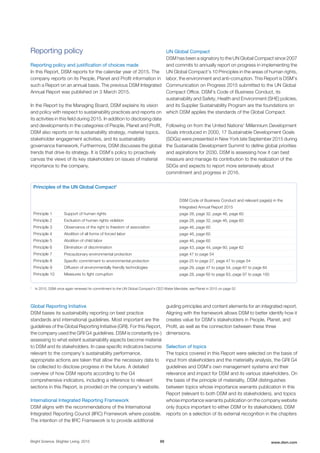
benefit can occur at any stage of the product life cycle.
People+ solutions, in short, create more value with a better social
impact. The qualification People+ is based upon the DSM People
Life Cycle Assessment (LCA) method. From 2016, DSM will refer
to its People+ solutions as Brighter Living Solutions. Brighter
Living Solutions are products and services that, when
considered over their whole life cycle, offer a clear environmental
benefit (ECO+) and/or a social benefit (People+).
People Life Cycle Assessment (People LCA)
The People LCA identifies the social impacts of products over its
life cycle on the dimensions of health, comfort and well-being,
working conditions and community development. The
methodology has been developed by DSM based on
international standards, extensive road testing and external
stakeholder dialogues. DSM takes an active approach to further
harmonize and standardize this metrics in the Roundtable for
Product Social Metrics and World Business Council for
Sustainable Development (WBCSD).
REC-rate DSM all
The REC-rate DSM all is the number of recordable injuries per
100 DSM employees and contractor employees in the past 12
months: REC-rate = 100 * (number of RECs (past 12 months) /
average effective manpower including contractor employees
(past 12 months)).
Safety, Health and Environment (SHE)
DSM’s policy is to maintain business activities and produce
products that do not adversely affect safety or health, and that
fit with the concept of sustainable development. The company
does this by setting the following objectives: to provide an injury-
free and incident-free workplace; to prevent all work-related
disabilities or health problems; to control and minimize the risks
associated with DSM's products for their whole life cycle and to
choose production processes and products such that the use
of raw materials and energy is minimized; to evaluate and
improve DSM's practices, processes and products continuously
in order to make them safe and acceptable to its employees, the
customers, the public and the environment.
United Nations Global Compact
A strategic policy initiative for businesses that are committed to
aligning their operations and strategies with 10 universally
accepted principles in the areas of human rights, labor,
environment and anti-corruption.
United Nations’ Universal Declaration of Human Rights
On 10 December 1948, the General Assembly of the United
Nations adopted and proclaimed the Universal Declaration of
Human Rights. Following this historic act, the Assembly called
upon all Member countries to publicize the text of the Declaration
and 'to cause it to be disseminated, displayed, read and
expounded principally in schools and other educational
institutions, without distinction based on the political status of
countries or territories'.
PLANET
Biofuel
A fuel which is derived from renewable organic resources, as
distinct from one which is derived from non-renewable resources
such as oil and natural gas.
Explanation of some concepts and
ratios
Bright Science. Brighter Living. 2015 209 www.dsm.com
Carbon footprint
The impact of a certain activity in terms of the emission of non-
renewable CO2 to the atmosphere.
Circular economy
Circular economy refers to an economy that is restorative and in
which materials flows are of two types: biological nutrients,
designed to re-enter the biosphere safely, and technical
nutrients, which are designed to circulate at high quality without
entering the biosphere throughout their entire lifecycle.
CO2
Carbon dioxide, a gas that naturally occurs in the atmosphere.
It is part of the natural carbon cycle through photosynthesis and
respiration. It is also generated as a by-product of combustion.
Carbon dioxide is a greenhouse gas.
Chemical Oxygen Demand (COD)
COD is an indicator of the degree of pollution of waste water by
organic substances.
ECO+
ECO+ is DSM’s program for the development of sustainable,
innovative products and solutions with environmental benefits.
Products qualify as ECO+ when their environmental impact is
lower than competing mainstream products that fulfill the same
function. When considered over their entire life cycle, ECO+
solutions offer superior performance with a lower eco-footprint.
The environmental benefits can be created at any stage of the
product life cycle, from the raw materials through to
manufacturing and potential re-use and end-of-life disposal.
ECO+ solutions, in short, create more value with the least
environmental impact. The qualification ECO+ is based upon
internal expert opinions where various impact categories are
evaluated. For a growing number of products these expert
opinions are supported by Life Cycle Assessments (LCA). As of
2016, the expert opinion process will be prescribed to harmonize
the processes for expert opinion and LCA-based ECO+
solutions. From 2016, DSM will refer to its ECO+ solutions as
Brighter Living Solutions. Brighter Living Solutions are products
and services that, when considered over their whole life cycle,
offer a clear environmental benefit (ECO+) and/or a social benefit
(People+).
Environmental Life Cycle Assessment (Eco LCA)
The Environmental Life Cycle Assessment (Eco LCA) identifies
the material, energy and waste flows associated with a product
or process over its entire life cycle to determine environmental
impacts and potential improvements; this full life cycle approach
is also referred to as ‘Cradle to Grave’. It is also possible to
assess a partial life cycle of a product or process with the most
common type being ‘Cradle to Gate’ which assesses the
environmental impacts of a manufacturing process without
accounting for use phase or end of life impacts. There are many
different environmental impact categories that can be assessed
using LCA; at DSM the standard approach is to evaluate the
carbon footprint and eco-footprint, published by the WBCSD
Chemical Sector in 2014.
Eco-efficiency
Eco-efficiency is a concept (created in 1992 by WBCSD) that
refers to the creation of more goods and services while using
less resources and creating less waste and pollution throughout
their entire life cycle. DSM applies the concept to its ECO+
program. In the context of DSM’s SHE targets, eco-efficiency
relates specifically to the reduction of emissions and energy and
water consumption, relative to the production volumes of DSM’s
plants.
Greenhouse-gas emissions (GHGE) reduction over volume-
related revenue (VRR)
The GHGE definition is according to the Kyoto Protocol and
includes carbon dioxide (CO2), methane, nitrous oxide (N2O),
sulfur hexafluoride, hydrofluorocarbons and perfluorocarbons.
VRR is net sales adjusted for changes in selling prices, exchange
rates and the impact of acquisitions and divestments. GHGE/
VRR is one of the ratios in the Long-Term Incentive part of the
Managing Board remuneration and relates to a three-year
period.
Greenhouse-gas emissions (GHGE) efficiency improvement
The GHGE efficiency improvement is the amount of GHG
emissions per unit of output (specific emissions) in a given year
compared to the specific emissions in the prior year. GHG
efficiency improvements are one of the ratios in the Long-Term
Incentive part of the Managing Board remuneration and relate to
a three-year period.
GRI
The Global Reporting Initiative (GRI) has developed Sustainability
Reporting Guidelines that strive to increase the transparency and
accountability of economic, environmental, and social
performance. The GRI was established in 1997 in partnership
with the United Nations’ Environment Programme. It is an
international, multi-stakeholder and independent institution
whose mission is to develop and disseminate globally applicable
Sustainability Reporting Guidelines. These Guidelines are for
voluntary use by organizations for reporting on the economic,
environmental, and social dimensions of their activities,
products, and services.
N
Nitrogen. A mostly inert gas constituting 78% of the earth’s
atmosphere, nitrogen is present in all living organisms.
N2O
Nitrous oxide. A gas that is formed during combustion. When
emitted to the environment, it contributes to global warming.
NOx
Nitrogen oxides. These gases are released mainly during
combustion and cause acidification.
Bright Science. Brighter Living. 2015 210 www.dsm.com
Renewable resources
A natural resource which is replenished by natural processes at
a rate comparable to, or faster than, its rate of consumption by
humans or other users. The term covers perpetual resources
such as solar radiation, tides, winds and hydroelectricity as well
as fuels derived from organic matter (bio-based fuels).
SO2
Sulfur dioxide. This gas is formed during the combustion of fossil
fuels and causes acidification.
VOC
Volatile organic compounds. The term covers a wide range of
chemical compounds, such as organic solvents, some of which
can be harmful.
PROFIT
General
In calculating financial profitability ratios, use is made of the
average of the opening and closing values of balance sheet items
in the year under review.
The financial indicators per ordinary share are calculated on the
basis of the average number of ordinary shares outstanding
(average daily number). In calculating Shareholders’ equity per
ordinary share, however, the number of shares outstanding at
year-end is used.
In calculating the figures per ordinary share and the ‘net profit as
a percentage of average Shareholders’ equity available to
holders of ordinary shares’, the amounts available to the holders
of cumulative preference shares are deducted from the profits
and from Shareholders’ equity.
Capital employed
The total of the carrying amount of intangible assets and
property, plant and equipment, inventories, trade receivables
and other receivables, less trade payables and other current
liabilities.
Capital expenditure
This includes all investments in intangible assets and property,
plant and equipment as well as the acquisition of subsidiaries
and associates and related cash flows.
Core earnings
Core earnings represent profit or loss from continuing operations
excluding exceptional items and excluding amortization of
intangible assets recognized from the application of purchase
accounting for business combinations.
Disposals
This includes the disposal of intangible assets and property,
plant and equipment as well as the disposal of participating
interests and other securities.
Earnings before interest, tax, depreciation and amortization
(EBITDA)
EBITDA is the sum total of operating profit plus depreciation and
amortization.
Earnings per ordinary share
Net profit attributable to equity holders of Koninklijke DSM N.V.
minus dividend on cumulative preference shares, divided by the
average number of ordinary shares outstanding.
Innovation sales
Innovation sales are defined as products and applications that
have been introduced over the last five years.
Operating working capital
The total of inventories and trade receivables, less trade
payables.
Organic sales growth
Organic sales growth is the total impact of volume and price/mix.
Return on capital employed (ROCE)
Operating profit as a percentage of weighted average capital
employed.
Total shareholder return (TSR)
Total shareholder return is capital gain plus dividend paid.
Bright Science. Brighter Living. 2015 211 www.dsm.com
ADR American Depositary Receipts
AFM Netherlands Authority for the Financial Markets
API Active Pharmaceutical Ingredients
BIO Biotechnology Industry Organization
BRIC High growth economies including Brazil, Russia, India and
China
CEFIC Conseil Européen des Fédérations de l'Industrie Chimique
(European Chemical Industry Council)
CGU Cash Generating Unit
COA Corporate Operational Audit department
COD Chemical Oxygen Demand
CRA Corporate Risk Assessment
CSR Corporate Social Responsibility
DNCC DSM Nanjing Chemical Co., Ltd.
DNP DSM Nutritional Products
DPP DSM Pharmaceutical Products
DSP DSM Sinochem Pharmaceuticals
EBA Emerging Business Area
EBIT Earnings before interest and taxes (Operating Profit)
EBITDA Earnings before interest, taxes, depreciation and amortization
EEI Energy Efficiency Improvement
FIFO First in, first out
FTE Full-time equivalent
GAIN Global Alliance for Improved Nutrition
GDP Gross Domestic Product
GHG Greenhouse gas
GHGE Greenhouse-gas emissions
GHS Globally Harmonized System
GMM Genetically Modified Microorganisms
GRI Global Reporting Initiative
IAS International Accounting Standards
IASB International Accounting Standards Board
IFRIC International Financial Reporting Interpretation Committee
IFRS International Financial Reporting Standards
ILO International Labour Organization
IP Intellectual Property
IUCN International Union for the Conservation of Nature
LCA Life Cycle Assessment
LTI Long-Term Incentive
LWC Lost Workday Case
NGO Non-Governmental Organization
NPS Net Promoter Score
OECD Organisation for Economic Co-operation and Development
PDN Stichting Pensioenfonds DSM Nederland
PPA Purchase Price Allocation
PSI Process Safety Incident
R&D Research & Development
REACH Registration, Evaluation, Authorization and Restriction of
Chemical substances
ROCE Return on Capital Employed
SAM Sustainable Asset Management
SAR Share Appreciation Rights
SHE Safety, Health and Environment
SSP Supplier Sustainability Program
STI Short-Term Incentive
TDC Total Direct Compensation
TSR Total Shareholder Return
VOC Volatile Organic Compound
VRR Volume-Related Revenue
WBCSD World Business Council for Sustainable Development
WEF World Economic Forum
WFP United Nations World Food Programme
List of abbreviations
Bright Science. Brighter Living. 2015 212 www.dsm.com
For the printing of this report 100% biological ink and FSC-paper was used.
This report is printed carbon neutral.
Questions about or feedback on this report can be addressed to:
Royal DSM
P.O. Box 6500
6401 JH Heerlen
The Netherlands
T	 +31 (0)45 578 8111
E	media.contacts@dsm.com
W	www.dsm.com

DSM Integrated Annual Report 2015

  • 1.
  • 3.
    Nutrition The Nutrition clustercomprises DSM Nutritional Products and DSM Food Specialties.These businesses serve the global industries for animal feed, food and beverage, pharmaceutical, infant nutrition, dietary supplements and personal care. DSM Nutritional Products is one of the world’s leading producers of essential nutrients such as vitamins, carotenoids, nutritional lipids and other ingredients to the feed, food, pharmaceutical and personal care industries. Among its customers are the world’s largest food and beverage companies. DSM is uniquely positioned thanks to the combination of its broad portfolio of active ingredients, maximum differentiation through formulation, local presence, a global premix network, and a strong focus on innovation. DSM Nutritional Products consists of the following business units: Animal Nutrition & Health addresses the nutritional additives segment of the global feed ingredients market. DSM is active in vitamins, feed enzymes, carotenoids, minerals and eubiotics. Human Nutrition & Health primarily addresses the nutritional ingredients markets, but is also active in coloration and preservation in the global food ingredients market. Personal Care focuses on active and performance ingredients such as vitamins, UV-filters and bio-actives for the skin care, sun care and hair care market segments. DSM Food Specialties is a leading global supplier of food enzymes, cultures, yeast extracts, savory flavors, hydrocolloids and other specialty ingredients for the food and beverage industries. DSM Food Specialties’ advanced ingredients make a considerable contribution to the success of the world’s favorite brands for the dairy, baking, beverages and savory segments. Performance Materials The Performance Materials cluster consists of DSM Engineering Plastics, DSM Dyneema and DSM Resins & Functional Materials. These business groups are active in technologically sophisticated high-quality products and offer specialized value propositions. In future this cluster will be referred to as Materials. DSM Engineering Plastics is a global player in developing, manufacturing and marketing specialty plastics used in components for the electrical and electronics, automotive, flexible food packaging and consumer goods industries. DSM Dyneema is the inventor, manufacturer and marketer of Dyneema®, the world’s strongest fiber™. This product, based on ultra high molecular weight polyethylene, is produced by means of DSM’s proprietary processes. The Dyneema® brand enjoys very high recognition in the value chains served. DSM Resins & Functional Materials is a global player in developing, manufacturing and marketing high-quality resins solutions for paints, industrial coatings and fiber-optic coatings. Continuous innovation means that customers can meet regulatory needs and respond better to consumer demands for more sustainable materials. Innovation Center DSM Innovation Center serves as an enabler and accelerator of innovation within DSM as well as providing support to the clusters. With its Emerging Business Areas, the Business Incubator and DSM Venturing & Licensing, the DSM Innovation Center has a general business development role, focusing on areas outside the current scope of the business groups. DSM’s Emerging Business Areas provide strong long-term growth platforms based on the company’s core competences in life sciences and materials sciences. The company has three Emerging Business Areas: DSM Biomedical supplies innovative biomedical materials that enable medical device manufacturers to make less-invasive devices. These can speed up recovery, shorten hospital stays and minimize reoperations, lowering health costs and helping people to lead longer, healthier and more active lives. DSM Bio-based Products & Services is at the forefront of building a more sustainable, bio-based economy with solutions for clean fuel from agricultural residue and for renewable chemical building blocks such as bio-based succinic acid. DSM Advanced Surfaces develops and provides solutions to increase the yield of solar materials – Same sun. More power™. Partnerships DSM Sinochem Pharmaceuticals (DSP), a 50-50 joint venture formed in 2011, is the global market leader in beta-lactam active pharmaceutical ingredients (APIs) such as semi-synthetic penicillins (SSPs) and semi-synthetic cephalosporins (SSCs), which represent the biggest class of APIs in anti-infectives. It is also a leader in other active ingredients such as nystatin and next generation statins. Patheon (formerly reported as DPx Holdings) is a global leader in contract development and manufacturing services established in 2014 and 49%-owned by DSM, with customers across the pharmaceutical industry. ChemicaInvest is a joint venture established in 2015 in which DSM has a 35% shareholding and comprises the former DSM Fibre Intermediates (caprolactam and acrylonitrile) and DSM Composite Resins businesses. DSM at a glance
  • 4.
    Driving Profitable Growththrough science-based, sustainable solutions Our purpose is to create brighter lives for people today and generations to come. We use our unique competences in health, nutrition and materials to create solutions that nourish, protect and improve performance. DSM uses its Bright Science to create Brighter Living for people today and generations to come. Based on a deep understanding of key global trends that are driving societies, markets and customers, DSM creates solutions to some of the world’s biggest challenges, thus adding to both its own and its customers’ success. DSM believes that its continued success will be driven by its ability to create shared value for all stakeholders, now and in the future. It creates sustainable shared value by innovating in ways that allow its customers to provide solutions to the challenges facing society, the environment and end-users. In this way, DSM’s customers derive value from being able to offer end-users improved products and services; society and the planet derive value from the impact of more sustainable, longer-lasting, safer, healthier and more nutritious alternatives; and, as a result, DSM and its shareholders derive value from stronger growth and profitability. Finally, DSM’s employees feel engaged and motivated both through the contribution they make to a better world and the success this creates for the company in which they work. More information on how DSM creates value for its stakeholders can be found on page 22. DSM – Bright Science. Brighter Living.™ Royal DSM is a global science-based company active in health, nutrition and materials. By connecting its unique competences in life sciences and materials sciences DSM is driving economic prosperity, environmental progress and social advances to create sustainable value for all stakeholders simultaneously. DSM delivers innovative solutions that nourish, protect and improve performance in global markets such as food and dietary supplements, personal care, feed, medical devices, automotive, paints, electrical and electronics, life protection, alternative energy and bio-based materials. DSM and its associated companies deliver annual net sales of about € 10 billion with approximately 25,000 employees. The company is listed on Euronext Amsterdam. More information can be found at www.dsm.com. © 2016 Royal DSM. All rights reserved. Bright Science. Brighter Living. 2015 www.dsm.com
  • 5.
    6 Key data 8Letter from the CEO 12 Report by the Managing Board 12 Strategy 2010-2015, DSM in motion: driving focused growth 17 Strategy 2018: Driving Profitable Growth 22 How DSM creates value for its stakeholders 24 Stakeholder engagement 39 People in 2015 47 Planet in 2015 55 Profit in 2015 60 DSM Code of Business Conduct 64 Review of business in 2015 66 Nutrition 74 Performance Materials 80 Innovation Center 85 Corporate Activities 86 Partnerships 88 Financial and reporting policy 88 Financial policy 89 Reporting policy 91 Corporate governance and risk management 91 Introduction 93 Dutch corporate governance code 93 Governance framework 96 Risk management 101 Statements of the Managing Board 102 Report by the Supervisory Board 102 Supervisory Board report 107 Remuneration policy for the Managing Board 114 Supervisory Board and Managing Board Royal DSM 116 What still went wrong in 2015 118 Information about the DSM share 122 Sustainability statements 124 Consolidated financial statements 124 Summary of significant accounting policies 130 Consolidated statements 137 Notes to the consolidated financial statements of Royal DSM 188 Parent company financial statements 189 Notes to the parent company financial statements 199 Other information 199 Independent auditor's report 203 Independent auditor's assurance report 204 Profit appropriation 205 Special statutory rights 205 Important dates 206 DSM figures: five-year summary 209 Explanation of some concepts and ratios 212 List of abbreviations Forward-looking statements This document may contain forward-looking statements with respect to DSM's future (financial) performance and position. Such statements are based on current expectations, estimates and projections of DSM and information currently available to the company. Examples of forward-looking statements include statements made or implied about the company’s strategy, estimates of sales growth, financial results, cost savings and future developments in its existing businesses as well as the impact of future acquisitions, and the company’s financial position. These statements can be management estimates based on information provided by specialized agencies or advisors. DSM cautions readers that such statements involve certain risks and uncertainties that are difficult to predict and therefore it should be understood that many factors can cause the company's actual performance and position to differ materially from these statements. These factors include, but are not limited to, macro-economic, market and business trends and conditions, (low-cost) competition, legal claims, the company's ability to protect intellectual property, changes in legislation, changes in exchange and interest rates, changes in tax rates, pension costs, raw material and energy prices, employee costs, the implementation of the company’s strategy, the company’s ability to identify and complete acquisitions and to successfully integrate acquired companies, the company’s ability to realize planned divestments, savings, restructuring or benefits, the company’s ability to identify, develop and successfully commercialize new products, markets or technologies, economic and/or political changes and other developments in countries and markets in which DSM operates. Additional factors that could cause results to differ materially from those described in the forward-looking statements can be found in the 'Risk Management' chapter. As a result, DSM’s actual future performance, position and/or financial results may differ materially from the plans, goals and expectations set forth in such forward- looking statements. DSM has no obligation to update the statements contained in this document, unless required by law. The English language version of this document is leading. Table of contents Bright Science. Brighter Living. 2015 5 www.dsm.com
  • 6.
    Key data Key data1 20152 2014 People Workforceat 31 December (headcount) 20,750 21,351 Female/male ratio 28/72 27/73 Total employee benefits costs (in € million) 1,778 1,713 Frequency Index of recordable injuries (per 100 DSM employees and contractor employees) 0.41 0.47 Employee engagement - favorable score (in %) 69 70 Planet Energy use (in petajoules) 20.9 39.1 Greenhouse-gas emissions in CO2-equivalents (x million tons) 1.1 4.2 Emission of volatile organic compounds (x 1000 tons) 3.1 4.2 COD (Chemical Oxygen Demand) discharges (x 1000 tons) 2.1 3.9 Water use (x million m3) 101 118 ECO+ solutions as % of innovation pipeline 91 95 ECO+ solutions as % of running business 57 49 Profit (in € million, unless otherwise indicated) Net sales, continuing operations 7,722 7,051 Operating profit plus depreciation and amortization, continuing operations (EBITDA)3 1,075 1,038 Operating profit, continuing operations (EBIT)3 573 587 Net profit attributable to equity holders of Koninklijke DSM N.V. 88 145 Cash provided by operating activities 696 808 Capital expenditure, cash based 536 628 Dividend for DSM shareholders 297 296 Net debt 2,321 2,420 Shareholders' equity 5,541 5,723 Total assets 11,743 12,126 Capital employed, continuing operations 7,553 7,431 Market capitalization at 31 December4 8,396 9,187 Per ordinary share in € Net earnings 0.45 0.78 Dividend 1.655 1.65 Ratios (%) Sales to high growth economies / net sales 44 42 Innovation sales / net sales 24 18 EBITDA / net sales (continuing operations) 13.9 14.7 Operating working capital / annualized fourth quarter net sales (continuing operations) 23.5 26.3 ROCE (continuing operations) 7.6 8.2 Gearing (net debt / equity plus net debt) 29.2 29.0 Equity / total assets 48.0 49.0 Cash provided by operating activities / EBITDA 59.5 69.3 1 For definitions see 'Explanation of some concepts and ratios' on page 209 2 Key data presented relate to total DSM (= continuing operations + discontinued operations), unless explicitly stated otherwise 3 Before exceptional items 4 Source: Bloomberg 5 Subject to approval by the Annual General Meeting of Shareholders Bright Science. Brighter Living. 2015 6 www.dsm.com
  • 7.
    Bright Science. BrighterLiving. 2015 7 www.dsm.com People Planet Net sales, continuing operations (x million) € 1,075€ 7,722 20,750 Workforce (at year-end 2015) EBITDA, continuing operations1 (x million) € 88 Net profit, total DSM (x million) € 468 Capital expenditure (cash based), continuing operations (x million) € 696 Cash provided by operating activities, total DSM (x million) € 0.45 Net earnings per ordinary share, total DSM1 € 1.65 Dividend per ordinary share2 7.6% ROCE, continuing operations (in %) Profit 2015 69 Employee engagement favorable score (in %) PlanetPl t P fit 1.1 Greenhouse-gas emissions, total DSM (in million tons) 101 Water use, total DSM (in million m3 ) 20.9 Energy use, total DSM (in petajoules) 108 Number of nationalities (at year-end 2015) 0.41 Frequency Index of recordable injuries (per 100 DSM employees and contractor employees) 24 Innovation sales as % of total sales of 57 ECO+ solutions as % of total sales 91 ECO+ solutions as % of innovation pipeline, total DSM 2014 1 Before exceptional items 2 Subject to approval by the Annual General Meeting of Shareholders
  • 8.
    Dear reader, Over recentyears we saw a multi-speed global economy, with marked differences in tempo across developing and already developed regions and markets, accompanied by currency volatility. In 2015, this picture shifted slightly; whilst the US economy remained dynamic and some key European economies made some – long anticipated – progress, the pace of growth however slowed in a number of emerging economies. The sudden and unexpected strengthening of the Swiss franc at the beginning of 2015 impacted cost positions for products produced in Switzerland, whereas the weakening of the euro against the US dollar improved the Eurozone’s competitive position. Several other currencies also made significant moves. Prices for oil and its derivatives remained under heavy pressure. The ongoing crisis in the Middle East led to heightened social and political tensions. This fractured and uncertain picture requires companies to be increasingly agile, with the capability to identify and act on relevant developments at an early stage. Last year was the final year of the implementation of our strategy for the 2010-2015 period, DSM in motion: driving focused growth. By consistently focusing on our four growth drivers (High Growth Economies, Innovation, Sustainability and Acquisitions & Partnerships) we have transformed DSM into a more global, more innovative and more sustainable company with a streamlined, simplified and high-value portfolio of businesses. We have built a uniquely broad, customer-focused and global Nutrition business, upgraded our Performance Materials businesses, significantly increased the share of sustainable and innovative solutions as a proportion of our sales and established new growth platforms with our Emerging Business Areas. With the long-term megatrends that drive our company’s business – Global Shifts and Digitization, Climate and Energy, and Health and Wellness – continuing to increase in significance, DSM is uniquely positioned to create value through science- based sustainable solutions in health, nutrition and materials to help address the challenges our societies are facing. During 2015, we took a further significant step in our strategic transformation to a more resilient and focused portfolio with the creation of the ChemicaInvest partnership with CVC Capital Partners for the Polymer Intermediates and Composite Resins businesses in which DSM holds a 35% share. This follows on the divestment of the Base Chemicals businesses in 2010 and 2011 and the establishment of partnerships for the Pharma activities in 2011 and 2014. Together with the value-contributing acquisitions we have made to strengthen our businesses during the strategy period, we are confident that DSM’s portfolio represents a good platform for profitable growth. We are focused on translating the potential that has been created into improved financial performance. Much of our work in 2015 was on optimizing our operational performance and ensuring that in the coming strategic period we are in position to capture the full business benefits our strengthened portfolio offers. In August, we announced the adjustment of our organizational and operating model, with the aim of creating a more agile, focused and cost-efficient organization, with a stronger business and market focus and globally leveraged support functions. This included the introduction of an Executive Committee to strengthen our management structure and enable faster strategic alignment and operational execution in the day- to-day running of our company. Creating a more agile, focused and cost-efficient organization is expected to result in structural savings of € 125-150 million compared to 2014, to be fully achieved by the end of 2017. These initiatives will result in a headcount reduction of 900-1,100 FTEs, of which approximately half in the Netherlands. Decisions affecting personnel are regrettable at all times and are only taken in the best interests of the company as a whole. We strive to provide all those concerned with an appropriate level of support and assistance in finding a new position. Besides this DSM-wide adjustment, a specific program to improve operational performance in the Nutrition cluster has also been announced, focused on productivity, growth and working capital reduction, which target a further € 130-150 million in cost savings by 2018 and drive increasing growth in our Human Nutrition & Health business. Whilst the Performance Materials cluster is already benefiting from the results of a similar program carried out in recent years, we will continue to identify and act on opportunities to implement further improvements in this cluster in the coming period. At our annual Capital Markets Day in November, we presented our company Strategy 2018: Driving Profitable Growth. With this new strategy we aim to capture the full potential of the portfolio we have created and translate this into improved financial results, focusing on organic sales growth, reducing costs and strict capital allocation. The Nutrition and Performance Materials businesses offer great potential for growth through sustainable innovative solutions, benefiting from opportunities the global megatrends offer. They have clear business strategies in place to drive sales and out- grow their markets. We are executing cost-reduction and efficiency programs with targeted overall savings of € 250-300 million in EBITDA by the end of 2018 and we have adjusted our top structure, organizational model and way of working to support the achievement of our newly-set targets. We have elected to set financial targets for a shorter strategic period up to 2018, reflecting our discipline and focus. We target a high single-digit annual percentage increase in EBITDA and a high double-digit annual basis point increase in Return on Capital Employed (ROCE). We have furthermore sharpened our sustainability approach and set more ambitious targets for our environmental performance. These include further improved greenhouse-gas efficiency (at least 45% improvement by 2025 versus 20% achieved so far), Letter from the CEO Bright Science. Brighter Living. 2015 8 www.dsm.com
  • 9.
    increased energy efficiency(over 10% improvement in the next 10 years) and a big step-up in the use of renewable electricity (50% by 2025), as well as continuing to drive the proportion of ECO+ and People+ solutions we provide to our customers. Moreover, we have key innovation projects in place to drive earnings growth beyond 2018. We expect to extract significant value from the Pharma and Bulk Chemicals partnerships in the coming years, providing further financial headroom. We do not expect to engage in large acquisitions in the near future as we continue to integrate recent acquisitions, which have made a strong contribution to earnings. DSM achieved solid financial results in 2015, broadly in line with our expectations for the year. We delivered net sales of € 7.7 billion and an EBITDA (before exceptional items) of € 1,075 million. Whilst currency developments showed a mixed picture, they had an overall positive effect on our results. Organic sales growth for the year was 1%, with 3% growth in volumes and a 2% decline in price-mix as a result of lower raw material prices. Our focus on emerging economies has taken the proportion of total sales generated in these countries to 44% at the end of 2015, up from 32% in 2010. The pace of growth slowed in a number of these economies in the year. The largest, the Chinese economy, continues to grow, if at lower absolute rates than in recent years. The fundamentals driving end-use markets relevant to DSM in China remain unchanged. In 2015, higher- margin innovation sales increased to 24% of total sales, fulfilling the strategic aspiration we set in 2010, when they made up 12% of sales. Innovation is also linked with our sustainability efforts. Our ECO+ solutions, which offer customers more value with less environmental impact than mainstream alternatives, now account for 57% of sales, ahead of the targets we set ourselves five years ago, when the proportion was 34%. We apply similar lifecycle assessments to the impact products have on peoples’ lives with the People+ methodology we have developed, and use these insights in steering product innovation. In Nutrition, we have built a unique, global and broad as well as customer-focused portfolio in nutritional ingredients and have increased our capability to offer full nutritional solutions, extending DSM’s offering over the value chain. This resilience proved its worth for the cluster as headwinds that we had previously signaled indeed materialized in 2015, in particular price pressure in vitamin E, mainly in our animal nutrition business, and the unfavorable development of the Swiss franc, which considerably reduced the overall positive effect from the strengthening of the US dollar. Despite these headwinds, Animal Nutrition & Health had a very good year. Human Nutrition & Health, which continued to be confronted with ongoing weakness in the North American markets for dietary supplements and omega-3, did not perform as well as we would have liked. We have taken action to get back on the front foot and started to see the benefit of this in the second half of the year. In 2015, organic sales growth for the cluster was strong at 6% and the EBITDA margin was lower at 16.6%, mainly caused by the appreciation of the Swiss franc and lower vitamin E pricing. EBITDA for Nutrition amounted to € 822 million in 2015, down 3% on the previous year for the same reasons. In Performance Materials, we pursue a differentiated approach to our businesses and their segments, and have created a high- quality portfolio with a higher growth and returns profile. We tailor the approach our businesses take depending on the dynamics and potential of the market and segment in question, focusing on maximized returns, growth or accelerated growth accordingly. During 2015, the cluster continued to upgrade its product portfolio towards innovative, more sustainable and higher-margin solutions. Whilst organic growth for the cluster was down as a consequence of lower input prices on steady volumes, there was a step-up in both EBITDA (at € 384 million a 19% increase) and in the EBITDA margin, which was 15.2%, above the targets we had set. Our Emerging Business Areas are promising platforms for growth outside the current scope of the business groups. The largest, DSM Biomedical, continued its development over the year and made a positive contribution to our EBITDA. In DSM Bio-based Products & Services, the start-up process for the Project LIBERTY facility to produce advanced cellulosic ethanol from crop residues, which we officially opened in the US in 2014 together with our partner POET, is progressing, although there are still some hurdles to overcome. DSM Advanced Surfaces provides solutions to boost the power solar panels produce and continued to strengthen its position in this market. When taken together, they already make a positive contribution to EBITDA, reducing the overall costs of the DSM Innovation Center. Although business conditions in Bulk Chemicals remained tough, steps have been taken to improve the competitiveness of the ChemicaInvest businesses together with CVC. Following the creation of the Pharma partnerships and therewith the completion of DSM’s Pharma strategy, Stefan Doboczky left the company at the beginning of June. We would like to thank him for his contribution to DSM and wish him every success as CEO of Lenzing Group. Bright Science. Brighter Living. 2015 9 www.dsm.com
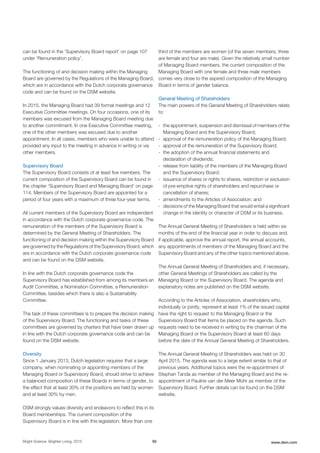
  • 10.
    Safety and Healthis of paramount importance to all of us at DSM and we have set ourselves the ambition of having an injury and incident-free working environment. While we made progress in improving occupational safety in 2015, with a reduction in the Frequency Index of Recordable Injuries from 0.47 in 2014 to 0.41 last year, more incidents still occur than we would like, regrettably. Our focus on safety is unwavering and we strive to bring this number down further. For more information on these and other incidents, see ‘What still went wrong’ on page 116. Successfully assimilating a high-performance culture will be crucial to realizing the full potential of our new operating model and our portfolio and to achieving our targets. During the year, we continued to implement the ONE DSM Culture Agenda in conjunction with our Leadership Model. We look to achieve a representative balance in gender and also in nationality in DSM’s leadership group, in line with the geographical distribution of our business. The number of women in executive positions showed a pleasing development, up three percentage points to 15% at the end of the year, with a significant increase in representation at all top levels across the organization. We did not make the same level of progress in increasing the proportion of non- European executives, however, and this has our attention. Overall, the company-wide Inclusion Index increased from 70% to 72% at the end of the year, reflecting our efforts in this regard. We held an Employee Engagement Pulse Survey last year, which 78% of the employees completed. The overall Employee Engagement Index was 69% in 2015, down very slightly from 70% a year earlier. This is understandable given that the survey was held after the announcement of the organizational adjustments and before the presentation of our updated strategy. Our resolve to see this rating improve is undiminished. It was a significant year for the worldwide societal and sustainability agenda. The UN General Assembly agreed upon 17 Global Goals to be achieved by 2030 (the so-called Sustainable Development Goals), including eradicating hunger and addressing climate change. Leaders from government, civil society and business also came together at the COP21 summit in Paris. Although there is still much to be gained, the agreements and measures to tackle climate change on a global level established there were unprecedented. The sense of urgency to develop and implement newer, more sustainable and impactful solutions at scale has never been more manifest. There is a crucial – and rewarding – contribution for businesses to make in helping to achieve this, which we at DSM champion. In December, we signed an extension to our strategic partnership with the United Nations’ World Food Programme (WFP) for another three years. It is a humbling and at the same time empowering feeling to realize that through this partnership, DSM now reaches over 25 million WFP beneficiaries annually with improved nutrition. DSM was also invited by the Government of Rwanda to participate in the Africa Improved Foods Ltd. joint venture to improve the nutritional status of the country’s population and help address malnutrition. We are pleased to report that we made further progress in our efforts to reduce the company's environmental footprint, among other things by improving our energy efficiency and greenhouse- gas efficiency by around 20%, as well as by reducing our absolute greenhouse-gas emissions (down by 75% versus 2008, with a big impact from the (partial) divestment of Polymer Intermediates). The new, sharpened targets we have set for the coming period will build on these achievements and continue to stretch the organization. We are proud to once again be named among the leaders in the Dow Jones Sustainability World Index. We also take pride in the external recognition, including awards, that our achievements in our integrated sustainability approach continue to receive. Our integrated reporting continues to develop; besides implementing G4, the fourth generation of sustainability reporting guidelines from the Global Reporting Initiative, this report also follows the <Integrated Reporting> framework of the International Integrated Reporting Council. We remain committed to aligning our strategy and operations with the principles of the United Nations Global Compact, as well as contributing to the realization of the Global Goals for Sustainable Development through our businesses and competences. We have many reasons to be confident about our future at DSM thanks above all to the tremendous efforts of many people; our employees, customers, shareholders, and suppliers and other partners, as well as civil society and the communities we engage with. We extend our most sincere thanks and appreciation to all those who have contributed to DSM’s success. At the start of an exciting and inspiring new period for DSM, we can be very proud that together we have made DSM a global company with a portfolio of high-quality businesses, well- positioned for growth. We apply our sustainable innovation to continually develop and bring to market improved products and solutions in health, nutrition and materials. Our focus for the coming period is on improving financial returns while building for further growth in the future. Our ability to leverage unique opportunities in our businesses for the benefit of People, Planet and Profit enables us to deliver on our mission of creating brighter lives for people today and for generations to come. Feike Sijbesma CEO/Chairman Managing Board Royal DSM Bright Science. Brighter Living. 2015 10 www.dsm.com
  • 11.
    Bright Science. BrighterLiving. 2015 11 www.dsm.com The year 2015 may one day be regarded as a pivotal year in human history. The Sustainable Development Goals and the climate deal struck at COP21 in Paris make clear that humanity really means business with the global agenda. It is also clear that businesses have a crucial role to play in creating the impact needed at scale to tackle these challenges. Companies have unrivalled skills and competences to address the challenges and at the same time open and develop profitable markets for their products and solutions. The Global Agenda Means Business Effectively tackling climate change whilst at the same time achieving energy security for the world’s population will require a global transition to the low-carbon economy; steps need to be taken urgently to meet the goals agreed at COP21 in Paris. This is accelerating the adoption of renewable energy sources and the use of chemicals and materials that are more sustainable in the transition from the fossil age to the (bio-) renewable age, as well as increasing attention for the circular economy concept. This presents opportunities for companies like DSM who have the ingenuity and ability to develop and deliver innovative solutions. DSM’s businesses include activities in bioplastics, biofuels, light-weight materials and solar coatings as well as ‘circular’ technologies such as those for reusable Niaga® carpets. Low-carbon economy Worldwide, two billion people are malnourished, half of whom go to bed hungry every day. While hunger predominantly affects people in the South and East, people the world over are affected by micronutrient deficiencies. This is due to factors including the lack of nutrient-rich options available, people’s inability to access these options or their lack of popular appeal. DSM helps the food industry create products that are not only available and affordable but nutritious as well – and within the reach of increasing numbers of people around the globe. An example is the joint venture DSM established with SOBISCO in 2015 to produce and market fortified snacks in India. DSM furthermore partners with the UN World Food Programme and several other development agencies to reach those in direst need of nutrition interventions, as well as participating in many initiatives, including its own, to combat micronutrient deficiency around the world. Malnutrition and deficienciesThe key is to collaborate across value chains and with governments, NGOs and civil society to focus these skills on sustainable solutions and thus really drive the development of effective, rewarding and intrinsically sustainable markets. Over many years, DSM has consistently made sustainability a real business driver, developing solutions, building partnerships and increasing its impact in key areas. The global agenda also means business for DSM.
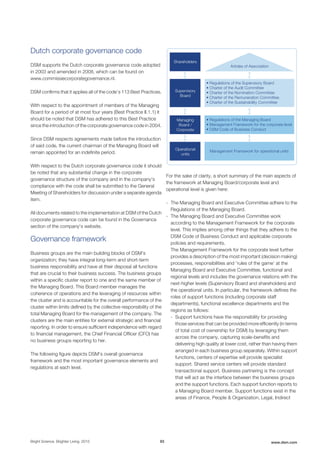
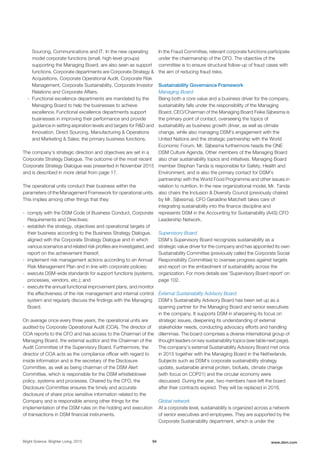
  • 12.
    Strategy 2010-2015, DSMin motion: driving focused growth Last year was the fifth and final year of the strategy DSM in motion: driving focused growth, which the company launched in 2010 to become a global leader in health, nutrition and materials. This strategy has provided DSM with the framework to drive sustainable and profitable growth in the company’s core activities. In 2015, DSM’s focus was on improving the operational performance of its Nutrition and Performance Materials businesses, while pursuing strategic actions for Polymer Intermediates and Composite Resins. These were delivered in March with the establishment of the ChemicaInvest partnership with CVC Capital Partners. In August, the company announced adjustments to its organizational and operating model to support its growth, creating a more agile, focused and cost-efficient organization. The final major development of the year was announced in November, when DSM presented its Strategy 2018: Driving Profitable Growth at its Capital Markets Day, details of which are given on page 17. Results 2015 Financial results DSM delivered solid results in 2015, posting net sales of € 7,722 million, up 10% on 2014 (€ 7,051 million). Overall organic sales growth for the year amounted to 1%, as a 3% increase in volumes, with strong growth in Nutrition, was largely off-set by 2% lower price/mix, due to lower input prices being partially passed on down the value chain in Performance Materials. Exchange rate fluctuations had a positive impact of 8%, while other effects such as acquisitions contributed 1%. EBITDA, operating profit from continuing operations before depreciation and amortization (before exceptional items), grew by 4% or € 37 million, from € 1,038 million in 2014 to € 1,075 million in 2015. Nutrition EBITDA declined by 3% as good organic growth and the positive impact of the strengthened US dollar were more than offset by the negative impact of significantly lower vitamin E prices, the appreciation of the Swiss franc and the weakening of the Brazilian real. Cost savings and good margin management as well as support from lower input prices and currency effects led to a strong increase in EBITDA for Performance Materials of 19%. DSM's overall EBITDA margin (operating profit before depreciation and amortization as a percentage of net sales) was 13.9% (2014: 14.7%). In 2015, Return on Capital Employed (ROCE) was 7.6% compared to 8.2% in 2014. Sales in emerging economies amounted to 44% of total sales in 2015, up from 43% in 2014. Innovation sales, defined as sales from products and solutions introduced within the last five years, made up 24% of total sales in 2015 (2014: 18%). DSM’s Emerging Business Areas (EBAs) DSM Biomedical, DSM Bio-based Products & Services and DSM Advanced Surfaces continued to make steady progress during the year. Collectively they made a positive EBITDA contribution, reducing the overall costs of the DSM Innovation Center. Financial targets and aspirations as updated in 2013 Realization 2015 Profitability targets 2015 - EBITDA margin 14%-15% 13.9% - ROCE 11%-12% 7.6% Sales targets 2015 - Organic sales growth 5%-7% annually 1% - China sales towards USD 3 bn1 USD ~1 bn - High growth economies sales about 45% of total sales 44% - Innovation sales 20% of total sales 24% - ECO+ sales towards 50% of total sales 57% Cluster targets 2015 - Nutrition EBITDA margin 20%-23% Organic sales growth GDP +2% 16.6% 6% - Performance Materials EBITDA margin 13%-15% Organic sales growth at double GDP 15.2% -4% Aspiration regarding Emerging Business Areas for 2020 - EBA sales > € 1 bn € 155 m 1 The China sales target was set in 2010 and included the contributions of the Pharma, Base and Bulk Chemicals activities, which have since been (partially) divested Report by the Managing Board Bright Science. Brighter Living. 2015 12 www.dsm.com
  • 13.
    The DSM ManagingBoard (from left to right): Dimitri de Vreeze, Feike Sijbesma (CEO/Chairman), Geraldine Matchett (CFO) and Stephan Tanda Sustainability results Sustainability is DSM's core value as well as a business driver and enables the company to provide higher-margin products and solutions. DSM has successfully implemented its sustainability program and ECO+ solutions now make up 57% of DSM’s total sales, exceeding the aspiration of towards 50%. ECO+ solutions also accounted for 91% of DSM’s innovation pipeline in 2015, which exceeded the company’s target of 80%. DSM made further progress with its People+ strategy, which aims to deliver products that have a measurable positive impact on people's lives. Going forward, DSM will refer to its ECO+ and People+ solutions collectively as Brighter Living Solutions. DSM again featured among the chemical industry leaders in the Dow Jones Sustainability World Index in 2015. DSM improved its ranking and has returned to RobecoSAM Gold Class status for 2016. DSM’s Employee Engagement Survey determines levels of engagement, measuring how employees score in terms of commitment, pride, advocacy and satisfaction expressed as an index. It is now carried out on a two-year cycle with a shorter Pulse survey held in the intervening year, which is what DSM held in 2015. This showed an Employee Engagement Index of 69% (2014: 70%), which is broadly in line with the global standard of 70%. For further details on the outcome of this survey and other people-related aspirations, see chapter 'People' on page 39. Sustainability aspirations 2011-2015 Realization 2015 Dow Jones Sustainability Index Top ranking (RobecoSAM Gold Class) Silver Class1 ECO+ (innovation) At least 80% of pipeline is ECO+2 91% ECO+ (running business) From approximately 34% towards 50% 57% Energy efficiency 20% improvement in 2020, compared to 2008 19% Greenhouse-gas emissions 25% reduction (absolute) by 2020, compared to 2008 75% reduction3 Employee Engagement Survey Towards High Performance Norm4 69% favorable Diversity5 Women in executive positions 15% Under-represented nationalities in executive positions 49% People+5 DSM People LCA Achieved 1 DSM has returned to Gold Class for 2016 2 See page 210 for a definition of ECO+ 3 Reduction of total emissions (absolute) of 75% was mainly attributable to the deconsolidation of DSM Fibre Intermediates; the GHG efficiency, which accounts for changes in production volume, has improved by 20% in 2015 compared to 2008 4 The High Performance Norm (over 80% favorable) is the composite of the top 25% employee responses of the selected external benchmark organizations 5 See 'People+' and 'Inclusion & Diversity' in the chapter 'People' in 2015 on page 39 and page 210 for a definition of People+ Bright Science. Brighter Living. 2015 13 www.dsm.com
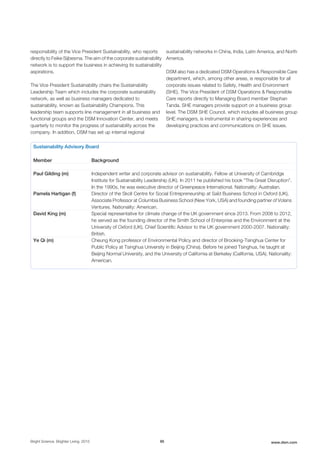
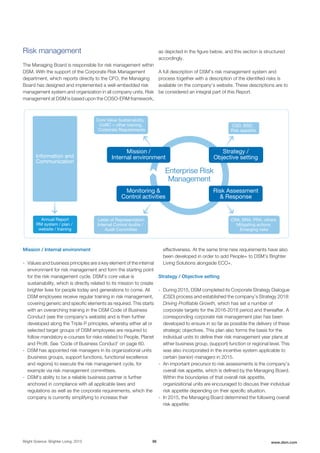
  • 14.
    Growth Drivers Over thelast five years, DSM has utilized the strategic growth drivers High Growth Economies, Innovation, Sustainability and Acquisitions & Partnerships to leverage its unique position and capitalize on the business opportunities created by key global megatrends. In doing so, DSM has successfully increased its global presence, became more innovative and more sustainable, and built a streamlined and simplified portfolio of high-value businesses. High Growth Economies One of the key elements of the company strategy has been the successful expansion of DSM’s global presence to be better placed to capture opportunities arising from the megatrends in economies such as Brazil, Russia, India and China as well as in more mature economies of the West. The share of sales in these economies as a proportion of DSM’s total sales has increased significantly, giving the company a well-balanced global footprint. In 2015, sales to emerging economies accounted for 44% of total sales. In 2010, this was 32%. In China, domestic consumption is playing an increasingly important role in re-balancing the economy to the so-called 'New Normal'. During the year, there was a change in the pace of economic growth in the country, in particular in the second half of the year. Overcapacity, low global commodity prices and weak demand impacted industrial production. However, the fundamental drivers resulting from the megatrends remain as valid as ever. In terms of DSM's end-user segments, this could be seen in a noticeable slowdown in automotive and construction-related industries, whilst the service sector and food industry segments developed well. DSM's sales in China for its continuing operations came to € 937 million in 2015, up 12% from € 833 million in 2014. During the year DSM finalized the acquisition of vitamin C producer Aland and began the expansion of a site in Tongxiang with the aim of establishing a world-class development center for hydrocolloids including gellan gum. DSM’s business in India showed double-digit growth. DSM focuses in particular on locally made products for markets in the country, for example partnering with SOBISCO in the year to produce and market fortified biscuits and snacks. Growth in Latin America was 11% in 2015, despite a very challenging overall economic picture in the region that has impacted consumption in various markets. DSM has established a robust platform in particular for its Animal Nutrition & Health business in the region and will leverage this as it expands the animal health capabilities it acquired with Tortuga outside Brazil. Sales in Russia remained on par with 2014, despite the severe recession in the country, supported by particularly strong performance in Animal Nutrition & Health, which also performed well in DSM’s other key markets in the region. With their rapidly expanding urban populations and burgeoning middle classes, it is clear that emerging economies will remain important growth engines for the world economy in the future. Moreover, increasing attention for environmental concerns and related legislation to tackle them presents further opportunities. Over recent years it has become evident that rates of economic growth in these economies are both divergent and changeable. In future, DSM will refer to the economies themselves by the commonly-used term ‘emerging economies’ rather than ‘high growth economies’. The capitalized term High Growth Economies relates specifically to DSM’s strategic growth driver. Net sales by destination, continuing operations  in %  ■Netherlands ■Rest of Western Europe ■Eastern Europe ■North America ■Latin America ■China ■India ■Japan ■Rest of Asia ■Rest of the world 4 24 6 23 14 12 2 3 9 3 2015 4 26 6 22 13 12 2 3 9 3 2014 Innovation DSM in motion: driving focused growth targeted an increase in the proportion of sales coming from innovative products and solutions from 16% in 2010 to 20% by 2015 (see page 209 for the definition of innovation sales). At the end of 2015, these products accounted for 24% of total sales. This was up from 18% in 2014, with the increase driven by both higher sales as well as by the deconsolidation of DSM Fibre Intermediates and DSM Composite Resins and their inherently more traditional portfolio in the year. In Nutrition this was 21% and in Performance Materials 29%. Innovation sales  as % of total sales  0 5 10 15 20 18 2011 18 2012 17 2013 18 2014 24 2015 Bright Science. Brighter Living. 2015 14 www.dsm.com
  • 15.
    Innovation sales playan important role in driving both top-line and bottom-line growth. Besides providing benefits to customers and end-users in terms of new or improved functionality, they also deliver margins that are on average higher than in the running business. DSM looks to foster and sustain its innovation practices on an ongoing basis. The DSM Innovation Center supports innovation by offering functional excellence to the company’s established Nutrition and Performance Materials businesses, as well as through venturing and its business incubator. At the same time it focuses on developing and extracting value from new growth platforms outside the current scope of DSM’s business groups with its EBAs, which currently comprise DSM Biomedical, DSM Bio-based Products & Services and DSM Advanced Surfaces. DSM has established best practices in innovation and manages its major innovation activities at a platform level within selected areas, including Food and Nutrition Security, Health, Sustainable Manufacturing and Energy Security. This platform-based approach to innovation under the direction of the Chief Technology Officer aims to develop larger initiatives and enables the company to increase the focus of its efforts and improve coordination. This structure provides the basis for an effective management of company-wide competence-building programs in Research & Development (R&D). R&D is instrumental to the realization of DSM’s innovation strategy, and most of the expenditure in this area is directed toward business-focused programs. R&D expenditure (including associated IP expenditure), continuing operations x € million 2015 2014 Nutrition 223 206 Performance Materials 143 135 Innovation Center 82 82 Corporate Activities 16 28 Total 464 451 Total as % of net sales 6.0 6.4 Staff employed in R&D activities 2,036 2,089 The more than 2,000 internal scientists in DSM’s science network are spread around the world. They cooperate extensively with external R&D institutions. Academic collaboration efforts are normally specific and bilateral, while DSM is also active in broader public-private partnerships that increase its scientific scope, such as the Bio-based Industries Consortium. A crucial element of DSM’s approach and an important business enabler is Open innovation. By combining its own capabilities with the vast pool of ideas, know-how and expertise that are available outside the company, DSM is better able to develop and discover solutions. DSM collaborated in a number of R&D and innovation partnerships in 2015. For further details see 'Stakeholder engagement' on page 24 and 'Review of business – Innovation Center' on page 81. Sustainability In the realization of its 2010-2015 strategy DSM in motion: driving focused growth, the company continued to fulfill its responsibilities towards society while simultaneously developing sustainability into a strategic and successful growth driver. For DSM this means pursuing activities that create shared value for all DSM’s stakeholders in the areas of People, Planet and Profit. Sustainability is a key differentiator and a driver of value in DSM's markets. Using its strong science competences, the company aims to deliver profitable products and solutions that have a positive impact on society. DSM does this by embedding sustainability practices across the company. Sustainability plays a central role in innovation, new product and business development, operations and strategic decisions. By continuously developing innovative science-based products and solutions that contribute to a brighter future, DSM is also creating a more sustainable and profitable future for itself. ECO+ ECO+ is DSM’s program for the development of sustainable, innovative products and solutions with environmental benefits. Products qualify as ECO+ when their environmental impact is lower than competing mainstream products that fulfill the same function. When considered over their entire life cycle, ECO+ solutions offer superior performance with a lower eco-footprint. The environmental benefits can be created at any stage of the product life cycle, from the raw materials through to manufacturing and potential re-use and end-of-life disposal. DSM uses comparative Life Cycle Assessments (LCAs) and/or expert opinions to determine whether a solution should be considered ECO+. For more information about the ECO+ program, see 'Planet' on page 53. People+ People+ is DSM’s program to develop solutions that measurably improve the lives of consumers, employees and communities across the value chains, better than competing alternatives in the market. People+, together with ECO+, makes DSM’s ‘Bright Science, Brighter Living™’ mission more tangible. Applying and road-testing harmonized joint standards for product social metrics across all DSM business groups and regions has laid the foundations for DSM to also set targets for People+ products within its Brighter Living Solutions for the coming period. For more information about the People+ program, see 'People' on page 46. Bright Science. Brighter Living. 2015 15 www.dsm.com
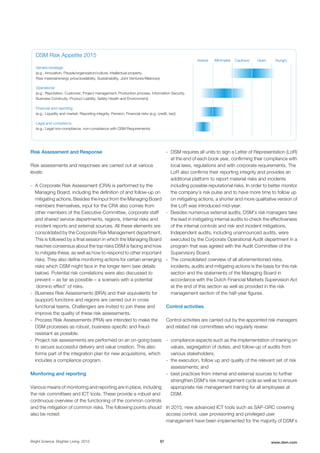
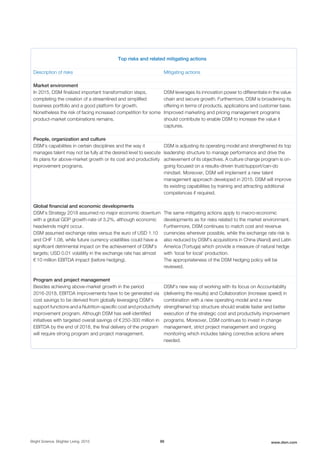
  • 16.
    Acquisitions & Partnerships Duringthe 2010-2015 strategy period for DSM in Motion: driving focused growth, acquisitions have been a key vehicle for DSM to add new growth platforms, especially in emerging economies and in North America. The company also established a number of value-enhancing partnerships in this time, most notably for the Pharma activities in 2011 (DSP) and 2014 (Patheon), details of which can found in 'Review of business – Partnerships' on page 86. The four most significant acquisitions during the period, which are all in the Nutrition cluster, have strengthened DSM’s portfolio, boosted growth and already made strong contributions to earnings, with further potential for the future. Collectively, the Martek (2010), Ocean Nutrition Canada (2012), Tortuga (2012) and Fortitech (2012) businesses added € 210 million in EBITDA at the time of acquisition. DSM has since successfully grown this contribution by 11% per year and in 2015 these acquisitions delivered a total of over € 300 million in EBITDA. The profitability of Ocean Nutrition Canada has however declined somewhat over the period, impacted by a sharp increase in the price of fish oil and weakness in the US market for fish oil-based omega-3 dietary supplements. Acquisitions & Partnerships in 2015 In 2015, DSM engaged in partnerships that serve clear strategic and financial objectives. These business partnerships sometimes involve long-term supply agreements and are material to DSM's business performance. The most significant partnership of 2015 was entered into in March, when DSM and CVC Capital Partners announced the establishment of a partnership comprising the DSM Fibre Intermediates and DSM Composite Resins businesses. The formation of ChemicaInvest, in which DSM has a 35% shareholding, was finalized at the end of July. The transaction delivered on the strategic actions DSM said it would pursue for the businesses in order to simplify its portfolio and reduce cyclicality in the Performance Materials cluster, whilst effectively maintaining DSM Engineering Plastics’ backward integration through a long-term purchasing agreement. See also 'Review of business – Partnerships' on page 86. DSM entered into or completed a number of other business- related acquisitions and partnerships during the year, details of which can be found in 'Review of business – Nutrition' on page 67, 'Review of business – Performance Materials' on page 75 and 'Review of business – Innovation Center' on page 81. In the summer of 2015, Patheon filed a registration statement (Form S-1) with the US Securities and Exchange Commission (SEC), preparing itself for a public offering. To date, neither the timing of such a public offering, nor the number of shares, nor the price have been confirmed. Bright Science. Brighter Living. 2015 16 www.dsm.com
  • 17.
    Strategy 2018: DrivingProfitable Growth Today, DSM is a more global, innovative and sustainable company than at any time in its history, with a portfolio of businesses that are well positioned to fulfill their growth potential. Over the next three years, DSM’s Strategy 2018: Driving Profitable Growth will focus on capturing the full potential of its portfolio by improving the company’s financial results through organic sales growth, reducing costs, increasing productivity and strict allocation of capital. DSM aims to step-up its financial results at the same time as pursuing its ambitions in sustainability and its beneficial impact on people’s lives, creating value in terms of People, Planet and Profit. Health & Wellness Climate & Energy Global shifts & Digitization Improving financial results 2018 Targets Annual EBITDA growth: high single-digit – Annual ROCE growth: high double-digit bps Health. Nutrition. Materials. Result-driven organization & culture Bright sciences Innovation Sustainability High Growth Economies Acquisitions & Partnership s Strategy 2018: Driving Profitable Growth through science-based, sustainable solutions Capital Efficiency Growth Cost & Productivity A number of fundamental global societal trends are affecting economies, people and markets across the world. The major driver behind these global trends is demographic change. The world population continues to grow towards an estimated nine billion in 2050. People are living longer and in the main becoming increasingly wealthy and urbanized. These trends will further increase the pressure on the planet’s resources and on the food chain, while also stimulating new patterns of consumption and impacting the environment. DSM addresses three key societal megatrends through its strategy and solutions, and therefore benefits from the increased attention they receive on a global scale. These are categorized as: Global Shifts and Digitization; Climate and Energy; and Health and Wellness (see next page). By focusing its unique capabilities in health, nutrition and materials on the opportunities the megatrends present, DSM is better able to support its customers in developing science-based, sustainable solutions that meet current and future needs and profitably grow its business. DSM’s Strategy 2018: Driving Profitable Growth builds on the achievements of the previous strategic period. It recognizes that, following a period of important portfolio transformation, the company will focus on ensuring that the potential of the current business portfolio translates into improved financial results. Consequently, DSM does not expect to engage in large acquisitions in the near future and this focus is reflected in a shorter, three-year, strategic period with two headline financial targets: high single-digit annual EBITDA growth and high double- digit basis point annual ROCE growth, while maintaining a long- term view on further business growth. DSM is confident that it has the right business strategies in place to meet the needs of its customers and succeed in its markets, providing innovative and sustainable solutions that will help address the challenges − and opportunities − arising from the societal megatrends. While the current significant macro-economic uncertainties are expected to persist for the foreseeable future, DSM has developed favorable product offerings for the segments it operates in and is well positioned to outpace market growth. During the coming three years, DSM is executing cost reduction and efficiency improvement programs with targeted overall savings of € 250-300 million by 2018 (of which € 25 million was achieved in 2015) and aims to enhance its financial performance through consistent improvements in capital efficiency. DSM furthermore aims to bring total working capital structurally below 20% of sales. Capital expenditure will primarily support growth areas, with approximately two-thirds being focused on the Nutrition cluster. At the same time, DSM is stepping up its sustainability aspirations. Sustainability is a key driver for DSM’s business in terms of commercial growth opportunities, and a focus area for reducing operating costs by decreasing the company's environmental footprint. Bright Science. Brighter Living. 2015 17 www.dsm.com
  • 18.
    Safety remains ofparamount importance and DSM aspires to further reduce injuries and incidents over time with the ultimate aim of providing an injury and incident-free workplace. In support of its targets, DSM is adjusting its organizational and operating model and way of working, fostering a results-driven, high-performance culture. It has furthermore strengthened its top structure with the establishment of an Executive Committee, which enables more rapid strategic alignment and operational execution across the company. As part of its strategic transformation and its move away from more commoditized and cyclical areas, DSM has established partnerships for its Pharma activities (DSM Sinochem Pharmaceuticals (DSP) for Anti-Infectives in 2011 and Patheon for contract development and manufacturing services in 2014) and for the remaining Bulk Chemical businesses in Polymer Intermediates and Composite Resins (ChemicaInvest in 2015). These partnerships have been created with a view to ultimately exiting these businesses and DSM expects to extract significant value from these partnerships in the coming years. Nutrition DSM is one of the world’s leading producers of specialty nutritional ingredients. DSM’s Nutrition cluster has unrivalled capabilities, with a global presence and an unparalleled network for local solutions as well as a complete portfolio of nutritional ingredients for food and feed and an extended offering over the value chain. This ranges from the production of active ingredients through their incorporation into sophisticated forms and tailored premixes, as well as nutrition end-products such as its i-Health range of dietary supplements. The Nutrition cluster has clear strategies in place to drive both top and bottom-line growth across its businesses. Taken together, they can be summarized as: (I) expanding proven and successful core competences, bringing them to more of the markets and territories it serves and maximizing their value; (II) adding new products and solutions to its offerings, making full use of DSM's capabilities in sustainable innovation; (III) growing in underpenetrated categories and regions and accessing new segments; and (IV) developing new business models to complement its positions across its value chains. The Animal Nutrition & Health business will further expand its unique global premix footprint. In addition, the business aims to grow through new solutions in feed enzymes and eubiotics that are tailored to meet the specific local needs of animal protein producers in the territories it serves. It will drive growth in underpenetrated species such as ruminants, aqua and pets as well as enter new customer segments with new channels. Bright Science. Brighter Living. 2015 18 www.dsm.com Megatrends more relevant than ever Global Shifts and Digitization Population growth and an accelerating shift of wealth, most notably in emerging economies, are creating a more urban, prosperous and connected world – as well as huge resource and cultural challenges. These changes are influencing global demand, the way people live and how they interact. Urbanization and prosperity are promoting dietary changes and increased spending on housing, transport, lifestyle and energy. New technology is impacting societies and their behavior, while ‘big data’ presents companies with new challenges as well as opportunities to optimize processes and to tailor solutions. Climate and Energy Scientists agree that climate change is influenced by human activity. Coordinated international efforts are urgently needed to reduce fossil-fuel dependencies and bring down levels of greenhouse-gas emissions in support of the COP21 objectives. This is accelerating the adoption of renewable energy and the use of more sustainable chemicals and materials in the transition to the (bio-) renewable age and the low-carbon economy. This will also increase attention for the circular economy concept. Besides the focus on bio-based materials and re-use, efficiency remains important as customers look to create more sustainable value chains with lower energy use, less waste and pollution and through higher yields. Health and Wellness A growing, aging and increasingly prosperous population seeks to improve its well-being and increase longevity. At the same time, people in the developing world, especially children below the age of three, continue to face a daily struggle for adequate nutrition. There is a growing need to address core health issues, whether through nutrition, medicines or lifestyle improvements, especially in emerging economies. In the West, healthcare costs are rising and access to quality nutrition is also growing in importance, with nutrition deficiencies on the rise. Demand is growing for safer and healthier solutions.
  • 19.
    After the recentslowdown in some of its end-markets, Human Nutrition & Health aspires to return to more vigorous growth through new initiatives focused on the expansion of its premix activities and new products and solutions, for example in dietary supplements. DSM is paying particular attention to its Human Nutrition & Health operations in North America, where, following a recent reshuffle, it is resolved to deliver growth with disciplined sales and marketing execution. DSM Food Specialties aims to leverage its leading cultures and enzymes platform to drive further growth in attractive markets and segments, as well as through new products and solutions. The business aims to further develop the positions it has built in savory ingredients. Excellence in execution 3 4 2 1 Nutrition Strategy 2018: global products and local solutions Growth acceleration and sustainable innovations 2 Add new products & solutions 3 Expand in new segments/regions 4 New business models • Reducing costs and increasing productivity • Driving cash generation • Increasing capital efficiency 1 Expand the core Aspirations 2018 underpinning Group targets • Above-market sales growth (at stable prices) High single-digit annual EBITDA growth • EBITDA margins: 18-20% over the period Annual ROCE growth: high double-digit bps increase These growth initiatives will be underpinned by reducing costs and increasing productivity across the cluster, driving cash generation and increasing capital efficiency. As part of the overall cost savings, a Nutrition-specific performance improvement program is being executed aimed at delivering cost savings of € 130-150 million by 2018. The program focuses on productivity, growth and working capital. Key contributions will come from purchasing savings, reduced manufacturing costs and boosting production efficiencies. The program also includes specific streams aimed at further stimulating sales by creating a more efficient and effective sales organization, especially in Human Nutrition & Health. The Nutrition cluster aspires to a high single-digit EBITDA growth and high double-digit basis point growth in ROCE in line with the overall targets for DSM, while aiming to achieve sales growth above market average with EBITDA margins of 18-20% over the period. Materials Over recent years, DSM has built an attractive portfolio with high- quality earnings within its Materials cluster. Its businesses are well positioned to capitalize on the dynamics within their respective end-use markets. DSM will continue its strategy of differentiation and tailored business approaches in the Materials cluster in the coming period. It will focus resources primarily on well-defined, higher-growth specialty segments, while leveraging existing assets to maximize returns in PA6 Polymers and Powder Coating Resins. One of the key trends fuelling the cluster's above-market growth ambitions is substitution. Customers are increasingly looking to replace existing parts and materials with newer, more sustainable alternatives, for example replacing metals with lighter, high-performance plastics to reduce the weight of vehicles or replacing solvent-based paints with those made using waterborne resins. Moreover, legislative bodies around the world are setting increasingly strict standards. These include curbs on the use of hazardous materials and more rigorous norms for vehicle emissions. This sharpening is by no means confined to the developed world; emerging economies are in some cases raising the bar faster than their western counterparts. The combination of market pull and legislative push will be a powerful driver for substitution. By continuing to focus on developing and delivering innovative and more sustainable solutions, DSM is well positioned to capture above- market growth in its Materials cluster. Materials will complement its top-line growth with further cost and capital discipline to ensure that this is also translated into its bottom-line results. Besides its contribution to the DSM-wide savings program in support functions and services, the cluster will build upon the successful profit improvement programs it has carried out and look for further savings and optimizations. Bright Science. Brighter Living. 2015 19 www.dsm.com
  • 20.
    In aspiring toa high single-digit EBITDA growth and high double- digit basis point growth in ROCE, the Materials cluster is in line with the new group targets, while aiming to achieve above-market average sales growth with EBITDA margins of >15% over the period. Growth Maximize returns Accelerated growth Low HighDSM’s capabilities to extract value Materials Strategy 2018 Marketgrowth High-Performance Plastics PA6 Compounds PA6 Polymers Functional Materials Specialty Coating Resins Powder Coating Resins Dyneema® Fiber Solutions Dyneema® Life Protection Advanced Surfaces Biomedical HighLow DSM Engineering Plastics DSM Resins & Functional Materials DSM Dyneema * Reported in Innovation Center Emerging Business Areas* 1 2 3 5 6 9 10 7 8 4 Aspirations 2018 underpinning Group targets • Annual EBITDA growth: high single-digit • Annual ROCE growth: high double-digit bps • EBITDA margins: > 15% over the period • Above-market sales growth (at stable prices) Innovation Innovation is what turns DSM’s ‘Bright Science’ into ‘Brighter Living’. It is about discovering and integrating the best, the most sustainable and commercially viable solutions to meet market needs and to drive profitable growth. Continually providing innovative and improved products and solutions does not just drive top-line sales growth. Innovation sales have also contributed to DSM’s EBITDA growth, providing higher margins than the average of its running business. DSM has successfully increased the proportion of innovative products and services it provides to customers. Innovation sales, defined as products and applications that have been introduced over the last five years, accounted for 24% of total sales in 2015. DSM aspires to maintain a level of around 20% going forward. DSM considers this to be a healthy proportion with a view to the overall balance of its product portfolio and product life cycles. Since this is a rolling target, maintaining this level will by definition be stretching. Besides supporting innovation in the company’s core businesses, the DSM Innovation Center also aims to develop its Emerging Business Areas (EBAs) established over the last five years. These are new and promising growth platforms outside the scope of the company’s business groups. They comprise DSM Biomedical, focused on innovative materials for medical devices; DSM Bio-based Products & Services, which focuses on clean energy from crop residues as well as bio-chemicals with enzymes and yeasts for biomass conversion; and DSM Advanced Surfaces, which offers yield-boosting solutions for solar energy. Taken together, these EBAs were already EBITDA positive in 2015 and DSM aspires to further grow the annual contribution they make to the company’s profit to € 30-40 million by 2018. With the annual cost of innovation support running at around € 15-20 million, DSM’s Innovation Center is expected to show EBITDA break-even in 2016. Stepping up sustainability aspirations Sustainability has become a key differentiator and business driver in DSM’s markets and helps guide the activities of the business groups as well as the company’s operations, strategic actions and decisions. By continuously developing innovative science-based products and solutions that make a real contribution to a brighter future for people around the world, DSM is also creating a more sustainable and profitable future for itself. DSM has successfully embedded sustainability into its business activities. ECO+ products now account for 57% of sales (see page 209 for a full definition of ECO+) and 91% of the innovation pipeline. With People+, the company has established a similar methodology supported by Life Cycle Assessments to measure and quantifiably improve the social impact of its products (see page 209 for a full definition of People+). From 2016, DSM will collectively refer to its ECO+ and People+ products as Brighter Living Solutions. Bright Science. Brighter Living. 2015 20 www.dsm.com
  • 21.
    For the comingperiod, DSM is stepping up its aspirations once again. DSM will increase the proportion of Brighter Living Solutions to 65% of sales by 2020 (2015: 60%). It will improve its greenhouse-gas efficiency − in other words, reduce its relative emissions − by 45% by 2025, compared to the reference year 2008 (2015: 20%). This will be supported by energy efficiency improvements of >1% per year and by sourcing at least 50% of its electricity from renewable sources by 2025. Increasing greenhouse-gas efficiency will also drive down costs. To support this targeted improvement and foster an appropriate sense of urgency to achieve these changes, DSM will apply an internal carbon price of € 50 per ton CO2-equivalent to large investment decisions. In addition, the company works with suppliers and customers to improve the overall footprint of the value chains in which it operates. Stepping up sustainability aspirations Dow Jones Sustainability Index Sustainability aspirations 2020 Gold Class GHG efficiency improvement 45% (by 2025) Brighter Living Solutions ECO+/People+ (running business) 65% Employee Engagement Survey Towards 75% Safety (Frequency Index Recordables) Diversity Female executives Executives from under-represented nationalities 0.25 25% 60% There is a strong link between DSM’s competences and business plans with key items on the global sustainable development agenda, namely malnutrition, and climate change and energy. DSM is in a position to be able to make a contribution to addressing these topics through its businesses. By developing innovative business solutions and engaging its value chains, networks and partnerships, DSM is driving sustainable markets that can have a beneficial impact at scale for all participants. At the end of 2015, DSM reaffirmed its strategic partnership with the UN World Food Programme, which currently reaches more than 25 million beneficiaries per year with improved nutrition, extending the partnership to 2018. Organization and culture DSM is adjusting its organizational and operating model to support the company's growth, creating a more agile, focused and cost-efficient organization, with a stronger business and market focus and globally leveraged support functions. The organizational adjustments DSM is implementing are intended to achieve far more than cost savings alone. DSM has strengthened its management structure by establishing an Executive Committee, which enables faster alignment and operational execution on finance, business, innovation, strategy and people. The members of the Executive Committee are the Managing Board members Feike Sijbesma (CEO/Chairman), Geraldine Matchett (CFO), Stephan Tanda (Nutrition) and Dimitri de Vreeze (Materials), as well as Chris Goppelsroeder (Nutritional Products), Philip Eykerman (Strategy and M&A), Peter Vrijsen (People & Organization) and Rob van Leen (R&D and Innovation) Furthermore, the company is establishing a new way of working, driving a change in mindset and culture aimed at establishing DSM as a results-driven, high-performance organization, both in terms of top-line and bottom-line growth and talent development. DSM began adjusting its organizational and operating model in 2015 and is optimizing cross-company supporting functions in areas including HR, Indirect Sourcing, Communications, Finance, Legal and ICT, thus freeing up capacity at its business groups to focus on their primary functions: Innovation and R&D, Direct Sourcing, Manufacturing & Operations and Marketing & Sales. By globally leveraging its support functions and shared services organization as well as improving the ability of functional excellence departments to support the business groups, DSM aims to achieve structural cost savings of € 125-150 million versus 2014. These savings are targeted to be achieved by the end of 2017. Building for earnings growth beyond 2018 DSM has set itself strategic targets for the period to 2018. This shorter three-year period is intended to channel the organization’s focus and forcefully drive achievement of the step-up in financial performance at which the company aims. At the same time, DSM is also preparing for longer-term growth; its business cycles are typically longer than the three-year period to 2018. The company has a range of key business and innovation projects across the clusters that will drive earnings growth beyond 2018 and will continue to develop more initiatives in light of market dynamics. Bright Science. Brighter Living. 2015 21 www.dsm.com
  • 22.
    How DSM createsvalue for its stakeholders Bright Science. Brighter Living. 2015 22 www.dsm.com How DSM creates value for its stakeholders Profit People Planet Profit People Planet Busin ess Groups Support and C orporatefunctions Functon alExcellence Mission Organizational and Operating model Strategy • Financial performance (EBITDA & ROCE growth) • Dividend • Contribute to business success for suppliers & customers • Contribute to civil society via tax • Patents & royalties • Safety & health • Engaged workforce • Skills & employability • Employee benefits • People+ solutions • Improved nutrition • ECO+ solutions • Reduced environmental footprint • Enabling transition to (bio) renewable & circular economy • Safer ingredients & materials Value outcomesCapital inputs • Shareholder equity • Borrowings • Partnerships & Open innovation • Purchased goods & services • Manufacturing asset base • Employees • Training & development • Stakeholder engagement & Public-Private Partnerships • Philanthropy & sponsoring • Raw materials (including renewables) • Energy (including renewables) • Water DSM’s business Human capital DSM employs many skilled and talented people from diverse backgrounds. DSM strives to provide employees with a safe and inspiring workplace as well as with the tools and training they need to be effective and to develop their abilities. DSM rewards employees with competitive benefit packages. Societal & relationship capital DSM engages with various stakeholders to ensure close alignment between the company’s aims and societal needs. DSM generates value for stakeholders outside its direct value chains of employees, suppliers, customers and end-users; these include employees’ families, governments, local communities and civil society. Natural capital DSM recognizes that the world is an interconnected system of resources. For DSM this represents a responsibility and a business opportunity. DSM aims to reduce the environmental impact of its supply chain, operations and products and services, whilst developing innovative solutions that deliver sustainability benefits to customers and beyond. Financial capital Providers of capital – shareholders and bondholders, banks and the financial markets – supply funds that DSM uses in its business to create value, driving growth and delivering sustainable returns. Re gions Profit People Planet Profit People Planet Busin ess Groups Support and C orporatefunctions Functon alExcellence Mission Organizational and Operating model Strategy • Financial performance (EBITDA & ROCE growth) • Dividend • Contribute to business success for suppliers & customers • Contribute to civil society via tax • Patents & royalties • Safety & health • Engaged workforce • Skills & employability • Employee benefits • People+ solutions • Improved nutrition • ECO+ solutions • Reduced environmental footprint • Enabling transition to (bio) renewable & circular economy • Safer ingredients & materials Value outcomesCapital inputs • Shareholder equity • Borrowings • Partnerships & Open innovation • Purchased goods & services • Manufacturing asset base • Employees • Training & development • Stakeholder engagement & Public-Private Partnerships • Philanthropy & sponsoring • Raw materials (including renewables) • Energy (including renewables) • Water DSM’s business Human capital DSM employs many skilled and talented people from diverse backgrounds. DSM strives to provide employees with a safe and inspiring workplace as well as with the tools and training they need to be effective and to develop their abilities. DSM rewards employees with competitive benefit packages. Societal & relationship capital DSM engages with various stakeholders to ensure close alignment between the company’s aims and societal needs. DSM generates value for stakeholders outside its direct value chains of employees, suppliers, customers and end-users; these include employees’ families, governments, local communities and civil society. Natural capital DSM recognizes that the world is an interconnected system of resources. For DSM this represents a responsibility and a business opportunity. DSM aims to reduce the environmental impact of its supply chain, operations and products and services, whilst developing innovative solutions that deliver sustainability benefits to customers and beyond. Financial capital Providers of capital – shareholders and bondholders, banks and the financial markets – supply funds that DSM uses in its business to create value, driving growth and delivering sustainable returns. Re gions
  • 23.
    DSM’s strategy isaimed at driving profitable growth through science-based, sustainable solutions based on the defining megatrends of our time. By using its unique competences in health, nutrition and materials, DSM is fostering economic prosperity, environmental progress and social advances to create value for all stakeholders simultaneously. The diagram on the left is based on the International Integrated Reporting Council’s <Integrated Reporting> (<IR>) framework and gives a schematic overview of the value DSM creates over time based on six capitals. These are: human capital; societal & relationship capital; natural capital; financial capital; intellectual capital; and manufactured capital. Descriptions of how these capitals apply to DSM are given below left. DSM employs these capital inputs in its business in the execution of its strategy and in the fulfilment of its mission to create brighter lives for people today and for generations to come. The company’s organizational and operating model is made up of market-facing business groups focused on the primary business functions (Innovation and R&D, Direct Sourcing, Manufacturing & Operations and Marketing & Sales), global support and functional excellence departments and regional organizations. It uses these to minimize and mitigate risks and take advantage of the opportunities the megatrends provide, thereby transforming the capital inputs into value outcomes aimed at having the most beneficial impact possible. Since 2002, DSM has established a track-record in Triple P reporting, disclosing its performance in terms of People, Planet and Profit. For the purposes of comparability, the six capitals as defined in the <IR> framework continue to be clustered under People (comprising the human and societal & relationship capitals), Planet (natural capital) and Profit (financial, intellectual and manufactured capitals). Specific performance indicators relating to the capitals are provided throughout this Integrated Annual Report (hereafter referred to as the Report). Bright Science. Brighter Living. 2015 23 www.dsm.com • Better fed & healthier individuals and communities • More prosperous and resilient employees for the company and its value chain • More sustainable use of resources, for the company and in its value chain • Products that contribute to safer, healthier working & living environments • Driving Profitable Growth through science-based sustainable solutions • Sustainable returns to investors • Positive contribution to economic growth in the countries & markets in which DSM operates Impact Intellectual capital DSM manufactures and distributes high-quality products and services safely, efficiently and responsibly and strives to develop valuable, collaborative and long-term relationships with customers and suppliers. DSM pursues open innovation, connect- ing and collaborating with partners and investing in start-ups. Manufactured capital DSM has unique competences in life sciences and materials sciences and connects these to deliver innovative solutions that nourish, protect and improve performance. • Better fed & healthier individuals and communities • More prosperous and resilient employees for the company and its value chain • More sustainable use of resources, for the company and in its value chain • Products that contribute to safer, healthier working & living environments • Driving Profitable Growth through science-based sustainable solutions • Sustainable returns to investors • Positive contribution to economic growth in the countries & markets in which DSM operates Impact Intellectual capital DSM manufactures and distributes high-quality products and services safely, efficiently and responsibly and strives to develop valuable, collaborative and long-term relationships with customers and suppliers. DSM pursues open innovation, connect- ing and collaborating with partners and investing in start-ups. Manufactured capital DSM has unique competences in life sciences and materials sciences and connects these to deliver innovative solutions that nourish, protect and improve performance.
  • 24.
    Stakeholder engagement Taking partin strategic and proactive dialogue with key stakeholders helps DSM to deepen its insights into the drivers of its business and the needs of society across the world, and thus be ahead of competition in adjusting to changing demands. In 2015, DSM reached out to its stakeholders – suppliers, customers, investors, employees, companies, governments, academia and civil society – to further align its strategy with their views. The company's stakeholder groups have been identified based on the influence they have on the company's operations, as well as whether they are significantly affected by them. The outcomes from the various stakeholder dialogues inform many aspects of DSM’s strategy such as risk management, business opportunities, and strategic objectives and ambitions. The continuous dialogue DSM has with its stakeholders takes place through a variety of channels. A non-exhaustive overview of the ways in which it has engaged with each stakeholder group is provided on page 29. DSM values engaging with its relevant stakeholders and maintains open discussions on topics relevant to its business activities and its role in society. Materiality For DSM, materiality is about identifying the People, Planet and Profit topics that are most relevant to the company’s stakeholders, and plotting them against the impact they have on its business. Business impact includes social, environmental and financial impact. DSM formally introduced its first materiality matrix in 2012. Since then, it has continuously assessed whether major changes to its material topics and matrix are needed by keeping up with societal debates and engaging in dialogue with international business organizations and other relevant stakeholders. DSM conducts media research and peer analyses as part of these efforts. In 2015, DSM refreshed its materiality matrix based on a process that included the aforementioned media and peer analysis, and identified external trends and developments relevant to DSM’s external stakeholders and to the business. For the first time, DSM also aligned its materiality matrix refresh with its risk management process, and checked that risks identified in its Corporate Risk Assessment were reflected in the material topics. The topics were validated via internal stakeholder interviews, as well as a formal review process with the Sustainability Leadership Team – a group of senior managers with the role to champion sustainability within the company. The refreshed materiality matrix was signed off by the members of the Managing Board. As a result of the materiality refresh in 2015, DSM added three new topics to its materiality matrix: Sharing economy, Responsible business practices and Transparency. The topic Human rights is now covered under Responsible business practices. Social media has been included in the management approach of the topic Advocacy & reputation. The results of the refreshed matrix highlight the ongoing, emerging and new topics that are most relevant for DSM to report to its stakeholders in 2015. The 19 subjects have been clustered into four categories: Societal Shifts, Eco Limits, Business Enablers and Trust & Accountability. An explanation of all topics and reference to DSM’s management approach are described on the next pages. Societal Shifts Eco Limits Business Enablers Trust & Accountability Priority Top Priority InterestHighinterestSocietalinterest Business impact 1 Health & wellness 4 Malnutrition & nutrition security 8 Emerging economies 11 Product & food safety 19 Sharing economy 9 Open innovation 15 Careers & employment 16 Advocacy & reputation 18 Trade barriers 2 Climate change & renewable energy 3 Sustainable & circular value chains 7 Water security 10 Sustainable animal protein 13 Bio-based economy 14 Biodiversity 5 Responsible business practices 6 Transparency 12 Tax 17 Bioethics Materiality matrix 2015 1 25 10 16 15 17 19 14 18 11 6 4 3 8 7 9 12 13 Bright Science. Brighter Living. 2015 24 www.dsm.com
  • 25.
    Societal Shifts Health &wellness As a global societal megatrend, Health & wellness is consistently confirmed by DSM's stakeholders as an important topic for the world's growing population, and as an area of opportunity for the company. DSM is uniquely positioned to offer products and solutions which contribute to individual health and well-being, including the prevention and/or reduction of diseases and increasing quality of life through its solutions to improve health and healthy lifestyles. Management approach. The topic Health & wellness underlies DSM's strategy. DSM manages its opportunities in this topic through its Nutrition cluster and the Emerging Business Area (EBA) DSM Biomedical. In the Performance Materials cluster the topic of health plays a role in marketing solvent-free products in close collaboration with its value chain partners. See 'Strategy 2018' on page 18 and 'Review of business' from page 67. Malnutrition & nutrition security Malnutrition & nutrition security continues to be a material topic that affects DSM’s stakeholders and the business. The effects of undernutrition on health and development (typically as a result of poverty) are pertinent to both the developing and developed world. DSM offers solutions to address this issue, which include increasing affordable access to sufficient, safe, and nutritious food to maintain a healthy and active life. Management approach. DSM manages the topic of Malnutrition & nutrition security for the developing world through its cross- sector partnerships in nutrition; and for the developed world through its strategies within the business groups DSM Nutritional Products and DSM Food Specialties. See 'Cross-sector nutrition partnerships' on page 36 and 'Review of business – DSM Nutritional Products' and 'DSM Food Specialties' on page 69 and page 72 respectively. Emerging economies Emerging economies remain a material topic for DSM and its stakeholders. The shifts in power and influence from developed to emerging economies in terms of political, social and economic considerations means that DSM monitors developments and manages its activities and operations in emerging economies such as China, India, Brazil and those in Africa. Management approach. DSM manages Emerging economies through its strategic growth driver High Growth Economies. See 'High Growth Economies' on page 14. In addition, the company strategically partakes in acquisitions and partnerships in emerging economies that meet DSM's criteria. For example, in 2015 DSM participated in a joint venture with the Africa Improved Foods Ltd. consortium to address malnutrition in Rwanda. See 'Acquisitions & Partnerships' on page 16 and 'Review of business − DSM Nutritional Products' on page 69. Product & food safety As a company that produces ingredients and solutions in health, nutrition and materials, Product & food safety ranks high in relevance for DSM and its stakeholders. Consumer trends show that a substantial majority of people are becoming more aware of and concerned about the source of what they are buying and eating, as well as aspects such as safe packaging and accurate labeling. Management approach. For DSM, Product & food safety means having practices in place to ensure ingredient and substance quality, including the production, handling, preparation, storage and use of DSM solutions in ways that prevent risks to health and wellness. DSM manages the subject Product & food safety for its value chains through its People+ program and its Product Stewardship strategy. See 'People+ program' on page 46, and 'Product Stewardship' on page 54. Sharing economy As opposed to the ownership economy, in a sharing economy physical assets are shared as services. For instance, a car owner may allow someone else to rent their vehicle during a period when they are not using it. In doing so, the owner prevents the car from being underutilized while simultaneously generating income. The Sharing economy was recognized by DSM’s stakeholders as a new and emerging topic that may impact the demand for DSM’s high-performance materials. Management approach. The Sharing economy is being monitored by DSM as an emerging topic for its Performance Materials businesses. It is also of consideration in how DSM will look at new business models within the circular economy, as sharing capital goods allows joint ownership of products such as cars, which will lead to a reduced demand for such products in the future. The demand for higher-quality, longer-lasting solutions that support the sharing economy will likely increase. DSM needs to prepare its Performance Materials businesses to provide solutions that allow for greater durability, reusability and recyclability. See 'Review of business - Performance Materials' on page 75. Eco Limits Climate change & renewable energy Climate change & renewable energy ranks high in importance for both DSM and its stakeholders. This topic refers to the long-term shifts in weather patterns and extreme weather events due to human-induced alterations. It includes the composition of energy supply and emissions resulting from direct and indirect energy use. Management approach. DSM’s approach to addressing climate change involves quantifying and tracking greenhouse-gas (GHG) emissions, as well as monitoring its energy consumption so as to be able to initiate projects to improve efficiency and reduce its footprint. Bright Science. Brighter Living. 2015 25 www.dsm.com
  • 26.
    Where feasible, projectsare initiated that benefit the environment, and also have other positive consequences, such as internal cost savings. DSM discloses its impact through the Carbon Disclosure Project. Climate change is also an area of opportunity for DSM to offer products and solutions to help enable the transition to a low- carbon economy. DSM furthermore advocates climate action in support of this transition. For a detailed description of DSM’s management approach for Climate change & renewable energy, and 2015 performance, see 'Planet' on page 49 and 'Sustainability statements' on page 123, as well as 'Review of business' from page 67. Sustainable & circular value chains Sustainable & circular value chains remains a material topic for DSM's stakeholders as it is becoming ever clearer that real sustainability can only be achieved when all parts of the value chain work together. DSM's suppliers, customers and peers are also becoming increasingly aware of the importance of the circular economy as a concept which can improve the environmental impact of the value chain. For DSM, Sustainable & circular value chains mean low environmental and positive societal impact value chains for its product and system design, which emphasizes use and re-use of materials enabled by the circular economy. The circular economy helps DSM to overcome its impact in relation to resource constraints and move to lower- impact business models, and is most relevant for seeking opportunities within DSM’s Performance Materials businesses. Management approach. DSM’s approach to Sustainable & circular value chains is through environmental and social Life Cycle Assessments (LCA) of its products and solutions, and collaborating with its partners in the value chain. See 'People+' and 'ECO+' on page 46 and page 53 and 'Planet' on page 52. Water security Water security is defined as the capacity of a population to safeguard sustainable access to adequate quantities of acceptable quality water for sustaining livelihoods, human well- being, and socio-economic development. Due to its effect on ecosystems services and political stability, it is a material topic for both DSM and its stakeholders around the world. DSM commits to the responsible use of water resources in light of the long-term decline in water supply as compared to water demand around the world. Management approach. DSM has been a signatory to the UN CEO Water Mandate since 2009. In addition, it has voluntarily reported its water policy and performance via the Carbon Disclosure Project since 2011. For DSM’s performance in 2015 and its target on water for the period 2016-2020 see 'Planet' on page 47, and 'Sustainability statements' on page 123. Bright Science. Brighter Living. 2015 26 www.dsm.com Open innovation is the future The Chemelot Institute for Science & Technology (InSciTe) is a public-private institute for biomedical materials and bio-based materials founded by DSM, Maastricht University and University Medical Center, Eindhoven University of Technology and the Provincie Limburg. Managing Director Emiel Staring explains how InSciTe uses open innovation to help DSM – among others – bring new ideas to market faster and with a greater chance of commercial success. “Our mission at InSciTe is to make materials smarter by enabling top scientists and ambitious entrepreneurs to address the societal challenges and economic opportunities of sustainable healthcare and sustainable bio-based production. InSciTe is a unique institute. We have our own facilities, where people from different organizations and fields of expertise come together and collaborate at the workbench. They aren’t in their own labs and then having project meetings to exchange updates, they are working side-by- side. This really is new. It allows us to increase the level of interaction and exchange, thereby accelerating the pace at which innovations can be brought to market. We are here to ‘de-risk’ R&D and innovation efforts; pooling resources and linking competences in our unique setting enables participants to lower their financial outlay and risks while at the same time increasing the probability of success. It’s about more than the science, it’s also about ensuring that the science can make an impact on the market. Open innovation is the future. I strongly believe that sharing know-how and knowledge has a multiplier effect and I encourage DSM – and all our other participants – to open up further. Trust is the basis of open innovation, and it goes without saying that we have very clear protocols and assurances on who owns project outcomes and intellectual property.”
  • 27.
    Sustainable animal protein Thetopic Sustainable animal protein is an emerging topic of importance for DSM's stakeholders. With the world population set to reach nine billion by 2050, one of the biggest concerns for governments worldwide is food security at an affordable price. The demand for high-quality protein from diverse sources including meat, fish, eggs and dairy is also increasing. Added to that, the adverse effects of climate change on natural resources means that sustainable animal protein production is becoming an increasingly important subject for the world to feed a larger, more urban and richer population in the future without endangering fragile ecosystems. DSM is uniquely positioned to respond to this topic by making more efficient use of feed, providing alternatives to antibiotic growth promoters, improving animal health and welfare with the aid of micronutrients and reducing the environmental impact of animal farming in terms of, for example, GHG emissions, air quality in stables and land use. Management approach. DSM manages its opportunities in Sustainable animal protein through its largest business group DSM Nutritional Products, contributing to reducing the environmental footprint of animal husbandry. See 'Review of business – DSM Nutritional Products' on page 69. See also DSM's position paper on Sustainable animal protein production on its website. Bio-based economy A Bio-based economy remains an important topic to DSM's stakeholders as the world moves toward a low-carbon economy and away from a fossil-based economy. In a Bio-based economy, production will rely on the use of natural inputs as is the case with renewable energy, biofuels and bio-based chemicals. By ensuring the renewability of raw materials, a bio- based economy makes a circular economy possible. The EBA DSM Bio-based Products & Services focuses on pioneering advances in biomass conversion and seeks to demonstrate the commercial viability of renewable technologies in collaboration with strategic partners in the value chain. Management approach. DSM manages the topic of Bio-based economy through the strategy and activities of its EBA DSM Bio- based Products & Services. See 'Review of business – DSM Bio- based Products & Services' on page 82. Biodiversity Biodiversity and healthy ecosystems are among the conditions necessary for a sustainable world. Biodiversity is the term given to the variety of life on earth and the natural patterns it forms. Changes can influence the supply of ecosystem services − the benefits people obtain from ecosystems. These include services such as food, water, and clean air; regulating services such as flood and disease control; cultural services such as spiritual, recreational and cultural benefits; and supporting services, such as nutrient cycles, that maintain the conditions for life on earth. Management approach. DSM supports the ambitions of the Convention on Biological Diversity and actively contributes to the preservation of biodiversity wherever possible. The company does this by building awareness about natural capital, biodiversity and ecosystems; assessing and monitoring DSM’s impact on protected areas within its vicinity; developing impact assessments with stakeholders; and developing measures that help mitigate this impact. In 2015, DSM published a position paper on Biodiversity on its website. For further detailed information on DSM's approach to Biodiversity, see 'Planet' on page 52. Business Enablers Open innovation Open innovation is an important element of DSM's approach to innovation and a business enabler. By combining its own capabilities with the vast pool of ideas, know-how and expertise that are available outside the company, DSM is better able to discover and develop solutions. Open innovation is of particular importance to DSM's suppliers, customers and partners, as it helps to contribute to their and the company's profitable growth. Management approach. DSM actively manages an Open innovation policy and collaborates with suppliers, customers and academic institutions in the name of innovation. See 'Review of business − Innovation Center' on page 81 and 'Stakeholders' on page 29. Careers & employment The topic of Careers & employment is important to DSM and its stakeholders − both within and outside of the company. DSM aims to provide rewarding career opportunities, engaged staff, a healthy work-life balance and a diverse workforce where individual differences are respected. Management approach. DSM’s approach to addressing careers & employment, includes managing the topics Safety and Health, ONE DSM Culture Agenda, Talent Development & Attraction, Mentoring, Organizational Learning and compliance with the International Labour Standards of the International Labour Organization (ILO). See 'People' on page 46. Advocacy & reputation For DSM, Advocacy & reputation means supporting the company's sustainable business interests and core values. DSM interacts with government, policymakers, industry associations and societal interest groups on areas of mutual interest to create a receptive environment for its solutions. It encourages legislators to promote competitiveness, sustainability and innovation. DSM’s reputation underpins its license to operate with stakeholders both within and outside its direct value chains. Management approach. DSM considers dialogues with government authorities a constructive part of the legislative decision-making process. It manages its relationship with Bright Science. Brighter Living. 2015 27 www.dsm.com
  • 28.
    government authorities througha global network of regional public affairs professionals. DSM is committed to acting responsibly and transparently when it comes to sharing its expertise with policymakers and government authorities in all markets and is registered in the EU Transparency register. In addition, the company works with progressive business coalitions, societal interest groups and international institutions on various topics including nutrition, innovation, climate and energy. It also supports public-private collaboration as an essential part of its engagement. The company adopts a structured approach to issue management in which cross- disciplinary teams identify, monitor and where necessary instigate actions on key issues for the company and its businesses. Alongside daily business practices, DSM's reputation is bolstered by its stakeholder outreach and engagement as well as by social media and campaigns such as 'Science can change the world' to promote science with a societal impact. For more information on how DSM engages with these groups, see 'Stakeholders' on page 29. Trade barriers Compliance with trade controls remains a material topic for DSM. Within this topic the company has to deal with legislation on strategic goods, sanctions and embargoes, sanctioned parties, restricted chemicals and technology controls. DSM actively follows the international geopolitical developments and the consequences for the trade barriers it has to cope with. During 2015, legitimate trade with embargoed countries was severely affected by the financial restrictions on facilitating the receipt of payments by financial institutions. Management approach. Compliance with trade controls legislation is embedded in the DSM Code of Business Conduct. DSM has standard business processes in place to guarantee compliance with these subjects. Corporate Requirements on Trade Controls Compliance came into force per 1 January 2015 and have been implemented. Trade Controls Compliance Managers have been appointed within the company to ensure compliance in the businesses. Reporting, training and risk assessment guidance are in place. See also 'Code of Business Conduct' on page 60. Trust & Accountability Responsible business practices Responsible business practices is important for both DSM and its stakeholders and provides DSM with a license to operate in its dynamic and international environment. A company that abides by ethical codes of behavior is able to draw more customers, attract and retain employees, and engage investors. For DSM, Responsible business practices includes a wide category of subjects related to doing responsible business as mentioned in DSM’s Code of Business Conduct and Supplier Code of Conduct; topics include: human rights, Safety, Health and Environment (SHE) practices, governance & compliance, competition law, trade controls and anti-bribery & corruption measures. Management approach. See 'Corporate governance' on page 91 and 'DSM Code of Business Conduct' on page 60. Transparency The topic of Transparency is a new topic identified as being material for DSM in 2015 by its stakeholders. For DSM, this means functional transparency of information to meet the needs of different types of stakeholders including (but not limited to) employees, customers, investors, governments, civil society and local communities. Examples of topics include tax payments, disclosures on the environmental and social impacts of DSM’s solutions and remuneration of the Managing Board. Management approach. DSM has published an Integrated Annual Report since 2010, with the objective to link its financial performance with its sustainability performance. Through integrated reporting and application of compulsory and voluntary reporting frameworks and guidelines, DSM aspires to report transparently to its relevant stakeholders about how it creates value on the dimensions People, Planet and Profit. In China, DSM has published a Corporate Social Responsibility report on an annual basis since 2007. In 2015, DSM China was recognized by the Shanghai Municipal Commission of Commerce and the Shanghai Association of Foreign Investment for its continued transparency of information. For DSM’s performance, see 'Consolidated financial statements' on page 124 and 'Sustainability statements' on page 122. Tax In recent years, fair share tax contribution has become a prominent societal issue. DSM believes that a responsible approach to tax is an integral aspect of sustainable business. DSM views the fulfilment of its tax obligations as part of the process of creating long-term value for all stakeholders. Management approach. DSM’s tax position is consistent with the normal course of its business operations and reflects the corporate strategy as well as the geographic spread of its activities. It strives to be compliant with the letter and spirit of national and international rules, regulations and best-practice guidelines (such as the OECD Guidelines for Multinational Enterprises) and is in line with the arm’s length principle. DSM supports the idea of a global solution for fair tax policies and systems. Thus, DSM closely monitors and provides input on the OECD initiative on Base Erosion & Profit Shifting. The company is transparent towards tax authorities in all the countries in which it operates and works closely together with them to determine the amount of tax due. DSM’s contribution to society includes the provision of employment to more than 20,000 people around the world. In addition to corporate income taxes, the company pays many Bright Science. Brighter Living. 2015 28 www.dsm.com
  • 29.
    other taxes includingpayroll taxes and social security contributions on the wages of its employees, value added taxes, customs duties, property taxes, etc. All these taxes are a significant source of funding of public services by governmental institutions at several levels worldwide. DSM sees it as its responsibility to contribute to this. DSM’s Managing Board is responsible for establishing the approach to taxation under the supervision of the Audit Committee of the Supervisory Board. Proper organization, procedures and processes are in place at DSM between Group Taxation, the business, and other support functions and functional excellence departments. The aim is to create a strong interconnection in order to keep everyone aware of relevant tax legislation and to ensure compliance. Compliance with both direct and indirect tax matters is monitored through a Tax Control Framework in order to achieve an effective, efficient and transparent tax function. The Tax Control Framework is a tax risk management and control system, which ensures that Group Taxation is aware of the worldwide tax risks for the company. Group Taxation possesses sufficient insights to adequately manage these risks. The key stakeholders in the Tax Control Framework are well-established and include the Supervisory Board, Managing Board, Executive Committee, Group Taxation, business, external auditors, as well as the tax authorities in countries where DSM is operating. For further detailed information see ‘Taxation at DSM' on the company's website. Bioethics Bioethics relates to responsible practice concerning the environmental, ethical and moral implications of new genetically modified organisms, biological discoveries and biomedical advances, as in the fields of genetic engineering and drug research. Biotechnology is a field of applied biology that involves the use of cells and proteins derived from these cells in bioprocesses for a broad range of applications such as pharmaceuticals, food, agricultural products, bio-based chemicals and materials, as well as fuels. Genetically Modified Micro-organisms (GMMs) are organisms with genetic material that has been altered via biotechnological means that are industrially used by definition in contained use (closed steel vessels). DSM’s latest consultations with stakeholders show that the debate now focuses on the role GMMs can play in nourishing the world's population by 2050. New or unfamiliar technologies like genetic modification often raise concerns in society about their possible implications for public health or the environment, and may trigger ethical discussions. DSM is aware that consumer acceptance of new technologies cannot be taken for granted, and so makes addressing safety and other concerns a top priority. Management approach. DSM manages the topic of Bioethics by continuously engaging in an open dialogue on the benefits and risks with its stakeholders, including the scientific community, industry, NGOs, governments and the general public. The company adheres to applicable regulations and legislation and applies the highest standards. It is transparent about its practices and uses science-based safety assessments, thus enabling the competent authorities to assess and approve its use of innovative strain development technologies and the resulting GMMs, which are for contained use in its production processes. DSM believes biotechnology can offer unique solutions to global challenges related to a growing and aging population and the depletion of fossil resources. See DSM's position paper on biotechnology on the company's website. Stakeholders DSM engages in an ongoing dialogue with its key stakeholders to share thoughts and views, and to deepen the company’s insights in order to respond to their needs and create shared value. More information on how DSM engages with its employees on topics such as safety and health, talent development and labor rights can be found in 'People' on page 39. For more information on how DSM engages with civil society on topics such as human rights, see page 46. DSM’s engagement with customers and suppliers is described in the following section 'Partners in the value chain'. A model of how DSM creates value for its stakeholders through its capital inputs and value outcomes can be found on page 22. Governments NGOs & Civil society CommunitiesEmployees DSM Value Chain Science institutions Investors Suppliers DSM Customers End users Stakeholders Bright Science. Brighter Living. 2015 29 www.dsm.com
  • 30.
    Stakeholders Stakeholder group HowDSM engages Examples 2015 Employees − create value for DSM's stakeholders by helping them provide solutions to some of the world’s greatest challenges Surveys, engagement events, intranet, internal campaigns - In October, DSM employees answered the Employee Engagement Pulse Survey with a response rate of 78% and an engagement score of 69%. Local management teams will work with employees to improve on focus areas, such as valuing employees’ diverse perspectives more. - DSM's young professionals network, DSM NEXT is committed to share knowledge and gain insight into DSM’s businesses through many activities. In 2015, this included site visits, workshops, and webinars. Investors - DSM aims to provide an attractive financial return to its shareholders Annual General Meeting, Capital Markets Day, conference calls, road shows, investor indices (e.g. DJSI), surveys - In November, DSM organized a Capital Markets Day for financial analysts to discuss strategic progress and the improvement of financial performance. - DSM defined a renewable energy strategy for its operations in the next strategic period taking into account concerns from Eumedion and VBDO. DSM also participates annually in socially responsible investment indices such as DJSI, FTSE4Good and Sustainalytics. Science research institutes - DSM openly cooperates with renowned universities and science institutes Financial support, knowledge & research, sharing facilities, lectures - Led by the Circularity Center, DSM, together with Lankhorst Ropes, Van Gansewinkel and the Port of Rotterdam, investigated end-of-life solutions for maritime ropes, fishing nets and gloves made with Dyneema®. - Founded by DSM with Dutch universities and Provincie Limburg, the Chemelot Institute for Science & Technology (InSciTe) opened a biomedical facility at Brightlands Chemelot Campus in September. This collaborative workspace will advance proven biomedical concepts to clinical applications through open innovation. NGOs and civil society - DSM works together with other organizations to jointly find solutions to societal challenges Meetings, discussion panels, philanthropic events - DSM’s involvement in Climate Week NYC included an event on nutrition and the Sustainable Development Goals hosted by GAIN, SUN Business Network and Devex. DSM CEO/ Chairman of the Managing Board Feike Sijbesma took part in a panel discussion on ways to create successful multi- stakeholder partnerships. - Through its co-chair advisory role in the SUN Business Network, DSM’s advocacy helped lead to 186 companies making public commitments to improving nutrition and tracking progress annually. Communities - a good relationship with parties that are geographically close to DSM's operations is important to maintain the company's license to operate Open days, news bulletins, social media, education, support through local initiatives - DSM Food Specialties in Delft (Netherlands) publishes a twice-yearly news bulletin which keeps the community up to date on developments at the site. - In India, DSM partners with a local community radio station to raise awareness of health issues among adolescents and couples in Gurgaon. The region also provides educational support to girls living close to DSM facilities. Governments - DSM engages with governments individually, as part of a coalition or through its memberships in relevant trade associations Meetings with officials, publications, position papers on DSM website, case studies, letters, reviewing proposed legislation, engagements in trade associations - DSM led an initiative in which 78 companies formed a coalition and signed a joint letter urging the world’s leaders to reach an ambitious climate deal at COP21 in Paris. - DSM formed an ad hoc coalition with industry peers on the topic of the circular economy. A position paper was sent to a wide range of stakeholders in Brussels (Belgium) to encourage the European Commission to design an ambitious circular economy legislative package. Bright Science. Brighter Living. 2015 30 www.dsm.com
  • 31.
    Partners in thevalue chain Customers DSM embraces customer centricity in its focus on excellence in marketing and sales. The company is committed to becoming a part of the top quartile of customer-centric companies and has developed a roadmap to continuously improve its marketing and sales capabilities. This roadmap includes how DSM engages with its customers, taking into consideration digitization and new ways of connecting; measuring and tracking performance in customer loyalty and complaints; and business development projects with new and existing customers. Engaging with customers The digital world plays an increasingly important role for DSM in engaging with its customers and other relevant stakeholders. With over 90% of business-to-business decision makers orientating themselves online before making a purchase decision, DSM aims to provide its customers with good online experiences. By improving search engines with relevant keywords, for example, DSM has been able to bring additional traffic to specific market and product websites. A further example is a new online health benefit platform ‘Improve your digestion’ launched by DSM Nutritional Products in 2015, which provides a unique range of solutions for customers to create customized products to support different requirements for digestive health. DSM also engages with its customers through more traditional means. In 2015 this included participation in 360 technical seminars and congresses to discuss industry challenges and possible solutions with customers and thought leaders, and a presence at more than 400 tradeshows and exhibitions to showcase DSM’s solutions for its markets. DSM Brand Value* x € million 2011 2012 2014 20152013 400 300 200 100 500 600 700 800 0 *As measured by the Brand Finance brand valuation methodology 213 275 320 607 729 A growing number of companies connect their brand to their bottom line, as evidence shows a compelling link between strong brands and market performance. DSM considers its brand an important business asset and aspires to be a company with a strong brand and reputation for providing innovative and sustainable solutions that fulfill the needs of the market. DSM's brand value as assessed by Brand Finance has grown consistently over the last five years and in 2015 increased by 20% to € 729 million (2014: € 607 million). Customer loyalty DSM uses the Net Promoter Score® (NPS), a customer interaction cycle that has become the lead performance indicator for loyalty and advocacy tracking to measure its performance with customers. NPS equips the company with the processes to drive customer centricity across the business. DSM is a frontrunner in using the NPS methodology in its sector. The essence of the NPS methodology is to create a closed loop to continuously improve the customer experience. DSM has developed a tailored NPS program that is used by all its business groups. In 2015, DSM finalized the implementation of NPS as the lead performance indicator of customer centricity in the organization, and maintained a high overall score for DSM of 35, remaining amongst the leading companies in its sector. Business development projects DSM’s business development approach is to work with partners within and across its value chains to focus on solutions that address societal challenges collectively, leading to shared value creation for all parties involved. Collaboration is an effective way to drive DSM’s sustainability agenda and to come up with innovative solutions that benefit business and society. An example of this are lines made with Dyneema® to replace steel wire rope for use in heavy lifting and towing. Developed in close partnership with its customer Samson, the new solution leads to faster, more efficient rigging and the reduction of health, safety, security and environment issues. In 2015, DSM further developed its approach with existing customers through its customer executive sponsorship program, which was launched in 2014. This program, which links senior executives to key DSM accounts, invites customers to have open discussions with DSM’s top management in order to maintain strong relationships and enable the fulfilment of both companies' business and social responsibility visions. An example of how this program resulted in a strategic project with a customer is DSM’s partnership with MedDay to produce pharmaceutical grade D-Biotin for use in the treatment of progressive multiple sclerosis. The partnership covers the manufacturing and exclusive supply by DSM for MedDay’s lead product, which is currently being investigated in a series of clinical trials. Close collaboration with customers allows DSM to tackle societal issues, such as climate change. Making carbon footprint declarations available to customers, as well as their customers in turn, provides transparency with respect to emissions and aids in efforts by DSM’s customers to reduce carbon emissions across their own value chain. For example, DSM Engineering Plastics makes the carbon footprint of a number of main compounds available in a database that customers can access. Bright Science. Brighter Living. 2015 31 www.dsm.com
  • 32.
    DSM also engageswith customers and organizations across multiple sectors to combat malnutrition and to find solutions to treat diseases. As a strategic partner in the supply of micronutrient powders and supplements, DSM not only distributes these products through its partnerships (such as the UN World Food Programme), but also through other commercial channels. For example, the South African Department of Health distributes DSM’s Mi-Vitamin™ and i-care™ ranges for use by patients in its national health system. In Asia, DSM focused its product and business development on consumers to develop fortified rice kernels with the look and taste of normal rice. DSM can now bring this concept to a wider market and contribute to addressing micronutrient deficiencies with this solution. Customer complaints In 2015, DSM continued its integrated complaint management process, which stimulates relevant continuous improvements in products, processes and services for the benefit of customers. As a learning and customer centric organization, DSM sees every customer complaint as an opportunity to further improve on the solutions it provides, as well as the corresponding processes. For this, DSM recognizes the importance of an effective customer dialogue. An example of DSM’s open handling of complaints is by DSM Food Specialties, concerning the specifications of one of DSM's preservation ingredients for a large beverage producing company. DSM’s efforts to solve the issues through open communication and the optimization of quality test methods led to nomination by this beverage producer as a top-10 preferred supplier in 2015. The customer team was awarded a 'Hall of Fame' award and valued by the customer for their open and positive attitude and support. Another example is at DSM Nutritional Products, which has found that its average investigation response time for product- related complaints can be reduced by 38%. This business has set targets for its operational teams to drive swifter responses and these are followed up on a weekly basis. Complaint investigators give incoming complaints their highest priority, and start immediate actions together with customer service agents and account managers. Close and active communication with customers enables DSM to better understand the issues and their impact for the customer, as well as to come up with satisfactory solutions. Suppliers DSM needs to be smart in how it engages with its 40,000 suppliers. DSM does this through a Supplier Sustainability Program (SSP), which is implemented through annual Supplier Sustainability Plans and Sustainability Roadmaps. Progress towards targets is shared on a monthly basis within Sourcing and on a quarterly basis with the Managing Board. The Supplier Sustainability Plan 2015 addressed a number of relevant topics for the materiality matrix: Sustainable & circular value chains, Bio- based economy, Responsible business practices and Climate change & renewable energy. DSM Supplier Sustainability Program Supplier Relationship Management ECO+ People+ Requirements to do business with DSM Low Risk – Opportunity for value creation High Risk – Mandatory Corrective Action Plan / Opportunity Medium Risk – Recommended Corrective Action Plan /Opportunity Better Business Supplier Code of Conduct SolutionsCompliance TfS Assessments & Audits Supplier Sustainability Program (SSP) strategy In 2015, DSM assessed the maturity level of its SSP along four dimensions: Strategy/Plan; Supply Risk & Opportunity; People, Infrastructure & Measurements; and Processes. The maturity assessment was used to indicate areas of improvement to meet the ambition level for 2020. The SSP was also benchmarked against the practices of other leading sustainable companies. The results of the benchmark and the maturity assessment were incorporated in the Sustainable Purchasing Roadmap 2016-2020, which aims to anchor sustainability even more firmly in DSM’s daily sourcing activities. More information about the maturity assessment of DSM's SSP can be found on the company's website. Internal skills and capabilities Good progress was made in 2015 in internal capability building. By the end of 2015, more than 300 employees in the sourcing community had participated in sustainability trainings. These trainings underpin the importance of sustainability, and provide practical tools to make it an integral part of daily work in sourcing. DSM once again organized an internal Strategic Sourcing Award and Key Supplier Management Award in 2015, in which sustainability was a key criterion for selecting the winners in both categories. Collaboration DSM works with external partners to enhance collaboration in the supply chain. These include the Roundtable for Sustainable Palm Oil (RSPO), Together for Sustainability (TfS) and Solidaridad. DSM joined RSPO as it is conscious of potential risks to the environment, human rights and labor practices in the palm oil supply chain, and palm oil is an ingredient that is used, albeit on a very limited scale, in DSM’s human nutrition activities. Bright Science. Brighter Living. 2015 32 www.dsm.com
  • 33.
    DSM has beensourcing sustainable palm oil derivatives for the DSM Nutritional Products Human Nutrition & Health business since 2014. Two key production sites were awarded RSPO Mass Balance Certification in 2015 and the ambition is for all remaining sites to achieve the same certification by 2017. DSM also anticipated and reacted to questions from the World Wide Fund for Nature (WWF) and SOMO on the use of palm oil and mica respectively in DSM processes or products, sharing information openly and transparently. Compliance DSM uses its Supplier Code of Conduct (SCoC) and carries out assessments and audits to check suppliers' compliance with the norms and values for doing business with DSM. In cases where risks or breaches are identified, DSM engages with the supplier to set up and execute an improvement plan. Should the breach or non-conformity persist, DSM will take measures to mitigate the risks or ultimately terminate the relationship with the supplier in question. The proportion of DSM's spend covered by its SCoC remained at a high level of 95% in 2015. DSM focuses on approximately 1,000 critical suppliers. Critical suppliers include those that are providing critical components, are located in potentially high-risk countries, supply a high volume of products or services, are non-substitutable, or have the potential to create shared value in areas of innovation and sustainability. In 2015, DSM began actively collaborating with TfS. The purpose of this initiative is to develop and implement a global assessment and audit program to screen and improve sustainability practices within chemical industry supply chains. DSM benefits from access to the higher standard and the larger number of assessments and audits which are executed by other TfS members and shared on the TfS platform. Since the start of the initiative, the collective (potential) supply base of the TfS members has been rated by 4,600 EcoVadis assessments and 446 TfS audits. In 2015, a total of 2,580 sustainability assessments were shared among TfS members and 179 new TfS audit reports were received by the initiative. Supplier Sustainability Program results 2015 2014 2013 Target Achieved Leverage TfS pool1 Target Achieved Target Achieved Spend coverage SCoC 91% 95% - 91% 94% 91% 95% Sustainability assessments 200 252 690 59 41 - 3 Sustainability audits2 20 10 27 40 42 40 40 Quality audits - 251 - - 294 - 299 Solutions 30 46 - 30 30 30 31 1 Total number of DSM suppliers assessed by TfS members 2 The lower target set for Sustainability audits in 2015 resulted from DSM’s membership of TfS Using this collaborative approach in 2015, DSM was able to screen more than 3,300 suppliers from its total base in 2015, of which 2% were identified as ‘risk suppliers’ with regard to environment, impact on society, human rights and labor conditions. In line with internal follow-up guidelines, investigations were initiated with these suppliers. In one case this resulted in an audit in 2015. The assessments that were performed by other TfS members will be followed up in due course. DSM was able to screen 6% of new suppliers with regard to their environmental performance, impact on society, human rights and labor practices. In 2015, sustainability compliance was also integrated into the standard supply risk management approach and the new supplier onboarding process. While compliance remains the cornerstone for DSM to achieve a sustainable supply base, procurement activities will increasingly focus on so-called ‘better business’. Better business As part of its drive to foster better business through its supplier solution projects, Sourcing engages in proactive dialogue with suppliers in order to drive the business agenda on topics such as climate change, food & nutrition security, health and the circular economy. In this context, Sourcing pursues initiatives to create joint value, awareness and engagement in areas related to ECO+ and People+. China Triple P Project DSM has run the ‘China Triple P Supplier Engagement and Capability Building’ project since 2013. The project, which aims to engage suppliers to jointly create a more sustainable supply chain in China, is run in partnership with Solidaridad, a global non-governmental organization specialized in sustainability audits. Participating Chinese suppliers are provided with the knowledge, experience and tools to set up their own supplier sustainability programs. Bright Science. Brighter Living. 2015 33 www.dsm.com
  • 34.
    Phase 2 ofthe project was successfully executed from July 2014 to August 2015. Sustainability, productivity and human rights experts organized workshops and offered in-house technical support to factories interested in making genuine improvements. The project supported DSM’s suppliers with their own SHE programs, energy efficiency improvements and footprint reductions, as well as communications between employees and management. In this phase, approximately each € 1,000 invested by DSM triggered initiatives that resulted in an estimated € 60,000 in efficiency improvements at the participating suppliers. The five participating suppliers completed 38 improvement projects. "We are very honored to be part of the China Triple P Project. With the help of DSM, we have improved a lot in safety, environment, and health. We will keep up the good work and continue to work with DSM on sustainability." – Song Xiang Zhe, General Manager Hebei Chengxin Co., Ltd. ECO+ As part of its ECO+ approach, DSM continued to engage in joint initiatives with suppliers that led to environmental benefits in the value chain, such as projects in packaging, logistics, and reduction in raw materials and carbon emissions. Via the CO2 Emission Reduction Initiative, the physical distribution team investigates suppliers’ footprints in road transportation, marine and packaging to explore opportunities for improvement. This is a continuation of the Green Tender Initiative that began in 2012 with the aim of achieving a 20% reduction in emissions associated with logistics and packaging. Since 2012, over 25% of global spend on physical distribution has been covered by the Green Tender Initiative. The cumulative CO2 emission reduction per unit of measure compared to 2010 reached 14% at the end of 2015. DSM considers GHG impact in its global sourcing selection process. Based on the insights of an LCA for supply of nitrogen, DSM understands the impact of scope 2 and 3 GHG emissions for each supply option. This has enabled a sourcing process that includes supply guarantee, quality and cost, as well as GHG impact. For example, the DSM Dyneema plant in Heerlen (Netherlands) will annually reduce 42% of its GHG emissions associated with nitrogen supply. In another initiative, DSM scientists and suppliers facilitated by Sourcing delivered a process improvement for the production of vitamin E. This resulted in the use of fewer raw materials, which enabled DSM to annually reduce 800 tons of CO2-equivalent emissions and improved the commercial agreement with the supplier, demonstrating that sustainability can be a real business driver for DSM. In 2015, Sourcing also helped shape DSM's Renewable energy strategy. See 'Planet' on page 49. People+ Suppliers play an important role in achieving DSM's People+ ambitions. DSM actively engages with its suppliers to build their capabilities, enhance working conditions and make safety improvements, an example of which is the China Triple P project described above. DSM is also keen to improve the working conditions of its own employees and the surrounding community. In North America, DSM Nutritional Products collaborated with one of its suppliers on Safety, Health, Environment and Quality to improve working conditions for its employees. In China, DSM and catering service supplier Sodexo worked together on several programs to improve the provision of healthy meals and waste management, which was welcomed by DSM employees. In the Netherlands, DSM and an energy supplier provided the Ronald McDonald House for the families of seriously ill children in Maastricht with solar electricity. These savings on the energy bill mean that more can be spent on providing care and support to families with hospitalized children. Collaboration in the value chain DSM’s ECO+ and People+ programs are instrumental for identifying and marketing DSM’s sustainable solutions, and also support engagement with key external stakeholders, such as suppliers, customers, NGOs and sector associations. Discussing today’s environmental and societal challenges and possible solutions brings in new perspectives and opportunities to the existing dialogues with business partners. Collaboration in the value chain has contributed to new innovations, value proposition development, advancement of sustainability metrics and to DSM being given preferred business partner status. In 2015, DSM and Nestlé joined forces to measure the environmental, social and health impacts of a fortified milk product in the Asian market. The project resulted in insights and recommendations for the development of products with a better sustainability impact and for integrating sustainability into innovation and communication. "The collaboration supports a mutual cross-fertilization of ways of working in the area of sustainability and innovation, beneficial for the early identification of new opportunities as well as mitigation of areas of risk." – Anne Roulin, Global R&D Sustainability Manager Nestlé In another collaboration to tackle health issues, reducing salt intake has been identified as an important and cost-effective measure to improve public health outcomes. Unilever and DSM collaborated on a modeling case study to assess the public health benefit from salt reduction in soup. The study demonstrated that small actions, such as reducing salt in soup, can make a difference to human health. Bright Science. Brighter Living. 2015 34 www.dsm.com
  • 35.
    A further exampleis a cooperation between DSM and Praxis. Praxis is one of the biggest DIY chains in the Netherlands. In October 2015, DSM and Praxis together launched a new high- performance paint for which DSM provided Decovery®, a bio- based component, which has no toxic emissions. This collaboration and joint marketing effort are new means to support DSM’s market development. Collaborative platforms and networks DSM collaborates with like-minded peers from other sectors to create social and environmental measurement and performance standards. Together with cross-sector companies and business organizations, DSM has been an advocate on urgent themes like climate change, nutrition and the pricing of externalities. World Economic Forum (WEF) DSM is a strategic partner of the WEF and is involved in initiatives including the New Vision on Agriculture platform and the Global Agenda Council on Food & Nutrition Security. At the Annual Meeting of the WEF in Davos (Switzerland) in 2015, DSM sponsored the UN World Food Programme (WFP) tent as in previous years, and organized events and discussions on hunger, malnutrition and climate change. The company was also represented at various regional meetings, including the Annual Meeting of the New Champions in Dalian (China). World Business Council for Sustainable Development (WBCSD) DSM is a member of the WBCSD, a business platform aiming to develop solutions that contribute to environmental and social challenges. DSM takes a leading role in various projects. The company co-chairs the ‘Reaching Full Potential’ project to develop guidance on assessing the social impact of chemical projects in the value chain. This working group builds on experiences from DSM’s People+ program and the Roundtable for Product Social Metrics. It is also active in the chemical sector working groups on the Low Carbon Technology Partnerships Initiative Framework and Low Carbon Transport Fuels. In November DSM announced, alongside AkzoNobel, Evonik, Solvay, and Mitsubishi Chemicals, a commitment to reduce emissions within the chemical industry by an additional 1.4 gigatons of CO2-equivalents by 2030 through advanced innovation and faster deployment of solutions at scale. DSM is closely involved in setting new standards for valuation methodologies in the multi-industry working groups ‘Natural Capital’ and ‘Social Capital’, bringing in its experiences with ECO+, People+ and internal valuation pilots. Accounting for Sustainability (A4S) DSM's CFO Geraldine Matchett takes an active role in the A4S Chief Financial Officer Leadership Network, launched by HRH The Prince of Wales in December 2013. The Network brings together leading CFOs from large businesses seeking to embed the management of environmental and social issues into business processes and strategy. DSM shares its own experiences and case studies on integrating People, Planet and Profit so that practical guidance can be provided for the finance and accounting community. Building on its 2014 contribution to the A4S guides 'CAPEX: a practical guide to embedding sustainability into capital investment appraisal' and 'Enhancing investor engagement', DSM participated in the project 'Integrated Management reporting' in 2015. This project focuses on embedding environmental and social considerations into management reporting to enhance business decision making. Learnings from the Network's activities have led to further integration of sustainability considerations into DSM's business processes. For example, as a result of participation in the CAPEX project, DSM is starting to address specific criteria related to the environment and people for large capital investment projects. DSM's CFO Geraldine Matchett and HRH The Prince of Wales Valuing natural and social capital DSM supports the movement towards greater transparency through valuing environmental and social impacts. In 2014, DSM signed a Green Deal with the Dutch Government, which is a collaboration on transparency of natural and social capital. An initiative of the nature conservation organization IUCN Netherlands, MVO Nederland and True Price, its purpose is to share and develop knowledge on the topic. In line with this commitment, DSM has been exploring the valuation of positive and negative environmental impacts at a product level. Over 2014 and 2015, DSM extended its study to valuing social impacts, with the product OatWell® from DSM Nutritional Products. DSM will use this case study to officially pilot test the Natural Capital Protocol in 2016. See also 'Review of business – DSM Nutritional Products' on page 69. Dutch Sustainable Growth Coalition (DSGC) The DSGC brings together a group of large Dutch multinational enterprises: AkzoNobel, DSM, Friesland Campina, Heineken, KLM, Philips, Shell and Unilever. They are recognized for their leading role in sustainable business development and seek to develop innovative strategies, business models and products that overcome societal challenges. In December 2015, the DSGC published its fourth report, which focused on the circular economy. DSM contributed product cases including its joint venture on the Niaga® technology, an innovation that enables Bright Science. Brighter Living. 2015 35 www.dsm.com
  • 36.
    the industry toclose the carpet materials loop through repeated recycling and re-use of materials. Global Goals Charter In the Netherlands, DSM partnered with Worldconnectors, True Price and others to found the Global Goals Charter, a platform with over 70 signatories representing business, public sector and civil society including, among others, UNICEF NL and Oxfam NL. In September 2014, DSM kicked off the 'Charter on the role of business, civil society and cross-sector partnerships in the post-2015 development agenda'. The charter describes what signatories can do to contribute and commits them to take joint action by creating partnerships. DSM will continue to play a leading role in the platform while evaluating the various new methods being introduced to demonstrate impact on the Global Goals for Sustainable Development. Cross-sector nutrition partnerships As a leading micronutrient provider, DSM develops innovative solutions for improved nutrition. In order for these solutions to have the broadest reach, DSM works with partner organizations that have direct access to beneficiaries. DSM’s nutrition partnerships focus on the following objectives: wider base of scientific evidence and endorsement; increased market for nutrition products; and improved employee engagement. Besides financial contributions, DSM also commits to contributing its time, technical assistance, products and volunteers. DSM’s main partners are described below. For a more extensive list and description of DSM’s other nutrition platforms and partnerships, see the company's website. Partnership benefitsPartner Impact - Product development - Value chains for enhanced nutrition - Advocacy - Employee engagement and development - Corporate reputation The DSM-WFP partnership ‘Improving Nutrition, Improving Lives’ aims to improve the nutritional value of the food that WFP distributes through product innovations such as fortified rice and a product aimed at people living with HIV/AIDS. The partnership now reaches over 25.1 million people per year with improved nutrition through the creation and reformulation of products. Additionally, DSM and WFP collaborate on training and development initiatives and on employee fundraising campaigns, including over € 145,000 raised by DSM and its employees for Nepal earthquake relief efforts in 2015. - Value chains for enhanced nutrition - Market-based solutions for improved nutrition - Advocacy - Corporate reputation DSM and UNICEF collaborate to support micronutrient programs in Nigeria and Madagascar. The partnership helped build capacity by supporting the African Nutrition Leadership program, examined the supply chain of micronutrient powder sachets and advocated for the importance of nutrition-related indicators in the new Sustainable Development Goals. - Value chains for enhanced nutrition - Market-based solutions for improved nutrition - Advocacy - Corporate reputation DSM and World Vision International collaborate on a flagship project in Tanzania called Miller’s Pride, which creates shared value through fortifying hammer-mill produced maize flour with essential micronutrients, reaching a largely under-served population. In addition to fortification, the partners work with the millers to build business expertise, improve food safety and increase markets and profits for the millers. - Market-based solutions for improved nutrition - Employee engagement and development - Corporate reputation Partners in Food Solutions is a multi-sector partnership between the companies DSM, General Mills, Cargill, The Hershey Company and Bühler working in partnership with USAID, TechnoServe and Root Capital to serve more than 600 small and growing food companies throughout Africa. Employee volunteers dedicate their technical and business expertise to improving the performance of food processors and millers in Africa with the goal of improving food security, nutrition and economic development. - Market-based solutions for improved nutrition - Advocacy - Employee engagement and development - Corporate reputation The SUN Business Network represents the private sector in the Scaling Up Nutrition Movement. The Network recruits and supports companies who pledge to contribute to the improvement of global nutrition. DSM advocates for business to take a leading role on this important issue, with CEO/ Chairman of the Managing Board Feike Sijbesma co-chairing the Advisory Group of the Network. DSM assists in the recruitment and management of this 186-company strong network of national and multinational companies by supporting workshops and seconding employee volunteers. Cross-sector nutrition partnerships Bright Science. Brighter Living. 2015 36 www.dsm.com
  • 37.
    Philanthropy and sponsorships DSMsupports causes and initiatives that relate to its mission of using Bright Science to create Brighter Living. It does so by providing products, expertise and funding. In 2015, DSM donated more than € 3.5 million to a range of initiatives. DSM makes no political donations, as outlined in its Code of Business Conduct. See the company's website. China As a global partner of the WFP, DSM in China has been taking part in the Walk the World fundraising event since 2007. With a theme of “Hunger is Solvable: Bright Experience”, this year’s event in September attracted 2,000 DSM employees and their families, as well as partners at 13 sites in 12 cities. Employees from DSM joined with WFP and China Foundation for Poverty Alleviation (CFPA) staff to raise funds. Donations were given to WFP’s School Feeding Programmes worldwide and the CFPA’s school meal program in impoverished areas of China. In all, DSM and its partners were able to provide more than 50,000 nutritious meals with milk and eggs to children in poor areas of Yunnan and Sichuan provinces. "In China, people in less-developed areas still need help; hunger and malnutrition remain key issues. As one of the global leaders in health and nutrition, we at DSM are responsible for leveraging our unique scientific expertise to develop micronutrient innovations to help address the issue.” – Weiming Jiang, Regional President DSM China Europe Fundraising in support of the Nepal earthquake relief effort raised over € 145,000 from DSM employees (of which € 50,000 was matched by DSM) for nutrition programming by WFP. In addition, DSM donated € 50,000 for emergency assistance by the Dutch Red Cross in Nepal. In December, DSM also supported the Dutch Red Cross in the national annual fundraising campaign Serious Request 2015. Together with its employees, the company raised over € 125,000 for the campaign in support of education for children from conflict areas. Sight & Life Through its continued support of the now independent (since 2015), non-profit humanitarian nutrition foundation Sight & Life (which became independent in 2015), DSM contributes to the body of knowledge and awareness of malnutrition & nutrition security. Sight & Life’s main research topics are in the field of implementation science and leadership capacity development in nutrition. Bright Science. Brighter Living. 2015 37 www.dsm.com
  • 38.
    External recognition People atDSM are proud when DSM's sustainability and innovation efforts, either as a company or individual products and solutions, are recognized by the outside world. A selection of some of the awards and other forms of recognition that DSM received from non-governmental and trade organizations, customers, suppliers and the academic world in 2015 can be found in the table below. Other awards and external recognition for the business groups can be found in 'Review of business' from page 67. Organization Recognition Islamic Food & Nutrition Council of America (IFANCA) In March, IFANCA named DSM ‘Company of the Year’ for its outstanding compliance with Halal policies. Association of International Chemical Manufacturers (AICM) In June, DSM received AICM's Responsible Care Award with nine peers. AICM is an initiative with an aspiration to stimulate sustainability in China's chemical industry, as well as to support communities affected by the sector's operations. Carbon Disclosure Project (CDP) In August, CDP reviewed 18 chemical corporations with a combined market capitalization of over USD 500 billion in seven categories with regards to environmental protection policies. With an A grade in three of the seven categories, DSM ranked second following DuPont. DSM also received the highest obtainable grade for carbon regulation readiness. RobecoSAM In September, DSM was once again named among the worldwide sustainability leaders in the Materials industry group in the Dow Jones Sustainability World Index (DJSI) and has returned to Gold Class in 2016. Cannes Film Festival In October, DSM was awarded two Silver Dolphin Awards at the Cannes Corporate Media & TV Awards. Unsung Heroes of Science, produced by DSM as part of its 'Science Can Change The World' campaign, is dedicated to all scientists and the impact they have on daily life, was awarded in the Corporate Films category. Hidden Hunger, produced by DSM Nutritional Products as part of its work raising awareness for global micronutrient deficiency, received an award in the Informational Films category. European Chemical Industrial Council (CEFIC) In October, DSM won the environmental category at this year’s European Responsible Care Awards in recognition of DSM’s success in implementing a sustainability program at its Dalry facility in Scotland (UK). The plant is the last European manufacturer of vitamin C supplements, and received the award for safety, use of innovative technology, and mitigation of negative externalities. Het Financieele Dagblad (FD) In late October, DSM was awarded the FD-Henri Sijthoff prize for the best annual report by a company listed on the AEX stock exchange in the Netherlands for its 2014 Integrated Annual Report. Global Initiatives In November, DSM was recognized as Overall Winner of the Singapore Sustainable Business Awards. DSM received the award for its commitment to sustainability and for creating value for People, Planet and Profit throughout its supply chain. DSM also won awards in Supply Chain Management and Climate Change. Bright Science. Brighter Living. 2015 38 www.dsm.com
  • 39.
    People in 2015 DSMaims to provide a healthy and safe working environment for its employees, and encourages its people to develop and build their careers by broadening their skills and knowledge. The company seeks to attract and retain people who can add value to the organization − original thinkers and doers who can stretch and move the company forward, in line with the organizational needs. With 108 nationalities and more than 200 sites and offices in 48 countries, DSM’s international profile allows it to bring its business closer to key markets and customers in order to achieve sustainable and focused business growth. Thus, it is important to create a shared culture that embraces differences. To this end, DSM seeks to stimulate inclusion, diversity and inspirational leadership through its human resources strategy. This is governed through a regional infrastructure with clear Managing Board-level accountability for performance. This chapter outlines the general internal elements of DSM's approach to its own employees, which is embodied in the company's safety and health and human resources policies. DSM’s approach to people affected by the operations in its value chain and civil society is reflected in the People+ program and the company’s policies on human rights. The performance elements of this strategy are included in the 'Sustainability statements' on page 122. See also 'Stakeholder engagement' on page 24. A model of how DSM creates value for its stakeholders through the human and societal & relationship capitals is shown on page 22. Safety and health Occupational safety DSM has been fatality-free for the last four years. Rigorous application of DSM’s Life Saving Rules has been an important factor in this. Nevertheless, the incidents that did occur and the severity of their consequences remain a cause for concern for the company. It is DSM's ambition to have an injury and incident- free working environment. The company has set itself the target of reducing the Frequency Index of Recordable Injuries by 50% or more by the year 2020 compared to 2010. DSM aims for an index score that is less than or equal to 0.25 by 2020, compared to the 0.57 achieved in 2010. Over the years, DSM has made steady progress in improving occupational safety. Whilst there had been a rise in 2014, the company was once again able to resume the downward trend in 2015. The Frequency Index of Recordable Injuries for 2015 was 0.41 (2014: 0.47). Bright Science. Brighter Living. 2015 39 www.dsm.com People PeoplePeople People f 28% / m 72% Ratio female/male employees How DSM creates value 25 million Beneficiaries DSM-WFP annually 25 million 29 Average training hours per employee annually 0.41 Frequency index of recordable injuries (per 100 DSM employees and contractors) Employee Engagement favorable score (EEI) 69% Inclusion index 72%
  • 40.
    The Frequency Indexmeasures Lost Workday Cases, Restricted Workday Cases, Medical Treatment Cases and fatalities. For a full description of the Index see 'Explanation of some concepts and ratios' on page 209. The Frequency Index of Lost Workday Cases for DSM employees was 0.13 (2014: 0.15). Frequency Index of Recordable Injuries 12-month moving average REC-rate DSM all Rate for Lost Workday Cases (LWC), DSM-own 1.00 0.80 0.60 0.40 1.20 0.13 LWC-rate DSM Own REC-rate DSM ALL 2005 2008 2011 2012 2014 201520132010200920072006 0.00 DSM Target FI REC All 2020: 0.25 0.41 0.20 In 2015, DSM’s change in portfolio again influenced its resulting Safety and Health performance. DSM Fibre Intermediates and DSM Composite Resins were (partially) divested and their contribution will be phased out from the safety and health statistics. Most recently acquired units showed significant improvement in their safety records and DSM is confident that they will achieve the high level of safety at those sites that have belonged to DSM for a longer time. Recently acquired units accounted for 32% of the total of 109 recordable injuries in 2015 (2014: 40%). These units account for 18.5% of the workforce. See also 'What Still Went Wrong in 2015' on page 116. DSM Responsible Care Plan 2016 - 2020 In 2015, a new five-year plan was approved to guide DSM's Responsible Care® priorities and to define indicators and internal targets. With regards to safety (occupational safety and process safety), the overall ambition remained unchanged: DSM's ambition is to have an injury and incident-free workplace. The targets in support of this ambition also remain valid. These are: a Total Recordable Injury rate (TRI rate) of 0.25 by 2020 and a 75% reduction in the Process Safety Incident rate in 2020 compared to 2010 (2015: 0.41). DSM's focus on preventing serious accidents and potential fatalities was strengthened with the introduction of the Life Saving Rules in 2011, which has resulted in a significant improvement in safety performance in recent years. This was further sharpened with the introduction of the Serious Injury and Fatalities (SIF) concept in 2014, which was rolled out in 2015. This concept uses a decision tree approach to identify all incidents and near-misses with the potential for severe injury, so that improvement efforts can be concentrated on the prevention of such incidents. After the successful introduction of the mandatory LOTOTO (Lock-out, Tag-out, Try-out) and 'Confined Space Entry' procedures in 2014, a new company-wide ‘permit-to-work’ standard was implemented in 2015, as a result of audits done by the DSM Corporate Operational Audit department. This new practice focuses on improving the existing work permit requirements within DSM by fostering better cooperation and communication between DSM and contractors in the execution of work. The ‘permit-to-work’ standard allows flexibility on details depending on the local situation. Furthermore, DSM will prioritize improvements to its behavioral systems, supported by the Safety, Health and Environment (SHE) leadership team and SHE competence trainings. With regards to occupational health, the new plan comprises objectives and targets in the areas of ensuring healthy working conditions (foundation) and driving healthy business (growth driver): - In terms of healthy working conditions, actions have been defined to keep exposure to chemical, physical and biological factors below limit values, to ensure the availability and use of industrial hygiene competence, and to have an industrial hygiene control strategy in place on all sites. A key performance indicator measuring the quality and completeness of sites’ Health Risk Assessments will be used to monitor progress. - As regards driving healthy business, actions have been defined to deploy a vitality policy, to assess vitality and work performance, and to implement a mental resilience program. The key performance indicators used to measure progress will include the participation rate in the Vitality@DSM program as well as the Employee Engagement Index score. Contractor safety Contractors that work at DSM are about two times more likely to suffer a work-related accident than DSM employees. Almost half the fatalities that have occurred at DSM over the past 14 years have involved contractors. This can partly be explained by the fact that contractors sometimes carry out more hazardous activities. For this reason, DSM pays special attention to contractor safety. The company strives for long-term partnerships with its contractors as it sees this as the foundation for good safety and health performance. Contractors must be well informed about the applicable rules and adequately trained, which is only Bright Science. Brighter Living. 2015 40 www.dsm.com
  • 41.
    possible when contractorsand DSM employees work closely together over a long period. The number of contractor incidents remained at the level of the past few years. One highlight in 2015 was the building of a new vitamin B6 plant in Xinghuo (China), which was completed without any recordable contractor safety incidents. SHE integration of new sites In 2015, DSM completed the acquisition of Aland, a producer of vitamin C located in Jingjiang (China). The SHE integration program started immediately after the acquisition and will continue in 2016. The other new sites acquired from 2012 have finalized or are in the finalization stage of the SHE integration process. Process safety Until now, DSM has followed the European Chemical Industry Council (CEFIC) guidance to define which incidents qualify as Process Safety Incidents (PSI). The total number of PSIs reported in 2015 was 109 (2014: 118). Translated into a Frequency Index, PSIs totaled 0.41 in the year (2014: 0.40). The target is to reduce the index to 0.34 by 2015 and 0.17 by 2020. These targets represent improvements of 50% and 75% respectively compared to 2010, when the PSI Frequency Index was 0.68. Whilst performance up to 2015 has shown improvement, the targeted intermediate reduction of 50% by 2015 was not met. DSM will step-up its efforts in order to reach its 2020 goal of a 75% reduction. Frequency Index of Process Safety Incidents PSIrate 0 0.1 0.2 0.3 0.4 0.5 0.6 0.7 0.8 2010 2011 2012 2013 2014 2015 PSI Target 2015: 0.34 0.41 DSM participated in efforts from the International Council of Chemical Associations (ICCA) to define a harmonized global standard for process safety performance reporting. A proposal defining a process safety event rate metric was approved by the ICCA Responsible Care Leadership Group and by the ICCA Board in 2015. Chemical Associations and companies will transition to the ICCA standard for performance data in the coming years. For DSM this will be implemented starting in 2016, thus replacing the current CEFIC guidance. SHE leadership development DSM works to continuously improve leadership skills in SHE. In 2015, a new leadership program, Mindful Collaboration, was added to the SHE leadership training portfolio. The Mindful Collaboration training provides participants insights to improve progress towards common team and company goals. ‘Mindful’ stands for being constantly alert and aware, being vigilant towards everything related to SHE and quality, and always striving for operational excellence and continuous improvement. This ultimately leads to a safer and healthier workplace, better performance, more efficiency and less stress. Employee health management DSM recognizes that healthy working conditions make a significant contribution to employee health and well-being and also have a significant positive impact on employee engagement and productivity. Both employees and the company benefit from healthy working conditions in today's increasingly fast-paced, challenging and competitive world. DSM has implemented policies and initiatives to safeguard employee health by controlling workplace risks (prevention) and to promote and support employee health and well-being. With a view to prevention, in 2015, DSM reviewed its health risk assessment practices. This included a focus on creating more transparency and consistency on the rating of workplace health risks and emphasis on the implementation of control measures around occupational hygiene. Dedicated regional health risk assessment training programs were also organized; these were aimed at ensuring adequate competence in industrial hygiene and ergonomics. Industrial hygiene was further specifically addressed in training programs for managers and engineers. Potential health-related consequences of social and demographic trends (e.g. an aging workforce) were specifically addressed in the health module of DSM's SHE leadership programs. DSM aims to foster a true culture of health among its employees. Vitality@DSM is a global health management program that provides employees with insights into their own lifestyle profile and explains the consequences of unhealthy lifestyle habits. It also stimulates them to take responsibility for changing their habits. To maximize engagement, cultural and regional differences are taken into account. Over the last eight years, more than 15,000 employees worldwide have participated in the Vitality@DSM program, in line with the target the company had set. Vitality@DSM is based on the HealthyRoads (designed to be used in alignment with the health care system in the US) and Vitality Checkpoint (rest of the world) health programs. Participating Vitality@DSM employees receive a general health check-up and fill in a self-assessment questionnaire to evaluate their profile across the dimensions of Nutrition, Recovery, Exercise and Mental health. A personal risk score and action plan Bright Science. Brighter Living. 2015 41 www.dsm.com
  • 42.
    is provided sothat employees benefit from awareness of their own health-related risks. Results from the self-assessments employees have completed since the start of the program show that 54% have moderate to very high stress risk; 38% have moderate to very high risk of poor eating habits; 27% seldom or never exercise; and 27% are overweight or obese. Knowing the health risks its employees face allows DSM to better support them with targeted health programs. For example, for the period 2013-2015, DSM has been able to lower the overall stress risk of participants in the US to below 30%, which is significantly lower than in other regions due to 92% of the participants having participated in stress coaching during this period. In 2015, the Vitality@DSM tool was upgraded to enable improved tracking of changes over time for groups of participants. Because this improved functionality directly impacts the calculation of productivity gain, the 2015 data for the total rise in productivity cannot be directly compared with the data published by DSM in previous years. Recalculating the 2014 figure with the current method shows a productivity gain of approximately € 102,500. In 2015, this came to approximately € 172,500. This is based on self-reported changes in lifestyle health-risk factors (alcohol consumption, eating habits, lack of exercise, smoking, stress and obesity) for participating employees in Europe, North America and Asia. Occupational health cases A total of five occupational health cases were reported in 2015. DSM continued to increase employee awareness of occupational health issues and to further improve the reporting of all occupational health cases the company encounters (2014: 11). New organizational and operating model As described on page 21, in 2015, DSM began implementing adjustments to its organizational and operating model to support its growth ambitions and create a more agile, focused and cost- efficient organization, with a stronger business and market focus and globally leveraged support functions. By becoming more agile and focused, the company will be better able to respond to market dynamics, capture opportunities and deliver on its aspirations. Furthermore, the company is establishing a new way of working in support of its strategic targets, driving a change in mindset and culture aimed at establishing DSM as a results- driven, high-performance organization, both in terms of top-line and bottom-line growth and talent development. Cross-company supporting functions in areas including HR, Indirect Sourcing, Communications, Finance, Legal and ICT are being optimized, thus freeing up capacity at DSM's business groups to focus on their primary functions: Innovation and R&D, Direct Sourcing, Manufacturing & Operations and Marketing & Sales. Globally leveraging support functions is allowing DSM to capture scale-benefits and deliver high-quality professional support at lower costs, among others via further standardization of processes, delayering, and elimination of duplications, resulting in a more efficient pooling of resources with clearer accountability for performance. This is leading to a reduction in size of the support functions, also in view of the transfer into partnerships of the Pharma, Polymer Intermediates and Composite Resins businesses. These initiatives will result in a reduction in headcount of 900-1,100 FTEs, of which approximately half in the Netherlands, with the remainder spread proportionally across the other countries where DSM operates, to be fully implemented by the end of 2017. In implementing the adjustments, DSM is actively applying its ‘work-to-work’ philosophy by supporting redundant employees in finding new employment. This happens differently in each country, according to local legislation and proven practices. Examples are outplacement services by an external partner or active support through an internally managed mobility center. DSM provides employees with a fair severance compensation allowing them to bridge the period until their next employment. In this process, DSM honors the good relationship with employee representation bodies and actively seeks the endorsement of works councils in those countries where an FTE reduction applies. DSM is implementing a culture and change program alongside the ONE DSM Culture Agenda to give managers and employees specific support in making the transition to the new operating model and new way of working. DSM recognizes that the period of reorganization that the company is undergoing puts employees under stress, which continues to be an area of attention. ONE DSM Culture Agenda The ONE DSM Culture Agenda was designed in 2012 in conjunction with DSM’s Leadership Model and aims to support the company’s strategic alignment with the needs of an ever- changing world by focusing on four themes: External Orientation; Accountability for Performance (and learning); Collaboration with Speed and Trust; and Inclusion & Diversity. This focus seeks to create a common language across the organization, and enhance ONE DSM. Through its implementation, DSM aims to become a high-performance organization. Building on the progress made since its introduction, in 2015, the emphasis was on the need for line managers to visibly role model and champion behaviors in support of the four themes. This is particularly important with a view to DSM's new operating model. Successful implementation and adoption of these themes and behaviors will be instrumental to achieving the company's strategic goals. Bright Science. Brighter Living. 2015 42 www.dsm.com
  • 43.
    ONE DSM CultureAgenda themes External Orientation DSM recognizes that in order to execute its growth strategy and adapt to changing customer and industry requirements, its employees must be aligned with the realities of a rapidly changing world. External Orientation also helps to broaden DSM’s networks and engage with stakeholder groups. Accountability for Performance (and learning) DSM expects its employees to set themselves ambitious targets and to deliver on these. Accountability for Performance (and learning) is about people taking responsibility for their actions and for the performance of their teams. It also means recognizing and celebrating successes, while viewing problems and mistakes as individual and collective learning opportunities. Collaboration with Speed and Trust In an ever more connected world, collaboration has become an important competitive advantage. DSM encourages employees to actively (co-)create, and to share and build on the ideas, information, knowledge and expertise of their colleagues and the outside world. Inclusion & Diversity Fostering an inclusive culture that embraces differences is consistent with DSM’s corporate values and helps it create the high-performance organization it requires as a truly global company. DSM Employee Engagement Survey An engaged workforce is critical for DSM to achieve its ambitions. The DSM Employee Engagement Survey, which the company has conducted since 2007, is an effective tool for understanding what employees need to feel engaged. The goal is to create a company in which employees feel proud to work, and where they feel they can excel. Its use is instrumental to becoming a high-performing company. Since 2015, DSM has moved this survey into a two-year cycle with a full survey in one year and a shorter pulse survey the next, in order to have more time to follow up on results and actions and achieve meaningful change. The next full survey will take place in 2016. The Employee Engagement Pulse Survey 2015 was a short, focused survey that gave the company essential information about safety, engagement, inclusion and other key topics, such as 'Purpose and Inspiration in the Job' and 'Part of a Winning Team'. The data from the pulse survey are crucial to measuring progress on DSM’s strategic priorities. In business units and teams, the results of the pulse survey can be used to check progress on Employee Engagement Survey action plans. In 2015, a total of 14,452 employees, including 222 contractor employees, completed the questionnaire, which was distributed online and on paper in 21 languages to all DSM employees. This represents a very high response rate of 78%. The main element in the survey is the measurement of DSM’s Employee Engagement Index, which is the percentage of employees scoring favorably on a combination of four attributes: commitment, pride, advocacy and satisfaction. The Employee Engagement Index measured in 2015 was 69% (2014: 70%). This is broadly in line with the overall global norm of 70%. For the highest-performing companies around the globe, the benchmark number is 81%. This is the league DSM aspires to be part of. Talent management DSM Leadership Model DSM has clear ambitions for the future supported by its new organizational and operating model. To meet these future ambitions, the organization needs a strong ONE DSM Culture and excellent leaders to shape this culture, develop talents, and create an environment of collaboration and high performance. Talent management is consequently one of DSM's key focuses in support of its strategic targets for 2018. The DSM Leadership Model specifies the characteristics expected from leaders now and in the future in a simple, understandable and compelling way. It provides a common vision and language regarding the leadership that DSM requires to succeed. The model sets out the expectation for leaders to be role models and developers of a sustainable and successful organization for the future. It is the basis for DSM’s processes to hire, grow and develop talent and build high-performing teams. Deliver Shape Insight Connect Develop © 2012 Royal DSM DSM Leadership Model: capabilities and expectations The further roll-out of the model to all employees in senior management roles commenced at the end of 2014 and continued throughout 2015. The goal is to train 50% of the target group by end of 2015 and to finalize the roll-out by mid-2016. Bright Science. Brighter Living. 2015 43 www.dsm.com
  • 44.
    DSM uses theLeadership Model behaviors in its recruitment processes while attracting new talents for the company. In performance management, the company assesses what and how employees perform in terms of the behaviors. Elements of the model are already integrated in the Performance Development Review (PDR) of executives; as of 2016 this will be rolled out further within DSM's management population. Individual development starts with awareness workshops and continues with 360 degree feedback. In addition, the Leadership Model intranet site has been renewed so that leaders can refresh their understanding of the model, watch inspiring leadership videos, learn from the most frequently asked questions and develop themselves and others by using an online toolkit. In team development, DSM uses the Leadership Model to review the strengths and weaknesses of its management teams as it looks to build high-performance teams. Using the Leadership Model for career management helps to drive the organization forward and ensure that DSM finds and develops the right people for the organization. In September, DSM’s top management was given an update on how DSM has been rolling out the model and how it is embedded in talent development processes. Their feedback is being used to improve the implementation of the Leadership Model going forward into 2016. Talent attraction DSM adopted a new recruitment model in 2015 to outsource the recruitment of all permanent hires below executive level across the globe. This process better serves DSM’s businesses through increased professionalism in recruitment, reduced ‘time to fill’, better market information and delivery of the best talent. Improved assessment and selection is necessary to attract tomorrow’s leaders. In addition to state-of-the-art recruitment tools and technology, an enhanced employer brand experience and improved transparency of the recruiting process, the new recruitment model is anticipated to deliver annual savings of € 6 million through improved processes and reduced headcount. Inclusion & Diversity In order to better reflect the company's global presence, DSM continues to engage in a targeted Inclusion & Diversity strategy. For Diversity, the immediate focus is to increase the number of women and under-represented nationalities in DSM's executive positions. The number of female executives has been increasing steadily, and reached 15% in 2015, up from 12% in 2014. The current composition of the Supervisory Board is well balanced and in line with Dutch legislation. More than one third of the members are women (of the seven members, three are female and four are male). The current composition of the Managing Board with one female and three male members comes very close to the aspired composition of the Managing Board in terms of gender balance. Furthermore, in the Bright Science. Brighter Living. 2015 44 www.dsm.com Improving nutrition for vulnerable communities DSM employee Grace Kuo talks about her voluntary assignment with the World Food Programme. “On my assignment, I was given the opportunity to help improve the nutrition of vulnerable communities. My task was to support the establishment of the Scaling Up Nutrition (SUN) Business Network in Zambia. In addition to setting up a multi-stakeholder event to kick-off the Network, I also helped to build up the local Network’s knowledge and market intelligence around food in the country. As part of this, I conducted a worldwide review of food fortification practices and the lessons learned. This will be further used in advice and advocacy material to help the Zambian government design and implement policy. I also executed a market study of food consumption and purchasing behavior among the urban population in Zambia. Together with a small team, we visited 600 households and 50 small-scale retailers to better understand consumers in the Zambian food market, to provide better consumer understanding to producers about nutritious food products. It has been very motivating to see how our work at DSM has an impact on improving nutrition and changing lives. I came to appreciate even more than before that what we do as an organization – and together in our partnership with the WFP – helps people to live brighter lives.”
  • 45.
    Supervisory Board ofDSM Nederland B.V., a subsidiary of Koninklijke DSM N.V., one of the three members is female. Gender balance will continue to require attention going forward. DSM's CEO/Chairman of the Managing Board Feike Sijbesma has signed the CEO Statement of Support for the United Nations Women's Empowerment Principles, signaling the company's support for gender equality and the guidance provided by the principles. The company is taking concrete steps to realize these principles through its Inclusion & Diversity strategy. In addition to recruiting female executives from external talent pools, DSM also focuses on developing female executives from its internal pool of candidates, and engages in various activities that foster new ways of working and changes in mindsets. The expansion of the executive population from emerging economies equally demands continued attention. There was a decline in the proportion of BRIC+ nationals (from 12% in 2014 to 10% in 2015) and North Americans (from 13% in 2014 to 10% in 2015) in executive positions as a percentage of the total number of executives. This development is being addressed. The number of 'other nationals' in the executive population increased to 29% in 2015, and the number of Dutch executives went from 50% to 51% of the executive population. See also 'Sustainability statements' on page 122. DSM's inclusion efforts are reflected in an improving Inclusion Index, which has continued to increase year on year, reaching 72% in 2015 (2014: 70%). The consistent improvement of this index suggests that sustained progress is being made in creating and maintaining inclusive environments across the company. Going forward, DSM continues to address the geographical distribution of executives and other key functions, with a keen eye on gender and nationality balance, as these remain, at this stage, the key diversity aspects to foster. At the end of 2014, new diversity targets were set for 2015 and 2016 to accelerate progress. DSM aspires to reach an incremental growth of 2% for both gender and under- represented nationalities for the executive population. The DSM Inclusion & Diversity Council, chaired as of 2015 by Managing Board member Stephan Tanda, plays a leading role in driving the achievement of the Inclusion & Diversity targets at DSM, and in supporting all DSM businesses in creating an inclusive environment in which diversity is embraced. Mentoring Mentoring forms an integral part of DSM’s learning and development programs. In 2015 a number of successful mentoring programs continued to run in different regions, businesses and functions. All programs provide trainings for mentors and mentees, have a matching procedure and an evaluation that takes place at the end of the mentoring relationship. In 2015, 183 mentees and 159 mentors participated in various mentoring programs around the globe. DSM is currently reviewing these mentoring programs to capture the best practices from each individual program to combine with external best practices in an open global mentoring platform. This online platform will allow all DSM employees to become either a mentor or mentee (or both) and will be launched in 2016. Organizational learning DSM fosters a culture of continuous learning, discovery and improvement. The organization strongly believes in the need to invest in the knowledge, skills and experience of its employees to ensure their long-term employability and to achieve its strategic objectives. It is vital for strengthening the talent pipeline and for developing inspiring and collaborative leaders. At DSM learning goes far beyond the classroom. The most valuable lessons are often learned by employees on the job, from other co-workers or from mentors and coaches. Learning together allows DSM to create communities across the breadth of the organization, foster collaboration and promote an inclusive working environment. The DSM learning architecture consists of four program clusters: executive programs, management programs, functional programs and e-learning programs. These are designed and delivered in close cooperation with leading international business schools and global training providers including the Wharton School of Business of the University of Pennsylvania (USA), Babson College (Massachusetts, USA) and Erasmus University (Netherlands), and are supported by a diverse internal faculty, primarily consisting of DSM’s top management. Program portfolio Available in 2015 Available in 2014 Executive programs 8 11 Management programs 90 66 Functional programs 40 60 e-Learning programs 16 14 Total 154 151 In 2015, the company organized DSM Leadership Model workshops and rolled out the Bright Talent Program. In order to better serve regional learning and development needs, a Global Learning and Development Portal was launched in the year. DSM employees can now access all programs from a single point. The Global Learning and Development center of expertise provides consistent content for all the regions where DSM offers learning and development programs. Bright Science. Brighter Living. 2015 45 www.dsm.com
  • 46.
    International Labour Standards DSMsupports the work-related rights defined by the International Labour Organization (ILO) and recognizes and applies the International Labour Standards. In countries or businesses where employees have third-party representation via a works council or collective bargaining, DSM respects these relationships and works constructively together with these third parties. In the event of an organizational restructuring that results in the loss of a significant number of jobs such as the adjustment to its organizational and operating model currently ongoing, DSM develops and implements either a social program (aimed at assisting employees to continue in employment, whether inside or outside the company) or a severance program. DSM promotes employee empowerment and human rights protection and therefore seeks dialogue with its employees and their representatives (works councils, labor unions). People in DSM's value chain and civil society People+ DSM is committed to improving peoples’ lives and strives to have a positive social impact. The company measures its impact on the lives of consumers, employees and communities to develop solutions that have a better societal impact than competing alternatives in the market with its people LCA methodology. In 2014, DSM, together with a group of 12 European industry leaders, launched the 'Handbook for Product Social Impact Assessment'. The Handbook provides a clear framework through which companies can analyze life-cycle data and calculate the impact products have on the health and well-being of people across its value chains. In 2015, the company further harmonized with its industry peers through co-chairing the World Business Council for Sustainable Development's ‘Reaching Full Potential’ project to develop guidance on assessing social impacts of chemical projects in the value chain. This working group built on experiences from DSM’s People+ program and the Roundtable for Product Social Metrics. People+ enables DSM to identify new levers for innovation, to develop value propositions and engage with partners in the value chain. By concentrating on the impact that its products have on the lives of people involved in making and using the product, the People+ program is an incentive for innovation and R&D across the company. An example of a People+ product is Maxarome® from DSM Food Specialties. This natural yeast-based food ingredient enables food producers to reduce the salt used in foods whilst maintaining authentic taste. A study published in September showed that using this in soups and bouillon can have an impact on public health and healthcare costs. Reducing salt intake is proven to be a good way to reduce high blood pressure, and is also linked to lower risks of stroke, cardiovascular and kidney diseases. employees em ployees employees employees emplo yees com m unities Product use Raw material extraction End of life Assembly Manufacturing People Life Cycle Assessment Human rights Respecting human rights is essential in all of DSM’s activities. The company has a longstanding commitment to the UN Universal Declaration of Human Rights, is a signatory to the UN Global Compact and recognizes the OECD Guidelines for Multinational Enterprises. Furthermore, DSM supports the UN Framework and Guiding Principles on Business and Human Rights (the Ruggie Framework), and the ILO International Labour Standards. Respecting human rights is already an integral part of the DSM Code of Business Conduct, Supplier Code of Conduct, and DSM's sourcing policy. In addition, DSM’s risk assessment on human rights has shown that the category of human rights most relevant and applicable to DSM relate to employees' working conditions, such as the right to social security. These rights are addressed through the ongoing update of the company's HR policies and procedures. In addition, DSM addresses the universal right to food and freedom from hunger by taking a leading role in the private sector to tackle the problem of malnutrition and nutrition security in both the developed and the developing world through its cross-sector nutrition partnerships and solutions. In 2015, to continue underlining the company’s commitment to human rights, DSM published a human rights position paper and developed a Human Rights Policy for further implementation within the business groups and regions. The policy will form the basis to further embed the responsibility to respect human rights in all business functions. In 2016, DSM will use its Human Rights Risk Assessment to set priorities and start implementing the policy, with a focus on monitoring human rights within the company and its value chain. See DSM's position paper on human rights on the company's website. Bright Science. Brighter Living. 2015 46 www.dsm.com
  • 47.
    Planet in 2015 DSMrecognizes the environmental impact of its business operations and is committed to taking measures to protect the planet for future generations. Within the Planet dimension of its Triple P (People, Planet and Profit) approach, DSM delivers activities, solutions and innovations that improve the environmental footprint of its business and its value chains. This chapter describes the material environmental issues that have been identified through DSM's stakeholder consultation in the DSM materiality matrix: Climate change & renewable energy, Water security, Biodiversity, and Sustainable & circular value chains; as well as other topics DSM considers to be relevant and important to the company’s operations. The topics Bio-based economy and Sustainable animal protein are described in 'Stakeholder engagement' on page 27. A model of how DSM creates value for its stakeholders through its natural capital is shown on page 22. Targets 2010-2015 Within the framework of its corporate strategy, DSM defines long-term sustainability aspirations, which include targets to improve the eco-efficiency of its operations. These targets are translated into plans and activities within a corporate multi-year plan. The plan provides the necessary guidance to each of the business groups. The eco-efficiency targets for the period 2010-2015 were based on the ambition that by the end of 2015, all DSM sites in the world should meet minimum standards applied within the EU or the US, via the use of Best Available Techniques. All new plants and major plant modifications must meet these requirements from the start. All of DSM's 2010-2015 environmental targets, except for greenhouse-gas (GHG) emissions, were efficiency targets in which performance is related to production volumes. The target for GHG emissions was an absolute reduction of DSM’s direct CO2 and N2O emissions and other gases, as well as of indirect CO2 emissions. The base year for this target, and for the energy efficiency target, was 2008. The divested units DSM Agro, DSM Melamine, DSM Elastomers, Citrique Belge and DSM Special Products were excluded from this 2008 base year, but the impact of all other acquisitions and divestments is reflected in the total GHG emissions (scopes 1 and 2). Energy and GHG have a target period of 2008-2020 and are on track to be met by 2020 or have already been met (the GHG absolute reduction target was achieved after the (partial) divestment of DSM Fibre Intermediates). The other six environmental indicators have a target period of 2010-2015 and, except for water and Chemical Oxygen Demand (COD), the targets for these other indicators (volatile organic compounds (VOC), SO2, NOx and waste) have been met. Bright Science. Brighter Living. 2015 47 www.dsm.com * As % of total sales People People Planet Planet f 28% / m 72% Ratio female/male employees How DSM creates value Planet Planet How DSM creates value 25 million Beneficiaries DSM-WFP annually 29 Average training hours per employee annually 0.41 Frequency index of recordable injuries (per 100 DSM employees and contractors) Energy efficiency improvement, total DSM 19% Water use, total DSM (in million m3 ) 101 1.1 Greenhouse-gas emissions, total DSM (in million tons) 57% ECO+ solutions* 12.9 Waste to landfill (in thousand tons) Employee Engagement favorable score (EEI) 69% Inclusion index 72%
  • 48.
    The COD targetwas not met mainly due to a planned improvement project at DSM Fibre Intermediates in North America having not been implemented. An explanation of why DSM did not reach its water targets as well as the associated learnings can be found in the section 'Water security' on page 52 and in 'What still went wrong in 2015' on page 116. The table below shows the 2015 performance against the base year of the key environmental indicators and the corresponding target. Both the performance and the target are expressed as percentage of efficiency improvement, except for GHG which is an absolute reduction. See also 'Sustainability statements' on page 123. DSM publishes detailed information and supporting calculations on the environmental performance of all its production sites on the company's website. Progress made in 2015 towards environmental reduction targets % Reduction realized compared to reference year Targets 2015 2010-2015 2008-2020 Climate change Energy efficiency 19% 20% Greenhouse gases 75%1 25% Emissions to air VOC 50% 40% SO2 91% 70% NOx 31% 30% Discharges to water COD 17% 20% Water availability and use Total water consumption 0% 15% Waste Landfilling non-hazardous waste 67% 15% 1 The GHG efficiency, which accounts for changes in production volume, has improved by 20% in 2015 compared to 2008 DSM follows the GHG-protocol of the World Business Council for Sustainable Development (WBCSD) for reporting GHG emissions, except for the fact that emissions related to on-site generated electricity and steam that is sold on a very limited number of sites are excluded from the total GHG-emissions. The overall impact of this deviation in 2015 is in the order of 3% of DSM’s total GHG-emissions. This relative impact is significantly larger than in previous years, due to the (partial) divestment of DSM Fibre Intermediates and DSM Composite Resins and the divestment of Synres in 2015. In order to ensure objective comparison with DSM performance in previous years, the 2011 International Energy Agency conversion factors have been used as in previous years. DSM Responsible Care Plan 2016-2020 DSM has developed a new Responsible Care Plan for the period 2016-2020. This plan comprises ambitions, targets and actions in the field of safety and health, resource efficiency (environment), sustainable value chains (Product Stewardship and sustainable products) and security. The development of the new plan started in 2014 and continued into 2015. Many people, with different backgrounds and responsibilities, were involved in the development of the plan, which was approved by DSM’s Managing Board and is considered an integral part of the company’s Strategy 2018: Driving Profitable Growth. In the field of resource efficiency, the main corporate target is a further reduction of the GHG emissions per unit of product: GHG efficiency improvement of 45% by 2025 compared with 2008. This target is an update of the previous GHG reduction target, which ran until 2020 and was an absolute reduction target. Updating the target was necessary, as the (partial) divestment of DSM Fibre Intermediates meant the company immediately achieved its absolute reduction target. DSM believes that true climate commitment should not be dependent on divestments or partnering and has thus set a new, equally ambitious, GHG efficiency improvement target for 2025. In addition, DSM has defined a renewable energy strategy for its operations and set a target to source 50% of its electricity needs from renewable sources by 2025, with the aim of becoming 100% renewable thereafter. New targets have also been defined on several other supportive indicators. The table on the next page gives an overview of the targets on all environmental indicators. Bright Science. Brighter Living. 2015 48 www.dsm.com
  • 49.
    Indicators New targets GHGefficiency improvement 45% by 2025 (reference 2008) Energy efficiency improvement >1% annually (>10% from 2015-2025) Renewable electricity 50% by 2025 Reduction of emissions to air per unit of product (VOC, NOx, SO2) 40% in 2020 (reference 2015) Waste 80-90% recycled by 2020 Water Water risk assessments completed on 90% of selected sites by 2020 The target for the reduction of emissions to air will focus on a limited number of sites which make the largest contribution to DSM’s total emissions to air, or on those sites which are yet to apply Best Available Techniques (and thus have relatively high emissions to air). The target for waste aims to reduce the amount of waste that is landfilled or incinerated without heat recovery, either through the reduction of the generation of waste or through a shift to an outlet with higher added value, such as recycling or recovery. The target for water acknowledges that water issues (scarcity, pollution) are usually local or regional. Going forward, DSM will focus on sites in scarcity regions and sites that have a relatively high groundwater consumption or waste water discharge. Appropriate measures will be taken at site level in order to mitigate any risks identified in water risk assessments. DSM is convinced that this local approach fits better with the specific characteristics of water security than a company-wide, global target on reduction of water consumption or discharge to water. DSM completed the acquisition of vitamin C-producer Aland in 2015. As a result, the facility at Jiangjing (China) will also be incorporated in DSM's environmental performance as of 2016 and it is expected that this will significantly impact some of the absolute numbers of the environmental indicators. Climate change & renewable energy It is now widely accepted that human activity is responsible for global warming, resulting in climate change. Without an urgent change in mindset and behavior to break with fossil-fuel dependencies, the planet is set to exceed the so-called ‘1.5 to 2 degree ceiling’: the global average increase in temperature defined by the UN as the upper threshold to avoid a potentially devastating impact on people. DSM aims to be a front-runner in climate action. Next to reducing its own carbon footprint, the company enables a low-carbon, bio-renewable economy through its innovative solutions and advocates climate action. At COP21 in Paris, national governments adopted an unprecedented global agreement on climate change prevention and adaption. In the run-up to COP21, DSM initiated and joined several initiatives to reassure governments that key global business leaders would be highly supportive of a strong agreement: - DSM’s CEO/Chairman of the Managing Board Feike Sijbesma led the development of an open letter to the world's governments facilitated by the World Economic Forum, which was signed by 78 CEOs from around the world (representing USD 2.1 trillion in revenue) stressing that business was ready to partner on climate action. - Mr. Sijbesma supported the World Bank as 'private sector ambassador' of the Carbon Pricing Panel, which includes heads of Government of, amongst others, Germany, France, Ethiopia and Mexico. This group, convened by the heads of the International Monetary Fund, World Bank Group and OECD, urges countries and companies to put a price on carbon. - DSM North America was invited by President Barack Obama to join 80 companies (with a combined market capitalization of over USD 5 trillion) in the American Business Act on Climate Change, to demonstrate business support for climate action. The outcome of COP21 was a legal agreement signed by nearly 200 countries, which set ambitious goals to limit average global temperature rises to well below 2 degrees and reach net zero emissions in the second half of the century. Governments agreed to periodically review and improve national climate action plans. DSM acknowledges that the world must urgently shift its energy mix from fossil-based fuels towards renewable energy, while continuing to secure its energy supply. DSM has undertaken an advocacy role to cooperate with energy suppliers, co-leaders in industry and regulatory bodies to enable the necessary shift towards more renewable energy. In 2015, DSM became a signatory to the Climate Group’s Renewable Energy 100 (RE100), an initiative that brings together leading companies worldwide that commit to powering 100% of their electricity needs from renewable sources. DSM has set a target of sourcing 50% of its electricity needs from renewable sources by 2025. In addition to defining its own renewable electricity use, DSM provides solutions for the renewable energy industry, such as technologies to produce cellulosic bio-ethanol from agricultural residual developed together with POET, and anti-reflective coatings for solar panels. Bright Science. Brighter Living. 2015 49 www.dsm.com
  • 50.
    DSM’s approach toaddressing climate change involves quantifying and tracking GHG emissions, as well as monitoring its energy consumption. Where feasible, projects are initiated that benefit both the environment and financial performance. In 2015, DSM joined the UN ‘Caring for Climate’ initiative and became a so-called Carbon Pricing Champion. To identify the risks and opportunities emerging from increased carbon pricing in many countries, DSM has set an internal carbon price of € 50 per ton CO2 for reviewing large investment decisions. Last year, DSM was amongst the highest scoring companies in the Carbon Disclosure Project Leadership Index, which demonstrates the company’s leading approach with respect to climate change disclosure practices. Energy In determining energy efficiency, DSM measures its energy consumption in relation to the production volume of each production site. In 2015, DSM’s energy efficiency performance improvement reached 19%, which was 2% above the 2014 level, and well on track to meet the 20% target in 2020. The main energy efficiency improvements were realized at the DSM Nutritional Products sites in Belvidere (New Jersey, USA) and in Sisseln (Switzerland). In Belvidere the installation of a new chiller (see description on the left) and the full utilization of a combined heat and power unit (cogen) were the main contributors for the efficiency improvements. In Sisseln the change in product mix towards less energy-intensive products, as well as several technical improvements in the infrastructure, contributed to the energy efficiency improvements. In 2015, DSM executed a variety of investment projects with the aim of increasing energy efficiency in its own operations. These projects included the replacement of an air compressor at DSM Resins & Functional Materials in Parets (Spain), improved heat recovery and several other measures at DSM Nutritional Products in Dalry (UK), the new chiller in Belvidere and lighting replacement on several sites. These projects with 2015 investments totaling € 2.4 million will not just improve the company's energy efficiency but also lead to annual cost savings of approximately € 1.7 million. DSM’s total annual energy consumption decreased from 39.1 to 20.9 petajoules. The main reason for the sharp decrease is the (partial) divestment of DSM Fibre Intermediates and, to a lesser extent, of DSM Composite Resins and the divestment of Synres. Greenhouse-gas (GHG) emissions There is scientific consensus that certain gases (e.g. carbon dioxide, methane, nitrous oxide) have contributed significantly to human-induced climate change. These gases, which are emitted during the course of a wide range of human activities, magnify the planet's natural greenhouse effect and cause the atmosphere to retain more heat than it otherwise would. This in turn results in a series of wide-ranging and inter-linked changes Bright Science. Brighter Living. 2015 50 www.dsm.com Energy-efficient chillers Energy conservation has become a key business focus for many companies across the globe including DSM. Reducing energy usage not only helps the environment but helps the bottom line as well. The DSM Nutritional Products facility at Belvidere (New Jersey, USA) produces, among other things, arachidonic acid, natural beta-carotene and trienol for customers in North America and other markets. The fermentation processes involved in production require a continuous supply of chilled water in order to maintain them at design temperatures. One of the projects at the site to reduce energy consumption and associated costs analyzed the chiller systems used in this process. The evaluation showed that considerable gains could be made by switching to new higher-efficiency units. In an initial deployment in 2015, one new chiller unit was installed, which assumed part of the loads of four existing units. The new chiller provides a 25% reduction in energy consumption as compared to the existing units. The resulting energy cost savings allow for pay-back in roughly four years and will reduce CO2 emissions by over 850 tons per year as well as provide a more reliable operation. A second new unit is being installed to complete the upgrade and will bring similar benefits, thereby doubling the CO2 reduction, improving reliability and further reducing operating costs.
  • 51.
    to the earth'sclimate, with negative consequences for human health and well-being. Greenhouse-gas emissions in DSM’s value chain ≈ 9 million tons, CO2 eq ≈ 5.9 million tons, CO2 eq CO2 0.6 million tons CO2 eq 0.5 million tons CO2 eq Upstream activities Royal DSM Downstream activities scope scope scope scope indirect indirect direct indirect Purchased goods and services Investments End-of-life- treatment of sold products Purchased electricity and steam © 2016 Royal DSM Since 2008, DSM has applied the Greenhouse Gas Protocol’s standards for reporting GHG emissions (scopes 1, 2 and 3). DSM does not yet follow the latest (2015) GHG Protocol scope 2 guidance, an amendment to the GHG Protocol's corporate standard. DSM’s target was to achieve a 25% reduction in scope 1 and 2 GHG emissions by 2020, compared to its 2008 emission levels. GHG emissions scope 1 & 2 In 2015, DSM emitted a total of 1.1 million tons of CO2- equivalents, which is a reduction of 75% compared to its emissions in 2008 (the total reduction target was 25% in 2020), which is almost fully attributable to the (partial) divestment of DSM Fibre Intermediates. GHG emissions scope 3 The Greenhouse Gas Protocol Corporate Value Chain Standard defines scope 3 emissions as ‘all other indirect emissions that occur in a company’s value chain’. DSM has reported on its scope 3 emissions since 2012. Scope 3 reporting can be considered as complementary to reporting on scope 1 and 2 emissions. Taken together, they reflect all the GHG emissions associated with DSM’s business activities. Inevitably, the calculation of scope 3 emissions is largely based on estimates, extrapolations and assumptions. In 2015, in keeping with the WBCSD 'Guidance for Accounting & Reporting Corporate GHG emissions in the Chemical Sector Value Chain', DSM prioritized reporting on three scope 3 categories that are most relevant and applicable to DSM's business, and for which data are available. In 2016, DSM will focus on designing a relevant and useful scope 3 reporting process for DSM going forward, which will focus on the material areas where the biggest improvements are possible. The main difference between the scope 3 emissions of DSM in 2014 and 2015 is the effect of the (partial) divestment of DSM Fibre Intermediates and DSM Composite Resins. As other changes are assumed to be relatively minor and within the limits of scope 3 reporting accuracy, the scope 3 emissions for 2015 have been derived from the 2014 Report, correcting for the deconsolidation of these two businesses. The purchased goods and services category accounted for DSM’s highest scope 3 emissions in 2015, but declined by approximately 18% compared to 2014 due to the (partial) divestment. On the other hand, scope 3 emissions in the investments category were more than 16 times higher due to DSM’s 35% shareholding in ChemicaInvest, which now comprises these businesses. DSM’s greenhouse-gas emissions (scope 3) 8,000 6,000 4,000 2,000 10,000 12,000 CO2 eq,kilotons 9,090 11,112 3,491 2,450 141 6,049 2015 2014 Investments End-of-life-treatment of sold products Purchased goods and services 0 DSM strives to achieve a sustained reduction of its carbon footprint across the value chain, for example through the DSM Supplier Sustainability Program. See also 'Stakeholder engagement − Suppliers' on page 32. Avoided emissions With a strong contribution from DSM, in 2013 the WBCSD and International Council of Chemical Associations (ICCA) published guidelines on reporting of avoided emissions for companies in the chemicals sector. According to these guidelines, avoided emissions are defined as the difference between the life cycle GHG emissions from the solution of the reporting company, and the comparable solution (i.e. a conventional product or market average). DSM supports the guidelines and is starting to apply them through its ECO+ program in order to credibly capture the effects Bright Science. Brighter Living. 2015 51 www.dsm.com
  • 52.
    of its productsin the value chain. Applicable DSM products and solutions for which avoided GHG emissions may be evaluated include advanced surfaces for solar panels, cellulosic bio- ethanol and enzymes. An example where DSM helps its customers avoid emissions are in jeans blended with Dyneema®, which can result in 50% added strength and a 30% lifetime decrease in carbon (and ecological) footprint. Water security Water and waste water DSM had previously set a company-wide target to reduce its water usage by 15% between 2010 and 2015. DSM has come to the conclusion that it would be more effective to concentrate its improvement efforts on businesses that operate in regions where water is scarce. DSM implemented a number of water-saving projects during the period. These had relatively little effect on the overall water- efficiency performance, as the improvements were largely realized at sites that contribute very little to the total water consumption. That notwithstanding, a small improvement was achieved in 2015. The main contribution came from the DSM Nutritional Products site in Sisseln where, besides operational improvements, a collaboration with two external partners on acidic waste water treatment resulted in a reduction in water consumption of about 300,000 m3 per year and a net saving of € 90,000. At the DSM Nutritional Products site in Lalden (Switzerland), water consumption went up due to increased once-through cooling; this did however contribute to a reduction in energy consumption. DSM supports UN CEO Water Mandate "Water availability is a worldwide concern. Many areas in the world are increasingly facing water scarcity, water pollution and water damages by natural disasters. A more sustainable management of water is therefore a must in our society. Individual and collective actions are necessary to mitigate adverse effects on water quality and availability in the regions and businesses where we operate. DSM truly values initiatives like the United Nations Global Compact CEO Water Mandate and its principles. The topic of water and sustainable water management has our continued full attention." Feike Sijbesma, CEO/Chairman Managing Board DSM’s water pollution reduction programs aim to reduce total water pollution, mainly through reductions in COD. Performance on this measure decreased during 2015, mainly as a result of product mix changes and extremely high summer temperatures at the DSM Nutritional Products site in Sisseln. In addition, a planned improvement project at the DSM Fibre Intermediates site in Augusta (Georgia, USA) was not implemented. Consequently, DSM did not meet its targeted 20% improvement in COD discharge by 2015, ending the year on a 17% overall improvement. Waste DSM had set itself a target of 15% efficiency improvement in terms of waste to landfill. In 2014, it had already made a relative improvement of 54%; in 2015, this was further increased to 67%. The main improvements came from the DSM Nutritional Products sites at Dalry, where two main waste streams were recycled for use in land restoration and agriculture, and at Kingstree (South Carolina, USA), where the shift to alternative waste outlets was completed. DSM has set a new target for waste and aims to recycle 80-90% by 2020, which reflects the ambitions in the field of the circular economy. The aim is to reduce the amount of waste that is landfilled or incinerated without heat recovery, either by reducing the amount of waste generated or through a shift to an outlet with a higher added value, such as recycling or recovery. Other emissions to air DSM was again able to improve its efficiency in terms of VOC in 2015. The company had achieved an improvement of 50% versus 2008 by year-end, up from 35% in 2014 and clearly ahead of its 40% target. The further improvement in 2015 was largely due to the fact that an abatement system to reduce the emissions of dichloromethane (DCM) at the Laiwu (China) site became operational. For NOx, the efficiency improvement at year-end 2015 was 31%, meaning that the target of 30% was achieved. This figure did however come down during the year (2014: 42%), mainly as a consequence of a change in the law in Germany, which affected the way in which emissions from on-site energy generation are accounted for. This was relevant to the DSM Nutritional Products site in Grenzach (Germany) as there is a power station on its property, which is operated on behalf of a consortium with other partners. At the Dalry site, an increase in the amount of electricity produced on site using gas led to a reduction in NOx efficiency. The 70% target for SO2 reduction had already been realized in 2012 and since then, the performance improvement was at or above 90%, without significant changes at the DSM sites. Biodiversity In its bid to protect biodiversity − the variety of life on earth − DSM identifies and monitors protected areas in the vicinity of its sites and the impact that it has on them. Some 58% of sites have been identified as being located in or adjacent to high biodiversity value areas. In all cases, production sites are operating within applicable limits, as defined by local authorities. DSM's Biodiversity position paper can be found on the company's website. Sustainable & circular value chains True sustainability can only occur when all parts of the value chain work together towards the same goals. To this end, DSM Bright Science. Brighter Living. 2015 52 www.dsm.com
  • 53.
    seeks to developand promote products and solutions that help reduce GHG emissions and energy usage across its value chains through its ECO+ program. DSM requires its suppliers to meet its sustainability standards and minimize their own environmental footprints so that all downstream players, from customers to end-users, can improve their environmental footprints as well. See also 'Stakeholder engagement − Suppliers' on page 32. ECO+ ECO+ is DSM’s program for the development of sustainable, innovative products and solutions with environmental benefits. Products qualify as ECO+ when their environmental impact is lower than competing mainstream products that fulfill the same function. When considered over their entire life cycle, ECO+ solutions offer superior performance with a lower eco-footprint. The ecological benefits can be created at any stage of the product life cycle, from the raw materials through to manufacturing and potential re-use and end-of-life disposal. DSM uses comparative Life Cycle Assessments (LCAs) and/or expert opinions to determine whether a solution should be considered ECO+. Environmental Life Cycle Assessment Raw material extraction Material processing Assembly Product use End of life transportation Manufacturing tr ansportation transportation transportation transportati on To this end, the company is chairing the work of the WBCSD Chemical Sector working group. In 2015, DSM and a number of other players in the chemical sector began consistently applying the harmonized LCA methodology set out in the guidance ‘Life Cycle Metrics for Chemical Products’, which DSM published together with nine industry peers in 2014. This is setting a new standard and creating additional transparency to the benefit of the chemical sector, its business partners and consumers. ECO+ solutions can be found across all of DSM's business groups with many more under development. They now account for 57% of total sales, exceeding the company's ECO+ sales target of towards 50% of the running business by 2015. In 2015, 52% of ECO+ innovation launches were supported by comparative LCAs as was 30% of the ECO+ running business. An example of an ECO+ solution is Maxiren®, an enzyme-based coagulant ingredient for cheese making. By using this product, less of this type of ingredient is needed, and the cheese has a longer textural shelf life. Another ECO+ example is DSM’s anti- reflective coating for solar panels. Whenever glass meets air, a portion of light hitting the glass is reflected; wasted sunlight means wasted energy. The innovative coating applied on solar panels minimizes reflection and enables a power gain of up to 4% over uncoated modules. Its smooth closed structure and surface enable solar panels to withstand most extreme weather conditions, contributing to longer durability. Circular economy A circular economy is a system in which resources in the value cycle can be used and re-used again and again. This requires a different way of thinking compared to linear value chains. For example, resource use, production and end-of-life waste management would all be taken into account in the ingredient and material design stage. DSM is strategically positioned and committed to increase durability of products, and to enable the recovery of valuable materials after use. By using safer and bio- based ingredients in the design phase, DSM can positively influence the circular economy of its customers and consumers. Circular economy Produce & assemble products Renewable energy Collect & disassemble products Biosphere (decomposition & enrichment) Technosphere (recycle & re-use) In addition, DSM is a member of the Ellen MacArthur Foundation CE100, a group of companies working together to create solutions for the circular economy. DSM's CEO/Chairman of the Managing Board Feike Sijbesma is a member of the steering committee of Project Mainstream, an initiative of the Ellen MacArthur Foundation and the World Economic Forum (WEF) aimed at accelerating cross-sector engagement for a circular economy. The company adopts a multi-faceted approach to sustainable and circular value chains. In 2015, DSM developed a circular economy roadmap, detailing the role of all business groups and Bright Science. Brighter Living. 2015 53 www.dsm.com
  • 54.
    identifying relevant keyproducts that can facilitate DSM's customers in pursuing their ambitions as regards the circular economy. DSM's major complementary initiatives, in addition to the ECO+ program and its contribution to the bio-based economy through its activities in its Emerging Business Area DSM Bio-based Products & Services, are discussed below. Renewable raw materials To maintain continuity of DSM’s operations, company-wide aspirations are in place to secure future availability of resources. This not only reduces DSM’s exposure to supply chain risks, it also contributes to the preservation of biodiversity on the planet. Securing future availability of resources can partly be achieved by relying on renewable energy rather than fossil fuels. DSM is exploring ways to gain access to renewable raw materials with a lower carbon footprint than the fossil equivalents they replace. Membership of the Ellen MacArthur Foundation CE100 provides DSM with valuable insights into ways to incorporate renewable raw material usage in the company’s operations. DSM is also carefully selecting renewable raw materials suppliers as a technology provider to support the establishment of new value chains based on biomass feedstocks. These include waste coming from operations in the agricultural industry, and are key ingredients for fuels such as bio-ethanol. Bio-based fuels emit significantly less carbon dioxide, supporting DSM’s efforts in reducing climate change. In 2015, approximately 16% of DSM’s total spend on raw materials related to renewable raw materials. This represents an increase compared to 2014 (11%), which is mainly due to the deconsolidation of DSM Fibre Intermediates and DSM Composite Resins. See also DSM's position paper on sustainable biomass on the company's website. Product Stewardship DSM recognizes both the impact and the benefit of a Product Stewardship strategy as part of its own responsibility in the full value chain, in line with the principles of Responsible Care®. This strategy is embedded in the company’s Safety, Health and Environment (SHE) requirements, sustainability programs (ECO+ and People+), and is closely linked to LCA activities to evaluate toxicological profiles throughout the value chain. This strategy provides for the longer-term management of risks and opportunities in the area of chemicals management. In 2015, DSM sharpened its own ambitions in Product Stewardship to address societal requirements and expectations. The overall ambition for the period 2016-2020 is detailed in a five-year plan which defines DSM’s vision and major objectives, drawing together existing programs and initiatives: - implementing a continuous improvement program to control Substances of Very High Concern (SVHC) in DSM products and the supply chain; - promoting active connections between Product Stewardship and Direct Sourcing, Innovation and Marketing & Sales in the business groups; and - anticipating upcoming regulation and societal needs. The progress of the multi-year plan is monitored by DSM's ‘Product Safety Network’, which is being transformed into a ‘Product Stewardship Network’ by expanding its scope and members to properly drive Product Stewardship competence. In the control of SVHCs, DSM has started to assess, before the end of 2020, all substances of which more than 1 ton per year is used in its processes to identify and monitor long-term human and environmental hazards. Identified SVHCs need to be reported in a DSM Priority Substance List and their use challenged by an internal justification process by a multidisciplinary team. The final goal is the phase-out of toxic substances, not only from DSM’s own portfolio but from the full life cycle of its products, in line with the company's commitment to bringing more sustainable alternatives to the market. Where substitution is not currently possible, a risk assessment is performed following industry standard procedures. If safe use cannot be shown, the SVHC is prohibited from further use or production within DSM. DSM is committed to delivering high-quality products to the market while complying with global and local product safety regulations (e.g. ARECS, K-REACH and Turkey REACH), in line with the Responsible Care® principles. DSM supports the UN initiative to implement a Globally Harmonized System of classification and labeling of chemicals (GHS), for which an internal e-learning has been developed. DSM closely follows developments on health exposure scenarios for mixtures that need to be implemented in the industry’s product safety systems. In 2015, regulatory changes meant that DSM had to adjust its automated systems to ensure that all products are accompanied by mandatory information in the form of compliant Safety Data Sheets and Labels. These were successfully implemented. The most significant changes related to the implementation of GHS in Brazil and in the US and the implementation of the new European directive on the Classification, Labeling and Packaging (CLP) for mixtures. DSM is working to meet the 2018 deadline of the EU regulation on the Registration, Evaluation, Authorization and Restriction of Chemical substances (REACH), by registering all substances of which between 1 and 100 metric tons per year is produced. At the same time, DSM continuously updates existing dossiers and supports authorities in EU member states in evaluating an increasing number of substances. DSM is in continuous dialogue with its raw materials suppliers to guarantee sustainable business through REACH compliance along the value chain. Bright Science. Brighter Living. 2015 54 www.dsm.com
  • 55.
    Profit in 2015 Financialresults Within the Profit dimension of DSM’s Triple P approach, DSM delivers a sustainable financial return. This ensures business continuity and allows the company to grow, while at the same time providing a good financial return to its shareholders. This chapter reports DSM’s financial performance and provides an overview of the key financial metrics of the company. A model of how DSM creates value for its stakeholders through the financial, intellectual and manufactured capitals is shown on page 22. Income statement x € million 2015 20141 Net sales, continuing operations 7,722 7,051 Operating profit before depreciation and amortization (EBITDA)2 1,075 1,038 Operating profit before exceptional items2 573 587 Net finance costs (149) (102) Income tax expense (97) (84) Share of the profit of associates 54 8 Profit attributable to non- controlling interests 2 5 Net profit continuing operations before exceptional items 383 414 Net profit from discontinued operations before exceptional items 33 12 Net result from exceptional items, continuing operations (199) (122) Net result from exceptional items, discontinued operations (129) (159) Total net profit attributable to equity holders of Koninklijke DSM N.V. 88 145 ROCE, continuing operations (in %) 7.6 8.2 EBITDA / net sales, continuing operations (in %) 13.9 14.7 1 Restated due to the disposal of the caprolactam, acrylonitrile and composite resins business 2 From continuing operations Bright Science. Brighter Living. 2015 55 www.dsm.com * As % of total sales* As % of total sales Planet Planet Profit Profit How DSM creates value Profit Profit How DSM creates value Organic sales growth 1% €468 Capital expenditure (cash based), continuing operations (x million) €1.65 Dividend per ordinary share Higher-margin innovation sales* 24% Energy efficiency improvement, total DSM 19% Water use, total DSM (in million m3 ) 101 1.1 Greenhouse-gas emissions, total DSM (in million tons) 57% ECO+ solutions* 12.9 Waste to landfill (in thousand tons) €696 Cash from operating activities (x million)(x million)(x million) 7.6% ROCE, continuing operations operations (x million) € (x million) 7.6%7.6% ROCE, continuing operations 4% EBITDA growth
  • 56.
    Net sales andEBITDA At € 7,722 million, net sales from continuing operations in 2015 were 10% higher than in 2014 (€ 7,051 million). Volume development accounted for a 3% improvement, with strong growth in Nutrition, while price/mix was on average 2% down on 2014, due to lower input prices being partially passed on down the value chain in Performance Materials. Exchange rate fluctuations had a positive impact of 8%, while other effects such as acquisitions contributed 1%. Net sales EBITDA x € million 2015 2014 % change 2015 2014 % change DSM, continuing operations 7,722 7,051 10% 1,075 1,038 4% Nutrition 4,963 4,335 14% 822 850 (3%) Performance Materials 2,528 2,460 3% 384 323 19% Innovation Center 155 154 1% (9) (18) Corporate Activities 76 102 (122) (117) Net sales bridge 2015 x € million 2014 7,051 3% -2% 8% 1% 7,722 Volume FX Other 2015Price/mix EBITDA / net sales, continuing operations  in %  ■2014 ■2015 0 5 10 15 20 19.6 16.6 Nutrition 13.1 15.2 Performance Materials 14.7 13.9 Total continuing operations EBITDA, operating profit from continuing operations before depreciation and amortization (before exceptional items), grew by 4% or € 37 million, from € 1,038 million in 2014 to € 1,075 million in 2015. Nutrition EBITDA declined by 3% as good organic growth and the positive impact of the strengthened US dollar were more than offset by the negative impact of significantly lower vitamin E prices, the appreciation of the Swiss franc and the weakening of the Brazilian real. Cost savings and good margin management as well as support from lower input prices and currency effects led to a strong increase in EBITDA for Performance Materials of 19%. DSM's overall EBITDA margin (operating profit before depreciation and amortization as a percentage of net sales) was 13.9% (2014: 14.7%). Operating profit from continuing operations before exceptional items went from € 587 million in 2014 to € 573 million in 2015, down 2%. Net sales by origin, continuing operations  in %  ■Netherlands ■Rest of Western Europe ■Eastern Europe ■North America ■Latin America ■China ■India ■Japan ■Rest of Asia ■Rest of the world 25 27 2 19 9 11 11 4 1 2015 28 292 16 9 9 11 4 1 2014 Net sales by destination, continuing operations  in %  ■Netherlands ■Rest of Western Europe ■Eastern Europe ■North America ■Latin America ■China ■India ■Japan ■Rest of Asia ■Rest of the world 4 24 6 23 14 12 2 3 9 3 2015 4 26 6 22 13 12 2 3 9 3 2014 Bright Science. Brighter Living. 2015 56 www.dsm.com
  • 57.
    Net sales bybusiness segment, continuing operations  in %  ■Nutrition ■Performance Materials ■Innovation Center ■Corporate Activities 64 33 21 2015 62 35 21 2014 Net sales by end-use market, continuing operations  in %  ■Health and nutrition ■Metal/building and construction ■Automotive/transport ■Textiles ■Electrical & electronics ■Packaging ■Other 66 6 7 1 5 7 8 2015 646 7 1 5 7 10 2014 Net profit Net profit from continuing operations attributable to shareholders DSM (before exceptional items) decreased by € 31 million to € 383 million. Expressed per ordinary share, net earnings from continuing operations before exceptional items amounted to € 2.14 in 2015 (2014: € 2.34). Net finance costs rose by € 47 million compared to the previous year to € 149 million. This was mainly the consequence of unfavorable hedge results and higher interest expenses. The effective tax rate (before exceptional items) for 2015 was 23% (2014: 17%), with a limited cash outflow impact. The increase was due amongst others to a one-time tax settlement related to the internal transfer of a business and a somewhat less favorable geographical mix. Total net profit for the full year came to € 88 million compared to € 145 million in 2014. This decrease was mainly caused by € 47 million higher net finance costs and € 47 million higher exceptional items, partly offset by a € 46 million higher share of the profit of associates. Exceptional items Total exceptional items from consolidated companies for the full year amounted to a loss of € 361 million (€ 304 million after tax) consisting of a € 130 million book result on the deconsolidation of the caprolactam, acrylonitrile and composite resins business, € 102 million restructuring costs related to the cost-reduction programs announced in the year, € 92 million impairments and € 37 million acquisition-related and other costs. Cash flow statement x € million 2015 2014 Cash and cash equivalents at 1 January 669 770 Cash flow provided by operating activities 696 808 of which provided by continuing operations 800 660 Cash from / used in investing activities (275) (515) Cash used in financing activities (440) (419) Effect of exchange differences 15 25 Cash and cash equivalents at 31 December 665 669 Bright Science. Brighter Living. 2015 57 www.dsm.com
  • 58.
    Cash flow providedby operating activities is driven by the EBITDA over the year (€ 1,170 million) and offset by various cash- out items including the settlement of derivatives of -€ 218 million. The focus on cash flow and total working capital resulted in a strong full-year operating cash flow from continuing operations of approximately € 800 million. The cash used in investing activities includes capital expenditures (-€ 543 million) and the settlement of the net investment hedge (-€ 136 million), partly offset by the proceeds from disposals (€ 297 million) and the dividend received from associated companies (€ 144 million). The cash used in financing activities consists mainly of dividend paid (-€ 174 million), interest paid (-€ 303 million) and repayment of commercial paper (-€ 250 million), partly offset by the increase in loans (€ 351 million). For the full cash flow statement, see 'Consolidated financial statements' on page 135. Balance sheet The balance sheet total (total assets) reached € 11.7 billion at year-end (2014: € 12.1 billion). Equity decreased by € 305 million compared to the position at the end of 2014. This decrease was due to the fact that the net profit for the year and the proceeds from reissued shares were more than offset by the dividend, the repurchase of shares, the impact from deconsolidation and the net actuarial losses on defined benefit obligations. Equity as a percentage of total assets went from 49% at the end of 2014 to 48% at the end of 2015. Compared to year-end 2014, net debt went down by € 99 million to € 2,321 million. The gearing was 29% at year-end, the same as in the prior year. Capital expenditure on intangible assets and property, plant and equipment amounted to € 570 million in 2015 and was above the level of amortization and depreciation. Total working capital amounted to € 1,343 million compared to € 1,587 million at year-end 2014, which represents 17.4% as a percentage of annualized sales 2015. Total working capital at year-end 2015 included cash-related liabilities of joint ventures and associates of € 137 million. Excluding these liabilities, total working capital as a percentage of annualized sales amounted to 19.2%. The operating working capital (continuing operations before reclassification to 'held for sale') was € 91 million lower than in the previous year and came to 24% of annualized net sales (2014: 26%). Cash and cash equivalents came to € 665 million at the end of the year; including current investments this came to € 674 million (2014: € 675 million). Capital employed per business segment at 31 December 2015, continuing operations  x € billion  0 1 2 3 4 5 5.3 Nutrition 1.7 Performance Materials 0.6 Innovation Center 0.0 Corporate Activities Equity at 31 December  as a % of balance sheet total  0 10 20 30 40 50 60 54 2011 50 2012 51 2013 49 2014 48 2015 Bright Science. Brighter Living. 2015 58 www.dsm.com
  • 59.
    Balance sheet profile 20152014 x € million in % x € million in % Intangible assets 3,228 27 2,867 24 Property, plant and equipment 3,171 27 3,673 30 Other non-current assets 1,429 12 1,319 11 Cash and cash equivalents 665 6 669 6 Other current assets 3,250 28 3,598 29 Total assets 11,743 100 12,126 100 Equity 5,631 48 5,936 49 Provisions 139 1 147 1 Other non-current liabilities 3,600 31 2,562 21 Other current liabilities 2,373 20 3,481 29 Total liabilities 11,743 100 12,126 100 Outlook DSM expects to make further progress with its growth initiatives in 2016 both in Nutrition and Materials, although the macro- economic context remains challenging. These will be underpinned by the group-wide cost and productivity improvement programs as well as the company’s disciplined focus on capital allocation and working capital. DSM aims to deliver increased full-year EBITDA and ROCE in line with the targets set out in its Strategy 2018: Driving Profitable Growth. Bright Science. Brighter Living. 2015 59 www.dsm.com
  • 60.
    DSM Code ofBusiness Conduct Business principles The DSM Code of Business Conduct ('the Code'), as introduced and rolled out from 2010, contains the company’s business principles across the three dimensions of People (11 principles), Planet (5 principles), and Profit (15 principles). These principles translate DSM’s mission and core value − sustainability − into daily practice across its business operations. All DSM employees are expected to act in accordance with the Code, and the Managing Board holds DSM’s unit management accountable for compliance with the Code. The Code is now available to employees in 19 languages and the full text of the Code can be found on the company's website. DSM Code of Business Conduct Certification via e-learning for: All employees Code of Business Conduct Basic Course Responsible Care Privacy Specific target audiences To come ‘alive’ via dilemma discussions Competition Law Anti-Bribery & Corruption Global Trade Controls Unlawful Harassment Prevention Dilemma Workshops (e.g. using UN Global Compact Dilemma Game) Mission Core Value: Sustainability (3P) Code of Business Conduct: 31 principles along 3P-dimensions Key Security Behaviors Life Saving Rules Umbrella function The Code serves as an umbrella for several other DSM regulations and together form the basis for the company's ethical business behavior. These regulations are often supported by e-learning programs to train relevant people within the company. Integration and compliance plans, comprising amongst others risk management and training on values, are being rolled-out for DSM's new acquisitions in Latin America and China. Depending on the subject, this concerns all employees or selected employees with a specific role in the organization. DSM regulations cover the three dimensions of People, Planet and Profit, of which the most important are listed below: People: To support DSM’s ambition to create an incident-free and injury-free workplace, the Life Saving Rules specify the 12 most important rules that must be followed by all employees to prevent serious or fatal incidents. In 2015, the Human Rights project further elaborated the business principles on diversity and non-discrimination, forced labor and child labor, fair remuneration and standards of business partners. An overarching Human Rights position paper bringing together existing human rights-related policies and procedures has been published on the company's website. For more information, see 'Human Rights' on page 46. The Unlawful Harassment Prevention e-learning emphasizes the importance of the cultural, diversity and non-discrimination aspects of the Code and focuses on effective employee relations, communications, and non-discriminatory practices in the workplace. The DSM Privacy Code for Employee Data and the DSM Privacy Code for Customer, Supplier and Business Partner Data came into force during 2014. These codes prescribe a mandatory training for Privacy Officers, human resources employees, legal counsels and employees who work with personal data on a regular basis. DSM began to roll out the related Privacy e-learning in 2015. Planet: The Basic Course Responsible Care® addresses the elements of the Responsible Care® Program: Safety, Health and Environment, Product Stewardship, Security and Sustainability. Because of the importance of the Responsible Care® principles for all functions and roles within the company, this course is Bright Science. Brighter Living. 2015 60 www.dsm.com
  • 61.
    mandatory for allDSM employees, as well as for selected contractor employees. Profit: DSM uses the e-learning trainings Global Competition Law Principles and Practices and Global Trade Controls. Compliance with these subjects is structurally embedded in DSM’s systems and processes. As part of the global trade controls compliance process, DSM master data is screened to check customers and suppliers against embargoes and lists of sanctioned parties. The DSM Anti-Bribery and Corruption (ABC) Policy and Compliance Manual has been communicated to targeted employees in commercial and business roles since 2014. Supporting classroom training and an ABC e-learning was further rolled out in 2015. Special attention has been given to DSM’s employees and businesses in China, including the provision of a Chinese translation of the DSM ABC Policy and Compliance Manual, an easy-to-use ABC checklist for business people, and ABC classroom trainings in addition to the Competition Law classroom program. The Security e-learning covers all key security topics relevant to DSM’s business, including DSM’s seven Key Security Behaviors. To complete the e-learning, participants are required to read and sign-off on the DSM Code of Conduct for Information Security. A classroom version of the training is available for locations without access to e-learning facilities. DSM also has rules in place on the holding of and execution of transactions in DSM financial instruments and certain other financial instruments related to trading in DSM shares, and if applicable, shares and related financial instruments in other companies, which apply to all relevant DSM employees, including the members of the Managing Board and the Supervisory Board. Value chain The business principles most relevant for the supply chain are brought together in the Supplier Code of Conduct and also structured along the three sustainability dimensions of People, Planet, and Profit. The Supplier Code of Conduct (available on the Company’s website in eight languages) is signed-off by suppliers in framework contracts, whereby they confirm their commitment to sustainability amongst other things. For distributors' and agents' contracts, the ABC Policy is being translated into terms and conditions to ensure ethical business conduct when these third parties are acting on behalf of DSM or dealing with DSM’s products further down the value chain. Training and awareness DSM employees must refresh their training on the Code every two years. The implementation of this training program continues to progress well. The Code training was rolled-out within a number of acquisitions (e.g. Latin America) for the first time in 2015, meaning that all regions are now covered. At year-end well over 90% of all DSM employees had completed (or refreshed) their training, excluding employees of some businesses acquired recently. The training program is also offered by the business units to selected contractor employees as well as to employees in DSM's joint ventures. A Code Review Team, chaired by the Vice President Risk Management, monitors implementation of the values training program as well as internal and external developments concerning corporate ethics to promote and safeguard the Company’s values and reputation. In 2015, the Code Review Team initiated a project to apply global monitoring and reporting − already in place for the Code training since 2014 − to all of the values trainings in DSM’s learning management system. People: At the end of 2015, well over 90% of all DSM employees had completed the Life Saving Rules training, underlining the importance of safety within DSM. Planet: The Basic Course Responsible Care® has now been successfully followed by over 90% of the employee population. Profit: Further implementation of the ABC program also progressed well in 2015. Employees within the ABC target group have been identified and invited to complete the ABC e-learning; over 90% had already done so by year-end. The training for Global Trade Controls and Security has been in place for longer and implementation levels remain good at 90% and 93% respectively. Additional training on Trade Controls Compliance has been given to zoom-in on various business specific aspects of this topic. Those employees for whom competition laws are most relevant must complete an annual statement to confirm their compliance with the rules set forth in the DSM Competition Law Compliance Manual. In this statement they confirm that they are not aware of any violation of competition laws by DSM. Sign-off levels are excellent. Alleged breaches are reported to and discussed with Group Legal Affairs. In 2015, no breaches were reported and DSM was not subject to any investigation by competition authorities related to potential anti-competitive behavior. Dilemmas Living the Code can sometimes result in dilemmas that do not have a quick or clear answer. Dilemma workshops are held to prepare for these cases using the UN Global Compact Dilemma Game as a tool. The workshops build on DSM’s company culture, which is based on openness, fairness and trust. The aim is to create an open-minded atmosphere in which dilemmas can be discussed. These discussions are used to calibrate 'what is right' and 'what is wrong' in order to continuously improve business integrity in daily operations. Bright Science. Brighter Living. 2015 61 www.dsm.com
  • 62.
    Letter of Representation Atthe end of each year, the management of all 33 operational units directly reporting to the Managing Board (business groups, regions, others) sign-off on a Letter of Representation. With this they confirm the compliance of the unit and its employees with applicable laws and regulations, the Code and related values training as well as corporate policies and requirements. Consequence management DSM applies zero-tolerance consequence management to violations of the Code. Most Code incidents are reported to, and dealt with by, local line management. If reporting to line management is not considered possible, the whistleblower procedure (DSM Alert) is used. Complaints received by DSM Alert are dealt with via the DSM Alert Officer. In all cases, consequence management practices are in place (e.g. official warning, temporary suspension, dismissal) to support compliance with the Code. The DSM Alert Officer reports to the Managing Board and is invited to report independently to the Supervisory Board at least once a year. As of 2014, people who are not DSM employees but wish to raise a concern regarding a violation of the Code can also contact the DSM Alert Officer via the company's website. In 2015, one external report of a potential violation was received. The table on the next page gives an overview of all reported Code violations, with a breakdown per Triple P dimension and per region. Proven serious violations of the Code can result in dismissal or other forms of consequence management. In line with this policy, 38 employees were dismissed in 2015 as a result of breaches of the Code or other legal or local company regulations. In addition, 51 cases were reported that have led to other kinds of consequence management (official warning or suspension). Overall this is a decrease compared to 2014, to which portfolio changes have also contributed. People: Most of the cases in the People dimension are related to violations of the Life Saving Rules or inappropriate behavior. Safety and health in the workplace has a priority for the company and incident-reporting channels are well-known. Planet: There were no violations of the Code reported in the Planet dimension. Investigations of serious environmental incidents have shown that none of these occurred due to seriously negligent or irresponsible behavior by employees. More details on serious environmental incidents are provided in the chapter 'What still went wrong in 2015' on page 116. Profit: There were fewer violations of the Code reported in the Profit dimension in 2015 compared to 2014. The cases that were reported related to matters including a number of fraud and falsification of time records cases. Bright Science. Brighter Living. 2015 62 www.dsm.com
  • 63.
    Code of BusinessConduct 2015 2014 Training and awareness e-learning: % of targeted employees trained General - Code of Business Conduct 96% 91% People - Life Saving Rules 96% -1 Planet - Basic Course Responsible Care® 93% -1 Profit - Global Trade Controls 90% -1 - Anti-Bribery and Corruption (introduced 2014) 94% 71% - Security 93% -1 DSM Competition Law: % of targeted employees signed-off - DSM Competition Law compliance annual statement 100% 100% Violations of the Code: Number of dismissals/other consequence management Triple P breakdown - People 26/45 32/64 - Planet 0/0 3/2 - Profit 12/6 27/10 Regional breakdown - Europe & Africa 5/19 10/38 - Americas 27/30 30/26 - Asia-Pacific 6/2 22/12 Total 38/51 62/76 Alert cases (whistleblower procedure): Number substantiated/not substantiated/under investigation Triple P breakdown - People 3/9/1 6/12/0 - Planet 0/0/0 0/0/0 - Profit 2/0/1 0/5/0 Regional breakdown - Europe & Africa 2/1/0 2/6/0 - Americas 3/5/2 2/7/0 - Asia-Pacific 0/3/0 2/4/0 Total 5/9/2 6/17/0 1 No overall global data available for this period Bright Science. Brighter Living. 2015 63 www.dsm.com
  • 64.
    In 2015, DSM'sactivities were grouped into three clusters: Nutrition, Performance Materials and Innovation Center. In addition, DSM reports separately on Corporate Activities. Results presented in this section (and elsewhere in the management report) are before exceptional items, and are relating to consolidated activities only (therefore non-consolidated Partnerships are excluded). Net sales x € million 2015 2014 Nutrition 4,963 4,335 Performance Materials 2,528 2,460 Innovation Center 155 154 Corporate Activities 76 102 Total continuing operations 7,722 7,051 Discontinued operations 1,213 2,232 Total DSM 8,935 9,283 EBITDA x € million 2015 2014 Nutrition 822 850 Performance Materials 384 323 Innovation Center (9) (18) Corporate Activities (122) (117) Total continuing operations 1,075 1,038 Discontinued operations 95 128 Total DSM 1,170 1,166 EBITDA / net sales in % 2015 2014 Nutrition 16.6 19.6 Performance Materials 15.2 13.1 Total continuing operations 13.9 14.7 Discontinued operations 7.8 5.7 Total DSM 13.1 12.6 Operating profit (EBIT) x € million 2015 2014 Nutrition 535 596 Performance Materials 250 204 Innovation Center (43) (45) Corporate Activities (169) (168) Total continuing operations 573 587 Discontinued operations 77 30 Total DSM 650 617 Capital employed at 31 December x € million 2015 2014 Nutrition 5,309 5,034 Performance Materials 1,723 1,744 Innovation Center 560 523 Corporate Activities (39) 130 Total continuing operations 7,553 7,431 Discontinued operations - 674 Total DSM 7,553 8,105 ROCE in % 2015 2014 Nutrition 10.3 12.5 Performance Materials 14.4 11.9 Total continuing operations 7.6 8.2 Discontinued operations 19.0 3.8 Total DSM 8.2 7.8 Review of business in 2015 Bright Science. Brighter Living. 2015 64 www.dsm.com
  • 65.
    Capital expenditure x €million 2015 2014 Nutrition 322 330 Performance Materials 98 71 Innovation Center 34 27 Corporate Activities 24 49 Total continuing operations 478 477 Discontinued operations 92 139 Total, accounting based 570 616 Non-cash items (27) 37 Customer funding (7) (25) Total, cash based 536 628 R&D expenditure (including associated IP expenditure) x € million as % of net sales 2015 2014 2015 2014 Nutrition 223 206 4.5 4.8 Performance Materials 143 135 5.7 5.5 Innovation Center 82 82 52.9 53.2 Corporate Activities 16 28 21.1 27.5 Total continuing operations 464 451 6.0 6.4 Workforce at 31 December headcount 2015 2014 Nutrition 12,930 10,857 Performance Materials 4,477 4,496 Innovation Center 556 675 Corporate Activities 2,787 2,999 Total continuing operations 20,750 19,027 Discontinued operations - 2,324 Total DSM 20,750 21,351 Bright Science. Brighter Living. 2015 65 www.dsm.com
  • 66.
    Nutrition Bright Science. BrighterLiving. 2015 66 www.dsm.com One of DSM’s key strengths in Animal Nutrition & Health is its unique global premix network, which enable the company to locally produce precisely-tailored formulations of its products and deliver solutions to customers – ranging from feed-mills to farmers – exactly when they need them. DSM will further expand this core network of 44 plants to tap into increasing demand for specialty products, in particular in Asia, North America, Russia and also Africa. Bringing these advanced capabilities closer to customers will also open new channels and new segments; DSM is currently developing a dedicated new brand of premix for mid-sized pig farms in China, a segment which it has previously not directly served. It will provide farmers with solutions for animal productivity and health, including support and service, under a dedicated brand. Bringing Nutrition Solutions Closer to the Mouths that Need Them DSM is also developing and opening new channels and segments in Human Nutrition & Health. i-Health is DSM’s fast-growing business-to-consumer unit, which over recent years has established market-leading brands in North America in probiotics, urinary health, menopause symptom relief and vegetarian omega-3. The company is also broadening its reach with additional forward solutions to support customers in providing high-quality solutions tailored to local consumer preferences. These include retail-ready solutions for both brands and white-label products and complete premix product solutions with micro- and macronutrients, flavors, textures, sweeteners and colors in a variety of packaging options. Unique global premix network New channels and segments Based on a deep understanding of customer and market needs, DSM has built up a unique position in its Nutrition businesses. With the broadest portfolio of specialty nutritional ingredients, a global presence and an unparalleled local network, DSM is developing forward solutions throughout its Nutrition value chains, bringing tailored products and services closer to the mouths that need them and capturing a greater share of value.
  • 67.
    x € million2015 2014 Net sales: DSM Nutritional Products: - Animal Nutrition & Health 2,359 2,084 - Human Nutrition & Health 1,845 1,626 - Personal Care 172 152 - Aland 63 - 4,439 3,862 DSM Food Specialties 524 473 Total 4,963 4,335 Organic sales growth (in %) 6 2 Operating profit plus depreciation and amortization (EBITDA) 822 850 Operating profit 535 596 Capital expenditure 322 330 Capital employed at 31 December 5,309 5,034 ROCE (in %) 10.3 12.5 EBITDA as % of net sales 16.6 19.6 R&D expenditure 223 206 Workforce at 31 December (headcount) 12,930 10,857 Business The Nutrition cluster is made up of DSM Nutritional Products and DSM Food Specialties. These businesses serve the global industries for animal feed, food and beverage, pharmaceutical, infant nutrition, dietary supplements and personal care. DSM has a unique position across the feed and food value chains, with a global and highly diversified portfolio of products, services and end-markets and provides solutions to the benefit of customers and other stakeholders. Nutrition cluster performance Nutrition - net sales bridge 2015 x € million 2014 4,335 0% 6% 7% 4,963 Volume FX Other 2015Price/mix 1% Nutrition DSM's Nutrition cluster achieved total sales of € 4,963 million in 2015, up 14% from € 4,335 million in the previous year. Organic sales growth was 6%, driven by higher volumes. Sales furthermore benefited from currency effects. Animal Nutrition & Health delivered strong growth throughout 2015. Human Nutrition & Health started 2015 weak but stabilized during the course of the year, showing progress in the second half and posting a solid fourth quarter. EBITDA declined by 3% to € 822 million in 2015, as good organic growth and the positive impact of the strengthened US dollar were more than offset by the negative impact of significantly lower vitamin E prices, the appreciation of the Swiss franc and the weakening of the Brazilian real. Trends The fundamental growth drivers in nutrition and health remained as relevant as ever in 2015, despite challenging and varied macro-economic conditions. The population continues to grow and the majority of people around the globe now live in urban environments. Consequently, there is a growing need for convenience and processed food. This matches DSM’s ability to deliver tailor-made local applications solutions and blends to its customers the world over. Rising standards of living especially in emerging economies are driving growth in the consumption of fish, meat, poultry and dairy products, which requires improved efficiency and more sustainable systems and value chains for animal proteins. People are on average living longer and are better informed about matters concerning health and well-being throughout life, which is fuelling demand for infant nutrition products, dietary supplements and healthier choices in food and beverages. There is also a trend towards increasing popularity for natural and organic products in Western food and beverage markets, which presents a challenge for many of DSM’s traditional customers. The need to address malnutrition, both in terms of hunger as well as micronutrient deficiencies, in the developing and the developed world, is evident. This is increasingly being translated into regulatory as well as market-driven actions to encourage healthy, nutritious and balanced diets, where necessary bolstered by fortified foods and supplements. Public concerns around food safety, quality and sustainability are leading to a stricter regulatory climate. Health authorities prefer producers to work with suppliers such as DSM, who are rigorous in their application of science and have state-of-the-art quality assurance systems. Environmental sustainability is also a key factor, particularly in countries with low-cost producers. In the coming period, DSM expects customers across the globe to intensify their demand for deeper insights and customized Bright Science. Brighter Living. 2015 67 www.dsm.com
  • 68.
    solutions, increasingly tailoredto local consumer preferences and market and channel structures. Sustainability Sustainability is one of the key business drivers in DSM’s nutrition markets, with demand continuing to increase for solutions that are more efficient and have distinct environmental advantages. Appreciation is also beginning to grow for products that offer benefits to individual people or communities. DSM’s Nutrition cluster contributes to the development of ECO+ and People+ solutions, helping to drive the uptake of these Brighter Living Solutions. DSM is convinced that good nutrition is fundamental to the realization of the full physical, mental and economic potential of everyone on the planet. It views the elimination of malnutrition as a key societal priority and a shared global responsibility. DSM wholeheartedly supports the fact that ‘zero hunger’ is the second of the United Nations’ 17 Global Goals for Sustainable Development between now and 2030. The company uses its leading position to help address malnutrition, both in terms of advancing understanding of the intrinsic relationship between nutrition and health as well as by helping customers improve the nutritional content of their products. Since 2007, DSM has been proud to be a strategic partner of the UN World Food Programme, the largest provider of food aid to the world’s hungry. Through the partnership, which was renewed for a further three years in December 2015, DSM reaches more than 25 million people per year with improved nutrition. See 'Cross-sector nutrition partnerships' on page 36. Strategy The Nutrition cluster’s unique business model aims to capture opportunities arising from global megatrends by combining global production capabilities with customized local formulations. DSM delivers the broadest portfolio of high quality and competitive active ingredients and formulations at a global scale while offering maximum differentiation through industry and segment-specific formulations. As a local solutions provider with strong market intimacy, its focus is on customer-driven solutions. DSM has grown into one of the strongest players in the industry by addressing growth opportunities through expanding and extending its offering across the value chain. The Nutrition cluster has operations in over 60 countries, with unparalleled customer access, a complete product portfolio and advanced skills and capabilities. It has significantly expanded its premix footprint, in particular in emerging economies, and will continue to do so. Over recent years, the cluster has further built-out its product portfolio, adding capabilities in cultures, textures, trace minerals, marine and microbial polyunsaturated fatty acids on top of its unrivalled position in vitamins, carotenoids, eubiotics, enzymes and yeasts. Established a unique business in Nutrition + Broad portfolio providing resilience 2015 2015 ■ ■ ■ ■ ■ ■ ■ ■ ■ ■ ■ ■ Pure Actives Formulations Global products Access & InsightsPremixes & Solutions Local solutions Broadest portfolio of ingredients Fat soluble vitamins (e.g. A,D,E) Water soluble vitamins (e.g. B,C) Carotenoids Marine PUFAs Microbial PUFAs Enzymes & Cultures Minerals & DCP Savory / yeast extracts Nutraceutical ingredients Aroma intermediates Other blend ingredients Other Sales, split over value chain steps ■ Active ingredients ■ Forms ■ Premixes ■ i-Health/B2C The combination of its strong global position and integrated business model has enabled DSM to become a leader in quality and innovation, with deep regulatory, technical and sustainability expertise and a clear understanding of customer and consumer needs as well as regular investment in quality management. Whilst successful acquisitions have been the main vehicle for adding new growth platforms over recent years, going forward the cluster aims to drive profitable growth by leveraging the position that has been created. It will expand its core capabilities, bringing them to more of the markets and territories it serves. Bright Science. Brighter Living. 2015 68 www.dsm.com
  • 69.
    DSM will continueto add new products and solutions to its portfolio, making full use of the company's expertise in sustainable innovation. The Nutrition cluster will also expand in segments and markets in which it is currently under-represented such as in ruminants. It aims to continue to develop and further implement new business models to complement its positions across its value chains. The Nutrition cluster’s business strategy to accelerate organic sales growth will be supported by cost savings and operational excellence measures which will boost efficiency and productivity and drive cash generation. The cluster has started implementing a performance improvement program with the aim of delivering cost savings versus 2015 of € 130-150 million by 2018. It will also benefit from the DSM-wide adjustment of the organizational and operating model, allowing it to focus more on serving its customers and markets. Together with increased capital efficiency, the cluster will deliver improved financial returns. DSM Nutritional Products DSM Nutritional Products has three market-facing entities: Animal Nutrition & Health, Human Nutrition & Health and Personal Care. DSM Nutritional Products achieved total sales of € 4,439 million in 2015; in 2014 this was € 3,862 million. Animal Nutrition & Health Highlights 2015 - Strong organic sales growth, despite adverse impact of vitamin E - Good progress in specialty portfolio - Entered development partnership with Evonik for innovative algae-based omega-3 fatty acids The Animal Nutrition & Health business achieved sales of € 2,359 million in 2015 compared to € 2,084 million in 2014. This business addresses the global feed ingredients markets for poultry, swine, aquaculture, ruminants and pets. In all these species, DSM is a full value chain player, providing active ingredients, delivery systems, and nutritional and premix solutions globally and at a local level. Its focus is on the nutritional ingredients and additives segments of these markets. Animal Nutrition & Health was able to deliver strong growth in 2015, despite lower prices in vitamin E; the effects of headwinds in certain currencies, which to an extent off-set the benefit of the strengthened US dollar; and challenging macro-economic conditions in a number of markets. Nevertheless, the societal megatrends including population growth and rising standards of living continued to drive this business in the year. DSM continued to see demand for its tailored nutritional solutions increase, as the market sought to further improve the efficiency of animal production as well as to bolster producer profitability. This led to strong growth, particularly in the specialty portfolio. Moreover, there was an increased focus on alternatives to antibiotic growth promoters. This has created new business opportunities that DSM, with its broad portfolio and application knowledge, is well positioned to capture. DSM’s strong focus on customer-led innovation continued to bear fruit during the year and its enzyme and lipid alliances strengthened this. In July, DSM entered into a joint development agreement with Evonik for algae-based omega-3 fatty acid products for animal nutrition, in particular for use in aquaculture and pet food applications. The Tortuga business continued to perform well. New nutritional programs and product launches enabled DSM to continue delivering greater value to its Brazilian beef and dairy customers. DSM is expanding these capabilities beyond Brazil into other markets in Latin America. During the year, DSM was able to benefit from the world-class capabilities of its new R&D center in China. Further investments were also made in the premix business in Asia, including in India and Indonesia. In 2015, DSM successfully developed and launched the first feed enzyme for the ruminant segment. RONOZYME® RumiStar™ is an amylase that increases the utilization of the starch in cow feed, leading to increased milk efficacy (the volume of milk produced for a given amount of feed) in dairy cows. DSM has made a breakthrough discovery in developing an innovative product that persistently decreases methane emission in cows - Clean Cow. Since methane is the second most important human-induced greenhouse gas after carbon dioxide, this innovation has the potential to help reduce the impact of methane emissions to the environment, as well as benefiting the animals themselves. In 2015, an international team of researchers led by academics from Pennsylvania State University, published a successful study together with DSM describing the effect of the Clean Cow compound on the reduction of methane emissions from enteric fermentation in dairy cows in the Proceedings of the National Academy of Sciences of the United States. It was the largest and longest trial of its type in lactating cows. Bright Science. Brighter Living. 2015 69 www.dsm.com
  • 70.
    Human Nutrition &Health Highlights 2015 - Progressive improvement of organic growth - Strong performance of i-Health dietary supplements business - Acquisition of Aland, further strengthening position in vitamin C Human Nutrition & Health reported 2015 sales of € 1,845 million compared to € 1,626 million in 2014. This business provides nutritional solutions for the food and beverage, dietary supplements and early-life nutrition markets, with an additional focus on pharmaceutical and aroma ingredients. The business also strives to help eliminate micronutrient deficiencies amongst the four billion people at the Base of the Pyramid. Its fundamental drivers are the link between nutrition and health, supported by a number of global megatrends. DSM continued to encounter headwinds that had a negative impact on performance in the year, with North and Latin America in particular providing challenging market environments in some segments, whilst the Asia-Pacific and EMEA regions performed robustly, as did the i-Health and aroma ingredients businesses. The US market for fish oil-based omega-3 dietary supplements contracted further, although as the year progressed, DSM was able to increase its market share somewhat. Outside the US, the segment performed well in 2015, particularly in Europe and Asia. Multivitamin consumption in the US showed some growth during the year with consumers increasingly favoring new delivery formats such as gummies. Food and beverage markets remained relatively weak in the US and elsewhere in the Americas, with the economic downturn in Latin America being felt in low consumer spending and a consequent prioritizing of more basic products and formulations by both customers and consumers. DSM has launched a multi- stakeholder engagement initiative in the region to reinforce the value of fortification. DSM’s i-Health dietary supplements consumer business again performed strongly, recording double-digit growth during the year. This is being supported by the high aspirations held by increasing numbers of consumers around topics such as immunity and gut-health. The i-Health business is predominantly based in the US where its now highly-regarded consumer brands such as Culturelle®, AZO™ and Estroven® were first launched. Its strong performance was driven by expanded Bright Science. Brighter Living. 2015 70 www.dsm.com True value creation of OatWell® True value creation of 1 kg OatWell® replacing wheat flour in cereal OatWell® production Avoided wheat production Avoided food production Sum Effects decreased cholesterol levels Truevalue(€/kgOatWell® ) Environmental EconomicSocial Exploring the natural and social capital of OatWell® DSM carries out pilot studies to assess its impact upon natural and social capital, assigning an economic value to the environmental and social impacts across the value chain for specific product and market applications. In this pilot, DSM teamed up with True Price to quantify the environmental costs and benefits associated with OatWell® , including the effect on the occurrence of cardiovascular diseases. OatWell® is an active ingredient derived from oatmeal that helps lower cholesterol levels and control blood glucose. A complimentary social capital study linked with DSM’s People+ program was also carried out. Results show that the positive environmental and social effects are substantially higher than the environmental costs associated with OatWell® ’s value chain. Producing OatWell® incurs environmental costs, mainly in water, energy and land use. A part of that cost is compensated because OatWell® replaces wheat that no longer has to be produced. Further significant environmental benefits are expected as a result of reduced food production, since research suggests that people eat considerably less when OatWell® is part of a healthy diet. The final effect is the expected social and economic benefit of reduced cardiovascular diseases, a specific health benefit of OatWell® . Additional positive economic values were calculated in the People+ areas of Better Health (reduction in other diseases); Working Conditions (safety and health, as well as remuneration); and Community Development (local employment, local sourcing, and education). This comprehensible presentation of combined environmental and social impacts allow comparison with economic costs, and encourages thinking about business models that capture societal value.
  • 71.
    distribution and newinnovations, as well as by international expansion to China, South Korea, Malaysia and the UK. DSM has seen a positive trend toward higher dosage vitamins for pharma applications alongside the already significant omega-3 active pharmaceutical ingredient (API) market. DSM has targeted the Pharma segment as one the priorities for the Human Nutrition & Health business; this will be supported amongst other things by a new facility in Mulgrave (Canada) offering advanced omega-3 refinement capabilities from both fish and algal sources, which is scheduled to come on stream in the first half of 2016. Also planned to begin operations in the first half of 2016, is a new vitamin B6 facility in Xinghuo (China), which was mechanically completed at the end of 2015. This will complement DSM's global manufacturing footprint and support growth in the region. DSM furthermore opened a state-of-the-art Nutrition Innovation Center in Singapore in March. The month also saw the finalization of DSM's acquisition of Aland, a producer of vitamin C in China; this business has subsequently been renamed DSM Jiangshan. The Human Nutrition & Health business engaged in a number of innovations during the year, both in terms of the development of new products as well as in establishing and growing new business models. In June, DSM entered into a partnership and co-investment with MedDay, a bio-technology company focused on the treatment of nervous system disorders, for the manufacture of pharmaceutical grade D-biotin for use in the treatment of multiple sclerosis. The company also made further progress with its retail-ready solutions. This is an example of an area in which DSM is leveraging its full value chain presence to provide a one-stop shop for ready to sell products for use by both established brands and private labels. In October, the government of Rwanda announced that it had invited DSM to participate with the Africa Improved Foods Ltd. consortium in a joint venture to improve the nutritional status of the Rwandan population and help address malnutrition. The joint venture partners are investing in a factory to be built in the capital Kigali to produce fortified foods for pregnant and breastfeeding women and for older infants and young children. The Africa Improved Foods Ltd. business will create 230 direct jobs while offering 9,000 local farmers a stable, sustainable income for a proportion of their harvest. By 2017, Africa Improved Foods Ltd. aims to reach more than one million people annually with effective nutrition interventions through its products. Personal Care Sales in Personal Care came to € 172 million in 2015, up from € 152 million in 2014. Personal Care provides ingredients and innovative solutions for some of the world’s best-selling beauty products. DSM’s extensive portfolio of key ingredients includes peptides, natural bio-actives, UV filters, hair polymers and vitamins; this is complemented by a range of services. The business is driven by global megatrends, local consumer beauty regime insights and tapping growth opportunities in emerging economies. In 2015, DSM took a number of measures to boost its position in the UV sun-filters category, focusing in particular on higher value specialty filters. As a result, there was a steady improvement in performance in this segment, despite some price pressure in the market for non-specialty filters. DSM’s ability to deliver regional innovations based on local consumer insights fuelled significant growth in the skin care category, in particular in emerging economies, with tailored products such as SYN®-COLL for the Chinese market performing very well. Increased demand for locally-tailored solutions was also noticeable in hair care. Overall, market conditions in Europe were challenging, whilst consumer demand in North America recovered in the year, fuelling improved performance. Growth continued to be strong in many emerging economies, especially China, although the fragile economic environment in various countries in Latin America hampered growth in that region. During the year, Personal Care moved the production of synthetic peptides from a site in Switzerland to a larger facility in Village-Neuf (France) to make it possible to scale up production of new and existing peptides while maintaining high quality and service to customers around the globe. Bright Science. Brighter Living. 2015 71 www.dsm.com
  • 72.
    DSM Food Specialties Highlights2015 - Solid organic sales growth - Strong performance in enzymes and cultures - New hydrocolloids product platform performed well In 2015, sales for DSM Food Specialties amounted to € 524 million, compared to € 473 million in 2014. DSM Food Specialties is a leading global supplier of food enzymes, cultures, yeast extracts, flavors and other specialties for many of the leading global and local dairy, baking, beverages and savory food brands. It aims to enable the production of better foods, helping to make diets healthier and more sustainable. Its advanced ingredients and applied knowledge help to make better food available and affordable to more people across the world. The food industry increasingly requires sustainable, higher value- added products that are healthier, better tasting and more appealing to customers. Producers are also looking to improve processes and reduce costs. Specialty food ingredients can have a significant, direct impact on the efficiency of the production process and the end-product itself. The enzymes business focuses on the food and beverage industry, where DSM enables customers to innovate products and production processes. Sales in enzyme solutions were supported by surging global demand for reduced-sugar products in dairy such as DSM's Maxilact®. This growth was further supported by continued take-up of DSM’s beer stabilization solution as well as by the introduction of a new baking enzyme. Cultures provides the dairy industry with a unique toolkit to create the desired texture, surface and flavor for their products while increasing yields from the milk used. The segment is driven by new product developments including advanced cultures for thick, indulgent and high-protein yoghurts as global demand for fermented milk products increased. In Savoury Ingredients, DSM offers a range of yeast extracts and process flavors that allow for authentic, intense, natural-tasting savory foods with the possibility of reduced salt. A key driver in this segment is demand for healthier alternative ingredients. The video 'DSM in 3 minutes' introduces DSM and its portfolio of science-based, sustainable solutions that nourish, protect and improve performance Bright Science. Brighter Living. 2015 72 www.dsm.com
  • 73.
    DSM has establisheda new growth platform in hydrocolloids following the acquisition of a stake in Andre Pectin and its grouping with DSM’s gellan gum assets. Based in China, the unit, which provides DSM with new texturing capabilities, progressed very well during the year. In October, work began on a significant expansion of its facility in Tongxiang (China), with the aim of establishing a world-class development center for hydrocolloids including gellan gum. All regions contributed to DSM Food Specialties' growth, with Latin America in particular performing well, posting double-digit growth for the fourth year in succession. DSM Food Specialties focuses its innovation efforts with market- led innovation projects driven by sound market, customer and consumer insights. Healthier options are an important driver in the food industry and sugar reduction is one of the key elements in this respect. This is an area in which DSM Food Specialties is uniquely positioned to leverage the breadth of its portfolio to offer solutions for taste and texture as well as salt and sugar reduction. In addition, DSM Food Specialties continued to make progress with the development of its fermentative stevia platform in 2015 and with several other innovative concepts to enhance product appeal or quality. Bright Science. Brighter Living. 2015 73 www.dsm.com
  • 74.
    Performance Materials Bright Science.Brighter Living. 2015 74 www.dsm.com Praxis, one of the leading chains of DIY stores in the Netherlands, was looking for a sustainable solution for its premium range of private-label decorative paints. In close cooperation with DSM, Praxis was able to further improve quality and sustainability using Decovery® . Decovery® plant- based resins are based on a novel process of converting renewable materials into a durable polymer. It is free of Volatile Organic Compounds (VOCs) and has an extremely low odor, as well as offering additional benefits for end-products. The Substitution Effect One of the key trends that will continue to fuel growth in the Performance Materials cluster is substitution. Customers are increasingly looking to replace existing parts and materials with newer, more sustainable alternatives, for example replacing metals with lighter, high-performance plastics to reduce the weight of vehicles; replacing heavy and high-maintenance steel cables with Dyneema® ; or using waterborne resins instead of those based on solvents. With its strong focus on sustainable innovation and collaborative development, DSM is using the substitution effect to drive the uptake of new applications that offer advantages for all, helping to power growth in the cluster. The BMW i8 is a plug-in hybrid with the appearance and the breathtaking performance of a sports car, which at the same time exhibits the consumption and emissions of a compact car. The performance of the i8 required a high-heat thermoplastic solution for its air intake manifold with integrated liquid- cooled charged air cooler (AIM/CAC). DSM’s Stanyl® Diablo offered superior performance as well as thermal stability and stiffness, leading to the world’s first high-heat plastic AIM/CAC combination. Stanyl® Diablo enabled BMW to come up with a revolutionary lightweight design without the use of metals. With a weight reduction of up to 40% compared to aluminum, it helped BMW create a higher-performing engine while still meeting new emission limits. Stanyl® Diablo – high performance at 250°C Decovery® : a new standard in sustainable decorative paints
  • 75.
    x € million2015 2014 Net sales: DSM Engineering Plastics 1,378 1,324 DSM Dyneema 284 264 DSM Resins & Functional Materials 866 872 Total 2,528 2,460 Organic sales growth (in %) (4) 3 Operating profit plus depreciation and amortization (EBITDA) 384 323 Operating profit 250 204 Capital expenditure 98 71 Capital employed at 31 December 1,723 1,744 ROCE (in %) 14.4 11.9 EBITDA as % of net sales 15.2 13.1 R&D expenditure 143 135 Workforce at 31 December (headcount) 4,477 4,496 Business The Performance Materials cluster is made up of DSM Engineering Plastics, DSM Dyneema and DSM Resins & Functional Materials. DSM Engineering Plastics is a global player in specialty plastics. These materials are used in components for the electrical and electronics, automotive, flexible food packaging and consumer goods industries. DSM Dyneema is the inventor, manufacturer and marketer of Dyneema®, the world’s strongest fiber™. DSM Resins & Functional Materials is a global player in innovative, sustainable resins solutions for paints and industrial and optical fiber coatings. In 2015, total sales for the Performance Materials cluster were up by 3% from € 2,460 million to € 2,528 million. This was driven by a positive 7% currency effect on overall flat volumes, while lower input costs led to a 4% decrease in prices. Total EBITDA for the full year 2015 increased by 19% to € 384 million from € 323 million in 2014. The cluster benefitted from the efficiency and cost-saving programs that have successfully been implemented over recent years, as well as good margin management. This positive development was further supported by lower input costs and currency developments. Performance Materials Performance Materials - net sales bridge 2015 x € million 2014 2,460 0% -4% 7% – 2,528 Volume FX Other 2015Price/mix Trends Resource scarcity and climate change have become key drivers in the materials industry. In nearly every market, customers demand products and solutions that help to reduce energy consumption and harmful emissions, both within their operations and across the value chain. Legislators are increasingly driving this agenda with more stringent regulatory requirements. DSM addresses these needs through innovative materials that offer the same or better functionalities whilst being lighter and more versatile with a lower environmental footprint than metals and other conventional materials. These include high-performance plastics; waterborne resins; and bio-based and renewable plastics and resins. The use of hazardous substances is a further topic of concern for consumers and regulators, which is driving demand for safer alternatives. In response, DSM Engineering Plastics and DSM Resins & Functional Materials offer products and solutions that eliminate or reduce the use of substances including halogens and volatile organic compounds (VOC). Substitution of existing materials through better performing alternatives is therefore a major growth driver in the Performance Materials cluster’s businesses, alongside the overall development of their respective markets and segments. Sustainability DSM delivers innovative solutions that make a positive difference to people’s lives and reduce the environmental footprint. Sustainability is a significant driver of new business and innovations in Performance Materials. Sustainable innovation is consequently one of the cluster’s cornerstones and leads to the development of new applications that address key challenges. DSM has shifted its materials portfolio to a higher added-value mix by introducing innovative and more sustainable solutions, some examples of which are described elsewhere in this chapter and the Report. Bright Science. Brighter Living. 2015 75 www.dsm.com
  • 76.
    Strategy DSM applies adifferentiated strategy in its Performance Materials portfolio based on its positions in various market segments. In the period 2010-2015, this strategy aimed to restructure, strengthen or accelerate its businesses. This approach has enabled the cluster to successfully upgrade its portfolio and DSM will continue to differentiate its Performance Materials business strategies in the coming years, focusing on well-defined, higher-growth specialty segments, while maximizing returns in PA6 Polymers and Powder Coating Resins. See 'Strategy 2018' on page 17. In 2015, the company completed the strategic actions it was pursuing for Composite Resins, which became part of the ChemicaInvest partnership with CVC Capital Partners alongside the Polymer Intermediates businesses, thereby finalizing the restructuring aspect of its strategy for the period. Whilst not part of the cluster, the Emerging Business Areas of DSM Biomedical and DSM Advanced Surfaces are also related to Performance Materials and represent promising growth platforms for the longer term. Growth Maximize returns Accelerated growth Low High Marketgrowth DSM’s capabilities to extract value DSM Resins & Functional Materials 4 Functional materials 5 Specialty coating resins 6 Powder coating resins DSM Engineering Plastics 1 High-performance plastics 2 PA6 compounds 3 PA6 polymers 7 Dyneema® Fiber Solutions 8 Dyneema® Life Protection 9 Advanced Surfaces 10 Biomedical Materials Strategy 2010-2015 DSM Dyneema Emerging Business Areas* * Reported in Innovation Center High 1 2 3 5 6 9 10 7 8 4 Low DSM Engineering Plastics Highlights 2015 - Specialty portfolio upgraded with PPS and PA66 compounds - Stanyl®ForTii™ selected for new USB-Type C connectors - New office on US West Coast to support growth in consumer electronics DSM Engineering Plastics booked full-year sales of € 1,378 million in 2015 compared to € 1,324 million in 2014. The markets for engineering plastics increasingly require sustainable, innovative solutions that make people’s lives safer, more convenient and healthier, while addressing climate change and food waste. DSM aims to create shared value by providing high-performance materials and solutions to help lower carbon footprints over the life cycle, eliminate the use of substances of concern, use recycled content or offer improved recyclability, and use content that is entirely or partly bio-based. DSM Engineering Plastics targets three key industries: automotive; electrical and electronics; and flexible food packaging. It has a focused portfolio with global leadership positions in many of its products in the areas of high- performance plastics such as Stanyl®, Arnite® and Akulon®. DSM seeks to continually shift its portfolio towards higher-value, specialty materials, introducing more advanced grades to its offering. In automotive, vehicle and parts manufacturers seek to lower fuel consumption and emissions by reducing weight and friction as well as through the use of alternative energy systems such as electric and hybrid technologies. They also look to fulfill regulations on end-of-life vehicles and reduce vehicle footprints with the use of bio-based or recycled materials, while improving safety and comfort. Furthermore, vehicles are becoming increasingly 'connected', enhancing the use of electronics. DSM’s expertise and broad portfolio of advanced and sustainable solutions enable customers to meet these requirements, reduce vehicle footprints and drive downstream innovation. Bright Science. Brighter Living. 2015 76 www.dsm.com
  • 77.
    DSM’s high-performance plasticsare being used in an increasing number of innovative applications by vehicle manufacturers. DSM’s Diablo range of high-temperature resistant Stanyl® and Akulon® polyamides are aimed at applications in automotive engine compartments. Diablo has been used in the world’s first high-heat plastic air-intake manifold on BMW’s electric i8 vehicle. Together with its partner ZKW Group, DSM also developed a new lightweight LED lighting module for the Audi Q7 using DSM’s Arnite® XL-T, which is able to withstand the intense heat the prisms used in these modules can generate. The electronics industry is particularly dynamic and continually demands improvements in terms of functionality, miniaturization and process efficiency, for example for use in smartphones, tablets and ultrabooks, as well as looking for ways to address the issue of e-waste, which is also relevant for producers of electrical goods. DSM offers a unique portfolio of materials and technical expertise and assistance to support these developments. At the end of 2015, DSM opened an office on the US West Coast to be able to give closer support to major consumer electronics customers and brands in and around Silicon Valley. Introduced in 2014, DSM’s Stanyl®ForTii™ has been selected for use by customers in key applications such as in the new generation of USB connectors; USB Type-C will become the universal standard connector in consumer electronics. Stanyl®ForTii™ offers an unparalleled combination of strength, durability and aesthetics in miniature applications and during the year it was selected by Xiaomi, the world’s fastest growing manufacturer of mobile handsets, for the antenna splitters used in its Mi4 device. In November, DSM announced a capacity expansion for production of the Akulon® XS polyamide at its facility in Emmen (Netherlands) to meet strong-growing market demand for this material, which has been specifically developed for blown films used in flexible food packaging. Demand is rising in response to the growing need to reduce food waste and longer shelf-life. Akulon® XS was also introduced in the Chinese market during the year. DSM’s 70% bio-based engineering plastic EcoPaXX® found a novel application in 2015 in a range of innovative mountaineering footwear. The material’s properties give climbers more stability on smaller stances coupled with improved comfort when walking. DSM formed partnerships during the year to strengthen its position in polymer compounds. It entered a global strategic alliance with Ascend for the supply of compounds based on polyamide 66 and announced the formation of a joint venture with NHU in China for the development and manufacture of high performance plastic compounds based on polyphenylene sulfide (PPS compounds). These additional capabilities complement DSM Engineering Plastics' existing range of materials, particularly for use in the automotive and electrical and electronics segments. DSM Dyneema Highlights 2015 - Strong growth Force Multiplier Technology - Strong growth in Dyneema® Diamond Technology - Acquisition of Cubic Tech expanded portfolio in Performance Apparel DSM Dyneema reported total sales of € 284 million in 2015 compared to € 264 million in 2014. Dyneema® is the world’s strongest and lightest fiber. It is 15 times stronger than steel on a weight-for-weight basis and 40 times stronger than aramid. Yet it can float on water. This combination of extreme strength and low weight makes it suitable for a wide and expanding range of applications such as commercial fishing and aquaculture nets; ropes, slings and synthetic chains; vehicle and personal multi-threat protection; radomes; high-performance fabrics in apparel; cut-resistant gloves; as well as medical sutures. Applications with Dyneema® push the boundaries of light-weight strength, offer comfort and safety and are inherently more sustainable than the materials they substitute. Products with Dyneema® weigh less, use less material, need less energy to process and deploy in their final application, and have longer lifetimes. DSM Dyneema has a well-established Fiber Solutions business serving the high-protection textiles and commercial marine & sports segments. It has also started entering and forward integrating into new segments in performance apparel, synthetic chains and radomes. The Fiber Solutions business is driven by customers’ needs for light-weight, sustainable solutions offering extreme durability coupled with improved safety and ergonomics. DSM is well positioned to address these demands. It has global product leadership with the lightest, strongest fiber available; unique, IP-protected technology platforms; and an increasing range of end-use applications for its segments, often developed in collaboration with industry partners. The Dyneema® Diamond Technology platform, which offers maximum protection with no loss of comfort in applications like cut-resistant gloves, showed strong sales growth in the year. Good progress was also made with developing solutions based on Dyneema® Max Technology; this technology has for example been applied in the offshore market to provide best-in-class permanent subsea anchoring for a major floating production storage and offloading vessel. Bright Science. Brighter Living. 2015 77 www.dsm.com
  • 78.
    In 2015, BlackDyneema® was introduced to the market. The Fiber Solutions portfolio was further boosted during the year with the acquisition of Cubic Tech, a company specialized in the custom design, development and production of innovative high- performance ultra-lightweight flexible fabrics. This acquisition accelerates DSM Dyneema’s entry into the performance apparel market and is also expected to enable additional developments and revenue streams in existing markets. In 2015, there were also initial sales in the new markets for radomes and synthetic chains. The Life Protection business provides personal and vehicle protection solutions to the law-enforcement, peace-keeping and defense sectors. One of the key drivers in personal protection is wearability. DSM’s Force Multiplier Technology offers the lightest and most flexible solution on the market, without compromising protection for the user. This technology platform delivered strong sales growth during 2015. The company furthermore expanded its portfolio in the year by bringing the innovative Dyneema® Anti Stab technology to market. DSM Dyneema increased its cooperation with key value chain partners in sustainability-related programs, an example being the Circular Ropes project, addressing end-of-life solutions for mooring ropes. DSM Dyneema was also granted membership of the Sustainable Apparel Coalition during 2015. During the year, brand licensing partnerships expanded significantly in both existing as well as new markets. DSM Resins & Functional Materials Highlights 2015 - Growth in China in sustainable coatings, both waterborne and powder - Capacity expansion for waterborne urethane resins at Wilmington (Massachusetts, USA) facility - DSM and Dutch DIY-retailer Praxis launch high-quality paint with plant-based resins DSM Resins & Functional Materials reported sales of € 866 million in 2015 compared to € 872 million in 2014. The key trend in coatings markets worldwide is the shift away from traditional solvent-based coatings that contain hazardous materials to the use of more sustainable coating technologies. Besides end-user preference, legislation on the reduction of substances such as VOC will continue to be an important driver for this substitution world-wide. DSM is a global leader in the coatings industry in the development and production of waterborne coating resins and Bright Science. Brighter Living. 2015 78 www.dsm.com A helping hand for safety and business Protective Industrial Products Inc. is a leading supplier of Hand Protection and Personal Protective Equipment in North America, and aims to provide the highest value safety products available to workers in the Industrial, Construction and Electrical industry. Amy Taft is the Hand Protection Product Manager at PIP. “PIP is the first licensing partner to offer cut-resistant products with Dyneema® Diamond Technology in the North American market. Using the Dyneema® Diamond Technology fiber in our 3GX line gives us the ability to offer superior cut-resistant products that also provide excellent fit, feel and function, without adding bulk, which is a major plus over competitive materials. Statistics from the US Occupational Safety and Health Administration on hand injuries in the workplace show that 70% of injured workers report not wearing gloves at the time of the incident. Injuries to the other 30% often involve gloves that are inadequate, damaged, or the wrong type for the hazard present. It is essential that all personal protection products provide the wearer with all day comfort. This is especially true for hand protection products that are typically used in a wide variety of environmental conditions. If the product fits well and is comfortable, the user will continue to wear it. By offering products made with Dyneema® Diamond Technology, we provide our customers with hand protection that is 40% lighter than traditional aramid products with greatly improved cut performance. We wish to be the number 1 supplier of hand protection to the industrial market in North America. We now offer the widest selection of cut-resistant products made with Dyneema® materials in the market and we will continue to enhance our cut-resistant product line with new offerings made with Dyneema® and Dyneema® Diamond Technology.”
  • 79.
    powder coating resinswith clear sustainability advantages. In functional materials, DSM is the global leader in fiber-optic coatings. In additive manufacturing, DSM offers highly efficient and effective prototyping technologies, and supports the industry in accelerating the pace at which new products are designed and brought to market. DSM finalized the divestments of Euroresins and the solvent- based coatings business Synres during the year, whilst the Composite Resins business became part of the ChemicaInvest partnership. DSM Coating Resins DSM Coating Resins focuses on products for three types of sustainable coatings: waterborne coatings, powder coatings and UV-curable coatings. These resins are used in a wide range of applications, such as architectural, industrial wood, flooring, graphic arts, can, coil and powder coating applications. In China, the trend towards increased attention for reduction of the environmental impact of paint and coatings manufacturing has accelerated, supported by the introduction of new standards and legislation in this area. Having anticipated these changes, DSM was able to capture growth in all segments. In the US, vigorous commercial efforts resulted in above-average market growth. The business is well-positioned to capture further growth with its innovation portfolio, which has been developed together with customers. The European market for building and construction remained relatively weak in 2015. DSM Coating Resins measures the carbon footprint of its innovations and conducts multiple Life Cycle Assessments (LCAs), using the data generated to stimulate cooperation across the value chain. One example in 2015 was an LCA study for Uralac® Ultra, a powder coating technology that enables fast curing at low temperatures. This technology has a significantly lower environmental footprint by reducing processing steps, avoiding waste by regaining overspray and using less energy for curing. In February, driven by its commitment to grow the sustainable coatings market, DSM announced an investment in its manufacturing facility in Wilmington (Massachusetts, USA), allowing for production of an extensive portfolio of state-of-the- art waterborne resins for ink and coatings. These resins are used in a wide range of applications, from packaging, textiles and flooring to automotive, adhesive and general industry segments. DSM’s joint venture with Niaga entered a new phase in the development of sustainable carpet technology in the year. Successful tests were held at scale with leading industry partners and the Niaga® technology is now ready for full-scale implementation. Based on proprietary and complementary technologies, the venture will enable carpets to be created and re-created from waste to close the carpet materials loop. In October, DSM and the Dutch retail organization Praxis introduced a quality paint with DSM’s Decovery® plant-based resins. This unique paint, a combination of high performance and sustainability, is available at all Praxis DIY stores in the Netherlands. The Taiwan-based DSM-AGI business for certain UV-curing resins continued to face very challenging market conditions throughout the year. DSM Functional Materials DSM’s UV-curable materials for optical fiber are recognized worldwide as the standard-bearer for fiber protection and identification. They help to ensure greater signal reliability and field performance within fiber-optic networks, which remains highly relevant as global bandwidth demand continues to surge. DSM offers telecommunications network owners a broad portfolio of DeSolite® Supercoatings. It added a new class of products to the portfolio in 2015, known as High Efficiency DeSolite® Coatings, which provide enhanced processing robustness with excellent on-fiber performance and durability. DSM is also actively developing, protecting and where needed defending its intellectual property position to support the significant research and development investment for its telecommunications portfolio. A capacity expansion to increase production of Somos® 3D printing materials at the Hoek van Holland (Netherlands) site was announced in the year. DSM Functional Materials furthermore announced a collaboration between DSM Somos and EnvisionTEC, a world leader in 3D printing equipment, for the development of high performance materials to enable the production of industrial parts at much faster speeds. Bright Science. Brighter Living. 2015 79 www.dsm.com
  • 80.
    Innovation Center Bright Science.Brighter Living. 2015 80 www.dsm.com When coronary arteries (arteries that feed the heart muscle) become narrowed by a build-up of fatty deposits called plaque, this can reduce blood flow, which can lead to chest pains and potentially to heart attacks. One means to address this and help prevent complications is through the insertion of a stent, a tube that can be placed in a passageway such as an artery to keep it open. Stents can have their effectiveness increased by including a special coating to release medicines that support arterial functioning. DSM Biomedical supplied Svelte Medical Systems with an innovative proprietary bioresorbable carrier technology made of naturally occurring amino acids, which Svelte has used in its DISCREET™ drug coating. With DISCREET™ bioresorable, carrier and drug are mixed together and applied to the stent in a single application. It is designed to provide high mechanical integrity and optimize healing while delivering desired drug dose to the local tissue in controlled fashion. The special characteristics of DSM’s carrier ensure relatively constant delivery over time, without the sudden changes that are often the case with other technologies. Healthy Value Chains, Healthy Populations An evolution in bioresorbable drug coating technology DSM Biomedical supplies innovative materials that enable medical device manufacturers to make more minimally invasive devices. These can speed up recovery, shorten hospital stays and minimize reoperations, lowering health costs and helping people to lead longer, healthier and more active lives. The company’s solutions also help medical device manufacturers to enhance their own operational processes and efficiency, improving business outcomes and contributing to the further development of sustainable value chains for high-quality healthcare. Sometimes, re-thinking processes can be just as impactful as coming up with completely new materials. One example of a process innovation is DSM Biomedical’s ‘Project Emerald’. DSM re-engineered the process used in producing a critical ingredient for a customer to be used in the manufacture of contact lenses. The new process improves yields, meaning that fewer raw material inputs need to be used to produce the same amount of product. This enables DSM not only to become more lean in its manufacturing but also to deliver products to its customer ‘just in time’. Furthermore, the new process eliminates the use of solvents, improving its environmental footprint. Moreover, supporting the customer’s competitive position by enabling improved efficiencies for device manufacture will help make contact lenses more affordable for the wearer. Project Emerald was qualified by the customer for commercialization towards the end of 2015. Clearly visible benefits to contact lens production
  • 81.
    x € million2015 2014 Net sales 155 154 Organic sales growth (in %) (11) 3 Operating profit plus depreciation and amortization (EBITDA) (9) (18) Operating profit (43) (45) Capital expenditure 34 27 Capital employed at 31 December 560 523 R&D expenditure 82 82 Workforce at 31 December (headcount) 556 675 DSM Innovation Center The DSM Innovation Center has two main functions. In the first place, it serves as an enabler and accelerator of innovation power and speed in DSM’s core businesses as a center of excellence. In this role it also focuses on adjacent technologies for growth through its Corporate Research Program, which is steered by the Chief Technology Officer through the DSM Science & Technology Department, as well as through the DSM Venturing & Licensing activities. In its second function, DSM Innovation Center has a clear business development role, focusing on areas outside the current scope of the business groups. It identifies and invests in new and innovative growth options, initially through the DSM Business Incubator. Moreover, DSM Innovation Center is responsible for developing and extracting value from the company’s Emerging Business Areas (EBAs). In 2015, strong sales development at DSM Advanced Surfaces and positive currency effects were offset by lower volumes at DSM Biomedical as a consequence of weak biomedical device markets driven by the health care reforms in the US. EBITDA showed an improvement driven by focused innovation activities, cost savings, currencies and license income from bio-succinic acid technology. DSM filed more than 400 patents in 2015, in line with 2014. The company also continued its Excellence in Innovation program in order to maintain its leading position as an innovator and to improve its capabilities. Emerging Business Areas DSM’s EBAs provide strong long-term growth platforms in promising end-markets that are based on the company’s core competences in health, nutrition and materials. DSM has three EBAs: Innovation Center - DSM Biomedical; - DSM Bio-based Products & Services; and - DSM Advanced Surfaces. Combined, the EBAs are already EBITDA positive, and DSM expects this contribution to continue to grow, bringing the Innovation Center to break-even overall in 2016. DSM Biomedical DSM Biomedical is a leading development partner, trusted by the medical industry to shape the future of biomaterials and regenerative medical devices that improve and brighten patients’ lives throughout the world. From its facilities in the US and the Netherlands, it provides medical device materials development and manufacturing to medical device companies. These products address key trends in medicine, from treating an aging population to caring for more active lifestyles − meeting the need for safer, less invasive procedures that are also more cost- effective. By using its wide range of state-of-the-art capabilities, DSM is able to develop and produce innovative materials, as well as components, sub-assemblies and full medical devices for its customers. Its broad portfolio of biomedical materials, technologies and capabilities includes biomedical polyurethanes and polyethylenes, resorbable polymers, ceramics, collagens, extracellular matrices, silicone hydrogels, device coatings, and drug delivery platforms. These products are used in applications in some of the most attractive high-growth markets, including orthopedics, sports medicine, ophthalmology, general surgery and cardiology. Whilst the global market for medical devices continues to grow, the healthcare sector as a whole is undergoing a period of unprecedented change. Spiraling healthcare costs are pressuring healthcare providers, who are consolidating and maturing their supply chains in response. Their key drivers when purchasing medical devices are clinical outcomes, healthcare economic outcomes and patient satisfaction. Traditional medical device companies are developing into overall solutions providers to hospitals and are focusing less on internal R&D, preferring to acquire novel innovations. These players are also further maturing their supply chains, choosing to work with a smaller number of stronger suppliers. These dynamics present medical device suppliers, such as DSM Biomedical, with new prospects but also new uncertainties. These companies have an opportunity to capture the R&D gap that is becoming available in the market. However, pricing pressure is increasing and supply chains becoming more exclusive. Medical device suppliers need to forge stronger, long- term partnerships to continue to prosper. Bright Science. Brighter Living. 2015 81 www.dsm.com
  • 82.
    During the year,DSM Biomedical initiated the first commercial activities in its in-house medical coating service plant following its launch in 2014. It also had an advanced new material qualify to be clinically tested by a market-leading customer in nephrology, expanding its business. Progress was made in partnerships in new devices and clinical trials, as well as in the development of DSM Biomedical’s own proprietary medical device product concepts, such as an implantable drug delivery device for treatment of glaucoma. The DSM-DuPont joint venture, Actamax, took further steps in bringing its novel sprayable adhesion barrier device to the US market for clinical testing. The Dyneema Purity® portfolio of medical fibers was expanded with the introduction of colored variants; this can greatly aid recognition during complex surgical procedures. Dyneema Purity® Radiopaque fibers were featured on a leading Dutch business TV series about impactful innovations with considerable potential. DSM Bio-based Products & Services1 As the world moves increasingly towards alternatives for its dependencies on fossil resources and towards a more sustainable, bio-renewable economy, there are significant opportunities in advanced biofuels and in renewable building blocks such as bio-based succinic acid. DSM Bio-based Products & Services is pioneering advances in biomass conversion and seeks to demonstrate the commercial viability of sustainable, renewable technologies in collaboration with strategic partners in the value chain. The development and supply of high-value knowledge, ingredients and expertise in the field of bio-conversion technology are critical success factors. DSM’s strategy is to license its technology and expertise to bio- based entrepreneurs, enabling them to convert biomass in a commercially viable and sustainable way. Cellulosic bio-ethanol (POET-DSM Advanced Biofuels) The POET-DSM Advanced Biofuels joint venture inaugurated a commercial-scale production facility for cellulosic bio-ethanol, Project LIBERTY, in Emmetsburg (Iowa, USA) in 2014. It processes corn-crop residues through a bioconversion process using enzymatic hydrolysis followed by fermentation. The startup process for the plant is facing challenges, mainly in the pretreatment section of the plant, similar to other players in the industry. Small quantities of cellulosic ethanol have been produced to date. Up until year-end 2015, the joint venture partners had invested a total of € 287 million (capital employed) in the project. The US regulatory environment around advanced biofuels remains dynamic. California’s Low Carbon Fuel Standard provides an attractive market for cellulosic ethanol, and the 1 DSM's interest in the net result is reported as part of Associates in 2015 Bright Science. Brighter Living. 2015 82 www.dsm.com Winning Together At the start of 2015, DSM and professional cycling Team Giant-Alpecin entered into an innovation partnership aimed at giving the team and its athletes an edge in one of the toughest and most competitive team sports around – as well as ultimately benefiting cyclists of all levels the world over. Team Giant-Alpecin manager Iwan Spekenbrink: “In the first year of our partnership, a number of innovations have already had a positive impact on the Team’s performance. One is the protective cycling clothing we have developed incorporating Dyneema® fibers. Crashes are unfortunately a fact of life in professional cycling. The key is to minimize the impact that they have, which is important not just in terms of the severity of the immediate injury but also in terms of recovery time. When the body needs energy to repair itself, that’s energy you can’t use to ride your race. The new shorts are comfortable, breathable and have an aerodynamic fit – and at the same time provide unrivalled protection. They have given the riders extra confidence, a competitive advantage for us. We are very proud that this innovative clothing won an award at Eurobike, the world’s most prestigious cycling trade show. A further area of innovation revolves around nutrition, in other words the fuel our athletes take on board. We have integrated DSM’s Culturelle® and PeptoPro® products into the Team’s diet to aid the digestion and provision of energy from food and to support the riders’ immune systems during training, racing and recovery. Our motto at Team Giant-Alpecin is ‘keep challenging’. Everyone in the team is committed to a constant process of improvement and development to achieve our collective goals, winning together. There is a clear natural fit between our culture and way of working and DSM. DSM is all about innovation. They understand, like we do, that there is no single finish line, but that you always need to keep improving.”
  • 83.
    Environmental Protection Agency(EPA) has increased the final renewable volume obligations for 2014-2016, although the levels are still below those called for by the original Renewable Fuels Standard (RFS) legislation. Global support for and interest in cellulosic ethanol continues to develop as climate change targets are driving attention for the advantages it offers in terms of greenhouse-gas emissions. Climate change targets also provide an important framework for growth of the POET-DSM licensing business in emerging economies. Bio-succinic acid (Reverdia) The Reverdia joint venture between DSM and Roquette operates its Biosuccinium™ plant in Cassano (Italy), where it has been producing high-quality bio-succinic acid since 2012. Reverdia is recognized as the technology leader in this field and there is growing interest in licensing the Biosuccinium™ technology, with Bio-Amber signed as the first licensee in December 2015. Market traction increased during the year and both sales volumes and order sizes went up. In October, Reverdia announced a collaboration with Covestro (formerly Bayer MaterialScience), to develop thermoplastic polyurethanes based on Biosuccinium™ for use in multiple applications, notably footwear and consumer electronics. This combination of a value chain approach with in-house application development appears to be succeeding in engendering market pull for the category. The same approach is used in the polybutylene succinate (PBS, a bio-degradable polyester) segment, which predominantly focuses on renewable and bio-degradable packaging. DSM Advanced Surfaces DSM Advanced Surfaces aims to accelerate the uptake and effectiveness of solar energy by focusing on the development and commercialization of technologies and materials solutions that increase the efficiency of solar modules, reducing the cost of the energy produced. During 2015, the EBA posted double-digit growth in sales and EBITDA as DSM continued to strengthen its position in anti- reflective coatings for the Solar PV (photovoltaic) panel market. It launched an engaging marketing strategy to support this with the promise ‘Same Sun. More Power™’. DSM Advanced Surfaces is known for its leading technological position and expertise, which has put the business in the position to develop specific, exclusive products for top-tier players in the market. Validation is a crucial aspect of bringing advanced technology to market. The solar technology demonstration center in Pune (India) that opened in 2014 received many visitors during the year; DSM followed this up by signing a strategic partnership with the Chinese state testing organization CPVT and with the establishment of an outdoor test facility in Sittard-Geleen (Netherlands) in collaboration with Fraunhofer TechBridge. The company is evaluating possibilities in China to broaden the geographical and climate zones covered by its validation facilities. In 2015, DSM Advanced Surfaces also took steps in preparation for further innovative solar solutions. Its light trapping technology has been made ready for validation under outdoor conditions and is expected to be brought to market during the course of 2016. As DSM looks to increase the proportion of renewable energy in its own mix of sources, it will investigate options to host solar parks utilizing the company’s yield-boosting technologies on its locations, like those already in operation in Pune, Sittard- Geleen and Belvidere (New Jersey, USA). DSM Business Incubator The DSM Business Incubator explores business opportunities in adjacent areas and future markets for DSM with a strong link to DSM’s technologies and competence base. Platforms are created within the scope of securing food, health and energy requirements of society, in close collaboration with industry partners and existing and potential customers. DSM’s Business Incubator has been instrumental in feeding the pipeline with opportunities that address customer needs. In 2015, the DSM Business Incubator worked on a range of projects including plant-based proteins, energy storage and additive manufacture. Towards the end of the year, DSM and Syngenta established an R&D partnership to develop microbial- based agricultural solutions to protect crops from pests and diseases, combat resistance and enhance plant productivity and fertility. DSM Venturing & Licensing DSM Venturing invests in early to late stage innovative companies in areas strategically relevant to DSM’s current and future businesses. The portfolio consists of 25 investment companies and each year DSM Venturing reviews well over 500 new candidates. In 2015, DSM Venturing added promising new investments in several Nutrition start-ups including Blue Prairie Brands, Natreon and NutriLeads as well as in NovoPolymers, a promising start-up company with an innovative encapsulent concept for solar. DSM Licensing consists of a group of Certified Licensing Professionals and offers professional licensing expertise across all DSM businesses for intellectual property-intensive deals, such as joint development agreements, technology acquisitions and sales as well as in-, out- and cross-licensing deals. DSM Licensing was involved in setting up several strategic partnerships for DSM, including the partnership with Syngenta to develop and commercialize biological solutions for agriculture. Bright Science. Brighter Living. 2015 83 www.dsm.com
  • 84.
    Innovation Partnerships Among DSM'smany innovation partnerships in various domains, two in particular achieved notable successes during 2015. These innovation partnerships and others like them provide direct and indirect business opportunities as well as support DSM in building its corporate brand as well as individual product brands. The first is a partnership with engineering students from the Nuon Solar Team, which has been on-going for a number of years. Last year, the team again won the World Solar Challenge, a long- distance race for solar powered cars. The winning 2015 vehicle featured resins from DSM as well as Dyneema® fabrics for structure and additional protection. The second is a new innovation partnership formed in 2015 with professional cycling Team Giant-Alpecin. The team was supported with DSM’s Culturelle® Probiotics to support the riders’ immune system and general health. Moreover, the partners also collaborated closely in the development of special protective cycling shorts incorporating Dyneema® fibers. The shorts were introduced at the start of the Tour de France and proved to be very effective in reducing road rash during some of the crashes that occurred in this and later races. The innovation was recognized with a prestigious Eurobike Award. 'Science can change the world' In 2015, DSM launched a campaign to highlight the key role that science can and must play in tackling the challenges societies face. Titled 'Science can change the world', it highlights the efforts and perseverance of a number of independent scientists to develop innovative solutions. The campaign underlines the value of science with a societal purpose and aims to inspire and engage both scientists and the wider community. For more information and to join the discussion, visit the campaign website (www.sciencecanchangetheworld.org). In 2016, the second phase of the campaign will put Open innovation into practice and use the campaign platform community to identify promising initiatives with the potential to benefit from support from DSM in being scaled up. Dr. Bart Knols has dedicated his life to eradicating malaria. He heads a team of more than 40 researchers who have developed a number of life-saving innovations, helping people in Tanzania and other malaria-affected areas live healthier lives − and sleep more peacefully. Bright Science. Brighter Living. 2015 84 www.dsm.com
  • 85.
    Any consolidated activitiesand businesses that are outside the three reporting clusters are reported as Corporate Activities. These comprise operating and service activities, as well as a number of costs that cannot be allocated to the clusters. While this segment reports net sales from its service units to third parties, it normally has a negative operating result. Corporate Activities includes various holding companies and corporate overheads. The most significant cost elements are corporate departments and the share-based compensation for the company. Corporate Activities x € million 2015 2014 Net sales 76 102 Operating profit plus depreciation and amortization (EBITDA) (122) (117) Operating profit (169) (168) Capital expenditure 24 49 R&D operating expenditure 16 28 Workforce at 31 December (headcount) 2,787 2,999 DSM Insurances The company retains a limited part of its material damage and business interruption and product liability risks via DSM’s captive insurance company. In 2015, the total retained damages were € 24 million. Corporate Research The Corporate Research Program (CRP) is aimed at developing key Science & Technology competences. As compared to business group-funded Science & Technology activities, the CRP, which falls under the responsibility of the Chief Technology Officer, typically funds competence development programs with a longer time horizon and with focus on competences that have a broad relevance for DSM. The CRP also supports Science & Technology programs that are carried out with external parties and programs covering relevant new trends. Share-based payments Under the DSM Stock Incentive Plan, performance-based and non-performance-based stock options are granted to senior management. The costs of these share-based payments are reported under Corporate Activities. For detailed information see note 28 of the 'Consolidated financial statements' on page 184. Corporate Activities Sitech Services Sitech Services provides manufacturing services, park services and Safety, Health & Environment services for the Chemelot industrial site in Sittard-Geleen (Netherlands). Sitech Services was reported under Corporate Activities until the end of July 2015, when the 65% stake in Sitech Services which DSM held via its caprolactam and acrylonitrile businesses was transferred to ChemicaInvest following the establishment of the partnership. DSM retains a 5% shareholding in Sitech Services via DSM Engineering Plastics. Bright Science. Brighter Living. 2015 85 www.dsm.com
  • 86.
    Partnerships As part ofits 2010-2015 strategy DSM in motion: driving focused growth, the company has established a number of partnerships for its Pharma and Bulk Chemicals activities over recent years in order to streamline and simplify its core portfolio around its more resilient, higher-value activities in Nutrition and Performance Materials, whilst at the same time maximizing the value of these businesses for its shareholders. DSM Sinochem Pharmaceuticals DSM Sinochem Pharmaceuticals (DSP) is a global leader in generic anti-infective molecules formed in 2011 as a 50/50 joint venture between DSM and Sinochem. DSP develops, produces and sells intermediates and active pharmaceutical ingredients (APIs) as well as finished dosage. It is at the forefront of technological and process developments for anti-infectives and cholesterol-lowering molecules, using environmentally-friendly production technologies based on biotechnology. DSP is a market leader in enzymatic beta-lactam APIs, with nearly 300 patented innovations in this field. It is also a B2B provider of generic drug products. Full backward integration and control of its supply chain with the advantage of using its own high-quality APIs delivers unique quality and performance in the finished dosage formulation and sets DSP apart from its competition. Sustainability is a key driver in DSP's antibiotics business. Nearly all of DSP’s high-quality APIs are manufactured using enzymatic processes, which allow the production of APIs with a much lower CO2 footprint versus comparable chemically manufactured products. DSP actively promotes the sustainable and responsible use of antibiotics throughout the value chain. DSM Sinochem Pharmaceuticals x € million (100%) 2015 2014 Net sales 418 399 Operating profit plus depreciation and amortization (EBITDA) 57 23 Operating profit 28 9 Capital employed at 31 December 313 322 Patheon Patheon (formerly reported as DPx Holdings) was formed in 2014 as part of a USD 2.6 billion transaction between JLL Partners and DSM, which combined the businesses of DSM Pharmaceutical Products and Patheon, Inc. The company is positioned to add scale, new value chain capabilities and technologies, as well as to expand its end-to-end service offerings as a comprehensive solution provider to the pharmaceutical industry. DSM has a 49% shareholding in Patheon. Patheon’s strategy is built upon the collective reputations of quality, innovation, customer service and operational excellence. The same core commitments are at the center of each of the business units. Patheon has continued to transform itself. Following various acquisitions in 2014, it acquired Irix Pharmaceuticals, Inc. and Agere Pharmaceuticals, Inc. in 2015. It has also divested its DPx Fine Chemicals division as well as operations in Capua (Italy) and Mexico City (Mexico). The Banner Life Sciences business was spun off to Patheon's investors during the year and is now positioned as a specialty pharma player. In the summer of 2015, Patheon filed a registration statement (Form S-1) with the US Securities and Exchange Commission (SEC), preparing itself for a public offering. To date, neither the timing of such a public offering, nor the number of shares nor price have been confirmed. Patheon1 x € million (100%) 2015 2014 Net sales 1,621 984 Operating profit plus depreciation and amortization (EBITDA) 366 177 Operating profit 191 92 Capital employed at 31 December 2,391 2,500 1 Book year 1 November until 31 October ChemicaInvest DSM completed its strategic actions for Polymer Intermediates and Composite Resins with the establishment of a new venture, ChemicaInvest, together with CVC Capital Partners. ChemicaInvest is a global leader in the production and supply of caprolactam and the leading European supplier of acrylonitrile and composite resins. DSM has a 35% shareholding in the company. As from 31 July, DSM reports ChemicaInvest as an associate in accordance with the equity method. Caprolactam Caprolactam is the raw material for polyamide 6 (PA6), also known as nylon 6. PA6 is used in diverse applications, ranging from carpets and textiles to car parts, electrical devices and packaging film. ChemicaInvest will continue to supply at least 80% of DSM Engineering Plastics' caprolactam needs in Europe and North America until 2030 via a drawing rights contract and in China via a continued supply agreement. This secures an Bright Science. Brighter Living. 2015 86 www.dsm.com
  • 87.
    ongoing strategic andcompetitive position for the PA6 business in which DSM is a global leader. The caprolactam business has been renamed Fibrant. Acrylonitrile ChemicaInvest is also the leading supplier in the European merchant acrylonitrile market. Acrylonitrile is a raw material for acrylic fibers, plastics, rubber, water treatment chemicals and a wide range of specialty products. This business now operates under the name AnQore. Composite Resins Composite Resins is a leading supplier in the European market and provides resins solutions for lightweight composites used in trucks and trains, bridges, building facades, wind-turbine blades and trenchless pipe renovation. The Composite Resins business is branded Aliancys. ChemicaInvest x € million (100%) 20151 2014 Net sales 756 - Operating profit plus depreciation and amortization (EBITDA) (3) - Operating profit (32) - Capital employed at 31 December 566 - 1 Started 31 July 2015 Bright Science. Brighter Living. 2015 87 www.dsm.com
  • 88.
    Financial policy As abasis for and contribution to effective risk management and to ensure that the company is able to pursue its strategies, even during periods of economic downturn, DSM retains a strong balance sheet and limits its financial risks. DSM's Strategy 2018: Driving Profitable Growth has ambitious strategic and financial targets that are outlined on page 17. DSM aims to maintain a strong investment grade long-term credit rating. Most of DSM's external funding needs are financed through long-term debt. Debt covenants are not included in the terms and conditions of outstanding bonds and financing arrangements. DSM aims to spread the maturity profile of outstanding bonds in order to have adequate financial flexibility. DSM has a commercial paper program of € 1,500 million that is available and two committed credit facilities totaling € 1,000 million, consisting of € 500 million until September 2018 and € 500 million until March 2020. For more details see note 24 to the 'Consolidated financial statements' on page 172. An important element of DSM’s financial policy is the allocation of cash flow. DSM primarily allocates cash flow to investments aimed at strengthening its business positions and to dividend payments to its shareholders. The cash flow is further used for Acquisitions & Partnerships that strengthen DSM's competences and market positions in health, nutrition and materials. Should the occasion arise, the company may choose to return cash to shareholders if excess cash is available over a longer period to such an extent that the above-mentioned cash flow priorities can be satisfied without affecting the credit rating. DSM aims to provide a stable, and preferably rising, dividend. In order to cover its commitments under management and employee option plans, DSM buys back shares insofar as this is necessary and feasible. 2,300,000 shares were repurchased in 2015 (3,733,055 shares were repurchased in 2014). It is DSM’s policy to hedge 100% of the currency risks resulting from sales and purchases at the moment of recognition of trade receivables and payables. Additionally, operating companies may – under strict conditions – opt for hedging currency risks from firm commitments and forecasted transactions. The currencies giving rise to these risks are primarily USD, CHF, JPY and GBP. The risks arising from currency exposures are regularly reviewed and hedged when appropriate. The most important acquisition criteria are strategic fit and financial condition. A business or partner should add value to DSM in terms of technological or market competences. Acquired companies are in principle required to contribute to DSM's cash earnings per share from the very beginning and to earnings per share from the second year. In addition, they are required to meet the company's profitability, sustainability and growth requirements. There are, however, exceptions to this rule. For instance, such requirements may not be appropriate in the case of small innovative growth acquisitions, although the sustainability requirement will be upheld at all times. DSM's policy in the various sub-disciplines of the finance function is strongly oriented toward solidity, reliability and protection of cash flows. The finance function plays an important role in business steering. For detailed information on DSM’s tax policy see ‘Taxation at DSM’ on the company's website. Financial and reporting policy Bright Science. Brighter Living. 2015 88 www.dsm.com
  • 89.
    Reporting policy Reporting policyand justification of choices made In this Report, DSM reports for the calendar year of 2015. The company reports on its People, Planet and Profit information in such a Report on an annual basis. The previous DSM Integrated Annual Report was published on 3 March 2015. In the Report by the Managing Board, DSM explains its vision and policy with respect to sustainability practices and reports on its activities in this field during 2015. In addition to disclosing data and developments in the categories of People, Planet and Profit, DSM also reports on its sustainability strategy, material topics, stakeholder engagement activities, and its sustainability governance framework. Furthermore, DSM discusses the global trends that drive its strategy. It is DSM’s policy to proactively canvas the views of its key stakeholders on issues of material importance to the company. UN Global Compact DSM has been a signatory to the UN Global Compact since 2007 and commits to annually report on progress in implementing the UN Global Compact’s 10 Principles in the areas of human rights, labor, the environment and anti-corruption. This Report is DSM’s Communication on Progress 2015 submitted to the UN Global Compact Office. DSM’s Code of Business Conduct, its sustainability and Safety, Health and Environment (SHE) policies, and its Supplier Sustainability Program are the foundations on which DSM applies the standards of the Global Compact. Following on from the United Nations’ Millennium Development Goals introduced in 2000, 17 Sustainable Development Goals (SDGs) were presented in New York late September 2015 during the Sustainable Development Summit to define global priorities and aspirations for 2030. DSM is assessing how it can best measure and manage its contribution to the realization of the SDGs and expects to report more extensively about commitment and progress in 2016. Principles of the UN Global Compact1 DSM Code of Business Conduct and relevant page(s) in the Integrated Annual Report 2015 Principle 1 Support of human rights page 28, page 32, page 46, page 60 Principle 2 Exclusion of human rights violation page 28, page 32, page 46, page 60 Principle 3 Observance of the right to freedom of association page 46, page 60 Principle 4 Abolition of all forms of forced labor page 46, page 60 Principle 5 Abolition of child labor page 46, page 60 Principle 6 Elimination of discrimination page 43, page 44, page 60, page 62 Principle 7 Precautionary environmental protection page 47 to page 54 Principle 8 Specific commitment to environmental protection page 25 to page 27, page 47 to page 54 Principle 9 Diffusion of environmentally friendly technologies page 29, page 47 to page 54, page 67 to page 84 Principle 10 Measures to fight corruption page 28, page 60 to page 63, page 97 to page 100 1 In 2015, DSM once again renewed its commitment to the UN Global Compact's CEO Water Mandate; see Planet in 2015 on page 52 Global Reporting Initiative DSM bases its sustainability reporting on best practice standards and international guidelines. Most important are the guidelines of the Global Reporting Initiative (GRI). For this Report, the company used the GRI G4 guidelines. DSM is constantly (re-) assessing to what extent sustainability aspects become material to DSM and its stakeholders. In case specific indicators become relevant to the company’s sustainability performance, appropriate actions are taken that allow the necessary data to be collected to disclose progress in the future. A detailed overview of how DSM reports according to the G4 comprehensive indicators, including a reference to relevant sections in this Report, is provided on the company's website. International Integrated Reporting Framework DSM aligns with the recommendations of the International Integrated Reporting Council (IIRC) Framework where possible. The intention of the IIRC Framework is to provide additional guiding principles and content elements for an integrated report. Aligning with the framework allows DSM to better identify how it creates value for DSM’s stakeholders in People, Planet, and Profit, as well as the connection between these three dimensions. Selection of topics The topics covered in this Report were selected on the basis of input from stakeholders and the materiality analysis, the GRI G4 guidelines and DSM’s own management systems and their relevance and impact for DSM and its various stakeholders. On the basis of the principle of materiality, DSM distinguishes between topics whose importance warrants publication in this Report (relevant to both DSM and its stakeholders), and topics whose importance warrants publication on the company website only (topics important to either DSM or its stakeholders). DSM reports on a selection of its external recognition in the chapters Bright Science. Brighter Living. 2015 89 www.dsm.com
  • 90.
    'Stakeholder engagement' onpage 38 and 'Review of business' from page 64. Scope The People, Planet and ECO+ data in this Report cover all entities that belong to the scope of the consolidated financial statements, provided that DSM also has operational control. Planet reporting covers all operational sites of DSM. Acquisitions and divestments The HR data (People) for newly acquired companies are reported from the first full month after the acquisition date. The Safety, Health (People), Environment (Planet) and ECO+ data for newly acquired companies are reported at the latest in the year following the first full year after acquisition, because these companies’ reporting procedures first have to be aligned with those of DSM. In the case of divestments, safety data are consolidated until the moment of divestment and planet data are reported to the last full year at DSM. In this respect, for 2015, the safety data relating to DSM Fibre Intermediates and DSM Composite Resins have been included up until the moment of deconsolidation, while the Planet data of these units are no longer included in 2015. Planet methodology The progress on the key environmental performance indicators is evaluated and established on a yearly basis. Data on these indicators are collected on a bi-annual basis. The data for the DSM sites are based on these sites’ own measurements and calculations, which are based on definitions, methods and procedures established at corporate level. The site managers of reporting units are responsible for the quality of the data. Data are collected based on measurements and calculations in the production processes, information from external parties (e.g. on waste and external energy) and estimates based on expert knowledge. Reporting units have direct insight into their performance compared to previous years and are required to provide justifications for deviations above the threshold. For most parameters the threshold is set at 10%. The year-on-year comparability of the data can be affected by changes in the portfolio as well as by improvements made in the measurement and recording systems at the various sites. Whenever impact is relevant, it is stated in the Report. Details for the individual sites as well as the methodology and calculations are published on the company's website, together with an explanation of the definitions used. People methodology People and HR data are collected per business group and consolidated at corporate level. ECO+ All financial ECO+ data are collected from the relevant financial and innovation systems by the controllers and Sustainability Directors of the business groups and the Innovation Center. All assessments of ECO+ involve internal Life Cycle Assessment experts. The data are internally validated with the Corporate Sustainability department and consolidated in DSM ECO+ key performance indicators. In addition, the Corporate Operational Audit department is involved with evaluating the robustness of the ECO+ assessments and reporting process. Bright Science. Brighter Living. 2015 90 www.dsm.com
  • 91.
    Introduction Koninklijke DSM N.V.(Royal DSM) is a company limited by shares listed on Euronext Amsterdam, with a Managing Board and an independent Supervisory Board. Members of the Managing Board and the Supervisory Board are appointed (and, if necessary, dismissed) by the General Meeting of Shareholders. The Managing Board is responsible for the company's strategy, its portfolio policy, the deployment of human and capital resources, the company’s risk management system, the company's financial performance and its performance in the area of sustainability. The Supervisory Board supervises the policy pursued by the Managing Board, the Managing Board's performance of its managerial duties and the company's general course of affairs, taking the interests of all the company's stakeholders into account. The annual financial statements are approved by the Supervisory Board and then submitted for adoption to the Annual General Meeting of Shareholders, accompanied by an explanation by the Supervisory Board of how it carried out its supervisory duties during the year concerned. The company is governed by Dutch law and by its Articles of Association, which can be consulted on the DSM website. The General Meeting of Shareholders decides on an amendment to the Articles of Association by an absolute majority of the votes cast. A decision to amend the Articles of Association may only be taken at the proposal of the Managing Board, subject to approval of the Supervisory Board. DSM fully informs its stakeholders about its corporate objectives, the way the company is managed and the company's performance. Its aim in doing so is to pursue an open dialogue with its shareholders and other stakeholders. DSM has a decentralized organizational structure built around business groups that are empowered to carry out all short-term and long-term business functions. On 25 August 2015, DSM announced a number of adjustments to its organizational structure related in particular to its support and corporate functions as well as its regional organizations. The new organizational and operating model aims to create more clarity between businesses, regions and support and corporate functions. At the operational level, the business groups remain the cornerstones of the organization. As the primary organizational and entrepreneurial building blocks they focus on four primary business functions: Innovation and R&D, Direct Sourcing, Manufacturing & Operations and Marketing & Sales. The business groups are grouped into clusters. Business groups within a cluster report to one and the same member of the Managing Board. The clusters are the main organizational entities for external strategic and financial reporting. This structure ensures a flexible, efficient and fast response to market changes. Intra-company product supplies are contracted by the business groups on an arm's length basis. DSM’s business groups receive services from global support functions and functional excellence departments and are supported by the regional organizations. This set up enables DSM to create a global high-performing organization focused on meeting its targets and ambitions. The support functions and functional excellence departments are paid for the services they supply by the users, which are for the largest part the business groups and to a lesser extent other DSM units. Corporate departments are paid from a corporate budget. Executive Committee Part of the organizational adjustments announced on 25 August 2015 was a strengthening of the management structure with the establishment of an Executive Committee. The Executive Committee enables faster strategic alignment and operational execution by increasing focus on the development of the business, innovation and people. The members of the Executive Committee are the Managing Board members as well as four senior managers appointed by the Chairman of the Managing Board after consultation with the Supervisory Board. The Executive Committee focuses on topics such as the overall strategy and direction, review of business results, functional and regional strategies, budget setting and people & organization. The statutory responsibilities of the Managing Board remain unchanged. Managing Board The Managing Board consists of three or more members, to be determined by the Supervisory Board. The current composition of the Managing Board can be found in the chapter 'Supervisory Board and Managing Board' on page 115. Since 2005, members of the Managing Board have been appointed for a period of four years. The members of the Managing Board are collectively responsible for the management of the company. Notwithstanding their collective responsibility within the Managing Board, certain tasks and responsibilities for business clusters and functional areas as well as regional responsibilities have been assigned to individual members. This distribution of tasks is published on the DSM website. The remuneration of the members of the Managing Board is determined by the Supervisory Board based on the remuneration policy approved by the General Meeting of Shareholders. The remuneration policy for the Managing Board Corporate governance and risk management Bright Science. Brighter Living. 2015 91 www.dsm.com
  • 92.
    can be foundin the 'Supervisory Board report' on page 107 under 'Remuneration policy'. The functioning of and decision making within the Managing Board are governed by the Regulations of the Managing Board, which are in accordance with the Dutch corporate governance code and can be found on the DSM website. In 2015, the Managing Board had 39 formal meetings and 12 Executive Committee meetings. On four occasions, one of its members was excused from the Managing Board meeting due to another commitment. In one Executive Committee meeting, one of the other members was excused due to another appointment. In all cases, members who were unable to attend provided any input to the meeting in advance in writing or via other members. Supervisory Board The Supervisory Board consists of at least five members. The current composition of the Supervisory Board can be found in the chapter 'Supervisory Board and Managing Board' on page 114. Members of the Supervisory Board are appointed for a period of four years with a maximum of three four-year terms. All current members of the Supervisory Board are independent in accordance with the Dutch corporate governance code. The remuneration of the members of the Supervisory Board is determined by the General Meeting of Shareholders. The functioning of and decision making within the Supervisory Board are governed by the Regulations of the Supervisory Board, which are in accordance with the Dutch corporate governance code and can be found on the DSM website. In line with the Dutch corporate governance code the Supervisory Board has established from among its members an Audit Committee, a Nomination Committee, a Remuneration Committee, besides which there is also a Sustainability Committee. The task of these committees is to prepare the decision making of the Supervisory Board. The functioning and tasks of these committees are governed by charters that have been drawn up in line with the Dutch corporate governance code and can be found on the DSM website. Diversity Since 1 January 2013, Dutch legislation requires that a large company, when nominating or appointing members of the Managing Board or Supervisory Board, should strive to achieve a balanced composition of these Boards in terms of gender, to the effect that at least 30% of the positions are held by women and at least 30% by men. DSM strongly values diversity and endeavors to reflect this in its Board memberships. The current composition of the Supervisory Board is in line with this legislation. More than one third of the members are women (of the seven members, three are female and four are male). Given the relatively small number of Managing Board members, the current composition of the Managing Board with one female and three male members comes very close to the aspired composition of the Managing Board in terms of gender balance. General Meeting of Shareholders The main powers of the General Meeting of Shareholders relate to: - the appointment, suspension and dismissal of members of the Managing Board and the Supervisory Board; - approval of the remuneration policy of the Managing Board; - approval of the remuneration of the Supervisory Board; - the adoption of the annual financial statements and declaration of dividends; - release from liability of the members of the Managing Board and the Supervisory Board; - issuance of shares or rights to shares, restriction or exclusion of pre-emptive rights of shareholders and repurchase or cancellation of shares; - amendments to the Articles of Association; and - decisions of the Managing Board that would entail a significant change in the identity or character of DSM or its business. The Annual General Meeting of Shareholders is held within six months of the end of the financial year in order to discuss and, if applicable, approve the annual report, the annual accounts, any appointments of members of the Managing Board and the Supervisory Board and any of the other topics mentioned above. The Annual General Meeting of Shareholders and, if necessary, other General Meetings of Shareholders are called by the Managing Board or the Supervisory Board. The agenda and explanatory notes are published on the DSM website. According to the Articles of Association, shareholders who, individually or jointly, represent at least 1% of the issued capital have the right to request to the Managing Board or the Supervisory Board that items be placed on the agenda. Such requests need to be received in writing by the chairman of the Managing Board or the Supervisory Board at least 60 days before the date of the Annual General Meeting of Shareholders. The Annual General Meeting of Shareholders was held on 30 April 2015. The agenda was to a large extent similar to that of previous years. Additional topics were the re-appointment of Stephan Tanda as member of the Managing Board and the re- appointment of Pauline van der Meer Mohr as member of the Supervisory Board. Further details can be found on the DSM website. Bright Science. Brighter Living. 2015 92 www.dsm.com
  • 93.
    Dutch corporate governancecode DSM supports the Dutch corporate governance code adopted in 2003 and amended in 2008, which can be found on www.commissiecorporategovernance.nl. DSM confirms that it applies all of the code’s 113 Best Practices. With respect to the appointment of members of the Managing Board for a period of at most four years (Best Practice II.1.1) it should be noted that DSM has adhered to this Best Practice since the introduction of the corporate governance code in 2004. Since DSM respects agreements made before the introduction of said code, the current chairman of the Managing Board will remain appointed for an indefinite period. With respect to the Dutch corporate governance code it should be noted that any substantial change in the corporate governance structure of the company and in the company's compliance with the code shall be submitted to the General Meeting of Shareholders for discussion under a separate agenda item. All documents related to the implementation at DSM of the Dutch corporate governance code can be found in the Governance section of the company's website. Governance framework Business groups are the main building blocks of DSM’s organization; they have integral long-term and short-term business responsibility and have at their disposal all functions that are crucial to their business success. The business groups within a specific cluster report to one and the same member of the Managing Board. This Board member manages the coherence of operations and the leveraging of resources within the cluster and is accountable for the overall performance of the cluster within limits defined by the collective responsibility of the total Managing Board for the management of the company. The clusters are the main entities for external strategic and financial reporting. In order to ensure sufficient independence with regard to financial management, the Chief Financial Officer (CFO) has no business groups reporting to her. The following figure depicts DSM's overall governance framework and the most important governance elements and regulations at each level. Supervisory Board Articles of Association • Regulations of the Supervisory Board • Charter of the Audit Committee • Charter of the Nomination Committee • Charter of the Remuneration Committee • Charter of the Sustainability Committee • Regulations of the Managing Board • Management Framework for the corporate level • DSM Code of Business Conduct Management Framework for operational unitsOperational units Managing Board / Corporate Shareholders For the sake of clarity, a short summary of the main aspects of the framework at Managing Board/corporate level and operational level is given here: - The Managing Board and Executive Committee adhere to the Regulations of the Managing Board. - The Managing Board and Executive Committee work according to the Management Framework for the corporate level. This implies among other things that they adhere to the DSM Code of Business Conduct and applicable corporate policies and requirements. The Management Framework for the corporate level further provides a description of the most important (decision making) processes, responsibilities and 'rules of the game' at the Managing Board and Executive Committee, functional and regional levels and includes the governance relations with the next-higher levels (Supervisory Board and shareholders) and the operational units. In particular, the framework defines the roles of support functions (including corporate staff departments), functional excellence departments and the regions as follows: - Support functions have the responsibility for providing those services that can be provided more efficiently (in terms of total cost of ownership for DSM) by leveraging them across the company, capturing scale-benefits and delivering high quality at lower cost, rather than having them arranged in each business group separately. Within support functions, centers of expertise will provide specialist support. Shared service centers will provide standard transactional support. Business partnering is the concept that will act as the interface between the business groups and the support functions. Each support function reports to a Managing Board member. Support functions exist in the areas of Finance, People & Organization, Legal, Indirect Bright Science. Brighter Living. 2015 93 www.dsm.com
  • 94.
    Sourcing, Communications andIT. In the new operating model corporate functions (small, high-level groups) supporting the Managing Board, are also seen as support functions. Corporate departments are Corporate Strategy & Acquisitions, Corporate Operational Audit, Corporate Risk Management, Corporate Sustainability, Corporate Investor Relations and Corporate Affairs. - Functional excellence departments are mandated by the Managing Board to help the businesses to achieve excellence. Functional excellence departments support businesses in improving their performance and provide guidance in setting aspiration levels and targets for R&D and Innovation, Direct Sourcing, Manufacturing & Operations and Marketing & Sales; the primary business functions. The company’s strategic direction and objectives are set in a Corporate Strategy Dialogue. The outcome of the most recent Corporate Strategy Dialogue was presented in November 2015 and is described in more detail from page 17. The operational units conduct their business within the parameters of the Management Framework for operational units. This implies among other things that they: - comply with the DSM Code of Business Conduct, Corporate Requirements and Directives; - establish the strategy, objectives and operational targets of their business according to the Business Strategy Dialogue, aligned with the Corporate Strategy Dialogue and in which various scenarios and related risk profiles are investigated, and report on the achievement thereof; - implement risk management actions according to an Annual Risk Management Plan and in line with corporate policies; - execute DSM-wide standards for support functions (systems, processes, vendors, etc.); and - execute the annual functional improvement plans, and monitor the effectiveness of the risk management and internal control system and regularly discuss the findings with the Managing Board. On average once every three years, the operational units are audited by Corporate Operational Audit (COA). The director of COA reports to the CFO and has access to the Chairman of the Managing Board, the external auditor and the Chairman of the Audit Committee of the Supervisory Board. Furthermore, the director of COA acts as the compliance officer with regard to inside information and is the secretary of the Disclosure Committee, as well as being chairman of the DSM Alert Committee, which is responsible for the DSM whistleblower policy, systems and processes. Chaired by the CFO, the Disclosure Committee ensures the timely and accurate disclosure of share price sensitive information related to the Company and is responsible among other things for the implementation of the DSM rules on the holding and execution of transactions in DSM financial instruments. In the Fraud Committee, relevant corporate functions participate under the chairmanship of the CFO. The objective of the committee is to ensure structural follow-up of fraud cases with the aim of reducing fraud risks. Sustainability Governance Framework Managing Board Being both a core value and a business driver for the company, sustainability falls under the responsibility of the Managing Board. CEO/Chairman of the Managing Board Feike Sijbesma is the primary point of contact, overseeing the topics of sustainability as business growth driver, as well as climate change, while also managing DSM’s engagement with the United Nations and the strategic partnership with the World Economic Forum. Mr. Sijbesma furthermore heads the ONE DSM Culture Agenda. Other members of the Managing Board also chair sustainability topics and initiatives. Managing Board member Stephan Tanda is responsible for Safety, Health and Environment, and is also the primary contact for DSM’s partnership with the World Food Programme and other issues in relation to nutrition. In the new organizational model, Mr. Tanda also chairs the Inclusion & Diversity Council (previously chaired by Mr. Sijbesma). CFO Geraldine Matchett takes care of integrating sustainability into the finance discipline and represents DSM in the Accounting for Sustainability (A4S) CFO Leadership Network. Supervisory Board DSM’s Supervisory Board recognizes sustainability as a strategic value driver for the company and has appointed its own Sustainability Committee (previously called the Corporate Social Responsibility Committee) to oversee progress against targets and report on the embedment of sustainability across the organization. For more details see 'Supervisory Board report' on page 102. External Sustainability Advisory Board DSM’s Sustainability Advisory Board has been set up as a sparring partner for the Managing Board and senior executives in the company. It supports DSM in sharpening its focus on strategic issues, deepening its understanding of external stakeholder needs, conducting advocacy efforts and handling dilemmas. The board comprises a diverse international group of thought leaders on key sustainability topics (see table next page). The company's external Sustainability Advisory Board met once in 2015 together with the Managing Board in the Netherlands. Subjects such as DSM's corporate sustainability strategy update, sustainable animal protein, biofuels, climate change (with focus on COP21) and the circular economy were discussed. During the year, two members have left the board after their contracts expired. They will be replaced in 2016. Global network At a corporate level, sustainability is organized across a network of senior executives and employees. They are supported by the Corporate Sustainability department, which is under the Bright Science. Brighter Living. 2015 94 www.dsm.com
  • 95.
    responsibility of theVice President Sustainability, who reports directly to Feike Sijbesma. The aim of the corporate sustainability network is to support the business in achieving its sustainability aspirations. The Vice President Sustainability chairs the Sustainability Leadership Team which includes the corporate sustainability network, as well as business managers dedicated to sustainability, known as Sustainability Champions. This leadership team supports line management in all business and functional groups and the DSM Innovation Center, and meets quarterly to monitor the progress of sustainability across the company. In addition, DSM has set up internal regional sustainability networks in China, India, Latin America, and North America. DSM also has a dedicated DSM Operations & Responsible Care department, which, among other areas, is responsible for all corporate issues related to Safety, Health and Environment (SHE). The Vice President of DSM Operations & Responsible Care reports directly to Managing Board member Stephan Tanda. SHE managers provide support on a business group level. The DSM SHE Council, which includes all business group SHE managers, is instrumental in sharing experiences and developing practices and communications on SHE issues. Sustainability Advisory Board Member Background Paul Gilding (m) Independent writer and corporate advisor on sustainability. Fellow at University of Cambridge Institute for Sustainability Leadership (UK). In 2011 he published his book “The Great Disruption”. In the 1990s, he was executive director of Greenpeace International. Nationality: Australian. Pamela Hartigan (f) Director of the Skoll Centre for Social Entrepreneurship at Saïd Business School in Oxford (UK), Associate Professor at Columbia Business School (New York, USA) and founding partner of Volans Ventures. Nationality: American. David King (m) Special representative for climate change of the UK government since 2013. From 2008 to 2012, he served as the founding director of the Smith School of Enterprise and the Environment at the University of Oxford (UK). Chief Scientific Advisor to the UK government 2000-2007. Nationality: British. Ye Qi (m) Cheung Kong professor of Environmental Policy and director of Brooking-Tsinghua Center for Public Policy at Tsinghua University in Beijing (China). Before he joined Tsinghua, he taught at Beijing Normal University, and the University of California at Berkeley (California, USA). Nationality: American. Bright Science. Brighter Living. 2015 95 www.dsm.com
  • 96.
    Risk management The ManagingBoard is responsible for risk management within DSM. With the support of the Corporate Risk Management department, which reports directly to the CFO, the Managing Board has designed and implemented a well-embedded risk management system and organization in all company units. Risk management at DSM is based upon the COSO-ERM framework, as depicted in the figure below, and this section is structured accordingly. A full description of DSM’s risk management system and process together with a description of the identified risks is available on the company’s website. These descriptions are to be considered an integral part of this Report. Enterprise Risk Management Information and Communication CSD, BSD, Risk appetite Letter of Representation Internal Control Audits / Audit Committee CRA, BRA, PRA, others Mitigating actions Emerging risks Core Value Sustainability, CoBC + other training, Corporate Requirements Annual Report RM system / plan / website / training Monitoring & Control activities Mission / Internal environment Risk Assessment & Response Strategy / Objective setting Mission / Internal environment - Values and business principles are a key element of the internal environment for risk management and form the starting point for the risk management cycle. DSM’s core value is sustainability, which is directly related to its mission to create brighter lives for people today and generations to come. All DSM employees receive regular training in risk management, covering generic and specific elements as required. This starts with an overarching training in the DSM Code of Business Conduct (see the company's website) and is then further developed along the Triple P principles, whereby either all or selected target groups of DSM employees are required to follow mandatory e-courses for risks related to People, Planet and Profit. See 'Code of Business Conduct' on page 60. - DSM has appointed risk managers in its organizational units (business groups, support functions, functional excellence and regions) to execute the risk management cycle, for example via risk management committees. - DSM's ability to be a reliable business partner is further anchored in compliance with all applicable laws and regulations as well as the corporate requirements, which the company is currently simplifying to increase their effectiveness. At the same time new requirements have also been developed in order to add People+ to DSM’s Brighter Living Solutions alongside ECO+. Strategy / Objective setting - During 2015, DSM completed its Corporate Strategy Dialogue (CSD) process and established the company’s Strategy 2018: Driving Profitable Growth, which has set a number of corporate targets for the 2016-2018 period and thereafter. A corresponding corporate risk management plan has been developed to ensure in so far as possible the delivery of these strategic objectives. This plan also forms the basis for the individual units to define their risk management year plans at either business group, (support) function or regional level. This was also incorporated in the incentive system applicable to certain (senior) managers in 2015. - An important precursor to risk assessments is the company’s overall risk appetite, which is defined by the Managing Board. Within the boundaries of that overall risk appetite, organizational units are encouraged to discuss their individual risk appetite depending on their specific situation. - In 2015, the Managing Board determined the following overall risk appetite: Bright Science. Brighter Living. 2015 96 www.dsm.com
  • 97.
    DSM Risk Appetite2015 Averse Minimalist Cautious Open Hungry Generic/strategic (e.g.: Innovation, People/organization/culture, Intellectual property, Raw material/energy price/availability, Sustainability, Joint Ventures/Alliances) Operational (e.g.: Reputation, Customer, Project management, Production process, Information Security, Business Continuity, Product Liability, Safety Health and Environment) Financial and reporting (e.g.: Liquidity and market, Reporting integrity, Pension, Financial risks (e.g. credit, tax)) Legal and compliance (e.g.: Legal non-compliance, non-compliance with DSM Requirements) Risk Assessment and Response Risk assessments and responses are carried out at various levels: - A Corporate Risk Assessment (CRA) is performed by the Managing Board, including the definition of and follow-up on mitigating actions. Besides the input from the Managing Board members themselves, input for the CRA also comes from other members of the Executive Committee, corporate staff and shared service departments, regions, internal risks and incident reports and external sources. All these elements are consolidated by the Corporate Risk Management department. This is followed by a final session in which the Managing Board reaches consensus about the top risks DSM is facing and how to mitigate these, as well as how to respond to other important risks. They also define monitoring actions for certain emerging risks which DSM might face in the longer term (see details below). Potential risk correlations were also discussed to prevent − as far as possible − a scenario with a potential ‘domino effect’ of risks. - Business Risk Assessments (BRA) and their equivalents for (support) functions and regions are carried out in cross functional teams. Challengers are invited to join these and improve the quality of these risk assessments. - Process Risk Assessments (PRA) are intended to make the DSM processes as robust, business-specific and fraud- resistant as possible. - Project risk assessments are performed on an on-going basis to secure successful delivery and value creation. This also forms part of the integration plan for new acquisitions, which includes a compliance program. Monitoring and reporting Various means of monitoring and reporting are in place, including the risk committees and ICT tools. These provide a robust and continuous overview of the functioning of the common controls and the mitigation of common risks. The following points should also be noted: - DSM requires all units to sign a Letter of Representation (LoR) at the end of each book year, confirming their compliance with local laws, regulations and with corporate requirements. The LoR also confirms their reporting integrity and provides an additional platform to report material risks and incidents including possible reputational risks. In order to better monitor the company’s risk pulse and to have more time to follow up on mitigating actions, a shorter and more qualitative version of the LoR was introduced mid-year. - Besides numerous external audits, DSM’s risk managers take the lead in instigating internal audits to check the effectiveness of the internal controls and risk and incident mitigations. Independent audits, including unannounced audits, were executed by the Corporate Operational Audit department in a program that was agreed with the Audit Committee of the Supervisory Board. - The consolidated overview of all aforementioned risks, incidents, audits and mitigating actions is the basis for this risk section and the statements of the Managing Board in accordance with the Dutch Financial Markets Supervision Act at the end of this section as well as provided in the risk management section of the half-year figures. Control activities Control activities are carried out by the appointed risk managers and related risk committees who regularly review: - compliance aspects such as the implementation of training on values, segregation of duties, and follow-up of audits from various stakeholders; - the execution, follow up and quality of the relevant set of risk assessments; and - best practices from internal and external sources to further strengthen DSM’s risk management cycle as well as to ensure appropriate risk management training for all employees at DSM. In 2015, new advanced ICT tools such as SAP-GRC covering access control, user provisioning and privileged user management have been implemented for the majority of DSM’s Bright Science. Brighter Living. 2015 97 www.dsm.com
  • 98.
    units. The FinancialShared Service Center is working on finalizing a pilot for financial process controls. Information and Communication Continuous efforts are made to inform employees about the DSM risk management system and train them in its use. Initiatives in 2015 included: - improvements to the learning management system and its implementation cycle for the DSM Code of Business Conduct training, bringing the number of employees who are fully trained above 90%; - the roll-out of updates to the DSM risk video and the basic (available for all employees) and advanced risk management courses, as well as the development of a new training for the risk management community on co-creating risk solutions in support of their role as a trusted advisor for the relevant units; - the introduction of a more user-friendly risk management intranet site; - the preparation of a short five-page summary of the DSM corporate requirements to improve their use in managing risks and preventing risks from materializing at DSM sites around the world; - the provision of risk management webinars and other communications tools to address specific (new) risk topics, fraud cases, etc. DSM also facilitated dilemma discussions to improve general risk awareness within the company; and - the start of an initiative to simplify the DSM policies and requirements in order to improve the effectiveness of the risk management cycle by making the information and communication more concise and risk-based. The company’s top and emerging risks The preliminary outcome of the CRA as performed by the Managing Board was reported to and discussed with the Audit Committee of the Supervisory Board in the meeting of 7 December 2015. This ‘top-down’ outcome was compared with the ‘bottom-up’ risks and incidents as reported by all the individual units in their LoR, as well as with the findings from the internal and external audits. This final risk profile was reported to and discussed with the Audit Committee on 15 February 2016 and forms the basis for the main risks and responses as reported on the next page. Top risks The table on the next page shows the four most important risks for DSM not achieving its targets as defined in Strategy 2018: Driving Profitable Growth and the remedial actions to mitigate them. Top risks have a potential impact on DSM's EBITDA of approximately € 25 million and over. Bright Science. Brighter Living. 2015 98 www.dsm.com
  • 99.
    Top risks andrelated mitigating actions Description of risks Mitigating actions Market environment In 2015, DSM finalized important transformation steps, completing the creation of a streamlined and simplified business portfolio and a good platform for growth. Nonetheless the risk of facing increased competition for some product-market combinations remains. DSM leverages its innovation power to differentiate in the value chain and secure growth. Furthermore, DSM is broadening its offering in terms of products, applications and customer base. Improved marketing and pricing management programs should contribute to enable DSM to increase the value it captures. People, organization and culture DSM's capabilities in certain disciplines and the way it manages talent may not be fully at the desired level to execute its plans for above-market growth or its cost and productivity improvement programs. DSM is adjusting its operating model and strengthened its top leadership structure to manage performance and drive the achievement of its objectives. A culture change program is on- going focused on a results-driven trust/support/can-do mindset. Moreover, DSM will implement a new talent management approach developed in 2015. DSM will improve its existing capabilities by training and attracting additional competences if required. Global financial and economic developments DSM's Strategy 2018 assumed no major economic downturn with a global GDP growth-rate of 3.2%, although economic headwinds might occur. DSM assumed exchange rates versus the euro of USD 1.10 and CHF 1.08, while future currency volatilities could have a significant detrimental impact on the achievement of DSM's targets; USD 0.01 volatility in the exchange rate has almost € 10 million EBITDA impact (before hedging). The same mitigating actions apply to macro-economic developments as for risks related to the market environment. Furthermore, DSM continues to match cost and revenue currencies wherever possible, while the exchange rate risk is also reduced by DSM's acquisitions in China (Aland) and Latin America (Tortuga) which provide a measure of natural hedge with 'local for local' production. The appropriateness of the DSM hedging policy will be reviewed. Program and project management Besides achieving above-market growth in the period 2016-2018, EBITDA improvements have to be generated via cost savings to be derived from globally leveraging DSM's support functions and a Nutrition-specific cost and productivity improvement program. Although DSM has well-identified initiatives with targeted overall savings of € 250-300 million in EBITDA by the end of 2018, the final delivery of the program will require strong program and project management. DSM's new way of working with its focus on Accountability (delivering the results) and Collaboration (increase speed) in combination with a new operating model and a new strengthened top structure should enable faster and better execution of the strategic cost and productivity improvement programs. Moreover, DSM continues to invest in change management, strict project management and ongoing monitoring which includes taking corrective actions where needed. Bright Science. Brighter Living. 2015 99 www.dsm.com
  • 100.
    In terms ofpossible risk correlations, the potential economic headwinds mentioned in the top risk 'Global financial and economic developments' might also impact the top risk of 'Market environment', for which the same mitigating actions as mentioned apply. DSM’s portfolio was strengthened, streamlined and made more resilient in 2015. Consequently a number of the top risks identified in 2014 no longer qualify: - The Market environment risk of increased competition/ reduced prices for vitamin E has materialized and stabilized, while the markets for a number of products from Human Nutrition & Health have shown signs of picking up again, driven by both industry campaigns and strengthening of the DSM Human Nutrition & Health organization. - The new DSM operating model, the implementation of which began, addresses the organization's regional and functional effectiveness in the category People, organization and culture. - DSM successfully concluded its pursuit of strategic actions for Polymer Intermediates and Composite Resins in July 2015 with the establishment of the ChemicaInvest partnership. - In its new operating model, DSM has made the role of functional excellence departments more explicit and improved their ability to support the business groups in order to ensure that top quartile performance will be met. Other important risks Besides the top strategic risks reported above, the CRA has identified a number of other important (sometimes more operational) risks with a potential EBITDA impact of approximately € 5 million and over; these include business continuity, product liability, cyber security, ICT complexity, intellectual property and raw material prices. Some of these risks, such as tax risks, are managed at corporate level, whilst others are managed at unit level through rigorous application of the DSM risk management cycle and its risk management practices as explained above. Some risks with the potential to emerge in the mid and longer-term have been identified and discussed by the Managing Board and are reported in the following paragraph. The company’s risk management and internal control system has been designed to monitor and respond to these developments in a timely manner, however 100% assurance can never be achieved. Emerging & mid-term risks The following emerging and mid-term risks have been reported by the Managing Board and are being carefully monitored so as to be able to mitigate them or use them as new opportunities in a timely manner: - Slower development pace of some longer-term DSM Innovation projects such as Clean Cow, new natural sweeteners, etc. To secure these key projects as early as possible, DSM must ensure strict project governance, staffing, adequate R&D and innovation budgets and customer alliances. - DSM's Nutrition and Performance Materials markets may be disrupted by longer-term changes in food preferences/food systems and/or by innovations (such as 3D printing, new systems replacing fossil by renewable energy, new mobility and transport options, the circular and sharing economy). At the same time these changes might also offer new opportunities in the value chains DSM serves. - Especially the Animal Nutrition & Health business may be affected by the global or regional spread of infectious diseases. However, DSM has a well-balanced portfolio delivering solutions to different species (including swine, poultry, aquatic and ruminants) and has a good regional spread, which intrinsically reduces this risk. Enhancement of the risk management system A number of improvements to the risk management system were developed and implemented during the year, some of which have been mentioned above. The key improvements were: - Compliance: DSM made significant progress in improving the training of its employees, especially for the Code of Business Conduct training (>90%) and related e-learnings such as Anti- Bribery and Corruption. For a full overview, see 'Code of Business Conduct' on page 60. - Risk assessments: the quality of the assessments has been stepped up by involving internal and/or external challengers; awareness on reputational risks has been raised by introducing a new tool for the identification and ranking of these risks; and creating more focus by paying more attention to the top risks. DSM introduced a new and simple methodology for bringing emerging risks to light and also improved the monitoring of these risks to ensure timely action. Potential risk correlations were also discussed to prevent − as far as possible − a scenario with a potential ‘domino effect’ of risks. - Risk solutions: DSM updated its full suite of risk management trainings, including a behavioral training to become a more effective trusted advisor able to co-create risk solutions together with the relevant management teams. The inclusion of more outside-in views and sharing internal and external best practices also contributed. - Finally, an in-depth presentation of the evolution of the DSM risk management system was shared with the Audit Committee of the Supervisory Board. This ensured that they are fully involved and aware of the developments in enterprise risk management and how they contribute to the achievement of DSM’s strategic objectives. Bright Science. Brighter Living. 2015 100 www.dsm.com
  • 101.
    Statements of theManaging Board On the basis of the above and in accordance with best practice II.1.5 of the Dutch corporate governance code of December 2008, and Article 5:25c of the Financial Markets Supervision Act, the Managing Board confirms that internal controls over financial reporting provide a reasonable level of assurance that the financial reporting does not contain any material inaccuracies, and confirms that these controls functioned properly in the year under review and that there are no indications that they will not continue to do so. The financial statements fairly represent the company's financial condition and the results of the company’s operations and provide the required disclosures. It should be noted that the above does not imply that these systems and procedures provide absolute assurance as to the realization of operational and strategic business objectives, or that they can prevent all misstatements, inaccuracies, errors, fraud and non-compliances with legislation, rules and regulations. In view of all of the above, the Managing Board confirms that, to the best of its knowledge, the financial statements give a true and fair view of the assets, liabilities, financial position and profit or loss of the company, and the management report includes a fair review of the position at the balance sheet date and the development and performance of the business during the financial year together with a description of the principal risks and uncertainties that the company faces. Heerlen, 29 February 2016 The Managing Board Feike Sijbesma, CEO/Chairman Managing Board Geraldine Matchett, CFO Stephan Tanda Dimitri de Vreeze Bright Science. Brighter Living. 2015 101 www.dsm.com
  • 102.
    Supervisory Board report Introductionby the Chairman Looking back at the Supervisory Board meetings in 2015, two topics in particular stand out amidst a range of subjects and activities. The first relates to the role of the Supervisory Board in the design of the divestment of the DSM Fibre Intermediates and DSM Composite Resins businesses. The second was the Supervisory Board’s intensive involvement in the development during the year of DSM’s Strategy 2018: Driving Profitable Growth, including the company objectives for the coming period. This new strategy takes DSM from a period of optimizing and simplifying its portfolio into a phase in which it can fully focus on driving the profitable growth for which it is very well positioned. The presentation of the new strategy during the Capital Markets Day in November was one of the highlights of the year. The Supervisory Board can also reflect on an inspiring site visit to the South of Limburg (Netherlands), during which the Supervisory Board was provided with in-depth insights into the worlds of Innovation, Emerging Business Areas (EBAs), DSM Dyneema and DSM Engineering Plastics, as well as into the performance improvement program in the Nutrition cluster. Aside from the shocking and contemptible terrorist attacks in Paris, one of the low-points of last year was without doubt the earthquake that caused such devastation to the Nepalese region. The Supervisory Board is proud of the way DSM and its employees immediately took action to organize fundraising and donated a large amount of money. On a positive note, the climate agreement reached in Paris will help conserve the planet for future generations and give vital support to the countries most vulnerable to the effects of climate change. Business leaders played a substantial role in advocating for and supporting the COP21 agreement, and the Supervisory Board is pleased that Feike Sijbesma is one of those leaders. The Supervisory Board also supports DSM's partnership with the UN World Food Programme (WFP), for which the contract was renewed at the end of 2015. This makes DSM the WFP's longest-running partner. This Report provides further information on the way the Supervisory Board performed its duties in 2015. These concern supervising the policy pursued by the Managing Board, the Managing Board's performance of its managerial duties and the general course of affairs within DSM and its businesses, as well as in assisting the Managing Board with advice, either upon request or proactively. Finally, these duties also include fulfilling the role of supervisor towards the Managing Board, assessing their performance and ensuring that their remuneration is both in line with that performance and provides the appropriate incentives. Composition of the Supervisory Board The composition of the DSM Supervisory Board is diverse in gender (four men, three women), nationality (four Dutch, one Swiss and two American), background, knowledge and experience. The Board's current members are Rob Routs (chair), Ewald Kist (deputy chair), Pierre Hochuli, Tom de Swaan, Pauline van der Meer Mohr, Victoria Haynes and Eileen Kennedy. For detailed information on their background, see 'Corporate Governance' on the DSM website and page 114 of this Report. The targeted profile of the Supervisory Board is reflected in its regulations, which are published on DSM's website under Corporate Governance. The Supervisory Board has four committees to cover key areas in greater detail: auditing, nominations (of the Supervisory Board and Managing Board), remuneration (of the Supervisory Board and Managing Board) and sustainability. Information on these committees is given elsewhere in this chapter. The charters of the committees are published on the DSM website under Corporate Governance. Information The Managing Board is the most important source of information for the Supervisory Board. Information is mainly submitted for Supervisory Board meetings but also provided around those meetings and in bilateral contacts between Supervisory Board and Managing Board members. Whenever the Supervisory Board or a member feels the need to be informed on a specific topic, this is requested; follow-up is provided by the Managing Board. In 2015, for example, the Supervisory Board asked for an overview of and update on the supply situation of omega-3 oils. At the start of each Supervisory Board meeting, the Managing Board shares news as well as highlights and lowlights since the previous meeting. This not only keeps the Supervisory Board informed, but also enables them to indicate any topics on which they would like to receive more information or have a discussion. The Supervisory Board furthermore regularly receives information on relevant topics from senior leaders and experts within DSM during committee meetings, full Supervisory Board meetings and as part of their ongoing professional education. In 2015, this was the case with respect to Intellectual Property, Communications, Innovation, Talent Development, Taxation and Pensions. During its annual site visit, the Supervisory Board has and actively takes the opportunity to interact with employees at different levels within the company, from the shop-, lab- and work-floor to senior leadership, thus collecting information from different sources within DSM. Relationship and stakeholder management In performing its duties, the Supervisory Board acts in accordance with the interests of the company and the business connected with it, taking into consideration the interests of the company's stakeholders. The Chairman of the Supervisory Board is in close contact with the CEO/Chairman of the Managing Board, as is the Chairman of the Audit Committee with the CFO. The Supervisory Board interacts with DSM employees on various occasions and in various settings. In general, bilateral contacts between Supervisory Board members and Managing Board members follow naturally from topics discussed in the Supervisory Board meetings and match the respective fields of Report by the Supervisory Board Bright Science. Brighter Living. 2015 102 www.dsm.com
  • 103.
    expertise. In viewof that expertise, Managing Board members also seek the advice of Supervisory Board members on specific matters. The same goes for bilateral contacts with other employees. In 2015, for example, one Supervisory Board member was, at her request, extensively briefed on the weighting factors applied in DSM’s Life Cycle Assessments; another Board member offered expertise in addressing a particular question on the subject of intellectual property; and the Chairman of the Supervisory Board shared his views on leadership with a group of senior DSM managers taking part in DSM’s executive leadership program. The Supervisory Board is informed of the position of other DSM stakeholders by the Managing Board. In addition, the Supervisory Board collects such information through its own network. The Supervisory Board has an active interest in maintaining a good understanding of shareholder's perceptions. Supervision and advice The Supervisory Board performs its duties of supervising and advising the Managing Board both with respect to recurring standard agenda items for Supervisory Board meetings as well as to specific topics that become relevant at a given point in time. The most prominent regular agenda item is an update on Business, Financials and Treasury topics. As part of this topic, the Supervisory Board tracks the financial performance of the company and approves the annual Finance Plan, as well as deliberating on any additional treasury topics as applicable. The Supervisory Board thus discussed and approved the share buy- back program to cover existing option plans for management, the issue of bonds and the hedging policy. Besides this regular item, most of the Supervisory Board’s meeting time in 2015 was spent on the Corporate Strategy Dialogue. Corporate Strategy Dialogue The Corporate Strategy Dialogue is the process within DSM that ultimately leads to the most appropriate strategy for a particular period. The development of DSM’s Strategy 2018: Driving Profitable Growth during the 2015 Corporate Strategy Dialogue was carried out in a number of work streams. These work streams focused on specific strategic aspects, ranging from portfolio questions to sustainability and innovation aspirations. The Supervisory Board’s involvement in the development of Strategy 2018 went beyond supervision and approval. Part of the Supervisory Board meetings were used by the Managing Board for working sessions to ensure that the Supervisory Board’s expertise could be utilized to the full. At various stages of the strategy’s progression, the Supervisory Board and Managing Board held break-out sessions to discuss and develop the new strategy. Discussions on operational performance, the progress of the execution of the 2010-2015 strategy DSM in motion: driving focused growth, the competitive landscape and M&A opportunities were incorporated into the Corporate Strategy Dialogue work streams. This resulted in in-depth discussions between Managing Board and Supervisory Board on the performance, potential and composition of the current portfolio. For the Nutrition cluster, discussions were focused on organic growth and improving performance, among other things against the backdrop of a slowdown in some human nutrition end- markets and pricing pressure in several product segments (notably in vitamin E). These also included the Nutrition-specific performance improvement program. In their discussions on the Performance Materials cluster, the Supervisory Board focused on efficiencies, ongoing cost control and improving the performance of the cluster’s portfolio. Two of the work streams focused on the DSM operating model and on people, culture and organization respectively and were ultimately considered together. This led to the adjustments to DSM’s organizational and operating model as announced on 25 August 2015, with the aim of creating a more agile, focused and cost-efficient organization, with a stronger business and market focus and globally leveraged support functions. This will result in structural savings of € 125-150 million, to be fully achieved by the end of 2017, and a headcount reduction of 900-1,100 FTEs, of which approximately half in the Netherlands. During discussions on this topic, the Supervisory Board challenged the Managing Board on the projected savings and on the clarity and sustainability of the chosen operating model, and stressed the need to give sufficient attention to change management. The final outcome of the Corporate Strategy Dialogue, DSM’s Strategy 2018: Driving Profitable Growth, has the full support of the Supervisory Board, and the targets set for the coming three years bear the Supervisory Board’s clear imprint. Site visit to the South of the Netherlands Each year the Supervisory Board takes a number of days to visit DSM sites in a particular region. This year’s visit was to DSM’s sites in the South of the Netherlands. Consequently, the main focus was on: the DSM Innovation Center including the EBAs; DSM Engineering Plastics; and DSM Dyneema. The site visits offer an opportunity to interact with employees across the company as well as providing the Supervisory Board members continuing education opportunities. The visit deepened the Supervisory Board’s understanding of DSM’s activities in the material sciences and innovation space, with the Board members gaining additional insights into the technologies used, DSM’s positioning in the value chains and into the business models applied. While visiting the Innovation Center, the Supervisory Board received extensive information about the way in which the Innovation Center operates within DSM as well as about the current state of development of the EBAs. While there, the Supervisory Board went to the DSM Advanced Surfaces demonstration lab and was also given presentations on five innovations that DSM expects to bring to market in the coming years. The visit included a tour of the Ahead R&D building (a shared research unit primarily serving the Performance Materials business groups, as well as the EBAs and some other business groups), RESOLVE (a competence center offering R&D support Bright Science. Brighter Living. 2015 103 www.dsm.com
  • 104.
    for products andprocesses servicing both DSM and third parties), a research and manufacturing unit for high-performance polymers, and the DSM Dyneema manufacturing site in Heerlen. The Supervisory Board was presented with a full review of both the DSM Engineering Plastics as well as the DSM Dyneema business. Furthermore, the Supervisory Board was informed about the Dutch regional organization and the changes this is undergoing following the introduction of the new operating model. In addition and at their request, the Supervisory Board was informed about the pension situation in the various countries in which DSM is active. Finally, the Supervisory Board took the opportunity to meet with 'talents' working at the business groups and regional organization they visited. Each day of the site visit was concluded with a reflection meeting in which the Supervisory Board shared its impressions with the Managing Board. During these meetings, the Supervisory Board members shared any specific advice they had pertaining to the business models applied and technologies used, as well as to talent development. Supervisory Board meetings and performance evaluation In 2015 the Supervisory Board had seven meetings and three conference calls in the presence of the Managing Board. On three occasions, a member was excused on health grounds and once a member was excused due to a conflicting commitment. The Supervisory Board also convenes in the absence of the Managing Board, which happens either before or after each meeting. As in previous years, a Board evaluation was carried out on the basis of written questionnaires and interviews with each of the Supervisory Board members. The review assessed the collective performance of the Board and its Committees and the performance of the Chairman. The overall feedback from the self-evaluation was that the Board is operating well and that discussions are very open and constructive. Key areas of strategy, business performance and risk management are well covered; in the coming year more attention will be paid to talent management and currency hedging. Steps will be taken to ensure that the level of discussion within DSM’s Sustainability Committee continues to develop, among others by looking at best practices from comparable committees in this relatively young discipline. This outcome was presented and discussed in the December meeting of the Supervisory Board. The Board established that all of its members are committed to allocating sufficient time and attention to the Board's duties of supervising and advising the Managing Board. Once every three years the evaluation is performed by an external advisor, which will be the case in 2016. Committees The Supervisory Board has four committees to cover key areas in greater detail: nominations, remunerations, sustainability and auditing, which are described in more detail below. Both the Nomination and the Remuneration Committee prepare the Supervisory Board's duties in its role as the Managing Board's employer. Board nominations Members of the Nomination Committee are Rob Routs (chair), Ewald Kist and Pauline van der Meer Mohr. Feike Sijbesma and Peter Vrijsen, Executive Vice President Group People & Organization, were also involved in these discussions. The Committee met three times in 2015; on a single occasion, a member had to excuse himself due to a scheduling clash. The recommendations and minutes of all Nomination Committee meetings were shared with the entire Supervisory Board. This feedback included advice and recommendations regarding topics to be approved by the full Supervisory Board. In 2015, nomination discussions were focused on succession planning for both the Managing Board and the Supervisory Board, also with a view to the desire to broaden the expertise of the Supervisory Board with a member experienced in doing business in Asia. The Nomination Committee discussed the proposed nomination for reappointment of Stephan Tanda, whose term as Managing Board member ended in 2015. Discussions also covered the arrangements around the departure of Stefan Doboczky. Furthermore, it was agreed in 2015, being one of the outcomes of the 2014 evaluation, that succession planning would be a standard agenda item at each meeting of the Nomination Committee in order to assess and review the succession potential for Managing Board positions. The Supervisory Board assessed the composition of the Managing Board following Mr. Doboczky's departure. It concluded that the Managing Board is diverse in nationality (two Dutch, one Austrian and one member being a Swiss, British and French citizen), gender (three men, one woman), background, knowledge and experience, and provides a good foundation to support all clusters and business groups in achieving their targets and thus contributing to the company strategy aimed at driving profitable growth. For detailed background information on all Managing Board members see the DSM website under 'Corporate Governance' and page 115 of this Report. Taking into account the Supervisory Board profile as laid down in the Supervisory Board regulations, the Nomination Committee continued discussions on the overall composition of the Supervisory Board and discussed the succession planning for the entire Managing and Supervisory Board. Given the Supervisory Board’s current composition, the Nomination Committee spent a reasonable amount of time in recruiting an Asian Board member. As a result of these efforts the Supervisory Board will nominate Pradeep Pant for appointment as Supervisory Board member at the 2016 Annual General Meeting of Shareholders. Following his appointment Pradeep Pant will become a member of both the Audit Committee and Sustainability Committee. Bright Science. Brighter Living. 2015 104 www.dsm.com
  • 105.
    Furthermore the NominationCommittee and, at its recommendation, the Supervisory Board, addressed the re- appointments of Victoria Haynes and Eileen Kennedy, whose terms as Supervisory Board members will expire in 2016 and who will both be proposed for re-appointment at the 2016 Annual General Meeting of Shareholders. As Ewald Kist’s third term as Supervisory Board member comes to an end in 2016, the Nomination Committee and subsequently the full Supervisory Board discussed the future composition of the Committees and the fulfilment of the role of vice-chair. As of the 2016 Annual General Meeting of Shareholders, Tom de Swaan will act as vice-chair of the Supervisory Board, Pauline van der Meer Mohr will chair the Remuneration Committee and, assuming the 2016 Annual General Meeting of Shareholders reappoints her, Eileen Kennedy will chair the Sustainability Committee. Board remuneration The Remuneration Committee had four meetings and one conference call in 2015. The chair was excused on two occasions, once on health grounds and once because of a conflicting commitment. Ewald Kist (chair), Rob Routs and Tom de Swaan are members of this committee. Recommendations and minutes of the Remuneration Committee meetings were shared with the full Supervisory Board and used to determine the final remuneration of the members of the Managing Board. Discussions were focused on the performance and the related remuneration of the members of the Managing Board, both in respect of company and individual performance in 2015, as well as the way the current remuneration policy should be applied given the targets set as part of Strategy 2018: Driving Profitable Growth. Feike Sijbesma and Peter Vrijsen were also partly involved in these discussions. At the request of the Managing Board, the Supervisory Board decided to refrain from an increase in the base salary of members of the Managing Board in 2015 in light of the various cost reduction programs being set up within the company at that time. Following a benchmark, the Remuneration Committee discussed the desirability of increasing the base salary of the Managing Board in 2016 in order to keep their remuneration at par. The same holds for the compensation received by the Supervisory Board. Advised by the Remuneration Committee, the Supervisory Board decided to raise the base salary of the members of the Managing Board by 3.5% as of 1 January 2016. At the end of 2015, the Remuneration Committee decided to benchmark the Supervisory Board fees in view of signals that the current fees may be lagging behind the market. The benchmark confirmed that the current fees (both general and some committee fees as well as the international travel allowance) are relatively low compared to peers. An increase of the fees in order for DSM to be able to continue to retain and attract highly qualified international Supervisory Board members was discussed and proposed to the full Supervisory Board. A proposal will be put before the Annual General Meeting of Shareholders to be held on 29 April 2016. Sustainability The Corporate Social Responsibility Committee, which prepares the Supervisory Board’s discussions on sustainability topics, was renamed the Sustainability Committee during the year. The Sustainability Committee met three times in 2015 and will continue to do so in the future (meetings were previously held twice annually). All members participated in these meetings. The members of this Committee are Pauline van der Meer Mohr (chair), Pierre Hochuli and Eileen Kennedy. The Chair of the Supervisory Board has a standing invitation and participated in all meetings. The recommendations and minutes of these meetings were shared and discussed with the entire Supervisory Board during its meetings with the Managing Board. This feedback included advice and recommendations regarding topics to be approved by the full Supervisory Board, in particular the sustainability reporting in the Report. With the 'Independent assurance report on the sustainability information' by KPMG on page 203 of this Report taken into consideration, the full Supervisory Board approved the reporting in these sections in its meeting of 29 February 2016. The Sustainability Information is in compliance with the G4 sustainability reporting guidelines of the Global Reporting Initiative and the internal reporting criteria of DSM, which are included in this Report, and is aligned with the International Integrated Reporting Council Framework where possible. During the year, a recurring topic has been DSM’s performance on its People and Planet targets with a focus on ECO+, People+, Responsible Care® and Inclusion & Diversity. Through these discussions, the Sustainability Committee followed-up on the implementation of the corporate strategy and the progress made with the implementation of the sustainability and safety aspirations set by the company as part of its strategy. A number of business cases were discussed in 2015, which gave the Sustainability Committee the opportunity to see how DSM applies Life Cycle Assessments and develops products to help enable the circular economy. Furthermore the Committee was updated on DSM’s performance in the Dow Jones Sustainability World Index and on DSM’s advocacy at the World Economic Forum. The Committee's view that DSM is doing well when it comes to sustainability is supported by the fact that the company has been named among the leaders in the Dow Jones Sustainability World Index for several years in a row and has returned to the so-called Gold Class in 2016. Financials and auditing The activities of the Supervisory Board in the area of financials and auditing are prepared by the Audit Committee. The Audit Committee met six times in 2015, of which four via conference call. The Audit Committee held one additional conference call to assess the subsequent event procedure performed between the publication of DSM’s full year results 2014 and the publication of its 2014 financial statements. Tom de Swaan (chair), Pierre Bright Science. Brighter Living. 2015 105 www.dsm.com
  • 106.
    Hochuli and VictoriaHaynes are members of the Audit Committee. All Supervisory Board members have a standing invitation to attend Audit Committee meetings; they do so most often for the regular conference calls in which financial developments and interim results are discussed. The Chair of the Supervisory Board has a standing invitation and participated in all meetings and calls. Whenever relevant, managers responsible for corporate control, internal audit, risk management, and operational audit and compliance were invited to explain developments in their areas to the Audit Committee. The external auditor, the CFO and occasionally the CEO also participated in the Audit Committee’s meetings and calls. At least once a year, the Audit Committee meets with the external auditor without the Managing Board being present. One such meeting took place in 2015. The highlights and the minutes of all Audit Committee meetings were shared with the full Supervisory Board. This feedback included advice and recommendations regarding topics to be approved by the full Supervisory Board. The Committee had in-depth discussions on the company’s financials, financing and guarantee plan, capital expenditure plan, dividend proposals, financial statements, accounting policy changes, internal risk management and control systems, potential risks (including Safety, Health and Environment (SHE) and security risks), compliance with recommendations and observations made by internal and external auditors, and on the role and functioning of the Operational Audit department, including the endorsement of its proposed audit plan. As part of the Corporate Risk Assessment, the company’s main risks and their mitigation were discussed. Furthermore the Committee was updated on DSM’s risk assessment methodology. The Committee also discussed and evaluated cases submitted under DSM’s whistleblower policy (DSM Alert), and mitigating actions to prevent recurrence. In accordance with new Dutch and European legislation with regard to the independence of auditors (mandatory audit firm rotation), at the 2014 Annual General Meeting, KPMG was appointed as the new external auditor for DSM as of 2015 for an initial period of three years. Discussions were held with KPMG about the financial statements for 2015. As part of the planning process, key audit matters dealing with, among others, goodwill impairment triggers, the potential impairment of the DSM-AGI business, on-going litigation and the accounting of the results of ChemicaInvest were explained and shared with the Audit Committee. Financial statements 2015 The Report by the Managing Board and the financial statements for 2015 were submitted by the Managing Board to the Supervisory Board, in accordance with the provisions of Article 30 of the Articles of Association, and subsequently approved by the Supervisory Board on 29 February 2016. The financial statements were audited by KPMG, who issued an unqualified opinion (see the 'Independent auditor's report on the financial statements' on page 199). The Supervisory Board established that the external auditor was independent of DSM. The Supervisory Board will submit the 2015 financial statements to the 2016 Annual General Meeting of Shareholders, and will propose that the shareholders adopt them and release the Managing Board from all liability in respect of its managerial activities and release the Supervisory Board from all liability in respect of its supervision of the Managing Board. The profit appropriation as proposed by the Managing Board and approved by the Supervisory Board is presented in the Profit section of the 2015 Integrated Annual Report. The Supervisory Board wishes to express its sincere appreciation for the results achieved and would like to thank everyone associated with DSM, most especially the employees and the Managing Board, for their efforts. Bright Science. Brighter Living. 2015 106 www.dsm.com
  • 107.
    Remuneration policy forthe Managing Board This chapter outlines the remuneration policy as approved by the Annual General Meeting of Shareholders. Details of the actual remuneration in 2015 as approved by the Remuneration Committee can be found in note 9 of the 'Parent company financial statements' on page 192. Remuneration policy The objective of DSM’s remuneration policy is to attract, reward, motivate, incentivize and retain qualified and expert individuals that the company needs in order to achieve its strategic and operational objectives, whilst acknowledging the societal context around remuneration and recognizing the interests of DSM's stakeholders. The following elements are taken into consideration: - The remuneration policy reflects a balance between the interests of DSM’s main stakeholders as well as a balance between the company’s short-term and long-term strategy. As a result, the structure of the remuneration package for the Managing Board is designed to balance short-term operational performance with the medium and long-term objective of creating sustainable value within the company, while taking into account the interests of its stakeholders. DSM strives for a high performance in the field of sustainability and aims to maintain a good balance between economic gain, respect for people and concern for the environment in line with the DSM values and business principles as reflected in the DSM Code of Business Conduct. - To ensure that highly skilled and qualified senior executives can be attracted, motivated and retained, DSM aims for a total remuneration level that is comparable to levels provided by other (Dutch and European) multinational companies that are similar to DSM in terms of size and complexity. - The remuneration policies for the members of the Managing Board and for other Executive Committee members as well as other senior executives of DSM are aligned. - In designing and setting the levels of remuneration for the Managing Board, the Supervisory Board also takes into account the relevant statutory provisions and provisions of the Dutch corporate governance code, societal and market trends and the interests of stakeholders. - DSM’s policy is to offer the Managing Board a total direct compensation approaching the median of the labor-market peer group. No adjustments to the remuneration policy for the Managing Board in 2015 There were no adjustments to DSM’s remuneration policy in 2015. The policy was last adjusted in 2013, when the Annual General Meeting of Shareholders of 3 May 2013 approved a number of changes which were aimed at: - aligning the remuneration policy even more with long-term stakeholder interests, in line with DSM's stated philosophy of creating long-term value for all stakeholders; - updating the policy in line with the most recent prevalent market practices and benchmarks for executive and board compensation; and - further strengthening pay for multi-dimensional, People- Planet-Profit driven performance within DSM. The approved adjustments did not change the overall remuneration model for the Managing Board. This model is based on providing fair compensation approaching the median, and consists of a base salary and a well-balanced mix of Short- Term and Long-Term Incentives. Both the Short-Term Incentive (STI) and the Long-Term Incentive (LTI) consist of two equal parts, one of which is linked to financial targets and the other to sustainability and in addition – for STI only – individual targets. Labor-market peer group In order to be able to recruit the right caliber of people for the Managing Board and to secure long-term retention of the current Board members, DSM will take external reference data into account in determining adequate remuneration levels. For this purpose, a specific labor-market peer group has been defined which consists of a number of Dutch and European companies that are more or less comparable to DSM in terms of size, international scope and complexity in business portfolio. The Supervisory Board regularly reviews the peer group to ensure that its composition is still appropriate. The labor-market peer group for 2015 consisted of the following 11 companies: Aegon Nutreco AkzoNobel Solvay Clariant Syngenta Heineken TNT Express KPN Wolters Kluwer LANXESS Recent mergers and takeovers have meant that this labor- market peer group has decreased in number, to below the desired number of at least 12 companies. Moreover, changes in the regulatory context mean that some of these companies have become less relevant as a benchmark for DSM. Therefore during the Remuneration Committee meetings of 7 December 2015 and 15 February 2016 it was decided that as of 1 January 2016 the labor-market peer group will consist of the following 16 companies: Bright Science. Brighter Living. 2015 107 www.dsm.com
  • 108.
    AkzoNobel KPN ASML LANXESS ClariantLonza Covestro Philips (Health Tech) Evonik Randstad Givaudan Relx (Reed Elsevier) Heineken Solvay Johnson Matthey Wolters Kluwer As part of its remuneration policy DSM will benchmark its remuneration package against the packages offered by the labor-market peer group once every three years, potentially leading to adjustments. In addition, the company may apply a yearly increase to the base salary based on the ‘general increase’ (market movement) for DSM executives in the Netherlands. The remuneration policy was last benchmarked against the peer group in Q4 2014. DSM aims to offer the Managing Board members a total direct compensation approaching the median of the labor-market peer group. The Supervisory Board recognizes that especially the CEO’s compensation is in the lowest quartile of this group, however, the Supervisory Board acknowledges the conservative position taken by the CEO regarding his own remuneration. Total Direct Compensation (TDC) The total direct compensation of the Managing Board consists of the following components: (I) Base salary (II) Variable income - Performance-related STI (Deferral and Share Matching Plan) - Performance-related LTI (Restricted Share Plan) In addition to this total direct compensation, the members of the Managing Board participate in the Dutch pension scheme for DSM employees in the Netherlands and are entitled to other benefits, such as a company car and representation allowance. Value as percentage of Total Direct Compensation (on target): A: Base Salary 50% B: Variable income (STI + LTI)1 50% Total Direct Compensation (TDC) 100% 1 LTI at discounted fair value Base salary On joining the Board, the Managing Board members receive a base salary that is comparable with the median of the labor- market peer group. Base salary levels are reviewed based on a three-year remuneration benchmark. In addition, the company will, when appropriate, apply a yearly increase to the base salary based on the ‘general increase’ (market movement) for DSM executives in the Netherlands, taking into account the general movements of the labor-market peer group as well. Adjustment of the base salary is at the discretion of the Supervisory Board. During the Remuneration Committee meeting of 7 December 2015 it was decided to adjust the annual base salary of the members of the Managing Board by 3.5% as of 1 January 2016. Given that, at the Managing Board’s request in light of the various cost-reduction programs being set up at the company at the time, the Supervisory Board decided to refrain from an increase in 2015, this is the first increase in base salary since that applied in 2014. Moreover, the next moment at which an increase will be considered will concern 2017, meaning that this 3.5% increase effectively covers the two-year period 2015-2016. Variable income The variable income part of remuneration consists of the Short- Term and Long-Term Incentives. The distribution between Short-Term and Long-Term Incentives for (on target) performance aims to achieve a proper balance between short- term result and long-term value creation. The parameters relating to the various elements of the variable income part of the remuneration are established and where necessary adjusted by and at the discretion of the Supervisory Board, taking into account the general rules and principles of the remuneration policy itself. Distribution of variable income (on target): A: Short-Term Incentive (STI) (50% base salary) 50% B: Long-Term Incentive (LTI) (50% base salary)1 50% Total variable income as % of base salary 100% 1 LTI at discounted fair value Short-Term Incentive (STI) Managing Board members are eligible to participate in a Short- Term Incentive (STI) scheme. The scheme is designed to reward short-term operational performance with the long-term objective of creating sustainable value, taking into account the interests of all stakeholders. The Short-Term Incentive opportunity amounts to 50% of the annual base salary for on-target performance (100% in the case of excellent over-performance). Half of the STI opportunity (i.e. 25% of base salary at on-target performance) is related to financial targets, the other half to sustainability and individual targets. Bright Science. Brighter Living. 2015 108 www.dsm.com
  • 109.
    Target areas TotalShared Individual Financial 25% 25% 0% Sustainability and individual 25% 15% 10% Total 50% 40% 10% Short-Term Incentive (STI) linked to financial targets The part of the STI that is linked to shared financial targets (25% of base salary at on-target) consists of elements related to the company's operational performance, being EBITDA before exceptional items, gross free cash flow and (organic) net sales growth, reflecting short-term financial results. Up until the end of 2015, the weighting given to the separate financial elements in the STI has been as follows: EBITDA 10%, gross free cash flow 7.5% and organic net sales growth 7.5% of annual base salary for on-target performance. The STI target-setting for the period as of 2016 has been aligned with DSM’s updated strategic objectives. The weighting of these elements has been adjusted to reflect the company’s rigorous focus on delivering the financial targets of its Strategy 2018: Driving Profitable Growth, namely EBITDA and ROCE growth. EBITDA represents an opportunity at target performance of 12.5%, gross free cash flow 10% and organic net sales growth 2.5%. Target areas On-target pay-out (% of base salary) On-target pay-out (% of base salary) Financial targets 2015 2016 - EBITDA before exceptional items 10.0 12.5 - Gross free cash flow 7.5 10 - Organic net sales growth1 7.5 2.5 Total 25.0 25.0 1 Excluding currency fluctuations, divestments and acquisitions The three financial-target-related Short-Term Incentive elements can be derived from the 'Parent company financial statements' on page 192. Short-Term Incentive (STI) linked to sustainability and individual targets The part of the STI that is linked to non-financial targets (25% of base salary at on-target) relates to shared sustainability as well as to individual targets. On a regular basis, following proper evaluation, further refinement/adaptations of performance measures in the area of sustainability and their weight take place. As from 2013, the following shared measures linked to sustainability are applicable for the STI: - ECO+: percentage of successful product launches that meet ECO+ criteria - Employee Engagement Index: related to the High Performance Norm in industry - Safety Performance The STI measures on sustainability are defined as follows: - ECO+ solutions ECO+ solutions are products and services that, when considered over their whole life cycle, offer a clearly lower environmental footprint compared to the mainstream solutions they compete with. These environmental benefits can be created at any stage of the product life cycle − from raw material through manufacturing and use to potential re-use and end-of-life disposal. ECO+ solutions, in short, create more value with less environmental impact. In line with DSM’s updated sustainability aspirations, ECO+ will be replaced by Brighter Living Solutions (ECO+ and People+ solutions) across the company as of performance year 2016. - Employee Engagement Index An Employee Engagement Survey is conducted annually either in the form of a full Survey or a shorter Pulse Survey, and focuses on a combination of perceptions that have a consistent impact on behavior and create a sense of ownership. Research has consistently shown that the four key elements (satisfaction, commitment, pride and advocacy) define engagement and link engagement to business performance metrics. - Safety Performance Defined as Frequency Index (FI) for recordable injuries. In addition to shared sustainability targets (15%), a limited number of individual non-financial targets (10%) will apply. Target areas On-target pay-out (% of base salary) Non-financial targets - Sustainability (3 targets with an equal weight of 5% each, ECO+, Employee Engagement and Safety) 15 - Individual 10 Total 25 The targets are determined each year by the Supervisory Board, based on historical performance, the operational and strategic outlook of the company in the short term and expectations of the company’s management and stakeholders, among other things. The targets contribute to the realization of the objective of long-term value creation. Bright Science. Brighter Living. 2015 109 www.dsm.com
  • 110.
    The company doesnot disclose the actual targets, as they qualify as commercially sensitive information. However, full transparency will be given on target areas and definitions. Target setting and realization are audited by external auditors. For detailed information see note 9 of 'Parent company financial statements' on page 192. Mandatory and voluntary deferral of STI A mandatory (25%) and a voluntary proportion (up to a total maximum of 50% of the total gross STI) of the STI amount earned in a year is deferred into DSM shares with a three-year vesting period. This is linked to a one-for-one matching award on the total deferred amount under the condition that predefined performance targets and measures are met at the end of the three-year vesting period. The performance measures are equivalent to the measures under the Long-Term Incentive (LTI) Plan. The Deferral and Share Matching Plan thus provides an additional link between Managing Board remuneration and long- term sustainable value creation. Long-Term Incentives (LTI) The Managing Board members will be eligible to receive performance-related shares. Under the performance share plan, shares will conditionally be granted to Managing Board members. Vesting of these shares is conditional on the achievement of certain predetermined performance targets at the end of a three-year period. The following four performance measures are applicable in equal measure for the calculation of the vesting of LTI performance shares: - Comparable Total Shareholder Return (TSR) performance versus a peer group - Return on Capital Employed (ROCE) - Energy Efficiency Improvement (EEI) - Greenhouse-gas emissions (GHGE) reduction over volume- related revenue Up to and including the 2012 grant, only TSR performance and GHGE were applicable, which will remain the case for the 2015 realization of the 2012 grant. The LTI performance targets can be defined as follows: - Total Shareholder Return (TSR) This is used to compare the performance of different companies’ stocks and shares over time. It combines share price appreciation and dividends paid to show the total return to shareholders. The relative TSR position reflects the market perception of overall performance relative to a reference group. - Return on Capital Employed (ROCE) This is the operating profit as a percentage of weighted average capital employed. In line with DSM’s updated strategic targets, as of 2016 the LTI target on ROCE will relate to ROCE growth as opposed to the absolute ROCE percentage used up until the end of the 2015 performance period. - Energy Efficiency Improvement (EEI) This is the reduction of the amount of energy that is used per unit of product (known as energy efficiency) on a three-year rolling average basis. Greenhouse-gas emissions (GHGE) reduction The definition of greenhouse-gases (GHG) according to the Kyoto Protocol includes carbon dioxide (CO2), methane, nitrous oxide (N2O), sulfur hexafluoride, hydrofluorocarbons and perfluorocarbons. The scope for calculation of GHGE reduction is as follows: (I) DSM’s direct emissions (on site or from DSM assets) mainly comprise CO2 and N2O (scope 1). (II) DSM’s indirect emissions (emissions created on behalf of DSM in the generation of electricity or the delivery of energy via hot water or steam) relate to electricity from the grid. DSM relies on local suppliers (scope 2). In determining the number of shares to be conditionally granted, the Supervisory Board takes into account the face value of the DSM share instead of the discounted fair value. This is in line with best practice and provides total transparency to shareholders. The policy for the value of the Long-Term Incentive is set as from 2014 at 100% of base salary when on target and 150% in the case of excellent performance (face value). The number of conditionally granted shares is set by dividing the policy level at maximum (150% of base salary as from 2014) by a share price at the beginning of the year of the conditional grant. The annual grant level will fluctuate as a consequence of this mechanism. With the introduction of the face value method, the actual number of shares granted has been kept at a similar level as when calculated on the basis of the discounted fair value method. Granting date The grant date of the conditional performance shares will be the last trading day of March. TSR as a performance measure TSR counts for the vesting of 25% of the performance shares. DSM’s TSR performance is compared to the average TSR performance of a set of predefined peer companies. Bright Science. Brighter Living. 2015 110 www.dsm.com
  • 111.
    The TSR peergroup for the 2015 performance period consisted of the following 12 companies:1 AkzoNobel DuPont Arkema Kerry BASF LANXESS Christian Hansen Lonza Group Clariant Novozymes Croda International Solvay 1 The review in 2014 resulted in EMS Chemie Holding being replaced by Croda International as of 2015. The 2015 review has led to the addition of Givaudan and Evonik as of 2016. The TSR peer group reflects the relevant market in which DSM competes for shareholder preference. It includes sector-specific competitors that the Supervisory Board considers to be suitable benchmarks for DSM. The peer group is verified and updated by the Supervisory Board each year based on market circumstances (such as mergers and acquisitions) that determine the appropriateness of the composition of the performance peer group. ROCE as a performance measure ROCE (as of 2016 ROCE growth) counts for the vesting of 25% of the performance shares. EEI as a performance measure EEI counts for the vesting of 25% of the performance shares. GHGE reduction as a performance measure GHGE reduction over volume-related revenues (as of 2016 GHGE efficiency gain) in percentage points (over a three-year period) is used as a basis for the vesting of 25% of the performance shares. Performance incentive zones Up to and including the 2012 LTI grant, the number of shares that become unconditional after three years ('vesting') is determined on the basis of two equally-weighted factors: DSM's performance relative to the average TSR performance of the peer group and DSM's GHGE reduction over volume-related revenue. As from the 2013 grant (vesting in 2016) the vesting will be based on four measures as outlined above. In light of the company’s updated targets for the strategy period 2016-2018, a new vesting scheme has been established to reflect DSM’s sharpened, challenging targets for the coming years, as set out in the following table. TSR vesting scheme GHGE vesting scheme Rank % of shares that vest DSM GHGE efficiency gain in % points (3 year improvement) % of shares that vest 1 100 ≥ 8.25 100 2 97 7.75 - < 8.25 83 3 93 7.25 - < 7.75 67 4 87 6.75 - < 7.25 50 5 80 6.25 - < 6.75 33 6 67 5.75 - < 6.25 17 7 50 < 5.75 0 8 33 9-13 0 Up to and including the 2014 grant (i.e. shares vesting up to and including 2017 depending on the fulfilment of performance criteria), the vesting scheme for the part of the grant related to GHGE performance was based on DSM’s reduction of GHGE over volume-related revenue as set out in the tables in the DSM Integrated Annual Report over 2013 and 2014. Taking into account the imminent (partial) divestment of DSM Fibre Intermediates and DSM Composite Resins, a similar scheme was due to be applied for the 2015 grant, the final year of the previous strategy period. In hindsight, the Supervisory Board has concluded that this scheme was insufficiently stretching for 2015 (and the subsequent years of the performance period). The Supervisory Board has consequently decided to apply the above, more challenging, scheme retroactively also to the 2015 grant (shares vesting in 2018 depending on fulfilment of performance criteria). ROCE and EEI targets and vesting schemes are not being disclosed given their business-sensitive nature. The retention period for performance shares expires five years after the three-year vesting period or at termination of employment if this occurs earlier. The final TSR performance of DSM versus its peers will be determined and validated by a bank and audited by the external auditor at the end of the vesting period. Pensions The members of the Managing Board participate in the Dutch pension fund Stichting Pensioenfonds DSM Nederland (PDN). The pension scheme for the Managing Board is equal to the pension scheme for the employees of DSM Executive Services B.V. and DSM employees in the Netherlands. Bright Science. Brighter Living. 2015 111 www.dsm.com
  • 112.
    Contractual arrangements Term ofemployment Managing Board members appointed prior to 1 January 2013 are engaged on the basis of an individual employment agreement for an indefinite period of time. Managing Board members appointed after 1 January 2013 are engaged on the basis of a Management Services Agreement with a four-year term, to be renewed at reappointment. Term of appointment Members of the Managing Board appointed before 1 January 2005 are appointed for an indefinite period of time. Managing Board members appointed after 1 January 2005 are appointed for a period of four years, after which they are eligible for reappointment by the Annual General Meeting of Shareholders. Notice period Resignation by a member of the Managing Board is subject to three months’ notice (six months in case of a Management Services Agreement). A notice period of six months applies in the event of termination by the company. Severance arrangement There are no specific contractual exit arrangements for members of the Managing Board appointed before 1 January 2005. Should a situation arise in which a severance payment is appropriate for such a Board member, the Remuneration Committee will recommend the terms and conditions. The Supervisory Board will decide upon this, taking into account usual practices for these types of situations, as well as applicable laws and corporate governance requirements. Members of the Managing Board appointed after 1 January 2005 are covered by a severance provision in accordance with the Dutch corporate governance code, which is set at a maximum of one annual base salary. Claw-back / change-of-control Legislation entered into force regarding the revision and claw- back of bonuses and profit sharing arrangements of board members of Dutch listed companies as of January 2014. Part of this legislation was already covered in comparable rules of the Dutch corporate governance code and consequently already included in the employment contracts of the members of the Managing Board. This regards in particular the possibility (1) to revise an incentive prior to payment, if unaltered payment of the bonus/incentive would be unreasonable and unfair, and (2) to claw back an incentive, if payment took place on the basis of incorrect information on the fulfilment of the incentive targets or the conditions for payment of the incentive. In addition, it is enacted that in the case of a change-of-control event a related increase in value of the securities that have been granted to a board member as part of his/her remuneration will be deducted from the remuneration to be paid to the board member at the time of selling these securities or when his/her board membership ends. Share ownership The Supervisory Board encourages the Managing Board to hold shares in the company to emphasize their confidence in the strategy and performance of the company. As of 2013, minimum shareholding guidelines for the members of the Managing Board are applicable, equivalent to three times the base salary in the case of the CEO and one time the base salary for the other MB members. These shareholdings can be built up over five years. Loans DSM does not provide any loans to members of the Managing Board. Scenario analysis The amended Dutch corporate governance code requires that the Supervisory Board ‘shall analyze possible outcomes of the variable income components and the effect on Managing Board remuneration’. Within DSM this analysis is conducted at least every three years. Heerlen, 29 February 2016 The Supervisory Board Rob Routs, Chairman Ewald Kist, Deputy Chairman Victoria Haynes Pierre Hochuli Eileen Kennedy Pauline van der Meer Mohr Tom de Swaan Bright Science. Brighter Living. 2015 112 www.dsm.com
  • 113.
    Bright Science. BrighterLiving. 2015 113 www.dsm.com
  • 114.
    Supervisory Board Rob Routs(1946, m), Chairman First appointed: 2010. End of current term: 2018. Position: retired; last position held: executive director Downstream and member Board of Royal Dutch Shell plc. Nationality: Dutch. Supervisory directorships/other positions held: chairman Supervisory Board of Aegon N.V., member Board of Directors of AECOM, ATCO Group Ltd. and A.P. Moeller-Maersk Group. Ewald Kist (1944, m), deputy Chairman First appointed: 2004. End of current term: 2016. Position: retired; last position held: chairman Managing Board of the ING Group. Nationality: Dutch. Supervisory directorships/other positions held: member Supervisory Boards of Royal Philips Electronics N.V. and Moody’s Investor Services. Victoria Haynes (1947, f) First appointed: 2012. End of current term: 2016. Position: retired; last position held: President and CEO Research Triangle Institute International. Nationality: American. Supervisory directorships/ other positions held: member Board of Directors of PPG, Nucor and Axiall. Pierre Hochuli (1947, m) First appointed: 2005. End of current term: 2017. Position: retired; last position held: chairman Board of Directors of Devgen N.V. Nationality: Swiss. Supervisory directorships/other positions held: none. Eileen Kennedy (1947, f) First appointed: 2012. End of current term: 2016. Position: Professor Nutrition Friedman School of Nutrition Science and Policy at Tufts University in Boston (USA); Nationality: American. Supervisory directorships/other positions held: High Level Panel of Experts on Food Security and Nutrition of the UN Committee on World Food Security (as of October 2015). Pauline van der Meer Mohr (1960, f) First appointed: 2011. End of current term: 2019. Position: President Executive Board of Erasmus University Rotterdam (until 1 December 2015). Nationality: Dutch. Supervisory directorships/ other positions held: independent non-executive Director HSBC (as of 1 September 2015), member Supervisory Board of ASML N.V., chair Supervisory Board of EY Netherlands (from 1 July 2015), chair Board of the Fulbright Center, director Hollandsche Maatschappij van Wetenschappen, member Economic Development Board of Rotterdam, member Board Concertgebouw Fonds and chair Supervisory Board Nederlands Danstheater. Tom de Swaan (1946, m) First appointed: 2006. End of current term: 2018. Position: retired; last position held: member Managing Board and Chief Financial Officer / Chief Risk Officer ABN AMRO. Nationality: Dutch. Supervisory directorships/other positions held: non-executive Director Board of GlaxoSmithKline plc (until 6 May 2015), chairman and as of 1 December 2015 Chief Executive Officer a.i. of Zurich Insurance Group, member Supervisory Board of Van Lanschot Bankiers (chairman until 21 December 2015), chairman Board of Trustees of Netherlands Cancer Institute-Antoni van Leeuwenhoek Hospital and chairman Advisory Board Rotterdam School of Management. Supervisory Board and Managing Board Royal DSM Bright Science. Brighter Living. 2015 114 www.dsm.com
  • 115.
    Managing Board Feike Sijbesma(1959, m), CEO/ Chairman Position: CEO/Chairman Managing Board since May 2007; member Managing Board since July 2000. Nationality: Dutch. Supervisory directorships/other positions held: member Supervisory Board De Nederlandsche Bank N.V. (Dutch Central Bank), member Supervisory Board (Non-Executive Director) Unilever N.V. and PLC., board member CEFIC (European Chemical Industry Council), member CEO Council Chinese Association for Friendship with Foreign Countries. e-mail: feike.sijbesma@dsm.com Geraldine Matchett (1972, f), CFO Position: member Managing Board since August 2014 and CFO since December 2014. End of current term: 2018. Nationality: British, French, Swiss. Supervisory directorships/other positions held: none. e-mail: geraldine.matchett@dsm.com Stephan Tanda (1965, m) Position: member Managing Board since May 2007. End of current term: 2019. Nationality: Austrian. Supervisory directorships/other positions held: board member and chairman Industrial Biotech Section, EuropaBio (European Biotechnology Industry Association), board member BIO (US Biotechnology Innovation Organization), board member FoodDrinkEurope (European Food and Drink Industry Association). e-mail: stephan.tanda@dsm.com Dimitri de Vreeze (1967, m) Position: member Managing Board since September 2013. End of current term: 2017. Nationality: Dutch. Supervisory directorships/other positions held: board member “Fonds voor de topsport” (NOC*NSF; Dutch Olympic Committee Fund for top sport) and member Advisory Board ECP (Electronic Commerce Platform Netherlands) and board member Young Captain Foundation. e-mail: dimitri.vreeze-de@dsm.com Bright Science. Brighter Living. 2015 115 www.dsm.com
  • 116.
    Although DSM strivesto improve its performance in all areas of its operations, sometimes things can still go wrong. This chapter summarizes the most important incidents in 2015, across the three dimensions of People, Planet and Profit. DSM endeavors to remedy the outcome of incidents and prevent these from recurring, as well as to identify and learn from business developments that have not progressed as planned. To this end, DSM investigates the root cause of any serious occurrence and takes steps to close the loop to eliminate the cause and start the improvement cycle. DSM subsequently communicates measures as appropriate, including applying stricter requirements or operating procedures if called for. An example relates to hand injuries. Hand injuries are among the most common industrial injuries and regrettably there were three such incidents involving DSM employees during the year (details below). The company took specific action to raise awareness about the importance of hand protection in the workplace and the importance of applying the company's Life Saving Rules in this respect. Where necessary, DSM applies consequence management to individual employees based on its Code of Business Conduct, see page 60. DSM does not disclose any personal details in cases involving individuals. In line with its reporting policy on Safety, Health and Environment and security, DSM includes some serious near misses within this overview. These are incidents that did not result in injury, illness or damage, but had the potential to do so, and are therefore used as a learning opportunity. DSM furthermore recognizes that the period of reorganization that the company is undergoing puts people under stress; this is an area of attention. People - Besides striving to provide as safe a working environment as possible, DSM also aims to foster sustainable health among its employees and a voluntary Wellness Checkpoint Program has been running since 2008. In 2015, 64% of the 1,836 participants indicated experiencing moderate to very high levels of stress. Consequently, the occupational health sections of the new DSM Responsible Care Plan 2016 – 2020 include a specific focus on the implementation of a mental resilience program as an integral part of Vitality@DSM and its various initiatives: nutrition, exercise, recovery and mental health. With this renewed focus DSM seeks to strengthen and foster a real culture of health among its employees. - At DSM Fibre Intermediates in Sittard-Geleen (Netherlands) an employee was de-icing a company car when a colleague inside the vehicle closed the electric window without noticing that one of the victim’s fingers would be trapped. The employee lost a portion of a fingertip as a result. DSM took steps to raise awareness about the potential for this type of accident with electric windows. - At DSM Nutritional Products in São Paulo (Brazil) an employee trapped a finger between a piston rod and a valve leading arm, leading to the loss of a fingertip. The background to this incident was insufficient attention for the LOTOTO (Lock-out, Tag-out, Try-out) procedure. DSM subsequently reinforced the implementation of this aspect of its Life Saving Rules and the importance of performing a job safety analysis. - At DSM Engineering Plastics in Emmen (Netherlands) a clamp fell onto an employee's hand during maintenance of a gear wheel. The hand injury meant that the employee was unable to work for a long period. - At DSM Nutritional Products in Deinze (Belgium) two electric pallet trucks collided, trapping an operator’s foot. Fortunately no permanent injury resulted. - At DSM Nutritional Products in Belvidere (New Jersey, USA) an employee got hot condensate and steam on his legs. After a period of absence the employee made a full recovery. Consequently DSM has raised awareness around working with hot steam or liquids, as many operations involve sterilization at high temperature. - At DSM Fibre Intermediates in Sittard-Geleen (Netherlands) a small emission of hydrogen cyanide occurred from the sewer during turn-around activities. Seven people who were working in the direct vicinity were sent to the Chemelot medical care center and then to the hospital. All were found to be ok. DSM has reviewed and improved its procedures for shutdown planning as a result. What still went wrong in 2015 Bright Science. Brighter Living. 2015 116 www.dsm.com
  • 117.
    - At DSMFood Specialties in Seclin (France) an incident with fatal potential occurred. While removing a pallet on the third level of a rack, a damaged rail caused two pallets to fall from an upper level. No one was injured. - At DSM Nutritional products in São Paulo (Brazil) an employee was returning from a business trip when he was robbed at gunpoint at the airport and had all his belongings including car, laptop etc. stolen from him. Fortunately, he was unharmed. - At DSM Nutritional Products, Kingstree (South Carolina, USA), a serious near miss occurred when miscommunication led an employee to remove a plate from a fermenter on the mistaken assumption that the vessel was de-pressurized. The consequence was luckily limited to a minor injury, but could have been much more severe. A flyer was produced to raise awareness and prevent this from happening again. - At DSM Dyneema in Heerlen (Netherlands) a near miss occurred when an employee was performing maintenance inspections involving a hot air blower and a spray container. While the employee was on a break and fortunately not in the room, the spray container exploded. This could have caused serious injury had anyone been in the room. DSM reinforced awareness when working with heat sources and spray containers. Planet - At DSM Composite Resins in Schaffhausen (Switzerland) an off-site transport incident occurred with dangerous goods. When the truck was opened for unloading, operators noticed leakage from a drum with corrosive material. - DSM set a company-wide target to reduce its water usage by 15% between 2010 and 2015. This is now seen to be an inefficient approach to improving its performance in this regard. DSM has come to the conclusion that it would be more effective to concentrate its efforts on businesses that operate in regions where water is scarce. Profit - In the port of Santos (Brazil) a serious third-party fire disrupted delivery of raw materials to DSM, hampering production and delivery of DSM Nutritional Products to customers. DSM is pursuing liability claims with the relevant service providers. - At the Chemelot site in Sittard-Geleen (Netherlands) a fire in a logistic warehouse operated by an external party destroyed inventory and samples for several DSM units. In some cases this led to business interruption or delays in delivery. DSM is pursuing liability claims with the relevant service providers. - At DSM Engineering Plastics in Evansville (Indiana, USA) an internal explosion started a fire. This resulted in the plant losing power for several hours. - 38 people in various regions were dismissed due to unauthorized absences from work, inappropriate behavior and fraud or theft. - On two occasions, online fraudsters pretending to be DSM’s CEO sent email instructions to an employee in the finance department to transfer funds with respect to a so-called confidential and sensitive transaction. In both cases, the finance employees involved verified the unusual request with management, with the result that the fraud attempt was discovered before any harm could be done. - Of the four major acquisitions in the Nutrition cluster between 2011 and 2015, Ocean Nutrition Canada (ONC) did not deliver fully on its projected targets. Post-acquisition, consumer demand for ONC’s products, namely fish oil-based omega-3 dietary supplements, declined significantly in its key North American market due to a change in consumer preference. The market as a whole remains very interesting and DSM has taken various initiatives both to bolster the broader market and to strengthen its own position, including investing in a new facility to produce higher-grade and higher-value omega-3 concentrations. - DSM has impaired equipment that was built for the manufacture of new materials for the Dyneema® Life Protection market. Cancellation of multiple large Vehicle Protection tenders has meant that actual production volumes were significantly below the capacity of the plant. As the full capacity is not being used, it has been impaired. - DSM has impaired its investment in DSM-AGI Taiwan having revised the estimated future earnings potential of the company downwards. Production at one of the company’s main sites in Taiwan was severely limited for more than a year following a fire shortly after DSM acquired its stake, resulting in a loss of market share in a market which has subsequently become highly competitive and shorter-term and remained difficult in 2015. - A number of innovation projects at DSM Nutritional Products were closed down because of insufficient business traction. The related R&D spend was impaired as a consequence. Bright Science. Brighter Living. 2015 117 www.dsm.com
  • 118.
    Shares and listings Ordinaryshares in Koninklijke DSM N.V. are listed on the Euronext stock exchange in Amsterdam, (Netherlands) (Stock code 00982, ISIN code NL0000009827). Options on ordinary DSM shares are traded on the European Option Exchange in Amsterdam (Euronext.liffe). In the US a sponsored unlisted American Depositary Receipts (ADR) program is offered by Deutsche Bank Trust Co. Americas (Cusip 780249108), with four ADRs representing the value of one ordinary DSM share. Besides the ordinary shares, 44.04 million cumulative preference shares A (cumprefs A) are in issue, which are not listed on the stock exchange; these have been placed with institutional investors. The cumprefs A have the same voting rights as ordinary shares, as their nominal value of € 1.50 per share is equal to the nominal value of the ordinary shares. Transfer of the cumprefs A requires the approval of the Managing Board, unless the shareholder is obliged to transfer his shares to a previous shareholder by virtue of the law. The average number of ordinary shares outstanding in 2015 was 174,357,139. All shares in issue are fully paid. On 31 December 2015 the company had 174,923,027 ordinary shares outstanding. Issue of shares The issue of shares takes place by a decision of the Managing Board. The decision is subject to the approval of the Supervisory Board. The scope of this power of the Managing Board shall be determined by a resolution of the General Meeting of Shareholders and shall relate to at most all unissued shares of the authorized capital, as applicable now or at any time in the future. In the Annual General Meeting of Shareholders of 30 April 2015 this power was extended up to and including 30 October 2016, on the understanding that this authorization of the Managing Board is limited to a number of ordinary shares with a nominal value amounting to 10% of the issued capital at the time of issue, and to an additional 10% of the issued capital at the time of issue if the issue takes place within the context of a merger or acquisition within the scope of DSM's strategy as published on the DSM website. The issue price will be determined by the Managing Board and shall as much as possible be calculated on the basis of the trading prices of ordinary shares on the Euronext Amsterdam Stock Exchange. Distribution of shares Under the Dutch Financial Markets Supervision Act shareholdings of 3% or more in any Dutch company must be disclosed to the Netherlands Authority for the Financial Markets (AFM). According to the register kept by the AFM the following shareholders had disclosed that they have a direct or indirect (potential) interest between 3% and 10% in DSM’s total share capital on 31 December 2015: - ASR Nederland B.V. - Rabobank Nederland Participatie B.V. - Delta Lloyd N.V. - Capital Research and Management Company and Capital Group International - Blackrock, Inc. - Third Point LLC (indirect interest) Repurchase of own shares The company may acquire paid-up own shares by virtue of a decision of the Managing Board, provided that the par value of the acquired shares in its capital amounts to no more than one tenth of the issued capital. Such a decision is subject to the approval of the Supervisory Board. In the Annual General Meeting of Shareholders of 30 April 2015 the Managing Board was authorized to acquire own shares for a period of 18 months from said date. On 14 May 2015 DSM announced its intention to repurchase 2,300,000 ordinary shares for the purpose of covering the company’s commitments under existing management and employee option plans. Under this program a total of 2,300,000 shares were repurchased for a combined consideration of € 122.5 million. The program was successfully finalized on 28 July 2015. Information about the DSM share Bright Science. Brighter Living. 2015 118 www.dsm.com
  • 119.
    Development of thenumber of ordinary DSM shares 2015 2014 Issued Repurchased Outstanding Outstanding Balance at 1 January 181,425,000 7,888,185 173,536,815 173,963,412 Changes: Reissue of shares in connection with exercise of option rights - (1,056,880) 1,056,880 725,210 Repurchase of shares - 2,300,000 (2,300,000) (3,733,055) Dividend in the form of ordinary shares - (2,629,332) 2,629,332 2,581,248 Balance at 31 December 181,425,000 6,501,973 174,923,027 173,536,815 DSM share prices on Euronext Amsterdam (€ per ordinary share): Highest closing price 55.11 57.97 Lowest closing price 39.62 44.44 At 31 December 46.28 50.64 Market capitalization at 31 December (€ million)1 8,396 9,187 1 Source: Bloomberg DSM share price development versus AEX and Dow Jones Euro StoXX Chemical Index, 2015 x € million DSM Dow Jones Euro StoXX Chemical IndexAEX Index 60 55 50 45 35 40 01/15 04/15 07/15 10/1509/1508/1506/1505/1503/1502/15 12/1511/15 65 Geographical spread of DSM shares outstanding in % (excl. cumprefs A) 2015 2014 North America 34 32 Netherlands 17 20 United Kingdom 14 12 France 7 8 Switzerland 6 7 Germany 5 5 Asia-Pacific 5 4 Other countries 12 12 Trading volume DSM shares 2015  x million shares as reported by Euronext Amsterdam  0 5 10 15 20 25 30 January February March April May June July August September October November December Bright Science. Brighter Living. 2015 119 www.dsm.com
  • 120.
    Article 10 ofDirective 2004/25 With regard to the information referred to in the Resolution of article 10 of the EC Directive pertaining to a takeover bid which is required to be provided according to Dutch law, the following can be reported: - Information on major shareholdings can be found above (Distribution of shares). - There are no special statutory rights attached to the shares of the company. - There are no restrictions on the voting rights of the company’s shares. When convening a General Meeting of Shareholders, the Managing Board is entitled to determine a registration date in accordance with the relevant provisions of the Dutch Civil Code. - The applicable provisions regarding the appointment and dismissal of members of the Managing Board and the Supervisory Board and amendments to the Articles of Association can be found in the chapter 'Corporate Governance' on page 91. - The powers of the Managing Board regarding the issue and repurchase of shares in the company can be found in the sections Issue of shares and Repurchase of own shares above. - Other information can be found in the 'Notes to the consolidated financial statements' (16 Equity, 20 Borrowings, 28 Share-based compensation). Dividend DSM’s dividend policy is to provide a stable and preferably rising dividend. DSM proposes to maintain the dividend at € 1.65 per ordinary share for 2015. This will be proposed to the Annual General Meeting of Shareholders to be held on 29 April 2016. An interim dividend of € 0.55 per ordinary share having been paid in August 2015, the final dividend would then amount to € 1.10 per ordinary share. Dividend in cash will be paid after deduction of 15% Dutch dividend withholding tax. The ex-dividend date is 3 May 2016. Dividend per ordinary share in €   2015 dividend subject to approval by Annual General Meeting of Shareholders  0 1 2 1.45 2011 1.50 2012 1.65 2013 1.65 2014 1.65 2015 Bright Science. Brighter Living. 2015 120 www.dsm.com
  • 121.
    Bright Science. BrighterLiving. 2015 121 www.dsm.com
  • 122.
    Sustainability statements -People 2015 2014 2013 2012 2011 Total workforce 20,750 21,351 23,485 23,498 22,224 % by age category <26 years 5 6 6 6 6 26-35 years 26 25 24 24 24 36-45 years 30 29 30 30 31 46-55 years 27 28 28 28 28 >55 12 12 12 12 11 % non-Dutch Executives 49 51 50 47 42 Management 68 64 65 63 58 Other 82 77 78 76 75 % female Executives 15 12 11 10 10 Management 27 24 23 23 21 Other 29 28 27 27 27 % executive hires Non-Dutch 79 88 75 58 70 Female 38 25 23 8 20 % new hires by region Netherlands 11 11 10 12 20 Rest of Europe 22 19 23 21 21 North America 16 26 26 23 18 China 18 18 16 22 23 Rest of Asia-Pacific 13 18 19 18 10 Rest of the world 22 8 6 4 8 Total number new hires (excluding acquisitions) 2,171 1,997 1,834 2,073 2,341 Outflow of employees Voluntary resignations 1,153 1,011 1,043 1,094 849 Dismissed 647 411 224 507 438 Reorganization 230 221 408 323 134 Retirements 170 167 259 225 303 Deceased 12 11 34 22 6 Total outflow (excluding divestments) 2,212 1,821 1,968 2,171 1,730 Divestments 2,324 2,479 78 18 1,763 Voluntary resignations (% total workforce) 5 4.7 4.4 4.7 3.8 Total resignations (% total workforce) 10.6 8.5 8.4 9.2 7.8 Training in hours per employee 29 25 25 24 28 Net sales per employee (x € 1,000) 367 409 401 399 410 Safety Frequency Index of recordable injuries (per 100 DSM employees and contractor employees) 0.41 0.47 0.38 0.44 0.53 Sustainability statements Bright Science. Brighter Living. 2015 122 www.dsm.com
  • 123.
    Sustainability statements −Planet 2015 2014 2013 2012 2011 ECO+ sales Innovation pipeline (in %) 91 95 95 80 94 Running business (in %) 57 49 45 43 41 Energy and greenhouse gases Energy use (in petajoules) 20.9 39.1 41.1 40.6 44.6 Energy efficiency improvement (in %) 19 17 16 15 13 Greenhouse-gas emissions (in CO2-equivalents x million tons) 1.1 4.2 4.2 4.3 4.6 Emissions to air Volatile Organic Compounds (x 1000 tons) 3.1 4.2 4.3 3.5 4.3 Nitrogen oxide (NOx) (x 1000 tons) 0.4 1.5 1.6 1.7 2.2 Sulfur dioxide (SO2) (x 1000 tons) 0.04 0.08 0.07 0.13 0.48 Discharges to water and landfill Chemical Oxygen Demand discharges to surface waters (x 1000 tons) 2.1 3.9 4.8 5.5 7.0 (Landfilling) Non-hazardous waste (x 1000 tons) 12.9 18.2 22.7 29.9 23.9 Water use Water use (x million m3) 101 118 150 149 154 Raw materials Renewable raw materials (in %) 16 10.8 9.9 8.7 8 Biodiversity Sites in or adjacent to protected areas (in %) 58 52 40 40 N/A Fines (in € ) 35,600 62,500 62,300 45,100 70,500 Non-monetary sanctions 5 4 4 6 12 Environmental incidents 257 297 261 316 300 Environmental complaints 31 56 42 34 23 DSM bases its sustainability reporting on best practice standards and international guidelines. Most important are the guidelines of the Global Reporting Initiative (GRI). For this report, the company used the GRI G4 guidelines, launched in 2013. A detailed overview of how DSM reports according to the G4 comprehensive indicators, including a reference to relevant sections in this report, is provided on the company's website. DSM aligns with the recommendations of the International Integrated Reporting Council (IIRC) Framework where possible. Bright Science. Brighter Living. 2015 123 www.dsm.com
  • 124.
    Summary of significantaccounting policies Basis of preparation DSM’s consolidated financial statements have been prepared in accordance with International Financial Reporting Standards (IFRS) as adopted by the European Union. The accounting policies applied by DSM comply with IFRS and the pronouncements of the International Financial Reporting Interpretation Committee (IFRIC) effective at 31 December 2015. Consolidation The consolidated financial statements comprise the financial statements of Royal DSM and its subsidiaries (together ‘DSM’ or ‘group’). As a parent DSM is exposed, or has right to, the variable returns from its involvement with its subsidiaries and has the ability to affect the returns through its power over the subsidiary. The financial data of subsidiaries are fully consolidated. Non-controlling interests in the group’s equity and profit and loss are stated separately. A joint arrangement is an entity in which DSM holds an interest and which is jointly controlled by DSM and one or more other venturers under a contractual arrangement. A joint arrangement can either be a joint venture where DSM and the other partner(s) have rights to the net assets of the arrangement or a joint operation where DSM and the partner(s) have rights to the assets, and obligations for the liabilities to the arrangement. For joint ventures the investment in the net assets is recognized and accounted for in accordance with the equity method. For a joint operation, assets, liabilities, revenues and expenses are recognized in the financial statements of DSM in accordance with the contractual entitlement or obligations of DSM. Subsidiaries are consolidated from the acquisition date until the date on which DSM ceases to have control. From the acquisition date onwards, all intra-group balances and transactions and unrealized profits or losses from intra-group transactions are eliminated, with one exception: unrealized losses are not eliminated if there is evidence of an impairment of the asset transferred. In such cases an impairment of the asset is recognized. Business combinations Business combinations are accounted for using the acquisition method. The cost of an acquisition is measured as the aggregate of the consideration transferred, including liabilities incurred, measured at acquisition date fair value, and the amount of any non-controlling interest in the acquiree. Acquisition costs incurred are expensed. As of the acquisition date identifiable, assets acquired, liabilities assumed and any non-controlling interest in the acquiree are recognized separately from goodwill. Identifiable assets acquired and the liabilities assumed are measured at acquisition date fair value. For each business combination, DSM elects whether it measures the non-controlling interest in the acquiree at fair value or at the proportionate share of the acquiree’s identifiable net assets. Any contingent consideration payable is measured at fair value at the acquisition date. Segmentation Segment information is presented in respect to the group’s operating segments about which separate financial information is available that is regularly evaluated by the chief operating decision maker. DSM has determined that Nutrition, Performance Materials and the Innovation Center represent reportable segments in addition to Corporate Activities. The Managing Board decides how to allocate resources and assesses the performance of the clusters. Cluster performance is reported and reviewed down to the level of EBITDA before exceptional items. The clusters are organized in accordance with the type of products produced and the nature of the markets served. The same accounting policies that are applied for the consolidated financial statements of DSM are also applied for the operating segments. Prices for transactions between segments are determined on an arm’s length basis except for supplies of caprolactam from DSM Fibre Intermediates to DSM Engineering Plastics against cash costs until deconsolidation. Segment results, assets and liabilities include items directly attributable to a segment as well as those that can reasonably and consistently be allocated. Selected information on a country and regional basis is provided in addition to the information about operating segments. Foreign currency translation The presentation currency of the group is the euro. Each entity of the group records transactions and balance sheet items in its functional currency. Transactions denominated in a currency other than the functional currency are recorded at the spot exchange rates prevailing at the date of the transactions. Monetary assets and liabilities denominated in a currency other than the functional currency of the entity are translated at the closing rates. Exchange differences resulting from the settlement of these transactions and from the translation of monetary items are recognized in the income statement. Non-monetary assets that are measured on the basis of historical costs denominated in a currency other than the functional currency continue to be translated against the rate at initial recognition and will not result in exchange differences. On consolidation, the balance sheets of subsidiaries that do not have the euro as their functional currency are translated into euro at the closing rate. The income statements of these entities are translated into euro at the average rates for the relevant period. Goodwill paid on acquisition is recorded in the functional currency of the acquired entity. Exchange differences arising from the translation of the net investment in entities with a functional currency other than the euro are recorded in Other comprehensive income. The same applies to exchange differences arising from borrowings and other financial Consolidated financial statements Bright Science. Brighter Living. 2015 124 www.dsm.com
  • 125.
    instruments in sofar as they hedge the currency risk related to the net investment. On disposal of an entity with a functional currency other than the euro, the cumulative exchange differences relating to the translation of the net investment are recognized in profit or loss. Distinction between current and non-current An asset (liability) is classified as current when it is expected to be realized (settled) within 12 months after the balance sheet date. Intangible assets Goodwill represents the excess of the cost of an acquisition over DSM’s share in the net fair value of the identifiable assets and liabilities of an acquired subsidiary, joint venture or associate. Goodwill paid on acquisition of subsidiaries is included in intangible assets. Goodwill paid on acquisition of joint ventures or associates is included in the carrying amount of these entities. Goodwill recognized as an intangible asset is not amortized but tested for impairment annually and when there are indications that the carrying amount may exceed the recoverable amount. A gain or loss on the disposal of an entity includes the carrying amount of goodwill relating to the entity sold. Intangible assets acquired in a business combination are recognized at fair value on the date of acquisition and subsequently amortized over their expected useful lives, which vary from 4 to 20 years. Separately acquired licenses, patents, drawing rights and application software are carried at historical cost less straight- line amortization and less any impairment losses. The expected useful lives vary from 4 to 15 years. Costs of software maintenance are expensed when incurred. Capital expenditure that is directly related to the development of application software is recognized as an intangible asset and amortized over its estimated useful life (5-8 years). Research costs are expensed when incurred. Development expenditure is capitalized if the recognition criteria are met and if it is demonstrated that it is technically feasible to complete the asset; that the entity intends to complete the asset; that the entity is able to sell the asset; that the asset is capable of generating future economic benefits; that adequate resources are available to complete the asset; and that the expenditure attributable to the asset can be reliably measured. Development expenditure is amortized over the asset’s useful life. Property, plant and equipment Property, plant and equipment are measured at cost less depreciation calculated on a straight-line basis and less any impairment losses. Interest during construction is capitalized. Expenditures relating to major scheduled turnarounds are capitalized and depreciated over the period up to the next turnaround. Property, plant and equipment are systematically depreciated over their estimated useful lives. The estimated remaining lives of assets are reviewed every year, taking account of commercial and technological obsolescence as well as normal wear and tear. The initially assumed expected useful lives are in principle as follows: for buildings 10-50 years; for plant and machinery 5-15 years; for other equipment 4-10 years. Land is not depreciated. An item of property, plant and equipment is derecognized upon disposal or when no future economic benefits are expected to arise from the continued use or the sale of the asset. Any gain or loss arising on derecognition of the asset is recorded in profit or loss. Leases Finance leases, which transfer to the group substantially all the risks and benefits incidental to ownership of the leased item, are capitalized at inception of the lease at the fair value of the leased property or, if lower, at the present value of the minimum lease payments. All other leases are operating leases. Lease payments for finance leases are apportioned to finance charges and reduction of the lease liability so as to achieve a constant rate of interest on the remaining balance of the liability. Finance charges are included in interest costs. Capitalized leased assets are depreciated over the shorter of the estimated useful life of the asset or the lease term. Operating lease payments are recognized as an expense over the lease term. Associates and joint ventures An associate is an entity over which DSM has significant influence but no control or joint control, usually evidenced by a shareholding that entitles DSM to between 20% and 50% of the voting rights. A joint venture is an entity where DSM has joint control and is entitled to the net assets. Investments in associates and joint ventures are accounted for by the equity method, which involves recognition in the income statement of DSM’s share of the associate’s or joint venture's profit or loss for the year determined in accordance with the accounting policies of DSM. DSM’s interest in an associate is carried in the balance sheet at its share in the net assets of the associate together with goodwill paid on acquisition, less any impairment loss. When DSM’s share in the loss of an associate exceeds the carrying amount of the associate or joint venture, including any other receivables, the carrying amount is reduced to zero. No further losses are recognized, unless DSM has responsibility for obligations relating to the associate or joint venture. Other financial assets Other financial assets comprise other participations, other receivables and other deferred items. Bright Science. Brighter Living. 2015 125 www.dsm.com
  • 126.
    Other participations compriseequity interests in entities in which DSM has no significant influence; they are accounted for as available-for-sale securities. These other participations are measured against fair value, with changes in fair value being recognized in Other comprehensive income (Fair value reserve). A significant or prolonged decline of the fair value of an equity interest below cost represents an impairment, which is recognized in profit or loss. On disposal, the cumulative fair value adjustments of the related other participations are released from equity and included in the income statement. If a reliable fair value cannot be established, the other participations are recognized at cost. The proceeds from these other participations and the gain or loss upon their disposal are recognized in profit or loss. Loans and long-term receivables are measured at fair value upon initial recognition and subsequently at amortized cost, if necessary after deduction for impairment. The proceeds from these assets and the gain or loss upon their disposal are recognized in profit or loss. Impairment of assets When there are indications that the carrying amount of a non- current asset (an intangible asset or an item of property, plant and equipment) may exceed the estimated recoverable amount (the higher of its value in use and fair value less costs to sell), the possible existence of an impairment loss is investigated. If an asset does not generate largely independent cash flows, the recoverable amount is determined for the cash generating unit (CGU) to which the asset belongs. In assessing the value in use, the estimated future cash flows are discounted to their present value using a pre-tax discount rate that reflects current market interest rates and the risks specific to the asset. When the recoverable amount of a non-current asset is less than its carrying amount, the carrying amount is impaired to its recoverable amount and an impairment charge is recognized in profit or loss. An impairment loss is reversed when there has been a change in estimate that is relevant for the determination of the asset’s recoverable amount since the last impairment loss was recognized. All financial assets are reviewed for impairment. If there is objective evidence of impairment as a result of one or more events after initial recognition, an impairment loss is recognized in profit or loss. Impairment losses for goodwill and other participations are never reversed. Inventories Inventories are stated at the lower of cost and net realizable value. The first in, first out (FIFO) method of valuation is used unless the nature of the inventories requires the use of a different cost formula, in which case the weighted average cost method is used. The cost of intermediates and finished goods includes directly attributable costs and related production overhead expenses. Net realizable value is determined as the estimated selling price in the ordinary course of business, less the estimated costs of completion and the estimated costs necessary to make the sale. Products whose manufacturing cost cannot be calculated because of joint cost components are stated at net realizable value after deduction of a margin for selling and distribution efforts. Current receivables Current receivables are measured at amortized cost, which generally corresponds to nominal value, less an adjustment for bad debts. Current investments Deposits held at call with banks with a remaining maturity between 3 and 12 months are classified as current investments. They are measured at amortized cost. Cash and cash equivalents Cash and cash equivalents comprise cash at banks and in hand and deposits held at call with banks with a maturity of less than three months at inception. Bank overdrafts are included in current liabilities. Cash and cash equivalents are measured at nominal value. Non-current assets and disposal groups held for sale Non-current assets and disposal groups (assets and liabilities relating to an activity that is to be sold) are classified as ‘held for sale’ if their carrying amount is to be recovered principally through a sales transaction rather than through continuing use. The reclassification takes place when the assets are available for immediate sale and the sale is highly probable. These conditions are usually met as from the date on which a letter of intent or agreement to sell is ready for signing. Non-current assets held for sale and disposal groups are measured at the lower of carrying amount and fair value less costs to sell. Non-current assets held for sale are not depreciated or amortized. For transparency, non-current assets and disposal groups that will be contributed to joint ventures are reported separately from other assets and liabilities held for sale. Discontinued operations Discontinued operations comprise those activities that were disposed of during the period or which were classified as held for sale at the end of the period, and represent a separate major line of business or geographical area that can be clearly distinguished for operational and financial reporting purposes. Royal DSM Shareholders’ equity DSM’s ordinary shares and cumulative preference shares are classified as Royal DSM Shareholders’ equity. The price paid for repurchased DSM shares (treasury shares) is deducted from Royal DSM Shareholders’ equity until the shares are cancelled or reissued. Dividend to be distributed to holders of cumulative preference shares is recognized as a liability when the Supervisory Board approves the proposal for profit distribution. Dividend to be distributed to holders of ordinary shares is Bright Science. Brighter Living. 2015 126 www.dsm.com
  • 127.
    recognized as aliability when the Annual General Meeting of Shareholders approves the profit appropriation. Provisions Provisions are recognized when all of the following conditions are met: 1) there is a present legal or constructive obligation as a result of past events; 2) it is probable that a transfer of economic benefits will settle the obligation; and 3) a reliable estimate can be made of the amount of the obligation. The probable amount required to settle long-term obligations is discounted if the effect of discounting is material. Where discounting is used, the increase in the provision due to the passage of time is recognized as interest costs. Borrowings Borrowings are initially recognized at fair value of the proceeds received, net of transaction costs. Subsequently, borrowings are stated at amortized cost using the effective interest method. Amortized cost is calculated taking into account any discount or premium. Interest expenses are recorded in profit or loss. Where the interest rate risk relating to a long-term borrowing is hedged through a fair value hedge, and the hedge is effective, the carrying amount of the long-term loan is adjusted for changes in fair value of the interest component of the hedge. Other current liabilities Other current liabilities are measured at amortized cost, which generally corresponds to the nominal value. Revenue recognition Revenue from the sale of goods is recognized when significant risks and rewards of ownership are transferred to the buyer. Net sales represent the invoice value less estimated rebates and cash discounts, and excluding indirect taxes. Royalty income is recognized in Other operating income or in Net sales on an accrual basis in accordance with the substance of the relevant agreements. Royalty income is reported in Net sales when licensing-out technologies is part of the ordinary and recurring activities of a business. Income that relates to the sale or out-licensing of technologies or technological expertise is recognized in profit or loss as of the effective date of the respective agreement if all rights relating to the technologies and all obligations resulting from them have been transferred under the contract terms. However, if rights to the technologies continue to exist or obligations resulting from them have yet to be fulfilled, the payments received are deferred accordingly. Interest income is recognized on a time-proportion basis using the effective interest method. Dividend income is recognized when the right to receive payment is established. Government grants Government grants are recognized at their fair value if there is reasonable assurance that the grant will be received and all related conditions will be complied with. Cost grants are recognized as income over the periods necessary to match the grant on a systematic basis to the cost that it is intended to compensate. If the grant is an investment grant, its fair value is initially recognized as deferred income in Other non-current liabilities and then released to profit or loss over the expected useful life of the relevant asset. Share-based compensation The costs of option plans are measured by reference to the fair value of the options on the date on which the options are granted. The fair value is determined using the Black-Scholes model, taking into account market conditions linked to the price of the DSM share. The costs of these options are recognized in profit or loss (Employee benefits costs) during the vesting period, together with a corresponding increase in Equity in the case of equity-settled options or Other non-current liabilities in the case of cash-settled options (Share Appreciation Rights). No expense is recognized for options that do not ultimately vest, except for options where vesting is conditional upon a market condition, which are treated as vesting, irrespective of whether or not the market condition is satisfied, provided that all other performance conditions are met. Performance shares and restricted share units (matching shares) are granted free of charge and vest after three years on the achievement of previously determined targets. The cost of performance shares and restricted share units is measured by reference to the fair value of the DSM shares on the date on which the performance shares and restricted share units were granted and is recognized in profit or loss (Employee benefits costs) during the vesting period, together with a corresponding increase in equity. Emission rights DSM is subject to legislation encouraging reductions in greenhouse-gas emissions and has been awarded emission rights (principally CO2 emission rights) in a number of jurisdictions. Emission rights are reserved for meeting delivery obligations and are recognized at cost (usually zero). Revenue is recognized when surplus emission rights are sold to third parties. When actual emissions exceed the emission rights available to DSM, a provision is recognized for the expected additional costs. Exceptional items Exceptional items relate to material non-recurring items of income and expense arising from circumstances such as: - write-downs of inventories to net realizable value or of property, plant and equipment to recoverable amount, as well as reversals of such write-downs; - acquisition costs incurred and integration costs in the first year after a business combination; - non-recurring inventory value adjustments related to business combinations; - restructurings of the activities of an entity; Bright Science. Brighter Living. 2015 127 www.dsm.com
  • 128.
    - costs relatedto refinancing existing loans; - releases of provisions; - disposals of property, plant and equipment; - disposals of joint ventures, associates or other financial assets; - book results on discontinued operations; - onerous contracts; and - litigation settlements. To provide a better understanding of the underlying results of the period, exceptional items are reported separately if the aggregate amount of the event or project exceeds € 10 million. From 2015 onwards, all acquisition and integration costs incurred in the first year from the acquisition date will be included in Exceptional items and the € 10 million threshold will no longer be applied for these costs. The reason for this change is the fact that DSM has entered into a new phase in its acquisition strategy with a focus on integration and targeted smaller (add-on) acquisitions. Income tax expense Income tax expense is recognized in the income statement except to the extent that it relates to an item recognized directly in Other comprehensive income or Shareholders’ equity. Current tax is the expected tax payable or receivable on the taxable income for the year, using tax rates enacted at the balance sheet date, and any adjustment to tax payable in respect to previous years. Deferred tax assets and liabilities are recognized for the expected tax consequences of temporary differences between the carrying amount of assets and liabilities and their tax base. Deferred tax assets and liabilities are measured at the tax rates that have been enacted or substantially enacted at the balance sheet date and are expected to apply when the related deferred tax assets are realized or the deferred tax liabilities are settled. Deferred tax assets, including assets arising from losses carried forward and tax credits, are recognized to the extent that it is probable that future taxable profits will be available against which the deductible temporary differences and unused tax losses can be utilized. Deferred tax assets and liabilities are stated at nominal value. Deferred taxes are not provided for the following temporary differences: the initial recognition of goodwill, the initial recognition of assets or liabilities that affect neither accounting nor taxable profit, and differences relating to investments in subsidiaries to the extent that they will probably not reverse in the foreseeable future. Deferred tax assets and deferred tax liabilities are offset and presented net when there is a legally enforceable right to offset, and the assets and liabilities relate to income taxes levied by the same taxation authority. Financial derivatives The group uses financial derivatives such as foreign currency forward contracts and interest rate swaps to hedge risks associated with foreign currency and interest rate fluctuations. Financial derivatives are initially recognized in the balance sheet at fair value and subsequently measured at their fair value on each balance sheet date. Changes in fair value are recognized in profit or loss unless cash flow hedge accounting or net investment hedge accounting is applied. Changes in the fair value of financial derivatives designated and qualifying as cash flow hedges are recognized in Other comprehensive income (Hedging reserve) to the extent that the hedge is effective. Upon recognition of the related asset or liability, the cumulative gain or loss is transferred from the Hedging reserve and included in the carrying amount of the hedged item if it is a non-financial asset or liability. If the hedged item is a financial asset or liability, the cumulative gain or loss is transferred to profit or loss. Changes in the fair value of financial derivatives designated and qualifying as net investment hedges are recognized in Other comprehensive income (hedging reserve) to the extent that the hedge is effective and the change in fair value is caused by changes in currency exchange rates. Accumulated gains and losses are released from Other comprehensive income and are included in profit or loss when the net investment is disposed of. Changes in the fair value of financial derivatives designated and qualifying as fair value hedges are immediately recognized in the income statement, together with any changes in the fair value of the hedged assets or liabilities attributable to the hedged risk. Pensions and other post-employment benefits DSM has both defined contribution plans and defined benefit plans. In the case of defined contribution plans, obligations are limited to the payment of contributions, which are recognized as Employee benefits costs. In the case of defined benefit plans, the aggregate of the value of the defined benefit obligation and the fair value of plan assets for each plan is recognized as a net defined benefit liability or asset. Defined benefit obligations are determined using the projected unit credit method. Plan assets are recognized at fair value. If the fair value of plan assets exceeds the present value of the defined benefit obligation, a net asset is only recognized to the extent that the asset is available for refunds to the employer or for reductions in future contributions to the plan. Defined benefit pension costs consist of three elements: service costs, net interest, and remeasurements. Service costs are part of Employee benefits costs and consist of current service costs, past service costs and results of plan settlements. Net interest is part of Other financial income and expense and is determined on the basis of the value of the net defined benefit asset or liability at the start of the year, and on the interest on high-quality corporate bonds. Remeasurements are actuarial gains and losses, the return (or interest cost) on net plan assets (or liabilities) excluding amounts included in net interest and changes in the effect of the asset ceiling. These remeasurements are recognized in Other comprehensive income as they occur and are not recycled through profit or loss at a later stage. Bright Science. Brighter Living. 2015 128 www.dsm.com
  • 129.
    Effect of newaccounting standards The International Accounting Standards Board (IASB) and IFRIC have issued new standards, amendments to existing standards and interpretations, some of which are not yet effective or have not yet been endorsed by the European Union. In 2015, no new or amended standards had to be applied for the first time that had an impact on the financial position, performance or disclosures of DSM. Neither were new or amended standards adopted early and applied in 2015 for the first time. Effect of forthcoming accounting standards not yet applied The following new standards are not yet being applied by DSM. IFRS 14, 'Regulatory Deferral Accounts', establishes requirements for accounting by entities that are subject to rate regulation. The new standard is effective for annual reporting periods beginning on or after 1 January 2016 but will not impact DSM, since none of the DSM reporting entities operate in a market that is subject to rate regulation. IFRS 15, 'Revenue from Contracts with Customers', establishes a new five-step approach to revenue recognition that applies to all entities. The new standard is effective for annual reporting periods beginning on or after 1 January 2018. The impact of this new standard on DSM’s financial position and performance is currently being investigated. IFRS 16, ‘Leases’, establishes a new model for lessee accounting that requires a lessee to recognize assets and liabilities for the rights and obligations created by leases. The new standard is effective for annual reporting periods beginning on or after 1 January 2019. The impact of this new standard on DSM’s financial position and performance is currently being investigated. New IFRIC interpretations are not expected to have a material effect on the financial statements of DSM. Bright Science. Brighter Living. 2015 129 www.dsm.com
  • 130.
    Consolidated statements Consolidated incomestatement for the year ended 31 December 2015 x € million Notes Continuing operations Discontinued operations Total Before exceptional items Exceptional items (note 6) Total Net sales 4 7,722 - 7,722 1,213 8,935 Cost of sales 4 (5,271) (142) (5,413) (1,190) (6,603) Gross margin 2,451 (142) 2,309 23 2,332 Marketing and sales (1,060) - (1,060) (59) (1,119) Research and development (330) (2) (332) (8) (340) General and administrative (512) (28) (540) (16) (556) Other operating income 64 12 76 6 82 Other operating expense (40) (51) (91) (4) (95) 4 (1,878) (69) (1,947) (81) (2,028) Operating profit 573 (211) 362 (58) 304 Interest costs 5 (138) - (138) (13) (151) Other financial income and expense 5 (11) (15) (26) 3 (23) Profit before income tax expense 424 (226) 198 (68) 130 Income tax expense 7 (97) 51 (46) (22) (68) Share of the profit of associates and joint ventures 54 (24) 30 - 30 Profit for the year 381 (199) 182 (90) 92 Reclassification of the net result from activities disposed of - (129) (129) 129 - Total 381 (328) 53 391 92 Of which: - Profit attributable to non-controlling interests 18 (2) - (2) 6 4 - Net profit attributable to equity holders of Koninklijke DSM N.V. 383 (328) 55 33 88 Net profit attributable to equity holders of Koninklijke DSM N.V. 383 (328) 55 33 88 Dividend on cumulative preference shares (10) - (10) - (10) Net profit available to holders of ordinary shares 373 (328) 45 33 78 Earnings per share (in € ) 17 - Basic 1.00 0.45 - Diluted 1.00 0.45 1 Excluding exceptional items Bright Science. Brighter Living. 2015 130 www.dsm.com
  • 131.
    Consolidated income statementfor the year ended 31 December 20141 x € million Notes Continuing operations Discontinued operations Total Before exceptional items Exceptional items (note 6) Total Net sales 4 7,051 - 7,051 2,232 9,283 Cost of sales 4 (4,803) (1) (4,804) (2,361) (7,165) Gross margin 2,248 (1) 2,247 (129) 2,118 Marketing and sales (921) - (921) (100) (1,021) Research and development (304) - (304) (19) (323) General and administrative (451) (35) (486) (33) (519) Other operating income 53 10 63 51 114 Other operating expense (38) (34) (72) (7) (79) 4 (1,661) (59) (1,720) (108) (1,828) Operating profit 587 (60) 527 (237) 290 Interest costs 5 (109) (7) (116) (16) (132) Other financial income and expense 5 7 - 7 - 7 Profit before income tax expense 485 (67) 418 (253) 165 Income tax expense 7 (84) 11 (73) 66 (7) Share of the profit of associates and joint ventures 8 (66) (58) (1) (59) Profit for the year 409 (122) 287 (188) 99 Reclassification of the net result from activities disposed of - (196) (196) 196 - Total 409 (318) 91 82 99 Of which: - Profit attributable to non-controlling interests 18 (5) (37) (42) (4) (46) - Net profit attributable to equity holders of Koninklijke DSM N.V. 414 (281) 133 12 145 Net profit attributable to equity holders of Koninklijke DSM N.V. 414 (281) 133 12 145 Dividend on cumulative preference shares (10) - (10) - (10) Net profit available to holders of ordinary shares 404 (281) 123 12 135 Earnings per share (in € ) 17 - Basic 1.63 0.78 - Diluted 1.63 0.78 1 The split in results over continuing and discontinued operations in 2014 has been restated due to the disposal of the caprolactam, acrylonitrile and composite resins businesses (now included under discontinued operations). See also note 1 General information and note 2 Change in the scope of the consolidation. 2 Excluding exceptional items. Bright Science. Brighter Living. 2015 131 www.dsm.com
  • 132.
    Consolidated statement ofcomprehensive income x € million 2015 2014 Items that will not be reclassified to profit or loss Remeasurements of defined benefit pension plans (59) (176) Exchange differences on translation of foreign operations relating to the non-controlling interests 14 28 Items that may subsequently be reclassified to profit or loss Exchange differences on translation of foreign operations - Change for the year 57 278 - Reclassification adjustment to the income statement related to discontinued operations (59) - Fair value reserve - Change for the year 8 4 - Reclassification adjustment to the income statement - - Hedging reserve - Change for the year (51) (174) - Reclassification adjustment to the income statement 51 (9) - Reclassification adjustment to the shares / deferred items (4) 2 Other comprehensive income, before tax (43) (47) Income tax expense 1 56 Other comprehensive income, net of tax (42) 9 Profit for the year 92 99 Total comprehensive income 50 108 Of which: - Attributable to non-controlling interests 17 (18) - Attributable to equity holders of Koninklijke DSM N.V. 33 126 Bright Science. Brighter Living. 2015 132 www.dsm.com
  • 133.
    Consolidated balance sheetas at 31 December x € million Notes 2015 2014 Assets Non-current assets Intangible assets 8 3,228 2,867 Property, plant and equipment 9 3,171 3,673 Deferred tax assets 7 366 427 Associates and joint ventures 10 872 762 Other financial assets 11 191 130 7,828 7,859 Current assets Inventories 12 1,627 1,739 Trade receivables 13 1,349 1,570 Other current receivables 13 207 199 Financial derivatives 24 47 47 Current investments 14 9 6 Cash and cash equivalents 15 665 669 3,904 4,230 Assets held for sale 2 11 37 3,915 4,267 Total 11,743 12,126 Equity and liabilities Equity 16 Shareholders' equity 5,541 5,723 Non-controlling interests 18 90 213 5,631 5,936 Non-current liabilities Deferred tax liabilities 7 319 365 Employee benefits liabilities 25 496 479 Provisions 19 98 105 Borrowings 20 2,557 1,637 Other non-current liabilities 21 228 81 3,698 2,667 Current liabilities Employee benefits liabilities 25 44 45 Provisions 19 41 42 Borrowings 20 253 1,143 Financial derivatives 24 232 362 Trade payables 22 1,168 1,361 Other current liabilities 22 674 554 2,412 3,507 Liabilities held for sale 2 2 16 2,414 3,523 Total 11,743 12,126 Bright Science. Brighter Living. 2015 133 www.dsm.com
  • 134.
    Consolidated statement ofchanges in equity (note 16) x € million Share capital Share premium Treasury shares Other reserves Retained earnings Total Non- controlling interests Total equityActuarial gains and losses Other Balance at 1 January 2014 338 489 (294) 35 13 5,327 5,908 188 6,096 Dividend - - - - - (301) (301) (6) (307) Options / performance shares granted - - - 19 - - 19 - 19 Options / performance shares exercised / cancelled - - - (11) - 11 - - - Proceeds from reissued shares - - 134 - - 26 160 - 160 Change in DSM's share in subsidiaries - - - - - - - 49 49 Repurchase of shares - - (189) - - - (189) - (189) Other - - - - 7 (7) - - - Total comprehensive income - - - 123 (142) 145 126 (18) 108 Balance at 31 December 2014 338 489 (349) 166 (122) 5,201 5,723 213 5,936 Dividend - - - - - (297) (297) (13) (310) Options / performance shares granted - - - 29 - - 29 - 29 Options / performance shares exercised / cancelled - - - (15) - 15 - - - Proceeds from reissued shares - - 152 - - 24 176 - 176 Change in DSM's share in subsidiaries - - - - - - - (127) (127) Repurchase of shares - - (122) - - - (122) - (122) Other - - - (7) 2 4 (1) - (1) Total comprehensive income - - - (2) (56) 91 33 17 50 Balance at 31 December 2015 338 489 (319) 171 (176) 5,038 5,541 90 5,631 Bright Science. Brighter Living. 2015 134 www.dsm.com
  • 135.
    Consolidated cash flowstatement (note 27) x € million 2015 2014 Operating activities Profit for the year 92 99 Share of the profit of associates (30) 59 Income tax 68 7 Profit before income tax expense 130 165 Net finance costs 159 118 Exceptional items 361 334 Operating profit 6501 617 Depreciation, amortization and impairments 520 549 Earnings before interest, tax, depreciation and amortization (EBITDA) 1,170 1,166 Adjustments for: - (Gain) or loss from disposals (6) (3) - Restructuring and other costs (67) (30) - Change in provisions (43) (49) - Defined benefit plans (60) (30) (176) (112) Income tax received 4 7 Income tax paid (79) (89) Settlement intercompany hedges (218) (122) Other 7 32 Changes, excluding working capital (462) (284) Operating cash flow before changes in working capital 708 882 Changes in operating working capital: - Inventories 45 (8) - Trade receivables (65) (31) - Trade payables (32) 2 (52) (37) Changes in other working capital 40 (37) Changes in working capital (12) (74) Cash provided by operating activities 696 808 1 This consists of the operating profit from continuing operations before exceptional items (€ 573 million) and discontinued operations (€ 77 million; see also Assets and liabilities held for sale in note 2 Change in the scope of the consolidation) Bright Science. Brighter Living. 2015 135 www.dsm.com
  • 136.
    Consolidated cash flowstatement (note 27) continued x € million 2015 2014 Cash provided by operating activities 696 808 Investing activities Capital expenditure for:1 - Intangible assets (85) (97) - Property, plant and equipment (458) (556) Proceeds from disposal of property, plant and equipment 10 13 Acquisition of subsidiaries and associates (86) (7) Cash from net investment hedge (136) - Proceeds from disposal of subsidiaries and businesses 297 78 Change in fixed-term deposits (2) 14 Interest received 66 108 Other financial assets: - Capital payments and acquisitions (52) (35) - Dividends received 144 3 - Change in loans granted 27 (38) - Proceeds from disposals - 2 Cash used in investing activities (275) (515) Financing activities Capital payments from / to non-controlling interests 1 4 Loans taken up 1,004 532 Repayment of loans (653) (534) Change in debt to credit institutions 18 (10) Cash facility associates - (21) Repayment / issue of commercial paper (250) 250 Dividend paid (174) (175) Interest paid (303) (302) Proceeds from reissued shares 39 26 Repurchase of shares (122) (189) Cash used in / from financing activities (440) (419) Change in cash and cash equivalents (19) (126) Cash and cash equivalents at 1 January 669 770 Exchange differences relating to cash held 15 25 Cash and cash equivalents at 31 December 665 669 1 An amount of € 7 million included in capital expenditure was funded by customers (2014: € 25 million) Bright Science. Brighter Living. 2015 136 www.dsm.com
  • 137.
    Notes to theconsolidated financial statements of Royal DSM 1 General information Unless stated otherwise, all amounts are in € million. In conformity with article 402, Book 2 of the Dutch Civil Code, a condensed income statement is included in the separate financial statements of the parent company. A list of DSM participations has been filed with the Chamber of Commerce (Netherlands) and is available from the company upon request. The list can also be downloaded from the company’s website. The preparation of financial statements requires estimates and judgments that affect the reported amounts of assets and liabilities, revenues and expenses, and related disclosure of contingent assets and liabilities at the date of the financial statements. The policies that management considers to be the most important to the presentation of the financial condition and results of operations are discussed in the relevant notes. The same holds for the issues that require management judgments or estimates about matters that are inherently uncertain. Management cautions that future events often vary from forecasts and that estimates routinely require adjustment. Areas of judgment that have the most significant effect on the amounts recognized in the financial statements relate to the categorization of certain items as 'exceptional', the identification of Cash Generating Units (CGUs) and the classification of activities as 'held for sale' and 'discontinued operations'. Key assumptions and estimates that need to be made by management relate to the useful lives of non-current assets (notes 8 and 9), the establishment of provisions for retirement and other post-employment benefits (note 25), the recognition and measurement of income taxes (note 7) and the determination of fair values for financial instruments (note 24) and for share-based compensation (note 28). Furthermore impairment testing requires judgments by management, amongst others with respect to the determination of CGUs, growth rates and discounts rates to apply (notes 6, 8 and 9). Significant judgment is also required for the determination of earn-out receivables and payables in business combinations (note 2) and for the valuation of drawing rights (note 8). Estimates are based on historical quoted market prices, experience and assumptions that are considered reasonable under the circumstances. Exchange rates The currency exchange rates that were used in preparing the consolidated statements are listed below for the most important currencies. 1 euro = Exchange rate at balance sheet date Average exchange rate 2015 2014 2015 2014 US dollar 1.09 1.22 1.11 1.33 Swiss franc 1.08 1.20 1.07 1.21 Pound sterling 0.74 0.78 0.73 0.81 Brazilian real 4.26 3.24 3.69 3.12 Chinese renminbi 7.09 7.44 6.91 8.16 Presentation of consolidated income statement In the consolidated income statement the qualifying activities that were disposed of during the period or which were classified as held for sale at the end of the period, are presented as discontinued operations. As a consequence of the disposal of the caprolactam, acrylonitrile and composite resins businesses, the results of these Bulk Chemicals businesses have been presented as discontinued operations. DSM presents expenses in the consolidated income statement in accordance with their function. This allows the presentation of gross margin on the face of the income statement, which is a widely used performance measure in the industry. The composition of the costs allocated to the individual functions is explained below. Bright Science. Brighter Living. 2015 137 www.dsm.com
  • 138.
    Cost of salesencompasses all manufacturing costs (including raw materials, employee benefits, and depreciation and amortization) related to goods and services captured in net sales. They are measured at their actual cost based on FIFO, or weighted average cost. Marketing and sales relates to the selling and marketing of goods and services, and also includes all costs that are directly related to the sale of goods, but that are not originated by the manufacturing of the goods (e.g. freight). Research and development consists of: - research, which is defined as original and planned investigation undertaken with the prospect of gaining new scientific or technical knowledge and understanding; - development, which is defined as the application of research findings or other knowledge to a plan or design for the production of new or substantially improved materials, devices, products, processes, systems or services before the start of commercial production or use. General and administrative relates to the strategic and governance role of the general management of the company as well as the representation of DSM as a whole in the financial, political or business community. It also relates to business support activities of staff departments that are not directly related to the other functional areas. 2 Change in the scope of the consolidation Acquisitions 2015 On 31 March 2015, DSM obtained control of Aland Nutraceutical Holding, Ltd., a Hong Kong-based company producing vitamin C in China by buying 100% of the shares. Aland was founded in 1990 and is one of the leading vitamin C manufacturers in China. The company has a production facility in Jingjiang (China). From the acquisition date onwards, the financial statements of Aland have been consolidated by DSM and reported in the Nutrition segment. The acquisition strengthens and complements DSM’s position as a producer of vitamin C. In accordance with IFRS 3, the purchase price of Aland had to be allocated to identifiable assets and liabilities acquired. Goodwill amounted to € 15 million. The value of goodwill and intangible assets acquired was rather limited because the principal driver for the acquisition was the ability to obtain plant and equipment and related production capacity. The acquisition of Aland contributed € 63 million to net sales and € 8 million to EBITDA in 2015. Aland-related exceptional items amounted to € 5 million before tax (see note 6 Exceptional items). On 13 May 2015, DSM Dyneema finalized the acquisition of Cubic Tech Corporation by buying 100% of the shares. This privately- owned company based in Mesa (Arizona, USA) is focused on high-end solutions in applications as diverse as racing yacht sails, equipment and apparel for sportswear, outdoor and future soldier programs as well as emergency medical equipment. From the acquisition date onwards, the financial statements of Cubic Tech have been consolidated by DSM and reported in the segment Performance Materials. In accordance with IFRS 3, the purchase price of Cubic Tech has to be allocated to identifiable assets and liabilities acquired. The purchase price allocation is still being performed and is expected to result in a re-allocation from goodwill to intangible assets. The goodwill can be explained by buyer-specific synergies due to DSM’s unique value chain proposition in ultra high molecular weight polyethylene. Up to one year from the acquisition date, the initial accounting for business combinations needs to be adjusted to reflect additional information that has been received about facts and circumstances that existed at the acquisition date and would have affected the measurement of amounts recognized as of that date. As a result of such adjustments the values of assets and liabilities recognized may change in the one-year period from the acquisition date. Bright Science. Brighter Living. 2015 138 www.dsm.com
  • 139.
    Acquisitions 2015 Aland CubicTech Total Book value Fair value Book value Fair value Book value Fair value Assets Intangible assets 8 16 - - 8 16 Property, plant and equipment 58 64 1 1 59 65 Other non-current assets 1 1 - - 1 1 Inventories 15 16 - - 15 16 Receivables 11 11 1 1 12 12 Cash and cash equivalents 4 4 - - 4 4 Total assets 97 112 2 2 99 114 Liabilities Non-current liabilities 8 11 - - 8 11 Current liabilities 25 25 - 1 25 26 Total liabilities 33 36 - 1 33 37 Net assets 64 76 2 1 66 77 Acquisition price (in cash) 74 10 84 Acquisition price (payable earn-out) 17 5 22 Consideration 91 15 106 Goodwill 15 14 29 Acquisition costs recognized in exceptional items1 5 - 5 1 Included in General and administrative: Other costs 2014 In January 2014, DSM obtained control of Yantai Andre Pectin co., Ltd. a China-based manufacturer of apple and citrus pectin, a key food hydrocolloid providing texture, as well as pectin-related food products. Andre Pectin is the only significant pectin manufacturer in Asia with premier access to the world’s fastest-growing specialty food ingredients market. DSM already owned 29% of the shares of Andre Pectin together with call options to buy out the other shareholders and obtained control by placing a DSM management team in the company. From January 2014 onwards, the financial statements of Andre Pectin have been consolidated by DSM and reported in the Nutrition segment. The acquisition strengthens and complements DSM’s position as a pectin manufacturer in Asia with access to the global food ingredients markets. In accordance with IFRS 3 the purchase price of Andre Pectin had to be allocated to identifiable assets and liabilities acquired. Goodwill amounted to € 1 million. The non-controlling interest in Andre Pectin was measured at the proportionate share of the value of net identifiable assets acquired and amounted to € 45 million at the acquisition date. At the acquisition date the fair value of the interest in Andre Pectin was not materially different from the carrying amount. The acquisition of Andre Pectin contributed € 36 million to net sales and € 7 million to EBITDA in 2014. Andre Pectin-related exceptional items amounted to € 3 million before tax (see note 6 Exceptional items). Up to one year from the acquisition date, the initial accounting for business combinations needs to be adjusted to reflect additional information that has been received about facts and circumstances that existed at the acquisition date and would have affected the measurement of amounts recognized as of that date. As a result of such adjustments the values of assets and liabilities recognized may change in the one-year period from the acquisition date which resulted in some adjustments to the opening balance sheet of Tortuga. The Purchase Price Allocation (PPA) of Andre Pectin was finalized in the course of the year. Bright Science. Brighter Living. 2015 139 www.dsm.com
  • 140.
    The impact ofall acquisitions made in 2014, including adjustments to the initial accounting for Tortuga on DSM’s consolidated balance sheet, at the date of acquisition, is summarized in the following table. Acquisitions 2014 Andre Pectin Tortuga (final PPA)2 Total Book value Fair value Book value Fair value total Change in fair value Fair value Assets Intangible assets 3 29 1 92 (2) 27 Property, plant and equipment 33 36 80 107 - 36 Other non-current assets 9 9 12 7 (5) 4 Inventories 11 12 34 45 - 12 Receivables 12 12 94 96 2 14 Cash and cash equivalents 3 3 3 2 (1) 2 Total assets 71 101 224 349 (6) 95 Non-controlling interests 27 45 - - - 45 Liabilities Non-current liabilities - 5 12 26 (1) 4 Current liabilities 33 33 130 131 1 34 Total non-controlling interests and liabilities 60 83 142 157 - 83 Net assets 11 18 82 192 (6) 12 Acquisition price (in cash) - 350 - - Value of associate contributed 19 - - 19 Consideration 19 350 - 19 Goodwill 1 158 6 7 Goodwill available for tax purposes (included in the above) - 152 - - Acquisition costs recognized in exceptional items1 2 2 1 3 1 Included in General and administrative: Other costs 2 In 2014, the final Purchase Price Allocation (PPA) of Tortuga was performed, which has led to the above changes in the fair value, compared to the draft PPA Bright Science. Brighter Living. 2015 140 www.dsm.com
  • 141.
    Disposals 2015 In March, DSMand CVC Capital Partners announced the establishment of a partnership comprising the DSM Fibre Intermediates and DSM Composite Resins businesses. The formation of ChemicaInvest, in which DSM has a 35% shareholding, was finalized on 31 July. From 31 July onwards, both businesses are no longer consolidated by DSM. The 35% shareholding in ChemicaInvest is reported as an associate and accounted in accordance with the equity method. The result on the contribution of DSM Fibre Intermediates and DSM Composite Resins to ChemicaInvest amounted to a loss of € 130 million and was recognized in 2015. The impairment/book result and the impact of the deconsolidation of these activities on the DSM consolidated financial statements is presented in the following table: Disposals 2015 Bulk chemicals Other Total Assets Intangible assets (15) - (15) Property, plant and equipment (818) (3) (821) Other non-current assets (65) (2) (67) Inventories (200) (12) (212) Receivables (416) (29) (445) Cash and cash equivalents (31) (1) (32) Total assets (1,545) (47) (1,592) Non-controlling interests (126) - (126) Liabilities Provisions (44) - (44) Non-current liabilities (369) - (369) Current liabilities (333) (32) (365) Non-controlling interests and liabilities (872) (32) (904) Net assets (673) (15) (688) Consideration 502 21 523 Transaction and other costs (18) (5) (23) Realization cumulative translation reserves 59 (2) 57 Consideration (net of selling costs, translation differences and net debt) 543 14 557 Impairment / book result (130) (1) (131) Income tax - - - Net impairment / book result (130) (1) (131) Bright Science. Brighter Living. 2015 141 www.dsm.com
  • 142.
    The impact ofthe business that has been disposed on the cash flow statement is presented in the following table: 2015 2014 Net cash provided by / used in - Operating activities (112) (117) - Investing activities (21) (135) Net change in cash and cash equivalents (133) (252) 2014 JLL Partners and DSM completed the transaction announced in November 2013 combining DSM Pharmaceutical Products (DPP) and Patheon Inc. into a new privately held company, named Patheon (previously reported as DPx), in which DSM holds a 49% share. From 11 March 2014 onwards, DPP, which was classified held for sale at the end of 2013, is no longer consolidated by DSM. The 49% investment in Patheon is reported as an associate and accounted in accordance with the equity method. The result on the contribution of DPP to Patheon recognized in 2014 amounted to a loss of € 124 million which is specified in the table on page 143. This is lower than the estimated loss that was recognized upon classification of the business as asset held for sale at the end of 2013. The difference of € 28 million was mainly attributable to lower tax costs than earlier estimated. The impact of the deconsolidation of these activities on the DSM consolidated financial statements is presented in the following table: Disposals 2014 DSM Pharmaceutical Products Other Total Assets Intangible assets (30) - (30) Property, plant and equipment (300) - (300) Other non-current assets (35) - (35) Inventories (205) - (205) Receivables (94) - (94) Cash and cash equivalents (7) - (7) Total assets (671) - (671) Liabilities Provisions (44) - (44) Non-current liabilities (26) - (26) Current liabilities (152) - (152) Total liabilities (222) - (222) Net assets (449) - (449) Consideration (net of selling costs, translation differences and net debt) 477 4 481 Book result 28 4 32 Income tax 2 (1) 1 Net book result 30 3 33 Bright Science. Brighter Living. 2015 142 www.dsm.com
  • 143.
    DSM Pharmaceutical Products Total Netassets - Book value DPP assets and liabilities 449 - Release related items in Other comprehensive income 16 Subtotal net assets upon divestment 465 - Impairment upon held for sale classification in 2013 152 Total net assets 617 Consideration / fair value 505 Transaction costs in 2014 (9) Liability for demolition costs (3) Consideration net of costs 493 Total book loss (124) Of which: - Goodwill impaired in 2013 (exceptional item) (152) - Book profit 2014 (exceptional item) 28 The impact of the business that has been disposed on the cash flow statement is presented in the following table: 2015 2014 Net cash provided by/used in: - Operating activities - (12) - Investing activities - 69 - Financing activities - (8) Net change in cash and cash equivalents - 49 Deconsolidation and other changes In 2015, there were no material deconsolidations or material changes in the percentage of ownership of subsidiaries (same as in 2014). Assets and liabilities held for sale 2015 In view of the agreements reached regarding the sale of certain assets and liabilities of the cultures and enzymes business of DSM Food Specialties in France, this business was impaired by € 1 million and reclassified as held for sale. Before reclassification these activities were reported in the segment Nutrition. In view of the limited size and importance of these activities they were not presented as discontinued operations. Cultures and enzymes France Assets Property, plant and equipment (PPE) (8) Inventories (2) Receivables (2) Total assets (12)1 Liabilities Current liabilities (2) Total liabilities (2) Net assets (10) Fair value less costs to sell 9 Impairment of intangible assets and PPE (1) 1 Assets held for sale in the balance sheet amount to € 11 million, which includes the impairment of € 1 million The impact of the business that has been reclassified as held for sale on the income statement (before exceptional items), is presented in the following table: 2015 2014 Net sales 11 10 Cost of sales 10 10 Gross margin 1 - Marketing and sales 1 1 General and administrative 1 1 2 2 Operating profit (1) (2) EBITDA - (1) Bright Science. Brighter Living. 2015 143 www.dsm.com
  • 144.
    2014 In view ofthe agreements reached regarding the sale of the remaining Euroresins business and DSM Synres, these businesses were reclassified as held for sale. Before reclassification these activities were reported in the segment Performance Materials. In view of the limited size and importance of these activities they were not presented as discontinued operations. Euroresins West Synres Total Assets Intangible assets (2) - (2) Property, plant and equipment (PPE) - (11) (11) Other non-current assets (1) - (1) Inventories (6) (5) (11) Receivables (15) (7) (22) Total assets (24) (23) (47)1 Liabilities Current liabilities (8) (8) (16) Total liabilities (8) (8) (16) Net assets (16) (15) (31) Fair value 16 10 26 Transaction costs (2) (3) (5) Fair value less costs to sell 14 7 21 Impairment of intangible assets and PPE (2) (8) (10) 1 Assets held for sale in the balance sheet amount to € 37 million, which includes the impairment of € 10 million Bright Science. Brighter Living. 2015 144 www.dsm.com
  • 145.
    3 Segment information Geographicalinformation 2014 Continuing operations The Nether- lands Rest of Western Europe Eastern Europe North America Latin America China India Japan Rest of Asia Rest of the world Total Net sales by origin In € million 1,982 2,033 122 1,160 675 636 54 72 253 64 7,051 In % 28 29 2 16 9 9 1 1 4 1 100 Net sales by destination In € million 302 1,818 437 1,546 951 833 133 203 617 211 7,051 In % 4 26 6 22 13 12 2 3 9 3 100 Workforce at year-end (headcount) 4,372 4,697 404 3,299 1,891 2,639 478 141 866 240 19,027 Intangible assets and Property, plant and equipment Capital expenditure 153 131 2 97 19 61 6 - 6 2 477 Carrying amount 1,402 1,201 31 2,324 353 373 18 20 144 22 5,888 Total assets (total DSM) 3,709 2,110 113 3,323 820 1,458 70 88 359 76 12,126 2015 Net sales by origin In € million 1,938 2,123 154 1,451 719 837 76 73 272 79 7,722 In % 25 27 2 19 9 11 1 1 4 1 100 Net sales by destination In € million 280 1,851 467 1,779 1,053 937 153 209 740 253 7,722 In % 4 24 6 23 14 12 2 3 9 3 100 Workforce at year-end (headcount) 4,190 4,682 426 3,151 2,021 4,551 521 145 811 252 20,750 Intangible assets and Property, plant and equipment Capital expenditure 138 121 2 102 22 84 2 - 5 2 478 Carrying amount 1,619 1,238 29 2,537 292 505 19 22 117 21 6,399 Total assets (total DSM) 3,838 2,038 119 3,486 749 882 82 95 361 93 11,743 DSM has no single external customer that represents 10% or more of revenues and therefore information about major customers is not provided. Bright Science. Brighter Living. 2015 145 www.dsm.com
  • 146.
    Business segments1 2015 Continuing operationsDiscon- tinued operations Elimina- tions Total Nutrition Perform- ance Materials Innovation Center Corporate Activities 2 Elimina- tions Total Financial performance Net sales 4,963 2,528 155 76 - 7,722 1,213 - 8,935 Supplies to other clusters 56 19 3 - (61) 17 253 (270) - Supplies 5,019 2,547 158 76 (61) 7,739 1,466 (270) 8,935 EBITDA 822 384 (9) (122) - 1,075 95 - 1,170 Operating profit 535 250 (43) (169) - 573 77 - 650 Exceptional items (40) (65) (23) (83) - (211) (135) - (346) Operating profit including exceptional items 495 185 (66) (252) - 362 (58) - 304 Depreciation and amortization 271 133 28 43 - 475 13 - 488 Impairments 16 1 6 4 - 27 5 - 32 Impairments in exceptional items 9 60 5 18 - 92 130 - 222 Additions to provisions 3 23 - 55 - 81 1 - 82 Share of the profit of associates and joint ventures - 3 (18) 45 - 30 - - 30 R&D costs3 123 109 70 28 - 330 8 - 338 Wages, salaries and social security costs 859 319 71 318 - 1,567 82 - 1,649 Financial position Total assets 6,523 2,122 809 2,289 - 11,743 - - 11,743 Total liabilities 1,755 791 77 3,489 - 6,112 - - 6,112 Capital employed at year-end 5,309 1,723 560 (39) - 7,553 - - 7,553 Capital expenditure 322 98 34 24 - 478 92 - 570 Share in equity of associates and joint ventures 1 7 135 501 - 644 - - 644 EBITDA / net sales (in %) 16.6 15.2 13.9 7.8 13.1 Workforce Average in FTE 12,903 4,450 551 2,677 - 20,581 1,238 - 21,819 Year-end (headcount) 12,930 4,477 556 2,787 - 20,750 - - 20,750 1 For a description of the types of products and services of each segment please refer to the 'Review of business' in the 'Report by the Managing Board'. Supplies from DSM Fibre Intermediates to DSM Engineering Plastics were executed at cost until deconsolidation. Transfers between other segments were fairly limited and were generally executed at market-based prices. 2 Corporate Activities also includes costs for regional holdings, corporate overhead and share-based compensation. 3 R&D costs relate to the functional area Research and development and exclude R&D cost included in the functional areas Cost of sales and Marketing and sales as well as R&D expenditure capitalized. Bright Science. Brighter Living. 2015 146 www.dsm.com
  • 147.
    Bright Science. BrighterLiving. 2015 147 www.dsm.com Business segments1 2014 Continuing operations Discon- tinued operations Elimina- tions Total Nutrition Perform- ance Materials Innovation Center Corporate Activities 2 Elimina- tions Total Financial performance Net sales 4,335 2,460 154 102 - 7,051 2,232 - 9,283 Supplies to other clusters 92 38 3 - (95) 38 415 (453) - Supplies 4,427 2,498 157 102 (95) 7,089 2,647 (453) 9,283 EBITDA 850 323 (18) (117) - 1,038 128 - 1,166 Operating profit 596 204 (45) (168) - 587 30 - 617 Exceptional items (23) 4 - (41) - (60) (267) - (327) Operating profit including exceptional items 573 208 (45) (209) - 527 (237) - 290 Depreciation and amortization 242 118 27 46 - 433 87 - 520 Impairments 12 1 - 5 - 18 11 - 29 Impairments in exceptional items 1 (1) - 3 - 3 294 - 297 Additions to provisions 29 - - 22 - 51 4 - 55 Share of the profit of associates and joint ventures (1) 2 (10) (48) - (57) (2) - (59) R&D costs3 103 98 70 33 - 304 19 - 323 Wages, salaries and social security costs 818 304 67 245 - 1,434 163 - 1,597 Financial position Total assets 6,200 1,835 750 2,012 - 10,797 1,329 - 12,126 Total liabilities 1,541 529 68 3,379 - 5,517 673 - 6,190 Capital employed at year-end 5,034 1,744 523 130 - 7,431 674 - 8,105 Capital expenditure 330 71 27 49 - 477 139 - 616 Share in equity of associates and joint ventures 1 6 118 482 - 607 10 - 617 EBITDA / net sales (in %) 19.6 13.1 14.7 5.7 12.6 Workforce Average in FTE 11,067 4,476 697 2,830 - 19,070 2,728 - 21,798 Year-end (headcount) 10,857 4,496 675 2,999 - 19,027 2,324 - 21,351 1 For a description of the types of products and services of each segment please refer to the 'Review of business' in the 'Report by the Managing Board'. Supplies from DSM Fibre Intermediates to DSM Engineering Plastics were executed at cost. Transfers between other segments were fairly limited and were generally executed at market-based prices. 2 Corporate Activities also includes costs for regional holdings, corporate overhead and share-based compensation. 3 R&D costs relate to the functional area Research and development and exclude R&D costs included in the functional areas Cost of sales and Marketing and sales as well as R&D expenditure capitalized.
  • 148.
    4 Net salesand costs Net sales 2015 2014 Continuing operations before exceptional items Goods sold 7,532 6,848 Services rendered 183 189 Royalties from ordinary activities 7 14 Total 7,722 7,051 Total costs In 2015, total operating costs of continuing operations before exceptional items amounted to € 7.1 billion, € 0.6 billion higher than in 2014, when these costs stood at € 6.5 billion. Total operating costs in 2015 included Cost of sales to an amount of € 5.3 billion (2014: € 4.8 billion); gross margin as a percentage of net sales stood at 32% (2014: 32%). Employee benefits costs 2015 2014 Continuing operations before exceptional items Wages and salaries 1,365 1,246 Social security costs 181 170 Pension costs (see also note 25) 122 106 Share-based compensation (see also note 28) 21 19 Total 1,689 1,541 Depreciation, amortization and impairments 2015 2014 Continuing operations before exceptional items Amortization of intangible assets 153 137 Depreciation of property, plant and equipment 322 296 Impairment losses 27 18 Total 502 451 The increase in depreciation is mainly due to investments in recent years that have been put into operation and acquisitions. Other operating income 2015 2014 Continuing operations before exceptional items Release of provisions 5 6 Gain on sale of assets and activities 11 3 Gain on scrap, waste material, emission rights, royalties and licenses sold 2 18 Insurance benefits 7 3 Amendments / settlements pension plans 12 4 Earn-out payments 2 - Claims - 3 Sundry 25 16 Total 64 53 Other operating expense 2015 2014 Continuing operations before exceptional items Additions to provisions 13 10 Loss from the disposal or closure of assets and activities - 1 Exchange differences 16 2 Costs of financial instruments - 3 Earn-out payments - - Damages - 13 Sundry 11 9 Total 40 38 Bright Science. Brighter Living. 2015 148 www.dsm.com
  • 149.
    5 Net financecosts 2015 2014 Continuing operations before exceptional items Interest costs Interest expense 125 103 Interest relating to defined benefit plans 11 10 Capitalized interest during construction (6) (5) Interest charge on discounted provisions 8 1 Total 138 109 Other financial income and expense Interest income (10) (13) Exchange differences 6 (1) Result from other securities 7 9 Sundry 8 (2) Total 11 (7) Net finance costs 149 102 In 2015, the interest rate applied in the capitalization of interest during construction was 5% (2014: 5%). 6 Exceptional items 2015 2014 Cost of sales: - Impairments of property, plant and equipment and business activities (204) (291) - Other costs (51) (1) (255) (292) Research and development: - Other costs (2) - (2) - General and administrative: - Impairments of property, plant and equipment and intangible assets (18) (4) - Other costs (32) (36) (50) (40) Other operating income: - Release of provisions 13 10 - Book gain on disposals - 28 - Other income 9 - 22 38 Other operating expense: - Additions to provisions (61) (33) (61) (33) Operating profit (346) (327) Other financial income and expense (15) (7) Total, before income tax expense (361) (334) Income tax expense 57 82 Share of the profit of associates/ joint ventures (24) (66) Net result from exceptional items (328) (318) Bright Science. Brighter Living. 2015 149 www.dsm.com
  • 150.
    2015 The exceptional itemsin 2015 are listed below: - The impairments of property, plant and equipment, and business activities within Cost of sales relate mainly to the impairment of the DSM Fibre Intermediates and DSM Composite Resins business, divested as per 31 July 2015 (€ 130 million); the impairment of the DSM-AGI business (€ 26 million), of which goodwill € 16 million; an impairment of US tape line assets at DSM Dyneema (€ 19 million) and an impairment at the site of DSM Resins & Functional Materials in Stanley (USA) (€ 15 million). Furthermore, impairments of equipments were recognized by DSM Nutritional Products (€ 9 million) and DSM Innovation Center (€ 5 million). - Other costs within Cost of sales relate to restructuring costs (€ 40 million) and the revaluation of certain inventories in Venezuela (€ 11 million). - Impairments of property, plant and equipment and intangible assets within General and administrative mainly relate to the impairment of software within DSM Business Services amounting to € 16 million. - Other costs within General & Administrative relate mainly to restructuring costs (€ 17 million), acquisition costs for Aland and Cubic Tech (€ 5 million) and divestment related costs (€ 5 million). - The release of provisions in Other operating income relates to the (partial) release of restructuring provisions (€ 4 million) and other provisions (€ 9 million) that were originally recognized through exceptional items. - Other income relates to a commercial settlement within DSM Resins & Functional Materials. - Additions to provisions relates to restructuring provisions (€ 47 million) and litigation (€ 14 million). - Other financial income and expense relates to the revaluation of monetary positions in Venezuela. Subsequent to the recognition of an impairment loss of € 291 million for DSM Fibre Intermediates in 2014 the business was included in the new partnership with CVC Capital Partners announced in March 2015. An additional loss of € 130 million was recognized in connection with the formation of this new partnership as mentioned above. The assets and liabilities of the entities in scope of the partnership (DSM Fibre Intermediates and DSM Composite Resins) were classified as assets held for sale and discontinued operations from March 2015 onwards. 2014 The exceptional items in 2014 are listed below: - The impairment of Property, plant and equipment and business activities within Cost of sales relates to the impairment of the caprolactam business of Polymer Intermediates. - Other costs within Cost of sales relate to the inventory step up of Andre Pectin. See also note 2, 'Change in the scope of consolidation'. - The impairment of Intangible assets within General and administrative relates to application software and other assets within DSM Business Services. See also note 8, 'Intangible assets'. - Other costs within General and administrative relate to restructuring costs (€ 33 million), acquisition and disposal costs (€ 5 million) and a settlement of a former disposal (-€ 2 million) - The release of provisions in Other operating income relates to the (partial) release of restructuring provisions (€ 7 million) and the partial release of Other provisions (€ 3 million) which were originally recognized as exceptional items. - The book gain on disposals relates to the sale of DPP. For further information see note 2, 'Change in the scope of consolidation'. - Additions to provisions relates fully to restructuring provisions. See also note 19 'Provisions'. - Other costs within operating expenses relate to acquisition and disposal costs. - Other financial income and expense relates to the waiver of a loan. Cash generating units (CGUs) are tested for impairment when economic circumstances trigger an impairment test, which was the case for the caprolactam business of DSM Fibre Intermediates in 2014. The impairment was principally triggered by the low utilization of the production capacity as a result of amongst others a huge increase in Chinese caprolactam capacity coming to market. DSM determined the value in use of the CGU using the model and approach that is also used for goodwill impairment testing. The CGU excludes the acrylonitrile and licensing businesses of DSM Fibre Intermediates because those are stand-alone businesses that generate their own independent cash flows. The cash flow projections for the first five years are derived from DSM’s business plan (Corporate Strategy Dialogue) as adopted by the Managing Board. Cash flow projections beyond the five-year planning period are extrapolated taking into account the growth rates that have been determined to apply for the specific CGU in the Annual Strategic Review. The key assumptions in the cash flow projections relate to the growth of the business which is expected to be below 1% and the related revenue projections. The projections exclude restructuring effects. This resulted in a non-cash impairment charge of € 291 million reported as an exceptional item. The impairment charge was allocated to long-term assets of the CGU on the basis of the book values of these assets, which resulted in the amount being allocated to Property, plant and equipment. The estimated pre-tax cash flows were discounted to their present value using a pre-tax weighted average cost of capital of 9%. Furthermore € 66 million of exceptional items after tax relating to associates/joint ventures have been included. This mainly relates Bright Science. Brighter Living. 2015 150 www.dsm.com
  • 151.
    to financing, reorganizationand acquisition-related costs of Patheon. 7 Income tax The income tax expense on the total result was € 68 million, which represents an effective income tax rate of 52.4% (2014: € 7 million, representing an effective income tax rate of 4.2%) and can be broken down as follows: 2015 2014 Current tax expense: - Current year (104) (64) - Prior-year adjustments 1 10 - Tax credits compensated 3 16 - Non-recoverable withholding tax (6) (7) (106) (45) Deferred tax expense: - Originating from temporary differences and their reversal 48 76 - Prior-year adjustments 7 (7) - Change in tax rate (2) 26 - Change in tax losses and tax credits recognized (15) (57) 38 38 Total (68) (7) Of which related to: - The result from continuing operations before exceptional items (97) (84) - The result from exceptional items continuing operations 51 11 - The result from discontinued operations (22) 66 The effective income tax rate on the result from continuing operations before exceptional items was 22.9% in 2015 (2014: 17.3%). This increase was due amongst others to a one-time tax settlement for the internal transfer of a business and a somewhat less favorable geographical mix. For the strategy period 2016-2018, DSM expects the effective tax rate to be in the range of 18-20%. The relationship between the income tax rate in the Netherlands and the effective tax rate on the result from continuing operations is as follows: Effective tax rate in % 2015 2014 Domestic income tax rate 25.0 25.0 Tax effects of: - Deviating rates 7.1 (7.9) - Tax-exempt income and non- deductible expense (3.9) (4.8) - Other effects (5.3) 5.0 Effective tax rate continuing operations 22.9 17.3 Discontinued operations 2.5 0.4 Exceptional items (see note 6) 0.9 (1.3) Impairment / book result bulk chemicals 26.1 (12.2) Total effective tax rate 52.4 4.2 Other effects relate to changes in tax losses and tax credits recognized. The balance of deferred tax assets and deferred tax liabilities decreased by € 15 million owing to the changes presented in the table below: Deferred tax assets and liabilities 2015 2014 Balance at 1 January Deferred tax assets 427 364 Deferred tax liabilities (365) (375) Total 62 (11) Changes: - Income tax expense in income statement 38 38 - Income tax expense in other comprehensive income 1 56 - Acquisitions and disposals (49) (5) - Exchange differences (16) (17) - Transfer 11 1 Balance at 31 December 47 62 Of which: - Deferred tax assets 366 427 - Deferred tax liabilities (319) (365) Bright Science. Brighter Living. 2015 151 www.dsm.com
  • 152.
    In various countriesDSM has taken standpoints regarding its tax position which may at any time be challenged, or have already been challenged, by the tax authorities because the authorities in question interpret the law differently. In determining the probability of realization of deferred tax assets and liabilities these uncertainties are taken into account. The deferred tax assets and liabilities relate to the following balance sheet items: Deferred tax assets and liabilities by balance sheet item 2015 2014 Deferred tax assets Deferred tax liabilities Deferred tax assets Deferred tax liabilities Intangible assets 20 (261) 22 (224) Property, plant and equipment 11 (214) 102 (279) Financial assets 2 (5) 2 (4) Inventories 54 (7) 58 (35) Receivables 5 (6) 6 (5) Equity 1 (3) 2 (2) Other non-current liabilities 40 (1) 36 (1) Non-current provisions 92 - 104 (1) Non-current borrowings - - - - Other current liabilities 71 (2) 81 (5) 296 (499) 413 (556) Tax losses carried forward 250 - 205 - Set-off (180) 180 (191) 191 Total 366 (319) 427 (365) No deferred tax assets were recognized for loss carryforwards amounting to € 86 million (2014: € 88 million). Unrecognized loss carryforwards amounting to € 2 million will expire in the years up to and including 2020 (2014: € 2 million up to and including 2019), € 77 million between 2021 and 2025 (2014: € 63 million between 2020 and 2024) and the remaining € 7 million between 2026 and 2030 (2014: € 23 million between 2025 and 2029). The valuation of deferred tax assets depends on the probability of the reversal of temporary differences and the utilization of tax loss carryforwards. Deferred tax assets are recognized for future tax benefits arising from temporary differences and for tax loss carryforwards to the extent that the tax benefits are likely to be realized. In the Netherlands tax losses may be carried forward for nine years. For the entities in the Dutch tax consolidation, losses will start to expire in 2019. DSM has to assess the likelihood that deferred tax assets will be recovered from future taxable profits. Deferred tax assets are reduced if, and to the extent that, it is not probable that all or some portion of the deferred tax assets will be realized. In the event that actual future results differ from estimates, and depending on tax strategies that DSM may be able to implement, changes to the measurement of deferred taxes could be required, which could impact on the company’s financial position and profit for the year. The recoverability of the Dutch deferred tax assets was enhanced in 2015 due to steps that were taken to structurally improve the profitability of the operations in the Netherlands. Bright Science. Brighter Living. 2015 152 www.dsm.com
  • 153.
    8 Intangible assets GoodwillLicenses and patents Under construction Development projects Other Total Balance at 1 January 2014 Cost 1,660 156 108 58 1,347 3,329 Amortization and impairment losses - 77 - 22 540 639 Carrying amount 1,660 79 108 36 807 2,690 Changes in carrying amount: - Capital expenditure - 10 70 15 2 97 - Put into operation - 1 (79) 4 74 - - Acquisitions 7 23 - - 4 34 - Amortization - (10) - (3) (126) (139) - Impairment losses (1) - - - (12) (13) - Exchange differences 122 5 2 1 63 193 - Reclassification to held for sale - - 1 - (1) - - Other reclassifications - 3 - 1 1 5 128 32 (6) 18 5 177 Balance at 31 December 2014 Cost 1,788 204 102 75 1,525 3,694 Amortization and impairment losses - 93 - 21 713 827 Carrying amount 1,788 111 102 54 812 2,867 Changes in carrying amount: - Capital expenditure - - 31 47 7 85 - Put into operation - 7 (35) - 28 - - Acquisitions 29 4 - - 12 45 - Disposals - (2) (2) - (11) (15) - Deconsolidation - - - - 334 334 - Amortization - (11) - (3) (140) (154) - Impairment losses (18) (2) - (13) (23) (56) - Exchange differences 67 1 4 1 44 117 - Other reclassifications - - 4 - 1 5 78 (3) 2 32 252 361 Balance at 31 December 2015 Cost 1,883 199 104 122 1,880 4,188 Amortization and impairment losses 17 91 - 36 816 960 Carrying amount 1,866 108 104 86 1,064 3,228 Other intangible assets principally comprises acquisition-related intangibles that have been included in the annual goodwill impairment test discussed later in this section. These assets are amortized on a straight-line basis. In 2015, an impairment on Intangible assets of € 56 million was recognized. This mainly related to an impairment of € 16 million at DSM Resins & Functional Materials against goodwill relating to DSM-AGI (see note 6 Exceptional items). Furthermore an impairment of development costs in DSM Nutritional Products of € 13 million has been included as certain new production techniques that had been developed were not taken into operation. Also an impairment of € 14 million was included relating to software, as a consequence of outsourcing the related activity. Bright Science. Brighter Living. 2015 153 www.dsm.com
  • 154.
    Deconsolidation of €334 million in 2015 relates to the impact of the disposal of Bulk Chemicals on the DSM Engineering Plastics business. The new partnership, ChemicaInvest, will continue to supply at least 80% of DSM Engineering Plastics caprolactam needs in Europe and North America for the coming 15 years via a drawing rights contract, effectively maintaining DSM Engineering Plastics' backward integration. The fair value of this contract has been recognized as an intangible asset by DSM Engineering Plastics. At the end of 2015 an amount of € 160 million was recognized as a liability towards ChemicaInvest for the acquisition of the drawing rights. Over the past few years, DSM has acquired several entities in business combinations that have been accounted for by the acquisition method, resulting in recognition of goodwill and other intangible assets. The amounts assigned to the acquired assets and liabilities are based on assumptions and estimates about their fair values. In making these estimates, management consults independent, qualified appraisers if appropriate. A change in assumptions and estimates could change the values allocated to certain assets and their estimated useful lives, which could affect the amount or timing of charges to the income statement, such as amortization of intangible assets. The breakdown of the carrying amount of goodwill at year-end 2015 is as follows: Goodwill Acquisition 2015 2014 Cash generating unit Functional currency Year of acquisition Martek 425 382 DSM Nutritional Products USD 2011 NeoResins 358 358 DSM Resins & Functional Materials EUR 2005 Fortitech 318 286 DSM Nutritional Products USD 2012 Ocean Nutrition Canada 196 210 DSM Nutritional Products CAD 2012 Kensey Nash 148 133 DSM Biomedical USD 2012 Tortuga 94 125 DSM Nutritional Products BRL 2013 The Polymer Technology Group 80 72 DSM Biomedical USD 2008 Pentapharm 36 32 DSM Nutritional Products CHF 2007 Cargill Culture and enzymes business 30 29 DSM Food Specialties EUR/USD 2012 Shandong ICD 27 26 DSM Dyneema CNY 2011 Unitech 17 17 DSM Nutritional Products NZD 2013 Cubic Tech 15 0 DSM Dyneema USD 2015 Aland 14 0 DSM Nutritional Products CNY 2015 Syntech Far East 12 11 DSM Resins & Functional Materials HKD 2005 Zhejiang Zhongken Biotechnology 11 11 DSM Food Specialties CNY 2010 Verenium 10 9 DSM Food Specialties USD 2012 C5 Yeast Company 9 9 DSM Bio-based Products & Services EUR 2011 Novamid 9 8 DSM Engineering Plastics JPY 2010 Crina 9 8 DSM Nutritional Products CHF 2006 DSM Japan Engineering Plastics 6 6 DSM Engineering Plastics EUR 2003 DSM Valley Research 6 5 DSM Food Specialties USD 2008 AGI Corporation 0 16 DSM Resins & Functional Materials TWD 2011 Other acquisitions 36 35 Total 1,866 1,788 The annual impairment tests of goodwill are performed in the fourth quarter. The recoverable amount of the cash generating units (CGUs) concerned is based on a value-in-use calculation. The cash flow projections for the first five years are derived from DSM’s business plan (Corporate Strategy Dialogue) as adopted by the Managing Board. Cash flow projections beyond the five-year planning period are extrapolated taking into account the growth rates that have been determined to apply for the specific CGU in the Annual Strategic Review. The key assumptions in the cash flow projections relate to the market growth for the CGUs and the related revenue projections. DSM Nutritional Products, DSM Resins & Functional Materials and DSM Biomedical are three CGUs to which significant amounts of goodwill are allocated. The growth assumptions for these CGUs are based on the growth of the global food and feed markets, the demand for advanced coating resins that is influenced by growth in the building and construction markets and the growth of the market for medical devices. Growth rates generally are between 3% and 5%. For DSM Nutritional Bright Science. Brighter Living. 2015 154 www.dsm.com
  • 155.
    Products organic salesgrowth is expected to be between 3 and 5% and the pre-tax discount rate for impairment testing is 8.5%. For DSM Resins & Functional Materials the expected growth also is between 3 and 5% and the pre-tax discount rate is 10.5%. For DSM Biomedical growth exceeding 10% is expected with a pre-tax discount rate of 10.5%. The terminal value for the period after 10 years is determined with the assumption of limited inflationary growth in all cases. A stress test was performed on the impairment tests of the CGUs. This showed that the conclusions of these tests would not have been different if reasonably possible adverse changes in key parameters had been assumed. The value-in-use of CGUs with significant amounts of goodwill clearly exceeded their carrying amount, with the exception of DSM Biomedical where the headroom was limited (similar to 2014). The market capitalization of DSM at 31 December 2015 amounted to € 8,396 million (31 December 2014: € 9,187 million) and was clearly above the carrying amount of net assets, providing an additional indication that goodwill was not impaired. The other intangible assets are listed in the following table: Other intangible assets 2015 2014 Cost Amortization Carrying amount Of which acquisition- related Of which acquisition- related Application software 202 (137) 65 12 11 Marketing-related 79 (18) 61 60 16 Customer-related 572 (208) 364 296 287 Technology-based 639 (422) 217 184 200 Drawing rights 334 (9) 325 - - Other 54 (22) 32 15 52 Total 1,880 (816) 1,064 567 566 Total 2014 1,525 (713) 812 566 Bright Science. Brighter Living. 2015 155 www.dsm.com
  • 156.
    9 Property, plantand equipment Land and buildings Plant and machinery Other equip- ment Under construc- tion Not used for operating activities Total Balance at 1 January 2014 Cost 2,024 4,441 201 734 20 7,420 Depreciation and impairment losses 844 2,810 140 1 14 3,809 Carrying amount 1,180 1,631 61 733 6 3,611 Changes in carrying amount: - Capital expenditure 15 43 5 456 - 519 - Put into operation 65 464 18 (547) - - - Acquisitions 15 21 - - - 36 - Disposals (5) (2) - - - (7) - Depreciation (75) (285) (22) - - (382) - Impairment losses (11) (191) - (110) - (312) - Exchange differences 60 126 3 34 - 223 - Reclassification to held for sale (3) (7) - - - (10) - Other reclassifications (11) 4 8 (7) - (6) - Other changes - - 1 - - 1 50 173 13 (174) - 62 Balance at 31 December 2014 Cost 2,155 5,097 234 669 20 8,175 Depreciation and impairment losses 925 3,293 160 110 14 4,502 Carrying amount 1,230 1,804 74 559 6 3,673 Changes in carrying amount: - Capital expenditure 3 31 3 448 - 485 - Put into operation 69 238 15 (322) - - - Acquisitions 32 28 4 1 - 65 - Disposals (108) (418) (10) (157) 2 (691) - Depreciation (74) (238) (20) - (2) (334) - Impairment losses (12) (185) (2) - - (199) - Impairment reversals 1 - - - - 1 - Exchange differences 53 112 1 17 - 183 - Reclassification to held for sale (5) (2) - - - (7) - Other reclassifications (3) (3) 1 - - (5) (44) (437) (8) (13) - (502) Balance at 31 December 2015 Cost 2,013 3,825 206 547 15 6,606 Depreciation and impairment losses 827 2,458 140 1 9 3,435 Carrying amount 1,186 1,367 66 546 6 3,171 There were no material finance lease agreements in 2015 (as was the case in 2014). Bright Science. Brighter Living. 2015 156 www.dsm.com
  • 157.
    In 2015, impairmentlosses on Property, plant and equipment of € 198 million were recognized. This included an impairment of € 130 million relating to the disposal of Bulk Chemicals (see note 2 'Change in the scope of consolidation'). Furthermore this included a € 19 million impairment of a DSM Dyneema tape production line in the US, primarily used for vehicle protection. At DSM Resins & Functional Materials an impairment of € 15 million was taken relating to the factory in Stanley (USA) and € 10 million to Property, plant and equipment of DSM-AGI (see also note 6 'Exceptional items'). In 2014, impairment losses on Property, plant and equipment of € 312 million were recognized. This mainly related to the impairment of the CGU caprolactam of € 291 million at DSM Fibre Intermediates. The impairment test for caprolactam is discussed in note 6 'Exceptional items'. 10 Associates and joint ventures DSM applies IFRS 11 since 2013. The interests in POET-DSM Advanced Biofuels and DSM Sinochem Pharmaceuticals are classified as joint venture in accordance with IFRS 11 and accounted for using the equity method. DSM has a 49% interest and significant influence in Patheon since the formation of this company early in 2014 and a 35% interest and significant influence in ChemicaInvest since the formation of this partnership in July 2015. DSM accounts for these interests using the equity method. Relations with these joint ventures and associates and their strategic importance are discussed in more detail in the sections 'Partnerships and Innovation Center in the Report by the Managing Board. Entities that meet the definition of joint operations of IFRS 11 were not identified. DSM's share in its most important associates and joint ventures is disclosed below: Company DSM interest 2015 2014 DSM Sinochem Pharmaceuticals, Ltd. (Hong Kong, China) joint control 50% 50% POET-DSM Advanced Biofuels LLC (Sioux Falls, South Dakota, USA) joint control 50% 50% JLL/Delta Patheon Holdings, L.P. (Cayman Islands) significant influence 48.9% 49% ChemicaInvest Holding B.V. (Netherlands) significant influence 35% - Bright Science. Brighter Living. 2015 157 www.dsm.com
  • 158.
    The following tableprovides an overview of DSM's investments in associates and joint ventures. Associates and joint ventures 2015 2014 Patheon DSP POET-DSM1 Chemica- Invest Other2 Total Balance at 1 January 413 142 147 - 60 762 295 Changes: - Share of profits 56 8 (13) (14) (14) 23 (61) - Capital payments - 13 15 - 23 51 35 - Repayments (14) (17) - - - (31) - - Dividend received (141) - - - (3) (144) (3) - New loans - - - 161 5 166 53 - Disposals - - - - (27) (27) (1) - Consolidation changes - - - 18 - 18 397 - Reclassification to held for sale - - - - - - (1) - Transfers - (6) - - - (6) - - Exchange differences 27 1 17 (3) 3 45 67 - Other 10 1 - - 4 15 (19) Total changes (62) - 19 162 (9) 110 467 Balance at 31 December 351 142 166 162 51 872 762 Of which carrying amount of the investment 351 129 120 1 43 644 617 Of which loans granted - 13 463 161 8 228 145 1 The future value of the investment in DSM-POET is subject to the realization of the business objectives of the company and the development of the market price for bio-ethanol 2 Amongst others Japan Fine Coatings and Actamax are included in Other 3 The outstanding loan receivable is secured for 50% by a guarantee from the joint venture partner POET LLC Loans include a € 54 million shareholder loan with an annual fixed interest rate of 9.875% and a € 108 million bridge loan with an annually rising interest rate from 7 to 10%, both with an expected 4-year maturity, granted to ChemicaInvest; a loan of € 12 million to DSP maturing in 2017; a USD 50 million loan to POET-DSM with a 5% interest rate repayable in 2018 and secured for 50% by a guarantee from the joint venture partner. Loans 2014 include a USD 61 million loan granted to Patheon (DPx) in 2014 with an annual fixed interest rate of 10.75% and an expected 5-year maturity (from 2015 onward the loan is in included in the carrying amount of the investment in Patheon); loans of € 6 million and € 12 million to DSP maturing in 2016 together with a loan of CNY 115 million to be repaid in or before 2017; a USD 50 million loan to POET-DSM with a 5% interest repayable in 2018 and secured for 50% by a guarantee from the joint venture partner. The next page gives an overview of associates and joint ventures (on a 100% basis). Patheon is included from 11 March 2014 until the end of fiscal year 2014 (31 October) for 2014 and from 1 November 2014 until 31 October 2015 for 2015. Furthermore the book result of the divestment of the generics business of Banner Life Sciences in December 2015 has been included in exceptional items for € 39 million (100% basis). A post-tax result discontinued operations of € 93 million has been reported, which includes the businesses of Banner Pharmacaps in Mexico City (Mexico), Biosolutions Operations in Capua (Italy) and the DPx Fine Chemicals division. ChemicaInvest is included from 31 July 2015. POET-DSM Advanced Biofuels is included in Other in view of the commercial start-up of the plant. At year-end 2015, total assets amounted to € 292 million (2014: € 258 million) and net assets amounted to € 240 million (2014: € 211 million). Revenue for 2015 was € 2 million (2014: € 0 million) and EBITDA was -€ 23 million (2014: -€ 8 million). Furthermore, Japan Fine Coatings and Actamax are included among others. Bright Science. Brighter Living. 2015 158 www.dsm.com
  • 159.
    Associates and jointventures on a 100% basis Patheon DSP ChemicaInvest1 Other Total 2015 2014 2015 2014 2015 2014 2015 2014 2015 2014 Assets Intangible assets 1,351 1,405 22 16 9 - 11 21 1,393 1,442 Property, plant and equipment 863 819 234 241 545 - 349 315 1,991 1,375 Other non-current assets 473 110 30 36 166 - 4 15 673 161 Inventories 340 362 81 75 171 - 14 13 606 450 Receivables 348 296 142 172 376 - 25 83 891 551 Cash and cash equivalents 567 70 102 67 107 - 33 48 809 185 Other current assets - - - - 7 - 10 5 17 5 Total assets 3,942 3,062 611 607 1,381 - 446 500 6,380 4,169 Liabilities Provisions (non-current) - - 1 3 1 - - 3 2 6 Borrowings (non-current) 2,422 1,625 46 47 534 - 80 80 3,082 1,752 Other non-current liabilities 339 299 10 9 295 - 6 6 650 314 Provisions (current) 23 42 - - 3 - - - 26 42 Borrowings and financial derivatives (current) 26 25 127 145 82 - 21 22 256 192 Other current liabilities 513 410 165 181 366 - 27 99 1,071 690 Total liabilities 3,323 2,401 349 385 1,281 - 134 210 5,087 2,996 Net assets (100% basis) 619 661 262 222 100 - 312 290 1,293 1,173 Of which non-controlling interest 62 - 4 4 94 - - - 160 4 Net assets excluding goodwill 619 661 262 222 100 - 312 290 1,293 1,173 Contingent liabilities - - - - - - - - - - Summarized statement of profit or loss Revenue (net sales)2 1,621 984 418 399 756 - 214 368 3,009 1,751 Operating profit (EBIT) 191 92 28 9 (32) - (42) (25) 145 76 Interest income - - 1 - - - - - 1 - Interest expense (133) (56) (7) (6) (18) - (2) (4) (160) (66) Other financial income and expense 10 (1) - 8 (4) - (1) - 5 7 Share of the profit of associates (2) (1) - - 4 - - - 2 (1) Profit before income tax expense 66 34 22 11 (50) - (45) (29) (7) 16 Income tax expense 8 9 (6) (5) 10 - (4) - 8 4 Profit for the year (continuing operations) 74 43 16 6 (40) - (49) (29) 1 20 Post-tax result discontinued operations 93 - - - - - - - 93 - Exceptional items as reported by associates / joint ventures (18) (152) - - - - - 2 (18) (150) Income tax expense exceptional items (16) 4 - - - - - - (16) 4 Profit for the year (total) 133 (105) 16 6 (40) - (49) (27) 60 (126) Other comprehensive income 2 (35) - (4) - - - - 2 (39) Total comprehensive income 135 (140) 16 2 (40) - (49) (27) 62 (165) of which non-controlling interest 20 - - - - - - - 20 - EBITDA 366 177 57 23 (3) - (31) (18) 389 182 Depreciation, amortization and impairment (175) (85) (29) (14) (29) - (11) (7) (244) (106) 1 ChemicaInvest will update the initial recognition of assets and liabilities acquired on the basis of a purchase price allocation in 2016 2 Excluding sales to DSM of € 10 million (DSP) and € 123 million (ChemicaInvest) Bright Science. Brighter Living. 2015 159 www.dsm.com €
  • 160.
    11 Other financialassets Other participations Other receivables Other deferred items Total Balance at 1 January 2014 46 71 35 152 Changes: - Charged to the income statement (6) - (7) (13) - Acquisitions - (5) 5 - - Capital payments 6 - - 6 - Disposals (2) - - (2) - Loans granted - 1 - 1 - Repayments - (2) - (2) - Prepayments - - 20 20 - Exchange differences (4) 1 2 (1) - Transfers - (21) (14) (35) - Changes in fair value 4 - - 4 Balance at 31 December 2014 44 45 41 130 Changes: - Charged to the income statement (8) 16 - 8 - Capital payments 2 - - 2 - Disposals - 56 - 56 - Loans granted - 2 - 2 - Repayments - (2) - (2) - Consolidation changes 4 - - 4 - Exchange differences 1 (3) 2 - - Transfers - (1) - (1) - Changes in fair value 5 - - 5 - Other 3 - (16) (13) Balance at 31 December 2015 51 113 27 191 Other participations relate to equity instruments in companies whose activities support DSM’s business and which can be quoted or unquoted. In Other participations an amount of € 32 million is included that relates to equity instruments, with a fair value that cannot be measured reliably (2014: € 26 million). These instruments are therefore measured at cost. Disposals in 2015 of € 56 million are mainly relating to the deconsolidation of the bulk chemicals business and the related earn-out receivable. Bright Science. Brighter Living. 2015 160 www.dsm.com
  • 161.
    12 Inventories 2015 2014 Rawmaterials and consumables 448 521 Intermediates and finished goods 1,227 1,274 1,675 1,795 Adjustments to lower net realizable value (48) (56) Total 1,627 1,739 The carrying amount of inventories adjusted to net realizable value (before reclassification to held for sale) was € 172 million (2014: € 213 million). The carrying amount of inventories reclassified to held for sale was € 2 million (2014: € 10 million). Changes in the adjustment to net realizable value 2015 2014 Balance at 1 January (56) (49) Additions charged to income statement (71) (38) Utilization / reversals 73 31 Exchange differences (3) (3) Reclassification to held for sale - 3 Disposals 9 - Balance at 31 December (48) (56) 13 Current receivables 2015 2014 Trade receivables Trade accounts receivable 1,312 1,538 Deferred items 30 33 Receivables from associates 24 17 1,366 1,588 Adjustment for bad debts (17) (18) Total Trade receivables 1,349 1,570 Other current receivables Income taxes receivable 71 50 Other taxes and social security contributions 22 21 Loans 32 30 Receivables from joint venture partners 9 40 Interest 1 1 Receivables associates relating to cash facility 36 11 Other receivables 32 38 Deferred items 4 8 Total Other current receivables 207 199 Deferred items comprised € 34 million (2014: € 41 million) in prepaid expenses that will impact profit or loss in future periods. Receivables from joint venture partners per 31 December 2014 included a deferred receivable of € 40 million excluding accrued interest from Sinochem Group (the joint venture partner in DSM Sinochem Pharmaceuticals) which has been received in 2015. Bright Science. Brighter Living. 2015 161 www.dsm.com
  • 162.
    With respect totrade accounts receivable that are neither impaired nor past due, there are no indications that the debtors will not meet their payment obligations. An aging overview of trade receivables related to commercial transactions amounting to € 1,177 million (2014: € 1,408 million) is provided below. The remaining balance reported as trade receivables amounting to € 135 million (2014: € 130 million) is excluded from this analysis because it principally concerns reclaimable VAT and accruals that are not related to the payment behavior of customers. Aging overview Trade receivables in % 2015 2014 Neither past due nor impaired 87 86 1-29 days overdue 9 10 30-89 days overdue 2 1 90 days or more overdue 2 3 The changes in the allowance for doubtful accounts receivable are as follows: 2015 2014 Balance at 1 January (18) (19) Additions charged to income statement (10) (7) Deductions 6 8 Disposals 5 - Balance at 31 December (17) (18) 14 Current investments 2015 2014 Fixed term deposits 9 6 Total 9 6 15 Cash and cash equivalents 2015 2014 Deposits 27 88 Cash at bank and in hand 615 550 Payments in transit 19 18 Bills of exchange 4 13 Total 665 669 Cash at year-end 2015 was not being used as collateral and therefore was not restricted (same as in 2014). In a few countries DSM faces cross-border foreign exchange controls and/or other legal restrictions that limits its ability to make these balances available on short notice for general use by the group. The amount of cash held in these countries was € 109 million (2014: € 141 million). The cash will generally be invested or held in the relevant country and, given the other capital resources available to the group, does not significantly affect the ability of the group to meet its cash obligations. Cash held by DSM includes cash from certain associates that continue to participate in the cash-pooling arrangements of DSM. At the end of 2015, the amount had increased by € 56 million to € 137 million. This applies, amongst others, to the former DSM-entities DSM Fibre Intermediates and DSM Composite Resins for which control was transferred to CVC in 2015. See also note 22 'Current liabilities'. Bright Science. Brighter Living. 2015 162 www.dsm.com
  • 163.
    16 Equity 2015 2014 Balanceat 1 January 5,936 6,096 Net profit 92 99 Net exchange differences 30 310 Net actuarial gains/(losses) on defined benefit obligations (54) (141) Dividend (310) (307) Proceeds from reissue of ordinary shares 176 160 Repurchase of shares (122) (189) Disposals (126) - Other changes 9 (92) Balance at 31 December 5,631 5,936 Disposals in 2015 relates to the derecognition of the non-controlling interest in the Bulk Chemicals activities, see note 18 ‘Non- controlling interests’. After the balance sheet date the following dividends were declared by the Managing Board: Dividend 2015 2014 Per cumulative preference share A: € 0.23 (2014: € 0.23) 10 10 Per ordinary share: € 1.65 (2014: € 1.65) 288 286 Total 298 296 The proposed final dividend on ordinary shares is subject to approval by the Annual General Meeting of Shareholders and has not been deducted from Equity. For a description of the rules of profit appropriation and of the statutory rights attached to preference shares B, see page 204. Share capital On 31 December 2015, the authorized capital amounted to € 1,125 million (2014: € 1,125 million), distributed over 330,960,000 ordinary shares, 44,040,000 cumulative preference shares A and 375,000,000 cumulative preference shares B. All shares have a nominal value of € 1.50 each. The changes in the number of issued and outstanding shares in 2014 and 2015 are shown in the following table. Bright Science. Brighter Living. 2015 163 www.dsm.com
  • 164.
    Overview of shares Issuedshares Treasury shares Ordinary Cumprefs A Ordinary Balance at 1 January 2014 181,425,000 44,040,000 7,461,588 Reissue of shares in connection with share-based payments (725,210) Repurchase of shares 3,733,055 Dividend in the form of ordinary shares (2,581,248) Balance at 31 December 2014 181,425,000 44,040,000 7,888,185 Number of treasury shares at 31 December 2014 (7,888,185) - Number of shares outstanding at 31 December 2014 173,536,815 44,040,000 Balance at 1 January 2015 181,425,000 44,040,000 7,888,185 Reissue of shares in connection with share-based payments (1,056,880) Repurchase of shares 2,300,000 Dividend in the form of ordinary shares (2,629,332) Balance at 31 December 2015 181,425,000 44,040,000 6,501,973 Number of treasury shares at 31 December 2015 (6,501,973) - Number of shares outstanding at 31 December 2015 174,923,027 44,040,000 The average number of ordinary shares outstanding in 2015 was 174,357,139 (2014: 172,605,434). All shares issued are fully paid. The cumulative preference shares A have been classified as equity because there is no mandatory redemption and distributions to the shareholders are at the discretion of DSM. On 31 December 2015, no cumulative preference shares B were outstanding. Share premium Of the total share premium of € 489 million (2014: € 489 million), an amount of € 106 million (2014: € 108 million) can be regarded as entirely free of tax. Treasury shares On 31 December 2015, DSM possessed 6,501,973 ordinary shares (nominal value € 10 million, 2.9% of the share capital). The average purchase price of the ordinary treasury shares was € 49.05. As at 31 December 2015, 5,087,588 of the total number of treasury shares outstanding were held for servicing management and personnel share-option rights. The remainder, 1,414,385 shares, is the balance of shares that were purchased under the company's share buy-back program in 2007 and 2008 and shares that were reissued as stock dividend in the years 2011 through 2015. On 31 December 2014, DSM possessed 7,888,185 ordinary shares (nominal value € 12 million, 3.5% of the share capital). The average purchase price of the ordinary treasury shares was € 44.27. As at 31 December 2014, 3,844,468 of the total number of treasury shares outstanding were held for servicing management and personnel share-option rights. The remainder, 4,043,717 shares, is the balance of shares that were purchased under the company's share buy-back program in 2007 and 2008 and shares that were reissued as stock dividend in the years 2011 through 2014. Bright Science. Brighter Living. 2015 164 www.dsm.com
  • 165.
    Other reserves inShareholder's equity Translation reserve Hedging reserve Reserve for share-based compensation Fair value reserve Total Balance at 1 January 2014 16 (7) 41 (15) 35 Changes: Fair-value changes of derivatives - (174) - - (174) Release to income statement - (9) - - (9) Release to share of subsidiaries (acquisition) - 2 - - 2 Fair-value changes of other financial assets - - - 4 4 Exchange differences 282 - - - 282 Options and performance shares granted - - 19 - 19 Options and performance shares exercised/cancelled - - (11) - (11) Income tax - 18 - - 18 Total changes 282 (163) 8 4 131 Balance at 31 December 2014 298 (170) 49 (11) 166 Changes: Fair-value changes of derivatives - (51) - - (51) Release to income statement (59) 51 - - (8) Release to retained earnings (7) - - - (7) Reclassification to deferred items - (4) - - (4) Fair-value changes of other financial assets - - - 8 8 Exchange differences 57 - - - 57 Options and performance shares granted - - 29 - 29 Options and performance shares exercised/cancelled - - (15) - (15) Income tax 25 (29) - - (4) Total changes 16 (33) 14 8 5 Balance at 31 December 2015 314 (203) 63 (3) 171 The increase in the Translation reserve is mainly caused by strengthening of the US dollar, Chinese renminbi and Swiss franc compared to the euro. As a consequence the value of the subsidiaries in those countries increased which lead to a positive exchange difference impact of € 57 million. This is offset by the € 59 million release of the cumulative translation reserve at the Bulk Chemical entities to the income statement upon their disposal. The significant increase in the Translation reserve in 2014 amounting to € 282 million is the result of the weakening of the euro in 2014. As a consequence the value of the US, Swiss and Brazilian subsidiaries of DSM increased. The decrease of the hedging reserve is the consequence of value changes of interest rate hedges for which cash flow hedge accounting is applied. The Translation reserve, Hedging reserve and the Fair value reserve are legal reserves in accordance with Dutch law and cannot be distributed to shareholders. Additional information is provided in note 6 to the 'Parent company financial statements'. Bright Science. Brighter Living. 2015 165 www.dsm.com
  • 166.
    17 Earnings perordinary share in € Continuing operations Discontinued operations Total Before exceptional items Exceptional items Total 2014 Net profit available to holders of ordinary shares (in € million)1 404 (281) 123 12 135 - Basic earnings 2.34 (0.71) 1.63 (0.85) 0.78 - Impact of reclassification of net result from activities disposed of - (0.92) (0.92) 0.92 - - Basic earnings after reclassification of net result from discontinued operations to exceptional items 2.34 (1.63) 0.71 0.07 0.78 - Diluted earnings 2.33 (0.70) 1.63 (0.85) 0.78 - Impact of reclassification of net result from activities disposed of - (0.92) (0.92) 0.92 - - Diluted earnings after reclassification of net result from discontinued operations to exceptional items 2.33 (1.62) 0.71 0.07 0.78 - Dividend distributed in the period (including stock dividend) 1.70 - Dividend for the year 1.65 - Weigthed average number of ordinary shares outstanding (x 1000) 172,605 - Effect of dilution due to share options (x 1000) 762 - Adjusted weighted average number of ordinary shares (x 1000) 173,367 2015 Net profit available to holders of ordinary shares (in € million)1 373 (328) 45 33 78 - Basic earnings 2.14 (1.14) 1.00 (0.55) 0.45 - Impact of reclassification of net result from activities disposed of - (0.74) (0.74) 0.74 - - Basic earnings after reclassification of net result from discontinued operations to exceptional items 2.14 (1.88) 0.26 0.19 0.45 - Diluted earnings 2.13 (1.13) 1.00 (0.55) 0.45 - Impact of reclassification of net result from activities disposed of - (0.74) (0.74) 0.74 - - Diluted earnings after reclassification of net result from discontinued operations to exceptional items 2.13 (1.87) 0.26 0.19 0.45 - Dividend distributed in the period (including stock dividend) 1.65 - Dividend for the year 1.65 - Weighted average number of ordinary shares outstanding (x 1000) 174,357 - Effect of dilution due to share options (x 1000) 624 - Adjusted weighted average number of ordinary shares (x 1000) 174,981 1 Reconciliation to profit for the year is provided in the Consolidated income statement Bright Science. Brighter Living. 2015 166 www.dsm.com
  • 167.
    18 Non-controlling interests 20152014 DNCC Nanjing (CN) Andre Pectin (CN) Other Total Total % of non-controlling interest 40% 71% Balance at 1 January 76 51 86 213 188 Changes: - Share of profit/charged to income statement 5 2 (3) 4 (46) - Acquisitions - - - - 45 - Capital payments - - 1 1 4 - Dividend paid - - (13) (13) (6) - New loans - - - - - - Disposals (87) - (39) (126) - - Consolidation changes (2) - - (2) - - Reclassification to held for sale - - - - - - Transfers - - - - - - Exchange differences 8 3 3 14 28 - Other - - (1) (1) - Subtotal changes (76) 5 (52) (123) 25 Balance at 31 December - 56 34 90 - The decrease in the non-controlling interests mainly relates to the disposal of the Bulk Chemicals activities, which includes the caprolactam, acrylonitrile and composite resins business. The non-controlling interests part of this disposal relates to DNCC Nanjing (€ 87 million), Sitech Services (€ 26 million), Jingling DSM Resins (€ 7 million) and Georgia Monomers Company (€ 6 million). Bright Science. Brighter Living. 2015 167 www.dsm.com
  • 168.
    Not fully-owned subsidiarieson a 100% basis DNCC Nanjing (CN) Andre Pectin (CN) Other 20151 2014 2015 2014 2015 2014 Assets Intangible assets - 6 29 30 32 39 Property, plant and equipment - 320 31 33 176 242 Other non-current assets - 13 - - 20 14 Inventories - 28 21 13 17 32 Receivables - 87 27 26 34 65 Cash and cash equivalents - 67 4 2 27 40 Other current assets - - - - - - Total assets - 521 112 104 306 432 Liabilities Provisions (non-current) - - 4 5 3 2 Borrowings (non-current) - 166 - - 23 68 Other non-current liabilities - - - - 28 29 Provisions (current) - - - - - - Borrowings and financial derivatives (current) - 40 12 11 75 54 Other current liabilities - 127 17 17 46 93 Total liabilities - 333 33 33 175 246 Net assets (100% basis) - 188 79 71 131 186 Net sales 409 616 45 31 291 395 Profit for the year (2) (14) 3 - (16) (13) Total comprehensive income (2) (14) 3 - (16) (15) Operating cash flows 15 33 3 8 Dividend paid to non-controlling interests - - - - 13 6 1 Due to the disposal of the Bulk Chemicals activities only up to and including July 2015 Bright Science. Brighter Living. 2015 168 www.dsm.com
  • 169.
    19 Provisions The totalof non-current and current provisions decreased by € 8 million. This is the balance of the following changes: Restructuring costs and termination benefits Environmental costs Other long- term employee benefits Other provisions Total Balance at 1 January 2014 66 30 43 23 162 Of which current 50 4 4 7 65 Changes in 2014: - Additions 33 4 7 11 55 - Releases (8) - - (8) (16) - Uses (42) (4) (3) (6) (55) - Exchange differences 1 - - - 1 - Other reclassifications (7) (2) - 9 - Total changes (23) (2) 4 6 (15) Balance at 31 December 2014 43 28 47 29 147 Of which current 24 2 4 12 42 Changes in 2015: - Additions 51 3 5 23 82 - Releases (7) - - (19) (26) - Uses (48) (4) (2) (7) (61) - Acquisitions - - 4 - 4 - Disposals (4) (1) (9) (1) (15) - Exchange differences 4 1 - (2) 3 - Other reclassifications - - (1) 6 5 Total changes (4) (1) (3) - (8) Balance at 31 December 2015 39 27 44 29 139 Of which current 28 2 3 8 41 In cases where the effect of the time value of money is material, provisions are measured at the present value of the expenditures expected to be required to settle the obligation. The discount rate used, increased from 1.8% to 2.0%. The balance of provisions measured at present value increased by € 0.4 million in 2015 in view of the passage of time. The provisions for restructuring costs and termination benefits mainly relate to the costs of redundancy schemes connected to the dismissal and transfer of employees and costs of termination of contracts. These provisions have an average life of 1 to 3 years. No material restructuring provisions for the adjustments to the organizational and operating model or the Nutrition- specific improvement program were recognized in 2015 because the recognition criteria of IFRS were not (yet) met. The provisions for environmental costs relate to soil clean-up obligations, among other things. These provisions have an average life of more than 10 years. The provisions for other long-term employee benefits mainly relate to length-of-service and end-of-service payments. The average life of this provision is estimated to be between 10 and 12 years. Several items have been combined under Other provisions, for example onerous contracts and legal risks. These provisions have an average life of 1 to 3 years. The additions to the provisions for restructuring costs and termination benefits in 2015 mainly relate to the various restructuring projects (same as in 2014). Bright Science. Brighter Living. 2015 169 www.dsm.com
  • 170.
    20 Borrowings 2015 2014 TotalOf which current Total Of which current Debenture loans 2,541 - 2,041 497 Private loans 38 22 237 144 Finance lease liabilities - - - - Credit institutions / commercial paper 231 231 502 502 Total 2,810 253 2,780 1,143 In agreements governing loans with a residual amount at year- end 2015 of € 2,541 million, none of which is of a short-term nature (31 December 2014: € 2,165 million, of which € 624 million of a short-term nature), clauses have been included that restrict the provision of security. The documentation of the € 750 million bond issued in October 2007, the documentation of the € 300 million bond issued in November 2013, the documentation of the € 500 million bond issued in March 2014, the documentation of the € 500 million bond issued in March 2015 and the documentation of the € 500 million bond issued in September 2015 include a change- of-control clause. This clause allows the bond investors to request repayment at par if 50% or more of the DSM shares are controlled by a third party and if the company is downgraded below investment grade (< BBB-). In November 2015, Moody's changed the outlook for their A3 credit rating for DSM to negative. Standard & Poor's changed DSM's credit rating in August 2015 to A- with a stable outlook. At 31 December 2015, there was € 1,493 million in borrowings outstanding with a remaining term of more than five years (at 31 December 2014, there was € 497 million with a remaining term of more than five years). The schedule of repayment of borrowings (excluding debt to credit institutions and commercial paper) is as follows: Borrowings by maturity 2015 2014 2015 - 641 2016 22 43 2017 760 794 2018 4 3 2019 and 2020 300 300 After 2020 1,493 497 Total 2,579 2,278 A breakdown of the borrowings by currency (excluding debt to credit institutions and commercial paper) is given in the following table: Borrowings by currency 2015 2014 EUR 2,542 2,042 USD 1 125 CNY 4 75 Other 32 36 Total 2,579 2,278 Bright Science. Brighter Living. 2015 170 www.dsm.com
  • 171.
    On balance, totalborrowings increased by € 30 million owing to the following changes: Movements borrowings 2015 2014 Balance at 1 January 2,780 2,566 Loans taken up 1,008 532 Repayments (653) (534) Acquisitions/disposals (121) 18 Changes in debt to credit institutions/commercial paper (232) 240 Exchange differences 28 31 Cash facility associates - (73) Balance at 31 December 2,810 2,780 The average effective interest rate on the portfolio of borrowings outstanding in 2015, including hedge instruments related to these borrowings, amounted to 3.41% (2014: 3.88%). A breakdown of debenture loans is given below: Debenture loans 2015 2014 EUR loan 4.00% 2005-2015 - 497 EUR loan 5.25% 2007-2017 748 747 EUR loan 1.75% 2013-2019 300 300 EUR loan 2.38% 2014-2024 497 497 EUR loan 1.00% 2015-2025 497 - EUR loan 1.38% 2015-2022 499 - Total 2,541 2,041 All debenture loans have a fixed interest rate. At the end of 2015, an amount of € 300 million (year-end 2014: € 300 million) of the 5.25% EUR loan 2007-2017 was swapped into CHF to hedge the currency risk of net investments in CHF denominated subsidiaries. In 2006 and 2007, the loan had been partly pre-hedged (cash flow hedge) by means of forward starting swaps, leading to a lower effective fixed interest rate of 4.89% for the full loan. The 2.375% EUR bond 2014-2024 of € 500 million was pre- hedged by means of forward starting swaps, resulting in an effective interest rate for this bond at 3.97% including settlement of pre-hedge and DSM spread. In March 2015, a new 1% EUR bond of € 500 million was issued for a tenor of 10 years. In November 2011, pre-hedge contracts were concluded for an intended refinancing in 2015 of the maturing 4% EUR loan 2005-2015 at a 10-year interest rate of 3.20% excluding DSM spread. At the issue of the new bond this pre-hedge was settled. The effective interest rate for this bond amounts to 3.65% including settlement of pre-hedge and DSM spread. In August 2015, pre-hedge contracts were concluded for an intended refinancing in 2017 of the 5.25% EUR loan 2007-2017. The pre-hedge was concluded for nominal of EUR 500 million by means of a collar on 10-year interest with a floor of 1% and capped at 1.97%, both excluding DSM spread. At year-end 2015, the fair value of this collar amounted to € 1 million negative, completely representing the time value of the collar and reported in Other financial income and expense. In September 2015, a new 1.375% EUR bond of € 500 million was issued for a tenor of 7 years. The effective interest rate for this bond amounts to 1.40% including DSM spread. A breakdown of private loans is given below: Private loans 2015 2014 TWD loan floating (1 month) 2013-2018 31 31 CNY loan floating (12 months) 2008-2017 - 40 USD loan 5.61% 2003-2015 - 124 Other loans 7 42 Total 38 237 DSM’s policy regarding financial-risk management is described in note 24. 21 Other non-current liabilities 2015 2014 Investment grants 40 42 Deferred items 11 29 Other non-current liabilities 177 10 Total 228 81 The increase in the non-current liabilities relates to the drawing rights agreements with ChemicaInvest for caprolactam supply for a period of 15 years. See also note 8 'Intangible assets'. Bright Science. Brighter Living. 2015 171 www.dsm.com
  • 172.
    22 Current liabilities 20152014 Trade payables Received in advance 4 6 Trade accounts payable 1,114 1,287 Notes and cheques due 6 45 Owing to associates 44 23 Total Trade payables 1,168 1,361 Other current liabilities Income taxes payable 32 27 Other taxes and social security contributions 44 49 Interest 25 24 Pensions 6 5 Investment creditors 103 108 Employee-related liabilities 256 240 Payables associates relating to cash facility 137 81 Other liabilities 69 19 Deferred items 2 1 Total Other current liabilities 674 554 23 Contingent liabilities and other financial obligations The contingent liabilities and other financial obligations in the following table are not recognized in the balance sheet. 2015 2014 Operating leases and rents 93 96 Guarantee obligations on behalf of associates and third parties 142 124 Outstanding orders for projects under construction 21 34 Other 4 27 Total 260 281 Guarantee obligations are principally related to VAT and duties on the one hand and to financing obligations of associates on the other. Most of the outstanding orders for projects under construction will be completed in 2016. Property, plant and equipment under operating leases primarily concerns catalysts, buildings and various equipment items. The commitments for operating leases and rents are spread as follows: Operating leases and rents 2015 2014 2015 - 52 2016 43 12 2017 5 2 2018 4 1 2019 and 2020 6 1 After 2020 35 28 Total 93 96 Litigation DSM has a process in place to monitor legal claims periodically and systematically. DSM is involved in several legal proceedings, most of which are related to the ordinary course of business. DSM does not expect these proceedings to result in liabilities that have a material effect on the company's financial position. In cases where it is probable that the outcome of the proceedings will be unfavorable, and the financial outcome can be measured reliably, a provision has been recognized in the financial statements and disclosed in note 19 Provisions. During the year, an award was issued against DSM Sinochem Pharmaceuticals India Private Ltd. (DSP India) in a protracted arbitration case in India going back to 2004 involving a joint venture that DSP India had formed with Hindustan Antibiotics Ltd., which suspended its operations in 2003. DSP India is covered by an indemnity from Koninklijke DSM N.V. for this case. DSP India has made an application with the Civil Court in Pune (India) to set aside the arbitral award. The award amounts to approximately € 18 million (excluding interest of 12% per annum). DSM has always viewed this case as unfounded and is of the opinion that the likelihood of the award being ultimately set aside is high. Therefore no liability is recognized in respect of this case. 24 Financial instruments and risks Policies on financial risks General The main financial risks faced by DSM relate to liquidity risk and market risk (comprising interest rate risk, currency risk, price risk and credit risk). DSM’s financial policy is aimed at minimizing the effects of fluctuations in currency-exchange and interest rates on its results in the short term and following market rates in the long term. DSM uses financial derivatives to manage financial risks relating to business operations and does not enter into speculative derivative positions. DSM does not hold financial instruments with embedded derivatives. DSM's financial policy, including policies and processes for managing capital, is Bright Science. Brighter Living. 2015 172 www.dsm.com
  • 173.
    discussed more extensivelyin Financial and reporting policy of the Report by the Managing Board. Liquidity risk DSM has two committed credit facilities: one facility of € 500 million issued in 2011 and maturing in September 2018 and one facility issued in 2013 of € 500 million and maturing in April 2020. In 2013, the second extension option for the 2011 facility was executed to extend the final maturity by another year, which was accepted by all banks but one, i.e. the facility amount in the last year will be € 445 million. In 2015, the second extension option for the 2013 facility was executed to extend the final maturity by another year, which was accepted by all banks but one. However the bank that did not accept was replaced by a bank that did accept the extension for the full amount and the full period, i.e. the amount of the facility remained € 500 million. Together, the facilities amount to a total of € 1,000 million (2014: € 1,000 million). Furthermore, DSM has a commercial paper program amounting to € 1,500 million (2014: € 1,500 million). The company will use the commercial-paper program to a total of not more than € 1,000 million (2014: € 1,000 million). The agreements for the committed credit facilities have neither financial covenants nor material adverse changes clauses. At year-end 2015, no loans have been taken up under the committed credit facilities. DSM has no derivative contracts to manage currency risk or interest rate risk outstanding under which margin calls by the counterparty would be permitted. Floating-rate and fixed-rate borrowings and short-term monetary liabilities analyzed by maturity are summarized in the following table. Borrowings excluding credit institutions are shown after taking into account related interest rate derivatives in designated hedging relationships. DSM manages financial liabilities and related derivative contracts on the basis of the remaining contractual maturities of these instruments. The remaining maturities presented in the following table provide an overview of the timing of the cash flows related to these instruments. Financial assets are not linked to financial liabilities in order to meet cash outflows on these liabilities. Borrowings and short-term monetary liabilities by maturity 2014 Fixed-rate borrowings Floating-rate borrowings Short-term monetary liabilities Subtotal Interest payments Cash at redemption 1 Total cash out Within 1 year 626 15 2,417 3,058 87 3 3,148 Within 1 to 2 years 11 32 - 43 65 - 108 Within 2 to 3 years 747 47 - 794 55 3 852 Within 3 to 4 years - 3 - 3 25 - 28 Within 4 to 5 years 300 - - 300 24 - 324 After 5 years 497 - - 497 84 3 584 Total 2,181 97 2,417 4,695 340 9 5,044 2015 Within 1 year 1 21 2,073 2,095 69 - 2,164 Within 1 to 2 years 751 7 - 758 68 2 828 Within 2 to 3 years 1 3 - 4 29 - 33 Within 3 to 4 years 300 - - 300 29 - 329 Within 4 to 5 years 2 - - 2 24 - 26 After 5 years 1,493 - - 1,493 872 7 1,587 Total 2,548 31 2,073 4,652 306 9 4,967 1 Difference between nominal redemption and amortized costs 2 Cumulative interest payment in remaining years Bright Science. Brighter Living. 2015 173 www.dsm.com
  • 174.
    The exposure ofthe financial derivatives to liquidity risk is as follows. The amounts are gross and undiscounted. 2016 2017 2018 2019 2020 Total Inflow 1,382 1,058 42 55 42 2,579 Outflow (1,418) (1,177) (49) (62) (43) (2,749) Interest rate risk DSM’s interest rate risk policy is aimed at minimizing the interest rate risks associated with the financing of the company and thus at the same time optimizing the net interest costs. This policy translates into a certain desired profile of fixed-interest and floating- interest positions, including cash and cash equivalents, with the floating-interest position in principle not exceeding 60% of net debt. On 31 December 2015, DSM had no outstanding fixed-floating interest rate swaps other than the pre-hedges for refinancing in 2017 (see note 20). The following analysis of the sensitivity of borrowings and related financial derivatives to interest rate movements assumes an instantaneous 1% change in interest rates for all currencies and maturities from their level on 31 December 2015, with all other variables held constant. A 1% reduction in interest rates would result in a € 4 million pre-tax loss in the income statement on the basis of the composition of financial instruments on 31 December 2015 as floating-rate borrowings are more than compensated for by floating-rate assets (mainly cash). The opposite applies in the case of a 1% increase in interest rates. The sensitivity of the fair value of financial instruments on 31 December 2015 to changes in interest rates is set out in the following table. Sensitivity of fair value to change in interest rate 2015 2014 Carrying amount Fair value Sensitivity of fair value to change in interest of: Carrying amount Fair value Sensitivity of fair value to change in interest of: +1% (1%) +1% (1%) Current investments 9 9 - - 6 6 - - Cash and cash equivalents 665 665 - - 669 669 - - Short-term borrowings (253) (253) 1 (1) (1,143) (1,166) 6 (6) Long-term borrowings (2,557) (2,750) 102 (109) (1,637) (1,842) 87 (94) Interest rate swaps (fixed to floating and pre- hedges) (1) (1) 31 (31) (109) (109) 52 (58) Currency risk It is DSM’s policy to hedge 100% of the currency risks resulting from sales and purchases at the moment of recognition of the trade receivables and trade payables. In addition, operating companies may – under strict conditions – opt for hedging currency risks from firm commitments and forecasted transactions. The currencies giving rise to these risks are primarily USD, GBP and JPY. The risks arising from currency exposures are regularly reviewed and hedged when appropriate. DSM uses average-rate currency forward contracts, currency forward contracts, spot contracts, and average-rate currency options to hedge the exposure to fluctuations in foreign exchange rates. At year-end, these instruments had remaining maturities of less than one year. To hedge intercompany loans, receivables and payables denominated in currencies other than the functional currency of the subsidiaries, DSM uses currency swaps or forward contracts. Hedge accounting is applied for instruments related to some larger internal loans with a total notional amount of € 825 million. On 31 December 2015, the notional amount of the currency forward contracts was € 2,541 million (2014: € 3,781 million). In 2015, DSM hedged USD 650 million (2014: USD 684 million) of its projected net cash flow in USD in 2016, of which USD 175 million against EUR and USD 475 million against CHF by means of average-rate currency forward contracts at an average exchange rate of USD 1.12 per euro and CHF 0.94 per US dollar, respectively, for the four quarters of 2016. In 2015, DSM also Bright Science. Brighter Living. 2015 174 www.dsm.com
  • 175.
    hedged JPY 5,450million (2014: JPY 5,100 million) of its projected net cash flow in JPY in 2016, of which JPY 4,000 million against CHF and JPY 1,450 million against EUR by means of average-rate currency forward contracts at an average exchange rate of JPY 129 per Swiss franc and JPY 136 per euro, respectively, for the four quarters of 2016. DSM also continued the hedge of projected GBP cash obligations against CHF: GBP 50 million at an average exchange rate of CHF 1.45 per British pound. These hedges have fixed the exchange rate for part of the USD and JPY receipts and GBP payments in 2016. Cash flow hedge accounting is applied for these hedges. As a result of similar hedges concluded in 2014 for the year 2015, in 2015 € 40 million negative (2014: € 11 million positive) was recognized in the operating income of the segments involved in accordance with the realization of the expected cash flows. There was no material ineffectiveness in relation to these hedges. The currency risk associated with the translation of DSM's net investment in entities denominated in currencies other than the euro was partially hedged at year-end 2015. CHF-denominated net assets have been partially hedged by currency swaps (2015: CHF 370 million; 2014: CHF 994 million). There was no material ineffectiveness in relation to these hedges. The following analysis of the sensitivity of net borrowings and derivative financial instruments to currency movements against the euro assumes a 10% change in all foreign currency rates against the euro from their level on 31 December, with all other variables held constant. A +10% change indicates a strengthening of the foreign currencies against the euro. A -10% change represents a weakening of the foreign currencies against the euro. Sensitivity of fair value to change in exchange rate 2015 2014 Carrying amount Fair value Sensitivity of fair value to change in all exchange rates of: Carrying amount Fair value Sensitivity of fair value to change in all exchange rates of: +10% (10%) +10% (10%) Current investments 9 9 1 (1) 6 6 1 (1) Cash and cash equivalents 665 665 54 (54) 669 669 53 (53) Short-term borrowings (253) (253) (10) 10 (1,143) (1,166) (25) 25 Long-term borrowings (2,557) (2,750) (1) 1 (1,637) (1,842) (9) 9 Interest rate swaps (1) (1) - - (109) (109) - - Cross currency swaps (110) (110) (112) 112 (49) (49) (101) 101 Currency forward contracts - - (19) 19 (36) (36) (136) 136 Cross currency swaps related to net investments in foreign entities1 (47) (47) (38) 38 (87) (87) (89) 89 Average-rate forwards used for economic hedging2 (27) (27) (19) 19 (34) (34) (20) 20 1 Fair-value change reported in Translation reserve 2 Fair-value change reported in Hedging reserve Fair-value changes on these positions will generally be recognized in profit or loss, with the exception of the instruments for which cash flow hedge accounting or net-investment hedge accounting is applied. Cash flow hedge accounting is applied for the average- rate forwards and average-rate currency options used for economic hedging; the fair value changes of these derivatives are recognized in the Hedging reserve in equity until recognition of the related cash flows. Net-investment hedge accounting is applied for the cross-currency swaps used to protect net investments in foreign entities; the fair-value changes of these derivatives are recognized in the Translation reserve in equity until the net investment is disposed of, to the extent that the changes in fair value are caused by changes in currency-exchange rates. Price risk Financial instruments that are subject to changes in stock exchange prices or indexes are subject to a price risk. At year-end 2015, price risks related to investments in securities were limited. Bright Science. Brighter Living. 2015 175 www.dsm.com
  • 176.
    Credit risk DSM managesthe credit risk to which it is exposed by applying credit limits per institution and by dealing exclusively with institutions having a high credit rating. At the balance sheet date there were no significant concentrations of credit risk. With regard to treasury activities it is ensured that financial transactions are only concluded with counterparties that have at least a Moody's credit rating of A3 for long-term instruments. At business group level, outstanding receivables are continuously monitored by the management of the operating companies. Appropriate allowances are made for any credit risks that have been identified (as listed in note 13). It is therefore unlikely that significant losses will arise in relation to receivables that have not been provided for. The maximum exposure to credit risk is represented by the carrying amounts of financial assets that are recognized in the balance sheet, including derivative financial instruments. No significant agreements or financial instruments were available at the reporting date that would reduce the maximum exposure to credit risk. Information about financial assets is presented in note 10 Associates and joint ventures, note 11 Other financial assets, note 13 Current receivables, note 14 Current investments, note 15 Cash and cash equivalents and note 24 Financial instruments and risks. Fair value of financial instruments In the following table the carrying amounts and the estimated fair values of financial instruments are disclosed: 31 December 2015 31 December 2014 Carrying amount Fair value Carrying amount Fair value Assets Other participations 51 51 44 44 Other non-current receivables 113 113 45 45 Current receivables 1,556 1,556 1,769 1,769 Financial derivatives 47 47 47 47 Current investments 9 9 6 6 Cash and cash equivalents 665 665 669 669 Liabilities Non-current borrowings 2,557 2,750 1,637 1,842 Other non-current liabilities 228 228 81 81 Current borrowings 253 253 1,143 1,166 Financial derivatives 232 232 362 362 Other current liabilities 1,842 1,842 1,915 1,915 The following methods and assumptions were used to determine the fair value of financial instruments: cash, current investments, current receivables, current borrowings and other current liabilities are stated at carrying amount, which approximates fair value in view of the short maturity of these instruments. The fair values of financial derivatives and long-term instruments are based on calculations, quoted market prices or quotes obtained from intermediaries. The portfolio of derivatives consists of average-rate forward contracts that are valued against average foreign exchange forward rates obtained from Bloomberg and other derivatives that are valued using a discounted cash flow model, applicable market yield curves and foreign exchange spot rates. All inputs for the fair value calculations represent observable market data that are obtained from external sources that are deemed to be independent and reliable. DSM uses the following hierarchy for determining the fair value of financial instruments measured at fair value: - Level 1: quoted prices in active markets for identical assets or liabilities - Level 2: other techniques for which all inputs that have a significant effect on the fair value are observable, either directly or indirectly - Level 3: techniques that use inputs that have a significant effect on the fair value that are not based on observable market data Bright Science. Brighter Living. 2015 176 www.dsm.com
  • 177.
    The financial instrumentsthat have a fair value that is different from the carrying amounts are classified as level 2 for both 2014 and 2015. The following table shows the carrying amounts of the financial instruments recognized at fair value, broken down by type and purpose: Carrying amounts financial instruments at fair value Fair value hierarchy Assets Liabilities Total Interest rate swaps Level 2 - (109) (109) Currency swaps Level 2 32 (168) (136) Total financial derivatives related to borrowings 32 (277) (245) Currency forward contracts Level 2 15 (85) (70) Balance at 31 December 2014 47 (362) (315) Interest rate swaps Level 2 - (1) (1) Currency swaps Level 2 2 (74) (72) Total financial derivatives related to borrowings 2 (75) (73) Currency forward contracts Level 2 45 (157) (112) Balance at 31 December 2015 47 (232) (185) During the year there were no transfers between individual levels of the fair value hierarchy. 25 Post-employment benefits The group operates a number of defined benefit plans and defined contribution plans throughout the world, the assets of which are generally held in separately administered funds. The pension plans are generally funded by payments from employees and from the relevant group companies. The group also provides certain additional healthcare benefits to retired employees in the US. Post-employment benefits relate to obligations that will be settled in the future and require assumptions to project benefit obligations. Post-employment benefit accounting is intended to reflect the recognition of post-employment benefits over the employee’s approximate service period, based on the terms of the plans and the investment and funding. The accounting requires management to make assumptions regarding variables such as discount rate, future salary increases, life expectancy, and future healthcare costs. Management consults with external actuaries regarding these assumptions at least annually for significant plans. Changes in these key assumptions can have a significant impact on the projected defined benefit obligations, funding requirements and periodic costs incurred. Bright Science. Brighter Living. 2015 177 www.dsm.com
  • 178.
    The charges forpension costs recognized in the income statement (note 4) relate to the following: Pension costs 2015 2014 Defined benefit plans: Pension costs included in employee benefit costs: - Current service costs pension plans 35 27 - Healthcare plans 1 1 - Other post-employment benefits 2 1 Defined contribution plans 84 77 Total pension costs included in employee benefits costs 122 106 - Pension costs included in Other operating income (12) (4) Total Continuing operations 110 102 Discontinued operations 9 14 Pension costs included in Financial income and expense 11 12 Pension costs included in Exceptional items (11) (8) Total 119 120 For 2016, costs (continuing operations) for the defined benefit plans relating to pensions will be € 49 million (2015: € 38 million). Changes in Employee benefits liabilities recognized in the balance sheet are disclosed in the following overview: Employment benefits liabilities 2015 2014 Balance at 1 January 524 360 Changes: - Balance of actuarial (gains) / losses 61 167 - Employee benefits costs 29 31 - Contributions by employer (79) (49) - Acquisitions 1 - - Disposals (20) - - Exchange differences 21 14 - Reclassification from/to held for sale - 1 - Other changes 3 - Total changes 16 164 Balance at 31 December 540 524 The Employee benefits liabilities of € 540 million (2014: € 524 million) consist of € 521 million related to pensions (2014: € 478 million), € 7 million related to healthcare and other costs (2014: €33 million), and € 11 million related to other post- employment benefits (2014: € 13 million). Pensions The DSM group companies have various pension plans, which are geared to the local regulations and practices in the countries in which they operate. As these plans are designed to comply with the statutory framework, tax legislation, local customs and economic situation of the countries concerned, it follows that the nature of the plans varies from country to country. The plans are based on local legal and contractual obligations. DSM’s current policy is to offer defined contribution retirement benefit plans to new employees wherever possible. However, DSM still has a (small) number of defined benefit pension and healthcare schemes from the past. Generally, these schemes have been funded through external trusts or foundations, where DSM faces the potential risk of funding shortfalls. The most significant defined benefit schemes are: - Pension Plan at DSM Nutritional Products AG in Switzerland (DNP AG) - DSM UK Pension Scheme in the UK - Consolidated Pension Plan from DSM Services USA in the US - Pension Plan at DSM Nutritional Products GmbH in Germany (DNP GmbH) Bright Science. Brighter Living. 2015 178 www.dsm.com
  • 179.
    For each planthe following characteristics are relevant: DNP AG Pension Plan in Switzerland The DNP AG Pension Plan is a typical Swiss Cash Balance plan. For accounting purposes this plan is qualified as a DB plan. It is a contribution based plan. There is no promise of indexation for on-going pensions. The Swiss state minimal requirements for occupational benefit plans have however to be respected; the Minimum Guaranteed Interest Return on the cash balance accounts for 2014-2015 was 1.75% for the mandatory portion (BVG/LPP). There is also a minimal conversion rate applicable. The pension plan is managed and controlled by a DSM company pension fund. The board of Trustees consists of representatives of the employer and the employees who have an independent role. The plan assets are collectively invested (no individual investment choice). The investment strategy is supported by an ALM study. The latest ALM study was done in 2012; a new study is planned for 2016. The risk budget for the pension fund is determined as the acceptable probability of the coverage ratio to at least exceed a threshold ratio of 90% for any given investment strategy. This probability was set at 95%. The current funding level, based on local standards, is 116% (estimate September 2015), which is above the legally required minimum funding level. DSM UK Pension Scheme The DSM UK Pension Scheme is an average pay pension plan for benefits accrued post 31 December 2011 (final pay for benefits accrued prior to 1 January 2012) with an unconditional indexation policy. The pension plan is managed and controlled by a DSM company pension fund. The board of Trustees consists of representatives of the employer and the employees who have an independent role. In 2015, an ALM study was performed to support the development of a de-risking strategy. The current funding level, based on local standards, is 83% (estimate September 2015). In the UK, funding requirements are a result of the triennial valuation. The latest valuation was performed at year-end 2012. This resulted in an annual recovery contribution (GBP 1 million) and a company guarantee of GBP 14 million. A new valuation will be performed in the course of 2016 (based on the year-end 2015 position). Consolidated Plan in the US The Consolidated Plan in the US is closed to new entrants as of 31 December 2004. Accrual is still applicable for participants who have chosen to stay in this plan. The 2015 disposal of the Bulk Chemicals activities has led to a 50% reduction of the active participants in this plan. The pension plan is a (smoothed) final pay benefit plan without indexation; only the employer is required to contribute to the plan. The pension plan is managed and controlled by a DSM company pension fund. The board of Trustees consists of representatives of the employer and the employees who have an independent role. Since 2011, there is a separate investment strategy for the closed plan (liability related to divested businesses/companies) and the open plan (liability related to the current businesses/companies). The investment strategy for the closed plan has a very low risk profile, whereas the investment strategy for the open plan anticipates on expected future returns on equity. This investment strategy is supported by an ALM study which was carried out in 2014. For both the open and the closed plan there is a de-risking strategy applicable to assure that the asset will be de-risked if the funding level improves. The internal funding policy of this plan is based on IFRS valuation. This implies a stricter funding policy than the minimum requirements on local funding. The current IFRS funding level is 84% (31 December 2015), whereas the funding level on local standards (PPA) is 111% (estimate 31 December 2015). The minimum required funding level on local standards is 80% on a PPA-basis. DNP GmbH Pension Plan in Germany The DNP GmbH Pension Plan in Germany is closed to new entrants as of 31 December 2008. Accrual is still applicable for employees who are participating in the plan since 2008. The pension plan is a final pay pension plan (averaged over last 12 months prior to retirement) and service related benefit. The liability is on the balance sheet of DNP GmbH. No assets are allocated to this liability. All the reimbursements will be paid out by DNP GmbH. The most important unfunded plans are in Germany. They amount to € 296 million (2014: € 294 million). Bright Science. Brighter Living. 2015 179 www.dsm.com
  • 180.
    The changes inthe present value of the defined benefit obligations and in the fair value of plan assets of the major plans are listed below: Present value of defined benefit obligations 2015 2014 Balance at 1 January 1,564 1,279 Changes: - Service costs 37 26 - Interest costs 34 40 - Contributions 14 13 - Actuarial (gains)/losses 43 223 - Past service costs (4) - - Curtailments/termination benefits (9) (8) - Acquisitions/disposals (2) - - Exchange differences 131 59 - Settlements - (16) - Benefits paid (63) (52) Balance at 31 December 1,745 1,564 Fair value of plan assets 2015 2014 Balance at 1 January 1,086 958 Changes: - Interest income on plan assets 24 29 - Actuarial gains/(losses) (22) 61 Actual return on plan assets 2 90 - Contributions by employer 57 33 - Contributions by employees 14 13 - Disbursement (50) (40) - Exchange differences 112 48 - Settlements - (16) - Other 3 - Balance at 31 December 1,224 1,086 The actuarial gains/losses as included in the previous tables can be specified as follows: Remeasurement effects as included in Other comprehensive income 2015 2014 Defined benefit obligation major pension plans Actuarial (gain)/loss due to experience 39 1 Actuarial (gain)/loss due to demographic assumption (2) 40 Actuarial (gain)/loss due to financial assumption changes 6 182 43 223 Plan assets major pension plans Return on plan assets (greater)/ less then discount rate (22) 61 Total actuarial (gain)/loss 65 162 Actuarial gains/losses other plans (4) 5 Total actuarial (gain)/loss 61 167 The amounts recognized of these major plans in the balance sheet are as follows: Net liabilities/assets 2015 2014 Present value of funded obligations (1,440) (1,261) Fair value of plan assets 1,224 1,086 (216) (175) Present value of unfunded obligations (305) (303) Funded status (521) (478) Effect of asset ceiling - - Net liabilities/net assets1 (521) (478) Of which: - Liabilities (Employee benefits liabilities) (521) (478) - Assets (Prepaid pension costs) - - 1 Excluding less material plans with a net liability of € 19 million (2014: € 46 million) Bright Science. Brighter Living. 2015 180 www.dsm.com
  • 181.
    The changes inthe net assets / liabilities recognized in the balance sheet are as follows: Changes in net assets/liabilities 2015 2014 Balance at 1 January (478) (321) Expense recognized in the income statement (32) (29) Actuarial gains/(losses) recognized directly in Other comprehensive income during the year (65) (162) Contributions paid by employer 58 33 Disbursements and settlements paid by employer 12 12 Acquisitions/disposals 2 - Exchange differences (19) (11) Other 1 - Balance at 31 December (521) (478) In 2016, DSM is expected to contribute € 45 million (actual 2015: € 58 million) to its defined benefit plans. The major categories of pension-plan assets as a percentage of total plan assets are as follows: Pension-plan assets by category 2015 2014 Bonds 53% 55% Equities 33% 34% Property 11% 7% Other 3% 4% The pension-plan assets include neither ordinary DSM shares nor property occupied by DSM. The total expense recognized in the income statement is as follows: Costs major defined benefit plans 2015 2014 Current service costs 37 30 Net interest costs 10 11 Past service costs in Other operating income (4) (4) Costs included in exceptional items (11) (8) Costs related to defined benefit plans 32 29 The main actuarial assumptions for the year (weighted averages) are: Actuarial assumptions for plans outside the Netherlands 2015 20141 Discount rate 1.98% 2.07% Price inflation 1.70% 1.73% Salary increase 2.40% 2.43% Pension increase 0.87-2.1% 0.93-2.2% 1 In the Netherlands there is only one defined benefit plan which is immaterial for the group Year-end amounts for the current and previous periods are as follows: Major defined benefit plans per year 2015 2014 2013 2012 2011 Defined benefit obligations (1,745) (1,564) (1,316) (1,317) (1,105) Plan assets 1,224 1,086 958 931 817 Funded status of asset/(liability) (521) (478) (358) (386) (288) Experience adjustments on plan assets, gain/(loss) (22) 61 7 55 (18) Experience adjustments on plan liabilities, gain/(loss) (39) (1) 16 (27) (8) Gain/(loss) on liabilities due to changes in assumptions (4) (222) (25) (157) (12) Bright Science. Brighter Living. 2015 181 www.dsm.com
  • 182.
    Sensitivities of significantactuarial assumptions The discount rate, the future increase in wages and salaries and the pension increase rate were identified as significant actuarial assumptions. The following impacts on the defined benefit obligation are to be expected: - A 0.25% increase/decrease in the discount rate would lead to a decrease/increase of 3.5% in the defined benefit obligation - A 0.25% increase/decrease in the expected increase in salaries/wages would lead to an increase/decrease of 0.5% in the defined benefit obligation - A 0.25% increase/decrease in the expected rate of pension increase would lead to an increase/decrease of less than 1.0% in the defined benefit obligation The sensitivity analysis is based on realistically possible changes as of the end of the reporting year. Each change in a significant actuarial assumption was analyzed separately as part of the test. Interdependencies were not taken into account. Healthcare and other costs In some countries, particularly in the US, group companies provide retired employees and their surviving dependants with post- employment benefits other than pensions, mainly allowances for healthcare expenses and life-insurance premiums. Some of these are unfunded; in these cases, approved expense claims are reimbursed out of the financial resources of the group companies concerned. These plans are not sufficiently material to warrant the individual disclosures required by IAS 19. Bright Science. Brighter Living. 2015 182 www.dsm.com
  • 183.
    26 Net debt Thedevelopment of the components of net debt is as follows: x € million Cash and cash equivalents Current investments Non-current borrowings Current borrowings Credit institutions Derivatives Total Balance at 1 January 2014 770 19 (1,725) (538) (303) (64) (1,841) Change from operating activities 808 - - - - 63 871 Change from investing activities (515) (13) 6 2 (26) - (546) Reclassification from non-current to current - - 623 (623) - - - Transfers 238 - (532) 534 (240) - - Dividend (175) - - - - - (175) Interest (302) - - - - 77 (225) Proceeds from reissued shares 26 - - - - - 26 Repurchase of shares (189) - - - - - (189) Cash facility associates (21) - - - 73 - 52 Derivatives - - - - - (391) (391) Other 4 - - - - - 4 Change from financing activities (419) - 91 (89) (167) (314) (898) Exchange differences 25 - (9) (16) (6) - (6) Total changes (101) (13) 88 (103) (199) (251) (579) Balance at 31 December 2014 669 6 (1,637) (641) (502) (315) (2,420) Change from operating activities 696 - - - - 225 921 Change from investing activities (275) 3 64 8 45 136 (19) Reclassification from non-current to current - - 30 (30) - - - Transfers 119 - (1,004) 653 232 - - Dividend (174) - - - - - (174) Interest (173) - - - - - (173) Proceeds from reissued shares 39 - - - - - 39 Repurchase of shares (122) - - - - - (122) Derivatives (130) - - - - (221) (351) Other 1 - - - - - 1 Change from financing activities (440) - (974) 623 232 (221) (780) Exchange differences 15 - (10) (12) (6) (10) (23) Total changes (4) 3 (920) 619 271 130 99 Balance at 31 December 2015 665 9 (2,557) (22) (231) (185) (2,321) Bright Science. Brighter Living. 2015 183 www.dsm.com
  • 184.
    27 Notes tothe cash flow statement The cash flow statement provides an explanation of the changes in cash and cash equivalents. It is prepared on the basis of a comparison of the balance sheets as at 1 January and 31 December. Changes that do not involve cash flows, such as changes in exchange rates, amortization, depreciation, impairment losses and transfers to other balance sheet items, are eliminated. Changes in working capital due to the acquisition or disposal of consolidated companies are included under Investing activities. Most of the changes in the cash flow statement can be traced back to the detailed statements of changes for the balance sheet items concerned. For those balance sheet items for which no detailed statement of changes is included, the table below shows the link between the change according to the balance sheet and the change according to the cash flow statement: Change in operating working capital 2015 2014 Operating working capital Balance at 1 January 1,948 1,843 Balance at 31 December 1,808 1,948 Balance sheet change (140) 105 Adjustments: - Exchange differences (127) (130) - Changes in consolidation (including acquisitions and disposals) 285 30 - Reclassification from / to held for sale 3 20 - Transfers / non cash value adjustments 31 12 Total change in operating working capital according to the cash flow statement 52 37 In 2015, the operating working capital of continuing operations before reclassification to held for sale was € 1,811 million, which amounts to 23.5% of annualized fourth quarter net sales (2014: 26.3%). Besides the business impact this decrease was due to acquisitions, disposals and an exchange rate effect. 28 Share-based compensation Under the DSM Stock Incentive Plan, performance-based and non-performance-based stock options or Share Appreciation Rights (SARs) are granted to senior management. Such a grant takes place on the first day on which the DSM stock is quoted ex-dividend following the Annual General Meeting of Shareholders. The opening price of the DSM stock on that day is the exercise price of the stock options and SARs. Since 2011, only stock options have been granted, and Share Appreciation Rights are no longer used as share-based compensation. Stock Options and SARs have a term of eight years and are subject to a vesting period of three years. After this three-year period, one third of the stock options and SARs (non-performance-related) will vest and two thirds of the stock options and SARs that are performance-based will become exercisable in whole, in part, or not at all, depending on the total shareholder return (TSR) achieved by DSM in comparison with a peer group. Non-vested performance based stock options and SARs will be forfeited. If employment is terminated prior to the vesting date, specific rules regarding vesting and forfeitures apply. The exercise of stock incentives is regulated. For members of the Managing Board specifically, only LTI performance shares have been granted since 2010 (no longer stock options). LTI performance shares vest after three years upon the realization of a predefined performance measure. The performance schedule is the same as that for stock options. For LTI performance shares, see note 9 to the financial statements of the parent company. Bright Science. Brighter Living. 2015 184 www.dsm.com
  • 185.
    All stock optionsand LTI performance shares are settled by physical delivery of DSM shares, while SARs are settled in cash. Overview of stock options and Share Appreciation Rights for management Year of issue Outstanding at 31 Dec. 2014 In 2015 Outstanding at 31 Dec. 2015 Fair value on grant date (€ ) Exercise price (€ ) Expiry date Granted Exercised Average price (€ ) Forfeited/ expired 2007 103,188 - (103,188) 51.04 - - 7.69 33.60 30 Mar. 2015 2008 337,904 - (103,750) 51.46 (3,125) 231,029 5.73 29.79 28 Mar. 2016 2009 327,700 - (42,800) 51.38 (3,100) 281,800 2.83 21.10 27 Mar. 2017 2010 520,625 - (64,500) 52.00 - 456,125 6.07 33.10 6 Apr. 2018 2011 1,118,508 - (194,525) 52.69 (2,500) 921,483 9.60 46.20 2 May 2019 20121,2 2,665,163 - (277,875) 52.96 (1,631,025)3 756,263 6.88 40.90 15 May 2020 20131 3,047,663 - (29,000) 53.97 (270,625)3 2,748,038 9.23 48.91 7 May 2021 20141 2,967,613 - - - (316,000)3 2,651,613 10.66 52.00 9 May 2022 20151 - 3,115,000 - - (143,250)3 2,971,750 9.89 50.98 5 May 2023 2015 Total 11,088,364 3,115,000 (815,638) 52.34 (2,369,625) 11,018,101 Of which vested 2,767,500 3,188,150 at 31 Dec. 2013 at 31 Dec. 2014 2014 Total 10,353,506 3,018,463 (599,375) 51.55 (1,684,230) 11,088,364 Of which vested 1,823,017 2,767,500 1 Stock options will partly vest, and may therefore be immediately exercised, upon termination of employment in connection with divestments, retirement or early retirement. The remaining term to exercise stock options or SARs after their vesting as a result of divestments, retirement or early retirement is limited to three years (the remaining term to exercise in the case of regular vesting is five years). 2 Based on TSR performance, the stock incentives tied to performance granted in 2012 did only partially vest; the remaining part has been forfeited. 3 Number of forfeited options: 1,631,025 (2012), 270,625 (2013), 316,000 (2014) and 126,750 (2015). Certain employees in the Netherlands are entitled to employee stock options that are granted on the first day on which the DSM stock is quoted ex-dividend following the Annual General Meeting of Shareholders. The opening price of the DSM stock on that day is the exercise price of the stock options. Employee stock options can immediately be exercised and have a term of five years. Overview of stock options for employees Year of issue1 Outstanding at 31 Dec. 2014 In 2015 Outstanding at 31 Dec. 2015 Fair value on grant date (€ ) Exercise price (€ ) Exercise period untilGranted Exercised Average price (€ ) Forfeited/ expired 2011 236,675 - (41,830) 52.84 (2,470) 192,375 10.35 46.20 May 2016 2012 194,060 - (32,755) 52.50 (2,460) 158,845 6.79 40.90 May 2017 2013 188,295 - (28,875) 53.35 (3,855) 155,565 6.51 48.91 May 2018 2014 308,460 - (33,185) 54.05 (12,970) 262,305 5.68 52.00 May 2019 2015 - 130,385 (15,765) 53.84 (555) 114,065 4.50 50.98 May 2020 2015 Total 927,490 130,385 (152,410) 53.23 (22,310) 883,155 2014 Total 708,387 314,660 (74,797) 49.88 (20,760) 927,490 1 Based on the 2009 result, no employee option rights were granted in 2010 Bright Science. Brighter Living. 2015 185 www.dsm.com
  • 186.
    Measurement of fairvalue The costs of option plans are measured by reference to the fair value of the options at the date at which the options are granted. The fair value is determined using the Black-Scholes model, taking into account market conditions linked to the price of the DSM share. Stock-price volatility is determined on the basis of historical volatilities of the DSM share price measured each month over a period equal to the expected option life. The costs of these options are recognized in the income statement (Employee benefits costs). The following assumptions were used in the Black-Scholes model to determine the fair value at grant date: 2015 2014 Management options Risk-free rate 0.18% 0.76% Expected option life in years 6 6 Nominal option life in years 8 8 Share price 50.98 52.00 Exercise price 50.98 52.00 Volatility 31% 31% Expected dividend 3.24% 3.17% Fair value of option granted 9.89 10.66 Employee options Risk-free rate (0.12%) 0.22% Expected option life in years 2.5 2.5 Nominal option life in years 5 5 Share price 50.98 52.00 Exercise price 50.98 52.00 Volatility 20.5% 23.5% Expected dividend 3.24% 3.17% Fair value of option granted 4.50 5.68 In the costs for wages and salaries an amount of € 21 million is included for share-based compensation (2014: € 19 million).The following table specifies the share-based compensation: Share-based compensation 2015 2014 Stock options 18 18 Share appreciation rights - (1) Performance shares 3 2 Total expense 21 19 29 Related parties Koninklijke DSM N.V. is the group holding company that is listed on the Euronext Amsterdam stock exchange. The financial statements of the company are included in the chapter 'Parent company financial statements'. In the ordinary course of business, DSM buys and sells goods and services to various related parties in which DSM has significant influence. Transactions are conducted under terms and conditions that are equivalent to those that apply to arm's length transactions. Transactions and relationships with related parties are reported in the table below. Transactions with related parties 20151 20141 Sales to related parties 49 14 Purchases from related parties 139 7 Loans to related parties 245 41 Receivables from related parties 25 3 Payables to related parties 54 1 1 Relates to continuing operations DSM has provided guarantees to third parties for debts of associates for an amount of € 91 million (2014: € 81 million). Other related-parties disclosure relates entirely to the key management of DSM, being represented by the company's Managing Board, Executive Committee and Supervisory Board. The total remuneration and related costs (including pension expenditures, other commitments, short-term and long-term incentives) of the current members of the Managing Board amounted to € 7.7 million (2014: € 7.3 million). The increase was mainly caused by increased costs for short- and long-term incentives partially offset by decreases due to the retirement of Mr. Schwalb and the departure of Mr. Doboczky. Total remuneration and related costs includes fixed annual salary including other items to the amount of € 3.2 million (2014: € 3.9 million), short-term incentives to the amount of € 1.7 million (2014: € 1.1 million), pension expenditure amounting to € 0.5 million (2014: € 0.5 million) and long-term incentives amounting to € 2.3 million (2014: € 1.8 million). For further information about the remuneration of the members of the Managing Board see note 9 to the 'Parent company financial statements'. The total remuneration and related costs (including pension expenditures, other commitments, short-term and long-term incentives) of the other members of the Executive Committee amounted to € 1.6 million for the last 4 months of 2015. Bright Science. Brighter Living. 2015 186 www.dsm.com
  • 187.
    Members of theSupervisory Board received a fixed remuneration (included in General and administrative) totaling € 0.5 million (2014: € 0.5 million). Further information about the remuneration of Managing Board members and Supervisory Board members and their share option rights is given in the report by the Supervisory Board, from Remuneration Policy for the Managing Board onwards, and note 9 to the Parent company financial statements. 30 Service fees paid to external auditors The service fees recognized in the financial statements 2015 for the service of KPMG amounted to € 3.7 million (2014: € 7.3 million to EY). The amounts per service category are shown in the following table. Total service fee Of which KPMG EY KPMG NL EY NL 2015 2014 2015 2014 Audit of the group financial statements 3.5 3.9 1.8 2.1 Audit of other (statutory) financial statements 0.1 0.8 - 0.3 Other assurance services 0.1 0.2 0.1 0.1 Total assurance services 3.7 4.9 1.9 2.5 Tax services - 2.4 - - Sundry services - - - - Total 3.7 7.3 1.9 2.5 Bright Science. Brighter Living. 2015 187 www.dsm.com
  • 188.
    Balance sheet at31 December of Koninklijke DSM N.V. before profit appropriation x € million Notes 2015 2014 Assets Non-current assets Intangible assets 2 450 444 Property, plant and equipment 3 16 19 Financial assets 4 9,385 9,773 Deferred tax assets 195 260 Other non-current assets - 6 10,046 10,502 Current assets Receivables 5 121 215 Cash and cash equivalents 41 41 162 256 Total 10,208 10,758 Shareholders' equity and liabilities Shareholders' equity 6 Share capital 338 338 Share premium 489 489 Treasury shares (319) (349) Other reserves (103) 166 Retained earnings 5,048 4,934 Profit for the year 88 145 5,541 5,723 Non-current liabilities Borrowings 7 2,541 1,544 2,541 1,544 Current liabilities Borrowings 7 150 1,021 Financial derivatives 51 215 Other current liabilities 8 1,925 2,255 2,126 3,491 Total 10,208 10,758 Income statement x € million 2015 2014 Share in results of subsidiaries, joint ventures and associates (after income tax expense) (72) (40) Other income and expense 160 185 Net profit attributable to equity holders of Koninklijke DSM N.V. 88 145 Parent company financial statements Bright Science. Brighter Living. 2015 188 www.dsm.com
  • 189.
    Notes to theparent company financial statements 1 General Unless stated otherwise, all amounts are in € million. The Parent company financial statements are the financial statements of Koninklijke DSM N.V., which have been prepared in accordance with accounting principles generally accepted in the Netherlands. The accounting policies used are the same as those used in the consolidated financial statements, in accordance with the provisions of article 362-8 of Book 2 of the Dutch Civil Code. In these separate financial statements, investments in subsidiaries are accounted for using the net asset value. The balance sheet presentation is aligned with the consolidated financial statements in order to enhance transparency and facilitate understanding. In conformity with article 402, Book 2 of the Dutch Civil Code, a condensed income statement is included in the separate financial statements of the parent company. The statutory seat of DSM is Het Overloon 1, Heerlen (Netherlands). A list of DSM participations has been filed with the Chamber of Commerce (Netherlands) and is available from the company upon request. The list can also be downloaded from the company’s website. DSM is registered with the Dutch Commercial Register under number 14022069. Information on the use of financial instruments and on related risks for the group is provided in the Notes to the consolidated financial statements of Royal DSM. 2 Intangible assets The carrying amount of intangible assets mainly comprises goodwill on the acquisition of NeoResins in 2005 (€ 358 million), Crina in 2006 (€ 9 million) and Pentapharm in 2007 (€ 36 million). For further information on these assets including the discussion of the related impairment tests please refer to note 8, 'Intangible assets' in the 'Consolidated financial statements'. 3 Property, plant and equipment This item mainly relates to land and buildings. Capital expenditure in 2015 was € 1 million (2014: € 3 million), while the depreciation charge in 2015 was € 2 million (2014: € 2 million). The historical cost of property, plant and equipment as at 31 December 2015 was € 62 million (2014: € 63 million); accumulated depreciation amounted to € 46 million (2014: € 44 million). Bright Science. Brighter Living. 2015 189 www.dsm.com
  • 190.
    4 Financial assets SubsidiariesAssociates Other loans Total Share in equity Loans Share in Equity Loans Balance at 1 January 2014 9,517 315 103 - 45 9,980 Changes: - Share in profit 8 - (48) - - (40) - Dividend received (895) - - - - (895) - Deconsolidation - - 381 - - 381 - Capital payments 150 - 3 - - 153 - Net actuarial gains/(losses) (133) - (8) - - (141) - Change in Fair value reserve 4 - - - - 4 - Change in Hedging reserve (71) - (1) - - (72) - Exchange differences 222 - 42 6 - 270 - New loans - - - 45 - 45 - Transfers 131 - (1) - (42) 88 Balance at 31 December 2014 8,933 315 471 51 3 9,773 Changes: - Share in profit (136) - 64 - - (72) - Dividend received (109) - (141) - - (250) - Capital payments 2 - 13 - - 15 - Net actuarial gains/(losses) (56) - 1 - - (55) - Change in Fair value reserve 8 - - - - 8 - Change in Hedging reserve 5 - 1 - - 6 - Exchange differences 519 - 22 4 - 545 - New loans - - - 3 93 96 - Transfers (359) (315) 51 (55) (3) (681) Balance at 31 December 2015 8,807 - 482 3 93 9,385 Transfers and the main part of dividend received and capital payments relate to the restructuring of the legal set-up of financing companies within DSM. 5 Receivables 2015 2014 Receivable from subsidiaries 100 157 Other receivables / deferred items 21 58 Total 121 215 Bright Science. Brighter Living. 2015 190 www.dsm.com
  • 191.
    6 Shareholders' equity 20152014 Balance at 1 January 5,723 5,908 Net profit 88 145 Exchange differences, net of income tax 16 282 Net actuarial gains/(losses) on defined benefit obligations (54) (140) Dividend (297) (301) Repurchase of shares (122) (189) Proceeds from reissue of ordinary shares 176 160 Other changes 11 (142) Balance at 31 December 5,541 5,723 For details see the consolidated statement of changes in equity (note 16) and page 134. Legal reserve Since the profits retained in Koninklijke DSM N.V.'s subsidiaries can be distributed and received in the Netherlands, no legal reserve for retained profits is required. Profits attributable to joint ventures and associates are not material and therefore any related legal reserve is also not material. In Shareholders' equity, an amount of € 314 million (2014: € 298 million) is included for Translation reserve, -€ 203 million (2014: -€ 170 million) for Hedging reserve, -€ 3 million (2014: -€ 11 million) for Fair value reserve and -€ 86 million (2014: -€ 54 million) for intangible assets related to product development projects. 7 Borrowings 2015 2014 Total Of which current Total Of which current Debenture loans 2,541 - 2,041 497 Private loans - - 124 124 Commercial paper 150 150 400 400 Total 2,691 150 2,565 1,021 At 31 December 2015, there were three debenture loans (€ 1,493 million, maturing in 2022, 2024 and 2025) with a remaining term of more than five years (€ 497 million at 31 December 2014). The repayment schedule for borrowings (excluding commercial paper) is as follows: Borrowings by maturity 2015 2014 2015 - 621 2016 - - 2017 748 747 2018 - - 2019 and 2020 300 300 2021 through 2025 1,493 497 Total 2,541 2,165 In agreements governing loans with a residual amount at year- end 2015 of € 2,541 million, none of which is of a current nature (31 December 2014: € 2,165 million, of which € 620 million of a current nature), clauses have been included which restrict the provision of security. More information on borrowings is provided in note 20 (Borrowings) to the 'Consolidated financial statements'. 8 Other current liabilities 2015 2014 Owing to subsidiaries 1,840 2,201 Other liabilities 84 49 Deferred items 1 5 Total 1,925 2,255 Contingent liabilities Guarantee obligations on behalf of affiliated companies and third parties amounted to € 190 million (31 December 2014: € 160 million). Koninklijke DSM N.V. has declared in writing that it accepts several liabilities for debts arising from acts in law of a number of consolidated companies (including relating to the fiscal unity for income tax and VAT). These debts are included in the consolidated balance sheet. Bright Science. Brighter Living. 2015 191 www.dsm.com
  • 192.
    9 Remuneration ofManaging Board and Supervisory Board Remuneration Managing Board in 2015 As part of its remuneration policy for the Managing Board, DSM benchmarks its remuneration package against the packages offered by the labor-market peer group once every three years. Base salary in 2015 Adjustment of the base salary is at the discretion of the Supervisory Board. The Supervisory Board decided to refrain from an increase in 2015 at the Managing Board’s request in light of the various cost-reduction programs being set up at the company at the time. Fixed annual salary in € 1 July 2015 1 July 2014 Feike Sijbesma 870,000 870,000 Geraldine Matchett 570,000 570,000 Stephan Tanda 570,000 570,000 Dimitri de Vreeze 570,000 570,000 Stefan Doboczky1 - 570,000 Rolf-Dieter Schwalb2 - 570,000 1 Left DSM to pursue career outside of the company as of 1 June 2015 2 Retired as member of the Managing Board as of 1 December 2014 Short-Term Incentives (STI) for 2015 STI targets are revised annually so as to ensure that they are stretching but realistic. Considerations regarding the performance targets are influenced by the operational and strategic course taken by the company and are directly linked to the company’s ambitions. The targets are determined at the beginning of the year for each Board member. Target STI level and pay-out When they achieve all their targets, Managing Board members receive an incentive of 50% of their annual base salary. Outstanding performance can increase the STI level to 100% of the annual base salary. The 2015 Integrated Annual Report presents the Short-Term Incentives that have been earned on the basis of results achieved in 2015. These Short-Term Incentives will be paid out in 2016. The Supervisory Board has established the extent to which the targets for 2015 were achieved. Regarding the financial targets, the score on the EBITDA target was above target, while the score on gross free cash flow was well above target. The target for net sales growth was however not achieved. For the sustainability targets, the score on ECO+ was well above target, and the score on the Employee Engagement Index was on target. The Safety Performance target was not achieved. Managing Board members also have individual targets. The scores achieved on these targets were above target. The realization of the 2015 financial STI targets has been assessed by KPMG. Furthermore, KPMG has assessed the process with respect to the target realization of the non-financial STI targets. The average realization percentage was 60-61% of base salary. With the STI Deferral and Share Matching Plan, only part of the STI outcome is paid out as cash. 25% of the gross STI value is mandatorily converted into DSM Investment shares. Managing Board members can choose to convert up to a further 25% into additional DSM Investment shares (in 5% increments, with a minimum of 5% and a maximum of 25%). The company matches these STI Investment shares with an equivalent number of Restricted Share Units (RSUs), vesting of which is deferred for three years, conditional on achieving predefined performance targets equivalent to the measures under the Long-Term Incentive (LTI) Plan. The remainder of the STI gross outcome (50% to maximum 75%) is paid out in cash after tax. Short-Term Incentives in € 20151 20142 Feike Sijbesma 522,000 320,812 Geraldine Matchett 342,000 92,329 Stephan Tanda 347,700 158,888 Dimitri de Vreeze 342,000 193,088 Stefan Doboczky3 143,291 188,813 Rolf-Dieter Schwalb4 - 166,548 1 Based on results achieved in 2015 and therefore payable in 2016 2 Based on results achieved in 2014 and therefore paid in 2015 3 Left DSM to pursue career outside of the company as of 1 June 2015 4 Retired as member of the Managing Board as of 1 December 2014 All members of the Managing Board decided to invest the maximum of 50% of their gross 2014 STI (payable in 2015) in accordance with the STI Deferral and Share Matching Plan. In all cases, these investment shares were matched with an equal number of Restricted Stock Units (RSU’s). Long-Term Incentives (LTI) The following table provides an overview of the LTI performance shares that were granted to members of the Managing Board in the respective year. These performance shares are subject to a three-year vesting period. Bright Science. Brighter Living. 2015 192 www.dsm.com
  • 193.
    Number of LTIperformance shares granted1 2015 2014 Feike Sijbesma 29,000 24,000 Geraldine Matchett 19,000 - Stephan Tanda 19,000 16,000 Dimitri de Vreeze 19,000 16,000 Stefan Doboczky2 - 16,000 Rolf-Dieter Schwalb3 - 16,000 1 Grant according to Koninklijke DSM N.V. Performance Share Plan 2 Left DSM to pursue career outside of the company as of 1 June 2015 3 Retired as member of the Managing Board as of 1 December 2014 For 2016, the number of conditionally granted ordinary shares under the LTI program will be: Chairman 31,000 Members 20,500 For an overview of all granted and vested stock options and performance shares see 'Overview of outstanding and exercised stock incentives' on page 195. In 2015, the Supervisory Board established which proportion of the shares conditionally granted in 2012, vested. The following two performance measures are applicable to the 2012 grant: comparable Total Shareholder Return (TSR) versus a peer group and the Greenhouse-gas Emissions (GHGE) reduction over volume-related revenue. Each of these measures determines half of the total vesting percentage. The applicable vesting schemes for the three-year vesting period starting in 2012 were published in DSM’s 2012 Integrated Annual Report. DSM’s TSR performance minus the peer group performance over the vesting period did not result in the vesting of any shares, whilst the performance in terms of GHGE reduction led to full vesting on this measure. Overall this resulted in the vesting of 50% of the total amount of shares granted. Pensions in 2015 The members of the Managing Board participate in the Dutch pension fund Stichting Pensioenfonds DSM Nederland (PDN). The pension scheme for the Managing Board is equal to the pension scheme for other DSM employees in the Netherlands. The current pension plan for DSM in the Netherlands came into effect in 2011. As of 1 January 2015, the Dutch tax treatment of pension contributions changed. As a consequence, DSM offers two different plans to employees whose pensionable salary exceeds € 100,000 per annum. A. Mandatory plan - Covers all employees employed in the Netherlands. - Collective Defined Contribution Scheme: accrual based on fixed contribution. Indexation or reduction of accrued benefits, depending on PDN's coverage ratio. - The accrual is tax exempt, the benefits will be taxed. - Based on career-average base pay. Pensionable salary equals base salary up to a maximum of (in 2015) € 100,000 per annum considering a deductible of € 13,093 (subject to annual review). Accrual of 1.875% per annum. - Retirement age 67 (as of 2015). - The scheme includes a spouses’- and disability pension. - Employee and employer contributions. B. Allowance for salary exceeding € 100,000 - Employees whose pensionable salary exceeds € 100,000 receive an age-dependent gross allowance that can be used to participate in a net pension scheme. The allowance is taxed. Revision and claw-back of bonuses As in 2014, no revision or claw-back of bonuses occurred in 2015. Remuneration Managing Board and Executive Committee The remuneration of the members of the Managing Board is determined by the Supervisory Board within the framework of the remuneration policy as approved by the Annual General Meeting of Shareholders. More details about the remuneration policy are included in the 'Report by the Supervisory Board' from page 107 onwards. As announced on 25 August 2015, DSM strengthened its management structure by establishing an Executive Committee, enabling faster strategic alignment and operational execution by increasing focus on the development of the business, innovation and people. The members of the Executive Committee are the Managing Board members Feike Sijbesma (CEO/Chairman), Geraldine Matchett (CFO), Stephan Tanda (Nutrition) and Dimitri de Vreeze (Materials), as well as Chris Goppelsroeder (Nutritional Products), Philip Eykerman (Strategy and M&A), Rob van Leen (R&D and Innovation) and Peter Vrijsen (People & Organization). The members of the Executive Committee meet the definition of key management personnel. Bright Science. Brighter Living. 2015 193 www.dsm.com
  • 194.
    The remuneration andrelated costs (including pension expenditure and other commitments and costs related to long-term incentives) of the current members of the Managing Board amounted to € 7.7 million (2014: € 7.3 million). The cost of the remuneration of the individual members of the Managing Board and of the other members of the Executive Committee collectively was as follows (these are costs for DSM which are not in all cases compensation paid to all members of the Executive Committee or a cash outflow for DSM): DSM's remuneration expense for the Managing Board and the Executive Committee x € thousand Salary Short-term incentive Pension expenditure Share-based compensation 1 Other items2 Total 2015 2014 2015 2014 20153 2014 2015 2014 2015 2014 2015 2014 Feike Sijbesma 870 863 522 321 180 127 709 594 85 85 2,366 1,990 Geraldine Matchett4 570 538 342 92 72 35 224 - 125 35 1,333 700 Stephan Tanda 570 565 348 159 92 84 464 391 86 40 1,560 1,239 Dimitri de Vreeze 570 531 342 193 85 79 372 106 88 40 1,457 949 Stefan Doboczky5 238 565 143 189 36 84 576 391 17 55 1,010 1,284 Rolf-Dieter Schwalb6 - 518 - 167 - 77 - 359 - 32 - 1,153 Total Managing Board 2,818 3,580 1,697 1,121 465 486 2,345 1,841 401 287 7,726 7,315 Other members of the Executive Committee7 674 - 345 - 119 - 399 - 41 - 1,578 - Total Executive Committee 3,492 3,580 2,042 1,121 584 486 2,744 1,841 442 287 9,304 7,315 1 Share-based compensation expense represents the non-cash cost for DSM of performance shares awarded to members of the Managing Board and stock options to other members of the Executive Committee. These costs are recognized over the vesting period of the performance shares and stock options and therefore cover several years. The increase in 2015 is a result of the fact that older grants are being replaced by newer, more expensive grants (non-cash). 2 Other items include company car and expense allowance. 3 Since 2015, the pension expenditure contains an age-dependent contribution for the salary exceeding € 100,000. For employees with a higher age, a higher contribution level is applicable. The 2015 increase is mainly due to the calculated actuarial impact of the increase of the pensionable age from 65 and 66 years to the new pensionable age of 67 years. 4 Member of the Managing Board as of 1 August 2014; including assignment bonus of € 300,000 in 2014. 5 Left DSM to pursue career outside of the company as of 1 June 2015. 6 Retired as Member of the Managing Board as of 1 December 2014. Excluding € 95,000 salary (2014: € 47,500) and € 136,542 (2014: € 57,987) other remuneration expenses for Mr. Schwalb as retired Member of the Managing Board. 7 From 1 September 2015 onwards. Bright Science. Brighter Living. 2015 194 www.dsm.com
  • 195.
    Outstanding and exercisedstock incentives The following table shows the stock incentives of the individual members of the Managing Board and the rights exercised. Overview of stock options Year of issue Outstanding at 31 Dec. 2014 In 2015 Outstanding at 31 Dec. 2015 1 Average share price at exercise (€ ) Exercise price (€ ) Expiry date Granted Exercised Forfeited/ expired Feike Sijbesma 2008 28,125 - - - 28,125 29.79 28 Mar 2016 2009 18,750 - - - 18,750 21.10 27 Mar 2017 Total 46,875 - - - 46,875 Of which vested 46,875 46,875 Stephan Tanda 2008 22,500 - - - 22,500 29.79 28 Mar 2016 2009 15,000 - - - 15,000 21.10 27 Mar 2017 Total 37,500 - - - 37,500 Of which vested 37,500 37,500 Dimitri de Vreeze 2008 22,500 - - - 22,500 29.79 28 Mar 2016 2009 18,000 - - - 18,000 21.10 27 Mar 2017 2010 18,000 - - - 18,000 33.10 6 Apr 2018 2011 18,000 - - - 18,000 46.20 2 May 2019 2012 36,000 - - (24,000) 12,000 40.90 15 May2020 2013 36,000 - - - 36,000 48.91 7 May 2021 Total 148,500 - - (24,000) 124,500 Of which vested 76,500 88,500 Rolf-Dieter Schwalb2 2008 22,500 - (22,500) - - 51.40 29.79 28 Mar 2016 2009 15,000 - (15,000) - - 51.09 21.10 27 Mar 2017 Total 37,500 - (37,500) - - Of which vested 37,500 - 1 Currently Geraldine Matchett does not hold any stock options 2 Retired as member of the Managing Board as of 1 December 2014 Since 2010, the Managing Board has been granted LTI performance shares instead of stock options. Bright Science. Brighter Living. 2015 195 www.dsm.com
  • 196.
    Overview of performanceshares Year of issue Outstanding at 31 Dec. 2014 In 2015 Outstanding at 31 Dec. 2015 Share price at date of grant (€ ) Granted Vested Forfeited / expired Feike Sijbesma 2012 31,000 - (15,500) (15,500) - 40.90 2013 24,000 - - - 24,000 48.91 2014 28,822 - - - 28,822 49.88 2015 - 32,051 - - 32,051 52.58 Total 83,822 32,051 (15,500) (15,500) 84,873 Retained shares originated from performance shares 58,624 Geraldine Matchett1 2015 - 27,008 - - 27,008 52.58 Total - 27,008 - - 27,008 Retained shares originated from performance shares - Stephan Tanda 2012 20,000 - (10,000) (10,000) - 40.90 2013 16,000 - - - 16,000 48.91 2014 18,990 - - - 18,990 49.88 2015 - 20,511 - - 20,511 52.58 Total 54,990 20,511 (10,000) (10,000) 55,501 Retained shares originated from performance shares 33,721 Dimitri de Vreeze 2014 16,910 - - - 16,910 49.88 2015 - 20,836 - - 20,836 52.58 Total 16,910 20,836 - - 37,746 Retained shares originated from performance shares - Stefan Doboczky2 2012 20,000 - (10,000) (10,000) - 40.90 2013 16,000 - (8,000) (8,000) - 48.91 2014 19,158 - (9,579) (9,579) - 49.88 2015 - 898 - (898) - 52.58 Total 55,158 898 (27,579) (28,477) - Rolf-Dieter Schwalb3 2012 20,000 - (10,000) (10,000) - 40.90 2013 16,000 - (8,000) (8,000) - 48.91 2014 19,158 - (9,579) (9,579) - 49.88 Total 55,158 - (27,579) (27,579) - 1 Member of the Managing Board as of 1 August 2014 2 Left DSM to pursue career outside of the company as of 1 June 2015 3 Retired as member of the Managing Board as of 1 December 2014 Purchasing shares In addition to the performance shares granted under the DSM Stock Incentive Plan, the current members of the Managing Board have themselves invested in DSM shares. All members of the Managing Board have purchased shares in the company to emphasize their confidence in the strategy and the company. At 31 December 2015, the members of the Managing Board together held 161,583 shares in Koninklijke DSM N.V. These shares were bought through private transactions with private funds (including shares bought from earned STI) and obtained through vested performance shares. Bright Science. Brighter Living. 2015 196 www.dsm.com
  • 197.
    Managing Board holdingsof DSM shares 31 December 2015 31 December 2014 Ordinary shares purchased with private money Retention from vested performance shares Total holdings Ordinary shares purchased with private money Retention from vested performance shares Total holdings Feike Sijbesma 48,973 58,624 107,597 45,922 47,900 93,822 Geraldine Matchett1 878 - 878 - - - Stephan Tanda 14,501 33,721 48,222 12,990 26,938 39,928 Dimitri de Vreeze 4,886 - 4,886 3,050 - 3,050 Stefan Doboczky2 n.a. 24,017 n.a. 11,158 5,382 16,540 Rolf-Dieter Schwalb3 n.a. 53,832 n.a. 17,658 31,600 49,258 Total holdings 69,238 170,194 161,583 90,778 111,820 202,598 1 Member of the Managing Board as of 1 August 2014 2 Left DSM to pursue career outside of the company as of 1 June 2015 3 Retired as member of the Managing Board as of 1 December 2014 Loans The company does not provide any loans to members of the Managing Board. Supervisory Board remuneration in 2015 The remuneration package for the Supervisory Board comprises an annual fixed fee and an annual committee-membership fee. The fixed fee for the Chairman of the Supervisory Board is € 70,000. The other members of the Supervisory Board each receive a fixed fee of € 50,000. Audit Committee membership is awarded € 10,000 per member and € 12,500 for the Chairman. Nomination Committee, Corporate Social Responsibility Committee and Remuneration Committee membership is awarded € 5,000 per member and € 7,500 for the Chairman. In addition, Supervisory Board members receive an intercontinental travel allowance of € 3,000 for each meeting that they attend outside their continent of residence. Bright Science. Brighter Living. 2015 197 www.dsm.com
  • 198.
    Overview of remunerationawarded to the Supervisory Board in 2015 The total remuneration (annual fixed fee and annual committee membership fee) of the members of the Supervisory Board amounted to € 0.5 million (2014: € 0.5 million). The remuneration of the individual members of the Supervisory Board was as follows: in € Annual fixed fee Committee fee Other costs Total Total 2015 2014 Rob Routs, Chairman 70,000 12,500 1,250 83,750 86,750 - Chairman Nomination Committee - Member Remuneration Committee Ewald Kist, Deputy Chairman 50,000 12,500 2,454 64,954 68,651 - Chairman Remuneration Committee - Member Nomination Committee Victoria Haynes 50,000 10,000 19,250 79,250 76,250 - Member Audit Committee Pierre Hochuli 50,000 15,000 1,250 66,250 69,250 - Member Audit Committee - Member CSR Committee Eileen Kennedy 50,000 5,000 19,250 74,250 71,250 - Member CSR Committee Pauline van der Meer Mohr 50,000 12,500 2,454 64,954 68,651 - Chairman CSR Committee - Member Nomination Committee Tom de Swaan 50,000 17,500 2,454 69,954 73,651 - Chairman Audit Committee - Member Remuneration Committee Total 370,000 85,000 48,362 503,362 514,453 Total 2014 370,000 85,000 59,453 514,453 At year-end 2015, two members of the Supervisory Board held shares in Koninklijke DSM N.V.: Pierre Hochuli 7,210 (2014: 7,210) and Victoria Haynes 300 (2014: 300). Loans The company does not provide any loans to members of the Supervisory Board. Heerlen, 29 February 2016 Heerlen, 29 February 2016 Managing Board, Supervisory Board, Feike Sijbesma, CEO/Chairman Rob Routs, Chairman Geraldine Matchett, CFO Ewald Kist, Deputy Chairman Stephan Tanda Victoria Haynes Dimitri de Vreeze Pierre Hochuli Eileen Kennedy Pauline van der Meer Mohr Tom de Swaan Bright Science. Brighter Living. 2015 198 www.dsm.com
  • 199.
    Independent auditor's report To:the Annual General Meeting of Shareholders and the Supervisory Board of Koninklijke DSM N.V. Report on the audit of the annual financial statements 2015 Opinion In our opinion: - the consolidated financial statements give a true and fair view of the financial position of Koninklijke DSM N.V. (hereafter: Royal DSM) as at 31 December 2015, and of its result and its cash flows for 2015 in accordance with International Financial Reporting Standards as adopted by the European Union (EU- IFRS) and with Part 9 of Book 2 of the Dutch Civil Code; and - the parent company financial statements give a true and fair view of the financial position of Royal DSM as at 31 December 2015, and of its result for 2015 in accordance with Part 9 of Book 2 of the Dutch Civil Code. What we have audited We have audited the financial statements 2015 of Royal DSM, based in Heerlen (Netherlands). The financial statements include the consolidated financial statements and the parent company financial statements. The consolidated financial statements comprise: - the consolidated balance sheet as at 31 December 2015; - the following consolidated statements for 2015: the income statement, the statement of comprehensive income, the statement of changes in equity and cash flow statement; and - the notes comprising a summary of the significant accounting policies and other explanatory information. The parent company financial statements comprise: - the parent company balance sheet as at 31 December 2015; - the parent company income statement for 2015; and - the notes comprising a summary of the significant accounting policies and other explanatory information. Basis for our opinion We conducted our audit in accordance with Dutch law, including the Dutch Standards on Auditing. Our responsibilities under those standards are further described in the ‘Our responsibilities for the audit of the financial statements’ section of our report. We are independent of Royal DSM in accordance with the “Verordening inzake de onafhankelijkheid van accountants bij assurance-opdrachten (ViO)” and other relevant independence regulations in the Netherlands. Furthermore, we have complied with the “Verordening gedrags- en beroepsregels accountants (VGBA)”. We believe that the audit evidence we have obtained is sufficient and appropriate to provide a basis for our opinion. Audit approach Summary Unqualified audit opinion Key audit matters Materiality Audit scope • Overall materiality of € 25 million • 5.2% of profit before tax from continuing operations, before exceptional items Audit at (business) group and local entity level resulting in a coverage of 74% of net sales from continuing operations and 75% of total assets • Auditor transition • Loss on disposal • Deferred tax assets • Goodwill and other (in)tangibles • Classification of exceptional items Materiality Misstatements can arise from fraud or error and are considered material if, individually or in aggregate, they could reasonably be expected to influence the economic decisions of users taken on the basis of these financial statements. Materiality affects the nature, timing and extent of our audit procedures and the evaluation of the effect of identified misstatements on our opinion. Based on our professional judgment we determined the materiality for the financial statements as a whole at € 25 million (2014 EY: € 44 million). The materiality is determined with reference to profit before tax from continuing operations, before exceptional items, of which it represents 5.2%. In addition, the appropriateness of the materiality was assessed by comparing the amount to consolidated net sales from continuing operations of which it represents 0.3% (2014 EY: 0.5%). We have also taken into account misstatements and/or possible misstatements that in our opinion are material for qualitative reasons for the users of the financial statements. We agreed with the Supervisory Board that misstatements in excess of € 1 million, which are identified during the audit, would be reported to them, as well as smaller misstatements that in our view must be reported on qualitative grounds. Scope of the group audit Royal DSM is head of a group of reporting entities (hereafter: entities). The financial information of this group is included in the financial statements of Royal DSM. Other information Bright Science. Brighter Living. 2015 199 www.dsm.com
  • 200.
    Because we areultimately responsible for the opinion, we are also responsible for directing, supervising and performing the group audit. In this respect we have determined the nature and extent of the audit procedures to be carried out for group entities. Decisive were the size and/or the risk profile of the group entities or operations. On this basis, we selected group entities for which an audit or specified audit procedures had to be carried out on the complete set of financial information or specific items. This resulted in a coverage of 74% of total net sales from continuing operations and 75% of total assets. For the remaining entities, we performed amongst others analytical procedures to validate our assessment that there are no significant risks of material misstatement within these. Total net sales from continuing operations in % ■ Full Scope ■ Specified Audit Procedure ■ Out-of-Scope 26 19 55 Total assets in % ■ Full Scope ■ Specified Audit Procedure ■ Out-of-Scope 25 11 64 We have: - performed audit procedures ourselves at group and business group level in respect of areas such as the annual goodwill impairment tests, other (in)tangible asset impairments, valuation of deferred tax assets, acquisitions and disposals and shared service centers; - used the work of local KPMG auditors when auditing or performing specified audit procedures at business group and local entity level and Royal DSM’s investment in POET-DSM Advanced Biofuels LLC; and - used the work of non-KPMG auditors when auditing Royal DSM’s investments such as Patheon, DSM Sinochem Pharmaceuticals, Ltd. and ChemicaInvest Holding B.V. The group audit team has set entity materiality levels, which ranged from € 5 million to € 12.5 million, based on the mix of size and risk profile of the entities within the group. The group audit team provided detailed instructions to all business group and local entity auditors who were part of the group audit, covering the significant audit areas, including the relevant risks of material misstatement, and set out the information required to be reported back to the group audit team. The group audit team visited entity locations in the United States of America, Switzerland, China, Brazil and the Shared Service Center in India. The group audit team also visited Royal DSM’s investments in Patheon and POET-DSM Advanced Biofuels LLC. Telephone conferences were also held with all entity auditors who were part of the group audit. During these visits and telephone conferences, the audit approach, the findings and observations reported to the group audit team were discussed in more detail. Also file reviews were performed for certain entities. By performing the procedures mentioned above, we have been able to obtain sufficient and appropriate audit evidence about the group’s financial information to provide an opinion about the financial statements. Our key audit matters Key audit matters are those matters that, in our professional judgment, were of most significance in our audit of the financial statements. We have communicated the key audit matters to the Supervisory Board. The key audit matters are not a comprehensive reflection of all matters discussed. These matters were addressed in the context of our audit of the financial statements as a whole and in forming our opinion thereon, and we do not provide a separate opinion on these matters. Transition as auditor Description Initial audit engagements involve considerations in addition to recurring audits. During initial audit engagements we have to gain sufficient knowledge about the company, its business, control environment and application of accounting principles in order to perform our initial audit risk assessment and planning of audit activities. Our response A detailed transition plan, including independence clearance, was prepared prior to the start of the audit. We gained an understanding of Royal DSM and its business including its control environment and accounting policies as we were involved early in the year at group, business group and local entity level. We have been in close contact with the predecessor Bright Science. Brighter Living. 2015 200 www.dsm.com
  • 201.
    auditor EY andhave performed reviews on their audit files at all levels throughout the group. During the year we had regular meetings with management, performed quarterly procedures and assessed key accounting matters at an early stage. Assessment of the loss on disposal of Polymer Intermediates and Composite Resins Description On 31 July 2015, Royal DSM completed the sale of its Polymer Intermediates (caprolactam and acrylonitrile) and Composite Resins activities. We considered the accounting treatment in the financial statements of this event as a key audit matter because of its size, complexity and the judgment required in calculating some of the amounts included in the loss on disposal. Our response We tested the loss on disposal by reconciling the consideration to the Share Purchase Agreement (SPA) and bank accounts and by verifying the net assets disposed to underlying accounting records. In addition we verified whether the loss on disposal was calculated in accordance with the relevant clauses of the SPA. When verifying the loss on disposal we particularly challenged the net present value of the earn-out receivable which is linked to future performance of the divested business. We also evaluated the adequacy of the disclosure (Note 2) of this disposal in the financial statements. Valuation of goodwill and other (in)tangible fixed assets Description Royal DSM carries a significant amount of goodwill and other (in) tangible fixed assets on the balance sheet. Under EU-IFRS, the Company is required to test the amount of goodwill for impairment at least annually. In case of impairment triggers, goodwill and other (in)tangibles require impairment testing as well. The impairment tests were significant to our audit due to the complexity of the assessment process and judgments and assumptions involved which are affected by expected future market and economic developments. Our response We challenged the cash flow projections included in the annual goodwill impairment tests. For our audit we furthermore critically assessed and tested the assumptions, methodologies, the weighted average cost of capital and other data used, for example by comparing them to external and historical data, such as external market growth expectations and by analyzing sensitivities in Royal DSM’s valuation model. We included valuation specialists in our team to assist us with these procedures. We specifically focused on the sensitivity in the available headroom for the cash generating units, evaluating whether a reasonably possible change in assumptions could cause the carrying amount to exceed its recoverable amount, and assessed the historical accuracy of management’s estimates. In case of recorded impairment losses, we tested the impairment calculations. Based on our procedures performed we consider management’s key assumptions to be within a reasonable range. We also assessed the adequacy of the disclosures (Note 8 and Note 9) in the financial statements. Valuation of deferred tax assets Description The group has a significant amount of deferred tax assets, mainly resulting from net operating losses. The risk exists that future (fiscal) profits will not be sufficient to fully recover the deferred tax assets. Management supports the recoverability of the deferred tax assets mainly with income projections which contain estimates of and tax strategies for future taxable income. Changes in for example the industrial footprint, the business and its markets and changes in regulations may impact these projections. Our response The valuation of deferred tax assets is significant to our audit because the assessment process is complex and is based on estimates of future taxable income. In this area, our audit procedures included, among others, using our own tax specialists to assist us in assessing the appropriateness of the level of deferred tax asset balance recognized in the balance sheet. We mainly focused on the long-term forecasts and critically assessed the assumptions and judgments included in these forecasts by considering the historical accuracy of forecasts and the sensitivities of the profit forecasts. Based on our procedures performed we consider management’s key assumptions to be within a reasonable range. We also assessed the adequacy of the tax disclosures (Note 7) in the financial statements setting out the basis of the deferred tax balance and the level of estimation involved. Appropriateness of presentation of exceptional items Description Royal DSM records exceptional items on the face of the consolidated income statement and discloses both the definition of exceptional items and the amount and nature of the recorded exceptional items. The presentation of exceptional items was significant to our audit given the size and nature of the amounts included. Our response We considered the items accounted for within ‘Exceptional items’ as defined in note 6 to the financial statements. We Bright Science. Brighter Living. 2015 201 www.dsm.com
  • 202.
    determined, through examinationof the audit evidence obtained relating to the underlying transactions and discussion with management, whether such classification is consistent with Royal DSM’s stated policy as disclosed in the summary of significant accounting policies and past practice for recognition of such items, and whether, taken as a whole, the income statement is fair and balanced in its presentation. Responsibilities of the Managing Board and the Supervisory Board for the financial statements The Managing Board is responsible for the preparation and fair presentation of the financial statements in accordance with EU- IFRS and with Part 9 of Book 2 of the Dutch Civil Code and for the preparation of the Report by the Managing Board in accordance with Part 9 of Book 2 of the Dutch Civil Code. Furthermore, the Managing Board is responsible for such internal control as the Managing Board determines is necessary to enable the preparation of the financial statements that are free from material misstatement, whether due to errors or fraud. As part of the preparation of the financial statements, the Managing Board is responsible for assessing the company’s ability to continue as a going concern. Based on the financial reporting framework mentioned, the Managing Board should prepare the financial statements using the going concern basis of accounting unless the Managing Board either intends to liquidate the company or to cease operations, or has no realistic alternative but to do so. The Managing Board should disclose events and circumstances that may cast significant doubt on the company’s ability to continue as a going concern in the financial statements. The Supervisory Board is responsible for overseeing the company’s financial reporting process, amongst other things. Our responsibilities for the audit of financial statements Our objective is to plan and perform the audit to obtain sufficient and appropriate audit evidence for our opinion. Our audit has been performed to obtain a high, but not absolute, level of assurance, which means we may not have detected all errors and fraud. For a further description of our responsibilities in respect of an audit of financial statements we refer to the website of the professional body for accountants in the Netherlands (NBA) www.nba.nl/standardtexts-auditorsreport. Report on other legal and regulatory requirements Report on the Report by the Managing Board and the other information Pursuant to legal requirements of Part 9 of Book 2 of the Dutch Civil Code (concerning our obligation to report about the Report by the Managing Board and other information): - We have no deficiencies to report as a result of our examination whether the Report by the Managing Board, to the extent we can assess, has been prepared in accordance with Part 9 of Book 2 of the Dutch Civil Code, and whether the information as required by Part 9 of Book 2 of the Dutch Civil Code has been annexed. - We report that the Report by the Managing Board, to the extent we can assess, is consistent with the financial statements. Engagement We were appointed as auditor of Royal DSM by the Annual General Meeting of Shareholders on 7 May 2014. The audit 2015 was our first year’s audit. Amstelveen, 29 February 2016 KPMG Accountants N.V. E.H.W. Weusten RA Bright Science. Brighter Living. 2015 202 www.dsm.com
  • 203.
    Independent auditor's assurancereport To: the Annual General Meeting of Shareholders and the Supervisory Board of Koninklijke DSM N.V. Independent auditor’s assurance report 2015 Our conclusion We have reviewed the sustainability information in the sections: ‘DSM in motion: driving focused growth’, ‘Growth driver: Sustainability’, ‘Stakeholder engagement’, ‘People in 2015’, ‘Planet in 2015’, and ‘Sustainability statements’, as included in the Integrated Annual Report (hereafter: the Report) over the year 2015 of Koninklijke DSM N.V. (hereafter: Royal DSM). Based on our review, nothing has come to our attention to indicate that the sustainability information in the Report is not presented, in all material respects, in accordance with the GRI G4 Guidelines and the reporting criteria of Royal DSM. Our report on consistency We report, to the extent we can assess, that the information on sustainability in the Report is consistent with the rest of Royal DSM’s Integrated Annual Report 2015. Basis for our conclusion We conducted our engagement in accordance with the Dutch Standard 3810N: “Assurance engagements relating to sustainability reports”, which is a specified standard under the International Standard on Assurance Engagements (ISAE) 3000: “Assurance Engagements other than Audits or Reviews of Historical Financial Information”. We do not provide any assurance on the achievability of the objectives, targets and expectations of Royal DSM. Our responsibilities under Standard 3810N and procedures performed have been further specified in the paragraph titled “Our responsibility for the review of the Report”. We are independent of Royal DSM in accordance with the “Verordening inzake de onafhankelijkheid van accountants bij assurance-opdrachten” (ViO) and other relevant independence requirements in the Netherlands. Furthermore we have complied with the “Verordening gedrags- en beroepsregels accountants” (VGBA). We believe that the review evidence we have obtained is sufficient and appropriate to provide a basis for our conclusion. Responsibilities of the Managing Board for the Report The Managing Board of Royal DSM is responsible for the preparation of the Report in accordance with the GRI G4 Guidelines and the reporting criteria of Royal DSM (as described in the section ‘Reporting policy’). It is important to view the information in the Report in the context of these criteria. As part of this, the Managing Board is responsible for such internal control as it determines is necessary to enable the preparation of the Report that is free from material misstatement, whether due to fraud or error. Our responsibility for the review of the Report Our objective is to plan and perform the review assignment in a manner that allows us to obtain sufficient and appropriate assurance evidence for our conclusion. Our review engagement has been performed to obtain a limited level of assurance. Procedures performed to obtain a limited level of assurance are aimed at determining the plausibility of information and are less extensive than those for a reasonable level of assurance. The following procedures were performed: - A risk analysis, to identify relevant sustainability issues for Royal DSM in the reporting period; - Reviewing the suitability and application of the internal reporting criteria including conversion factors used in the preparation of the Report; - Evaluating the design and implementation of the reporting processes and the controls regarding the qualitative and quantitative information in the Report; - Interviewing management and relevant staff at corporate, business group, and site level responsible for the sustainability strategy, policies, management, internal controls and reporting; - Visits to production sites to review the source data and the design and implementation of controls at site level; - Review of the results of procedures performed by the Corporate Operational Audit department of Royal DSM as part of the operational audits at sites with respect to sustainability information; - Evaluating internal and external documentation, based on sampling, to determine whether the information in the Report is supported by sufficient evidence; - Analytical review of the data and trend explanations submitted by all business groups and sites for consolidation at corporate level. Amstelveen, 29 February 2016 KPMG Accountants N.V. E.H.W. Weusten RA Bright Science. Brighter Living. 2015 203 www.dsm.com
  • 204.
    Profit appropriation According toarticle 32 of the Articles of Association of Koninklijke DSM N.V. and with the approval of the Supervisory Board, every year the Managing Board determines the portion of the net profit to be appropriated to the reserves. For the year 2015 it has been determined that no amount of the net profit of € 88 million will be appropriated to the reserves. From the profit of € 88 million, dividend is first distributed on the cumulative preference shares B. At the end of 2015 no cumprefs B were in issue. Subsequently, a 4.348% dividend is distributed on the cumulative preference shares A, based on a share price of € 5.29 per cumulative preference share A. For 2015 this distribution amounts to € 0.23 per share, which is € 10 million in total. An interim dividend of € 0.08 per cumulative preference share A having been paid in August 2015, the final dividend will then amount to € 0.15 per cumulative preference share A. The profit remaining after distribution of these dividends on the cumulative preference shares A (€ 78 million) will be put at the disposal of the Annual General Meeting of Shareholders in accordance with the provisions of Article 32, section 5 of the Articles of Association. The Managing Board proposes a dividend on ordinary shares outstanding for the year 2015 of € 1.65 per share to be paid from the profit remaining after distribution (€ 78 million) and from the distributable reserves in accordance with the provisions of Article 33, section 4 of the Articles of Association (€ 210 million). With a total dividend of € 1.65 per ordinary share and an interim dividend of € 0.55 per ordinary share having been paid in August 2015, the final dividend would then amount to € 1.10 per ordinary share. If the Annual General Meeting of Shareholders makes a decision in accordance with the proposal, the net profit will be appropriated as follows: in € million 2015 2014 Net profit 88 145 Profit appropriation: - To be paid from the reserves (210) (151) - Dividend on cumprefs A 10 10 - Interim dividend on ordinary shares 96 95 - Final dividend distributable on ordinary shares 192 191 Bright Science. Brighter Living. 2015 204 www.dsm.com
  • 205.
    Special statutory rights DSMPreference Shares Foundation The DSM Preference Shares Foundation was established in 1989. By virtue of DSM's Articles of Association, 375,000,000 cumulative preference shares B can be issued. The listing prospectus of 1989 stated that if, without the approval of the Managing Board and Supervisory Board, either a bid is made for the ordinary shares or a significant participation in ordinary shares is built up, or such an event is likely to occur, then these preference shares B may be issued, which shall have the same voting rights as the ordinary shares. Under an agreement entered into in 1999, and subsequently amended, between the DSM Preference Shares Foundation and DSM, the Foundation has the right to acquire such preference shares (call option) to a maximum corresponding to 100% of the capital issued in any form other than preference shares B, less one. The objective of the Foundation is to promote the interest of DSM, and the enterprise maintained by DSM and all parties connected therewith, whereby influences that would threaten the continuity, independence or identity, contrary to the aforementioned interests, are resisted to the maximum extent possible. The purpose of the agreement with the Foundation is, among other things, for the Foundation to allow DSM the opportunity to determine its position, for example with regard to a possible bidder for DSM shares or a party or parties tempting to obtain (de facto) control, to examine any plans in detail and, to the extent applicable, to look for (better) alternatives. Preference shares B will not be outstanding longer than necessary. As soon as there are no longer any reasons for the preference shares B to remain outstanding, the Managing Board will convene a General Meeting of Shareholders and recommend the cancellation of the preference shares B that are still outstanding. The Foundation acquired no preference shares B in 2015. The DSM Preference Shares Foundation is an independent legal entity within the meaning of article 5:71, first paragraph, under c of the Dutch Act on Financial Supervision (Wet op het financieel toezicht). On 31 December 2015, the board of the Foundation was composed as follows: Gerard Kleisterlee, chairman Cees Maas, vice-chairman Mick den Boogert Important dates Annual General Meeting of Shareholders The Annual General Meeting of Shareholders is to be held at the DSM head office in Heerlen (Netherlands) on Friday, 29 April 2016 at 14.00 hours. Important dates Publication of first-quarter results Tuesday, 26 April 2016 Ex-dividend quotation Tuesday, 3 May 2016 Publication of second-quarter results Tuesday, 2 August 2016 Publication of third-quarter results Thursday, 3 November 2016 Full year results 2016 Wednesday, 15 February 2017 Bright Science. Brighter Living. 2015 205 www.dsm.com
  • 206.
    Balance sheet x €million 20151 20141 2013 2012 2011 Assets Intangible assets 3,228 2,867 2,690 2,793 1,786 Property, plant and equipment 3,171 3,673 3,611 3,811 3,405 Deferred tax assets 366 427 364 340 292 Associates 872 762 295 40 35 Other financial assets 191 130 152 141 135 Non-current assets 7,828 7,859 7,112 7,125 5,653 Inventories 1,627 1,739 1,638 1,803 1,573 Receivables 1,556 1,769 1,597 1,799 1,704 Financial derivatives 47 47 126 62 50 Current investments 9 6 19 12 89 Cash and cash equivalents 665 669 770 1,121 2,058 3,904 4,230 4,150 4,797 5,474 Other assets held for sale 11 37 637 44 30 Current assets 3,915 4,267 4,787 4,841 5,504 Total assets 11,743 12,126 11,899 11,966 11,157 Equity and liabilities Shareholders' equity 5,541 5,723 5,908 5,874 5,784 Non-controlling interests 90 213 188 168 190 Equity 5,631 5,936 6,096 6,042 5,974 Deferred tax liabilities 319 365 375 236 192 Employee benefits liabilities 496 479 326 388 322 Provisions 98 105 97 125 116 Borrowings 2,557 1,637 1,725 1,922 2,029 Other non-current liabilities 228 81 75 94 69 Non-current liabilities 3,698 2,667 2,598 2,765 2,728 Employee benefits liabilities 44 45 34 42 6 Provisions 41 42 65 81 43 Borrowings 253 1,143 841 642 160 Financial derivatives 232 362 190 299 326 Current liabilities 1,842 1,915 1,845 2,081 1,905 2,412 3,507 2,975 3,145 2,440 Other liabilities held for sale 2 16 230 14 15 Current liabilities 2,414 3,523 3,205 3,159 2,455 Total equity and liabilities 11,743 12,126 11,899 11,966 11,157 1 Application of IFRS 11 'Joint Arrangements' that came into effect from 1 January 2014. 2013 has been restated. The years 2011 and 2012 have not been restated. DSM figures: five-year summary Bright Science. Brighter Living. 2015 206 www.dsm.com
  • 207.
    Income statement x €million 2015 2014 2013 2012 2011 Net sales 8,935 9,283 9,429 9,131 9,193 Operating profit plus depreciation and amortization (EBITDA) 1,170 1,166 1,312 1,109 1,325 Operating profit (EBIT) 650 617 773 635 895 Net finance costs (159) (118) (137) (109) (82) Income tax expense (125) (89) (111) (91) (155) Share of the profit of associates 54 7 (19) 2 3 Net profit before exceptional items 420 417 506 437 661 Net profit from exceptional items (328) (318) (237) (149) 199 Profit for the year 92 99 269 288 860 Profit attributable to non-controlling interests (4) 46 2 (10) (46) Net profit attributable to equity holders of Koninklijke DSM N.V. 88 145 271 278 814 Dividend on cumulative preference shares (10) (10) (10) (10) (10) Net profit available to holders of ordinary shares 78 135 261 268 804 Key figures and ratios Capital employed1 7,553 8,105 8,060 8,084 6,581 Capital expenditure: - Intangible assets and Property, plant and equipment 570 616 694 715 528 - Acquisitions 106 - 424 1,265 974 Disposals 307 93 78 46 742 Depreciation, amortization and impairments 520 549 539 474 430 Net debt (2,321) (2,420) (1,841) (1,668) (318) Dividend 297 296 297 263 247 Workforce at 31 December, headcount 20,750 21,351 23,485 23,498 22,224 Employee benefits costs (x € million) 1,778 1,713 1,822 1,761 1,655 Ratios1 - ROCE in % 8.2 7.8 9.6 8.9 14.3 - Net sales / average capital employed 1.13 1.17 1.18 1.29 1.53 - Current assets / current liabilities 1.62 1.21 1.49 1.53 2.24 - Equity / total assets 0.48 0.49 0.51 0.50 0.54 - Gearing (net debt / equity plus net debt) 0.29 0.29 0.23 0.22 0.05 - EBIT / net sales in % 7.3 6.6 8.2 7.0 9.7 - Net profit / average Shareholders' equity available to holders of ordinary shares in % 1.4 2.4 4.5 4.8 14.9 - EBITDA / net finance costs 7.4 9.9 9.6 10.2 16.2 1 Before reclassification to held for sale Bright Science. Brighter Living. 2015 207 www.dsm.com
  • 208.
    Information about ordinaryDSM shares per ordinary share in € 2015 2014 2013 2012 2011 Net profit continuing operations before exceptional items 2.14 2.34 2.84 2.52 3.66 Net profit 0.45 0.78 1.52 1.62 4.86 Operating cash flow 3.93 4.62 5.74 4.35 5.27 Dividend: 1.651 1.65 1.65 1.50 1.45 - Interim dividend 0.55 0.55 0.50 0.48 0.45 - Final dividend 1.10 1.10 1.15 1.02 1.00 Pay-out including dividend on cumulative preference shares as % of net profit before exceptional items 71 71 59 60 37 Dividend yield (dividend as % of average price of an ordinary DSM share) 3.4 3.3 3.2 3.7 3.6 Share prices on Euronext Amsterdam (closing price): - Highest price 55.11 57.97 59.75 46.29 46.82 - Lowest price 39.62 44.44 43.93 36.33 30.54 - At 31 December 46.28 50.64 57.16 45.79 35.85 (x 1000) Number of ordinary shares outstanding: - At 31 December 174,923 173,537 173,963 168,684 163,257 - Average 174,357 172,605 172,183 165,543 165,567 Daily trading volumes on Euronext Amsterdam: - Average 912 801 728 823 1,028 - Lowest 130 104 95 225 191 - Highest 4,506 7,981 3,049 2,720 3,512 1 Subject to approval by the Annual General Meeting of Shareholders Bright Science. Brighter Living. 2015 208 www.dsm.com
  • 209.
    PEOPLE Eubiotics Eubiotics is thescience of hygienic and healthy living. The term is used to refer to a healthy balance of the micro-flora in the gastrointestinal tract. Frequency Index (FI) The Frequency Index is a way to measure safety performance. The number of accidents of a particular category per 100 employees per year. Inclusion Index The Inclusion Index is a subset of items in the Employee Engagement (Pulse) Survey to specifically measure Inclusion. Inclusion is: “A working environment where all employees are a full and equal member of a team; where diverse perspectives are valued, and investment is made in their development; where people are respected and able to contribute as they are and not having to conform; where they can reach their potential, and where they can speak up without fear of retribution. LWC-rate DSM own The LWC-rate DSM own is the number of lost workday cases per 100 DSM employees in the past 12 months: LWC-rate = 100 * (number of LWCs (past 12 months) / average effective manpower (past 12 months)). Occupational Health Incident This refers to any abnormal condition or disorder requiring medical treatment – other than one resulting directly from an accident – caused by, or mainly caused by, repeated exposure to work-related factors. People+ People+ solutions are products and services that, when considered over their whole life cycle, offer a clear social benefit compared to the mainstream reference solutions. The social benefit can occur at any stage of the product life cycle. People+ solutions, in short, create more value with a better social impact. The qualification People+ is based upon the DSM People Life Cycle Assessment (LCA) method. From 2016, DSM will refer to its People+ solutions as Brighter Living Solutions. Brighter Living Solutions are products and services that, when considered over their whole life cycle, offer a clear environmental benefit (ECO+) and/or a social benefit (People+). People Life Cycle Assessment (People LCA) The People LCA identifies the social impacts of products over its life cycle on the dimensions of health, comfort and well-being, working conditions and community development. The methodology has been developed by DSM based on international standards, extensive road testing and external stakeholder dialogues. DSM takes an active approach to further harmonize and standardize this metrics in the Roundtable for Product Social Metrics and World Business Council for Sustainable Development (WBCSD). REC-rate DSM all The REC-rate DSM all is the number of recordable injuries per 100 DSM employees and contractor employees in the past 12 months: REC-rate = 100 * (number of RECs (past 12 months) / average effective manpower including contractor employees (past 12 months)). Safety, Health and Environment (SHE) DSM’s policy is to maintain business activities and produce products that do not adversely affect safety or health, and that fit with the concept of sustainable development. The company does this by setting the following objectives: to provide an injury- free and incident-free workplace; to prevent all work-related disabilities or health problems; to control and minimize the risks associated with DSM's products for their whole life cycle and to choose production processes and products such that the use of raw materials and energy is minimized; to evaluate and improve DSM's practices, processes and products continuously in order to make them safe and acceptable to its employees, the customers, the public and the environment. United Nations Global Compact A strategic policy initiative for businesses that are committed to aligning their operations and strategies with 10 universally accepted principles in the areas of human rights, labor, environment and anti-corruption. United Nations’ Universal Declaration of Human Rights On 10 December 1948, the General Assembly of the United Nations adopted and proclaimed the Universal Declaration of Human Rights. Following this historic act, the Assembly called upon all Member countries to publicize the text of the Declaration and 'to cause it to be disseminated, displayed, read and expounded principally in schools and other educational institutions, without distinction based on the political status of countries or territories'. PLANET Biofuel A fuel which is derived from renewable organic resources, as distinct from one which is derived from non-renewable resources such as oil and natural gas. Explanation of some concepts and ratios Bright Science. Brighter Living. 2015 209 www.dsm.com
  • 210.
    Carbon footprint The impactof a certain activity in terms of the emission of non- renewable CO2 to the atmosphere. Circular economy Circular economy refers to an economy that is restorative and in which materials flows are of two types: biological nutrients, designed to re-enter the biosphere safely, and technical nutrients, which are designed to circulate at high quality without entering the biosphere throughout their entire lifecycle. CO2 Carbon dioxide, a gas that naturally occurs in the atmosphere. It is part of the natural carbon cycle through photosynthesis and respiration. It is also generated as a by-product of combustion. Carbon dioxide is a greenhouse gas. Chemical Oxygen Demand (COD) COD is an indicator of the degree of pollution of waste water by organic substances. ECO+ ECO+ is DSM’s program for the development of sustainable, innovative products and solutions with environmental benefits. Products qualify as ECO+ when their environmental impact is lower than competing mainstream products that fulfill the same function. When considered over their entire life cycle, ECO+ solutions offer superior performance with a lower eco-footprint. The environmental benefits can be created at any stage of the product life cycle, from the raw materials through to manufacturing and potential re-use and end-of-life disposal. ECO+ solutions, in short, create more value with the least environmental impact. The qualification ECO+ is based upon internal expert opinions where various impact categories are evaluated. For a growing number of products these expert opinions are supported by Life Cycle Assessments (LCA). As of 2016, the expert opinion process will be prescribed to harmonize the processes for expert opinion and LCA-based ECO+ solutions. From 2016, DSM will refer to its ECO+ solutions as Brighter Living Solutions. Brighter Living Solutions are products and services that, when considered over their whole life cycle, offer a clear environmental benefit (ECO+) and/or a social benefit (People+). Environmental Life Cycle Assessment (Eco LCA) The Environmental Life Cycle Assessment (Eco LCA) identifies the material, energy and waste flows associated with a product or process over its entire life cycle to determine environmental impacts and potential improvements; this full life cycle approach is also referred to as ‘Cradle to Grave’. It is also possible to assess a partial life cycle of a product or process with the most common type being ‘Cradle to Gate’ which assesses the environmental impacts of a manufacturing process without accounting for use phase or end of life impacts. There are many different environmental impact categories that can be assessed using LCA; at DSM the standard approach is to evaluate the carbon footprint and eco-footprint, published by the WBCSD Chemical Sector in 2014. Eco-efficiency Eco-efficiency is a concept (created in 1992 by WBCSD) that refers to the creation of more goods and services while using less resources and creating less waste and pollution throughout their entire life cycle. DSM applies the concept to its ECO+ program. In the context of DSM’s SHE targets, eco-efficiency relates specifically to the reduction of emissions and energy and water consumption, relative to the production volumes of DSM’s plants. Greenhouse-gas emissions (GHGE) reduction over volume- related revenue (VRR) The GHGE definition is according to the Kyoto Protocol and includes carbon dioxide (CO2), methane, nitrous oxide (N2O), sulfur hexafluoride, hydrofluorocarbons and perfluorocarbons. VRR is net sales adjusted for changes in selling prices, exchange rates and the impact of acquisitions and divestments. GHGE/ VRR is one of the ratios in the Long-Term Incentive part of the Managing Board remuneration and relates to a three-year period. Greenhouse-gas emissions (GHGE) efficiency improvement The GHGE efficiency improvement is the amount of GHG emissions per unit of output (specific emissions) in a given year compared to the specific emissions in the prior year. GHG efficiency improvements are one of the ratios in the Long-Term Incentive part of the Managing Board remuneration and relate to a three-year period. GRI The Global Reporting Initiative (GRI) has developed Sustainability Reporting Guidelines that strive to increase the transparency and accountability of economic, environmental, and social performance. The GRI was established in 1997 in partnership with the United Nations’ Environment Programme. It is an international, multi-stakeholder and independent institution whose mission is to develop and disseminate globally applicable Sustainability Reporting Guidelines. These Guidelines are for voluntary use by organizations for reporting on the economic, environmental, and social dimensions of their activities, products, and services. N Nitrogen. A mostly inert gas constituting 78% of the earth’s atmosphere, nitrogen is present in all living organisms. N2O Nitrous oxide. A gas that is formed during combustion. When emitted to the environment, it contributes to global warming. NOx Nitrogen oxides. These gases are released mainly during combustion and cause acidification. Bright Science. Brighter Living. 2015 210 www.dsm.com
  • 211.
    Renewable resources A naturalresource which is replenished by natural processes at a rate comparable to, or faster than, its rate of consumption by humans or other users. The term covers perpetual resources such as solar radiation, tides, winds and hydroelectricity as well as fuels derived from organic matter (bio-based fuels). SO2 Sulfur dioxide. This gas is formed during the combustion of fossil fuels and causes acidification. VOC Volatile organic compounds. The term covers a wide range of chemical compounds, such as organic solvents, some of which can be harmful. PROFIT General In calculating financial profitability ratios, use is made of the average of the opening and closing values of balance sheet items in the year under review. The financial indicators per ordinary share are calculated on the basis of the average number of ordinary shares outstanding (average daily number). In calculating Shareholders’ equity per ordinary share, however, the number of shares outstanding at year-end is used. In calculating the figures per ordinary share and the ‘net profit as a percentage of average Shareholders’ equity available to holders of ordinary shares’, the amounts available to the holders of cumulative preference shares are deducted from the profits and from Shareholders’ equity. Capital employed The total of the carrying amount of intangible assets and property, plant and equipment, inventories, trade receivables and other receivables, less trade payables and other current liabilities. Capital expenditure This includes all investments in intangible assets and property, plant and equipment as well as the acquisition of subsidiaries and associates and related cash flows. Core earnings Core earnings represent profit or loss from continuing operations excluding exceptional items and excluding amortization of intangible assets recognized from the application of purchase accounting for business combinations. Disposals This includes the disposal of intangible assets and property, plant and equipment as well as the disposal of participating interests and other securities. Earnings before interest, tax, depreciation and amortization (EBITDA) EBITDA is the sum total of operating profit plus depreciation and amortization. Earnings per ordinary share Net profit attributable to equity holders of Koninklijke DSM N.V. minus dividend on cumulative preference shares, divided by the average number of ordinary shares outstanding. Innovation sales Innovation sales are defined as products and applications that have been introduced over the last five years. Operating working capital The total of inventories and trade receivables, less trade payables. Organic sales growth Organic sales growth is the total impact of volume and price/mix. Return on capital employed (ROCE) Operating profit as a percentage of weighted average capital employed. Total shareholder return (TSR) Total shareholder return is capital gain plus dividend paid. Bright Science. Brighter Living. 2015 211 www.dsm.com
  • 212.
    ADR American DepositaryReceipts AFM Netherlands Authority for the Financial Markets API Active Pharmaceutical Ingredients BIO Biotechnology Industry Organization BRIC High growth economies including Brazil, Russia, India and China CEFIC Conseil Européen des Fédérations de l'Industrie Chimique (European Chemical Industry Council) CGU Cash Generating Unit COA Corporate Operational Audit department COD Chemical Oxygen Demand CRA Corporate Risk Assessment CSR Corporate Social Responsibility DNCC DSM Nanjing Chemical Co., Ltd. DNP DSM Nutritional Products DPP DSM Pharmaceutical Products DSP DSM Sinochem Pharmaceuticals EBA Emerging Business Area EBIT Earnings before interest and taxes (Operating Profit) EBITDA Earnings before interest, taxes, depreciation and amortization EEI Energy Efficiency Improvement FIFO First in, first out FTE Full-time equivalent GAIN Global Alliance for Improved Nutrition GDP Gross Domestic Product GHG Greenhouse gas GHGE Greenhouse-gas emissions GHS Globally Harmonized System GMM Genetically Modified Microorganisms GRI Global Reporting Initiative IAS International Accounting Standards IASB International Accounting Standards Board IFRIC International Financial Reporting Interpretation Committee IFRS International Financial Reporting Standards ILO International Labour Organization IP Intellectual Property IUCN International Union for the Conservation of Nature LCA Life Cycle Assessment LTI Long-Term Incentive LWC Lost Workday Case NGO Non-Governmental Organization NPS Net Promoter Score OECD Organisation for Economic Co-operation and Development PDN Stichting Pensioenfonds DSM Nederland PPA Purchase Price Allocation PSI Process Safety Incident R&D Research & Development REACH Registration, Evaluation, Authorization and Restriction of Chemical substances ROCE Return on Capital Employed SAM Sustainable Asset Management SAR Share Appreciation Rights SHE Safety, Health and Environment SSP Supplier Sustainability Program STI Short-Term Incentive TDC Total Direct Compensation TSR Total Shareholder Return VOC Volatile Organic Compound VRR Volume-Related Revenue WBCSD World Business Council for Sustainable Development WEF World Economic Forum WFP United Nations World Food Programme List of abbreviations Bright Science. Brighter Living. 2015 212 www.dsm.com
  • 214.
    For the printingof this report 100% biological ink and FSC-paper was used. This report is printed carbon neutral. Questions about or feedback on this report can be addressed to: Royal DSM P.O. Box 6500 6401 JH Heerlen The Netherlands T +31 (0)45 578 8111 E media.contacts@dsm.com W www.dsm.com