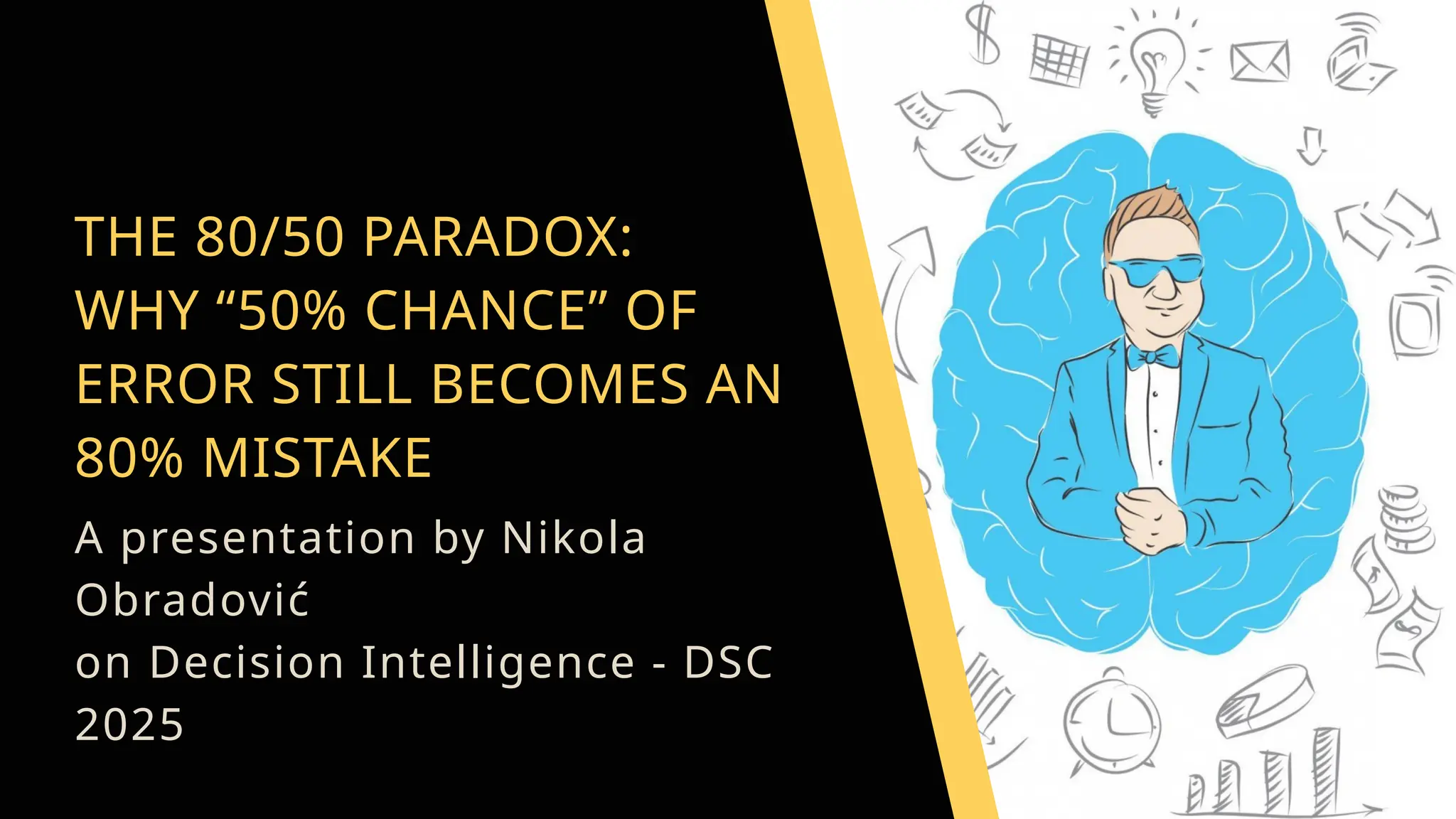
THE 80/50 PARADOX:
WHY “50% CHANCE” OF
ERROR STILL BECOMES AN
80% MISTAKE
A presentation by Nikola
Obradović
on Decision Intelligence - DSC
2025
1990.
FAMILY
COMPANY
2012.
OWN
COMPANY
2025.
10+
COMPANIES
Startups
Fortune 500
3.000+
PROJECTS
Client’s revenue
using our
technology
200M+
EUR
ABOUT ME
"In life, you only need to be smart
twice:
when you choose your profession
and when you choose your spouse.
Whoever misses both has to be
smart for the rest of their life."
-Dusko Radovic
- Carnegie Institute of Technology
85% of your financial success is
due to your personality, and ability
to communicate, negotiate, and
lead.
Shockingly, only 15% is due to
technical knowledge.
- Mario Andretti
1978 Formula One World Champion
If everything seems under control,
you're not going fast enough.
The illusion of the coin flip
STEP 1:
YOU SEE 50/50
STEP 2: DISTORTION
CREEPS IN
STEP 3: ERROR RATE
CLIMBS TO 80%
Two options appear equally
valid. Data suggests a balanced
choice. You feel informed and
rational.
Biases tilt your perception.
Overconfidence inflates one
option. Noise introduces
randomness. Hidden variables
remain unseen.
What felt like even odds has
quietly shifted. Your actual
probability of choosing wrong is
now 4 times higher than you
thought.
The Anatomy of the 80/50 Paradox
The math behind the madness
BIAS BLINDNESS
OVERCONFIDENC
E TRAP
DECISION NOISE
INVISIBLE
VARIABLES
Confirmation bias,
recency bias,
and anchoring warp
our
perception without us
noticing.
We consistently
overestimate our ability
to predict outcomes -
especially under
pressure.
Random variability in
judgment means the
same person makes
different choices on
different days.
The factors we don't
see, or deliberately
ignore - are often the
ones that matter most.
Why leaders keep getting it wrong?
Every day we make decisions
DECISION INTELLIGENCE
is the business discipline of turning
information into better action.
DECISION INTELLIGENCE
=
structured reasoning + data signals + feedback loops.
It upgrades intuition instead of replacing it.
How do you orchestrate those decisions?
How do you monitor the outcomes?
How do you improve it?
1. SIGNAL
CLARITY
2. DECISION
MODEL
3. SIMULATION
4. FEEDBACK
LOOP
What do we actually
know?
What criteria matter?
What happens if we are
wrong?
How do we learn and
adjust?
DI Operating System
- Cassie Kozyrkov
(ex Chief Decision Scientist @ Google)
Data is pretty but not important.
Data is important
when it changes our actions.
When the numbers speak, strategy becomes
sharper, and results become clearer.
Automated Decisions
Input Model Action
→ →
Augmented Decisions
Input Model Human Action
→ → →
What do you measure
before you decide?
VISION
OKR (OBJECTIVES AND
KEY RESULTS)
KPI (KEY PERFORMANCE
INDICATORS)
Your vision defines the long-
term destination.
Every decision, metric, and
priority should align with where
you want to go.
OKRs help set ambitious goals
and drive innovation.
They push teams beyond
comfort zones and focus effort
on what truly moves the
company forward.
KPIs help track essential
business processes and
performance.
They show whether execution is
healthy and whether the
organization is progressing
toward its goals.
Vision, OKR and KPI in Decision Making
A Founder's War Stories
#1
2019.
#2 • OUR SOLUTION CAN GENERATE FORECASTING MODELS
THAT DELIVER ACCURATE, DATA-DRIVEN DEMAND
PREDICTIONS.
• IT CONNECTS DIRECTLY TO INVENTORY SYSTEMS,
ALLOWING THOSE PREDICTIONS TO BE TURNED INTO
REAL PRODUCTION WORK ORDERS.
#3
#4
#5
OBD H/W DEVICE FOR
CARS
DATING
IGAMING / VIRTUAL
GAMING
Insurance Companies
Dating platforms are full of
uncertainty. Users make
hundreds of micro-decisions:
Who to like, who to message,
who to trust, whether to
upgrade, whether to stay on the
platform.
In dating, we help people
decide who to contact.
iGaming is a high-speed
environment with thousands of
dynamic outcomes, bets, and
user actions happening in real
time.
In gaming, we help the system
decide what to show.
More examples
THE INSIGHT THE AI / ROUTING LOGIC THE IMPACT
UPS discovered that left turns
are statistically more dangerous
and less efficient.
They require crossing
oncoming traffic, longer idling,
and higher fuel burn.
UPS routing software plans
delivery routes that avoid most
left turns.
Drivers are trained to follow
these right-turn–optimized
routes, even if the distance is
slightly longer.
• Increased driver safety
• Reduced fuel consumption
• Lower CO₂ emissions
• Faster, more predictable
delivery times
A simple decision rule.
Millions saved.
UPS: The decision rule that changed everything
“No left turns.”
PROBLEM AI SOLUTION RESULT
Tesla needed to develop and
continuously improve its
autonomous driving technology
using real-world driving data.
Tesla collects massive amounts
of data from everyday use of its
vehicles and uses AI to train
self-driving models.
AI systems analyze traffic
patterns, road conditions, driver
behavior, and environmental
factors to improve performance
and safety.
This approach allows Tesla to
constantly upgrade its
autonomous driving
capabilities, increasing vehicle
value and driving long-term
revenue growth.
Tesla: Autonomous Driving and Data Intelligence
PROBLEM AI SOLUTION RESULT
John Deere wanted to help
farmers increase yield and
reduce costs through precision
agriculture.
The company uses artificial
intelligence to analyze data
from drones and field sensors
that monitor crop health,
weather conditions, and soil
quality.
AI models predict the best
timing for planting, irrigation,
and harvesting, as well as the
optimal amount of fertilizer and
pesticides.
Farmers reduce resource
consumption and increase crop
yield, which lowers production
costs and boosts profitability.
John Deere: Smart Farming Powered by AI
The 80/50 Paradox shows us something
simple:
Humans don’t fail because they’re wrong -
they fail because they’re unprepared.
We’re not in a data
economy anymore.
We’re in a decision
economy.
Driver or Passenger?
Your Decisions Decide.
Knowledge pays the bills.
Wisdom shapes your path.
DECISION INTELLIGENCE connects the two.
THANK YOU.
IT’S Q&A
TIME

[DSC Europe 25] Nikola Obradovic - The 80/50 Paradox: Why 50% chance of error still becomes an 80% mistake.pptx

  • 1.
    THE 80/50 PARADOX: WHY“50% CHANCE” OF ERROR STILL BECOMES AN 80% MISTAKE A presentation by Nikola Obradović on Decision Intelligence - DSC 2025
  • 2.
  • 3.
    "In life, youonly need to be smart twice: when you choose your profession and when you choose your spouse. Whoever misses both has to be smart for the rest of their life." -Dusko Radovic
  • 4.
    - Carnegie Instituteof Technology 85% of your financial success is due to your personality, and ability to communicate, negotiate, and lead. Shockingly, only 15% is due to technical knowledge.
  • 5.
    - Mario Andretti 1978Formula One World Champion If everything seems under control, you're not going fast enough.
  • 6.
    The illusion ofthe coin flip
  • 7.
    STEP 1: YOU SEE50/50 STEP 2: DISTORTION CREEPS IN STEP 3: ERROR RATE CLIMBS TO 80% Two options appear equally valid. Data suggests a balanced choice. You feel informed and rational. Biases tilt your perception. Overconfidence inflates one option. Noise introduces randomness. Hidden variables remain unseen. What felt like even odds has quietly shifted. Your actual probability of choosing wrong is now 4 times higher than you thought. The Anatomy of the 80/50 Paradox
  • 8.
    The math behindthe madness
  • 9.
    BIAS BLINDNESS OVERCONFIDENC E TRAP DECISIONNOISE INVISIBLE VARIABLES Confirmation bias, recency bias, and anchoring warp our perception without us noticing. We consistently overestimate our ability to predict outcomes - especially under pressure. Random variability in judgment means the same person makes different choices on different days. The factors we don't see, or deliberately ignore - are often the ones that matter most. Why leaders keep getting it wrong?
  • 10.
    Every day wemake decisions
  • 11.
    DECISION INTELLIGENCE is thebusiness discipline of turning information into better action.
  • 12.
    DECISION INTELLIGENCE = structured reasoning+ data signals + feedback loops. It upgrades intuition instead of replacing it.
  • 13.
    How do youorchestrate those decisions? How do you monitor the outcomes? How do you improve it?
  • 14.
    1. SIGNAL CLARITY 2. DECISION MODEL 3.SIMULATION 4. FEEDBACK LOOP What do we actually know? What criteria matter? What happens if we are wrong? How do we learn and adjust? DI Operating System
  • 15.
    - Cassie Kozyrkov (exChief Decision Scientist @ Google) Data is pretty but not important.
  • 16.
    Data is important whenit changes our actions.
  • 17.
    When the numbersspeak, strategy becomes sharper, and results become clearer.
  • 18.
    Automated Decisions Input ModelAction → → Augmented Decisions Input Model Human Action → → →
  • 19.
    What do youmeasure before you decide?
  • 20.
    VISION OKR (OBJECTIVES AND KEYRESULTS) KPI (KEY PERFORMANCE INDICATORS) Your vision defines the long- term destination. Every decision, metric, and priority should align with where you want to go. OKRs help set ambitious goals and drive innovation. They push teams beyond comfort zones and focus effort on what truly moves the company forward. KPIs help track essential business processes and performance. They show whether execution is healthy and whether the organization is progressing toward its goals. Vision, OKR and KPI in Decision Making
  • 24.
  • 25.
  • 29.
    #2 • OURSOLUTION CAN GENERATE FORECASTING MODELS THAT DELIVER ACCURATE, DATA-DRIVEN DEMAND PREDICTIONS. • IT CONNECTS DIRECTLY TO INVENTORY SYSTEMS, ALLOWING THOSE PREDICTIONS TO BE TURNED INTO REAL PRODUCTION WORK ORDERS.
  • 30.
  • 31.
  • 32.
  • 34.
    OBD H/W DEVICEFOR CARS DATING IGAMING / VIRTUAL GAMING Insurance Companies Dating platforms are full of uncertainty. Users make hundreds of micro-decisions: Who to like, who to message, who to trust, whether to upgrade, whether to stay on the platform. In dating, we help people decide who to contact. iGaming is a high-speed environment with thousands of dynamic outcomes, bets, and user actions happening in real time. In gaming, we help the system decide what to show. More examples
  • 36.
    THE INSIGHT THEAI / ROUTING LOGIC THE IMPACT UPS discovered that left turns are statistically more dangerous and less efficient. They require crossing oncoming traffic, longer idling, and higher fuel burn. UPS routing software plans delivery routes that avoid most left turns. Drivers are trained to follow these right-turn–optimized routes, even if the distance is slightly longer. • Increased driver safety • Reduced fuel consumption • Lower CO₂ emissions • Faster, more predictable delivery times A simple decision rule. Millions saved. UPS: The decision rule that changed everything “No left turns.”
  • 37.
    PROBLEM AI SOLUTIONRESULT Tesla needed to develop and continuously improve its autonomous driving technology using real-world driving data. Tesla collects massive amounts of data from everyday use of its vehicles and uses AI to train self-driving models. AI systems analyze traffic patterns, road conditions, driver behavior, and environmental factors to improve performance and safety. This approach allows Tesla to constantly upgrade its autonomous driving capabilities, increasing vehicle value and driving long-term revenue growth. Tesla: Autonomous Driving and Data Intelligence
  • 38.
    PROBLEM AI SOLUTIONRESULT John Deere wanted to help farmers increase yield and reduce costs through precision agriculture. The company uses artificial intelligence to analyze data from drones and field sensors that monitor crop health, weather conditions, and soil quality. AI models predict the best timing for planting, irrigation, and harvesting, as well as the optimal amount of fertilizer and pesticides. Farmers reduce resource consumption and increase crop yield, which lowers production costs and boosts profitability. John Deere: Smart Farming Powered by AI
  • 39.
    The 80/50 Paradoxshows us something simple: Humans don’t fail because they’re wrong - they fail because they’re unprepared.
  • 40.
    We’re not ina data economy anymore. We’re in a decision economy.
  • 41.
    Driver or Passenger? YourDecisions Decide.
  • 42.
    Knowledge pays thebills. Wisdom shapes your path. DECISION INTELLIGENCE connects the two.
  • 43.