Drugs
Any substance that prevents or cures
diseases,
or enhances physical or mental welfare.
Any chemical agent that alters the biochemical
or physiological processes of tissues or
organisms.
United Nations Office on Drugs and Crime (UNODC)
Image Source http://media.vocativ.com/photos/2016/02/drugs-pills-0323153180635513.jpg
http://media.vocativ.com/photos/2016/02/drugs-pills-0323153180635513.jpg
https://publications.nigms.nih.gov/medbydesign/images/ch1_drugadmin.jpg
Drugs
United Nations Office on Drugs and Crime (UNODC)
Image Source http://media.mercola.com/imageserver/public/2010/May/5.25drug-prescription.jpg
http://www.businesspundit.com/wp-content/uploads/2011/12/Cover-600x4811.jpg
Legal Drugs
(Prescribed and OTC Over-the-
counter Drugs)
Illegal
Drugs
(Psychoactive
Substances)
Psychoactive
Substances
Substances that modify a person’s perception,
mood,
cognition, behavior, or motor functions
Substance Abuse
The harmful use of psychoactive
substances, including alcohol and other
drugs (AOD).
World Health Organization, 2000
The sustained use of psychoactive
substances can lead to dependence
syndrome
a cluster of behavioral, cognitive,
and physiological phenomena.
Understanding Drug Dependence
World Health Organization, 2016
Typically characterized by:
A strong desire to consume
drugs Difficulty controlling its
use
Persistent use despite detrimental effects
Preference to use drugs than to other
activities Increasing tolerance to the drug
used
Understanding Drug Dependence
Addiction is progressive.
Without intervention or treatment, it can
cause disability or even death.
Common Signs of Drug Use
Changes in attendance in school or
work Abrupt changes in overall
attitude Irritable, discourteous,
aggressive
Usually untrustworthy and lacks self-
confidence
Low frustration tolerance
Lacking interest in one’s studies or work
World Health Organization, 2000
Image Source http://www.about-drugs.org/skin1/images/signs-of-drug-use.jpg
Common Signs of Drug Use
Blames everybody but
oneself Prefers to stay with
peers May frequent odd
places Poor physical
appearance
Wearing of sunglasses at inappropriate times
Unusual effort to cover arms to hide needle
marks
World Health Organization, 2000
Image Source https://i.ytimg.com/vi/g_-TnJ3Myvs/maxresdefault.jpg
Common Signs of Drug Use
Stealing items which can be readily sold
Unusual borrowing of money from relatives
and friends
Association with known drug abuses
World Health Organization, 2000
Image Source http://cnnphilippines.com/news/vwekg9-Criminals-
PH_CNNPH.png/alternates/FREE_640/Criminals-PH_CNNPH.png
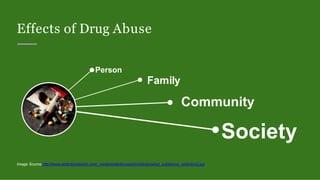
Effects of Drug Abuse
Person
Family
Community
Society
Image Source http://www.addictionsearch.com/_media/addictionsearch/articles/what_substance_addiction2.jpg
Effects on the Person
Image Source http://www.newhealthadvisor.com/images/1HT00463/drug_abusers_03.jpg
Medical and Physical Deterioration
Respiratory, digestive, and other health problems
Personal Deterioration
Manipulativeness; negative attitudes; selfishness;
low frustration tolerance; poor family relations;
non-
trustworthiness; depression; absence of good
manners and right conduct, among others.
Effects on the Person
Image Source http://www.drug-addiction-support.org/images/xnarcoticsusefactsnodup.jpg.pagespeed.ic.7N3BEgjF7v.jpg
Mental Deterioration
Loss of interest to productive activities; emotional
immaturity; no initiative for self-improvement; inability
to
concentrate; psychosis, among others.
Spiritual Deterioration
Drug abusers are godless; no spiritual beliefs, no
spiritual obligations, nor religious responsibilities.
Effects on the Family
Family members develop intense feelings
of
humiliation and guilt
Low self esteem of family members
Spirit of togetherness and unity are
broken
Domestic violence
Loss of money or valuables
Image Source http://img.zhiding.cn/4/501/lisbKfA1c1WuE.jpg?rand=122
Effects on the Community
Increase in petty crimes within
neighborhoods Increase of drug
dependents and drug pushers Developing
fear of drug users among residents,
especially at night
Neighborhood association and interaction is
reduced
Image Source https://c1.staticflickr.com/5/4036/4628934493_db6054a5f4_b.jpg
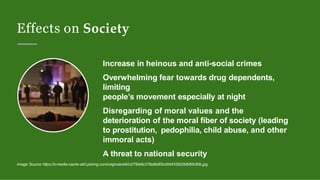
Effects on Society
Increase in heinous and anti-social crimes
Overwhelming fear towards drug dependents,
limiting
people’s movement especially at night
Disregarding of moral values and the
deterioration of the moral fiber of society (leading
to prostitution, pedophilia, child abuse, and other
immoral acts)
A threat to national security
Image Source https://s-media-cache-ak0.pinimg.com/originals/e6/c2/78/e6c278a9b8f3cd0d433920bfbfbfc80b.jpg
Myths & Misconceptions
Image Source http://www.drugrehab.us/wp-content/uploads/2013/02/recreational-drug-use.jpg
“Recreational use of drugs is not
harmful”
All illegal drugs are dangerous and can cause
physical and psychological changes to the
user.
Prolonged drug use worsens the harmful
effects. Prescription drugs should always be
administered and used only at the direction of
a physician.
Myths & Misconceptions
Image Source http://www.wallstreethedge.com/wp-content/uploads/2015/10/marijuana-use.jpg
“Marijuana is no worse than using
alcohol
or tobacco”
Alcohol leaves the body within 24 hours (it is
water- soluble)
Marijuana is fat-soluble. It attaches to fatty parts
of the body (usually the brain and reproductive
organs) and can be detected up to 30 days after
initial use.
Myths & Misconceptions
Image Source http://www.wallstreethedge.com/wp-content/uploads/2015/10/marijuana-use.jpg
“Marijuana is no worse than using
alcohol
or tobacco”
Marijuana:
Impairs short term memory
Interferes with reproductive functions
Impairs lung and respiratory functions
Interferes with perception, judgment, and
fine motor skills
Myths & Misconceptions
Image Source http://www.americanmilitaryforum.com/forums/attachments/philippinexs_war_on_drugs_kills_34_in_4_days-jpg_1718483346-
jpg.4882/
“Everybody is taking drugs. Only
the weak
ones become drug dependent.”
The majority of the population do not use
illegal
drugs.
Peer pressure is always difficult to cope with
and it takes more courage and strength to
stand up for what you know is right.
Myths & Misconceptions
“Drug abuse is a ‘victimless’
crime that
only hurts the user.”
Image Source http://i2.cdn.cnn.com/cnnnext/dam/assets/160804020917-phillippines-duterte-drug-war-watson-pkg-00011921-full-169.jpg
It affects the user, one’s family, friends,
immediate
community, and society at large.
Myths & Misconceptions
Image Source https://img.rt.com/files/2016.06/original/575aa675c46188b6328b45a7.jpg
“If a person wants to take
drugs,
governments should not
interfere”
The rights of an individual must be consistent
with
the safety and welfare of all.
No one has a right to behave in a manner
destructive to others. Users must accept
responsibility for the damage, disruption
Myths & Misconceptions
Image Source http://i.dailymail.co.uk/i/pix/2016/07/30/10/36B81D4400000578-3715617-image-a-13_1469872253479.jpg
“All drug users should be
imprisoned.”
Imprisonment does not solve the problem.
Counseling, medical treatment,and long-
term support are essential as intervention
tools.
Imprisonment does not cure the disease
and he/she is likely to return to the drug
cycle upon release.
Risk Factors
Family Social
School
Other Factors
Risk Factors (Family)
Drug Use and Criminal Behavior
Drug use in the family is a factor
associated with the initiation and
frequency of drug abuse by
children.
Poor, Inconsistent Family
Management Practices
Children in families with low disciplinary practices
and interaction with parents are at high risk for
delinquency and drug abuse.
Risk Factors (Family)
Family Conflict
Children raised in families with high rates of
conflict
appear at risk for delinquency and drug abuse.
Homes broken by marital discord are at higher
risk of delinquency and drug use.
Family Social Deprivation
Children living in families characterized by social isolation and multiple
entrapments of parents in extreme poverty are at elevated risk of drug
abuse.
Image Source:https://cdn.shutterstock.com/shutterstock/videos/17614399/thumb/1.jpg?i10c=img.resize(height:160)
Risk Factors (Social)
Early Exposure and Frequency of Antisocial Behaviors
Early antisocial behavior in the
primary grades predicts frequent use
of drugs in adolescence.
Delinquent behavior may lead to drug
addiction later in adolescence.
Risk Factors (Social)
Attitudes and
Beliefs
Individuals with values different from
those dominant in society are likely to
become delinquents and drug abusers.
These values include:
Low religiosity
Rebelliousness
High tolerance of deviance
Resistance to authority
A strong need for independence
Image Source http://www.davidspell.com/wp-content/uploads/2014/12/rebelliousteenneleidzia-draugauti.jpg
Risk Factors (Social)
Image Source http://images.wisegeek.com/man-sitting-on-couch-near-drugs.jpg
Attitudes and Beliefs
Knowledge about the health effects
has preventive effect on drug use.
Positive beliefs and attitude towards
use of drugs, alcohol, and tobacco
leads to use of these vices.
Risk Factors (Social)
Peer Pressure and Other
Factors
Drug behavior and drug-related
attitudes of peers are among the
strongest and most potent
predictors of drug involvement.
Image Source http://www.secureteen.com/uploads/2015/05/shutterstock_29507842.jpg
School Failure
Delinquency is related to academic
performance in school.
School failure in elementary grades
precedes delinquency.
Poor school performance is a
common antecedent into drugs.
Risk Factors (School)
Low Degree of Commitment to
Education and Attachment
to School
Those who are committed to participating in school activities,
hold high achievement and educational aspirations are the
least prone to delinquency and drug abuse.
Drug users are more likely to be absent from school, cut classes
and to perform more poorly than non-users.
Neighborhood Attachment and
Community
Disorganization
High population densities, high crime rates, and
lack of natural surveillance in public places can
cause increased delinquency and drug abuse.
Similar to crime rates, community values and
norms also affect rate of adolescent delinquency
and drug abuse.
Risk Factors (Social)
Risk Factors (Other Factors)
Mobilit
y Increased antisocial behavior results when
experiencing transitions (transferring schools
or moving between levels)
Residential mobility can also predict
delinquency, and is also related with drug
initiation and frequency of use.
Image Source https://www.dosomething.org/sites/default/files/styles/550x300/public/images/high%20school%20dropout.jpg?itok=CdNg2cdK
Risk Factors (Other Factors)
Constitutional, Genetic and Personality
Factors
Children with biological or psychological deficiencies are at
greater risk of abusing drugs.
Those displaying abnormal mood, anxiety or behavior disorders
are at increased risk.
Those who are clinically depressive, display anxiety
disorders, or impulse control disorders are vulnerable to
substance abuse.
Risk Factors (Other Factors)
Media
Advertising is powerful in influencing
youth decisions.
Film and TV stars, pop stars and fashion
models make smoking seem attractive (Ary,
1988) and the adolescents imitate them to
smoke their style.
Image Source http://drmichaelwayne.com/blog/wp-content/uploads/2010/03/drug-ad1.jpg
Other Terms: Ethyl alcohol or ethanol
How it is Used: Drinking
Effects on the Body: Slows reflexes and
causes drowsiness when used in excess,
dementia, stroke, cardiovascular problems,
hypertension, increased risk of many kinds of
cancer.
Alcohol
Image source: http://images.wisegeek.com/two-glasses-of-beer-on-wooden-table.jpg
Commonly Abused Substances
Found in: Coffee, tea, cocoa, soft drinks, and
some medications
How it is Used: Orally in pill form or
consumed in food and drinks
Effects on the Body: Reduces fine motor
coordination, increases alertness, alters sleep
patterns, and can cause headaches,
nervousness, and dizziness.
Caffeine
Image source: http://images.agoramedia.com/everydayhealth/gcms/10-Essential-Facts-about-Caffeine-01-1440x810.jpg
Commonly Abused Substances
Other Terms: Tobacco; found in cigarettes,
cigars, and smokeless tobacco
How it is Used: Smoked or chewed
Effects on the Body: Reduces appetite and
can
cause nausea and vomiting, increases
alertness.
Nicotine
Image source: http://www.wicenet.com/wp-content/uploads/2016/04/Nicotine.jpg
Commonly Abused Substances
Other Terms: Grass, pot, reefer, and
weed
How it is Used: Usually smoked; baked
into brownies; brewed like tea
Effects on the Body: Marijuana
impairs memory, concentration,
perception, and movement.
Marijua
na
Image source: http://specials-images.forbesimg.com/imageserve/348038528/960x0.jpg?fit=scale.
https://d14rmgtrwzf5a.cloudfront.net/sites/default/files/joints_shutterstock-52960849.jpg
Commonly Abused Substances
Other Terms: Crack, blow, rock, snow, coke
How it is Used: Snorted, smoked, or injected
Effects on the Body: Causes dizziness,
headache, stimulates the brain and spinal
cord, and increased heart rate. Elevated
blood pressure, increased body temperature,
increased breathing rate.
Cocaine
Image source: http://www.wicenet.com/wp-content/uploads/2016/04/Nicotine.jpg
Commonly Abused Substances
Other Terms: X, Molly, Happy Drug, Love
Drug
How it is Used: Orally in pill form
Effects on the Body: Increased heart rate,
blood pressure, and body temperature,
dehydration, nausea, muscle cramping,
involuntary teeth clenching, blurred vision,
chills, sweating.
Ecsta
sy
Image source: https://sossafetymagazine.com/wp-content/uploads/ecstasy-1.jpg.
http://drugabuse.com/wp-content/uploads/drugabuse-shutterstock307243289-buying_pills.jpg
Commonly Abused Substances
Other Terms: Shabs, S, bato
How it is Used: Snorted
Effects on the Body: Tachycardia,
hypertension, atrial and ventricular arrhythmias,
chest pain, accelerated atherosclerosis,
dyspnea, edema, abscess, cellulitis, seizures,
hypotension, dental caries, periodontal abscess
(meth mouth), pupillary dilatation.
Shab
u
Image source: http://www.wicenet.com/wp-content/uploads/2016/04/Nicotine.jpg
Commonly Abused Substances
Other Terms: Vs, Downers, Benzos
How it is Used: Taken orally
Effects on the Body: Euphoria,
drowsiness, stupor, coma, respiratory
depression, seizures, slurring of speech,
disorientation, delayed reflexes.
Benzodiazepi
nes
Image source: http://media.recovery.org/wp-content/uploads/Benzodiazepines2-640x300.jpg
http://blog.tranquilene.com/Portals/207868/images/benzodiazepines_pills.jpg
How to Avoid Drug Use
Understand how alcohol and drug
addiction develops
Get help if you have an alcohol or
drug
problem
Avoid temptation and peer pressure
Find support that you need
Maintain physical wellness and
mental
health
Use drugs properly
Image source: http://www.formulatedfitness.com/wp-content/uploads/2015/04/FF-Kids-healthy-Habits.jpg.
http://img.aws.livestrongcdn.com/ls-article-image-400/cme/cme_public_images/www_livestrong_com/photos.demandstudios.com/getty/article/171/18/76764132_XS.jpg.
How to Avoid Drug Use
Accept yourself
Develop your potentials and engage
in
productive and fulfilling activities
Communicate your issues and
concerns
Learn how to cope with your
problems
Seek professional help if you feel
you cannot cope with problems
Develop strong moral and spiritual
foundations.
Image source: https://feelpositive.files.wordpress.com/2016/08/accept_yourself.jpg?w=300&h=225.
http://a3559z1.americdn.com/wp-content/uploads/2016/04/How-to-Engage-Kids-in-Outdoor-Activities-1.jpg
Drug Treatment
Withdrawal Management (WM)
Medical and psychological care of patients who are
experiencing withdrawal symptoms as a result of
ceasing or reducing use of their drug of dependence
https://www.ncbi.nlm.nih.gov/books/NBK310652/
Detoxification
The process of expelling toxins and substances from the
body
and suppressing withdrawal symptoms.
U.S. Department of Health and Human Services (2006). "Detoxification and Substance Abuse Treatment": 4–5.
Drug Treatment
Sets of medical or psychotherapeutic treatment for
dependency on psychoactive substances such as alcohol,
prescription drugs, and street drugs such as cocaine, heroin
or amphetamines.
Rehabilitation
Program
Potenza, M. N (12 October 2008). "The neurobiology of pathological gambling and drug addiction: an overview and
new findings".
Drug Treatment
Out-patient Treatment
Drug dependency treatment where the patient is not
admitted
to the hospital or facility.
Drug Treatment
Residential Rehabilitation
Treatment programs for substance dependency
provided for
patients in residential settings.
https://www.addiction.com/a-z/residential- rehabilitation/
Drug Treatment
Follow-up and
Aftercare
Support services for
persons discharged from
hospitals and rehabilitation
centers.
LEVEL OF USE MANAGEMENT
Abstainer Preventive Education
Experimenters
Occasional Users
Regular Users
Counseling
Drug Dependent Drug Rehabilitation
Mentally Ill Chemical
Abuser
Psychiatric treatment
(Substance Induced
Psychosis)
Drug Treatment
How to Help a Friend
Listen
Encourage
Share
Inform
Support

drug-education-module.pptx

  • 1.
    Drugs Any substance thatprevents or cures diseases, or enhances physical or mental welfare. Any chemical agent that alters the biochemical or physiological processes of tissues or organisms. United Nations Office on Drugs and Crime (UNODC) Image Source http://media.vocativ.com/photos/2016/02/drugs-pills-0323153180635513.jpg http://media.vocativ.com/photos/2016/02/drugs-pills-0323153180635513.jpg https://publications.nigms.nih.gov/medbydesign/images/ch1_drugadmin.jpg
  • 2.
    Drugs United Nations Officeon Drugs and Crime (UNODC) Image Source http://media.mercola.com/imageserver/public/2010/May/5.25drug-prescription.jpg http://www.businesspundit.com/wp-content/uploads/2011/12/Cover-600x4811.jpg Legal Drugs (Prescribed and OTC Over-the- counter Drugs) Illegal Drugs (Psychoactive Substances)
  • 3.
    Psychoactive Substances Substances that modifya person’s perception, mood, cognition, behavior, or motor functions Substance Abuse The harmful use of psychoactive substances, including alcohol and other drugs (AOD). World Health Organization, 2000
  • 4.
    World Health Organization,2000 The sustained use of psychoactive substances can lead to dependence syndrome a cluster of behavioral, cognitive, and physiological phenomena.
  • 5.
    Understanding Drug Dependence WorldHealth Organization, 2016 Typically characterized by: A strong desire to consume drugs Difficulty controlling its use Persistent use despite detrimental effects Preference to use drugs than to other activities Increasing tolerance to the drug used
  • 6.
    Understanding Drug Dependence Addictionis progressive. Without intervention or treatment, it can cause disability or even death.
  • 7.
    Common Signs ofDrug Use Changes in attendance in school or work Abrupt changes in overall attitude Irritable, discourteous, aggressive Usually untrustworthy and lacks self- confidence Low frustration tolerance Lacking interest in one’s studies or work World Health Organization, 2000 Image Source http://www.about-drugs.org/skin1/images/signs-of-drug-use.jpg
  • 8.
    Common Signs ofDrug Use Blames everybody but oneself Prefers to stay with peers May frequent odd places Poor physical appearance Wearing of sunglasses at inappropriate times Unusual effort to cover arms to hide needle marks World Health Organization, 2000 Image Source https://i.ytimg.com/vi/g_-TnJ3Myvs/maxresdefault.jpg
  • 9.
    Common Signs ofDrug Use Stealing items which can be readily sold Unusual borrowing of money from relatives and friends Association with known drug abuses World Health Organization, 2000 Image Source http://cnnphilippines.com/news/vwekg9-Criminals- PH_CNNPH.png/alternates/FREE_640/Criminals-PH_CNNPH.png
  • 10.
    Effects of DrugAbuse Person Family Community Society Image Source http://www.addictionsearch.com/_media/addictionsearch/articles/what_substance_addiction2.jpg
  • 11.
    Effects on thePerson Image Source http://www.newhealthadvisor.com/images/1HT00463/drug_abusers_03.jpg Medical and Physical Deterioration Respiratory, digestive, and other health problems Personal Deterioration Manipulativeness; negative attitudes; selfishness; low frustration tolerance; poor family relations; non- trustworthiness; depression; absence of good manners and right conduct, among others.
  • 12.
    Effects on thePerson Image Source http://www.drug-addiction-support.org/images/xnarcoticsusefactsnodup.jpg.pagespeed.ic.7N3BEgjF7v.jpg Mental Deterioration Loss of interest to productive activities; emotional immaturity; no initiative for self-improvement; inability to concentrate; psychosis, among others. Spiritual Deterioration Drug abusers are godless; no spiritual beliefs, no spiritual obligations, nor religious responsibilities.
  • 13.
    Effects on theFamily Family members develop intense feelings of humiliation and guilt Low self esteem of family members Spirit of togetherness and unity are broken Domestic violence Loss of money or valuables Image Source http://img.zhiding.cn/4/501/lisbKfA1c1WuE.jpg?rand=122
  • 14.
    Effects on theCommunity Increase in petty crimes within neighborhoods Increase of drug dependents and drug pushers Developing fear of drug users among residents, especially at night Neighborhood association and interaction is reduced Image Source https://c1.staticflickr.com/5/4036/4628934493_db6054a5f4_b.jpg
  • 15.
    Effects on Society Increasein heinous and anti-social crimes Overwhelming fear towards drug dependents, limiting people’s movement especially at night Disregarding of moral values and the deterioration of the moral fiber of society (leading to prostitution, pedophilia, child abuse, and other immoral acts) A threat to national security Image Source https://s-media-cache-ak0.pinimg.com/originals/e6/c2/78/e6c278a9b8f3cd0d433920bfbfbfc80b.jpg
  • 16.
    Myths & Misconceptions ImageSource http://www.drugrehab.us/wp-content/uploads/2013/02/recreational-drug-use.jpg “Recreational use of drugs is not harmful” All illegal drugs are dangerous and can cause physical and psychological changes to the user. Prolonged drug use worsens the harmful effects. Prescription drugs should always be administered and used only at the direction of a physician.
  • 17.
    Myths & Misconceptions ImageSource http://www.wallstreethedge.com/wp-content/uploads/2015/10/marijuana-use.jpg “Marijuana is no worse than using alcohol or tobacco” Alcohol leaves the body within 24 hours (it is water- soluble) Marijuana is fat-soluble. It attaches to fatty parts of the body (usually the brain and reproductive organs) and can be detected up to 30 days after initial use.
  • 18.
    Myths & Misconceptions ImageSource http://www.wallstreethedge.com/wp-content/uploads/2015/10/marijuana-use.jpg “Marijuana is no worse than using alcohol or tobacco” Marijuana: Impairs short term memory Interferes with reproductive functions Impairs lung and respiratory functions Interferes with perception, judgment, and fine motor skills
  • 19.
    Myths & Misconceptions ImageSource http://www.americanmilitaryforum.com/forums/attachments/philippinexs_war_on_drugs_kills_34_in_4_days-jpg_1718483346- jpg.4882/ “Everybody is taking drugs. Only the weak ones become drug dependent.” The majority of the population do not use illegal drugs. Peer pressure is always difficult to cope with and it takes more courage and strength to stand up for what you know is right.
  • 20.
    Myths & Misconceptions “Drugabuse is a ‘victimless’ crime that only hurts the user.” Image Source http://i2.cdn.cnn.com/cnnnext/dam/assets/160804020917-phillippines-duterte-drug-war-watson-pkg-00011921-full-169.jpg It affects the user, one’s family, friends, immediate community, and society at large.
  • 21.
    Myths & Misconceptions ImageSource https://img.rt.com/files/2016.06/original/575aa675c46188b6328b45a7.jpg “If a person wants to take drugs, governments should not interfere” The rights of an individual must be consistent with the safety and welfare of all. No one has a right to behave in a manner destructive to others. Users must accept responsibility for the damage, disruption
  • 22.
    Myths & Misconceptions ImageSource http://i.dailymail.co.uk/i/pix/2016/07/30/10/36B81D4400000578-3715617-image-a-13_1469872253479.jpg “All drug users should be imprisoned.” Imprisonment does not solve the problem. Counseling, medical treatment,and long- term support are essential as intervention tools. Imprisonment does not cure the disease and he/she is likely to return to the drug cycle upon release.
  • 23.
  • 24.
    Risk Factors (Family) DrugUse and Criminal Behavior Drug use in the family is a factor associated with the initiation and frequency of drug abuse by children. Poor, Inconsistent Family Management Practices Children in families with low disciplinary practices and interaction with parents are at high risk for delinquency and drug abuse.
  • 25.
    Risk Factors (Family) FamilyConflict Children raised in families with high rates of conflict appear at risk for delinquency and drug abuse. Homes broken by marital discord are at higher risk of delinquency and drug use. Family Social Deprivation Children living in families characterized by social isolation and multiple entrapments of parents in extreme poverty are at elevated risk of drug abuse. Image Source:https://cdn.shutterstock.com/shutterstock/videos/17614399/thumb/1.jpg?i10c=img.resize(height:160)
  • 26.
    Risk Factors (Social) EarlyExposure and Frequency of Antisocial Behaviors Early antisocial behavior in the primary grades predicts frequent use of drugs in adolescence. Delinquent behavior may lead to drug addiction later in adolescence.
  • 27.
    Risk Factors (Social) Attitudesand Beliefs Individuals with values different from those dominant in society are likely to become delinquents and drug abusers. These values include: Low religiosity Rebelliousness High tolerance of deviance Resistance to authority A strong need for independence Image Source http://www.davidspell.com/wp-content/uploads/2014/12/rebelliousteenneleidzia-draugauti.jpg
  • 28.
    Risk Factors (Social) ImageSource http://images.wisegeek.com/man-sitting-on-couch-near-drugs.jpg Attitudes and Beliefs Knowledge about the health effects has preventive effect on drug use. Positive beliefs and attitude towards use of drugs, alcohol, and tobacco leads to use of these vices.
  • 29.
    Risk Factors (Social) PeerPressure and Other Factors Drug behavior and drug-related attitudes of peers are among the strongest and most potent predictors of drug involvement. Image Source http://www.secureteen.com/uploads/2015/05/shutterstock_29507842.jpg
  • 30.
    School Failure Delinquency isrelated to academic performance in school. School failure in elementary grades precedes delinquency. Poor school performance is a common antecedent into drugs. Risk Factors (School)
  • 31.
    Risk Factors (School) LowDegree of Commitment to Education and Attachment to School Those who are committed to participating in school activities, hold high achievement and educational aspirations are the least prone to delinquency and drug abuse. Drug users are more likely to be absent from school, cut classes and to perform more poorly than non-users.
  • 32.
    Neighborhood Attachment and Community Disorganization Highpopulation densities, high crime rates, and lack of natural surveillance in public places can cause increased delinquency and drug abuse. Similar to crime rates, community values and norms also affect rate of adolescent delinquency and drug abuse. Risk Factors (Social)
  • 33.
    Risk Factors (OtherFactors) Mobilit y Increased antisocial behavior results when experiencing transitions (transferring schools or moving between levels) Residential mobility can also predict delinquency, and is also related with drug initiation and frequency of use. Image Source https://www.dosomething.org/sites/default/files/styles/550x300/public/images/high%20school%20dropout.jpg?itok=CdNg2cdK
  • 34.
    Risk Factors (OtherFactors) Constitutional, Genetic and Personality Factors Children with biological or psychological deficiencies are at greater risk of abusing drugs. Those displaying abnormal mood, anxiety or behavior disorders are at increased risk. Those who are clinically depressive, display anxiety disorders, or impulse control disorders are vulnerable to substance abuse.
  • 35.
    Risk Factors (OtherFactors) Media Advertising is powerful in influencing youth decisions. Film and TV stars, pop stars and fashion models make smoking seem attractive (Ary, 1988) and the adolescents imitate them to smoke their style. Image Source http://drmichaelwayne.com/blog/wp-content/uploads/2010/03/drug-ad1.jpg
  • 36.
    Other Terms: Ethylalcohol or ethanol How it is Used: Drinking Effects on the Body: Slows reflexes and causes drowsiness when used in excess, dementia, stroke, cardiovascular problems, hypertension, increased risk of many kinds of cancer. Alcohol Image source: http://images.wisegeek.com/two-glasses-of-beer-on-wooden-table.jpg Commonly Abused Substances
  • 37.
    Found in: Coffee,tea, cocoa, soft drinks, and some medications How it is Used: Orally in pill form or consumed in food and drinks Effects on the Body: Reduces fine motor coordination, increases alertness, alters sleep patterns, and can cause headaches, nervousness, and dizziness. Caffeine Image source: http://images.agoramedia.com/everydayhealth/gcms/10-Essential-Facts-about-Caffeine-01-1440x810.jpg Commonly Abused Substances
  • 38.
    Other Terms: Tobacco;found in cigarettes, cigars, and smokeless tobacco How it is Used: Smoked or chewed Effects on the Body: Reduces appetite and can cause nausea and vomiting, increases alertness. Nicotine Image source: http://www.wicenet.com/wp-content/uploads/2016/04/Nicotine.jpg Commonly Abused Substances
  • 39.
    Other Terms: Grass,pot, reefer, and weed How it is Used: Usually smoked; baked into brownies; brewed like tea Effects on the Body: Marijuana impairs memory, concentration, perception, and movement. Marijua na Image source: http://specials-images.forbesimg.com/imageserve/348038528/960x0.jpg?fit=scale. https://d14rmgtrwzf5a.cloudfront.net/sites/default/files/joints_shutterstock-52960849.jpg Commonly Abused Substances
  • 40.
    Other Terms: Crack,blow, rock, snow, coke How it is Used: Snorted, smoked, or injected Effects on the Body: Causes dizziness, headache, stimulates the brain and spinal cord, and increased heart rate. Elevated blood pressure, increased body temperature, increased breathing rate. Cocaine Image source: http://www.wicenet.com/wp-content/uploads/2016/04/Nicotine.jpg Commonly Abused Substances
  • 41.
    Other Terms: X,Molly, Happy Drug, Love Drug How it is Used: Orally in pill form Effects on the Body: Increased heart rate, blood pressure, and body temperature, dehydration, nausea, muscle cramping, involuntary teeth clenching, blurred vision, chills, sweating. Ecsta sy Image source: https://sossafetymagazine.com/wp-content/uploads/ecstasy-1.jpg. http://drugabuse.com/wp-content/uploads/drugabuse-shutterstock307243289-buying_pills.jpg Commonly Abused Substances
  • 42.
    Other Terms: Shabs,S, bato How it is Used: Snorted Effects on the Body: Tachycardia, hypertension, atrial and ventricular arrhythmias, chest pain, accelerated atherosclerosis, dyspnea, edema, abscess, cellulitis, seizures, hypotension, dental caries, periodontal abscess (meth mouth), pupillary dilatation. Shab u Image source: http://www.wicenet.com/wp-content/uploads/2016/04/Nicotine.jpg Commonly Abused Substances
  • 43.
    Commonly Abused Substances OtherTerms: Vs, Downers, Benzos How it is Used: Taken orally Effects on the Body: Euphoria, drowsiness, stupor, coma, respiratory depression, seizures, slurring of speech, disorientation, delayed reflexes. Benzodiazepi nes Image source: http://media.recovery.org/wp-content/uploads/Benzodiazepines2-640x300.jpg http://blog.tranquilene.com/Portals/207868/images/benzodiazepines_pills.jpg
  • 44.
    How to AvoidDrug Use Understand how alcohol and drug addiction develops Get help if you have an alcohol or drug problem Avoid temptation and peer pressure Find support that you need Maintain physical wellness and mental health Use drugs properly Image source: http://www.formulatedfitness.com/wp-content/uploads/2015/04/FF-Kids-healthy-Habits.jpg. http://img.aws.livestrongcdn.com/ls-article-image-400/cme/cme_public_images/www_livestrong_com/photos.demandstudios.com/getty/article/171/18/76764132_XS.jpg.
  • 45.
    How to AvoidDrug Use Accept yourself Develop your potentials and engage in productive and fulfilling activities Communicate your issues and concerns Learn how to cope with your problems Seek professional help if you feel you cannot cope with problems Develop strong moral and spiritual foundations. Image source: https://feelpositive.files.wordpress.com/2016/08/accept_yourself.jpg?w=300&h=225. http://a3559z1.americdn.com/wp-content/uploads/2016/04/How-to-Engage-Kids-in-Outdoor-Activities-1.jpg
  • 46.
    Drug Treatment Withdrawal Management(WM) Medical and psychological care of patients who are experiencing withdrawal symptoms as a result of ceasing or reducing use of their drug of dependence https://www.ncbi.nlm.nih.gov/books/NBK310652/
  • 47.
    Detoxification The process ofexpelling toxins and substances from the body and suppressing withdrawal symptoms. U.S. Department of Health and Human Services (2006). "Detoxification and Substance Abuse Treatment": 4–5. Drug Treatment
  • 48.
    Sets of medicalor psychotherapeutic treatment for dependency on psychoactive substances such as alcohol, prescription drugs, and street drugs such as cocaine, heroin or amphetamines. Rehabilitation Program Potenza, M. N (12 October 2008). "The neurobiology of pathological gambling and drug addiction: an overview and new findings". Drug Treatment
  • 49.
    Out-patient Treatment Drug dependencytreatment where the patient is not admitted to the hospital or facility. Drug Treatment
  • 50.
    Residential Rehabilitation Treatment programsfor substance dependency provided for patients in residential settings. https://www.addiction.com/a-z/residential- rehabilitation/ Drug Treatment
  • 51.
    Follow-up and Aftercare Support servicesfor persons discharged from hospitals and rehabilitation centers. LEVEL OF USE MANAGEMENT Abstainer Preventive Education Experimenters Occasional Users Regular Users Counseling Drug Dependent Drug Rehabilitation Mentally Ill Chemical Abuser Psychiatric treatment (Substance Induced Psychosis) Drug Treatment
  • 52.
    How to Helpa Friend Listen Encourage Share Inform Support