DAILY
LESSON LOG
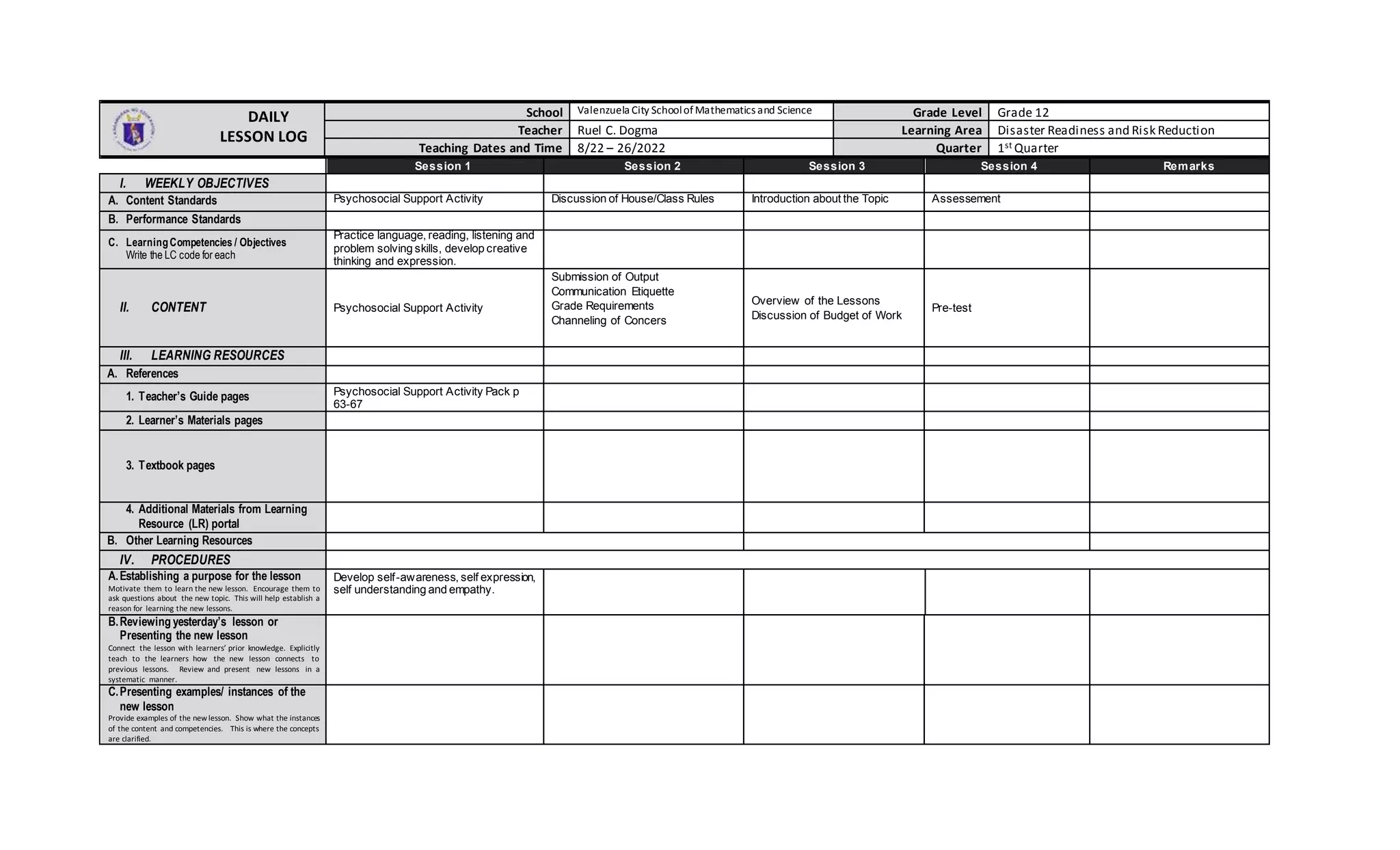
School Valenzuela City SchoolofMathematics and Science Grade Level Grade 12
Teacher Ruel C. Dogma Learning Area Disaster Readiness and Risk Reduction
Teaching Dates and Time 8/22 – 26/2022 Quarter 1st Quarter
Session 1 Session 2 Session 3 Session 4 Remarks
I. WEEKLY OBJECTIVES
A. Content Standards Psychosocial Support Activity Discussion of House/Class Rules Introduction about the Topic Assessement
B. Performance Standards
C. LearningCompetencies / Objectives
Write the LC code for each
Practice language, reading, listening and
problem solving skills, develop creative
thinking and expression.
II. CONTENT Psychosocial Support Activity
Submission of Output
Communication Etiquette
Grade Requirements
Channeling of Concers
Overview of the Lessons
Discussion of Budget of Work
Pre-test
III. LEARNING RESOURCES
A. References
1. Teacher’s Guide pages Psychosocial Support Activity Pack p
63-67
2. Learner’s Materials pages
3. Textbook pages
4. Additional Materials from Learning
Resource (LR) portal
B. Other Learning Resources
IV. PROCEDURES
A.Establishing a purpose for the lesson
Motivate them to learn the new lesson. Encourage them to
ask questions about the new topic. This will help establish a
reason for learning the new lessons.
Develop self-awareness, self expression,
self understanding and empathy.
B.Reviewing yesterday’s lesson or
Presenting the new lesson
Connect the lesson with learners’ prior knowledge. Explicitly
teach to the learners how the new lesson connects to
previous lessons. Review and present new lessons in a
systematic manner.
C.Presenting examples/ instances of the
new lesson
Provide examples of the new lesson. Show what the instances
of the content and competencies. This is where the concepts
are clarified.
DAILY
LESSON LOG
School Valenzuela City SchoolofMathematics and Science Grade Level Grade 12
Teacher Ruel C. Dogma Learning Area Disaster Readiness and Risk Reduction
Teaching Dates and Time 8/22 – 26/2022 Quarter 1st Quarter
Session 1 Session 2 Session 3 Session 4 Remarks
D.Discussing new concepts and practicing
new skills #1
(Leads to Formative Assessment 1)
Discuss the concepts. Prepare good questions for this.
Listen to the answers of learners to gauge if they
understood your presentation lesson. If not, then
reteach. If they have understood, then proceed to
deepening the lesson.
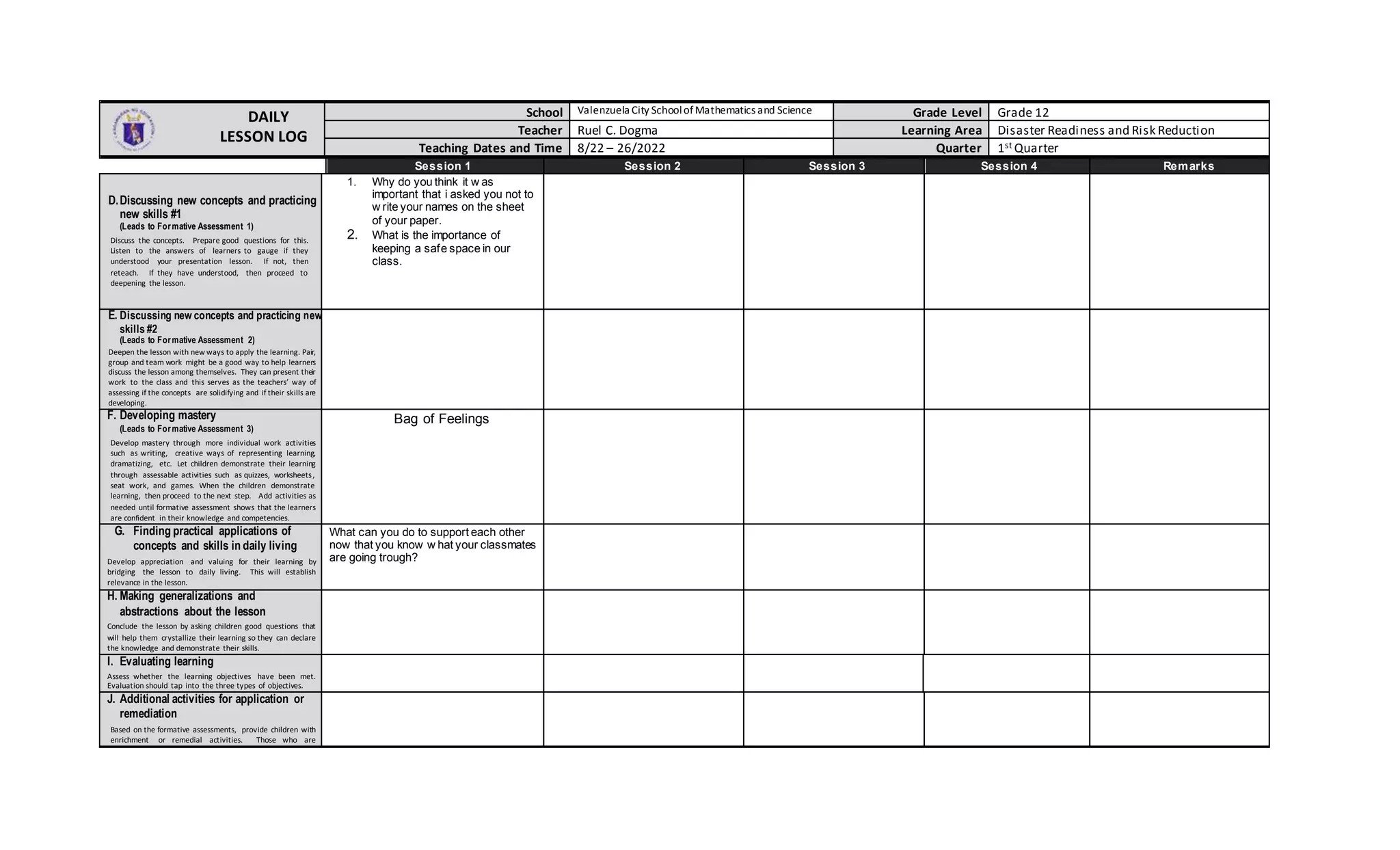
1. Why do you think it w as
important that i asked you not to
w rite your names on the sheet
of your paper.
2. What is the importance of
keeping a safe space in our
class.
E. Discussing new concepts and practicing new
skills #2
(Leads to Formative Assessment 2)
Deepen the lesson with new ways to apply the learning. Pair,
group and team work might be a good way to help learners
discuss the lesson among themselves. They can present their
work to the class and this serves as the teachers’ way of
assessing if the concepts are solidifying and if their skills are
developing.
F. Developing mastery
(Leads to Formative Assessment 3)
Develop mastery through more individual work activities
such as writing, creative ways of representing learning,
dramatizing, etc. Let children demonstrate their learning
through assessable activities such as quizzes, worksheets,
seat work, and games. When the children demonstrate
learning, then proceed to the next step. Add activities as
needed until formative assessment shows that the learners
are confident in their knowledge and competencies.
Bag of Feelings
G. Finding practical applications of
concepts and skills in daily living
Develop appreciation and valuing for their learning by
bridging the lesson to daily living. This will establish
relevance in the lesson.
What can you do to support each other
now that you know w hat your classmates
are going trough?
H. Making generalizations and
abstractions about the lesson
Conclude the lesson by asking children good questions that
will help them crystallize their learning so they can declare
the knowledge and demonstrate their skills.
I. Evaluating learning
Assess whether the learning objectives have been met.
Evaluation should tap into the three types of objectives.
J. Additional activities for application or
remediation
Based on the formative assessments, provide children with
enrichment or remedial activities. Those who are
DAILY
LESSON LOG
School Valenzuela City SchoolofMathematics and Science Grade Level Grade 12
Teacher Ruel C. Dogma Learning Area Disaster Readiness and Risk Reduction
Teaching Dates and Time 8/22 – 26/2022 Quarter 1st Quarter
Session 1 Session 2 Session 3 Session 4 Remarks
demonstrating difficulties with the lesson should be given
extra time by the teacher for additional teaching.
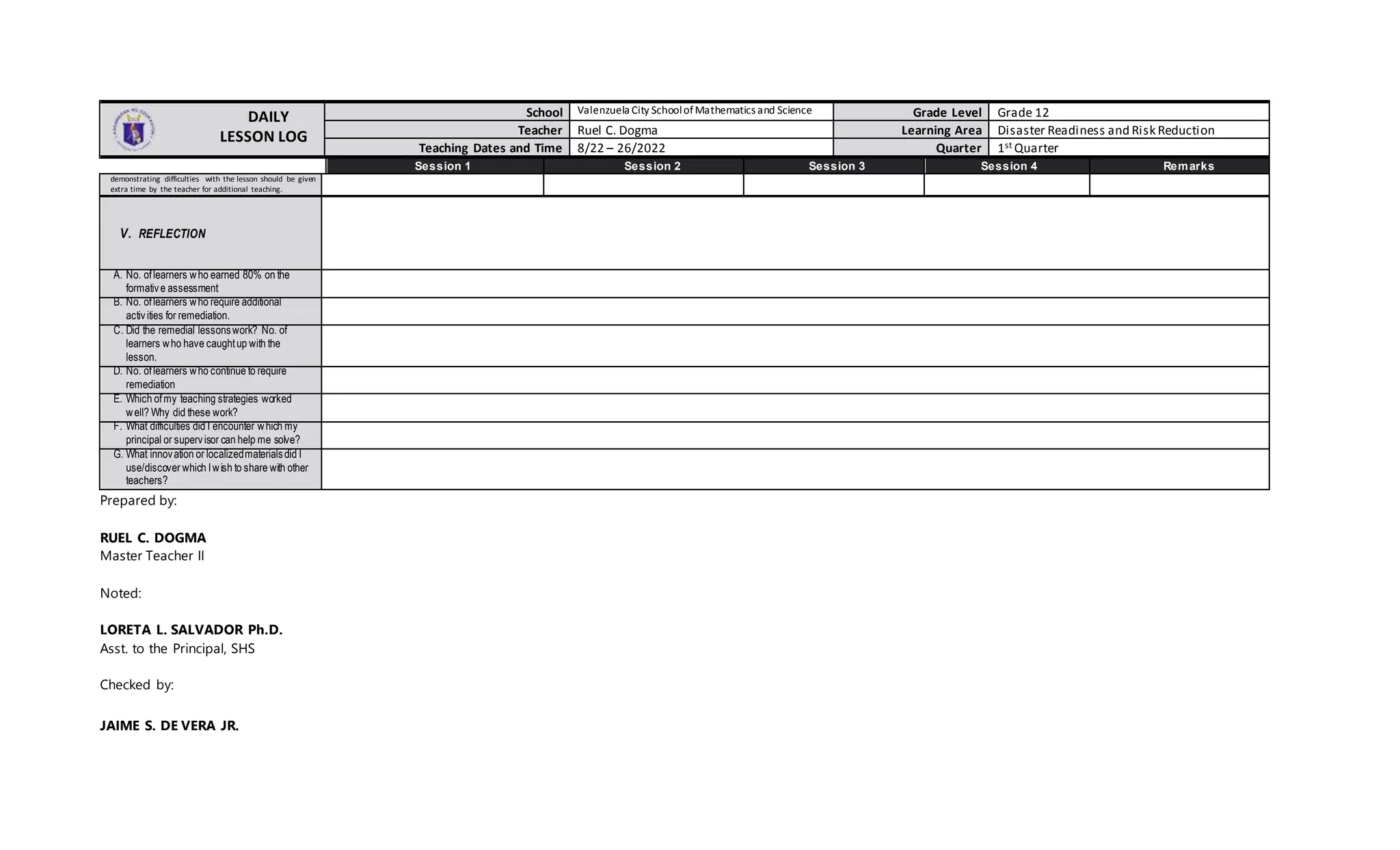
V. REFLECTION
A. No. oflearners who earned 80% on the
formative assessment
B. No. oflearners who require additional
activities for remediation.
C. Did the remedial lessonswork? No. of
learners who have caughtup with the
lesson.
D. No. oflearners who continue to require
remediation
E. Which ofmy teaching strategies worked
well? Why did these work?
F. What difficulties did I encounter which my
principal or supervisor can help me solve?
G. What innovation or localizedmaterialsdid I
use/discover which Iwish to share with other
teachers?
Prepared by:
RUEL C. DOGMA
Master Teacher II
Noted:
LORETA L. SALVADOR Ph.D.
Asst. to the Principal, SHS
Checked by:
JAIME S. DE VERA JR.
Principal III

DRRR Week 1 2022-2023.docx

  • 1.
    DAILY LESSON LOG School ValenzuelaCity SchoolofMathematics and Science Grade Level Grade 12 Teacher Ruel C. Dogma Learning Area Disaster Readiness and Risk Reduction Teaching Dates and Time 8/22 – 26/2022 Quarter 1st Quarter Session 1 Session 2 Session 3 Session 4 Remarks I. WEEKLY OBJECTIVES A. Content Standards Psychosocial Support Activity Discussion of House/Class Rules Introduction about the Topic Assessement B. Performance Standards C. LearningCompetencies / Objectives Write the LC code for each Practice language, reading, listening and problem solving skills, develop creative thinking and expression. II. CONTENT Psychosocial Support Activity Submission of Output Communication Etiquette Grade Requirements Channeling of Concers Overview of the Lessons Discussion of Budget of Work Pre-test III. LEARNING RESOURCES A. References 1. Teacher’s Guide pages Psychosocial Support Activity Pack p 63-67 2. Learner’s Materials pages 3. Textbook pages 4. Additional Materials from Learning Resource (LR) portal B. Other Learning Resources IV. PROCEDURES A.Establishing a purpose for the lesson Motivate them to learn the new lesson. Encourage them to ask questions about the new topic. This will help establish a reason for learning the new lessons. Develop self-awareness, self expression, self understanding and empathy. B.Reviewing yesterday’s lesson or Presenting the new lesson Connect the lesson with learners’ prior knowledge. Explicitly teach to the learners how the new lesson connects to previous lessons. Review and present new lessons in a systematic manner. C.Presenting examples/ instances of the new lesson Provide examples of the new lesson. Show what the instances of the content and competencies. This is where the concepts are clarified.
  • 2.
    DAILY LESSON LOG School ValenzuelaCity SchoolofMathematics and Science Grade Level Grade 12 Teacher Ruel C. Dogma Learning Area Disaster Readiness and Risk Reduction Teaching Dates and Time 8/22 – 26/2022 Quarter 1st Quarter Session 1 Session 2 Session 3 Session 4 Remarks D.Discussing new concepts and practicing new skills #1 (Leads to Formative Assessment 1) Discuss the concepts. Prepare good questions for this. Listen to the answers of learners to gauge if they understood your presentation lesson. If not, then reteach. If they have understood, then proceed to deepening the lesson. 1. Why do you think it w as important that i asked you not to w rite your names on the sheet of your paper. 2. What is the importance of keeping a safe space in our class. E. Discussing new concepts and practicing new skills #2 (Leads to Formative Assessment 2) Deepen the lesson with new ways to apply the learning. Pair, group and team work might be a good way to help learners discuss the lesson among themselves. They can present their work to the class and this serves as the teachers’ way of assessing if the concepts are solidifying and if their skills are developing. F. Developing mastery (Leads to Formative Assessment 3) Develop mastery through more individual work activities such as writing, creative ways of representing learning, dramatizing, etc. Let children demonstrate their learning through assessable activities such as quizzes, worksheets, seat work, and games. When the children demonstrate learning, then proceed to the next step. Add activities as needed until formative assessment shows that the learners are confident in their knowledge and competencies. Bag of Feelings G. Finding practical applications of concepts and skills in daily living Develop appreciation and valuing for their learning by bridging the lesson to daily living. This will establish relevance in the lesson. What can you do to support each other now that you know w hat your classmates are going trough? H. Making generalizations and abstractions about the lesson Conclude the lesson by asking children good questions that will help them crystallize their learning so they can declare the knowledge and demonstrate their skills. I. Evaluating learning Assess whether the learning objectives have been met. Evaluation should tap into the three types of objectives. J. Additional activities for application or remediation Based on the formative assessments, provide children with enrichment or remedial activities. Those who are
  • 3.
    DAILY LESSON LOG School ValenzuelaCity SchoolofMathematics and Science Grade Level Grade 12 Teacher Ruel C. Dogma Learning Area Disaster Readiness and Risk Reduction Teaching Dates and Time 8/22 – 26/2022 Quarter 1st Quarter Session 1 Session 2 Session 3 Session 4 Remarks demonstrating difficulties with the lesson should be given extra time by the teacher for additional teaching. V. REFLECTION A. No. oflearners who earned 80% on the formative assessment B. No. oflearners who require additional activities for remediation. C. Did the remedial lessonswork? No. of learners who have caughtup with the lesson. D. No. oflearners who continue to require remediation E. Which ofmy teaching strategies worked well? Why did these work? F. What difficulties did I encounter which my principal or supervisor can help me solve? G. What innovation or localizedmaterialsdid I use/discover which Iwish to share with other teachers? Prepared by: RUEL C. DOGMA Master Teacher II Noted: LORETA L. SALVADOR Ph.D. Asst. to the Principal, SHS Checked by: JAIME S. DE VERA JR.
  • 4.