energy
         FactS


     Driving Emissions to Zero: A Strong California
     Zero Emissions Vehicle Program Can Deliver the
le   Future of Electric Cars
 S   Battery, fuel cell, and plug-in hybrid electric cars are a key part of California’s efforts to protect public health,
     improve our nation’s energy security, and reach our long-term carbon reduction goals. California now has
     an opportunity to achieve these goals as the California Air Resources Board (ARB) works to set strong Zero
     Emissions Vehicle (ZEV) requirements through 2025. Updating these standards will drive advanced vehicle
     technologies not only in California, but around the nation.

     caliFornia can lead the electric-drive                                    California can help advance the successful commercial-
                                                                            ization of electric-drive vehicles by sending a strong signal to
     Market Forward
                                                                            automakers to continue investing in electric-drive technol-
     To avoid the worst consequences of global warming, cars in             ogy. To build a future where electric-drive cars are as readily
     California and the United States must produce 80 percent to            available as airbags and power steering, the California ARB
     90 percent less global warming pollution than they do today.1          must strengthen the ZEV standard beyond what is currently
     Nearly all stakeholders, including government agencies,                being proposed to help put at least 1.8 million new electric-
     energy and climate experts, and even automakers, agree                 drive cars on the road in California between 2018 and 2025.
     that large-scale commercialization of electric-drive vehicles          Together with the ten other states that have adopted Califor-
     is necessary to achieve long-term carbon and oil reduction             nia’s ZEV standards, this could result in at least 5 percent of
     goals. While electric-drive cars alone cannot achieve this             the U.S. market being electric-drive by 2025. By requiring half
     goal, analysis by ARB, automakers, the International Energy            or more of these vehicles to run exclusively on electricity or
     Agency, Natural Resources Defense Council, and the Union               hydrogen, California will ensure that investments continue
     of Concerned Scientists, all show that it will be critical for a       to be made in the technology solutions necessary to reach
     large majority of vehicles to have significant electric-drive          climate and energy goals.
     capability by 2040.2                                                      Given past rates of automotive technology progress,
                                                                            electric cars need to reach a national mass market level of
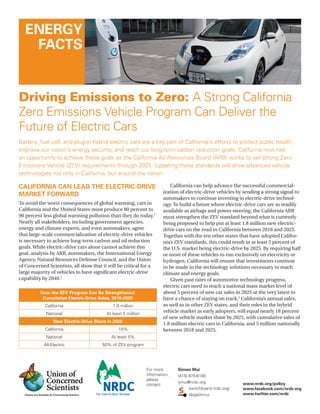
               how the Zev Program can Be Strengthened:                     about 5 percent of new car sales in 2025 at the very latest to
                cumulative electric-drive Sales, 2018-2025                  have a chance of staying on track.3 California’s annual sales,
                 California                      1.8 million                as well as in other ZEV states, and their roles in the hybrid
                 National                     At least 5 million
                                                                            vehicle market as early adopters, will equal nearly 18 percent
                                                                            of new vehicle market share by 2025, with cumulative sales of
                     new electric-drive Share in 2025
                                                                            1.8 million electric cars in California, and 5 million nationally
                 California                         18%                     between 2018 and 2025.
                 National                       At least 5%
                All-Electric                50% of ZEV program


                                                                   For more        Simon Mui
                                                                   information,    (415) 875-6100
                                                                   please
                                                                                   smui@nrdc.org                 www.nrdc.org/policy
                                                                   contact:
                                                                                         switchboard.nrdc.org/   www.facebook.com/nrdc.org
                                                                                         blogs/smui              www.twitter.com/nrdc
electric vehicles critical to Meeting climate goals                                                         auto induStry aiMS to weaken Zero
                                                                                                                                    eMiSSionS vehicle StandardS
                                                    3.0
                                                                                                                                    Some members of the industry have spoken out publically
U.S. Car and Light-Truck Global Warming Pollution


                                                                                                                                    against the ZEV program, the only initiative in the United
                                                    2.5                                                                             States ensuring long-term, continued investments in
                                                                                                         line
                                                                                                     Base
                                                                                            othing                                  advanced electric-drive technologies. As California highlights
                                                                                       Do-N
                                                                                                                                    the potential to require electric cars to reach as high as 20
                (billion metric tons)


                                                    2.0
                                                                                                     Fuel Economy
                                                                                                                                    percent of auto sales in California by 2025. Some automakers,
                                                                                                                                    in turn for signing on to a deal to set national automobile
                                                    1.5
                                                                                                                                    greenhouse gas standards through 2025, have demanded a
                                                                                                 Sustainable Biofuel                provision that could cut their obligations under ZEV by up to
                                                    1.0                                                                             40 percent between 2018 and 2021.4
                                                                                                                Electrification

                                                                        Remaining
                                                    0.5
                                                                 Global Warming Pollution                                           StateS MuSt ShiFt electric carS
                                                                                                                                    into high gear
                                                    0.0 2010   2015   2020   2025      2030      2035       2040    2045     2050
                                                                                                                                    The ZEV program was established in 1990 to protect public
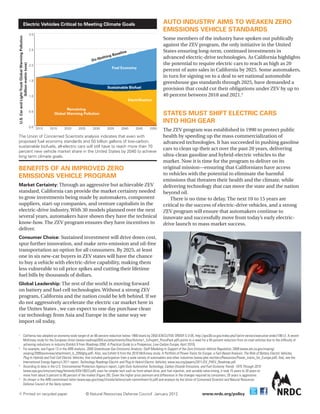
The Union of Concerned Scientists analysis indicates that even with                                                                 health by speeding up the mass commercialization of
proposed fuel economy standards and 50 billion gallons of low-carbon,                                                               advanced technologies. It has succeeded in pushing gasoline
sustainable biofuels, all-electric cars will still have to reach more than 70
                                                                                                                                    cars to clean up their act over the past 20 years, delivering
percent new vehicle market share in the United States by 2040 to achieve
long term climate goals.                                                                                                            ultra-clean gasoline and hybrid-electric vehicles to the
                                                                                                                                    market. Now it is time for the program to deliver on its
BeneFitS oF an iMProved Zero                                                                                                        original mission—ensuring that Californians have access
                                                                                                                                    to vehicles with the potential to eliminate the harmful
eMiSSionS vehicle PrograM
                                                                                                                                    emissions that threaten their health and the climate, while
Market certainty: Through an aggressive but achievable ZEV                                                                          delivering technology that can move the state and the nation
standard, California can provide the market certainty needed                                                                        beyond oil.
to grow investments being made by automakers, component                                                                                 There is no time to delay. The next 10 to 15 years are
suppliers, start-up companies, and venture capitalists in the                                                                       critical to the success of electric-drive vehicles, and a strong
electric-drive industry. With 30 models planned over the next                                                                       ZEV program will ensure that automakers continue to
several years, automakers have shown they have the technical                                                                        innovate and successfully move from today’s early electric-
know-how. The ZEV program ensures they have incentives to                                                                           drive launch to mass market success.
deliver.
consumer choice: Sustained investment will drive down cost,
spur further innovation, and make zero-emission and oil-free
transportation an option for all consumers. By 2025, at least
one in six new-car buyers in ZEV states will have the chance
to buy a vehicle with electric-drive capability, making them
less vulnerable to oil price spikes and cutting their lifetime
fuel bills by thousands of dollars.
global leadership: The rest of the world is moving forward
on battery and fuel cell technologies. Without a strong ZEV
program, California and the nation could be left behind. If we
do not aggressively accelerate the electric car market here in
the Unites States , we can expect to one day purchase clean
car technology from Asia and Europe in the same way we
import oil today.

 1
                         California has adopted an economy-wide target of an 80 percent reduction below 1990 levels by 2050 (EXECUTIVE ORDER S-3-05, http://gov38.ca.gov/index.php?/print-version/executive-order/1861/). A recent
                         McKinsey study for the European Union (www.roadmap2050.eu/attachments/files/Volume1_fullreport_PressPack.pdf) points to a need for a 95 percent reduction from on-road vehicles due to the difficulty of
                         achieving reductions in industry (Exhibit 9 from Roadmap 2050: A Practical Guide to a Prosperous, Low-Carbon Europe, April 2010).
 2
                         For example, see Figure 13 in the ARB analysis, 2050 Greenhouse Gas Emissions Analysis: Staff Modeling in Support of the Zero Emission Vehicle Regulation, 2009 (www.arb.ca.gov/msprog/
                         zevprog/2009zevreview/attachment_b_2050ghg.pdf). Also, see Exhibit 6 from the 2010 McKinsey study, A Portfolio of Power-Trains for Europe, a Fact-Based Analysis: The Role of Battery Electric Vehicles,
                         Plug-In Hybrids and Fuel Cell Electric Vehicles, that included participation from a wide variety of automakers and other industries (www.iphe.net/docs/Resources/Power_trains_for_Europe.pdf). And, see the
                         International Energy Agency’s 2011 report, Technology Roadmap Electric and Plug-In Hybrid Electric Vehicles, www.iea.org/papers/2011/EV_PHEV_Roadmap.pdf.
 3
                         According to data in the U.S. Environmental Protection Agency’s report, Light-Duty Automotive Technology, Carbon Dioxide Emissions, and Fuel Economy Trends: 1975 Through 2010
                         (www.epa.gov/oms/cert/mpg/fetrends/420r10023.pdf), even for simpler tech such as front-wheel drive, port fuel injection, and variable valve timing, it took 15 years to 20 years to
                         move from about 5 percent to 80 percent of the market (Figure 28). Given the higher price premium and differences in the changes required by consumers, 20 years is aggressive.
 4
                         As shown in the ARB commitment letter (www.epa.gov/otaq/climate/letters/carb-commitment-ltr.pdf) and analysis by the Union of Concerned Scientist and Natural Resources
                         Defense Council of the likely system.

                       Printed on recycled paper                                    © Natural Resources Defense Council January 2012                        www.nrdc.org/policy

Driving emissions fs 0112 03hr

  • 1.
    energy FactS Driving Emissions to Zero: A Strong California Zero Emissions Vehicle Program Can Deliver the le Future of Electric Cars S Battery, fuel cell, and plug-in hybrid electric cars are a key part of California’s efforts to protect public health, improve our nation’s energy security, and reach our long-term carbon reduction goals. California now has an opportunity to achieve these goals as the California Air Resources Board (ARB) works to set strong Zero Emissions Vehicle (ZEV) requirements through 2025. Updating these standards will drive advanced vehicle technologies not only in California, but around the nation. caliFornia can lead the electric-drive California can help advance the successful commercial- ization of electric-drive vehicles by sending a strong signal to Market Forward automakers to continue investing in electric-drive technol- To avoid the worst consequences of global warming, cars in ogy. To build a future where electric-drive cars are as readily California and the United States must produce 80 percent to available as airbags and power steering, the California ARB 90 percent less global warming pollution than they do today.1 must strengthen the ZEV standard beyond what is currently Nearly all stakeholders, including government agencies, being proposed to help put at least 1.8 million new electric- energy and climate experts, and even automakers, agree drive cars on the road in California between 2018 and 2025. that large-scale commercialization of electric-drive vehicles Together with the ten other states that have adopted Califor- is necessary to achieve long-term carbon and oil reduction nia’s ZEV standards, this could result in at least 5 percent of goals. While electric-drive cars alone cannot achieve this the U.S. market being electric-drive by 2025. By requiring half goal, analysis by ARB, automakers, the International Energy or more of these vehicles to run exclusively on electricity or Agency, Natural Resources Defense Council, and the Union hydrogen, California will ensure that investments continue of Concerned Scientists, all show that it will be critical for a to be made in the technology solutions necessary to reach large majority of vehicles to have significant electric-drive climate and energy goals. capability by 2040.2 Given past rates of automotive technology progress, electric cars need to reach a national mass market level of how the Zev Program can Be Strengthened: about 5 percent of new car sales in 2025 at the very latest to cumulative electric-drive Sales, 2018-2025 have a chance of staying on track.3 California’s annual sales, California 1.8 million as well as in other ZEV states, and their roles in the hybrid National At least 5 million vehicle market as early adopters, will equal nearly 18 percent of new vehicle market share by 2025, with cumulative sales of new electric-drive Share in 2025 1.8 million electric cars in California, and 5 million nationally California 18% between 2018 and 2025. National At least 5% All-Electric 50% of ZEV program For more Simon Mui information, (415) 875-6100 please smui@nrdc.org www.nrdc.org/policy contact: switchboard.nrdc.org/ www.facebook.com/nrdc.org blogs/smui www.twitter.com/nrdc
  • 2.
    electric vehicles criticalto Meeting climate goals auto induStry aiMS to weaken Zero eMiSSionS vehicle StandardS 3.0 Some members of the industry have spoken out publically U.S. Car and Light-Truck Global Warming Pollution against the ZEV program, the only initiative in the United 2.5 States ensuring long-term, continued investments in line Base othing advanced electric-drive technologies. As California highlights Do-N the potential to require electric cars to reach as high as 20 (billion metric tons) 2.0 Fuel Economy percent of auto sales in California by 2025. Some automakers, in turn for signing on to a deal to set national automobile 1.5 greenhouse gas standards through 2025, have demanded a Sustainable Biofuel provision that could cut their obligations under ZEV by up to 1.0 40 percent between 2018 and 2021.4 Electrification Remaining 0.5 Global Warming Pollution StateS MuSt ShiFt electric carS into high gear 0.0 2010 2015 2020 2025 2030 2035 2040 2045 2050 The ZEV program was established in 1990 to protect public The Union of Concerned Scientists analysis indicates that even with health by speeding up the mass commercialization of proposed fuel economy standards and 50 billion gallons of low-carbon, advanced technologies. It has succeeded in pushing gasoline sustainable biofuels, all-electric cars will still have to reach more than 70 cars to clean up their act over the past 20 years, delivering percent new vehicle market share in the United States by 2040 to achieve long term climate goals. ultra-clean gasoline and hybrid-electric vehicles to the market. Now it is time for the program to deliver on its BeneFitS oF an iMProved Zero original mission—ensuring that Californians have access to vehicles with the potential to eliminate the harmful eMiSSionS vehicle PrograM emissions that threaten their health and the climate, while Market certainty: Through an aggressive but achievable ZEV delivering technology that can move the state and the nation standard, California can provide the market certainty needed beyond oil. to grow investments being made by automakers, component There is no time to delay. The next 10 to 15 years are suppliers, start-up companies, and venture capitalists in the critical to the success of electric-drive vehicles, and a strong electric-drive industry. With 30 models planned over the next ZEV program will ensure that automakers continue to several years, automakers have shown they have the technical innovate and successfully move from today’s early electric- know-how. The ZEV program ensures they have incentives to drive launch to mass market success. deliver. consumer choice: Sustained investment will drive down cost, spur further innovation, and make zero-emission and oil-free transportation an option for all consumers. By 2025, at least one in six new-car buyers in ZEV states will have the chance to buy a vehicle with electric-drive capability, making them less vulnerable to oil price spikes and cutting their lifetime fuel bills by thousands of dollars. global leadership: The rest of the world is moving forward on battery and fuel cell technologies. Without a strong ZEV program, California and the nation could be left behind. If we do not aggressively accelerate the electric car market here in the Unites States , we can expect to one day purchase clean car technology from Asia and Europe in the same way we import oil today. 1 California has adopted an economy-wide target of an 80 percent reduction below 1990 levels by 2050 (EXECUTIVE ORDER S-3-05, http://gov38.ca.gov/index.php?/print-version/executive-order/1861/). A recent McKinsey study for the European Union (www.roadmap2050.eu/attachments/files/Volume1_fullreport_PressPack.pdf) points to a need for a 95 percent reduction from on-road vehicles due to the difficulty of achieving reductions in industry (Exhibit 9 from Roadmap 2050: A Practical Guide to a Prosperous, Low-Carbon Europe, April 2010). 2 For example, see Figure 13 in the ARB analysis, 2050 Greenhouse Gas Emissions Analysis: Staff Modeling in Support of the Zero Emission Vehicle Regulation, 2009 (www.arb.ca.gov/msprog/ zevprog/2009zevreview/attachment_b_2050ghg.pdf). Also, see Exhibit 6 from the 2010 McKinsey study, A Portfolio of Power-Trains for Europe, a Fact-Based Analysis: The Role of Battery Electric Vehicles, Plug-In Hybrids and Fuel Cell Electric Vehicles, that included participation from a wide variety of automakers and other industries (www.iphe.net/docs/Resources/Power_trains_for_Europe.pdf). And, see the International Energy Agency’s 2011 report, Technology Roadmap Electric and Plug-In Hybrid Electric Vehicles, www.iea.org/papers/2011/EV_PHEV_Roadmap.pdf. 3 According to data in the U.S. Environmental Protection Agency’s report, Light-Duty Automotive Technology, Carbon Dioxide Emissions, and Fuel Economy Trends: 1975 Through 2010 (www.epa.gov/oms/cert/mpg/fetrends/420r10023.pdf), even for simpler tech such as front-wheel drive, port fuel injection, and variable valve timing, it took 15 years to 20 years to move from about 5 percent to 80 percent of the market (Figure 28). Given the higher price premium and differences in the changes required by consumers, 20 years is aggressive. 4 As shown in the ARB commitment letter (www.epa.gov/otaq/climate/letters/carb-commitment-ltr.pdf) and analysis by the Union of Concerned Scientist and Natural Resources Defense Council of the likely system. Printed on recycled paper © Natural Resources Defense Council January 2012 www.nrdc.org/policy