DRAWING DIAGRAMS
TO
ILLUSTRATE GEOGRAPHICAL FEATURES
PROCEDURE
In Geography you may be asked to draw a sketch diagram. The purpose of a sketch is to identify the
main geographical features of a landform or landscape. When drawing a sketch diagram, substance is
more important over quantity, that means, you don’t have to spend time drawing a lot of irrelevant
details that may be confusing. Instead, think about what it is that you are trying to show, concentrate
on these aspects, clearly show them in your sketch and draw them accurately and neatly.
Use a sharp pencil, and add detailed labels to your sketch.
Labels are called annotations. Remember
none annotated diagrams will give you no
marks so spare the time to properly label your
diagrams.
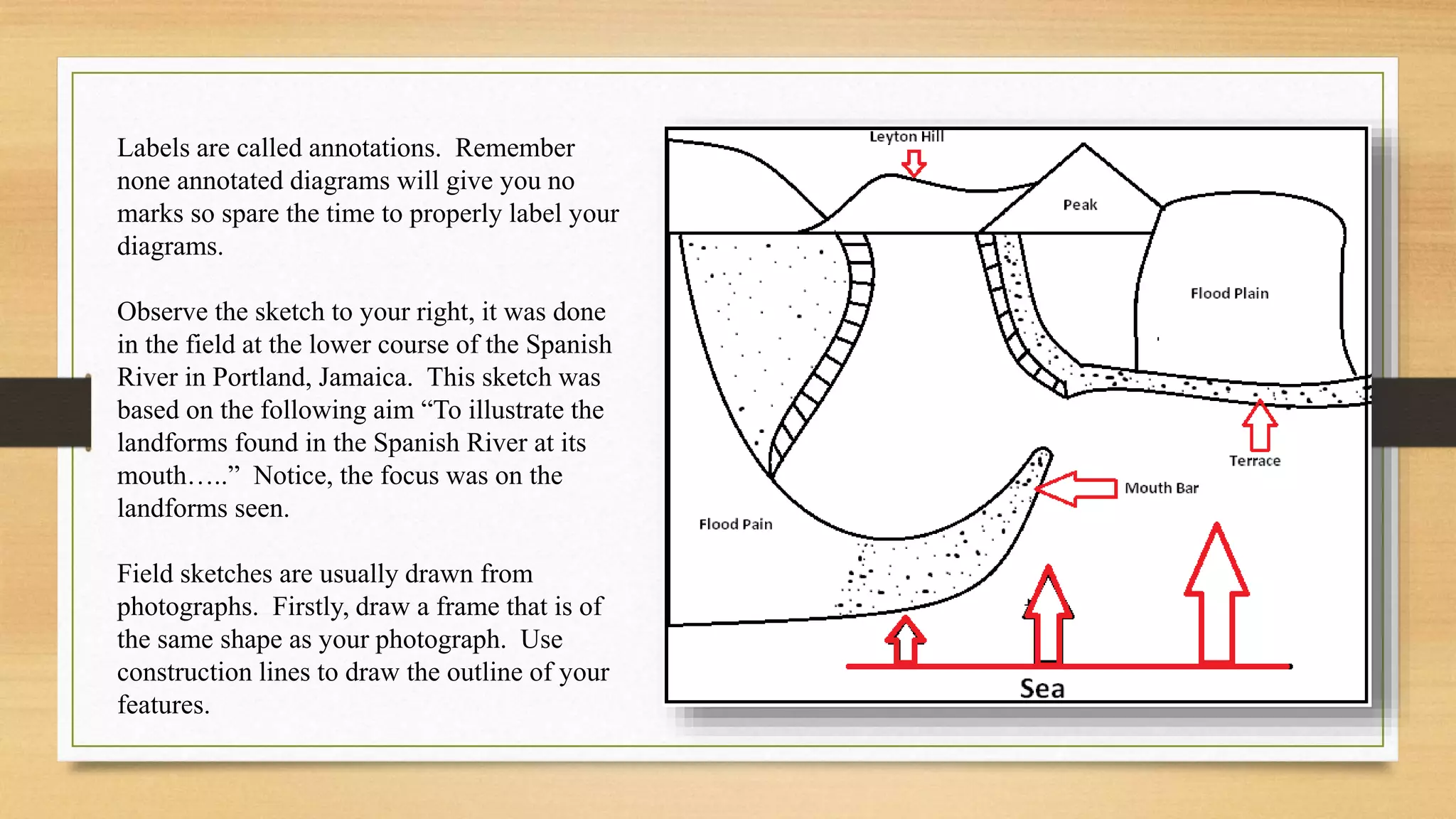
Observe the sketch to your right, it was done
in the field at the lower course of the Spanish
River in Portland, Jamaica. This sketch was
based on the following aim “To illustrate the
landforms found in the Spanish River at its
mouth…..” Notice, the focus was on the
landforms seen.
Field sketches are usually drawn from
photographs. Firstly, draw a frame that is of
the same shape as your photograph. Use
construction lines to draw the outline of your
features.
Next, give your sketch detail with black ink. Do not be afraid to colour your diagrams or sketches with
penciled crayons. Under exam time constraints, this may not always be possible but for the S.B.A. it is.
Once again, always remember that your diagrams/sketches are incomplete without labels. Additionally,
remember to give your diagram an appropriate title. For the field sketch, it is important to incorporate
your sketches with your text instead of separating them. Finally, throughout your study, ensure that you
always make reference to your diagrams in order to maximize your marks.

Drawing diagrams

  • 1.
  • 2.
    PROCEDURE In Geography youmay be asked to draw a sketch diagram. The purpose of a sketch is to identify the main geographical features of a landform or landscape. When drawing a sketch diagram, substance is more important over quantity, that means, you don’t have to spend time drawing a lot of irrelevant details that may be confusing. Instead, think about what it is that you are trying to show, concentrate on these aspects, clearly show them in your sketch and draw them accurately and neatly. Use a sharp pencil, and add detailed labels to your sketch.
  • 3.
    Labels are calledannotations. Remember none annotated diagrams will give you no marks so spare the time to properly label your diagrams. Observe the sketch to your right, it was done in the field at the lower course of the Spanish River in Portland, Jamaica. This sketch was based on the following aim “To illustrate the landforms found in the Spanish River at its mouth…..” Notice, the focus was on the landforms seen. Field sketches are usually drawn from photographs. Firstly, draw a frame that is of the same shape as your photograph. Use construction lines to draw the outline of your features.
  • 4.
    Next, give yoursketch detail with black ink. Do not be afraid to colour your diagrams or sketches with penciled crayons. Under exam time constraints, this may not always be possible but for the S.B.A. it is. Once again, always remember that your diagrams/sketches are incomplete without labels. Additionally, remember to give your diagram an appropriate title. For the field sketch, it is important to incorporate your sketches with your text instead of separating them. Finally, throughout your study, ensure that you always make reference to your diagrams in order to maximize your marks.