INSECTS:
                                    FACTS ABOUT BEES


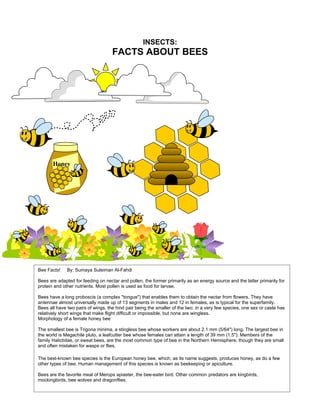
       Honey


Bee Facts!    By: Sumaya Suleiman Al-Fahdi

Bees are adapted for feeding on nectar and pollen, the former primarily as an energy source and the latter primarily for
protein and other nutrients. Most pollen is used as food for larvae.

Bees have a long proboscis (a complex "tongue") that enables them to obtain the nectar from flowers. They have
antennae almost universally made up of 13 segments in males and 12 in females, as is typical for the superfamily.
Bees all have two pairs of wings, the hind pair being the smaller of the two; in a very few species, one sex or caste has
relatively short wings that make flight difficult or impossible, but none are wingless.
Morphology of a female honey bee

The smallest bee is Trigona minima, a stingless bee whose workers are about 2.1 mm (5/64") long. The largest bee in
the world is Megachile pluto, a leafcutter bee whose females can attain a length of 39 mm (1.5"). Members of the
family Halictidae, or sweat bees, are the most common type of bee in the Northern Hemisphere, though they are small
and often mistaken for wasps or flies.

The best-known bee species is the European honey bee, which, as its name suggests, produces honey, as do a few
other types of bee. Human management of this species is known as beekeeping or apiculture.

Bees are the favorite meal of Merops apiaster, the bee-eater bird. Other common predators are kingbirds,
mockingbirds, bee wolves and dragonflies.

Drawing

  • 1.
    INSECTS: FACTS ABOUT BEES Honey Bee Facts! By: Sumaya Suleiman Al-Fahdi Bees are adapted for feeding on nectar and pollen, the former primarily as an energy source and the latter primarily for protein and other nutrients. Most pollen is used as food for larvae. Bees have a long proboscis (a complex "tongue") that enables them to obtain the nectar from flowers. They have antennae almost universally made up of 13 segments in males and 12 in females, as is typical for the superfamily. Bees all have two pairs of wings, the hind pair being the smaller of the two; in a very few species, one sex or caste has relatively short wings that make flight difficult or impossible, but none are wingless. Morphology of a female honey bee The smallest bee is Trigona minima, a stingless bee whose workers are about 2.1 mm (5/64") long. The largest bee in the world is Megachile pluto, a leafcutter bee whose females can attain a length of 39 mm (1.5"). Members of the family Halictidae, or sweat bees, are the most common type of bee in the Northern Hemisphere, though they are small and often mistaken for wasps or flies. The best-known bee species is the European honey bee, which, as its name suggests, produces honey, as do a few other types of bee. Human management of this species is known as beekeeping or apiculture. Bees are the favorite meal of Merops apiaster, the bee-eater bird. Other common predators are kingbirds, mockingbirds, bee wolves and dragonflies.