Drama Genre Conventions
Conventions
As a part of my A level project, I will as well exhibit a piece
of the drama genre.Therefore, due to the fact that I have
already covered the codes and conventions of the drama
genre during myAS level research, I will revise my
previously acquired knowledge of the following
presentation as a basis for my knowledge of filming this
type of genre. In regards, to indulging into the premise of
my film, being inner conflict, more accurately I will base
my knowledge on previous existing dramas with the
addition of relating the codes and conventions of my film
to the standardized ones of the drama genre.
Prior to developing and consequently finalizing my
film idea, I have decided to obtain a deeper insight
into the genre of my short film in order to
understand which conventions I should incorporate
into my project most accurately and appropriately.
In order to fully indulge into my genre research of
drama I will base my secondary tasks on different
sources so that I would have a broad understanding
of the genre. In addition of main drama genre
conventions I will carry out research into specific
sub-genre which would enable me to crystallize my
final film idea in regards to script writing, filming
and editing.
 For drama to achieve its fullest impact upon the public, it must include
symbolizing conventions which exhibit how the story is portrayed.
 Drama as a genre exhibits an increase and thus dramatization of human
emotion. These aspects can be implemented through a variety of socially
indulging event such as: poverty, class difference, moral dilemmas….etc.
“I thought drama was when the actors cried.
But Drama is when the audience cries.”
- Frank Capra
Conventions
 All drama films are created to be full of tension by the
soundtrack/music playing a crucial part in this factor. With
mysterious intense scores the director can initiate emotions in
the spectator.
 Known for challenging the ignorance of stereotypes
 The plot connects on a more complex/personal level with the
audience
 The storyline has therapeutic qualities since it shows the
protagonist overcoming his/her difficulties demonstrating
therapeutic qualities  causes the audience to think after the film
 This genre displays a serious representation of real life situations
through highlighting the aspects which affect everyday life and
how they can or cannot be resolved.
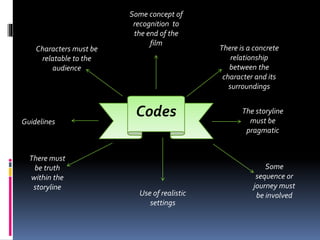
Codes
Characters must be
relatable to the
audience
Some concept of
recognition to
the end of the
film
There is a concrete
relationship
between the
character and its
surroundings
The storyline
must be
pragmatic
Some
sequence or
journey must
be involvedUse of realistic
settings
Guidelines
There must
be truth
within the
storyline
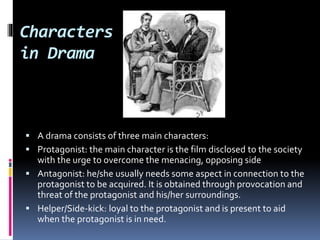
Characters
in Drama
 A drama consists of three main characters:
 Protagonist: the main character is the film disclosed to the society
with the urge to overcome the menacing, opposing side
 Antagonist: he/she usually needs some aspect in connection to the
protagonist to be acquired. It is obtained through provocation and
threat of the protagonist and his/her surroundings.
 Helper/Side-kick: loyal to the protagonist and is present to aid
when the protagonist is in need.
Sherlock Holmes and
John Watson – the
famous protagonist and
helper duo
 The main premise behind the
evolution of the protagonist is
his/her transition through the
film which consists of climaxes
and anti-climaxes which keep
the audience indulged and the
tension to increase.
 The struggle of the character
through the storyline involves
inner and outer conflict.
 The character is constructed to
be made relatable and usually an
average or normal person that
fits into reality so the events
happening to him/her have a
deeper meaning to the
audience.
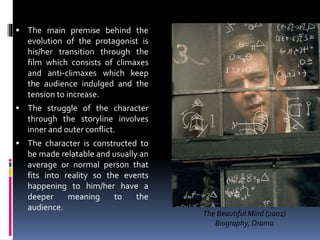
The Beautiful Mind (2001)
Biography, Drama
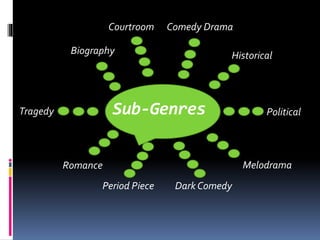
Sub-Genres
Biography
Courtroom Comedy Drama
Historical
Tragedy Political
Romance
Period Piece Dark Comedy
Melodrama
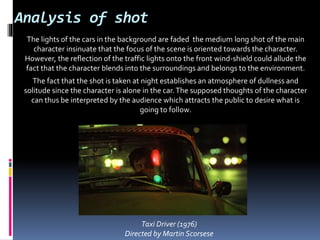
Analysis of shot
The lights of the cars in the background are faded the medium long shot of the main
character insinuate that the focus of the scene is oriented towards the character.
However, the reflection of the traffic lights onto the front wind-shield could allude the
fact that the character blends into the surroundings and belongs to the environment.
The fact that the shot is taken at night establishes an atmosphere of dullness and
solitude since the character is alone in the car.The supposed thoughts of the character
can thus be interpreted by the audience which attracts the public to desire what is
going to follow.
Taxi Driver (1976)
Directed by Martin Scorsese
Evaluation
During this secondary research, I have summarized key
drama conventions which will be incorporated in the
development of my own film idea and later on in the
making of film opening sequence. In order to visually
communicate with desired audience these conventions
must be applied during production and post production
stage (filming, editing).The following task will be to do a
detailed research of a sub-genre that is appropriate to
my final film idea.
Relationbetweenthecodesandconventionofdrama
andmyAlevelfilm
 1. Human emotion:The film is entirely based on the human emotion of guilt and
regret due to an involuntarily action making the lead character’s remorse even more
poignant
 2.Tension created by the soundtrack/music: In the wish to make my film more
artistically oriented yet still follow the principles of a short film and drama genre, I to
an extent challenged this notion by implementing both jolly and melancholic music
in order to create the contrast between the two personalities even more.
 3. Challenging the ignorance of stereotypes:With the goal of my film to be a of
a highly realistic nature, I aimed to dissolve any form of stereotypes since the sense of
mental health, being the main notion of my film, can be considered a highly taboo
subject in today's world.
 4. Plot connects on a more complex/personal level with the audience: Due
to the plotline revolving around the analysis of a mentally deteriorating character, the
subject of my film therefore illustrates a complex structure that the audience can
therefore relate to.
 5.Therapeutic qualities  causes the audience to think after the film: By
focusing on the dwindling mental health of the main character in combination with an
open-ended conclusion of the film, the audience gets a deeper insight into resolving
the end individually.
 6. A serious representation of real life situations challenged: In order to
accentuate the character’s inner turmoil however still maintaining a sense of realism
towards the storyline, the surrealistic yet mundane exterior structure of a terrace
illustrates the main character’s internal struggle even more
 7. Character must be relatable: Due to the highly broad concept of mental health,
the structure of the character with this notion in mind is already widely relatable due
to the impact of mental stability reaching all mature ages.
 8.There is a concrete relationship between the character and its
surroundings: In order to capture the monotonous and draining cycle of the main
character’s inner struggle the focus of concrete and cold tiles instigates the bleakness
of his “inner” and outer appearance
 9. Structure of characters: typically a film of a drama genre consists of three
characters: the protagonist, antagonist and the helper. However, in my film the
relationship between these characters is linked by the main character.The
protagonist and antagonist are embodied by the inner struggle of the main character
and the helper, also in a way the main character by being his sub-conscious. Therefore
I have challenged the traditional structure in order to make my film more original.
 10.The evolution of the protagonist is his/her transition through the film:
the storyline follows the evolution of the main character’s struggle however the open-
ended conclusion of the play coincides with not only the main character coming to a
latent reasoning but also leaving the audience to think for themselves about the
message. Therefore, each element of the film is “impacted”, the actors and the
audience.

Drama Genre Codes and Conventions

  • 1.
  • 2.
    As a partof my A level project, I will as well exhibit a piece of the drama genre.Therefore, due to the fact that I have already covered the codes and conventions of the drama genre during myAS level research, I will revise my previously acquired knowledge of the following presentation as a basis for my knowledge of filming this type of genre. In regards, to indulging into the premise of my film, being inner conflict, more accurately I will base my knowledge on previous existing dramas with the addition of relating the codes and conventions of my film to the standardized ones of the drama genre.
  • 3.
    Prior to developingand consequently finalizing my film idea, I have decided to obtain a deeper insight into the genre of my short film in order to understand which conventions I should incorporate into my project most accurately and appropriately. In order to fully indulge into my genre research of drama I will base my secondary tasks on different sources so that I would have a broad understanding of the genre. In addition of main drama genre conventions I will carry out research into specific sub-genre which would enable me to crystallize my final film idea in regards to script writing, filming and editing.
  • 4.
     For dramato achieve its fullest impact upon the public, it must include symbolizing conventions which exhibit how the story is portrayed.  Drama as a genre exhibits an increase and thus dramatization of human emotion. These aspects can be implemented through a variety of socially indulging event such as: poverty, class difference, moral dilemmas….etc. “I thought drama was when the actors cried. But Drama is when the audience cries.” - Frank Capra Conventions
  • 5.
     All dramafilms are created to be full of tension by the soundtrack/music playing a crucial part in this factor. With mysterious intense scores the director can initiate emotions in the spectator.  Known for challenging the ignorance of stereotypes  The plot connects on a more complex/personal level with the audience  The storyline has therapeutic qualities since it shows the protagonist overcoming his/her difficulties demonstrating therapeutic qualities  causes the audience to think after the film  This genre displays a serious representation of real life situations through highlighting the aspects which affect everyday life and how they can or cannot be resolved.
  • 6.
    Codes Characters must be relatableto the audience Some concept of recognition to the end of the film There is a concrete relationship between the character and its surroundings The storyline must be pragmatic Some sequence or journey must be involvedUse of realistic settings Guidelines There must be truth within the storyline
  • 7.
    Characters in Drama  Adrama consists of three main characters:  Protagonist: the main character is the film disclosed to the society with the urge to overcome the menacing, opposing side  Antagonist: he/she usually needs some aspect in connection to the protagonist to be acquired. It is obtained through provocation and threat of the protagonist and his/her surroundings.  Helper/Side-kick: loyal to the protagonist and is present to aid when the protagonist is in need. Sherlock Holmes and John Watson – the famous protagonist and helper duo
  • 8.
     The mainpremise behind the evolution of the protagonist is his/her transition through the film which consists of climaxes and anti-climaxes which keep the audience indulged and the tension to increase.  The struggle of the character through the storyline involves inner and outer conflict.  The character is constructed to be made relatable and usually an average or normal person that fits into reality so the events happening to him/her have a deeper meaning to the audience. The Beautiful Mind (2001) Biography, Drama
  • 9.
    Sub-Genres Biography Courtroom Comedy Drama Historical TragedyPolitical Romance Period Piece Dark Comedy Melodrama
  • 10.
    Analysis of shot Thelights of the cars in the background are faded the medium long shot of the main character insinuate that the focus of the scene is oriented towards the character. However, the reflection of the traffic lights onto the front wind-shield could allude the fact that the character blends into the surroundings and belongs to the environment. The fact that the shot is taken at night establishes an atmosphere of dullness and solitude since the character is alone in the car.The supposed thoughts of the character can thus be interpreted by the audience which attracts the public to desire what is going to follow. Taxi Driver (1976) Directed by Martin Scorsese
  • 11.
    Evaluation During this secondaryresearch, I have summarized key drama conventions which will be incorporated in the development of my own film idea and later on in the making of film opening sequence. In order to visually communicate with desired audience these conventions must be applied during production and post production stage (filming, editing).The following task will be to do a detailed research of a sub-genre that is appropriate to my final film idea.
  • 12.
    Relationbetweenthecodesandconventionofdrama andmyAlevelfilm  1. Humanemotion:The film is entirely based on the human emotion of guilt and regret due to an involuntarily action making the lead character’s remorse even more poignant  2.Tension created by the soundtrack/music: In the wish to make my film more artistically oriented yet still follow the principles of a short film and drama genre, I to an extent challenged this notion by implementing both jolly and melancholic music in order to create the contrast between the two personalities even more.  3. Challenging the ignorance of stereotypes:With the goal of my film to be a of a highly realistic nature, I aimed to dissolve any form of stereotypes since the sense of mental health, being the main notion of my film, can be considered a highly taboo subject in today's world.  4. Plot connects on a more complex/personal level with the audience: Due to the plotline revolving around the analysis of a mentally deteriorating character, the subject of my film therefore illustrates a complex structure that the audience can therefore relate to.  5.Therapeutic qualities  causes the audience to think after the film: By focusing on the dwindling mental health of the main character in combination with an open-ended conclusion of the film, the audience gets a deeper insight into resolving the end individually.
  • 13.
     6. Aserious representation of real life situations challenged: In order to accentuate the character’s inner turmoil however still maintaining a sense of realism towards the storyline, the surrealistic yet mundane exterior structure of a terrace illustrates the main character’s internal struggle even more  7. Character must be relatable: Due to the highly broad concept of mental health, the structure of the character with this notion in mind is already widely relatable due to the impact of mental stability reaching all mature ages.  8.There is a concrete relationship between the character and its surroundings: In order to capture the monotonous and draining cycle of the main character’s inner struggle the focus of concrete and cold tiles instigates the bleakness of his “inner” and outer appearance  9. Structure of characters: typically a film of a drama genre consists of three characters: the protagonist, antagonist and the helper. However, in my film the relationship between these characters is linked by the main character.The protagonist and antagonist are embodied by the inner struggle of the main character and the helper, also in a way the main character by being his sub-conscious. Therefore I have challenged the traditional structure in order to make my film more original.  10.The evolution of the protagonist is his/her transition through the film: the storyline follows the evolution of the main character’s struggle however the open- ended conclusion of the play coincides with not only the main character coming to a latent reasoning but also leaving the audience to think for themselves about the message. Therefore, each element of the film is “impacted”, the actors and the audience.