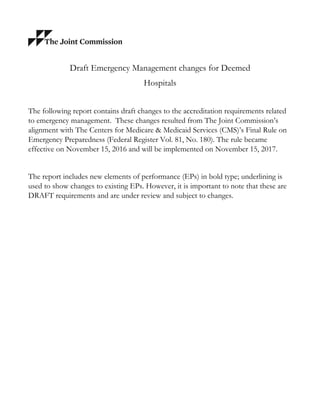
Draft Emergency Management changes for Deemed
Hospitals
The following report contains draft changes to the accreditation requirements related
to emergency management. These changes resulted from The Joint Commission’s
alignment with The Centers for Medicare & Medicaid Services (CMS)’s Final Rule on
Emergency Preparedness (Federal Register Vol. 81, No. 180). The rule became
effective on November 15, 2016 and will be implemented on November 15, 2017.
The report includes new elements of performance (EPs) in bold type; underlining is
used to show changes to existing EPs. However, it is important to note that these are
DRAFT requirements and are under review and subject to changes.
Hospital Accreditation Program
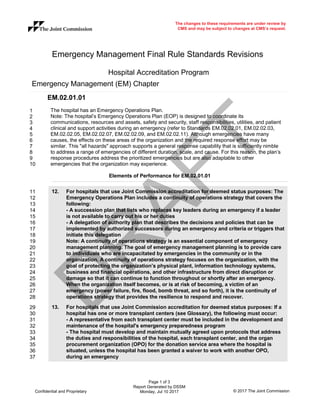
Emergency Management Final Rule Standards Revisions
The changes to these requirements are under review by
CMS and may be subject to changes at CMS’s request.
Emergency Management (EM) Chapter
EM.02.01.01
Elements of Performance for EM.02.01.01
1
2
3
4
5
6
7
8
9
10
The hospital has an Emergency Operations Plan.
Note: The hospital’s Emergency Operations Plan (EOP) is designed to coordinate its
communications, resources and assets, safety and security, staff responsibilities, utilities, and patient
clinical and support activities during an emergency (refer to Standards EM.02.02.01, EM.02.02.03,
EM.02.02.05, EM.02.02.07, EM.02.02.09, and EM.02.02.11). Although emergencies have many
causes, the effects on these areas of the organization and the required response effort may be
similar. This "all hazards" approach supports a general response capability that is sufficiently nimble
to address a range of emergencies of different duration, scale, and cause. For this reason, the plan’s
response procedures address the prioritized emergencies but are also adaptable to other
emergencies that the organization may experience.
11
12
13
14
15
16
17
18
19
20
21
22
23
24
25
26
27
28
For hospitals that use Joint Commission accreditation for deemed status purposes: The
Emergency Operations Plan includes a continuity of operations strategy that covers the
following:
- A succession plan that lists who replaces key leaders during an emergency if a leader
is not available to carry out his or her duties
- A delegation of authority plan that describes the decisions and policies that can be
implemented by authorized successors during an emergency and criteria or triggers that
initiate this delegation
Note: A continuity of operations strategy is an essential component of emergency
management planning. The goal of emergency management planning is to provide care
to individuals who are incapacitated by emergencies in the community or in the
organization. A continuity of operations strategy focuses on the organization, with the
goal of protecting the organization’s physical plant, information technology systems,
business and financial operations, and other infrastructure from direct disruption or
damage so that it can continue to function throughout or shortly after an emergency.
When the organization itself becomes, or is at risk of becoming, a victim of an
emergency (power failure, fire, flood, bomb threat, and so forth), it is the continuity of
operations strategy that provides the resilience to respond and recover.
12.
29
30
31
32
33
34
35
36
37
For hospitals that use Joint Commission accreditation for deemed status purposes: If a
hospital has one or more transplant centers (see Glossary), the following must occur:
- A representative from each transplant center must be included in the development and
maintenance of the hospital's emergency preparedness program
- The hospital must develop and maintain mutually agreed upon protocols that address
the duties and responsibilities of the hospital, each transplant center, and the organ
procurement organization (OPO) for the donation service area where the hospital is
situated, unless the hospital has been granted a waiver to work with another OPO,
during an emergency
13.
Page 1 of 3
Report Generated by DSSM
Monday, Jul 10 2017 © 2017 The Joint CommissionConfidential and Proprietary
D
R
AFT
Hospital Accreditation Program
The changes to these requirements are under review by
CMS and may be subject to changes at CMS’s request.
38
39
40
41
42
43
44
45
46
47
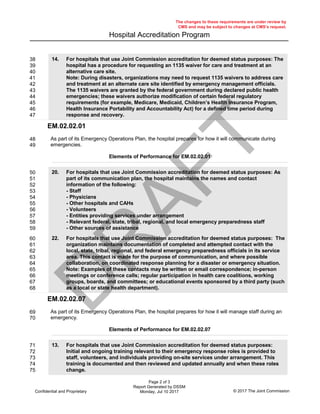
For hospitals that use Joint Commission accreditation for deemed status purposes: The
hospital has a procedure for requesting an 1135 waiver for care and treatment at an
alternative care site.
Note: During disasters, organizations may need to request 1135 waivers to address care
and treatment at an alternate care site identified by emergency management officials.
The 1135 waivers are granted by the federal government during declared public health
emergencies; these waivers authorize modification of certain federal regulatory
requirements (for example, Medicare, Medicaid, Children’s Health Insurance Program,
Health Insurance Portability and Accountability Act) for a defined time period during
response and recovery.
14.
EM.02.02.01
Elements of Performance for EM.02.02.01
48
49
As part of its Emergency Operations Plan, the hospital prepares for how it will communicate during
emergencies.
50
51
52
53
54
55
56
57
58
59
For hospitals that use Joint Commission accreditation for deemed status purposes: As
part of its communication plan, the hospital maintains the names and contact
information of the following:
- Staff
- Physicians
- Other hospitals and CAHs
- Volunteers
- Entities providing services under arrangement
- Relevant federal, state, tribal, regional, and local emergency preparedness staff
- Other sources of assistance
20.
60
61
62
63
64
65
66
67
68
For hospitals that use Joint Commission accreditation for deemed status purposes: The
organization maintains documentation of completed and attempted contact with the
local, state, tribal, regional, and federal emergency preparedness officials in its service
area. This contact is made for the purpose of communication, and where possible
collaboration, on coordinated response planning for a disaster or emergency situation.
Note: Examples of these contacts may be written or email correspondence; in-person
meetings or conference calls; regular participation in health care coalitions, working
groups, boards, and committees; or educational events sponsored by a third party (such
as a local or state health department).
22.
EM.02.02.07
Elements of Performance for EM.02.02.07
69
70
As part of its Emergency Operations Plan, the hospital prepares for how it will manage staff during an
emergency.
71
72
73
74
75
For hospitals that use Joint Commission accreditation for deemed status purposes:
Initial and ongoing training relevant to their emergency response roles is provided to
staff, volunteers, and individuals providing on-site services under arrangement. This
training is documented and then reviewed and updated annually and when these roles
change.
13.
Page 2 of 3
Report Generated by DSSM
Monday, Jul 10 2017 © 2017 The Joint CommissionConfidential and Proprietary
D
R
AFT
Hospital Accreditation Program
The changes to these requirements are under review by
CMS and may be subject to changes at CMS’s request.
EM.04.01.01
Elements of Performance for EM.04.01.01
76
77
78
79
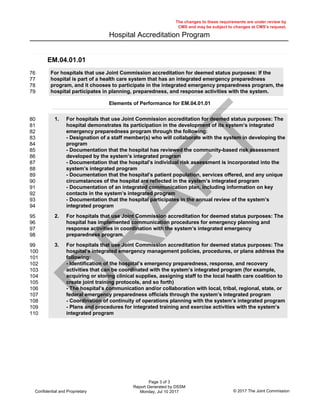
For hospitals that use Joint Commission accreditation for deemed status purposes: If the
hospital is part of a health care system that has an integrated emergency preparedness
program, and it chooses to participate in the integrated emergency preparedness program, the
hospital participates in planning, preparedness, and response activities with the system.
80
81
82
83
84
85
86
87
88
89
90
91
92
93
94
For hospitals that use Joint Commission accreditation for deemed status purposes: The
hospital demonstrates its participation in the development of its system’s integrated
emergency preparedness program through the following:
- Designation of a staff member(s) who will collaborate with the system in developing the
program
- Documentation that the hospital has reviewed the community-based risk assessment
developed by the system’s integrated program
- Documentation that the hospital’s individual risk assessment is incorporated into the
system’s integrated program
- Documentation that the hospital’s patient population, services offered, and any unique
circumstances of the hospital are reflected in the system’s integrated program
- Documentation of an integrated communication plan, including information on key
contacts in the system’s integrated program
- Documentation that the hospital participates in the annual review of the system’s
integrated program
1.
95
96
97
98
For hospitals that use Joint Commission accreditation for deemed status purposes: The
hospital has implemented communication procedures for emergency planning and
response activities in coordination with the system’s integrated emergency
preparedness program.
2.
99
100
101
102
103
104
105
106
107
108
109
110
For hospitals that use Joint Commission accreditation for deemed status purposes: The
hospital’s integrated emergency management policies, procedures, or plans address the
following:
- Identification of the hospital’s emergency preparedness, response, and recovery
activities that can be coordinated with the system’s integrated program (for example,
acquiring or storing clinical supplies, assigning staff to the local health care coalition to
create joint training protocols, and so forth)
- The hospital’s communication and/or collaboration with local, tribal, regional, state, or
federal emergency preparedness officials through the system’s integrated program
- Coordination of continuity of operations planning with the system’s integrated program
- Plans and procedures for integrated training and exercise activities with the system’s
integrated program
3.
Page 3 of 3
Report Generated by DSSM
Monday, Jul 10 2017 © 2017 The Joint CommissionConfidential and Proprietary
D
R
AFT

Draft Emergency Management Final Rule Standards Revision

  • 1.
    Draft Emergency Managementchanges for Deemed Hospitals The following report contains draft changes to the accreditation requirements related to emergency management. These changes resulted from The Joint Commission’s alignment with The Centers for Medicare & Medicaid Services (CMS)’s Final Rule on Emergency Preparedness (Federal Register Vol. 81, No. 180). The rule became effective on November 15, 2016 and will be implemented on November 15, 2017. The report includes new elements of performance (EPs) in bold type; underlining is used to show changes to existing EPs. However, it is important to note that these are DRAFT requirements and are under review and subject to changes.
  • 2.
    Hospital Accreditation Program EmergencyManagement Final Rule Standards Revisions The changes to these requirements are under review by CMS and may be subject to changes at CMS’s request. Emergency Management (EM) Chapter EM.02.01.01 Elements of Performance for EM.02.01.01 1 2 3 4 5 6 7 8 9 10 The hospital has an Emergency Operations Plan. Note: The hospital’s Emergency Operations Plan (EOP) is designed to coordinate its communications, resources and assets, safety and security, staff responsibilities, utilities, and patient clinical and support activities during an emergency (refer to Standards EM.02.02.01, EM.02.02.03, EM.02.02.05, EM.02.02.07, EM.02.02.09, and EM.02.02.11). Although emergencies have many causes, the effects on these areas of the organization and the required response effort may be similar. This "all hazards" approach supports a general response capability that is sufficiently nimble to address a range of emergencies of different duration, scale, and cause. For this reason, the plan’s response procedures address the prioritized emergencies but are also adaptable to other emergencies that the organization may experience. 11 12 13 14 15 16 17 18 19 20 21 22 23 24 25 26 27 28 For hospitals that use Joint Commission accreditation for deemed status purposes: The Emergency Operations Plan includes a continuity of operations strategy that covers the following: - A succession plan that lists who replaces key leaders during an emergency if a leader is not available to carry out his or her duties - A delegation of authority plan that describes the decisions and policies that can be implemented by authorized successors during an emergency and criteria or triggers that initiate this delegation Note: A continuity of operations strategy is an essential component of emergency management planning. The goal of emergency management planning is to provide care to individuals who are incapacitated by emergencies in the community or in the organization. A continuity of operations strategy focuses on the organization, with the goal of protecting the organization’s physical plant, information technology systems, business and financial operations, and other infrastructure from direct disruption or damage so that it can continue to function throughout or shortly after an emergency. When the organization itself becomes, or is at risk of becoming, a victim of an emergency (power failure, fire, flood, bomb threat, and so forth), it is the continuity of operations strategy that provides the resilience to respond and recover. 12. 29 30 31 32 33 34 35 36 37 For hospitals that use Joint Commission accreditation for deemed status purposes: If a hospital has one or more transplant centers (see Glossary), the following must occur: - A representative from each transplant center must be included in the development and maintenance of the hospital's emergency preparedness program - The hospital must develop and maintain mutually agreed upon protocols that address the duties and responsibilities of the hospital, each transplant center, and the organ procurement organization (OPO) for the donation service area where the hospital is situated, unless the hospital has been granted a waiver to work with another OPO, during an emergency 13. Page 1 of 3 Report Generated by DSSM Monday, Jul 10 2017 © 2017 The Joint CommissionConfidential and Proprietary D R AFT
  • 3.
    Hospital Accreditation Program Thechanges to these requirements are under review by CMS and may be subject to changes at CMS’s request. 38 39 40 41 42 43 44 45 46 47 For hospitals that use Joint Commission accreditation for deemed status purposes: The hospital has a procedure for requesting an 1135 waiver for care and treatment at an alternative care site. Note: During disasters, organizations may need to request 1135 waivers to address care and treatment at an alternate care site identified by emergency management officials. The 1135 waivers are granted by the federal government during declared public health emergencies; these waivers authorize modification of certain federal regulatory requirements (for example, Medicare, Medicaid, Children’s Health Insurance Program, Health Insurance Portability and Accountability Act) for a defined time period during response and recovery. 14. EM.02.02.01 Elements of Performance for EM.02.02.01 48 49 As part of its Emergency Operations Plan, the hospital prepares for how it will communicate during emergencies. 50 51 52 53 54 55 56 57 58 59 For hospitals that use Joint Commission accreditation for deemed status purposes: As part of its communication plan, the hospital maintains the names and contact information of the following: - Staff - Physicians - Other hospitals and CAHs - Volunteers - Entities providing services under arrangement - Relevant federal, state, tribal, regional, and local emergency preparedness staff - Other sources of assistance 20. 60 61 62 63 64 65 66 67 68 For hospitals that use Joint Commission accreditation for deemed status purposes: The organization maintains documentation of completed and attempted contact with the local, state, tribal, regional, and federal emergency preparedness officials in its service area. This contact is made for the purpose of communication, and where possible collaboration, on coordinated response planning for a disaster or emergency situation. Note: Examples of these contacts may be written or email correspondence; in-person meetings or conference calls; regular participation in health care coalitions, working groups, boards, and committees; or educational events sponsored by a third party (such as a local or state health department). 22. EM.02.02.07 Elements of Performance for EM.02.02.07 69 70 As part of its Emergency Operations Plan, the hospital prepares for how it will manage staff during an emergency. 71 72 73 74 75 For hospitals that use Joint Commission accreditation for deemed status purposes: Initial and ongoing training relevant to their emergency response roles is provided to staff, volunteers, and individuals providing on-site services under arrangement. This training is documented and then reviewed and updated annually and when these roles change. 13. Page 2 of 3 Report Generated by DSSM Monday, Jul 10 2017 © 2017 The Joint CommissionConfidential and Proprietary D R AFT
  • 4.
    Hospital Accreditation Program Thechanges to these requirements are under review by CMS and may be subject to changes at CMS’s request. EM.04.01.01 Elements of Performance for EM.04.01.01 76 77 78 79 For hospitals that use Joint Commission accreditation for deemed status purposes: If the hospital is part of a health care system that has an integrated emergency preparedness program, and it chooses to participate in the integrated emergency preparedness program, the hospital participates in planning, preparedness, and response activities with the system. 80 81 82 83 84 85 86 87 88 89 90 91 92 93 94 For hospitals that use Joint Commission accreditation for deemed status purposes: The hospital demonstrates its participation in the development of its system’s integrated emergency preparedness program through the following: - Designation of a staff member(s) who will collaborate with the system in developing the program - Documentation that the hospital has reviewed the community-based risk assessment developed by the system’s integrated program - Documentation that the hospital’s individual risk assessment is incorporated into the system’s integrated program - Documentation that the hospital’s patient population, services offered, and any unique circumstances of the hospital are reflected in the system’s integrated program - Documentation of an integrated communication plan, including information on key contacts in the system’s integrated program - Documentation that the hospital participates in the annual review of the system’s integrated program 1. 95 96 97 98 For hospitals that use Joint Commission accreditation for deemed status purposes: The hospital has implemented communication procedures for emergency planning and response activities in coordination with the system’s integrated emergency preparedness program. 2. 99 100 101 102 103 104 105 106 107 108 109 110 For hospitals that use Joint Commission accreditation for deemed status purposes: The hospital’s integrated emergency management policies, procedures, or plans address the following: - Identification of the hospital’s emergency preparedness, response, and recovery activities that can be coordinated with the system’s integrated program (for example, acquiring or storing clinical supplies, assigning staff to the local health care coalition to create joint training protocols, and so forth) - The hospital’s communication and/or collaboration with local, tribal, regional, state, or federal emergency preparedness officials through the system’s integrated program - Coordination of continuity of operations planning with the system’s integrated program - Plans and procedures for integrated training and exercise activities with the system’s integrated program 3. Page 3 of 3 Report Generated by DSSM Monday, Jul 10 2017 © 2017 The Joint CommissionConfidential and Proprietary D R AFT