KNR UNIVERSITY OF HEALTH
SCIENCES,WANARGAL, TELANGANA
PRESENTTION OF DISSERTATION FOR IEC
By
Dr. K YASHODA
1ST YEAR PG SCHOLAR
DEPT. OF KAYA CHIKITSA
Dr. B.R.K.R GOVT. AYURVEDIC MEDICAL COLLEGE,
ERRAGADDA, HYD
A CRITICAL EVALUATION OF CLINICAL EFFICACY
OF ‘VRIDDA DARVADI LOHA’ IN MANAGEMENT OF
AMAVATA W.S.R TO RHEUMATOID ARTHRITIS
By
Dr. K YASHODA
1st YEAR P.G SCHOLAR
P.G DEPT. OF KAYA CHIKITSA
GUIDE
Dr. P. SRIKANTH BABU. M.D (Ay) (K.C)
GOLD MEDALIST
PROFESSOR
P.G DEPARTMENT OF KAYACHIKITSA
CONTENTS
 INTRODUCTION
 AIM AND OBJECTIVES
 MATERIALS AND METHODS
 PARAMETERS
 DIAGNOSTIC CRITERIA
 INCLUSION CRITERIA
 EXCLUSION CRITERIA
 DRUG REVIEW
 DRUG INTERVENTION
 REFERENCES
INTRODUCTION
 AMAVATA is the most common debilitating joint
disorder.
 Madavakara was the first person to give a detailed
description of Amavata. It effects the individuals,
who indulge in viruddhahara ( improper and
irregular dietery habits ) viruddha chesta
(improper physical and psychological activities)
 Amavata may be correlated with Rheumatoid
arthritis, it is a chronic progressive autoimmune
arthropathy and characterized by bilateral
symmetrical involvement of joints with some
systemic clinical manifestation.
 Acc to ICD -10 WHO RHEUMATOID
ARTHRITIS, UNSPECIFIED is M06.9
 RHEUMATOID ARTHRITIS usually effects symmetrically,
and most frequently attacks the wrist, hand, shoulders, knees
and ankles.
CLINICAL FEATURES
 Pain
 Swelling
 Morning stiffness
 Tenderness
 Fatigue, anorexia
 Local temperature
 Shifting pain
Continued….
NEED OF STUDY
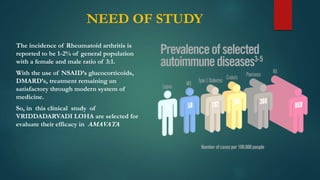
The incidence of Rheumatoid arthritis is
reported to be 1-2% of general population
with a female and male ratio of 3:1.
With the use of NSAID’s glucocorticoids,
DMARD’s, treatment remaining un
satisfactory through modern system of
medicine.
So, in this clinical study of
VRIDDADARVADI LOHA are selected for
evaluate their efficacy in AMAVATA
AIM AND OBJECTIVES
 1). To study the etiopathogenesis and treatment of Amavata
in Ayurvedic perspective.
 2). To evaluate the therapeutic efficacy of Vriddadarvadi
Loha in patients suffering from Amavata
MATERIALS AND METHODS
1) SOURCES OF DATA
A minimum of 30 patients will be randomly selected from OPD and
of Dr. B.R.K.R. Govt Ayurvedic college, Erragadda, Hyd.
Patients will also be selected from referral sources and special camps
conducted for this purpose.
2) METHODS OF COLLECTION OF DATA
Patients of either sex will be randomly selected based on the clinical
features of AMAVATA.
Patients will be assigned under a single group consisting minimum of
30 patients excluding drop-outs.
INCLUSION CRITERIA
 Patients with clinical features of
Amavata
 Patients of either sex and age 18 – 60
 Patients who had fulfilled the revised
criteria for rheumatoid arthritis fixed
by the American college of
rheumatology 2010
 Patients of both RA factor positive
(or) RA factor negative & A.S.O titer
positives.
 Patients below 18 yrs and above 60 yrs
 Chronicity more than 10 yrs
 Systemic diseases like uncontrolled
Diabeties , tuberculosis, hypertension
 Malignancy
 Pregnant and lactating women
 Having severe crippling deformities
EXCLUSIVE CRITERIA
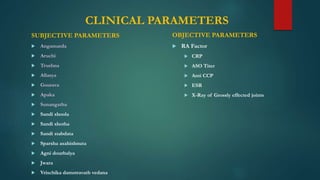
CLINICAL PARAMETERS
SUBJECTIVE PARAMETERS
 Angamarda
 Aruchi
 Trushna
 Allasya
 Gourava
 Apaka
 Sunangatha
 Sandi shoola
 Sandi shotha
 Sandi stabdata
 Sparsha asahishnuta
 Agni dourbalya
 Jwara
 Vrischika damstravath vedana
OBJECTIVE PARAMETERS
 RA Factor
 CRP
 ASO Titer
 Anti CCP
 ESR
 X-Ray of Grossly effected joints
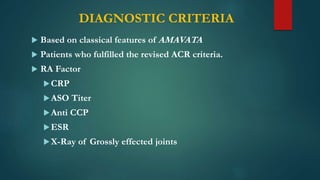
DIAGNOSTIC CRITERIA
 Based on classical features of AMAVATA
 Patients who fulfilled the revised ACR criteria.
 RA Factor
CRP
ASO Titer
Anti CCP
ESR
X-Ray of Grossly effected joints
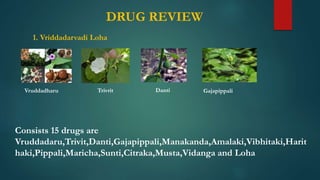
DRUG REVIEW
1. Vriddadarvadi Loha
Consists 15 drugs are
Vruddadaru,Trivit,Danti,Gajapippali,Manakanda,Amalaki,Vibhitaki,Harit
haki,Pippali,Maricha,Sunti,Citraka,Musta,Vidanga and Loha
Vruddadharu Trivrit Danti Gajapippali
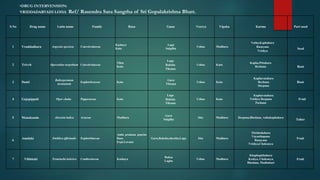
S.No Drug name Latin name Family Rasa Guna Veerya Vipaka Karma Part used
1 Vruddadharu Argyreia speciosa Convolvulaceae
Kashaya
Katu
Lagu
Snigdha
Ushna Madhura
Vatha,Kaphahara
Rasayana
Vrishya
Seed
2 Trivrit Operculina turpethum Convolvulaceae
Tikta
Katu
Lagu
Ruksha
Tiksana
Ushna Katu
Kapha,Pittahara
Rechana Root
3 Danti
Baliospermum
montanum
Euphorbraceae Katu
Guru
Tiksana
Ushna Katu
Kaphavatahara
Rechana
Deepana
Root
4 Gajapippali Piper chaba Pipperaceae Katu
Lagu
Ruksha
Tiksana
Ushna Katu
Kaphavatahara
Vrishya Deepana
Pachana
Fruit
5 Manakanda Alocasia indica Araceae Madhura
Guru
Snigdha
Sita Madhura Deepana,Bhedana, vathakaphahara
Tuber
6
Amalaki Emblica officinalis Euphorbiaceae
Amla pradana pancha
Rasa
Expt.Lavana
Guru,Ruksha,sheetha,Lagu Sita Madhura
Thridoshahara
Vayasthapana
Rasayana
Vrishya,Chaksusya
Fruit
7 Vibhitaki Terminelia belerica Combretaceae Kashaya
Ruksa
Laghu
Ushna Madhura
Khaphapithahara
Keshya, Chaksusya
Bhedana, Madhakari
Fruit
•DRUG INTERVENSION:
VRIDDADARVADI LOHA Ref/ Rasendra Sara Sangrha of Sri Gopalakrishna Bhatt.
8 Harithaki Terminalia chebula Combretaceae
Pancharsa kashaya
paradana
Expt.Lavana
Laghu
Ruksa
Ushna Madhura
Thridosha hara
Anulomana,Rasayana Prajasthapana, Chaksusya
Hrukleshana
Fruit
9 Pippali Piper longum Piperacea Katu
Laghu
Snigdha
Thekshana
Ushna Madhura
Vatha,Kaphahara
(Ardhakha=Khapakara)
Deepana,Rasayana
Fruit
10 Maricha Piper nigrum Piperacea Katu
Laghu
Thekshana
Ushana Katu
Kaphavathahara,Avrisya,Deeana,
Pramathi
Fruit
11 Sunti Zingiber officinale Zingiberaceae Katu Guru,Ruksa,Tiksna Ushna Madhura
Vathakaphahara,Deepana,
Bhedana
Rhizome
12 Citraka
Plumbago
zeylanica
Plumbaginaceae Katu Lagu,Ruksa,Tiksna Ushna Katu Vathakaphahara,Deepana,Pachana,Grahi Root
13 Musta Cyperus rotundus Cyperaceae Pikta,Katu,Kashaya Lagu,Ruksa, Sita Katu Kaphapithahara,Deepana,Pachana,Grahi Rhizome
14 Vidanga Embelia ribes Primulaceae Katu,Kashaya
Lagu,Ruksa,
Tikshna
Ushna Katu
Lekhana,Vishagna,Krimigna,
Deepena
Fruit
15 Loha Iron Incinerated Ferrus --- --- ----- ----- --- --
DRUG INTERVENTION
S.No Drug name Latin name Quantity
1 Vruddadharu Argyeia specinosa 1 part
2 Trivrit Operculina turpethum 1 part
3 Danti Baliospermum montanum 1 part
4 Gajapippali Piper chab 1 part
5 Manakanda Alocasia indica 1 part
6 Amlaki Emblika officinalis 1 part
7 Vibhitaki Terminelia belerica 1 part
8 Harithaki Termenelia chebula 1 part
9 Pippali Piper langum 1 part
10 Marica Piper nigram 1 part
11 Sunti Zingiberofficinali 1 part
12 Citraka Plumdago zeylanica 1 part
13 Musta Cyperus rotundus 1 part
14 Vidanga Embeliaca ribes 1 part
15 Loha Iron 1 4 parts
All the drugs are taken in equal ratio ( Expt. Loha 14 parts) and made into fine powder and will be
prepared according to the classical method. 500 mg per day for 30 patients for 60 days.
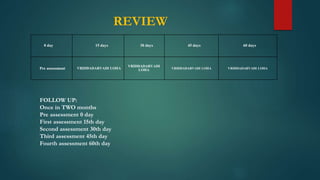
REVIEW
0 day 15 days 30 days 45 days 60 days
Pre assessment VRIDDADARVADI LOHA
VRIDDADARVADI
LOHA VRIDDADARVADI LOHA VRIDDADARVADI LOHA
FOLLOW UP:
Once in TWO months
Pre assessment 0 day
First assessment 15th day
Second assessment 30th day
Third assessment 45th day
Fourth assessment 60th day
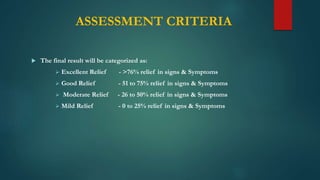
ASSESSMENT CRITERIA
 The final result will be categorized as:
 Excellent Relief - >76% relief in signs & Symptoms
 Good Relief - 51 to 75% relief in signs & Symptoms
 Moderate Relief - 26 to 50% relief in signs & Symptoms
 Mild Relief - 0 to 25% relief in signs & Symptoms
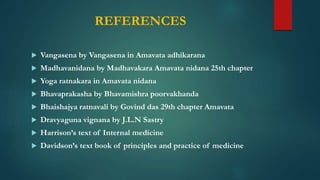
REFERENCES
 Vangasena by Vangasena in Amavata adhikarana
 Madhavanidana by Madhavakara Amavata nidana 25th chapter
 Yoga ratnakara in Amavata nidana
 Bhavaprakasha by Bhavamishra poorvakhanda
 Bhaishajya ratnavali by Govind das 29th chapter Amavata
 Dravyaguna vignana by J.L.N Sastry
 Harrison’s text of Internal medicine
 Davidson’s text book of principles and practice of medicine
Dr yashoda ppt

Dr yashoda ppt

  • 1.
    KNR UNIVERSITY OFHEALTH SCIENCES,WANARGAL, TELANGANA PRESENTTION OF DISSERTATION FOR IEC By Dr. K YASHODA 1ST YEAR PG SCHOLAR DEPT. OF KAYA CHIKITSA Dr. B.R.K.R GOVT. AYURVEDIC MEDICAL COLLEGE, ERRAGADDA, HYD
  • 2.
    A CRITICAL EVALUATIONOF CLINICAL EFFICACY OF ‘VRIDDA DARVADI LOHA’ IN MANAGEMENT OF AMAVATA W.S.R TO RHEUMATOID ARTHRITIS By Dr. K YASHODA 1st YEAR P.G SCHOLAR P.G DEPT. OF KAYA CHIKITSA GUIDE Dr. P. SRIKANTH BABU. M.D (Ay) (K.C) GOLD MEDALIST PROFESSOR P.G DEPARTMENT OF KAYACHIKITSA
  • 3.
    CONTENTS  INTRODUCTION  AIMAND OBJECTIVES  MATERIALS AND METHODS  PARAMETERS  DIAGNOSTIC CRITERIA  INCLUSION CRITERIA  EXCLUSION CRITERIA  DRUG REVIEW  DRUG INTERVENTION  REFERENCES
  • 4.
    INTRODUCTION  AMAVATA isthe most common debilitating joint disorder.  Madavakara was the first person to give a detailed description of Amavata. It effects the individuals, who indulge in viruddhahara ( improper and irregular dietery habits ) viruddha chesta (improper physical and psychological activities)  Amavata may be correlated with Rheumatoid arthritis, it is a chronic progressive autoimmune arthropathy and characterized by bilateral symmetrical involvement of joints with some systemic clinical manifestation.  Acc to ICD -10 WHO RHEUMATOID ARTHRITIS, UNSPECIFIED is M06.9
  • 5.
     RHEUMATOID ARTHRITISusually effects symmetrically, and most frequently attacks the wrist, hand, shoulders, knees and ankles. CLINICAL FEATURES  Pain  Swelling  Morning stiffness  Tenderness  Fatigue, anorexia  Local temperature  Shifting pain Continued….
  • 6.
    NEED OF STUDY Theincidence of Rheumatoid arthritis is reported to be 1-2% of general population with a female and male ratio of 3:1. With the use of NSAID’s glucocorticoids, DMARD’s, treatment remaining un satisfactory through modern system of medicine. So, in this clinical study of VRIDDADARVADI LOHA are selected for evaluate their efficacy in AMAVATA
  • 7.
    AIM AND OBJECTIVES 1). To study the etiopathogenesis and treatment of Amavata in Ayurvedic perspective.  2). To evaluate the therapeutic efficacy of Vriddadarvadi Loha in patients suffering from Amavata
  • 8.
    MATERIALS AND METHODS 1)SOURCES OF DATA A minimum of 30 patients will be randomly selected from OPD and of Dr. B.R.K.R. Govt Ayurvedic college, Erragadda, Hyd. Patients will also be selected from referral sources and special camps conducted for this purpose. 2) METHODS OF COLLECTION OF DATA Patients of either sex will be randomly selected based on the clinical features of AMAVATA. Patients will be assigned under a single group consisting minimum of 30 patients excluding drop-outs.
  • 9.
    INCLUSION CRITERIA  Patientswith clinical features of Amavata  Patients of either sex and age 18 – 60  Patients who had fulfilled the revised criteria for rheumatoid arthritis fixed by the American college of rheumatology 2010  Patients of both RA factor positive (or) RA factor negative & A.S.O titer positives.  Patients below 18 yrs and above 60 yrs  Chronicity more than 10 yrs  Systemic diseases like uncontrolled Diabeties , tuberculosis, hypertension  Malignancy  Pregnant and lactating women  Having severe crippling deformities EXCLUSIVE CRITERIA
  • 10.
    CLINICAL PARAMETERS SUBJECTIVE PARAMETERS Angamarda  Aruchi  Trushna  Allasya  Gourava  Apaka  Sunangatha  Sandi shoola  Sandi shotha  Sandi stabdata  Sparsha asahishnuta  Agni dourbalya  Jwara  Vrischika damstravath vedana OBJECTIVE PARAMETERS  RA Factor  CRP  ASO Titer  Anti CCP  ESR  X-Ray of Grossly effected joints
  • 11.
    DIAGNOSTIC CRITERIA  Basedon classical features of AMAVATA  Patients who fulfilled the revised ACR criteria.  RA Factor CRP ASO Titer Anti CCP ESR X-Ray of Grossly effected joints
  • 12.
    DRUG REVIEW 1. VriddadarvadiLoha Consists 15 drugs are Vruddadaru,Trivit,Danti,Gajapippali,Manakanda,Amalaki,Vibhitaki,Harit haki,Pippali,Maricha,Sunti,Citraka,Musta,Vidanga and Loha Vruddadharu Trivrit Danti Gajapippali
  • 13.
    S.No Drug nameLatin name Family Rasa Guna Veerya Vipaka Karma Part used 1 Vruddadharu Argyreia speciosa Convolvulaceae Kashaya Katu Lagu Snigdha Ushna Madhura Vatha,Kaphahara Rasayana Vrishya Seed 2 Trivrit Operculina turpethum Convolvulaceae Tikta Katu Lagu Ruksha Tiksana Ushna Katu Kapha,Pittahara Rechana Root 3 Danti Baliospermum montanum Euphorbraceae Katu Guru Tiksana Ushna Katu Kaphavatahara Rechana Deepana Root 4 Gajapippali Piper chaba Pipperaceae Katu Lagu Ruksha Tiksana Ushna Katu Kaphavatahara Vrishya Deepana Pachana Fruit 5 Manakanda Alocasia indica Araceae Madhura Guru Snigdha Sita Madhura Deepana,Bhedana, vathakaphahara Tuber 6 Amalaki Emblica officinalis Euphorbiaceae Amla pradana pancha Rasa Expt.Lavana Guru,Ruksha,sheetha,Lagu Sita Madhura Thridoshahara Vayasthapana Rasayana Vrishya,Chaksusya Fruit 7 Vibhitaki Terminelia belerica Combretaceae Kashaya Ruksa Laghu Ushna Madhura Khaphapithahara Keshya, Chaksusya Bhedana, Madhakari Fruit •DRUG INTERVENSION: VRIDDADARVADI LOHA Ref/ Rasendra Sara Sangrha of Sri Gopalakrishna Bhatt.
  • 14.
    8 Harithaki Terminaliachebula Combretaceae Pancharsa kashaya paradana Expt.Lavana Laghu Ruksa Ushna Madhura Thridosha hara Anulomana,Rasayana Prajasthapana, Chaksusya Hrukleshana Fruit 9 Pippali Piper longum Piperacea Katu Laghu Snigdha Thekshana Ushna Madhura Vatha,Kaphahara (Ardhakha=Khapakara) Deepana,Rasayana Fruit 10 Maricha Piper nigrum Piperacea Katu Laghu Thekshana Ushana Katu Kaphavathahara,Avrisya,Deeana, Pramathi Fruit 11 Sunti Zingiber officinale Zingiberaceae Katu Guru,Ruksa,Tiksna Ushna Madhura Vathakaphahara,Deepana, Bhedana Rhizome 12 Citraka Plumbago zeylanica Plumbaginaceae Katu Lagu,Ruksa,Tiksna Ushna Katu Vathakaphahara,Deepana,Pachana,Grahi Root 13 Musta Cyperus rotundus Cyperaceae Pikta,Katu,Kashaya Lagu,Ruksa, Sita Katu Kaphapithahara,Deepana,Pachana,Grahi Rhizome 14 Vidanga Embelia ribes Primulaceae Katu,Kashaya Lagu,Ruksa, Tikshna Ushna Katu Lekhana,Vishagna,Krimigna, Deepena Fruit 15 Loha Iron Incinerated Ferrus --- --- ----- ----- --- --
  • 15.
    DRUG INTERVENTION S.No Drugname Latin name Quantity 1 Vruddadharu Argyeia specinosa 1 part 2 Trivrit Operculina turpethum 1 part 3 Danti Baliospermum montanum 1 part 4 Gajapippali Piper chab 1 part 5 Manakanda Alocasia indica 1 part 6 Amlaki Emblika officinalis 1 part 7 Vibhitaki Terminelia belerica 1 part 8 Harithaki Termenelia chebula 1 part 9 Pippali Piper langum 1 part 10 Marica Piper nigram 1 part 11 Sunti Zingiberofficinali 1 part 12 Citraka Plumdago zeylanica 1 part 13 Musta Cyperus rotundus 1 part 14 Vidanga Embeliaca ribes 1 part 15 Loha Iron 1 4 parts All the drugs are taken in equal ratio ( Expt. Loha 14 parts) and made into fine powder and will be prepared according to the classical method. 500 mg per day for 30 patients for 60 days.
  • 16.
    REVIEW 0 day 15days 30 days 45 days 60 days Pre assessment VRIDDADARVADI LOHA VRIDDADARVADI LOHA VRIDDADARVADI LOHA VRIDDADARVADI LOHA FOLLOW UP: Once in TWO months Pre assessment 0 day First assessment 15th day Second assessment 30th day Third assessment 45th day Fourth assessment 60th day
  • 17.
    ASSESSMENT CRITERIA  Thefinal result will be categorized as:  Excellent Relief - >76% relief in signs & Symptoms  Good Relief - 51 to 75% relief in signs & Symptoms  Moderate Relief - 26 to 50% relief in signs & Symptoms  Mild Relief - 0 to 25% relief in signs & Symptoms
  • 18.
    REFERENCES  Vangasena byVangasena in Amavata adhikarana  Madhavanidana by Madhavakara Amavata nidana 25th chapter  Yoga ratnakara in Amavata nidana  Bhavaprakasha by Bhavamishra poorvakhanda  Bhaishajya ratnavali by Govind das 29th chapter Amavata  Dravyaguna vignana by J.L.N Sastry  Harrison’s text of Internal medicine  Davidson’s text book of principles and practice of medicine