ear 1 work-plan
“ORGANISATIONAL ASSESSMENT -
DIRECTORY OF PUBLIC UTILITY SERVICES,
PROTECTION AND RESCUE-MUNICIPALITY OF
PRISTINA”
REPORT
April, 2014
This publication was produced for review by the Deutsche Gesellschaft für Internationale Zusammenarbeit
(GIZ) GmbH. It was prepared by SIGMA BMC Kosovo.
“ORGANISATIONAL ASSESSMENT -
DIRECTORY OF PUBLIC UTILITY
SERVICES, PROTECTION AND RESCUE-
MUNICIPALITY OF PRISTINA”
REPORT
April, 2014
Contracting Client
Deutsche Gesellschaft für Internationale Zusammenarbeit (GIZ)
Modernization of Municipal Services Project
Operative Contact
Mr. Nicolas von Kalm
Head of Programme:
Mr. James Macbeth Forbes
Contractor:
SIGMA BMC- Pristina
In Charge of the Assessment:
Ms. Myesere Hoxha myeserehoxha@gmail.com
2
TABLE OF CONTENT
TABLE OF CONTENT.......................................................................................................2
ABREVATIONS ..................................................................................................................3
EXECUTIVE SUMMARY ....................................................................................................4
I. INTRODUCTION....................................................................................................5
1.1 Directory of Public Utility/Services, Protection and Rescue........................................................6
II. METHODOLOGY ...................................................................................................9
III. CAF ASSESSMENT OF DPUSPR.........................................................................11
IV. ORGANISATIONAL ASSESSMENT SURVEY....................................................27
4.1 Approach..............................................................................................................................27
4.2 Method.................................................................................................................................27
4.3 Survey assessment of the organizational aspects......................................................................27
V. DPUSPR QUALITY MANAGEMENT SYSTEM GAP ANALYSIS ......................29
5.1 GAP Analysis ........................................................................................................................29
5.2 Recommendations.................................................................................................................31
ANNEX I: DPUSPR ORGANIZATIONAL STRUCTURE...............................................32
ANNEX II: THE PROCESS OF CITIZEN SERVICE PROVISIONS THROUGH CENTER
FOR CITIZEN SERVICES ACCORDING TO AI NO. 2011/03 .......................................33
ANNEX III: DPUSPR LEGAL AND REGULATORY FRAMEWORK .............................34
ANNEX IV: CITIZEN SATISFACTION SURVEY WITH PUBLIC UTILITY &
COMMUNAL SERVICES SURVEY (2012).......................................................................35
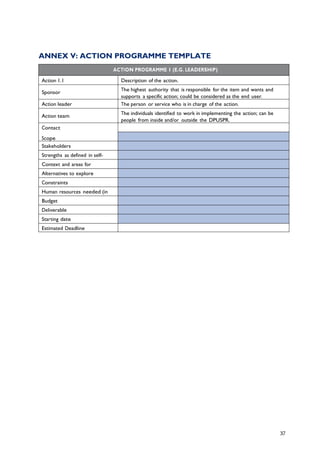
ANNEX V: ACTION PROGRAMME TEMPLATE...........................................................37
ANNEX VI: ORGANISATIONAL ASSESSMENT SURVEY QUESTIONNAIRE...........38
3
ABREVATIONS
DPUSPR Directorate of Public utility, Protection and Rescue
DEMI Democratic Effective Municipality Initiative
EIPA European Institute for Public Administration
CAF Common Assessment Framework
IPSG Innovative Public Service Group
CCS Centre for Citizen Services
MLGA Ministry of Local Government Administration
PDCA Plan, Do, Check, Act
PEST Political, Economic, Social and Technological analysis
LPE Local Publicly Owned Enterprises
LLG Law on Local Governance
IT Information Technology
AI Administrative Instruction
USAID United States Agency for International Development
WWRO Water and Wastewater Regulatory Office
4
EXECUTIVE SUMMARY
“A secure supply of clean water, energy, and sustainable waste management are basic need for each
individual society. The users of these rights must be confident that their needs are being met, that they
are provided for in fair and environmentally responsible manner at a just price.”1
Having the above in mind, this assessment undertakes three comprehensive tasks. The first
one is to identify strengths of the DPRSP, the second is to point out to the areas for
improvement, and finally it provides action items that will support DPRSP in its journey of
growing towards excellence in the performance and the introduction of a culture of
excellence.
The scope and methodology of this assessment is initially based on the CAF instrument, a
common European quality assessment scheme for public sector organizations.
This assessment report starts with the overall assessment of the directorate according to nine
criteria (See Figure 1) that represent key aspects considered in the organizational analysis.
Based on the assessment conducted in terms of enablers, it results that the DPRSP has an
approach which hardly involves planning, implementation and review of their actions and none
of the above is integrated within the directory.
In terms of results, the overall output of the assessment finds out that the directory measures
some of its key results; however, they show negative trends and they do not achieve relevant
targets. Nevertheless, the focus of this assessment is to point out to the strengths of the
directory and areas for improvement and suggestions for action items. As identified by the
assessment bellow there are 68 action items/recommendations for improvement.
Overall final recommendations and steps to be undertaken include:
 This assessment report should be utilized as input for the effective and performance
improvement planning at the DPUSPR and for the development of a middle term
improvement strategy.
 It is highly recommended that management in consultation with stakeholders should
utilize this report to summarize action items, set priorities according to their relevance
and resources in disposition and formulate strategic improvement objectives.
Additionally, preparation of an improvement plan.
1 Introduction to Public Utilities, European Federation of Public Service Unions, accessed at: http://www.epsu.org/a/4041
5
I. INTRODUCTION
Public utilities on the local level are important not only because they satisfy the essential
requirements of human beings, but also because citizens assess the quality of municipal services
as an indicator of the quality of the local government itself. In this sense, the question of public
utility becomes a highly political issue. In some cases, where economically deprived groups in
society have difficulties or are not able to pay for public utility due to an existing pricing
system, even the question of human rights is raised.
Municipalities in Kosovo are obliged to exercise their scope in compliance with the
Constitution of Kosovo, the principles of European Charter of Local Self-Government, Law on
Local Self Government Nr. 03/L-040 and other applicable laws.
Municipality, as a basic unit of local government represents an administrative - territorial unity
and community of residents. It consists of two basic bodies: the Municipal Assembly and the
Mayor. Both are elected directly by the citizens and organized in a manner that enables
complementary functioning to each other. As such, the Municipality of Pristina administration
is composed of a political component - including here the directors of directories appointed by
the Mayor - and the civil component2
. The later, consisting of all the persons employed by a
municipal authority whose salary is paid by the Budget of Republic of Kosovo. The
administration of Municipality of Pristina is organized in eleven directories established as per
the Statute of Municipality of Pristina. Directors are political appointees whereas civil servants
are recruited and selected based on open calls and according to applicable civil service law and
related regulations. The administration of Municipality of Pristina is based on the Weberian
model of administration which is based on the principles of hierarchy, neutrality and career
civil servants. As such it is characterized as “administration under formal control of political
leadership based on the model of bureaucracy, with permanent neutral, anonymous staff motivated by
the public interest, serving and partially governed equally, without contribution to policy development
but being limited to the administration of those policies which are decided by politicians3
.
The purpose of reemphasizing the model of administration is to set up the foundations for the
potential reforms of the administration of the Municipality of Pristina in general and the
DPUSPR in particular. Latest studies on reform processes show that the new public
management model based on marketization and a private-sector management style has not
been implemented in many EU member states. Countries such as Germany, Belgium, Finland,
France, etc. have formed a group of “modernizers” to follow a new specific model of reform
to which Bockert and Pollit refer as Neo-Weberian State. The added elements in this regard
are:
 Transition from internal orientation in bureaucratic rules towards the external orientation
of meeting the needs and requirements of citizens. The basic manner to achieve this effect
is to create a professional culture towards quality and service.
 Completion (not substitution) of the role of representative democracy by a range of
consulting instruments and with the representation of direct views of citizens.
2 Kosovo Assembly: "Law on Local Self-Government", article 62, Section 62.1 and 62.2
3 James P. Pfiffner., 2004,Traditional Public Administration versus The New Public Management: Accountability versus
Efficiency, Published in Institutionenbildung in Regierung und Verwaltung: Festschrift fur Klaus Konig, A. Benz, H. Siedentopf,
and K.P. Sommermann, eds. Berlin,Germany: Duncker & Humbolt, pp. 443-454.
6
 In terms of government resource management, a modernization of relevant laws to guide
towards an orientation of achieving greater results rather than in focusing on correct
following of procedures. This can be partially expressed through transferring the balance of
ex-ante and ex-post controls.
 Professionalization of public service. In this instance managers are not just experts in their
fields but professional managers oriented towards the fulfillment of the needs of the
citizens.
In summary this can be achieved by professionalization of administration personnel, increase of
their capacities through systematic trainings and investments so that citizens receive quality
and efficient services by the administration of the Municipality of Pristina.
1.1 Directory of Public Utility/Services, Protection and Rescue
The tasks of DPUSPR are set according to Article 17 of the Law on Local Self Government Nr.
03/L-040, the Status of Municipality of Pristina and the Regulation on municipal public utility
No. 352-19344
. Internal organization and systematization of civil servants in their work places
and in particular at the DPUSPR is based on the “Decision for organization and systematization of
work places” revised in 2013. As per the main DPUSPR competencies, they can be grouped as
follows:
1. Provision and maintenance of public utility and utilities, including:
a. water supply,
b. sewers and drains,
c. sewage treatment,
d. waste management,
e. local roads,
f. local transport, and
g. local heating schemes;
2. Local emergency response;
3. Licensing of local services and facilities, including those related to entertainment,
cultural and leisure activities, food, lodging, markets, street vendors, local public
transportation and taxis;
4. Naming of roads, streets and other public places;
5. Provision and maintenance of public parks and spaces;
6. Cemetery maintenance, other services.
Organization and Supervision
As described above the tasks of the DPUSPR, the organizational form of their implementation
and relations to the providers of public utility are defined in the laws on administration and
public enterprises. DPRSP main organizational forms for the provision of utility and communal
services include: (1) Public Enterprises, (2) Market mechanisms (user charges, tenders, contracts,
etc.) and direct provision.
As set out in the Law No. 04/L-111 on amending and supplementing the Law No. 03/L-087 on
Publicly Owned Enterprises (LPE), identifies publicly owned enterprises and the concerned
municipality or municipalities having ownership rights and related obligations with respect
thereto. LPE’s with the Municipality of Pristina as their owner are listed below.
4 A complete legal framework of the DPUSPR is depicted in Annex III
7
1. District Heating Termokos J.S.C, Prishtinë, Prishtinë
2. Public Residential Enterprise, Prishtina
3. Bus station in Prishtina, Prishtina
4. Hortikultura J.S.C. – Prishtinë, Prishtinë
5. Sport-Marketing J.S.C – Prishtinë, Prishtinë
6. MPOE Trafiku Urban J.S.C. -Prishtina, Prishtina
Whereas, the Regional Water Company Pristina J.S.C., Pristina and Regional Waste Company
Pastrimi J.S.C., Pristina are Central Publicly Owned Enterprises (CPE)
DPRSP provides the main public utility and communal services such as water supply, sewerage,
waste management, public transport, roads and maintenance of public spaces through public
enterprises. The latest data (2012) of citizen satisfaction with Municipality of Pristina public
utility and communal services are to be desired for (See Annex IV). Main performance
constrains in providing quality and efficient public utility and communal services are:
 Legal adequacy and management issues. The status of public enterprises is relatively
independent and the competencies of the municipality are limited in terms of their
management;
 Low level of accountability towards the Municipality of Pristina and its Oversight bodies
(Municipal Shareholder Commissions and Board of Directors);
 Politicization of Publicly Owned Enterprises Managing Bodies. Publicly Owned
Enterprises in Kosovo continue to be among the weak aspects of institutional
organization with regards to the composition and functioning of their governing boards.
Certain reports continue to address a lot of criticism towards these institutions. What
is mostly noticed is the proposal and selection of people closed to the political party in
power. Notwithstanding that the organization, composition and functioning have a legal
basis, in majority of cases Publicly Owned Enterprises have breached the legislation. In
this regard, there have been evidenced cases of political influence in the involvement of
political people in governing boards as well cases evidenced of the conflict of interest in
certain cases5.
 Challenges faced by PEs themselves including here: poor performance, financial loss, the
inadequate financial management in relation to the applicable requirements, and the
lack of human resources control6
.
In terms of the provision of utility and communal services through market mechanisms (user
charges, tenders, contracts, etc.), DPUSPR follow the general procurement rules. The user
charges for water and waste services are regulated by the Water and Wastewater Regulatory
Office (WWRO) whereas other fees for public utility are regulated based on the Municipality
Regulation on Fees and charges.
5 (In) Dependent Agencies and “Publicly” Owned Enterprises in Kosovo, Analysis on the Functioning of Independent Agencies
and Publicly Owned Enterprises, their Legal Basis, Politicization of Managing Boards, and their Relations with Establishing
Institutions, Kosova Democratic Institute (KDI), 2014 http://www.kdi-kosova.org/publications/APNPKen.pdf
6 Performance report of the Office of the Auditor General (2012)
8
Citizen Satisfaction with Municipal Public utility
Citizen Satisfaction with Municipal Services evaluates citizens’ perceptions and satisfaction with
local authorities and public utility. DPRPS officials since 2012 have initiated the measurement
of institutional indicators. The Municipal Service Performance Management System has been
introduced by USAID Democratic Effective Municipalities Initiative and Ministry of Local
Government Administration.
About 66.67% of respondents (citizens of Municipality of Pristina) are satisfied with public
utility in general7
. Leadership of Municipality of Pristina in general and the DPUSPR in particular
should focus their attention on sidewalk maintenance and their usability since only 21% to 24%
of citizens were satisfied with the level of provision of these services.
Table 1: Municipality of Pristina Citizen Satisfaction Survey 2012
% of satisfied or
very satisfied
Priority Ranking for
Quick Fixes
(1 lowest
satisfaction)
Parks and squares 58.71% 12
Roads
Level of cleanliness of roads 46.21% 9
Condition of roads 49.62% 8
Horizontal and vertical signage 33.71% 3
Sidewalks
Sidewalks Maintenance 24.24% 2
Usable Sidewalks (free from
vehicles/sellers/terrace/waste/etc.)
21.21% 1
Public
Transport
Overall public transport service 51.52% 10
Arrival at the destination on time 44.70% 7
Public Parking
Lot
Safety of parking 37.5% 5
Location of parking lots 36.72% 4
Public Lighting 77% 14
Water supply/drinking water supply 65% 13
Sewage and sanitation 55.3% 11
Waste collection services 41% 6
Source: Survey report on Citizens’ Satisfaction with Municipal Services, 2012
7 Survey report on Citizens’ Satisfaction with Municipal Services, 2012 http://demi-
ks.org/repository/docs/Citizen_Satisfaction_Report.pdf
9
II. METHODOLOGY
The methodology utilized for the overall assessment of the DPUSPR is based on the Common
Assessment Framework (CAF). It is a total quality management tool developed by the public
sector for the public sector, inspired by the Excellence Model of the European Foundation for
Quality Management (EFQM®). Its aim is to develop and support public sector organizations
to evaluate and improve further their performance. The model is based on the premise that
excellent results in organizational performance, citizens/customers, people and society are
achieved through leadership driving strategy and planning, people, partnerships, resources and
processes. It looks at the organization from different angles at the same time; a holistic
approach to an organization performance analysis.
The model is a nine-box structure which identifies the main aspects requiring consideration in
any organizational analysis. Criteria 1-5 deal with the managerial practices of an organization:
the so-called Enablers. These determine what the organization does and how it approaches its
tasks to achieve the desired results. In criteria 6-9, Results achieved in the fields of
citizens/customers, people, social responsibility and key performance are measured by
perception and performance measurements.
Figure 1: The structure of the Model
The scoring system8
Whilst the discovery of strengths and areas for improvement and the linked
improvement actions are the most important outputs of the self- assessment, the scoring
system developed in CAF has a specific function, but should not be the main focus. Allocating a
score to each sub-criterion and criterion of the CAF model has four main aims:
1. to give an indication of the direction to follow for improvement activities;
2. to measure the organisational progress;
3. to identify good practices as indicated by high scoring for Enablers and Results;
4. to help the organization to find valid partners to learn from.
8 More information is available on the CAF website: www.eipa.eu/CAF
10
SCORE
CAF provides two ways of scoring: the PDCA cycle is the fundament of both. For the
purpose of this assessment the ‘classical’ CAF scoring has been utilized. The classical CAF
scoring gives a global appreciation of each sub-criterion by indicating the PCDA phase in which
the sub-criterion finds itself. In the enablers assessment panel the PDCA phase is in place only
when bench learning activities are part of the continuous improvement cycle, whereas in the
results assessment panel a distinction is made between the trend of the results and the
achievement of the targets.
Whilst the discovery of strengths and areas for improvement and the linked improvement
actions are the most important output of the self-assessment, the scoring system has a specific
function but should not be the main focus.
PHASE ENABLERS PANEL - CLASSICAL SCORING SCORE
The organization is not active in this field, they have no information or are very
anecdotal.
0-10
PLAN The organization has a plan to do this. 11-30
DO The organization is implementing / doing this. 31-50
CHECK The organization is checking / reviewing if they are doing the right things in the right
way.
51-70
ACT On the basis of checking / reviews the organization undertakes adjustments if
necessary.
71-90
PDCA
Everything the organisation does, they plan, implement, check and adjust regularly
and they learn from others. They are in a continuous improvement cycle on this
issue.
91-100
A score between 0 and 100 is given for each sub-criterion to determine the level reached
inside the phase (PLAN, DO, CHECK or ACT). The scale on 100 allows to specify the degree
of deployment and implementation of the approach. Whereas for results a score between 0
and 100 is given for each sub-criterion on a scale divided in 6 levels. For each level one can
take into account either the trend, the acheivemetn of the target or both.
RESULTS PANEL - CLASSICAL SCORING
Score
0-10
11-30
31-50
51-70
71-90
91-100
No results are measured and/or no information is available.
Results are measured and show negative trends and/or results do not meet relevant targets.
Results show flat trends and/or some relevant targets are met.
Results show improving trends and/or most of the relevant targets is met.
Results show substantial progress and/or all the relevant targets are met.
Excellent and sustained results are achieved. All the relevant targets are met. Positive
comparisons with relevant organisations for all the key results are made.
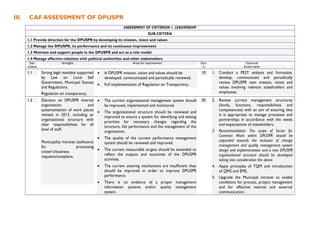
III. CAF ASSESSMENT OF DPUSPR
ASSESSMENT OF CRITERION 1: LEADERSHIP
SUB-CRITERIA
1.1 Provide direction for the DPUSPR by developing its mission, vision and values
1.2 Manage the DPUSPR, its performance and its continuous improvement
1.3 Motivate and support people in the DPUSPR and act as a role model
1.4 Manage effective relations with political authorities and other stakeholders
Sub-
criteria
Strengths Areas for improvement Scor
e
(Optional)
Action items
1.1 Strong legal mandate supported
by Law on Local Self
Government, Municipal Statute
and Regulations.
Regulation on transparency.
 A DPUSPR mission, vision and values should be
developed, communicated and periodically reviewed.
 Full implementation of Regulation on Transparency.
10 1. Conduct a PEST analysis and formulate,
develop, communicate and periodically
review DPUSPR own mission, vision and
values involving relevant stakeholders and
employees.
1.2 Decision on DPUSPR internal
organization and
systematization of work places
revised in 2013, including an
organizational structure with
clear responsibilities for all
level of staff.
Municipality Intranet (software)
for processing
citizen’s/business
requests/complains.
 The current organizational management system should
be improved, implemented and monitored.
 The organizational structure should be reviewed and
improved to ensure a system for identifying and setting
priorities for necessary changes regarding the
structure, the performance and the management of the
organization.
 The quality of the current performance management
system should be reviewed and improved.
 The current measurable targets should be extended to
reflect the outputs and outcomes of the DPUSPR
activities.
 The current steering mechanisms are insufficient they
should be improved in order to improve DPUSPR
performance.
 There is no evidence of a proper management
information systems and/or quality management
system.
50 2. Review current management structures
(levels, functions, responsibilities and
competencies) with an aim of ensuring that
it is appropriate to manage processes and
partnerships in accordance with the needs
and expectations of stakeholders.
3. Recommendation: The scope of Sector for
Common Work within DPUSPR should be
expanded towards the inclusion of change
management and quality management system
design and implementation and a new DPUSPR
organizational structure should be developed
taking into consideration the above.
4. Apply principles of TQM and introduction
of QMS and EMS.
5. Upgrade the Municipal intranet to enable
conditions for process, project management
and for effective internal and external
communication. .
12
 The DPUSPR does not have appropriate conditions for
process, project management and for effective internal
and external communication.
6. Lawful procedures and the professionalism
of decisions should be ensured both for
discretionary local cases.
1.3 The new management
(director) has introduced a
new leadership style through
leading by example and
promoting a culture of mutual
trust.
The new management informs
and consults employees
regularly on key issues related
to the organization and
support employees in carrying
their duties, plans and
objectives to enhance the
achievement of overall
directories objectives.
The new management
continuously stimulates,
encourages and empowers
through the delegation of
authority, responsibility and
competencies including
authority.
 Present work-load on the head of directory on
reviewing all citizens request and complains (by both
systems including electronic and manual) should be
reduced by delegation.
31 7. Develop a reliable mechanism to delegate
competences and responsibilities, including
accountability, with focus on reviewing
citizen requests/complains.
8. Introduce mechanism to recognize and
reward the efforts of teams and individuals.
9. Promote the culture of mutual trust and
respect by informing and consulting
employees regularly on key issues related to
the directory.
1.4 Existing public policies cover
main DPUSPR public utility and
communal services.
Municipal regulations are
implementation artifacts of
policy statements and there are
14 existing regulations (See
Annex III) supporting the
implementation of DPUSPR
10. Existing DPUSPR regulatory framework should be
reviewed and improved in terms of quantity and
quality. Regulations are outdated; majority of
regulations do not reflect changes of sectorial laws, etc.
e.g The DPUSPR/Mayors Cabinet should develop Regulation
for document classification/storage/retrieval/ based on the
Law on state archiving No. 04-L-088-2012 Article 17.
11. Stakeholder analysis and identification of their actual
and future needs should be undertaken. The definition
31 10. Update outdated regulations and define,
identify, incorporate other regulations
needed related to the directory by ensuring
that objectives and goals on output and
outcome of the directory are aligned with
those public policies and political decision
and concluding agreements with the political
authorities on the related resources
required. e.g. Regulation on road transport in
the territory of Municipality of Pristina should
13
tasks including here:
Regular and proactive relations
with political authorities from
appropriate executive and
legislative areas are maintained
and continues partnership and
network with important
stakeholders (citizens, NGO’s,
interest groups, professional
associations, industry and
other public authorities in line
with the scope of DPSRP is
developed and maintained.
of roles and responsibilities of actors of public service
management such as:
1. Service provider (client, regulator);
2. Sources of financing (Grant, subsidy);
3.Service producer (Contractor);
4.Customer (Mandatory or optional use/User
charges, tax, or free of charge);
be reviewed and revised to reflect the changes
Law on road transport amended in 2013.
Amendments have enhanced the competencies
of municipality and require introduction of
licensing.
11. This also requires the improvement of
external document review system at the
level of Mayor ’Cabinet. The legal affairs
office and/or the DPUSPR sector for
common work should develop a system of
external document maintenance including
here informing and planning necessary
reviews and revisions of regulations and
other municipality documents.
12. Develop a stakeholders ‘analysis, defining
their major actual and future needs, roles
and responsibilities and share findings with
the municipality.
Total
121
Averag
e 40.
3
14
ASSESSMENT OF CRITERION 2: STRATEGY & PLANNING
SUB-CRITERIA
2.1 Gather information on the present and future needs of stakeholders as well as relevant management information
2.2 Develop strategy and planning, taking into account the gathered information
2.3 Communicate and implement strategy and planning in the whole DPUSPR and review it on a regular basis
2.4 Plan, implement and review innovation and change
Sub-
criteria
Strengths Areas for improvement Score (Optional)
Action items
2.1 There are baseline data from
the Municipal Service
Performance Management
Report and/or from: Measuring
Citizen Satisfaction with
Municipality Services 2012
conducted by donor
organizations and central
government.
 There is no internal mechanism for systematic
gathering, analyzing and reviewing information about
stakeholders, their needs, expectations and satisfaction.
 There is no evidence for systematic analysis of internal
strengths and weaknesses including threat and
opportunities (e.g. SWOT analysis, risk management).
10 13. Introduce mechanisms for information
gathering on the present and future needs
of citizens/stakeholders [available
resources at: http://www.demi-
ks.org/?cid=1,90,951
14. Strengthen strategic planning capacity.
15. Develop and introduce own (directory)
system of client satisfaction measurement.
2.2 Middle Term Development
Strategy of Municipality of
Pristina 2008-2011 in terms of
Public utility included:
Goal 4. Provision of quality public
utility and communal services.
Objective I. Sustainable drinking
water supply; Objective II. Access
of all facilities to sewage; Objective
III. Efficacy in urban waste
collection and processing; Objective
IV. Maintenance of public and
green spaces.
National Strategy for Security
and Safety in Community and
action plan 2011-2016
Local plan for inert waste
 Latest developmental mid-term strategy included the
period of 2008-2011. Currently there is no strategy
that incorporates public utility and communal services.
 Major strategic planning problems identified include:
slow absorption rates for all operational programs due
to low capacity to prepare, manage, monitor, consult
on, and implement successful and efficient projects; and
low administrative capacity to deal with policy and its
implementation.
40 16. Review and evaluate the impact of Mid-
term strategy (2008-2011) and initiate and
plan the development of Public Utility and
Communal Service Strategy and formulate
public service improvement action plans.
17. Local plan for inert waste administration
should be reviewed, revised and upgraded
to include output indicators/outcomes.
15
administration in the
Municipality of Pristina 2012 –
2016
2.3 Local plan for inert waste
administration in the
Municipality of Pristina 2012 –
2016
 The Local plan for inert waste administration does not
include outputs/outcomes.
 Plans either are in the process of being approved or
there is no plan, but even when there is a development
plans they have a little impact on the executive
decisions or they don’t get reviewed and revised
accordingly to reflect the changes.
 Plans for public utilities including here water supply,
heat supply, sewage, transport, public lightening, should
be developed.
31 18. Develop strategy and planning by
setting priorities, establishing time
frames, appropriate processes and
projects with indicators establishing
the level of change to be achieved for
each public utility and communal
service.
19. Review and revise the Local plan for
inert waste to reflect the changes
needed for the remaining
implementation period (2014-2016),
develop annual action plans
accordingly.
2.4 11 public utility and communal
service indicators are being
monitored.
 The quality and frequency of monitoring of current
internal indicators should be improved and internal
indicators/drivers for change and external demands for
innovation and change should be introduced.
10 20. Ensure the deployment of an efficient
change management system (e.g.
project management, reporting on the
follow-up, QMS/PDCA
implementation);
Total 91
Average 22.7
16
ASSESSMENT OF CRITERION 3: PEOPLE
SUB-CRITERIA
3.1 Plan, manage and improve human resources transparently with regard to strategy and planning
3.2 Identify, develop and use competencies of people aligning individual and DPUSPR goals
3.3 Involve employees by developing open dialogue and empowerment, supporting their well-being
Sub-
criteria
Strengths Areas for improvement Scor
e
(Optional)
Action items
3.1 Law on Civil Service of the
Republic of Kosovo 2010/03-L-
149 applies.
Job and function descriptions for
each position are defined in the
Decision for organization and
systematization of work of the
Municipality of Pristina, 2013.
Human Resources are managed
centrally at the level of the
Cabinet of the Mayor.
Planned 33 employees, currently
29 staff without the inclusion of
94 firefighters.
 Qualification structure of human resources at the
Directory is not sufficient to carry out quality public
utility and communal services. According to the
assessment out of 29 civil servants employed within
the directory 50% are with high school education and
the average age of 44 years old.
 Low strategic and planning human capacity. Issues
with the skills to define realistic goals of public
significance; with the capacity to set the DPUSPR’s
priorities as too many un-prioritized goals are set
leading to inefficiency and dispersion of efforts; and
with the limited analysis and planning skills in the
administration.
 Human resource management carried out centrally at
the level of Mayors Cabinet inefficient in promoting
people’s engagement, motivation and development.
11 21. Assessment of current and future human
resources needs, taking into account the
needs and expectations of stakeholders and
the strategy.
22. Develop and implement a human resource
management policy based on the strategy and
planning of the organization, taking into
account the necessary competencies for the
future.
23. Strengthen the capacities of Human Resource
Management within the directory common
work sector.
3.2 Decision for organization and
systematization of work of the
Municipality of Pristina, 2013,
identified current people
competencies.
 Identified competencies of people at the individual
and directory level in terms of knowledge, skills and
attitudes are not sufficient and not based on the
needs of the directory.
 Employee performance evaluation and personal
training and development plans are carried out only
for the sake of documenting the process.
 Capacities for quality, environment, health and safety
management systems are scarce.
31 24. Identify needed staff competencies and
discuss, establish and communicate a strategy
for developing needed competencies including
the development of a training plan based on
current and future directory and individual
competency needs.
25. Develop capacities on quality, environment,
health and safety management systems such as
ISO 9001, ISO 14001, OHSAS 18001.
3.3 New leadership is promoting a  Employee feedbacks on the quality of management 31 26. Conduct a staff survey, publishing and giving
17
culture of open communication
and dialogue and encouraging
team work.
they receive form their line managers/directors.
 No evidence of staff survey.
 Employee involvement.
feedback.
27. Involve employees and their representatives in
the development of plans, strategies, goals,
the design of processes and in the
identification and implementation of
improvement activities.
Total 73
Averag
e
24.3
18
ASSESSMENT OF CRITERION 4: PARTNERSHIP & RESOURCES
SUB-CRITERIA
4.1 Develop and manage partnerships with relevant DPUSPRs
4.2 Develop and implement partnerships with the citizens/customers
4.3 Manage finances
4.4 Manage information and knowledge
4.5 Manage technology
4.6 Manage facilities
Sub-
criteria
Strengths Areas for improvement Score (Optional)
Action items
4.1 Fair collaboration between
DPUSPR and
organization/directories at the
same institutional level and
between organizations of
different institutional level.
Mandate for coordination with
public enterprises.
 Partnerships with public enterprises,
contracted providers of services and other
public organizations should be built up and
considered important resources for the food
functioning of DPUSPR.
 Legal adequacy and level of accountability with
POE’s should be improved and strengthened.
 Unclear role/no guidelines/ in terms of
coordination with the Committee for Public
utility and Public Enterprises.
 Unsystematic regulatory monitoring, low
quality of management and evaluation of
partners including here local public enterprises
and contracted providers of services should be
improved.
31 28. Define the sector network or policy chain DPSRP
belongs to and the role it plays to assure the
success of the whole network.
29. Document the identified public key partners,
private, civil society partners and the nature of the
relationship. There is no documented evidence of
who are the relevant partners of the DPUSPR
including here the outsourced services, close
partnerships on common goals.
30. Strengthen the implementation of Law on POE’s and
introduce use of systems of management and
supervision, focusing on activities of boards at
improving the performance to ensure the
functioning of the process of incomes and a reliable
financial reporting as well as drafting of unified
guides of management, which would help PEs on
increasing and cultivating the transparency and the
due environment of control, were some of the
recommendations addressed.
31. Strengthen regulatory framework for monitoring
and evaluation of implementation and results of
public enterprises and contracted providers of
services.
32. Improve the quality of management of partnership
19
agreements in terms of stimulating and organizing of
task-specific partnerships and developing and
implementing joint projects with other public sector
organizations belonging to the same policy
sector/chain and to different institutional level.
4.2 There is a practice of ensuring
transparency through the
publication of annual reports,
press conferences, publication
of decisions on the Prishtina
Municipality Webpage.
Citizens complain system
through the Center for Citizen
Services.
 DPUSPR should ensure a proactive
information policy and systematic
transparency. There are still uncertainties in
relation to its role and responsibilities and the
publication of annual reports and posting
information on the internet is not systematic.
 Role of citizen/customer as co-designers, co-
decision makers, co-producers and co-
evaluators should be improved.
 Active citizen encouragement for their self-
organization, to express their needs and
expectations and supporting citizen groups.
31 33. Expand the Municipalities Webpage or develop a
separate section for DPUSPR, among others to
ensure updated information is available for
citizens/customers.
34. Introduce a model for citizen engagement and
feedback for improving public utility (e.g. Trained
Observer Raters, Multi-Service Surveys and Service-
Focused or User Surveys; Open House Meetings;
Focus Groups);
35. Define and agree on ways to develop role of
citizen/costumer as co-producer of services (e.g. in
the context of waste management).
4.3 Finance management
information system introduced
by Government of Kosovo.
Free balance, Free Balance, a
global Government Resource
Planning (GRP).
There is an annual budget and
procurement plan.
 Financial management should be in line with
strategic/operational objectives. Currently
these strategic/operational objectives are not
set. It is uncertain if the current financial
management is effective, sustainable and
accountable.
 Main challenges of DPUSPR on improving its
performance are:
 Demanding capital investments
 Raising of technical standards of services
 Low rate of collection charges and Issues with
low income consumer due to social policy
aspects
50 36. Introduction of innovative budgeting systems and
cost planning (e.g. multi annual budgets, programs of
project budgets, gender budget, etc.) and increase
staff capacities in this domain.
37. Improve the efficiency of service delivery and
introduction of modern financial techniques to
increase internal and external funding.
38. Analysis of collection and “Charging” methods
influencing performance of the service sector with
an aim to improve the collection rate of utility
charges.
39. Balance social considerations with technical (capital
investment) goals and financial (efficiency) objectives
in the development policies.
40. Review possibilities of DPUSPR to generate financial
resources.
20
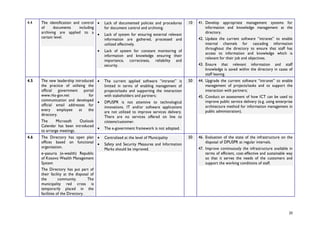
4.4 The identification and control
of documents including
archiving are applied to a
certain level.
 Lack of documented policies and procedures
for document control and archiving.
 Lack of system for ensuring external relevant
information are gathered, processed and
utilized effectively.
 Lack of system for constant monitoring of
information and knowledge ensuring their
importance, correctness, reliability and
security.
10 41. Develop appropriate management systems for
information and knowledge management at the
directory.
42. Update the current software “intranet” to enable
internal channels for cascading information
throughout the directory to ensure that staff has
access to information and knowledge which is
relevant for their job and objectives.
43. Ensure that relevant information and staff
knowledge is saved within the directory in cases of
staff leaving.
4.5 The new leadership introduced
the practice of utilizing the
official government portal
www.rks-gov.net for
communication and developed
official email addresses for
every employee at the
directory.
The Microsoft Outlook
Calendar has been introduced
to arrange meetings.
 The current applied software “intranet” is
limited in terms of enabling management of
projects/tasks and supporting the interaction
with stakeholders and partners;
 DPUSPR is not attentive to technological
innovations. IT and/or software applications
are not utilized to improve services delivery.
There are no services offered on line to
citizens/customer.
 The e-government framework is not adopted.
50 44. Upgrade the current software “intranet” to enable
management of projects/tasks and to support the
interaction with partners;
45. Conduct an assessment of how ICT can be used to
improve public service delivery (e.g. using enterprise
architecture method for information management in
public administration).
4.6 The Directory has open plan
offices based on functional
organization.
e–pasuria (e-wealth) Republic
of Kosovo Wealth Management
System
The Directory has put part of
their facility at the disposal of
the community. The
municipality red cross is
temporarily placed in the
facilities of the Directory.
 Centralized at the level of Municipality
 Safety and Security Measures and Information
Marks should be improved.
50 46. Evaluation of the state of the infrastructure on the
disposal of DPUSPR at regular intervals.
47. Improve continuously the infrastructure available in
terms of efficient, cost-effective and sustainable way
so that it serves the needs of the customers and
support the working conditions of staff.
21
Total 222
Averag
e
37
ASSESSMENT OF CRITERION 5: PROCESSES
SUB-CRITERIA
5.1 Identify, design, manage and innovate processes on an ongoing basis, involving the stakeholders
5.2 Develop and deliver citizen/customer-oriented services and products
5.3 Coordinate processes across the DPUSPR and with other relevant DPUSPRs
Sub-
criteria
Strengths Areas for improvement Score (Optional)
Action items
5.1 The scope and functions of the
directory are defined.
 The terms describing the scope and functions of
the directory are not properly
translated/defined. There are cases that a
function is described with “provision of care”
which can lead to misunderstanding among staff
and citizen/customer.
 Currently the directory utilizes a functional
approach, adoption of process approach to
management should be considered.
 DPUSPR key processes are not identified,
mapped, described and documented and there
are no process owners identified.
50 48. Scope and functions should be defined using
proper management language and terms.
49. Introduce process approach to management.
Develop a system and build staff capacity of
people to identify, design, flowchart, manage,
document and innovate processes on ongoing
basis.
50. Assign process owners (responsible to control
all the steps in the process) and assign
responsibilities and competences to them.
5.2 An initial of DPUSPR resulted
with identification of: 3 key
macro-processes, 51 key sub-
processes and 28 administrative
procedures.
 Administrative procedures are not documented.
There are no documented standard operating
procedures for issuing permits/lack of
specifications and detailed criteria.
 Involvement of citizens/customers as co-
designers and the changing environment in areas
such as technology, economy and population
should be taken into consideration.
10 51. Develop and document relevant standard
operating procedures.
52. Introduce mechanisms for involvement of
citizens in co-design. (See above).
22
5.3 Fair practice of task forces
creation with service providers.
 The effectiveness of DPUSPR in terms of
collaboration with POE’s and private service
delivery partners should be improved by
developing cross-functional processes and
service delivery chain.
10 53. Define the service delivery chain and develop a
common system in the service delivery chain to
facilitate data exchange with each POE and
partners.
Total 70
Averag
e
23.3
ASSESSMENT OF CRITERION 6: CITIZEN/CUSTOMER ORIENTED RESULTS
SUB-CRITERIA
6.1 Perception measurements
6.2 Performance measurements
Sub-
criteria
Strengths Areas for improvement Score (Optional)
Action items
6.1 DPUSPR through its “intranet”
(citizen/customer request/complain
administration system) has the
ability and is addressing
individual solution to
citizens/customers.
Baseline data on
citizen/customer satisfaction
with DPUSPR public utility and
communal services exist. (See
Annex 4).
 Customer/citizen perception measurement
should be introduced at the level of DPUSPR.
 The trends of citizen satisfaction measurement
are moving towards “From satisfaction
measurement to satisfaction management”,
DPUSPR should introduce own system to
manage the satisfaction of citizen/customer with
services provided.
 The overall image of the DPUSPR and the
public reputation and trust (e.g. friendliness,
fairness of treatment, openness, clarity of
the provided information, the employees
‘willingness to listen, the reception, flexibility
and ability to address individual solutions,
etc. should be improved.
 Regulation on transparency should be updated
50 54. Develop a strategic framework on Customer
Satisfaction Management and implement
citizen/customer results
measurement/management system.
55. Manage citizen/customer satisfaction according
to EUPAN European Primer on Customer
Satisfaction.
56. Conduct satisfaction/performance analysis
based on citizen satisfaction with DPUSPR
services data. Set quality objectives and
develop improvement action plans for each
measured indicator.
23
and transparency of DPUSPR (e.g. its
functioning, the explanation of the applicable
legislation, and decision-making processes)
should be improved.
 Products and services (e.g. quality, reliability,
compliance with quality standards, process-
ing/providing time, quality of advice given to the
customers/citizens, environmental approach
should be improved.
 The available information: quantity,
quality, reliability, transparency, readability,
appropriateness for the target group, etc.
should be improved.
 The citizens/customers opinion survey on the
DPUSPR should be strengthened, more inclusive
and frequent.
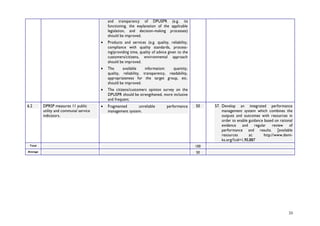
6.2 DPRSP measures 11 public
utility and communal service
indicators.
 Fragmented unreliable performance
management system.
50 57. Develop an integrated performance
management system which combines the
outputs and outcomes with resources in
order to enable guidance based on rational
evidence and regular review of
performance and results. [available
resources at: http://www.demi-
ks.org/?cid=1,90,887
Total 100
Average 50
24
ASSESSMENT OF CRITERION 7: PEOPLE RESULTS
SUB-CRITERIA
7.1 Perception measurements
7.2 Performance measurements
Sub-
criteria
Strengths Areas for improvement Score (Optional)
Action items
7.1 There is willingness of people
to improve results regarding
the overall perception of
people of the image and overall
performance of the
organization.
DPUSPR has not assessed if its staff perceive the
organization as an attractive workplace and if they’re
motivated.
The perception of its people in relation to their
competence, motivation, and satisfaction is not
measured/managed.
10 58. Introduce a mechanism to systematically
measure people’s performance of the DPUSPR
and the products/service it provides.
59. This mechanism should ensure to provides
and/or encompasses the following results:
a) Results regarding the overall perception
of people in relation to DPUSPR image
and the overall performance, people’s
involvement in decision-making,
improvement activities, their awareness
on conflict of interest, etc.
b) Results regarding the perception of the
management and management systems;
c) Results regarding the perception of the
working conditions;
d) Results regarding the perception of the
career and skills development;
7.2 Employee performance
management system.
HRM at the level of Mayors
Cabinet conducts internal
measurement of the behavior
of people display in practice
(e.g. sick leave, staff turnover,
number of staff complaints,
etc.)
Current practices of performance measurement are
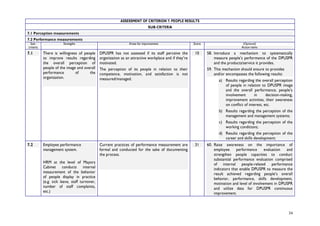
formal and conducted for the sake of documenting
the process.
31 60. Raise awareness on the importance of
employee performance evaluation and
strengthen people capacities to conduct
substantial performance evaluation comprised
of internal people-related performance
indicators that enable DPUSPR to measure the
result achieved regarding people’s overall
behavior, performance, skills development,
motivation and level of involvement in DPUSPR
and utilize data for DPUSPR continuous
improvement.
25
Total/ 41
Average 20.5
ASSESSMENT OF CRITERION 8: SOCIAL RESPONSIBILITY RESULTS
SUB-CRITERIA
8.1 Perception measurements
8.2 Performance measurements
Sub-
criteria
Strengths Areas for improvement Score (Optional)
Action items
8.1 The scope and role of DPUSPR
relates and in many cases with
the indicators of social
responsibility such as:
compliance with environmental
standards, use of recycled
material, use of environmental
friendly modes of transport,
reduction in use of utilities e.g.
water, electricity.
Integration of social and environmental aspects in
the decision-making and developmental strategies
and plans of DPUSPR.
5 61. Introduce mechanisms to measure the perception
of the community in relation to performance.
8.2 Environment and Mandate. Increase the degree of compliance with the
environmental standards/use of recycled materials/
becoming a role model for other partners to follow.
Increase activities to raise awareness and promote
compliance with environmental standards, use of
recycled material, use of environmental friendly
modes of transport, reduction in use of utilities e.g.
water, electricity.
5 62. Introduce measures to monitor, understand,
predict and improve the performance regarding
DPUSPR social responsibility.
63. Introduce environmental standards at the level of
DPUSPR and as criteria for potential services
providers.
64. Introduce awareness raising and promotional
programs in social and environmental aspects and
measure their performance.
Total 10
Averag
e
5
26
ASSESSMENT OF CRITERION 9:KY PERFORMANCE RESULTS
SUB-CRITERIA
9.1 External results: outputs and outcomes to goals
9.2 Internal results: level of efficiency
Sub-
criteria
Strengths Areas for improvement Score (Optional)
Action items
9.1 / Measures of the effectiveness of the DPUSPR
strategy in terms of capacity to satisfy the
expectations of external stakeholders in line with
the DPUSPR mission and vision should be
determined and implemented.
Controls in relation to contract management are
not functional and they are not being
implemented. The same was a remark of the
2012 audit of the Office of General Auditor.
0 65. Assessment of extent of achievement of outputs
(services and products) and outcomes (impact of
the organization’s key activities on external
stakeholders and on society.
66. Determine level of quality of services in relation
to standards and regulation.
67. Determine degree of achievement of
contracts/agreements.
9.2 Some baseline data for
productivity results are
available.
E.g. period: 01/01/2014 to
31/03/2014
Total # requests/complains=
421
# requests/complains
approved=156
#requests/complains in
process=4
#requests not reviewed=38
#requests/complains
suspended=223
DPUSPR should introduce mechanisms to ensure
that data on internal results are measured and
available. e.g. data on efficiency of the DPUSPR in
managing available resources, data on results of
performance improvements, data on effectiveness
of partnerships, etc. to improve internal results
related to efficiency, effectiveness and the
economy measures its functioning.
Out of 11 recommendations of the external
financial management audit of the Office of
General Audit for 2011, only 5 have been
completely addressed throughout 2012.
10 68. Increase awareness, build capacities in relation to,
and introduce efficiency and effectiveness of
internal processes and the economy measures of
the functioning of DPUSPR In terms of:
a. process management measure productivity,
cost effectiveness or defectiveness;
b. financial performance measure effective use
of financial resources, conformity with the
budget
c. effective use of resources measure
partnership, information, technology
d. capacity to involve stakeholders in the
DPUSPR
e. results of audits.
Total 10
Averag
e
5
IV.ORGANISATIONAL ASSESSMENT SURVEY
4.1 Approach
The analysis followed a design which combined a preparative study of relevant documents
with a subsequent conduct of appraisal amongst DPUSPR – staff.
4.2 Method
The design of the appraisal was content-wise following the aspect grid developed for the
assessment, which covers the seven core dimensions of the everyday life of any
organization. The grid served as analytical tool where each of the seven dimensions
comprises a set of sub-dimensions which have been analyzed.
Assessment grid:
4.3 Survey assessment of the organizational aspects
Within the framework of organizational aspects the idea was to systematically look at all
relevant dimensions of the organization without overemphasizing one or few of them. The
aim was to obtain a balanced view on the development possibilities that arise from areas
where improvements can still be realized.
In the graph below we see the result of the self-assessment (green line) as well as the
consultant´s perception (violet line) which slightly differs from it. A value of 5 would mean
that all best-practice-statements from the questionnaire had been rated with “strongly
agree”, a value of 4 relates to “agree”, a value of 3 to “neither agree, nor disagree” or in
other words “questionable”, a value of 2 means “disagree” and 1 would correspond with
the rating option “strongly disagree”.
28
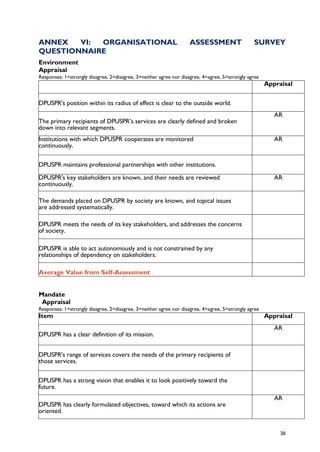
The results of the appraisal in this case, is a combined rating of the self-assessment (internal
survey), and the impression the consultant developed in the course of the interviews
(orange text rating). The questionnaires from the survey are displayed in Annex VI. The
column “AR” means “action recommended”.
29
V. DPUSPR Quality Management System GAP ANALYSIS
5.1 GAP Analysis
A gap analysis is the initial step in the QMS certification process. It is used to identify areas
within a quality management system that do not meet defined requirements for certification.
This can include processes, persons or products. The results of the gap analysis are based
upon objective evidence, to evaluate an Auditee’s conformance with requirements.
A brief summary version of the GAP analysis for the DPUSPR is conducted. It entails the
GAP analysis of five principle elements, which each specify a set of requirements, actions,
and processes that need to be considered for the system implementation9
:
Quality Management System and documentation
Yes (Y)
No (N)
Neither
nor (nn)
Has DPUSPR identified its key processes and defined how they are operated
and controlled?
N
Do the key processes have measurements applied to them and are they
regularly reviewed?
N
Where DPUSPR outsources work that could affect product/service quality,
have they defined how this will be controlled?
Y
Does DPUSPR have a documented quality policy and defined how it is
reviewed?
N
Are the quality objectives defined in a way that can be measured? N
Does DPUSPR have a quality manual that covers the requirements defined in
the standard?
N
Does DPUSPR have procedures for the control of documents and records? N
Management responsibility
Yes (Y)
No (N)
Neither
nor (nn)
Does DPUSPR have evidence of management commitment to the system and
are they actively involved in the management reviews?
N
At a strategic level, have management officials defined the activities that are
critical
to meet customer requirements?
N
Has a management representative and deputy been appointed? N
Has DPUSPR defined the frequency and method of carrying out management
reviews of the system?
N
Resource management
Yes (Y)
No (N)
Neither
nor (nn)
Has all staff who can affect quality been trained in their role and do they
understand how their roles fit within the quality management system?
N
9
Selection and use of the ISO 9000 family of standards (2009) International Organization for Standardization.
Switzerland [Online] Available at: http://www.iso.org/iso/iso_9000_selection_and_use-2009.pdf [Accessed on
April 13, 2014].
30
Are there appropriate records for training, skills and education? nn
Is the work infrastructure and work environment suitable for meeting
customer and regulatory requirements?
Y
Does the work environment meet all regulations and is it fit for purpose? Y
Product realization
Yes (Y)
No (N)
Neither
nor (nn)
Is there a defined plan/process for the provision of products and services? nn
Is there a defined method by which customer requirements are agreed? N
Are all appropriate regulatory and legal requirements identified as part of the
review of customer requirements?
nn
If changes to specification are accepted, do you have a method to ensure that
these are communicated and controlled?
nn
Is the process of managing customer complaints and feedback defined? Y
If you carry out product design, are the inputs to the design process defined
and documented?
n
Has DPUSPR defined how they verify that the final design meets the design
specification?
Y
Are the design stages defined and reviews carried out with appropriate
personnel at all stages?
N
Does DPUSPR have a method to validate that the final product/service will
operate as intended?
N
Are all changes to the design specification verified and validated and results
recorded?
N
Has DPUSPR defined how suppliers are selected and their performance
reviewed?
Y
Is the process for receiving and approving supplied goods defined? Y
Does DPUSPR have defined method of identification and traceability for
products as they go through the realization process?
nn
Does DPUSPR have records of calibration or verification of measuring
equipment?
excluded
Measuring, analysis and improvement
Yes (Y)
No (N)
Neither
nor (nn)
Does DPUSPR have a way of monitoring citizen/customer satisfaction and
perception?
N
Does DPUSPR have a defined procedure for performing and analyzing internal
audits?
N
Does DPUSPR have a procedure for identifying potential non-conformities in
the system?
N
Does DPUSPR have a procedure for identifying non-conformities, their cause,
and implementing actions to prevent reoccurrence?
N
Does DPUSPR have a documented procedure for dealing with non-
conforming products which prevent them from being delivered?
N
31
5.2 Recommendations
For DPUSPR to be considered reliable, they should guarantee minimum conditions of
reliability for the processes that are necessary to provide all the services needed by its
citizens in a consistent and reliable manner, and with the aim of addressing GAP’s identified
above DPUSPR should think of at least introducing and setting up a quality management
system based on ISO 9001:2008.
Through the implementation of ISO 9001 requirements at DPUSPR a framework of how
this Directory should work in regards to quality management will be set.
ISO 9001:2008 is based on five principle elements, which each specifies a set of
requirements, actions, and processes that need to be considered for the system
implementation10
:
Overall requirements for the quality management system and documentation
 Management responsibility, focus, policy, planning and objectives
 Resource management and allocation
 Product realization and process management, and
 Measurement, monitoring, analysis and continuous improvement.
10 Selection and use of the ISO 9000 family of standards (2009) International Organization for Standardization. Switzerland
[Online] Available at: http://www.iso.org/iso/iso_9000_selection_and_use-2009.pdf [Accessed on April 13, 2014].
32
ANNEX I: DPUSPR organizational structure
ANNEX II: The process of citizen service provisions through center
for citizen services according to AI No. 2011/03
Legend: Hard Copy Electronic Copy.
MUNICIPALITY DIRECTORIES
CENTRE FOR CITIZEN/CUSTOMER SERVICES
CITIZEN/COSTUMER
REQUEST/COMPLAIN FILE
(HARDCOPY)/SUPPORTING
DOCUMENTS
INTRANET
RECORDING REQUEST / COMPLAIN
VERIFICATION OF SUPPORT DOCUMENTS/
SCANNING
IS INFO
COMPLETE?
FEE PAYMENT
<10E
REQUEST/COMPLAINT
REQUEST FILE
INTRANET
REQUEST PROCESSING
REQUEST DISTRIBUTION TO DIRECTORIES
APPROVED REFUSED REJECTED SUSPENDED
PROTOCOL
NUMBER
INVOICE
CIZITEN
INFORMATION
ANNEX III: DPUSPR LEGAL AND REGULATORY FRAMEWORK
Reactions to local emergencies
1 Law on Fire Fighting and Rescue No. 04/L049;
2 Law on Protection Against Fire No. 04/L-012;
3 Law on protection against Natural and other disasters No. 04/L-027.
Naming of roads, streets and other public places
4 Law on Address System No. 04/L-071;
Provision and maintenance of parks and public space:
5 Law on Spatial Planning No. 03/L-106;
6 Law on Protection of Environment No. 03/L-025.
Licensing/Permits of public services and objects, including those related to amusement,
cultural activities and leisure, food, housing, markets, vendors, public local transport and taxi
7 Law on Road Transport No. 04/L-179;
8 Law No. 04/L-005 amending and supplementing Law No .2 004/18 on Internal Trade;
9 Law on Food No. 03/L-016;
10 Law on Financing of Special Housing Programs No. 03/L-164;
11 Law on Theatres No. 04/L-106;
12 Law on National Ensemble of Songs and Dances “Shota” and Other Ensembles No. 04/L-164;
13 Law No. 04/L-075 amending and supplementing Law No. 2003/24 on Sport;
14 Law on Empowerment and Participation of Youth No. 03/L-145.
Protection of environment
15 Law on Protection of Environment No. 03/L-025
Provision and maintenance of public and municipal services, including water supply, sewage, drainage
and treatment of waste water, waste management, local roads, local transport, schemes of local
heating
16 Law on Waste No. 04/L-060;
17 Law on Road Transport No. 04/L-179;
18 Law on Waters of Kosovo No. 04/L-147;
19 Law on Protection from Domestic Violence No. 03/L-182;
20 Law on Gender Equality No. 2004/2;
21 Law on Use of Languages No. 02/L-37;
22 Law against discrimination No. 2004/3.
23 Regulation on road transport in the territory of Municipality of Pristina, No. 110-41910
24 Regulation on urban transport rout determination and scheduling
25 Regulation for requirements and criteria for exercising the activity of passenger taxi transportation.
26 Regulation on waste management in the territory of Municipality of Pristina, No. 110-48364, 28.12.2012
27 Regulation on conditions and criteria for taxi passenger transportation, No. 344-3707, 31.01.2012
28 Regulation for municipality fees, charges and penalties, No. 110-2782, 02.12.2011
29 Regulation on occupational health and safety of municipal civil service, No. 110-2631, 16.11.2011
30 Regulation on “Spider” transport services, No. 110-1205, 16.06.2010
31 Regulation on municipal public utility and communal services, No.352-1934, 28.7.2010
32 Regulation on committee structure and competencies, No. 110 --1200, 16.06.2010
33 Regulation on temporary utilization of municipal property, establishment of temporary facilities, No. 110-
1936, 28.7.2010
34 Regulation on transparency, No. 110-1300, 03.07.2009
35 Regulation for safety and maintenance of cemetery, No. 352-157/1, 30.05.2006
36 Regulation for air protection, NN, 2006
37 Regulation for start and end working hours of trade, catering, man crafts, other enterprises. 30.09.2003
35
ANNEX IV: CITIZEN SATISFACTION SURVEY WITH PUBLIC
UTILITY & COMMUNAL SERVICES SURVEY (2012)
Source: DEMI/USAID Citizen Satisfaction with Municipal Services Report 2012
Emergency cases in Pristina:
The number of
emergency cases,
disasters (fires,
floods,
earthquakes, etc)
The amount of lost
assets during
emergency cases in
€
The number of emergency case
for which teams
responded
% of citizens
satisfied or very
satisfied with the
fire services or other
emergency services
1993 270000 1954 39.77%
Parks and Squares:
% of surface of
parks/squares
maintained on
regular basis
(m2)
% of municipal parks/squares
connected to a
drinking wate
network
% of satisfied or
very satisfied with
parks and squares
% of citizens who
use parks and
squares
2.66 63.64% 58.71% 51.14%
Roads included in the municipal plan for cleaning/wiping/washing and winter/summer
maintenance/horizontal and vertical signage:
% of local
roads
included
in the
municipal
plan for
cleaning of
roads (km)
% of local
asphalted
roads
(km)
%
municipal
local roads
included in
the
municipal
plan for
winter
maintenance
e (km)
% of satisfied or very satisfied
citizens with:
Level of cleanliness of
roads
Condition
of
roads
Horizontal and
vertical
signage of
roads
93.87% 94.83% 79.12% 46.21% 49.62% 33.71%
Sidewalks:
Public Transport:
% of
villages
included
in the
municipal
public
transport
% of bus stops
with signs
% Citizens satisfied or very satisfied
citizens with
Services of public
transport in the
territory of
municipality
Arrival at the
destination on time
97.73% 97.61% 51.52% 44.70%
Public parking lot:
The totalnumber of The total The total % of % of public % of satisfied or very satisfied
% of regulated sidewalks % of sidewalks
(km) included in
the municipal plan
27for maintenance
(cleaning)
winter/summer
(km)
% of satisfied or very satisfied
citizens with:
Maintenance
and repairing
of roads
Usable sidewalks (free from
vehicles/sellers/terraces/w
aste/etc.)
98.53% 94.13% 24.24% 21.21%
36
parking
lots (in
roads andoutside
roads)
number of
parking lots
with signs (in
roads and
outside roads)
number of
parking lots
(in roads and
outside roads)
parking lots
with
horizontal
and vertical
signs
parking lots
reserved
fordisabled
persons
citizens with
Safety of
parking
Respective
signs in
the
public
parking
Location
of
parking
lots
498 415 193 83.33% 3.01% 37.50% 41.41% 36.72%
Public lighting:
% of km
with public
lighting -
in total
b. In
urban areas
% of km
with public
lighting – in
total
b. In rural
areas /
villages
% of km with public
lighting - from the
total number in the city
and in rural
areas / villages
% of people who claim
that they feel very safe
or somewhat safe at
night (as a result of
street lighting)
% of citizens satisfied
or somewhat satisfied
with the public
lighting of streets and
public spaces
79.47% 33.54% 55.56% 73.83% 77.34%
Water supply:
% of
households
connected
to the water
supply
system
% of villages connected to
the water
supply
public
system
% of paid
payments
% of
billed
drinking
water
% of citizens
satisfied or very
satisfied with the
drinking water
supply
94.19% 86.36% 74.72% 50.43% 65.15%
Sewage and sanitation
% of
household
s
connected to
sewage
systems
a) urban
zone
% of
household
s
connected to sewage
systems
a) rural
zone
% of
households
connected
to sewage
systems
a) total
% of
municipal
settlements with
waste
water –
Sewage
systems
% of very
satisfied
and
somewhat
satisfied
with the
sewage
system
% of
citizens
who agree
with the
tariffs set
for waste
water
services
96.35% 31.43% 89.39% 81.82% 55.30% 71.97%
Waste collection
% of households
with access to
waste collection
services
% of
settlements
covered by
waste collection
services
% of
payments
made
% of citizens satisfied or
very satisfied with the
waste collection services
66.27% 40.91% 76.15% 41.67%
Waste disposal: More than 94.96kg of waste per capita was disposed throughout 2012 nation-
wide and citizen satisfaction with waste management disposal is 34.06%.
Quantity of waste disposed per capita -
kg/year
% of citizens satisfied with waste landfill
management
164.02 33.20%
37
ANNEX V: ACTION PROGRAMME TEMPLATE
ACTION PROGRAMME 1 (E.G. LEADERSHIP)
Action 1.1 Description of the action.
Sponsor
The highest authority that is responsible for the item and wants and
supports a specific action; could be considered as the end user.
Action leader The person or service who is in charge of the action.
Action team
The individuals identified to work in implementing the action; can be
people from inside and/or outside the DPUSPR.
Contact
Scope
Stakeholders
Strengths as defined in self-
assessment
Context and areas for
improvement
Alternatives to explore
Constraints
Human resources needed (in
man/days)
Budget
Deliverable
Starting date
Estimated Deadline
38
ANNEX VI: ORGANISATIONAL ASSESSMENT SURVEY
QUESTIONNAIRE
Environment
Appraisal
Responses: 1=strongly disagree, 2=disagree, 3=neither agree nor disagree, 4=agree, 5=strongly agree
Appraisal
DPUSPR's position within its radius of effect is clear to the outside world.
The primary recipients of DPUSPR’s services are clearly defined and broken
down into relevant segments.
AR
Institutions with which DPUSPR cooperates are monitored
continuously.
AR
DPUSPR maintains professional partnerships with other institutions.
DPUSPR's key stakeholders are known, and their needs are reviewed
continuously.
AR
The demands placed on DPUSPR by society are known, and topical issues
are addressed systematically.
DPUSPR meets the needs of its key stakeholders, and addresses the concerns
of society.
DPUSPR is able to act autonomously and is not constrained by any
relationships of dependency on stakeholders.
Average Value from Self-Assessment
Mandate
Appraisal
Responses: 1=strongly disagree, 2=disagree, 3=neither agree nor disagree, 4=agree, 5=strongly agree
Item Appraisal
DPUSPR has a clear definition of its mission.
AR
DPUSPR's range of services covers the needs of the primary recipients of
those services.
DPUSPR has a strong vision that enables it to look positively toward the
future.
DPUSPR has clearly formulated objectives, toward which its actions are
oriented.
AR
39
DPUSPR has explicit strategies for achieving its objectives. AR
DPUSPR's objectives are supported by all key stakeholders.
All managers and key staff members within DPUSPR are familiar with its
objectives and strategies.
DPUSPR objectives are further developed at the level of sectors.
AR
Average Value from Self-Assessment
Culture
Appraisal
Responses: 1=strongly disagree, 2=disagree, 3=neither agree nor disagree, 4=agree, 5=strongly agree
Appraisal
DPUSPR is committed to clearly defined basic values, toward which it
orients its action.
AR
Staff are subject to clear rules that guide their everyday action. AR
DPUSPR has an intact working climate that is conducive to the delivery of
its services.
Power is exercised with responsibility within DPUSPR, and is not abused one-
sidedly for the benefit of a few.
AR
Cooperation between levels of the hierarchy, units of DPUSPR, women and
men, and different age groups takes place without major friction.
A clear vision of success and failure provides all staff members with
orientation.
DPUSPR is free from the after-effects of any past crises that may have
threatened its existence.
DPUSPR is in harmony with its cultural context.
Average Value from Self-Assessment
Management
Appraisal
Responses: 1=strongly disagree, 2=disagree, 3=neither agree nor disagree, 4=agree, 5=strongly agree
Appraisal
DPUSPR has a functioning management that is sufficiently alert to the steering
of the organisation.
AR
40
The management, in addition to the more administrative managerial
tasks, also performs tasks of leadership.
AR
The style of management and leadership is in harmony with the purpose of
DPUSPR and the needs of the staff.
The management avail themselves of today's standard instruments for
planning and steering of DPUSPR.
AR
Feedback from the key stakeholders is obtained at regular intervals.
AR
To achieve DPUSPR's corporate objectives incentives are created, positive
behaviours are rewarded and conduct displaying room for improvement is
corrected.
AR
The management employ appropriate technical and social communication
systems, e.g. meetings, talks, intranet, e-mail etc.
For key structures, processes and projects, communication structures
and instruments are explicitly agreed on.
AR
DPUSPR has tight monitoring structures that quickly detect deviations
from desired conduct.
AR
Average Value from Self-Assessment
Resources
Appraisal
Responses: 1=strongly disagree, 2=disagree, 3=neither agree nor disagree, 4=agree, 5=strongly agree
Appraisal
DPUSPR has at its disposal sufficient numbers of staff to be able to fulfil its
mandate.
DPUSPR has at its disposal sufficiently highly qualified staff to be able to fulfil
its mandate.
AR
The infrastructure needed to deliver DPUSPR´s services is in place and is of
sufficient quality.
A modern IT infrastructure with file-sharing and task-management is in place.
AR
The knowledge required to deliver DPUSPR´s services is sufficiently available
and is being actively further developed.
AR
41
DPUSPR has at its disposal reliable sources (information, data, etc.) it needs
in order to deliver its services.
DPUSPR has sufficient financial resources to be able to implement both current
operations and developments for the future.
Average Value from Self-Assessment
Structures and Processes
Appraisal
Responses: 1=strongly disagree, 2=disagree, 3=neither agree nor disagree, 4=agree, 5=strongly agree
Appraisal
DPUSPR´s structures for division of labour are easy to understand.
Tasks, responsibilities and the necessary decision-making competences
are distributed on a logical basis.
AR
There are a sufficient number of hierarchy levels, though no more than
necessary and clear lines of decision.
DPUSPR's core work and support processes are clearly defined and
responsibilities clearly allocated throughout.
AR
The key relationships within the DPUSPR are explicitly controlled and do not
function merely by chance.
The organisation of work, its results and key decisions are carefully
documented.
AR
Key documents are filed systematically and can be readily accessed by
the relevant individuals.
AR
Average Value from Self-Assessment
Rezultatet
Appraisal
Responses: 1=strongly disagree, 2=disagree, 3=neither agree nor disagree, 4=agree, 5=strongly agree
Appraisal
DPUSPR is able to meet stakeholder expectations with the means available to
it.
DPUSPR´s service delivery is efficient, and the expenditure incurred is
covered by the financial resources available.
DPUSPR's budget is balanced and proportionate, and needed investments
can be financed.
42
DPUSPR succeeds in maintaining a high level of key stakeholder satisfaction.
DPUSPR evaluates key experiences on a structured basis, documents
the findings and communicates these to staff.
AR
DPUSPR generates new ideas to satisfy its stakeholders; it develops and
implements innovations.
AR
DPUSPR ensures overall strategic capacity development
for results.
AR
Average Value from Self-Assessment

DPSPR Assessment Report_04_2014

  • 1.
    ear 1 work-plan “ORGANISATIONALASSESSMENT - DIRECTORY OF PUBLIC UTILITY SERVICES, PROTECTION AND RESCUE-MUNICIPALITY OF PRISTINA” REPORT April, 2014 This publication was produced for review by the Deutsche Gesellschaft für Internationale Zusammenarbeit (GIZ) GmbH. It was prepared by SIGMA BMC Kosovo.
  • 2.
    “ORGANISATIONAL ASSESSMENT - DIRECTORYOF PUBLIC UTILITY SERVICES, PROTECTION AND RESCUE- MUNICIPALITY OF PRISTINA” REPORT April, 2014 Contracting Client Deutsche Gesellschaft für Internationale Zusammenarbeit (GIZ) Modernization of Municipal Services Project Operative Contact Mr. Nicolas von Kalm Head of Programme: Mr. James Macbeth Forbes Contractor: SIGMA BMC- Pristina In Charge of the Assessment: Ms. Myesere Hoxha myeserehoxha@gmail.com
  • 3.
    2 TABLE OF CONTENT TABLEOF CONTENT.......................................................................................................2 ABREVATIONS ..................................................................................................................3 EXECUTIVE SUMMARY ....................................................................................................4 I. INTRODUCTION....................................................................................................5 1.1 Directory of Public Utility/Services, Protection and Rescue........................................................6 II. METHODOLOGY ...................................................................................................9 III. CAF ASSESSMENT OF DPUSPR.........................................................................11 IV. ORGANISATIONAL ASSESSMENT SURVEY....................................................27 4.1 Approach..............................................................................................................................27 4.2 Method.................................................................................................................................27 4.3 Survey assessment of the organizational aspects......................................................................27 V. DPUSPR QUALITY MANAGEMENT SYSTEM GAP ANALYSIS ......................29 5.1 GAP Analysis ........................................................................................................................29 5.2 Recommendations.................................................................................................................31 ANNEX I: DPUSPR ORGANIZATIONAL STRUCTURE...............................................32 ANNEX II: THE PROCESS OF CITIZEN SERVICE PROVISIONS THROUGH CENTER FOR CITIZEN SERVICES ACCORDING TO AI NO. 2011/03 .......................................33 ANNEX III: DPUSPR LEGAL AND REGULATORY FRAMEWORK .............................34 ANNEX IV: CITIZEN SATISFACTION SURVEY WITH PUBLIC UTILITY & COMMUNAL SERVICES SURVEY (2012).......................................................................35 ANNEX V: ACTION PROGRAMME TEMPLATE...........................................................37 ANNEX VI: ORGANISATIONAL ASSESSMENT SURVEY QUESTIONNAIRE...........38
  • 4.
    3 ABREVATIONS DPUSPR Directorate ofPublic utility, Protection and Rescue DEMI Democratic Effective Municipality Initiative EIPA European Institute for Public Administration CAF Common Assessment Framework IPSG Innovative Public Service Group CCS Centre for Citizen Services MLGA Ministry of Local Government Administration PDCA Plan, Do, Check, Act PEST Political, Economic, Social and Technological analysis LPE Local Publicly Owned Enterprises LLG Law on Local Governance IT Information Technology AI Administrative Instruction USAID United States Agency for International Development WWRO Water and Wastewater Regulatory Office
  • 5.
    4 EXECUTIVE SUMMARY “A securesupply of clean water, energy, and sustainable waste management are basic need for each individual society. The users of these rights must be confident that their needs are being met, that they are provided for in fair and environmentally responsible manner at a just price.”1 Having the above in mind, this assessment undertakes three comprehensive tasks. The first one is to identify strengths of the DPRSP, the second is to point out to the areas for improvement, and finally it provides action items that will support DPRSP in its journey of growing towards excellence in the performance and the introduction of a culture of excellence. The scope and methodology of this assessment is initially based on the CAF instrument, a common European quality assessment scheme for public sector organizations. This assessment report starts with the overall assessment of the directorate according to nine criteria (See Figure 1) that represent key aspects considered in the organizational analysis. Based on the assessment conducted in terms of enablers, it results that the DPRSP has an approach which hardly involves planning, implementation and review of their actions and none of the above is integrated within the directory. In terms of results, the overall output of the assessment finds out that the directory measures some of its key results; however, they show negative trends and they do not achieve relevant targets. Nevertheless, the focus of this assessment is to point out to the strengths of the directory and areas for improvement and suggestions for action items. As identified by the assessment bellow there are 68 action items/recommendations for improvement. Overall final recommendations and steps to be undertaken include:  This assessment report should be utilized as input for the effective and performance improvement planning at the DPUSPR and for the development of a middle term improvement strategy.  It is highly recommended that management in consultation with stakeholders should utilize this report to summarize action items, set priorities according to their relevance and resources in disposition and formulate strategic improvement objectives. Additionally, preparation of an improvement plan. 1 Introduction to Public Utilities, European Federation of Public Service Unions, accessed at: http://www.epsu.org/a/4041
  • 6.
    5 I. INTRODUCTION Public utilitieson the local level are important not only because they satisfy the essential requirements of human beings, but also because citizens assess the quality of municipal services as an indicator of the quality of the local government itself. In this sense, the question of public utility becomes a highly political issue. In some cases, where economically deprived groups in society have difficulties or are not able to pay for public utility due to an existing pricing system, even the question of human rights is raised. Municipalities in Kosovo are obliged to exercise their scope in compliance with the Constitution of Kosovo, the principles of European Charter of Local Self-Government, Law on Local Self Government Nr. 03/L-040 and other applicable laws. Municipality, as a basic unit of local government represents an administrative - territorial unity and community of residents. It consists of two basic bodies: the Municipal Assembly and the Mayor. Both are elected directly by the citizens and organized in a manner that enables complementary functioning to each other. As such, the Municipality of Pristina administration is composed of a political component - including here the directors of directories appointed by the Mayor - and the civil component2 . The later, consisting of all the persons employed by a municipal authority whose salary is paid by the Budget of Republic of Kosovo. The administration of Municipality of Pristina is organized in eleven directories established as per the Statute of Municipality of Pristina. Directors are political appointees whereas civil servants are recruited and selected based on open calls and according to applicable civil service law and related regulations. The administration of Municipality of Pristina is based on the Weberian model of administration which is based on the principles of hierarchy, neutrality and career civil servants. As such it is characterized as “administration under formal control of political leadership based on the model of bureaucracy, with permanent neutral, anonymous staff motivated by the public interest, serving and partially governed equally, without contribution to policy development but being limited to the administration of those policies which are decided by politicians3 . The purpose of reemphasizing the model of administration is to set up the foundations for the potential reforms of the administration of the Municipality of Pristina in general and the DPUSPR in particular. Latest studies on reform processes show that the new public management model based on marketization and a private-sector management style has not been implemented in many EU member states. Countries such as Germany, Belgium, Finland, France, etc. have formed a group of “modernizers” to follow a new specific model of reform to which Bockert and Pollit refer as Neo-Weberian State. The added elements in this regard are:  Transition from internal orientation in bureaucratic rules towards the external orientation of meeting the needs and requirements of citizens. The basic manner to achieve this effect is to create a professional culture towards quality and service.  Completion (not substitution) of the role of representative democracy by a range of consulting instruments and with the representation of direct views of citizens. 2 Kosovo Assembly: "Law on Local Self-Government", article 62, Section 62.1 and 62.2 3 James P. Pfiffner., 2004,Traditional Public Administration versus The New Public Management: Accountability versus Efficiency, Published in Institutionenbildung in Regierung und Verwaltung: Festschrift fur Klaus Konig, A. Benz, H. Siedentopf, and K.P. Sommermann, eds. Berlin,Germany: Duncker & Humbolt, pp. 443-454.
  • 7.
    6  In termsof government resource management, a modernization of relevant laws to guide towards an orientation of achieving greater results rather than in focusing on correct following of procedures. This can be partially expressed through transferring the balance of ex-ante and ex-post controls.  Professionalization of public service. In this instance managers are not just experts in their fields but professional managers oriented towards the fulfillment of the needs of the citizens. In summary this can be achieved by professionalization of administration personnel, increase of their capacities through systematic trainings and investments so that citizens receive quality and efficient services by the administration of the Municipality of Pristina. 1.1 Directory of Public Utility/Services, Protection and Rescue The tasks of DPUSPR are set according to Article 17 of the Law on Local Self Government Nr. 03/L-040, the Status of Municipality of Pristina and the Regulation on municipal public utility No. 352-19344 . Internal organization and systematization of civil servants in their work places and in particular at the DPUSPR is based on the “Decision for organization and systematization of work places” revised in 2013. As per the main DPUSPR competencies, they can be grouped as follows: 1. Provision and maintenance of public utility and utilities, including: a. water supply, b. sewers and drains, c. sewage treatment, d. waste management, e. local roads, f. local transport, and g. local heating schemes; 2. Local emergency response; 3. Licensing of local services and facilities, including those related to entertainment, cultural and leisure activities, food, lodging, markets, street vendors, local public transportation and taxis; 4. Naming of roads, streets and other public places; 5. Provision and maintenance of public parks and spaces; 6. Cemetery maintenance, other services. Organization and Supervision As described above the tasks of the DPUSPR, the organizational form of their implementation and relations to the providers of public utility are defined in the laws on administration and public enterprises. DPRSP main organizational forms for the provision of utility and communal services include: (1) Public Enterprises, (2) Market mechanisms (user charges, tenders, contracts, etc.) and direct provision. As set out in the Law No. 04/L-111 on amending and supplementing the Law No. 03/L-087 on Publicly Owned Enterprises (LPE), identifies publicly owned enterprises and the concerned municipality or municipalities having ownership rights and related obligations with respect thereto. LPE’s with the Municipality of Pristina as their owner are listed below. 4 A complete legal framework of the DPUSPR is depicted in Annex III
  • 8.
    7 1. District HeatingTermokos J.S.C, Prishtinë, Prishtinë 2. Public Residential Enterprise, Prishtina 3. Bus station in Prishtina, Prishtina 4. Hortikultura J.S.C. – Prishtinë, Prishtinë 5. Sport-Marketing J.S.C – Prishtinë, Prishtinë 6. MPOE Trafiku Urban J.S.C. -Prishtina, Prishtina Whereas, the Regional Water Company Pristina J.S.C., Pristina and Regional Waste Company Pastrimi J.S.C., Pristina are Central Publicly Owned Enterprises (CPE) DPRSP provides the main public utility and communal services such as water supply, sewerage, waste management, public transport, roads and maintenance of public spaces through public enterprises. The latest data (2012) of citizen satisfaction with Municipality of Pristina public utility and communal services are to be desired for (See Annex IV). Main performance constrains in providing quality and efficient public utility and communal services are:  Legal adequacy and management issues. The status of public enterprises is relatively independent and the competencies of the municipality are limited in terms of their management;  Low level of accountability towards the Municipality of Pristina and its Oversight bodies (Municipal Shareholder Commissions and Board of Directors);  Politicization of Publicly Owned Enterprises Managing Bodies. Publicly Owned Enterprises in Kosovo continue to be among the weak aspects of institutional organization with regards to the composition and functioning of their governing boards. Certain reports continue to address a lot of criticism towards these institutions. What is mostly noticed is the proposal and selection of people closed to the political party in power. Notwithstanding that the organization, composition and functioning have a legal basis, in majority of cases Publicly Owned Enterprises have breached the legislation. In this regard, there have been evidenced cases of political influence in the involvement of political people in governing boards as well cases evidenced of the conflict of interest in certain cases5.  Challenges faced by PEs themselves including here: poor performance, financial loss, the inadequate financial management in relation to the applicable requirements, and the lack of human resources control6 . In terms of the provision of utility and communal services through market mechanisms (user charges, tenders, contracts, etc.), DPUSPR follow the general procurement rules. The user charges for water and waste services are regulated by the Water and Wastewater Regulatory Office (WWRO) whereas other fees for public utility are regulated based on the Municipality Regulation on Fees and charges. 5 (In) Dependent Agencies and “Publicly” Owned Enterprises in Kosovo, Analysis on the Functioning of Independent Agencies and Publicly Owned Enterprises, their Legal Basis, Politicization of Managing Boards, and their Relations with Establishing Institutions, Kosova Democratic Institute (KDI), 2014 http://www.kdi-kosova.org/publications/APNPKen.pdf 6 Performance report of the Office of the Auditor General (2012)
  • 9.
    8 Citizen Satisfaction withMunicipal Public utility Citizen Satisfaction with Municipal Services evaluates citizens’ perceptions and satisfaction with local authorities and public utility. DPRPS officials since 2012 have initiated the measurement of institutional indicators. The Municipal Service Performance Management System has been introduced by USAID Democratic Effective Municipalities Initiative and Ministry of Local Government Administration. About 66.67% of respondents (citizens of Municipality of Pristina) are satisfied with public utility in general7 . Leadership of Municipality of Pristina in general and the DPUSPR in particular should focus their attention on sidewalk maintenance and their usability since only 21% to 24% of citizens were satisfied with the level of provision of these services. Table 1: Municipality of Pristina Citizen Satisfaction Survey 2012 % of satisfied or very satisfied Priority Ranking for Quick Fixes (1 lowest satisfaction) Parks and squares 58.71% 12 Roads Level of cleanliness of roads 46.21% 9 Condition of roads 49.62% 8 Horizontal and vertical signage 33.71% 3 Sidewalks Sidewalks Maintenance 24.24% 2 Usable Sidewalks (free from vehicles/sellers/terrace/waste/etc.) 21.21% 1 Public Transport Overall public transport service 51.52% 10 Arrival at the destination on time 44.70% 7 Public Parking Lot Safety of parking 37.5% 5 Location of parking lots 36.72% 4 Public Lighting 77% 14 Water supply/drinking water supply 65% 13 Sewage and sanitation 55.3% 11 Waste collection services 41% 6 Source: Survey report on Citizens’ Satisfaction with Municipal Services, 2012 7 Survey report on Citizens’ Satisfaction with Municipal Services, 2012 http://demi- ks.org/repository/docs/Citizen_Satisfaction_Report.pdf
  • 10.
    9 II. METHODOLOGY The methodologyutilized for the overall assessment of the DPUSPR is based on the Common Assessment Framework (CAF). It is a total quality management tool developed by the public sector for the public sector, inspired by the Excellence Model of the European Foundation for Quality Management (EFQM®). Its aim is to develop and support public sector organizations to evaluate and improve further their performance. The model is based on the premise that excellent results in organizational performance, citizens/customers, people and society are achieved through leadership driving strategy and planning, people, partnerships, resources and processes. It looks at the organization from different angles at the same time; a holistic approach to an organization performance analysis. The model is a nine-box structure which identifies the main aspects requiring consideration in any organizational analysis. Criteria 1-5 deal with the managerial practices of an organization: the so-called Enablers. These determine what the organization does and how it approaches its tasks to achieve the desired results. In criteria 6-9, Results achieved in the fields of citizens/customers, people, social responsibility and key performance are measured by perception and performance measurements. Figure 1: The structure of the Model The scoring system8 Whilst the discovery of strengths and areas for improvement and the linked improvement actions are the most important outputs of the self- assessment, the scoring system developed in CAF has a specific function, but should not be the main focus. Allocating a score to each sub-criterion and criterion of the CAF model has four main aims: 1. to give an indication of the direction to follow for improvement activities; 2. to measure the organisational progress; 3. to identify good practices as indicated by high scoring for Enablers and Results; 4. to help the organization to find valid partners to learn from. 8 More information is available on the CAF website: www.eipa.eu/CAF
  • 11.
    10 SCORE CAF provides twoways of scoring: the PDCA cycle is the fundament of both. For the purpose of this assessment the ‘classical’ CAF scoring has been utilized. The classical CAF scoring gives a global appreciation of each sub-criterion by indicating the PCDA phase in which the sub-criterion finds itself. In the enablers assessment panel the PDCA phase is in place only when bench learning activities are part of the continuous improvement cycle, whereas in the results assessment panel a distinction is made between the trend of the results and the achievement of the targets. Whilst the discovery of strengths and areas for improvement and the linked improvement actions are the most important output of the self-assessment, the scoring system has a specific function but should not be the main focus. PHASE ENABLERS PANEL - CLASSICAL SCORING SCORE The organization is not active in this field, they have no information or are very anecdotal. 0-10 PLAN The organization has a plan to do this. 11-30 DO The organization is implementing / doing this. 31-50 CHECK The organization is checking / reviewing if they are doing the right things in the right way. 51-70 ACT On the basis of checking / reviews the organization undertakes adjustments if necessary. 71-90 PDCA Everything the organisation does, they plan, implement, check and adjust regularly and they learn from others. They are in a continuous improvement cycle on this issue. 91-100 A score between 0 and 100 is given for each sub-criterion to determine the level reached inside the phase (PLAN, DO, CHECK or ACT). The scale on 100 allows to specify the degree of deployment and implementation of the approach. Whereas for results a score between 0 and 100 is given for each sub-criterion on a scale divided in 6 levels. For each level one can take into account either the trend, the acheivemetn of the target or both. RESULTS PANEL - CLASSICAL SCORING Score 0-10 11-30 31-50 51-70 71-90 91-100 No results are measured and/or no information is available. Results are measured and show negative trends and/or results do not meet relevant targets. Results show flat trends and/or some relevant targets are met. Results show improving trends and/or most of the relevant targets is met. Results show substantial progress and/or all the relevant targets are met. Excellent and sustained results are achieved. All the relevant targets are met. Positive comparisons with relevant organisations for all the key results are made.
  • 12.
    III. CAF ASSESSMENTOF DPUSPR ASSESSMENT OF CRITERION 1: LEADERSHIP SUB-CRITERIA 1.1 Provide direction for the DPUSPR by developing its mission, vision and values 1.2 Manage the DPUSPR, its performance and its continuous improvement 1.3 Motivate and support people in the DPUSPR and act as a role model 1.4 Manage effective relations with political authorities and other stakeholders Sub- criteria Strengths Areas for improvement Scor e (Optional) Action items 1.1 Strong legal mandate supported by Law on Local Self Government, Municipal Statute and Regulations. Regulation on transparency.  A DPUSPR mission, vision and values should be developed, communicated and periodically reviewed.  Full implementation of Regulation on Transparency. 10 1. Conduct a PEST analysis and formulate, develop, communicate and periodically review DPUSPR own mission, vision and values involving relevant stakeholders and employees. 1.2 Decision on DPUSPR internal organization and systematization of work places revised in 2013, including an organizational structure with clear responsibilities for all level of staff. Municipality Intranet (software) for processing citizen’s/business requests/complains.  The current organizational management system should be improved, implemented and monitored.  The organizational structure should be reviewed and improved to ensure a system for identifying and setting priorities for necessary changes regarding the structure, the performance and the management of the organization.  The quality of the current performance management system should be reviewed and improved.  The current measurable targets should be extended to reflect the outputs and outcomes of the DPUSPR activities.  The current steering mechanisms are insufficient they should be improved in order to improve DPUSPR performance.  There is no evidence of a proper management information systems and/or quality management system. 50 2. Review current management structures (levels, functions, responsibilities and competencies) with an aim of ensuring that it is appropriate to manage processes and partnerships in accordance with the needs and expectations of stakeholders. 3. Recommendation: The scope of Sector for Common Work within DPUSPR should be expanded towards the inclusion of change management and quality management system design and implementation and a new DPUSPR organizational structure should be developed taking into consideration the above. 4. Apply principles of TQM and introduction of QMS and EMS. 5. Upgrade the Municipal intranet to enable conditions for process, project management and for effective internal and external communication. .
  • 13.
    12  The DPUSPRdoes not have appropriate conditions for process, project management and for effective internal and external communication. 6. Lawful procedures and the professionalism of decisions should be ensured both for discretionary local cases. 1.3 The new management (director) has introduced a new leadership style through leading by example and promoting a culture of mutual trust. The new management informs and consults employees regularly on key issues related to the organization and support employees in carrying their duties, plans and objectives to enhance the achievement of overall directories objectives. The new management continuously stimulates, encourages and empowers through the delegation of authority, responsibility and competencies including authority.  Present work-load on the head of directory on reviewing all citizens request and complains (by both systems including electronic and manual) should be reduced by delegation. 31 7. Develop a reliable mechanism to delegate competences and responsibilities, including accountability, with focus on reviewing citizen requests/complains. 8. Introduce mechanism to recognize and reward the efforts of teams and individuals. 9. Promote the culture of mutual trust and respect by informing and consulting employees regularly on key issues related to the directory. 1.4 Existing public policies cover main DPUSPR public utility and communal services. Municipal regulations are implementation artifacts of policy statements and there are 14 existing regulations (See Annex III) supporting the implementation of DPUSPR 10. Existing DPUSPR regulatory framework should be reviewed and improved in terms of quantity and quality. Regulations are outdated; majority of regulations do not reflect changes of sectorial laws, etc. e.g The DPUSPR/Mayors Cabinet should develop Regulation for document classification/storage/retrieval/ based on the Law on state archiving No. 04-L-088-2012 Article 17. 11. Stakeholder analysis and identification of their actual and future needs should be undertaken. The definition 31 10. Update outdated regulations and define, identify, incorporate other regulations needed related to the directory by ensuring that objectives and goals on output and outcome of the directory are aligned with those public policies and political decision and concluding agreements with the political authorities on the related resources required. e.g. Regulation on road transport in the territory of Municipality of Pristina should
  • 14.
    13 tasks including here: Regularand proactive relations with political authorities from appropriate executive and legislative areas are maintained and continues partnership and network with important stakeholders (citizens, NGO’s, interest groups, professional associations, industry and other public authorities in line with the scope of DPSRP is developed and maintained. of roles and responsibilities of actors of public service management such as: 1. Service provider (client, regulator); 2. Sources of financing (Grant, subsidy); 3.Service producer (Contractor); 4.Customer (Mandatory or optional use/User charges, tax, or free of charge); be reviewed and revised to reflect the changes Law on road transport amended in 2013. Amendments have enhanced the competencies of municipality and require introduction of licensing. 11. This also requires the improvement of external document review system at the level of Mayor ’Cabinet. The legal affairs office and/or the DPUSPR sector for common work should develop a system of external document maintenance including here informing and planning necessary reviews and revisions of regulations and other municipality documents. 12. Develop a stakeholders ‘analysis, defining their major actual and future needs, roles and responsibilities and share findings with the municipality. Total 121 Averag e 40. 3
  • 15.
    14 ASSESSMENT OF CRITERION2: STRATEGY & PLANNING SUB-CRITERIA 2.1 Gather information on the present and future needs of stakeholders as well as relevant management information 2.2 Develop strategy and planning, taking into account the gathered information 2.3 Communicate and implement strategy and planning in the whole DPUSPR and review it on a regular basis 2.4 Plan, implement and review innovation and change Sub- criteria Strengths Areas for improvement Score (Optional) Action items 2.1 There are baseline data from the Municipal Service Performance Management Report and/or from: Measuring Citizen Satisfaction with Municipality Services 2012 conducted by donor organizations and central government.  There is no internal mechanism for systematic gathering, analyzing and reviewing information about stakeholders, their needs, expectations and satisfaction.  There is no evidence for systematic analysis of internal strengths and weaknesses including threat and opportunities (e.g. SWOT analysis, risk management). 10 13. Introduce mechanisms for information gathering on the present and future needs of citizens/stakeholders [available resources at: http://www.demi- ks.org/?cid=1,90,951 14. Strengthen strategic planning capacity. 15. Develop and introduce own (directory) system of client satisfaction measurement. 2.2 Middle Term Development Strategy of Municipality of Pristina 2008-2011 in terms of Public utility included: Goal 4. Provision of quality public utility and communal services. Objective I. Sustainable drinking water supply; Objective II. Access of all facilities to sewage; Objective III. Efficacy in urban waste collection and processing; Objective IV. Maintenance of public and green spaces. National Strategy for Security and Safety in Community and action plan 2011-2016 Local plan for inert waste  Latest developmental mid-term strategy included the period of 2008-2011. Currently there is no strategy that incorporates public utility and communal services.  Major strategic planning problems identified include: slow absorption rates for all operational programs due to low capacity to prepare, manage, monitor, consult on, and implement successful and efficient projects; and low administrative capacity to deal with policy and its implementation. 40 16. Review and evaluate the impact of Mid- term strategy (2008-2011) and initiate and plan the development of Public Utility and Communal Service Strategy and formulate public service improvement action plans. 17. Local plan for inert waste administration should be reviewed, revised and upgraded to include output indicators/outcomes.
  • 16.
    15 administration in the Municipalityof Pristina 2012 – 2016 2.3 Local plan for inert waste administration in the Municipality of Pristina 2012 – 2016  The Local plan for inert waste administration does not include outputs/outcomes.  Plans either are in the process of being approved or there is no plan, but even when there is a development plans they have a little impact on the executive decisions or they don’t get reviewed and revised accordingly to reflect the changes.  Plans for public utilities including here water supply, heat supply, sewage, transport, public lightening, should be developed. 31 18. Develop strategy and planning by setting priorities, establishing time frames, appropriate processes and projects with indicators establishing the level of change to be achieved for each public utility and communal service. 19. Review and revise the Local plan for inert waste to reflect the changes needed for the remaining implementation period (2014-2016), develop annual action plans accordingly. 2.4 11 public utility and communal service indicators are being monitored.  The quality and frequency of monitoring of current internal indicators should be improved and internal indicators/drivers for change and external demands for innovation and change should be introduced. 10 20. Ensure the deployment of an efficient change management system (e.g. project management, reporting on the follow-up, QMS/PDCA implementation); Total 91 Average 22.7
  • 17.
    16 ASSESSMENT OF CRITERION3: PEOPLE SUB-CRITERIA 3.1 Plan, manage and improve human resources transparently with regard to strategy and planning 3.2 Identify, develop and use competencies of people aligning individual and DPUSPR goals 3.3 Involve employees by developing open dialogue and empowerment, supporting their well-being Sub- criteria Strengths Areas for improvement Scor e (Optional) Action items 3.1 Law on Civil Service of the Republic of Kosovo 2010/03-L- 149 applies. Job and function descriptions for each position are defined in the Decision for organization and systematization of work of the Municipality of Pristina, 2013. Human Resources are managed centrally at the level of the Cabinet of the Mayor. Planned 33 employees, currently 29 staff without the inclusion of 94 firefighters.  Qualification structure of human resources at the Directory is not sufficient to carry out quality public utility and communal services. According to the assessment out of 29 civil servants employed within the directory 50% are with high school education and the average age of 44 years old.  Low strategic and planning human capacity. Issues with the skills to define realistic goals of public significance; with the capacity to set the DPUSPR’s priorities as too many un-prioritized goals are set leading to inefficiency and dispersion of efforts; and with the limited analysis and planning skills in the administration.  Human resource management carried out centrally at the level of Mayors Cabinet inefficient in promoting people’s engagement, motivation and development. 11 21. Assessment of current and future human resources needs, taking into account the needs and expectations of stakeholders and the strategy. 22. Develop and implement a human resource management policy based on the strategy and planning of the organization, taking into account the necessary competencies for the future. 23. Strengthen the capacities of Human Resource Management within the directory common work sector. 3.2 Decision for organization and systematization of work of the Municipality of Pristina, 2013, identified current people competencies.  Identified competencies of people at the individual and directory level in terms of knowledge, skills and attitudes are not sufficient and not based on the needs of the directory.  Employee performance evaluation and personal training and development plans are carried out only for the sake of documenting the process.  Capacities for quality, environment, health and safety management systems are scarce. 31 24. Identify needed staff competencies and discuss, establish and communicate a strategy for developing needed competencies including the development of a training plan based on current and future directory and individual competency needs. 25. Develop capacities on quality, environment, health and safety management systems such as ISO 9001, ISO 14001, OHSAS 18001. 3.3 New leadership is promoting a  Employee feedbacks on the quality of management 31 26. Conduct a staff survey, publishing and giving
  • 18.
    17 culture of opencommunication and dialogue and encouraging team work. they receive form their line managers/directors.  No evidence of staff survey.  Employee involvement. feedback. 27. Involve employees and their representatives in the development of plans, strategies, goals, the design of processes and in the identification and implementation of improvement activities. Total 73 Averag e 24.3
  • 19.
    18 ASSESSMENT OF CRITERION4: PARTNERSHIP & RESOURCES SUB-CRITERIA 4.1 Develop and manage partnerships with relevant DPUSPRs 4.2 Develop and implement partnerships with the citizens/customers 4.3 Manage finances 4.4 Manage information and knowledge 4.5 Manage technology 4.6 Manage facilities Sub- criteria Strengths Areas for improvement Score (Optional) Action items 4.1 Fair collaboration between DPUSPR and organization/directories at the same institutional level and between organizations of different institutional level. Mandate for coordination with public enterprises.  Partnerships with public enterprises, contracted providers of services and other public organizations should be built up and considered important resources for the food functioning of DPUSPR.  Legal adequacy and level of accountability with POE’s should be improved and strengthened.  Unclear role/no guidelines/ in terms of coordination with the Committee for Public utility and Public Enterprises.  Unsystematic regulatory monitoring, low quality of management and evaluation of partners including here local public enterprises and contracted providers of services should be improved. 31 28. Define the sector network or policy chain DPSRP belongs to and the role it plays to assure the success of the whole network. 29. Document the identified public key partners, private, civil society partners and the nature of the relationship. There is no documented evidence of who are the relevant partners of the DPUSPR including here the outsourced services, close partnerships on common goals. 30. Strengthen the implementation of Law on POE’s and introduce use of systems of management and supervision, focusing on activities of boards at improving the performance to ensure the functioning of the process of incomes and a reliable financial reporting as well as drafting of unified guides of management, which would help PEs on increasing and cultivating the transparency and the due environment of control, were some of the recommendations addressed. 31. Strengthen regulatory framework for monitoring and evaluation of implementation and results of public enterprises and contracted providers of services. 32. Improve the quality of management of partnership
  • 20.
    19 agreements in termsof stimulating and organizing of task-specific partnerships and developing and implementing joint projects with other public sector organizations belonging to the same policy sector/chain and to different institutional level. 4.2 There is a practice of ensuring transparency through the publication of annual reports, press conferences, publication of decisions on the Prishtina Municipality Webpage. Citizens complain system through the Center for Citizen Services.  DPUSPR should ensure a proactive information policy and systematic transparency. There are still uncertainties in relation to its role and responsibilities and the publication of annual reports and posting information on the internet is not systematic.  Role of citizen/customer as co-designers, co- decision makers, co-producers and co- evaluators should be improved.  Active citizen encouragement for their self- organization, to express their needs and expectations and supporting citizen groups. 31 33. Expand the Municipalities Webpage or develop a separate section for DPUSPR, among others to ensure updated information is available for citizens/customers. 34. Introduce a model for citizen engagement and feedback for improving public utility (e.g. Trained Observer Raters, Multi-Service Surveys and Service- Focused or User Surveys; Open House Meetings; Focus Groups); 35. Define and agree on ways to develop role of citizen/costumer as co-producer of services (e.g. in the context of waste management). 4.3 Finance management information system introduced by Government of Kosovo. Free balance, Free Balance, a global Government Resource Planning (GRP). There is an annual budget and procurement plan.  Financial management should be in line with strategic/operational objectives. Currently these strategic/operational objectives are not set. It is uncertain if the current financial management is effective, sustainable and accountable.  Main challenges of DPUSPR on improving its performance are:  Demanding capital investments  Raising of technical standards of services  Low rate of collection charges and Issues with low income consumer due to social policy aspects 50 36. Introduction of innovative budgeting systems and cost planning (e.g. multi annual budgets, programs of project budgets, gender budget, etc.) and increase staff capacities in this domain. 37. Improve the efficiency of service delivery and introduction of modern financial techniques to increase internal and external funding. 38. Analysis of collection and “Charging” methods influencing performance of the service sector with an aim to improve the collection rate of utility charges. 39. Balance social considerations with technical (capital investment) goals and financial (efficiency) objectives in the development policies. 40. Review possibilities of DPUSPR to generate financial resources.
  • 21.
    20 4.4 The identificationand control of documents including archiving are applied to a certain level.  Lack of documented policies and procedures for document control and archiving.  Lack of system for ensuring external relevant information are gathered, processed and utilized effectively.  Lack of system for constant monitoring of information and knowledge ensuring their importance, correctness, reliability and security. 10 41. Develop appropriate management systems for information and knowledge management at the directory. 42. Update the current software “intranet” to enable internal channels for cascading information throughout the directory to ensure that staff has access to information and knowledge which is relevant for their job and objectives. 43. Ensure that relevant information and staff knowledge is saved within the directory in cases of staff leaving. 4.5 The new leadership introduced the practice of utilizing the official government portal www.rks-gov.net for communication and developed official email addresses for every employee at the directory. The Microsoft Outlook Calendar has been introduced to arrange meetings.  The current applied software “intranet” is limited in terms of enabling management of projects/tasks and supporting the interaction with stakeholders and partners;  DPUSPR is not attentive to technological innovations. IT and/or software applications are not utilized to improve services delivery. There are no services offered on line to citizens/customer.  The e-government framework is not adopted. 50 44. Upgrade the current software “intranet” to enable management of projects/tasks and to support the interaction with partners; 45. Conduct an assessment of how ICT can be used to improve public service delivery (e.g. using enterprise architecture method for information management in public administration). 4.6 The Directory has open plan offices based on functional organization. e–pasuria (e-wealth) Republic of Kosovo Wealth Management System The Directory has put part of their facility at the disposal of the community. The municipality red cross is temporarily placed in the facilities of the Directory.  Centralized at the level of Municipality  Safety and Security Measures and Information Marks should be improved. 50 46. Evaluation of the state of the infrastructure on the disposal of DPUSPR at regular intervals. 47. Improve continuously the infrastructure available in terms of efficient, cost-effective and sustainable way so that it serves the needs of the customers and support the working conditions of staff.
  • 22.
    21 Total 222 Averag e 37 ASSESSMENT OFCRITERION 5: PROCESSES SUB-CRITERIA 5.1 Identify, design, manage and innovate processes on an ongoing basis, involving the stakeholders 5.2 Develop and deliver citizen/customer-oriented services and products 5.3 Coordinate processes across the DPUSPR and with other relevant DPUSPRs Sub- criteria Strengths Areas for improvement Score (Optional) Action items 5.1 The scope and functions of the directory are defined.  The terms describing the scope and functions of the directory are not properly translated/defined. There are cases that a function is described with “provision of care” which can lead to misunderstanding among staff and citizen/customer.  Currently the directory utilizes a functional approach, adoption of process approach to management should be considered.  DPUSPR key processes are not identified, mapped, described and documented and there are no process owners identified. 50 48. Scope and functions should be defined using proper management language and terms. 49. Introduce process approach to management. Develop a system and build staff capacity of people to identify, design, flowchart, manage, document and innovate processes on ongoing basis. 50. Assign process owners (responsible to control all the steps in the process) and assign responsibilities and competences to them. 5.2 An initial of DPUSPR resulted with identification of: 3 key macro-processes, 51 key sub- processes and 28 administrative procedures.  Administrative procedures are not documented. There are no documented standard operating procedures for issuing permits/lack of specifications and detailed criteria.  Involvement of citizens/customers as co- designers and the changing environment in areas such as technology, economy and population should be taken into consideration. 10 51. Develop and document relevant standard operating procedures. 52. Introduce mechanisms for involvement of citizens in co-design. (See above).
  • 23.
    22 5.3 Fair practiceof task forces creation with service providers.  The effectiveness of DPUSPR in terms of collaboration with POE’s and private service delivery partners should be improved by developing cross-functional processes and service delivery chain. 10 53. Define the service delivery chain and develop a common system in the service delivery chain to facilitate data exchange with each POE and partners. Total 70 Averag e 23.3 ASSESSMENT OF CRITERION 6: CITIZEN/CUSTOMER ORIENTED RESULTS SUB-CRITERIA 6.1 Perception measurements 6.2 Performance measurements Sub- criteria Strengths Areas for improvement Score (Optional) Action items 6.1 DPUSPR through its “intranet” (citizen/customer request/complain administration system) has the ability and is addressing individual solution to citizens/customers. Baseline data on citizen/customer satisfaction with DPUSPR public utility and communal services exist. (See Annex 4).  Customer/citizen perception measurement should be introduced at the level of DPUSPR.  The trends of citizen satisfaction measurement are moving towards “From satisfaction measurement to satisfaction management”, DPUSPR should introduce own system to manage the satisfaction of citizen/customer with services provided.  The overall image of the DPUSPR and the public reputation and trust (e.g. friendliness, fairness of treatment, openness, clarity of the provided information, the employees ‘willingness to listen, the reception, flexibility and ability to address individual solutions, etc. should be improved.  Regulation on transparency should be updated 50 54. Develop a strategic framework on Customer Satisfaction Management and implement citizen/customer results measurement/management system. 55. Manage citizen/customer satisfaction according to EUPAN European Primer on Customer Satisfaction. 56. Conduct satisfaction/performance analysis based on citizen satisfaction with DPUSPR services data. Set quality objectives and develop improvement action plans for each measured indicator.
  • 24.
    23 and transparency ofDPUSPR (e.g. its functioning, the explanation of the applicable legislation, and decision-making processes) should be improved.  Products and services (e.g. quality, reliability, compliance with quality standards, process- ing/providing time, quality of advice given to the customers/citizens, environmental approach should be improved.  The available information: quantity, quality, reliability, transparency, readability, appropriateness for the target group, etc. should be improved.  The citizens/customers opinion survey on the DPUSPR should be strengthened, more inclusive and frequent. 6.2 DPRSP measures 11 public utility and communal service indicators.  Fragmented unreliable performance management system. 50 57. Develop an integrated performance management system which combines the outputs and outcomes with resources in order to enable guidance based on rational evidence and regular review of performance and results. [available resources at: http://www.demi- ks.org/?cid=1,90,887 Total 100 Average 50
  • 25.
    24 ASSESSMENT OF CRITERION7: PEOPLE RESULTS SUB-CRITERIA 7.1 Perception measurements 7.2 Performance measurements Sub- criteria Strengths Areas for improvement Score (Optional) Action items 7.1 There is willingness of people to improve results regarding the overall perception of people of the image and overall performance of the organization. DPUSPR has not assessed if its staff perceive the organization as an attractive workplace and if they’re motivated. The perception of its people in relation to their competence, motivation, and satisfaction is not measured/managed. 10 58. Introduce a mechanism to systematically measure people’s performance of the DPUSPR and the products/service it provides. 59. This mechanism should ensure to provides and/or encompasses the following results: a) Results regarding the overall perception of people in relation to DPUSPR image and the overall performance, people’s involvement in decision-making, improvement activities, their awareness on conflict of interest, etc. b) Results regarding the perception of the management and management systems; c) Results regarding the perception of the working conditions; d) Results regarding the perception of the career and skills development; 7.2 Employee performance management system. HRM at the level of Mayors Cabinet conducts internal measurement of the behavior of people display in practice (e.g. sick leave, staff turnover, number of staff complaints, etc.) Current practices of performance measurement are formal and conducted for the sake of documenting the process. 31 60. Raise awareness on the importance of employee performance evaluation and strengthen people capacities to conduct substantial performance evaluation comprised of internal people-related performance indicators that enable DPUSPR to measure the result achieved regarding people’s overall behavior, performance, skills development, motivation and level of involvement in DPUSPR and utilize data for DPUSPR continuous improvement.
  • 26.
    25 Total/ 41 Average 20.5 ASSESSMENTOF CRITERION 8: SOCIAL RESPONSIBILITY RESULTS SUB-CRITERIA 8.1 Perception measurements 8.2 Performance measurements Sub- criteria Strengths Areas for improvement Score (Optional) Action items 8.1 The scope and role of DPUSPR relates and in many cases with the indicators of social responsibility such as: compliance with environmental standards, use of recycled material, use of environmental friendly modes of transport, reduction in use of utilities e.g. water, electricity. Integration of social and environmental aspects in the decision-making and developmental strategies and plans of DPUSPR. 5 61. Introduce mechanisms to measure the perception of the community in relation to performance. 8.2 Environment and Mandate. Increase the degree of compliance with the environmental standards/use of recycled materials/ becoming a role model for other partners to follow. Increase activities to raise awareness and promote compliance with environmental standards, use of recycled material, use of environmental friendly modes of transport, reduction in use of utilities e.g. water, electricity. 5 62. Introduce measures to monitor, understand, predict and improve the performance regarding DPUSPR social responsibility. 63. Introduce environmental standards at the level of DPUSPR and as criteria for potential services providers. 64. Introduce awareness raising and promotional programs in social and environmental aspects and measure their performance. Total 10 Averag e 5
  • 27.
    26 ASSESSMENT OF CRITERION9:KY PERFORMANCE RESULTS SUB-CRITERIA 9.1 External results: outputs and outcomes to goals 9.2 Internal results: level of efficiency Sub- criteria Strengths Areas for improvement Score (Optional) Action items 9.1 / Measures of the effectiveness of the DPUSPR strategy in terms of capacity to satisfy the expectations of external stakeholders in line with the DPUSPR mission and vision should be determined and implemented. Controls in relation to contract management are not functional and they are not being implemented. The same was a remark of the 2012 audit of the Office of General Auditor. 0 65. Assessment of extent of achievement of outputs (services and products) and outcomes (impact of the organization’s key activities on external stakeholders and on society. 66. Determine level of quality of services in relation to standards and regulation. 67. Determine degree of achievement of contracts/agreements. 9.2 Some baseline data for productivity results are available. E.g. period: 01/01/2014 to 31/03/2014 Total # requests/complains= 421 # requests/complains approved=156 #requests/complains in process=4 #requests not reviewed=38 #requests/complains suspended=223 DPUSPR should introduce mechanisms to ensure that data on internal results are measured and available. e.g. data on efficiency of the DPUSPR in managing available resources, data on results of performance improvements, data on effectiveness of partnerships, etc. to improve internal results related to efficiency, effectiveness and the economy measures its functioning. Out of 11 recommendations of the external financial management audit of the Office of General Audit for 2011, only 5 have been completely addressed throughout 2012. 10 68. Increase awareness, build capacities in relation to, and introduce efficiency and effectiveness of internal processes and the economy measures of the functioning of DPUSPR In terms of: a. process management measure productivity, cost effectiveness or defectiveness; b. financial performance measure effective use of financial resources, conformity with the budget c. effective use of resources measure partnership, information, technology d. capacity to involve stakeholders in the DPUSPR e. results of audits. Total 10 Averag e 5
  • 28.
    IV.ORGANISATIONAL ASSESSMENT SURVEY 4.1Approach The analysis followed a design which combined a preparative study of relevant documents with a subsequent conduct of appraisal amongst DPUSPR – staff. 4.2 Method The design of the appraisal was content-wise following the aspect grid developed for the assessment, which covers the seven core dimensions of the everyday life of any organization. The grid served as analytical tool where each of the seven dimensions comprises a set of sub-dimensions which have been analyzed. Assessment grid: 4.3 Survey assessment of the organizational aspects Within the framework of organizational aspects the idea was to systematically look at all relevant dimensions of the organization without overemphasizing one or few of them. The aim was to obtain a balanced view on the development possibilities that arise from areas where improvements can still be realized. In the graph below we see the result of the self-assessment (green line) as well as the consultant´s perception (violet line) which slightly differs from it. A value of 5 would mean that all best-practice-statements from the questionnaire had been rated with “strongly agree”, a value of 4 relates to “agree”, a value of 3 to “neither agree, nor disagree” or in other words “questionable”, a value of 2 means “disagree” and 1 would correspond with the rating option “strongly disagree”.
  • 29.
    28 The results ofthe appraisal in this case, is a combined rating of the self-assessment (internal survey), and the impression the consultant developed in the course of the interviews (orange text rating). The questionnaires from the survey are displayed in Annex VI. The column “AR” means “action recommended”.
  • 30.
    29 V. DPUSPR QualityManagement System GAP ANALYSIS 5.1 GAP Analysis A gap analysis is the initial step in the QMS certification process. It is used to identify areas within a quality management system that do not meet defined requirements for certification. This can include processes, persons or products. The results of the gap analysis are based upon objective evidence, to evaluate an Auditee’s conformance with requirements. A brief summary version of the GAP analysis for the DPUSPR is conducted. It entails the GAP analysis of five principle elements, which each specify a set of requirements, actions, and processes that need to be considered for the system implementation9 : Quality Management System and documentation Yes (Y) No (N) Neither nor (nn) Has DPUSPR identified its key processes and defined how they are operated and controlled? N Do the key processes have measurements applied to them and are they regularly reviewed? N Where DPUSPR outsources work that could affect product/service quality, have they defined how this will be controlled? Y Does DPUSPR have a documented quality policy and defined how it is reviewed? N Are the quality objectives defined in a way that can be measured? N Does DPUSPR have a quality manual that covers the requirements defined in the standard? N Does DPUSPR have procedures for the control of documents and records? N Management responsibility Yes (Y) No (N) Neither nor (nn) Does DPUSPR have evidence of management commitment to the system and are they actively involved in the management reviews? N At a strategic level, have management officials defined the activities that are critical to meet customer requirements? N Has a management representative and deputy been appointed? N Has DPUSPR defined the frequency and method of carrying out management reviews of the system? N Resource management Yes (Y) No (N) Neither nor (nn) Has all staff who can affect quality been trained in their role and do they understand how their roles fit within the quality management system? N 9 Selection and use of the ISO 9000 family of standards (2009) International Organization for Standardization. Switzerland [Online] Available at: http://www.iso.org/iso/iso_9000_selection_and_use-2009.pdf [Accessed on April 13, 2014].
  • 31.
    30 Are there appropriaterecords for training, skills and education? nn Is the work infrastructure and work environment suitable for meeting customer and regulatory requirements? Y Does the work environment meet all regulations and is it fit for purpose? Y Product realization Yes (Y) No (N) Neither nor (nn) Is there a defined plan/process for the provision of products and services? nn Is there a defined method by which customer requirements are agreed? N Are all appropriate regulatory and legal requirements identified as part of the review of customer requirements? nn If changes to specification are accepted, do you have a method to ensure that these are communicated and controlled? nn Is the process of managing customer complaints and feedback defined? Y If you carry out product design, are the inputs to the design process defined and documented? n Has DPUSPR defined how they verify that the final design meets the design specification? Y Are the design stages defined and reviews carried out with appropriate personnel at all stages? N Does DPUSPR have a method to validate that the final product/service will operate as intended? N Are all changes to the design specification verified and validated and results recorded? N Has DPUSPR defined how suppliers are selected and their performance reviewed? Y Is the process for receiving and approving supplied goods defined? Y Does DPUSPR have defined method of identification and traceability for products as they go through the realization process? nn Does DPUSPR have records of calibration or verification of measuring equipment? excluded Measuring, analysis and improvement Yes (Y) No (N) Neither nor (nn) Does DPUSPR have a way of monitoring citizen/customer satisfaction and perception? N Does DPUSPR have a defined procedure for performing and analyzing internal audits? N Does DPUSPR have a procedure for identifying potential non-conformities in the system? N Does DPUSPR have a procedure for identifying non-conformities, their cause, and implementing actions to prevent reoccurrence? N Does DPUSPR have a documented procedure for dealing with non- conforming products which prevent them from being delivered? N
  • 32.
    31 5.2 Recommendations For DPUSPRto be considered reliable, they should guarantee minimum conditions of reliability for the processes that are necessary to provide all the services needed by its citizens in a consistent and reliable manner, and with the aim of addressing GAP’s identified above DPUSPR should think of at least introducing and setting up a quality management system based on ISO 9001:2008. Through the implementation of ISO 9001 requirements at DPUSPR a framework of how this Directory should work in regards to quality management will be set. ISO 9001:2008 is based on five principle elements, which each specifies a set of requirements, actions, and processes that need to be considered for the system implementation10 : Overall requirements for the quality management system and documentation  Management responsibility, focus, policy, planning and objectives  Resource management and allocation  Product realization and process management, and  Measurement, monitoring, analysis and continuous improvement. 10 Selection and use of the ISO 9000 family of standards (2009) International Organization for Standardization. Switzerland [Online] Available at: http://www.iso.org/iso/iso_9000_selection_and_use-2009.pdf [Accessed on April 13, 2014].
  • 33.
    32 ANNEX I: DPUSPRorganizational structure
  • 34.
    ANNEX II: Theprocess of citizen service provisions through center for citizen services according to AI No. 2011/03 Legend: Hard Copy Electronic Copy. MUNICIPALITY DIRECTORIES CENTRE FOR CITIZEN/CUSTOMER SERVICES CITIZEN/COSTUMER REQUEST/COMPLAIN FILE (HARDCOPY)/SUPPORTING DOCUMENTS INTRANET RECORDING REQUEST / COMPLAIN VERIFICATION OF SUPPORT DOCUMENTS/ SCANNING IS INFO COMPLETE? FEE PAYMENT <10E REQUEST/COMPLAINT REQUEST FILE INTRANET REQUEST PROCESSING REQUEST DISTRIBUTION TO DIRECTORIES APPROVED REFUSED REJECTED SUSPENDED PROTOCOL NUMBER INVOICE CIZITEN INFORMATION
  • 35.
    ANNEX III: DPUSPRLEGAL AND REGULATORY FRAMEWORK Reactions to local emergencies 1 Law on Fire Fighting and Rescue No. 04/L049; 2 Law on Protection Against Fire No. 04/L-012; 3 Law on protection against Natural and other disasters No. 04/L-027. Naming of roads, streets and other public places 4 Law on Address System No. 04/L-071; Provision and maintenance of parks and public space: 5 Law on Spatial Planning No. 03/L-106; 6 Law on Protection of Environment No. 03/L-025. Licensing/Permits of public services and objects, including those related to amusement, cultural activities and leisure, food, housing, markets, vendors, public local transport and taxi 7 Law on Road Transport No. 04/L-179; 8 Law No. 04/L-005 amending and supplementing Law No .2 004/18 on Internal Trade; 9 Law on Food No. 03/L-016; 10 Law on Financing of Special Housing Programs No. 03/L-164; 11 Law on Theatres No. 04/L-106; 12 Law on National Ensemble of Songs and Dances “Shota” and Other Ensembles No. 04/L-164; 13 Law No. 04/L-075 amending and supplementing Law No. 2003/24 on Sport; 14 Law on Empowerment and Participation of Youth No. 03/L-145. Protection of environment 15 Law on Protection of Environment No. 03/L-025 Provision and maintenance of public and municipal services, including water supply, sewage, drainage and treatment of waste water, waste management, local roads, local transport, schemes of local heating 16 Law on Waste No. 04/L-060; 17 Law on Road Transport No. 04/L-179; 18 Law on Waters of Kosovo No. 04/L-147; 19 Law on Protection from Domestic Violence No. 03/L-182; 20 Law on Gender Equality No. 2004/2; 21 Law on Use of Languages No. 02/L-37; 22 Law against discrimination No. 2004/3. 23 Regulation on road transport in the territory of Municipality of Pristina, No. 110-41910 24 Regulation on urban transport rout determination and scheduling 25 Regulation for requirements and criteria for exercising the activity of passenger taxi transportation. 26 Regulation on waste management in the territory of Municipality of Pristina, No. 110-48364, 28.12.2012 27 Regulation on conditions and criteria for taxi passenger transportation, No. 344-3707, 31.01.2012 28 Regulation for municipality fees, charges and penalties, No. 110-2782, 02.12.2011 29 Regulation on occupational health and safety of municipal civil service, No. 110-2631, 16.11.2011 30 Regulation on “Spider” transport services, No. 110-1205, 16.06.2010 31 Regulation on municipal public utility and communal services, No.352-1934, 28.7.2010 32 Regulation on committee structure and competencies, No. 110 --1200, 16.06.2010 33 Regulation on temporary utilization of municipal property, establishment of temporary facilities, No. 110- 1936, 28.7.2010 34 Regulation on transparency, No. 110-1300, 03.07.2009 35 Regulation for safety and maintenance of cemetery, No. 352-157/1, 30.05.2006 36 Regulation for air protection, NN, 2006 37 Regulation for start and end working hours of trade, catering, man crafts, other enterprises. 30.09.2003
  • 36.
    35 ANNEX IV: CITIZENSATISFACTION SURVEY WITH PUBLIC UTILITY & COMMUNAL SERVICES SURVEY (2012) Source: DEMI/USAID Citizen Satisfaction with Municipal Services Report 2012 Emergency cases in Pristina: The number of emergency cases, disasters (fires, floods, earthquakes, etc) The amount of lost assets during emergency cases in € The number of emergency case for which teams responded % of citizens satisfied or very satisfied with the fire services or other emergency services 1993 270000 1954 39.77% Parks and Squares: % of surface of parks/squares maintained on regular basis (m2) % of municipal parks/squares connected to a drinking wate network % of satisfied or very satisfied with parks and squares % of citizens who use parks and squares 2.66 63.64% 58.71% 51.14% Roads included in the municipal plan for cleaning/wiping/washing and winter/summer maintenance/horizontal and vertical signage: % of local roads included in the municipal plan for cleaning of roads (km) % of local asphalted roads (km) % municipal local roads included in the municipal plan for winter maintenance e (km) % of satisfied or very satisfied citizens with: Level of cleanliness of roads Condition of roads Horizontal and vertical signage of roads 93.87% 94.83% 79.12% 46.21% 49.62% 33.71% Sidewalks: Public Transport: % of villages included in the municipal public transport % of bus stops with signs % Citizens satisfied or very satisfied citizens with Services of public transport in the territory of municipality Arrival at the destination on time 97.73% 97.61% 51.52% 44.70% Public parking lot: The totalnumber of The total The total % of % of public % of satisfied or very satisfied % of regulated sidewalks % of sidewalks (km) included in the municipal plan 27for maintenance (cleaning) winter/summer (km) % of satisfied or very satisfied citizens with: Maintenance and repairing of roads Usable sidewalks (free from vehicles/sellers/terraces/w aste/etc.) 98.53% 94.13% 24.24% 21.21%
  • 37.
    36 parking lots (in roads andoutside roads) numberof parking lots with signs (in roads and outside roads) number of parking lots (in roads and outside roads) parking lots with horizontal and vertical signs parking lots reserved fordisabled persons citizens with Safety of parking Respective signs in the public parking Location of parking lots 498 415 193 83.33% 3.01% 37.50% 41.41% 36.72% Public lighting: % of km with public lighting - in total b. In urban areas % of km with public lighting – in total b. In rural areas / villages % of km with public lighting - from the total number in the city and in rural areas / villages % of people who claim that they feel very safe or somewhat safe at night (as a result of street lighting) % of citizens satisfied or somewhat satisfied with the public lighting of streets and public spaces 79.47% 33.54% 55.56% 73.83% 77.34% Water supply: % of households connected to the water supply system % of villages connected to the water supply public system % of paid payments % of billed drinking water % of citizens satisfied or very satisfied with the drinking water supply 94.19% 86.36% 74.72% 50.43% 65.15% Sewage and sanitation % of household s connected to sewage systems a) urban zone % of household s connected to sewage systems a) rural zone % of households connected to sewage systems a) total % of municipal settlements with waste water – Sewage systems % of very satisfied and somewhat satisfied with the sewage system % of citizens who agree with the tariffs set for waste water services 96.35% 31.43% 89.39% 81.82% 55.30% 71.97% Waste collection % of households with access to waste collection services % of settlements covered by waste collection services % of payments made % of citizens satisfied or very satisfied with the waste collection services 66.27% 40.91% 76.15% 41.67% Waste disposal: More than 94.96kg of waste per capita was disposed throughout 2012 nation- wide and citizen satisfaction with waste management disposal is 34.06%. Quantity of waste disposed per capita - kg/year % of citizens satisfied with waste landfill management 164.02 33.20%
  • 38.
    37 ANNEX V: ACTIONPROGRAMME TEMPLATE ACTION PROGRAMME 1 (E.G. LEADERSHIP) Action 1.1 Description of the action. Sponsor The highest authority that is responsible for the item and wants and supports a specific action; could be considered as the end user. Action leader The person or service who is in charge of the action. Action team The individuals identified to work in implementing the action; can be people from inside and/or outside the DPUSPR. Contact Scope Stakeholders Strengths as defined in self- assessment Context and areas for improvement Alternatives to explore Constraints Human resources needed (in man/days) Budget Deliverable Starting date Estimated Deadline
  • 39.
    38 ANNEX VI: ORGANISATIONALASSESSMENT SURVEY QUESTIONNAIRE Environment Appraisal Responses: 1=strongly disagree, 2=disagree, 3=neither agree nor disagree, 4=agree, 5=strongly agree Appraisal DPUSPR's position within its radius of effect is clear to the outside world. The primary recipients of DPUSPR’s services are clearly defined and broken down into relevant segments. AR Institutions with which DPUSPR cooperates are monitored continuously. AR DPUSPR maintains professional partnerships with other institutions. DPUSPR's key stakeholders are known, and their needs are reviewed continuously. AR The demands placed on DPUSPR by society are known, and topical issues are addressed systematically. DPUSPR meets the needs of its key stakeholders, and addresses the concerns of society. DPUSPR is able to act autonomously and is not constrained by any relationships of dependency on stakeholders. Average Value from Self-Assessment Mandate Appraisal Responses: 1=strongly disagree, 2=disagree, 3=neither agree nor disagree, 4=agree, 5=strongly agree Item Appraisal DPUSPR has a clear definition of its mission. AR DPUSPR's range of services covers the needs of the primary recipients of those services. DPUSPR has a strong vision that enables it to look positively toward the future. DPUSPR has clearly formulated objectives, toward which its actions are oriented. AR
  • 40.
    39 DPUSPR has explicitstrategies for achieving its objectives. AR DPUSPR's objectives are supported by all key stakeholders. All managers and key staff members within DPUSPR are familiar with its objectives and strategies. DPUSPR objectives are further developed at the level of sectors. AR Average Value from Self-Assessment Culture Appraisal Responses: 1=strongly disagree, 2=disagree, 3=neither agree nor disagree, 4=agree, 5=strongly agree Appraisal DPUSPR is committed to clearly defined basic values, toward which it orients its action. AR Staff are subject to clear rules that guide their everyday action. AR DPUSPR has an intact working climate that is conducive to the delivery of its services. Power is exercised with responsibility within DPUSPR, and is not abused one- sidedly for the benefit of a few. AR Cooperation between levels of the hierarchy, units of DPUSPR, women and men, and different age groups takes place without major friction. A clear vision of success and failure provides all staff members with orientation. DPUSPR is free from the after-effects of any past crises that may have threatened its existence. DPUSPR is in harmony with its cultural context. Average Value from Self-Assessment Management Appraisal Responses: 1=strongly disagree, 2=disagree, 3=neither agree nor disagree, 4=agree, 5=strongly agree Appraisal DPUSPR has a functioning management that is sufficiently alert to the steering of the organisation. AR
  • 41.
    40 The management, inaddition to the more administrative managerial tasks, also performs tasks of leadership. AR The style of management and leadership is in harmony with the purpose of DPUSPR and the needs of the staff. The management avail themselves of today's standard instruments for planning and steering of DPUSPR. AR Feedback from the key stakeholders is obtained at regular intervals. AR To achieve DPUSPR's corporate objectives incentives are created, positive behaviours are rewarded and conduct displaying room for improvement is corrected. AR The management employ appropriate technical and social communication systems, e.g. meetings, talks, intranet, e-mail etc. For key structures, processes and projects, communication structures and instruments are explicitly agreed on. AR DPUSPR has tight monitoring structures that quickly detect deviations from desired conduct. AR Average Value from Self-Assessment Resources Appraisal Responses: 1=strongly disagree, 2=disagree, 3=neither agree nor disagree, 4=agree, 5=strongly agree Appraisal DPUSPR has at its disposal sufficient numbers of staff to be able to fulfil its mandate. DPUSPR has at its disposal sufficiently highly qualified staff to be able to fulfil its mandate. AR The infrastructure needed to deliver DPUSPR´s services is in place and is of sufficient quality. A modern IT infrastructure with file-sharing and task-management is in place. AR The knowledge required to deliver DPUSPR´s services is sufficiently available and is being actively further developed. AR
  • 42.
    41 DPUSPR has atits disposal reliable sources (information, data, etc.) it needs in order to deliver its services. DPUSPR has sufficient financial resources to be able to implement both current operations and developments for the future. Average Value from Self-Assessment Structures and Processes Appraisal Responses: 1=strongly disagree, 2=disagree, 3=neither agree nor disagree, 4=agree, 5=strongly agree Appraisal DPUSPR´s structures for division of labour are easy to understand. Tasks, responsibilities and the necessary decision-making competences are distributed on a logical basis. AR There are a sufficient number of hierarchy levels, though no more than necessary and clear lines of decision. DPUSPR's core work and support processes are clearly defined and responsibilities clearly allocated throughout. AR The key relationships within the DPUSPR are explicitly controlled and do not function merely by chance. The organisation of work, its results and key decisions are carefully documented. AR Key documents are filed systematically and can be readily accessed by the relevant individuals. AR Average Value from Self-Assessment Rezultatet Appraisal Responses: 1=strongly disagree, 2=disagree, 3=neither agree nor disagree, 4=agree, 5=strongly agree Appraisal DPUSPR is able to meet stakeholder expectations with the means available to it. DPUSPR´s service delivery is efficient, and the expenditure incurred is covered by the financial resources available. DPUSPR's budget is balanced and proportionate, and needed investments can be financed.
  • 43.
    42 DPUSPR succeeds inmaintaining a high level of key stakeholder satisfaction. DPUSPR evaluates key experiences on a structured basis, documents the findings and communicates these to staff. AR DPUSPR generates new ideas to satisfy its stakeholders; it develops and implements innovations. AR DPUSPR ensures overall strategic capacity development for results. AR Average Value from Self-Assessment