DP Choices
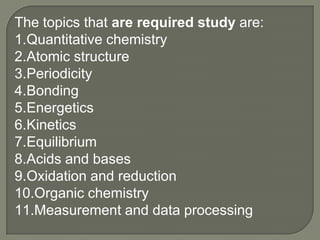
The topics that are required study are:
1.Quantitative chemistry
2.Atomic structure
3.Periodicity
4.Bonding
5.Energetics
6.Kinetics
7.Equilibrium
8.Acids and bases
9.Oxidation and reduction
10.Organic chemistry
11.Measurement and data processing
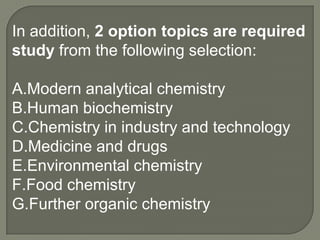
In addition, 2 option topics are required
study from the following selection:

A.Modern analytical chemistry
B.Human biochemistry
C.Chemistry in industry and technology
D.Medicine and drugs
E.Environmental chemistry
F.Food chemistry
G.Further organic chemistry
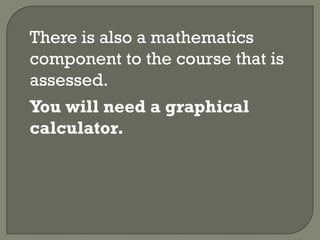
There is also a mathematics
component to the course that is
assessed.
You will need a graphical
calculator.
How will I be taught?
Instruction is dependent on many factors
but will range from direct instruction to
collaborative activities to independent
inquiry.
A lot of information must be learned
within a short period of time so the pace
is rapid.
It is important to be organized and self-
directed.
How will I be assessed?
Assessment is external and internal.
External assessment is based on test
performance and accounts for 76% of
the final grade.
Internal assessment is based on
practical work and accounts for 24% of
the final grade.
External assessment for the IB Diploma is divided into 3
separate exams called Papers.
• Paper 1 is 1 hour with 40 multiple choice questions on
  the required topics.
   • It is 20% of the final mark.
• Paper 2 is 2 hour 15 minutes with data-based/short-
  answer questions and extended-response questions in 2
  sections on the required topics.
   • It is 36% / 32% of the final mark.
• Paper 3 is a 1 hour 15 minutes with short-answer
  questions on each of the 2 option topics.
   • It is 20% / 24% of the final mark.
Internal assessment requires a
minimum of 60 / 40 hours of hands-on
investigation, excluding write-up time,
and a minimum number of assessed
pieces of work.
Written reports on practical work are
assessed according to 3 prescribed
assessment criteria:
  • Design – 6% of the final mark
  • Data collection and processing– 6% of
    the final mark
  • Conclusion and evaluation– 6% of the
    final mark
A minimum of 2 assessed pieces of work
per criterion are required.
Chemistry is in Group 4 of the IB Diploma
Programme and fulfils 1 of its requirements.
It is important for entrance and placement in
post-secondary institutions.
It provides a fundamental basis for
understanding the physical world.
It is intellectually engaging and enjoyable.

Dp choices chemistry

  • 1.
  • 2.
    The topics thatare required study are: 1.Quantitative chemistry 2.Atomic structure 3.Periodicity 4.Bonding 5.Energetics 6.Kinetics 7.Equilibrium 8.Acids and bases 9.Oxidation and reduction 10.Organic chemistry 11.Measurement and data processing
  • 3.
    In addition, 2option topics are required study from the following selection: A.Modern analytical chemistry B.Human biochemistry C.Chemistry in industry and technology D.Medicine and drugs E.Environmental chemistry F.Food chemistry G.Further organic chemistry
  • 4.
    There is alsoa mathematics component to the course that is assessed. You will need a graphical calculator.
  • 5.
    How will Ibe taught? Instruction is dependent on many factors but will range from direct instruction to collaborative activities to independent inquiry. A lot of information must be learned within a short period of time so the pace is rapid. It is important to be organized and self- directed.
  • 6.
    How will Ibe assessed? Assessment is external and internal. External assessment is based on test performance and accounts for 76% of the final grade. Internal assessment is based on practical work and accounts for 24% of the final grade.
  • 7.
    External assessment forthe IB Diploma is divided into 3 separate exams called Papers. • Paper 1 is 1 hour with 40 multiple choice questions on the required topics. • It is 20% of the final mark. • Paper 2 is 2 hour 15 minutes with data-based/short- answer questions and extended-response questions in 2 sections on the required topics. • It is 36% / 32% of the final mark. • Paper 3 is a 1 hour 15 minutes with short-answer questions on each of the 2 option topics. • It is 20% / 24% of the final mark.
  • 8.
    Internal assessment requiresa minimum of 60 / 40 hours of hands-on investigation, excluding write-up time, and a minimum number of assessed pieces of work.
  • 9.
    Written reports onpractical work are assessed according to 3 prescribed assessment criteria: • Design – 6% of the final mark • Data collection and processing– 6% of the final mark • Conclusion and evaluation– 6% of the final mark A minimum of 2 assessed pieces of work per criterion are required.
  • 10.
    Chemistry is inGroup 4 of the IB Diploma Programme and fulfils 1 of its requirements. It is important for entrance and placement in post-secondary institutions. It provides a fundamental basis for understanding the physical world. It is intellectually engaging and enjoyable.