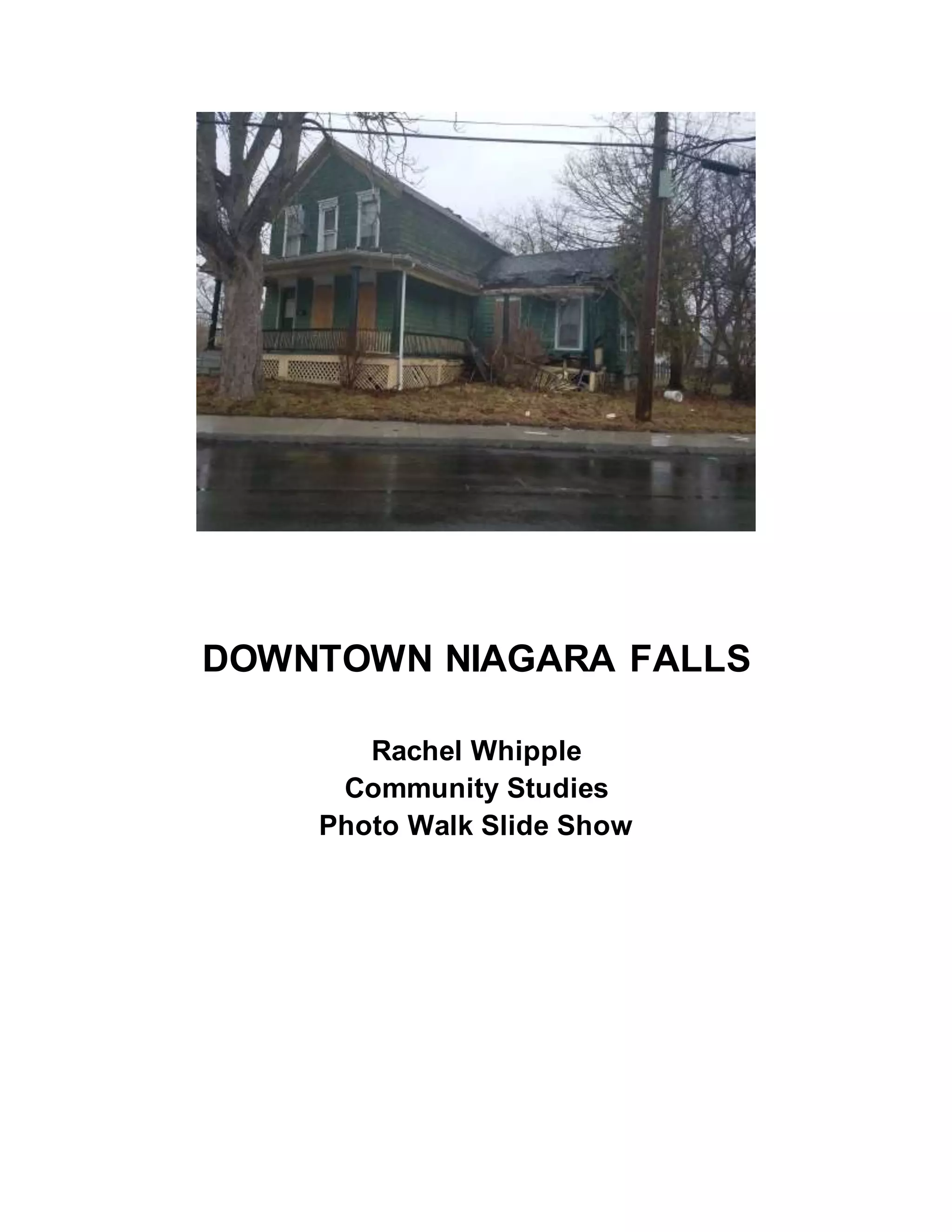
DOWNTOWN NIAGARA FALLS
Rachel Whipple
Community Studies
Photo Walk Slide Show
● The topic I chose for my slide show comes from
the chapter entitled, The Social Environment of
Metro Areas: Strangers, Crowding, Homelessness
and Crime.
● The specific topic I wanted to concentrate on is
The Broken Windows Theory.
● I chose this topic because as it is obvious to
anyone who drives through downtown Niagara
Falls, the area is quite depressed and unsettling
and unsafe.
● The Broken Windows Theory was developed by
social scientists, James Q. Wilson and George L.
Kelling.
● The Broken Windows Theory “suggests the best
way to control crime is to prevent it, and the best
way to prevent crime is not by concentrating
police efforts on solving major crimes, but
focusing on preventing minor quality-of-life
offenses such as drinking in public and public
vandalism”.1
1
Palen, J. John. The Urban World. Oxford Univ. Press, 2015. pg. 170
● I drive around this area every day since it is where
I work. But for this assignment I travelled side
streets I wasn’t very familiar with to find perfect
photos. I gathered photos in an area from 1st St to
about 19th St, and from Buffalo Ave to Findlay
Ave.
● Here’s a link to a map of the area -
https://www.mapquest.com/us/ny/14302-
286272459
● I found that the Census Bureau was perfect for
looking up quick statistics on the city,
https://www.census.gov/quickfacts/fact/table/niagaraf
allscitynewyork/PST045216
● Here are some stats I found relevant to my topic:
○ Median Household Income - $32,322
○ Median House Value - $69,200
○ Median Rent - $648
○ Residents below Poverty Level - 27.2%
○ Highschool Diploma or Higher Degree - 86.2%
○ White population - 69.7%
○ African American population - 22.3%
○ Hispanic poloulation - 3.3%
○ Native American population - 1.6%
● I tried getting data from UCR (Uniform Crime
Reporting Statistics, but it is far from user
friendly). So instead I used CityRating.com who
cites their information was collected from the
UCR. Here’s their site:
https://www.cityrating.com/crime-statistics/new-
york/niagara-falls.html
● A startling statistic they provide is that the violent
crime in the city of Niagara Falls (2016) is higher
than the National violent crime rate by 192.33%.
And for property crime, higher than the national
by 101.36%.
● Here’s where it gets interesting, the violent crime
rate in the city of Niagara Falls (2016) is higher
than the New York State violent crime rate by
208.54%. Property crime is higher in the Falls by
219.28%.
● Area Vibes is a great site as well, breaks it down a
bit more user friendly too. They claim to get their
data from the UCR as well. Here’s their link:
http://www.areavibes.com/niagara+falls-ny/crime/
Rough Neighborhoods
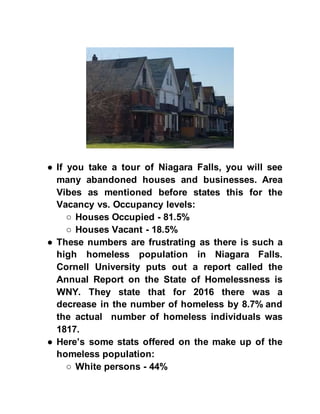
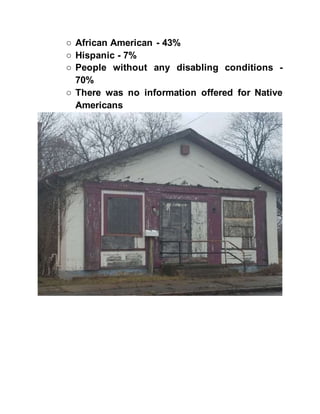
● If you take a tour of Niagara Falls, you will see
many abandoned houses and businesses. Area
Vibes as mentioned before states this for the
Vacancy vs. Occupancy levels:
○ Houses Occupied - 81.5%
○ Houses Vacant - 18.5%
● These numbers are frustrating as there is such a
high homeless population in Niagara Falls.
Cornell University puts out a report called the
Annual Report on the State of Homelessness is
WNY. They state that for 2016 there was a
decrease in the number of homeless by 8.7% and
the actual number of homeless individuals was
1817.
● Here’s some stats offered on the make up of the
homeless population:
○ White persons - 44%
○ African American - 43%
○ Hispanic - 7%
○ People without any disabling conditions -
70%
○ There was no information offered for Native
Americans
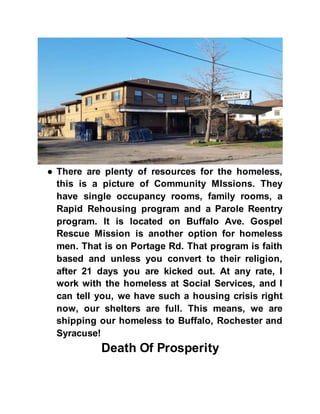
● There are plenty of resources for the homeless,
this is a picture of Community MIssions. They
have single occupancy rooms, family rooms, a
Rapid Rehousing program and a Parole Reentry
program. It is located on Buffalo Ave. Gospel
Rescue Mission is another option for homeless
men. That is on Portage Rd. That program is faith
based and unless you convert to their religion,
after 21 days you are kicked out. At any rate, I
work with the homeless at Social Services, and I
can tell you, we have such a housing crisis right
now, our shelters are full. This means, we are
shipping our homeless to Buffalo, Rochester and
Syracuse!
Death Of Prosperity
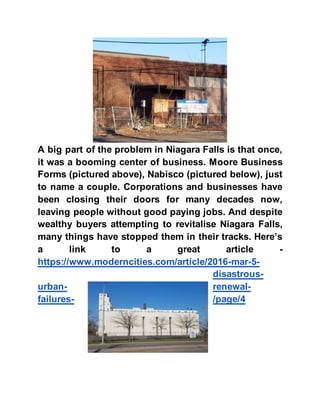
A big part of the problem in Niagara Falls is that once,
it was a booming center of business. Moore Business
Forms (pictured above), Nabisco (pictured below), just
to name a couple. Corporations and businesses have
been closing their doors for many decades now,
leaving people without good paying jobs. And despite
wealthy buyers attempting to revitalise Niagara Falls,
many things have stopped them in their tracks. Here’s
a link to a great article -
https://www.moderncities.com/article/2016-mar-5-
disastrous-
urban- renewal-
failures- /page/4
In Closing…..
● I don’t have the answers. Niagara Falls is very
broken, just likes its windows. Would a police
force focusing on the minor infractions make it a
better place? It certainly couldn’t hurt. But in all I
think we have a community so depressed that it’s
lost all hope. And when you have politics and
corporations getting in the way of real
redevelopment and renewal, all we can do is
hope.
● This class has at least helped me to understand
some of the background and sociological
approach to the communities around me.

Downtown Niagara Falls

  • 1.
    DOWNTOWN NIAGARA FALLS RachelWhipple Community Studies Photo Walk Slide Show
  • 2.
    ● The topicI chose for my slide show comes from the chapter entitled, The Social Environment of Metro Areas: Strangers, Crowding, Homelessness and Crime. ● The specific topic I wanted to concentrate on is The Broken Windows Theory. ● I chose this topic because as it is obvious to anyone who drives through downtown Niagara Falls, the area is quite depressed and unsettling and unsafe. ● The Broken Windows Theory was developed by social scientists, James Q. Wilson and George L. Kelling. ● The Broken Windows Theory “suggests the best way to control crime is to prevent it, and the best way to prevent crime is not by concentrating police efforts on solving major crimes, but focusing on preventing minor quality-of-life offenses such as drinking in public and public vandalism”.1 1 Palen, J. John. The Urban World. Oxford Univ. Press, 2015. pg. 170
  • 3.
    ● I drivearound this area every day since it is where I work. But for this assignment I travelled side streets I wasn’t very familiar with to find perfect photos. I gathered photos in an area from 1st St to about 19th St, and from Buffalo Ave to Findlay Ave. ● Here’s a link to a map of the area - https://www.mapquest.com/us/ny/14302- 286272459 ● I found that the Census Bureau was perfect for looking up quick statistics on the city, https://www.census.gov/quickfacts/fact/table/niagaraf allscitynewyork/PST045216 ● Here are some stats I found relevant to my topic: ○ Median Household Income - $32,322 ○ Median House Value - $69,200 ○ Median Rent - $648 ○ Residents below Poverty Level - 27.2% ○ Highschool Diploma or Higher Degree - 86.2% ○ White population - 69.7% ○ African American population - 22.3% ○ Hispanic poloulation - 3.3% ○ Native American population - 1.6%
  • 4.
    ● I triedgetting data from UCR (Uniform Crime Reporting Statistics, but it is far from user friendly). So instead I used CityRating.com who cites their information was collected from the UCR. Here’s their site: https://www.cityrating.com/crime-statistics/new- york/niagara-falls.html ● A startling statistic they provide is that the violent crime in the city of Niagara Falls (2016) is higher than the National violent crime rate by 192.33%. And for property crime, higher than the national by 101.36%. ● Here’s where it gets interesting, the violent crime rate in the city of Niagara Falls (2016) is higher than the New York State violent crime rate by 208.54%. Property crime is higher in the Falls by 219.28%. ● Area Vibes is a great site as well, breaks it down a bit more user friendly too. They claim to get their data from the UCR as well. Here’s their link: http://www.areavibes.com/niagara+falls-ny/crime/ Rough Neighborhoods
  • 5.
    ● If youtake a tour of Niagara Falls, you will see many abandoned houses and businesses. Area Vibes as mentioned before states this for the Vacancy vs. Occupancy levels: ○ Houses Occupied - 81.5% ○ Houses Vacant - 18.5% ● These numbers are frustrating as there is such a high homeless population in Niagara Falls. Cornell University puts out a report called the Annual Report on the State of Homelessness is WNY. They state that for 2016 there was a decrease in the number of homeless by 8.7% and the actual number of homeless individuals was 1817. ● Here’s some stats offered on the make up of the homeless population: ○ White persons - 44%
  • 6.
    ○ African American- 43% ○ Hispanic - 7% ○ People without any disabling conditions - 70% ○ There was no information offered for Native Americans
  • 7.
    ● There areplenty of resources for the homeless, this is a picture of Community MIssions. They have single occupancy rooms, family rooms, a Rapid Rehousing program and a Parole Reentry program. It is located on Buffalo Ave. Gospel Rescue Mission is another option for homeless men. That is on Portage Rd. That program is faith based and unless you convert to their religion, after 21 days you are kicked out. At any rate, I work with the homeless at Social Services, and I can tell you, we have such a housing crisis right now, our shelters are full. This means, we are shipping our homeless to Buffalo, Rochester and Syracuse! Death Of Prosperity
  • 8.
    A big partof the problem in Niagara Falls is that once, it was a booming center of business. Moore Business Forms (pictured above), Nabisco (pictured below), just to name a couple. Corporations and businesses have been closing their doors for many decades now, leaving people without good paying jobs. And despite wealthy buyers attempting to revitalise Niagara Falls, many things have stopped them in their tracks. Here’s a link to a great article - https://www.moderncities.com/article/2016-mar-5- disastrous- urban- renewal- failures- /page/4
  • 9.
    In Closing….. ● Idon’t have the answers. Niagara Falls is very broken, just likes its windows. Would a police force focusing on the minor infractions make it a better place? It certainly couldn’t hurt. But in all I think we have a community so depressed that it’s lost all hope. And when you have politics and corporations getting in the way of real redevelopment and renewal, all we can do is hope. ● This class has at least helped me to understand some of the background and sociological approach to the communities around me.