Dorothy E. Johnson’sBehavioral
System Model
• A Blueprint for Holistic Nursing Care
• Presented by: [Your Name]
• Nursing Program | [Instructor Name] | [Date]
2.
Who Was DorothyE. Johnson?
• • Born: August 21, 1919 | Died: 1999
• • American nurse theorist and professor at
Vanderbilt University
• • Believed in the behavioral approach to
nursing care
• Quote:
• “Nursing is concerned with man as an
integrated whole and his behavior as it reflects
this total integration.” – Johnson, 1968
3.
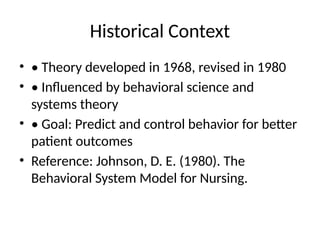
Historical Context
• •Theory developed in 1968, revised in 1980
• • Influenced by behavioral science and
systems theory
• • Goal: Predict and control behavior for better
patient outcomes
• Reference: Johnson, D. E. (1980). The
Behavioral System Model for Nursing.
4.
Overview of theBehavioral System
Model
• • Patients are behavioral systems striving for
balance
• • Illness disrupts behavioral balance
• • Nursing restores equilibrium by managing
behaviors
5.
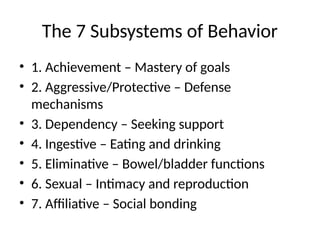
The 7 Subsystemsof Behavior
• 1. Achievement – Mastery of goals
• 2. Aggressive/Protective – Defense
mechanisms
• 3. Dependency – Seeking support
• 4. Ingestive – Eating and drinking
• 5. Eliminative – Bowel/bladder functions
• 6. Sexual – Intimacy and reproduction
• 7. Affiliative – Social bonding
6.
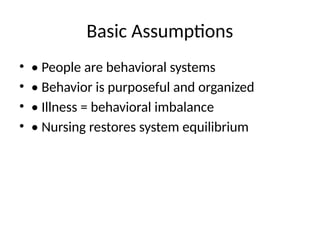
Basic Assumptions
• •People are behavioral systems
• • Behavior is purposeful and organized
• • Illness = behavioral imbalance
• • Nursing restores system equilibrium
7.
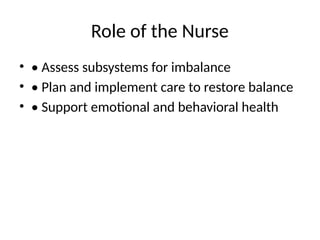
Role of theNurse
• • Assess subsystems for imbalance
• • Plan and implement care to restore balance
• • Support emotional and behavioral health
8.
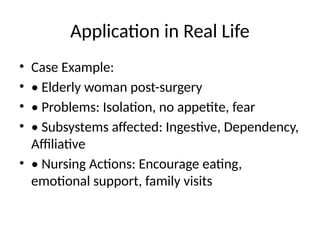
Application in RealLife
• Case Example:
• • Elderly woman post-surgery
• • Problems: Isolation, no appetite, fear
• • Subsystems affected: Ingestive, Dependency,
Affiliative
• • Nursing Actions: Encourage eating,
emotional support, family visits
9.
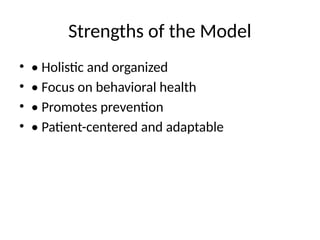
Strengths of theModel
• • Holistic and organized
• • Focus on behavioral health
• • Promotes prevention
• • Patient-centered and adaptable
10.
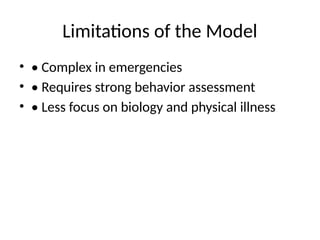
Limitations of theModel
• • Complex in emergencies
• • Requires strong behavior assessment
• • Less focus on biology and physical illness
11.
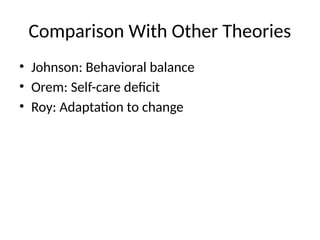
Comparison With OtherTheories
• Johnson: Behavioral balance
• Orem: Self-care deficit
• Roy: Adaptation to change
12.
Summary
• • Behavioralsystem model = patient care via 7
subsystems
• • Nurses help restore behavioral balance
• • Focus on prevention, stability, and holistic
care
13.
Final Thought
• “Theultimate goal of nursing is to help the
patient achieve or maintain behavioral
balance.” – Johnson, 1980
• Question: How would you use this model in
your next clinical experience?
14.
Q&A / Discussion
•1. What subsystem is affected by chronic pain?
• 2. Can Johnson’s model work in pediatrics or
psychiatry?
15.
References
• 1. Johnson,D. E. (1980). The Behavioral
System Model for Nursing.
• 2. Alligood, M.R. (2021). Nursing Theorists and
Their Work. Elsevier.
• 3. McEwen & Wills (2018). Theoretical Basis
for Nursing. 5th ed.
![Dorothy E. Johnson’s Behavioral
System Model
• A Blueprint for Holistic Nursing Care
• Presented by: [Your Name]
• Nursing Program | [Instructor Name] | [Date]](https://image.slidesharecdn.com/dorothyjohnsonnursingpresentation-250618142759-464cc865/85/Dorothy_Johnson_Nursing_Presentation-pptx-1-320.jpg)





![orems theory presentation [Autosaved].pptx](https://cdn.slidesharecdn.com/ss_thumbnails/oremstheorypresentationautosaved-221229160050-f38ec094-thumbnail.jpg?width=640&height=640&fit=bounds)


