Urban Redevelopment and Gentrification:
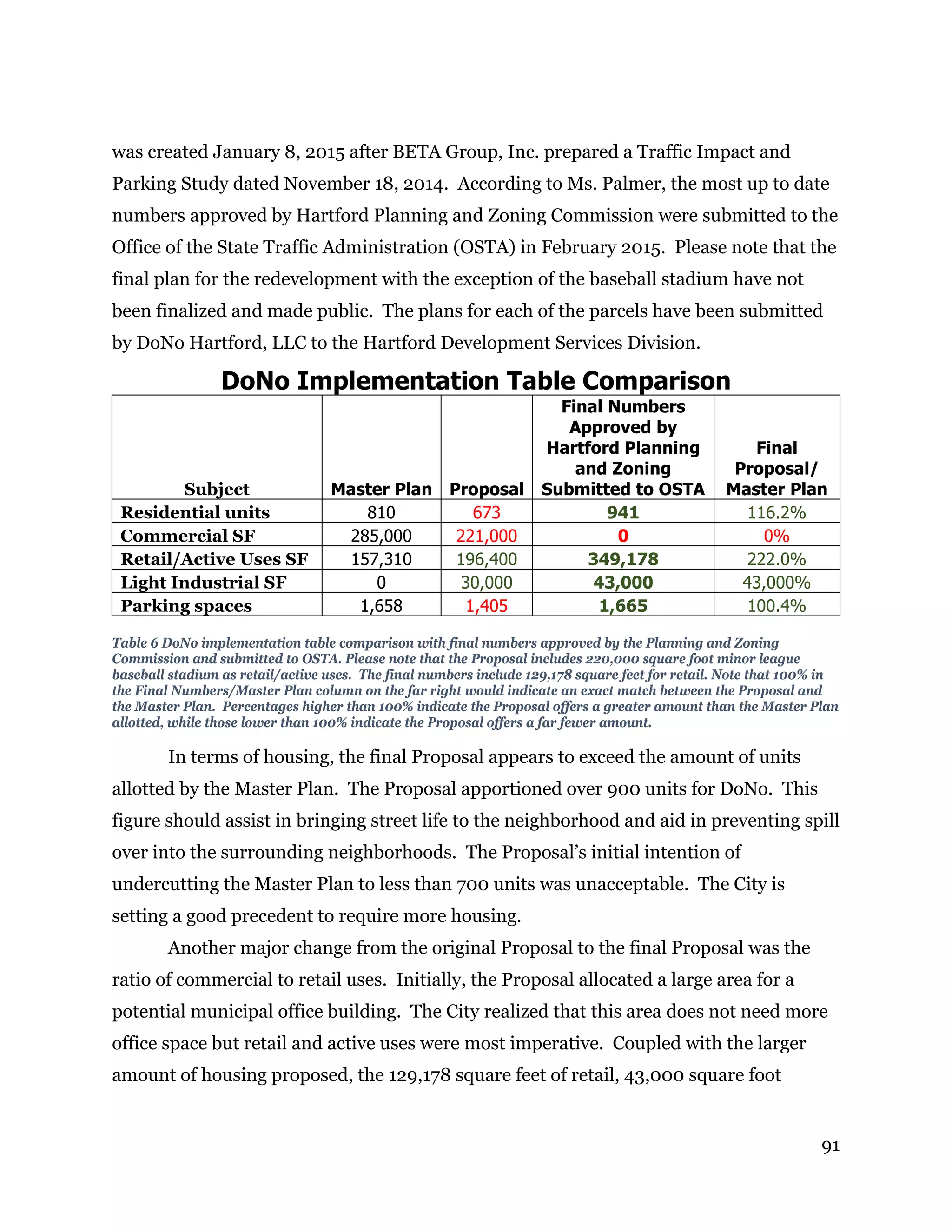
How will Hartford’s Downtown North /
Downtown West Master Plan affect the
adjacent neighborhoods?
Master’s Project
Jesse Regnier
Master’s of Regional Planning
University of Massachusetts, Amherst
September 2015
Approved as to style and content by:
Darrel Ramsey-Musolf, Committee Chair
LARP
Wayne Feiden, Committee Member
LARP
Patricia McGirr, Department Head
LARP
2
Acknowledgements
I would like to thank all those who assisted me throughout this project. First and
foremost, thank you to the City of Hartford from the City of Hartford’s Planning
Division, Khara C. Dodds, AICP and Caitlin Palmer, who kept me informed and up to
date on the DoNo project. Thank you to Philip S. Chester, AICP, Lebanon Town
Planner; Emily Hultquist, AICP, Principal Planner and Policy Analyst at Capitol Region
Council of Governments; Juliet Burdelski, Director of Economic Development for the
City of Meriden; and Tom Gentile, Business Development Manager of the Waterbury
Development Corporation for their insights into the field of planning and
redevelopment in Connecticut.
A special thanks to all those at the University of Massachusetts who helped me
along the way. From within the Department of Landscape Architecture and Regional
Planning we wish to thank to John Mullin, FAICP for extending his decades of applied
planning expertise. Thank you to Ethan Carr, FASLA, for assisting me in brainstorming
my research interests and pushing me to get this project off the ground.
I also wish to express my deepest gratitude to my Committee. Thank you to
Wayne Feiden, FAICP, whose experience helped guide me in the right direction. Last
but not least, I would like to express my deepest appreciation to my advisor and mentor,
Professor Darrel Ramsey-Musolf who invested his full effort in guiding me throughout
the past two years and worked tirelessly to support me in so many ways throughout this
project.
3
Table of Contents 
Acknowledgements .............................................................................................................2 
Table of Figures................................................................................................................... 5 
Table of Tables..................................................................................................................... 7 
Table of Photographs ..........................................................................................................8 
Executive Summary........................................................................................................... 10 
Introduction ...................................................................................................................... 12 
Existing Conditions........................................................................................................... 16 
Population.......................................................................................................................17 
Median Age....................................................................................................................18 
Race and Ethnicity......................................................................................................... 19 
Median Household Income ...........................................................................................20 
Poverty Rate................................................................................................................... 21 
Unemployment Rate......................................................................................................22 
Food Stamps ..................................................................................................................23 
Housing..........................................................................................................................24 
Educational Attainment ................................................................................................30 
Zoning............................................................................................................................ 31 
Summary........................................................................................................................34 
Site Visits and Photographs...........................................................................................36 
Research Questions and Methods.....................................................................................45 
Research Approach........................................................................................................45 
Research Questions .......................................................................................................46 
Understanding Gentrification...........................................................................................48 
Origins and Definitions .................................................................................................48 
Production vs. Consumption.........................................................................................49 
Non-Displacement Studies............................................................................................52 
Conclusions....................................................................................................................53 
Understanding Housing.................................................................................................... 55 
Introduction................................................................................................................... 55 
4
Federal Housing Policy..................................................................................................56 
Federal Housing Policy Summary.................................................................................58 
Low Income Housing Tax Credits (LIHTC)..................................................................59 
LIHTC Summary ...........................................................................................................62 
Deconcentrating Poverty...............................................................................................62 
Deconcentrating Poverty Summary ..............................................................................65 
Discrimination...............................................................................................................66 
Discrimination Summary ..............................................................................................69 
Conclusions....................................................................................................................70 
Summary of DoNo Master Plan ........................................................................................ 73 
Vision ............................................................................................................................. 73 
Previous Studies ............................................................................................................ 74 
Transportation Network................................................................................................ 75 
Retail Market Analysis................................................................................................... 76 
Housing Analysis ........................................................................................................... 76 
Open Space .................................................................................................................... 77 
Design Guidelines and Zoning ......................................................................................78 
Priority Areas.................................................................................................................79 
Ann Uccello................................................................................................................ 79 
Main and Trumbull....................................................................................................80 
Request for Proposals....................................................................................................82 
DoNo Hartford, LLC Proposal ..........................................................................................83 
Proposal Description .....................................................................................................85 
Planning and Zoning Commission Staff Report ...........................................................89 
Submitted Plans.............................................................................................................90 
Rubric Analysis of Two Case Studies ................................................................................94 
Demographic Changes 2000-2013................................................................................94 
Waterbury, Connecticut ................................................................................................98 
Meriden, Connecticut.................................................................................................. 102 
Conclusions and Lessons Learned ...............................................................................110 
Summary & Analysis of DoNo Proposal/Master Plan.....................................................113 
Recommendations............................................................................................................118 
5
Affordable Housing...................................................................................................118 
Mixed-Income...........................................................................................................119 
Master Plan .............................................................................................................. 120 
Case Studies ............................................................................................................. 120 
References ....................................................................................................................... 122 
Table of Figures
Figure 1 Downtown North and Downton West aerial photograph. ................................. 13
Figure 2 Hartford Neighborhood Map ............................................................................. 16
Figure 3 Population of the neighborhoods ........................................................................17
Figure 4 Median Age of the neighborhoods...................................................................... 18
Figure 5 Race and Ethnicity of the neighborhoods .......................................................... 19
Figure 6 Median Household Income of the neighborhoods.............................................20
Figure 7 Poverty Rate of the neighborhoods .................................................................... 21
Figure 8 Unemployment Rate of the neighborhoods.......................................................22
Figure 9 Household Receiving Food Stamps of the neighborhoods................................23
Figure 10 Students Eligible For Free- Or Reduced-Price School Lunch..........................23
Figure 11 Housing Units of the neighborhoods ................................................................24
Figure 12 Vacant Housing Units of the neighborhoods....................................................25
Figure 13 Rent Great Than 30% of Income of the neighborhoods...................................26
Figure 14 Median rent of the neighborhoods ................................................................... 27
Figure 15 Commute times of the neighborhoods..............................................................28
Figure 16 Housing Authority of the City of Hartford Affordable Housing Locations......29
Figure 17 Educational Attainment of the neighborhoods ................................................30
Figure 18 Zoning Map of the neighborhoods containing and surrounding DoNo. .........33
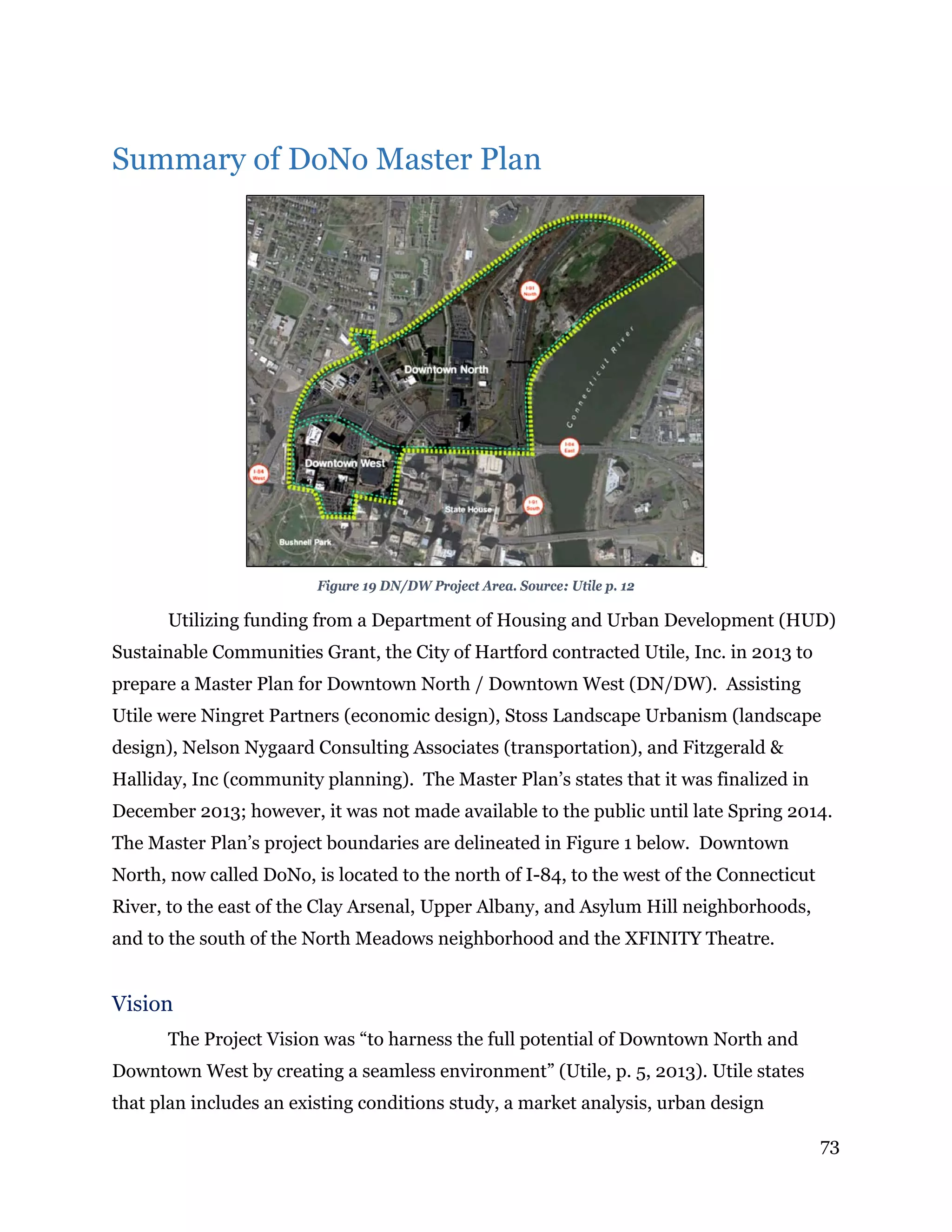
Figure 19 DN/DW Project Area ........................................................................................ 73
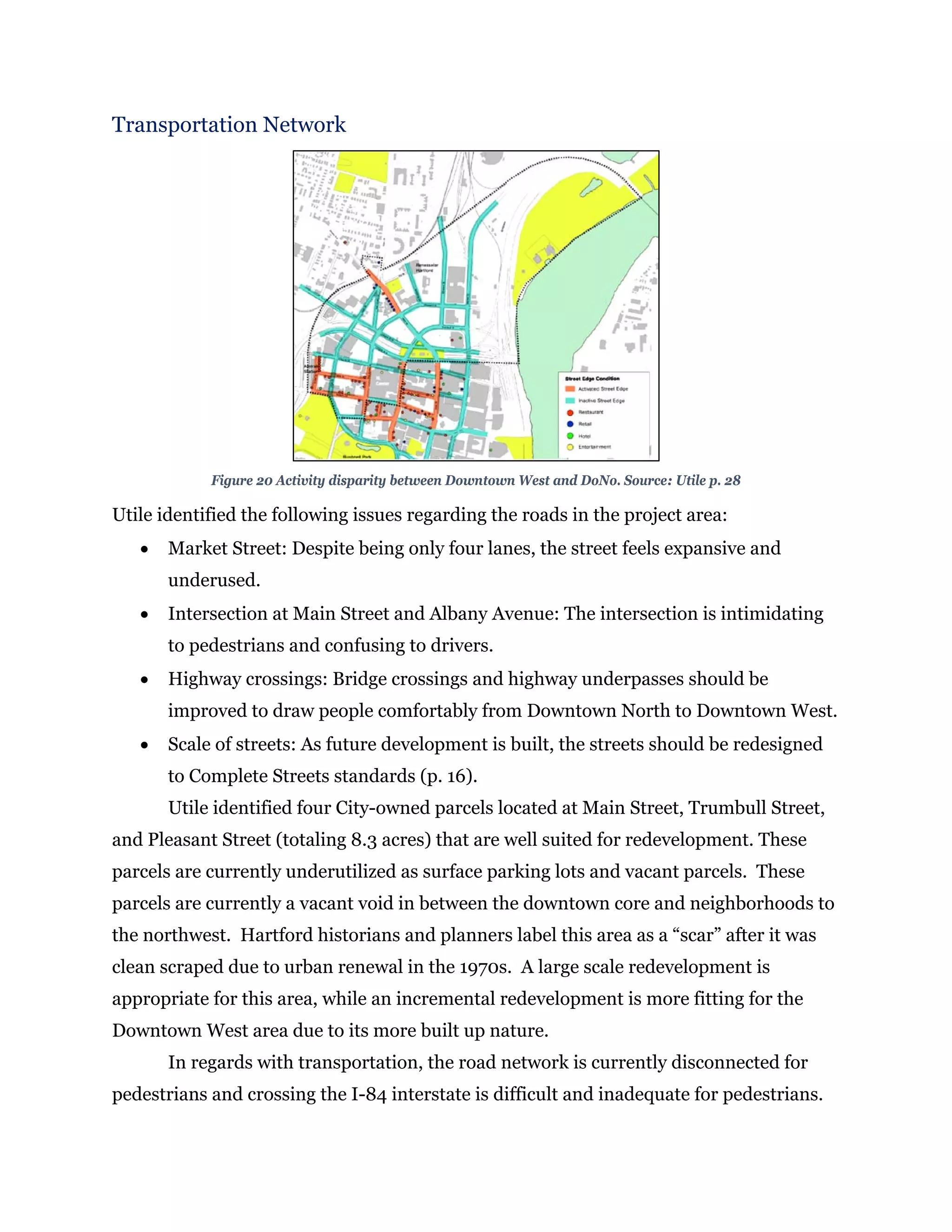
Figure 20 Activity disparity between Downtown West and DoNo................................... 75
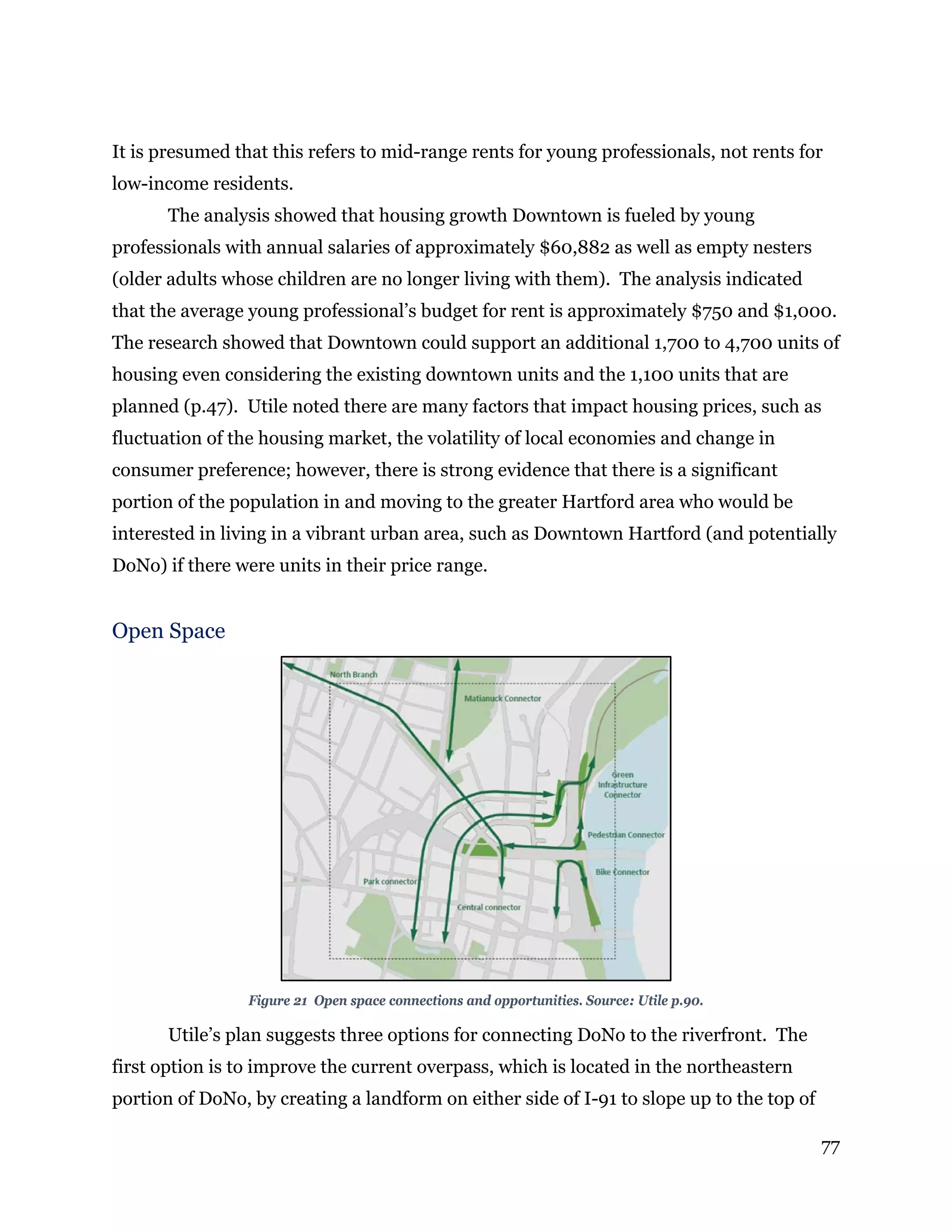
Figure 21 Open space connections and opportunities..................................................... 77
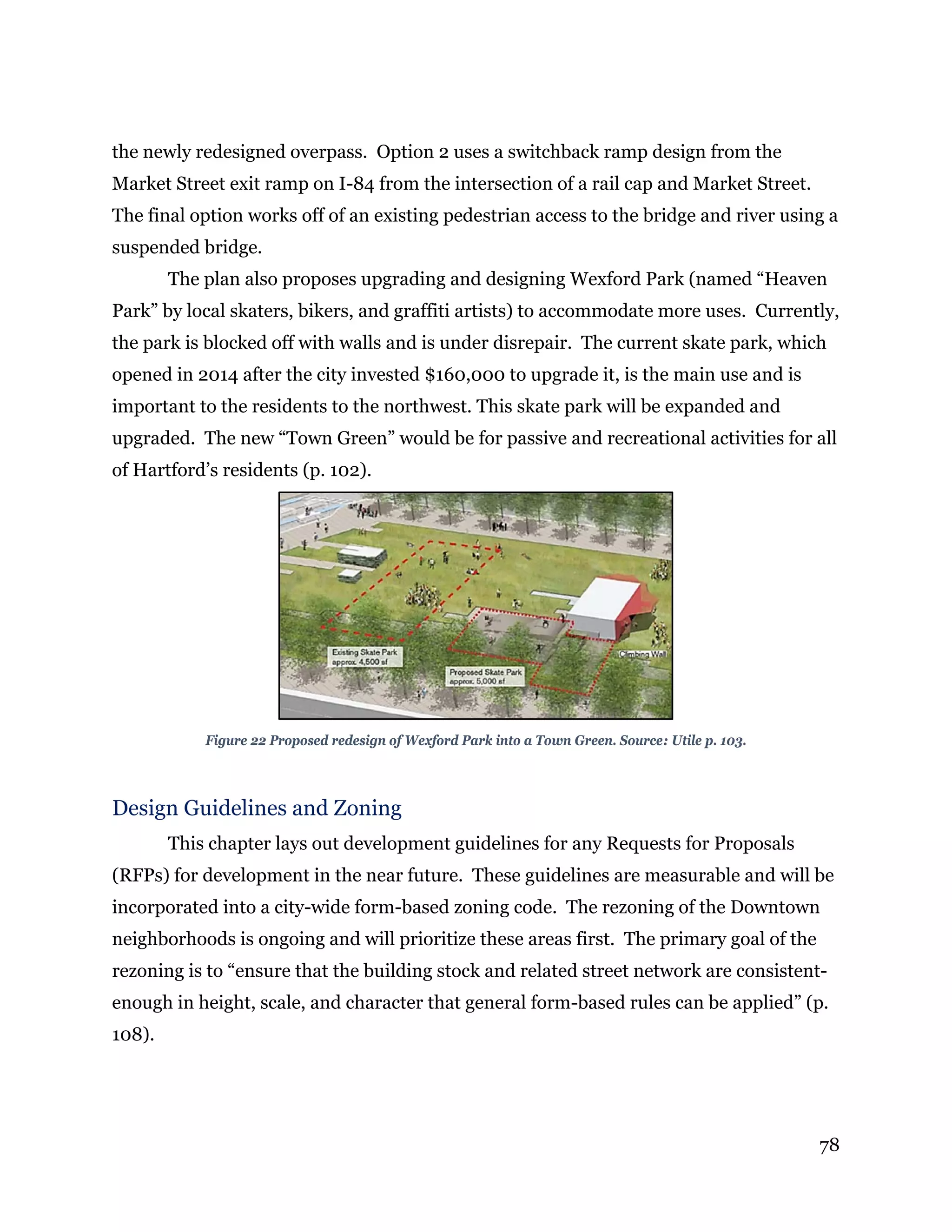
Figure 22 Proposed redesign of Wexford Park into a Town Green..................................78
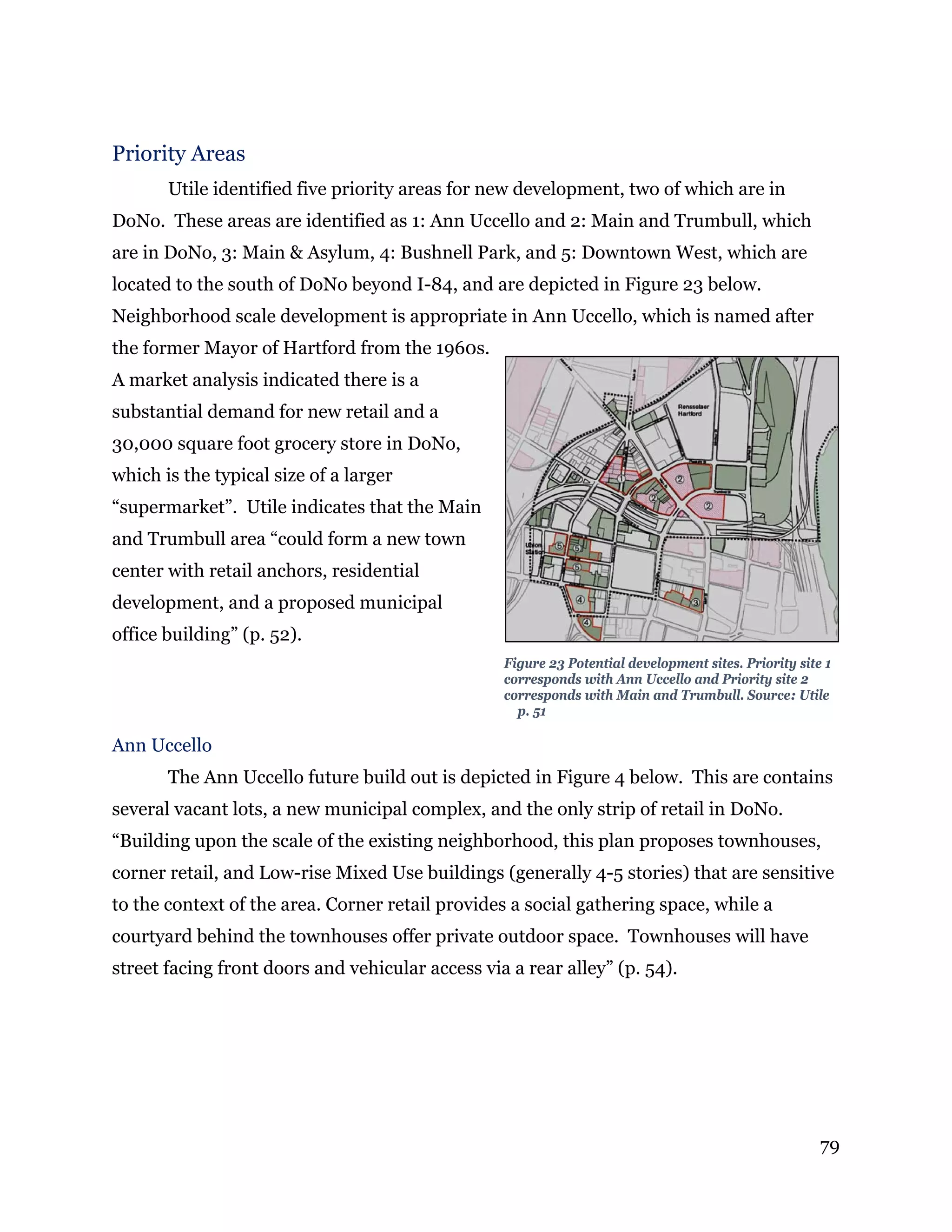
Figure 23 Potential development sites……………............................................................... 79
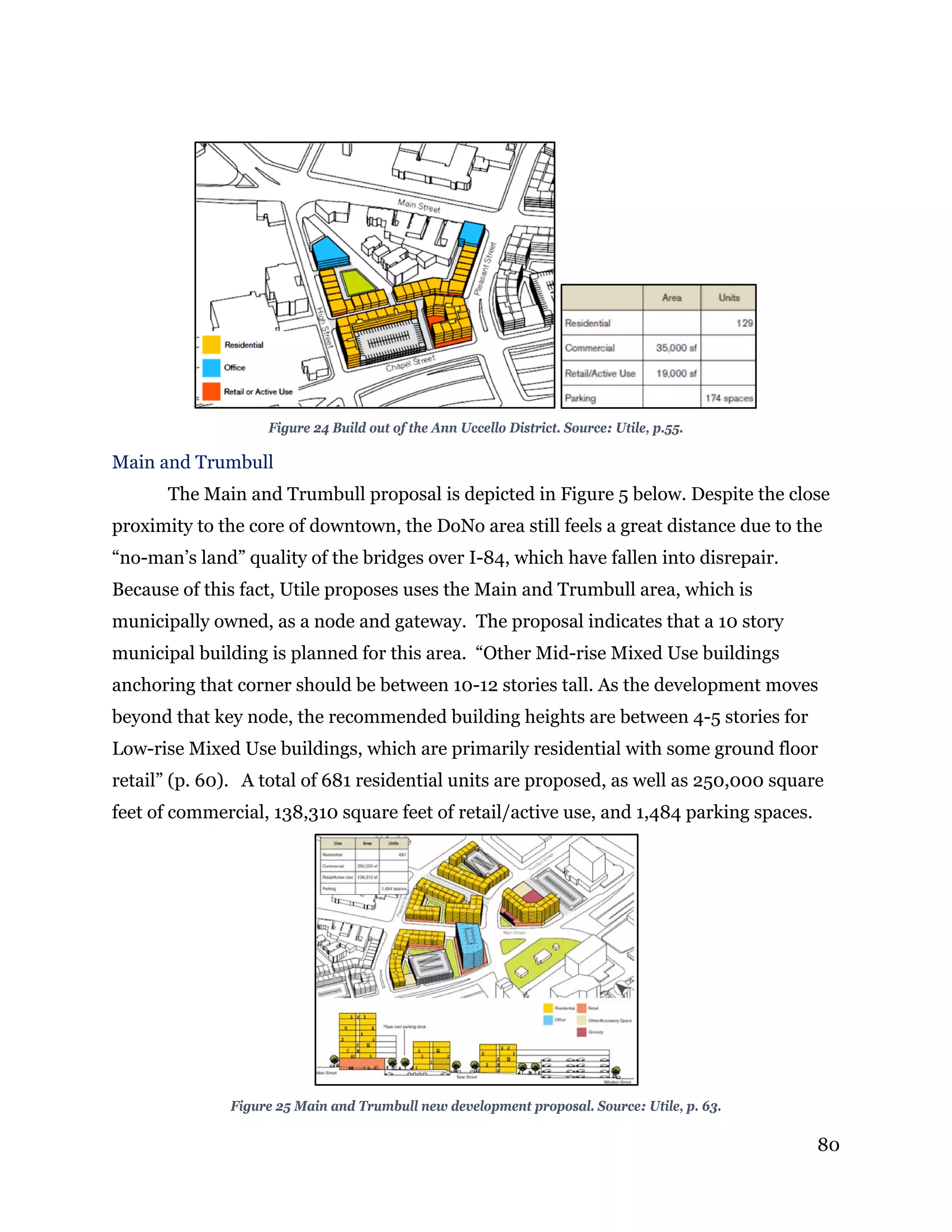
Figure 24 Build out of the Ann Uccello District ...............................................................80
6
Figure 25 Main and Trumbull new development proposal..............................................80
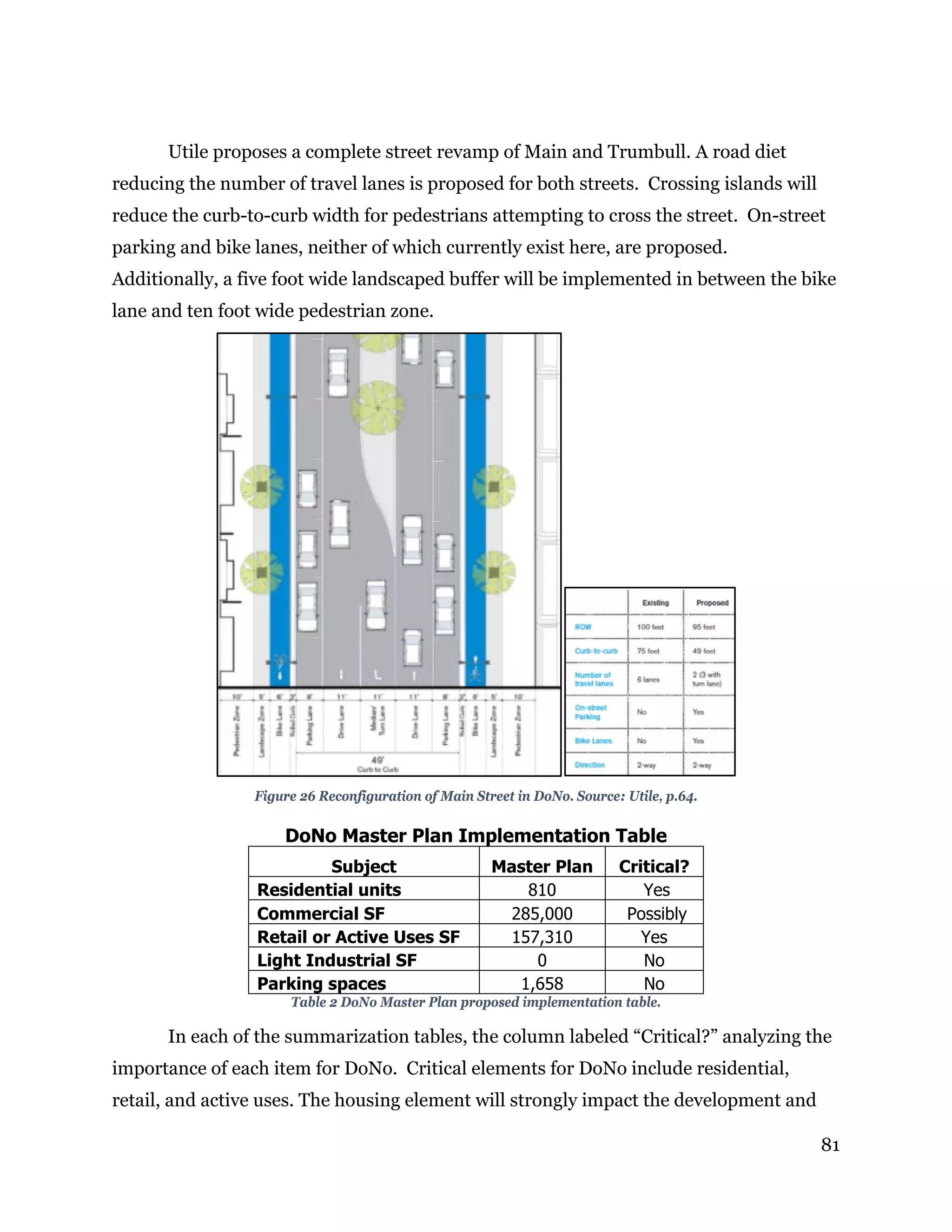
Figure 26 Reconfiguration of Main Street in DoNo. ........................................................ 81
Figure 27 DoNo Hartford LLC's concept site design of the DoNo redevelopment..........84
Figure 28 DoNo Hartford LLC's conceptual graphic of the Proposal..............................85
Figure 29 Final Planning and Zoning Commission Site Plan Subdivision for the DoNo 90
Figure 30 Land Use Plan for the Central Business District Renewal Project. ...............100
Figure 31 Google Earth aerial 1991 pre-redevelopment. Figure 32 Google Earth aerial
2014 post-redevelopment. ..............................................................................................100
Figure 33 HUB site Figure 34 Adjacent Downtown Meriden..............................104
Figure 35 Train station Figure 36 Adjacent affordable housing
complex……………………104
Figure 37 Meriden Master Plan Implementation Table.............. Error! Bookmark not
defined.
Figure 38 Meriden HUB redevelopment final concept plan. ......................................... 106
Figure 39 HUB Conceptual Site Plan.............................................................................. 107
Figure 40 Graphic of proposed mixed use building on the HUB site ............................ 107
Figure 41 Concept plan for 11 Crown Street.................................................................... 109
Figure 42 Concept Site Plan for the 116 Cook Ave redevelopment. ............................... 109
7
Table of Tables
Table 1 Zoning in and around DoNo................................................................................. 31 
Table 2 DoNo Master Plan proposed implementation table............................................ 81 
Table 3 Detail of proposed uses with quantities within the Proposal..............................88 
Table 4 Comparison of the DoNo Master Plan's implementation proposal ....................88 
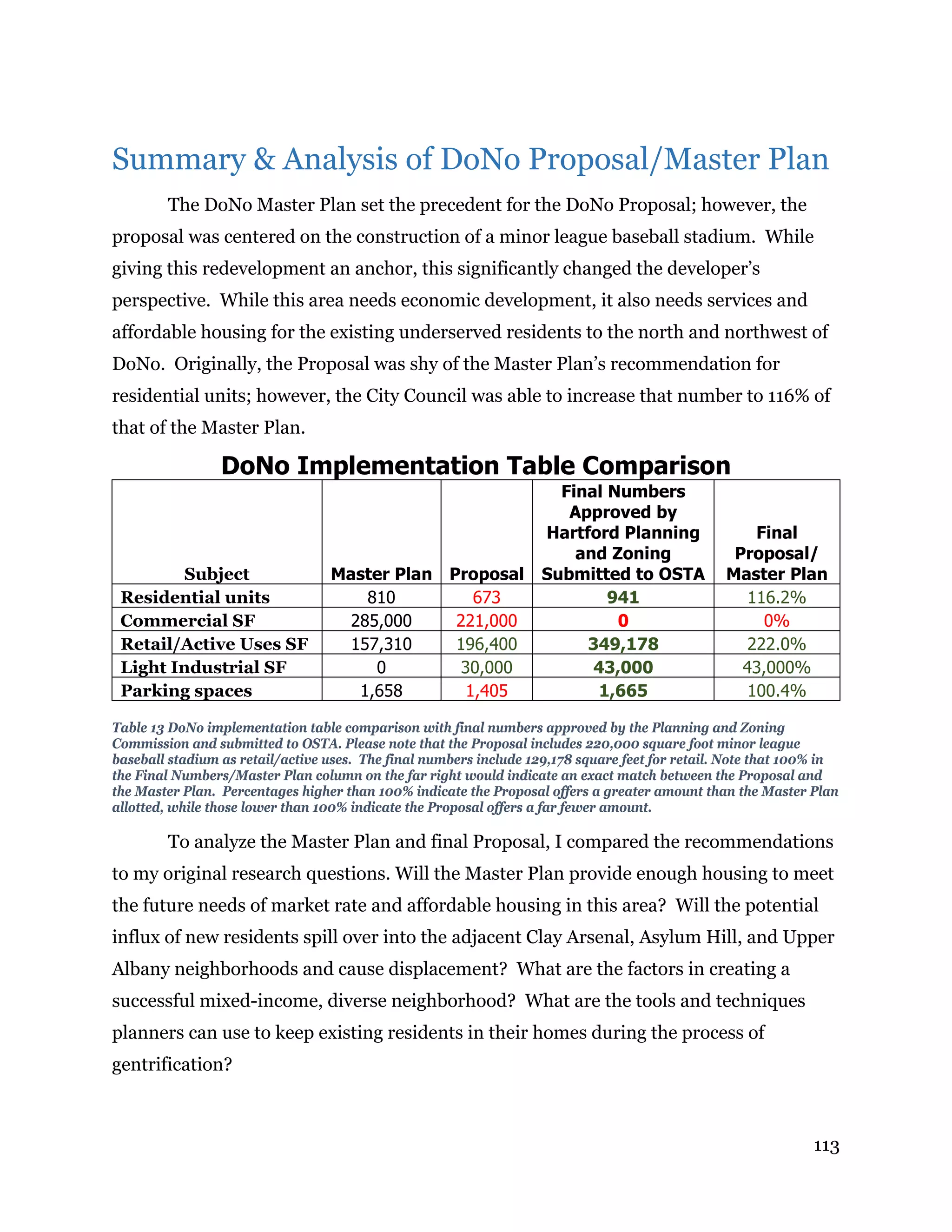
Table 5 DoNo implementation table comparison ............................................................90 
Table 6 DoNo implementation table comparison with final numbers approved by the
Planning and Zoning Commission and submitted to OSTA.. .......................................... 91 
Table 7 Meriden Master Plan Implementation Table..................................................... 105 
Table 8 Demographic changes in Meriden Center and Waterbury Central Business
District from 2000 to 2013.. .............................................................................................95 
Table 9 Housing changes in Meriden Center and Waterbury Central Business District
from 2000 to 2013.. ..........................................................................................................96 
Table 10 Education changes in Meriden Center and Waterbury Central Business District
from 2000 to 2013. ...........................................................................................................96 
Table 11 Employment changes in Meriden Center and Waterbury Central Business
District from 2000 to 2013.. ............................................................................................. 97 
8
Table of Photographs
Photograph 1 View of a parking lot at the intersection of Main Street and Trumbull
Street at the heart of the DoNo redevelopment area........................................................36 
Photograph 2 View of a parking lot and vacant lot at the intersection of Main Street and
Trumbull Street at the heart of the DoNo redevelopment area. ...................................... 37 
Photograph 3 View of Downtown Hartford beyond a parking lot and vacant lot at the
intersection of Main Street and Trumbull Street.............................................................. 37 
Photograph 4 View of a Downton Hartford beyond a parking lot at the intersection of
Main Street and Trumbull Street at the heart of the DoNo redevelopment area. ...........38 
Photograph 5 View of a vacant lot at the intersection of Main Street and Trumbull Street
at the heart of the DoNo redevelopment area. .................................................................38 
Photograph 6 View of a parking lot at the intersection of Main Street and Trumbull
Street at the heart of the DoNo redevelopment area........................................................39 
Photograph 7 View of a parking lot at 1214 Main Street between Pleasant Street and
Trumbull Street. This is the location of the proposed minor league baseball stadium. .39 
Photograph 8 View of the intersection of Chapel Street and Market Street beneath I-84
highway..............................................................................................................................40 
Photograph 9 View of a vacant lot on the east side of Market Street in the eastern
portion of the DoNo redevelopment area.........................................................................40 
Photograph 10 View of the pedestrian bridge over the I-91 highway to Riverside Park in
the eastern portion of the DoNo area. .............................................................................. 41 
Photograph 11 View of barbeque picnic areas along the Connecticut River in Riverside
Park.................................................................................................................................... 41 
Photograph 12 View of the Downtown Hartford from Windsor Street............................42 
Photograph 13 View of typical multi-family residences with first floor retail spaces on
the western side of the DoNo redevelopment area (1355 Main Street).. .........................42 
Photograph 14 View of the North End Gateway Apartments (1450 Main Street) ...........43 
Photograph 15 View west along Albany Avenue at the junction of the Clay Arsenal &
Upper Albany neighborhoods. ..........................................................................................43 
9
Photograph 16 Palace Theater and UConn Campus Photograph 17 Arts Magnet
School on the eastern side of at the heart of the redeveloment. 101 
Photograph 18 View of redevelopment zone from the east. Photograph 19 Parking garage
at rear of Palace Theater. ................................................................................................ 102 
Photograph 20 Redevelopment site was formerly a mixed Photograph 21 Former
Meriden Mall/HUB building. 1971. use downtown. Undated (pre 1965).. .................... 103 
Photograph 22 Flood of HUB site. Photograph 23 Abandoned Meriden HUB 2006. .. 103 
10
Executive Summary
The purpose of this project is to determine the impact of a redevelopment master
plan on the existing population surrounding the project area. In the Spring of 2014, the
City of Hartford, Connecticut and Utile prepared a redevelopment Master Plan for a
portion of their downtown titled “Downtown North / Downtown West: A Plan for the
City of Hartford.” The Downtown North (DoNo) section of the plan area consists of
vacant lots, parking lots, and underutilized properties, many city-owned, which appear
prime for redevelopment. My research questions and analysis focus on the housing
portion of this Master Plan in the DoNo neighborhood, and examine the social justice
impacts of the potential redevelopment.
Abutting this area is the wealthy and more expensive Downtown and in contrast
with the low-income, minority, and marginalized neighborhoods of Clay Arsenal, Upper
Albany, and Asylum Hill. My main research questions are as follows. Will the Master
Plan provide enough housing to meet the future needs of market rate and affordable
housing in the project area? Will the potential influx of new residents spill over into the
adjacent Clay Arsenal, Asylum Hill, and Upper Albany neighborhoods and cause the
displacement of residents?
Throughout the year long process of conducting this research project, the City
contracted the New Britain Rock Cats to move to the DoNo and agreed to construct a
$56 million minor league baseball stadium for them. A developer submitted a proposal
in response to the City’s Request for Proposals (RFP) for the stadium and included a
$350 million mixed-use neighborhood development around the stadium. The evolution
of this project has given me the opportunity to also compare the developer’s proposal,
which is in the final negotiations with the City Council, to the original redevelopment
Master Plan.
The DoNo redevelopment Master Plan and subsequent proposal struggle to
balance needed economic development to the neighborhood, the City, and existing
residents. This critical piece (DoNo) of the City has formed a gap between Downtown
and the surrounding North End neighborhoods. The City is at an exciting time in its
history with the opportunity to heal the scars of the early generations of urban renewal
11
that left much of DoNo vacant and underutilized, and shifted resources and amenities
away from the North End and into Downtown.
The DoNo Master Plan aimed to bring in approximately 800 residential units
into DoNo, for young professionals and empty nesters. Much of the plan intends to
bring in amenities that would also benefit these groups, although the improvements in
streetscaping, transportation, and connections to several parks would benefit the
surrounding neighborhoods. A grocery store that would also serve North End
neighborhoods, as well as Downtown, would be a great benefit.
The redevelopment proposal for the minor league baseball stadium and mixed-
use neighborhood drew criticism despite its best efforts to produce a viable plan for this
forgotten part of Hartford. The original proposal included no affordable housing units,
which targeted units for wealthier young professionals. The proposal substantially
undercut the number of housing units initially; however, the City pushed back and now
will see over 900 units. If the City Council succeeds in their efforts in the developer’s
agreement, 20% of the units will have low and moderate-income affordability
restrictions. No preference requirements have been set yet for the neighborhood.
Moderate-income affordable units may be most successful as they would slowly
transition income mixing.
Analysis of this project has developed recommendations for the City of Hartford
to assist them in planning for the benefit of the existing low-income residents. This
project, at the very least, proves that the field of planning matters. We may never know
if the Master Plan process was the impetus for this redevelopment; however, it has acted
as a guiding document none-the-less. The City has been able to utilize the Master Plan
to push the developers to follow the type of development they are interested in for their
community.
12
Introduction
As a culminating experience for my Master’s of Regional Planning degree at the
University of Massachusetts, I selected to complete a Master’s Project. This six credit
course required me to work independently on a project to explore various aspects of
regional planning. This self-designed research project was developed with the
assistance of my advisor, Professor Darrel Ramsey-Musolf, my Committee Member,
Professor Wayne Feiden, and my Research Issues Professor Ethan Carr.
This Masters Project analyzes the potential impacts of Hartford’s Downtown
North / Downtown West Master Plan (December 2013) on the surrounding
neighborhoods. The area that is the focus of this Masters Project is the Downtown
North neighborhood. This neighborhood has been coined “DoNo” (pounced Dough-
N0), playing off of Hartford’s south-of-downtown “SoDo” neighborhood. DoNo is
bound by Interstate 84 to the south, the Connecticut River to the east, railroad tracks
and the North Meadows neighborhood to the north, railroad tracks and the Clay Arsenal
neighborhood to the west.
The DoNo area is located north of Interstate 84, which separated this
neighborhood from downtown in the late 1960’s. This formerly diverse neighborhood
has been plagued with poverty, lack of resources, and large amounts of vacant parcels.
This area contains prime developable real estate in Hartford. Hartford is the 8th
smallest capital city in the United States by land area.
Hartford has been a low or no growth city within a low or no growth state for
almost half a century. After urban renewal and race riots demolished many structures
in the DoNo area in the 1960’s, Hartford’s population drastically declined with “white
flight” to the suburbs. Historically, there has been little reason to attract people to move
back to Hartford, until now. There is a trend in many cities across the country of young
professionals and people without children to move back to urban centers, especially in
up and coming and inexpensive areas. The city, the University of Connecticut, the
University of St. Joseph’s, and Trinity College have all expressed interest in revitalizing
the greater downtown area of Hartford and this Master Plan as it stands represents a
13
vision for this area. As a small capital city, any vacant or underutilized land such as the
Downtown North area has potential for infill development.
The redevelopment plan focuses on the area surrounding the junction of I-84 and
I-91 located just north of Downtown Hartford. Much of this land is vacant land, parking
lots, or underdeveloped. The project’s vision statement seeks: “To harness the full
potential of Downtown North and Downtown West by creating a seamless
environment.” With the Connecticut River to the east and Downtown to the south, this
predominantly African American, West Indian, Latino, and low-income neighborhood
located to the northwest (Upper Albany and Clay Arsenal neighborhoods) is a vulnerable
part of the city in relation to the proposed development due to its lack of resources,
political power, and inexpensive housing stock.
Since the beginning of this Master’s Project, the Master Plan was completed,
released to the public, and the City called for Requests for Proposals (RFPs). A proposal
was submitted, plans were submitted to the City and were approved by the City Council,
and the groundbreaking for a minor league baseball stadium has been celebrated.
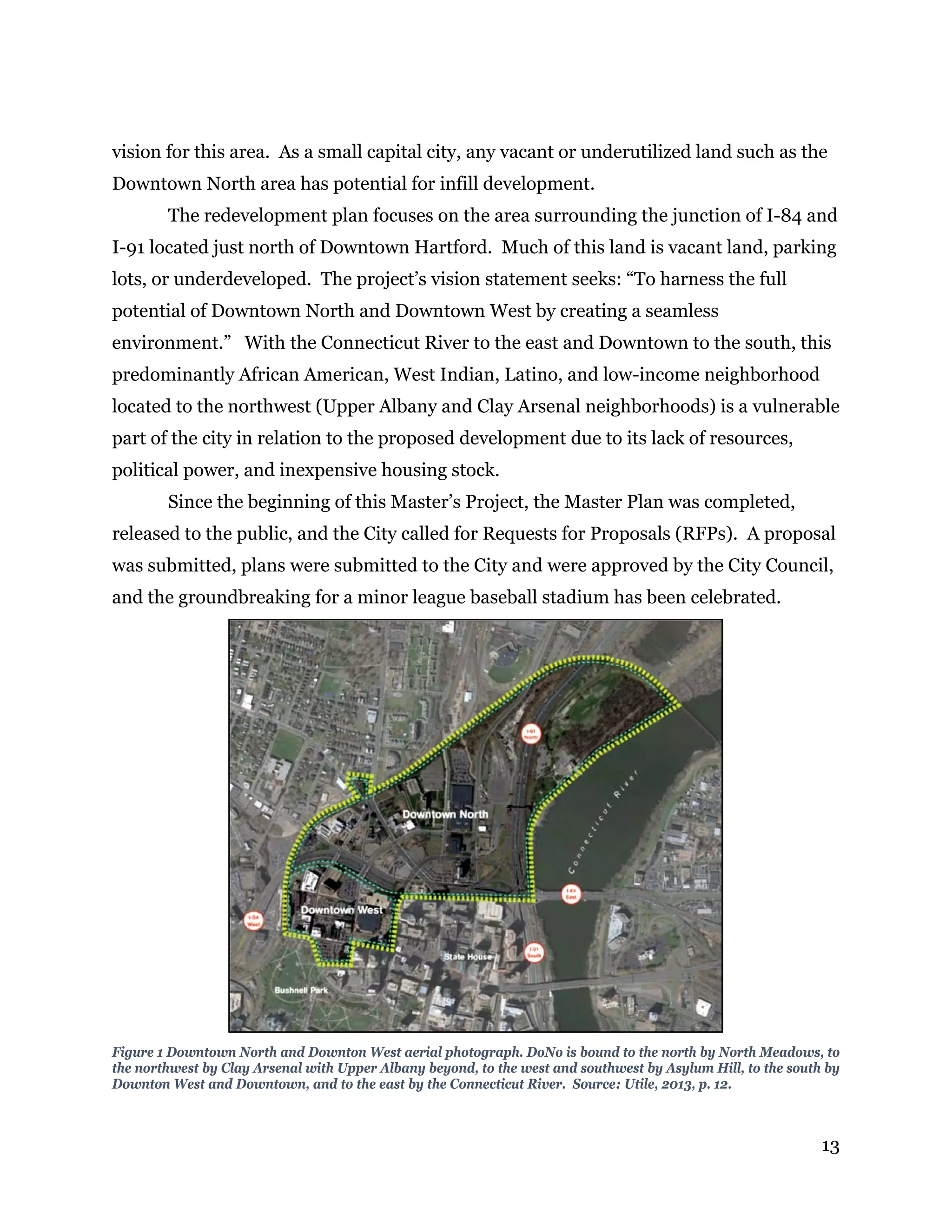
Figure 1 Downtown North and Downton West aerial photograph. DoNo is bound to the north by North Meadows, to
the northwest by Clay Arsenal with Upper Albany beyond, to the west and southwest by Asylum Hill, to the south by
Downton West and Downtown, and to the east by the Connecticut River. Source: Utile, 2013, p. 12.
14
If the DoNo Master Plan does not adequately involve the northwest adjacent
Upper Albany community members in the planning process, then the Downtown North
area may only for attract middle and upper income individuals coming from outside the
city. The Upper Albany neighborhood is largely African American and West Indian, and
has a high concentration of low-income residents. This community has been devastated
by “White flight” after race riots in the 1960’s and urban renewal that demolished much
of this area. It is important to note that the Clay Arsenal and Upper Albany
neighborhood formerly connected and included portions of the Downtown North area.
Specifically, if the plan fails to provide enough housing units and a variety of
housing types that are attractive for these newcomers, then the residents of the adjacent
Clay Arsenal and Upper Albany neighborhood may be susceptible to displacement due
to its inexpensive and diverse housing that may be renovated for higher profits. The
Capital Region Development Authority (CRDA) currently has granted $60 million
dollars specifically for housing development in downtown Hartford. The projects seek
to create mixed income housing (80% market rate and 20% affordable units) while
providing small mixed use areas as well.
Additional negative effects of gentrification may also include difficulties with
mixing cultures; newcomers versus existing residents, mixed-income housing, and
different retail and housing preferences and needs. Longtime residents, regardless of
income level may be accustomed to certain ways of life, types of housing, types of retail,
and architectural styles. Low-income residents may only have access to certain kinds of
retail and other resources that may be displaced with the retail demands of new middle
and upper-income residents. In mixed-income housing complexes or neighborhoods,
amenities may be only allotted for the residents paying market rate prices and housing
association fees, creating a divide amongst residents (Johnson, 2008, p. 599-600.)
It should be noted that there are positive effects of gentrification. These can
include an increase in shops, restaurants, and entertainment, which can lead to more
vibrancy in an area. The increase in business can increase the tax base for the city.
Often times better amenities and infrastructure such as park benches, trash service,
sidewalks, street lighting, signage, street plantings, crosswalks etc. are brought in and
are maintained better. Many of these positive effects of gentrification do impact people
15
across all demographics. Many of these services and amenities require significant
funding and the increase in economic development that spurs gentrification has the
ability to pay for them.
16
Existing Conditions
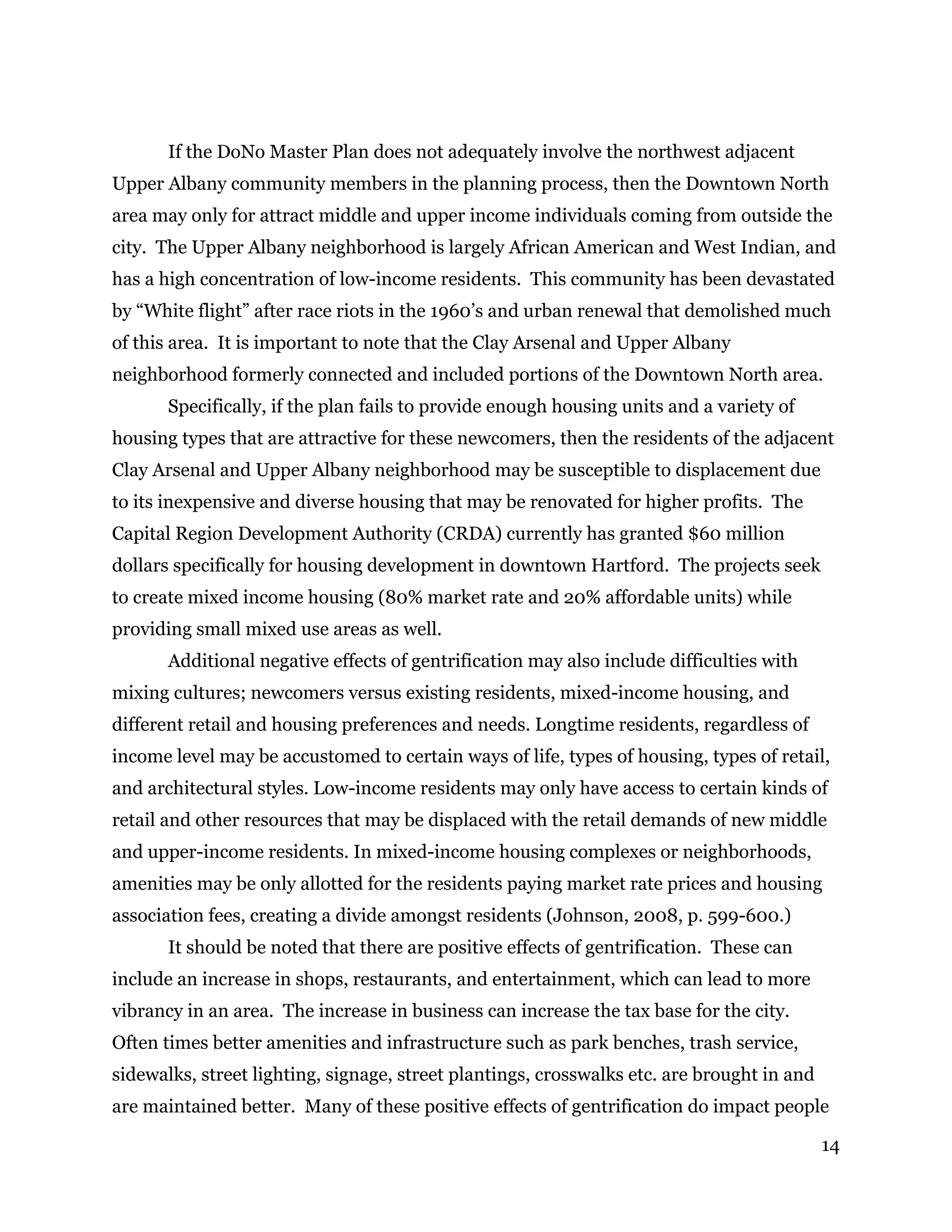
The DoNo project area is located within the northern portion of the “Downtown”
census tract 5021 and southern portion of the “North Meadows” neighborhood (5007).
The nearby neighborhoods are Clay Arsenal to the northwest (5009, 5017, 5018), Upper
Albany beyond Clay Arsenal to the west (5014, 5035, 5037), Asylum Hill to the
southwest (5031, 5032, 5033, 5034), and Downtown to the south (5021). The
Connecticut River abuts the area to the east. Figure 2 below identifies the
neighborhoods of Hartford and their census tracts. The approximate DoNo boundary is
outlined in blue. For the purposes of conducting the existing conditions, the Downtown
statistics have not been broken down as the DoNo portion of this census tract contains
no residential units.
Figure 2 Hartford Neighborhood Map of the neighborhoods containing and surrounding DoNo by census tracts
The existing conditions are described into the following themes: population,
median age, race and ethnicity, income and poverty, housing, educational attainment,
and zoning. The immediately adjacent neighborhoods are compared with the City of
Hartford as a whole and the State of Connecticut. Although the North Meadows has a
small reported population, the majority of the existing conditions were not reported for
this neighborhood and are not listed on the graphs. The data was collected from the
United States Census Bureau’s American Community Survey (ACS) 5-year estimates
DoNo
17
from 2009 to 2013 by census tract, with the exception of in Asylum Hill due to census
tracts 5032 and 5034 latest data being from the 2005 to 2009 five-year estimates.
Population
It is important to analyze population to see where the people are located in
relation to the redevelopment, who will be most affected, and the scale of the
neighborhood. The total population of Hartford, the Capital of Connecticut, is 125,130
persons, making it the fourth largest city in the State. The total population of the State
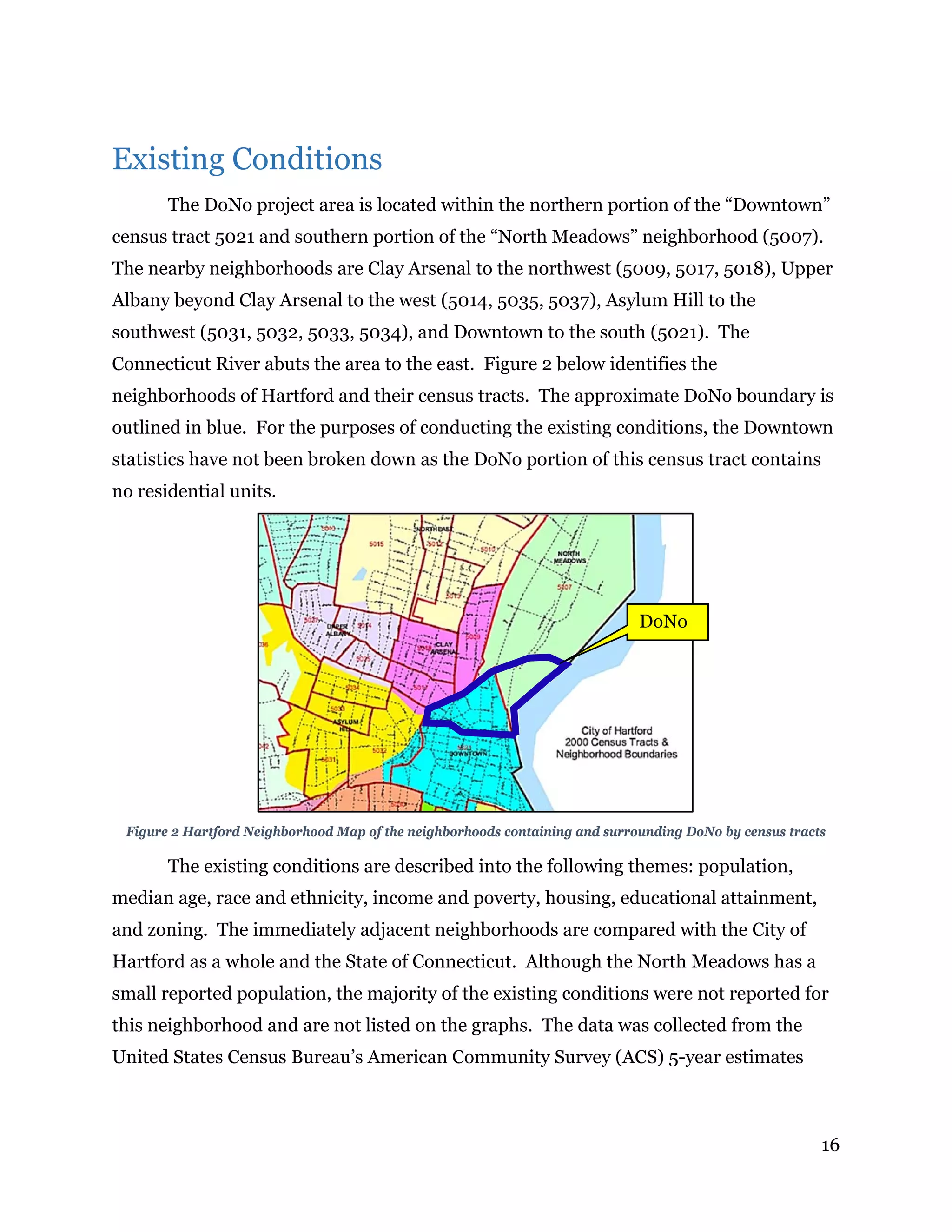
of Connecticut is 3,583,561. The five neighborhoods that encompass and surround
DoNo consists of a total of 27,456 persons, with the majority of persons living in Asylum
Hill, as depicted in Figure 3. Downtown and North Meadows have the smallest
populations with less than 2,000 each. The population for Hartford and Connecticut are
not included in the graph. Due to their large size, their populations would have skewed
the interpretation of the graph.
Figure 3 Population of the neighborhoods containing and surrounding DoNo by census tracts
1,742
5,841
7,180
11,447
1,246
0
2,000
4,000
6,000
8,000
10,000
12,000
Downtown Clay Arsenal Upper Albany Asylum Hill* North
Meadows
Persons
Total Population by Neighborhood
18
Median Age
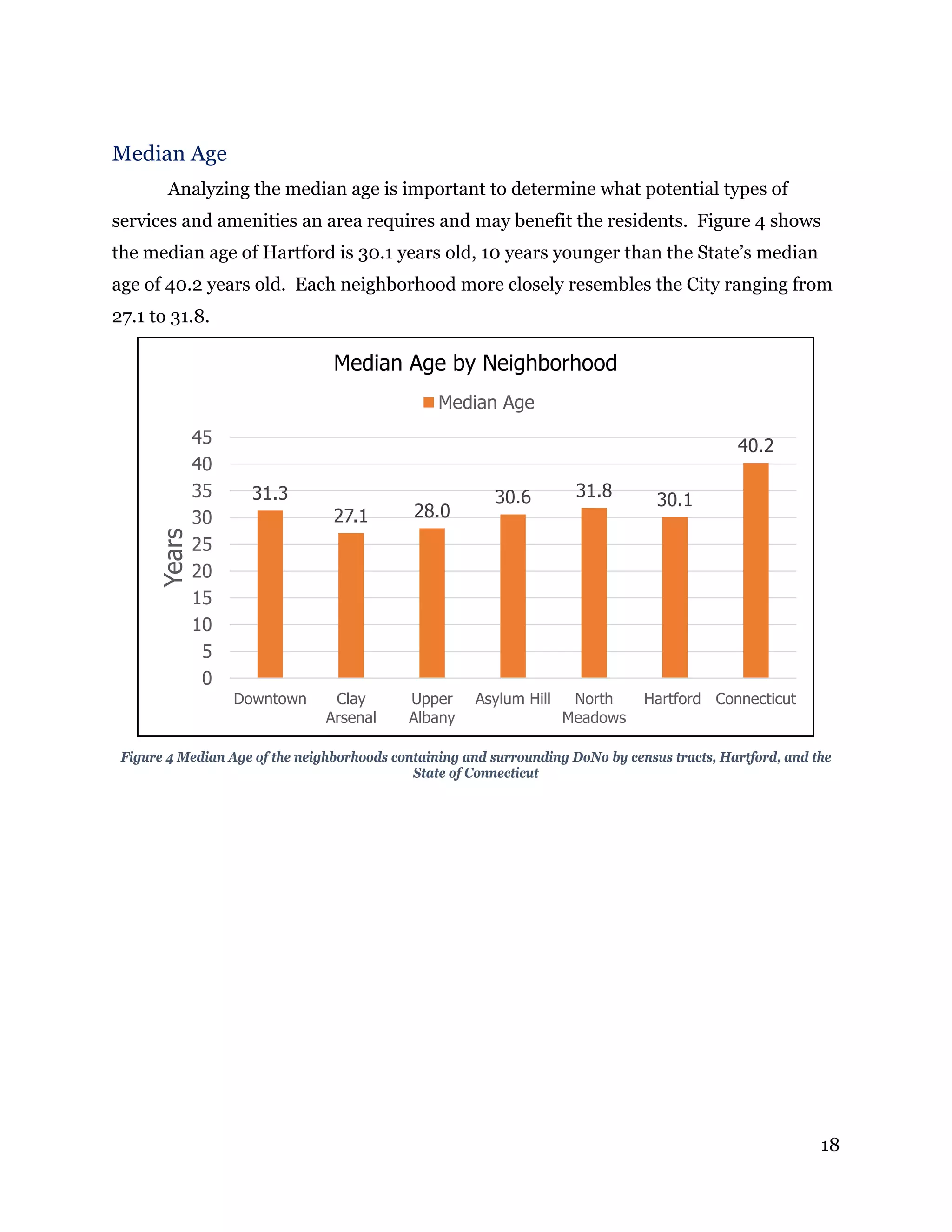
Analyzing the median age is important to determine what potential types of
services and amenities an area requires and may benefit the residents. Figure 4 shows
the median age of Hartford is 30.1 years old, 10 years younger than the State’s median
age of 40.2 years old. Each neighborhood more closely resembles the City ranging from
27.1 to 31.8.
Figure 4 Median Age of the neighborhoods containing and surrounding DoNo by census tracts, Hartford, and the
State of Connecticut
31.3
27.1 28.0
30.6 31.8 30.1
40.2
0
5
10
15
20
25
30
35
40
45
Downtown Clay
Arsenal
Upper
Albany
Asylum Hill North
Meadows
Hartford Connecticut
Years
Median Age by Neighborhood
Median Age
19
Race and Ethnicity
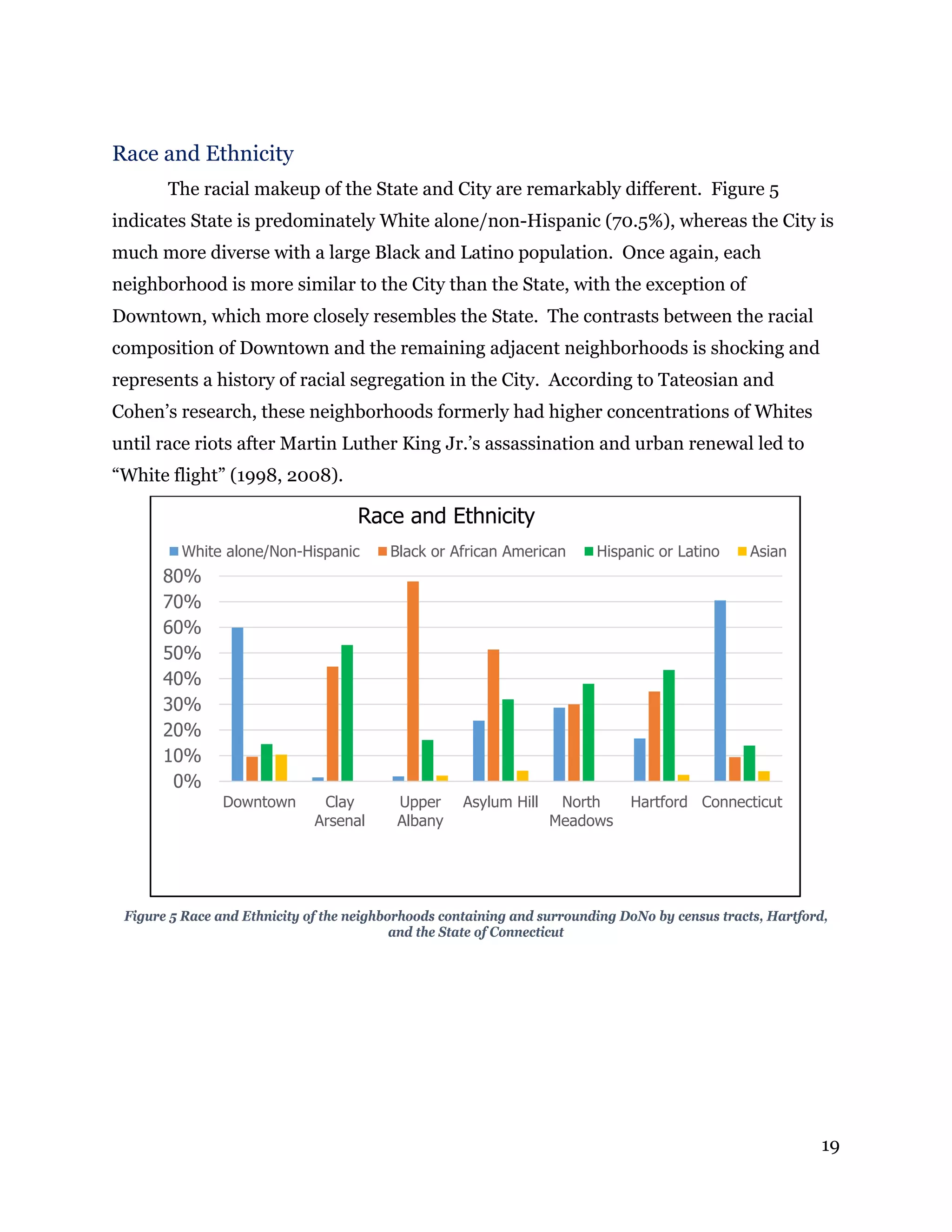
The racial makeup of the State and City are remarkably different. Figure 5
indicates State is predominately White alone/non-Hispanic (70.5%), whereas the City is
much more diverse with a large Black and Latino population. Once again, each
neighborhood is more similar to the City than the State, with the exception of
Downtown, which more closely resembles the State. The contrasts between the racial
composition of Downtown and the remaining adjacent neighborhoods is shocking and
represents a history of racial segregation in the City. According to Tateosian and
Cohen’s research, these neighborhoods formerly had higher concentrations of Whites
until race riots after Martin Luther King Jr.’s assassination and urban renewal led to
“White flight” (1998, 2008).
Figure 5 Race and Ethnicity of the neighborhoods containing and surrounding DoNo by census tracts, Hartford,
and the State of Connecticut
0%
10%
20%
30%
40%
50%
60%
70%
80%
Downtown Clay
Arsenal
Upper
Albany
Asylum Hill North
Meadows
Hartford Connecticut
Race and Ethnicity
White alone/Non-Hispanic Black or African American Hispanic or Latino Asian
20
Median Household Income
Median household income is the amount of income for households, not
necessarily families, where half of households make more and half make less than the
median. Median household income is generally used as the best indicator for a
community’s wealth due to the fact that it is not dramatically affected by high or low
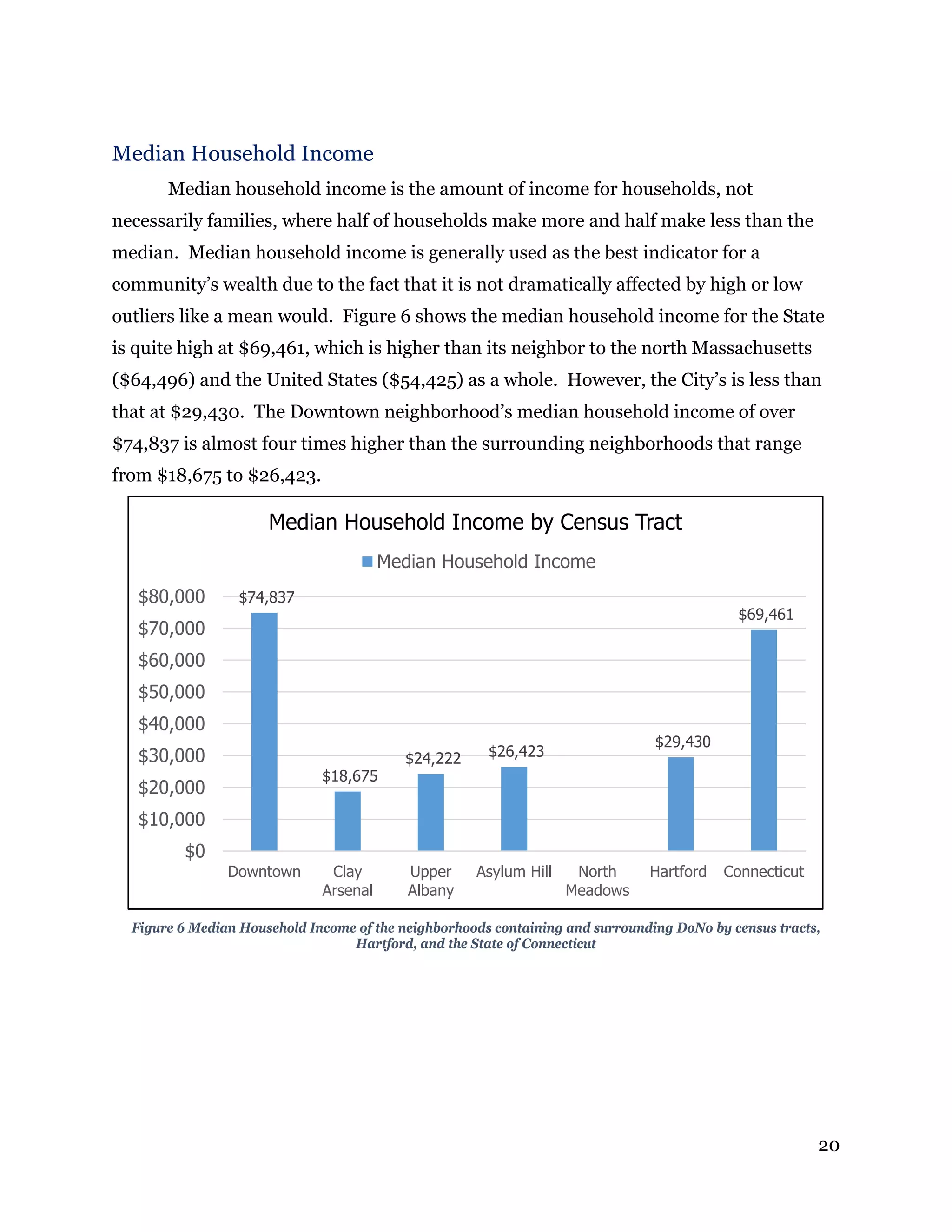
outliers like a mean would. Figure 6 shows the median household income for the State
is quite high at $69,461, which is higher than its neighbor to the north Massachusetts
($64,496) and the United States ($54,425) as a whole. However, the City’s is less than
that at $29,430. The Downtown neighborhood’s median household income of over
$74,837 is almost four times higher than the surrounding neighborhoods that range
from $18,675 to $26,423.
Figure 6 Median Household Income of the neighborhoods containing and surrounding DoNo by census tracts,
Hartford, and the State of Connecticut
$74,837
$18,675
$24,222 $26,423
$29,430
$69,461
$0
$10,000
$20,000
$30,000
$40,000
$50,000
$60,000
$70,000
$80,000
Downtown Clay
Arsenal
Upper
Albany
Asylum Hill North
Meadows
Hartford Connecticut
Median Household Income by Census Tract
Median Household Income
21
Poverty Rate
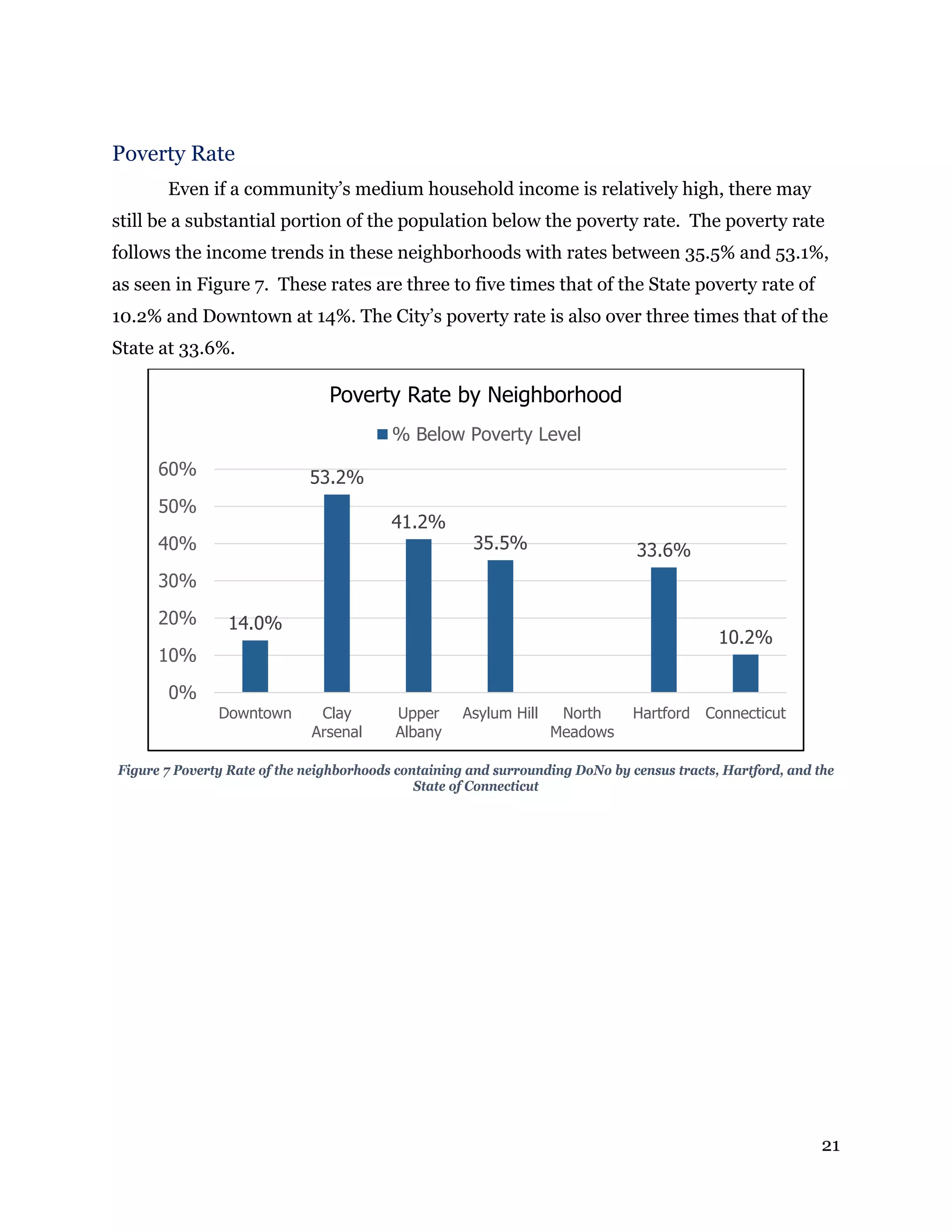
Even if a community’s medium household income is relatively high, there may
still be a substantial portion of the population below the poverty rate. The poverty rate
follows the income trends in these neighborhoods with rates between 35.5% and 53.1%,
as seen in Figure 7. These rates are three to five times that of the State poverty rate of
10.2% and Downtown at 14%. The City’s poverty rate is also over three times that of the
State at 33.6%.
Figure 7 Poverty Rate of the neighborhoods containing and surrounding DoNo by census tracts, Hartford, and the
State of Connecticut
14.0%
53.2%
41.2%
35.5% 33.6%
10.2%
0%
10%
20%
30%
40%
50%
60%
Downtown Clay
Arsenal
Upper
Albany
Asylum Hill North
Meadows
Hartford Connecticut
Poverty Rate by Neighborhood
% Below Poverty Level
22
Unemployment Rate
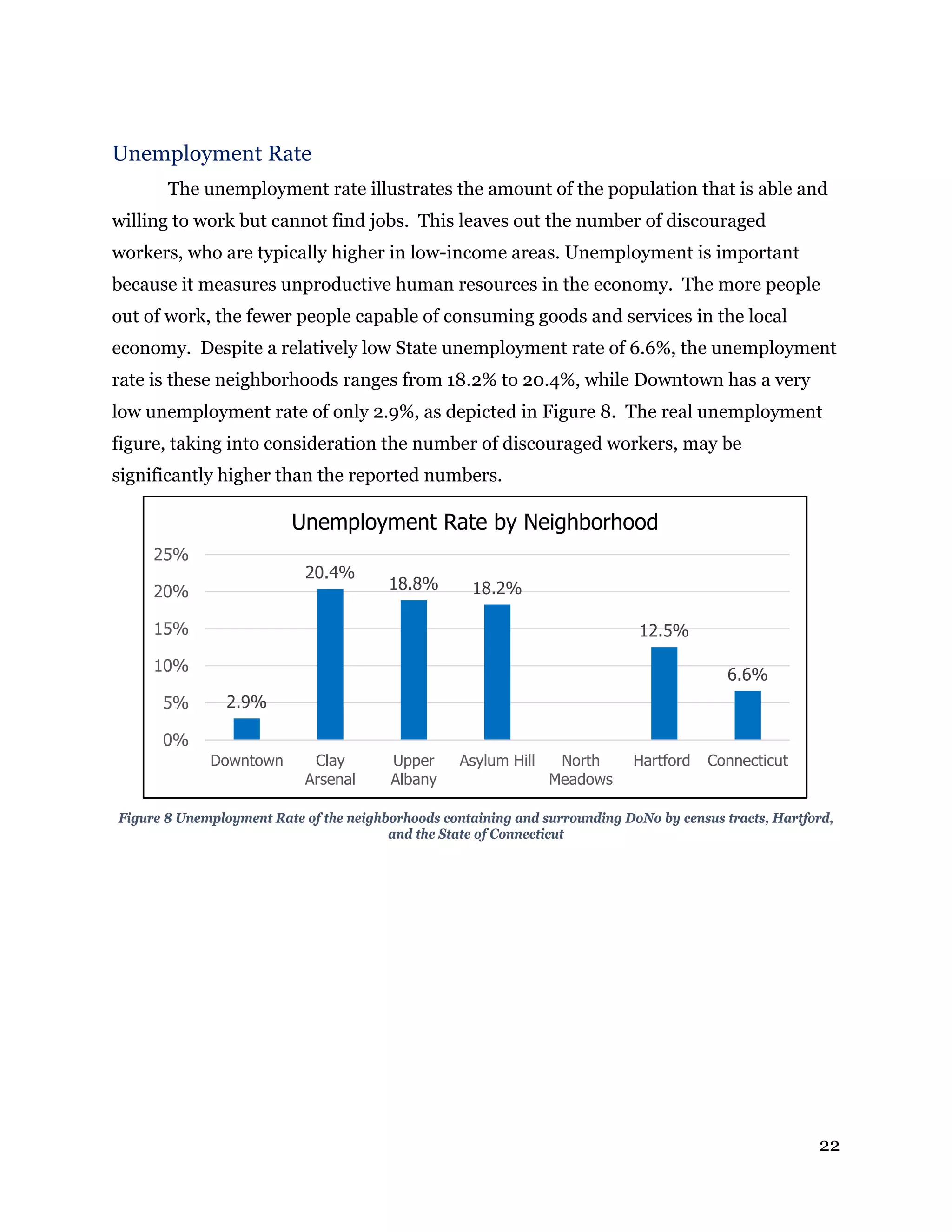
The unemployment rate illustrates the amount of the population that is able and
willing to work but cannot find jobs. This leaves out the number of discouraged
workers, who are typically higher in low-income areas. Unemployment is important
because it measures unproductive human resources in the economy. The more people
out of work, the fewer people capable of consuming goods and services in the local
economy. Despite a relatively low State unemployment rate of 6.6%, the unemployment
rate is these neighborhoods ranges from 18.2% to 20.4%, while Downtown has a very
low unemployment rate of only 2.9%, as depicted in Figure 8. The real unemployment
figure, taking into consideration the number of discouraged workers, may be
significantly higher than the reported numbers.
Figure 8 Unemployment Rate of the neighborhoods containing and surrounding DoNo by census tracts, Hartford,
and the State of Connecticut
2.9%
20.4%
18.8% 18.2%
12.5%
6.6%
0%
5%
10%
15%
20%
25%
Downtown Clay
Arsenal
Upper
Albany
Asylum Hill North
Meadows
Hartford Connecticut
Unemployment Rate by Neighborhood
23
Food Stamps
The food stamp program, which is now titled Supplemental Nutrition Assistance
Program (SNAP), assists low-income individuals and families purchase necessary
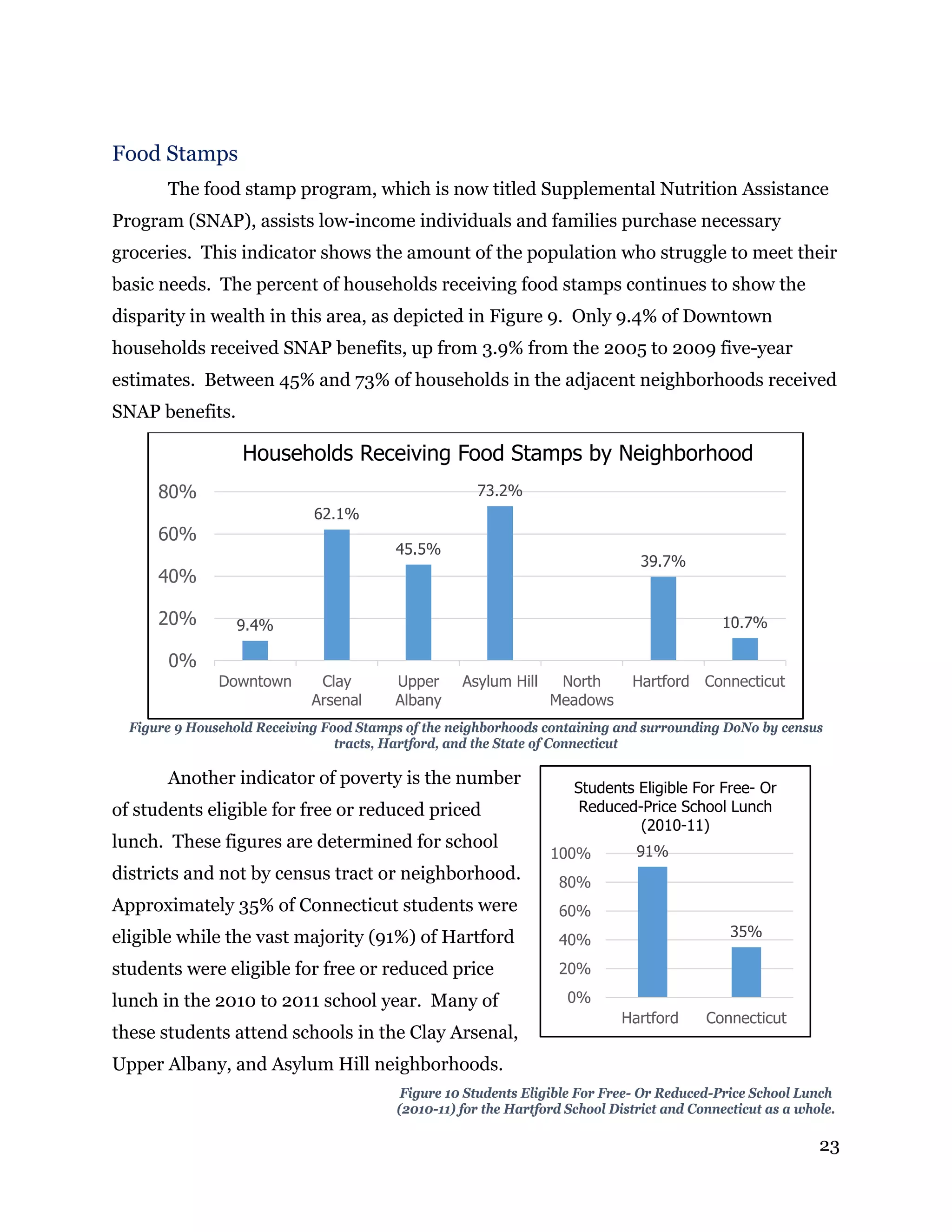
groceries. This indicator shows the amount of the population who struggle to meet their
basic needs. The percent of households receiving food stamps continues to show the
disparity in wealth in this area, as depicted in Figure 9. Only 9.4% of Downtown
households received SNAP benefits, up from 3.9% from the 2005 to 2009 five-year
estimates. Between 45% and 73% of households in the adjacent neighborhoods received
SNAP benefits.
Figure 9 Household Receiving Food Stamps of the neighborhoods containing and surrounding DoNo by census
tracts, Hartford, and the State of Connecticut
Another indicator of poverty is the number
of students eligible for free or reduced priced
lunch. These figures are determined for school
districts and not by census tract or neighborhood.
Approximately 35% of Connecticut students were
eligible while the vast majority (91%) of Hartford
students were eligible for free or reduced price
lunch in the 2010 to 2011 school year. Many of
these students attend schools in the Clay Arsenal,
Upper Albany, and Asylum Hill neighborhoods.
Figure 10 Students Eligible For Free- Or Reduced-Price School Lunch
(2010-11) for the Hartford School District and Connecticut as a whole.
9.4%
62.1%
45.5%
73.2%
39.7%
10.7%
0%
20%
40%
60%
80%
Downtown Clay
Arsenal
Upper
Albany
Asylum Hill North
Meadows
Hartford Connecticut
Households Receiving Food Stamps by Neighborhood
91%
35%
0%
20%
40%
60%
80%
100%
Hartford Connecticut
Students Eligible For Free- Or
Reduced-Price School Lunch
(2010-11)
24
Housing
Housing is the basis of this project. The redevelopment project will likely include
housing and will impact the housing of the surrounding neighborhoods. Therefore, it is
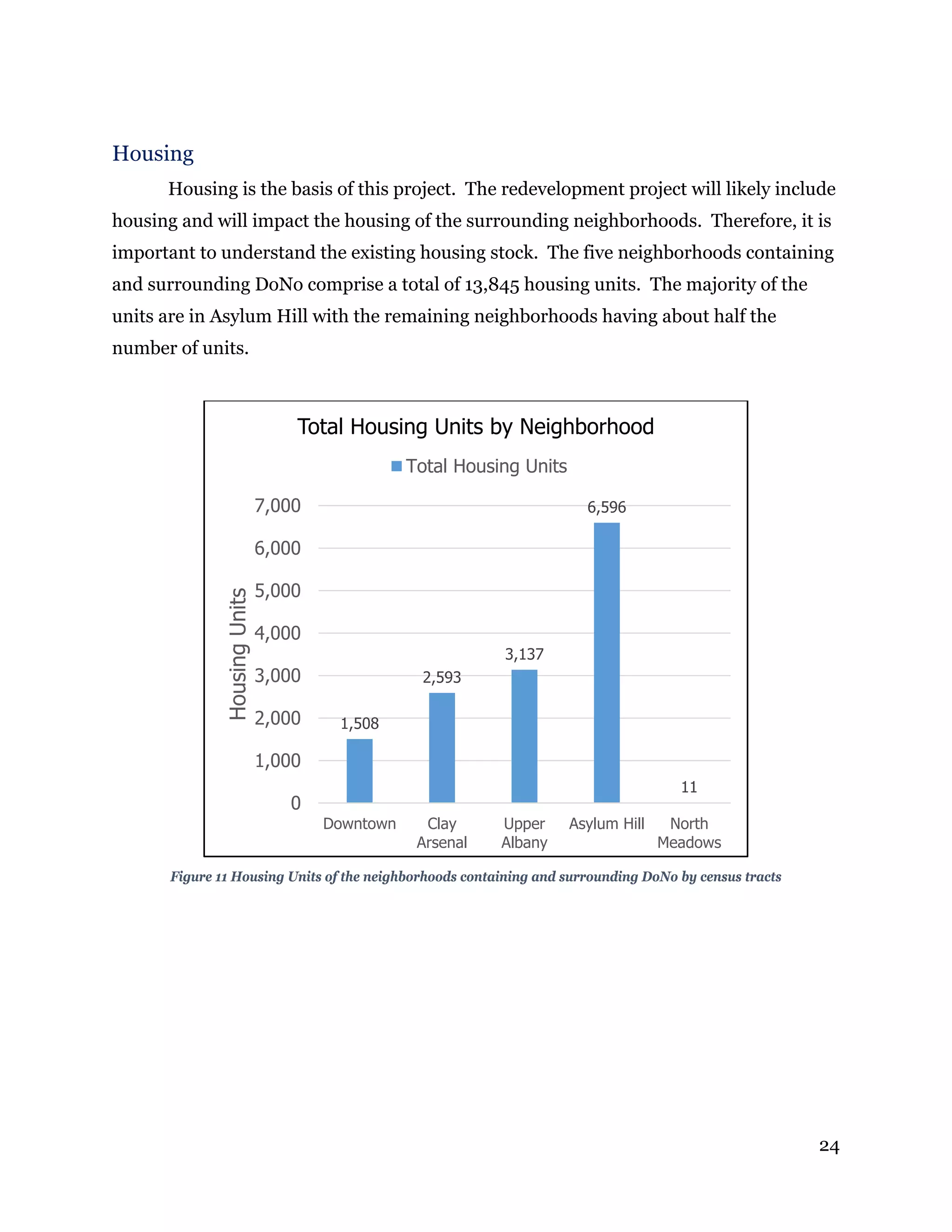
important to understand the existing housing stock. The five neighborhoods containing
and surrounding DoNo comprise a total of 13,845 housing units. The majority of the
units are in Asylum Hill with the remaining neighborhoods having about half the
number of units.
Figure 11 Housing Units of the neighborhoods containing and surrounding DoNo by census tracts
1,508
2,593
3,137
6,596
11
0
1,000
2,000
3,000
4,000
5,000
6,000
7,000
Downtown Clay
Arsenal
Upper
Albany
Asylum Hill North
Meadows
HousingUnits
Total Housing Units by Neighborhood
Total Housing Units
25
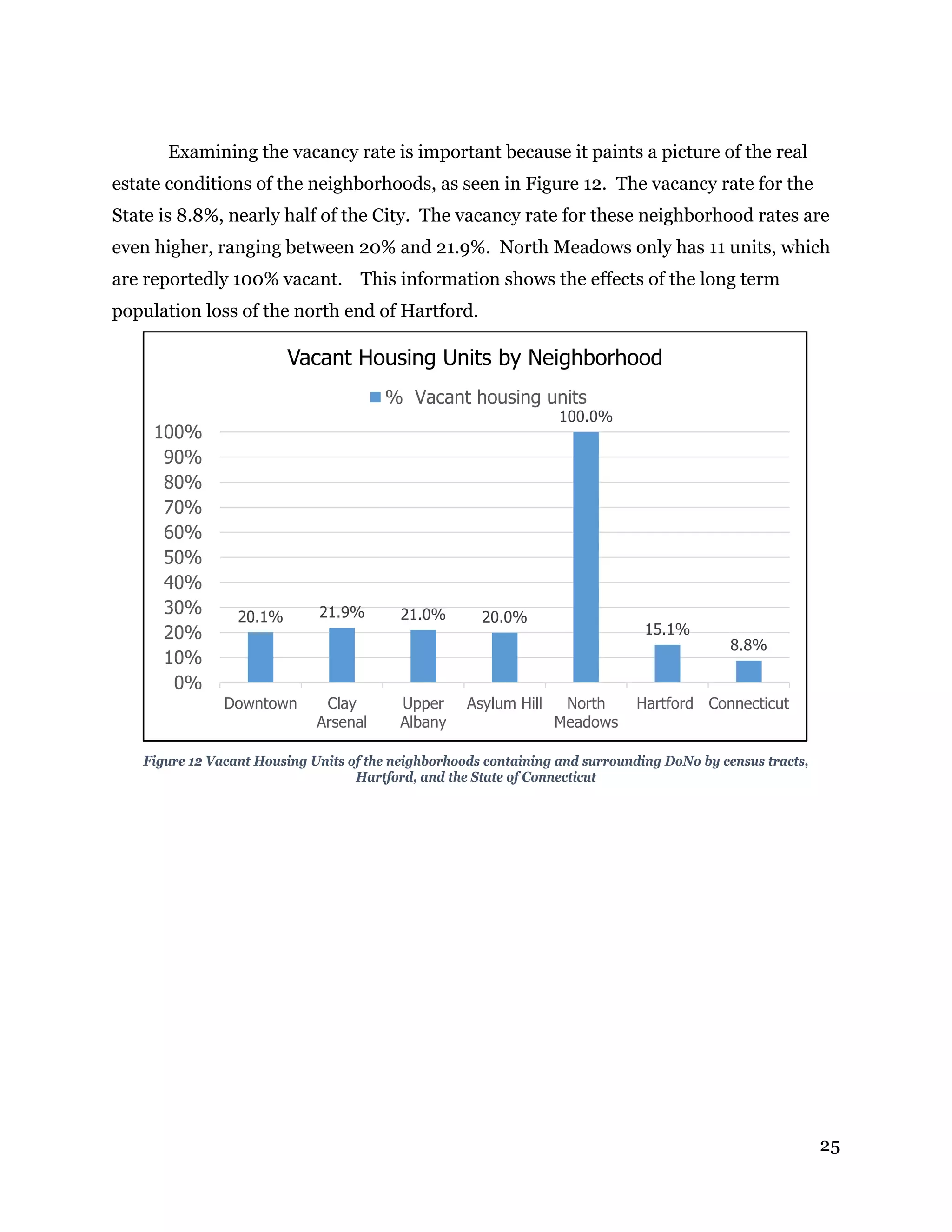
Examining the vacancy rate is important because it paints a picture of the real
estate conditions of the neighborhoods, as seen in Figure 12. The vacancy rate for the
State is 8.8%, nearly half of the City. The vacancy rate for these neighborhood rates are
even higher, ranging between 20% and 21.9%. North Meadows only has 11 units, which
are reportedly 100% vacant. This information shows the effects of the long term
population loss of the north end of Hartford.
Figure 12 Vacant Housing Units of the neighborhoods containing and surrounding DoNo by census tracts,
Hartford, and the State of Connecticut
20.1% 21.9% 21.0% 20.0%
100.0%
15.1%
8.8%
0%
10%
20%
30%
40%
50%
60%
70%
80%
90%
100%
Downtown Clay
Arsenal
Upper
Albany
Asylum Hill North
Meadows
Hartford Connecticut
Vacant Housing Units by Neighborhood
% Vacant housing units
26
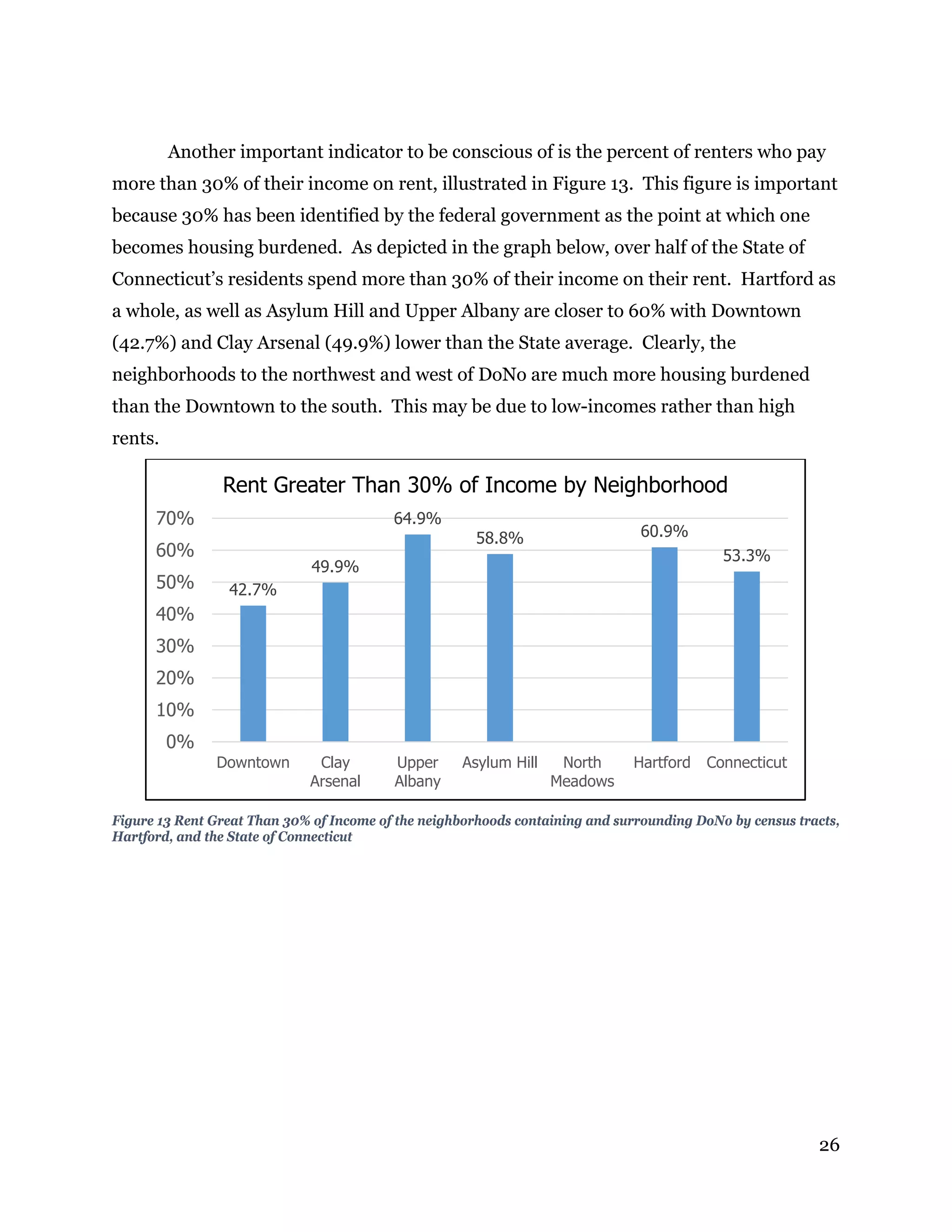
Another important indicator to be conscious of is the percent of renters who pay
more than 30% of their income on rent, illustrated in Figure 13. This figure is important
because 30% has been identified by the federal government as the point at which one
becomes housing burdened. As depicted in the graph below, over half of the State of
Connecticut’s residents spend more than 30% of their income on their rent. Hartford as
a whole, as well as Asylum Hill and Upper Albany are closer to 60% with Downtown
(42.7%) and Clay Arsenal (49.9%) lower than the State average. Clearly, the
neighborhoods to the northwest and west of DoNo are much more housing burdened
than the Downtown to the south. This may be due to low-incomes rather than high
rents.
Figure 13 Rent Great Than 30% of Income of the neighborhoods containing and surrounding DoNo by census tracts,
Hartford, and the State of Connecticut
42.7%
49.9%
64.9%
58.8% 60.9%
53.3%
0%
10%
20%
30%
40%
50%
60%
70%
Downtown Clay
Arsenal
Upper
Albany
Asylum Hill North
Meadows
Hartford Connecticut
Rent Greater Than 30% of Income by Neighborhood
27
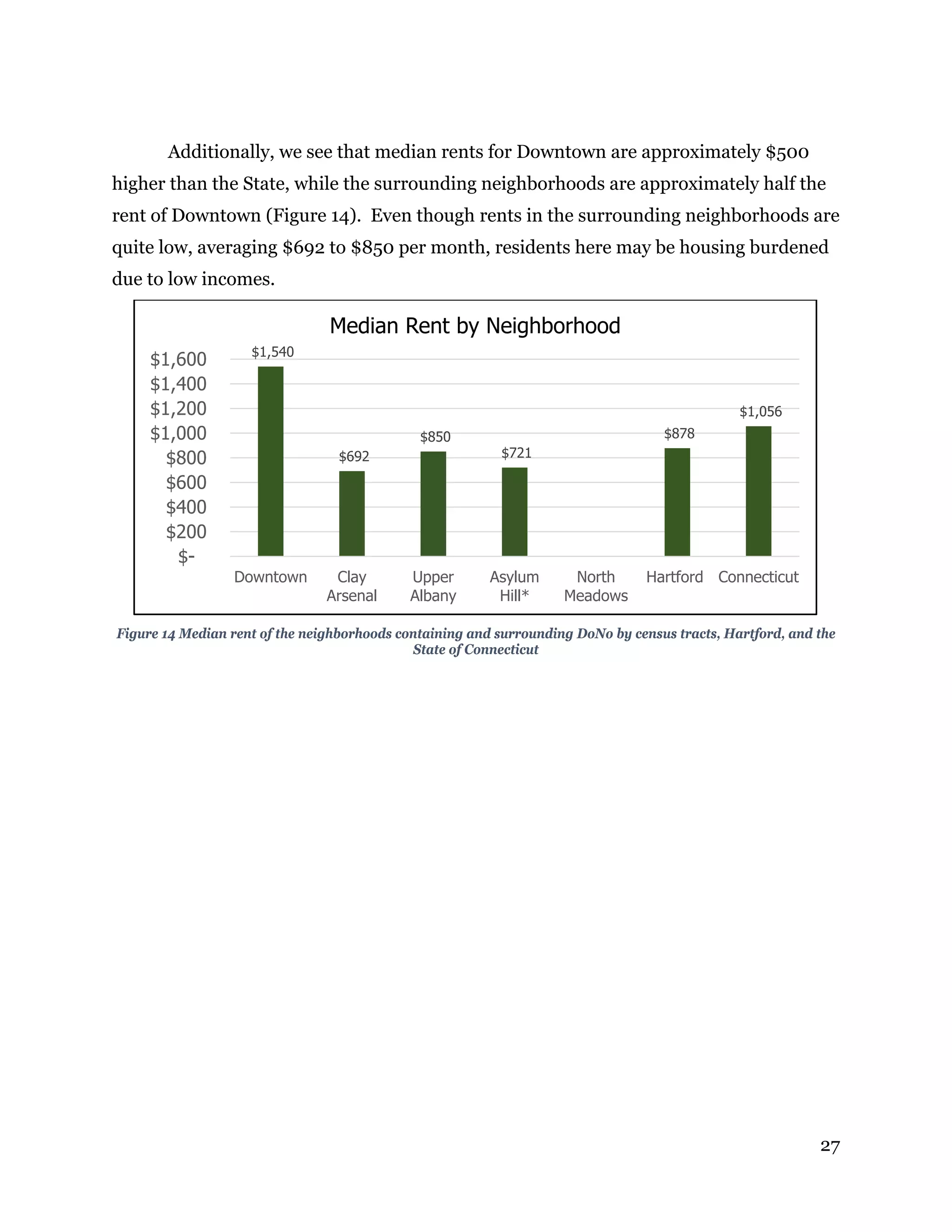
Additionally, we see that median rents for Downtown are approximately $500
higher than the State, while the surrounding neighborhoods are approximately half the
rent of Downtown (Figure 14). Even though rents in the surrounding neighborhoods are
quite low, averaging $692 to $850 per month, residents here may be housing burdened
due to low incomes.
Figure 14 Median rent of the neighborhoods containing and surrounding DoNo by census tracts, Hartford, and the
State of Connecticut
$1,540
$692
$850
$721
$878
$1,056
$-
$200
$400
$600
$800
$1,000
$1,200
$1,400
$1,600
Downtown Clay
Arsenal
Upper
Albany
Asylum
Hill*
North
Meadows
Hartford Connecticut
Median Rent by Neighborhood
28
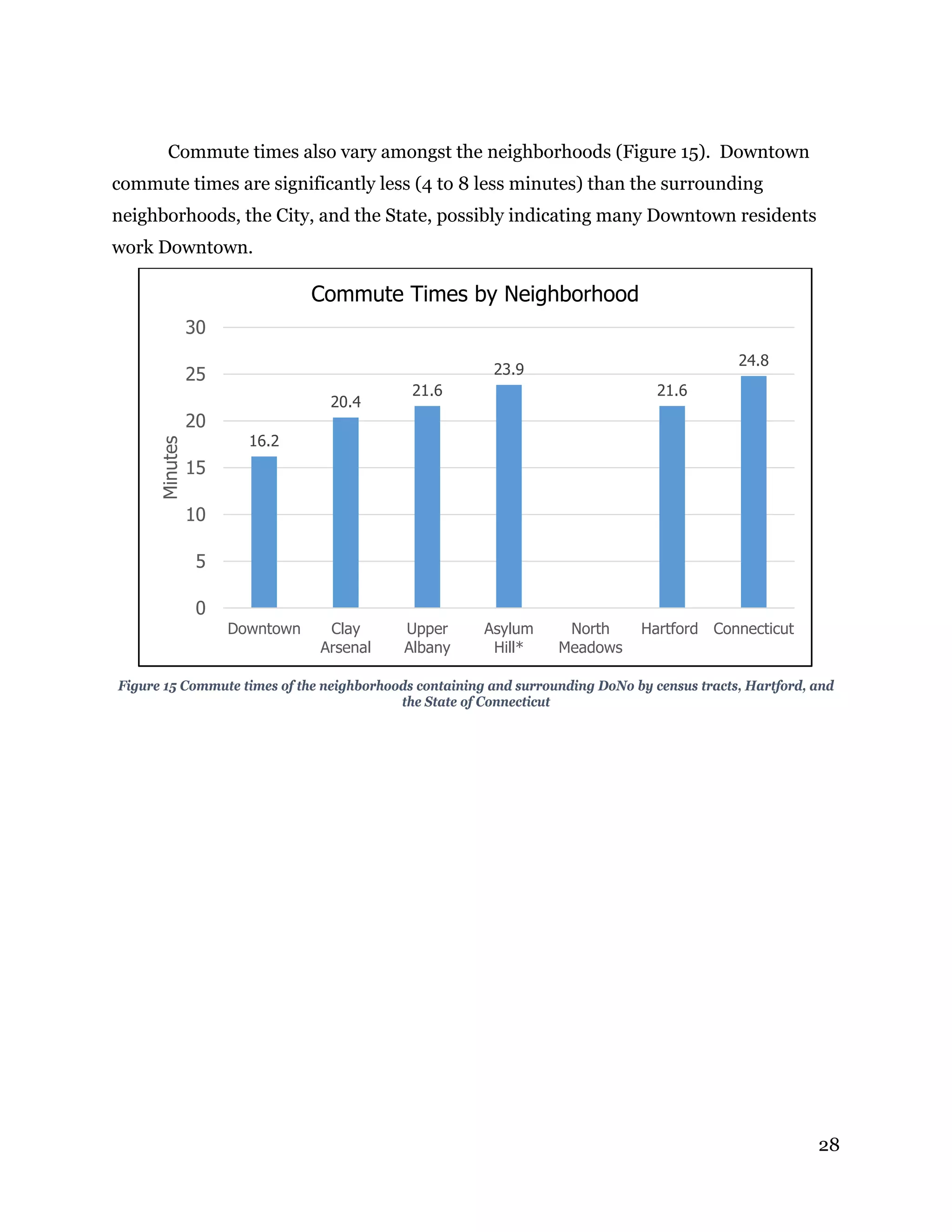
Commute times also vary amongst the neighborhoods (Figure 15). Downtown
commute times are significantly less (4 to 8 less minutes) than the surrounding
neighborhoods, the City, and the State, possibly indicating many Downtown residents
work Downtown.
Figure 15 Commute times of the neighborhoods containing and surrounding DoNo by census tracts, Hartford, and
the State of Connecticut
16.2
20.4
21.6
23.9
21.6
24.8
0
5
10
15
20
25
30
Downtown Clay
Arsenal
Upper
Albany
Asylum
Hill*
North
Meadows
Hartford Connecticut
Minutes
Commute Times by Neighborhood
29
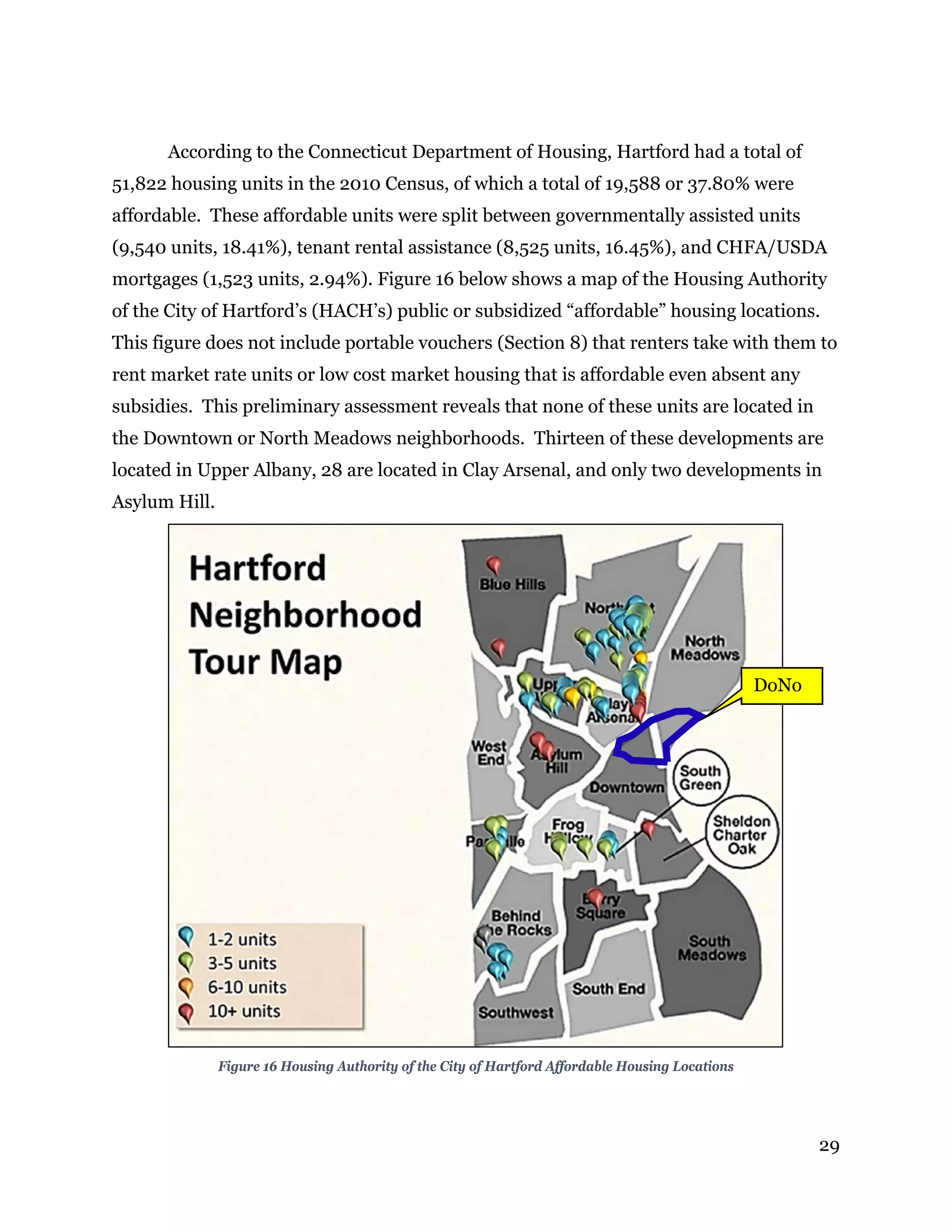
According to the Connecticut Department of Housing, Hartford had a total of
51,822 housing units in the 2010 Census, of which a total of 19,588 or 37.80% were
affordable. These affordable units were split between governmentally assisted units
(9,540 units, 18.41%), tenant rental assistance (8,525 units, 16.45%), and CHFA/USDA
mortgages (1,523 units, 2.94%). Figure 16 below shows a map of the Housing Authority
of the City of Hartford’s (HACH’s) public or subsidized “affordable” housing locations.
This figure does not include portable vouchers (Section 8) that renters take with them to
rent market rate units or low cost market housing that is affordable even absent any
subsidies. This preliminary assessment reveals that none of these units are located in
the Downtown or North Meadows neighborhoods. Thirteen of these developments are
located in Upper Albany, 28 are located in Clay Arsenal, and only two developments in
Asylum Hill.
Figure 16 Housing Authority of the City of Hartford Affordable Housing Locations
DoNo
30
Educational Attainment
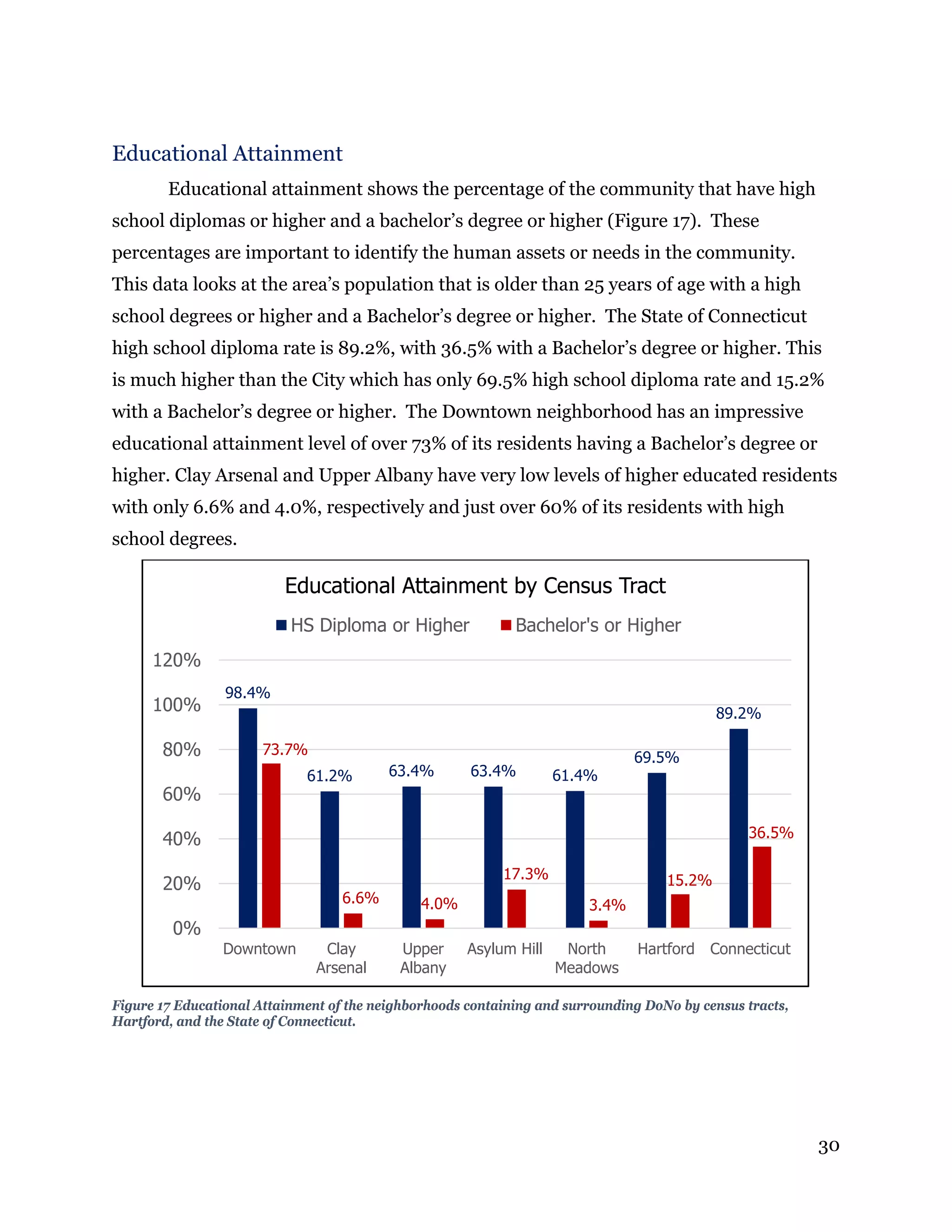
Educational attainment shows the percentage of the community that have high
school diplomas or higher and a bachelor’s degree or higher (Figure 17). These
percentages are important to identify the human assets or needs in the community.
This data looks at the area’s population that is older than 25 years of age with a high
school degrees or higher and a Bachelor’s degree or higher. The State of Connecticut
high school diploma rate is 89.2%, with 36.5% with a Bachelor’s degree or higher. This
is much higher than the City which has only 69.5% high school diploma rate and 15.2%
with a Bachelor’s degree or higher. The Downtown neighborhood has an impressive
educational attainment level of over 73% of its residents having a Bachelor’s degree or
higher. Clay Arsenal and Upper Albany have very low levels of higher educated residents
with only 6.6% and 4.0%, respectively and just over 60% of its residents with high
school degrees.
Figure 17 Educational Attainment of the neighborhoods containing and surrounding DoNo by census tracts,
Hartford, and the State of Connecticut.
98.4%
61.2% 63.4% 63.4% 61.4%
69.5%
89.2%
73.7%
6.6% 4.0%
17.3%
3.4%
15.2%
36.5%
0%
20%
40%
60%
80%
100%
120%
Downtown Clay
Arsenal
Upper
Albany
Asylum Hill North
Meadows
Hartford Connecticut
Educational Attainment by Census Tract
HS Diploma or Higher Bachelor's or Higher
31
Zoning
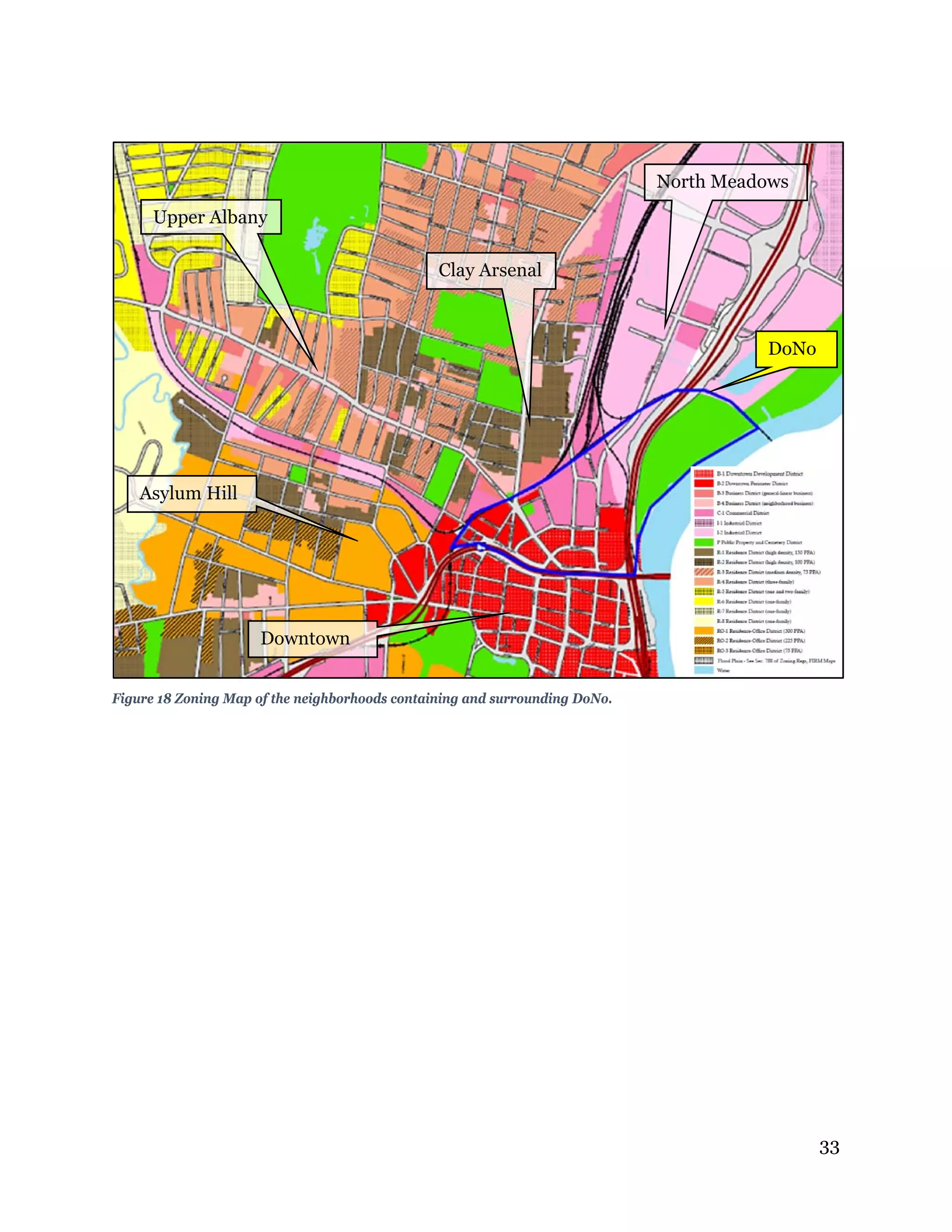
The DoNo area is primarily zoned B-1 Downtown Development District and B-2
Downtown Perimeter District just north of I-84. DoNo also has areas zoned C-1
Commercial District, I-1 Industrial District, and P Public Property and Cemetery
District. The surrounding neighborhoods zoning is detailed in the Table 1 below.
Residential potential is high within each of these areas. It should be noted that single
and two-family dwellings are permitted by right in RO-1, Ro-2, and R-1 through R-7.
Three family dwellings are permitted by special permit in RO-1, Ro-2, and R-1 through
R-4. Four or more family dwellings are permitted by special permit in RO-1, Ro-2, R-1
through R-4, I-1, I-2, C-1, B-1, and B-2.
Zoning
DoNo
Clay
Arsenal
Upper
Albany Downtown
Asylum
Hill
North
Meadows
B-1 Downtown Development District X X
B-2 Downtown Perimeter District X X X X
B-3 Business District (general-linear
business) X X
B-4 Business District (neighborhood
business) X X X
C-1 Commercial District X X X X
I-1 Industrial District X
I-2 Industrial District X X
P Public Property & Cemetery District X X X X X X
R-1 Residence District (high density,
150 PPA) X
R-2 Residence District (high density,
100 PPA) X X X
R-3 Residence District (medium
density, 75 PPA) X X
R-4 Residence District (three-family) X X X
R-5 Residence District (one & two-
family) X
R-7 Residence District (single-family) X
R0-1 Residence-Office District (300
PPA) X X X X
R0-2 Residence-Office District (225
PPA) X
PPA=Persons Per Acre
Table 1 Zoning in and around DoNo
32
The City is currently undertaking a “Zone Hartford” project to update and revise
their zoning regulations from 2005. The City is contemplating changing to form based
regulations. The goals as stated by the City Planning Department website
(http://zonehartford.com/) are to:
 Simplify the regulations- making them more user friendly, using clearer
language, charts, and diagrams to better explain processes and requirements
 Support walkable development- by adjusting current zoning districts, and
creating new districts where necessary, the City can promote pedestrian-oriented,
mixed-use development in proximity to transit and where people live
 Protect neighborhood character – new regulations and the addition of
design guidelines will help guide and improve the quality of Hartford’s built
environment
 Spur economic development- new regulations and changes to the current
processes will make it easier for businesses and developers to open and develop
with less red tape, saving everyone time and money
33
Figure 18 Zoning Map of the neighborhoods containing and surrounding DoNo.
DoNo
Clay Arsenal
Upper Albany
Asylum Hill
Downtown
North Meadows
Summary
By analyzing the existing conditions of the DoNo area, we see that the Asylum
Hill neighborhood to the west/southwest of DoNo has the highest population with much
fewer people residing in Downtown. The median age of people Downtown is
significantly higher than the other neighborhoods. Downtown is also significantly
Whiter than the other neighborhoods and the City of Hartford as a whole, which are
more diverse with a large Black and Latino population. Additionally, Downtown is
much more educated than these neighborhoods with a higher percentage of their
residents having Bachelor’s degrees or higher than the percentage of surrounding
neighborhoods residents with a high school diploma or higher.
Income and poverty was analyzed with several indicators. The results revealed
downtown is considerably wealthier, has less unemployment, less poverty, and less
people on food stamps than the surrounding neighborhoods. The residents of these
neighborhoods are also much more likely to be housing burdened due to low incomes
despite high amounts of vacant housing units. Downtown and DoNo reportedly do not
have any subsidized or public “affordable” housing units. Asylum Hill, where the
majority of housing units are, only has two affordable housing developments, while
Upper Albany contains 13 and Clay Arsenal has 28 subsidized “affordable” housing
developments.
The area around DoNo has a plethora of different zoning designation. These
neighborhoods have a total of 16 different zoning districts ranging from industrial to
various commercial and business districts to single and multi-family residential. These
districts are in general, clear and understandable and relate well with each other. There
are nine different residential zones to ensure proper densities.
Most of the neighborhoods to the northwest and west are zoned for medium to
higher density residential with strips or pockets of commercial uses. The North
Meadows neighborhood to the north is mostly industrial with the Downtown to the
south zoned Downtown Development. The City of Hartford’s Planning Department is
currently conducting a rezoning of the City and therefore, these zones may be different
in the near future.
35
It is clear to see that there is an extreme dichotomy between the Downtown and
the adjacent neighborhoods to the west and north. The Downtown is far more affluent,
better educated, less diverse, and slightly older than its neighbors. DoNo is located at
the intersection of these neighborhoods and represents a bridge that has been a scar
that divided the Downtown from the north end neighborhoods since the 1960’s when
urban renewal demolished most of the DoNo area and I-84 cut off the north end from
Downtown.
36
Site Visits and Photographs
On June 24, 2014, July 23, 2014, and October 11, 2014, I conducted site visits on
foot and by motor vehicle. I ran and drove around DoNo and the surrounding
neighborhoods extensively on June 24th. The July 23rd tour was at Riverside Park on the
east side of DoNo. Photographs from October 11th were taken from the Radisson Hotel,
located at 50 Morgan Street, which is immediately adjacent to I-84 with Downtown to
the south and the proposed DoNo redevelopment immediately to the west and
northwest.
Photograph 1 View of a parking lot at the intersection of Main Street and Trumbull Street at the heart of the DoNo
redevelopment area.
37
Photograph 2 View of a parking lot and vacant lot at the intersection of Main Street and Trumbull Street at the
heart of the DoNo redevelopment area.
Photograph 3 View of Downtown Hartford beyond a parking lot and vacant lot at the intersection of Main Street
and Trumbull Street at the heart of the DoNo redevelopment area.
38
Photograph 4 View of a Downton Hartford beyond a parking lot at the intersection of Main Street and Trumbull
Street at the heart of the DoNo redevelopment area.
Photograph 5 View of a vacant lot at the intersection of Main Street and Trumbull Street at the heart of the DoNo
redevelopment area.
39
Photograph 6 View of a parking lot at the intersection of Main Street and Trumbull Street at the heart of the DoNo
redevelopment area. Main Street is very wide, which makes crossing on foot difficult and creates a feeling unsafe
pedestrian conditions.
Photograph 7 View of a parking lot at 1214 Main Street between Pleasant Street and Trumbull Street. This is the
location of the proposed minor league baseball stadium.
40
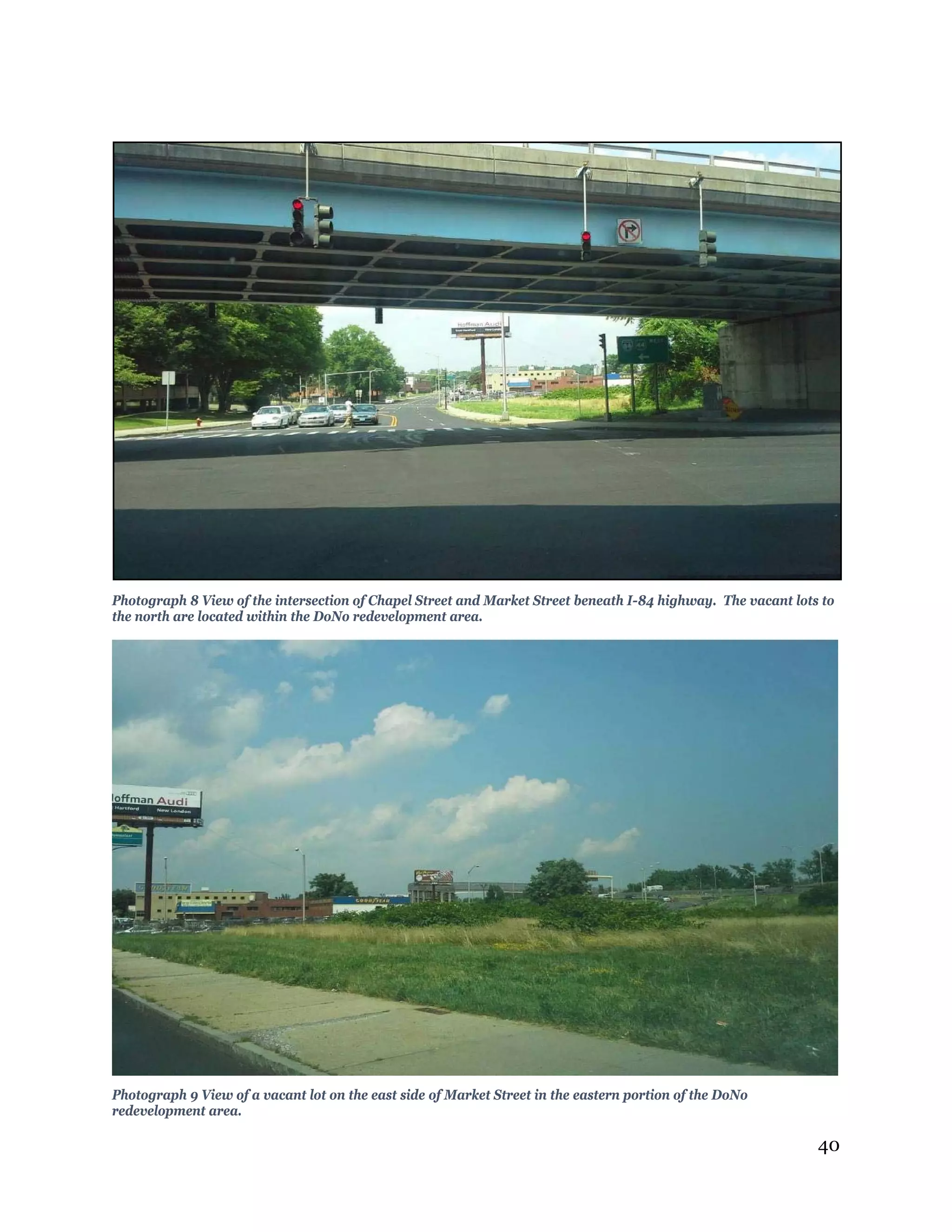
Photograph 8 View of the intersection of Chapel Street and Market Street beneath I-84 highway. The vacant lots to
the north are located within the DoNo redevelopment area.
Photograph 9 View of a vacant lot on the east side of Market Street in the eastern portion of the DoNo
redevelopment area.
41
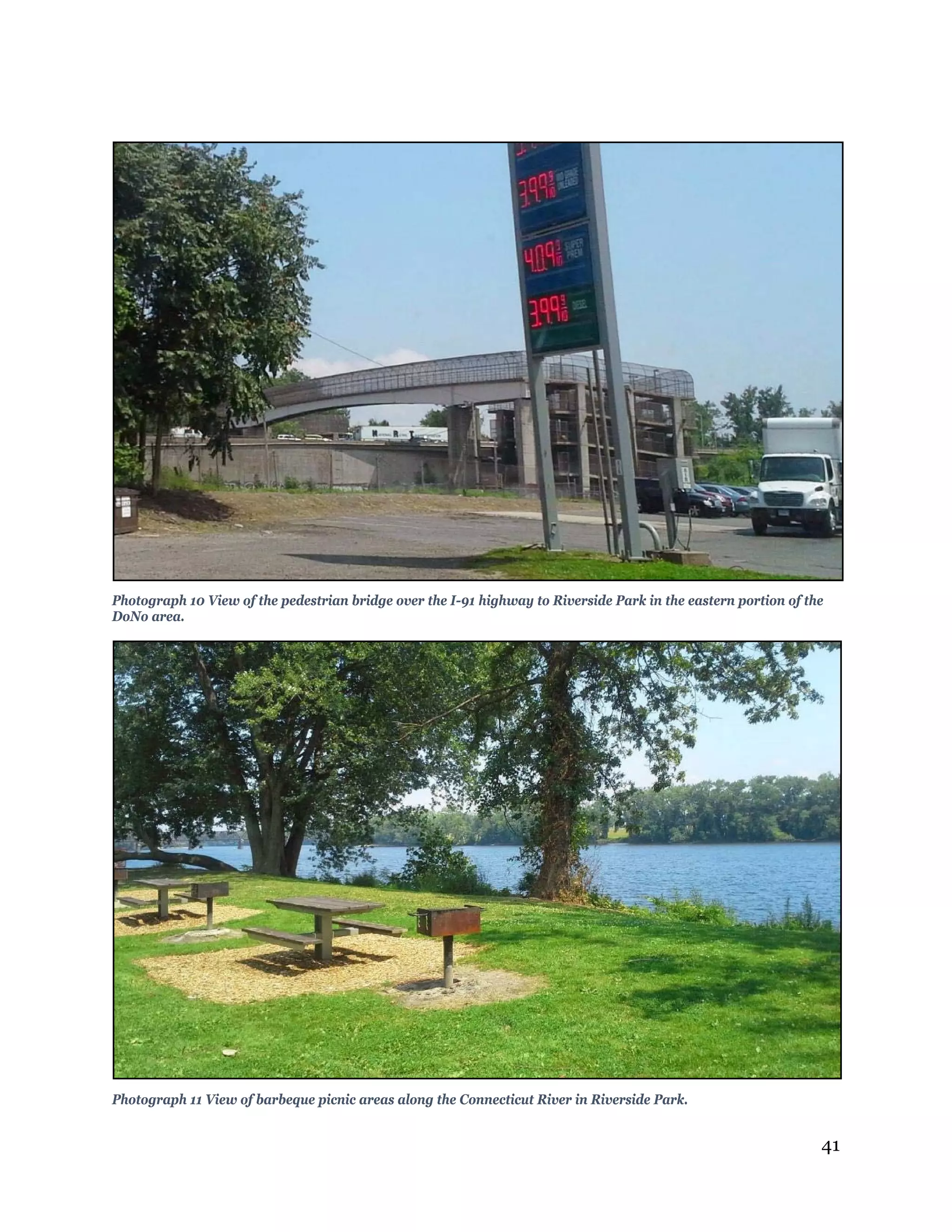
Photograph 10 View of the pedestrian bridge over the I-91 highway to Riverside Park in the eastern portion of the
DoNo area.
Photograph 11 View of barbeque picnic areas along the Connecticut River in Riverside Park.
42
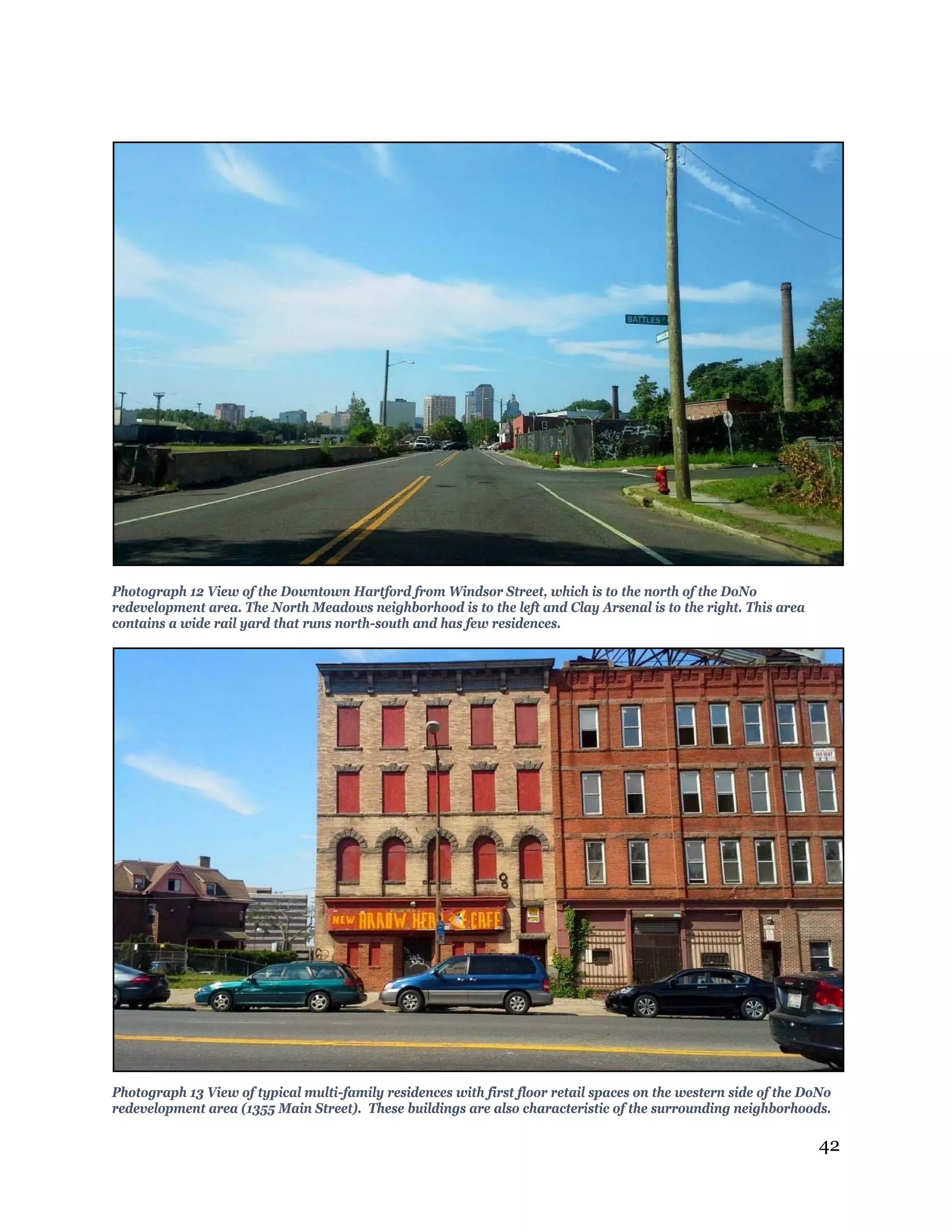
Photograph 12 View of the Downtown Hartford from Windsor Street, which is to the north of the DoNo
redevelopment area. The North Meadows neighborhood is to the left and Clay Arsenal is to the right. This area
contains a wide rail yard that runs north-south and has few residences.
Photograph 13 View of typical multi-family residences with first floor retail spaces on the western side of the DoNo
redevelopment area (1355 Main Street). These buildings are also characteristic of the surrounding neighborhoods.
43
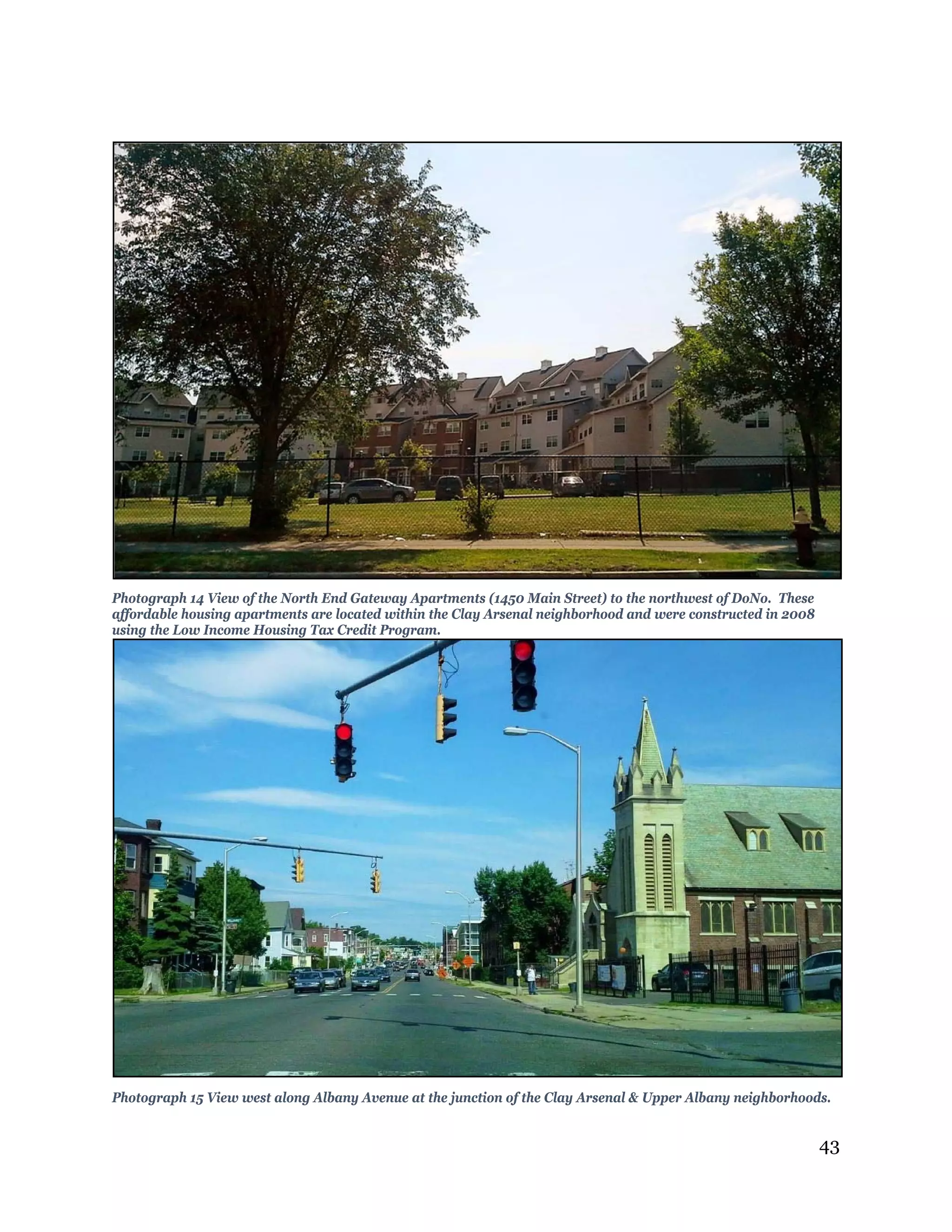
Photograph 14 View of the North End Gateway Apartments (1450 Main Street) to the northwest of DoNo. These
affordable housing apartments are located within the Clay Arsenal neighborhood and were constructed in 2008
using the Low Income Housing Tax Credit Program.
Photograph 15 View west along Albany Avenue at the junction of the Clay Arsenal & Upper Albany neighborhoods.
44
This photo tour was conducted to gain on the ground experience of DoNo and the
surrounding neighborhoods. The photographs illustrate the dichotomy between the
neighborhoods to the north and northwest of DoNo and Downtown, and how DoNo acts
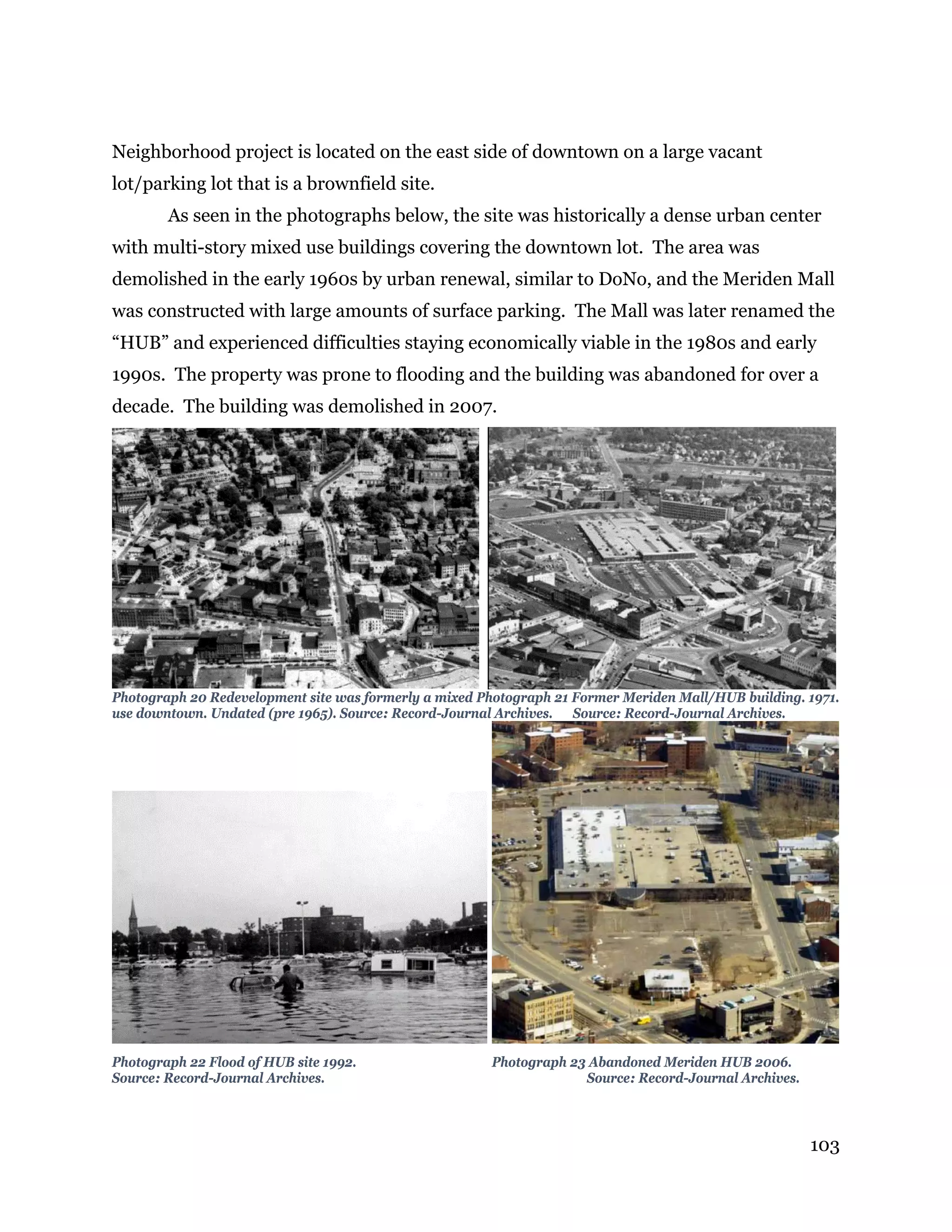
as a physical gap separating the neighborhoods from a pedestrian point of view. The
surrounding area consists of a beautiful Riverside Park, an industrial strip, partially or
fully vacant mixed-use buildings with good bones, a plethora of low-rise housing, and
Downtown office buildings. In many areas, connections are difficult on foot, and even
by automobile. After conducting the site visits, it became clear that the vacant parking
lots within DoNo were ripe for redevelopment and, with improved connections and
amenities, the surrounding neighborhoods could foster gentrification.
45
Research Questions and Methods
Research Approach
My first step in beginning of this project has been to identify the City of Hartford
as my location. The City of Hartford is at a pivotal moment leading up to a large scale
redevelopment effort in its North End. The area was subject to a Master Plan titled
“Downtown North / Downtown West: A Plan for the City of Hartford.” Although the
report is dated December 2013, it was not made public until April 2014. “This project
area bears both the traces of its historical origins and the scars of urban renewal and
suburban flight…existing challenges can become assets and help create opportunity for
change” (City of Hartford Planning Department Website, 2014.) I analyzed the housing
aspects of the redevelopment plan to determine if the proposal will meet the housing
needs or if it strains the adjacent low-income minority neighborhood. Additionally,
since this redevelopment has actually begun, I compared the Master Plan with the final
proposal and most up to date plans.
In order to contextualize the projected results of Hartford’s Master Plan, I
identified two similar cities that have undergone redevelopment in the past 15 years. By
analyzing cities that have completed similar plans within the past 15 years, I been able to
evaluate any results from those plans, gaps between goals and results, and any changes
throughout the process. This Project concludes with recommendations to the City of
Hartford in implementing their plan.
46
Research Questions
The focus of this proposal and the overarching question is: How will the Master
Plan impact the adjacent neighborhood in terms of housing, mixed-income neighbors,
and gentrification? The following questions break this focus down into smaller
components.
1. Will the Master Plan provide enough housing to meet the future needs of market
rate and affordable housing in this area? Will the potential influx of new
residents spill over into the adjacent Clay Arsenal, Asylum Hill, and Upper
Albany neighborhoods and cause displacement? More specifically:
 How many units are planned?
 What kind of units are they?
 Where are they located within the project area?
 What proportion of housing will be affordable compared to market
rate?
 Is the housing going to be constructed all at once or phased?
 What are the existing conditions of the adjacent neighborhood?
 What does the plan propose exactly?
 How does the plan work with the City’s Planning Department, the
State redevelopment agency, and Capital Region Development
Authority?
 What is the target audience?
 Who is likely to move into this area once/if it is redeveloped?
 Will there be auxiliary benefits with increased retail and
commercial businesses? Will the incoming businesses be too
expensive for the current residents?
 How are the housing projects going to be funded?
 What are the planning strategies, tools and techniques planners can
use to successfully integrate a variety of income levels in this
portion of the City.
47
2. What are the factors in creating a successful mixed-income, diverse
neighborhood? It is necessary to understand these factors that enhance social
fabric to influence the planning process of mixed-income communities.
 How do planners provide both high end, expensive retail for the
middle and upper class residents, as well as affordable retail and
food options for the existing lower income residents?
 Are the mixed-income residential units in the same building or
different buildings?
 Will amenities be shared equally across income levels?
 Is authentic integration possible with new-coming middle and
upper class residents and existing low-income residents?
3. What are the tools and techniques planners can use to keep existing residents in
their homes during the process of gentrification?
 Is Hartford’s historical lack of growth going to continue despite the
revitalization leading to the elimination of possible displacement?
 Is there already a surplus of housing that will accommodate
newcomers?
 If local residents are displaced, where will they likely go? Will their
lives be impacted negatively by the displacement: longer commute,
more expensive housing, lack of community etc., or just different?
In summary, what are the details of the redevelopment that will impact the
existing underserved residents? DoNo is located at the junction of contrasting
neighborhood: the affluent Downtown and the low-income Clay Arsenal, Upper Albany,
and Asylum Hill. The Master Plan attempts to balance of economic development and
social justice. This Masters Project aims to analyze what that proper balance is and
what planners can do to meet it.
48
Understanding Gentrification
Origins and Definitions
The phenomenon of gentrification has a deep and complicated history.
Gentrification as a unified field of study began when the British sociologist Glass coined
the term “gentrification” in 1964. Citing from Smith, Essoka of the U.S. Environmental
Protection Agency writes that Glass “recognized certain rehabilitation patterns where
working-class London residences and multiple-family dwellings were converted to
expensive residences once leases expired” (Essoka 2010, p. 303). However, the process
of gentrification occurred long before the coining of the term. The “Haussmannization of
Paris” demolished the low-income residential areas and replacing them with tree-lined
boulevards, monuments, and new buildings with strict building guidelines (Lees, Slater,
and Wyly 2008, p. 5). Additionally, parts of New York, New Orleans, Charleston, and
Washington, D.C. began gentrifying in the late 1930’s (p.5).
The definition of gentrification has been fought over and transformed for half a
century now. Early definitions of gentrification began along the lines of Glass’s by Neil
Smith, a Scottish geographer and anthropologist. By gentrification I mean the process
by which working class residential neighborhoods are rehabilitated by middle class
homebuyers, landlords and professional developers. I make the theoretical distinction
between gentrification and redevelopment. Redevelopment involves not rehabilitation
of old structures but the construction of new buildings on previously developed land
(Lees, Slater, and Wyly 2008, p. 9).
Most definitions complimented Smith and Glass’s throughout the 1970’s and
early 1980’s. Dictionaries went back and forth defining gentrification as the ‘movement
of middle class families into urban areas causing property values to increase and having
the secondary effect of driving out poorer families,’ 1980 Oxford American Dictionary,
to the ‘restoration of deteriorated urban property especially in working-class
neighborhoods by the middle and upper classes’, 1982 American Heritage Dictionary
(Lees, Slater, and Wyly 2008, p. 9). While some adhere with these definitions, Smith
altered his definition in 2000 due to the evolution of the field to the ‘reinvestment of
CAPITAL at the urban centre, which is designed to produce space for a more affluent
49
class of people than currently occupies that space’ (Lees, Slater, and Wyly 2008, p. 9, all
capitals in the original).
Clearly, there are many facets to the process of gentrification and a strict
definition only limits our understanding of the full process. One early box put on
gentrification occurred only in urban areas and only to low-income neighborhoods. The
original and mainstream “classical gentrification” stems from Glass’s ideas of
disinvestment of neighborhoods that are then revitalized by “pioneer gentrifiers” and
leading to the inevitable displacement of the indigenous residents (Lees, Slater, and
Wyly 2008, p. 10). This definition delves only into the residential rehabilitation facet of
gentrification. Early models “developed in the 1970’s and 1980’s to both explain the
process and predict the future course of gentrification mirrored Glass’s definition of
classical gentrification” (Lees, Slater, and Wyly 2008, p. 30). Early studies by Clay in
the late 1970’s laid out gentrification from stage 1 (pioneer gentrification) to stage 4
(maturing gentrification) (Lees, Slater, and Wyly 2008, p. 30).
With many definitions and explanations of different processes, it is difficult to
pin down a complete definition without removing an important component. However,
Davidson and Lees proposed a flexible definition relating to the following contexts: “(1)
reinvestment of capital; (2) social upgrading of locale by incoming high-income groups;
(3) landscape change; and (4) direct or indirect displacement of low-income groups”
(Davidson and Lees 2005, p.1170). This definition sets out criteria that allows
researchers to identify the different processes at play.
Production vs. Consumption
The early theoretical debates about gentrification revolved around finding the
causal factors of gentrification. Smith posed a production-side or supply-side
arguments based on economics, while Ley suggests that changing societal consumption
demands is the main factor in gentrification (Mathema 2013, p. 1-2). A key feud between
the two dealt with the quantification issues with Smith’s “rent gap” thesis. This states
that “gentrification occurs when there is a mismatch or a “rent gap” between potential
economic returns from a centrally located building and the actual economic gains from
50
its current use. This comes in the form of underutilized, decayed buildings in central
areas. The investment in rehabilitation, reconstruction, or new construction takes place
only when it is profitable, or in other words, if the gains that the structure can generate
from its future use is more than the cost of investing in it (Mathema 2013, p. 1-2).
Smith’s ideas stemmed from Glass’s identification of the cyclical nature of
gentrification. Middle or higher income neighborhoods become disinvested in and
begin to decay with lower income populations filling the housing. Many properties are
left abandoned or in need of repair, opening the door for the upswing of rehabilitation
and the possibility for higher rents and home values.
The ‘see-saw’ process of investment and disinvestment highlights uneven
geographical development that was the focus of much of Smith’s work (Lees, Slater, and
Wyly 2008, p. 50-51). The key to this theory is that capitalism drives these changes.
Landowners and developers are constantly looking to maximize their profits.
Revitalizing properties in places where real estate is low in price offers an avenue to
desired higher profits. This brings up the issue of measuring the potential “ground rent”
or highest and best economic use of a property. Though we can measure current housing
prices, there are other components that affect the potential ground rent of a property.
Very little work has been done empirically in this area and is the main cause for debate
(Lees, Slater, and Wyly 2008, p. 61-62).
After Glass’s coining of the term gentrification, it was Smith’s rent gap theory that
brought above the next wave of ideas of the causes of gentrification. A divergence from
the rent gap theory came in 1986 with Hamnett and Randolph’s “value gap” explaining
the pressure to convert rental housing to owner-occupancy (Lees, Slater, and Wyly
2008, p. 69). The value gap refers to the difference between the stream of rental income
versus the sale value for owner-occupation of a particular property.
The greatest debate with the production-side argument is the consumption-side
theory. Consumption-side theories “explain gentrification as a consequence of changes
in the industrial and occupational structure of advanced capitalist cities. This is the loss
of manufacturing employment and an increase in service employment” (Lees, Slater,
and Wyly 2008, p. 90). This change in employment opportunities created a larger
middle-class of “yuppies” who desired to live in central urban areas. Early on, the
51
debates of the consumption-side focused on who the gentrifiers were and why they were
returning to the city. The revanchist, anti-suburbanization ideals of these possible
gentrifiers is the main factor, though their reasons and make up are quite diverse and
complicated. The key player on the consumption-side, Ley, began his “humanistic
geography” work in 1972 in Canada, where he continues to work (Lees, Slater, and Wyly
2008, p. 91-92).
Ley argued that postindustrial society and altered the rationale behind the
allocation of land use in the urban contexts in Canada, as new middle-class
professionals (i.e. ‘cultural new class’) were an expanding cohort with ‘a vocation to
enhance the quality of life in pursuits that are not simply economistic’ (Lees, Slater, and
Wyly 2008, p. 92). Ley argued that gentrification represented a new phase in urban
development where consumption factors, taste, and a particular aesthetic outlook
towards the city from an expanding middle class saw an ‘imagineering of an alternative
urbanism to suburbanization’ which could not be captured by explanations of the
process that privileged structural forces of production and housing market dynamics (p.
92).
Instead of looking at the economics that produce gentrification, Ley, along with
Hamnett (Lees, Slater, and Wyly 2008, p. 90) focused on the production of potential
gentrifiers. These are the middle class people returning to the city for a variety of
reasons. Changing types of employment, political and social movements, as well as
education have fed the production of gentrifiers. Gentrifiers are not simply middle or
upper class households looking for a good deal in an urban area. They are yuppies,
artists, hipsters, members of the Lesbian Bisexual Gay Queer and Transgender (LBGQT)
community and others minorities looking for a home in a diverse neighborhood away
from the rigid nuclear family suburbs. The focus on who the gentrifiers are, however,
distracts attention away from the injustices at play. People empathize with the fact that
the neighborhoods are getting more desirable and, over the long term, safer, rather not
the indigenous low-income residents.
Here lies the main debates and avenues of discussion in the gentrification arena
in its first few decades. These discuss what has been deemed the first and second waves
of gentrification where sporadic gentrification occurred in the 1960’s and 1970’s and the
52
anchoring of gentrification in the 1980’s (Lees, Slater, and Wyly 2008, p 174-177). Other
offshoots or mutations have sprung up with the third wave of gentrification in the ever
globalization of the world (Lees, Slater, and Wyly 2008, p. 178). Rural-gentrification,
new-build gentrification, super-gentrification, and tourism gentrification are examples
of these mutations (Lees, Slater, and Wyly 2008, p. 129-159).
The newest avenue in gentrification research lies within a “geography of
gentrification.” With contemporary gentrification’s changes during neo-liberalism and
globalization, the geographical location of gentrification has been a major focus of new
research (Lees, Slater, and Wyly 2008, p. 187-189). The geography of the gentrification
process allows for comparisons across nations and cities. Gentrification is not always a
homogenous process but one impacted by the actors and economics of different
locations. Each actor has a different identity, which impacts where they may gentrify,
why they gentrify, and how they gentrify.
Non-Displacement Studies
Despite a half century of gentrification research conducted on the displacement
of indigenous residents is a key result of gentrification, many recent studies expel this
assumption. Displacement is not easy to measure so these surprising results have
sparked skepticism amongst many community activists and researchers. This was the
key motivation for Freeman’s book There Goes the ‘Hood (Freeman 2006, p. 4-5).
The wave of non-displacement gentrification theories has led to the makeover of
gentrification as a positive redevelopment strategy. Often titled ‘urban renaissance’ or
‘social mixing,’ these strategies are amongst the third wave of state led gentrification
(Lees 2008, p. 2646). These euphemistic terms are used in place of the heavy and
negative gentrification term to push revitalization. The reality is that social mixing
policies often create more social segregation by forcing the privileged middle class into
areas dominated by indigenous low-income residents.
Social mixing is heavily influenced by the types of gentrifiers or middle class new
residents who are the key to having social mixing work, if possible at all. These incoming
households may disrupt the indigenous communities’ way of life, while also bringing
53
access to resources and amenities. Progressive political consciousness and
respectfulness to others is another key to the functionality of social mixing. “The new
urbanist approach of intermixing a variety of building types and levels of affordability…
becomes the template for infill development… it can provide a framework for a city that
offers a higher quality of life to residents and visitors (Lees 2008, p. 2646).
Young’s ideas in 1990 accepted the domination of specific neighborhoods by
single groups, as long as the boundaries remained blurred. “In her ideal of city life,
there is group differentiation and the interfusion of these groups occurs through social
space. It is an openness to unassimilated otherness. She highlights the need to provide
spaces (not neighborhoods) that offer opportunities for social interaction amongst
people from different social backgrounds” (Lees 2008, p. 2646). Many social mixing or
anti-discrimination policies propose to not only boost home ownership opportunities
and affordable housing, but also to create economic opportunities with increasing job
training and promoting small (local and minority) businesses (Glanville 2013, p. 13).
Essoka lays out the necessities for social mixing:
No line should exist where revitalization begets gentrification. Instead,
revitalization in debilitated areas should stress upgrading local resources (people
and infrastructure) to produce more viable and attractive neighborhoods.
Equitable development strategies can create more integrated communities—a
preferred alternative to class-stratified neighborhoods. Integrated communities
tend to be economically diverse, have varied housing choices, attractive physical
characteristics, and strong community-based organizations and social
institutions committed to maintaining diversity (Essoka 2010, p. 311).
Conclusions
There are gaps and conflicts in the research of gentrification. At this point, there
is no consensus of the displacing effects of indigenous residents. The geography of
gentrification tells that every place is different and making sweeping conclusions across
all geographies is limited. Regardless of the actualization of displacement, it is known
54
that the benefits of gentrification don’t always ‘trickle down’ to the low-income
indigenous populations and lead to social segregation. As Orfield discusses below, true,
authentic, and just housing policies must be sought out to bring an end to segregation in
this country. Orfield states:
Advocates need to pursue other remedies to further an integrated society. This
involves using the federal FHA and state statutes and constitutions, together with
a coherent multi-front legislative strategy. This strategy must involve long-term
metropolitan integration, principles of opportunity-based housing, and the
stabilization of integrated and gentrifying neighborhoods. Housing must be
viewed as a clear path toward racial and economic opportunity that holds a real
hope for revitalizing cities and older suburbs (Orfield 2005, p. 1804).
The positive effects of gentrification can include an increase in shops,
restaurants, and entertainment, which can lead to more vibrancy in an area. The
increase in business can increase the tax base for the city. Often times better amenities
and infrastructure such as park benches, trash service, sidewalks, street lighting,
signage, street plantings, crosswalks etc. are brought in and are maintained better.
Many of these positive effects of gentrification do impact people across all
demographics. Many of these services and amenities require significant funding and the
increase in economic development that spurs gentrification has the ability to pay for
them.
Housing assistance and rent stabilization can be used in gentrifying
neighborhoods to increase the indigenous or ‘in-place’ resident’s resiliency to the
increasing cost of living (Pearsall 2013, p. 2307). A multi-pronged approach to
authentic social integration is the holistic approach that attacks the economic and
housing disparities issues of gentrification. This Master’s Project seeks to identify
specific tools and techniques that planners in urban areas can use to combat the
negative effects of gentrification.
55
Understanding Housing
Introduction
Affordable housing has a long and complex history in the United States. The
term elicits a variety of good and bad feelings, ideas, and tensions. Affordable housing is
not one simple program, but is comprised of several different forms. Several of the
programs include Housing Choice Vouchers (HCV) or Section 8, Low Income Housing
Tax Credits (LIHTC), Hope VI, and public or subsidized housing. Each of these
programs have different focuses, successes, and challenges, as well as varying histories,
time periods, and impacts.
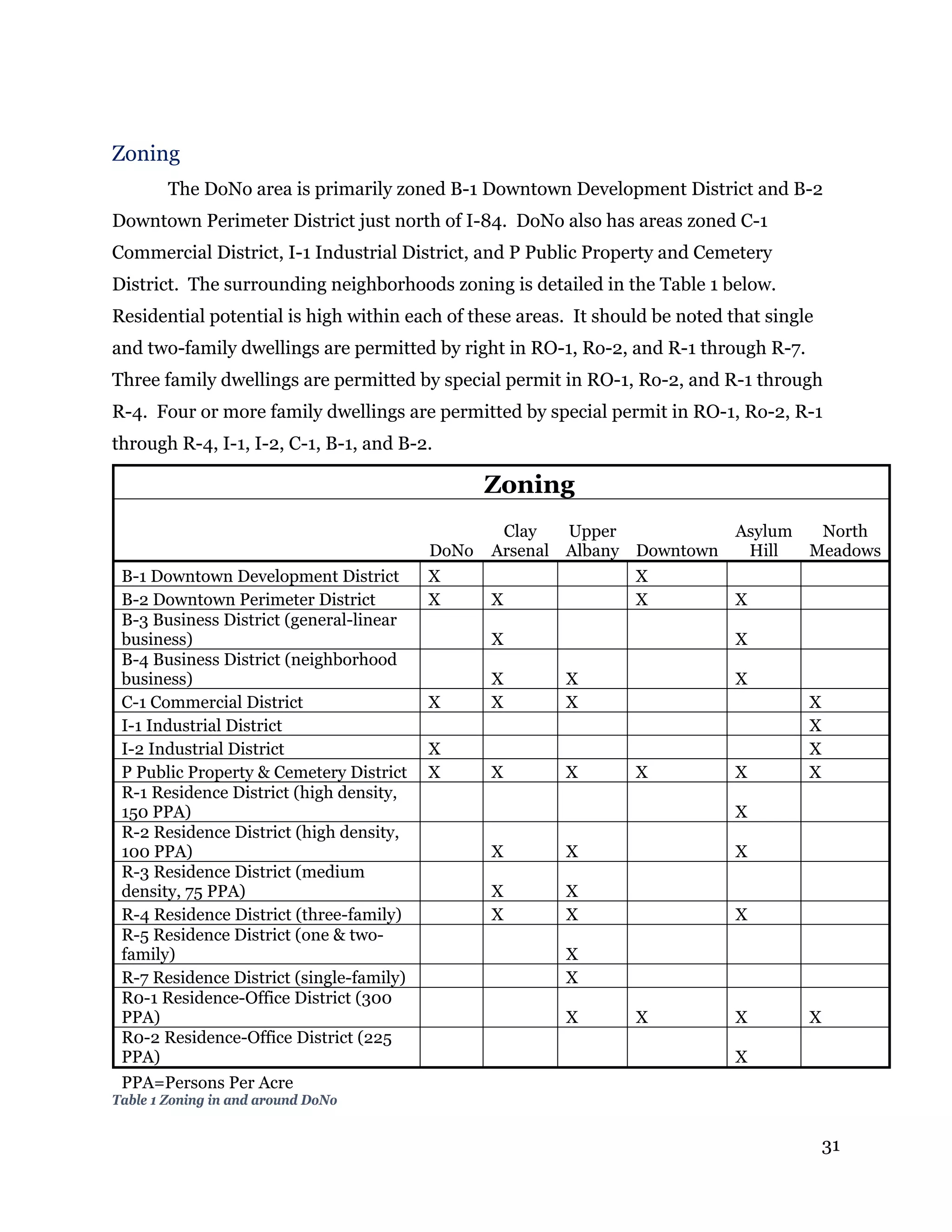
Housing is an essential human need that is often times taken for granted.
However, the private market often times does not meet the needs of all residents. This
gap affects many low-income, and even middle-income households in the United States.
These households struggle to find safe housing they can afford in locations that provide
quality opportunities and amenities. Since the private market fails to meet this demand,
the federal government has policies and programs to address the issue of affordable
housing.
This literature review explores the various affordable housing programs and
connects them to the City of Hartford’s Downtown North (DoNo) redevelopment
project. The review is centered on the following question: What are the housing policies
and best practices that can be implemented in the DoNo area to prevent spillover into
the adjacent neighborhoods, causing displacement of the existing low-income residents?
The research is grounded in Schwartz’s pivotal book Housing Policy in the United States
(2010) and explores current literature on affordable housing. By understanding the
history and context of affordable housing in the United States, this review frames the
situation in Hartford and sets out to assist the City in planning for the future.
Following this brief introduction, the next section explores the history and
various aspects of federal housing policy. The second section discusses LIHTC and
identifies pros and cons of such developments. The third section focuses on how various
programs address or don’t address, promote or work against deconcentrating poverty.
The fourth section analyzes the effects of programs and policies in regards to
56
discrimination. At the end of each section, the major take away points are provided as
recommendations for the City of Hartford.
Federal Housing Policy
This section reviews four articles that discuss the history of United States federal
housing policy and what it means for cities today. First von Hoffman’s “The End of the
Dream: The Political Struggle of America’s Public Housers” is examined as it describes
the history of public housing from its early days in the United States (2005). Landis and
McClure’s article “Rethinking federal housing policy” evaluates the major goals of
federal housing policy (2010). Tiebout’s “A pure theory of local expenditures” teaches
us that people vote with their feet (1956). Lastly, Basolo’s “The impacts of intercity
competition and intergovernmental factors on local affordable housing expenditures”
lays out the difficulties municipalities have regarding funding and providing services to
its residents (1999).
Von Hoffman discusses how public housing has transformed from its beginnings
in the early 20th century to today (2005). In the early 20th century, the public housers
early European experiments (decentralized with limited-dividend cooperatives) were
municipality driven and included non-profits and cooperatives. Their original plan was
to have a varied and flexible housing program for the majority of American households
run by the states, municipalities, and private non-commercial housing developers. This
plan was never fully imagined due to the Great Depression and other political
circumstances that led to rigid and complex, top-down federal programs. Despite the
housers strength and network, their message did not resonate with the middle class to
implement a grassroots campaign to push their houser ideals , therefore, the housers
employed a smoke-and-mirrors strategy of anti-slum arguments to win supporters. The
result was a focus on the very poor and slum clearance, rather than the middle class
housing satisfaction.
The European experiments are quite fascinating. These socialist ideals of equality
for all, and giving government a hand in creating that equality, is generally not a widely
excepted idea in the United States. Individualism and capitalism are too strong to
57
consider these ideas, even if they were quite impressive. Public Housing policy has put
the very poor in a position of having to take assistance from the government, with few
options, while at the same time being looked down by from society. Releasing control of
public housing to smaller, more localized agencies could provide better oversight and
variety of housing as the top-down public housing had a stereotypical “look.” Providing
affordable housing to not just the very poor but the lower middle and middle classes
would provide a substantial benefit to the country and is almost impossible to imagine.
Landis and McClure identify the three main focuses of federal housing policy:
increase home ownership, assist low-come households, and reduce discrimination
(2010). Federal housing policy has succeeded in increasing home ownership; however,
this push has led to the housing crisis and crash of 2008 and threatens low-income
renters as it does not provide much support for them. Landis and McClure aimed to
“examine the trends, summarize the research evaluating the performance of these
programs, and suggest steps to make them more effective and connected to each other”
(p. 319). Landis recommends “privatizing aspects of the secondary mortgage market and
move to eliminate mortgage interest deductions and replace with ten year home
ownership tax credit,” regionalize the voucher program or make it into an entitlement
program that works through income tax system, and “sell public housing projects to
nonprofit sponsors where appropriate, and eliminate some of the rigidities in the Low
Income Housing Tax Credit (LIHTC) program” (p. 319).
These programs are not well coordinated and aimed towards helping higher
income households that vote and contribute. There is little evidence that much will
change in the near future. Landis and McClure recommended utilizing fewer and better
coordinated programs, as well as using tax credits rather than tax deductions. Low-
income subsidy programs should be reconfigured to make it easier for able-bodied
individuals, who want to work, move to areas of higher opportunities. LIHTC has been
successful; however, it is expensive and should promote mixed income developments
better.
Tiebout furthers this idea of intercity competition with an analysis of tax rates
and services (1956). His theory is that individuals move to municipalities that have the
best goods and services with the lowest tax rates. This way individuals are getting the
58
most for their money. When roads fall to disrepair and school systems worsen, the
wealthy leave because they have the financial option to find a better place to live. This
means that municipalities limit affordable housing to decrease taxes and services.
Basolo’s research analyzes the influences and effects of intercity competition and
intergovernmental factors on local affordable housing expenditures (1999). Due to the
lack of regional agencies and regional planning, municipalities are forced to compete
with each other for funding. This leads to inequality and hasty developments. The effect
of competition on affordable housing is that municipalities are looking to increase their
tax base in order to be able to provide services and amenities. Affordable housing
doesn’t produce high amounts of taxes so the attention given to affordable housing is
much lower. “Intercity competition reduces the likelihood that cities will spend local
dollars on housing programs. Intergovernmental factors, such as federal funding and
state-mandated housing planning, on the other hand, positively influence cities to spend
local funds on affordable housing programs” (p. 659).
Basolo’s research found that when intercity competition increases, cities are less
likely to spend their local funds on affordable housing unless they are a municipality
that already spends their local money on it. The influx of federal dollars only partially
motivates municipalities to spend their own money, while state money does not have an
impact. States do however have more influence with state-mandated housing planning
and local set-aside requirements. Basolo’s research determined that most
intergovernmental factors did not influence municipalities to begin funding housing
programs but do have a positive influence on the amount of local-source dollars spent
on affordable housing programs, in municipalities that already spend their local funds
on these programs (p. 681).
Basolo’s findings indicate that cities have different commitments to affordable
housing and therefore, spend various amounts of their own money on housing programs
in competitive regions (ibid). Furthermore, state and federal policies do affect local
expenditures on affordable housing (p. 682).
Federal Housing Policy Summary
59
In summary, federal housing policy impacts municipalities at the local level.
According to the Connecticut Department of Housing (DOH), 37.80% of Hartford’s
housing units are affordable (2010). Basolo’s research suggests Hartford is invested in
affordable housing and federal and state housing policies and funding will continue to
complement their efforts. However, Hartford may be looking to be more competitive
with neighboring communities in terms of goods and services, as well as higher
end/luxury housing and amenities. Tiebout would say this may impact their
commitment to affordable housing. Landis and McClure would recommend Hartford to
implement an inclusionary housing policy and to be cautious when utilizing LIHTC for
affordable housing as often times it does not promote mixed income developments due
to the larger profits to developers who construct only affordable units (Landis &
McClure, 2010, p. 334).
Hartford, and specifically the DoNo area, still feel the scars of urban renewal and
slum clearance. The DoNo redevelopment is in an area devastated by urban renewal and
left as vacant or underutilized for decades. The City has the opportunity to patch the
injuries of the past and should plan the redevelopment to combat the errors of their
history. Urban renewal destroyed DoNo once before, Hartford should implement a
housing policy that will not devastate or push out the adjacent residents who have lived
cut off from downtown for decades due to urban renewal and I-84. Redevelopment of
this area with mixed use and mixed income developments has the possibility to
revitalize the community.
Low Income Housing Tax Credits (LIHTC)
LIHTC is an affordable housing program that began in 1986 during the Reagan
administration. LIHTC funds are allocated by the United States Treasury Department
to states based on population size. Each developer has to apply to the state for tax
credits to build affordable housing. Developers with higher scores based upon how well
their projects meet the priorities and selection criteria set forth get more tax credits.
LIHTC developments generally consist of lower-middle class and working class
individuals and families.
60
This section focuses on three peer-reviewed articles on the LIHTC program.
Deng’s two articles analyzing LIHTC: “The cost-effectiveness of the low-income housing
tax credit relative to vouchers: Evidence from six metropolitan areas” (2005) and “Low-
Income Housing Tax Credit Developments and Neighborhood Change: A Case Study of
Miami-Dade County” (2011) focus on costs, as well as the community impacts of LIHTC.
Melendez and Schwartz’s article “After year 15: Challenges to the preservation of
housing financed with Low-Income Housing Tax Credits” (2008) discusses the major
issues in maintaining LIHTC housing for the long term.
In 2005, Deng compared the cost of LIHTC development subsidies of new-
construction with the alternative 20-year HCV voucher subsidies in six cities around the
United States, three in hot markets: San Jose, Boston, and New York City and three in
cold markets: Cleveland, Atlanta, and Miami (2005). Deng found that LIHTC is more
expensive than vouchers. Local market conditions and program administration lead to
regional variations in premiums. Vouchers were still cheaper in the three tight housing
markets. Supply and demand in the low-income housing submarkets is what matters to
housing policy makers as this impacts the cost-effectiveness of vouchers.
Payment standards used by state and local governments administering the
voucher program also impact their cost-effectiveness. Additionally, higher quality
standards for apartment units reduces the cost advantage for vouchers, although this
means expanding neighborhood choices and improves access to employment and
education. New York City and Boston add community revitalization and other objectives
onto LIHTC, making the development invaluable to the local residents and
communities, though it significantly increases the cost.
HCV vouchers and LIHTC compete ideologically and programmatically. As,
discussed above, HCV vouchers are allocated to qualified low-income individuals who
then have to search for apartments that are willing to adhere to inspections. LIHTC
developments are constructed by developers who apply to the state for tax credits that
are initially allocated by the United States Treasury Department. They work very
differently and analyzing the costs of each program is helpful for municipalities to
determine the best option. It is important to think about the aspects of LIHTC and
61
vouchers that can be controlled that increase the costs, such as adding community
revitalization to LIHTC or having higher standards for vouchers.
In Deng’s second article, she uses a case study in Miami-Dade County to analyze
the neighborhood change with LIHTC developments (2011). The study finds that over
half of the LIHTC neighborhoods have experienced more positive changes than their
control groups; however, the effects vary by neighborhood context. Black high-poverty
neighborhoods receiving the LIHTC investment have experienced the most positive
changes, while changes in middle-class neighborhoods have been the most negative. In
the Black neighborhoods, LIHTC was located in redevelopment projects, so any money
was seen as a positive step; however, in white neighborhoods it was not received as well
and may have led to White flight and disinvestment.
Melendez and Schwartz’s article looks at the challenges associated with
sustaining LIHTC developments for the long term (2008). LIHTC is currently the
largest subsidy program for low-income housing. According to Schwartz and Melendez,
the greatest risks to LIHTC are the expiration of income/rent restrictions and more
strongly the need for capital improvements. Schwartz and Melendez’s research looks at
the “likelihood that tax credit housing will convert to market-rate occupancy and the
challenges confronting the long-term physical viability of the housing if it is to remain
affordable” (p. 261).
LIHTC credits go to private owners but do not guarantee long-term low-income
housing as the restrictions are only for 15 years, unless built after 1990, which have 30
years of required affordability in most circumstances. Most owners do not turn over to
market rate but need assistance for maintenance and improvements. Even if these units
continue to be affordable, the Internal Revenue Service (IRS) stops monitoring these
units after the initial restriction has expired. The article concludes that a relatively small
amount of the affordable housing stock is likely to convert to market-rate (ibid).
Each state is essentially conducting their own experiment. Planners must
balance the need for expanding and preserving affordable housing when subsidy dollars
are scarce. A major issue is monitoring and enforcing long-term affordability
requirements by state housing finance agencies after year 15. The federal government
should reform the law to extend the restriction to 30 years. In addition, the IRS should
62
monitor the restrictions because each state’s housing finance agencies have uneven
administrative enforcement capacity. It doesn’t appear as though convincing owners to
keep the housing affordable is the major issue; however, in high growth markets or in
times of rapid price increases, this may not be the case.
LIHTC Summary
In summary, LIHTC developments have many benefits but the City of Hartford
should be cognizant of its drawbacks. LIHTC is very attractive to many developers and
can lead to an increase in affordable housing. Despite its benefits, LIHTC is overall
more costly than HCV vouchers and, as discussed later in this review, are not always
located in the areas of higher opportunity. Hartford needs to decide whether adding
higher quality standards for HCV or community revitalization programs in LIHTC are
important enough to implement in these programs. Although creating a sufficient
quantity of affordable housing units for the area is the main priority, the extra effort in
developing the community are also essential to fight the cycle of poverty.
The neighborhoods in the vicinity of DoNo are majority Black and Latino. LIHTC
in the DoNo area and surrounding areas may therefore lead to positive impacts for the
adjacent neighborhoods. With the coming redevelopment of DoNo, LIHTC could aid
the construction of affordable housing. Even though Hartford has been a no or slow-
growth city for decades, DoNo has the possibility of turning things around and
triggering a spur of growth. Since Hartford is giving the land to the developer for $1, far
below market-rate, Hartford should consider extending the restrictions past 15 years to
prevent the units from turning over to market rate and put a plan in place to monitor
and enforce the affordability of the units. Additionally, Hartford should plan ways to
assist owners in the areas with capital improvements, maintenance, and upgrades,
which could require longer affordability restriction periods.
Deconcentrating Poverty
In this section, three articles review how housing policies and programs work
with the deconcentration of poverty. The review begins with an analysis of McClure’s
63
article “Deconcentrating Poverty with Housing Programs” (2008). In “Forced
relocation vs. voluntary mobility: The effects of dispersal programs on households,”
Goetz breaks down the successes and failures of two poverty deconcentration programs
in the Twin Cities region of Minnesota (2002). Lastly, DeFilippis and Wyly discuss the
vouchers and LIHTC’s abilities to deconcentrate poverty in “Running to Stand Still:
Through the Looking Glass with Federally Subsidized Housing in New York City”
(2006).
According to McClure, housing vouchers supplied to households are not helping
renters locate in low-poverty areas any more effectively than are current project-based
subsidies (2008). It is McClure’s opinion that “planners seeking to make poverty
deconcentration more effective [should] use housing placement counselors, administer
programs at the metropolitan scale, lease and broker market-rate housing directly,
promote mixed income LIHTC developments, practice inclusionary zoning, and monitor
the impacts of these efforts” (p. 90). The LIHTC program may be providing greater low-
poverty market penetration than the HCV program because the developer makes the
location decision in the LIHTC program, while in the HCV program the household
chooses the location. There are difficulties finding units, fear of discrimination, and loss
of social fabric. Housing placement counselors are essential in the HCV program to help
households that may not have access to internet, good credit, or references to find units
and facilitate transition. Planners should make it easy for developers to place LIHTC
and other affordable housing in the proper neighborhoods rather than vulnerable
neighborhoods by zoning these areas to allow for multi-family developments.
Goetz’s research analyzed two poverty deconcentration programs: voluntary
mobility programs and involuntary relocation of families through government action in
the Twin Cities Region in response to the Hollman v. Cisneros case settled in 1995 that
demolished 700 units (2002). These units were mandated to be replaced in a scattered
fashion in non-concentrated parts of the metropolitan area (p. 108). The voluntary
mobility program was similar to the “Moving to Opportunity” (MTO) program, which is
a modified Section 8 voucher that must be used in low poverty areas (ibid). The greatest
effects of these programs was seen in relieving issues of personal safety and
neighborhood incivility (drug use, graffiti, drinking etc.). Neighborhood satisfaction was
64
highly variable and there were no employment effects of the moves that families made.
Those who voluntarily moved saw happier neighborhood scenarios than those
involuntarily relocated (p. 121).
Goetz hypothesizes that neighborhood conditions experienced by those who were
relocated in Minneapolis were possibly not as bad as expected or in other cities. It is
important for municipalities to not stereotype neighborhoods based on their low-
income status as bad, decayed, or inhabitable. There is always social fabric and hidden
assets that may not be seen from the outside. Furthermore, forcing people out of their
homes generally does not make people happy or put them in better neighborhoods.
Giving people options and the agency to make decisions leads to better neighborhood
satisfaction.
DeFilippis’ focuses on vouchers (tenant-based) and the project-based Section 8
form of subsidized housing in New York City to determine if either program are locating
in deconcentrated areas (2006). Project-based Section 8 units receive vouchers and stay
with the private unit, not the tenant. Since the federal government has stopped
constructing new public housing units and struggles to maintain the existing housing
stock, project-based Section 8 programs seem to be doing well. However, landlords are
leaving the program in gentrifying areas because they can get higher profits by
converting units to market rate. The research found that vouchers do not promote
deconcentrating poverty in New York City despite the common belief that vouchers
allow poor households to move to neighborhoods with better opportunities and
amenities.
The federal government has been paying project-based Section 8 landlords in
New York City up to $3,000 per month to keep their units affordable (p. 24). By
matching the market, the government is just reinforcing the market processes that have
not been able to produce affordable housing. An alternate strategy is to move to an
ownership system of preservation in which purchasers are tenant organizations or
community based non-profits. DeFilippis believes the government should cease
persuading landlords with extra funding to keep units affordable (ibid). If the market
can’t keep units affordable, public housing should be built as a viable alternative to keep
tenants in these areas of growth and opportunities.
65
DeFilippis suggests two approaches to combatting these issues. First, landlords
should be required to give a longer notification period before termination of
affordability and provide the “right of first refusal.” States should also require landlords
to mitigate the costs of relocation for displaced tenants, which is the “stick” method.
Lastly, the “carrot” approach would be tax incentives from the government.
Deconcentrating Poverty Summary
In summary, deconcentrating poverty with housing programs such as LIHTC and
HCV vouchers has historically failed. HCV vouchers are not helping deconcentrating
poverty despite the agency given to recipients to choose where they live. Voucher
recipients may require a councilor to assist in finding the right place in neighborhoods
with opportunities. LIHTC developments may have a greater ability to be placed in
deconcentrated areas because of the developer’s options. Planners need to make it easy
for developers to place LIHTC developments in deconcentrated areas with multi-family
zoning and municipalities may have to offer additional incentives if the cost of land is
too high in these areas to allow for a profitable development.
As stated previously, 37.80% of Hartford’s housing units are affordable (2010).
From a preliminary analysis, the neighborhoods surrounding the DoNo area (north,
northwest, and west) have substantial amounts of affordable housing that is likely to
contain project-based Section 8, HCV vouchers, and public housing. With the coming
DoNo redevelopment and influx of new residents, landlords may be interested in
switching their units to market rate to increase their profits, which would begin to
decrease the amount of available affordable housing. Hartford could work with
landlords and incentivize keeping housing units affordable longer and provider longer
notification before termination of affordability. The City of Hartford should persuade
developers to construct LIHTC developments in low-poverty areas such as the DoNo
area, as it is adjacent to and may be less expensive than the adjacent higher income
Downtown. Additionally, since the City is in the process of revamping their zoning, they
should make sure they have elements of inclusionary zoning.
66
Discrimination
This section discusses various aspects of federal housing policy and affordable
housing programs that impact equality. As stated in the section above, Landis and
McClure identified reducing discrimination as one of the three main focuses of federal
housing policy (2010). This review begins with Woods’ “The Federal Home Loan Bank
Board, Redlining, and the National Proliferation of Racial Lending Discrimination,
1921-1950” and Pritchett’s “Which Urban Crisis?: Regionalism, Race, and Urban Policy,
1960-1974” to demonstrate the United States’ segregated history (2012 & 2008). Next,
the review looks at Mhatre and Van Zandt’s research on the location of LIHTC
developments in “Growing Pains: Perpetuating Inequality through the production of
low-income housing in the Dallas/Fort Worth metroplex (2009). Halasz analyzes fair
housing standards and inequality in “Fair and affordable? Racial and ethnic segregation
and inequality in New York City rental housing” (2011). The section concludes with
Orfield’s article “Racial integration and community revitalization: Applying the fair
housing act to the low income housing tax credit” (2005).
Woods reviewed materials from the Federal Home Loan Bank Board (FHLBB)
and examined the detrimental consequences of the national adoption of the Home
Owners’ Loan Corporation’s (HOLC’s) appraisal standards by national lending
institutions (2012). HOLC’s definition of undesirable residents as racial or ethnic
minorities, or low-income inhabitants was discriminatory, yet adopted and used
throughout the country. These “scientific appraisal” standards systematically
disadvantaged Black and low-income urban inhabitants and severely limited their
ability to obtain mortgages (p. 1038). The process of “redlining” communities,
discouraged by lending in Black neighborhoods, enforced segregation in much of the
United States.
Wood’s research shows that “widespread disinvestment in urban neighborhoods,
particularly those populated by African Americans, ultimately contributed to deplorable
housing conditions experienced by that group in most American cities by the mid-
twentieth century” (p. 1039). The HOLC assisted in nationalizing the practice of racial
and socioeconomic lending bias that led to the segregation of the United States.
67
Although these practices have been illegal for decades, their effects are still shown today
and people of color are still discriminated against in the real estate market by being
shown less units and lower quality units.
Pritchett’s research looks at the debate in the United States in the 1960’s and
1970’s regarding the proper role of the federal government in addressing “urban
problems” faced by older cities (2008). After struggles in the 1960’s by the federal
government to solve these issues, President Nixon signed a bill in 1974 that provided
funds to local governments for urban development (CDBG) (p. 282). This led to the end
of regional and municipal planning cooperation and to competition between local
governments. The results of the devolution of power back to local governments and the
lack of strong federal support over the past several decades is that cities still struggle
with uneven development and racial inequality without leadership from the federal
government (p. 282).
Issues of “urban problems” became identified as issues of racial conflict in the
1960’s. Today, the stigma is still there. It is important to realize that this issues
originated from the disinvestment of cities and governments in central cities and from
“White flight.” The federal government has taken a back seat in addressing these issues;
however, municipalities have the opportunity to take control using the federally funded
CDBG resources. Local control can give municipalities the agency to make the changes
they see as necessary to revitalize their inner cities.
Mhatre and Van Zandt examined LIHTC in the Dallas/Fort Worth area to test the
theory that supply-side housing can facilitate redistribution of low-income residents,
dispersing them throughout areas of better opportunity (2009). The author’s found that
LIHTC units were increasing in non-central city counties of the region but not within
the affluent suburbs. LIHTC units were being placed in less affluent peripheral areas to
underwrite the production of small stocks of rental housing. Additionally, they were
being located on the edge of these already peripheral municipalities.
The issue stems from the Department of Housing and Urban Development’s
(HUDs) use of Qualified Census Tracts (QCTs) to identify Difficult Development Areas
(DDAs). These designations allow bonuses to be paid to developers who build affordable
units in these areas that are defined by low incomes and high percentages of minorities.
68
QCTs are a strong predictor of the clustering of LIHTC developments. LIHTC should be
amended encourage the development of affordable units in unaffordable markets.
In disadvantaged neighborhoods, tax credit guidelines might limit the proportion
of LIHTC units that are low-income to promote income mixing and deconcentration,
whereas in affluent neighborhood developments should be required to include higher
proportions of low-income units to promote economic integration. Zoning is likely
concentrating multi-family in certain areas in the exurban/periphery areas. Planners
have the ability and responsibility to make the changes necessary to encourage multi-
family within these areas.
Halasz uses New York City as a case study to “examine the extent to which
current affordable rental housing programs and policies violate fair housing standards
and exacerbates socio-economic inequality” (2011, p. 267). Halasz’s research contributes
three startling findings. Blacks and Latinos are still considerably segregated from
Whites and Asians despite increasing neighborhood diversity in certain types of
affordable housing (ibid). Contrary to popular opinion, wealth and social class do not
determine the type of housing a family may occupy as much as race and ethnicity (ibid).
Lastly, mixed income multi-family developments containing a variety of incomes,
employment levels, and poverty were found to provide significant advantages over
cluster developments such as public housing, which furthers racial, ethnic, and socio-
economic inequality (ibid).
Halasz’s research reveals some unpleasant facts about segregation in the United
States. Her research does provide hope in mixed income, multi-family developments.
The planning implications are substantial. Planners can zone affluent areas for multi-
family developments and use inclusionary zoning to require a certain percentage of the
new units be affordable. These tools can begin to increase the mixing of incomes and
possibly people of different races and ethnicities.
Orfield’s research analyzes the effects LIHTC has had on segregated and
resegregating neighborhoods (2005). Orfield suggests HUD’s MTO and HOPE VI
projects failed to bring economic opportunities to low-income households because they
were located mainly in resegregating areas, despite being less poor than their original
neighborhood. The Gautreaux program succeeded because the units were located
69
stable, more affluent, and more White areas with substantial opportunities (p. 153).
Orfield warns though that race based planning (i.e. requiring units be located in
majority White neighborhoods) is illegal. Planners can look at other characteristics to
determine the health of a community such as school population, tax base, growth, jobs,
and available land.
Orfield states that “based on law, regionalist policy, and empirical evidence, this
article argues that the government should prioritize locating low-income housing in
places with strong schools, economic opportunity, and plentiful local resources. It
provides approaches for preserving affordable housing in rapidly gentrifying
neighborhoods with segregated schools and maintaining or enhancing integration in
communities that are unstably integrated” (p. 107). In terms of preventing
gentrification or stabilizing gentrifying neighborhoods, shallow subsidies of up to half
the cost of a new unit can be used to maintain existing housing to prevent resegregation.
Subsidies should be concentrated in areas where opportunities exist to preserve units.
Lastly, municipalities with weak market demand should avoid constructing new units
where existing units are available, which may lead to abandonment with new
construction.
Discrimination Summary
In summary, the private market, as well as housing policies at the local, state, and
federal levels have historically discriminated against people of color and low-income
households. Historically, discriminatory policies led to or enforced the segregation of
the United States and placement of Black households in poor quality housing. Today, as
Halasz found, socio-economic status does not determine the type of housing a family
may occupy as much as race and ethnicity. This is disturbing for today’s society and
housing policy must address these issues to combat housing discrimination in the
United States.
Research shows that mixed income, multi-family developments can work well at
providing opportunities for low-income households. It is important to note that while
minorities have been discriminated against, mixed income does not necessarily mean
70
locating in wealthier White neighborhoods. Associating low-income to people of color
reinforces the history of discrimination. Additionally, since LIHTC aims for lower
middle class and working class households, LIHTC could be used to transition the low
and very low-income housing with the middle and higher-income housing in Downtown
and DoNo. Hartford should have a community revitalization plan addressing the
possible gentrification of the DoNo area and surrounding neighborhoods. Efforts to
stabilize the region prior to the redevelopment will go a long way in creating a long
lasting mixed income and diverse community.
Conclusions
Affordable housing in the United States comes in many forms and benefits low-
income households to varying degrees. The private market has been unable to supply
housing that is affordable to all residents and at the same time providing access to
opportunities, services, and amenities. This literature review examined various aspects
of the evolution of federal housing policy and programs in an effort to paint a picture of
the current situation for cities in the United States today. The review also identifies best
practices and recommendations for the City of Hartford to implement with the coming
redevelopment of its DoNo area.
In terms of federal housing policy, HCV vouchers, project-based Section 8,
LIHTC, and public housing all play a role in providing affordable housing in
municipalities. As previously stated, Hartford already has a significant amount of
affordable housing. The questions though are: what is the quality of the housing and
how long is the unit’s affordability restriction? HCV vouchers give recipient the agency
to choose where they live, though Hartford should implement a program with housing
placement councilors to ensure the successful placement of the recipients. Project-
based Section 8 units may be most at risk with the DoNo redevelopment. Hartford can
work with landlords to extend the restrictions before the market provides for higher
profits in market rate. Programs and funding should be sought after to maintain the
existing project-based Section 8, LIHTC, and public housing.
71
LIHTC can be a strong incentive for developers to include affordable housing;
however, Hartford should make sure that the developments are mixed income and
located in neighborhoods with opportunities and amenities. LIHTC should be used
within the DoNo redevelopment to provide mixed income housing in this area. Hartford
should require extending the restrictions past 15 years to prevent the units from turning
over to market rate and put a plan in place to monitor and enforce the affordability of
the units. Additionally, Hartford should plan ways to assist owners in the areas with
capital improvements, maintenance, and upgrades.
Federal housing policy and housing programs have historically created
discrimination, segregation, and concentrated poverty. HCV vouchers alone are not
helping deconcentrating poverty without councilors or resources to assist households in
finding the right place in neighborhoods with opportunities. LIHTC developments may
have a greater ability to be placed in deconcentrated areas because the developer
decides. The Hartford Planning Department should use multi-family zoning and other
incentives to facilitate developers to place LIHTC developments in deconcentrated
areas. The City of Hartford should persuade developers to construct LIHTC
developments in low-poverty areas such as the DoNo area, as it is adjacent to and may
be less expensive than the adjacent higher income Downtown.
The City is currently undertaking a “Zone Hartford” project to update and revise
their zoning regulations from 2005. The City is contemplating changing to form-based
regulations. Inclusionary zoning should also be included in the rezoning of the City.
Much of the DoNo area and surrounding area is zoned for medium to high density
multi-family residential.
This literature review concludes that mixed income, multi-family developments
are essential at providing opportunities for low-income households. The Clay Arsenal,
Upper Albany, and Asylum Hill neighborhoods adjacent to DoNo are largely segregated
and in need of investment and opportunities. LIHTC could be used to transition the low
and very low-income housing with the middle and higher-income housing in Downtown
and DoNo. HCV vouchers can give existing residents the opportunity to move to other
areas of the City if they desire. Since the redevelopment is still in the initial planning
72
stages, Hartford should create a community revitalization plan addressing the housing
needs and possible gentrification of the surrounding neighborhoods.
73
Summary of DoNo Master Plan
Figure 19 DN/DW Project Area. Source: Utile p. 12
Utilizing funding from a Department of Housing and Urban Development (HUD)
Sustainable Communities Grant, the City of Hartford contracted Utile, Inc. in 2013 to
prepare a Master Plan for Downtown North / Downtown West (DN/DW). Assisting
Utile were Ningret Partners (economic design), Stoss Landscape Urbanism (landscape
design), Nelson Nygaard Consulting Associates (transportation), and Fitzgerald &
Halliday, Inc (community planning). The Master Plan’s states that it was finalized in
December 2013; however, it was not made available to the public until late Spring 2014.
The Master Plan’s project boundaries are delineated in Figure 1 below. Downtown
North, now called DoNo, is located to the north of I-84, to the west of the Connecticut
River, to the east of the Clay Arsenal, Upper Albany, and Asylum Hill neighborhoods,
and to the south of the North Meadows neighborhood and the XFINITY Theatre.
Vision
The Project Vision was “to harness the full potential of Downtown North and
Downtown West by creating a seamless environment” (Utile, p. 5, 2013). Utile states
that plan includes an existing conditions study, a market analysis, urban design
74
framework, recommendations and implementation plan, and design guidelines and
zoning. The plan is divided into the following chapters: Previous Studies, Study Area
Character, Transportation Network, Planning Strategy, Retail and Housing Analysis,
Development Districts, Transportation Planning, Open Space Planning and Design, and
Design Guidelines and Zoning. The recommendations and implementations plan are
found within the Development Districts chapter. Below is a summary of the relevant
sections referenced above, with the exception of Study Area Character, Planning
Strategy, and Transportation Planning.
Previous Studies
Utile discusses several previous studies and reports that were conducted in these
areas sponsored by the City of Hartford. The Downtown West Opportunities Plan in
2006 guided investment by identifying areas that are suited for redevelopment. A 2010
Downtown Circulation Study identified four projects concerned with converting one-
way streets to two-way streets and redesigning intersections for improved traffic
mobility at peak-periods. A Downtown North project from 2008, who’s purpose was to
“remove obsolete and blighted buildings from a critical perimeter area of the
Downtown, conduct site assemblage, and create a development opportunity for mixed-
use development, rehabilitation of historic structures, and educational and commercial
development that will strengthen the development patterns of the Project Area” and was
the basis for this 2013 Master Plan (p. 10).
Also beginning in 2008 was a planning process to search for linkages between
many of Hartford’s assets titled iQuilt. “Downtown Hartford’s exciting urban design
strategy for walkability and creative place making. It capitalizes on two of Hartford’s
greatest strengths: its extraordinary concentration of arts, cultural, and landscape assets
and it’s exceptionally compact downtown” (p.11). The plan focused on signage,
wayfinding, and place making strategies for Downtown Hartford, A Greenwalk Master
Plan was a core part of iQuilt (p. 11). These plans prepped Utile for the DN/DW Master
Plan process and provided them with important background information.
Transportation Network
Figure 20 Activity disparity between Downtown West and DoNo. Source: Utile p. 28
Utile identified the following issues regarding the roads in the project area:
 Market Street: Despite being only four lanes, the street feels expansive and
underused.
 Intersection at Main Street and Albany Avenue: The intersection is intimidating
to pedestrians and confusing to drivers.
 Highway crossings: Bridge crossings and highway underpasses should be
improved to draw people comfortably from Downtown North to Downtown West.
 Scale of streets: As future development is built, the streets should be redesigned
to Complete Streets standards (p. 16).
Utile identified four City-owned parcels located at Main Street, Trumbull Street,
and Pleasant Street (totaling 8.3 acres) that are well suited for redevelopment. These
parcels are currently underutilized as surface parking lots and vacant parcels. These
parcels are currently a vacant void in between the downtown core and neighborhoods to
the northwest. Hartford historians and planners label this area as a “scar” after it was
clean scraped due to urban renewal in the 1970s. A large scale redevelopment is
appropriate for this area, while an incremental redevelopment is more fitting for the
Downtown West area due to its more built up nature.
In regards with transportation, the road network is currently disconnected for
pedestrians and crossing the I-84 interstate is difficult and inadequate for pedestrians.
76
Additionally, Figure 20 above depicts active and inactive street edges in terms of
restaurants, retail, hotels, and entertainment. The figure shows a large void of activity
in the DoNo area with the exception of the northwest portion of Main Street before it
turns into Albany Avenue.
Retail Market Analysis
Utile conducted a retail market analysis split between Downtown North and
Downtown West because they serve very different demographics. The DoNo area was
found to be able to provide needed goods and services for the surrounding population,
including nearby residents, the 70,000 daytime office workers in Downtown, and
visitors. Utile discusses the needs of the surrounding neighborhood in the following
quote. “The residents north of the study area are currently underserved by retail and are
required to drive to find basic retail services, such as groceries stores. It was determined
that the Downtown North study area has a demand for 163,000 square feet (SF) of
additional retail development. This development would produce $59 million in sales,
and by 2017 it would generate up to $62 million in gross sales. The area could absorb up
to 53,000 SF of restaurant space, a new 31,000 SF grocery store and additional retailers,
such as departments stores, appliance stores and clothing stores.” (p. 44-45).
Housing Analysis
Due to the unpredictability of housing growth, Utile conducted a varied analysis
of housing by looking at resident market research, demographic statistics, and
precedent studies. Surveys and focus groups found that Downtown residents want more
amenities and activities such as restaurants, entertainment, and shops. Respondents
showed a demand for a mix of housing types such as townhouses or condos that opens
to the street (61%), high-rise apartment or condos of 4-10 units (46%), lofts or
untraditional (46%), and apartments or condo buildings (37%) (p. 46-47). Survey
respondents stated that finding housing that is affordable in a walkable area is desired
but not available in Downtown. Please note that the survey respondent’s demographics
were not provided so the definition of what is “affordable” to the respondents is unclear.
77
It is presumed that this refers to mid-range rents for young professionals, not rents for
low-income residents.
The analysis showed that housing growth Downtown is fueled by young
professionals with annual salaries of approximately $60,882 as well as empty nesters
(older adults whose children are no longer living with them). The analysis indicated
that the average young professional’s budget for rent is approximately $750 and $1,000.
The research showed that Downtown could support an additional 1,700 to 4,700 units of
housing even considering the existing downtown units and the 1,100 units that are
planned (p.47). Utile noted there are many factors that impact housing prices, such as
fluctuation of the housing market, the volatility of local economies and change in
consumer preference; however, there is strong evidence that there is a significant
portion of the population in and moving to the greater Hartford area who would be
interested in living in a vibrant urban area, such as Downtown Hartford (and potentially
DoNo) if there were units in their price range.
Open Space
Figure 21 Open space connections and opportunities. Source: Utile p.90.
Utile’s plan suggests three options for connecting DoNo to the riverfront. The
first option is to improve the current overpass, which is located in the northeastern
portion of DoNo, by creating a landform on either side of I-91 to slope up to the top of
78
the newly redesigned overpass. Option 2 uses a switchback ramp design from the
Market Street exit ramp on I-84 from the intersection of a rail cap and Market Street.
The final option works off of an existing pedestrian access to the bridge and river using a
suspended bridge.
The plan also proposes upgrading and designing Wexford Park (named “Heaven
Park” by local skaters, bikers, and graffiti artists) to accommodate more uses. Currently,
the park is blocked off with walls and is under disrepair. The current skate park, which
opened in 2014 after the city invested $160,000 to upgrade it, is the main use and is
important to the residents to the northwest. This skate park will be expanded and
upgraded. The new “Town Green” would be for passive and recreational activities for all
of Hartford’s residents (p. 102).
Figure 22 Proposed redesign of Wexford Park into a Town Green. Source: Utile p. 103.
Design Guidelines and Zoning
This chapter lays out development guidelines for any Requests for Proposals
(RFPs) for development in the near future. These guidelines are measurable and will be
incorporated into a city-wide form-based zoning code. The rezoning of the Downtown
neighborhoods is ongoing and will prioritize these areas first. The primary goal of the
rezoning is to “ensure that the building stock and related street network are consistent-
enough in height, scale, and character that general form-based rules can be applied” (p.
108).
79
Priority Areas
Utile identified five priority areas for new development, two of which are in
DoNo. These areas are identified as 1: Ann Uccello and 2: Main and Trumbull, which
are in DoNo, 3: Main & Asylum, 4: Bushnell Park, and 5: Downtown West, which are
located to the south of DoNo beyond I-84, and are depicted in Figure 23 below.
Neighborhood scale development is appropriate in Ann Uccello, which is named after
the former Mayor of Hartford from the 1960s.
A market analysis indicated there is a
substantial demand for new retail and a
30,000 square foot grocery store in DoNo,
which is the typical size of a larger
“supermarket”. Utile indicates that the Main
and Trumbull area “could form a new town
center with retail anchors, residential
development, and a proposed municipal
office building” (p. 52).
Figure 23 Potential development sites. Priority site 1
corresponds with Ann Uccello and Priority site 2
corresponds with Main and Trumbull. Source: Utile
p. 51
Ann Uccello
The Ann Uccello future build out is depicted in Figure 4 below. This are contains
several vacant lots, a new municipal complex, and the only strip of retail in DoNo.
“Building upon the scale of the existing neighborhood, this plan proposes townhouses,
corner retail, and Low-rise Mixed Use buildings (generally 4-5 stories) that are sensitive
to the context of the area. Corner retail provides a social gathering space, while a
courtyard behind the townhouses offer private outdoor space. Townhouses will have
street facing front doors and vehicular access via a rear alley” (p. 54).
80
Figure 24 Build out of the Ann Uccello District. Source: Utile, p.55.
Main and Trumbull
The Main and Trumbull proposal is depicted in Figure 5 below. Despite the close
proximity to the core of downtown, the DoNo area still feels a great distance due to the
“no-man’s land” quality of the bridges over I-84, which have fallen into disrepair.
Because of this fact, Utile proposes uses the Main and Trumbull area, which is
municipally owned, as a node and gateway. The proposal indicates that a 10 story
municipal building is planned for this area. “Other Mid-rise Mixed Use buildings
anchoring that corner should be between 10-12 stories tall. As the development moves
beyond that key node, the recommended building heights are between 4-5 stories for
Low-rise Mixed Use buildings, which are primarily residential with some ground floor
retail” (p. 60). A total of 681 residential units are proposed, as well as 250,000 square
feet of commercial, 138,310 square feet of retail/active use, and 1,484 parking spaces.
Figure 25 Main and Trumbull new development proposal. Source: Utile, p. 63.
81
Utile proposes a complete street revamp of Main and Trumbull. A road diet
reducing the number of travel lanes is proposed for both streets. Crossing islands will
reduce the curb-to-curb width for pedestrians attempting to cross the street. On-street
parking and bike lanes, neither of which currently exist here, are proposed.
Additionally, a five foot wide landscaped buffer will be implemented in between the bike
lane and ten foot wide pedestrian zone.
Figure 26 Reconfiguration of Main Street in DoNo. Source: Utile, p.64.
DoNo Master Plan Implementation Table
Subject Master Plan Critical?
Residential units 810 Yes
Commercial SF 285,000 Possibly
Retail or Active Uses SF 157,310 Yes
Light Industrial SF 0 No
Parking spaces 1,658 No
Table 2 DoNo Master Plan proposed implementation table.
In each of the summarization tables, the column labeled “Critical?” analyzing the
importance of each item for DoNo. Critical elements for DoNo include residential,
retail, and active uses. The housing element will strongly impact the development and
82
the surrounding neighborhoods, while retail and active uses will set the tone for the new
neighborhood. Since Downtown and surrounding areas have a plethora of commercial
office space, industrial properties, and parking, these elements may be less critical to the
area.
Request for Proposals
On July 2nd, 2014, the City of Hartford posted a Request for Proposals (RFP) for
“For Public Private Partnership of Completing Hartford’s Neighborhoods with Mixed-
Use Development & Proposed Minor League Baseball Facility” at the DoNo site. The
RFP responses were received by August 1, 2014. The main proposal, herein referred to
as “the Proposal”, was created by DoNo Hartford, LLC, a collaboration between
Centerplan Development Corporation and Leyland Alliance utilizing Priority Sites 1 and
2 (Ann Uccello and Main and Trumbull). The following section analyzes the Proposal
and outlines the major differences from the proposal and the Master Plan.
83
DoNo Hartford, LLC Proposal
The DoNo Hartford LLC Proposal took many Hartford and Connecticut
residences by surprise. Many had lost hope that anything would come of the blighted
area. The Proposal is not for a single parcel but to create a full DoNo neighborhood.
Below is the Proposal’s Concept Site Design, which includes a 6,000 square foot minor
league baseball stadium with 3,000 additional suite, picnic, and standing seats, a little
league field above three levels of parking, a 11,000 square foot brewpub with 35,000
square foot brewery, three additional parking garages, a large-scale grocery store, multi-
family apartment buildings, offices, and mixed use buildings. The Concept Site Design
also indicates that approximately twelve historic buildings along Main Street on the
western portion of DoNo would be renovated and maintained as mixed use and multi-
family buildings.
Interestingly, the possibility of the New Britain Rock Cats Double-A minor league
baseball affiliate of the Colorado Rockies ending its 30 years with the City of New
Britain and moving to Hartford was not discussed within the DoNo Master Plan.
Reportedly, the Mayor of Hartford, Pedro Segarra and Hartford Director of
Development Services, Thomas Deller, had been in private negotiations with the Rock
Cats owner, Joshua Solomon, for 18 months prior to announcing in June, shortly after
the completion of the DoNo Master Plan, that the Rock Cats signing a 25-year lease with
the City of Hartford beginning in 2016. From my conversations with Junior Planner
Caitlin Palmer, it appears as though these negotiations were completely private and the
entire 2013 planning process for the DoNo Master Plan did not entertain this possibility.
During my June 2014 interviews with Ms. Palmer, who assisted on portions of
the Downtown North / Downtown West Master Plan, stated that she didn’t believe there
wasn’t an imminent potential for redevelopment in DoNo. Besides the City indicating it
may start off the redevelopment with a municipal building in the DoNo area, she was
unaware of any proposals or talks of potential developers for the mostly city-owned and
underdeveloped site. From my research of newspapers, there appeared to be no talks of
any development in this area.
84
Figure 27 DoNo Hartford LLC's concept site design of the DoNo redevelopment. Source: DoNo Hartford LLC p. 22).
Below is the Statement of Interest from DoNo Hartford LLC that was submitted
to the City in August 2014.
[DoNo Hartford LLC] proposes to deliver a wide range of services in the creation
of a dynamic, mixed‐use neighborhood, including planning and design,
construction management, financing strategies, commercial and residential
leasing, and property management. The net result will create a neighborhood that
will not only become an entertainment destination for hundreds of thousands of
visitors annually, with a professional baseball team as its focal point, but will also
link the North End of Hartford and Downtown within an environment that
includes public space, apartments, offices, retail, restaurants, a grocery store, and
a variety of potential destinations that will define itself as a holistic urban core
that provides its residents with a real opportunity to live, work and play. This
neighborhood, known as Downtown North, or DoNo, will energize an area that is
presently dormant, and create a major new assembly venue for the region.
(DoNo Hartford LLC, 2014, p. 6)
B
D-1
A
G-2
F
B
D-1
E
D-2
C
G-1
85
Figure 28 DoNo Hartford LLC's conceptual graphic of the Proposal. Source: DoNo Hartford LLC p. 21.
Proposal Description
The proposal separates DoNo into two development projects, Parcel A for the
baseball stadium and Parcels B-G for a mixed-used development, which are depicted in
Figure 27 above. All of these parcels are to be sold to DoNo Hartford LLC by the City
for one dollar. The ballpark is situated on a parking lot and vacant lot bounded by Main
Street, Trumbull Street, Pleasant Street, and Windsor Street. The Proposal eliminates
this section of Windsor Street, allowing the ballpark to flow into a little league park
overlooking the minor league stadium, a brewery with an outdoor bear garden, and 228
residential units, all located on parcel G. DoNo Hartford secured a contract to purchase
this eastern parcel, currently developed with a vacant concrete block building. This new
feature will create a new gateway to DoNo, connecting the triangle and Heaven Park
(located above I-84) better for pedestrians.
DoNo Hartford LLC envisioned the City of Hartford moving its municipal office
building to parcel F at the intersection of Trumbull, Main, and Morgan (an existing
parking lot). This was proposed to be the anchor of the eastern side of DoNo and
gateway to the park.
A block with parcels B, C, and D located in the southwestern portion of DoNo will
be a residential block with a reconfigured Ann Uccello Street and parking garage. The
existing buildings along Main Street and High Street will be restored and reused for
86
mixed use and residential purposes. The aim is to create a pedestrian friendly new
neighborhood in across from the new public safety building on High Street. The parcels
bounded by Chapel Street North, Main Street, Trumbull Street, and Ann Uccello Street
will be a mixed use block E with a parking garage, and a 25,000 square foot (medium-
large sized) urban grocery store. The first floor of the buildings will be retail shops along
Main Street with four stories of residential above.
Regarding traffic, the proposal aims to improve pedestrian and transportation
throughout DoNo. Currently, the area is heavily car centric with wide roads designed
for faster driving and dangerous pedestrian atmosphere. The Proposal has three goals
for roadway improvements. These include street re‐alignment to accommodate the new
stadium, street re‐construction for traffic calming/place‐making, and creating a
functional/multi‐modal transportation system (DoNo Hartford, LLC p. 14).
Regarding housing, the DoNo Hartford, LLC Proposal states that “the current
downtown lifestyle proposition combines bland retail, old housing stock, and an office
driven environment, making it a weak alternative to the incumbent outlying areas” (p.
17). The Proposal states that there is no real product in the middle to higher level rents,
creating a “substantial latent demand in the $1,300 - $2,200 rent band” (p. 17). DoNo
Hartford LLC sees the possibility of more mature households, renter by choice and
empty nester renters, and student housing if the area can mature into a “fully-realized
neighborhood that also has amenities and retail which properly caters to these multiple
groups” (DoNo Hartford, LLC p. 17).
The Proposal included a market analysis prepared by RCLCO to supplement the
Master Plan and 2013 Market Analysis of DoNo. The market analysis indicated that
there is sufficient potential sources of demand for 750 to 800 total units making up 87%
young professionals, 12% renters by choice, and 5% empty nesters (DoNo Hartford, LLC
p. 19). Affordable housing and the needs of the low-income neighborhoods surrounding
in DoNo are not discussed anywhere in the Proposal.
Although DoNo Hartford LLC discusses the need of including a centralized
grocery store, they do not mention of the need due to the surrounding low-income food
desert neighborhoods. Rather, they discuss the grocery store as necessary for the new
young professionals. There is a concern that this could be a Whole Foods, which may be
87
too expensive for the existing residences. With the exception of stating that the new
construction will preserve the historic fabric of the neighborhood, DoNo Hartford LLC
appears to make no connection with the surrounding neighborhoods, except for wealthy
Downtown. The developers state that “other smaller format, neighborhood-serving
retail options such as a pharmacy or dry cleaner should be carefully vetted by how they
fit within the wider ecosystem of a walkable residential community” (DoNo Hartford,
LLC p. 18).
RCLCO lists daily serving retail, restaurants and nightlife, and public spaces are
required for place making in DoNo. “These three uses are all critical in creating a place
where residents can comfortably work, live, and play. Ultimately, the successful
execution of this phase I plan will be determined by how well the target young
professional’s core social and lifestyle needs are met. If this place making strategy is
executed well, RCLCO believes there is a substantial amount of demand for the kind of
integrated community that this site can offer” (DoNo Hartford, LLC p. 18). Other
residential amenities recommended include a full-service gym, rooftop access to the
residential buildings, Zipcar space, cappuccino/coffee bar, cardio bar classes, yoga
studio, microbrewery, wave pool, bike storage, communal kitchen, dog park, drycleaner,
community garden, and a workshop area.
RCLCO’s conclusion is that there is substantial potential in creating a revitalized
neighborhoods for high income young professionals. Young professionals need to be
targeted initially with later phases of the development catering to empty nesters and
students.
Given the current dynamics between employment, the state of housing
opportunities in outlying areas of Hartford, and the tremendous opportunity for
place making around the ballpark, the necessary conditions are in place to
redefine what it means to live downtown. There is currently no location in the
region where young professionals can live in a walkable neighborhood with the
critical mass of retail, restaurants, nightlife, and social activities that they truly
prefer. Other markets have proven that a well-executed neighborhood providing
these lifestyle amenities can be extremely successful in attracting and retaining
young people. Hartford itself has proven that even in the absence of compelling
lifestyle offerings, the downtown can still increasingly draw high income young
professional residents. The subject site represents an opportunity to develop and
deliver a mixed use neighborhood at the exact inflection point of downtown
redevelopment. (DoNo Hartford LLC/RCLCO p. 20)
88
Table 3 represents the Proposal’s initial square footages and various uses for
each of the parcels. A total of eleven buildings ranging from two to eight stories were
proposed. A total of 673 residential units, a grocery store, retail space, two office-
buildings, Hooker Brewery and Brew Pub, and five parking lots/garages were proposed.
The number of residential units is significantly lower than the Master Plans. Not
included in this table is the square footage of the baseball stadium, the center piece of
the redevelopment.
Table 3 Detail of proposed uses with quantities within the Proposal. Source: DoNo Hartford, LLC p. 23.
Table 4 details the differences between the DoNo Master Plan’s implementation
plan and DoNo Hartford, LLC’s Proposal.
DoNo Implementation Table Comparison
Subject
Master
Plan Proposal
Difference
(Proposal
compared to
Master Plan)
Proposal /
Master Plan Critical?
Residential units 810 673 -137 83.1% Yes
Commercial SF 285,000 221,000 -64,000 77.5% Possibly
Retail/Active Uses SF 157,310 326,400* +169,090 207.5% Yes
Light Industrial SF 0 30,000 +30,000 30,000% No
Parking spaces 1,658 1,405 -253 84.7% No
Table 4 Comparison of the DoNo Master Plan's implementation proposal with the DoNo Hartford, LLC's proposal.
Please note that the Proposal includes 220,000 square foot minor league baseball stadium as retail/active uses.
89
Therefore, the Proposal only includes 106,400 square feet of retail space, which is less than the Master Plan.
Legend: Square Feet=SF
An analysis of the difference between the DoNo Master Plan’s implementation of
residential, commercial, and parking with DoNo Hartford, LLC’s Proposal reveals that
the Proposal does not meet the majority of the Master Plan’s numbers for DoNo as a
whole. DoNo Hartford, LLC proposes slightly less residential units and parking spaces
than the Master Plan. Hartford is not lacking parking; however, the lower amount of
residential units is an issue. It should be noted that the Master Plan distinguishes
between “commercial” and “retail or active uses” but does not define the two. DoNo
Hartford, LLC indicates square footages for office, retail, residential, and light
industrial.
I included office space as commercial and combined the retail figure with the
proposed 220,000 square foot baseball stadium, which includes a 6,000 seat baseball
stadium with 3,000 additional standing, picnic, and suite-style seats on Parcel A for
retail or active uses. Please note the stadium building itself will only be approximately
90,000 square feet but the entire stadium with the field and standing room will be
approximately 220, 000 square feet. The light industrial use proposed by DoNo
Hartford, LLC is a brewery for Hooker Brewing, which will also have a restaurant.
Planning and Zoning Commission Staff Report
On December 9, 2014, the City of Hartford Planning and Zoning Commission
completed a staff report with recommendations regarding the DoNo Hartford, LLC
proposal. Table 5 represents the changes made per the staff recommendations that
increased the amount of housing over that of the Master Plan, while still providing retail
and active uses, the two critical elements of the redevelopment.
DoNo Implementation Table Comparison
Subject Master Plan Proposal
Proposal after
Staff Report Critical?
Residential units 810 673 842 Yes
Commercial SF 285,000 221,000 Not Listed Possibly
Retail/Active Uses SF 157,310 326,400 407,955* Yes
90
Light Industrial SF 0 30,000 Not Listed No
Parking spaces 1,658 1,405 1,583 No
Table 5 DoNo implementation table comparison with updated numbers after the Planning and Zoning
Commission's staff report. Please note that the square footage for the commercial space and brewery may have
been combined within the retail square footage within the staff report. *Additionally, the Proposal includes 220,000
square foot minor league baseball stadium as retail/active uses. The updated Proposal increased the retail space to
187,955 square feet.
Submitted Plans
On February 14, 2015, the City Council approved the proposed 25-year lease with
a municipal authority formed to own and finance the baseball stadium. The plans were
approved by the Planning and Zoning Commission with special permits and the
ceremonial groundbreaking for the baseball stadium occurred on February 17, 2015.
The City Council is still in negotiations over the final developer agreement with details
regarding the mixed-use development portion of the project.
Figure 29 Final Planning and Zoning Commission Site Plan Subdivision for the DoNo redevelopment. Source: DoNo
Hartford LLC dated November 25, 2014.
Since the Proposal was submitted, the City and DoNo Hartford, LLC have worked
out some of the finer details for the DoNo redevelopment. A revised development plan
91
was created January 8, 2015 after BETA Group, Inc. prepared a Traffic Impact and
Parking Study dated November 18, 2014. According to Ms. Palmer, the most up to date
numbers approved by Hartford Planning and Zoning Commission were submitted to the
Office of the State Traffic Administration (OSTA) in February 2015. Please note that the
final plan for the redevelopment with the exception of the baseball stadium have not
been finalized and made public. The plans for each of the parcels have been submitted
by DoNo Hartford, LLC to the Hartford Development Services Division.
DoNo Implementation Table Comparison
Subject Master Plan Proposal
Final Numbers
Approved by
Hartford Planning
and Zoning
Submitted to OSTA
Final
Proposal/
Master Plan
Residential units 810 673 941 116.2%
Commercial SF 285,000 221,000 0 0%
Retail/Active Uses SF 157,310 196,400 349,178 222.0%
Light Industrial SF 0 30,000 43,000 43,000%
Parking spaces 1,658 1,405 1,665 100.4%
Table 6 DoNo implementation table comparison with final numbers approved by the Planning and Zoning
Commission and submitted to OSTA. Please note that the Proposal includes 220,000 square foot minor league
baseball stadium as retail/active uses. The final numbers include 129,178 square feet for retail. Note that 100% in
the Final Numbers/Master Plan column on the far right would indicate an exact match between the Proposal and
the Master Plan. Percentages higher than 100% indicate the Proposal offers a greater amount than the Master Plan
allotted, while those lower than 100% indicate the Proposal offers a far fewer amount.
In terms of housing, the final Proposal appears to exceed the amount of units
allotted by the Master Plan. The Proposal apportioned over 900 units for DoNo. This
figure should assist in bringing street life to the neighborhood and aid in preventing spill
over into the surrounding neighborhoods. The Proposal’s initial intention of
undercutting the Master Plan to less than 700 units was unacceptable. The City is
setting a good precedent to require more housing.
Another major change from the original Proposal to the final Proposal was the
ratio of commercial to retail uses. Initially, the Proposal allocated a large area for a
potential municipal office building. The City realized that this area does not need more
office space but retail and active uses were most imperative. Coupled with the larger
amount of housing proposed, the 129,178 square feet of retail, 43,000 square foot
92
brewery, and 220,000 square foot baseball stadium should create a vibrant
neighborhood.
According to Ms. Palmer, the Planning and Zoning Commission did not require a
percent of the housing be affordable as part of their special permit; however, the
agreement with the city council, which hasn’t been finalized, may include 20% of the
units be affordable housing. It is my opinion that the Planning and Zoning Commission
should have required a percentage of affordable housing. Parcel E, confined by,
Trumbull Street, Main Street, Pleasant Street, and Chapel Street in the southwestern
portion of DoNo along I-84 will include a larger grocery store. Of note is the “historic”
buildings along the western portion of Main Street and High Street, are no longer
included in the project and will not be renovated by the developer. Additionally, the
little league baseball field that was initially proposed on Parcel G to overlook the minor
league stadium and inspire the youth of Hartford, is no longer included.
It appears as though the developer is removing some of the features designed to
benefit the local residents. There seems to be no restriction on the type or price of
grocery store or other retail tenants. The only aspect that appears to maintain some
connection with the Hartford community are within the baseball stadium agreement
with the City Council, which has yet to be finalized and provided publically. According
to a Hartford Courant article “Hartford Releases Details of Downtown, Stadium
Projects,” the city will be entitled to free use of the public areas of the ballpark for a
minimum of five city sponsored events during baseball season and five additional events
during the offseason (Carlesso, Jenna, and Goode Steven). The club will also be
required to price tickets so that they are affordable to families, provide special programs
for seniors and children, and hold an annual "Hartford" day. Additionally, local, woman
and minority-owned businesses are to be given preference in contract work.
After all of the back and forth, the final proposal exceeded the Master Plans
recommendation for residential units; however, the amount of affordable units is still up
in the air due to the Master Plan not discussing this element. It is my opinion that if the
Master Plan had identified affordable housing as a critical element for DoNo and
recommended a certain percentage of units be affordable housing, the developer would
have had better expectations and the City Council would have had firmer ground to
93
stand on to ask for affordable housing units. The removal of the office building appears
warranted, while the increase in retail space and the baseball stadium should create a
vibrant neighborhood. The grocery store should be a significant resource for the
community; however, it is located in the south-central portion of DoNo and closer to
Downtown than the underserved neighborhoods to the north and northwest. Overall,
the final proposal exceeds the Master Plan. The developer’s agreement will tell how
many community benefits may come from the redevelopment.
94
Rubric Analysis of Two Case Studies
As part of this research project, I searched for case studies within the State of
Connecticut to help analyze the DoNo redevelopment and be able to extract some
potential impacts of the project. Since the State of Connecticut does not maintain a list
of redevelopment projects sponsored by municipalities, I contacted the planning
departments of Connecticut’s ten largest municipalities to see if they had done such
projects. Several cities along Long Island Sound in the southern portion of Connecticut
were ruled out due to the economic spillover effect from New York City and from Yale
University in New Haven. The two case studies I chose to analyze were in the cities of
Meriden and Waterbury, Connecticut.
The Meriden redevelopment project has been in a longer planning phase than
DoNo (since 2005), yet is coming to fruition in a similar time period. My analysis has
focused on comparing Meriden’s guiding plan with the redevelopment proposals. I use
Waterbury’s redevelopment to analyze the impacts of the project ten years after its
completion.
I reviewed the redevelopment plans and any other relevant documents for each
case study to understand what was originally proposed. To analyze the case studies, I
conducted a site reconnaissance, interviewed municipal officials in connection with the
prospective redevelopment projects, and compared demographic statistics from 2000
with 2013. From this information, I’ve made recommendations for DoNo based on the
case studies.
Demographic Changes 2000-2013
To analyze the impacts of these redevelopment projects, I compared the
demographic changes within each redevelopment area between 2000 and 2013. The
redevelopment impacts were compared across population, age, race and ethnicity,
educational attainment, employment and poverty, and housing to identify any changes
that may have occurred as a result of the redevelopment projects.
95
Demographic statistics were collected from the U.S. Census Bureau 2000
decennial census and the 2008-2013 five-year estimates. Data for Meriden Center was
collected for census tracts 1701 and 1702. Data for Waterbury’s Central Business
District was collected for census tract 3501. The results are depicted in the tables and
figures below. Please note that the results are for the census tracts listed above
revolving around the redevelopment areas.
The below table shows that population has decreased in both redevelopment
areas with a greater loss in Waterbury where the redevelopment has been completed for
a decade. The median age also increased significantly in Waterbury. The only major
race and ethnicity changes occurred in Meriden with few White alone residents and a
higher concentration of Hispanic or Latino residents.
Demographic Changes 2000-2013 in the Case Study Redevelopment Zones
Redevelopment
Area
Year
Total
Population
Median
Age
White
Black or
African
American
Asian
Hispanic
or
Latino
(of any
race)
White
Alone
Meriden
2000 4,214 31.1 59.1% 12.9% 0.9% 49.5% 34.8%
2013 4,098 33.1 58.7% 12.1% 0.6% 61.1% 27.4%
Change -116 2.0 -0.4% -0.8% -0.3% 11.6% -7.4%
Waterbury
2000 4,788 42.3 50.4% 20.3% 0.8% 44.6% 33.3%
2013 3,429 55.4 53.6% 20.6% 5.1% 41.8% 33.5%
Change -1,359 13.1 3.2% 0.3% 4.3% -2.8% 0.2%
Table 7 Demographic changes in Meriden Center and Waterbury Central Business District from 2000 to 2013.
Source U.S Census Bureau.
In terms of housing, both redevelopment areas increased the total number of
housing units slightly; however, the overall vacant housing rate also increased to over
20%. Notably, the homeowner vacancy rate dropped to zero for Waterbury. Median
rents for both redevelopment areas rose substantially with rents in Waterbury nearly
doubling.
96
Housing Changes 2000-2013 in the Case Study Redevelopment Zones
Redevelopment
Area
Year
Total
Housing
Units
Vacant
Housing
Rate
Homeowner
Vacancy
Rate
Rental
Vacancy
Rate
Median
Rent
Meriden
2000 2,122 10.4% 9.1% 6.8% $447.89
2013 2,286 20.3% 22.2% 11.7% $745.81
Change +164 +9.9% +13.0% +5.0% +$297.92
Waterbury
2000 2,731 10.6% 10.3% 5.7% $290.00
2013 2,813 22.6% 0.0% 14.5% $503.00
Change +82 +12.0% -10.3% +8.8% +$213.00
Table 8 Housing changes in Meriden Center and Waterbury Central Business District from 2000 to 2013. Source
U.S Census Bureau.
In both areas, the percentage of residents 25 years of age and older with a high
school degree or higher rose; however, their rates are significantly lower than those of
the State. With Waterbury’s arts and education redevelopment project, the percentage
of residents 25 years of age and older with a bachelor’s degree or higher rose to over
10%.
Education Changes 2000-2013 in the Case Study
Redevelopment Zones
Redevelopment
Area
Year
% High
School
Graduate or
Higher
%
Bachelor's
Degree or
Higher
Meriden
2000 54.7% 6.0%
2013 66.2% 5.3%
Change +11.5% -0.7%
Waterbury
2000 49.5% 6.0%
2013 53.4% 10.3%
Change +3.9% +4.3%
Table 9 Education changes in Meriden Center and Waterbury Central Business District from 2000 to 2013.
Source U.S Census Bureau.
The unemployment rates for both redevelopment areas increased to over 17%,
over three times that of the State. The poverty rate increased to over 41% in Meriden
but decreased to 26.3% in Waterbury. While the median household income rose several
thousand dollars to nearly $21,000 in Meriden, Waterbury’s decreased to under
$11,000.
97
Employment Changes 2000-2013 in the Case Study
Redevelopment Zones
Redevelopment
Area
Year
Mean
Travel
Time
to
Work
Unemployed
% Below
Poverty
Median
Household
Income
Meriden
2000 16.8 6.7% 28.9% $18,710
2013 20.6 26.1% 41.3% $20,983
Change +3.8 +19.4% +12.4% +$2,273
Waterbury
2000 18.9 7.8% 44.0% $11,324
2013 19.3 17.60% 26.3% $10,967
Change +0.4 +9.8% -17.7% -$357
Table 10 Employment changes in Meriden Center and Waterbury Central Business District from 2000 to 2013.
Source U.S Census Bureau.
The positive effects of the redevelopment project in Waterbury appear to be few
and far between. Unemployment in the area surrounding the redevelopment area
increased, while median household income. However, the percent of residents below
poverty decreased substantially. Small gains were seen in educational attainment. The
population has decreased and aged. Despite the lack of increased housing units, the
vacancy rate and rents has increased.
It appears as though the Downtown of Waterbury was heavily impacted by the
economic crisis beginning in 2008. Despite the efforts of the City and State to revitalize
this area via the redevelopment project, few gains were seen by the residents living in
this area. Some significant set backs were also seen in the decrease in median
household income and increase in unemployment rate.
Although the redevelopment project has yet to be fully realized in Meriden,
analyzing the changes in the past 15 years shows the direction Meriden is heading. The
population in the vicinity of the redevelopment remained relatively stable with an
increase of Hispanic or Latino residents of any race. Unemployment and the percent of
residents below the poverty rate increased substantially despite the median household
income rising over $2,200.
98
This area increased the number of housing units slightly while nearly doubling its
vacancy rate. The median rent also rose nearly $300. Although the percent of high
school graduates increased over 11%, the percent with bachelor’s degrees or higher
decreased slightly. With the rise in vacancy rates and rents, this redevelopment project
should be cautious in providing the appropriate housing for the existing residents.
Waterbury, Connecticut
Waterbury is the fifth largest city in Connecticut with 110,366 residents and is
located approximately 30 minutes southwest of Hartford. Along with a rise and fall of
manufacturing, the City of Waterbury has had a long history of redevelopment aimed at
stabilizing employment and revitalizing the Downtown. Urban Renewal began in 1981,
and was updated in 1987. Amendments 3 and 4 were conducted beginning in 2000.
The City has conducted several amendments to the original Urban Renewal Plan of their
downtown. In June 2000, the Waterbury Development Agency conducted the Third
and Fourth Amendments of the Urban Renewal Plan for the Central Business District
Renewal Project.
As part of my site reconnaissance, I interviewed Tom Gentile, Business
Development Manager of the Waterbury Development Corporation. Mr. Gentile took
me on a tour the redevelopment site and surrounding areas on March 3, 2015. Mr.
Gentile provided information regarding the history of redevelopment in Waterbury.
The first Urban Renewal project in Waterbury began in 1981 and was funded by
the U.S. Department Housing and Urban Development (HUD) to remove blighted
structures from the Downtown. The 1987 Amendment focused on a larger area on the
east side of Downtown, and did not bring in substantial reinvestment into the East Main
Street section of Downtown, according to the Urban Renewal Plan for the Central
Business District Renewal Project Amendment 4 report. The Palace Theater remained
vacant with several other vacant properties. This area, along with the north side of East
Main Street, were identified in a 1998 downtown revitalization planning process for
redevelopment with cultural, entertainment, and education uses.
99
The current focus of this case study is the fourth amendment to the original
Urban Renewal Plan that was implemented between 2000 and 2005. The 2000 project
consisted of the redevelopment of Palace Theater, construction of one parking garage
and renovation of a second garage, a new Arts Magnet Public School, and a University of
Connecticut (UConn) campus.
Reportedly, Governor Tom Rowland backed the 2000 project and expanded it to
include the larger education scope, beyond the original intention of just renovating the
historic Palace Theater. According to Mr. Gentile, the project was entirely State funded
with approximately $240 million of bonds. Similar to DoNo, the project was politically
pushed. Initially, the idea was disliked by the public until the Governor backed the
larger redevelopment project.
The Urban Renewal Plan did not provide as many detailed specifics regarding the
redevelopment with the exception of the zoning and land use regulation changes for the
area. The plan reads more as a general guide to the process. More detailed information
regarding the redevelopment were acquired from Mr. Gentile. The larger project
involved approximately 23 properties, some of which were acquired using eminent
domain with several “blighted” buildings demolished. The residential and commercial
tenants of several of the demolished structures were successfully relocated outside of the
redevelopment area.
According to the Land Use Plan section of the Urban Renewal Plan, no ground
floor residential area would be allowed in this area. The plan limited residential
development to not more than 100 bedrooms per acre for the portion of one parcel
(parcel 4) where apartments were permitted. No restrictions were designated for parcel
8, who’s zoning also allowed multi-family residential.
100
Figure 30 Land Use Plan for the Central Business District Renewal Project with the boundary of Amendments 3 and
4. Note that the redevelopment is solely zoned Cultural/Entertainment/Education with the majority of the
remaining area zoned for commercial. 2000.
The aerial map on the left below (Figure 30) shows the Palace Theater to the east
of Waterbury Green and Downtown. Much of the area to the north and east was
underdeveloped with parking lots. The aerial map on the right below (Figure 31) shows
the redeveloped area with the UConn campus to the north and Arts Magnet School to
the east on the location of the demolished multi-family residential building and parking
lot. The approximate redevelopment boundaries are outlined in red.
Figure 31 Google Earth aerial 1991 pre-redevelopment. Figure 32 Google Earth aerial 2014 post-redevelopment.
Amendment 4:
UConn & Garage
Amendment 3:
Palace Theater &
Arts Magnet School
1987
Amendment 2:
101
According to Mr. Gentile, the area didn’t see much private investment after the
redevelopment. Few restaurants or shops appeared to come in despite the influx of
students. The “Great Recession” and housing crisis beginning in 2008 certainly
impacted the already struggling, former industrial city.
Several design elements appear to have hindered the street life in this
redevelopment zone. The two parking garages are located in the rear of the project.
One is directly behind the Palace Theater and the other is behind the UConn building.
Street parking was also removed to enhance the pedestrian friendliness of the street.
These elements allows people to drive in to the rear of the redevelopment site, park in
the parking garages, walk through the garages into their respective buildings, and exit
the same way, never interacting with the street.
The commuter centric result of the project and the lack of housing constructed
deterred walkability and street life. As stated above, the plan specifically limited multi-
family residential to a portion of two of the parcels and restricted the density to be no
more than 100 bedrooms per acre for one of the parcels. According to Mr. Gentile, a 48
efficiency unit building was actually demolished on the eastern portion of the project to
create room for the Arts Magnet School, relocating those tenants out of the area. No
dormitories were constructed on the UConn campus and the school is geared to
commuters living at home, outside of the downtown area. These factors have resulted in
a lack of street life and therefore, lack of shops and restaurants.
Photograph 16 Palace Theater and UConn Campus Photograph 17 Arts Magnet School on the eastern side of
at the heart of the redevelopment. the redevelopment zone.
102
Photograph 18 View of redevelopment zone from the east. Photograph 19 Parking garage at rear of Palace Theater.
By restricting housing in this area, the redevelopment focused on meeting the
needs of commuters. The project relied too heavily on the hopes of private investment
to bring in additional shops, restaurants, and housing. By leaving these elements out of
the redevelopment, the project was only successful at bringing in stand-alone cultural,
entertainment, and arts facilities without creating a neighborhood.
Meriden, Connecticut
Meriden is the tenth largest city in Connecticut with 59,653 residents and is
located approximately 25 minutes south of Hartford. Meriden saw disinvestment in the
1960s like Hartford and Waterbury. Meriden is a federal entitlement community and a
state-designated “distressed” municipality.
The redevelopment project involves the former Meriden Mall (later renamed
HUB) site, a site consisting of 14 brownfields that is being redeveloped into a park and
flood control area with approximately three acres for private development. The HUB
site is part of the City's transit oriented development (TOD) district. Within the TOD
district there are several potential redevelopment sites, including the Mills Memorial
Housing Complex, 116 Cook Ave/former Factory H, and the former Meriden
Wallingford hospital site. This redevelopment is being done in as part of HUD’s new
“Choice Neighborhoods" program, which “supports locally driven strategies to address
struggling neighborhoods with distressed public or HUD-assisted housing through a
comprehensive approach to neighborhood transformation” (HUD, 2015). The Choice
103
Neighborhood project is located on the east side of downtown on a large vacant
lot/parking lot that is a brownfield site.
As seen in the photographs below, the site was historically a dense urban center
with multi-story mixed use buildings covering the downtown lot. The area was
demolished in the early 1960s by urban renewal, similar to DoNo, and the Meriden Mall
was constructed with large amounts of surface parking. The Mall was later renamed the
“HUB” and experienced difficulties staying economically viable in the 1980s and early
1990s. The property was prone to flooding and the building was abandoned for over a
decade. The building was demolished in 2007.
Photograph 20 Redevelopment site was formerly a mixed Photograph 21 Former Meriden Mall/HUB building. 1971.
use downtown. Undated (pre 1965). Source: Record-Journal Archives. Source: Record-Journal Archives.
Photograph 22 Flood of HUB site 1992. Photograph 23 Abandoned Meriden HUB 2006.
Source: Record-Journal Archives. Source: Record-Journal Archives.
104
Figure 33 HUB site. Source: Regnier, 2015. Figure 34 Adjacent Downtown Meriden. Source: Regnier, 2015.
Figure 35 Upgraded train station. Source: Regnier, 2015. Figure 36 East adjacent affordable housing complex.
Source: Regnier, 2015.
The City has been trying to redevelop this large, downtown property in the heart
of their downtown for over a decade. The commercial portion of the current downtown
lies adjacent to the west beyond a railroad operated by Amtrak. Several proposals were
suggested; however, major remediation of the contaminated brownfield site needed to
be completed first. Much of this work was recently completed in 2014 utilizing U.S.
Environmental Protection Agency (EPA) Brownfields Assessment & Clean Up grant
funding.
The HUB redevelopment project is part of a larger City Center Initiative to
transform the downtown area. The guiding document for the redevelopment is the
Meriden Transit Oriented Development (TOD) Master Plan dated April 2012 prepared
by Parsons Brincherhoff. “The TOD Master Plan is intended to be a collaborative
105
community process that will include preliminary design concepts for the new Meriden
Intermodal Center, a station‐area market analysis, a strategy for building long‐term
public‐private partnerships (tax incentives, subsidies, land assemblage),
recommendations for improved traffic patterns and parking, and an exploration of the
merits of various planning tools (zoning/regulations) and design guidelines
(streetscapes/public realm/architecture) for defining the new identity of the City
Center” (p. 4).
The Master Plan noted that the majority of Meriden is zoned for small lots;
however, the HUB site and several other Downtown sites were identified as large parcels
capable of being redeveloped due to their vacancy or underutilization. The Master Plan
indicated the need for strategic infill development in the Downtown to fill in the gaps.
The Master Plan specifically discusses mixed-use and mixed-income developments.
Table 7 describes the Master Plans focus areas and recommendations for
redevelopment.
Meriden Master Plan Implementation Table
Subject Description
Meriden
Intermodal Center
Pedestrian link across the rail line from Colony Street to the HUB
Park; a new mixed‐use, multi‐modal interface and parking structure
Colony Street
(11 Crown Street)
Revitalize the north‐south commercial‐retail corridor with strategic
infill development and the preservation of historic buildings; connect
to the new Meriden Intermodal Center
HUB Park
14.4‐acre park affording public amenities, Harbor Brook flood
control, and 150,000 SF of mixed‐use development
Meriden Housing
Authority Site
Provide quality affordable housing for residents of the Mills Housing
complex could facilitate construction of a variety of mixed‐income
residential typologies within walking distance of the Meriden
Intermodal Center
East and West
Main Street
Utilize historic building fabric, plus new infill of the commercial‐retail
streetscape to revitalize and reconnect civic, educational and
community facilities
Factory H Area
(116 Cook Ave)
Mixed‐use project (100 housing units / 35,000 square feet
commercial-retail space) to anchor area south of Hanover Street.
Viable development tied to new traffic, greenway and pedestrian
connectivity
Pratt Street
“Gateway”
A grand, landscaped boulevard that connects the interstates directly
to the new City Center will be a catalyst for development to the
north and east of the park, connecting to the library and City Hall
Table 11 Meriden Master Plan Implementation Table. Data collected from Parson Brinckerhoff report, 2012.
106
As in DoNo, the redevelopment is occurring in three sections. Three separate
proposals from three different developers were selected in the Spring of 2015 for the
three different areas of redevelopment. It should be noted that The Michaels
Organization’s proposal was for all three areas; however, they were only chosen for their
redevelopment proposal of the 11 Crown Street site. According to Ms. Juliet Burdelski,
Director of the Meriden Department of Economic Development, developer agreements
will be negotiated over the next six months while the final brownfields remediation is
completed.
The larger HUB development project will daylight the underground Harbor
Brook and create flood control infrastructure needed to eliminate flooding in and
downstream of the central business area. Although several versions of the
redevelopment have been proposed over the years, the City of Meriden’s Development &
Enforcement Department website indicate Figure 38 is the Final Concept Plan. The
plan consists of a city center park with transit oriented economic development with the
upgraded high-speed Amtrak line running north-south (www.cityofmeriden.org).
Figure 37 Meriden HUB redevelopment final concept plan. Source: City of Meriden, Milone & MacBroom 2007.
Pennrose’s proposal for the HUB site includes a city park with a daylighted
brook. Two principal buildings will be constructed along the roadside to help connect to
107
the street and will provide neighborhood retail with mixed-income housing. An
amphitheater and pavilion cafe will also be included.
Figure 38 HUB Conceptual Site Plan with ground floor plans of retail with mixed-income apartments above.
Source: Pennrose, 2014, p. 17.
Figure 39 Graphic of proposed mixed use building on the HUB site. Source: Penrose, 2014, p. 16.
Pennrose’s proposal is for one building along State Street and two along Pratt
Street. “The two principal proposed buildings are mixed-use and mixed-income, with
affordable apartments mixed into the buildings in such a way as to be indistinguishable
from the market rate units. All building materials and finishes will be of the highest
quality and aesthetically compatible with the existing, historic context of downtown
108
Meriden” (Pennrose, 2014, p.14). The third building will be a single story commercial
structure that may double as a visitor’s center for the HUB park. The redevelopment is
meant to serve as a bridge to the new train station and spill over development into
Downtown.
The buildings will have 80 and 90 residential units, respectively, and ground
floor retail with housing above. Penrose understood the need for density, affordable
housing, and meeting the needs of the surrounding community. Penrose sought to
create a mixed-income development targeting units at or below 80% of area medium
income (AMI) that will still bring in ample rents; however, this may leave out the
poorest of the poor in Meriden.
In order to maximize the density at 50 dwelling units per acre (du/acre) within the
TOD the proposed developments must have 10% of the units reserved for residents at
affordable income bands. The projects presented herein include both market rate
scenarios and mixed income, with 20% of the units at or below 80% of area median
income. For both financing feasibility reasons and in order to maximize density on
these sites, the scenarios with 20% of the units limited to 80% of AMI, which still
carry substantial rents, will likely be the preferred course of development. (p. 14)
The second redevelopment site is located at 11 Crown Street and consists of a 1.6 acre
parcel overlooking the larger HUB site. The proposal calls for a five story podium
apartment building overlooking the proposed HUB park with potential for ground floor
retail or commercial and four smaller, three-story integral garage townhomes to taper down
to the lower rise buildings on the southwest side of the neighborhood. A total of 81 mixed
income units are proposed. “Michaels anticipates the use of Project Based Section 8, LIHTC
(both 9% and 4% with tax exempt bonds), DOH funds, and private mortgage and equity
financing. The first two phases will include 25% project based Section 8 units, 55% 9%
LIHTC units, and 20% straight market rate units. The third and final phase is projected to
be a tax exempt bond phase and include 50% tax credit units and 50% straight market rate
units” (Michaels, 2014, p. 9). Landis and McClure have found that does not promote
mixed income developments effectively due to the larger profits to developers who
construct only affordable units (Landis & McClure, 2010, p. 334). However, since
Michaels plans to use a mix of funding sources, their strategy may be more successful.
109
Figure 40 Concept plan of five-story apartment building and garage town homes for 11 Crown Street located to the
southwest of the HUB site. Source; Michaels, 2014, p. 15.
The final redevelopment proposal by Poko Partners was for the 116 Cook Avenue
property located approximately ½ mile to the southwest of the main HUB
redevelopment area. Poko proposes to redevelop the main former industrial building.
The second phase of the redevelopment would consist of six smaller three and four-story
residential buildings constructed around a central recreation area. “The proposed
development will consist of 184 mixed-income units distributed throughout the seven
buildings. Of the 184 total units, 145 will be market rate and 39 will be affordable to
households earning up to 50% AMI. Meriden Mews will include 309 new parking spaces
in three separate lots” (Poko, p. 4).
Figure 41 Concept Site Plan for the 116 Cook Ave redevelopment located approximately 1/2 mile to the southwest of
the HUB site. Source; Poko, 2014, p. 8.
110
Table 8 details the differences between the Master Plan and the redevelopment
proposals. The proposals allow for more mixed-income residential units and
retail/commercial space than promoted in the Master Plan, while maintaining the need
for a public park and intermodal transportation center.
Meriden Implementation Table Comparison
Subject Master Plan Proposed Critical?
HUB Site
14.4‐acre park affording public
amenities, Harbor Brook flood
control, and 150,000 SF of mixed‐
use development
14.4-acre park, Harbor Brook flood
control, 170 mixed-income units,
and approximately 225,000 SF of
retail, restaurants, and
commercial/visitor center.
Yes
Colony Street
(11 Crown
Street)
Infill development and the
preservation of historic buildings
Single-use: 81 mixed-income units
with potential ground floor retail.
No proposals were accepted for
other portions of Colony Street
Yes
Factory H
Area (116
Cook Ave)
Mixed‐use project (100 housing
units / 35,000 square feet
commercial-retail space)
Single-use: 184 mixed-income
units with recreation area. Historic
preservation and redevelopment of
the old factory.
Yes
Meriden
Intermodal
Center
Pedestrian link across the rail line
from Colony Street to the HUB
Park; a new mixed‐use, multi‐
modal interface and parking
structure
Upgrades to the train station are in
progress
Possibly
Table 12 Meriden Implementation Table Comparison
It is clear that the developers who submitted proposals for the three
redevelopment projects within Meriden’s downtown were connected to the needs of the
City and its current residents. Without denying the need for economic development and
revitalization of the underdeveloped areas of its downtown, the developers were still
able to meet the needs of the existing residents with affordable and mixed income units
and neighborhood scale retail.
Conclusions and Lessons Learned
These two case studies provided unique insight into the world of redevelopment.
Waterbury provided a case study of an area with a long history of large scale, State and
Federally funded redeveloped. The latest of which began in 2000 and was fully
complete in 2005, a full decade ago. This allowed me to analyze the results of the
redevelopment and articulate lessons relevant to the DoNo redevelopment. Utilizing
111
Meriden as a case study showed a parallel redevelopment project, which gave me the
opportunity to compare how Meriden’s guiding planning document worked in relation
to the received development proposals.
The biggest lesson in Waterbury is that cultural, entertainment, and educational
facilities do not always spur private investment, nor does it always spur displacement.
The revitalization of the Palace Theater, UConn campus, and Arts Magnet School may
be anchors in the neighborhood; however, these were designed for people outside of the
surrounding area. This has led to people coming in for one purpose and returning
immediately home. Waterbury, like DoNo, could have put out an RFP for mixed-use
development to coincide within the redevelopment project.
The poor economy and continual decline of the inner city in Waterbury over the
past decade, combined with the design flaws of the redevelopment, revitalization did not
spur economic development in the area. Because of this, the surrounding neighborhood
actually declined in terms of unemployment and poverty. Gentrification and spillover
did not appear to occur as a result of this redevelopment. Due to the projects, some
residences and local businesses were displaced anyway.
Meriden, like DoNo, has studied their target area many times in the last decade.
Planning does not always immediately kick start development. The planning process
may take many years in order to reach a consensus amongst municipal officials and the
public. It also allows more time for research and data collection, which may later assist
in attracting funding as in Meriden’s case. Because of their years of research into the
target area, the City knows its issues well and have been able to collect grants and
subsidies to assist in the redevelopment.
Since the Meriden redevelopment project is on a similar time frame as DoNo,
comparing the redevelopment proposals with how well they match the Master Plan
allowed me to make conclusions on how well DoNo was doing. It appeared as though
the developers working in Meriden were much more attuned to the neighborhood needs,
while also pursuing the economic development that DoNo seeks. Meriden; however,
lacks the same wealthy and expensive Downtown that Hartford has so they had less pull
to cater to the non-existent wealthy, young professional demographic in Meriden.
Meriden was more successful at getting developers to do affordable housing because it’s
112
a Choice Neighborhood and had identified the need for affordable housing in previous
studies and plans.
113
Summary & Analysis of DoNo Proposal/Master Plan
The DoNo Master Plan set the precedent for the DoNo Proposal; however, the
proposal was centered on the construction of a minor league baseball stadium. While
giving this redevelopment an anchor, this significantly changed the developer’s
perspective. While this area needs economic development, it also needs services and
affordable housing for the existing underserved residents to the north and northwest of
DoNo. Originally, the Proposal was shy of the Master Plan’s recommendation for
residential units; however, the City Council was able to increase that number to 116% of
that of the Master Plan.
DoNo Implementation Table Comparison
Subject Master Plan Proposal
Final Numbers
Approved by
Hartford Planning
and Zoning
Submitted to OSTA
Final
Proposal/
Master Plan
Residential units 810 673 941 116.2%
Commercial SF 285,000 221,000 0 0%
Retail/Active Uses SF 157,310 196,400 349,178 222.0%
Light Industrial SF 0 30,000 43,000 43,000%
Parking spaces 1,658 1,405 1,665 100.4%
Table 13 DoNo implementation table comparison with final numbers approved by the Planning and Zoning
Commission and submitted to OSTA. Please note that the Proposal includes 220,000 square foot minor league
baseball stadium as retail/active uses. The final numbers include 129,178 square feet for retail. Note that 100% in
the Final Numbers/Master Plan column on the far right would indicate an exact match between the Proposal and
the Master Plan. Percentages higher than 100% indicate the Proposal offers a greater amount than the Master Plan
allotted, while those lower than 100% indicate the Proposal offers a far fewer amount.
To analyze the Master Plan and final Proposal, I compared the recommendations
to my original research questions. Will the Master Plan provide enough housing to meet
the future needs of market rate and affordable housing in this area? Will the potential
influx of new residents spill over into the adjacent Clay Arsenal, Asylum Hill, and Upper
Albany neighborhoods and cause displacement? What are the factors in creating a
successful mixed-income, diverse neighborhood? What are the tools and techniques
planners can use to keep existing residents in their homes during the process of
gentrification?
114
Utile’s Master Plan showed that housing growth Downtown is fueled by young
professionals with annual salaries of approximately $60,882 as well as empty nesters
(older adults whose children are no longer living with them). The analysis indicated
that the average young professional’s budget for rent is approximately $750 and $1,000.
The research showed that Downtown could support an additional 1,700 to 4,700 units of
housing even considering the existing downtown units and the 1,100 units that are
planned (Utile p.47). With this information, Utile proposed a total of 2,185 housing
units within all five of the development districts. Of these units, 810 were designated for
the two districts which are located in DoNo.
The latest numbers for the DoNo Hartford, LLC Proposal designated 941 units for
the DoNo area. This area does not include the Downtown West area, which contained
three additional development districts. The City appears to have pushed back on DoNo
Hartford, LLC whose original Proposal included only 673 housing units. Although this
number matches the Master Plan, it leaves a large gap in housing units for Downtown
West, which has no current development plans. DoNo Hartford, LLC is not required to
fully match the Master Plan; however, it is setting the precedent for development in
Downtown Hartford. It may be in the City’s best interest to require development
proposals to meet the standards set within its’ Master Plans. Without additional units
planned throughout Downtown, there is a possibility of spillover of the targeted higher-
income young professionals and empty nesters into the surrounding neighborhoods.
If this mixed-use development succeeds in attracting the large pool of young
professionals and empty nesters Utile believes are interested and willing to move to a
walkable urban environment in the Hartford area, there is a likely possibility of spill
over to the adjacent neighborhoods. While each of the surrounding neighborhoods;
Downtown, Asylum Hill, Clay Arsenal, and Upper Albany, all have high housing vacancy
rates of 20 to 22%, low median rents in Asylum Hill, Clay Arsenal, and Upper Albany
could attract young professionals to these neighborhoods.
Now, it may seem as though with vacancy rates double that of the state, these
neighborhoods would simply slowly fill up and have room for any newcomers. In a
perfect world this may be true but according to Andrew Helms research “gentrification
seems to be undeterred by housing vacancy, particularly during the early stages when
115
renovators purchase and renovate abandoned buildings that are usually deteriorated but
still structurally sound” (Helms, 2003, p. 485). Helms has several other findings that
indicate the neighborhoods to the northwest and west of DoNo have the possibility of
gentrifying:
By and large, the results confirm intuitive expectations and support anecdotal
accounts about the determinants of renovation, particularly as it occurs in the
context of gentrification. Older, low-density houses in older, moderate-density
neighborhoods are most likely to be renovated. Accessibility to the [Central
Business District] CBD matters: improvement is more likely in areas that are
close to downtown and well-served by mass transit. Housing vacancy does not
deter renovation, but nearby public housing projects do. Neighborhood
amenities, including city parks and bodies of water (Lake Michigan in this case),
encourage renovation activity (Helms, 496).
Clay Arsenal, Upper Albany, and Asylum Hill are all located adjacent to a
maximum of two miles from the CBD (Downtown), are older, moderate-density
neighborhoods, and have a fair amount of parks. The DoNo redevelopment may also
connect these neighborhoods to Riverside Park and the Connecticut River. These
neighborhoods already contain the large Keney Park and Golf Course, Bellevue Square
Park, Brackett Park & Parker Community Center, Heartbeat Park, Sigourney Square
Park, and are close to Bushnell Park in Downtown.
Hartford’s public transportation is also increasing. There is an existing bus
system connecting the surrounding neighborhood to Downtown, as well as a free “dash
shuttle” circulating Downtown. The Amtrak train has recently been upgraded to “high-
speed” connecting north and south, making it easier to get to cities such as New Haven
and New York City. Hartford also has several large entertainment venues, and will have
the new minor league baseball stadium in DoNo in Spring 2016.
According to the Metro Hartford Progress Points report developed by the
Hartford Foundation for Public Giving, 82% of the 121,000 jobs in Hartford are filled by
commuters from the surrounding region. The population of Hartford reportedly
doubles during the daytime due to the influx of commuters. These statistics were
collected from the U.S. Census Bureau, 2011. Many of these jobs are located in
Downtown Hartford, especially those within the insurance and finance industries.
Based on this information, coupled with the National trend of people moving back into
116
urban centers, there is a market for attracting professionals into the city for live, work,
and play.
Comparing the final redevelopment Proposal, whose details are in the process of
being finalized in a developer agreement with the City Council, with the Master Plan, we
see a greater amount of housing, retail, and active uses with far less commercial
development. The findings of this project indicate that this will assist in creating a
vibrant and successful neighborhood with revitalization. The details regarding
affordable housing and what types of future retail establishment are brought in will
determine if the development will be beneficial to the existing low-income residents in
the surrounding neighborhoods.
The project appears as though it’ll bring in some new people to the DoNo area;
however, with Hartford being within a cold market and it being historically low-growth,
it is unclear whether or not this redevelopment will create a large enough influx of new
population that may cause spill over into the surrounding neighborhoods. That being
said, the construction of over 900 housing units is at least a good start to supporting
housing in this area and preventing displacement amongst the low-income residents of
Clay Arsenal, Asylum Hill, and Upper Albany neighborhoods.
Unfortunately, little information is known regarding the developer’s agreement,
as it has yet to be finalized for the mixed-use portion of the redevelopment. According
to a Hartford Courant article “Hartford Releases Details of Downtown, Stadium
Projects,” local, woman and minority-owned businesses are to be given preference in
contract work for the baseball stadium. (Carlesso, Jenna, and Goode Steven). The City
should use the developer’s agreement to get neighborhood services, job preferences, or
training because it is selling the land below market rate. This is a critical planning tool
that can be used to combat any negative impacts of gentrification.
Another planning technique the City could use is to sell a portion of the land to a
non-profit to construct affordable housing using LIHTC, in order to more easily create a
larger percentage of affordable housing units as it is more profitable for developers to
construct all low-income units. This would create a balance of affordable housing
constructed and operated by a non-profit and market rate units constructed by the
stadium and mixed-use developer. This strategy may be more enticing for the mixed-
117
use developer as it would relieve them of the affordable housing requirements and need
for a subsidy, while streamlining the affordable housing development under a non-profit
developers who specializes in affordable housing.
The factors in creating a successful mixed-income, diverse neighborhood are
different for every neighborhood. However, a key element is allowing access municipal
amenities, such as parks and transit. Separating income levels by structure may not
always lead to social and economic segregation if these amenities and opportunities are
still accessible to all residents. Planners can use developer’s agreements as their tool to
developing successful neighborhoods.
118
Recommendations
Essential to this project is the question “what is ‘Planning’?” The basis of this
Master’s Project is to analyze the potential impacts of a critical piece of planning, a
master plan. According to the American Planning Association, Planning works to
improve the present and future community.
[Planning] is a dynamic profession that works to improve the welfare of people
and their communities by creating more convenient, equitable, healthful,
efficient, and attractive places for present and future generations…Good planning
helps create communities that offer better choices for where and how people live.
Planning helps communities to envision their future. It helps them find the right
balance of new development and essential services, environmental protection,
and innovative change (www.planning.org).
I began this project in the Spring of 2014 prior to the completion of the DoNo
Master Plan or any proposals being submitted to the City for development. I had hope
and excitement that this area was ripe for redevelopment. To my pleasant surprise, a
major redevelopment of DoNo has unfolded right in front of me. While I am excited for
the prospect of revitalization in and around DoNo, as a Planner, I seek to work to the
benefit of the entire community.
Throughout my research of housing, gentrification, redevelopment, several case
studies, and the details of this project, I have developed several recommendations for
the City of Hartford to plan for all the current residents. DoNo’s location as the
connecting piece between the contrasting Downtown and North End neighborhoods of
Clay Arsenal, Upper Albany, and Asylum Hill makes its’ redevelopment sensitive and
political. The needs of the City and its economic development must be balanced with
the needs of the existing underserved community.
Affordable Housing
 Hartford should require that 20% of the housing units constructed in DoNo are
affordable with affordability restrictions of 80 or 99 years. DoNo Hartford LLC has
stated that with the exception of the funding for the baseball stadium, the mixed use
development was originally intended to be funded entirely by private financing. This
119
appears to be DoNo Hartford LLC’s reason for not originally including affordable
housing.
 According to an article written by Kenneth Gosselin in the Hartford Courant on
February 20, 2015, after they are seeking a $20 million subsidy from the Capital
Region Development Authority (CRDA). “[The] city council pushed to have some
rentals set aside for low and moderate income households. Those apartments carry
lower rents. Centerplan and its partner, Leyland Alliance of New York, had intended
not to seek public subsidies. However, including ‘affordable’ housing would create a
gap between the cost to develop and the revenue that would be generated” (Gosselin,
2015).
 Additionally, the City should make a concerted effort to map the location of all types
of affordable housing: Section 8 Housing Choice Voucher, Section 8 project-based
housing, LIHTC developments, and public housing, that are located in the
Downtown and surrounding neighborhoods. This information will arm the City with
the knowledge of what units may be most susceptible to conversion to market-rate
housing. The City could then work to enforce longer affordability restrictions at
these locations. The City could provide resources to properties in need of
maintenance or to the most vulnerable properties in terms of conversion and
displacement.
Mixed-Income
 The DoNo redevelopment may be seen as something for middle and higher income
residents with DoNo Hartford LLC stating that wealthier young professionals will be
targeted and catered to at the start of this redevelopment. However, there are many
efforts to make the development beneficial for the Hartford residents, especially in
the surrounding neighborhoods.
The need for a grocery store is high in these neighborhoods that have been classified
as food deserts. The City should ensure that this grocery store is in the price range of
those residents who need it now. Additionally, the grocery store is located in the
south-central portion of DoNo and closer to Downtown than the underserved
neighborhoods to the north and northwest. It would be more beneficial to the
120
residents of the food desert if it were located closer to them. It is understandable
that not all of the retail and housing will be affordable to all the residents of
Hartford; however, an effort should be made to include amenities for those of
varying incomes and backgrounds.
 The City should use the developer’s agreement to get neighborhood services, job
preferences, or training because it is selling the land below market rate.
 A technique the City could use is to sell a portion of the land to a non-profit to
construct affordable housing using LIHTC, in order to more easily create a larger
percentage of affordable housing units as it is more profitable for developers to
construct all low-income units. This would create a balance of affordable housing
constructed and operated by a non-profit and market rate units constructed by the
stadium and mixed-use developer. This strategy may be more enticing for the
mixed-use developer as it would relieve them of the affordable housing requirements
and need for a subsidy, while streamlining the affordable housing development
under a non-profit developers who specializes in affordable housing.
Master Plan
 Since DoNo Hartford, LLC is only focusing on DoNo and not Downtown West, the
City of Hartford should push DoNo Hartford, LLC to match the Master Plan as best
as possible to set a precedent for any potential Downtown West development.
Additionally, the City should make a concerted effort to match the Master Plan’s
additional housing units to meet the potential demand in the Downtown area. The
creation of the attractive mixed-used neighborhood in Downtown will certainly bring
in new residents to Hartford’s Downtown and surrounding neighborhoods. Hartford
must plan for the possibility of spill over into the surrounding neighborhoods of Clay
Arsenal, Upper Albany, and Asylum Hill.
Case Studies
 In terms of revitalization, Hartford should learn from Waterbury that bringing in
cultural, entertainment, and educational facilities may not bring the economic
development and private investment needed to create a vibrant and attractive
121
neighborhood for people to live in. Waterbury’s redevelopment brought in no
housing, restaurants, or shops and was aimed for those who live outside of the
greater Downtown area to drive in to use one facility and go home afterwards,
eliminating much of the desired economic development and street life Waterbury
desired.
 Attracting the minor league baseball stadium is a fantastic catalyst to the
redevelopment of DoNo; however, if this is the only piece initially completed, DoNo
will likely see the commuter-centric result of middle to high-income outsiders
coming in for the sole purpose of going to the stadium and leaving immediately after
without spending time in the surrounding areas around the stadium. This will leave
DoNo in a similar state as it is today with the exception of a beautiful baseball
stadium sitting amongst other vacant and underutilized parcels. The residential and
retail mixed-use portion of the redevelopment will be the true anchor for the DoNo
neighborhood.
 DoNo Hartford LLC and the City of Hartford could utilize resources and funding
from various sources, which cities like Meriden and Waterbury took advantage of for
their redevelopment. As in Meriden’s redevelopment, DoNo Hartford should work
to make the affordable units blend in with the market rate units in a success mixed-
income environmental. The structures should be compatible with the existing
context of the surrounding neighborhoods, not just Downtown. This redevelopment
should not just be an extension of the high-income and expensive Downtown, but
should be beneficial to the Clay Arsenal, Upper Albany, and Asylum Hill
neighborhoods as well.
122
References
 Cohen, Jeffrey, “Anger After King’s Death Left Lasting Mark on Hartford’s North
End” (April 6, 2008). Hartford Courant,
http://www.hartfordinfo.org/issues/documents/history/htfd_courant_040608.
asp.
 Tateosian, Nicole, "Hartford, Connecticut: Discrimination, Segregation, and
Urban Riots" (1998). Hartford Studies Collection: Papers by Students and
Faculty. Paper 24.
 Dale, Ann and Lenore L. Newman. 2009. "Sustainable development for some:
green urban development and affordability." Local Environment 14, no. 7: 669-
681.
 Basolo, V. (1999). The impacts of intercity competition and intergovernmental
factors on local affordable housing expenditures. Housing Policy Debate, 10(3),
659-688.
 DeFilippis, J. and E. Wyly, Running to Stand Still: Through the Looking Glass
With
Federally Subsidized Housing in New York City. Urban Affairs Review, 2006. 43:
p.777-816.
 Deng, L. (2005). The cost-effectiveness of the low-income housing tax credit
relative to vouchers: Evidence from six metropolitan areas. Housing Policy
Debate, 16(3-4), 469-511.
 Deng, L. (2005). The cost-effectiveness of the low-income housing tax credit
relative to vouchers: Evidence from six metropolitan areas. Housing Policy
Debate, 16(3-4), 469-511.
 Goetz, E. G. (2002). Forced relocation vs. voluntary mobility: The effects of
dispersal programs on households. Housing Studies, 17(1), 107-123.
 Halasz, J.R. (2011). Fair and affordable? Racial and ethnic segregation and
inequality in New York City rental housing. Housing Policy Debate, 21(2), 267-
293.
 Housing and Urban Development, 2015,
http://portal.hud.gov/hudportal/HUD?src=/program_offices/public_indian_ho
using/programs/ph/cn. FHUB site
 Landis, J. D., & McClure, K. (2010). Rethinking federal housing policy. Journal of
the American planning Association, 76(3), 319-348.
 McClure, K., (2008). Deconcentrating Poverty with Housing Programs. Journal
of the American Planning Association. 74(1): p. 90-99.
 Melendez, E., & Schwartz, A. (2008). After year 15: Challenges to the
preservation of housing financed with Low-Income Housing Tax Credits.
[Article]. Housing Policy Debate, 19(2), 261-294.
 Mhatre, P. C., & Van Zandt, S. (2009). Growing Pains: Perpetuating Inequality
through the production of low-income housing in the Dallas/Fort Worth
metroplex. Urban Geography, 30(5), 490-513.
123
 Orfield, M. (2005). Racial integration and community revitalization: Applying the
fair housing act to the low income housing tax credit. [Review]. Vanderbilt Law
Review, 58(6), 1747-+.
 Pritchett, W. E. (2008). Which Urban Crisis? Regionalism, Race, and Urban
Policy, 1960-1974. Journal of Urban History, 34(2), 266-286.
 Tiebout, C. M. (1956). A pure theory of local expenditures. The Journal of
Political Economy, 64(5), 416.
 von Hoffman, A. (2005). The End of the Dream: The Political Struggle of
America’s Public Housers. Journal of Planning History, 4(3), 222.
 Woods, L. L. (2012). The Federal Home Loan Bank Board, Redlining, and the
National Proliferation of Racial Lending Discrimination, 1921-1950. [Article].
Journal of Urban History, 38(6), 1036-1059. doi: 10.1177/0096144211435126
 Davidson, Justin. 2014. "Is Gentrification All Bad?" New York 47, no. 3: 36-75.
 Davidson, Mark and Lees, Loretta. 2005. "New-build 'gentrification' and
London's riverside renaissance." Environment & Planning A, 37: no. 7: 1165-
1190.
 Davis, Tomeka and Oakley, Deirdre. 2013. "Linking Charter School Emergence to
Urban Revitalization and Gentrification: a Socio-Spatial Analysis of Three Cities."
Journal of Urban Affairs 35, no. 1: 81-102.
 Eckerd, Adam. 2011. "Cleaning Up Without Clearing Out? A Spatial Assessment
of Environmental Gentrification." Urban Affairs Review, no. 47: 31-59.
 Essoka, Jonathan D. 2010. "The Gentrifying Effects of Brownfields
Redevelopment." Western Journal of Black Studies 34, no. 3: 299-315.
 Freeman, Lance. 2006. There Goes the 'Hood: Views of Gentrification from the
Ground Up. Philadelphia, Temple University Press.
 Glanville, Justin 2013. “Taking the Sting Out of Gentrification,” American
Planning Association, April 2013: 12-15.
 Hartford Foundation for Public Giving. 2014. “Metro Hartford Progress Points.”
 Helms, Andrew. 2000; revised 2003. “Understanding gentrification; an empirical
analysis of the determinants of urban housing renovation,” Journal of Urban
Economics, no. 54: 474-498.
 Johnson, Jennifer S. 2008. “Affordable Housing in New Urbanist Communities:
A Survey of Developers.” Housing Policy Debate Volume 19 Issue 4: 583-613.
 Lees, Loretta. 2008. "Gentrification and Social Mixing: Towards an Inclusive
Urban Renaissance?" Urban Studies 45, no. 12: 2449-2470.
 Lees, Loretta, Tom Slater, and Elvin Wyly. 2008. Gentrification. New York:
Routledge/Taylor and Francis Group.
 Mathema, Silva. 2013. “Gentrification: An Updated Literature Review.” Poverty
& Race Research Action Council: 1-8.
 Orfield, Myron. 2005. "Racial Integration and Community Revitalization:
Applying the Fair Housing Act to the Low Income Housing Tax Credit."
Vanderbilt Law Review 58, no. 6: 1747-1804.
 Pearsall, Hamil. 2013. "Superfund Me: A Study of Resistance to Gentrification in
New York City." Urban Studies 50, no. 11: 2293-2310.
124
 Pearsall, Hamil. 2010. "From brown to green? Assessing social vulnerability to
environmental gentrification in New York City." Environment & Planning C:
Government & Policy 28, no. 5: 872-886.
 Solitare, Laura and Lowrie, Karen. 2012. "Increasing the capacity of community
development corporations for brownfield redevelopment: an inside-out
approach." Local Environment 17, no. 4: 461-479.
 Talen, Emily. 2010. "The Context of Diversity: A Study of Six Chicago
Neighborhoods." Urban Studies, no. 47: 486-513.
 York, Abigail, et al. 2011. "Ethnic and Class Clustering through the Ages: A
Transdisciplinary Approach to Urban Neighborhood Social Patterns." Urban
Studies, no. 48: 2399-2415.
 Gosselin, Kenneth. (February 15, 2015.) “DoNo Developer Seeks $20M to Help
Fund ‘Affordable Housing’.” Hartford Courant.
 Carlesso, Jenna, Goode, Steven. (February 10, 2015). “Hartford Releases Details
of Downtown, Stadium Projects.” Hartford Courant.
 DoNo Hartford LLC. (August 1, 2014). “Response to The City of Hartford’s
Request for Proposals For Public-Private Partnership: Completing Hartford’s
Neighborhoods with Mixed-Use Development and Proposed Minor League
Baseball Facility.” Retrieved from http://www.hartford.gov/dono
 Utile. (December 2013). “Downtown North / Downtown West: A Plan for the City
of Hartford.” Retrieved from http://www.hartford.gov/dono
 Parsons Brincherhoff. April 2012. “Meriden Transit Oriented Development
(TOD) Master Plan.” Retrieved from
http://www.meriden2020.com/FileRepository/
 DoNo Hartford LLC. (April 1, 2014). “Response to The City of Hartford’s Request
for Proposals For Public-Private Partnership: Completing Hartford’s
Neighborhoods with Mixed-Use Development and Proposed Minor League
Baseball Facility for the City of Hartford, Connecticut.” Retrieved from
http://www.hartford.gov/dono
 Waterbury Development Agency. (June 2000). “Urban Renewal Plan for the
Central Business District Renewal Project Fourth Amendment.” Waterbury
Development Corporation.
 Pennrose Properties, LLC & The Cloud Company, Plc with WRT. (December
2014). “Proposal For Transit Oriented Development -Development Of City
Owned Properties In Meriden.” Meriden Department of Economic Development.
 The Michaels Organization (December 2014). “Proposal For Transit Oriented
Development -Development Of City Owned Properties In Meriden.” Meriden
Department of Economic Development.
 Pokos Partners. (December 2014). “Proposal For Transit Oriented Development
-Development Of City Owned Properties In Meriden.” Meriden Department of
Economic Development.
 United States Census Bureau. 2000 Decennial Census Data. Retrieved from
http://factfinder.census.gov/
 United States Census Bureau. 2005-2009 Five-Year Estimates Census Data.
Retrieved from http://factfinder.census.gov/
125
 United States Census Bureau. 2009-2013 Five-Year Estimates Census Data.
Retrieved from http://factfinder.census.gov/

DoNo Master's Project FINAL DRAFT

  • 1.
    Urban Redevelopment andGentrification: How will Hartford’s Downtown North / Downtown West Master Plan affect the adjacent neighborhoods? Master’s Project Jesse Regnier Master’s of Regional Planning University of Massachusetts, Amherst September 2015 Approved as to style and content by: Darrel Ramsey-Musolf, Committee Chair LARP Wayne Feiden, Committee Member LARP Patricia McGirr, Department Head LARP
  • 2.
    2 Acknowledgements I would liketo thank all those who assisted me throughout this project. First and foremost, thank you to the City of Hartford from the City of Hartford’s Planning Division, Khara C. Dodds, AICP and Caitlin Palmer, who kept me informed and up to date on the DoNo project. Thank you to Philip S. Chester, AICP, Lebanon Town Planner; Emily Hultquist, AICP, Principal Planner and Policy Analyst at Capitol Region Council of Governments; Juliet Burdelski, Director of Economic Development for the City of Meriden; and Tom Gentile, Business Development Manager of the Waterbury Development Corporation for their insights into the field of planning and redevelopment in Connecticut. A special thanks to all those at the University of Massachusetts who helped me along the way. From within the Department of Landscape Architecture and Regional Planning we wish to thank to John Mullin, FAICP for extending his decades of applied planning expertise. Thank you to Ethan Carr, FASLA, for assisting me in brainstorming my research interests and pushing me to get this project off the ground. I also wish to express my deepest gratitude to my Committee. Thank you to Wayne Feiden, FAICP, whose experience helped guide me in the right direction. Last but not least, I would like to express my deepest appreciation to my advisor and mentor, Professor Darrel Ramsey-Musolf who invested his full effort in guiding me throughout the past two years and worked tirelessly to support me in so many ways throughout this project.
  • 3.
    3 Table of Contents  Acknowledgements.............................................................................................................2  Table of Figures................................................................................................................... 5  Table of Tables..................................................................................................................... 7  Table of Photographs ..........................................................................................................8  Executive Summary........................................................................................................... 10  Introduction ...................................................................................................................... 12  Existing Conditions........................................................................................................... 16  Population.......................................................................................................................17  Median Age....................................................................................................................18  Race and Ethnicity......................................................................................................... 19  Median Household Income ...........................................................................................20  Poverty Rate................................................................................................................... 21  Unemployment Rate......................................................................................................22  Food Stamps ..................................................................................................................23  Housing..........................................................................................................................24  Educational Attainment ................................................................................................30  Zoning............................................................................................................................ 31  Summary........................................................................................................................34  Site Visits and Photographs...........................................................................................36  Research Questions and Methods.....................................................................................45  Research Approach........................................................................................................45  Research Questions .......................................................................................................46  Understanding Gentrification...........................................................................................48  Origins and Definitions .................................................................................................48  Production vs. Consumption.........................................................................................49  Non-Displacement Studies............................................................................................52  Conclusions....................................................................................................................53  Understanding Housing.................................................................................................... 55  Introduction................................................................................................................... 55 
  • 4.
    4 Federal Housing Policy..................................................................................................56  FederalHousing Policy Summary.................................................................................58  Low Income Housing Tax Credits (LIHTC)..................................................................59  LIHTC Summary ...........................................................................................................62  Deconcentrating Poverty...............................................................................................62  Deconcentrating Poverty Summary ..............................................................................65  Discrimination...............................................................................................................66  Discrimination Summary ..............................................................................................69  Conclusions....................................................................................................................70  Summary of DoNo Master Plan ........................................................................................ 73  Vision ............................................................................................................................. 73  Previous Studies ............................................................................................................ 74  Transportation Network................................................................................................ 75  Retail Market Analysis................................................................................................... 76  Housing Analysis ........................................................................................................... 76  Open Space .................................................................................................................... 77  Design Guidelines and Zoning ......................................................................................78  Priority Areas.................................................................................................................79  Ann Uccello................................................................................................................ 79  Main and Trumbull....................................................................................................80  Request for Proposals....................................................................................................82  DoNo Hartford, LLC Proposal ..........................................................................................83  Proposal Description .....................................................................................................85  Planning and Zoning Commission Staff Report ...........................................................89  Submitted Plans.............................................................................................................90  Rubric Analysis of Two Case Studies ................................................................................94  Demographic Changes 2000-2013................................................................................94  Waterbury, Connecticut ................................................................................................98  Meriden, Connecticut.................................................................................................. 102  Conclusions and Lessons Learned ...............................................................................110  Summary & Analysis of DoNo Proposal/Master Plan.....................................................113  Recommendations............................................................................................................118 
  • 5.
    5 Affordable Housing...................................................................................................118  Mixed-Income...........................................................................................................119  Master Plan.............................................................................................................. 120  Case Studies ............................................................................................................. 120  References ....................................................................................................................... 122  Table of Figures Figure 1 Downtown North and Downton West aerial photograph. ................................. 13 Figure 2 Hartford Neighborhood Map ............................................................................. 16 Figure 3 Population of the neighborhoods ........................................................................17 Figure 4 Median Age of the neighborhoods...................................................................... 18 Figure 5 Race and Ethnicity of the neighborhoods .......................................................... 19 Figure 6 Median Household Income of the neighborhoods.............................................20 Figure 7 Poverty Rate of the neighborhoods .................................................................... 21 Figure 8 Unemployment Rate of the neighborhoods.......................................................22 Figure 9 Household Receiving Food Stamps of the neighborhoods................................23 Figure 10 Students Eligible For Free- Or Reduced-Price School Lunch..........................23 Figure 11 Housing Units of the neighborhoods ................................................................24 Figure 12 Vacant Housing Units of the neighborhoods....................................................25 Figure 13 Rent Great Than 30% of Income of the neighborhoods...................................26 Figure 14 Median rent of the neighborhoods ................................................................... 27 Figure 15 Commute times of the neighborhoods..............................................................28 Figure 16 Housing Authority of the City of Hartford Affordable Housing Locations......29 Figure 17 Educational Attainment of the neighborhoods ................................................30 Figure 18 Zoning Map of the neighborhoods containing and surrounding DoNo. .........33 Figure 19 DN/DW Project Area ........................................................................................ 73 Figure 20 Activity disparity between Downtown West and DoNo................................... 75 Figure 21 Open space connections and opportunities..................................................... 77 Figure 22 Proposed redesign of Wexford Park into a Town Green..................................78 Figure 23 Potential development sites……………............................................................... 79 Figure 24 Build out of the Ann Uccello District ...............................................................80
  • 6.
    6 Figure 25 Mainand Trumbull new development proposal..............................................80 Figure 26 Reconfiguration of Main Street in DoNo. ........................................................ 81 Figure 27 DoNo Hartford LLC's concept site design of the DoNo redevelopment..........84 Figure 28 DoNo Hartford LLC's conceptual graphic of the Proposal..............................85 Figure 29 Final Planning and Zoning Commission Site Plan Subdivision for the DoNo 90 Figure 30 Land Use Plan for the Central Business District Renewal Project. ...............100 Figure 31 Google Earth aerial 1991 pre-redevelopment. Figure 32 Google Earth aerial 2014 post-redevelopment. ..............................................................................................100 Figure 33 HUB site Figure 34 Adjacent Downtown Meriden..............................104 Figure 35 Train station Figure 36 Adjacent affordable housing complex……………………104 Figure 37 Meriden Master Plan Implementation Table.............. Error! Bookmark not defined. Figure 38 Meriden HUB redevelopment final concept plan. ......................................... 106 Figure 39 HUB Conceptual Site Plan.............................................................................. 107 Figure 40 Graphic of proposed mixed use building on the HUB site ............................ 107 Figure 41 Concept plan for 11 Crown Street.................................................................... 109 Figure 42 Concept Site Plan for the 116 Cook Ave redevelopment. ............................... 109
  • 7.
    7 Table of Tables Table1 Zoning in and around DoNo................................................................................. 31  Table 2 DoNo Master Plan proposed implementation table............................................ 81  Table 3 Detail of proposed uses with quantities within the Proposal..............................88  Table 4 Comparison of the DoNo Master Plan's implementation proposal ....................88  Table 5 DoNo implementation table comparison ............................................................90  Table 6 DoNo implementation table comparison with final numbers approved by the Planning and Zoning Commission and submitted to OSTA.. .......................................... 91  Table 7 Meriden Master Plan Implementation Table..................................................... 105  Table 8 Demographic changes in Meriden Center and Waterbury Central Business District from 2000 to 2013.. .............................................................................................95  Table 9 Housing changes in Meriden Center and Waterbury Central Business District from 2000 to 2013.. ..........................................................................................................96  Table 10 Education changes in Meriden Center and Waterbury Central Business District from 2000 to 2013. ...........................................................................................................96  Table 11 Employment changes in Meriden Center and Waterbury Central Business District from 2000 to 2013.. ............................................................................................. 97 
  • 8.
    8 Table of Photographs Photograph1 View of a parking lot at the intersection of Main Street and Trumbull Street at the heart of the DoNo redevelopment area........................................................36  Photograph 2 View of a parking lot and vacant lot at the intersection of Main Street and Trumbull Street at the heart of the DoNo redevelopment area. ...................................... 37  Photograph 3 View of Downtown Hartford beyond a parking lot and vacant lot at the intersection of Main Street and Trumbull Street.............................................................. 37  Photograph 4 View of a Downton Hartford beyond a parking lot at the intersection of Main Street and Trumbull Street at the heart of the DoNo redevelopment area. ...........38  Photograph 5 View of a vacant lot at the intersection of Main Street and Trumbull Street at the heart of the DoNo redevelopment area. .................................................................38  Photograph 6 View of a parking lot at the intersection of Main Street and Trumbull Street at the heart of the DoNo redevelopment area........................................................39  Photograph 7 View of a parking lot at 1214 Main Street between Pleasant Street and Trumbull Street. This is the location of the proposed minor league baseball stadium. .39  Photograph 8 View of the intersection of Chapel Street and Market Street beneath I-84 highway..............................................................................................................................40  Photograph 9 View of a vacant lot on the east side of Market Street in the eastern portion of the DoNo redevelopment area.........................................................................40  Photograph 10 View of the pedestrian bridge over the I-91 highway to Riverside Park in the eastern portion of the DoNo area. .............................................................................. 41  Photograph 11 View of barbeque picnic areas along the Connecticut River in Riverside Park.................................................................................................................................... 41  Photograph 12 View of the Downtown Hartford from Windsor Street............................42  Photograph 13 View of typical multi-family residences with first floor retail spaces on the western side of the DoNo redevelopment area (1355 Main Street).. .........................42  Photograph 14 View of the North End Gateway Apartments (1450 Main Street) ...........43  Photograph 15 View west along Albany Avenue at the junction of the Clay Arsenal & Upper Albany neighborhoods. ..........................................................................................43 
  • 9.
    9 Photograph 16 PalaceTheater and UConn Campus Photograph 17 Arts Magnet School on the eastern side of at the heart of the redeveloment. 101  Photograph 18 View of redevelopment zone from the east. Photograph 19 Parking garage at rear of Palace Theater. ................................................................................................ 102  Photograph 20 Redevelopment site was formerly a mixed Photograph 21 Former Meriden Mall/HUB building. 1971. use downtown. Undated (pre 1965).. .................... 103  Photograph 22 Flood of HUB site. Photograph 23 Abandoned Meriden HUB 2006. .. 103 
  • 10.
    10 Executive Summary The purposeof this project is to determine the impact of a redevelopment master plan on the existing population surrounding the project area. In the Spring of 2014, the City of Hartford, Connecticut and Utile prepared a redevelopment Master Plan for a portion of their downtown titled “Downtown North / Downtown West: A Plan for the City of Hartford.” The Downtown North (DoNo) section of the plan area consists of vacant lots, parking lots, and underutilized properties, many city-owned, which appear prime for redevelopment. My research questions and analysis focus on the housing portion of this Master Plan in the DoNo neighborhood, and examine the social justice impacts of the potential redevelopment. Abutting this area is the wealthy and more expensive Downtown and in contrast with the low-income, minority, and marginalized neighborhoods of Clay Arsenal, Upper Albany, and Asylum Hill. My main research questions are as follows. Will the Master Plan provide enough housing to meet the future needs of market rate and affordable housing in the project area? Will the potential influx of new residents spill over into the adjacent Clay Arsenal, Asylum Hill, and Upper Albany neighborhoods and cause the displacement of residents? Throughout the year long process of conducting this research project, the City contracted the New Britain Rock Cats to move to the DoNo and agreed to construct a $56 million minor league baseball stadium for them. A developer submitted a proposal in response to the City’s Request for Proposals (RFP) for the stadium and included a $350 million mixed-use neighborhood development around the stadium. The evolution of this project has given me the opportunity to also compare the developer’s proposal, which is in the final negotiations with the City Council, to the original redevelopment Master Plan. The DoNo redevelopment Master Plan and subsequent proposal struggle to balance needed economic development to the neighborhood, the City, and existing residents. This critical piece (DoNo) of the City has formed a gap between Downtown and the surrounding North End neighborhoods. The City is at an exciting time in its history with the opportunity to heal the scars of the early generations of urban renewal
  • 11.
    11 that left muchof DoNo vacant and underutilized, and shifted resources and amenities away from the North End and into Downtown. The DoNo Master Plan aimed to bring in approximately 800 residential units into DoNo, for young professionals and empty nesters. Much of the plan intends to bring in amenities that would also benefit these groups, although the improvements in streetscaping, transportation, and connections to several parks would benefit the surrounding neighborhoods. A grocery store that would also serve North End neighborhoods, as well as Downtown, would be a great benefit. The redevelopment proposal for the minor league baseball stadium and mixed- use neighborhood drew criticism despite its best efforts to produce a viable plan for this forgotten part of Hartford. The original proposal included no affordable housing units, which targeted units for wealthier young professionals. The proposal substantially undercut the number of housing units initially; however, the City pushed back and now will see over 900 units. If the City Council succeeds in their efforts in the developer’s agreement, 20% of the units will have low and moderate-income affordability restrictions. No preference requirements have been set yet for the neighborhood. Moderate-income affordable units may be most successful as they would slowly transition income mixing. Analysis of this project has developed recommendations for the City of Hartford to assist them in planning for the benefit of the existing low-income residents. This project, at the very least, proves that the field of planning matters. We may never know if the Master Plan process was the impetus for this redevelopment; however, it has acted as a guiding document none-the-less. The City has been able to utilize the Master Plan to push the developers to follow the type of development they are interested in for their community.
  • 12.
    12 Introduction As a culminatingexperience for my Master’s of Regional Planning degree at the University of Massachusetts, I selected to complete a Master’s Project. This six credit course required me to work independently on a project to explore various aspects of regional planning. This self-designed research project was developed with the assistance of my advisor, Professor Darrel Ramsey-Musolf, my Committee Member, Professor Wayne Feiden, and my Research Issues Professor Ethan Carr. This Masters Project analyzes the potential impacts of Hartford’s Downtown North / Downtown West Master Plan (December 2013) on the surrounding neighborhoods. The area that is the focus of this Masters Project is the Downtown North neighborhood. This neighborhood has been coined “DoNo” (pounced Dough- N0), playing off of Hartford’s south-of-downtown “SoDo” neighborhood. DoNo is bound by Interstate 84 to the south, the Connecticut River to the east, railroad tracks and the North Meadows neighborhood to the north, railroad tracks and the Clay Arsenal neighborhood to the west. The DoNo area is located north of Interstate 84, which separated this neighborhood from downtown in the late 1960’s. This formerly diverse neighborhood has been plagued with poverty, lack of resources, and large amounts of vacant parcels. This area contains prime developable real estate in Hartford. Hartford is the 8th smallest capital city in the United States by land area. Hartford has been a low or no growth city within a low or no growth state for almost half a century. After urban renewal and race riots demolished many structures in the DoNo area in the 1960’s, Hartford’s population drastically declined with “white flight” to the suburbs. Historically, there has been little reason to attract people to move back to Hartford, until now. There is a trend in many cities across the country of young professionals and people without children to move back to urban centers, especially in up and coming and inexpensive areas. The city, the University of Connecticut, the University of St. Joseph’s, and Trinity College have all expressed interest in revitalizing the greater downtown area of Hartford and this Master Plan as it stands represents a
  • 13.
    13 vision for thisarea. As a small capital city, any vacant or underutilized land such as the Downtown North area has potential for infill development. The redevelopment plan focuses on the area surrounding the junction of I-84 and I-91 located just north of Downtown Hartford. Much of this land is vacant land, parking lots, or underdeveloped. The project’s vision statement seeks: “To harness the full potential of Downtown North and Downtown West by creating a seamless environment.” With the Connecticut River to the east and Downtown to the south, this predominantly African American, West Indian, Latino, and low-income neighborhood located to the northwest (Upper Albany and Clay Arsenal neighborhoods) is a vulnerable part of the city in relation to the proposed development due to its lack of resources, political power, and inexpensive housing stock. Since the beginning of this Master’s Project, the Master Plan was completed, released to the public, and the City called for Requests for Proposals (RFPs). A proposal was submitted, plans were submitted to the City and were approved by the City Council, and the groundbreaking for a minor league baseball stadium has been celebrated. Figure 1 Downtown North and Downton West aerial photograph. DoNo is bound to the north by North Meadows, to the northwest by Clay Arsenal with Upper Albany beyond, to the west and southwest by Asylum Hill, to the south by Downton West and Downtown, and to the east by the Connecticut River. Source: Utile, 2013, p. 12.
  • 14.
    14 If the DoNoMaster Plan does not adequately involve the northwest adjacent Upper Albany community members in the planning process, then the Downtown North area may only for attract middle and upper income individuals coming from outside the city. The Upper Albany neighborhood is largely African American and West Indian, and has a high concentration of low-income residents. This community has been devastated by “White flight” after race riots in the 1960’s and urban renewal that demolished much of this area. It is important to note that the Clay Arsenal and Upper Albany neighborhood formerly connected and included portions of the Downtown North area. Specifically, if the plan fails to provide enough housing units and a variety of housing types that are attractive for these newcomers, then the residents of the adjacent Clay Arsenal and Upper Albany neighborhood may be susceptible to displacement due to its inexpensive and diverse housing that may be renovated for higher profits. The Capital Region Development Authority (CRDA) currently has granted $60 million dollars specifically for housing development in downtown Hartford. The projects seek to create mixed income housing (80% market rate and 20% affordable units) while providing small mixed use areas as well. Additional negative effects of gentrification may also include difficulties with mixing cultures; newcomers versus existing residents, mixed-income housing, and different retail and housing preferences and needs. Longtime residents, regardless of income level may be accustomed to certain ways of life, types of housing, types of retail, and architectural styles. Low-income residents may only have access to certain kinds of retail and other resources that may be displaced with the retail demands of new middle and upper-income residents. In mixed-income housing complexes or neighborhoods, amenities may be only allotted for the residents paying market rate prices and housing association fees, creating a divide amongst residents (Johnson, 2008, p. 599-600.) It should be noted that there are positive effects of gentrification. These can include an increase in shops, restaurants, and entertainment, which can lead to more vibrancy in an area. The increase in business can increase the tax base for the city. Often times better amenities and infrastructure such as park benches, trash service, sidewalks, street lighting, signage, street plantings, crosswalks etc. are brought in and are maintained better. Many of these positive effects of gentrification do impact people
  • 15.
    15 across all demographics.Many of these services and amenities require significant funding and the increase in economic development that spurs gentrification has the ability to pay for them.
  • 16.
    16 Existing Conditions The DoNoproject area is located within the northern portion of the “Downtown” census tract 5021 and southern portion of the “North Meadows” neighborhood (5007). The nearby neighborhoods are Clay Arsenal to the northwest (5009, 5017, 5018), Upper Albany beyond Clay Arsenal to the west (5014, 5035, 5037), Asylum Hill to the southwest (5031, 5032, 5033, 5034), and Downtown to the south (5021). The Connecticut River abuts the area to the east. Figure 2 below identifies the neighborhoods of Hartford and their census tracts. The approximate DoNo boundary is outlined in blue. For the purposes of conducting the existing conditions, the Downtown statistics have not been broken down as the DoNo portion of this census tract contains no residential units. Figure 2 Hartford Neighborhood Map of the neighborhoods containing and surrounding DoNo by census tracts The existing conditions are described into the following themes: population, median age, race and ethnicity, income and poverty, housing, educational attainment, and zoning. The immediately adjacent neighborhoods are compared with the City of Hartford as a whole and the State of Connecticut. Although the North Meadows has a small reported population, the majority of the existing conditions were not reported for this neighborhood and are not listed on the graphs. The data was collected from the United States Census Bureau’s American Community Survey (ACS) 5-year estimates DoNo
  • 17.
    17 from 2009 to2013 by census tract, with the exception of in Asylum Hill due to census tracts 5032 and 5034 latest data being from the 2005 to 2009 five-year estimates. Population It is important to analyze population to see where the people are located in relation to the redevelopment, who will be most affected, and the scale of the neighborhood. The total population of Hartford, the Capital of Connecticut, is 125,130 persons, making it the fourth largest city in the State. The total population of the State of Connecticut is 3,583,561. The five neighborhoods that encompass and surround DoNo consists of a total of 27,456 persons, with the majority of persons living in Asylum Hill, as depicted in Figure 3. Downtown and North Meadows have the smallest populations with less than 2,000 each. The population for Hartford and Connecticut are not included in the graph. Due to their large size, their populations would have skewed the interpretation of the graph. Figure 3 Population of the neighborhoods containing and surrounding DoNo by census tracts 1,742 5,841 7,180 11,447 1,246 0 2,000 4,000 6,000 8,000 10,000 12,000 Downtown Clay Arsenal Upper Albany Asylum Hill* North Meadows Persons Total Population by Neighborhood
  • 18.
    18 Median Age Analyzing themedian age is important to determine what potential types of services and amenities an area requires and may benefit the residents. Figure 4 shows the median age of Hartford is 30.1 years old, 10 years younger than the State’s median age of 40.2 years old. Each neighborhood more closely resembles the City ranging from 27.1 to 31.8. Figure 4 Median Age of the neighborhoods containing and surrounding DoNo by census tracts, Hartford, and the State of Connecticut 31.3 27.1 28.0 30.6 31.8 30.1 40.2 0 5 10 15 20 25 30 35 40 45 Downtown Clay Arsenal Upper Albany Asylum Hill North Meadows Hartford Connecticut Years Median Age by Neighborhood Median Age
  • 19.
    19 Race and Ethnicity Theracial makeup of the State and City are remarkably different. Figure 5 indicates State is predominately White alone/non-Hispanic (70.5%), whereas the City is much more diverse with a large Black and Latino population. Once again, each neighborhood is more similar to the City than the State, with the exception of Downtown, which more closely resembles the State. The contrasts between the racial composition of Downtown and the remaining adjacent neighborhoods is shocking and represents a history of racial segregation in the City. According to Tateosian and Cohen’s research, these neighborhoods formerly had higher concentrations of Whites until race riots after Martin Luther King Jr.’s assassination and urban renewal led to “White flight” (1998, 2008). Figure 5 Race and Ethnicity of the neighborhoods containing and surrounding DoNo by census tracts, Hartford, and the State of Connecticut 0% 10% 20% 30% 40% 50% 60% 70% 80% Downtown Clay Arsenal Upper Albany Asylum Hill North Meadows Hartford Connecticut Race and Ethnicity White alone/Non-Hispanic Black or African American Hispanic or Latino Asian
  • 20.
    20 Median Household Income Medianhousehold income is the amount of income for households, not necessarily families, where half of households make more and half make less than the median. Median household income is generally used as the best indicator for a community’s wealth due to the fact that it is not dramatically affected by high or low outliers like a mean would. Figure 6 shows the median household income for the State is quite high at $69,461, which is higher than its neighbor to the north Massachusetts ($64,496) and the United States ($54,425) as a whole. However, the City’s is less than that at $29,430. The Downtown neighborhood’s median household income of over $74,837 is almost four times higher than the surrounding neighborhoods that range from $18,675 to $26,423. Figure 6 Median Household Income of the neighborhoods containing and surrounding DoNo by census tracts, Hartford, and the State of Connecticut $74,837 $18,675 $24,222 $26,423 $29,430 $69,461 $0 $10,000 $20,000 $30,000 $40,000 $50,000 $60,000 $70,000 $80,000 Downtown Clay Arsenal Upper Albany Asylum Hill North Meadows Hartford Connecticut Median Household Income by Census Tract Median Household Income
  • 21.
    21 Poverty Rate Even ifa community’s medium household income is relatively high, there may still be a substantial portion of the population below the poverty rate. The poverty rate follows the income trends in these neighborhoods with rates between 35.5% and 53.1%, as seen in Figure 7. These rates are three to five times that of the State poverty rate of 10.2% and Downtown at 14%. The City’s poverty rate is also over three times that of the State at 33.6%. Figure 7 Poverty Rate of the neighborhoods containing and surrounding DoNo by census tracts, Hartford, and the State of Connecticut 14.0% 53.2% 41.2% 35.5% 33.6% 10.2% 0% 10% 20% 30% 40% 50% 60% Downtown Clay Arsenal Upper Albany Asylum Hill North Meadows Hartford Connecticut Poverty Rate by Neighborhood % Below Poverty Level
  • 22.
    22 Unemployment Rate The unemploymentrate illustrates the amount of the population that is able and willing to work but cannot find jobs. This leaves out the number of discouraged workers, who are typically higher in low-income areas. Unemployment is important because it measures unproductive human resources in the economy. The more people out of work, the fewer people capable of consuming goods and services in the local economy. Despite a relatively low State unemployment rate of 6.6%, the unemployment rate is these neighborhoods ranges from 18.2% to 20.4%, while Downtown has a very low unemployment rate of only 2.9%, as depicted in Figure 8. The real unemployment figure, taking into consideration the number of discouraged workers, may be significantly higher than the reported numbers. Figure 8 Unemployment Rate of the neighborhoods containing and surrounding DoNo by census tracts, Hartford, and the State of Connecticut 2.9% 20.4% 18.8% 18.2% 12.5% 6.6% 0% 5% 10% 15% 20% 25% Downtown Clay Arsenal Upper Albany Asylum Hill North Meadows Hartford Connecticut Unemployment Rate by Neighborhood
  • 23.
    23 Food Stamps The foodstamp program, which is now titled Supplemental Nutrition Assistance Program (SNAP), assists low-income individuals and families purchase necessary groceries. This indicator shows the amount of the population who struggle to meet their basic needs. The percent of households receiving food stamps continues to show the disparity in wealth in this area, as depicted in Figure 9. Only 9.4% of Downtown households received SNAP benefits, up from 3.9% from the 2005 to 2009 five-year estimates. Between 45% and 73% of households in the adjacent neighborhoods received SNAP benefits. Figure 9 Household Receiving Food Stamps of the neighborhoods containing and surrounding DoNo by census tracts, Hartford, and the State of Connecticut Another indicator of poverty is the number of students eligible for free or reduced priced lunch. These figures are determined for school districts and not by census tract or neighborhood. Approximately 35% of Connecticut students were eligible while the vast majority (91%) of Hartford students were eligible for free or reduced price lunch in the 2010 to 2011 school year. Many of these students attend schools in the Clay Arsenal, Upper Albany, and Asylum Hill neighborhoods. Figure 10 Students Eligible For Free- Or Reduced-Price School Lunch (2010-11) for the Hartford School District and Connecticut as a whole. 9.4% 62.1% 45.5% 73.2% 39.7% 10.7% 0% 20% 40% 60% 80% Downtown Clay Arsenal Upper Albany Asylum Hill North Meadows Hartford Connecticut Households Receiving Food Stamps by Neighborhood 91% 35% 0% 20% 40% 60% 80% 100% Hartford Connecticut Students Eligible For Free- Or Reduced-Price School Lunch (2010-11)
  • 24.
    24 Housing Housing is thebasis of this project. The redevelopment project will likely include housing and will impact the housing of the surrounding neighborhoods. Therefore, it is important to understand the existing housing stock. The five neighborhoods containing and surrounding DoNo comprise a total of 13,845 housing units. The majority of the units are in Asylum Hill with the remaining neighborhoods having about half the number of units. Figure 11 Housing Units of the neighborhoods containing and surrounding DoNo by census tracts 1,508 2,593 3,137 6,596 11 0 1,000 2,000 3,000 4,000 5,000 6,000 7,000 Downtown Clay Arsenal Upper Albany Asylum Hill North Meadows HousingUnits Total Housing Units by Neighborhood Total Housing Units
  • 25.
    25 Examining the vacancyrate is important because it paints a picture of the real estate conditions of the neighborhoods, as seen in Figure 12. The vacancy rate for the State is 8.8%, nearly half of the City. The vacancy rate for these neighborhood rates are even higher, ranging between 20% and 21.9%. North Meadows only has 11 units, which are reportedly 100% vacant. This information shows the effects of the long term population loss of the north end of Hartford. Figure 12 Vacant Housing Units of the neighborhoods containing and surrounding DoNo by census tracts, Hartford, and the State of Connecticut 20.1% 21.9% 21.0% 20.0% 100.0% 15.1% 8.8% 0% 10% 20% 30% 40% 50% 60% 70% 80% 90% 100% Downtown Clay Arsenal Upper Albany Asylum Hill North Meadows Hartford Connecticut Vacant Housing Units by Neighborhood % Vacant housing units
  • 26.
    26 Another important indicatorto be conscious of is the percent of renters who pay more than 30% of their income on rent, illustrated in Figure 13. This figure is important because 30% has been identified by the federal government as the point at which one becomes housing burdened. As depicted in the graph below, over half of the State of Connecticut’s residents spend more than 30% of their income on their rent. Hartford as a whole, as well as Asylum Hill and Upper Albany are closer to 60% with Downtown (42.7%) and Clay Arsenal (49.9%) lower than the State average. Clearly, the neighborhoods to the northwest and west of DoNo are much more housing burdened than the Downtown to the south. This may be due to low-incomes rather than high rents. Figure 13 Rent Great Than 30% of Income of the neighborhoods containing and surrounding DoNo by census tracts, Hartford, and the State of Connecticut 42.7% 49.9% 64.9% 58.8% 60.9% 53.3% 0% 10% 20% 30% 40% 50% 60% 70% Downtown Clay Arsenal Upper Albany Asylum Hill North Meadows Hartford Connecticut Rent Greater Than 30% of Income by Neighborhood
  • 27.
    27 Additionally, we seethat median rents for Downtown are approximately $500 higher than the State, while the surrounding neighborhoods are approximately half the rent of Downtown (Figure 14). Even though rents in the surrounding neighborhoods are quite low, averaging $692 to $850 per month, residents here may be housing burdened due to low incomes. Figure 14 Median rent of the neighborhoods containing and surrounding DoNo by census tracts, Hartford, and the State of Connecticut $1,540 $692 $850 $721 $878 $1,056 $- $200 $400 $600 $800 $1,000 $1,200 $1,400 $1,600 Downtown Clay Arsenal Upper Albany Asylum Hill* North Meadows Hartford Connecticut Median Rent by Neighborhood
  • 28.
    28 Commute times alsovary amongst the neighborhoods (Figure 15). Downtown commute times are significantly less (4 to 8 less minutes) than the surrounding neighborhoods, the City, and the State, possibly indicating many Downtown residents work Downtown. Figure 15 Commute times of the neighborhoods containing and surrounding DoNo by census tracts, Hartford, and the State of Connecticut 16.2 20.4 21.6 23.9 21.6 24.8 0 5 10 15 20 25 30 Downtown Clay Arsenal Upper Albany Asylum Hill* North Meadows Hartford Connecticut Minutes Commute Times by Neighborhood
  • 29.
    29 According to theConnecticut Department of Housing, Hartford had a total of 51,822 housing units in the 2010 Census, of which a total of 19,588 or 37.80% were affordable. These affordable units were split between governmentally assisted units (9,540 units, 18.41%), tenant rental assistance (8,525 units, 16.45%), and CHFA/USDA mortgages (1,523 units, 2.94%). Figure 16 below shows a map of the Housing Authority of the City of Hartford’s (HACH’s) public or subsidized “affordable” housing locations. This figure does not include portable vouchers (Section 8) that renters take with them to rent market rate units or low cost market housing that is affordable even absent any subsidies. This preliminary assessment reveals that none of these units are located in the Downtown or North Meadows neighborhoods. Thirteen of these developments are located in Upper Albany, 28 are located in Clay Arsenal, and only two developments in Asylum Hill. Figure 16 Housing Authority of the City of Hartford Affordable Housing Locations DoNo
  • 30.
    30 Educational Attainment Educational attainmentshows the percentage of the community that have high school diplomas or higher and a bachelor’s degree or higher (Figure 17). These percentages are important to identify the human assets or needs in the community. This data looks at the area’s population that is older than 25 years of age with a high school degrees or higher and a Bachelor’s degree or higher. The State of Connecticut high school diploma rate is 89.2%, with 36.5% with a Bachelor’s degree or higher. This is much higher than the City which has only 69.5% high school diploma rate and 15.2% with a Bachelor’s degree or higher. The Downtown neighborhood has an impressive educational attainment level of over 73% of its residents having a Bachelor’s degree or higher. Clay Arsenal and Upper Albany have very low levels of higher educated residents with only 6.6% and 4.0%, respectively and just over 60% of its residents with high school degrees. Figure 17 Educational Attainment of the neighborhoods containing and surrounding DoNo by census tracts, Hartford, and the State of Connecticut. 98.4% 61.2% 63.4% 63.4% 61.4% 69.5% 89.2% 73.7% 6.6% 4.0% 17.3% 3.4% 15.2% 36.5% 0% 20% 40% 60% 80% 100% 120% Downtown Clay Arsenal Upper Albany Asylum Hill North Meadows Hartford Connecticut Educational Attainment by Census Tract HS Diploma or Higher Bachelor's or Higher
  • 31.
    31 Zoning The DoNo areais primarily zoned B-1 Downtown Development District and B-2 Downtown Perimeter District just north of I-84. DoNo also has areas zoned C-1 Commercial District, I-1 Industrial District, and P Public Property and Cemetery District. The surrounding neighborhoods zoning is detailed in the Table 1 below. Residential potential is high within each of these areas. It should be noted that single and two-family dwellings are permitted by right in RO-1, Ro-2, and R-1 through R-7. Three family dwellings are permitted by special permit in RO-1, Ro-2, and R-1 through R-4. Four or more family dwellings are permitted by special permit in RO-1, Ro-2, R-1 through R-4, I-1, I-2, C-1, B-1, and B-2. Zoning DoNo Clay Arsenal Upper Albany Downtown Asylum Hill North Meadows B-1 Downtown Development District X X B-2 Downtown Perimeter District X X X X B-3 Business District (general-linear business) X X B-4 Business District (neighborhood business) X X X C-1 Commercial District X X X X I-1 Industrial District X I-2 Industrial District X X P Public Property & Cemetery District X X X X X X R-1 Residence District (high density, 150 PPA) X R-2 Residence District (high density, 100 PPA) X X X R-3 Residence District (medium density, 75 PPA) X X R-4 Residence District (three-family) X X X R-5 Residence District (one & two- family) X R-7 Residence District (single-family) X R0-1 Residence-Office District (300 PPA) X X X X R0-2 Residence-Office District (225 PPA) X PPA=Persons Per Acre Table 1 Zoning in and around DoNo
  • 32.
    32 The City iscurrently undertaking a “Zone Hartford” project to update and revise their zoning regulations from 2005. The City is contemplating changing to form based regulations. The goals as stated by the City Planning Department website (http://zonehartford.com/) are to:  Simplify the regulations- making them more user friendly, using clearer language, charts, and diagrams to better explain processes and requirements  Support walkable development- by adjusting current zoning districts, and creating new districts where necessary, the City can promote pedestrian-oriented, mixed-use development in proximity to transit and where people live  Protect neighborhood character – new regulations and the addition of design guidelines will help guide and improve the quality of Hartford’s built environment  Spur economic development- new regulations and changes to the current processes will make it easier for businesses and developers to open and develop with less red tape, saving everyone time and money
  • 33.
    33 Figure 18 ZoningMap of the neighborhoods containing and surrounding DoNo. DoNo Clay Arsenal Upper Albany Asylum Hill Downtown North Meadows
  • 34.
    Summary By analyzing theexisting conditions of the DoNo area, we see that the Asylum Hill neighborhood to the west/southwest of DoNo has the highest population with much fewer people residing in Downtown. The median age of people Downtown is significantly higher than the other neighborhoods. Downtown is also significantly Whiter than the other neighborhoods and the City of Hartford as a whole, which are more diverse with a large Black and Latino population. Additionally, Downtown is much more educated than these neighborhoods with a higher percentage of their residents having Bachelor’s degrees or higher than the percentage of surrounding neighborhoods residents with a high school diploma or higher. Income and poverty was analyzed with several indicators. The results revealed downtown is considerably wealthier, has less unemployment, less poverty, and less people on food stamps than the surrounding neighborhoods. The residents of these neighborhoods are also much more likely to be housing burdened due to low incomes despite high amounts of vacant housing units. Downtown and DoNo reportedly do not have any subsidized or public “affordable” housing units. Asylum Hill, where the majority of housing units are, only has two affordable housing developments, while Upper Albany contains 13 and Clay Arsenal has 28 subsidized “affordable” housing developments. The area around DoNo has a plethora of different zoning designation. These neighborhoods have a total of 16 different zoning districts ranging from industrial to various commercial and business districts to single and multi-family residential. These districts are in general, clear and understandable and relate well with each other. There are nine different residential zones to ensure proper densities. Most of the neighborhoods to the northwest and west are zoned for medium to higher density residential with strips or pockets of commercial uses. The North Meadows neighborhood to the north is mostly industrial with the Downtown to the south zoned Downtown Development. The City of Hartford’s Planning Department is currently conducting a rezoning of the City and therefore, these zones may be different in the near future.
  • 35.
    35 It is clearto see that there is an extreme dichotomy between the Downtown and the adjacent neighborhoods to the west and north. The Downtown is far more affluent, better educated, less diverse, and slightly older than its neighbors. DoNo is located at the intersection of these neighborhoods and represents a bridge that has been a scar that divided the Downtown from the north end neighborhoods since the 1960’s when urban renewal demolished most of the DoNo area and I-84 cut off the north end from Downtown.
  • 36.
    36 Site Visits andPhotographs On June 24, 2014, July 23, 2014, and October 11, 2014, I conducted site visits on foot and by motor vehicle. I ran and drove around DoNo and the surrounding neighborhoods extensively on June 24th. The July 23rd tour was at Riverside Park on the east side of DoNo. Photographs from October 11th were taken from the Radisson Hotel, located at 50 Morgan Street, which is immediately adjacent to I-84 with Downtown to the south and the proposed DoNo redevelopment immediately to the west and northwest. Photograph 1 View of a parking lot at the intersection of Main Street and Trumbull Street at the heart of the DoNo redevelopment area.
  • 37.
    37 Photograph 2 Viewof a parking lot and vacant lot at the intersection of Main Street and Trumbull Street at the heart of the DoNo redevelopment area. Photograph 3 View of Downtown Hartford beyond a parking lot and vacant lot at the intersection of Main Street and Trumbull Street at the heart of the DoNo redevelopment area.
  • 38.
    38 Photograph 4 Viewof a Downton Hartford beyond a parking lot at the intersection of Main Street and Trumbull Street at the heart of the DoNo redevelopment area. Photograph 5 View of a vacant lot at the intersection of Main Street and Trumbull Street at the heart of the DoNo redevelopment area.
  • 39.
    39 Photograph 6 Viewof a parking lot at the intersection of Main Street and Trumbull Street at the heart of the DoNo redevelopment area. Main Street is very wide, which makes crossing on foot difficult and creates a feeling unsafe pedestrian conditions. Photograph 7 View of a parking lot at 1214 Main Street between Pleasant Street and Trumbull Street. This is the location of the proposed minor league baseball stadium.
  • 40.
    40 Photograph 8 Viewof the intersection of Chapel Street and Market Street beneath I-84 highway. The vacant lots to the north are located within the DoNo redevelopment area. Photograph 9 View of a vacant lot on the east side of Market Street in the eastern portion of the DoNo redevelopment area.
  • 41.
    41 Photograph 10 Viewof the pedestrian bridge over the I-91 highway to Riverside Park in the eastern portion of the DoNo area. Photograph 11 View of barbeque picnic areas along the Connecticut River in Riverside Park.
  • 42.
    42 Photograph 12 Viewof the Downtown Hartford from Windsor Street, which is to the north of the DoNo redevelopment area. The North Meadows neighborhood is to the left and Clay Arsenal is to the right. This area contains a wide rail yard that runs north-south and has few residences. Photograph 13 View of typical multi-family residences with first floor retail spaces on the western side of the DoNo redevelopment area (1355 Main Street). These buildings are also characteristic of the surrounding neighborhoods.
  • 43.
    43 Photograph 14 Viewof the North End Gateway Apartments (1450 Main Street) to the northwest of DoNo. These affordable housing apartments are located within the Clay Arsenal neighborhood and were constructed in 2008 using the Low Income Housing Tax Credit Program. Photograph 15 View west along Albany Avenue at the junction of the Clay Arsenal & Upper Albany neighborhoods.
  • 44.
    44 This photo tourwas conducted to gain on the ground experience of DoNo and the surrounding neighborhoods. The photographs illustrate the dichotomy between the neighborhoods to the north and northwest of DoNo and Downtown, and how DoNo acts as a physical gap separating the neighborhoods from a pedestrian point of view. The surrounding area consists of a beautiful Riverside Park, an industrial strip, partially or fully vacant mixed-use buildings with good bones, a plethora of low-rise housing, and Downtown office buildings. In many areas, connections are difficult on foot, and even by automobile. After conducting the site visits, it became clear that the vacant parking lots within DoNo were ripe for redevelopment and, with improved connections and amenities, the surrounding neighborhoods could foster gentrification.
  • 45.
    45 Research Questions andMethods Research Approach My first step in beginning of this project has been to identify the City of Hartford as my location. The City of Hartford is at a pivotal moment leading up to a large scale redevelopment effort in its North End. The area was subject to a Master Plan titled “Downtown North / Downtown West: A Plan for the City of Hartford.” Although the report is dated December 2013, it was not made public until April 2014. “This project area bears both the traces of its historical origins and the scars of urban renewal and suburban flight…existing challenges can become assets and help create opportunity for change” (City of Hartford Planning Department Website, 2014.) I analyzed the housing aspects of the redevelopment plan to determine if the proposal will meet the housing needs or if it strains the adjacent low-income minority neighborhood. Additionally, since this redevelopment has actually begun, I compared the Master Plan with the final proposal and most up to date plans. In order to contextualize the projected results of Hartford’s Master Plan, I identified two similar cities that have undergone redevelopment in the past 15 years. By analyzing cities that have completed similar plans within the past 15 years, I been able to evaluate any results from those plans, gaps between goals and results, and any changes throughout the process. This Project concludes with recommendations to the City of Hartford in implementing their plan.
  • 46.
    46 Research Questions The focusof this proposal and the overarching question is: How will the Master Plan impact the adjacent neighborhood in terms of housing, mixed-income neighbors, and gentrification? The following questions break this focus down into smaller components. 1. Will the Master Plan provide enough housing to meet the future needs of market rate and affordable housing in this area? Will the potential influx of new residents spill over into the adjacent Clay Arsenal, Asylum Hill, and Upper Albany neighborhoods and cause displacement? More specifically:  How many units are planned?  What kind of units are they?  Where are they located within the project area?  What proportion of housing will be affordable compared to market rate?  Is the housing going to be constructed all at once or phased?  What are the existing conditions of the adjacent neighborhood?  What does the plan propose exactly?  How does the plan work with the City’s Planning Department, the State redevelopment agency, and Capital Region Development Authority?  What is the target audience?  Who is likely to move into this area once/if it is redeveloped?  Will there be auxiliary benefits with increased retail and commercial businesses? Will the incoming businesses be too expensive for the current residents?  How are the housing projects going to be funded?  What are the planning strategies, tools and techniques planners can use to successfully integrate a variety of income levels in this portion of the City.
  • 47.
    47 2. What arethe factors in creating a successful mixed-income, diverse neighborhood? It is necessary to understand these factors that enhance social fabric to influence the planning process of mixed-income communities.  How do planners provide both high end, expensive retail for the middle and upper class residents, as well as affordable retail and food options for the existing lower income residents?  Are the mixed-income residential units in the same building or different buildings?  Will amenities be shared equally across income levels?  Is authentic integration possible with new-coming middle and upper class residents and existing low-income residents? 3. What are the tools and techniques planners can use to keep existing residents in their homes during the process of gentrification?  Is Hartford’s historical lack of growth going to continue despite the revitalization leading to the elimination of possible displacement?  Is there already a surplus of housing that will accommodate newcomers?  If local residents are displaced, where will they likely go? Will their lives be impacted negatively by the displacement: longer commute, more expensive housing, lack of community etc., or just different? In summary, what are the details of the redevelopment that will impact the existing underserved residents? DoNo is located at the junction of contrasting neighborhood: the affluent Downtown and the low-income Clay Arsenal, Upper Albany, and Asylum Hill. The Master Plan attempts to balance of economic development and social justice. This Masters Project aims to analyze what that proper balance is and what planners can do to meet it.
  • 48.
    48 Understanding Gentrification Origins andDefinitions The phenomenon of gentrification has a deep and complicated history. Gentrification as a unified field of study began when the British sociologist Glass coined the term “gentrification” in 1964. Citing from Smith, Essoka of the U.S. Environmental Protection Agency writes that Glass “recognized certain rehabilitation patterns where working-class London residences and multiple-family dwellings were converted to expensive residences once leases expired” (Essoka 2010, p. 303). However, the process of gentrification occurred long before the coining of the term. The “Haussmannization of Paris” demolished the low-income residential areas and replacing them with tree-lined boulevards, monuments, and new buildings with strict building guidelines (Lees, Slater, and Wyly 2008, p. 5). Additionally, parts of New York, New Orleans, Charleston, and Washington, D.C. began gentrifying in the late 1930’s (p.5). The definition of gentrification has been fought over and transformed for half a century now. Early definitions of gentrification began along the lines of Glass’s by Neil Smith, a Scottish geographer and anthropologist. By gentrification I mean the process by which working class residential neighborhoods are rehabilitated by middle class homebuyers, landlords and professional developers. I make the theoretical distinction between gentrification and redevelopment. Redevelopment involves not rehabilitation of old structures but the construction of new buildings on previously developed land (Lees, Slater, and Wyly 2008, p. 9). Most definitions complimented Smith and Glass’s throughout the 1970’s and early 1980’s. Dictionaries went back and forth defining gentrification as the ‘movement of middle class families into urban areas causing property values to increase and having the secondary effect of driving out poorer families,’ 1980 Oxford American Dictionary, to the ‘restoration of deteriorated urban property especially in working-class neighborhoods by the middle and upper classes’, 1982 American Heritage Dictionary (Lees, Slater, and Wyly 2008, p. 9). While some adhere with these definitions, Smith altered his definition in 2000 due to the evolution of the field to the ‘reinvestment of CAPITAL at the urban centre, which is designed to produce space for a more affluent
  • 49.
    49 class of peoplethan currently occupies that space’ (Lees, Slater, and Wyly 2008, p. 9, all capitals in the original). Clearly, there are many facets to the process of gentrification and a strict definition only limits our understanding of the full process. One early box put on gentrification occurred only in urban areas and only to low-income neighborhoods. The original and mainstream “classical gentrification” stems from Glass’s ideas of disinvestment of neighborhoods that are then revitalized by “pioneer gentrifiers” and leading to the inevitable displacement of the indigenous residents (Lees, Slater, and Wyly 2008, p. 10). This definition delves only into the residential rehabilitation facet of gentrification. Early models “developed in the 1970’s and 1980’s to both explain the process and predict the future course of gentrification mirrored Glass’s definition of classical gentrification” (Lees, Slater, and Wyly 2008, p. 30). Early studies by Clay in the late 1970’s laid out gentrification from stage 1 (pioneer gentrification) to stage 4 (maturing gentrification) (Lees, Slater, and Wyly 2008, p. 30). With many definitions and explanations of different processes, it is difficult to pin down a complete definition without removing an important component. However, Davidson and Lees proposed a flexible definition relating to the following contexts: “(1) reinvestment of capital; (2) social upgrading of locale by incoming high-income groups; (3) landscape change; and (4) direct or indirect displacement of low-income groups” (Davidson and Lees 2005, p.1170). This definition sets out criteria that allows researchers to identify the different processes at play. Production vs. Consumption The early theoretical debates about gentrification revolved around finding the causal factors of gentrification. Smith posed a production-side or supply-side arguments based on economics, while Ley suggests that changing societal consumption demands is the main factor in gentrification (Mathema 2013, p. 1-2). A key feud between the two dealt with the quantification issues with Smith’s “rent gap” thesis. This states that “gentrification occurs when there is a mismatch or a “rent gap” between potential economic returns from a centrally located building and the actual economic gains from
  • 50.
    50 its current use.This comes in the form of underutilized, decayed buildings in central areas. The investment in rehabilitation, reconstruction, or new construction takes place only when it is profitable, or in other words, if the gains that the structure can generate from its future use is more than the cost of investing in it (Mathema 2013, p. 1-2). Smith’s ideas stemmed from Glass’s identification of the cyclical nature of gentrification. Middle or higher income neighborhoods become disinvested in and begin to decay with lower income populations filling the housing. Many properties are left abandoned or in need of repair, opening the door for the upswing of rehabilitation and the possibility for higher rents and home values. The ‘see-saw’ process of investment and disinvestment highlights uneven geographical development that was the focus of much of Smith’s work (Lees, Slater, and Wyly 2008, p. 50-51). The key to this theory is that capitalism drives these changes. Landowners and developers are constantly looking to maximize their profits. Revitalizing properties in places where real estate is low in price offers an avenue to desired higher profits. This brings up the issue of measuring the potential “ground rent” or highest and best economic use of a property. Though we can measure current housing prices, there are other components that affect the potential ground rent of a property. Very little work has been done empirically in this area and is the main cause for debate (Lees, Slater, and Wyly 2008, p. 61-62). After Glass’s coining of the term gentrification, it was Smith’s rent gap theory that brought above the next wave of ideas of the causes of gentrification. A divergence from the rent gap theory came in 1986 with Hamnett and Randolph’s “value gap” explaining the pressure to convert rental housing to owner-occupancy (Lees, Slater, and Wyly 2008, p. 69). The value gap refers to the difference between the stream of rental income versus the sale value for owner-occupation of a particular property. The greatest debate with the production-side argument is the consumption-side theory. Consumption-side theories “explain gentrification as a consequence of changes in the industrial and occupational structure of advanced capitalist cities. This is the loss of manufacturing employment and an increase in service employment” (Lees, Slater, and Wyly 2008, p. 90). This change in employment opportunities created a larger middle-class of “yuppies” who desired to live in central urban areas. Early on, the
  • 51.
    51 debates of theconsumption-side focused on who the gentrifiers were and why they were returning to the city. The revanchist, anti-suburbanization ideals of these possible gentrifiers is the main factor, though their reasons and make up are quite diverse and complicated. The key player on the consumption-side, Ley, began his “humanistic geography” work in 1972 in Canada, where he continues to work (Lees, Slater, and Wyly 2008, p. 91-92). Ley argued that postindustrial society and altered the rationale behind the allocation of land use in the urban contexts in Canada, as new middle-class professionals (i.e. ‘cultural new class’) were an expanding cohort with ‘a vocation to enhance the quality of life in pursuits that are not simply economistic’ (Lees, Slater, and Wyly 2008, p. 92). Ley argued that gentrification represented a new phase in urban development where consumption factors, taste, and a particular aesthetic outlook towards the city from an expanding middle class saw an ‘imagineering of an alternative urbanism to suburbanization’ which could not be captured by explanations of the process that privileged structural forces of production and housing market dynamics (p. 92). Instead of looking at the economics that produce gentrification, Ley, along with Hamnett (Lees, Slater, and Wyly 2008, p. 90) focused on the production of potential gentrifiers. These are the middle class people returning to the city for a variety of reasons. Changing types of employment, political and social movements, as well as education have fed the production of gentrifiers. Gentrifiers are not simply middle or upper class households looking for a good deal in an urban area. They are yuppies, artists, hipsters, members of the Lesbian Bisexual Gay Queer and Transgender (LBGQT) community and others minorities looking for a home in a diverse neighborhood away from the rigid nuclear family suburbs. The focus on who the gentrifiers are, however, distracts attention away from the injustices at play. People empathize with the fact that the neighborhoods are getting more desirable and, over the long term, safer, rather not the indigenous low-income residents. Here lies the main debates and avenues of discussion in the gentrification arena in its first few decades. These discuss what has been deemed the first and second waves of gentrification where sporadic gentrification occurred in the 1960’s and 1970’s and the
  • 52.
    52 anchoring of gentrificationin the 1980’s (Lees, Slater, and Wyly 2008, p 174-177). Other offshoots or mutations have sprung up with the third wave of gentrification in the ever globalization of the world (Lees, Slater, and Wyly 2008, p. 178). Rural-gentrification, new-build gentrification, super-gentrification, and tourism gentrification are examples of these mutations (Lees, Slater, and Wyly 2008, p. 129-159). The newest avenue in gentrification research lies within a “geography of gentrification.” With contemporary gentrification’s changes during neo-liberalism and globalization, the geographical location of gentrification has been a major focus of new research (Lees, Slater, and Wyly 2008, p. 187-189). The geography of the gentrification process allows for comparisons across nations and cities. Gentrification is not always a homogenous process but one impacted by the actors and economics of different locations. Each actor has a different identity, which impacts where they may gentrify, why they gentrify, and how they gentrify. Non-Displacement Studies Despite a half century of gentrification research conducted on the displacement of indigenous residents is a key result of gentrification, many recent studies expel this assumption. Displacement is not easy to measure so these surprising results have sparked skepticism amongst many community activists and researchers. This was the key motivation for Freeman’s book There Goes the ‘Hood (Freeman 2006, p. 4-5). The wave of non-displacement gentrification theories has led to the makeover of gentrification as a positive redevelopment strategy. Often titled ‘urban renaissance’ or ‘social mixing,’ these strategies are amongst the third wave of state led gentrification (Lees 2008, p. 2646). These euphemistic terms are used in place of the heavy and negative gentrification term to push revitalization. The reality is that social mixing policies often create more social segregation by forcing the privileged middle class into areas dominated by indigenous low-income residents. Social mixing is heavily influenced by the types of gentrifiers or middle class new residents who are the key to having social mixing work, if possible at all. These incoming households may disrupt the indigenous communities’ way of life, while also bringing
  • 53.
    53 access to resourcesand amenities. Progressive political consciousness and respectfulness to others is another key to the functionality of social mixing. “The new urbanist approach of intermixing a variety of building types and levels of affordability… becomes the template for infill development… it can provide a framework for a city that offers a higher quality of life to residents and visitors (Lees 2008, p. 2646). Young’s ideas in 1990 accepted the domination of specific neighborhoods by single groups, as long as the boundaries remained blurred. “In her ideal of city life, there is group differentiation and the interfusion of these groups occurs through social space. It is an openness to unassimilated otherness. She highlights the need to provide spaces (not neighborhoods) that offer opportunities for social interaction amongst people from different social backgrounds” (Lees 2008, p. 2646). Many social mixing or anti-discrimination policies propose to not only boost home ownership opportunities and affordable housing, but also to create economic opportunities with increasing job training and promoting small (local and minority) businesses (Glanville 2013, p. 13). Essoka lays out the necessities for social mixing: No line should exist where revitalization begets gentrification. Instead, revitalization in debilitated areas should stress upgrading local resources (people and infrastructure) to produce more viable and attractive neighborhoods. Equitable development strategies can create more integrated communities—a preferred alternative to class-stratified neighborhoods. Integrated communities tend to be economically diverse, have varied housing choices, attractive physical characteristics, and strong community-based organizations and social institutions committed to maintaining diversity (Essoka 2010, p. 311). Conclusions There are gaps and conflicts in the research of gentrification. At this point, there is no consensus of the displacing effects of indigenous residents. The geography of gentrification tells that every place is different and making sweeping conclusions across all geographies is limited. Regardless of the actualization of displacement, it is known
  • 54.
    54 that the benefitsof gentrification don’t always ‘trickle down’ to the low-income indigenous populations and lead to social segregation. As Orfield discusses below, true, authentic, and just housing policies must be sought out to bring an end to segregation in this country. Orfield states: Advocates need to pursue other remedies to further an integrated society. This involves using the federal FHA and state statutes and constitutions, together with a coherent multi-front legislative strategy. This strategy must involve long-term metropolitan integration, principles of opportunity-based housing, and the stabilization of integrated and gentrifying neighborhoods. Housing must be viewed as a clear path toward racial and economic opportunity that holds a real hope for revitalizing cities and older suburbs (Orfield 2005, p. 1804). The positive effects of gentrification can include an increase in shops, restaurants, and entertainment, which can lead to more vibrancy in an area. The increase in business can increase the tax base for the city. Often times better amenities and infrastructure such as park benches, trash service, sidewalks, street lighting, signage, street plantings, crosswalks etc. are brought in and are maintained better. Many of these positive effects of gentrification do impact people across all demographics. Many of these services and amenities require significant funding and the increase in economic development that spurs gentrification has the ability to pay for them. Housing assistance and rent stabilization can be used in gentrifying neighborhoods to increase the indigenous or ‘in-place’ resident’s resiliency to the increasing cost of living (Pearsall 2013, p. 2307). A multi-pronged approach to authentic social integration is the holistic approach that attacks the economic and housing disparities issues of gentrification. This Master’s Project seeks to identify specific tools and techniques that planners in urban areas can use to combat the negative effects of gentrification.
  • 55.
    55 Understanding Housing Introduction Affordable housinghas a long and complex history in the United States. The term elicits a variety of good and bad feelings, ideas, and tensions. Affordable housing is not one simple program, but is comprised of several different forms. Several of the programs include Housing Choice Vouchers (HCV) or Section 8, Low Income Housing Tax Credits (LIHTC), Hope VI, and public or subsidized housing. Each of these programs have different focuses, successes, and challenges, as well as varying histories, time periods, and impacts. Housing is an essential human need that is often times taken for granted. However, the private market often times does not meet the needs of all residents. This gap affects many low-income, and even middle-income households in the United States. These households struggle to find safe housing they can afford in locations that provide quality opportunities and amenities. Since the private market fails to meet this demand, the federal government has policies and programs to address the issue of affordable housing. This literature review explores the various affordable housing programs and connects them to the City of Hartford’s Downtown North (DoNo) redevelopment project. The review is centered on the following question: What are the housing policies and best practices that can be implemented in the DoNo area to prevent spillover into the adjacent neighborhoods, causing displacement of the existing low-income residents? The research is grounded in Schwartz’s pivotal book Housing Policy in the United States (2010) and explores current literature on affordable housing. By understanding the history and context of affordable housing in the United States, this review frames the situation in Hartford and sets out to assist the City in planning for the future. Following this brief introduction, the next section explores the history and various aspects of federal housing policy. The second section discusses LIHTC and identifies pros and cons of such developments. The third section focuses on how various programs address or don’t address, promote or work against deconcentrating poverty. The fourth section analyzes the effects of programs and policies in regards to
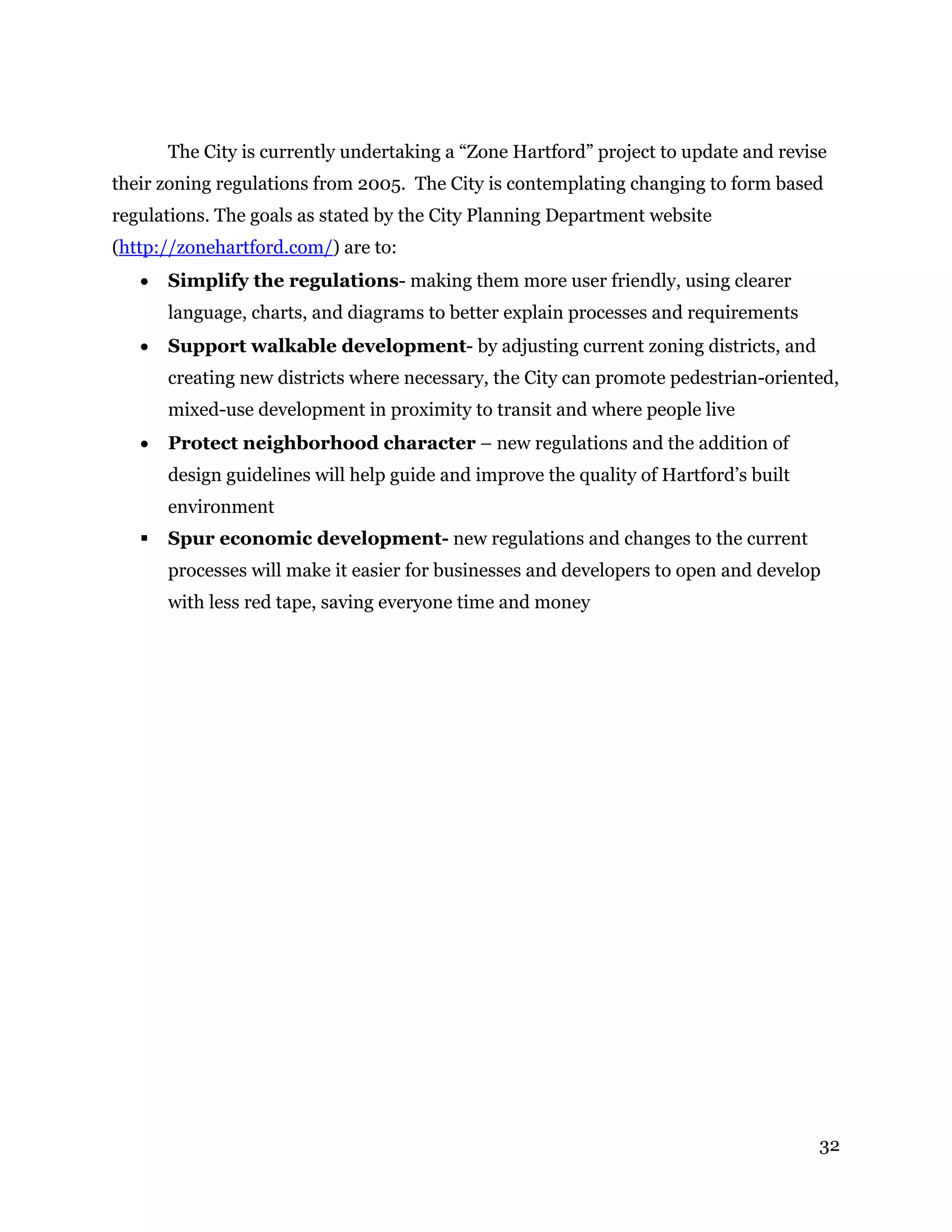
  • 56.
    56 discrimination. At theend of each section, the major take away points are provided as recommendations for the City of Hartford. Federal Housing Policy This section reviews four articles that discuss the history of United States federal housing policy and what it means for cities today. First von Hoffman’s “The End of the Dream: The Political Struggle of America’s Public Housers” is examined as it describes the history of public housing from its early days in the United States (2005). Landis and McClure’s article “Rethinking federal housing policy” evaluates the major goals of federal housing policy (2010). Tiebout’s “A pure theory of local expenditures” teaches us that people vote with their feet (1956). Lastly, Basolo’s “The impacts of intercity competition and intergovernmental factors on local affordable housing expenditures” lays out the difficulties municipalities have regarding funding and providing services to its residents (1999). Von Hoffman discusses how public housing has transformed from its beginnings in the early 20th century to today (2005). In the early 20th century, the public housers early European experiments (decentralized with limited-dividend cooperatives) were municipality driven and included non-profits and cooperatives. Their original plan was to have a varied and flexible housing program for the majority of American households run by the states, municipalities, and private non-commercial housing developers. This plan was never fully imagined due to the Great Depression and other political circumstances that led to rigid and complex, top-down federal programs. Despite the housers strength and network, their message did not resonate with the middle class to implement a grassroots campaign to push their houser ideals , therefore, the housers employed a smoke-and-mirrors strategy of anti-slum arguments to win supporters. The result was a focus on the very poor and slum clearance, rather than the middle class housing satisfaction. The European experiments are quite fascinating. These socialist ideals of equality for all, and giving government a hand in creating that equality, is generally not a widely excepted idea in the United States. Individualism and capitalism are too strong to
  • 57.
    57 consider these ideas,even if they were quite impressive. Public Housing policy has put the very poor in a position of having to take assistance from the government, with few options, while at the same time being looked down by from society. Releasing control of public housing to smaller, more localized agencies could provide better oversight and variety of housing as the top-down public housing had a stereotypical “look.” Providing affordable housing to not just the very poor but the lower middle and middle classes would provide a substantial benefit to the country and is almost impossible to imagine. Landis and McClure identify the three main focuses of federal housing policy: increase home ownership, assist low-come households, and reduce discrimination (2010). Federal housing policy has succeeded in increasing home ownership; however, this push has led to the housing crisis and crash of 2008 and threatens low-income renters as it does not provide much support for them. Landis and McClure aimed to “examine the trends, summarize the research evaluating the performance of these programs, and suggest steps to make them more effective and connected to each other” (p. 319). Landis recommends “privatizing aspects of the secondary mortgage market and move to eliminate mortgage interest deductions and replace with ten year home ownership tax credit,” regionalize the voucher program or make it into an entitlement program that works through income tax system, and “sell public housing projects to nonprofit sponsors where appropriate, and eliminate some of the rigidities in the Low Income Housing Tax Credit (LIHTC) program” (p. 319). These programs are not well coordinated and aimed towards helping higher income households that vote and contribute. There is little evidence that much will change in the near future. Landis and McClure recommended utilizing fewer and better coordinated programs, as well as using tax credits rather than tax deductions. Low- income subsidy programs should be reconfigured to make it easier for able-bodied individuals, who want to work, move to areas of higher opportunities. LIHTC has been successful; however, it is expensive and should promote mixed income developments better. Tiebout furthers this idea of intercity competition with an analysis of tax rates and services (1956). His theory is that individuals move to municipalities that have the best goods and services with the lowest tax rates. This way individuals are getting the
  • 58.
    58 most for theirmoney. When roads fall to disrepair and school systems worsen, the wealthy leave because they have the financial option to find a better place to live. This means that municipalities limit affordable housing to decrease taxes and services. Basolo’s research analyzes the influences and effects of intercity competition and intergovernmental factors on local affordable housing expenditures (1999). Due to the lack of regional agencies and regional planning, municipalities are forced to compete with each other for funding. This leads to inequality and hasty developments. The effect of competition on affordable housing is that municipalities are looking to increase their tax base in order to be able to provide services and amenities. Affordable housing doesn’t produce high amounts of taxes so the attention given to affordable housing is much lower. “Intercity competition reduces the likelihood that cities will spend local dollars on housing programs. Intergovernmental factors, such as federal funding and state-mandated housing planning, on the other hand, positively influence cities to spend local funds on affordable housing programs” (p. 659). Basolo’s research found that when intercity competition increases, cities are less likely to spend their local funds on affordable housing unless they are a municipality that already spends their local money on it. The influx of federal dollars only partially motivates municipalities to spend their own money, while state money does not have an impact. States do however have more influence with state-mandated housing planning and local set-aside requirements. Basolo’s research determined that most intergovernmental factors did not influence municipalities to begin funding housing programs but do have a positive influence on the amount of local-source dollars spent on affordable housing programs, in municipalities that already spend their local funds on these programs (p. 681). Basolo’s findings indicate that cities have different commitments to affordable housing and therefore, spend various amounts of their own money on housing programs in competitive regions (ibid). Furthermore, state and federal policies do affect local expenditures on affordable housing (p. 682). Federal Housing Policy Summary
  • 59.
    59 In summary, federalhousing policy impacts municipalities at the local level. According to the Connecticut Department of Housing (DOH), 37.80% of Hartford’s housing units are affordable (2010). Basolo’s research suggests Hartford is invested in affordable housing and federal and state housing policies and funding will continue to complement their efforts. However, Hartford may be looking to be more competitive with neighboring communities in terms of goods and services, as well as higher end/luxury housing and amenities. Tiebout would say this may impact their commitment to affordable housing. Landis and McClure would recommend Hartford to implement an inclusionary housing policy and to be cautious when utilizing LIHTC for affordable housing as often times it does not promote mixed income developments due to the larger profits to developers who construct only affordable units (Landis & McClure, 2010, p. 334). Hartford, and specifically the DoNo area, still feel the scars of urban renewal and slum clearance. The DoNo redevelopment is in an area devastated by urban renewal and left as vacant or underutilized for decades. The City has the opportunity to patch the injuries of the past and should plan the redevelopment to combat the errors of their history. Urban renewal destroyed DoNo once before, Hartford should implement a housing policy that will not devastate or push out the adjacent residents who have lived cut off from downtown for decades due to urban renewal and I-84. Redevelopment of this area with mixed use and mixed income developments has the possibility to revitalize the community. Low Income Housing Tax Credits (LIHTC) LIHTC is an affordable housing program that began in 1986 during the Reagan administration. LIHTC funds are allocated by the United States Treasury Department to states based on population size. Each developer has to apply to the state for tax credits to build affordable housing. Developers with higher scores based upon how well their projects meet the priorities and selection criteria set forth get more tax credits. LIHTC developments generally consist of lower-middle class and working class individuals and families.
  • 60.
    60 This section focuseson three peer-reviewed articles on the LIHTC program. Deng’s two articles analyzing LIHTC: “The cost-effectiveness of the low-income housing tax credit relative to vouchers: Evidence from six metropolitan areas” (2005) and “Low- Income Housing Tax Credit Developments and Neighborhood Change: A Case Study of Miami-Dade County” (2011) focus on costs, as well as the community impacts of LIHTC. Melendez and Schwartz’s article “After year 15: Challenges to the preservation of housing financed with Low-Income Housing Tax Credits” (2008) discusses the major issues in maintaining LIHTC housing for the long term. In 2005, Deng compared the cost of LIHTC development subsidies of new- construction with the alternative 20-year HCV voucher subsidies in six cities around the United States, three in hot markets: San Jose, Boston, and New York City and three in cold markets: Cleveland, Atlanta, and Miami (2005). Deng found that LIHTC is more expensive than vouchers. Local market conditions and program administration lead to regional variations in premiums. Vouchers were still cheaper in the three tight housing markets. Supply and demand in the low-income housing submarkets is what matters to housing policy makers as this impacts the cost-effectiveness of vouchers. Payment standards used by state and local governments administering the voucher program also impact their cost-effectiveness. Additionally, higher quality standards for apartment units reduces the cost advantage for vouchers, although this means expanding neighborhood choices and improves access to employment and education. New York City and Boston add community revitalization and other objectives onto LIHTC, making the development invaluable to the local residents and communities, though it significantly increases the cost. HCV vouchers and LIHTC compete ideologically and programmatically. As, discussed above, HCV vouchers are allocated to qualified low-income individuals who then have to search for apartments that are willing to adhere to inspections. LIHTC developments are constructed by developers who apply to the state for tax credits that are initially allocated by the United States Treasury Department. They work very differently and analyzing the costs of each program is helpful for municipalities to determine the best option. It is important to think about the aspects of LIHTC and
  • 61.
    61 vouchers that canbe controlled that increase the costs, such as adding community revitalization to LIHTC or having higher standards for vouchers. In Deng’s second article, she uses a case study in Miami-Dade County to analyze the neighborhood change with LIHTC developments (2011). The study finds that over half of the LIHTC neighborhoods have experienced more positive changes than their control groups; however, the effects vary by neighborhood context. Black high-poverty neighborhoods receiving the LIHTC investment have experienced the most positive changes, while changes in middle-class neighborhoods have been the most negative. In the Black neighborhoods, LIHTC was located in redevelopment projects, so any money was seen as a positive step; however, in white neighborhoods it was not received as well and may have led to White flight and disinvestment. Melendez and Schwartz’s article looks at the challenges associated with sustaining LIHTC developments for the long term (2008). LIHTC is currently the largest subsidy program for low-income housing. According to Schwartz and Melendez, the greatest risks to LIHTC are the expiration of income/rent restrictions and more strongly the need for capital improvements. Schwartz and Melendez’s research looks at the “likelihood that tax credit housing will convert to market-rate occupancy and the challenges confronting the long-term physical viability of the housing if it is to remain affordable” (p. 261). LIHTC credits go to private owners but do not guarantee long-term low-income housing as the restrictions are only for 15 years, unless built after 1990, which have 30 years of required affordability in most circumstances. Most owners do not turn over to market rate but need assistance for maintenance and improvements. Even if these units continue to be affordable, the Internal Revenue Service (IRS) stops monitoring these units after the initial restriction has expired. The article concludes that a relatively small amount of the affordable housing stock is likely to convert to market-rate (ibid). Each state is essentially conducting their own experiment. Planners must balance the need for expanding and preserving affordable housing when subsidy dollars are scarce. A major issue is monitoring and enforcing long-term affordability requirements by state housing finance agencies after year 15. The federal government should reform the law to extend the restriction to 30 years. In addition, the IRS should
  • 62.
    62 monitor the restrictionsbecause each state’s housing finance agencies have uneven administrative enforcement capacity. It doesn’t appear as though convincing owners to keep the housing affordable is the major issue; however, in high growth markets or in times of rapid price increases, this may not be the case. LIHTC Summary In summary, LIHTC developments have many benefits but the City of Hartford should be cognizant of its drawbacks. LIHTC is very attractive to many developers and can lead to an increase in affordable housing. Despite its benefits, LIHTC is overall more costly than HCV vouchers and, as discussed later in this review, are not always located in the areas of higher opportunity. Hartford needs to decide whether adding higher quality standards for HCV or community revitalization programs in LIHTC are important enough to implement in these programs. Although creating a sufficient quantity of affordable housing units for the area is the main priority, the extra effort in developing the community are also essential to fight the cycle of poverty. The neighborhoods in the vicinity of DoNo are majority Black and Latino. LIHTC in the DoNo area and surrounding areas may therefore lead to positive impacts for the adjacent neighborhoods. With the coming redevelopment of DoNo, LIHTC could aid the construction of affordable housing. Even though Hartford has been a no or slow- growth city for decades, DoNo has the possibility of turning things around and triggering a spur of growth. Since Hartford is giving the land to the developer for $1, far below market-rate, Hartford should consider extending the restrictions past 15 years to prevent the units from turning over to market rate and put a plan in place to monitor and enforce the affordability of the units. Additionally, Hartford should plan ways to assist owners in the areas with capital improvements, maintenance, and upgrades, which could require longer affordability restriction periods. Deconcentrating Poverty In this section, three articles review how housing policies and programs work with the deconcentration of poverty. The review begins with an analysis of McClure’s
  • 63.
    63 article “Deconcentrating Povertywith Housing Programs” (2008). In “Forced relocation vs. voluntary mobility: The effects of dispersal programs on households,” Goetz breaks down the successes and failures of two poverty deconcentration programs in the Twin Cities region of Minnesota (2002). Lastly, DeFilippis and Wyly discuss the vouchers and LIHTC’s abilities to deconcentrate poverty in “Running to Stand Still: Through the Looking Glass with Federally Subsidized Housing in New York City” (2006). According to McClure, housing vouchers supplied to households are not helping renters locate in low-poverty areas any more effectively than are current project-based subsidies (2008). It is McClure’s opinion that “planners seeking to make poverty deconcentration more effective [should] use housing placement counselors, administer programs at the metropolitan scale, lease and broker market-rate housing directly, promote mixed income LIHTC developments, practice inclusionary zoning, and monitor the impacts of these efforts” (p. 90). The LIHTC program may be providing greater low- poverty market penetration than the HCV program because the developer makes the location decision in the LIHTC program, while in the HCV program the household chooses the location. There are difficulties finding units, fear of discrimination, and loss of social fabric. Housing placement counselors are essential in the HCV program to help households that may not have access to internet, good credit, or references to find units and facilitate transition. Planners should make it easy for developers to place LIHTC and other affordable housing in the proper neighborhoods rather than vulnerable neighborhoods by zoning these areas to allow for multi-family developments. Goetz’s research analyzed two poverty deconcentration programs: voluntary mobility programs and involuntary relocation of families through government action in the Twin Cities Region in response to the Hollman v. Cisneros case settled in 1995 that demolished 700 units (2002). These units were mandated to be replaced in a scattered fashion in non-concentrated parts of the metropolitan area (p. 108). The voluntary mobility program was similar to the “Moving to Opportunity” (MTO) program, which is a modified Section 8 voucher that must be used in low poverty areas (ibid). The greatest effects of these programs was seen in relieving issues of personal safety and neighborhood incivility (drug use, graffiti, drinking etc.). Neighborhood satisfaction was
  • 64.
    64 highly variable andthere were no employment effects of the moves that families made. Those who voluntarily moved saw happier neighborhood scenarios than those involuntarily relocated (p. 121). Goetz hypothesizes that neighborhood conditions experienced by those who were relocated in Minneapolis were possibly not as bad as expected or in other cities. It is important for municipalities to not stereotype neighborhoods based on their low- income status as bad, decayed, or inhabitable. There is always social fabric and hidden assets that may not be seen from the outside. Furthermore, forcing people out of their homes generally does not make people happy or put them in better neighborhoods. Giving people options and the agency to make decisions leads to better neighborhood satisfaction. DeFilippis’ focuses on vouchers (tenant-based) and the project-based Section 8 form of subsidized housing in New York City to determine if either program are locating in deconcentrated areas (2006). Project-based Section 8 units receive vouchers and stay with the private unit, not the tenant. Since the federal government has stopped constructing new public housing units and struggles to maintain the existing housing stock, project-based Section 8 programs seem to be doing well. However, landlords are leaving the program in gentrifying areas because they can get higher profits by converting units to market rate. The research found that vouchers do not promote deconcentrating poverty in New York City despite the common belief that vouchers allow poor households to move to neighborhoods with better opportunities and amenities. The federal government has been paying project-based Section 8 landlords in New York City up to $3,000 per month to keep their units affordable (p. 24). By matching the market, the government is just reinforcing the market processes that have not been able to produce affordable housing. An alternate strategy is to move to an ownership system of preservation in which purchasers are tenant organizations or community based non-profits. DeFilippis believes the government should cease persuading landlords with extra funding to keep units affordable (ibid). If the market can’t keep units affordable, public housing should be built as a viable alternative to keep tenants in these areas of growth and opportunities.
  • 65.
    65 DeFilippis suggests twoapproaches to combatting these issues. First, landlords should be required to give a longer notification period before termination of affordability and provide the “right of first refusal.” States should also require landlords to mitigate the costs of relocation for displaced tenants, which is the “stick” method. Lastly, the “carrot” approach would be tax incentives from the government. Deconcentrating Poverty Summary In summary, deconcentrating poverty with housing programs such as LIHTC and HCV vouchers has historically failed. HCV vouchers are not helping deconcentrating poverty despite the agency given to recipients to choose where they live. Voucher recipients may require a councilor to assist in finding the right place in neighborhoods with opportunities. LIHTC developments may have a greater ability to be placed in deconcentrated areas because of the developer’s options. Planners need to make it easy for developers to place LIHTC developments in deconcentrated areas with multi-family zoning and municipalities may have to offer additional incentives if the cost of land is too high in these areas to allow for a profitable development. As stated previously, 37.80% of Hartford’s housing units are affordable (2010). From a preliminary analysis, the neighborhoods surrounding the DoNo area (north, northwest, and west) have substantial amounts of affordable housing that is likely to contain project-based Section 8, HCV vouchers, and public housing. With the coming DoNo redevelopment and influx of new residents, landlords may be interested in switching their units to market rate to increase their profits, which would begin to decrease the amount of available affordable housing. Hartford could work with landlords and incentivize keeping housing units affordable longer and provider longer notification before termination of affordability. The City of Hartford should persuade developers to construct LIHTC developments in low-poverty areas such as the DoNo area, as it is adjacent to and may be less expensive than the adjacent higher income Downtown. Additionally, since the City is in the process of revamping their zoning, they should make sure they have elements of inclusionary zoning.
  • 66.
    66 Discrimination This section discussesvarious aspects of federal housing policy and affordable housing programs that impact equality. As stated in the section above, Landis and McClure identified reducing discrimination as one of the three main focuses of federal housing policy (2010). This review begins with Woods’ “The Federal Home Loan Bank Board, Redlining, and the National Proliferation of Racial Lending Discrimination, 1921-1950” and Pritchett’s “Which Urban Crisis?: Regionalism, Race, and Urban Policy, 1960-1974” to demonstrate the United States’ segregated history (2012 & 2008). Next, the review looks at Mhatre and Van Zandt’s research on the location of LIHTC developments in “Growing Pains: Perpetuating Inequality through the production of low-income housing in the Dallas/Fort Worth metroplex (2009). Halasz analyzes fair housing standards and inequality in “Fair and affordable? Racial and ethnic segregation and inequality in New York City rental housing” (2011). The section concludes with Orfield’s article “Racial integration and community revitalization: Applying the fair housing act to the low income housing tax credit” (2005). Woods reviewed materials from the Federal Home Loan Bank Board (FHLBB) and examined the detrimental consequences of the national adoption of the Home Owners’ Loan Corporation’s (HOLC’s) appraisal standards by national lending institutions (2012). HOLC’s definition of undesirable residents as racial or ethnic minorities, or low-income inhabitants was discriminatory, yet adopted and used throughout the country. These “scientific appraisal” standards systematically disadvantaged Black and low-income urban inhabitants and severely limited their ability to obtain mortgages (p. 1038). The process of “redlining” communities, discouraged by lending in Black neighborhoods, enforced segregation in much of the United States. Wood’s research shows that “widespread disinvestment in urban neighborhoods, particularly those populated by African Americans, ultimately contributed to deplorable housing conditions experienced by that group in most American cities by the mid- twentieth century” (p. 1039). The HOLC assisted in nationalizing the practice of racial and socioeconomic lending bias that led to the segregation of the United States.
  • 67.
    67 Although these practiceshave been illegal for decades, their effects are still shown today and people of color are still discriminated against in the real estate market by being shown less units and lower quality units. Pritchett’s research looks at the debate in the United States in the 1960’s and 1970’s regarding the proper role of the federal government in addressing “urban problems” faced by older cities (2008). After struggles in the 1960’s by the federal government to solve these issues, President Nixon signed a bill in 1974 that provided funds to local governments for urban development (CDBG) (p. 282). This led to the end of regional and municipal planning cooperation and to competition between local governments. The results of the devolution of power back to local governments and the lack of strong federal support over the past several decades is that cities still struggle with uneven development and racial inequality without leadership from the federal government (p. 282). Issues of “urban problems” became identified as issues of racial conflict in the 1960’s. Today, the stigma is still there. It is important to realize that this issues originated from the disinvestment of cities and governments in central cities and from “White flight.” The federal government has taken a back seat in addressing these issues; however, municipalities have the opportunity to take control using the federally funded CDBG resources. Local control can give municipalities the agency to make the changes they see as necessary to revitalize their inner cities. Mhatre and Van Zandt examined LIHTC in the Dallas/Fort Worth area to test the theory that supply-side housing can facilitate redistribution of low-income residents, dispersing them throughout areas of better opportunity (2009). The author’s found that LIHTC units were increasing in non-central city counties of the region but not within the affluent suburbs. LIHTC units were being placed in less affluent peripheral areas to underwrite the production of small stocks of rental housing. Additionally, they were being located on the edge of these already peripheral municipalities. The issue stems from the Department of Housing and Urban Development’s (HUDs) use of Qualified Census Tracts (QCTs) to identify Difficult Development Areas (DDAs). These designations allow bonuses to be paid to developers who build affordable units in these areas that are defined by low incomes and high percentages of minorities.
  • 68.
    68 QCTs are astrong predictor of the clustering of LIHTC developments. LIHTC should be amended encourage the development of affordable units in unaffordable markets. In disadvantaged neighborhoods, tax credit guidelines might limit the proportion of LIHTC units that are low-income to promote income mixing and deconcentration, whereas in affluent neighborhood developments should be required to include higher proportions of low-income units to promote economic integration. Zoning is likely concentrating multi-family in certain areas in the exurban/periphery areas. Planners have the ability and responsibility to make the changes necessary to encourage multi- family within these areas. Halasz uses New York City as a case study to “examine the extent to which current affordable rental housing programs and policies violate fair housing standards and exacerbates socio-economic inequality” (2011, p. 267). Halasz’s research contributes three startling findings. Blacks and Latinos are still considerably segregated from Whites and Asians despite increasing neighborhood diversity in certain types of affordable housing (ibid). Contrary to popular opinion, wealth and social class do not determine the type of housing a family may occupy as much as race and ethnicity (ibid). Lastly, mixed income multi-family developments containing a variety of incomes, employment levels, and poverty were found to provide significant advantages over cluster developments such as public housing, which furthers racial, ethnic, and socio- economic inequality (ibid). Halasz’s research reveals some unpleasant facts about segregation in the United States. Her research does provide hope in mixed income, multi-family developments. The planning implications are substantial. Planners can zone affluent areas for multi- family developments and use inclusionary zoning to require a certain percentage of the new units be affordable. These tools can begin to increase the mixing of incomes and possibly people of different races and ethnicities. Orfield’s research analyzes the effects LIHTC has had on segregated and resegregating neighborhoods (2005). Orfield suggests HUD’s MTO and HOPE VI projects failed to bring economic opportunities to low-income households because they were located mainly in resegregating areas, despite being less poor than their original neighborhood. The Gautreaux program succeeded because the units were located
  • 69.
    69 stable, more affluent,and more White areas with substantial opportunities (p. 153). Orfield warns though that race based planning (i.e. requiring units be located in majority White neighborhoods) is illegal. Planners can look at other characteristics to determine the health of a community such as school population, tax base, growth, jobs, and available land. Orfield states that “based on law, regionalist policy, and empirical evidence, this article argues that the government should prioritize locating low-income housing in places with strong schools, economic opportunity, and plentiful local resources. It provides approaches for preserving affordable housing in rapidly gentrifying neighborhoods with segregated schools and maintaining or enhancing integration in communities that are unstably integrated” (p. 107). In terms of preventing gentrification or stabilizing gentrifying neighborhoods, shallow subsidies of up to half the cost of a new unit can be used to maintain existing housing to prevent resegregation. Subsidies should be concentrated in areas where opportunities exist to preserve units. Lastly, municipalities with weak market demand should avoid constructing new units where existing units are available, which may lead to abandonment with new construction. Discrimination Summary In summary, the private market, as well as housing policies at the local, state, and federal levels have historically discriminated against people of color and low-income households. Historically, discriminatory policies led to or enforced the segregation of the United States and placement of Black households in poor quality housing. Today, as Halasz found, socio-economic status does not determine the type of housing a family may occupy as much as race and ethnicity. This is disturbing for today’s society and housing policy must address these issues to combat housing discrimination in the United States. Research shows that mixed income, multi-family developments can work well at providing opportunities for low-income households. It is important to note that while minorities have been discriminated against, mixed income does not necessarily mean
  • 70.
    70 locating in wealthierWhite neighborhoods. Associating low-income to people of color reinforces the history of discrimination. Additionally, since LIHTC aims for lower middle class and working class households, LIHTC could be used to transition the low and very low-income housing with the middle and higher-income housing in Downtown and DoNo. Hartford should have a community revitalization plan addressing the possible gentrification of the DoNo area and surrounding neighborhoods. Efforts to stabilize the region prior to the redevelopment will go a long way in creating a long lasting mixed income and diverse community. Conclusions Affordable housing in the United States comes in many forms and benefits low- income households to varying degrees. The private market has been unable to supply housing that is affordable to all residents and at the same time providing access to opportunities, services, and amenities. This literature review examined various aspects of the evolution of federal housing policy and programs in an effort to paint a picture of the current situation for cities in the United States today. The review also identifies best practices and recommendations for the City of Hartford to implement with the coming redevelopment of its DoNo area. In terms of federal housing policy, HCV vouchers, project-based Section 8, LIHTC, and public housing all play a role in providing affordable housing in municipalities. As previously stated, Hartford already has a significant amount of affordable housing. The questions though are: what is the quality of the housing and how long is the unit’s affordability restriction? HCV vouchers give recipient the agency to choose where they live, though Hartford should implement a program with housing placement councilors to ensure the successful placement of the recipients. Project- based Section 8 units may be most at risk with the DoNo redevelopment. Hartford can work with landlords to extend the restrictions before the market provides for higher profits in market rate. Programs and funding should be sought after to maintain the existing project-based Section 8, LIHTC, and public housing.
  • 71.
    71 LIHTC can bea strong incentive for developers to include affordable housing; however, Hartford should make sure that the developments are mixed income and located in neighborhoods with opportunities and amenities. LIHTC should be used within the DoNo redevelopment to provide mixed income housing in this area. Hartford should require extending the restrictions past 15 years to prevent the units from turning over to market rate and put a plan in place to monitor and enforce the affordability of the units. Additionally, Hartford should plan ways to assist owners in the areas with capital improvements, maintenance, and upgrades. Federal housing policy and housing programs have historically created discrimination, segregation, and concentrated poverty. HCV vouchers alone are not helping deconcentrating poverty without councilors or resources to assist households in finding the right place in neighborhoods with opportunities. LIHTC developments may have a greater ability to be placed in deconcentrated areas because the developer decides. The Hartford Planning Department should use multi-family zoning and other incentives to facilitate developers to place LIHTC developments in deconcentrated areas. The City of Hartford should persuade developers to construct LIHTC developments in low-poverty areas such as the DoNo area, as it is adjacent to and may be less expensive than the adjacent higher income Downtown. The City is currently undertaking a “Zone Hartford” project to update and revise their zoning regulations from 2005. The City is contemplating changing to form-based regulations. Inclusionary zoning should also be included in the rezoning of the City. Much of the DoNo area and surrounding area is zoned for medium to high density multi-family residential. This literature review concludes that mixed income, multi-family developments are essential at providing opportunities for low-income households. The Clay Arsenal, Upper Albany, and Asylum Hill neighborhoods adjacent to DoNo are largely segregated and in need of investment and opportunities. LIHTC could be used to transition the low and very low-income housing with the middle and higher-income housing in Downtown and DoNo. HCV vouchers can give existing residents the opportunity to move to other areas of the City if they desire. Since the redevelopment is still in the initial planning
  • 72.
    72 stages, Hartford shouldcreate a community revitalization plan addressing the housing needs and possible gentrification of the surrounding neighborhoods.
  • 73.
    73 Summary of DoNoMaster Plan Figure 19 DN/DW Project Area. Source: Utile p. 12 Utilizing funding from a Department of Housing and Urban Development (HUD) Sustainable Communities Grant, the City of Hartford contracted Utile, Inc. in 2013 to prepare a Master Plan for Downtown North / Downtown West (DN/DW). Assisting Utile were Ningret Partners (economic design), Stoss Landscape Urbanism (landscape design), Nelson Nygaard Consulting Associates (transportation), and Fitzgerald & Halliday, Inc (community planning). The Master Plan’s states that it was finalized in December 2013; however, it was not made available to the public until late Spring 2014. The Master Plan’s project boundaries are delineated in Figure 1 below. Downtown North, now called DoNo, is located to the north of I-84, to the west of the Connecticut River, to the east of the Clay Arsenal, Upper Albany, and Asylum Hill neighborhoods, and to the south of the North Meadows neighborhood and the XFINITY Theatre. Vision The Project Vision was “to harness the full potential of Downtown North and Downtown West by creating a seamless environment” (Utile, p. 5, 2013). Utile states that plan includes an existing conditions study, a market analysis, urban design
  • 74.
    74 framework, recommendations andimplementation plan, and design guidelines and zoning. The plan is divided into the following chapters: Previous Studies, Study Area Character, Transportation Network, Planning Strategy, Retail and Housing Analysis, Development Districts, Transportation Planning, Open Space Planning and Design, and Design Guidelines and Zoning. The recommendations and implementations plan are found within the Development Districts chapter. Below is a summary of the relevant sections referenced above, with the exception of Study Area Character, Planning Strategy, and Transportation Planning. Previous Studies Utile discusses several previous studies and reports that were conducted in these areas sponsored by the City of Hartford. The Downtown West Opportunities Plan in 2006 guided investment by identifying areas that are suited for redevelopment. A 2010 Downtown Circulation Study identified four projects concerned with converting one- way streets to two-way streets and redesigning intersections for improved traffic mobility at peak-periods. A Downtown North project from 2008, who’s purpose was to “remove obsolete and blighted buildings from a critical perimeter area of the Downtown, conduct site assemblage, and create a development opportunity for mixed- use development, rehabilitation of historic structures, and educational and commercial development that will strengthen the development patterns of the Project Area” and was the basis for this 2013 Master Plan (p. 10). Also beginning in 2008 was a planning process to search for linkages between many of Hartford’s assets titled iQuilt. “Downtown Hartford’s exciting urban design strategy for walkability and creative place making. It capitalizes on two of Hartford’s greatest strengths: its extraordinary concentration of arts, cultural, and landscape assets and it’s exceptionally compact downtown” (p.11). The plan focused on signage, wayfinding, and place making strategies for Downtown Hartford, A Greenwalk Master Plan was a core part of iQuilt (p. 11). These plans prepped Utile for the DN/DW Master Plan process and provided them with important background information.
  • 75.
    Transportation Network Figure 20Activity disparity between Downtown West and DoNo. Source: Utile p. 28 Utile identified the following issues regarding the roads in the project area:  Market Street: Despite being only four lanes, the street feels expansive and underused.  Intersection at Main Street and Albany Avenue: The intersection is intimidating to pedestrians and confusing to drivers.  Highway crossings: Bridge crossings and highway underpasses should be improved to draw people comfortably from Downtown North to Downtown West.  Scale of streets: As future development is built, the streets should be redesigned to Complete Streets standards (p. 16). Utile identified four City-owned parcels located at Main Street, Trumbull Street, and Pleasant Street (totaling 8.3 acres) that are well suited for redevelopment. These parcels are currently underutilized as surface parking lots and vacant parcels. These parcels are currently a vacant void in between the downtown core and neighborhoods to the northwest. Hartford historians and planners label this area as a “scar” after it was clean scraped due to urban renewal in the 1970s. A large scale redevelopment is appropriate for this area, while an incremental redevelopment is more fitting for the Downtown West area due to its more built up nature. In regards with transportation, the road network is currently disconnected for pedestrians and crossing the I-84 interstate is difficult and inadequate for pedestrians.
  • 76.
    76 Additionally, Figure 20above depicts active and inactive street edges in terms of restaurants, retail, hotels, and entertainment. The figure shows a large void of activity in the DoNo area with the exception of the northwest portion of Main Street before it turns into Albany Avenue. Retail Market Analysis Utile conducted a retail market analysis split between Downtown North and Downtown West because they serve very different demographics. The DoNo area was found to be able to provide needed goods and services for the surrounding population, including nearby residents, the 70,000 daytime office workers in Downtown, and visitors. Utile discusses the needs of the surrounding neighborhood in the following quote. “The residents north of the study area are currently underserved by retail and are required to drive to find basic retail services, such as groceries stores. It was determined that the Downtown North study area has a demand for 163,000 square feet (SF) of additional retail development. This development would produce $59 million in sales, and by 2017 it would generate up to $62 million in gross sales. The area could absorb up to 53,000 SF of restaurant space, a new 31,000 SF grocery store and additional retailers, such as departments stores, appliance stores and clothing stores.” (p. 44-45). Housing Analysis Due to the unpredictability of housing growth, Utile conducted a varied analysis of housing by looking at resident market research, demographic statistics, and precedent studies. Surveys and focus groups found that Downtown residents want more amenities and activities such as restaurants, entertainment, and shops. Respondents showed a demand for a mix of housing types such as townhouses or condos that opens to the street (61%), high-rise apartment or condos of 4-10 units (46%), lofts or untraditional (46%), and apartments or condo buildings (37%) (p. 46-47). Survey respondents stated that finding housing that is affordable in a walkable area is desired but not available in Downtown. Please note that the survey respondent’s demographics were not provided so the definition of what is “affordable” to the respondents is unclear.
  • 77.
    77 It is presumedthat this refers to mid-range rents for young professionals, not rents for low-income residents. The analysis showed that housing growth Downtown is fueled by young professionals with annual salaries of approximately $60,882 as well as empty nesters (older adults whose children are no longer living with them). The analysis indicated that the average young professional’s budget for rent is approximately $750 and $1,000. The research showed that Downtown could support an additional 1,700 to 4,700 units of housing even considering the existing downtown units and the 1,100 units that are planned (p.47). Utile noted there are many factors that impact housing prices, such as fluctuation of the housing market, the volatility of local economies and change in consumer preference; however, there is strong evidence that there is a significant portion of the population in and moving to the greater Hartford area who would be interested in living in a vibrant urban area, such as Downtown Hartford (and potentially DoNo) if there were units in their price range. Open Space Figure 21 Open space connections and opportunities. Source: Utile p.90. Utile’s plan suggests three options for connecting DoNo to the riverfront. The first option is to improve the current overpass, which is located in the northeastern portion of DoNo, by creating a landform on either side of I-91 to slope up to the top of
  • 78.
    78 the newly redesignedoverpass. Option 2 uses a switchback ramp design from the Market Street exit ramp on I-84 from the intersection of a rail cap and Market Street. The final option works off of an existing pedestrian access to the bridge and river using a suspended bridge. The plan also proposes upgrading and designing Wexford Park (named “Heaven Park” by local skaters, bikers, and graffiti artists) to accommodate more uses. Currently, the park is blocked off with walls and is under disrepair. The current skate park, which opened in 2014 after the city invested $160,000 to upgrade it, is the main use and is important to the residents to the northwest. This skate park will be expanded and upgraded. The new “Town Green” would be for passive and recreational activities for all of Hartford’s residents (p. 102). Figure 22 Proposed redesign of Wexford Park into a Town Green. Source: Utile p. 103. Design Guidelines and Zoning This chapter lays out development guidelines for any Requests for Proposals (RFPs) for development in the near future. These guidelines are measurable and will be incorporated into a city-wide form-based zoning code. The rezoning of the Downtown neighborhoods is ongoing and will prioritize these areas first. The primary goal of the rezoning is to “ensure that the building stock and related street network are consistent- enough in height, scale, and character that general form-based rules can be applied” (p. 108).
  • 79.
    79 Priority Areas Utile identifiedfive priority areas for new development, two of which are in DoNo. These areas are identified as 1: Ann Uccello and 2: Main and Trumbull, which are in DoNo, 3: Main & Asylum, 4: Bushnell Park, and 5: Downtown West, which are located to the south of DoNo beyond I-84, and are depicted in Figure 23 below. Neighborhood scale development is appropriate in Ann Uccello, which is named after the former Mayor of Hartford from the 1960s. A market analysis indicated there is a substantial demand for new retail and a 30,000 square foot grocery store in DoNo, which is the typical size of a larger “supermarket”. Utile indicates that the Main and Trumbull area “could form a new town center with retail anchors, residential development, and a proposed municipal office building” (p. 52). Figure 23 Potential development sites. Priority site 1 corresponds with Ann Uccello and Priority site 2 corresponds with Main and Trumbull. Source: Utile p. 51 Ann Uccello The Ann Uccello future build out is depicted in Figure 4 below. This are contains several vacant lots, a new municipal complex, and the only strip of retail in DoNo. “Building upon the scale of the existing neighborhood, this plan proposes townhouses, corner retail, and Low-rise Mixed Use buildings (generally 4-5 stories) that are sensitive to the context of the area. Corner retail provides a social gathering space, while a courtyard behind the townhouses offer private outdoor space. Townhouses will have street facing front doors and vehicular access via a rear alley” (p. 54).
  • 80.
    80 Figure 24 Buildout of the Ann Uccello District. Source: Utile, p.55. Main and Trumbull The Main and Trumbull proposal is depicted in Figure 5 below. Despite the close proximity to the core of downtown, the DoNo area still feels a great distance due to the “no-man’s land” quality of the bridges over I-84, which have fallen into disrepair. Because of this fact, Utile proposes uses the Main and Trumbull area, which is municipally owned, as a node and gateway. The proposal indicates that a 10 story municipal building is planned for this area. “Other Mid-rise Mixed Use buildings anchoring that corner should be between 10-12 stories tall. As the development moves beyond that key node, the recommended building heights are between 4-5 stories for Low-rise Mixed Use buildings, which are primarily residential with some ground floor retail” (p. 60). A total of 681 residential units are proposed, as well as 250,000 square feet of commercial, 138,310 square feet of retail/active use, and 1,484 parking spaces. Figure 25 Main and Trumbull new development proposal. Source: Utile, p. 63.
  • 81.
    81 Utile proposes acomplete street revamp of Main and Trumbull. A road diet reducing the number of travel lanes is proposed for both streets. Crossing islands will reduce the curb-to-curb width for pedestrians attempting to cross the street. On-street parking and bike lanes, neither of which currently exist here, are proposed. Additionally, a five foot wide landscaped buffer will be implemented in between the bike lane and ten foot wide pedestrian zone. Figure 26 Reconfiguration of Main Street in DoNo. Source: Utile, p.64. DoNo Master Plan Implementation Table Subject Master Plan Critical? Residential units 810 Yes Commercial SF 285,000 Possibly Retail or Active Uses SF 157,310 Yes Light Industrial SF 0 No Parking spaces 1,658 No Table 2 DoNo Master Plan proposed implementation table. In each of the summarization tables, the column labeled “Critical?” analyzing the importance of each item for DoNo. Critical elements for DoNo include residential, retail, and active uses. The housing element will strongly impact the development and
  • 82.
    82 the surrounding neighborhoods,while retail and active uses will set the tone for the new neighborhood. Since Downtown and surrounding areas have a plethora of commercial office space, industrial properties, and parking, these elements may be less critical to the area. Request for Proposals On July 2nd, 2014, the City of Hartford posted a Request for Proposals (RFP) for “For Public Private Partnership of Completing Hartford’s Neighborhoods with Mixed- Use Development & Proposed Minor League Baseball Facility” at the DoNo site. The RFP responses were received by August 1, 2014. The main proposal, herein referred to as “the Proposal”, was created by DoNo Hartford, LLC, a collaboration between Centerplan Development Corporation and Leyland Alliance utilizing Priority Sites 1 and 2 (Ann Uccello and Main and Trumbull). The following section analyzes the Proposal and outlines the major differences from the proposal and the Master Plan.
  • 83.
    83 DoNo Hartford, LLCProposal The DoNo Hartford LLC Proposal took many Hartford and Connecticut residences by surprise. Many had lost hope that anything would come of the blighted area. The Proposal is not for a single parcel but to create a full DoNo neighborhood. Below is the Proposal’s Concept Site Design, which includes a 6,000 square foot minor league baseball stadium with 3,000 additional suite, picnic, and standing seats, a little league field above three levels of parking, a 11,000 square foot brewpub with 35,000 square foot brewery, three additional parking garages, a large-scale grocery store, multi- family apartment buildings, offices, and mixed use buildings. The Concept Site Design also indicates that approximately twelve historic buildings along Main Street on the western portion of DoNo would be renovated and maintained as mixed use and multi- family buildings. Interestingly, the possibility of the New Britain Rock Cats Double-A minor league baseball affiliate of the Colorado Rockies ending its 30 years with the City of New Britain and moving to Hartford was not discussed within the DoNo Master Plan. Reportedly, the Mayor of Hartford, Pedro Segarra and Hartford Director of Development Services, Thomas Deller, had been in private negotiations with the Rock Cats owner, Joshua Solomon, for 18 months prior to announcing in June, shortly after the completion of the DoNo Master Plan, that the Rock Cats signing a 25-year lease with the City of Hartford beginning in 2016. From my conversations with Junior Planner Caitlin Palmer, it appears as though these negotiations were completely private and the entire 2013 planning process for the DoNo Master Plan did not entertain this possibility. During my June 2014 interviews with Ms. Palmer, who assisted on portions of the Downtown North / Downtown West Master Plan, stated that she didn’t believe there wasn’t an imminent potential for redevelopment in DoNo. Besides the City indicating it may start off the redevelopment with a municipal building in the DoNo area, she was unaware of any proposals or talks of potential developers for the mostly city-owned and underdeveloped site. From my research of newspapers, there appeared to be no talks of any development in this area.
  • 84.
    84 Figure 27 DoNoHartford LLC's concept site design of the DoNo redevelopment. Source: DoNo Hartford LLC p. 22). Below is the Statement of Interest from DoNo Hartford LLC that was submitted to the City in August 2014. [DoNo Hartford LLC] proposes to deliver a wide range of services in the creation of a dynamic, mixed‐use neighborhood, including planning and design, construction management, financing strategies, commercial and residential leasing, and property management. The net result will create a neighborhood that will not only become an entertainment destination for hundreds of thousands of visitors annually, with a professional baseball team as its focal point, but will also link the North End of Hartford and Downtown within an environment that includes public space, apartments, offices, retail, restaurants, a grocery store, and a variety of potential destinations that will define itself as a holistic urban core that provides its residents with a real opportunity to live, work and play. This neighborhood, known as Downtown North, or DoNo, will energize an area that is presently dormant, and create a major new assembly venue for the region. (DoNo Hartford LLC, 2014, p. 6) B D-1 A G-2 F B D-1 E D-2 C G-1
  • 85.
    85 Figure 28 DoNoHartford LLC's conceptual graphic of the Proposal. Source: DoNo Hartford LLC p. 21. Proposal Description The proposal separates DoNo into two development projects, Parcel A for the baseball stadium and Parcels B-G for a mixed-used development, which are depicted in Figure 27 above. All of these parcels are to be sold to DoNo Hartford LLC by the City for one dollar. The ballpark is situated on a parking lot and vacant lot bounded by Main Street, Trumbull Street, Pleasant Street, and Windsor Street. The Proposal eliminates this section of Windsor Street, allowing the ballpark to flow into a little league park overlooking the minor league stadium, a brewery with an outdoor bear garden, and 228 residential units, all located on parcel G. DoNo Hartford secured a contract to purchase this eastern parcel, currently developed with a vacant concrete block building. This new feature will create a new gateway to DoNo, connecting the triangle and Heaven Park (located above I-84) better for pedestrians. DoNo Hartford LLC envisioned the City of Hartford moving its municipal office building to parcel F at the intersection of Trumbull, Main, and Morgan (an existing parking lot). This was proposed to be the anchor of the eastern side of DoNo and gateway to the park. A block with parcels B, C, and D located in the southwestern portion of DoNo will be a residential block with a reconfigured Ann Uccello Street and parking garage. The existing buildings along Main Street and High Street will be restored and reused for
  • 86.
    86 mixed use andresidential purposes. The aim is to create a pedestrian friendly new neighborhood in across from the new public safety building on High Street. The parcels bounded by Chapel Street North, Main Street, Trumbull Street, and Ann Uccello Street will be a mixed use block E with a parking garage, and a 25,000 square foot (medium- large sized) urban grocery store. The first floor of the buildings will be retail shops along Main Street with four stories of residential above. Regarding traffic, the proposal aims to improve pedestrian and transportation throughout DoNo. Currently, the area is heavily car centric with wide roads designed for faster driving and dangerous pedestrian atmosphere. The Proposal has three goals for roadway improvements. These include street re‐alignment to accommodate the new stadium, street re‐construction for traffic calming/place‐making, and creating a functional/multi‐modal transportation system (DoNo Hartford, LLC p. 14). Regarding housing, the DoNo Hartford, LLC Proposal states that “the current downtown lifestyle proposition combines bland retail, old housing stock, and an office driven environment, making it a weak alternative to the incumbent outlying areas” (p. 17). The Proposal states that there is no real product in the middle to higher level rents, creating a “substantial latent demand in the $1,300 - $2,200 rent band” (p. 17). DoNo Hartford LLC sees the possibility of more mature households, renter by choice and empty nester renters, and student housing if the area can mature into a “fully-realized neighborhood that also has amenities and retail which properly caters to these multiple groups” (DoNo Hartford, LLC p. 17). The Proposal included a market analysis prepared by RCLCO to supplement the Master Plan and 2013 Market Analysis of DoNo. The market analysis indicated that there is sufficient potential sources of demand for 750 to 800 total units making up 87% young professionals, 12% renters by choice, and 5% empty nesters (DoNo Hartford, LLC p. 19). Affordable housing and the needs of the low-income neighborhoods surrounding in DoNo are not discussed anywhere in the Proposal. Although DoNo Hartford LLC discusses the need of including a centralized grocery store, they do not mention of the need due to the surrounding low-income food desert neighborhoods. Rather, they discuss the grocery store as necessary for the new young professionals. There is a concern that this could be a Whole Foods, which may be
  • 87.
    87 too expensive forthe existing residences. With the exception of stating that the new construction will preserve the historic fabric of the neighborhood, DoNo Hartford LLC appears to make no connection with the surrounding neighborhoods, except for wealthy Downtown. The developers state that “other smaller format, neighborhood-serving retail options such as a pharmacy or dry cleaner should be carefully vetted by how they fit within the wider ecosystem of a walkable residential community” (DoNo Hartford, LLC p. 18). RCLCO lists daily serving retail, restaurants and nightlife, and public spaces are required for place making in DoNo. “These three uses are all critical in creating a place where residents can comfortably work, live, and play. Ultimately, the successful execution of this phase I plan will be determined by how well the target young professional’s core social and lifestyle needs are met. If this place making strategy is executed well, RCLCO believes there is a substantial amount of demand for the kind of integrated community that this site can offer” (DoNo Hartford, LLC p. 18). Other residential amenities recommended include a full-service gym, rooftop access to the residential buildings, Zipcar space, cappuccino/coffee bar, cardio bar classes, yoga studio, microbrewery, wave pool, bike storage, communal kitchen, dog park, drycleaner, community garden, and a workshop area. RCLCO’s conclusion is that there is substantial potential in creating a revitalized neighborhoods for high income young professionals. Young professionals need to be targeted initially with later phases of the development catering to empty nesters and students. Given the current dynamics between employment, the state of housing opportunities in outlying areas of Hartford, and the tremendous opportunity for place making around the ballpark, the necessary conditions are in place to redefine what it means to live downtown. There is currently no location in the region where young professionals can live in a walkable neighborhood with the critical mass of retail, restaurants, nightlife, and social activities that they truly prefer. Other markets have proven that a well-executed neighborhood providing these lifestyle amenities can be extremely successful in attracting and retaining young people. Hartford itself has proven that even in the absence of compelling lifestyle offerings, the downtown can still increasingly draw high income young professional residents. The subject site represents an opportunity to develop and deliver a mixed use neighborhood at the exact inflection point of downtown redevelopment. (DoNo Hartford LLC/RCLCO p. 20)
  • 88.
    88 Table 3 representsthe Proposal’s initial square footages and various uses for each of the parcels. A total of eleven buildings ranging from two to eight stories were proposed. A total of 673 residential units, a grocery store, retail space, two office- buildings, Hooker Brewery and Brew Pub, and five parking lots/garages were proposed. The number of residential units is significantly lower than the Master Plans. Not included in this table is the square footage of the baseball stadium, the center piece of the redevelopment. Table 3 Detail of proposed uses with quantities within the Proposal. Source: DoNo Hartford, LLC p. 23. Table 4 details the differences between the DoNo Master Plan’s implementation plan and DoNo Hartford, LLC’s Proposal. DoNo Implementation Table Comparison Subject Master Plan Proposal Difference (Proposal compared to Master Plan) Proposal / Master Plan Critical? Residential units 810 673 -137 83.1% Yes Commercial SF 285,000 221,000 -64,000 77.5% Possibly Retail/Active Uses SF 157,310 326,400* +169,090 207.5% Yes Light Industrial SF 0 30,000 +30,000 30,000% No Parking spaces 1,658 1,405 -253 84.7% No Table 4 Comparison of the DoNo Master Plan's implementation proposal with the DoNo Hartford, LLC's proposal. Please note that the Proposal includes 220,000 square foot minor league baseball stadium as retail/active uses.
  • 89.
    89 Therefore, the Proposalonly includes 106,400 square feet of retail space, which is less than the Master Plan. Legend: Square Feet=SF An analysis of the difference between the DoNo Master Plan’s implementation of residential, commercial, and parking with DoNo Hartford, LLC’s Proposal reveals that the Proposal does not meet the majority of the Master Plan’s numbers for DoNo as a whole. DoNo Hartford, LLC proposes slightly less residential units and parking spaces than the Master Plan. Hartford is not lacking parking; however, the lower amount of residential units is an issue. It should be noted that the Master Plan distinguishes between “commercial” and “retail or active uses” but does not define the two. DoNo Hartford, LLC indicates square footages for office, retail, residential, and light industrial. I included office space as commercial and combined the retail figure with the proposed 220,000 square foot baseball stadium, which includes a 6,000 seat baseball stadium with 3,000 additional standing, picnic, and suite-style seats on Parcel A for retail or active uses. Please note the stadium building itself will only be approximately 90,000 square feet but the entire stadium with the field and standing room will be approximately 220, 000 square feet. The light industrial use proposed by DoNo Hartford, LLC is a brewery for Hooker Brewing, which will also have a restaurant. Planning and Zoning Commission Staff Report On December 9, 2014, the City of Hartford Planning and Zoning Commission completed a staff report with recommendations regarding the DoNo Hartford, LLC proposal. Table 5 represents the changes made per the staff recommendations that increased the amount of housing over that of the Master Plan, while still providing retail and active uses, the two critical elements of the redevelopment. DoNo Implementation Table Comparison Subject Master Plan Proposal Proposal after Staff Report Critical? Residential units 810 673 842 Yes Commercial SF 285,000 221,000 Not Listed Possibly Retail/Active Uses SF 157,310 326,400 407,955* Yes
  • 90.
    90 Light Industrial SF0 30,000 Not Listed No Parking spaces 1,658 1,405 1,583 No Table 5 DoNo implementation table comparison with updated numbers after the Planning and Zoning Commission's staff report. Please note that the square footage for the commercial space and brewery may have been combined within the retail square footage within the staff report. *Additionally, the Proposal includes 220,000 square foot minor league baseball stadium as retail/active uses. The updated Proposal increased the retail space to 187,955 square feet. Submitted Plans On February 14, 2015, the City Council approved the proposed 25-year lease with a municipal authority formed to own and finance the baseball stadium. The plans were approved by the Planning and Zoning Commission with special permits and the ceremonial groundbreaking for the baseball stadium occurred on February 17, 2015. The City Council is still in negotiations over the final developer agreement with details regarding the mixed-use development portion of the project. Figure 29 Final Planning and Zoning Commission Site Plan Subdivision for the DoNo redevelopment. Source: DoNo Hartford LLC dated November 25, 2014. Since the Proposal was submitted, the City and DoNo Hartford, LLC have worked out some of the finer details for the DoNo redevelopment. A revised development plan
  • 91.
    91 was created January8, 2015 after BETA Group, Inc. prepared a Traffic Impact and Parking Study dated November 18, 2014. According to Ms. Palmer, the most up to date numbers approved by Hartford Planning and Zoning Commission were submitted to the Office of the State Traffic Administration (OSTA) in February 2015. Please note that the final plan for the redevelopment with the exception of the baseball stadium have not been finalized and made public. The plans for each of the parcels have been submitted by DoNo Hartford, LLC to the Hartford Development Services Division. DoNo Implementation Table Comparison Subject Master Plan Proposal Final Numbers Approved by Hartford Planning and Zoning Submitted to OSTA Final Proposal/ Master Plan Residential units 810 673 941 116.2% Commercial SF 285,000 221,000 0 0% Retail/Active Uses SF 157,310 196,400 349,178 222.0% Light Industrial SF 0 30,000 43,000 43,000% Parking spaces 1,658 1,405 1,665 100.4% Table 6 DoNo implementation table comparison with final numbers approved by the Planning and Zoning Commission and submitted to OSTA. Please note that the Proposal includes 220,000 square foot minor league baseball stadium as retail/active uses. The final numbers include 129,178 square feet for retail. Note that 100% in the Final Numbers/Master Plan column on the far right would indicate an exact match between the Proposal and the Master Plan. Percentages higher than 100% indicate the Proposal offers a greater amount than the Master Plan allotted, while those lower than 100% indicate the Proposal offers a far fewer amount. In terms of housing, the final Proposal appears to exceed the amount of units allotted by the Master Plan. The Proposal apportioned over 900 units for DoNo. This figure should assist in bringing street life to the neighborhood and aid in preventing spill over into the surrounding neighborhoods. The Proposal’s initial intention of undercutting the Master Plan to less than 700 units was unacceptable. The City is setting a good precedent to require more housing. Another major change from the original Proposal to the final Proposal was the ratio of commercial to retail uses. Initially, the Proposal allocated a large area for a potential municipal office building. The City realized that this area does not need more office space but retail and active uses were most imperative. Coupled with the larger amount of housing proposed, the 129,178 square feet of retail, 43,000 square foot
  • 92.
    92 brewery, and 220,000square foot baseball stadium should create a vibrant neighborhood. According to Ms. Palmer, the Planning and Zoning Commission did not require a percent of the housing be affordable as part of their special permit; however, the agreement with the city council, which hasn’t been finalized, may include 20% of the units be affordable housing. It is my opinion that the Planning and Zoning Commission should have required a percentage of affordable housing. Parcel E, confined by, Trumbull Street, Main Street, Pleasant Street, and Chapel Street in the southwestern portion of DoNo along I-84 will include a larger grocery store. Of note is the “historic” buildings along the western portion of Main Street and High Street, are no longer included in the project and will not be renovated by the developer. Additionally, the little league baseball field that was initially proposed on Parcel G to overlook the minor league stadium and inspire the youth of Hartford, is no longer included. It appears as though the developer is removing some of the features designed to benefit the local residents. There seems to be no restriction on the type or price of grocery store or other retail tenants. The only aspect that appears to maintain some connection with the Hartford community are within the baseball stadium agreement with the City Council, which has yet to be finalized and provided publically. According to a Hartford Courant article “Hartford Releases Details of Downtown, Stadium Projects,” the city will be entitled to free use of the public areas of the ballpark for a minimum of five city sponsored events during baseball season and five additional events during the offseason (Carlesso, Jenna, and Goode Steven). The club will also be required to price tickets so that they are affordable to families, provide special programs for seniors and children, and hold an annual "Hartford" day. Additionally, local, woman and minority-owned businesses are to be given preference in contract work. After all of the back and forth, the final proposal exceeded the Master Plans recommendation for residential units; however, the amount of affordable units is still up in the air due to the Master Plan not discussing this element. It is my opinion that if the Master Plan had identified affordable housing as a critical element for DoNo and recommended a certain percentage of units be affordable housing, the developer would have had better expectations and the City Council would have had firmer ground to
  • 93.
    93 stand on toask for affordable housing units. The removal of the office building appears warranted, while the increase in retail space and the baseball stadium should create a vibrant neighborhood. The grocery store should be a significant resource for the community; however, it is located in the south-central portion of DoNo and closer to Downtown than the underserved neighborhoods to the north and northwest. Overall, the final proposal exceeds the Master Plan. The developer’s agreement will tell how many community benefits may come from the redevelopment.
  • 94.
    94 Rubric Analysis ofTwo Case Studies As part of this research project, I searched for case studies within the State of Connecticut to help analyze the DoNo redevelopment and be able to extract some potential impacts of the project. Since the State of Connecticut does not maintain a list of redevelopment projects sponsored by municipalities, I contacted the planning departments of Connecticut’s ten largest municipalities to see if they had done such projects. Several cities along Long Island Sound in the southern portion of Connecticut were ruled out due to the economic spillover effect from New York City and from Yale University in New Haven. The two case studies I chose to analyze were in the cities of Meriden and Waterbury, Connecticut. The Meriden redevelopment project has been in a longer planning phase than DoNo (since 2005), yet is coming to fruition in a similar time period. My analysis has focused on comparing Meriden’s guiding plan with the redevelopment proposals. I use Waterbury’s redevelopment to analyze the impacts of the project ten years after its completion. I reviewed the redevelopment plans and any other relevant documents for each case study to understand what was originally proposed. To analyze the case studies, I conducted a site reconnaissance, interviewed municipal officials in connection with the prospective redevelopment projects, and compared demographic statistics from 2000 with 2013. From this information, I’ve made recommendations for DoNo based on the case studies. Demographic Changes 2000-2013 To analyze the impacts of these redevelopment projects, I compared the demographic changes within each redevelopment area between 2000 and 2013. The redevelopment impacts were compared across population, age, race and ethnicity, educational attainment, employment and poverty, and housing to identify any changes that may have occurred as a result of the redevelopment projects.
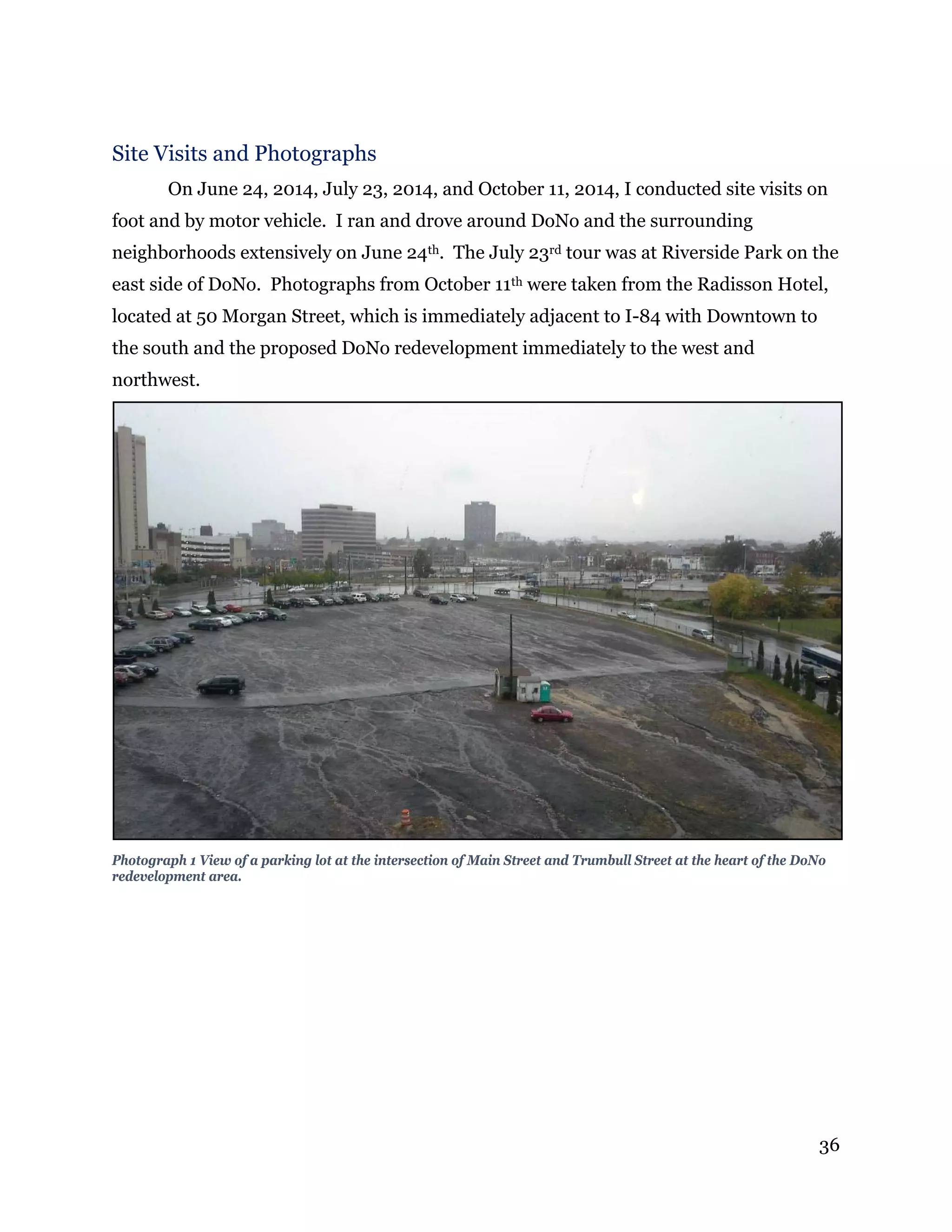
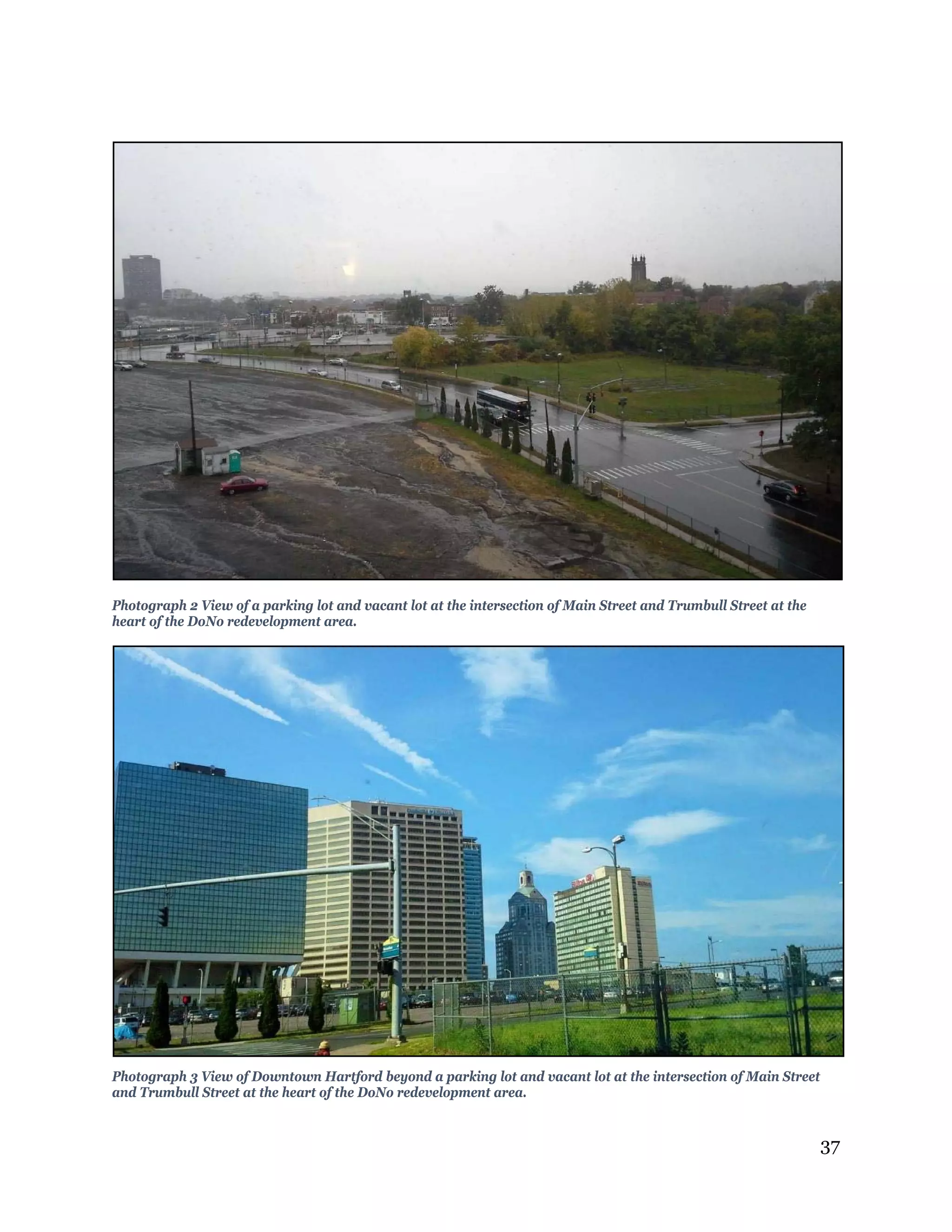
  • 95.
    95 Demographic statistics werecollected from the U.S. Census Bureau 2000 decennial census and the 2008-2013 five-year estimates. Data for Meriden Center was collected for census tracts 1701 and 1702. Data for Waterbury’s Central Business District was collected for census tract 3501. The results are depicted in the tables and figures below. Please note that the results are for the census tracts listed above revolving around the redevelopment areas. The below table shows that population has decreased in both redevelopment areas with a greater loss in Waterbury where the redevelopment has been completed for a decade. The median age also increased significantly in Waterbury. The only major race and ethnicity changes occurred in Meriden with few White alone residents and a higher concentration of Hispanic or Latino residents. Demographic Changes 2000-2013 in the Case Study Redevelopment Zones Redevelopment Area Year Total Population Median Age White Black or African American Asian Hispanic or Latino (of any race) White Alone Meriden 2000 4,214 31.1 59.1% 12.9% 0.9% 49.5% 34.8% 2013 4,098 33.1 58.7% 12.1% 0.6% 61.1% 27.4% Change -116 2.0 -0.4% -0.8% -0.3% 11.6% -7.4% Waterbury 2000 4,788 42.3 50.4% 20.3% 0.8% 44.6% 33.3% 2013 3,429 55.4 53.6% 20.6% 5.1% 41.8% 33.5% Change -1,359 13.1 3.2% 0.3% 4.3% -2.8% 0.2% Table 7 Demographic changes in Meriden Center and Waterbury Central Business District from 2000 to 2013. Source U.S Census Bureau. In terms of housing, both redevelopment areas increased the total number of housing units slightly; however, the overall vacant housing rate also increased to over 20%. Notably, the homeowner vacancy rate dropped to zero for Waterbury. Median rents for both redevelopment areas rose substantially with rents in Waterbury nearly doubling.
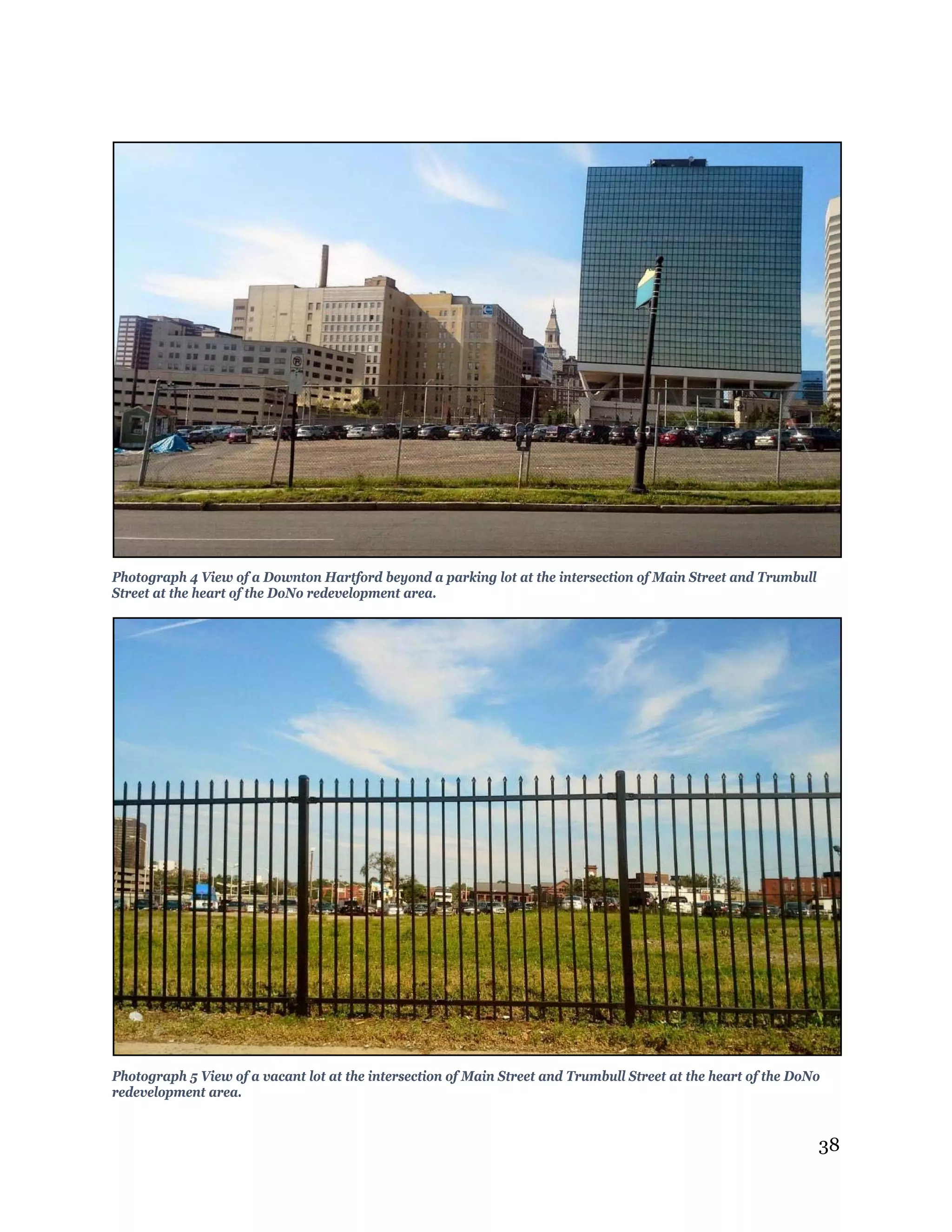
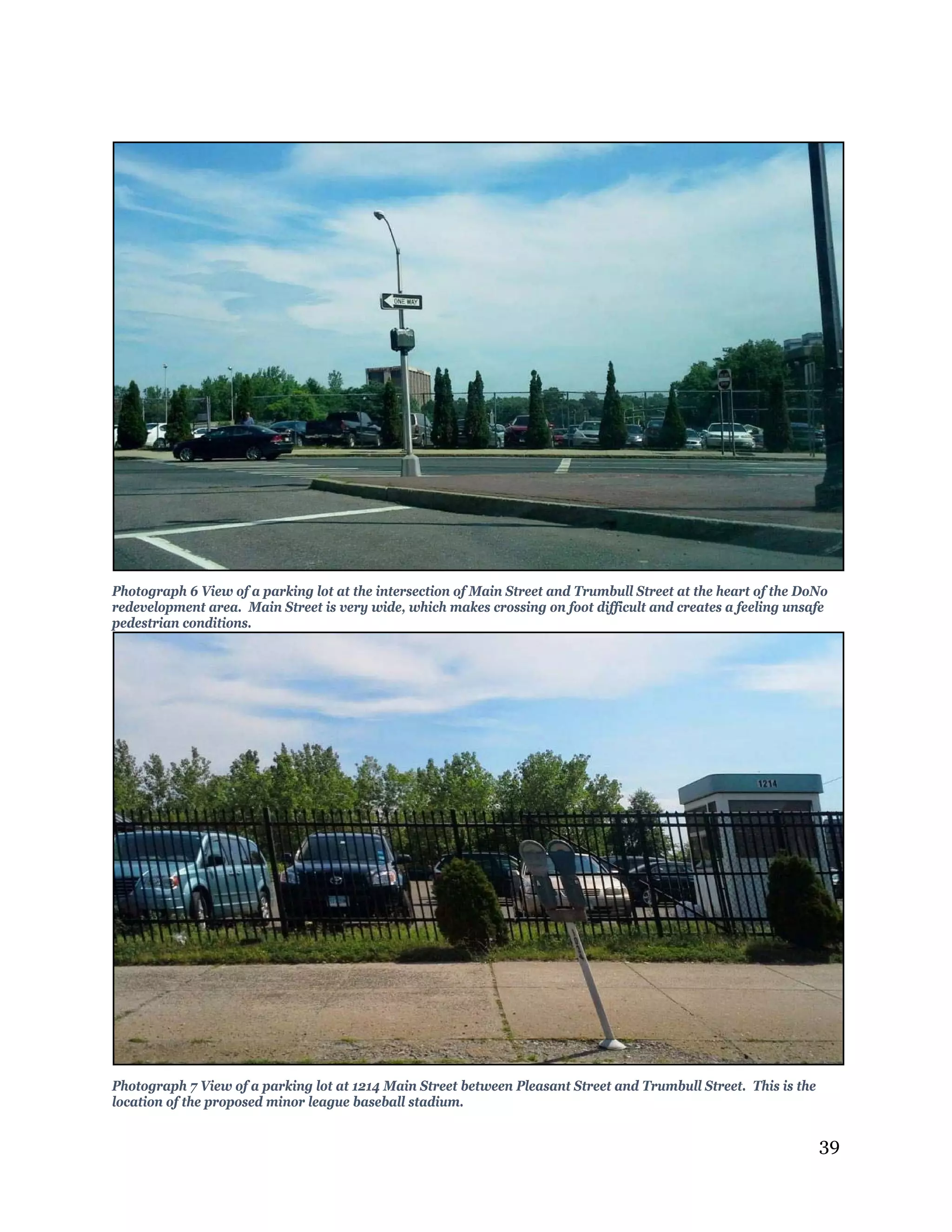
  • 96.
    96 Housing Changes 2000-2013in the Case Study Redevelopment Zones Redevelopment Area Year Total Housing Units Vacant Housing Rate Homeowner Vacancy Rate Rental Vacancy Rate Median Rent Meriden 2000 2,122 10.4% 9.1% 6.8% $447.89 2013 2,286 20.3% 22.2% 11.7% $745.81 Change +164 +9.9% +13.0% +5.0% +$297.92 Waterbury 2000 2,731 10.6% 10.3% 5.7% $290.00 2013 2,813 22.6% 0.0% 14.5% $503.00 Change +82 +12.0% -10.3% +8.8% +$213.00 Table 8 Housing changes in Meriden Center and Waterbury Central Business District from 2000 to 2013. Source U.S Census Bureau. In both areas, the percentage of residents 25 years of age and older with a high school degree or higher rose; however, their rates are significantly lower than those of the State. With Waterbury’s arts and education redevelopment project, the percentage of residents 25 years of age and older with a bachelor’s degree or higher rose to over 10%. Education Changes 2000-2013 in the Case Study Redevelopment Zones Redevelopment Area Year % High School Graduate or Higher % Bachelor's Degree or Higher Meriden 2000 54.7% 6.0% 2013 66.2% 5.3% Change +11.5% -0.7% Waterbury 2000 49.5% 6.0% 2013 53.4% 10.3% Change +3.9% +4.3% Table 9 Education changes in Meriden Center and Waterbury Central Business District from 2000 to 2013. Source U.S Census Bureau. The unemployment rates for both redevelopment areas increased to over 17%, over three times that of the State. The poverty rate increased to over 41% in Meriden but decreased to 26.3% in Waterbury. While the median household income rose several thousand dollars to nearly $21,000 in Meriden, Waterbury’s decreased to under $11,000.
  • 97.
    97 Employment Changes 2000-2013in the Case Study Redevelopment Zones Redevelopment Area Year Mean Travel Time to Work Unemployed % Below Poverty Median Household Income Meriden 2000 16.8 6.7% 28.9% $18,710 2013 20.6 26.1% 41.3% $20,983 Change +3.8 +19.4% +12.4% +$2,273 Waterbury 2000 18.9 7.8% 44.0% $11,324 2013 19.3 17.60% 26.3% $10,967 Change +0.4 +9.8% -17.7% -$357 Table 10 Employment changes in Meriden Center and Waterbury Central Business District from 2000 to 2013. Source U.S Census Bureau. The positive effects of the redevelopment project in Waterbury appear to be few and far between. Unemployment in the area surrounding the redevelopment area increased, while median household income. However, the percent of residents below poverty decreased substantially. Small gains were seen in educational attainment. The population has decreased and aged. Despite the lack of increased housing units, the vacancy rate and rents has increased. It appears as though the Downtown of Waterbury was heavily impacted by the economic crisis beginning in 2008. Despite the efforts of the City and State to revitalize this area via the redevelopment project, few gains were seen by the residents living in this area. Some significant set backs were also seen in the decrease in median household income and increase in unemployment rate. Although the redevelopment project has yet to be fully realized in Meriden, analyzing the changes in the past 15 years shows the direction Meriden is heading. The population in the vicinity of the redevelopment remained relatively stable with an increase of Hispanic or Latino residents of any race. Unemployment and the percent of residents below the poverty rate increased substantially despite the median household income rising over $2,200.
  • 98.
    98 This area increasedthe number of housing units slightly while nearly doubling its vacancy rate. The median rent also rose nearly $300. Although the percent of high school graduates increased over 11%, the percent with bachelor’s degrees or higher decreased slightly. With the rise in vacancy rates and rents, this redevelopment project should be cautious in providing the appropriate housing for the existing residents. Waterbury, Connecticut Waterbury is the fifth largest city in Connecticut with 110,366 residents and is located approximately 30 minutes southwest of Hartford. Along with a rise and fall of manufacturing, the City of Waterbury has had a long history of redevelopment aimed at stabilizing employment and revitalizing the Downtown. Urban Renewal began in 1981, and was updated in 1987. Amendments 3 and 4 were conducted beginning in 2000. The City has conducted several amendments to the original Urban Renewal Plan of their downtown. In June 2000, the Waterbury Development Agency conducted the Third and Fourth Amendments of the Urban Renewal Plan for the Central Business District Renewal Project. As part of my site reconnaissance, I interviewed Tom Gentile, Business Development Manager of the Waterbury Development Corporation. Mr. Gentile took me on a tour the redevelopment site and surrounding areas on March 3, 2015. Mr. Gentile provided information regarding the history of redevelopment in Waterbury. The first Urban Renewal project in Waterbury began in 1981 and was funded by the U.S. Department Housing and Urban Development (HUD) to remove blighted structures from the Downtown. The 1987 Amendment focused on a larger area on the east side of Downtown, and did not bring in substantial reinvestment into the East Main Street section of Downtown, according to the Urban Renewal Plan for the Central Business District Renewal Project Amendment 4 report. The Palace Theater remained vacant with several other vacant properties. This area, along with the north side of East Main Street, were identified in a 1998 downtown revitalization planning process for redevelopment with cultural, entertainment, and education uses.
  • 99.
    99 The current focusof this case study is the fourth amendment to the original Urban Renewal Plan that was implemented between 2000 and 2005. The 2000 project consisted of the redevelopment of Palace Theater, construction of one parking garage and renovation of a second garage, a new Arts Magnet Public School, and a University of Connecticut (UConn) campus. Reportedly, Governor Tom Rowland backed the 2000 project and expanded it to include the larger education scope, beyond the original intention of just renovating the historic Palace Theater. According to Mr. Gentile, the project was entirely State funded with approximately $240 million of bonds. Similar to DoNo, the project was politically pushed. Initially, the idea was disliked by the public until the Governor backed the larger redevelopment project. The Urban Renewal Plan did not provide as many detailed specifics regarding the redevelopment with the exception of the zoning and land use regulation changes for the area. The plan reads more as a general guide to the process. More detailed information regarding the redevelopment were acquired from Mr. Gentile. The larger project involved approximately 23 properties, some of which were acquired using eminent domain with several “blighted” buildings demolished. The residential and commercial tenants of several of the demolished structures were successfully relocated outside of the redevelopment area. According to the Land Use Plan section of the Urban Renewal Plan, no ground floor residential area would be allowed in this area. The plan limited residential development to not more than 100 bedrooms per acre for the portion of one parcel (parcel 4) where apartments were permitted. No restrictions were designated for parcel 8, who’s zoning also allowed multi-family residential.
  • 100.
    100 Figure 30 LandUse Plan for the Central Business District Renewal Project with the boundary of Amendments 3 and 4. Note that the redevelopment is solely zoned Cultural/Entertainment/Education with the majority of the remaining area zoned for commercial. 2000. The aerial map on the left below (Figure 30) shows the Palace Theater to the east of Waterbury Green and Downtown. Much of the area to the north and east was underdeveloped with parking lots. The aerial map on the right below (Figure 31) shows the redeveloped area with the UConn campus to the north and Arts Magnet School to the east on the location of the demolished multi-family residential building and parking lot. The approximate redevelopment boundaries are outlined in red. Figure 31 Google Earth aerial 1991 pre-redevelopment. Figure 32 Google Earth aerial 2014 post-redevelopment. Amendment 4: UConn & Garage Amendment 3: Palace Theater & Arts Magnet School 1987 Amendment 2:
  • 101.
    101 According to Mr.Gentile, the area didn’t see much private investment after the redevelopment. Few restaurants or shops appeared to come in despite the influx of students. The “Great Recession” and housing crisis beginning in 2008 certainly impacted the already struggling, former industrial city. Several design elements appear to have hindered the street life in this redevelopment zone. The two parking garages are located in the rear of the project. One is directly behind the Palace Theater and the other is behind the UConn building. Street parking was also removed to enhance the pedestrian friendliness of the street. These elements allows people to drive in to the rear of the redevelopment site, park in the parking garages, walk through the garages into their respective buildings, and exit the same way, never interacting with the street. The commuter centric result of the project and the lack of housing constructed deterred walkability and street life. As stated above, the plan specifically limited multi- family residential to a portion of two of the parcels and restricted the density to be no more than 100 bedrooms per acre for one of the parcels. According to Mr. Gentile, a 48 efficiency unit building was actually demolished on the eastern portion of the project to create room for the Arts Magnet School, relocating those tenants out of the area. No dormitories were constructed on the UConn campus and the school is geared to commuters living at home, outside of the downtown area. These factors have resulted in a lack of street life and therefore, lack of shops and restaurants. Photograph 16 Palace Theater and UConn Campus Photograph 17 Arts Magnet School on the eastern side of at the heart of the redevelopment. the redevelopment zone.
  • 102.
    102 Photograph 18 Viewof redevelopment zone from the east. Photograph 19 Parking garage at rear of Palace Theater. By restricting housing in this area, the redevelopment focused on meeting the needs of commuters. The project relied too heavily on the hopes of private investment to bring in additional shops, restaurants, and housing. By leaving these elements out of the redevelopment, the project was only successful at bringing in stand-alone cultural, entertainment, and arts facilities without creating a neighborhood. Meriden, Connecticut Meriden is the tenth largest city in Connecticut with 59,653 residents and is located approximately 25 minutes south of Hartford. Meriden saw disinvestment in the 1960s like Hartford and Waterbury. Meriden is a federal entitlement community and a state-designated “distressed” municipality. The redevelopment project involves the former Meriden Mall (later renamed HUB) site, a site consisting of 14 brownfields that is being redeveloped into a park and flood control area with approximately three acres for private development. The HUB site is part of the City's transit oriented development (TOD) district. Within the TOD district there are several potential redevelopment sites, including the Mills Memorial Housing Complex, 116 Cook Ave/former Factory H, and the former Meriden Wallingford hospital site. This redevelopment is being done in as part of HUD’s new “Choice Neighborhoods" program, which “supports locally driven strategies to address struggling neighborhoods with distressed public or HUD-assisted housing through a comprehensive approach to neighborhood transformation” (HUD, 2015). The Choice
  • 103.
    103 Neighborhood project islocated on the east side of downtown on a large vacant lot/parking lot that is a brownfield site. As seen in the photographs below, the site was historically a dense urban center with multi-story mixed use buildings covering the downtown lot. The area was demolished in the early 1960s by urban renewal, similar to DoNo, and the Meriden Mall was constructed with large amounts of surface parking. The Mall was later renamed the “HUB” and experienced difficulties staying economically viable in the 1980s and early 1990s. The property was prone to flooding and the building was abandoned for over a decade. The building was demolished in 2007. Photograph 20 Redevelopment site was formerly a mixed Photograph 21 Former Meriden Mall/HUB building. 1971. use downtown. Undated (pre 1965). Source: Record-Journal Archives. Source: Record-Journal Archives. Photograph 22 Flood of HUB site 1992. Photograph 23 Abandoned Meriden HUB 2006. Source: Record-Journal Archives. Source: Record-Journal Archives.
  • 104.
    104 Figure 33 HUBsite. Source: Regnier, 2015. Figure 34 Adjacent Downtown Meriden. Source: Regnier, 2015. Figure 35 Upgraded train station. Source: Regnier, 2015. Figure 36 East adjacent affordable housing complex. Source: Regnier, 2015. The City has been trying to redevelop this large, downtown property in the heart of their downtown for over a decade. The commercial portion of the current downtown lies adjacent to the west beyond a railroad operated by Amtrak. Several proposals were suggested; however, major remediation of the contaminated brownfield site needed to be completed first. Much of this work was recently completed in 2014 utilizing U.S. Environmental Protection Agency (EPA) Brownfields Assessment & Clean Up grant funding. The HUB redevelopment project is part of a larger City Center Initiative to transform the downtown area. The guiding document for the redevelopment is the Meriden Transit Oriented Development (TOD) Master Plan dated April 2012 prepared by Parsons Brincherhoff. “The TOD Master Plan is intended to be a collaborative
  • 105.
    105 community process thatwill include preliminary design concepts for the new Meriden Intermodal Center, a station‐area market analysis, a strategy for building long‐term public‐private partnerships (tax incentives, subsidies, land assemblage), recommendations for improved traffic patterns and parking, and an exploration of the merits of various planning tools (zoning/regulations) and design guidelines (streetscapes/public realm/architecture) for defining the new identity of the City Center” (p. 4). The Master Plan noted that the majority of Meriden is zoned for small lots; however, the HUB site and several other Downtown sites were identified as large parcels capable of being redeveloped due to their vacancy or underutilization. The Master Plan indicated the need for strategic infill development in the Downtown to fill in the gaps. The Master Plan specifically discusses mixed-use and mixed-income developments. Table 7 describes the Master Plans focus areas and recommendations for redevelopment. Meriden Master Plan Implementation Table Subject Description Meriden Intermodal Center Pedestrian link across the rail line from Colony Street to the HUB Park; a new mixed‐use, multi‐modal interface and parking structure Colony Street (11 Crown Street) Revitalize the north‐south commercial‐retail corridor with strategic infill development and the preservation of historic buildings; connect to the new Meriden Intermodal Center HUB Park 14.4‐acre park affording public amenities, Harbor Brook flood control, and 150,000 SF of mixed‐use development Meriden Housing Authority Site Provide quality affordable housing for residents of the Mills Housing complex could facilitate construction of a variety of mixed‐income residential typologies within walking distance of the Meriden Intermodal Center East and West Main Street Utilize historic building fabric, plus new infill of the commercial‐retail streetscape to revitalize and reconnect civic, educational and community facilities Factory H Area (116 Cook Ave) Mixed‐use project (100 housing units / 35,000 square feet commercial-retail space) to anchor area south of Hanover Street. Viable development tied to new traffic, greenway and pedestrian connectivity Pratt Street “Gateway” A grand, landscaped boulevard that connects the interstates directly to the new City Center will be a catalyst for development to the north and east of the park, connecting to the library and City Hall Table 11 Meriden Master Plan Implementation Table. Data collected from Parson Brinckerhoff report, 2012.
  • 106.
    106 As in DoNo,the redevelopment is occurring in three sections. Three separate proposals from three different developers were selected in the Spring of 2015 for the three different areas of redevelopment. It should be noted that The Michaels Organization’s proposal was for all three areas; however, they were only chosen for their redevelopment proposal of the 11 Crown Street site. According to Ms. Juliet Burdelski, Director of the Meriden Department of Economic Development, developer agreements will be negotiated over the next six months while the final brownfields remediation is completed. The larger HUB development project will daylight the underground Harbor Brook and create flood control infrastructure needed to eliminate flooding in and downstream of the central business area. Although several versions of the redevelopment have been proposed over the years, the City of Meriden’s Development & Enforcement Department website indicate Figure 38 is the Final Concept Plan. The plan consists of a city center park with transit oriented economic development with the upgraded high-speed Amtrak line running north-south (www.cityofmeriden.org). Figure 37 Meriden HUB redevelopment final concept plan. Source: City of Meriden, Milone & MacBroom 2007. Pennrose’s proposal for the HUB site includes a city park with a daylighted brook. Two principal buildings will be constructed along the roadside to help connect to
  • 107.
    107 the street andwill provide neighborhood retail with mixed-income housing. An amphitheater and pavilion cafe will also be included. Figure 38 HUB Conceptual Site Plan with ground floor plans of retail with mixed-income apartments above. Source: Pennrose, 2014, p. 17. Figure 39 Graphic of proposed mixed use building on the HUB site. Source: Penrose, 2014, p. 16. Pennrose’s proposal is for one building along State Street and two along Pratt Street. “The two principal proposed buildings are mixed-use and mixed-income, with affordable apartments mixed into the buildings in such a way as to be indistinguishable from the market rate units. All building materials and finishes will be of the highest quality and aesthetically compatible with the existing, historic context of downtown
  • 108.
    108 Meriden” (Pennrose, 2014,p.14). The third building will be a single story commercial structure that may double as a visitor’s center for the HUB park. The redevelopment is meant to serve as a bridge to the new train station and spill over development into Downtown. The buildings will have 80 and 90 residential units, respectively, and ground floor retail with housing above. Penrose understood the need for density, affordable housing, and meeting the needs of the surrounding community. Penrose sought to create a mixed-income development targeting units at or below 80% of area medium income (AMI) that will still bring in ample rents; however, this may leave out the poorest of the poor in Meriden. In order to maximize the density at 50 dwelling units per acre (du/acre) within the TOD the proposed developments must have 10% of the units reserved for residents at affordable income bands. The projects presented herein include both market rate scenarios and mixed income, with 20% of the units at or below 80% of area median income. For both financing feasibility reasons and in order to maximize density on these sites, the scenarios with 20% of the units limited to 80% of AMI, which still carry substantial rents, will likely be the preferred course of development. (p. 14) The second redevelopment site is located at 11 Crown Street and consists of a 1.6 acre parcel overlooking the larger HUB site. The proposal calls for a five story podium apartment building overlooking the proposed HUB park with potential for ground floor retail or commercial and four smaller, three-story integral garage townhomes to taper down to the lower rise buildings on the southwest side of the neighborhood. A total of 81 mixed income units are proposed. “Michaels anticipates the use of Project Based Section 8, LIHTC (both 9% and 4% with tax exempt bonds), DOH funds, and private mortgage and equity financing. The first two phases will include 25% project based Section 8 units, 55% 9% LIHTC units, and 20% straight market rate units. The third and final phase is projected to be a tax exempt bond phase and include 50% tax credit units and 50% straight market rate units” (Michaels, 2014, p. 9). Landis and McClure have found that does not promote mixed income developments effectively due to the larger profits to developers who construct only affordable units (Landis & McClure, 2010, p. 334). However, since Michaels plans to use a mix of funding sources, their strategy may be more successful.
  • 109.
    109 Figure 40 Conceptplan of five-story apartment building and garage town homes for 11 Crown Street located to the southwest of the HUB site. Source; Michaels, 2014, p. 15. The final redevelopment proposal by Poko Partners was for the 116 Cook Avenue property located approximately ½ mile to the southwest of the main HUB redevelopment area. Poko proposes to redevelop the main former industrial building. The second phase of the redevelopment would consist of six smaller three and four-story residential buildings constructed around a central recreation area. “The proposed development will consist of 184 mixed-income units distributed throughout the seven buildings. Of the 184 total units, 145 will be market rate and 39 will be affordable to households earning up to 50% AMI. Meriden Mews will include 309 new parking spaces in three separate lots” (Poko, p. 4). Figure 41 Concept Site Plan for the 116 Cook Ave redevelopment located approximately 1/2 mile to the southwest of the HUB site. Source; Poko, 2014, p. 8.
  • 110.
    110 Table 8 detailsthe differences between the Master Plan and the redevelopment proposals. The proposals allow for more mixed-income residential units and retail/commercial space than promoted in the Master Plan, while maintaining the need for a public park and intermodal transportation center. Meriden Implementation Table Comparison Subject Master Plan Proposed Critical? HUB Site 14.4‐acre park affording public amenities, Harbor Brook flood control, and 150,000 SF of mixed‐ use development 14.4-acre park, Harbor Brook flood control, 170 mixed-income units, and approximately 225,000 SF of retail, restaurants, and commercial/visitor center. Yes Colony Street (11 Crown Street) Infill development and the preservation of historic buildings Single-use: 81 mixed-income units with potential ground floor retail. No proposals were accepted for other portions of Colony Street Yes Factory H Area (116 Cook Ave) Mixed‐use project (100 housing units / 35,000 square feet commercial-retail space) Single-use: 184 mixed-income units with recreation area. Historic preservation and redevelopment of the old factory. Yes Meriden Intermodal Center Pedestrian link across the rail line from Colony Street to the HUB Park; a new mixed‐use, multi‐ modal interface and parking structure Upgrades to the train station are in progress Possibly Table 12 Meriden Implementation Table Comparison It is clear that the developers who submitted proposals for the three redevelopment projects within Meriden’s downtown were connected to the needs of the City and its current residents. Without denying the need for economic development and revitalization of the underdeveloped areas of its downtown, the developers were still able to meet the needs of the existing residents with affordable and mixed income units and neighborhood scale retail. Conclusions and Lessons Learned These two case studies provided unique insight into the world of redevelopment. Waterbury provided a case study of an area with a long history of large scale, State and Federally funded redeveloped. The latest of which began in 2000 and was fully complete in 2005, a full decade ago. This allowed me to analyze the results of the redevelopment and articulate lessons relevant to the DoNo redevelopment. Utilizing
  • 111.
    111 Meriden as acase study showed a parallel redevelopment project, which gave me the opportunity to compare how Meriden’s guiding planning document worked in relation to the received development proposals. The biggest lesson in Waterbury is that cultural, entertainment, and educational facilities do not always spur private investment, nor does it always spur displacement. The revitalization of the Palace Theater, UConn campus, and Arts Magnet School may be anchors in the neighborhood; however, these were designed for people outside of the surrounding area. This has led to people coming in for one purpose and returning immediately home. Waterbury, like DoNo, could have put out an RFP for mixed-use development to coincide within the redevelopment project. The poor economy and continual decline of the inner city in Waterbury over the past decade, combined with the design flaws of the redevelopment, revitalization did not spur economic development in the area. Because of this, the surrounding neighborhood actually declined in terms of unemployment and poverty. Gentrification and spillover did not appear to occur as a result of this redevelopment. Due to the projects, some residences and local businesses were displaced anyway. Meriden, like DoNo, has studied their target area many times in the last decade. Planning does not always immediately kick start development. The planning process may take many years in order to reach a consensus amongst municipal officials and the public. It also allows more time for research and data collection, which may later assist in attracting funding as in Meriden’s case. Because of their years of research into the target area, the City knows its issues well and have been able to collect grants and subsidies to assist in the redevelopment. Since the Meriden redevelopment project is on a similar time frame as DoNo, comparing the redevelopment proposals with how well they match the Master Plan allowed me to make conclusions on how well DoNo was doing. It appeared as though the developers working in Meriden were much more attuned to the neighborhood needs, while also pursuing the economic development that DoNo seeks. Meriden; however, lacks the same wealthy and expensive Downtown that Hartford has so they had less pull to cater to the non-existent wealthy, young professional demographic in Meriden. Meriden was more successful at getting developers to do affordable housing because it’s
  • 112.
    112 a Choice Neighborhoodand had identified the need for affordable housing in previous studies and plans.
  • 113.
    113 Summary & Analysisof DoNo Proposal/Master Plan The DoNo Master Plan set the precedent for the DoNo Proposal; however, the proposal was centered on the construction of a minor league baseball stadium. While giving this redevelopment an anchor, this significantly changed the developer’s perspective. While this area needs economic development, it also needs services and affordable housing for the existing underserved residents to the north and northwest of DoNo. Originally, the Proposal was shy of the Master Plan’s recommendation for residential units; however, the City Council was able to increase that number to 116% of that of the Master Plan. DoNo Implementation Table Comparison Subject Master Plan Proposal Final Numbers Approved by Hartford Planning and Zoning Submitted to OSTA Final Proposal/ Master Plan Residential units 810 673 941 116.2% Commercial SF 285,000 221,000 0 0% Retail/Active Uses SF 157,310 196,400 349,178 222.0% Light Industrial SF 0 30,000 43,000 43,000% Parking spaces 1,658 1,405 1,665 100.4% Table 13 DoNo implementation table comparison with final numbers approved by the Planning and Zoning Commission and submitted to OSTA. Please note that the Proposal includes 220,000 square foot minor league baseball stadium as retail/active uses. The final numbers include 129,178 square feet for retail. Note that 100% in the Final Numbers/Master Plan column on the far right would indicate an exact match between the Proposal and the Master Plan. Percentages higher than 100% indicate the Proposal offers a greater amount than the Master Plan allotted, while those lower than 100% indicate the Proposal offers a far fewer amount. To analyze the Master Plan and final Proposal, I compared the recommendations to my original research questions. Will the Master Plan provide enough housing to meet the future needs of market rate and affordable housing in this area? Will the potential influx of new residents spill over into the adjacent Clay Arsenal, Asylum Hill, and Upper Albany neighborhoods and cause displacement? What are the factors in creating a successful mixed-income, diverse neighborhood? What are the tools and techniques planners can use to keep existing residents in their homes during the process of gentrification?
  • 114.
    114 Utile’s Master Planshowed that housing growth Downtown is fueled by young professionals with annual salaries of approximately $60,882 as well as empty nesters (older adults whose children are no longer living with them). The analysis indicated that the average young professional’s budget for rent is approximately $750 and $1,000. The research showed that Downtown could support an additional 1,700 to 4,700 units of housing even considering the existing downtown units and the 1,100 units that are planned (Utile p.47). With this information, Utile proposed a total of 2,185 housing units within all five of the development districts. Of these units, 810 were designated for the two districts which are located in DoNo. The latest numbers for the DoNo Hartford, LLC Proposal designated 941 units for the DoNo area. This area does not include the Downtown West area, which contained three additional development districts. The City appears to have pushed back on DoNo Hartford, LLC whose original Proposal included only 673 housing units. Although this number matches the Master Plan, it leaves a large gap in housing units for Downtown West, which has no current development plans. DoNo Hartford, LLC is not required to fully match the Master Plan; however, it is setting the precedent for development in Downtown Hartford. It may be in the City’s best interest to require development proposals to meet the standards set within its’ Master Plans. Without additional units planned throughout Downtown, there is a possibility of spillover of the targeted higher- income young professionals and empty nesters into the surrounding neighborhoods. If this mixed-use development succeeds in attracting the large pool of young professionals and empty nesters Utile believes are interested and willing to move to a walkable urban environment in the Hartford area, there is a likely possibility of spill over to the adjacent neighborhoods. While each of the surrounding neighborhoods; Downtown, Asylum Hill, Clay Arsenal, and Upper Albany, all have high housing vacancy rates of 20 to 22%, low median rents in Asylum Hill, Clay Arsenal, and Upper Albany could attract young professionals to these neighborhoods. Now, it may seem as though with vacancy rates double that of the state, these neighborhoods would simply slowly fill up and have room for any newcomers. In a perfect world this may be true but according to Andrew Helms research “gentrification seems to be undeterred by housing vacancy, particularly during the early stages when
  • 115.
    115 renovators purchase andrenovate abandoned buildings that are usually deteriorated but still structurally sound” (Helms, 2003, p. 485). Helms has several other findings that indicate the neighborhoods to the northwest and west of DoNo have the possibility of gentrifying: By and large, the results confirm intuitive expectations and support anecdotal accounts about the determinants of renovation, particularly as it occurs in the context of gentrification. Older, low-density houses in older, moderate-density neighborhoods are most likely to be renovated. Accessibility to the [Central Business District] CBD matters: improvement is more likely in areas that are close to downtown and well-served by mass transit. Housing vacancy does not deter renovation, but nearby public housing projects do. Neighborhood amenities, including city parks and bodies of water (Lake Michigan in this case), encourage renovation activity (Helms, 496). Clay Arsenal, Upper Albany, and Asylum Hill are all located adjacent to a maximum of two miles from the CBD (Downtown), are older, moderate-density neighborhoods, and have a fair amount of parks. The DoNo redevelopment may also connect these neighborhoods to Riverside Park and the Connecticut River. These neighborhoods already contain the large Keney Park and Golf Course, Bellevue Square Park, Brackett Park & Parker Community Center, Heartbeat Park, Sigourney Square Park, and are close to Bushnell Park in Downtown. Hartford’s public transportation is also increasing. There is an existing bus system connecting the surrounding neighborhood to Downtown, as well as a free “dash shuttle” circulating Downtown. The Amtrak train has recently been upgraded to “high- speed” connecting north and south, making it easier to get to cities such as New Haven and New York City. Hartford also has several large entertainment venues, and will have the new minor league baseball stadium in DoNo in Spring 2016. According to the Metro Hartford Progress Points report developed by the Hartford Foundation for Public Giving, 82% of the 121,000 jobs in Hartford are filled by commuters from the surrounding region. The population of Hartford reportedly doubles during the daytime due to the influx of commuters. These statistics were collected from the U.S. Census Bureau, 2011. Many of these jobs are located in Downtown Hartford, especially those within the insurance and finance industries. Based on this information, coupled with the National trend of people moving back into
  • 116.
    116 urban centers, thereis a market for attracting professionals into the city for live, work, and play. Comparing the final redevelopment Proposal, whose details are in the process of being finalized in a developer agreement with the City Council, with the Master Plan, we see a greater amount of housing, retail, and active uses with far less commercial development. The findings of this project indicate that this will assist in creating a vibrant and successful neighborhood with revitalization. The details regarding affordable housing and what types of future retail establishment are brought in will determine if the development will be beneficial to the existing low-income residents in the surrounding neighborhoods. The project appears as though it’ll bring in some new people to the DoNo area; however, with Hartford being within a cold market and it being historically low-growth, it is unclear whether or not this redevelopment will create a large enough influx of new population that may cause spill over into the surrounding neighborhoods. That being said, the construction of over 900 housing units is at least a good start to supporting housing in this area and preventing displacement amongst the low-income residents of Clay Arsenal, Asylum Hill, and Upper Albany neighborhoods. Unfortunately, little information is known regarding the developer’s agreement, as it has yet to be finalized for the mixed-use portion of the redevelopment. According to a Hartford Courant article “Hartford Releases Details of Downtown, Stadium Projects,” local, woman and minority-owned businesses are to be given preference in contract work for the baseball stadium. (Carlesso, Jenna, and Goode Steven). The City should use the developer’s agreement to get neighborhood services, job preferences, or training because it is selling the land below market rate. This is a critical planning tool that can be used to combat any negative impacts of gentrification. Another planning technique the City could use is to sell a portion of the land to a non-profit to construct affordable housing using LIHTC, in order to more easily create a larger percentage of affordable housing units as it is more profitable for developers to construct all low-income units. This would create a balance of affordable housing constructed and operated by a non-profit and market rate units constructed by the stadium and mixed-use developer. This strategy may be more enticing for the mixed-
  • 117.
    117 use developer asit would relieve them of the affordable housing requirements and need for a subsidy, while streamlining the affordable housing development under a non-profit developers who specializes in affordable housing. The factors in creating a successful mixed-income, diverse neighborhood are different for every neighborhood. However, a key element is allowing access municipal amenities, such as parks and transit. Separating income levels by structure may not always lead to social and economic segregation if these amenities and opportunities are still accessible to all residents. Planners can use developer’s agreements as their tool to developing successful neighborhoods.
  • 118.
    118 Recommendations Essential to thisproject is the question “what is ‘Planning’?” The basis of this Master’s Project is to analyze the potential impacts of a critical piece of planning, a master plan. According to the American Planning Association, Planning works to improve the present and future community. [Planning] is a dynamic profession that works to improve the welfare of people and their communities by creating more convenient, equitable, healthful, efficient, and attractive places for present and future generations…Good planning helps create communities that offer better choices for where and how people live. Planning helps communities to envision their future. It helps them find the right balance of new development and essential services, environmental protection, and innovative change (www.planning.org). I began this project in the Spring of 2014 prior to the completion of the DoNo Master Plan or any proposals being submitted to the City for development. I had hope and excitement that this area was ripe for redevelopment. To my pleasant surprise, a major redevelopment of DoNo has unfolded right in front of me. While I am excited for the prospect of revitalization in and around DoNo, as a Planner, I seek to work to the benefit of the entire community. Throughout my research of housing, gentrification, redevelopment, several case studies, and the details of this project, I have developed several recommendations for the City of Hartford to plan for all the current residents. DoNo’s location as the connecting piece between the contrasting Downtown and North End neighborhoods of Clay Arsenal, Upper Albany, and Asylum Hill makes its’ redevelopment sensitive and political. The needs of the City and its economic development must be balanced with the needs of the existing underserved community. Affordable Housing  Hartford should require that 20% of the housing units constructed in DoNo are affordable with affordability restrictions of 80 or 99 years. DoNo Hartford LLC has stated that with the exception of the funding for the baseball stadium, the mixed use development was originally intended to be funded entirely by private financing. This
  • 119.
    119 appears to beDoNo Hartford LLC’s reason for not originally including affordable housing.  According to an article written by Kenneth Gosselin in the Hartford Courant on February 20, 2015, after they are seeking a $20 million subsidy from the Capital Region Development Authority (CRDA). “[The] city council pushed to have some rentals set aside for low and moderate income households. Those apartments carry lower rents. Centerplan and its partner, Leyland Alliance of New York, had intended not to seek public subsidies. However, including ‘affordable’ housing would create a gap between the cost to develop and the revenue that would be generated” (Gosselin, 2015).  Additionally, the City should make a concerted effort to map the location of all types of affordable housing: Section 8 Housing Choice Voucher, Section 8 project-based housing, LIHTC developments, and public housing, that are located in the Downtown and surrounding neighborhoods. This information will arm the City with the knowledge of what units may be most susceptible to conversion to market-rate housing. The City could then work to enforce longer affordability restrictions at these locations. The City could provide resources to properties in need of maintenance or to the most vulnerable properties in terms of conversion and displacement. Mixed-Income  The DoNo redevelopment may be seen as something for middle and higher income residents with DoNo Hartford LLC stating that wealthier young professionals will be targeted and catered to at the start of this redevelopment. However, there are many efforts to make the development beneficial for the Hartford residents, especially in the surrounding neighborhoods. The need for a grocery store is high in these neighborhoods that have been classified as food deserts. The City should ensure that this grocery store is in the price range of those residents who need it now. Additionally, the grocery store is located in the south-central portion of DoNo and closer to Downtown than the underserved neighborhoods to the north and northwest. It would be more beneficial to the
  • 120.
    120 residents of thefood desert if it were located closer to them. It is understandable that not all of the retail and housing will be affordable to all the residents of Hartford; however, an effort should be made to include amenities for those of varying incomes and backgrounds.  The City should use the developer’s agreement to get neighborhood services, job preferences, or training because it is selling the land below market rate.  A technique the City could use is to sell a portion of the land to a non-profit to construct affordable housing using LIHTC, in order to more easily create a larger percentage of affordable housing units as it is more profitable for developers to construct all low-income units. This would create a balance of affordable housing constructed and operated by a non-profit and market rate units constructed by the stadium and mixed-use developer. This strategy may be more enticing for the mixed-use developer as it would relieve them of the affordable housing requirements and need for a subsidy, while streamlining the affordable housing development under a non-profit developers who specializes in affordable housing. Master Plan  Since DoNo Hartford, LLC is only focusing on DoNo and not Downtown West, the City of Hartford should push DoNo Hartford, LLC to match the Master Plan as best as possible to set a precedent for any potential Downtown West development. Additionally, the City should make a concerted effort to match the Master Plan’s additional housing units to meet the potential demand in the Downtown area. The creation of the attractive mixed-used neighborhood in Downtown will certainly bring in new residents to Hartford’s Downtown and surrounding neighborhoods. Hartford must plan for the possibility of spill over into the surrounding neighborhoods of Clay Arsenal, Upper Albany, and Asylum Hill. Case Studies  In terms of revitalization, Hartford should learn from Waterbury that bringing in cultural, entertainment, and educational facilities may not bring the economic development and private investment needed to create a vibrant and attractive
  • 121.
    121 neighborhood for peopleto live in. Waterbury’s redevelopment brought in no housing, restaurants, or shops and was aimed for those who live outside of the greater Downtown area to drive in to use one facility and go home afterwards, eliminating much of the desired economic development and street life Waterbury desired.  Attracting the minor league baseball stadium is a fantastic catalyst to the redevelopment of DoNo; however, if this is the only piece initially completed, DoNo will likely see the commuter-centric result of middle to high-income outsiders coming in for the sole purpose of going to the stadium and leaving immediately after without spending time in the surrounding areas around the stadium. This will leave DoNo in a similar state as it is today with the exception of a beautiful baseball stadium sitting amongst other vacant and underutilized parcels. The residential and retail mixed-use portion of the redevelopment will be the true anchor for the DoNo neighborhood.  DoNo Hartford LLC and the City of Hartford could utilize resources and funding from various sources, which cities like Meriden and Waterbury took advantage of for their redevelopment. As in Meriden’s redevelopment, DoNo Hartford should work to make the affordable units blend in with the market rate units in a success mixed- income environmental. The structures should be compatible with the existing context of the surrounding neighborhoods, not just Downtown. This redevelopment should not just be an extension of the high-income and expensive Downtown, but should be beneficial to the Clay Arsenal, Upper Albany, and Asylum Hill neighborhoods as well.
  • 122.
    122 References  Cohen, Jeffrey,“Anger After King’s Death Left Lasting Mark on Hartford’s North End” (April 6, 2008). Hartford Courant, http://www.hartfordinfo.org/issues/documents/history/htfd_courant_040608. asp.  Tateosian, Nicole, "Hartford, Connecticut: Discrimination, Segregation, and Urban Riots" (1998). Hartford Studies Collection: Papers by Students and Faculty. Paper 24.  Dale, Ann and Lenore L. Newman. 2009. "Sustainable development for some: green urban development and affordability." Local Environment 14, no. 7: 669- 681.  Basolo, V. (1999). The impacts of intercity competition and intergovernmental factors on local affordable housing expenditures. Housing Policy Debate, 10(3), 659-688.  DeFilippis, J. and E. Wyly, Running to Stand Still: Through the Looking Glass With Federally Subsidized Housing in New York City. Urban Affairs Review, 2006. 43: p.777-816.  Deng, L. (2005). The cost-effectiveness of the low-income housing tax credit relative to vouchers: Evidence from six metropolitan areas. Housing Policy Debate, 16(3-4), 469-511.  Deng, L. (2005). The cost-effectiveness of the low-income housing tax credit relative to vouchers: Evidence from six metropolitan areas. Housing Policy Debate, 16(3-4), 469-511.  Goetz, E. G. (2002). Forced relocation vs. voluntary mobility: The effects of dispersal programs on households. Housing Studies, 17(1), 107-123.  Halasz, J.R. (2011). Fair and affordable? Racial and ethnic segregation and inequality in New York City rental housing. Housing Policy Debate, 21(2), 267- 293.  Housing and Urban Development, 2015, http://portal.hud.gov/hudportal/HUD?src=/program_offices/public_indian_ho using/programs/ph/cn. FHUB site  Landis, J. D., & McClure, K. (2010). Rethinking federal housing policy. Journal of the American planning Association, 76(3), 319-348.  McClure, K., (2008). Deconcentrating Poverty with Housing Programs. Journal of the American Planning Association. 74(1): p. 90-99.  Melendez, E., & Schwartz, A. (2008). After year 15: Challenges to the preservation of housing financed with Low-Income Housing Tax Credits. [Article]. Housing Policy Debate, 19(2), 261-294.  Mhatre, P. C., & Van Zandt, S. (2009). Growing Pains: Perpetuating Inequality through the production of low-income housing in the Dallas/Fort Worth metroplex. Urban Geography, 30(5), 490-513.
  • 123.
    123  Orfield, M.(2005). Racial integration and community revitalization: Applying the fair housing act to the low income housing tax credit. [Review]. Vanderbilt Law Review, 58(6), 1747-+.  Pritchett, W. E. (2008). Which Urban Crisis? Regionalism, Race, and Urban Policy, 1960-1974. Journal of Urban History, 34(2), 266-286.  Tiebout, C. M. (1956). A pure theory of local expenditures. The Journal of Political Economy, 64(5), 416.  von Hoffman, A. (2005). The End of the Dream: The Political Struggle of America’s Public Housers. Journal of Planning History, 4(3), 222.  Woods, L. L. (2012). The Federal Home Loan Bank Board, Redlining, and the National Proliferation of Racial Lending Discrimination, 1921-1950. [Article]. Journal of Urban History, 38(6), 1036-1059. doi: 10.1177/0096144211435126  Davidson, Justin. 2014. "Is Gentrification All Bad?" New York 47, no. 3: 36-75.  Davidson, Mark and Lees, Loretta. 2005. "New-build 'gentrification' and London's riverside renaissance." Environment & Planning A, 37: no. 7: 1165- 1190.  Davis, Tomeka and Oakley, Deirdre. 2013. "Linking Charter School Emergence to Urban Revitalization and Gentrification: a Socio-Spatial Analysis of Three Cities." Journal of Urban Affairs 35, no. 1: 81-102.  Eckerd, Adam. 2011. "Cleaning Up Without Clearing Out? A Spatial Assessment of Environmental Gentrification." Urban Affairs Review, no. 47: 31-59.  Essoka, Jonathan D. 2010. "The Gentrifying Effects of Brownfields Redevelopment." Western Journal of Black Studies 34, no. 3: 299-315.  Freeman, Lance. 2006. There Goes the 'Hood: Views of Gentrification from the Ground Up. Philadelphia, Temple University Press.  Glanville, Justin 2013. “Taking the Sting Out of Gentrification,” American Planning Association, April 2013: 12-15.  Hartford Foundation for Public Giving. 2014. “Metro Hartford Progress Points.”  Helms, Andrew. 2000; revised 2003. “Understanding gentrification; an empirical analysis of the determinants of urban housing renovation,” Journal of Urban Economics, no. 54: 474-498.  Johnson, Jennifer S. 2008. “Affordable Housing in New Urbanist Communities: A Survey of Developers.” Housing Policy Debate Volume 19 Issue 4: 583-613.  Lees, Loretta. 2008. "Gentrification and Social Mixing: Towards an Inclusive Urban Renaissance?" Urban Studies 45, no. 12: 2449-2470.  Lees, Loretta, Tom Slater, and Elvin Wyly. 2008. Gentrification. New York: Routledge/Taylor and Francis Group.  Mathema, Silva. 2013. “Gentrification: An Updated Literature Review.” Poverty & Race Research Action Council: 1-8.  Orfield, Myron. 2005. "Racial Integration and Community Revitalization: Applying the Fair Housing Act to the Low Income Housing Tax Credit." Vanderbilt Law Review 58, no. 6: 1747-1804.  Pearsall, Hamil. 2013. "Superfund Me: A Study of Resistance to Gentrification in New York City." Urban Studies 50, no. 11: 2293-2310.
  • 124.
    124  Pearsall, Hamil.2010. "From brown to green? Assessing social vulnerability to environmental gentrification in New York City." Environment & Planning C: Government & Policy 28, no. 5: 872-886.  Solitare, Laura and Lowrie, Karen. 2012. "Increasing the capacity of community development corporations for brownfield redevelopment: an inside-out approach." Local Environment 17, no. 4: 461-479.  Talen, Emily. 2010. "The Context of Diversity: A Study of Six Chicago Neighborhoods." Urban Studies, no. 47: 486-513.  York, Abigail, et al. 2011. "Ethnic and Class Clustering through the Ages: A Transdisciplinary Approach to Urban Neighborhood Social Patterns." Urban Studies, no. 48: 2399-2415.  Gosselin, Kenneth. (February 15, 2015.) “DoNo Developer Seeks $20M to Help Fund ‘Affordable Housing’.” Hartford Courant.  Carlesso, Jenna, Goode, Steven. (February 10, 2015). “Hartford Releases Details of Downtown, Stadium Projects.” Hartford Courant.  DoNo Hartford LLC. (August 1, 2014). “Response to The City of Hartford’s Request for Proposals For Public-Private Partnership: Completing Hartford’s Neighborhoods with Mixed-Use Development and Proposed Minor League Baseball Facility.” Retrieved from http://www.hartford.gov/dono  Utile. (December 2013). “Downtown North / Downtown West: A Plan for the City of Hartford.” Retrieved from http://www.hartford.gov/dono  Parsons Brincherhoff. April 2012. “Meriden Transit Oriented Development (TOD) Master Plan.” Retrieved from http://www.meriden2020.com/FileRepository/  DoNo Hartford LLC. (April 1, 2014). “Response to The City of Hartford’s Request for Proposals For Public-Private Partnership: Completing Hartford’s Neighborhoods with Mixed-Use Development and Proposed Minor League Baseball Facility for the City of Hartford, Connecticut.” Retrieved from http://www.hartford.gov/dono  Waterbury Development Agency. (June 2000). “Urban Renewal Plan for the Central Business District Renewal Project Fourth Amendment.” Waterbury Development Corporation.  Pennrose Properties, LLC & The Cloud Company, Plc with WRT. (December 2014). “Proposal For Transit Oriented Development -Development Of City Owned Properties In Meriden.” Meriden Department of Economic Development.  The Michaels Organization (December 2014). “Proposal For Transit Oriented Development -Development Of City Owned Properties In Meriden.” Meriden Department of Economic Development.  Pokos Partners. (December 2014). “Proposal For Transit Oriented Development -Development Of City Owned Properties In Meriden.” Meriden Department of Economic Development.  United States Census Bureau. 2000 Decennial Census Data. Retrieved from http://factfinder.census.gov/  United States Census Bureau. 2005-2009 Five-Year Estimates Census Data. Retrieved from http://factfinder.census.gov/
  • 125.
    125  United StatesCensus Bureau. 2009-2013 Five-Year Estimates Census Data. Retrieved from http://factfinder.census.gov/