Domain Ontology Usage Analysis Framework  Analyzing the Usage of Domain Ontologies on the (Semantic) Web Jamshaid Ashraf,  M aja Hadzic Presenter :  Dr Omar Khadeer Hussain >>  SKG2011 ,  Beijing, China          Oct. 24-26, 2011
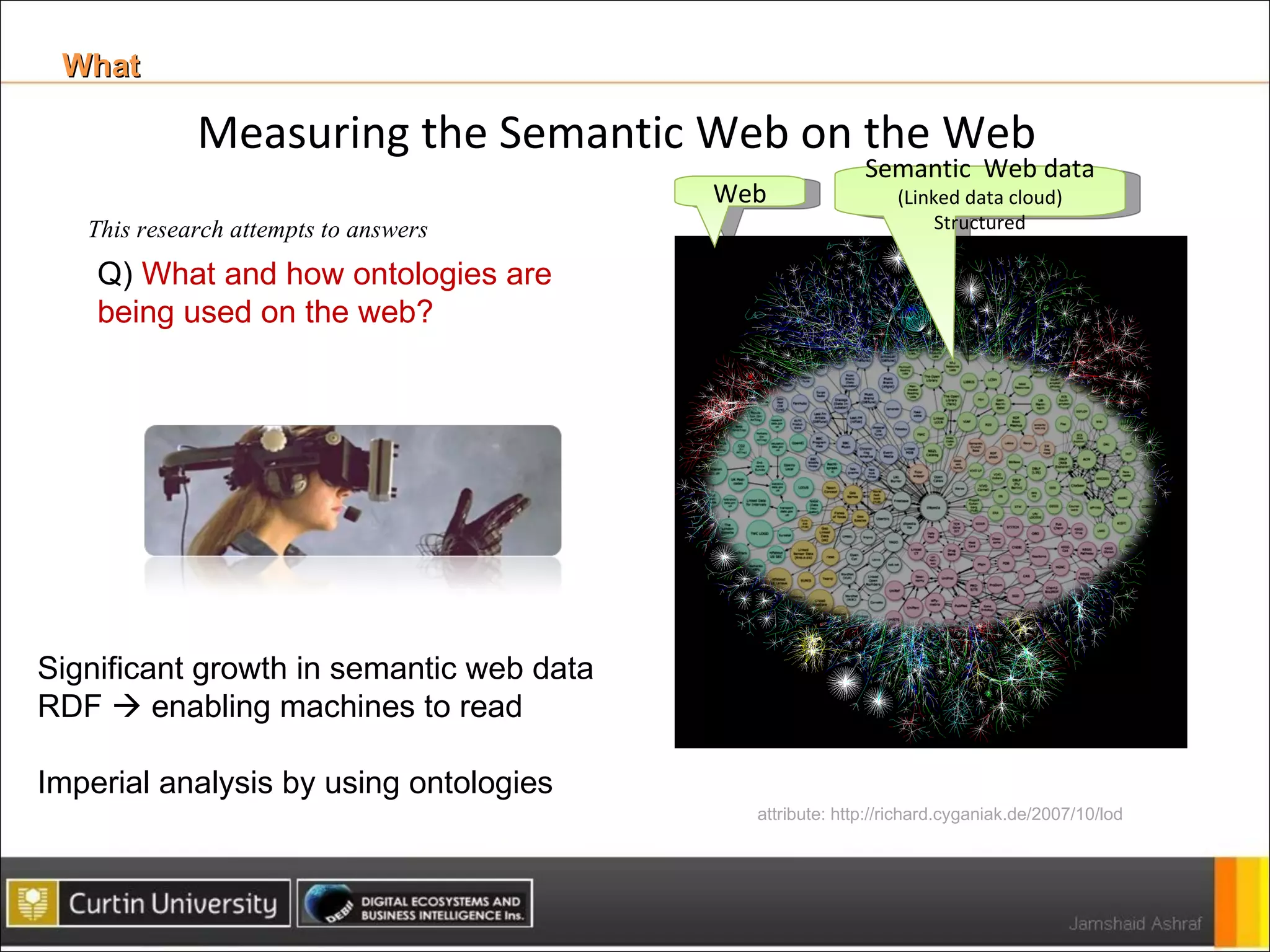
Measuring the Semantic Web on the Web Web Semantic  Web data  (Linked data cloud) Structured attribute: http://richard.cyganiak.de/2007/10/lod Q)  What and how ontologies are being used on the web?  This research attempts to answers What  Significant growth in semantic web data RDF    enabling machines to read Imperial analysis by using ontologies
Growth of Ontologies Tremendous growth in the use of ontologies Swoogle has an index of 10,000 ontologies PingTheSemanticWeb has listed 1442 known namespaces used in the documents Ontologies are developed based on Ontology development process based on certain methodology
What is needed? Evaluate and analyse the usage of an ontology Its adoption and uptake by different users on the semantic web. Provide an insight into the structure, understand the pattern available, actual use and the intended use Understand Ontology Usage in Billions of triples in Linked Open Data (LOD) cloud.
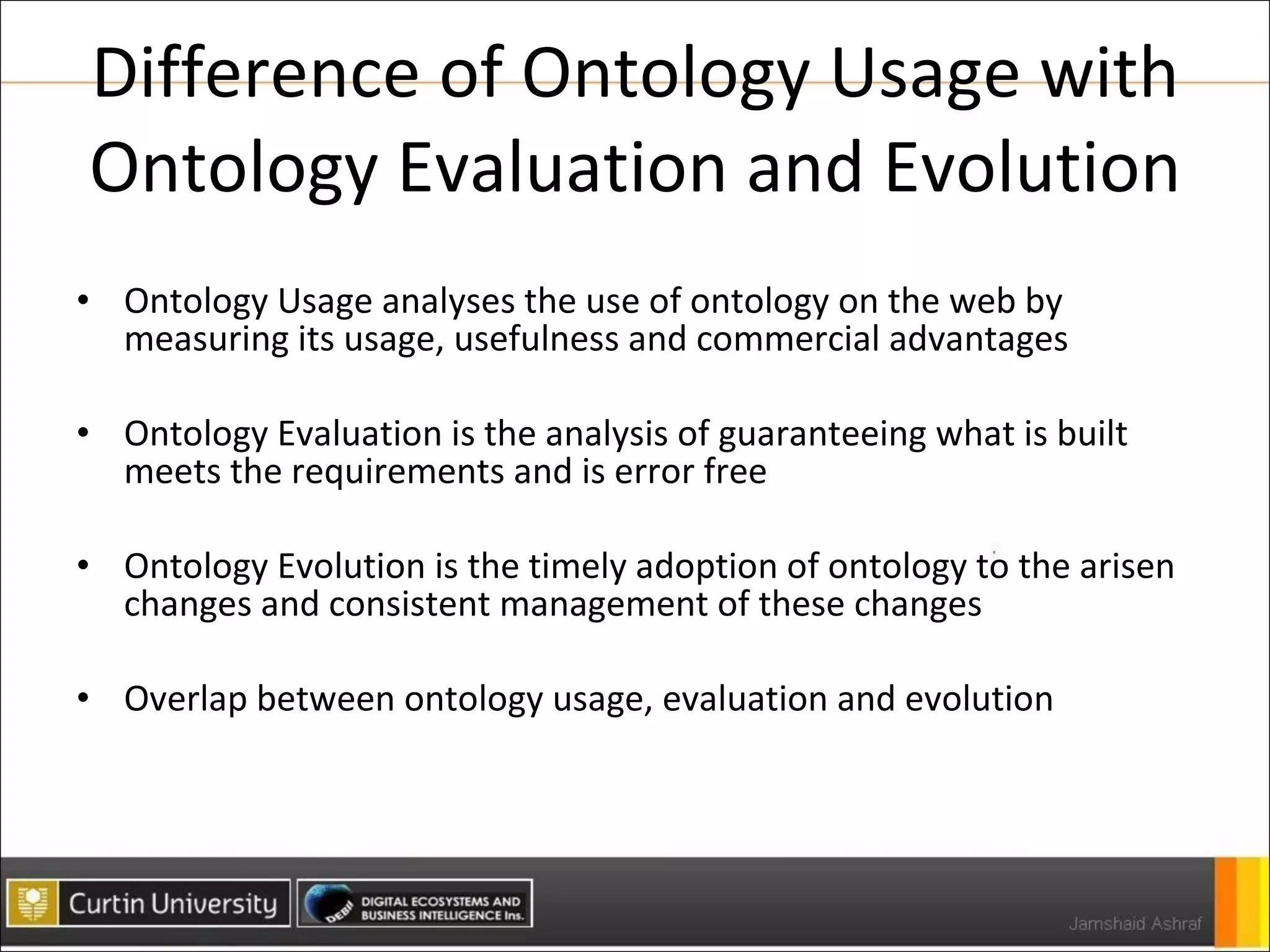
Contributions of this paper Ontology Usage Analysis Framework Proposes a set of metrics to measure the ontology usage Understand the depth of ontology adoptions and the structured data patterns available in the web of data
Difference of Ontology Usage with Ontology Evaluation and Evolution Ontology Usage analyses the use of ontology on the web by measuring its usage, usefulness and commercial advantages Ontology Evaluation is the analysis of guaranteeing what is built meets the requirements and is error free Ontology Evolution is the timely adoption of ontology to the arisen changes and consistent management of these changes Overlap between ontology usage, evaluation and evolution
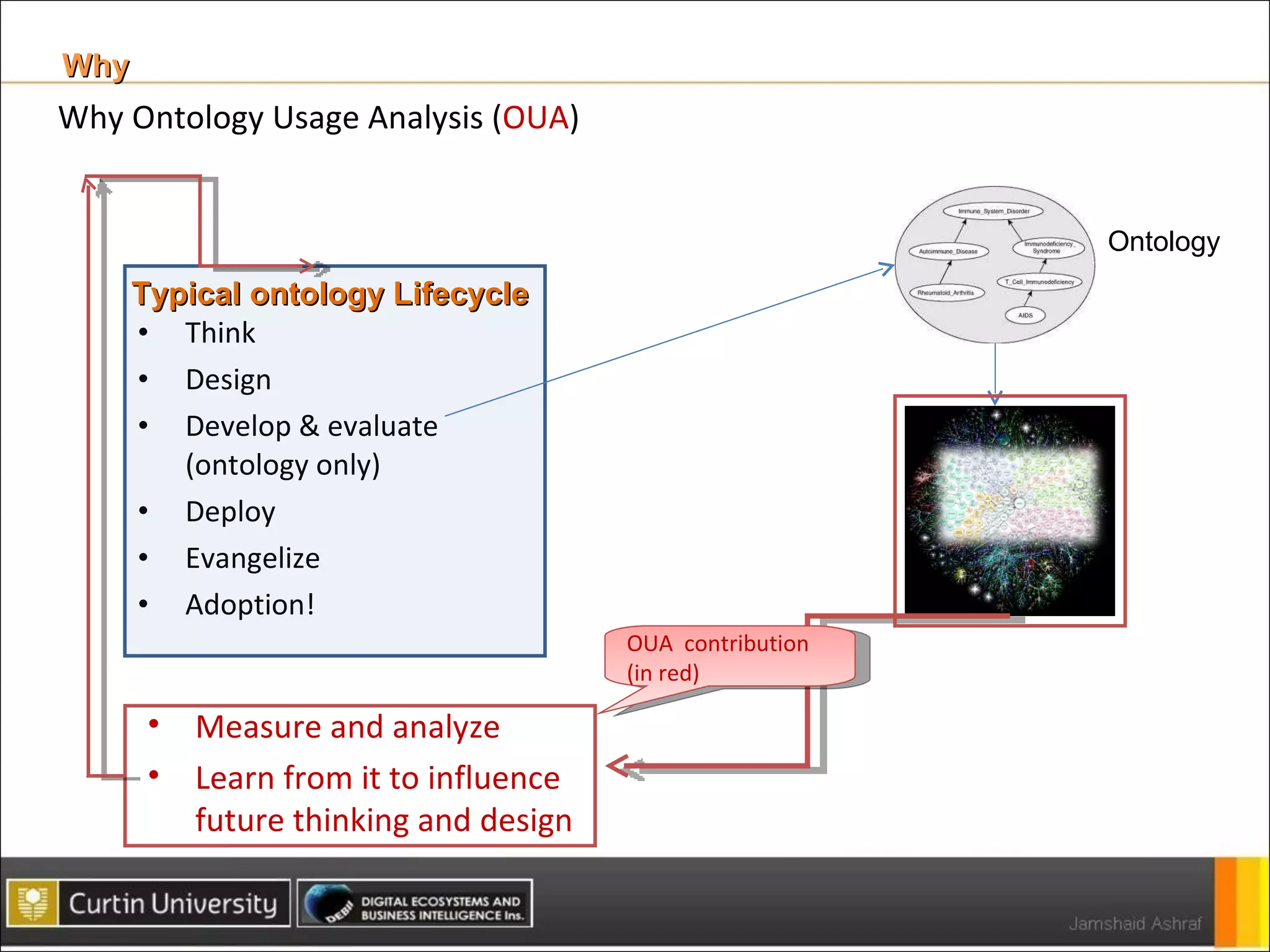
Why Ontology Usage Analysis ( OUA ) Think Design Develop & evaluate (ontology only) Deploy Evangelize Adoption! Measure and analyze Learn from it to influence future thinking and design Typical ontology Lifecycle Ontology OUA  contribution  (in red) Why
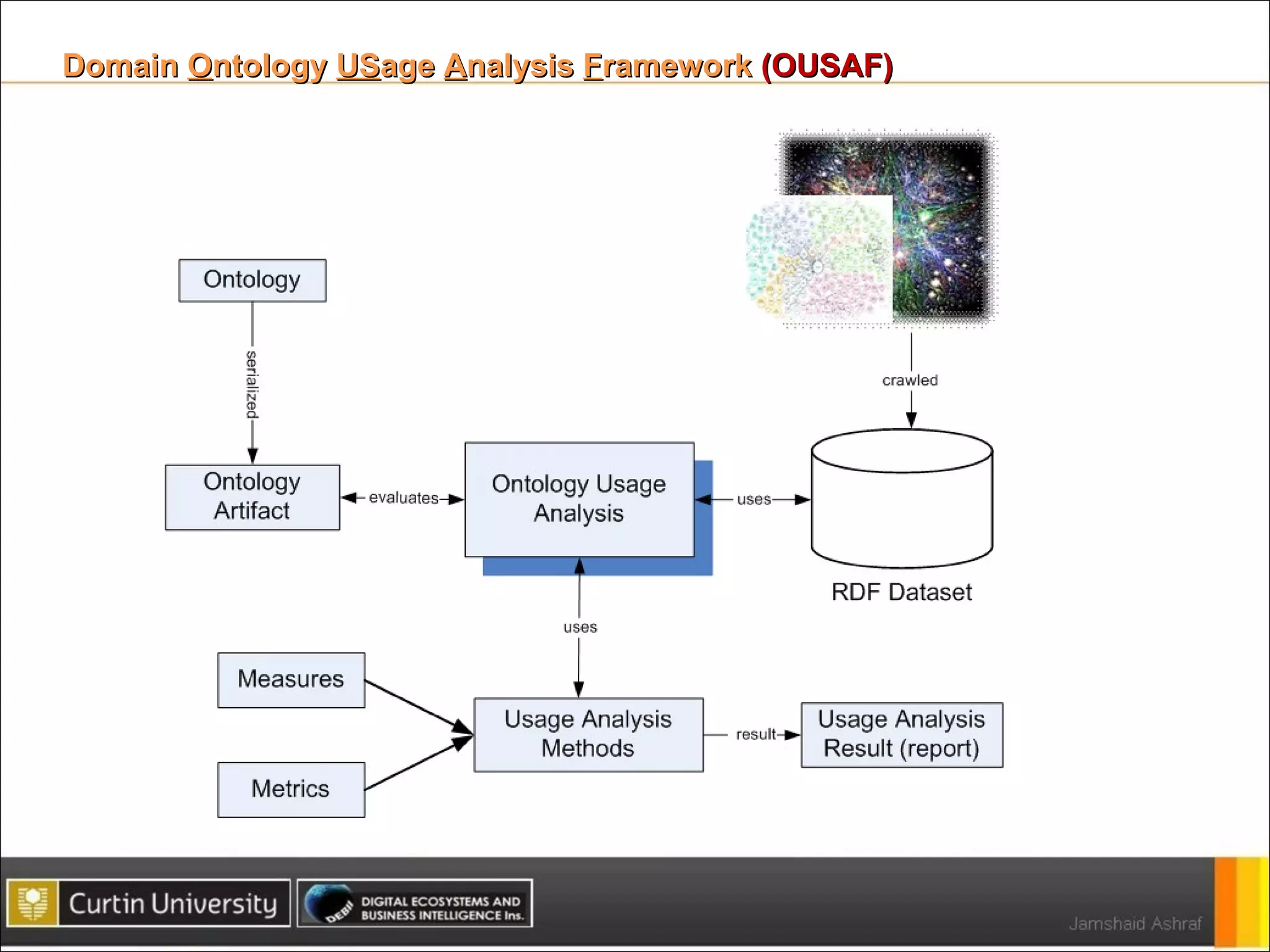
Domain  O ntology  US age  A nalysis  F ramework  (OUSAF)
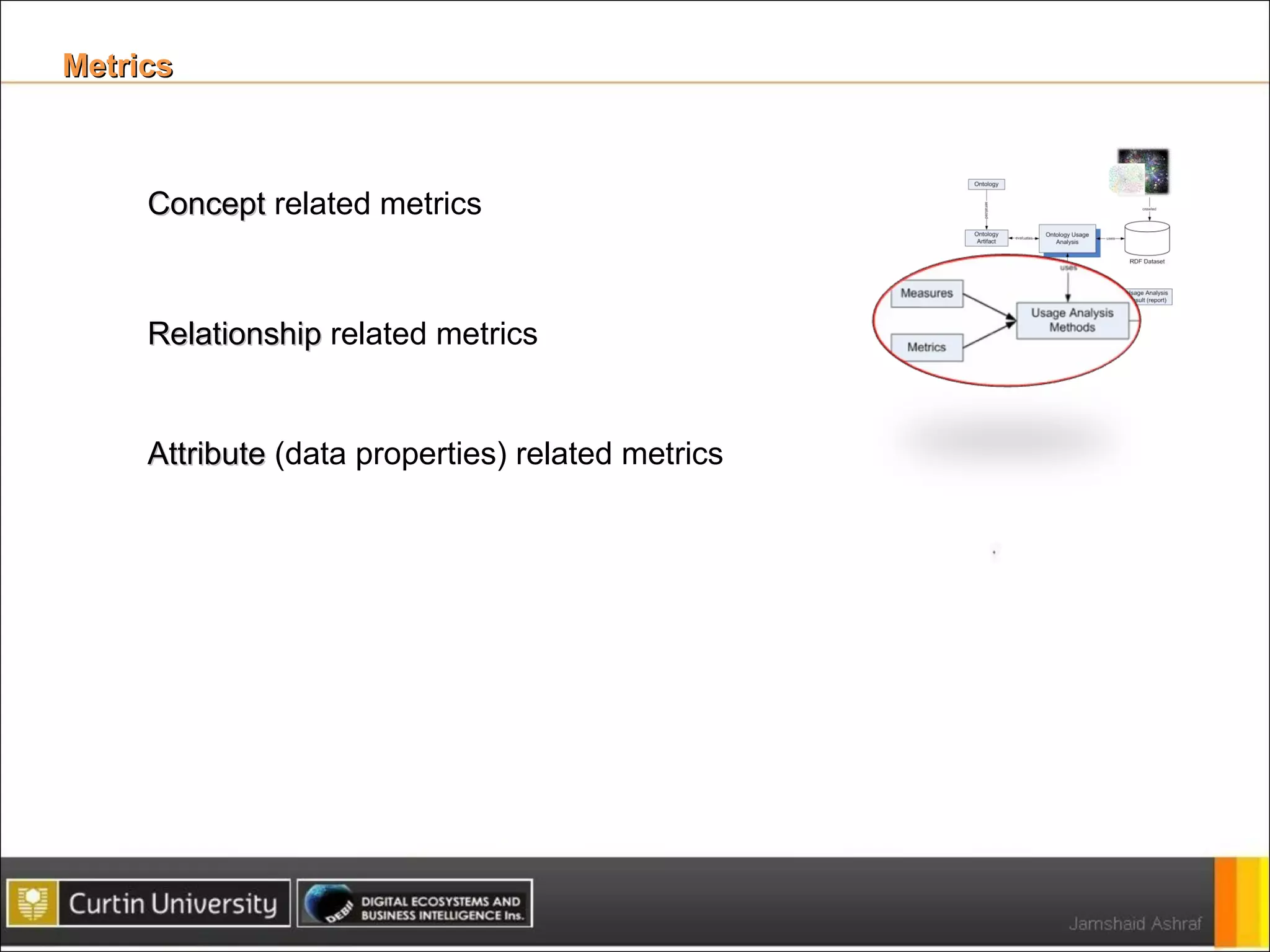
Metrics  Concept  related metrics Relationship  related metrics Attribute  (data properties) related metrics
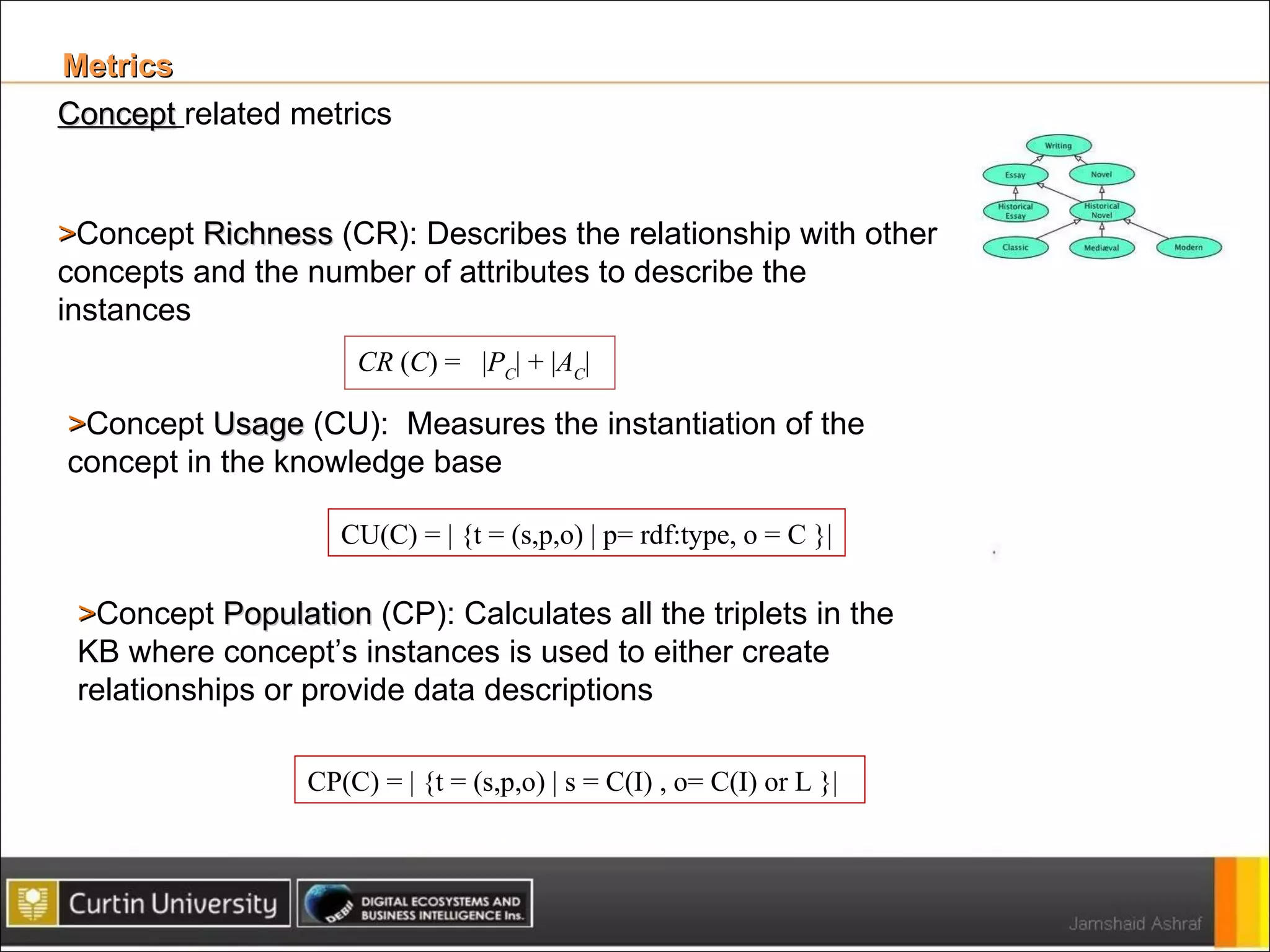
Metrics  Concept   related metrics > Concept  Richness  (CR): Describes the relationship with other concepts and the number of attributes to describe the instances CR  ( C ) =  | P C | + | A C | > Concept  Usage  (CU):  Measures the instantiation of the concept in the knowledge base CU(C) = | {t = (s,p,o) | p= rdf:type, o = C }| > Concept  Population  (CP): Calculates all the triplets in the KB where concept’s instances is used to either create relationships or provide data descriptions CP(C) = | {t = (s,p,o) | s = C(I) , o= C(I) or L }|
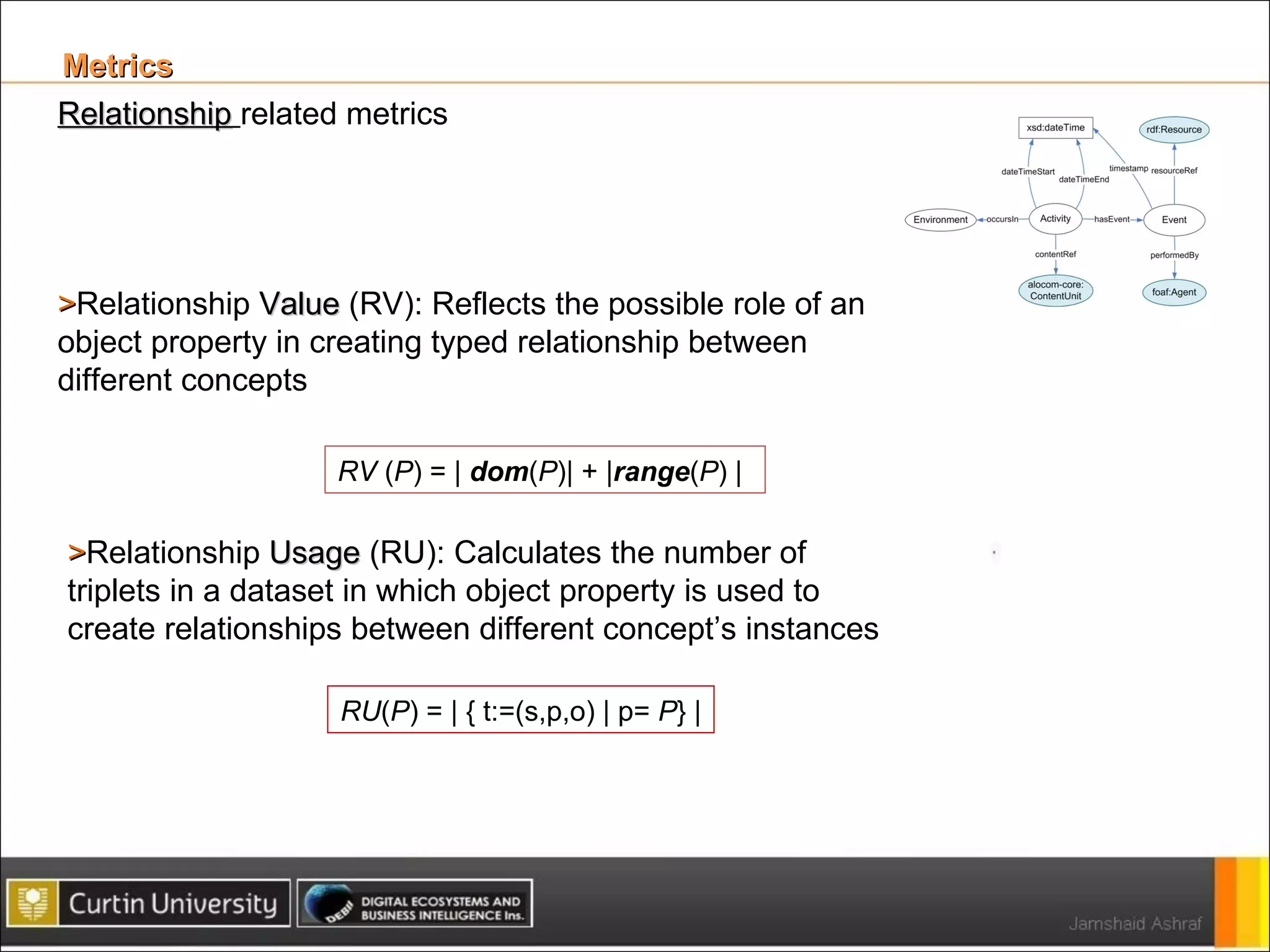
Metrics  Relationship   related metrics > Relationship  Value  (RV): Reflects the possible role of an object property in creating typed relationship between different concepts RV  ( P ) = |  dom ( P )| + | range ( P ) | > Relationship  Usage  (RU): Calculates the number of triplets in a dataset in which object property is used to create relationships between different concept’s instances RU ( P ) = | { t:=(s,p,o) | p=  P } |
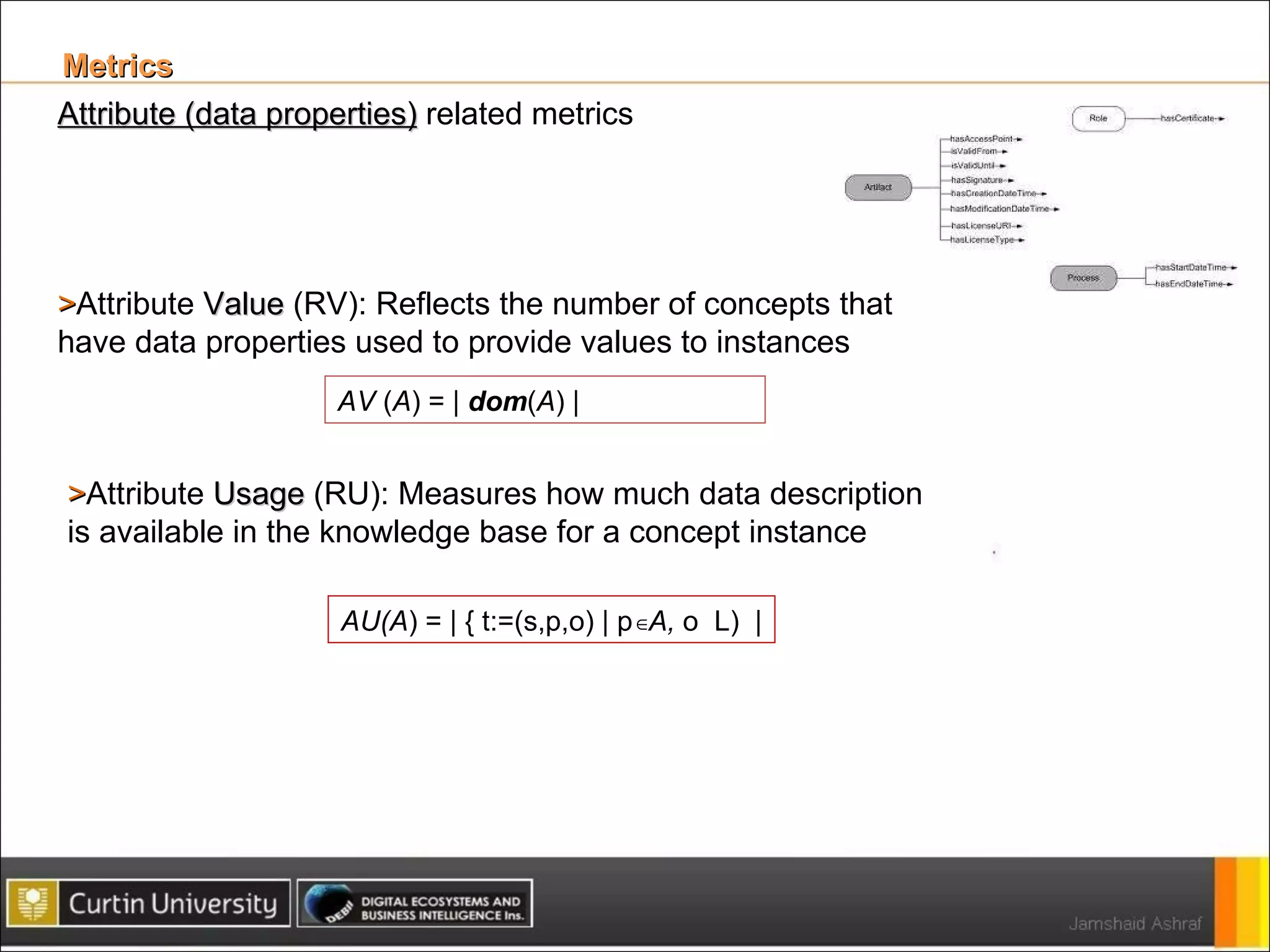
Metrics  Attribute (data properties)  related metrics > Attribute  Value  (RV): Reflects the number of concepts that have data properties used to provide values to instances  AV  ( A ) = |  dom ( A ) | > Attribute  Usage  (RU): Measures how much data description is available in the knowledge base for a concept instance AU(A ) = | { t:=(s,p,o) | p  A,  o  L)  |
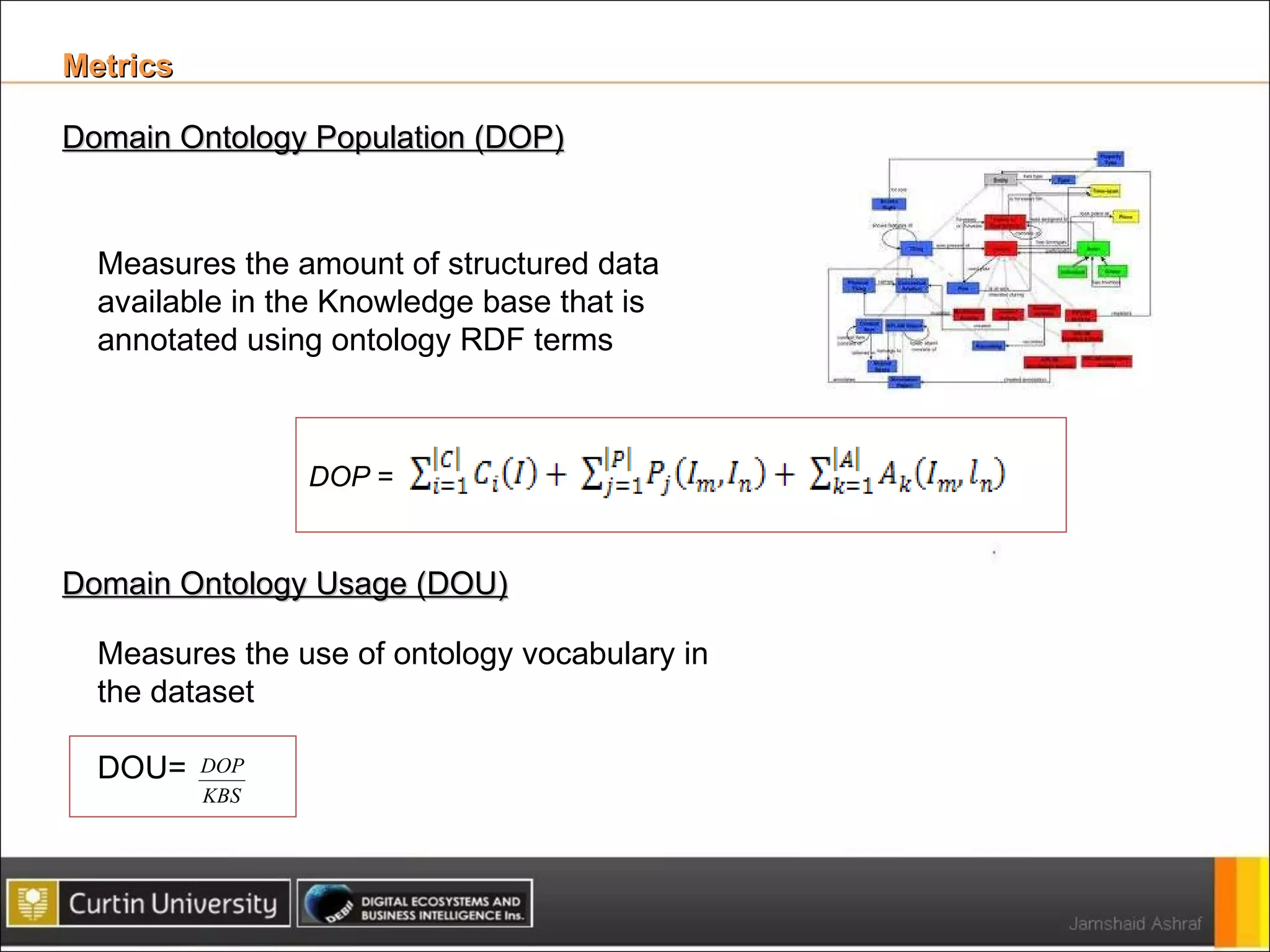
Metrics  Domain Ontology Population (DOP) Measures the amount of structured data available in the Knowledge base that is annotated using ontology RDF terms Domain Ontology Usage (DOU) Measures the use of ontology vocabulary in the dataset DOU=  DOP  =
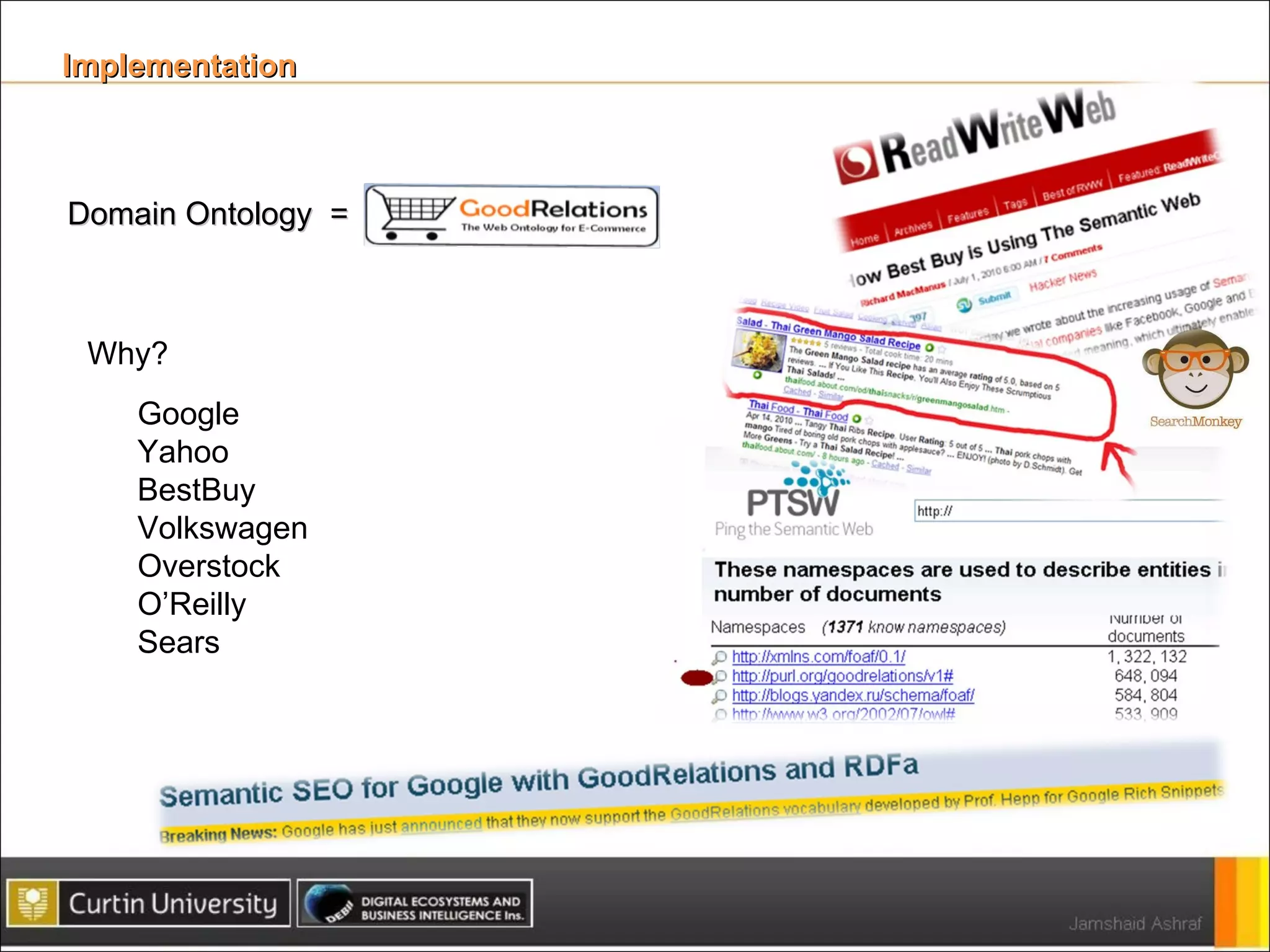
Implementation  Domain Ontology  =  Why? Google Yahoo BestBuy Volkswagen Overstock O’Reilly Sears
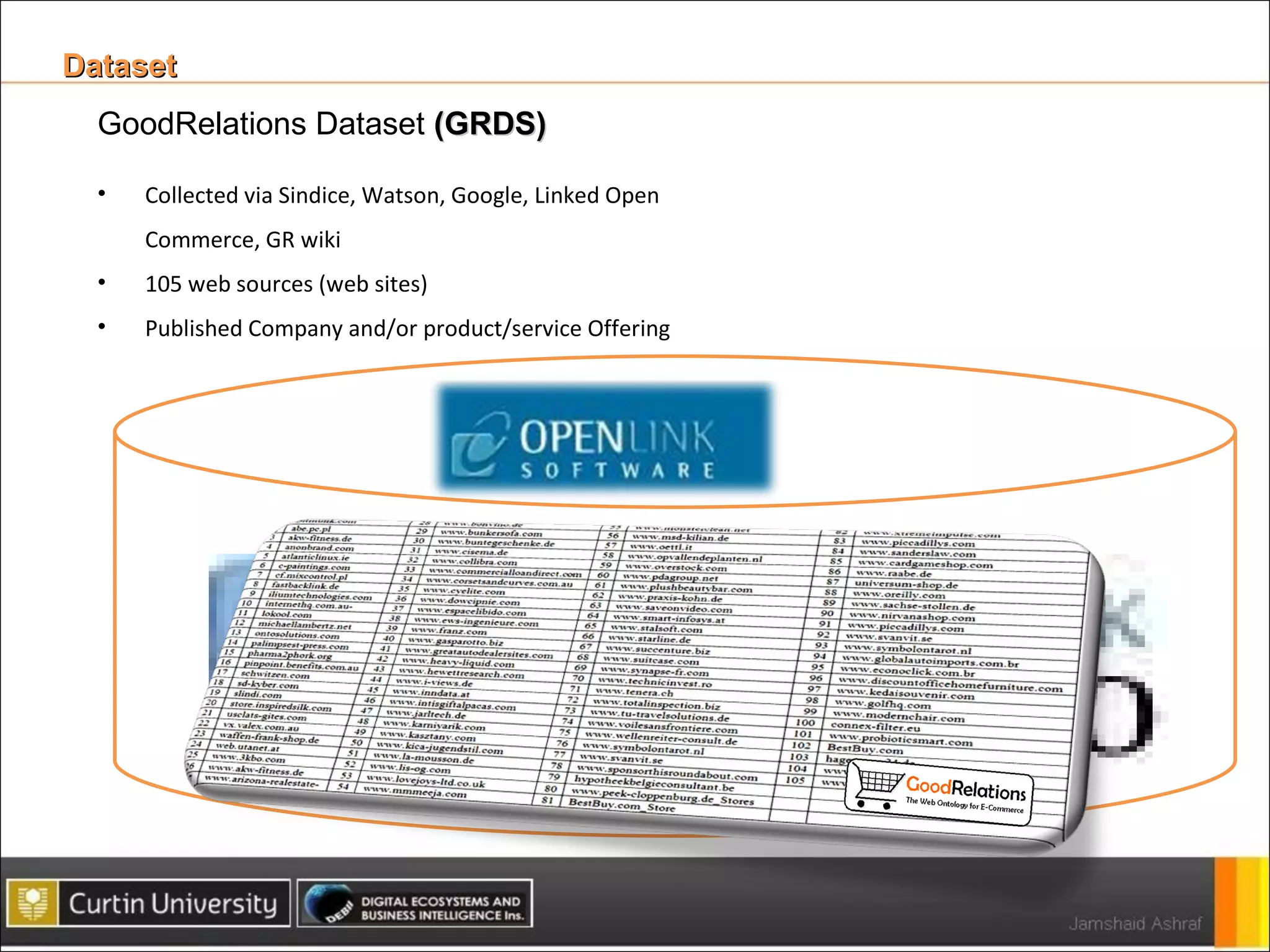
Dataset  Collected via Sindice, Watson, Google, Linked Open Commerce, GR wiki 105 web sources (web sites) Published Company and/or product/service Offering  GoodRelations Dataset  (GRDS)
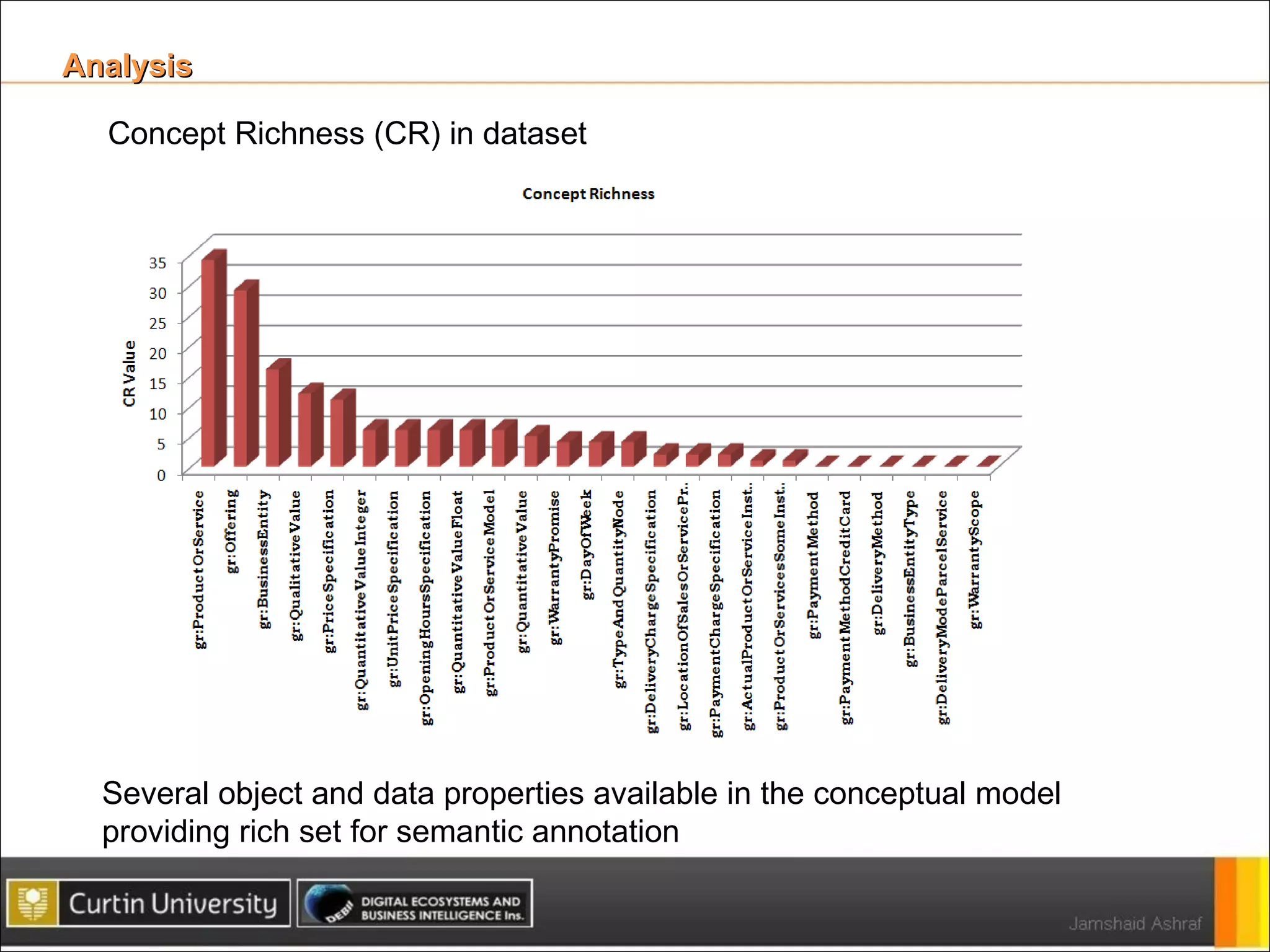
Analysis Concept Richness (CR) in dataset Several object and data properties available in the conceptual model providing rich set for semantic annotation
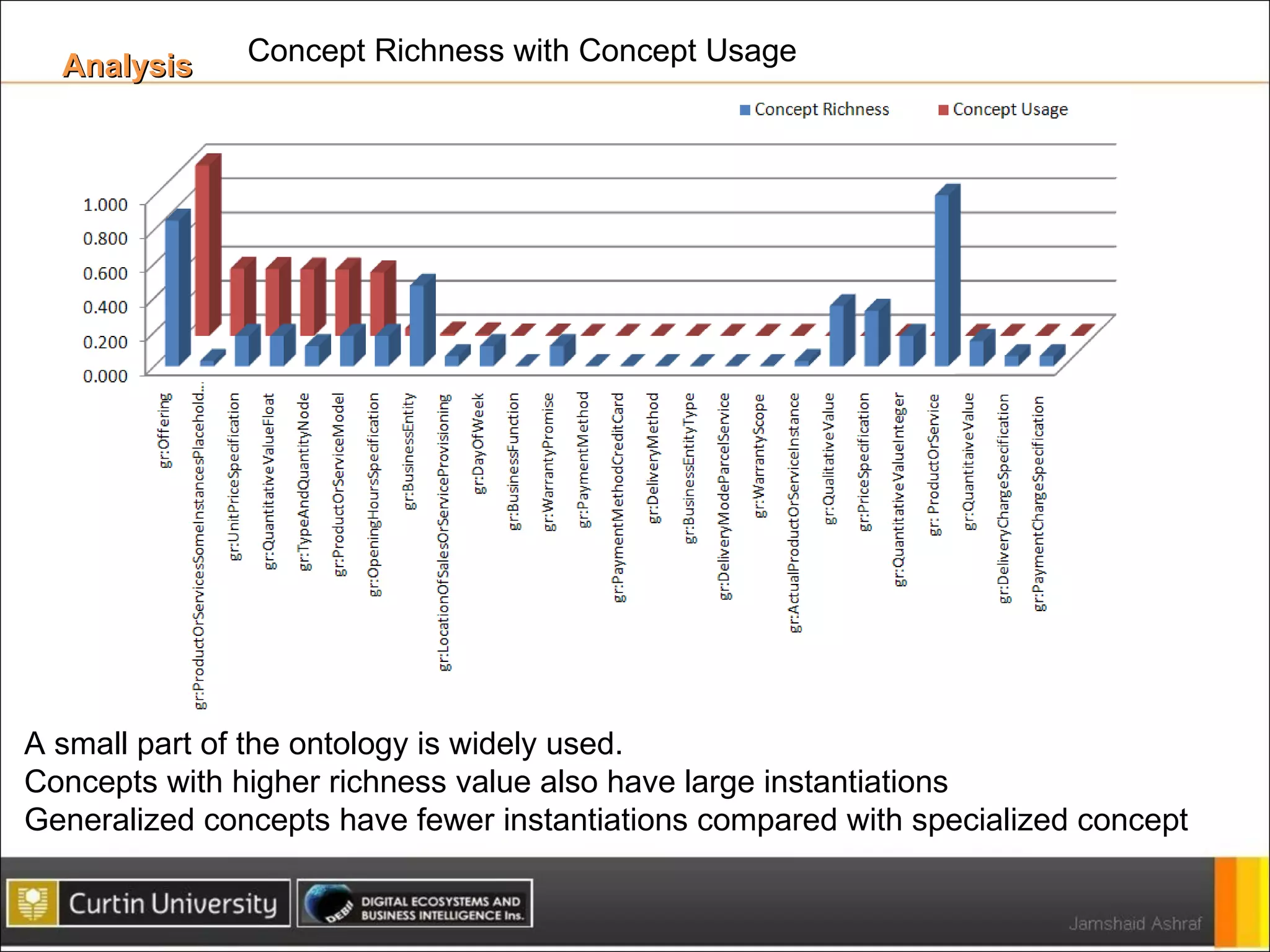
Analysis Concept Richness with Concept Usage A small part of the ontology is widely used. Concepts with higher richness value also have large instantiations Generalized concepts have fewer instantiations compared with specialized concept
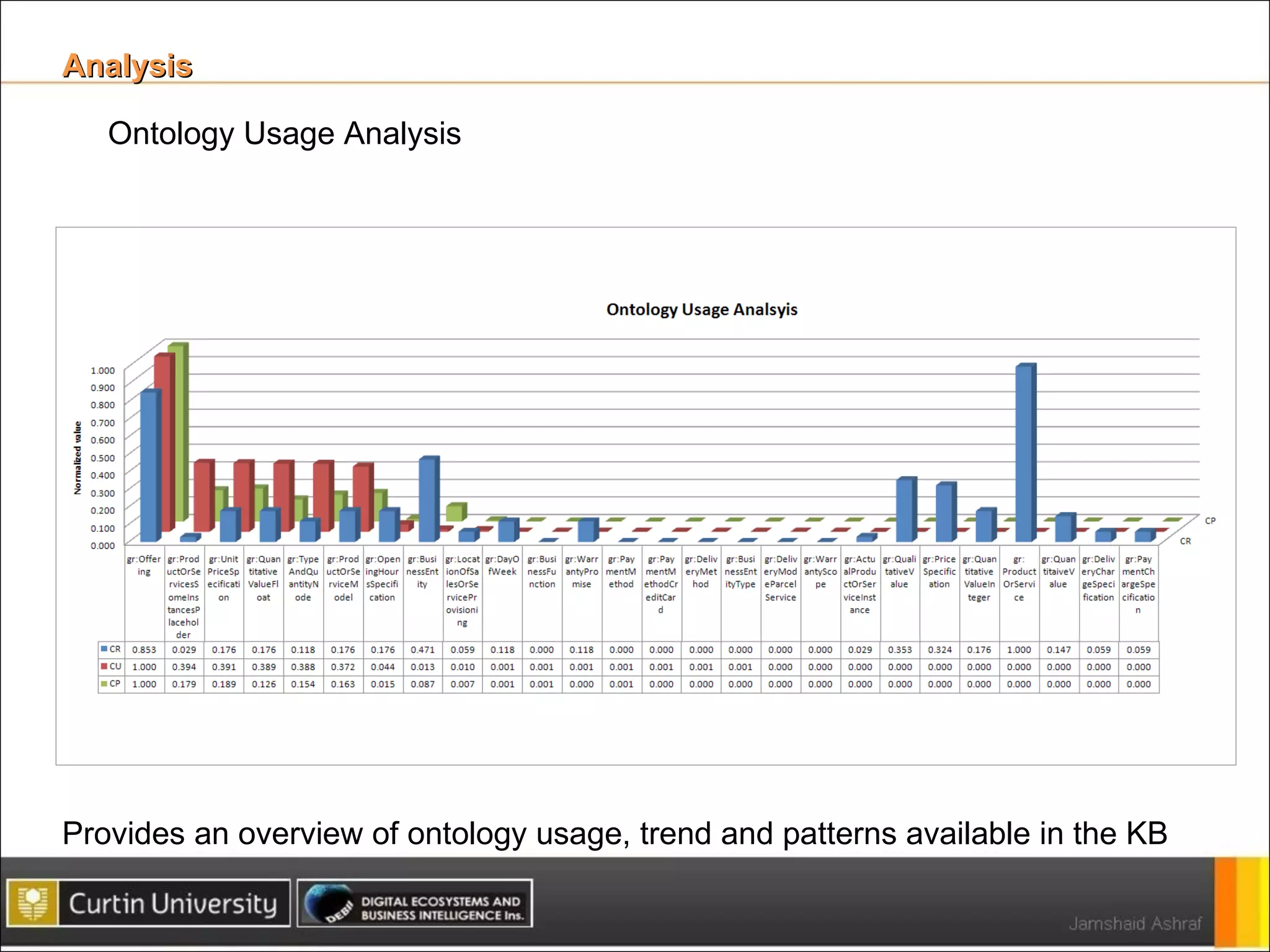
Analysis Ontology Usage Analysis Provides an overview of ontology usage, trend and patterns available in the KB
Conclusion  Ontology Usage Analysis helps is finding the data patterns available in the web of data  helps  ontology engineers/developer to understand the usage patterns and evolve the ontology accordingly helps is mapping different vocabularies based on their usages helps  developers in anticipating the available knowledge (T-Box) in knowledgebase
Expand the dataset and include other ontologies  Automate the analysis process  Instance data quality, consistency Recommendations to publishers and vocabulary designers Future work
Thanks!  Questions……… Please email: jamshaid.ashraf@gmail.com

Domain Ontology Usage Analysis Framework (OUSAF)

  • 1.
    Domain Ontology UsageAnalysis Framework Analyzing the Usage of Domain Ontologies on the (Semantic) Web Jamshaid Ashraf, M aja Hadzic Presenter : Dr Omar Khadeer Hussain >> SKG2011 , Beijing, China        Oct. 24-26, 2011
  • 2.
    Measuring the SemanticWeb on the Web Web Semantic Web data (Linked data cloud) Structured attribute: http://richard.cyganiak.de/2007/10/lod Q) What and how ontologies are being used on the web? This research attempts to answers What Significant growth in semantic web data RDF  enabling machines to read Imperial analysis by using ontologies
  • 3.
    Growth of OntologiesTremendous growth in the use of ontologies Swoogle has an index of 10,000 ontologies PingTheSemanticWeb has listed 1442 known namespaces used in the documents Ontologies are developed based on Ontology development process based on certain methodology
  • 4.
    What is needed?Evaluate and analyse the usage of an ontology Its adoption and uptake by different users on the semantic web. Provide an insight into the structure, understand the pattern available, actual use and the intended use Understand Ontology Usage in Billions of triples in Linked Open Data (LOD) cloud.
  • 5.
    Contributions of thispaper Ontology Usage Analysis Framework Proposes a set of metrics to measure the ontology usage Understand the depth of ontology adoptions and the structured data patterns available in the web of data
  • 6.
    Difference of OntologyUsage with Ontology Evaluation and Evolution Ontology Usage analyses the use of ontology on the web by measuring its usage, usefulness and commercial advantages Ontology Evaluation is the analysis of guaranteeing what is built meets the requirements and is error free Ontology Evolution is the timely adoption of ontology to the arisen changes and consistent management of these changes Overlap between ontology usage, evaluation and evolution
  • 7.
    Why Ontology UsageAnalysis ( OUA ) Think Design Develop & evaluate (ontology only) Deploy Evangelize Adoption! Measure and analyze Learn from it to influence future thinking and design Typical ontology Lifecycle Ontology OUA contribution (in red) Why
  • 8.
    Domain Ontology US age A nalysis F ramework (OUSAF)
  • 9.
    Metrics Concept related metrics Relationship related metrics Attribute (data properties) related metrics
  • 10.
    Metrics Concept related metrics > Concept Richness (CR): Describes the relationship with other concepts and the number of attributes to describe the instances CR ( C ) = | P C | + | A C | > Concept Usage (CU): Measures the instantiation of the concept in the knowledge base CU(C) = | {t = (s,p,o) | p= rdf:type, o = C }| > Concept Population (CP): Calculates all the triplets in the KB where concept’s instances is used to either create relationships or provide data descriptions CP(C) = | {t = (s,p,o) | s = C(I) , o= C(I) or L }|
  • 11.
    Metrics Relationship related metrics > Relationship Value (RV): Reflects the possible role of an object property in creating typed relationship between different concepts RV ( P ) = | dom ( P )| + | range ( P ) | > Relationship Usage (RU): Calculates the number of triplets in a dataset in which object property is used to create relationships between different concept’s instances RU ( P ) = | { t:=(s,p,o) | p= P } |
  • 12.
    Metrics Attribute(data properties) related metrics > Attribute Value (RV): Reflects the number of concepts that have data properties used to provide values to instances AV ( A ) = | dom ( A ) | > Attribute Usage (RU): Measures how much data description is available in the knowledge base for a concept instance AU(A ) = | { t:=(s,p,o) | p A, o L) |
  • 13.
    Metrics DomainOntology Population (DOP) Measures the amount of structured data available in the Knowledge base that is annotated using ontology RDF terms Domain Ontology Usage (DOU) Measures the use of ontology vocabulary in the dataset DOU= DOP =
  • 14.
    Implementation DomainOntology = Why? Google Yahoo BestBuy Volkswagen Overstock O’Reilly Sears
  • 15.
    Dataset Collectedvia Sindice, Watson, Google, Linked Open Commerce, GR wiki 105 web sources (web sites) Published Company and/or product/service Offering GoodRelations Dataset (GRDS)
  • 16.
    Analysis Concept Richness(CR) in dataset Several object and data properties available in the conceptual model providing rich set for semantic annotation
  • 17.
    Analysis Concept Richnesswith Concept Usage A small part of the ontology is widely used. Concepts with higher richness value also have large instantiations Generalized concepts have fewer instantiations compared with specialized concept
  • 18.
    Analysis Ontology UsageAnalysis Provides an overview of ontology usage, trend and patterns available in the KB
  • 19.
    Conclusion OntologyUsage Analysis helps is finding the data patterns available in the web of data helps ontology engineers/developer to understand the usage patterns and evolve the ontology accordingly helps is mapping different vocabularies based on their usages helps developers in anticipating the available knowledge (T-Box) in knowledgebase
  • 20.
    Expand the datasetand include other ontologies Automate the analysis process Instance data quality, consistency Recommendations to publishers and vocabulary designers Future work
  • 21.
    Thanks! Questions………Please email: jamshaid.ashraf@gmail.com

Editor's Notes

  • #3 What are we trying to achieve in this research? We have seen tremendous growth in the semantic web data (web-of-data) on the web. As a result of it now we have “structured data” on the web in the form of RDF, enabling “ machines ” to automatically understand the data and process it. Now, we have reached to the point where, the availability of semantic data on the web is enabling the possibility of conducting imperial analysis about the data, use of ontologies .
  • #8 In the early days of ontology engineering research the main focus was on evaluating the ontologies based on their conceptual coverage and the taxonomical relationships available in ontology. All the previous work in ontology evaluation hardly included the “actual” instantiated data in their evaluation due to the lack on ontology implementation in real world setting/application. Now, since we have seem tremendous adoption of different ontologies on the web, and having billions of triples in Linked Open Data (LOD) cloud, now we are in position to perform ontology usage analysis on actual data ….. Conducting empirical studies… In the semantic data life cycle, we need to introduce set of metrics and measures to understand the ontology usage, data patterns and semantic coverage of data The results of these measures can be used further to improve the ontology design, model and help developers to effectively and efficiently consume semantic data.
  • #9 This is the schematic diagram of the framework.
  • #10 The set of metrics and measures implemented in OUSAF is grouped under three categories 1) concepts 2) object relations and 3) data properties
  • #14 This computes the ontology instantiation in the dataset
  • #15 Why we are considering GoodRelations in our experiment? Because it enjoys the adoption and is being considered the largely used ontology after FOAF. There are images showing the press news, and the snapshots of application in which it is used such as Google snippet
  • #16 We used dataset comprising on around 105 data sources.