Composite Materials
Manufacturing
정분방
Introduction
 Definition: a material composed of 2 or more
constituents
 Reinforcement (e.g., Fibers)
 matrix (e.g.,epoxy)
 Advantages
 High strength and stiffness
 Low weight ratio
 Material can be designed in addition to the structure
 Can manufacture structures and eliminate joints
Applications
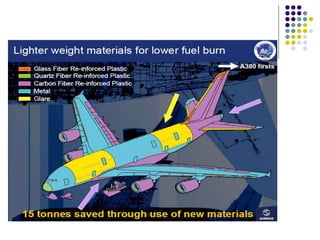
 Aerospace industry
 Sporting goods
 Automotive
 Construction
Costs of composite manufacture
 Material costs -- higher for composites
 Constituent materials (e.g., fibers and resin)
 Processing costs -- embedding fibers in matrix
 Design costs -- lower for composites
 Can reduce the number of parts in a complex assembly by
designing the material in combination with the structure
Material Forms and manufacturing
 Objectives of material production
 assemble fibers
 impregnate resin
 shape product
 cure resin
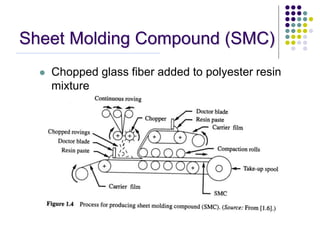
Sheet Molding Compound (SMC)
 Chopped glass fiber added to polyester resin
mixture
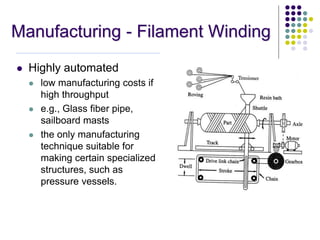
Manufacturing - Filament Winding
 Highly automated
 low manufacturing costs if
high throughput
 e.g., Glass fiber pipe,
sailboard masts
 the only manufacturing
technique suitable for
making certain specialized
structures, such as
pressure vessels.
Prepregs
 Prepreg and prepreg layup
 “prepreg” - partially cured mixture of fiber and
resin
 Unidirectional prepreg tape with paper backing
 wound on spools
 Cut and stacked
 Curing conditions
 Typical temperature and pressure in autoclave is 120-
200C, 100 psi
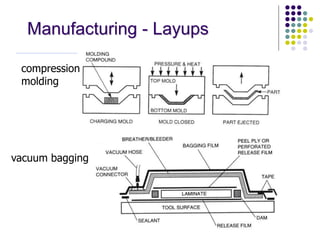
Manufacturing - Layups
compression
molding
vacuum bagging
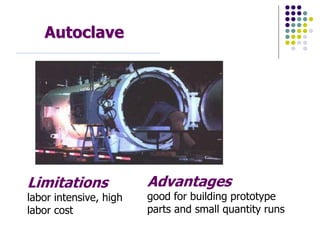
Autoclave
Limitations
labor intensive, high
labor cost
Advantages
good for building prototype
parts and small quantity runs
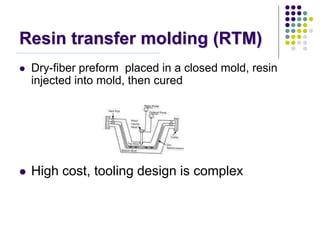
Resin transfer molding (RTM)
 Dry-fiber preform placed in a closed mold, resin
injected into mold, then cured
 High cost, tooling design is complex
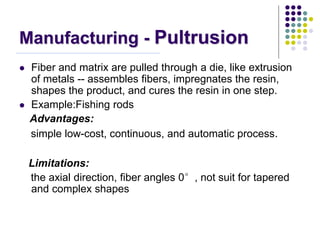
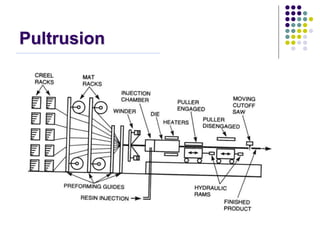
Manufacturing - Pultrusion
 Fiber and matrix are pulled through a die, like extrusion
of metals -- assembles fibers, impregnates the resin,
shapes the product, and cures the resin in one step.
 Example:Fishing rods
Advantages:
simple low-cost, continuous, and automatic process.
Limitations:
the axial direction, fiber angles 0°, not suit for tapered
and complex shapes
Pultrusion
 Thank you

dokumen.tips_composite-materials-manufacturing-composite-materials-manufacturing-.ppt

  • 1.
  • 3.
    Introduction  Definition: amaterial composed of 2 or more constituents  Reinforcement (e.g., Fibers)  matrix (e.g.,epoxy)  Advantages  High strength and stiffness  Low weight ratio  Material can be designed in addition to the structure  Can manufacture structures and eliminate joints
  • 4.
    Applications  Aerospace industry Sporting goods  Automotive  Construction
  • 5.
    Costs of compositemanufacture  Material costs -- higher for composites  Constituent materials (e.g., fibers and resin)  Processing costs -- embedding fibers in matrix  Design costs -- lower for composites  Can reduce the number of parts in a complex assembly by designing the material in combination with the structure
  • 6.
    Material Forms andmanufacturing  Objectives of material production  assemble fibers  impregnate resin  shape product  cure resin
  • 7.
    Sheet Molding Compound(SMC)  Chopped glass fiber added to polyester resin mixture
  • 8.
    Manufacturing - FilamentWinding  Highly automated  low manufacturing costs if high throughput  e.g., Glass fiber pipe, sailboard masts  the only manufacturing technique suitable for making certain specialized structures, such as pressure vessels.
  • 9.
    Prepregs  Prepreg andprepreg layup  “prepreg” - partially cured mixture of fiber and resin  Unidirectional prepreg tape with paper backing  wound on spools  Cut and stacked  Curing conditions  Typical temperature and pressure in autoclave is 120- 200C, 100 psi
  • 10.
  • 11.
    Autoclave Limitations labor intensive, high laborcost Advantages good for building prototype parts and small quantity runs
  • 12.
    Resin transfer molding(RTM)  Dry-fiber preform placed in a closed mold, resin injected into mold, then cured  High cost, tooling design is complex
  • 13.
    Manufacturing - Pultrusion Fiber and matrix are pulled through a die, like extrusion of metals -- assembles fibers, impregnates the resin, shapes the product, and cures the resin in one step.  Example:Fishing rods Advantages: simple low-cost, continuous, and automatic process. Limitations: the axial direction, fiber angles 0°, not suit for tapered and complex shapes
  • 14.
  • 15.