Documentation What is it? Why do you need it?
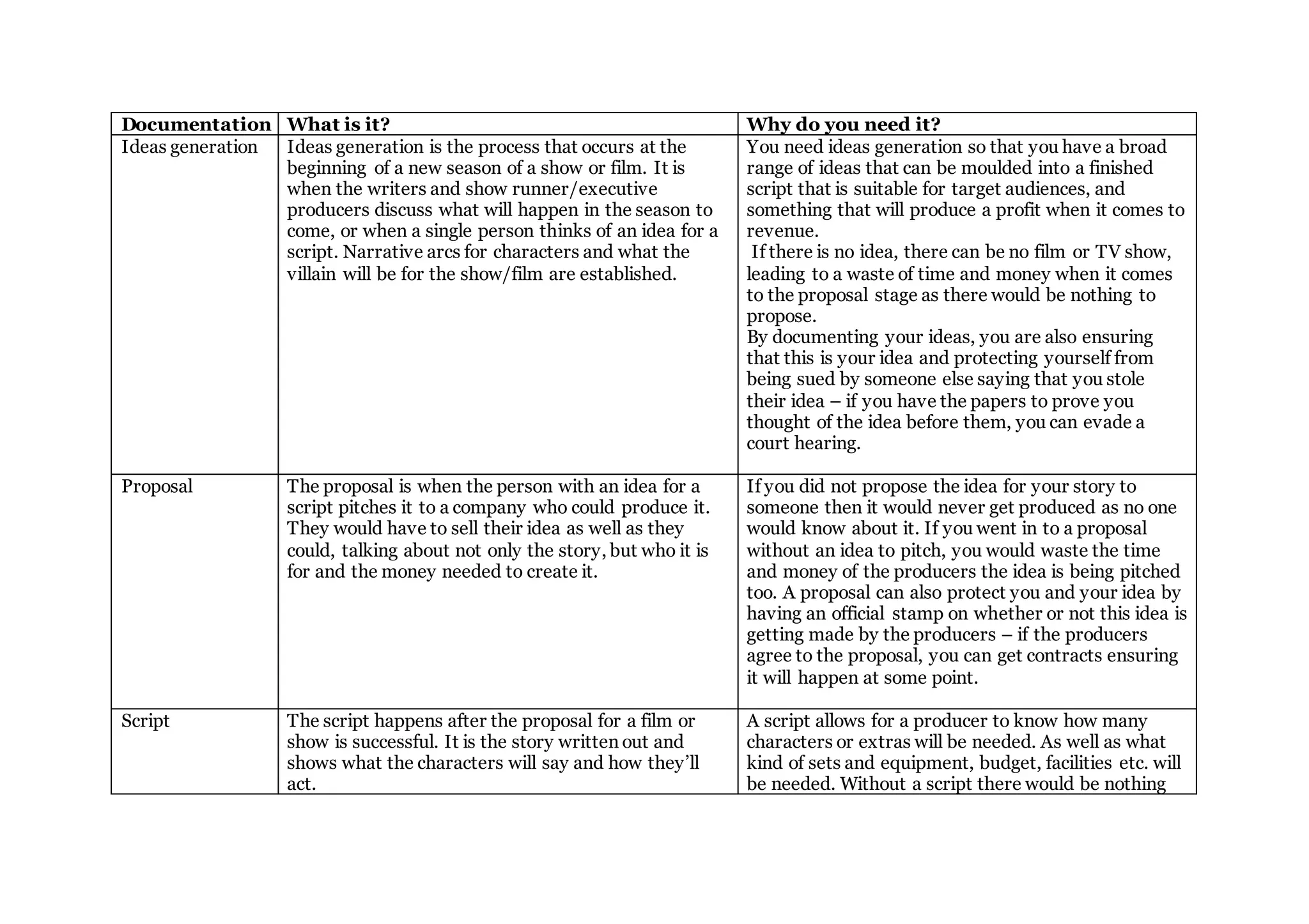
Ideas generation Ideas generation is the process that occurs at the
beginning of a new season of a show or film. It is
when the writers and show runner/executive
producers discuss what will happen in the season to
come, or when a single person thinks of an idea for a
script. Narrative arcs for characters and what the
villain will be for the show/film are established.
You need ideas generation so that you have a broad
range of ideas that can be moulded into a finished
script that is suitable for target audiences, and
something that will produce a profit when it comes to
revenue.
If there is no idea, there can be no film or TV show,
leading to a waste of time and money when it comes
to the proposal stage as there would be nothing to
propose.
By documenting your ideas, you are also ensuring
that this is your idea and protecting yourself from
being sued by someone else saying that you stole
their idea – if you have the papers to prove you
thought of the idea before them, you can evade a
court hearing.
Proposal The proposal is when the person with an idea for a
script pitches it to a company who could produce it.
They would have to sell their idea as well as they
could, talking about not only the story, but who it is
for and the money needed to create it.
If you did not propose the idea for your story to
someone then it would never get produced as no one
would know about it. If you went in to a proposal
without an idea to pitch, you would waste the time
and money of the producers the idea is being pitched
too. A proposal can also protect you and your idea by
having an official stamp on whether or not this idea is
getting made by the producers – if the producers
agree to the proposal, you can get contracts ensuring
it will happen at some point.
Script The script happens after the proposal for a film or
show is successful. It is the story written out and
shows what the characters will say and how they’ll
act.
A script allows for a producer to know how many
characters or extras will be needed. As well as what
kind of sets and equipment, budget, facilities etc. will
be needed. Without a script there would be nothing
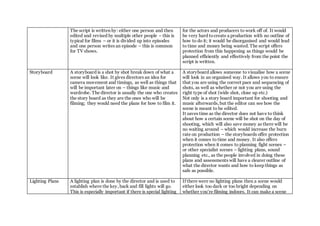
The script is written by: either one person and then
edited and revised by multiple other people – this is
typical for films – or it is divided up into episodes
and one person writes an episode – this is common
for TV shows.
for the actors and producers to work off of. It would
be very hard tocreate a production with no outline of
how to do it; it would be disorganised and would lead
to time and money being wasted. The script offers
protection from this happening as things would be
planned efficiently and effectively from the point the
script is written.
Storyboard A storyboard is a shot by shot break down of what a
scene will look like. It gives directors an idea for
camera movement and timings, as well as things that
will be important later on – things like music and
wardrobe. The director is usually the one who creates
the story board as they are the ones who will be
filming; they would need the plans for how to film it.
A storyboard allows someone to visualise how a scene
will look in an organised way. It allows you to ensure
that you are using the correct pace and sequencing of
shots, as well as whether or not you are using the
right type of shot (wide shot, close up etc.)
Not only is a story board important for shooting and
music afterwards, but the editor can see how the
scene is meant to be edited.
It saves time as the director does not have to think
about how a certain scene will be shot on the day of
shooting, which will also save money as there will be
no waiting around – which would increase the burn
rate on production – the storyboards offer protection
when it comes to time and money. It also offers
protection when it comes to planning fight scenes –
or other specialist scenes – lighting plans, sound
planning etc., as the people involved in doing these
plans and assessments will have a clearer outline of
what the director wants and how to keep things as
safe as possible.
Lighting Plans A lighting plan is done by the director and is used to
establish where the key, back and fill lights will go.
This is especially important if there is special lighting
If there were no lighting plans then a scene would
either look too dark or too bright depending on
whether you’re filming indoors. It can make a scene
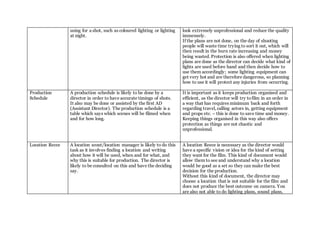
using for a shot, such as coloured lighting or lighting
at night.
look extremely unprofessional and reduce the quality
immensely.
If the plans are not done, on the day of shooting
people will waste time trying to sort it out, which will
then result in the burn rate increasing and money
being wasted. Protection is also offered when lighting
plans are done as the director can decide what kind of
lights are used before hand and then decide how to
use them accordingly; some lighting equipment can
get very hot and are therefore dangerous, so planning
how to use it will protect any injuries from occurring.
Production
Schedule
A production schedule is likely to be done by a
director in order to have accurate timings of shots.
It also may be done or assisted by the first AD
(Assistant Director). The production schedule is a
table which says which scenes will be filmed when
and for how long.
It is important as it keeps production organised and
efficient, as the director will try tofilm in an order in
a way that has requires minimum back and forth
regarding travel, calling actors in, getting equipment
and props etc. – this is done to save time and money.
Keeping things organised in this way also offers
protection as things are not chaotic and
unprofessional.
Location Recce A location scout/location manager is likely to do this
task as it involves finding a location and writing
about how it will be used, when and for what, and
why this is suitable for production. The director is
likely to be consulted on this and have the deciding
say.
A location Reece is necessary as the director would
have a specific vision or idea for the kind of setting
they want for the film. This kind of document would
allow them to see and understand why a location
would be good as a set so they can make the best
decision for the production.
Without this kind of document, the director may
choose a location that is not suitable for the film and
does not produce the best outcome on camera. You
are also not able to do lighting plans, sound plans,
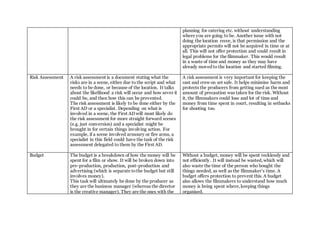
planning for catering etc. without understanding
where you are going to be. Another issue with not
doing the location recce, is that permission and the
appropriate permits will not be acquired in time or at
all. This will not offer protection and could result in
legal problems for the filmmaker. This would result
in a waste of time and money as they may have
already moved to the location and started filming.
Risk Assessment A risk assessment is a document stating what the
risks are in a scene, either due to the script and what
needs to be done, or because of the location. It talks
about the likelihood a risk will occur and how sever it
could be, and then how this can be prevented.
The risk assessment is likely to be done either by the
First AD or a specialist. Depending on what is
involved in a scene, the First AD will most likely do
the risk assessment for more straight forward scenes
(e.g. just conversion) and a specialist might be
brought in for certain things involving action. For
example, if a scene involved armoury or fire arms, a
specialist in this field could have the task of the risk
assessment delegated to them by the First AD.
A risk assessment is very important for keeping the
cast and crew on set safe. It helps minimise harm and
protects the producers from getting sued as the most
amount of precaution was taken for the risk. Without
it, the filmmakers could lose and lot of time and
money from time spent in court, resulting in setbacks
for shooting too.
Budget The budget is a breakdown of how the money will be
spent for a film or show. It will be broken down into
pre-production, production, post-production and
advertising (which is separate tothe budget but still
involves money).
This task will ultimately be done by the producer as
they are the business manager (whereas the director
is the creative manager). They are the ones with the
Without a budget, money will be spent recklessly and
not efficiently. It will instead be wasted, which will
also waste the time of the person who bought the
things needed, as well as the filmmaker’s time. A
budget offers protection to prevent this. A budget
also allows the filmmakers to understand how much
money is being spent where, keeping things
organised.
final say but are likely to delegate job roles to
accounting and finance departments lower down to
get things done.
Call Sheets The First AD is the person in charge of doing call
sheets. It is a document that tells people what actors
are needed on set and when, as well as some
information on what will be filmed that day.
This is done to save money and time because people
only come to set when they are needed, meaning they
do not spend a lot of time sitting in their trailer
rather than working – as this industry is unionised,
people sitting around are likely to get paid, so a call
sheet protects the filmmakers from wasting time and
money. Call sheets also allows the actor to prepare
for the scene they are going to do that day (as films
and shows are often filmed out of order).
Equipment
Booking Forms
Equipment is not always bought, but rented out when
filming certain projects. This means that someone,
the First AD, will have to book a list of equipment for
a certain amount of time.
Without these forms, certain equipment that might
be needed might be missed out and it could lead to
set backs on filming, wasting time. Money may also
be wasted if someone books the wrong type of
equipment. Keeping things organised with the
appropriate documents offers protection for
production and allows things to run smoothly.
Ensuring the correct things are booked for the right
amount of time will save money as you may not need
a certain type of camera throughout the whole of
production.
Contributor
Release Forms
Contributor release forms are consent forms that the
actors involved must sign before things are filmed
and released. It is documented proof that an actor
has consented to being in the film or show being shot.
The First AD is the person in charge of collecting this
document.
If the consent forms are not signed, the production
cannot be released to the public as the actors would
not have consented to it. If the filmmakers released
the media anyway, there could be legal repercussions
and they could get sued by the actor if the actor did
not want the media to go out. The consent form
protects the producers and directors from getting in
this sort of situation. The actors can also pull out of
filming if they change their mind in the middle of
shooting, decided that they no longer want to be a
part of the project. If they did not sign the
contributor release form, then they could do this
without repercussions, which would then lead to the
time and money spend on the production being
wasted and the actor may have to be recast – the
form protects this from happening.
If a child is involved in filming (under 16 in the UK)
the parents must sign the form for them, or it could
again lead to legal action being taken.

Documentation table

  • 1.
    Documentation What isit? Why do you need it? Ideas generation Ideas generation is the process that occurs at the beginning of a new season of a show or film. It is when the writers and show runner/executive producers discuss what will happen in the season to come, or when a single person thinks of an idea for a script. Narrative arcs for characters and what the villain will be for the show/film are established. You need ideas generation so that you have a broad range of ideas that can be moulded into a finished script that is suitable for target audiences, and something that will produce a profit when it comes to revenue. If there is no idea, there can be no film or TV show, leading to a waste of time and money when it comes to the proposal stage as there would be nothing to propose. By documenting your ideas, you are also ensuring that this is your idea and protecting yourself from being sued by someone else saying that you stole their idea – if you have the papers to prove you thought of the idea before them, you can evade a court hearing. Proposal The proposal is when the person with an idea for a script pitches it to a company who could produce it. They would have to sell their idea as well as they could, talking about not only the story, but who it is for and the money needed to create it. If you did not propose the idea for your story to someone then it would never get produced as no one would know about it. If you went in to a proposal without an idea to pitch, you would waste the time and money of the producers the idea is being pitched too. A proposal can also protect you and your idea by having an official stamp on whether or not this idea is getting made by the producers – if the producers agree to the proposal, you can get contracts ensuring it will happen at some point. Script The script happens after the proposal for a film or show is successful. It is the story written out and shows what the characters will say and how they’ll act. A script allows for a producer to know how many characters or extras will be needed. As well as what kind of sets and equipment, budget, facilities etc. will be needed. Without a script there would be nothing
  • 2.
    The script iswritten by: either one person and then edited and revised by multiple other people – this is typical for films – or it is divided up into episodes and one person writes an episode – this is common for TV shows. for the actors and producers to work off of. It would be very hard tocreate a production with no outline of how to do it; it would be disorganised and would lead to time and money being wasted. The script offers protection from this happening as things would be planned efficiently and effectively from the point the script is written. Storyboard A storyboard is a shot by shot break down of what a scene will look like. It gives directors an idea for camera movement and timings, as well as things that will be important later on – things like music and wardrobe. The director is usually the one who creates the story board as they are the ones who will be filming; they would need the plans for how to film it. A storyboard allows someone to visualise how a scene will look in an organised way. It allows you to ensure that you are using the correct pace and sequencing of shots, as well as whether or not you are using the right type of shot (wide shot, close up etc.) Not only is a story board important for shooting and music afterwards, but the editor can see how the scene is meant to be edited. It saves time as the director does not have to think about how a certain scene will be shot on the day of shooting, which will also save money as there will be no waiting around – which would increase the burn rate on production – the storyboards offer protection when it comes to time and money. It also offers protection when it comes to planning fight scenes – or other specialist scenes – lighting plans, sound planning etc., as the people involved in doing these plans and assessments will have a clearer outline of what the director wants and how to keep things as safe as possible. Lighting Plans A lighting plan is done by the director and is used to establish where the key, back and fill lights will go. This is especially important if there is special lighting If there were no lighting plans then a scene would either look too dark or too bright depending on whether you’re filming indoors. It can make a scene
  • 3.
    using for ashot, such as coloured lighting or lighting at night. look extremely unprofessional and reduce the quality immensely. If the plans are not done, on the day of shooting people will waste time trying to sort it out, which will then result in the burn rate increasing and money being wasted. Protection is also offered when lighting plans are done as the director can decide what kind of lights are used before hand and then decide how to use them accordingly; some lighting equipment can get very hot and are therefore dangerous, so planning how to use it will protect any injuries from occurring. Production Schedule A production schedule is likely to be done by a director in order to have accurate timings of shots. It also may be done or assisted by the first AD (Assistant Director). The production schedule is a table which says which scenes will be filmed when and for how long. It is important as it keeps production organised and efficient, as the director will try tofilm in an order in a way that has requires minimum back and forth regarding travel, calling actors in, getting equipment and props etc. – this is done to save time and money. Keeping things organised in this way also offers protection as things are not chaotic and unprofessional. Location Recce A location scout/location manager is likely to do this task as it involves finding a location and writing about how it will be used, when and for what, and why this is suitable for production. The director is likely to be consulted on this and have the deciding say. A location Reece is necessary as the director would have a specific vision or idea for the kind of setting they want for the film. This kind of document would allow them to see and understand why a location would be good as a set so they can make the best decision for the production. Without this kind of document, the director may choose a location that is not suitable for the film and does not produce the best outcome on camera. You are also not able to do lighting plans, sound plans,
  • 4.
    planning for cateringetc. without understanding where you are going to be. Another issue with not doing the location recce, is that permission and the appropriate permits will not be acquired in time or at all. This will not offer protection and could result in legal problems for the filmmaker. This would result in a waste of time and money as they may have already moved to the location and started filming. Risk Assessment A risk assessment is a document stating what the risks are in a scene, either due to the script and what needs to be done, or because of the location. It talks about the likelihood a risk will occur and how sever it could be, and then how this can be prevented. The risk assessment is likely to be done either by the First AD or a specialist. Depending on what is involved in a scene, the First AD will most likely do the risk assessment for more straight forward scenes (e.g. just conversion) and a specialist might be brought in for certain things involving action. For example, if a scene involved armoury or fire arms, a specialist in this field could have the task of the risk assessment delegated to them by the First AD. A risk assessment is very important for keeping the cast and crew on set safe. It helps minimise harm and protects the producers from getting sued as the most amount of precaution was taken for the risk. Without it, the filmmakers could lose and lot of time and money from time spent in court, resulting in setbacks for shooting too. Budget The budget is a breakdown of how the money will be spent for a film or show. It will be broken down into pre-production, production, post-production and advertising (which is separate tothe budget but still involves money). This task will ultimately be done by the producer as they are the business manager (whereas the director is the creative manager). They are the ones with the Without a budget, money will be spent recklessly and not efficiently. It will instead be wasted, which will also waste the time of the person who bought the things needed, as well as the filmmaker’s time. A budget offers protection to prevent this. A budget also allows the filmmakers to understand how much money is being spent where, keeping things organised.
  • 5.
    final say butare likely to delegate job roles to accounting and finance departments lower down to get things done. Call Sheets The First AD is the person in charge of doing call sheets. It is a document that tells people what actors are needed on set and when, as well as some information on what will be filmed that day. This is done to save money and time because people only come to set when they are needed, meaning they do not spend a lot of time sitting in their trailer rather than working – as this industry is unionised, people sitting around are likely to get paid, so a call sheet protects the filmmakers from wasting time and money. Call sheets also allows the actor to prepare for the scene they are going to do that day (as films and shows are often filmed out of order). Equipment Booking Forms Equipment is not always bought, but rented out when filming certain projects. This means that someone, the First AD, will have to book a list of equipment for a certain amount of time. Without these forms, certain equipment that might be needed might be missed out and it could lead to set backs on filming, wasting time. Money may also be wasted if someone books the wrong type of equipment. Keeping things organised with the appropriate documents offers protection for production and allows things to run smoothly. Ensuring the correct things are booked for the right amount of time will save money as you may not need a certain type of camera throughout the whole of production. Contributor Release Forms Contributor release forms are consent forms that the actors involved must sign before things are filmed and released. It is documented proof that an actor has consented to being in the film or show being shot. The First AD is the person in charge of collecting this document. If the consent forms are not signed, the production cannot be released to the public as the actors would not have consented to it. If the filmmakers released the media anyway, there could be legal repercussions and they could get sued by the actor if the actor did not want the media to go out. The consent form
  • 6.
    protects the producersand directors from getting in this sort of situation. The actors can also pull out of filming if they change their mind in the middle of shooting, decided that they no longer want to be a part of the project. If they did not sign the contributor release form, then they could do this without repercussions, which would then lead to the time and money spend on the production being wasted and the actor may have to be recast – the form protects this from happening. If a child is involved in filming (under 16 in the UK) the parents must sign the form for them, or it could again lead to legal action being taken.