
Understanding
DOCUMENT DEVELOPMENT
LIFE CYCLE
Document Development Life Cycle (DDLC) is a complete
life cycle of a documentation task. It involves step-by-
step process involved in creating a document.
Okay, why a document needs a
lifecycle? It’s just a document!
Document Development Life Cycle…
• Creates a baseline methodology for document creation.
• Leads to a well-defined and structured technical
document.
• Improves productivity and gives better results.
Here’s Why!
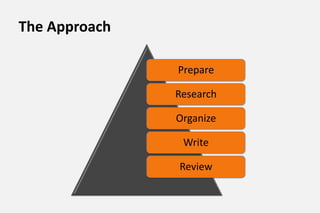
The Approach
Prepare
Research
Organize
Write
Review
PREPARE
You should prepare well before initiating any process.
Same goes for creating a document.
Get Set!
Establish your primary purpose
Assess your audience and the context
Determine the scope of your coverage
Select the appropriate medium
#1
#2
#3
#4
RESEARCH
Research is the engine room of development.
Do It Well. Do It Thoroughly.
Brainstorm to determine what you already know
Perform background research to gather source
documents, correspondence, reports, etc.
Conduct SME interviews and take notes
Leverage internet sources, including websites,
directories, archives, and groups
#1
#2
#3
#4
ORGANIZE
Organized information is most accessible and useful.
When everything is organized, it makes work so easier
and fun.
Classify Your Chunks.
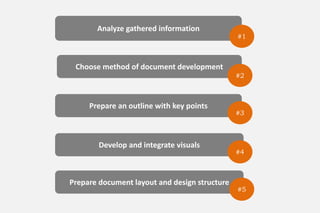
Choose method of document development
Prepare an outline with key points
Develop and integrate visuals
#2
#3
#4
Analyze gathered information
#1
Prepare document layout and design structure
#5
WRITE
They’ll use it when they’ll be stuck. Consider whether
or not the audience will be able to understand
your words.
Be User-Centered.
Expand outlines
Adopt an appropriate style and tone
Prepare first draft
Create introduction
#1
#2
#3
#4
Write conclusion/ summary
#5
REVISION
A bad document causes frustration and
miscommunication.
Proofread, Review.
Check for accuracy and completeness
Check for grammar and language issues
Trim extraneous information
Peer Review
#1
#2
#3
#4
Technical and Editorial Review
#5
Documentation in Agile Environment
Iterative Is The Keyword.
What is Agile Environment, Anyways?
Agile environment is where things change frequently, and
we need to change with them.
If we spend too much time setting requirements in stone,
they’re out of date by the time we write the document.
And then the documentation will be obsolete.
Agile is all about iterative development, which requires
iterative writing.
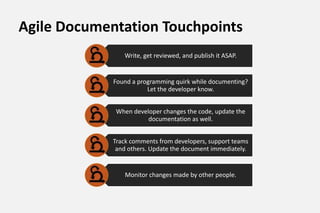
Agile Documentation Touchpoints
Write, get reviewed, and publish it ASAP.
Found a programming quirk while documenting?
Let the developer know.
When developer changes the code, update the
documentation as well.
Track comments from developers, support teams
and others. Update the document immediately.
Monitor changes made by other people.
That’s all!
Creating a document is easy. You just need to be Agile,
and align the processes with your goals.
Thank You!

Document Development Life Cycle

  • 1.
  • 2.
    Document Development LifeCycle (DDLC) is a complete life cycle of a documentation task. It involves step-by- step process involved in creating a document.
  • 3.
    Okay, why adocument needs a lifecycle? It’s just a document!
  • 4.
    Document Development LifeCycle… • Creates a baseline methodology for document creation. • Leads to a well-defined and structured technical document. • Improves productivity and gives better results. Here’s Why!
  • 5.
  • 6.
  • 7.
    You should preparewell before initiating any process. Same goes for creating a document. Get Set!
  • 8.
    Establish your primarypurpose Assess your audience and the context Determine the scope of your coverage Select the appropriate medium #1 #2 #3 #4
  • 9.
  • 10.
    Research is theengine room of development. Do It Well. Do It Thoroughly.
  • 11.
    Brainstorm to determinewhat you already know Perform background research to gather source documents, correspondence, reports, etc. Conduct SME interviews and take notes Leverage internet sources, including websites, directories, archives, and groups #1 #2 #3 #4
  • 12.
  • 13.
    Organized information ismost accessible and useful. When everything is organized, it makes work so easier and fun. Classify Your Chunks.
  • 14.
    Choose method ofdocument development Prepare an outline with key points Develop and integrate visuals #2 #3 #4 Analyze gathered information #1 Prepare document layout and design structure #5
  • 15.
  • 16.
    They’ll use itwhen they’ll be stuck. Consider whether or not the audience will be able to understand your words. Be User-Centered.
  • 17.
    Expand outlines Adopt anappropriate style and tone Prepare first draft Create introduction #1 #2 #3 #4 Write conclusion/ summary #5
  • 18.
  • 19.
    A bad documentcauses frustration and miscommunication. Proofread, Review.
  • 20.
    Check for accuracyand completeness Check for grammar and language issues Trim extraneous information Peer Review #1 #2 #3 #4 Technical and Editorial Review #5
  • 21.
    Documentation in AgileEnvironment Iterative Is The Keyword.
  • 22.
    What is AgileEnvironment, Anyways? Agile environment is where things change frequently, and we need to change with them. If we spend too much time setting requirements in stone, they’re out of date by the time we write the document. And then the documentation will be obsolete. Agile is all about iterative development, which requires iterative writing.
  • 23.
    Agile Documentation Touchpoints Write,get reviewed, and publish it ASAP. Found a programming quirk while documenting? Let the developer know. When developer changes the code, update the documentation as well. Track comments from developers, support teams and others. Update the document immediately. Monitor changes made by other people.
  • 24.
    That’s all! Creating adocument is easy. You just need to be Agile, and align the processes with your goals.
  • 25.