DoThis, Don’t DoThat:
A Primer on Sitecore
Development
Presented by:
Ben Hoelting and
DaveYoungerman
Do This, Don’t Do That: A Primer on Sitecore Development
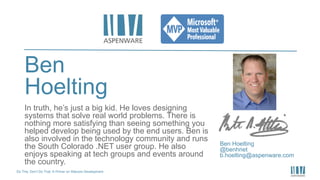
Ben
Hoelting
In truth, he’s just a big kid. He loves designing
systems that solve real world problems. There is
nothing more satisfying than seeing something you
helped develop being used by the end users. Ben is
also involved in the technology community and runs
the South Colorado .NET user group. He also
enjoys speaking at tech groups and events around
the country.
Ben Hoelting
@benhnet
b.hoelting@aspenware.com
Do This, Don’t Do That: A Primer on Sitecore Development
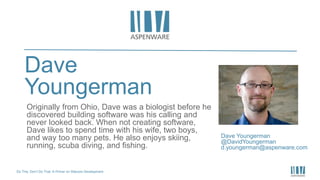
Dave
Youngerman
Dave Youngerman
@DavidYoungerman
d.youngerman@aspenware.com
Originally from Ohio, Dave was a biologist before he
discovered building software was his calling and
never looked back. When not creating software,
Dave likes to spend time with his wife, two boys,
and way too many pets. He also enjoys skiing,
running, scuba diving, and fishing.
Do This, Don’t Do That: A Primer on Sitecore Development
Agenda
• Accessing Sitecore Data
• Using Config System
• Dev Ops - DEMO
• Indexing
• Cache Management
• Unit Testing Sitecore - DEMO
Accessing
Sitecore Data
Do This, Don’t Do That: A Primer on Sitecore Development
Accessing Sitecore Data
• Sitecore templates contain the fields needed to
display data.
• There are two ways to access fields on a template
• By Name
• By ID
Do This, Don’t Do That: A Primer on Sitecore Development
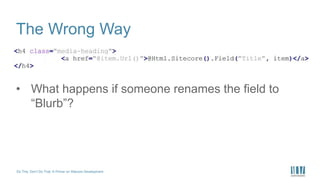
The Wrong Way
• What happens if someone renames the field to
“Blurb”?
Do This, Don’t Do That: A Primer on Sitecore Development
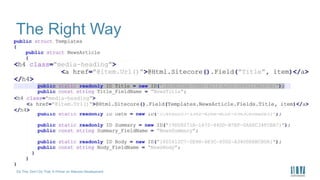
The Right Way
Next steps/Resources/Questions
9
What to do
• Take a look at Glass Mapper and decide if it is right for
you
• If not create structs, constants or classes with the ids to
your templates and fields
Resources available
• http://glass.lu/
• Use Habitat as an Example.
• http://habitat.sitecore.net
Using the
Config System
Do This, Don’t Do That: A Primer on Sitecore Development
Using the Config System
• Sitecore has a very robust configuration
system
• Use showconfig.aspx to view configs
• App_config Folder
• App_configInclude Folder
Do This, Don’t Do That: A Primer on Sitecore Development
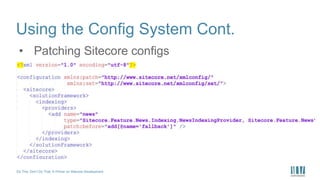
Using the Config System Cont.
• Patching Sitecore configs
Next steps/Resources/Questions
13
What to do
• Refactor any web.config changes to patches
• Use Slow Cheetah to create transforms for different
environments
Resources available
• http://tinyurl.com/j9armlv
• Use Habitat as an Example.
• http://habitat.sitecore.net
Dev Ops
Do This, Don’t Do That: A Primer on Sitecore Development
Dev Ops
• Deployment of any system that is based
on metadata is difficult
• 3rd party tools are needed
• Unicorn
• Team Development for Sitecore (TDS)
• MSBuild
• Octopus
Dev Ops
Demo
Next steps/Resources/Questions
17
What to do
• Decide between Unicorn orTeam Development for
Sitecore (TDS)
• Create build configurations for each environment and
configure them with your build server
Resources available
• http://www.teamdevelopmentforsitecore.com
• https://github.com/kamsar/Unicorn
IndexingTips
Do This, Don’t Do That: A Primer on Sitecore Development
Indexing
• Index update strategies
• You can use multiple strategies (max
of 3) to keep your indexes up to date.
• Strategies are:
• RebuildAfterFullPublish
• OnPublishEndAsync
• IntervalAsynchronous
• Synchronous
• RemoteBuild
• TimeIndexRefresh
• Manual
Indexing
Lucene vs Solr
Do This, Don’t Do That: A Primer on Sitecore Development
Indexing - Lucene
• Lucene is configured by default for content
searching.
• Stick with Lucene when...
• You don't have to index a large number of
items.
• You don't need multiple content delivery
servers.
Do This, Don’t Do That: A Primer on Sitecore Development
Indexing - Solr
• Solr is more robust, so use it when...
• You need to index large numbers of items
(50,000 and up).
• Search is your site's primary interface.
• You use multiple content delivery servers, or
you plan to in the future.
Next Steps/Resources/Questions
23
What to do
• Review Sitecore Documentation on Lucene vs Solr.
• Determine your data and scaling requirements.
Resources available
• http://tinyurl.com/gtb9bcj
Cache
Management
Do This, Don’t Do That: A Primer on Sitecore Development
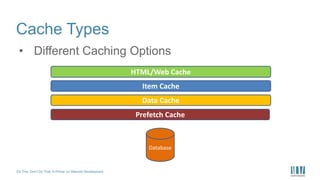
Cache Types
• Different Caching Options
HTML/Web Cache
Item Cache
Data Cache
Prefetch Cache
Database
Do This, Don’t Do That: A Primer on Sitecore Development
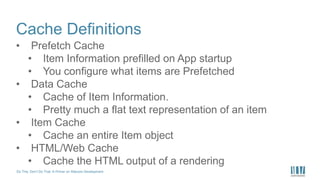
Cache Definitions
• Prefetch Cache
• Item Information prefilled on App startup
• You configure what items are Prefetched
• Data Cache
• Cache of Item Information.
• Pretty much a flat text representation of an item
• Item Cache
• Cache an entire Item object
• HTML/Web Cache
• Cache the HTML output of a rendering
Next steps/Resources/Questions
27
What to do
• Run performance tests against your site to identify
bottlenecks where caching can be applied.
• Review Sitecore cache documentation.
Resources available
• http://tinyurl.com/h7oerhy
UnitTesting
Sitecore
Do This, Don’t Do That: A Primer on Sitecore Development
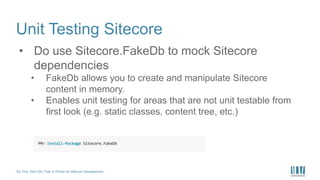
Unit Testing Sitecore
• Do use Sitecore.FakeDb to mock Sitecore
dependencies
• FakeDb allows you to create and manipulate Sitecore
content in memory.
• Enables unit testing for areas that are not unit testable from
first look (e.g. static classes, content tree, etc.)
Do This, Don’t Do That: A Primer on Sitecore Development
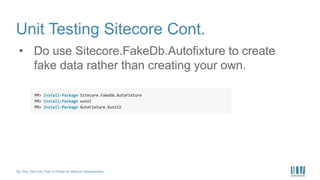
Unit Testing Sitecore Cont.
• Do use Sitecore.FakeDb.Autofixture to create
fake data rather than creating your own.
Do This, Don’t Do That: A Primer on Sitecore Development
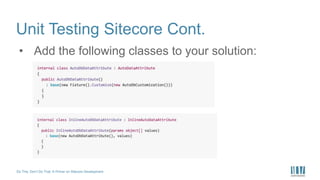
Unit Testing Sitecore Cont.
• Add the following classes to your solution:
UnitTesting
Sitecore Demo
Next steps/Resources/Questions
33
What to do
• Read the Sitecore.FakeDb GitHubWiki and start
mocking Sitecore dependencies.
• Use Autofixture to prepopulate your Sitecore mocks.
• Review Sitecore.Habitat's unit tests.
Resources available
• http://tinyurl.com/z5jn4sa
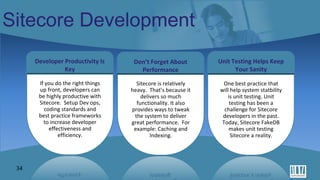
Tools for Modern Web Development
34
Sitecore Development
Don’t Forget About
Performance
Unit Testing Helps Keep
Your Sanity
Developer Productivity Is
Key
If you do the right things
up front, developers can
be highly productive with
Sitecore. Setup Dev ops,
coding standards and
best practice frameworks
to increase developer
effectiveness and
efficiency.
Sitecore is relatively
heavy. That’s because it
delivers so much
functionality. It also
provides ways to tweak
the system to deliver
great performance. For
example: Caching and
Indexing.
One best practice that
will help system statbility
is unit testing. Unit
testing has been a
challenge for Sitecore
developers in the past.
Today, Sitecore FakeDB
makes unit testing
Sitecore a reality.
Do This, Don’t Do That: A Primer on Sitecore Development
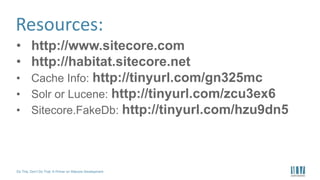
Resources:
• http://www.sitecore.com
• http://habitat.sitecore.net
• Cache Info: http://tinyurl.com/gn325mc
• Solr or Lucene: http://tinyurl.com/zcu3ex6
• Sitecore.FakeDb: http://tinyurl.com/hzu9dn5
FOR DISCUSSION PURPOSESONLY. Sitecore
Confidential and Proprietary. © 2016 Sitecore
Corporation A/S. All rights reserved. Sitecore®
and Own the Experience® are registered
trademarks of Sitecore Corporation A/S. All
other brand and product names are the
property of their respective owners.

Do This, Don't Do That: A Primer on Sitecore Development

  • 1.
    DoThis, Don’t DoThat: APrimer on Sitecore Development Presented by: Ben Hoelting and DaveYoungerman
  • 2.
    Do This, Don’tDo That: A Primer on Sitecore Development Ben Hoelting In truth, he’s just a big kid. He loves designing systems that solve real world problems. There is nothing more satisfying than seeing something you helped develop being used by the end users. Ben is also involved in the technology community and runs the South Colorado .NET user group. He also enjoys speaking at tech groups and events around the country. Ben Hoelting @benhnet b.hoelting@aspenware.com
  • 3.
    Do This, Don’tDo That: A Primer on Sitecore Development Dave Youngerman Dave Youngerman @DavidYoungerman d.youngerman@aspenware.com Originally from Ohio, Dave was a biologist before he discovered building software was his calling and never looked back. When not creating software, Dave likes to spend time with his wife, two boys, and way too many pets. He also enjoys skiing, running, scuba diving, and fishing.
  • 4.
    Do This, Don’tDo That: A Primer on Sitecore Development Agenda • Accessing Sitecore Data • Using Config System • Dev Ops - DEMO • Indexing • Cache Management • Unit Testing Sitecore - DEMO
  • 5.
  • 6.
    Do This, Don’tDo That: A Primer on Sitecore Development Accessing Sitecore Data • Sitecore templates contain the fields needed to display data. • There are two ways to access fields on a template • By Name • By ID
  • 7.
    Do This, Don’tDo That: A Primer on Sitecore Development The Wrong Way • What happens if someone renames the field to “Blurb”?
  • 8.
    Do This, Don’tDo That: A Primer on Sitecore Development The Right Way
  • 9.
    Next steps/Resources/Questions 9 What todo • Take a look at Glass Mapper and decide if it is right for you • If not create structs, constants or classes with the ids to your templates and fields Resources available • http://glass.lu/ • Use Habitat as an Example. • http://habitat.sitecore.net
  • 10.
  • 11.
    Do This, Don’tDo That: A Primer on Sitecore Development Using the Config System • Sitecore has a very robust configuration system • Use showconfig.aspx to view configs • App_config Folder • App_configInclude Folder
  • 12.
    Do This, Don’tDo That: A Primer on Sitecore Development Using the Config System Cont. • Patching Sitecore configs
  • 13.
    Next steps/Resources/Questions 13 What todo • Refactor any web.config changes to patches • Use Slow Cheetah to create transforms for different environments Resources available • http://tinyurl.com/j9armlv • Use Habitat as an Example. • http://habitat.sitecore.net
  • 14.
  • 15.
    Do This, Don’tDo That: A Primer on Sitecore Development Dev Ops • Deployment of any system that is based on metadata is difficult • 3rd party tools are needed • Unicorn • Team Development for Sitecore (TDS) • MSBuild • Octopus
  • 16.
  • 17.
    Next steps/Resources/Questions 17 What todo • Decide between Unicorn orTeam Development for Sitecore (TDS) • Create build configurations for each environment and configure them with your build server Resources available • http://www.teamdevelopmentforsitecore.com • https://github.com/kamsar/Unicorn
  • 18.
  • 19.
    Do This, Don’tDo That: A Primer on Sitecore Development Indexing • Index update strategies • You can use multiple strategies (max of 3) to keep your indexes up to date. • Strategies are: • RebuildAfterFullPublish • OnPublishEndAsync • IntervalAsynchronous • Synchronous • RemoteBuild • TimeIndexRefresh • Manual
  • 20.
  • 21.
    Do This, Don’tDo That: A Primer on Sitecore Development Indexing - Lucene • Lucene is configured by default for content searching. • Stick with Lucene when... • You don't have to index a large number of items. • You don't need multiple content delivery servers.
  • 22.
    Do This, Don’tDo That: A Primer on Sitecore Development Indexing - Solr • Solr is more robust, so use it when... • You need to index large numbers of items (50,000 and up). • Search is your site's primary interface. • You use multiple content delivery servers, or you plan to in the future.
  • 23.
    Next Steps/Resources/Questions 23 What todo • Review Sitecore Documentation on Lucene vs Solr. • Determine your data and scaling requirements. Resources available • http://tinyurl.com/gtb9bcj
  • 24.
  • 25.
    Do This, Don’tDo That: A Primer on Sitecore Development Cache Types • Different Caching Options HTML/Web Cache Item Cache Data Cache Prefetch Cache Database
  • 26.
    Do This, Don’tDo That: A Primer on Sitecore Development Cache Definitions • Prefetch Cache • Item Information prefilled on App startup • You configure what items are Prefetched • Data Cache • Cache of Item Information. • Pretty much a flat text representation of an item • Item Cache • Cache an entire Item object • HTML/Web Cache • Cache the HTML output of a rendering
  • 27.
    Next steps/Resources/Questions 27 What todo • Run performance tests against your site to identify bottlenecks where caching can be applied. • Review Sitecore cache documentation. Resources available • http://tinyurl.com/h7oerhy
  • 28.
  • 29.
    Do This, Don’tDo That: A Primer on Sitecore Development Unit Testing Sitecore • Do use Sitecore.FakeDb to mock Sitecore dependencies • FakeDb allows you to create and manipulate Sitecore content in memory. • Enables unit testing for areas that are not unit testable from first look (e.g. static classes, content tree, etc.)
  • 30.
    Do This, Don’tDo That: A Primer on Sitecore Development Unit Testing Sitecore Cont. • Do use Sitecore.FakeDb.Autofixture to create fake data rather than creating your own.
  • 31.
    Do This, Don’tDo That: A Primer on Sitecore Development Unit Testing Sitecore Cont. • Add the following classes to your solution:
  • 32.
  • 33.
    Next steps/Resources/Questions 33 What todo • Read the Sitecore.FakeDb GitHubWiki and start mocking Sitecore dependencies. • Use Autofixture to prepopulate your Sitecore mocks. • Review Sitecore.Habitat's unit tests. Resources available • http://tinyurl.com/z5jn4sa
  • 34.
    Tools for ModernWeb Development 34 Sitecore Development Don’t Forget About Performance Unit Testing Helps Keep Your Sanity Developer Productivity Is Key If you do the right things up front, developers can be highly productive with Sitecore. Setup Dev ops, coding standards and best practice frameworks to increase developer effectiveness and efficiency. Sitecore is relatively heavy. That’s because it delivers so much functionality. It also provides ways to tweak the system to deliver great performance. For example: Caching and Indexing. One best practice that will help system statbility is unit testing. Unit testing has been a challenge for Sitecore developers in the past. Today, Sitecore FakeDB makes unit testing Sitecore a reality.
  • 35.
    Do This, Don’tDo That: A Primer on Sitecore Development Resources: • http://www.sitecore.com • http://habitat.sitecore.net • Cache Info: http://tinyurl.com/gn325mc • Solr or Lucene: http://tinyurl.com/zcu3ex6 • Sitecore.FakeDb: http://tinyurl.com/hzu9dn5
  • 36.
    FOR DISCUSSION PURPOSESONLY.Sitecore Confidential and Proprietary. © 2016 Sitecore Corporation A/S. All rights reserved. Sitecore® and Own the Experience® are registered trademarks of Sitecore Corporation A/S. All other brand and product names are the property of their respective owners.