Do conditional cash transfer programmes induce
intra-household spillovers?
John Creamer and Florencia Lopez-Boo
Heriot-Watt University
2016 SGPE Methodology Conference
Acknowledgement
This project was funded by the Scottish Institute for Research in Economics
(SIRE) through the Early Career Engagement Grant. During my time at
the Inter-American Development Bank (BID) , I was a part of the
Knowledge and Experience Unpaid Internship Program (KEIP).
Outline
1 Motivation
Literature Review
2 Data
Empirical Method
3 Summary
Motivation
Motivation
The objective of the research is to build on the previous research and
determine if there are intra-household spillovers as a result of Bono
10000
The study is important because it adds to the existing economic
literature that has not focused on early childhood development
outcomes
Motivation Literature Review
General Spillover Literature
The existing literature covers a number of different cases outside
CCT’s
Jonesen and Nielsen (2015) exploits an exogenous change in Danish
school policy to determine that younger siblings are more likely to
follow their older siblings school subject.
Nicoletti and Rabe (2014) shows that higher achieving older siblings
have higher achieving younger siblings (UK GCSE data).
Motivation Literature Review
General Spillover Literature
Adermon (2013) shows a positive relationship for education
attainment between older and younger siblings.
Qureshi (2013) finds that older sisters in Pakistan have a positive
effect on their younger siblings.
Because of their household responsibility.
Motivation Literature Review
Spillovers and CCTs
Barrera-Osorio et al. (2008) examines three different types of transfers
in Colombia, finding that the displacement effect causes negative
spillovers in terms of enrollment, child labour, etc..
The programme does lead to a positive direct effect for the beneficiary
children.
Ferreira et al. (2009) generate a model of spillovers as a result of
CCT’s using data from Cambodia.
The empirical analysis shows that the direct effect of the transfer is
positive, but the displacement effect makes spillovers insignificant.
Motivation Literature Review
Impact Evaluation
McEwan et al. (2014) analyzes the Bono 10000 CCT in Honduras.
Program results in increased enrollment and decreased child labour.
Also show that heterogeneity is important in terms of household size
Same programme and dataset
Motivates heterogeneous relationships in terms of size of household and
certain specific effects
Motivation Literature Review
Research Goals
The previous results give us a few targets to aim for in terms of
intra-household spillovers:
1 Look for average treatment effects
2 Look to see if there are heterogeneous effects
1 Focus especially on number of eligible children in household
3 Determine actual size of effect
Data
Bono 10000
Baseline and Follow up data from the Encuesta de Desarollo Humano
in 2012 and 2013 which surveyed households on a number of different
characteristics
Early childhood development measured by ASQ test
Globally recognized
Comprehensive
Different tests based on age of child
Low cost
Data
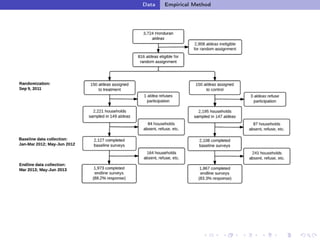
Bono 10000 Methodology
Bono 10000 was a randomised CCT that incentivized households to
send eligible children to school in return for 10,000 lempiras
(USD$500) per-household
Children must be 6 to 18 years old, in a treatment area, and enrolled in
school in lower than the 9th grade
The eligibility constraint is useful because it can be used for
identification, or to create subsamples to study heterogeneous effects.
Data Empirical Method
Framework
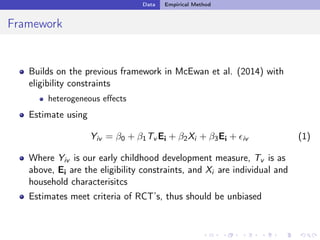
Builds on the previous framework in McEwan et al. (2014) with
eligibility constraints
heterogeneous effects
Estimate using
Yiv = 0 + 1Tv Ei + 2Xi + 3Ei + ✏iv (1)
Where Yiv is our early childhood development measure, Tv is as
above, Ei are the eligibility constraints, and Xi are individual and
household characterisitcs
Estimates meet criteria of RCT’s, thus should be unbiased
Data Empirical Method
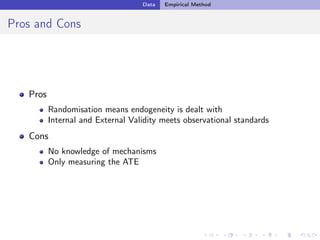
Pros and Cons
Pros
Randomisation means endogeneity is dealt with
Internal and External Validity meets observational standards
Cons
No knowledge of mechanisms
Only measuring the ATE
Summary
Summary
Study gives evidence into indirect effects of CCTs on childhood
development, rather than household resource allocations
Introduces new research opportunities
Next Steps
More detailed data analysis
Review and submission
Summary
Adermon, A. Sibling Spillovers in Education PhD dissertation, 2013
Angelucci, M. & Maro, V. D. Program Evaluation and spillover effects,
Journal of Development Effectiveness, ahead-of-print, 1-22, 2015
Barrera-Osorio, F.; Bertrand, M.; Linden, L. L. & Perez-Calle, F.
Conditional Cash Transfers in Education: Design Features, Peer and
Sibling Effects Evidence from a Randomized Experiment in Colombia
World Bank Policy Research Working Paper, 2008, 4580
Benedetti, F.; Ibarrarán, P. & McEwan, P. J. Do education and health
conditions matter in a large cash transfer? Evidence from a Honduran
experiment Inter-American Development Bank, 2015
Ferreira, F. H.; Filmer, D. & Schady, N. Own and sibling effects of
conditional cash transfer programs: Theory and evidence from
Cambodia World Bank Policy Research Working Paper Series, Vol,
2009
Joensen, J. & Nielsen, H. Peer Effects in Math and Science 2015
Summary
Nicoletti, C. & Rabe, B. Sibling Spillover Effects in School
Achievement IZA DP No. 8615, 2014
Quershi, J. A. Additional Returns to Investing in Girls Education:
Impact on Younger Sibling Human Capital, 2013

Do conditional cash transfer programs induce intra-household spillovers?

  • 1.
    Do conditional cashtransfer programmes induce intra-household spillovers? John Creamer and Florencia Lopez-Boo Heriot-Watt University 2016 SGPE Methodology Conference
  • 2.
    Acknowledgement This project wasfunded by the Scottish Institute for Research in Economics (SIRE) through the Early Career Engagement Grant. During my time at the Inter-American Development Bank (BID) , I was a part of the Knowledge and Experience Unpaid Internship Program (KEIP).
  • 3.
    Outline 1 Motivation Literature Review 2Data Empirical Method 3 Summary
  • 4.
    Motivation Motivation The objective ofthe research is to build on the previous research and determine if there are intra-household spillovers as a result of Bono 10000 The study is important because it adds to the existing economic literature that has not focused on early childhood development outcomes
  • 5.
    Motivation Literature Review GeneralSpillover Literature The existing literature covers a number of different cases outside CCT’s Jonesen and Nielsen (2015) exploits an exogenous change in Danish school policy to determine that younger siblings are more likely to follow their older siblings school subject. Nicoletti and Rabe (2014) shows that higher achieving older siblings have higher achieving younger siblings (UK GCSE data).
  • 6.
    Motivation Literature Review GeneralSpillover Literature Adermon (2013) shows a positive relationship for education attainment between older and younger siblings. Qureshi (2013) finds that older sisters in Pakistan have a positive effect on their younger siblings. Because of their household responsibility.
  • 7.
    Motivation Literature Review Spilloversand CCTs Barrera-Osorio et al. (2008) examines three different types of transfers in Colombia, finding that the displacement effect causes negative spillovers in terms of enrollment, child labour, etc.. The programme does lead to a positive direct effect for the beneficiary children. Ferreira et al. (2009) generate a model of spillovers as a result of CCT’s using data from Cambodia. The empirical analysis shows that the direct effect of the transfer is positive, but the displacement effect makes spillovers insignificant.
  • 8.
    Motivation Literature Review ImpactEvaluation McEwan et al. (2014) analyzes the Bono 10000 CCT in Honduras. Program results in increased enrollment and decreased child labour. Also show that heterogeneity is important in terms of household size Same programme and dataset Motivates heterogeneous relationships in terms of size of household and certain specific effects
  • 9.
    Motivation Literature Review ResearchGoals The previous results give us a few targets to aim for in terms of intra-household spillovers: 1 Look for average treatment effects 2 Look to see if there are heterogeneous effects 1 Focus especially on number of eligible children in household 3 Determine actual size of effect
  • 10.
    Data Bono 10000 Baseline andFollow up data from the Encuesta de Desarollo Humano in 2012 and 2013 which surveyed households on a number of different characteristics Early childhood development measured by ASQ test Globally recognized Comprehensive Different tests based on age of child Low cost
  • 11.
    Data Bono 10000 Methodology Bono10000 was a randomised CCT that incentivized households to send eligible children to school in return for 10,000 lempiras (USD$500) per-household Children must be 6 to 18 years old, in a treatment area, and enrolled in school in lower than the 9th grade The eligibility constraint is useful because it can be used for identification, or to create subsamples to study heterogeneous effects.
  • 12.
  • 13.
    Data Empirical Method Framework Buildson the previous framework in McEwan et al. (2014) with eligibility constraints heterogeneous effects Estimate using Yiv = 0 + 1Tv Ei + 2Xi + 3Ei + ✏iv (1) Where Yiv is our early childhood development measure, Tv is as above, Ei are the eligibility constraints, and Xi are individual and household characterisitcs Estimates meet criteria of RCT’s, thus should be unbiased
  • 14.
    Data Empirical Method Prosand Cons Pros Randomisation means endogeneity is dealt with Internal and External Validity meets observational standards Cons No knowledge of mechanisms Only measuring the ATE
  • 15.
    Summary Summary Study gives evidenceinto indirect effects of CCTs on childhood development, rather than household resource allocations Introduces new research opportunities Next Steps More detailed data analysis Review and submission
  • 16.
    Summary Adermon, A. SiblingSpillovers in Education PhD dissertation, 2013 Angelucci, M. & Maro, V. D. Program Evaluation and spillover effects, Journal of Development Effectiveness, ahead-of-print, 1-22, 2015 Barrera-Osorio, F.; Bertrand, M.; Linden, L. L. & Perez-Calle, F. Conditional Cash Transfers in Education: Design Features, Peer and Sibling Effects Evidence from a Randomized Experiment in Colombia World Bank Policy Research Working Paper, 2008, 4580 Benedetti, F.; Ibarrarán, P. & McEwan, P. J. Do education and health conditions matter in a large cash transfer? Evidence from a Honduran experiment Inter-American Development Bank, 2015 Ferreira, F. H.; Filmer, D. & Schady, N. Own and sibling effects of conditional cash transfer programs: Theory and evidence from Cambodia World Bank Policy Research Working Paper Series, Vol, 2009 Joensen, J. & Nielsen, H. Peer Effects in Math and Science 2015
  • 17.
    Summary Nicoletti, C. &Rabe, B. Sibling Spillover Effects in School Achievement IZA DP No. 8615, 2014 Quershi, J. A. Additional Returns to Investing in Girls Education: Impact on Younger Sibling Human Capital, 2013