DNA
(deoxyribonucleic acid)
&
GEnes
Dr. Allyson Lister, University of Oxford
CC BY-SA 4.0
Part one
What is DNA?
How many???
Around 2.5 billion cells in
one of your hands, but they
are tiny. If every cell in
your hand was the size of a
grain of sand, your hand
would be the size of a bus!
Each cell has its own job.
But how does each cell know
what job to do?
[5,6]
What is DNA for?
DNA acts like a recipe, telling our bodies how to develop and
how to work. There are about 1.5 gigabytes of information in
each cell[2].
[2]
There must be 1000s of recipes!!
Each piece of information /
recipe is carried on a
different section of the DNA.
These sections are called
genes[1].
[3]
Part TWO
What are Genes?
http://www.allerca.com/images/aboutt.jpg
Pumpkin
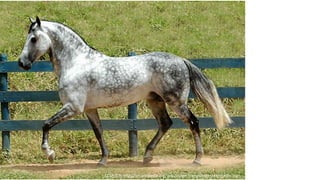
CCSA 2.5: http://en.wikipedia.org/wiki/Image:Mangalarga_Marchador.jpg
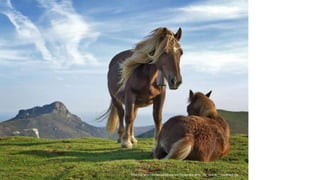
CCSA 2.0: http://en.wikipedia.org/wiki/Image:Biandintz_eta_zaldiak_-_modified2.jpg
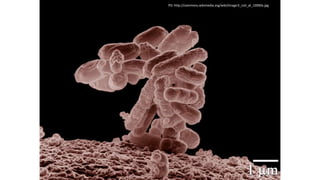
PD: http://commons.wikimedia.org/wiki/Image:E_coli_at_10000x.jpg
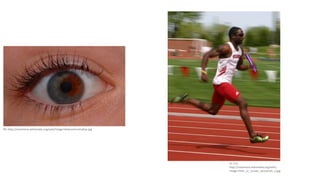
CC 2.0:
http://commons.wikimedia.org/wiki/
Image:Flickr_cc_runner_wisconsin_u.jpg
PD: http://commons.wikimedia.org/wiki/Image:HeterochromiaEye.jpg
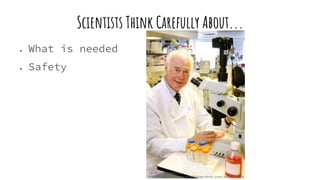
Scientists Think Carefully About...
● What is needed
● Safety
CC 3.0: Cardiff University,
http://commons.wikimedia.org/wiki/Image:Martin_Evans_Nobel_Prize.jpg
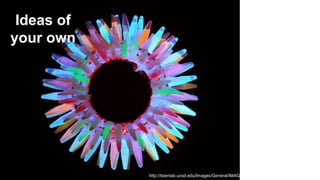
http://tsienlab.ucsd.edu/Images/General/IMAGE%20-%20Wreath%202002.jpg
Ideas of
your own
Jellyfish Glow
You can get fluorescent
yellows and greens from
jellyfish.
You can get fluorescent
reds from some corals.
[8]
What Bacteria Painting Would you Do?
[7]
Part Three
What do sweets have to do with all of this?
Why are we different?
● Ingredients
● Recipes
● Menu choice
[9]
CookBook of Me
● We all have different cookbooks
(our genomes), arranged in
chapters (chromosomes) with a
mixture of shared and unique
recipes (genes) with a varied
mixture of ingredients (base
pairs).
● Menu choice: We only use the
recipes appropriate for the
situation (gene expression)
Building sweetie DNA: 6 Billion* pairs??!!
[2,4]
* Diploid number
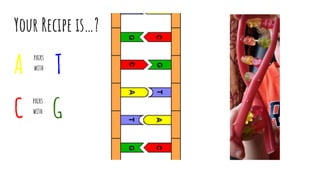
Your Recipe is…?
A T
C G
pairs
with
pairs
with
Citations
[1] http://kids.britannica.com/elementary/article-390730/DNA Accessed 2 March 2017.
[2] https://pdb101.rcsb.org/motm/23 Accessed 2 March 2017.
[3] https://www.pets4homes.co.uk/pet-advice/is-it-true-bengal-cats-shed-less-than-other-cats.html Accessed 2
March 2017.
[4] http://science.howstuffworks.com/life/cellular-microscopic/cell6.htm Accessed 2 March 2017.
[5] http://www.cell.com/pictureshow/skin Accessed 2 March 2017.
[6] http://www.cell.com/pictureshow/viruses Accessed 2 March 2017.
[7] http://tsienlab.ucsd.edu/HTML/Images/IMAGE%20-%20PLATE%20-%20Beach.jpg Accessed 2 March 2017.
[8] By Brocken Inaglory - Own work, CC BY-SA 3.0, https://commons.wikimedia.org/w/index.php?curid=2141765
Accessed 2 March 2017.
[9] https://www.biggerbolderbaking.com/crazy-cookie-dough/ Accessed 27 February 2018.
[10] Made via the book cover generator at http://tinymoo.com/penguin.php Accessed 27 February 2018.
What does it look like?
https://www.ted.com/talks/drew_berry_animations_of_unseeable_
biology?language=en (from about 4 minutes 40 seconds)
https://www.wehi.edu.au/molecular-visualisations-dna
https://www.youtube.com/watch?v=a_89IZjn96A&list=PL4tp0cRyFUk
dXqNOjfhSliOoGqEEdcpux&index=2&t=142s

DNA & Genes KS2

Editor's Notes

  • #6 Genes store the information that makes each one of us different. Eye color, shoe size, hair color…Sometimes, there can be a change in a gene that is “good”: that allows a cat to run faster, or a dog to smell better. Sometimes that change can cause problems: some diseases are caused by mistakes in genes.
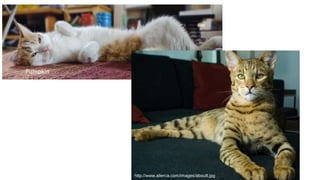
  • #8 KS1 and KS2: Pumpkin is a normal domestic cat and is 4 years old and lives with me. Do you know what that pattern is? She's an orange tabby with some white bits. This other cat looks the same, and acts the same. But there is one big difference. He wouldn't make my neighbour sneeze! How many of you know people who sneeze when they are around cats or dogs? The domestic cat was selectively bred from wild cats at least 9.500 years ago, and has been around since at least ancient Egypt (http://news.bbc.co.uk/1/hi/sci/tech/6251434.stm) and probably longer, see recent SciAm article: http://www.scientificamerican.com/article.cfm?id=the-taming-of-the-cat The company that breeds cats like the guy at the bottom here found a few cats that didn't cause allergies, and bred more of them. What traits do you like most in cats? What would you like to see? KS2: Allerca bred out cases where the Fel d 1 glycoprotein was a version that caused allergic reactions. The process uses gene sequencing to detect rare naturally occurring genetic divergences in cats.
  • #9 KS1: What kind of domestic animal is this? KS1 and KS2: Humans breed horses to look and act specific ways What do you think are the most important things that make up a good horse? Colour? Strong muscles? Good eyesight? Size? Personality? KS2: What might you want to breed out of horses? Do they have any problems that should be fixed?
  • #10 KS1 and KS2 Would those things you suggested in the previous slide be good all the time? A large horse would have trouble finding food on a small island A black horse would stand out in the desert. KS2 Having lots of different types of horses makes sure that some of them will always survive changes in the environment
  • #11  KS1 and KS2 We use germs to make medicine! The germs in the picture live in our guts, and help us out in digesting our food. You might have drunk some if you have had a probiotic drink. Some examples of good choices discussed in previous slide: Using “germs” to make medicine. Insulin (Diabetes) We can put the human gene for insulin into these guys, and they will make the medicine for us Originally from cow, horse, pig or fish pancreases , but now 70% of insulin sold is recombinant (2002).(http://en.wikipedia.org/wiki/Insulin) KS2 With cells dividing rapidly (every 20 minutes), a bacterium containing human cDNA (encoding for insulin, for example) will shortly produce many millions of similar cells (clones) containing the same human gene. http://www.accessexcellence.org/RC/VL/GG/transfer_and.php http://www.littletree.com.au/dna.htm : 51 amino acids long Adding vaccines for humans into food crops/animals (into tomatoes, e.g.) References in reference document.
  • #12 KS1 and KS2 We can fix mistakes in our own bodies! Target a specific area: Diseases of the eye: https://www.england.nhs.uk/2020/02/first-patients-begin-gene-therapy-treatment-for-blindness/ Cystic fibrosis: https://www.cff.org/gene-therapy-cystic-fibrosis It is a single gene defect. The lung is most affected. Most heterozygote carriers have approximately 50 % CFTR function and are completely asymptomatic. Thalassaemia: http://www.newscientist.com/article.ns?id=dn2915 (others include Haemophilia, but prb won't talk about it)
  • #13 we change things, and have done for 1000s of years The tool is not the issue: it used to be just selective breeding, now there are new tools each individual change has to be thought about, to determine if it is a good idea or not
  • #14 pigs with less saturated fat (not happened yet, but people talking about it): http://www.newscientist.com/channel/health/gm-food/dn1841 spider silk from goats' milk (in the original study, 5x stronger than steel, by weight, and very flexible – bulletproof vests!): http://www.newscientist.com/channel/health/gm-food/dn1807 and now in 2008 from alfalfa http://hayandforage.com/hay/alfalfa/0301-silk-gene-value-alfalfa/ , as it would otherwise take 600 lbs of goats' milk to make one bulletproof vest! caffeine-free coffee plants: http://www.newscientist.com/channel/health/gm-food/dn3851 no-tears onion: http://www.newscientist.com/channel/health/gm-food/dn2935