Frederick Griffith
• British bacteriologist
• 1928 = designed and performed experiment
on rats and bacteria that causes pneumonia.
• 2 strains of the bacteria
• Type S = causes severe pneumonia
• Type R = relatively harmless
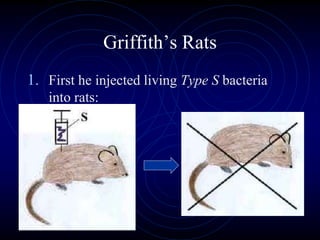
Griffith’s Rats
1. First he injected living Type S bacteria
into rats:
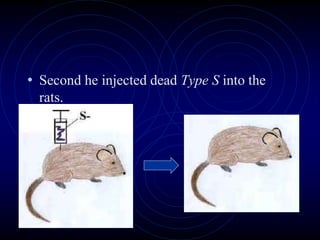
• Second he injected dead Type S into the
rats.
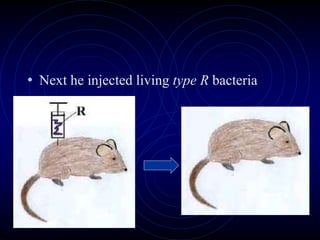
• Next he injected living type R bacteria
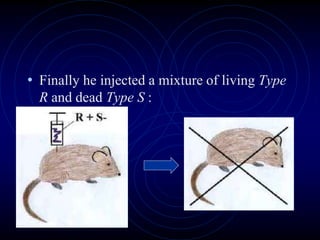
• Finally he injected a mixture of living Type
R and dead Type S :
Results of experiments:
• Because the dead rat tissue showed living
Type S bacteria, something “brought the
Type S back to life”
• Actually one bacterial type incorporated the
DNA, or instructions, from the dead
bacteria into its own DNA
• Known as transformation. Confirmed by
Avery, MacLeod, and McCarty in 1944
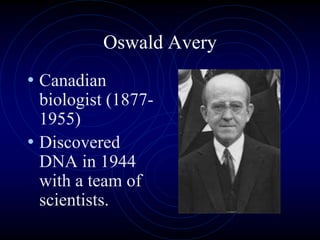
Oswald Avery
• Canadian
biologist (1877-
1955)
• Discovered
DNA in 1944
with a team of
scientists.
Hershey and Chase
• 1952
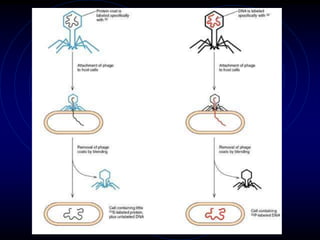
• Attempted to solve the debate on whether
DNA or proteins are responsible for providing
the genetic material.
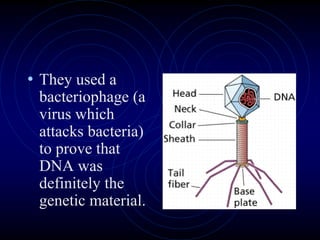
• They used a
bacteriophage (a
virus which
attacks bacteria)
to prove that
DNA was
definitely the
genetic material.
Phoebus A. Levene
• Russian born; immigrated to America,
moves to Europe.
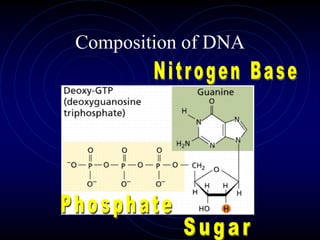
• 1920’s discovered nucleotides
(building blocks of DNA)
1. Sugar
2. Phosphate group
3. Nitrogenous base
Composition of DNA
Components and structure of
DNA
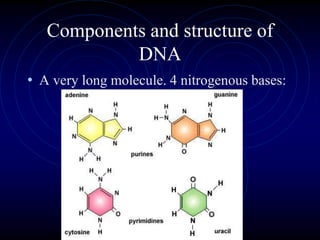
• A very long molecule. 4 nitrogenous bases:
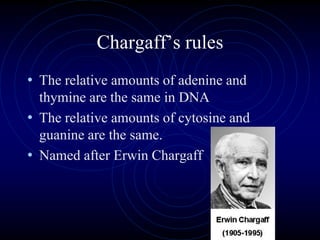
Chargaff’s rules
• The relative amounts of adenine and
thymine are the same in DNA
• The relative amounts of cytosine and
guanine are the same.
• Named after Erwin Chargaff
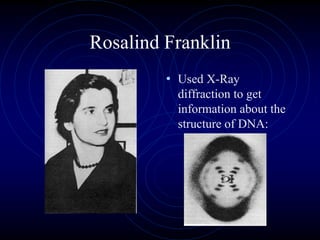
Rosalind Franklin
• Used X-Ray
diffraction to get
information about the
structure of DNA:
Structure of DNA
• Discovered in 1953
by two scientists:
• James Watson
(USA)
• Francis Crick
(GBR)
• Known as the
double-helix model.

DNA Experiments - DNA as Genetic Material

  • 1.
    Frederick Griffith • Britishbacteriologist • 1928 = designed and performed experiment on rats and bacteria that causes pneumonia. • 2 strains of the bacteria • Type S = causes severe pneumonia • Type R = relatively harmless
  • 2.
    Griffith’s Rats 1. Firsthe injected living Type S bacteria into rats:
  • 3.
    • Second heinjected dead Type S into the rats.
  • 4.
    • Next heinjected living type R bacteria
  • 5.
    • Finally heinjected a mixture of living Type R and dead Type S :
  • 6.
    Results of experiments: •Because the dead rat tissue showed living Type S bacteria, something “brought the Type S back to life” • Actually one bacterial type incorporated the DNA, or instructions, from the dead bacteria into its own DNA • Known as transformation. Confirmed by Avery, MacLeod, and McCarty in 1944
  • 7.
    Oswald Avery • Canadian biologist(1877- 1955) • Discovered DNA in 1944 with a team of scientists.
  • 8.
    Hershey and Chase •1952 • Attempted to solve the debate on whether DNA or proteins are responsible for providing the genetic material.
  • 9.
    • They useda bacteriophage (a virus which attacks bacteria) to prove that DNA was definitely the genetic material.
  • 11.
    Phoebus A. Levene •Russian born; immigrated to America, moves to Europe. • 1920’s discovered nucleotides (building blocks of DNA) 1. Sugar 2. Phosphate group 3. Nitrogenous base
  • 12.
  • 13.
    Components and structureof DNA • A very long molecule. 4 nitrogenous bases:
  • 14.
    Chargaff’s rules • Therelative amounts of adenine and thymine are the same in DNA • The relative amounts of cytosine and guanine are the same. • Named after Erwin Chargaff
  • 15.
    Rosalind Franklin • UsedX-Ray diffraction to get information about the structure of DNA:
  • 16.
    Structure of DNA •Discovered in 1953 by two scientists: • James Watson (USA) • Francis Crick (GBR) • Known as the double-helix model.