Demystifying Mixins
with Django
@anabalica
Mixins are
a controlled
way of adding
functionality
to classes.
Mixins are not
special language
constructs.
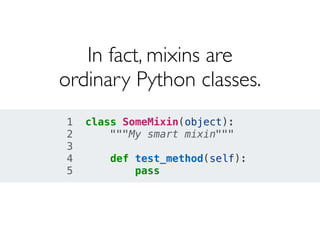
In fact, mixins are
ordinary Python classes.
1 class SomeMixin(object):
2 """My smart mixin"""
3
4 def test_method(self):
5 pass
Why use mixins?
to improve modularity
When to use mixins?
want to reuse a
particular feature in a lot
of different classes
Properties
• single responsibility
• not meant to be extended
• not meant to be instantiated
In Python the concept of
mixins is implemented using
multiple inheritance.
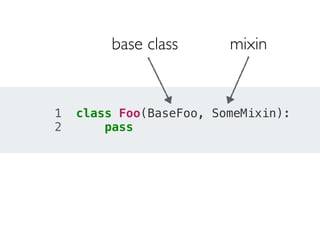
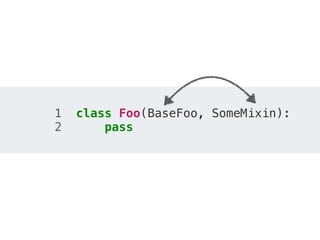
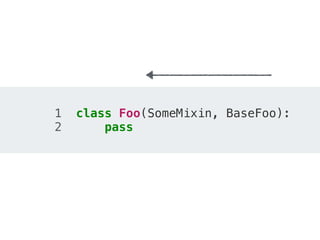
Order matters
1 class Foo(BaseFoo, SomeMixin):
2 pass
base class mixin
1 class Foo(BaseFoo, SomeMixin):
2 pass
1 class Foo(SomeMixin, BaseFoo):
2 pass
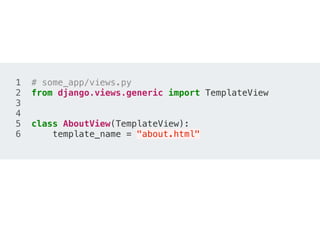
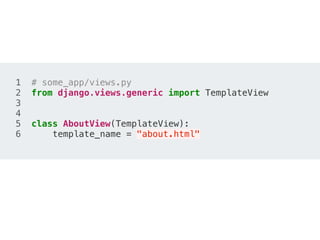
1 # some_app/views.py
2 from django.views.generic import TemplateView
3
4
5 class AboutView(TemplateView):
6 template_name = "about.html"
1 # some_app/views.py
2 from django.views.generic import TemplateView
3
4
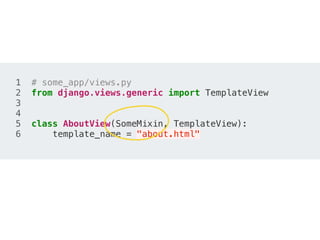
5 class AboutView(SomeMixin, TemplateView):
6 template_name = "about.html"
My first mixin
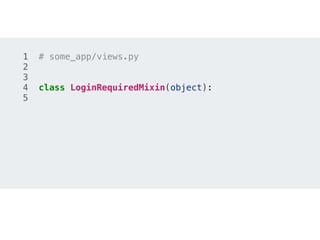
1 # some_app/views.py
2
3
4 class LoginRequiredMixin(object):
5
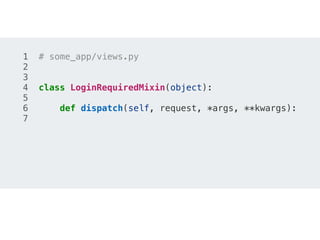
1 # some_app/views.py
2
3
4 class LoginRequiredMixin(object):
5
6 def dispatch(self, request, *args, **kwargs):
7
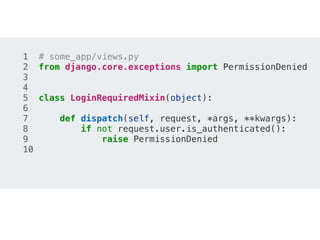
1 # some_app/views.py
2 from django.core.exceptions import PermissionDenied
3
4
5 class LoginRequiredMixin(object):
6
7 def dispatch(self, request, *args, **kwargs):
8 if not request.user.is_authenticated():
9 raise PermissionDenied
10
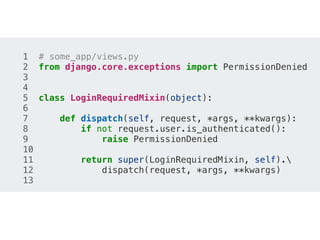
1 # some_app/views.py
2 from django.core.exceptions import PermissionDenied
3
4
5 class LoginRequiredMixin(object):
6
7 def dispatch(self, request, *args, **kwargs):
8 if not request.user.is_authenticated():
9 raise PermissionDenied
10
11 return super(LoginRequiredMixin, self).
12 dispatch(request, *args, **kwargs)
13
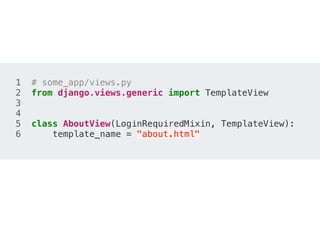
1 # some_app/views.py
2 from django.views.generic import TemplateView
3
4
5 class AboutView(LoginRequiredMixin, TemplateView):
6 template_name = "about.html"
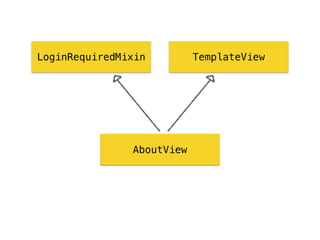
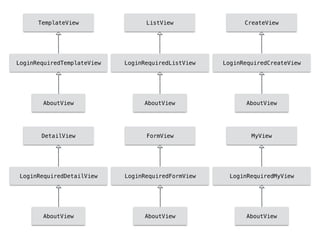
LoginRequiredMixin TemplateView
AboutView
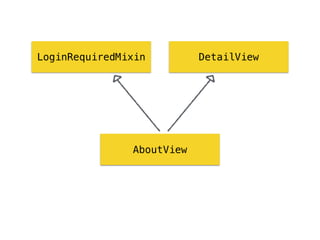
LoginRequiredMixin DetailView
AboutView
ListView
LoginRequiredListView
AboutView
CreateView
LoginRequiredCreateView
AboutView
DetailView
LoginRequiredDetailView
AboutView
FormView
LoginRequiredFormView
AboutView
MyView
LoginRequiredMyView
AboutView
TemplateView
LoginRequiredTemplateView
AboutView
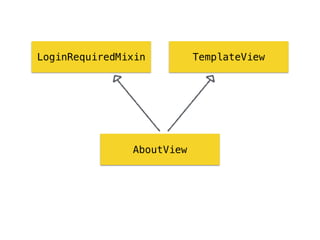
LoginRequiredMixin TemplateView
AboutView
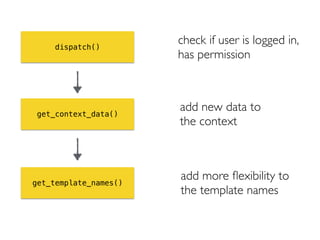
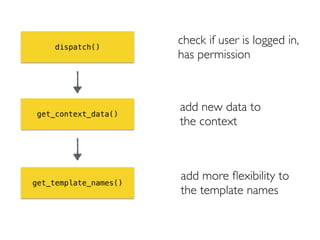
dispatch()
get_context_data()
get_template_names()
check if user is logged in,
has permission
add new data to
the context
add more flexibility to
the template names
1 # some_app/views.py
2 from django.views.generic import TemplateView
3
4
5 class AboutView(TemplateView):
6 template_name = "about.html"
dispatch()
get_context_data()
get_template_names()
check if user is logged in,
has permission
add new data to
the context
add more flexibility to
the template names
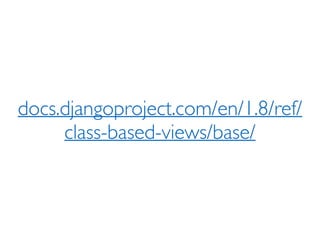
docs.djangoproject.com/en/1.8/ref/
class-based-views/base/
docs.djangoproject.com/en/1.8/ref/
class-based-views/base/
docs.djangoproject.com/en/1.8/topics/
class-based-views/mixins/
docs.djangoproject.com/en/1.8/topics/
class-based-views/mixins/
ccbv.co.uk/
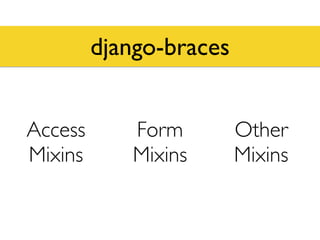
django-braces
Access
Mixins
Form
Mixins
Other
Mixins
With great
power comes great
responsibility
Recap
• single responsibility
• plug-in functionality
• isn’t creating a subtyping
relation
Go back to your views
and start writing mixins
to clean up the code.

[Djangocon2015] Demystifying mixins with Django