Pulling more out of Django application Supreet Sethi Email < [email_address] This talk is possible because of kindness of  some clients, who let me use their machinery for my utterly wierd experiments
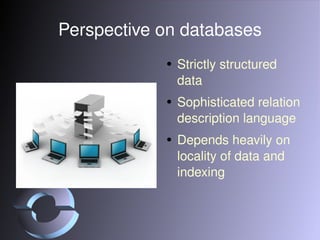
Perspective on databases Strictly structured data Sophisticated relation description language Depends heavily on locality of data and indexing
Perspective on databases 2 ORM see database as storage ORMs are less sophisticated in mapping relations 1-1 mapping is sometimes not possible Atomicity of operations cannot of insured
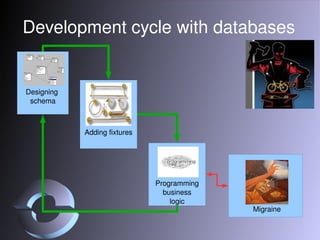
Development cycle with databases Migraine Designing  schema Programming business logic Adding fixtures
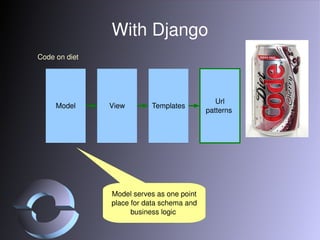
With Django Code on diet Model Templates View Model serves as one point place for data schema and business logic  Url patterns
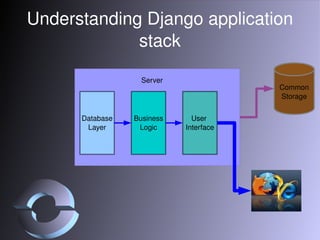
Understanding Django application stack Server Database Layer User  Interface Business Logic Common Storage
Problem with the stack Tightly coupled
General overview of django scaling Using javascript to load as much dynamic data making static content in pages cacheable (AJAX) Compress applications CSS and javascripts (django-compress) Optimize pagination Connection pooling Memory Caching
Database scaling for django application Schema design and modeling Debug queries Data specific changes in the model Database architecture for scaling
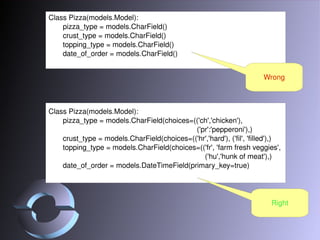
Schema design and modeling Using appropriate field type CharField for small text DateField for date and time Text, Integer, Slug, Email, Url, Image, File Using hinting whereever possible or required Define primary_key for primary key field Map relations well Use choice modifier BooleanField Unique modifier
Class Pizza(models.Model): pizza_type = models.CharField(choices=(('ch','chicken'), ('pr':'pepperoni'),)  crust_type = models.CharField(choices=(('hr','hard'), ('fil', 'filled'),) topping_type = models.CharField(choices=(('fr', 'farm fresh veggies', ('hu','hunk of meat'),) date_of_order = models.DateTimeField(primary_key=true) Class Pizza(models.Model): pizza_type = models.CharField() crust_type = models.CharField() topping_type = models.CharField() date_of_order = models.CharField() Wrong Right
Debug the queries http://github.com/robhudson/django-debug-toolbar/tree/master
Data specific changes in the model db_index modifier on fields  Be sure to use them carefully  Increases the write costs on the field Helps in seeking data faster Unique constraint with unique modifier Recheck relations between tables
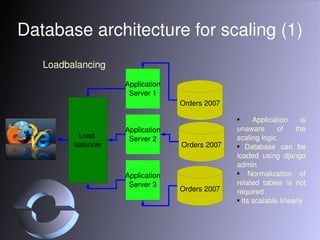
Database architecture for scaling (1) Loadbalancing Application is unaware of the scaling logic Database can be loaded using django admin Normalization of related tables is not required Its scalable linearly Orders 2007 Load  balancer Application Server 3 Orders 2007 Orders 2007 Orders 2007 Application Server 1 Application Server 2
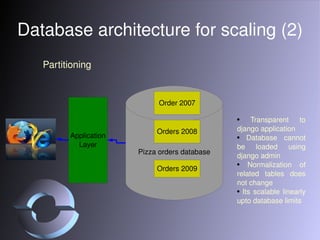
Database architecture for scaling (2) Partitioning Transparent to django application Database cannot be loaded using django admin Normalization of related tables does not change Its scalable linearly upto database limits Pizza orders database Order 2007 Orders 2009 Orders 2008 Application Layer
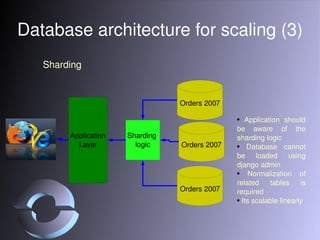
Database architecture for scaling (3) Sharding Application should be aware of the sharding logic Database cannot be loaded using django admin Normalization of related tables is required Its scalable linearly Orders 2007 Application Layer Sharding  logic Orders 2007 Orders 2007 Orders 2007
Example of sharding http://www.eflorenzano.com/blog/tag/database-sharding/
Where not to use django Where atomicity of operation is required Where data needs to be updated on tables and pulled using a view Complex schemas

Django Database Optimization

  • 1.
    Pulling more outof Django application Supreet Sethi Email < [email_address] This talk is possible because of kindness of some clients, who let me use their machinery for my utterly wierd experiments
  • 2.
    Perspective on databasesStrictly structured data Sophisticated relation description language Depends heavily on locality of data and indexing
  • 3.
    Perspective on databases2 ORM see database as storage ORMs are less sophisticated in mapping relations 1-1 mapping is sometimes not possible Atomicity of operations cannot of insured
  • 4.
    Development cycle withdatabases Migraine Designing schema Programming business logic Adding fixtures
  • 5.
    With Django Codeon diet Model Templates View Model serves as one point place for data schema and business logic Url patterns
  • 6.
    Understanding Django applicationstack Server Database Layer User Interface Business Logic Common Storage
  • 7.
    Problem with thestack Tightly coupled
  • 8.
    General overview ofdjango scaling Using javascript to load as much dynamic data making static content in pages cacheable (AJAX) Compress applications CSS and javascripts (django-compress) Optimize pagination Connection pooling Memory Caching
  • 9.
    Database scaling fordjango application Schema design and modeling Debug queries Data specific changes in the model Database architecture for scaling
  • 10.
    Schema design andmodeling Using appropriate field type CharField for small text DateField for date and time Text, Integer, Slug, Email, Url, Image, File Using hinting whereever possible or required Define primary_key for primary key field Map relations well Use choice modifier BooleanField Unique modifier
  • 11.
    Class Pizza(models.Model): pizza_type= models.CharField(choices=(('ch','chicken'), ('pr':'pepperoni'),) crust_type = models.CharField(choices=(('hr','hard'), ('fil', 'filled'),) topping_type = models.CharField(choices=(('fr', 'farm fresh veggies', ('hu','hunk of meat'),) date_of_order = models.DateTimeField(primary_key=true) Class Pizza(models.Model): pizza_type = models.CharField() crust_type = models.CharField() topping_type = models.CharField() date_of_order = models.CharField() Wrong Right
  • 12.
    Debug the querieshttp://github.com/robhudson/django-debug-toolbar/tree/master
  • 13.
    Data specific changesin the model db_index modifier on fields Be sure to use them carefully Increases the write costs on the field Helps in seeking data faster Unique constraint with unique modifier Recheck relations between tables
  • 14.
    Database architecture forscaling (1) Loadbalancing Application is unaware of the scaling logic Database can be loaded using django admin Normalization of related tables is not required Its scalable linearly Orders 2007 Load balancer Application Server 3 Orders 2007 Orders 2007 Orders 2007 Application Server 1 Application Server 2
  • 15.
    Database architecture forscaling (2) Partitioning Transparent to django application Database cannot be loaded using django admin Normalization of related tables does not change Its scalable linearly upto database limits Pizza orders database Order 2007 Orders 2009 Orders 2008 Application Layer
  • 16.
    Database architecture forscaling (3) Sharding Application should be aware of the sharding logic Database cannot be loaded using django admin Normalization of related tables is required Its scalable linearly Orders 2007 Application Layer Sharding logic Orders 2007 Orders 2007 Orders 2007
  • 17.
    Example of shardinghttp://www.eflorenzano.com/blog/tag/database-sharding/
  • 18.
    Where not touse django Where atomicity of operation is required Where data needs to be updated on tables and pulled using a view Complex schemas