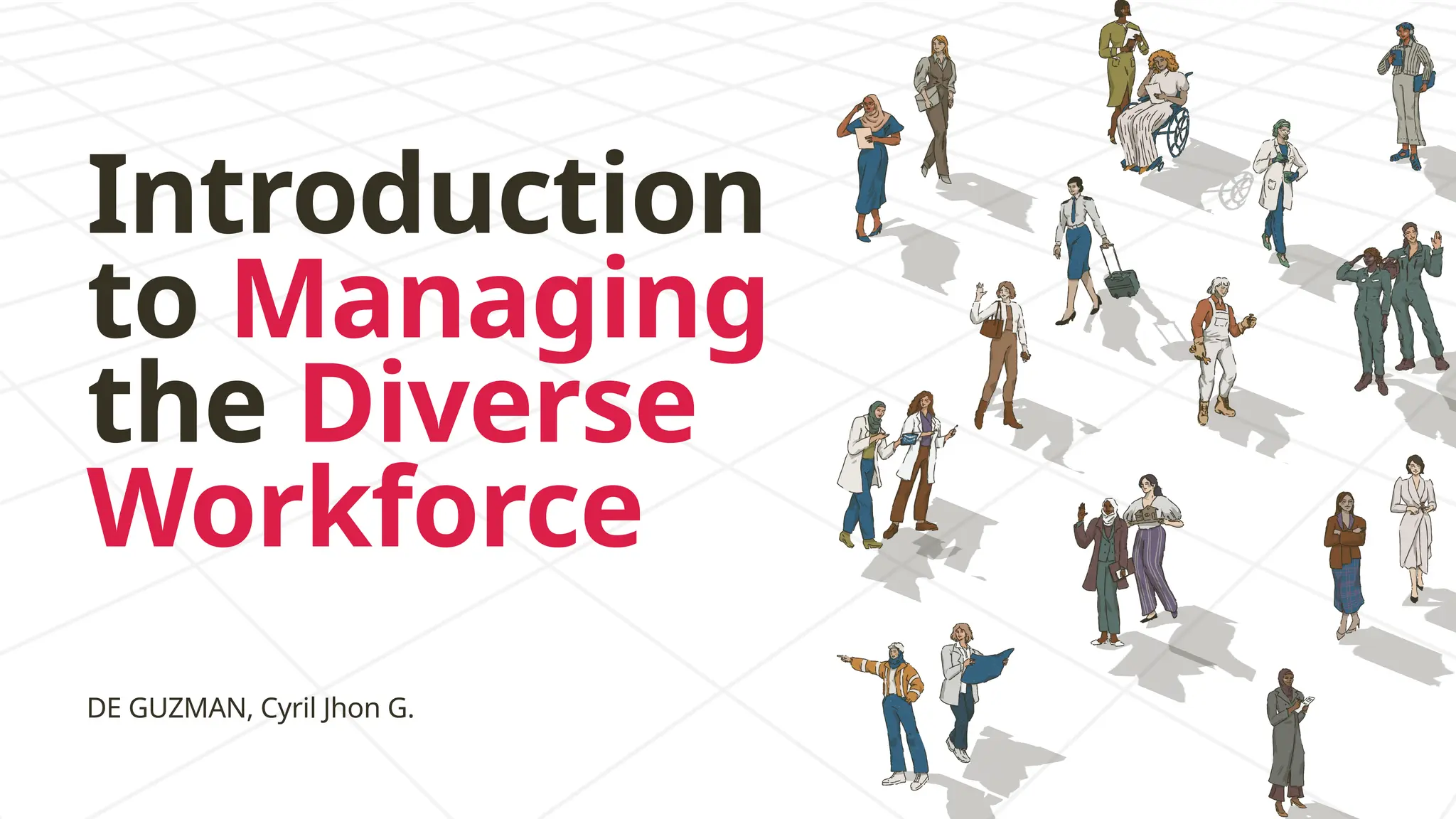
Introduction
to Managing
the Diverse
Workforce
DE GUZMAN, Cyril Jhon G.
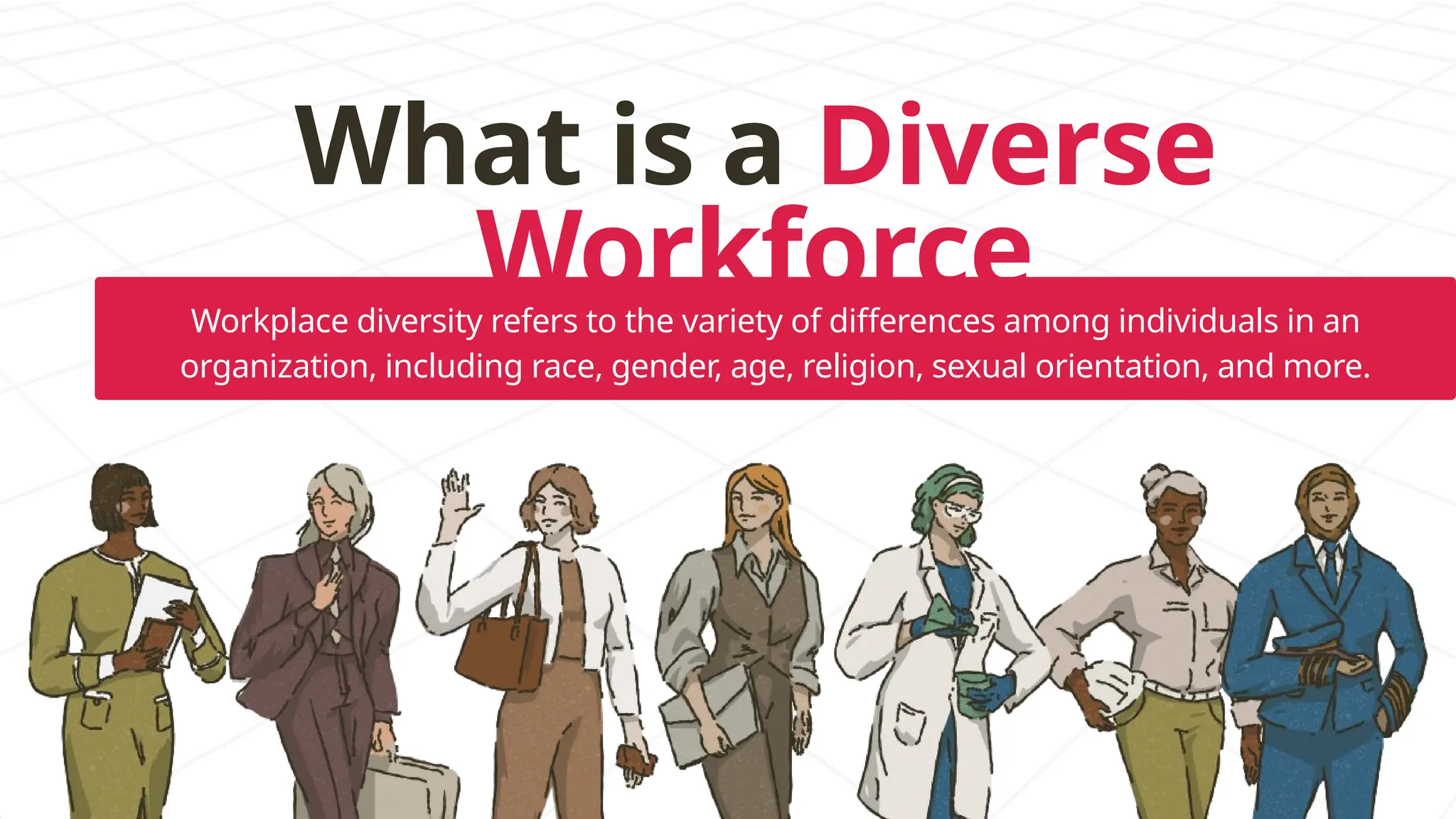
What is a Diverse
Workforce
Workplace diversity refers to the variety of differences among individuals in an
organization, including race, gender, age, religion, sexual orientation, and more.
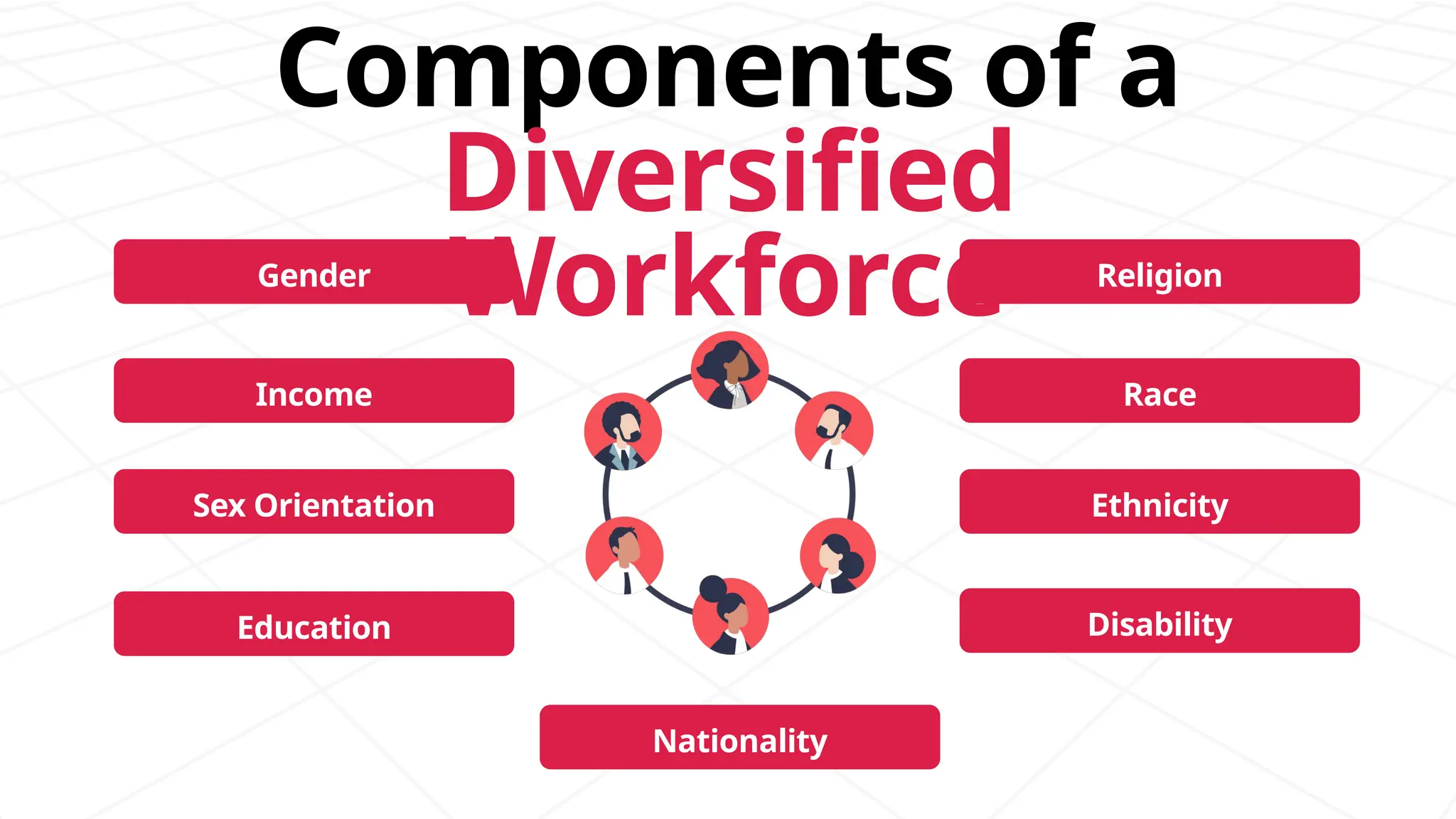
Gender
Components of a
Diversified
Workforce
Income Race
Sex Orientation
Nationality
Ethnicity
Religion
Education Disability
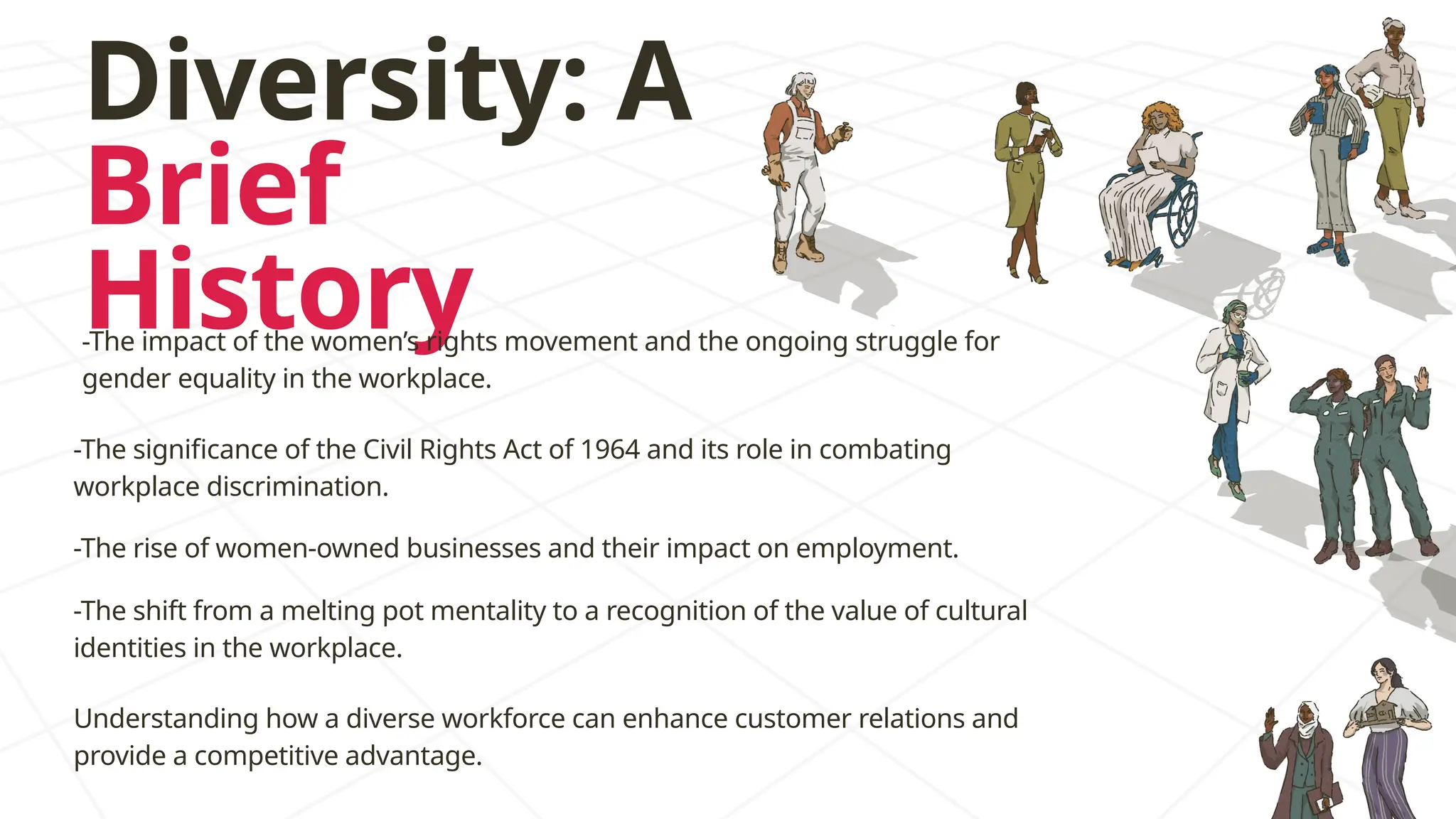
Diversity: A
Brief
History
-The significance of the Civil Rights Act of 1964 and its role in combating
workplace discrimination.
-The impact of the women’s rights movement and the ongoing struggle for
gender equality in the workplace.
-The rise of women-owned businesses and their impact on employment.
-The shift from a melting pot mentality to a recognition of the value of cultural
identities in the workplace.
Understanding how a diverse workforce can enhance customer relations and
provide a competitive advantage.
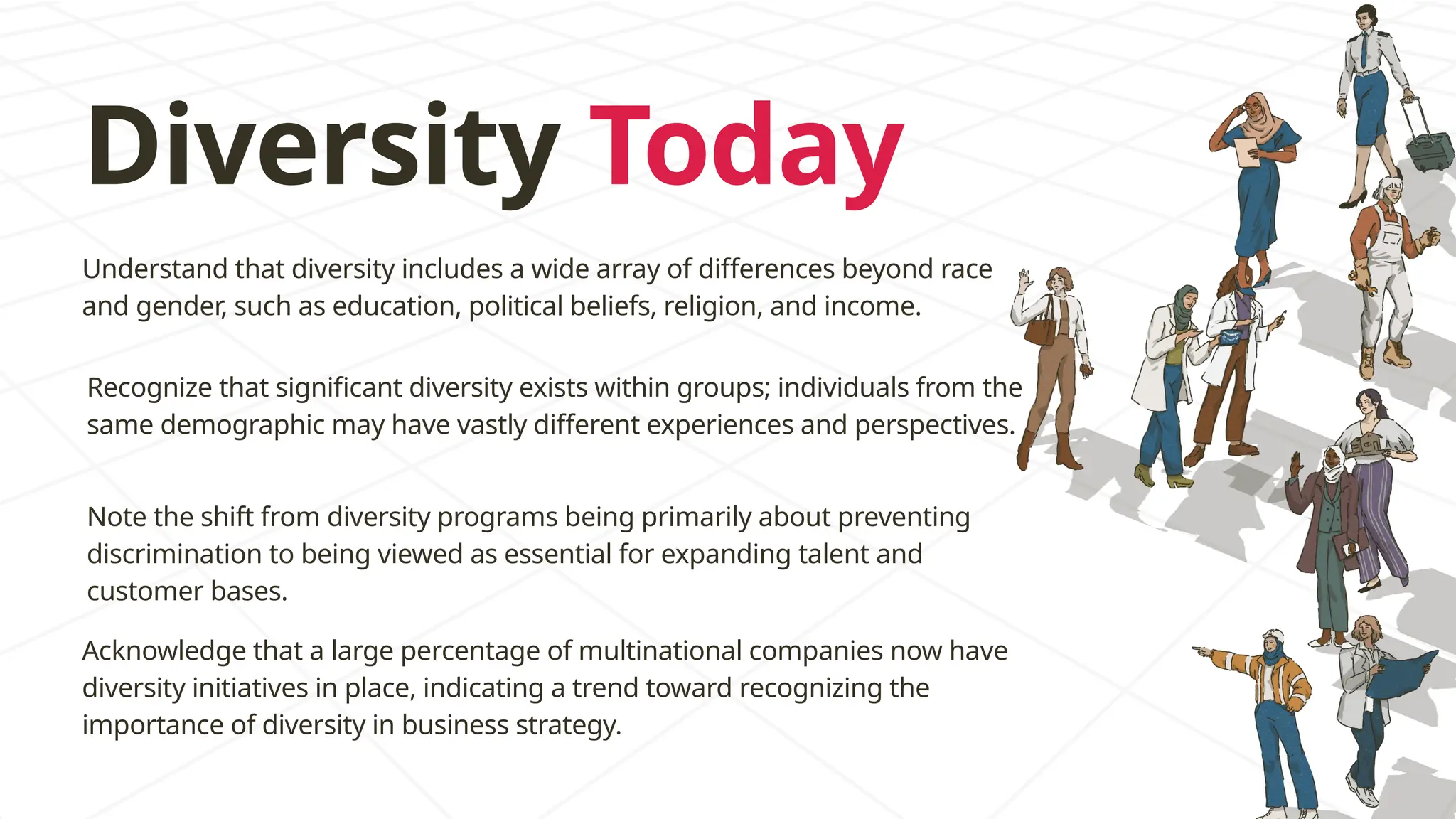
Diversity Today
Understand that diversity includes a wide array of differences beyond race
and gender, such as education, political beliefs, religion, and income.
Note the shift from diversity programs being primarily about preventing
discrimination to being viewed as essential for expanding talent and
customer bases.
Recognize that significant diversity exists within groups; individuals from the
same demographic may have vastly different experiences and perspectives.
Acknowledge that a large percentage of multinational companies now have
diversity initiatives in place, indicating a trend toward recognizing the
importance of diversity in business strategy.
Workforce
Demographi
c and
Generation
Furog, Paulo B.
The Workforce of the
Future:
refers to the evolving nature of the global workforce as
it adapts to the challenges and opportunities of a
rapidly changing world. This concept encompasses a
wide range of factors including technological
advancements, shifting demographics, changing
societal values, and the rise of new business models.
The future workforce will be defined by its diversity,
adaptability, and integration with emerging
technologies.
Developments
in workforce
• Minorities and Immigrants - In addition to gender issues, the importance and
scope of diversity are evident in the growth of racial minorities and immigrants in
the workforce.
• Gender Issues - One of the most important developments in the U.S. labor market
has been the growing number of women working outside the home. Social changes
during the 1960s and 1970s coupled with financial necessity caused women to enter
the workforce and redefine their roles
• Mentally and Physically Disabled People - The largest unemployed minority
population in the United States is people with disabilities. It is composed of people
of all ethnic backgrounds, cultures, and ages. The share of the population with a
disability is growing as the average worker gets older and heavier
• Education Levels - When the United States was primarily an industrial economy,
many jobs required physical strength, stamina, and skill in a trade, rather than
college and professional degrees. In today’s service and technology economy,
more positions require a college education and even a graduate or professional
degree.
The Workforce of the
Future:
• The workforce of the future will be shaped by a combination
of technology, shifting demographics, evolving workplace
expectations, and global interconnectedness. Businesses that
successfully navigate this new era will need to be adaptable,
focus on continuous learning, embrace diverse perspectives,
and create environments that prioritize employee well-being,
inclusivity, and purpose. As the future unfolds, the key to
success will be organizations that can blend technology with
human-centered values, creating workplaces where
employees can thrive, contribute meaningfully, and be
prepared for the challenges ahead.
Multiple Generations at
Work
Multi-Generational Workforce refers to a workplace where employees from
different generations work together. As the workforce becomes more diverse
in terms of age, organizations now have employees ranging from Baby
Boomers to Generation Z, with each group bringing distinct experiences,
values, expectations, and work styles.
Generations in the Workforce
As of today, the workforce typically includes employees from five
generations:
• Baby Boomers (born 1946–1964)
• Generation X (born 1965–1980)
• Millennials or Generation Y (born 1981–1996)
• Generation Z (born 1997–2012)
• Generation Alpha (born after 2012, still young, but soon to enter the
workforce in the 2030s)
The Age of the
Workforce
• The baby boom generation (those born between 1946 and 1964) is
aging. The Pew Research Center states that approximately 10,000
Boomers are retiring each day in the United States.27 Industries most at
risk include health care (hospitals and nursing facili ties), transportation,
social assistance, and mining and construction.28 As a result of these
trends, the Bureau of Labor Statistics projects that entry-level workers will
be in short supply.
• The age of the workforce is a dynamic and evolving demographic
factor. In most countries, the workforce is aging, and older workers are
staying in the labor market longer than they have in the past. At the
same time, younger generations are entering the workforce, leading
to a more diverse multigenerational workforce. How this plays out will
depend on local demographic trends, economic conditions, and
• The age of the workforce refers to the range of ages of individuals who
are employed or actively seeking employment in the labor market. It is
typically measured by examining the age distribution of the working-
age population within a country or industry.
Managing a Diverse
Workforce
• Diversity and inclusion are
critical for modern
organizations.
• Embracing differences in race,
ethnicity, age, gender, and life
experiences enhances
organizational effectiveness.
• Organizations are increasingly
viewing diversity from a
practical, business-oriented
perspective.
Competitive
Advantage
through
Diversity
Diversity as a Business Tool
• Studies show a correlation between
diversity in upper management and
superior financial performance.
• Diversity can be a source of
competitive advantage if leveraged
effectively.
Attracting and Retaining
Motivated Employees
• Companies known for valuing
diversity attract top talent.
• Employees who feel their differences
are valued are more loyal, productive,
and committed.
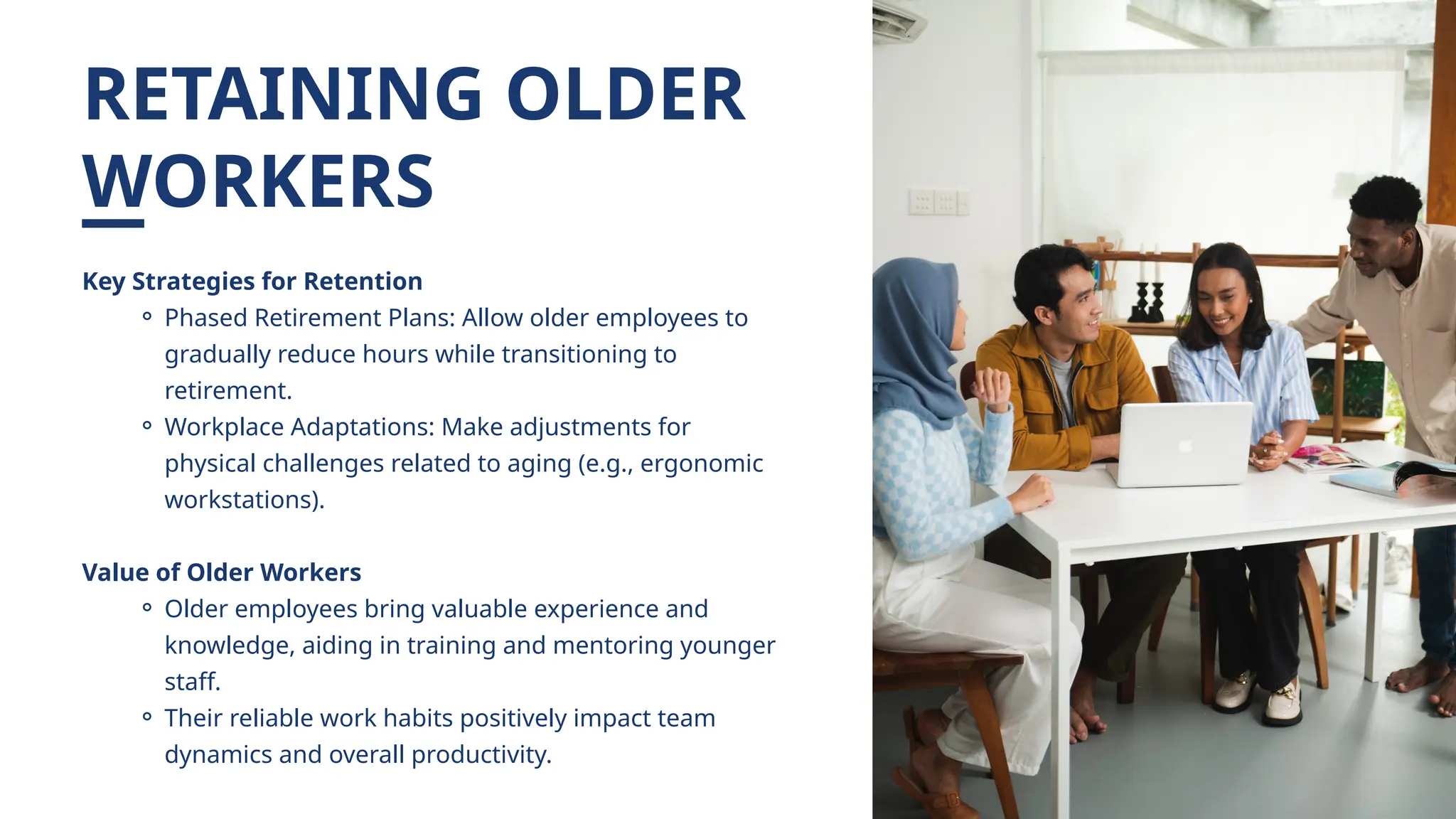
RETAINING OLDER
WORKERS
Key Strategies for Retention
⚬ Phased Retirement Plans: Allow older employees to
gradually reduce hours while transitioning to
retirement.
⚬ Workplace Adaptations: Make adjustments for
physical challenges related to aging (e.g., ergonomic
workstations).
Value of Older Workers
⚬ Older employees bring valuable experience and
knowledge, aiding in training and mentoring younger
staff.
⚬ Their reliable work habits positively impact team
dynamics and overall productivity.
Challenges in the Job Market
• A smaller pool of young talent due to
demographic shifts.
• Younger workers (Generation Y) often
have high expectations for workplace
culture and engagement.
Strategies for Engagement
• Online Recruiting Tactics: Utilize social
media platforms (e.g., LinkedIn,
Instagram) to connect with younger
candidates.
• Creating Stimulating Work
Environments: Foster teamwork, provide
reasonable work hours, and offer
positive feedback to enhance job
satisfaction.
ATTRACTING YOUNGER
TALENT
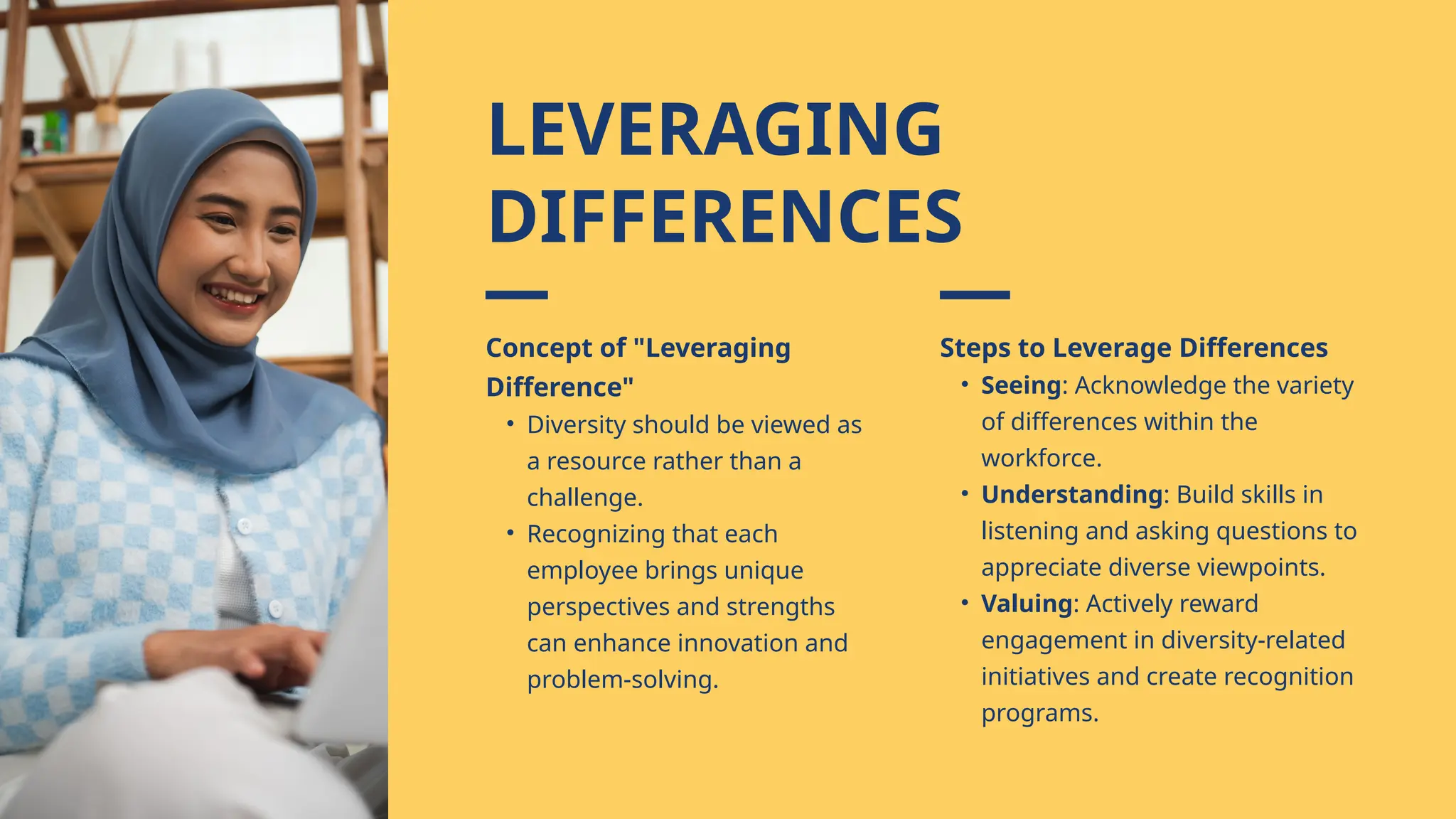
Concept of "Leveraging
Difference"
• Diversity should be viewed as
a resource rather than a
challenge.
• Recognizing that each
employee brings unique
perspectives and strengths
can enhance innovation and
problem-solving.
Steps to Leverage Differences
• Seeing: Acknowledge the variety
of differences within the
workforce.
• Understanding: Build skills in
listening and asking questions to
appreciate diverse viewpoints.
• Valuing: Actively reward
engagement in diversity-related
initiatives and create recognition
programs.
LEVERAGING
DIFFERENCES
Common Challenges in Managing Diversity
• Unexamined Assumptions: Difficulty in
understanding perspectives different from one’s own.
• Communication Problems: Cultural differences can
lead to misunderstandings and misinterpretations.
• Stereotyping and Mistrust: These can hinder
teamwork and collaboration.
OVERCOMING
CHALLENGES
Strategies to Address Challenges:
• Implement training programs to raise awareness of
biases and stereotypes.
• Foster an environment of open dialogue where all
employees feel valued and heard.
Affirmative Action vs. Diversity Management:
• Affirmative action focuses on compliance with legal
mandates, while diversity management is a proactive
approach that values differences.
• It emphasizes treating individuals as unique and
recognizing their contributions to the organization.
Creating an Inclusive Environment:
• Organizations should listen to diverse voices and foster
collaboration to enhance team effectiveness.
THE ROLE OF AFFIRMATIVE
ACTION
CONCLUSION
Summary of Key Points:
• Diversity is essential for organizational success and provides a competitive advantage.
• Effective strategies for retention and attraction of diverse talent are crucial.
• Overcoming challenges is necessary to leverage diversity for organizational growth.
Call to Action:
• Implement strategies to create an inclusive workplace that values and respects all
employees.
Cultivating a
Diverse
Workforce
By Chad Calumpang
MONOLITHIC
ORGANIZATION
• An organization that has a low degree of structural integration—employing
few women, minorities, or other groups that differ from the majority—and
thus has a highly homogeneous employee population.
• is the opposite of a multicultural all-inclusive organization. This is a large
organization with rigid employee rules, unfriendly management, and
means only business, that is to achieve the organization's goal by making
employees toil and not giving them enough credit for it.
monolithic in a system or organization means inflexible, rigid and
unchanging.
Multiple objectives: Pluralistic organizations have multiple objectives.
Diffuse power: Power is spread out in pluralistic organizations.
Knowledge-based work: Work processes in pluralistic organizations
are based on knowledge.
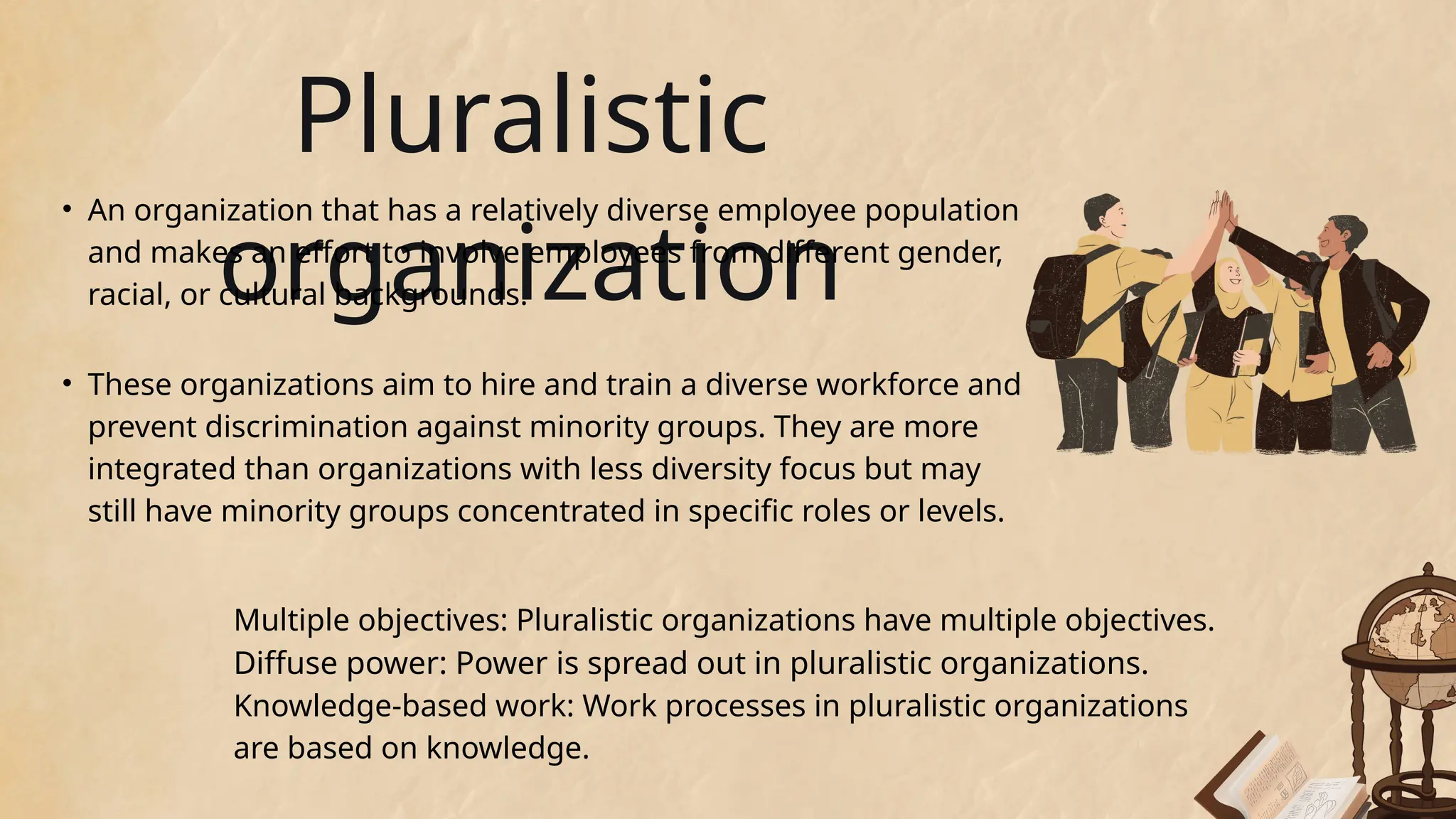
Pluralistic
organization
• An organization that has a relatively diverse employee population
and makes an effort to involve employees from different gender,
racial, or cultural backgrounds.
• These organizations aim to hire and train a diverse workforce and
prevent discrimination against minority groups. They are more
integrated than organizations with less diversity focus but may
still have minority groups concentrated in specific roles or levels.
• To capitalize on the benefits and minimize the costs of a
diverse workforce, perhaps one of the first things
managers need to do is examine their organization’s
prevailing assumptions about people and cultures.
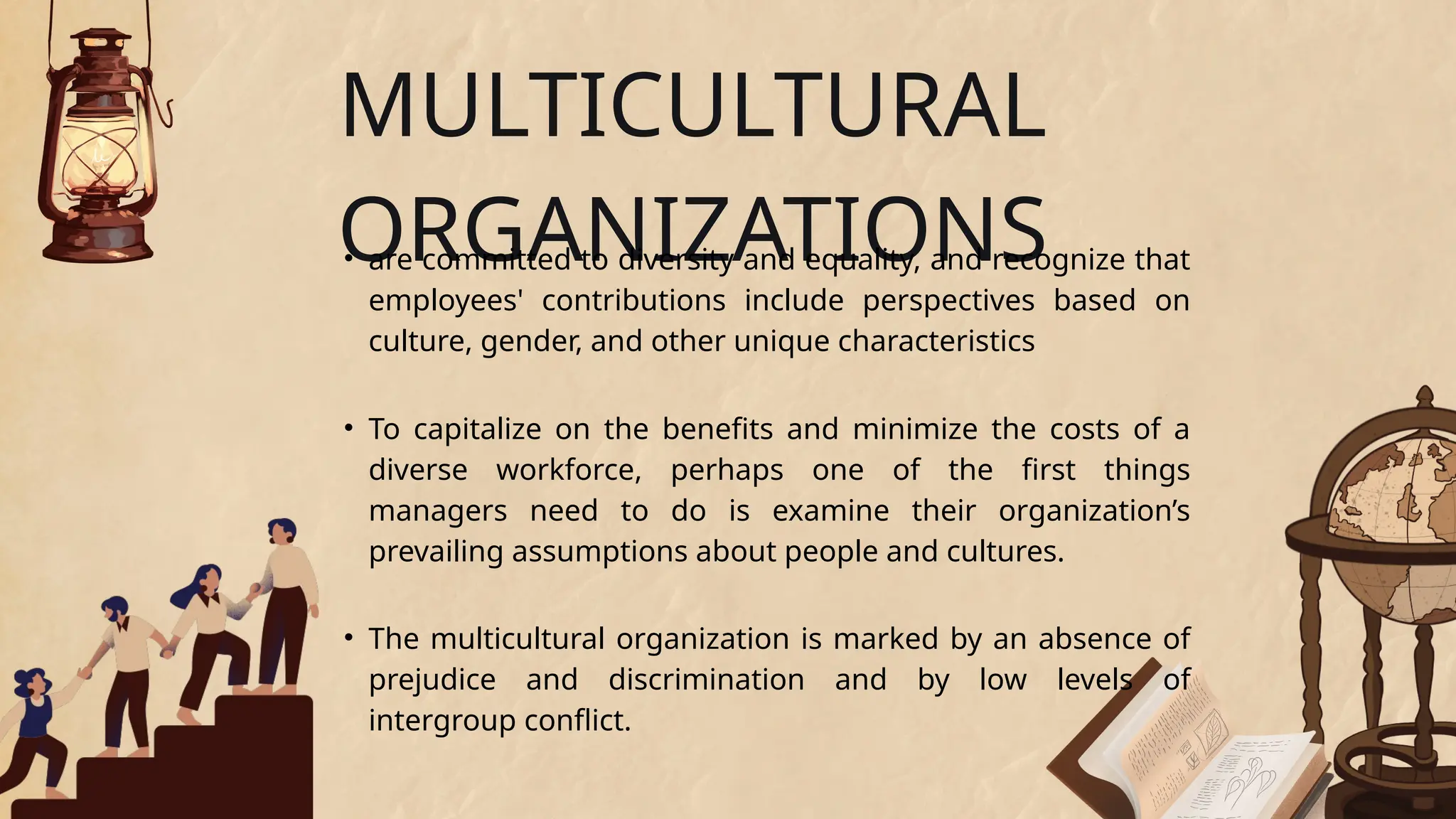
MULTICULTURAL
ORGANIZATIONS
• are committed to diversity and equality, and recognize that
employees' contributions include perspectives based on
culture, gender, and other unique characteristics
• The multicultural organization is marked by an absence of
prejudice and discrimination and by low levels of
intergroup conflict.
AMBICULTURAL
ORGANIZATION
• is one that integrates and balances diverse and sometimes conflicting
cultural elements, ideas, and practices
• Instead of choosing one approach over another, ambicultural organizations
embrace both, finding ways to combine the strengths of different
perspectives and practices
• This approach helps them navigate complex global environments and
fosters innovation by reconciling paradoxes and bridging divisions
CULTIVATIN
G
DIVERSE
WORKFORCE
Strategies to Cultivate Diversity;
Secure top management’s leadership and commitment.
Assess the organization’s progress toward goals.
Attract employees.
Train employees in diversity.
Retain employees.
Strategies to
Cultivate Diversity
Top Management
Commitment
Policies and practices
should be established to
support inclusion.
Organizational
Assessment
Use surveys and feedback
to measure progress and
identify areas for
improvement.
Attracting Diverse
Talent
Ensure job postings are
inclusive and reach a wide
audience.
Strategies to
Cultivate Diversity
Training and
Development
Encourage ongoing
education to build
awareness and
understanding
Retention Strategies
Offer mentorship and
career development
opportunities
Emphasize the need for an
ongoing commitment to
diversity.
Highlight the positive
impact of a diverse
workforce on the
organization's success
CONCLUSI
ON
Embracing diversity in the workplace is crucial for success.
Effective management enhances talent, innovation, and
adaptability while addressing communication challenges.
Commitment from top management and comprehensive
diversity programs foster an inclusive environment, leveraging
unique strengths for organizational growth.
Diverse Workforce of the workplace environment

Diverse Workforce of the workplace environment

  • 1.
  • 2.
    What is aDiverse Workforce Workplace diversity refers to the variety of differences among individuals in an organization, including race, gender, age, religion, sexual orientation, and more.
  • 3.
    Gender Components of a Diversified Workforce IncomeRace Sex Orientation Nationality Ethnicity Religion Education Disability
  • 4.
    Diversity: A Brief History -The significanceof the Civil Rights Act of 1964 and its role in combating workplace discrimination. -The impact of the women’s rights movement and the ongoing struggle for gender equality in the workplace. -The rise of women-owned businesses and their impact on employment. -The shift from a melting pot mentality to a recognition of the value of cultural identities in the workplace. Understanding how a diverse workforce can enhance customer relations and provide a competitive advantage.
  • 5.
    Diversity Today Understand thatdiversity includes a wide array of differences beyond race and gender, such as education, political beliefs, religion, and income. Note the shift from diversity programs being primarily about preventing discrimination to being viewed as essential for expanding talent and customer bases. Recognize that significant diversity exists within groups; individuals from the same demographic may have vastly different experiences and perspectives. Acknowledge that a large percentage of multinational companies now have diversity initiatives in place, indicating a trend toward recognizing the importance of diversity in business strategy.
  • 6.
  • 7.
    The Workforce ofthe Future: refers to the evolving nature of the global workforce as it adapts to the challenges and opportunities of a rapidly changing world. This concept encompasses a wide range of factors including technological advancements, shifting demographics, changing societal values, and the rise of new business models. The future workforce will be defined by its diversity, adaptability, and integration with emerging technologies.
  • 8.
    Developments in workforce • Minoritiesand Immigrants - In addition to gender issues, the importance and scope of diversity are evident in the growth of racial minorities and immigrants in the workforce. • Gender Issues - One of the most important developments in the U.S. labor market has been the growing number of women working outside the home. Social changes during the 1960s and 1970s coupled with financial necessity caused women to enter the workforce and redefine their roles • Mentally and Physically Disabled People - The largest unemployed minority population in the United States is people with disabilities. It is composed of people of all ethnic backgrounds, cultures, and ages. The share of the population with a disability is growing as the average worker gets older and heavier • Education Levels - When the United States was primarily an industrial economy, many jobs required physical strength, stamina, and skill in a trade, rather than college and professional degrees. In today’s service and technology economy, more positions require a college education and even a graduate or professional degree.
  • 9.
    The Workforce ofthe Future: • The workforce of the future will be shaped by a combination of technology, shifting demographics, evolving workplace expectations, and global interconnectedness. Businesses that successfully navigate this new era will need to be adaptable, focus on continuous learning, embrace diverse perspectives, and create environments that prioritize employee well-being, inclusivity, and purpose. As the future unfolds, the key to success will be organizations that can blend technology with human-centered values, creating workplaces where employees can thrive, contribute meaningfully, and be prepared for the challenges ahead.
  • 10.
    Multiple Generations at Work Multi-GenerationalWorkforce refers to a workplace where employees from different generations work together. As the workforce becomes more diverse in terms of age, organizations now have employees ranging from Baby Boomers to Generation Z, with each group bringing distinct experiences, values, expectations, and work styles. Generations in the Workforce As of today, the workforce typically includes employees from five generations: • Baby Boomers (born 1946–1964) • Generation X (born 1965–1980) • Millennials or Generation Y (born 1981–1996) • Generation Z (born 1997–2012) • Generation Alpha (born after 2012, still young, but soon to enter the workforce in the 2030s)
  • 11.
    The Age ofthe Workforce • The baby boom generation (those born between 1946 and 1964) is aging. The Pew Research Center states that approximately 10,000 Boomers are retiring each day in the United States.27 Industries most at risk include health care (hospitals and nursing facili ties), transportation, social assistance, and mining and construction.28 As a result of these trends, the Bureau of Labor Statistics projects that entry-level workers will be in short supply. • The age of the workforce is a dynamic and evolving demographic factor. In most countries, the workforce is aging, and older workers are staying in the labor market longer than they have in the past. At the same time, younger generations are entering the workforce, leading to a more diverse multigenerational workforce. How this plays out will depend on local demographic trends, economic conditions, and • The age of the workforce refers to the range of ages of individuals who are employed or actively seeking employment in the labor market. It is typically measured by examining the age distribution of the working- age population within a country or industry.
  • 12.
  • 13.
    • Diversity andinclusion are critical for modern organizations. • Embracing differences in race, ethnicity, age, gender, and life experiences enhances organizational effectiveness. • Organizations are increasingly viewing diversity from a practical, business-oriented perspective.
  • 14.
  • 15.
    Diversity as aBusiness Tool • Studies show a correlation between diversity in upper management and superior financial performance. • Diversity can be a source of competitive advantage if leveraged effectively. Attracting and Retaining Motivated Employees • Companies known for valuing diversity attract top talent. • Employees who feel their differences are valued are more loyal, productive, and committed.
  • 16.
    RETAINING OLDER WORKERS Key Strategiesfor Retention ⚬ Phased Retirement Plans: Allow older employees to gradually reduce hours while transitioning to retirement. ⚬ Workplace Adaptations: Make adjustments for physical challenges related to aging (e.g., ergonomic workstations). Value of Older Workers ⚬ Older employees bring valuable experience and knowledge, aiding in training and mentoring younger staff. ⚬ Their reliable work habits positively impact team dynamics and overall productivity.
  • 17.
    Challenges in theJob Market • A smaller pool of young talent due to demographic shifts. • Younger workers (Generation Y) often have high expectations for workplace culture and engagement. Strategies for Engagement • Online Recruiting Tactics: Utilize social media platforms (e.g., LinkedIn, Instagram) to connect with younger candidates. • Creating Stimulating Work Environments: Foster teamwork, provide reasonable work hours, and offer positive feedback to enhance job satisfaction. ATTRACTING YOUNGER TALENT
  • 18.
    Concept of "Leveraging Difference" •Diversity should be viewed as a resource rather than a challenge. • Recognizing that each employee brings unique perspectives and strengths can enhance innovation and problem-solving. Steps to Leverage Differences • Seeing: Acknowledge the variety of differences within the workforce. • Understanding: Build skills in listening and asking questions to appreciate diverse viewpoints. • Valuing: Actively reward engagement in diversity-related initiatives and create recognition programs. LEVERAGING DIFFERENCES
  • 19.
    Common Challenges inManaging Diversity • Unexamined Assumptions: Difficulty in understanding perspectives different from one’s own. • Communication Problems: Cultural differences can lead to misunderstandings and misinterpretations. • Stereotyping and Mistrust: These can hinder teamwork and collaboration. OVERCOMING CHALLENGES Strategies to Address Challenges: • Implement training programs to raise awareness of biases and stereotypes. • Foster an environment of open dialogue where all employees feel valued and heard.
  • 20.
    Affirmative Action vs.Diversity Management: • Affirmative action focuses on compliance with legal mandates, while diversity management is a proactive approach that values differences. • It emphasizes treating individuals as unique and recognizing their contributions to the organization. Creating an Inclusive Environment: • Organizations should listen to diverse voices and foster collaboration to enhance team effectiveness. THE ROLE OF AFFIRMATIVE ACTION
  • 21.
    CONCLUSION Summary of KeyPoints: • Diversity is essential for organizational success and provides a competitive advantage. • Effective strategies for retention and attraction of diverse talent are crucial. • Overcoming challenges is necessary to leverage diversity for organizational growth. Call to Action: • Implement strategies to create an inclusive workplace that values and respects all employees.
  • 22.
  • 23.
    MONOLITHIC ORGANIZATION • An organizationthat has a low degree of structural integration—employing few women, minorities, or other groups that differ from the majority—and thus has a highly homogeneous employee population. • is the opposite of a multicultural all-inclusive organization. This is a large organization with rigid employee rules, unfriendly management, and means only business, that is to achieve the organization's goal by making employees toil and not giving them enough credit for it. monolithic in a system or organization means inflexible, rigid and unchanging.
  • 24.
    Multiple objectives: Pluralisticorganizations have multiple objectives. Diffuse power: Power is spread out in pluralistic organizations. Knowledge-based work: Work processes in pluralistic organizations are based on knowledge. Pluralistic organization • An organization that has a relatively diverse employee population and makes an effort to involve employees from different gender, racial, or cultural backgrounds. • These organizations aim to hire and train a diverse workforce and prevent discrimination against minority groups. They are more integrated than organizations with less diversity focus but may still have minority groups concentrated in specific roles or levels.
  • 25.
    • To capitalizeon the benefits and minimize the costs of a diverse workforce, perhaps one of the first things managers need to do is examine their organization’s prevailing assumptions about people and cultures. MULTICULTURAL ORGANIZATIONS • are committed to diversity and equality, and recognize that employees' contributions include perspectives based on culture, gender, and other unique characteristics • The multicultural organization is marked by an absence of prejudice and discrimination and by low levels of intergroup conflict.
  • 26.
    AMBICULTURAL ORGANIZATION • is onethat integrates and balances diverse and sometimes conflicting cultural elements, ideas, and practices • Instead of choosing one approach over another, ambicultural organizations embrace both, finding ways to combine the strengths of different perspectives and practices • This approach helps them navigate complex global environments and fosters innovation by reconciling paradoxes and bridging divisions
  • 27.
  • 28.
    Strategies to CultivateDiversity; Secure top management’s leadership and commitment. Assess the organization’s progress toward goals. Attract employees. Train employees in diversity. Retain employees.
  • 29.
    Strategies to Cultivate Diversity TopManagement Commitment Policies and practices should be established to support inclusion. Organizational Assessment Use surveys and feedback to measure progress and identify areas for improvement. Attracting Diverse Talent Ensure job postings are inclusive and reach a wide audience.
  • 30.
    Strategies to Cultivate Diversity Trainingand Development Encourage ongoing education to build awareness and understanding Retention Strategies Offer mentorship and career development opportunities Emphasize the need for an ongoing commitment to diversity. Highlight the positive impact of a diverse workforce on the organization's success
  • 31.
    CONCLUSI ON Embracing diversity inthe workplace is crucial for success. Effective management enhances talent, innovation, and adaptability while addressing communication challenges. Commitment from top management and comprehensive diversity programs foster an inclusive environment, leveraging unique strengths for organizational growth.