Computing the IR spectra of
protonated peptides and their
fragments
Thomas Rook
Aim
Compute accurate infrared
spectra of protonated peptides
and their fragments.
This spectra can then be compared with experimental data
to help identify conformers
Introduction
1. H. Steen and M. Mann, Nat. Rev. Mol. Cell Biol., 2004, 5, 699–711.
H. Steen et al1
 Proteomics
 Identify proteins from peptides
 A lot of protonation sites are available
 All structures determined by inspection
 Everything calculated at PM6 and then B3LYP/6-31++G*
Initial structure
 Molecule is excited
 Numerous conformers available
 A lot of protonation sites are available
 Mobile proton theory2
 All structures determined by inspection
 Everything calculated at PM6 and then B3LYP/6-31++G*
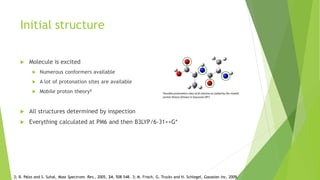
Possible protonation sites of di-alanine as stated by the mobile
proton theory (Drawn in Gaussian 093)
2; B. Palzs and S. Suhal, Mass Spectrom. Rev., 2005, 24, 508–548. 3; M. Frisch, G. Trucks and H. Schlegel, Gaussian Inc, 2009.
Theory level and basis set
 PM6
 Semi empirical
 Fast structure optimization
 B3LYP/6-31++G*
 Hybrid DFT technique
 Split valence,
 IR data
 Geometry optimization produces Hessian
 Need mass weighted hessian
 This produces frequencies
4; M. Orio, D. a Pantazis and F. Neese, Photosynth. Res., 2009, 102, 443–53.
Rizzo et al
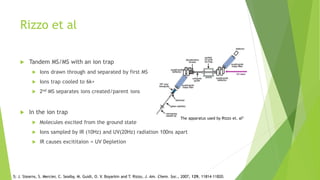
 Tandem MS/MS with an ion trap
 Ions drawn through and separated by first MS
 Ions trap cooled to 6k+
 2nd MS separates ions created/parent ions
 In the ion trap
 Molecules excited from the ground state
 Ions sampled by IR (10Hz) and UV(20Hz) radiation 100ns apart
 IR causes excititaion = UV Depletion
The apparatus used by Rizzo et. al5
5; J. Stearns, S. Mercier, C. Seaiby, M. Guidi, O. V. Boyarkin and T. Rizzo, J. Am. Chem. Soc., 2007, 129, 11814–11820.
Phenylalanine Lowest Energy Conformer
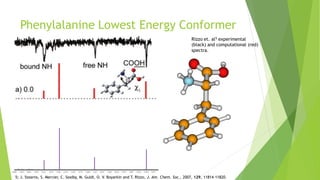
Rizzo et. al5 experimental
(black) and computational (red)
spectra.
5; J. Stearns, S. Mercier, C. Seaiby, M. Guidi, O. V. Boyarkin and T. Rizzo, J. Am. Chem. Soc., 2007, 129, 11814–11820.
Centre Laser Infrarouge d'Orsay (CLIO)
 Next 2 experiments performed at this facility
 FT-ICR
 Fourier Transform Ion Cyclotron Resonance
 Proceeded by both Hexapole and Quadrople
 IRMPD
 Infrared multiphoton dissociation
 Tuneable free electron laser (FEL)
B. Lucas et al
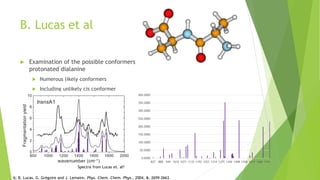
 Examination of the possible conformers of
protonated dialanine
 Numerous likely conformers
 Including unlikely cis conformer
0.0000
50.0000
100.0000
150.0000
200.0000
250.0000
300.0000
350.0000
400.0000
827 888 949 1010 1071 1133 1192 1253 1314 1375 1436 1498 1558 1619 1680 1741
6; B. Lucas, G. Grégoire and J. Lemaire, Phys. Chem. Chem. Phys., 2004, 6, 2659–2663.
Spectra from Lucas et. al6
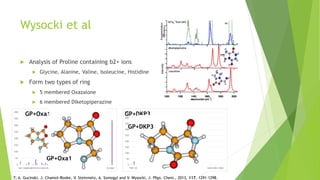
Wysocki et al
 Analysis of Proline containing b2+ ions
 Glycine, Alanine, Valine, Isoleucine, Histidine
 Form two types of ring
 5 membered Oxazalone
 6 membered Diketopiperazine
GP+Oxa1 GP+DKP3
GP+DKP3
GP+Oxa1
7; A. Gucinski, J. Chamot-Rooke, V. Steinmetz, A. Somogyi and V. Wysocki, J. Phys. Chem., 2013, 117, 1291–1298.
Conclusions
 IR Data can be reliably produced from computational techniques
 This data is comparable to experimental data.

Dissertation Presentation

  • 1.
    Computing the IRspectra of protonated peptides and their fragments Thomas Rook
  • 2.
    Aim Compute accurate infrared spectraof protonated peptides and their fragments. This spectra can then be compared with experimental data to help identify conformers
  • 3.
    Introduction 1. H. Steenand M. Mann, Nat. Rev. Mol. Cell Biol., 2004, 5, 699–711. H. Steen et al1  Proteomics  Identify proteins from peptides  A lot of protonation sites are available  All structures determined by inspection  Everything calculated at PM6 and then B3LYP/6-31++G*
  • 4.
    Initial structure  Moleculeis excited  Numerous conformers available  A lot of protonation sites are available  Mobile proton theory2  All structures determined by inspection  Everything calculated at PM6 and then B3LYP/6-31++G* Possible protonation sites of di-alanine as stated by the mobile proton theory (Drawn in Gaussian 093) 2; B. Palzs and S. Suhal, Mass Spectrom. Rev., 2005, 24, 508–548. 3; M. Frisch, G. Trucks and H. Schlegel, Gaussian Inc, 2009.
  • 5.
    Theory level andbasis set  PM6  Semi empirical  Fast structure optimization  B3LYP/6-31++G*  Hybrid DFT technique  Split valence,  IR data  Geometry optimization produces Hessian  Need mass weighted hessian  This produces frequencies 4; M. Orio, D. a Pantazis and F. Neese, Photosynth. Res., 2009, 102, 443–53.
  • 6.
    Rizzo et al Tandem MS/MS with an ion trap  Ions drawn through and separated by first MS  Ions trap cooled to 6k+  2nd MS separates ions created/parent ions  In the ion trap  Molecules excited from the ground state  Ions sampled by IR (10Hz) and UV(20Hz) radiation 100ns apart  IR causes excititaion = UV Depletion The apparatus used by Rizzo et. al5 5; J. Stearns, S. Mercier, C. Seaiby, M. Guidi, O. V. Boyarkin and T. Rizzo, J. Am. Chem. Soc., 2007, 129, 11814–11820.
  • 7.
    Phenylalanine Lowest EnergyConformer Rizzo et. al5 experimental (black) and computational (red) spectra. 5; J. Stearns, S. Mercier, C. Seaiby, M. Guidi, O. V. Boyarkin and T. Rizzo, J. Am. Chem. Soc., 2007, 129, 11814–11820.
  • 8.
    Centre Laser Infrarouged'Orsay (CLIO)  Next 2 experiments performed at this facility  FT-ICR  Fourier Transform Ion Cyclotron Resonance  Proceeded by both Hexapole and Quadrople  IRMPD  Infrared multiphoton dissociation  Tuneable free electron laser (FEL)
  • 9.
    B. Lucas etal  Examination of the possible conformers of protonated dialanine  Numerous likely conformers  Including unlikely cis conformer 0.0000 50.0000 100.0000 150.0000 200.0000 250.0000 300.0000 350.0000 400.0000 827 888 949 1010 1071 1133 1192 1253 1314 1375 1436 1498 1558 1619 1680 1741 6; B. Lucas, G. Grégoire and J. Lemaire, Phys. Chem. Chem. Phys., 2004, 6, 2659–2663. Spectra from Lucas et. al6
  • 10.
    Wysocki et al Analysis of Proline containing b2+ ions  Glycine, Alanine, Valine, Isoleucine, Histidine  Form two types of ring  5 membered Oxazalone  6 membered Diketopiperazine GP+Oxa1 GP+DKP3 GP+DKP3 GP+Oxa1 7; A. Gucinski, J. Chamot-Rooke, V. Steinmetz, A. Somogyi and V. Wysocki, J. Phys. Chem., 2013, 117, 1291–1298.
  • 11.
    Conclusions  IR Datacan be reliably produced from computational techniques  This data is comparable to experimental data.