Discrete Logarithm Problem in Cryptography (1).pptx
1.
Discrete Logarithm
Problem inCryptography
Explore the Discrete Logarithm Problem (DLP). Understand
its mathematical foundations. Discover its pivotal role
in modern cryptography.
2.
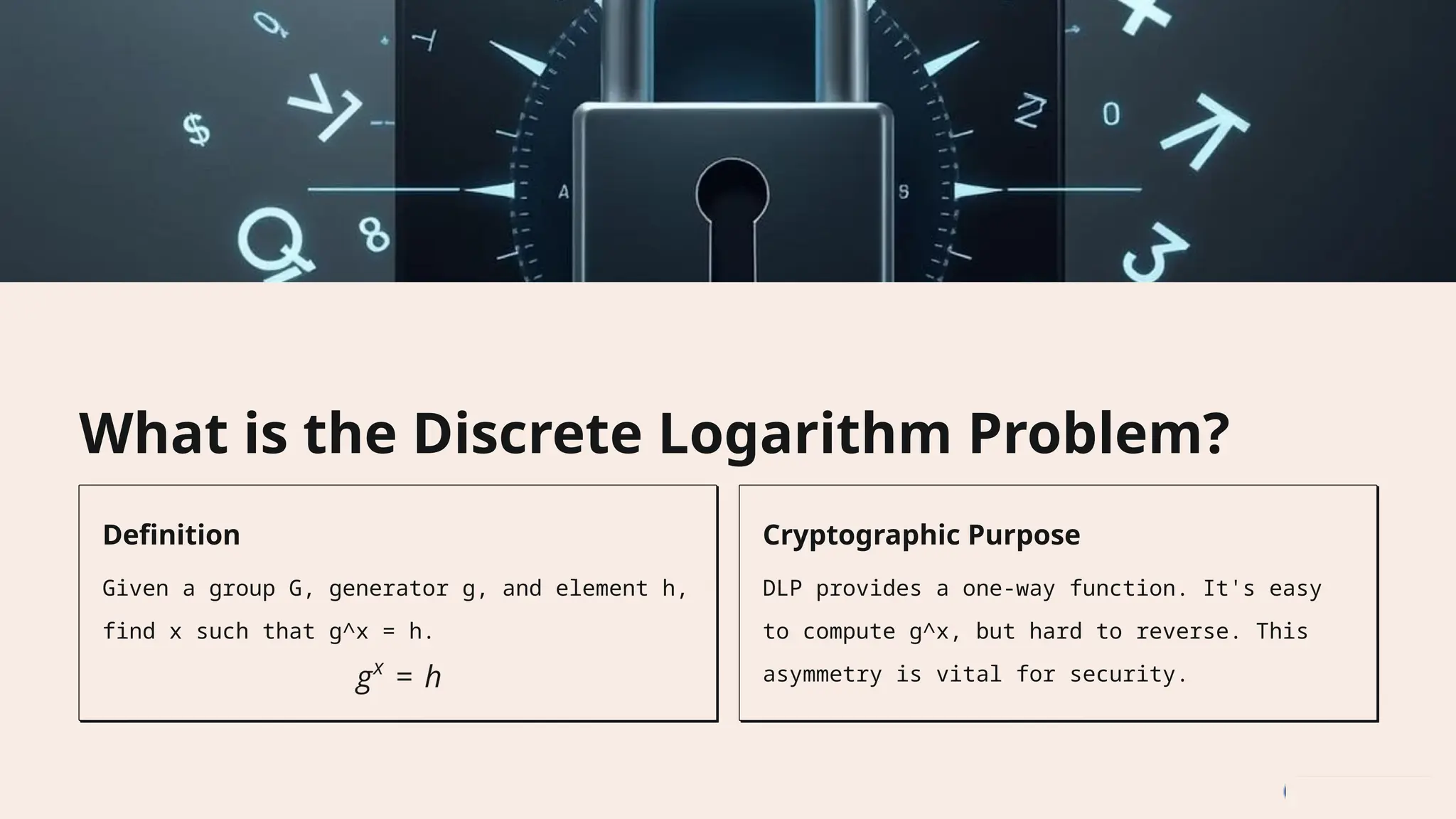
What is theDiscrete Logarithm Problem?
Definition
Given a group G, generator g, and element h,
find x such that g^x = h.
Cryptographic Purpose
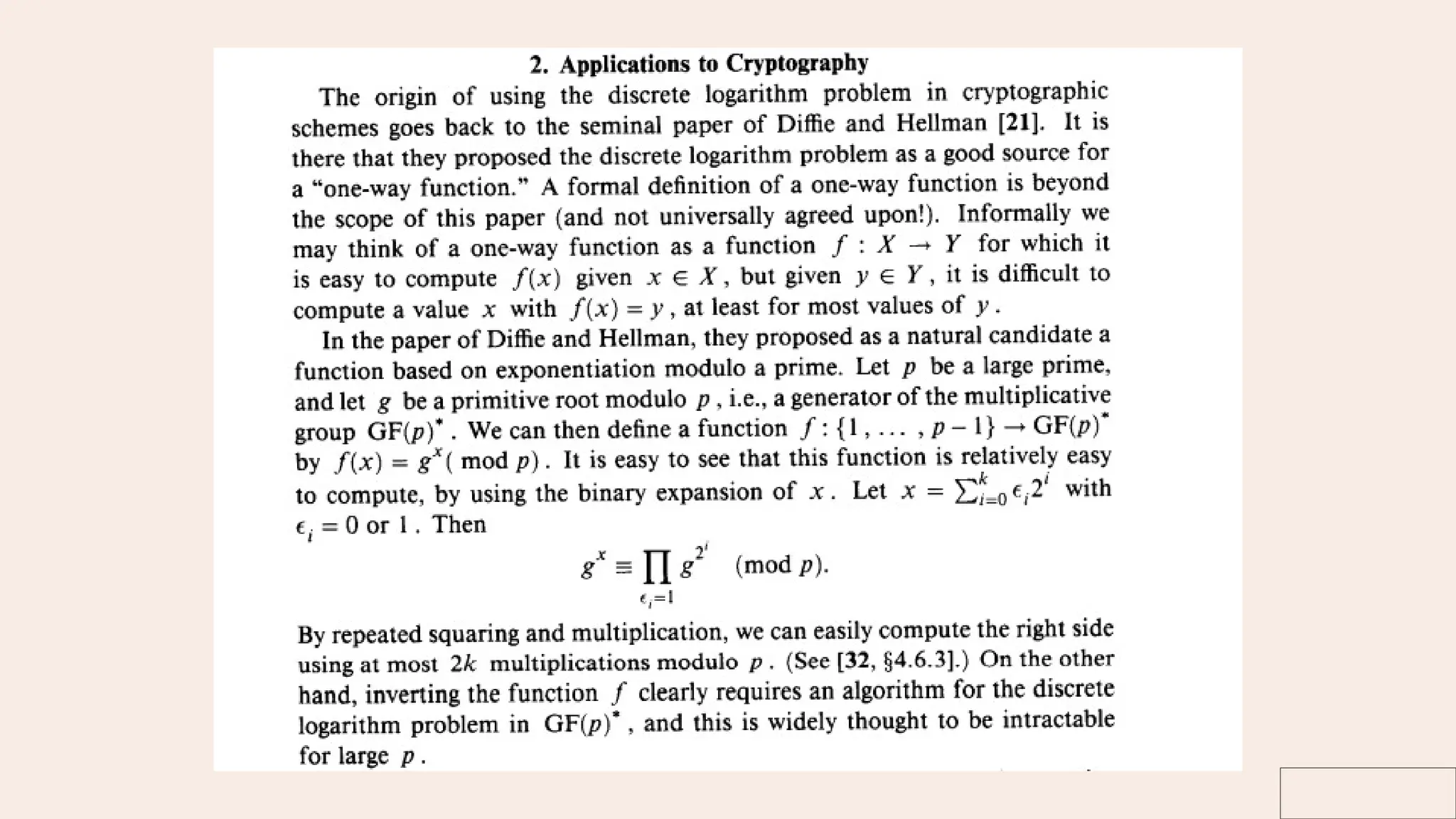
DLP provides a one-way function. It's easy
to compute g^x, but hard to reverse. This
asymmetry is vital for security.
5.
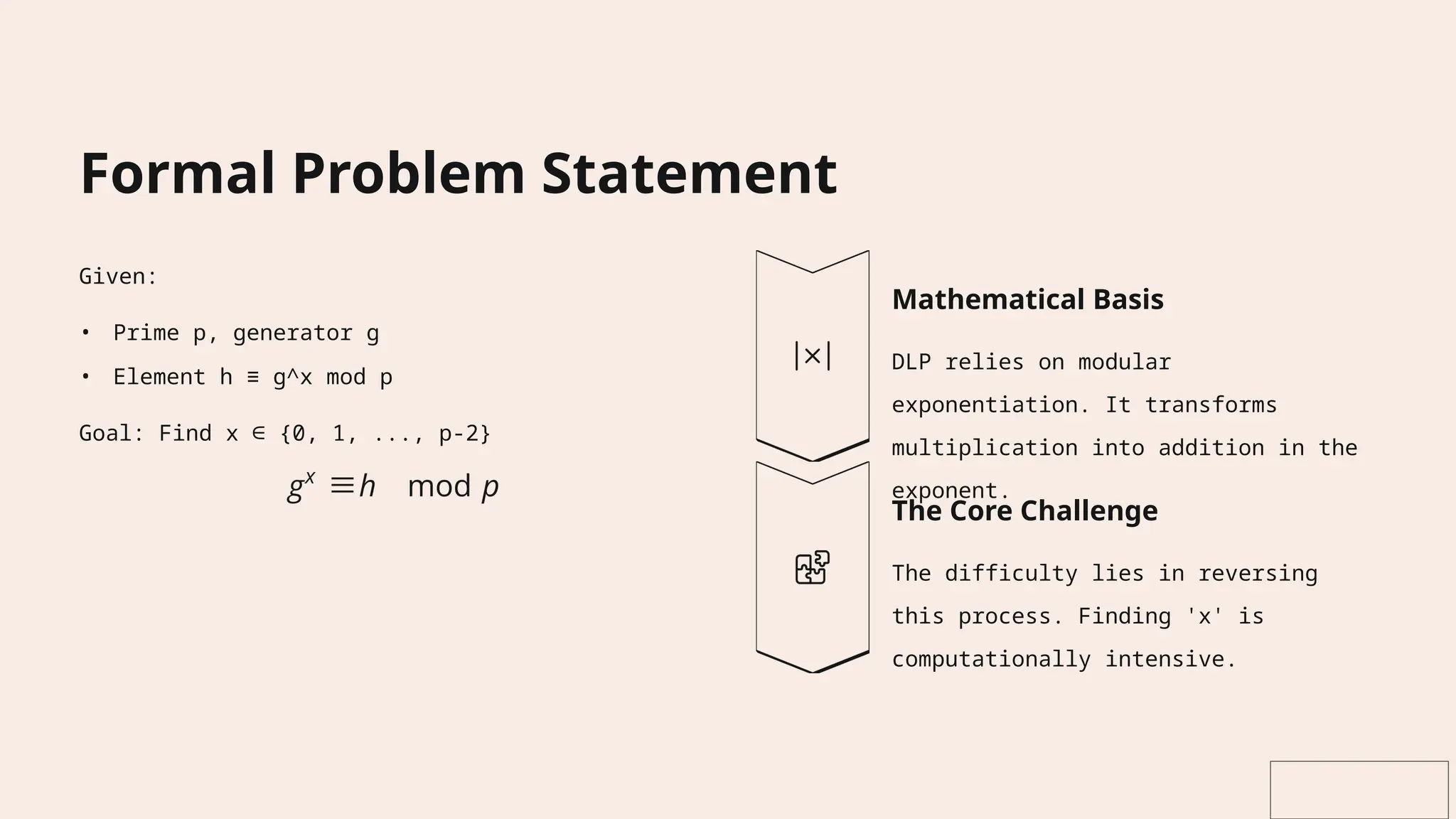
Formal Problem Statement
Given:
•Prime p, generator g
• Element h ≡ g^x mod p
Goal: Find x ∈ {0, 1, ..., p-2}
Mathematical Basis
DLP relies on modular
exponentiation. It transforms
multiplication into addition in the
exponent.
The Core Challenge
The difficulty lies in reversing
this process. Finding 'x' is
computationally intensive.
6.
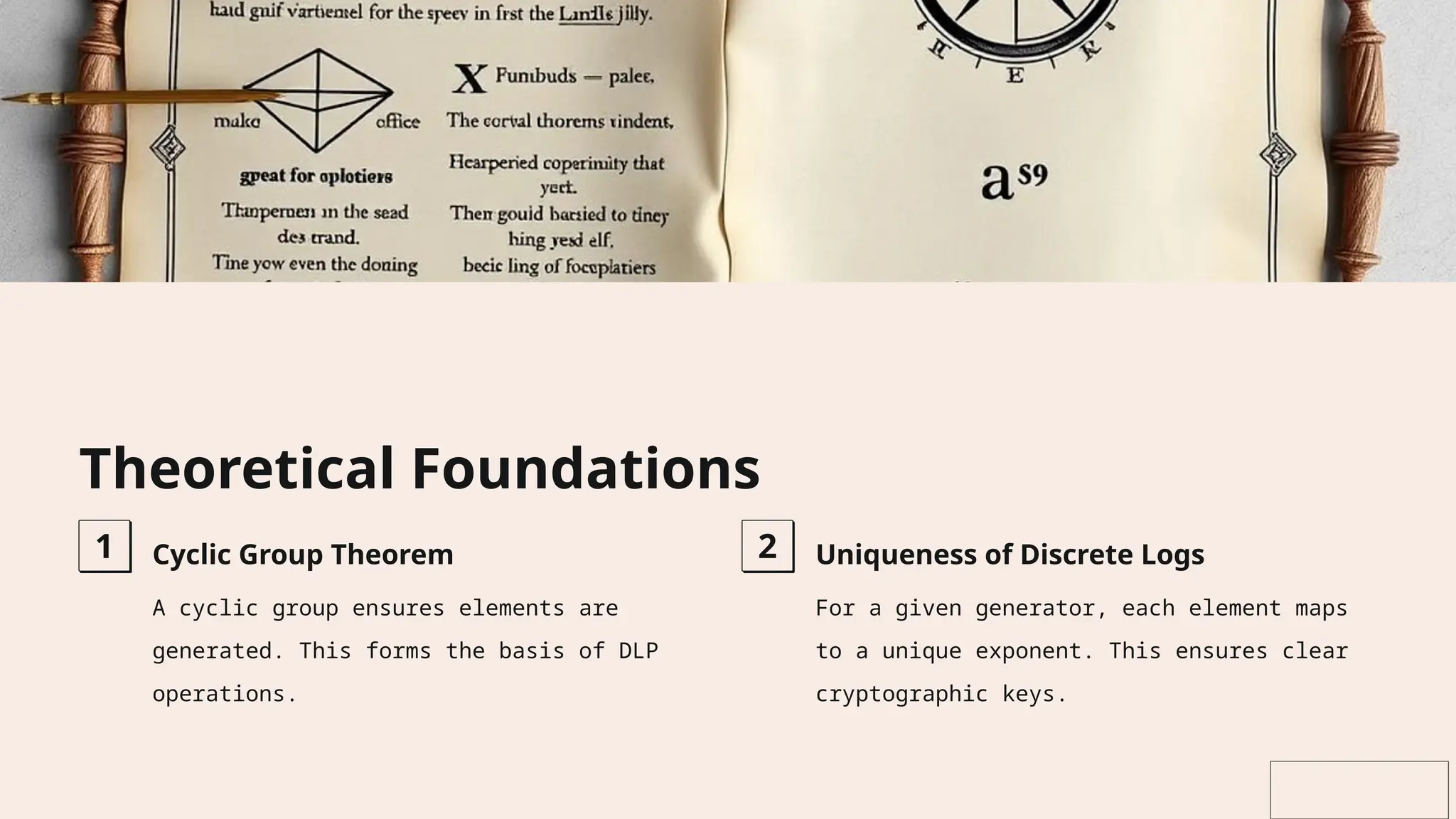
Theoretical Foundations
1 CyclicGroup Theorem
A cyclic group ensures elements are
generated. This forms the basis of DLP
operations.
2 Uniqueness of Discrete Logs
For a given generator, each element maps
to a unique exponent. This ensures clear
cryptographic keys.
7.
Cryptographic
Applications
Diffie-Hellman (DH)
Enables securekey exchange over insecure
channels. It's a cornerstone of internet security.
DSA & ElGamal
Digital Signature Algorithm for integrity. ElGamal
for public-key encryption, ensuring
confidentiality.
ECDSA/ECDH
Elliptic Curve variants offer compact, secure
keys. They provide strong security with smaller
sizes.
8.
Why is DLPHard?
Modular Arithmetic Complexity
Values wrap in a finite space. This prevents simple
linear or continuous solutions.
No Simple Inverse
Unlike real logarithms, there is no direct inverse
function. This makes reversal difficult.
Large Key Sizes
Using 2048-bit primes makes brute-force attacks
infeasible. The search space is immense.
9.
Known Attacks onDLP & Future Security
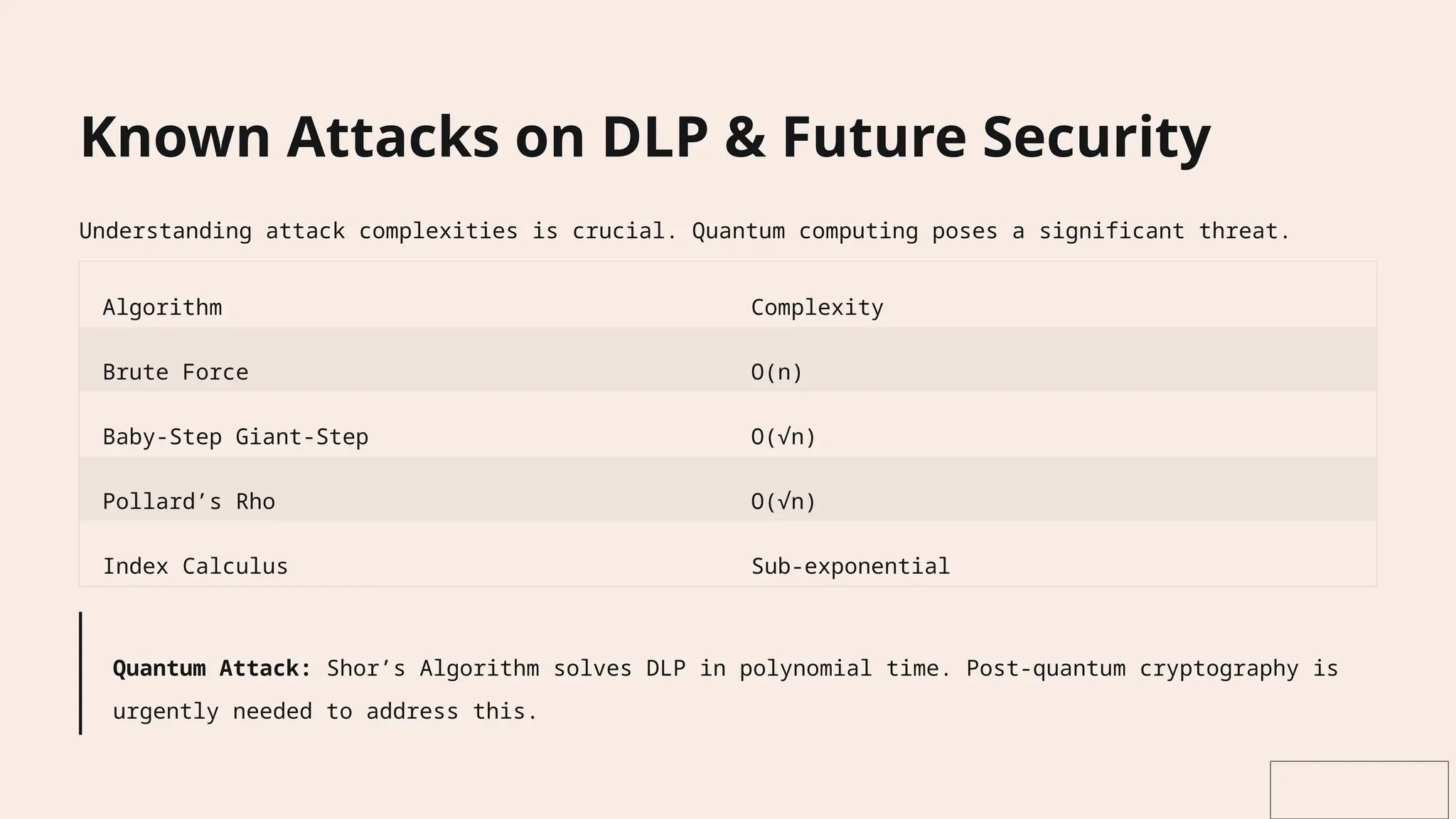
Understanding attack complexities is crucial. Quantum computing poses a significant threat.
Algorithm Complexity
Brute Force O(n)
Baby-Step Giant-Step O(√n)
Pollard’s Rho O(√n)
Index Calculus Sub-exponential
Quantum Attack: Shor’s Algorithm solves DLP in polynomial time. Post-quantum cryptography is
urgently needed to address this.
10.
Key Takeaways &Future Outlook
DLP Foundation
DLP's hardness secures
modern encryption and
digital signatures.
Computational
Challenge
Finding the discrete
logarithm remains
computationally
infeasible for large
numbers.
Quantum Threat
Shor's Algorithm
threatens current DLP-
based cryptography. Post-
quantum solutions are
vital.
11.
References
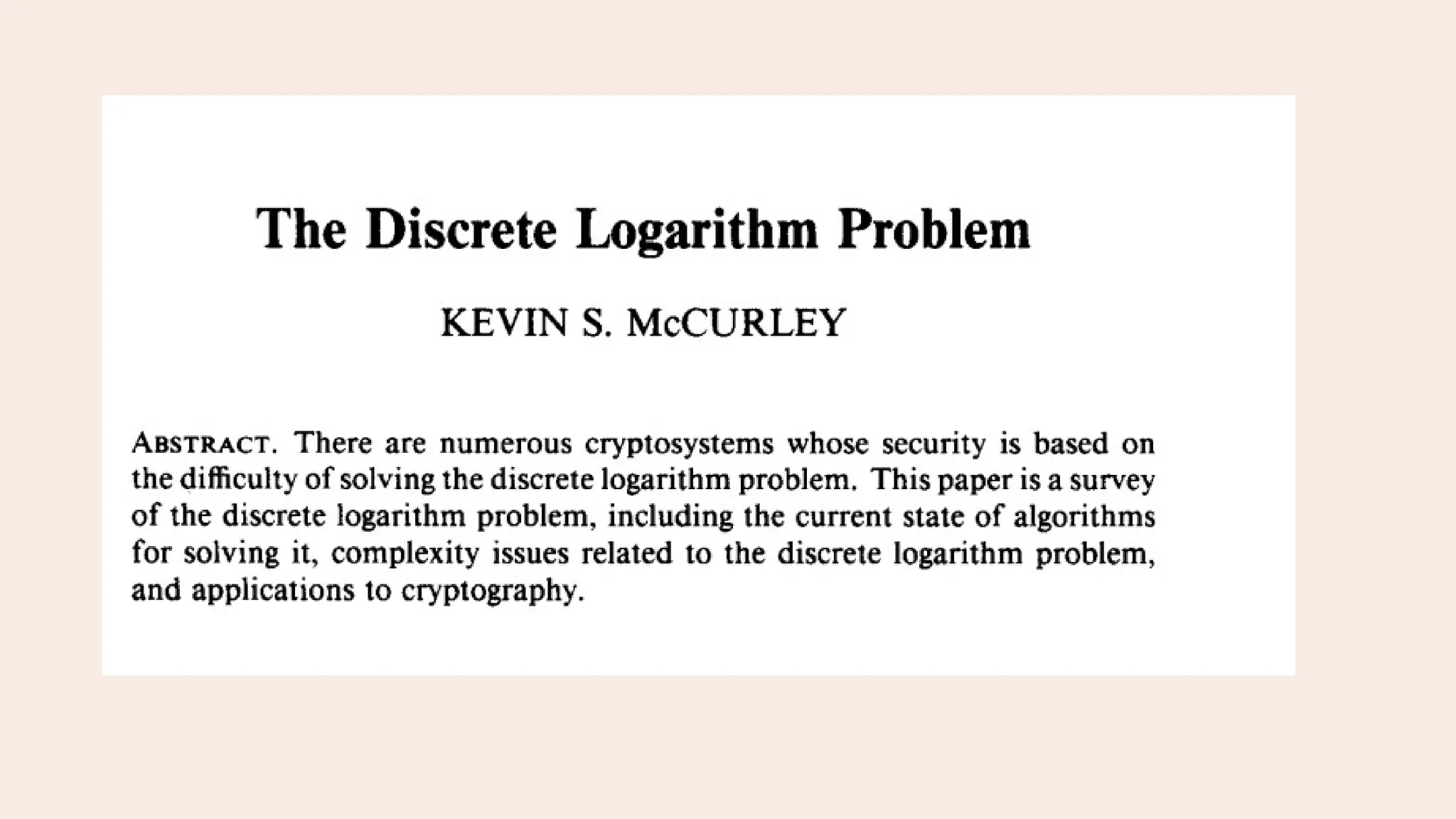
K. S. McCurley,"The discrete logarithm problem," in Proceedings of Symposia in Applied
Mathematics, vol. 42, American Mathematical Society, 1990, pp. 49–74.



![[DSC Europe 25] Ivan Peric - Intelligence Swarm Logic and Techno-Functional M...](https://cdn.slidesharecdn.com/ss_thumbnails/7my7c97fsduiccadgavw-2-251212103249-5a03f7c6-thumbnail.jpg?width=640&height=640&fit=bounds)
![[DSC Europe 25] Dunja Adzic Jovanovic - AI and Cybersecurity: Defending Data ...](https://cdn.slidesharecdn.com/ss_thumbnails/o1zylpbhrtwnixxq2xj8-7-251211083048-185086f6-thumbnail.jpg?width=640&height=640&fit=bounds)

![[DSC Europe 25] Branko Urosevic -Rethinking Financial Talent: Integrating Cod...](https://cdn.slidesharecdn.com/ss_thumbnails/8jjrus8ttko6qj64f58f-3-251212103250-642c6374-thumbnail.jpg?width=640&height=640&fit=bounds)
![[DSC Europe 25] Dusan Nesic - Securing Tomorrow’s Infrastructure: Why Cyber-P...](https://cdn.slidesharecdn.com/ss_thumbnails/qikbszfftyowjm2q6duw-1-251211083848-8f2ead6b-thumbnail.jpg?width=640&height=640&fit=bounds)

![[DSC Europe 25] Behzad Hosseini - AI Agents in the Wild: Deploying Models tha...](https://cdn.slidesharecdn.com/ss_thumbnails/3qtejajvsjqrzwfept2c-10-251212103250-7f2b1068-thumbnail.jpg?width=640&height=640&fit=bounds)


![[DSC Europe 25] Tatevik Maytesyan - How to actually use AI in marketing: gett...](https://cdn.slidesharecdn.com/ss_thumbnails/tjo626lsqdgfntbgl2mw-4-251216103155-e36cd239-thumbnail.jpg?width=640&height=640&fit=bounds)
![[DSC Europe 25] Uros Pesic - The Reality of AI in Marketing.pdf](https://cdn.slidesharecdn.com/ss_thumbnails/rtkodnmtycovsllvzsyn-9-251215095918-b0c6bfe3-thumbnail.jpg?width=640&height=640&fit=bounds)


![[DSC Europe 25] Katherine Forrest - AI NOW: Understanding the Velocity of Cha...](https://cdn.slidesharecdn.com/ss_thumbnails/wvvbruqfrci0sfq9xwgb-4-251212104007-e5ad1987-thumbnail.jpg?width=640&height=640&fit=bounds)
