Discovery Using Data at Rest
By
Dr. Sanjeev Kumar
Professor
Department of Computer Application
Contents
• Introduction
• Discovery Data at Rest
• Big Data Discovery
• Data Protection: Data At Rest
• Role of Encryption In Data Protection
• Best Practices for Protection Data in Rest
• Conclusion
2
Real-time Big Data Architectures, Dr. Sanjeev Kumar
What is Data Rest
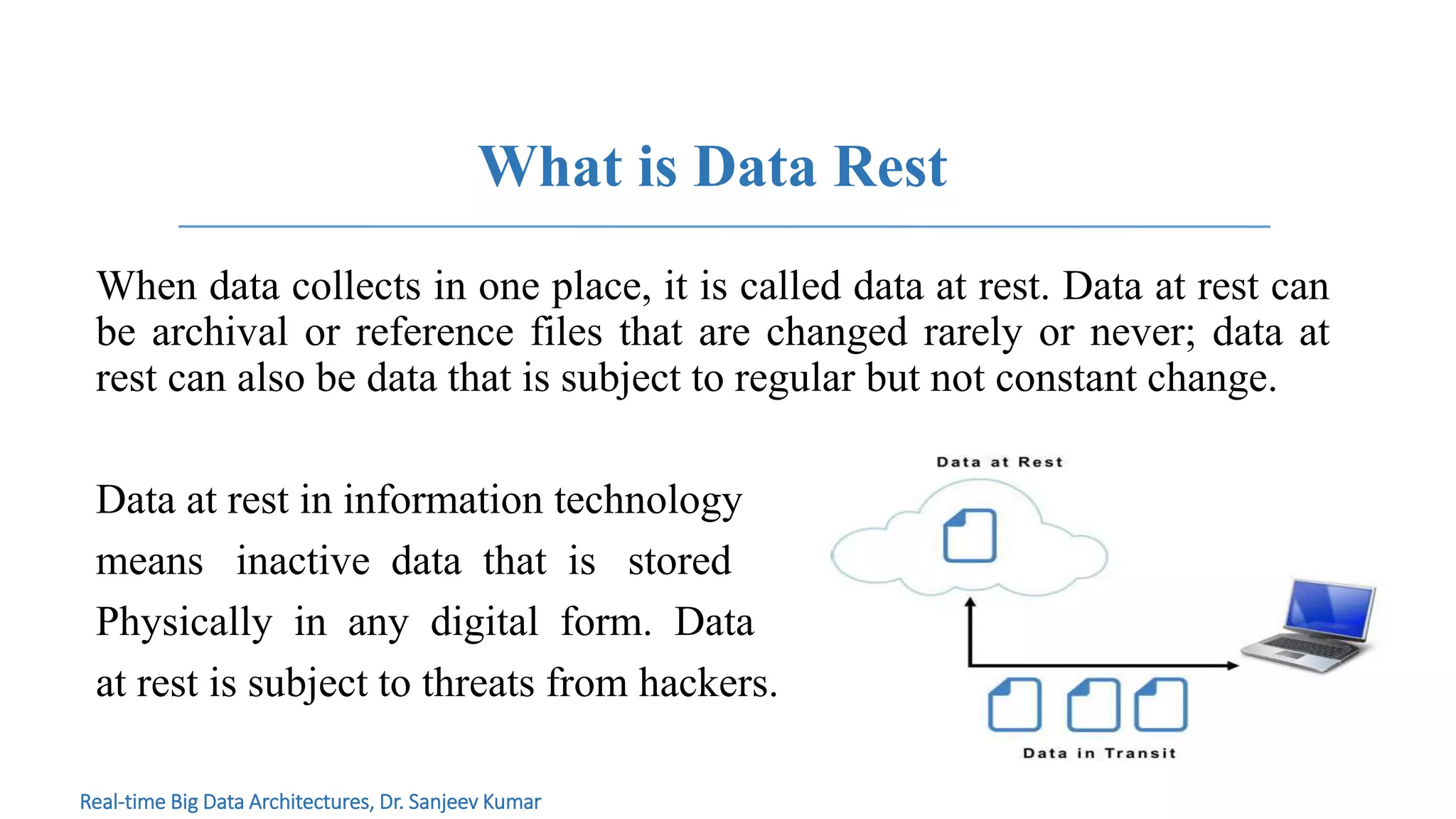
When data collects in one place, it is called data at rest. Data at rest can
be archival or reference files that are changed rarely or never; data at
rest can also be data that is subject to regular but not constant change.
Data at rest in information technology
means inactive data that is stored
Physically in any digital form. Data
at rest is subject to threats from hackers.
Real-time Big Data Architectures, Dr. Sanjeev Kumar
Data at Rest Includes:
Real-time Big Data Architectures, Dr. Sanjeev Kumar
 Data stored in an online database
 Data stored on disk
 Data stored online or offline database extracts
 Backups transferred to disk, tape, or optical (CD/DVD)
media
Discovery Data at Rest
Real-time Big Data Architectures, Dr. Sanjeev Kumar
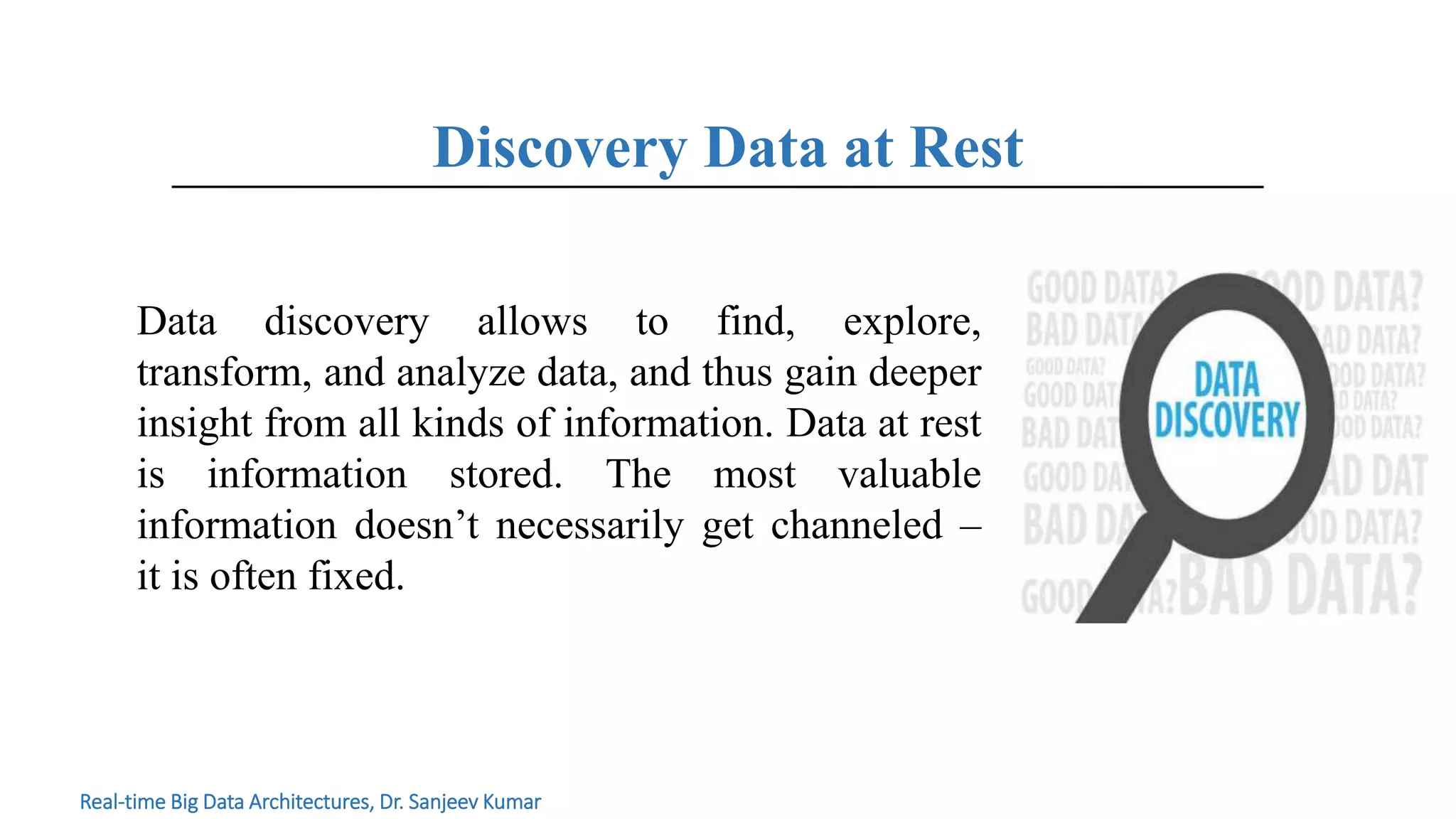
Data discovery allows to find, explore,
transform, and analyze data, and thus gain deeper
insight from all kinds of information. Data at rest
is information stored. The most valuable
information doesn’t necessarily get channeled –
it is often fixed.
Big Data Discovery
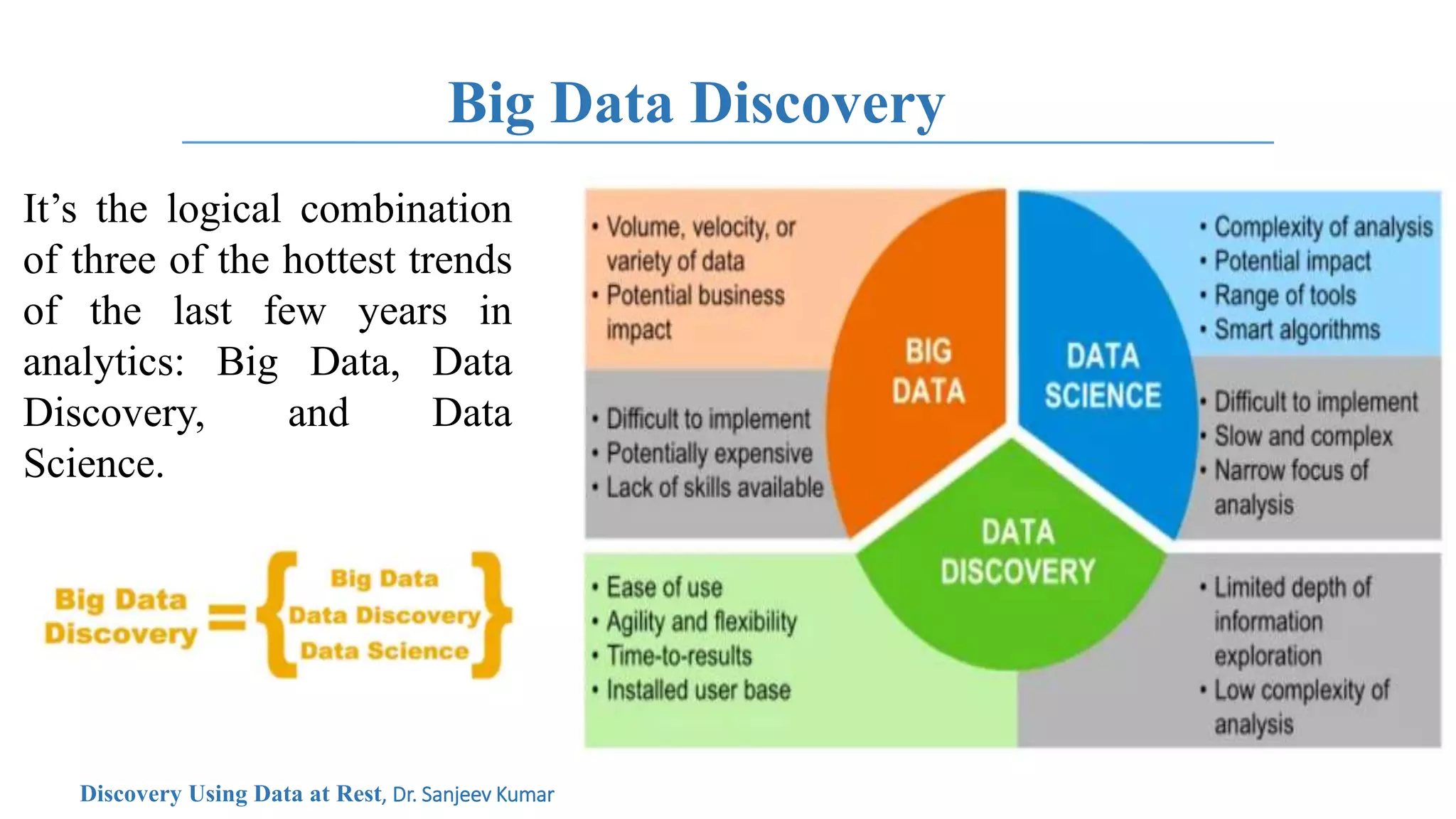
It’s the logical combination
of three of the hottest trends
of the last few years in
analytics: Big Data, Data
Discovery, and Data
Science.
Discovery Using Data at Rest, Dr. Sanjeev Kumar
Data Protection: Data At Rest
Data protection at rest aims to secure inactive data stored on any device
or network. While data at rest is sometimes considered to be less
vulnerable than data in transit, attackers often find data at rest a more
valuable target than data in motion. The risk profile for data in transit
or data at rest depends on the security measures that are in place to
secure data in either state.
Protecting sensitive data at rest is imperative for modern enterprises as
attackers find increasingly innovative ways to compromise systems and
steal data.
Discovery Using Data at Rest, Dr. Sanjeev Kumar
Role of Encryption In Data Protection
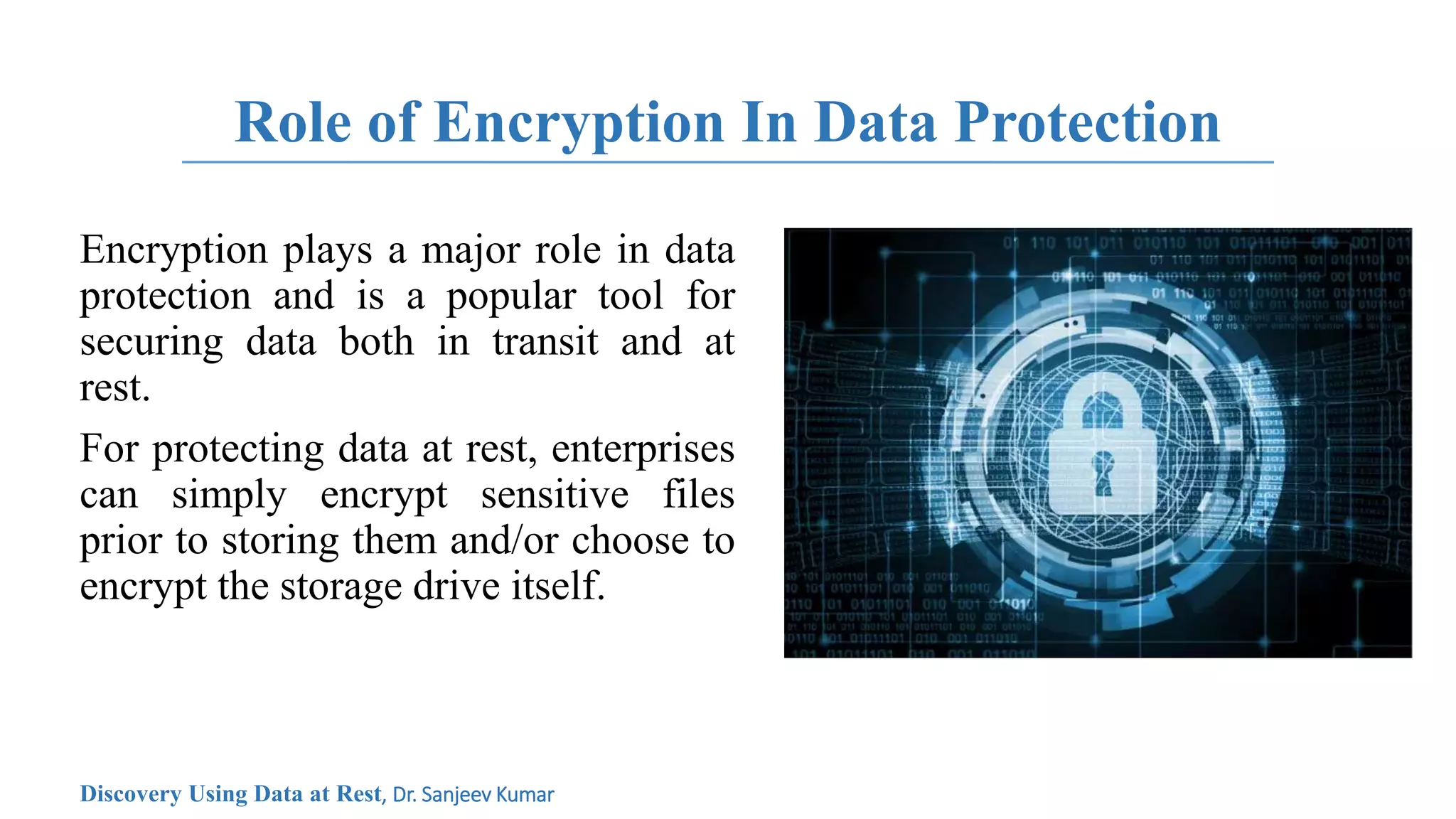
Encryption plays a major role in data
protection and is a popular tool for
securing data both in transit and at
rest.
For protecting data at rest, enterprises
can simply encrypt sensitive files
prior to storing them and/or choose to
encrypt the storage drive itself.
Discovery Using Data at Rest, Dr. Sanjeev Kumar
Best Practices for Protection Data in Rest
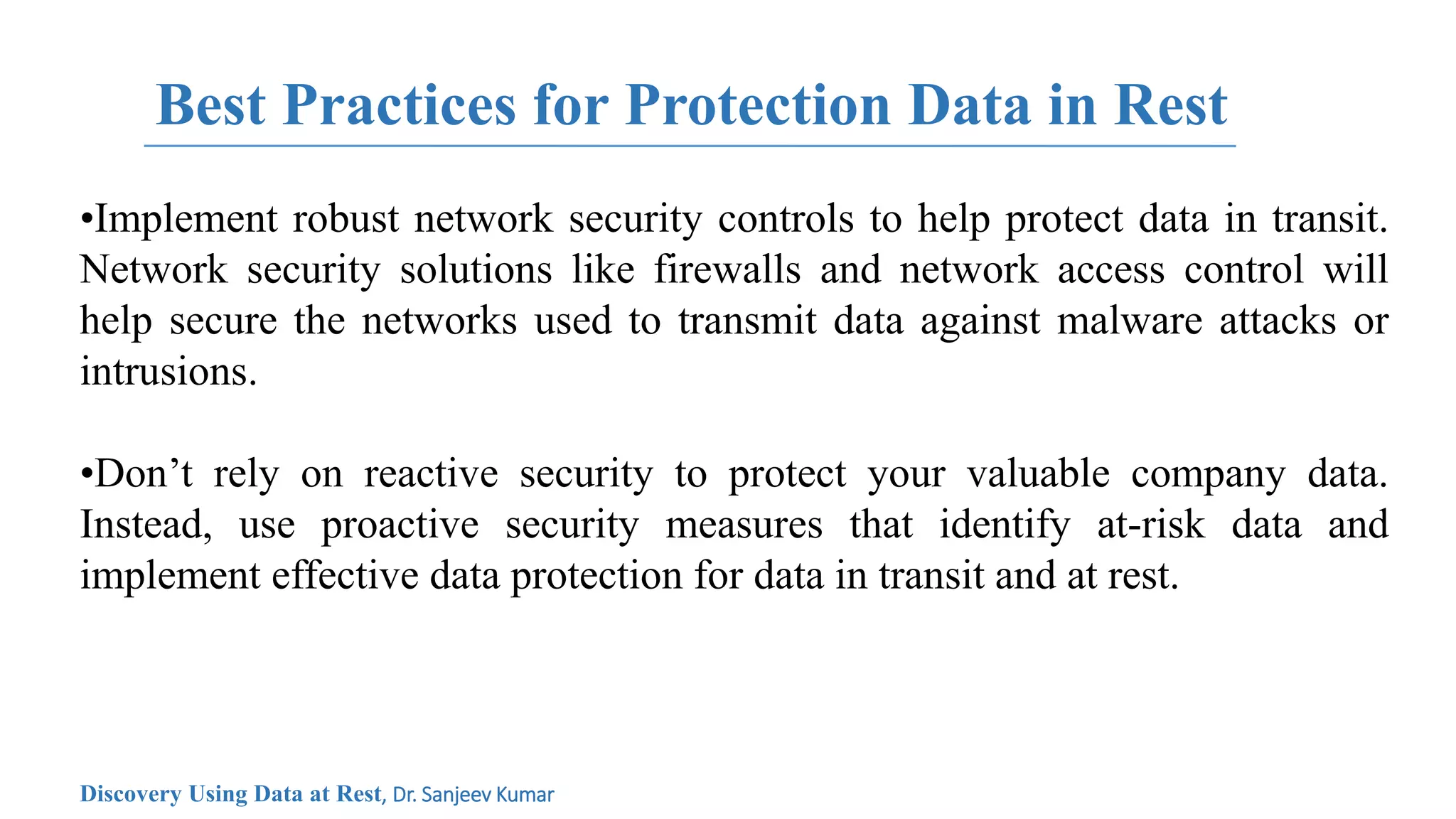
•Implement robust network security controls to help protect data in transit.
Network security solutions like firewalls and network access control will
help secure the networks used to transmit data against malware attacks or
intrusions.
•Don’t rely on reactive security to protect your valuable company data.
Instead, use proactive security measures that identify at-risk data and
implement effective data protection for data in transit and at rest.
Discovery Using Data at Rest, Dr. Sanjeev Kumar
Best Practices for Protection Data in Rest
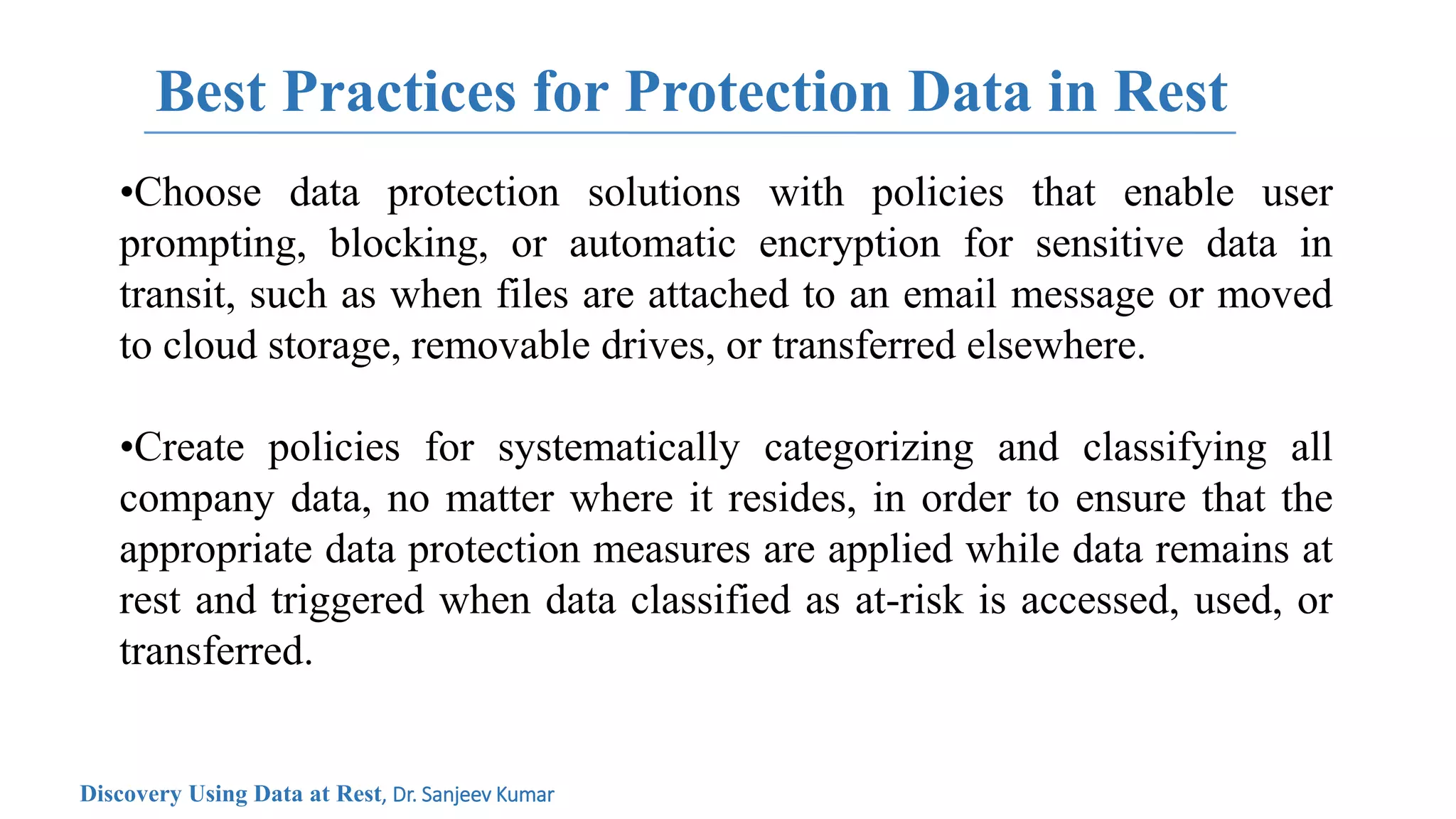
•Choose data protection solutions with policies that enable user
prompting, blocking, or automatic encryption for sensitive data in
transit, such as when files are attached to an email message or moved
to cloud storage, removable drives, or transferred elsewhere.
•Create policies for systematically categorizing and classifying all
company data, no matter where it resides, in order to ensure that the
appropriate data protection measures are applied while data remains at
rest and triggered when data classified as at-risk is accessed, used, or
transferred.
Discovery Using Data at Rest, Dr. Sanjeev Kumar
Conclusion:
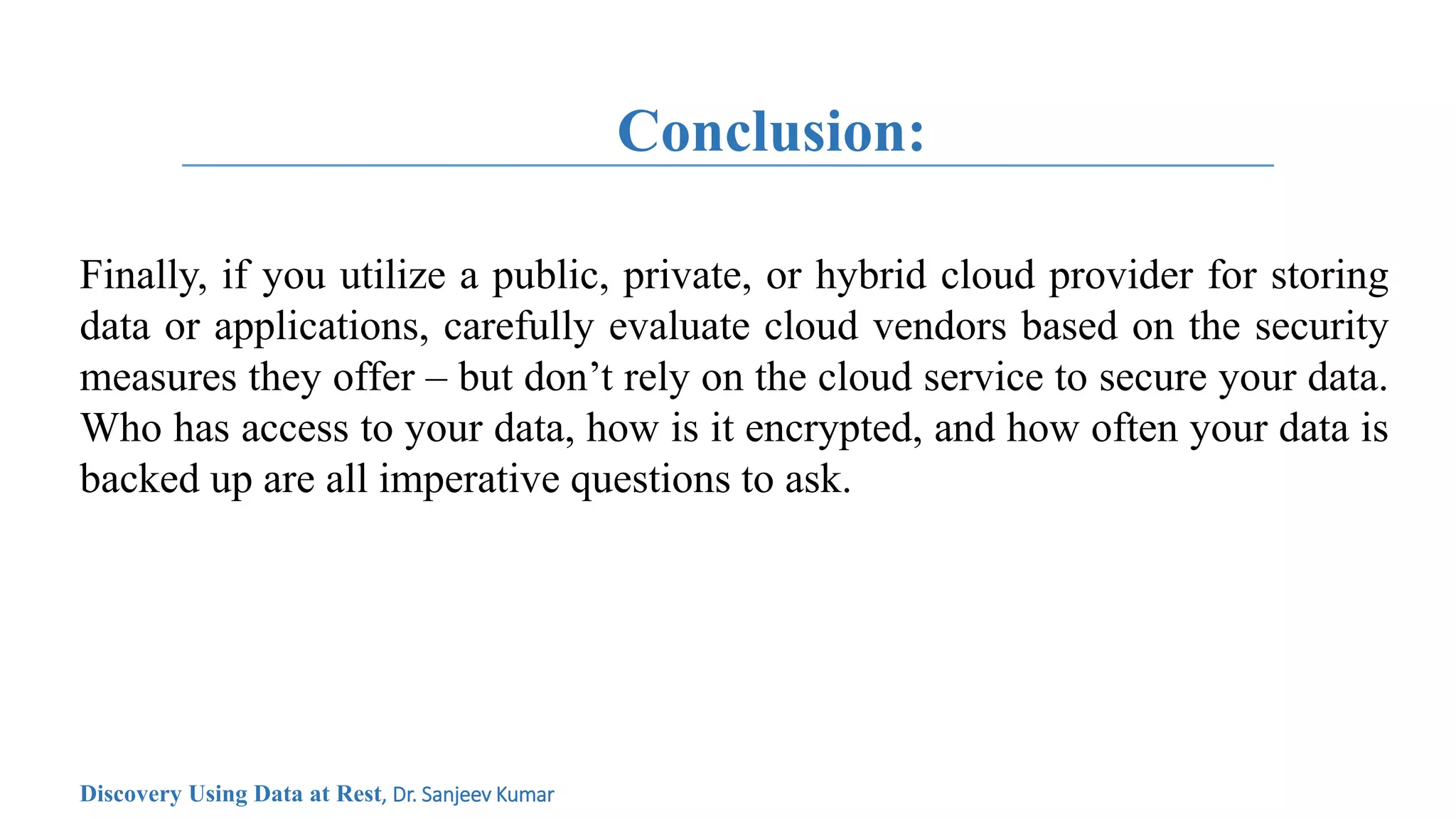
Finally, if you utilize a public, private, or hybrid cloud provider for storing
data or applications, carefully evaluate cloud vendors based on the security
measures they offer – but don’t rely on the cloud service to secure your data.
Who has access to your data, how is it encrypted, and how often your data is
backed up are all imperative questions to ask.
Discovery Using Data at Rest, Dr. Sanjeev Kumar
Thanks

Discovery of rest at data

  • 1.
    Discovery Using Dataat Rest By Dr. Sanjeev Kumar Professor Department of Computer Application
  • 2.
    Contents • Introduction • DiscoveryData at Rest • Big Data Discovery • Data Protection: Data At Rest • Role of Encryption In Data Protection • Best Practices for Protection Data in Rest • Conclusion 2 Real-time Big Data Architectures, Dr. Sanjeev Kumar
  • 3.
    What is DataRest When data collects in one place, it is called data at rest. Data at rest can be archival or reference files that are changed rarely or never; data at rest can also be data that is subject to regular but not constant change. Data at rest in information technology means inactive data that is stored Physically in any digital form. Data at rest is subject to threats from hackers. Real-time Big Data Architectures, Dr. Sanjeev Kumar
  • 4.
    Data at RestIncludes: Real-time Big Data Architectures, Dr. Sanjeev Kumar  Data stored in an online database  Data stored on disk  Data stored online or offline database extracts  Backups transferred to disk, tape, or optical (CD/DVD) media
  • 5.
    Discovery Data atRest Real-time Big Data Architectures, Dr. Sanjeev Kumar Data discovery allows to find, explore, transform, and analyze data, and thus gain deeper insight from all kinds of information. Data at rest is information stored. The most valuable information doesn’t necessarily get channeled – it is often fixed.
  • 6.
    Big Data Discovery It’sthe logical combination of three of the hottest trends of the last few years in analytics: Big Data, Data Discovery, and Data Science. Discovery Using Data at Rest, Dr. Sanjeev Kumar
  • 7.
    Data Protection: DataAt Rest Data protection at rest aims to secure inactive data stored on any device or network. While data at rest is sometimes considered to be less vulnerable than data in transit, attackers often find data at rest a more valuable target than data in motion. The risk profile for data in transit or data at rest depends on the security measures that are in place to secure data in either state. Protecting sensitive data at rest is imperative for modern enterprises as attackers find increasingly innovative ways to compromise systems and steal data. Discovery Using Data at Rest, Dr. Sanjeev Kumar
  • 8.
    Role of EncryptionIn Data Protection Encryption plays a major role in data protection and is a popular tool for securing data both in transit and at rest. For protecting data at rest, enterprises can simply encrypt sensitive files prior to storing them and/or choose to encrypt the storage drive itself. Discovery Using Data at Rest, Dr. Sanjeev Kumar
  • 9.
    Best Practices forProtection Data in Rest •Implement robust network security controls to help protect data in transit. Network security solutions like firewalls and network access control will help secure the networks used to transmit data against malware attacks or intrusions. •Don’t rely on reactive security to protect your valuable company data. Instead, use proactive security measures that identify at-risk data and implement effective data protection for data in transit and at rest. Discovery Using Data at Rest, Dr. Sanjeev Kumar
  • 10.
    Best Practices forProtection Data in Rest •Choose data protection solutions with policies that enable user prompting, blocking, or automatic encryption for sensitive data in transit, such as when files are attached to an email message or moved to cloud storage, removable drives, or transferred elsewhere. •Create policies for systematically categorizing and classifying all company data, no matter where it resides, in order to ensure that the appropriate data protection measures are applied while data remains at rest and triggered when data classified as at-risk is accessed, used, or transferred. Discovery Using Data at Rest, Dr. Sanjeev Kumar
  • 11.
    Conclusion: Finally, if youutilize a public, private, or hybrid cloud provider for storing data or applications, carefully evaluate cloud vendors based on the security measures they offer – but don’t rely on the cloud service to secure your data. Who has access to your data, how is it encrypted, and how often your data is backed up are all imperative questions to ask. Discovery Using Data at Rest, Dr. Sanjeev Kumar
  • 12.