Name_____________________________________Period_____________Date________
                               Activity – Learning How to Predict Products
                                      Objectives 5.9, 5.10, 5.11, 5.12

                                      SUMMARY OF REACTION TYPES LEARNED
       Synthesis reaction - Two or more substances combine to form a new compound
             Example: A + B                    AB
       Decomposition reaction - A single compound undergoes a reaction that produces two or more simpler substances
             Example: AB                  A + B or ABC                     AB + C
       Single Displacement reaction - One element replaces or “displaces” another element in a compound
             Example: A + BC                       AC + B
             Remember – Element can only displace another element BELOW itself on the activity series chart!
       Double Displacement reaction - Ions of two compounds exchange places to form two new compounds
             Example: AB + CD                    AD + CB
       Combustion reaction - Substance combines with oxygen, and releases energy in the form of light and heat.
             Example: CxHx + O2 (g)                 CO2 (g) + H2O (l)

Goal: You’re goal today is to work in groups and to use each other, class notes, and the guided PowerPoint as resources to
be able to predict products for synthesis, decomposition, single displacement, double displacement and combustion
reactions.

Method: Based on class discussions, you will attempt to predict products based upon the reaction type determined. For
any struggles/clarifications you might need, please refer to the narrated PowerPoint slides for guidance and examples.

Objective: Every student will be able to correctly predict products, write correct formulas, and balance equations for each of
the types of chemical reactions. Please see reverse side for assignment to be turned in. ALL STUDENTS MUST BE
WORKING TOGETHER ON THE SAME REACTION TYPE. There will be no dividing up questions amongst the group.
Use the following websites for guided examples for each of the following reaction types:

Synthesis:
http://www.screencast.com/users/l_burkett/folders/Jing/media/6f685044-1db9-4a96-8d3e-182e47ae45ae

Decomposition:
http://www.screencast.com/users/l_burkett/folders/Jing/media/b5d0924a-563a-42e8-be07-d878d89ff0c2

Single Displacement
http://www.screencast.com/users/l_burkett/folders/Jing/media/64afa598-2bf4-489c-9537-62572e083e26

Double Displacement
http://www.screencast.com/users/l_burkett/folders/Jing/media/09ac1316-2746-4d05-b26f-d17983882afa

Combustion
http://www.screencast.com/users/l_burkett/folders/Jing/media/71df8f8c-7e8b-4eee-9446-3c27bbfc61fc

FOR EACH OF THE FOLLOWING EQUATIONS, identify the reaction type, predict the products (making sure to NEVER
carry subscripts unless part of a polyatomic ion), write correct formulas of products (using charges of elements in new
compounds formed) and balance the equation. For single displacement and double displacement reactions, make sure to
determine if a reaction will take place (SD – activity series chart, DD – solubility chart).

_______________________________ 1. ___Mg + ___N2

_______________________________ 2. ___Zn + ___MgSO4

_______________________________ 3. ___Cd + ___O2

_______________________________ 4. ___HCl + ___KOH

_______________________________ 5. ___C5H12 + ___O2

_______________________________ 6. ___Zn + ___Ni(NO3)2

_______________________________ 7. ___Br2 + ___FeI3

_______________________________ 8. ___Li2SO4 + ___BaCl2

_______________________________ 9. ___HgO

_______________________________10. ___KNO3 + ___NaCl

_______________________________11. ___Na + ___Cl2

_______________________________12. ___Al + ___O2

_______________________________13. ___PBr3

_______________________________14. ___Fe + ___Pb(NO3)2

_______________________________15. ___KMnO4 + ___ZnCl2

Discovery Based Predicting Products

  • 1.
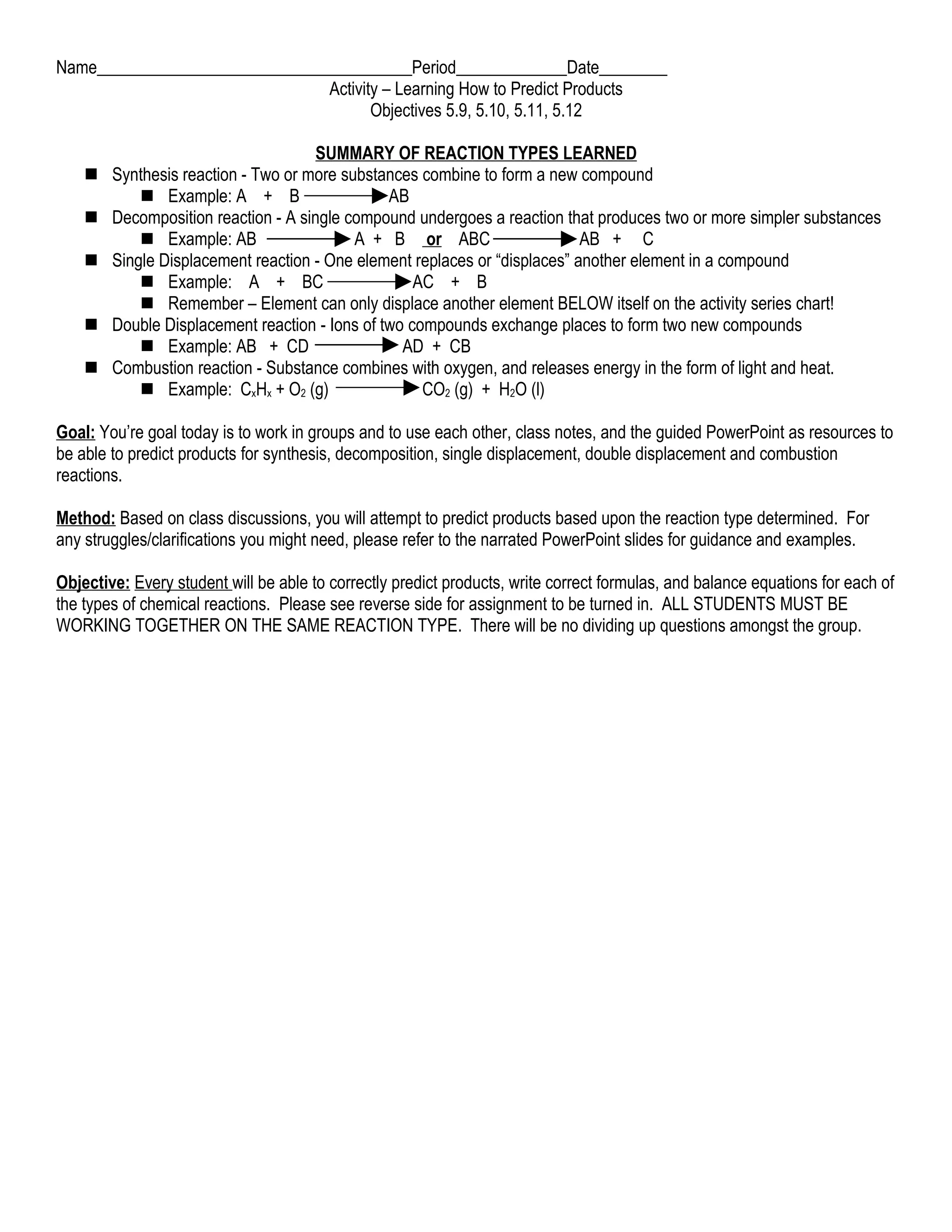
    Name_____________________________________Period_____________Date________ Activity – Learning How to Predict Products Objectives 5.9, 5.10, 5.11, 5.12 SUMMARY OF REACTION TYPES LEARNED  Synthesis reaction - Two or more substances combine to form a new compound  Example: A + B AB  Decomposition reaction - A single compound undergoes a reaction that produces two or more simpler substances  Example: AB A + B or ABC AB + C  Single Displacement reaction - One element replaces or “displaces” another element in a compound  Example: A + BC AC + B  Remember – Element can only displace another element BELOW itself on the activity series chart!  Double Displacement reaction - Ions of two compounds exchange places to form two new compounds  Example: AB + CD AD + CB  Combustion reaction - Substance combines with oxygen, and releases energy in the form of light and heat.  Example: CxHx + O2 (g) CO2 (g) + H2O (l) Goal: You’re goal today is to work in groups and to use each other, class notes, and the guided PowerPoint as resources to be able to predict products for synthesis, decomposition, single displacement, double displacement and combustion reactions. Method: Based on class discussions, you will attempt to predict products based upon the reaction type determined. For any struggles/clarifications you might need, please refer to the narrated PowerPoint slides for guidance and examples. Objective: Every student will be able to correctly predict products, write correct formulas, and balance equations for each of the types of chemical reactions. Please see reverse side for assignment to be turned in. ALL STUDENTS MUST BE WORKING TOGETHER ON THE SAME REACTION TYPE. There will be no dividing up questions amongst the group.
  • 2.
    Use the followingwebsites for guided examples for each of the following reaction types: Synthesis: http://www.screencast.com/users/l_burkett/folders/Jing/media/6f685044-1db9-4a96-8d3e-182e47ae45ae Decomposition: http://www.screencast.com/users/l_burkett/folders/Jing/media/b5d0924a-563a-42e8-be07-d878d89ff0c2 Single Displacement http://www.screencast.com/users/l_burkett/folders/Jing/media/64afa598-2bf4-489c-9537-62572e083e26 Double Displacement http://www.screencast.com/users/l_burkett/folders/Jing/media/09ac1316-2746-4d05-b26f-d17983882afa Combustion http://www.screencast.com/users/l_burkett/folders/Jing/media/71df8f8c-7e8b-4eee-9446-3c27bbfc61fc FOR EACH OF THE FOLLOWING EQUATIONS, identify the reaction type, predict the products (making sure to NEVER carry subscripts unless part of a polyatomic ion), write correct formulas of products (using charges of elements in new compounds formed) and balance the equation. For single displacement and double displacement reactions, make sure to determine if a reaction will take place (SD – activity series chart, DD – solubility chart). _______________________________ 1. ___Mg + ___N2 _______________________________ 2. ___Zn + ___MgSO4 _______________________________ 3. ___Cd + ___O2 _______________________________ 4. ___HCl + ___KOH _______________________________ 5. ___C5H12 + ___O2 _______________________________ 6. ___Zn + ___Ni(NO3)2 _______________________________ 7. ___Br2 + ___FeI3 _______________________________ 8. ___Li2SO4 + ___BaCl2 _______________________________ 9. ___HgO _______________________________10. ___KNO3 + ___NaCl _______________________________11. ___Na + ___Cl2 _______________________________12. ___Al + ___O2 _______________________________13. ___PBr3 _______________________________14. ___Fe + ___Pb(NO3)2 _______________________________15. ___KMnO4 + ___ZnCl2