“Discourse and
Context in
Language Teaching”
“Discourse and Context in
Language Teaching: A Guide for
Language Teachers”
Chapter 7 “Reading” & Chapter 8 “Writing”
Celce-Murcia,M & Olshtain
ISFD n° 41 - Profesorado de Inglés
Students: López Verónica - Nagel Paula - Torres Karina
Teacher: Stella Saubidet
2
Written Language Skills
⬩ Reading
⬩ Writing
3
4
Communication takes place between
readers and writers through well
planned, organized and
comprehended texts
We communicate in order to:
- Gain information.
- Expand our knowledge.
- Open to culture and literature.
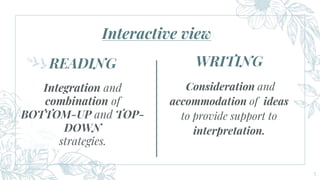
Interactive view
Integration and
combination of
BOTTOM-UP and TOP-
DOWN
strategies.
5
READING WRITING
Consideration and
accommodation of ideas
to provide support to
interpretation.
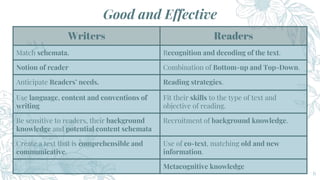
Good and Effective
6
Writers Readers
Match schemata. Recognition and decoding of the text.
Notion of reader Combination of Bottom-up and Top-Down.
Anticipate Readers’ needs. Reading strategies.
Use language, content and conventions of
writing
Fit their skills to the type of text and
objective of reading.
Be sensitive to readers, their background
knowledge and potential content schemata
Recruitment of background knowledge.
Create a text that is comprehensible and
communicative.
Use of co-text, matching old and new
information.
Metacognitive knowledge
7
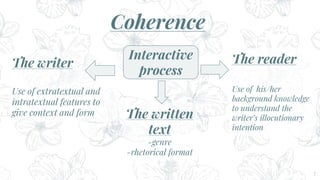
Coherence
Interactive
process
The reader
Use of his/her
background knowledge
to understand the
writer’s illocutionary
intention
The writer
Use of extratextual and
intratextual features to
give context and form The written
text
-genre
-rhetorical format
Interactive
process
8
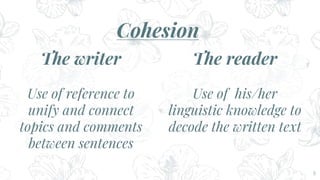
Cohesion
The writer
Use of reference to
unify and connect
topics and comments
between sentences
The reader
Use of his/her
linguistic knowledge to
decode the written text
1.
Reading
The reader has to:
- DECODE the message by
recognizing the written signs.
- INTERPRET the message by
assigning meaning to the string of
words.
- UNDERSTAND what the
author's intention was.
The interactive nature of the
Reading process
Reading is an interactive
process between three
participants:
⬩ the writer
⬩ the text
⬩ the reader
10
The psycholinguistic-
cognitive approach (Barnett)
⬩ It is learner- centered.
⬩ It is focused on cognitive
development.
⬩ It is focused on text
processing.
⬩ Prior knowledge =
SCHEMATA
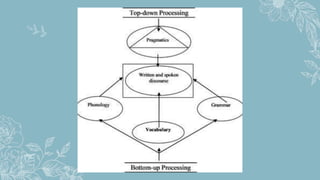
There are two main
approaches to
reading in literature:
⬩ Top-down
approaches
⬩ Bottom-up
approaches
11
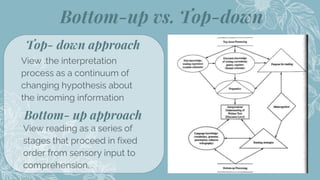
Top- down approach
View .the interpretation
process as a continuum of
changing hypothesis about
the incoming information
12
Bottom- up approach
View reading as a series of
stages that proceed in fixed
order from sensory input to
comprehension. .
Bottom-up vs. Top-down
Interactive view of reading
13
“Knowledge base + BOTTOM-UP strategies + TOP-
DOWN strategies = COMPREHENSION
★ Top-Down Processing → Used in less familiar texts.
○ Prior Knowledge + Reader’s expectations.
Content + Text Genre Expectations +
Experience
★ Bottom-Up Processing → Used in more difficult texts
○ Linguistic Information + Reading strategies
Semantic + Syntactic
14
Difficulties Encountered by
Readers while Reading
15
★ Global processing difficulties:
○ Grammatical features that cause difficulties:
★ Discourse features that might cause difficulties:
★ Lexical accessibility:
Developing a reading course
16
⬩ Defining Reading Goals:
▫ Discourse-based approach: Maximise
independent reading, metacognitive
awareness and learner autonomy.
▫ Discourse-oriented reading: Negotiate
interaction with the text.
▫ Expose learners to a variety of texts, genres,
content areas, and styles of writing.
2.
Writing.
Different views for the relationship
between
Speaking and Writing
★ -Writing is different from speech
★ -Writing is similar to speech
18
19
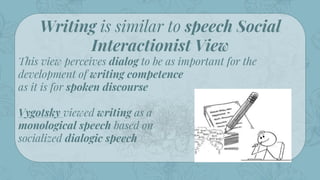
Writing is similar to speech Social
Interactionist View
This view perceives dialog to be as important for the
development of writing competence
as it is for spoken discourse
Vygotsky viewed writing as a
monological speech based on
socialized dialogic speech
.
20
Lorem ipsum
congue
Lorem
ipsum
Lorem
ipsum
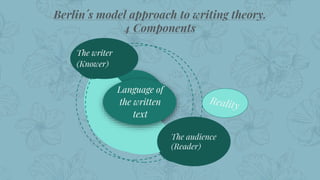
Language of
the written
text
The writer
(Knower)
The audience
(Reader)
Berlin´s model approach to writing theory.
4 Components
21
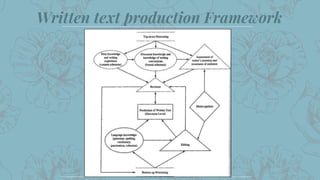
Written text production Framework
22
Revision and edition
top-down and bottom-up strategies
Maxims of quantity, quality,relevance and manner(Grice)
Quantity Amount of information in a text.
Quality Support and justification for the position adopted.
Relevance Meaningful text within the potential context of
the reader.
Manner Use of bottom-up techniques.
23
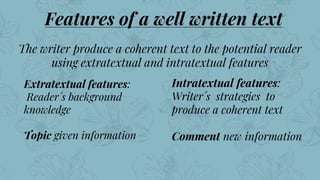
Features of a well written text
The writer produce a coherent text to the potential reader
using extratextual and intratextual features
Extratextual features:
Reader´s background
knowledge
Topic given information
Intratextual features:
Writer´s strategies to
produce a coherent text
Comment new information
24
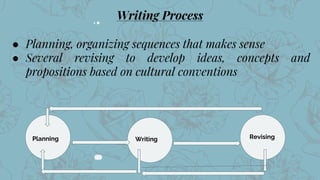
Writing Process
● Planning, organizing sequences that makes sense
● Several revising to develop ideas, concepts and
propositions based on cultural conventions
Planning Writing Revising
Reference
★ Celce-Murcia, M. (2001). Discourse And Context In Language
Teaching. Cambridge University Press.
26
Thanks!

Discourse and Context in Language Teaching

  • 1.
  • 2.
    “Discourse and Contextin Language Teaching: A Guide for Language Teachers” Chapter 7 “Reading” & Chapter 8 “Writing” Celce-Murcia,M & Olshtain ISFD n° 41 - Profesorado de Inglés Students: López Verónica - Nagel Paula - Torres Karina Teacher: Stella Saubidet 2
  • 3.
    Written Language Skills ⬩Reading ⬩ Writing 3
  • 4.
    4 Communication takes placebetween readers and writers through well planned, organized and comprehended texts We communicate in order to: - Gain information. - Expand our knowledge. - Open to culture and literature.
  • 5.
    Interactive view Integration and combinationof BOTTOM-UP and TOP- DOWN strategies. 5 READING WRITING Consideration and accommodation of ideas to provide support to interpretation.
  • 6.
    Good and Effective 6 WritersReaders Match schemata. Recognition and decoding of the text. Notion of reader Combination of Bottom-up and Top-Down. Anticipate Readers’ needs. Reading strategies. Use language, content and conventions of writing Fit their skills to the type of text and objective of reading. Be sensitive to readers, their background knowledge and potential content schemata Recruitment of background knowledge. Create a text that is comprehensible and communicative. Use of co-text, matching old and new information. Metacognitive knowledge
  • 7.
    7 Coherence Interactive process The reader Use ofhis/her background knowledge to understand the writer’s illocutionary intention The writer Use of extratextual and intratextual features to give context and form The written text -genre -rhetorical format Interactive process
  • 8.
    8 Cohesion The writer Use ofreference to unify and connect topics and comments between sentences The reader Use of his/her linguistic knowledge to decode the written text
  • 9.
  • 10.
    The reader hasto: - DECODE the message by recognizing the written signs. - INTERPRET the message by assigning meaning to the string of words. - UNDERSTAND what the author's intention was. The interactive nature of the Reading process Reading is an interactive process between three participants: ⬩ the writer ⬩ the text ⬩ the reader 10
  • 11.
    The psycholinguistic- cognitive approach(Barnett) ⬩ It is learner- centered. ⬩ It is focused on cognitive development. ⬩ It is focused on text processing. ⬩ Prior knowledge = SCHEMATA There are two main approaches to reading in literature: ⬩ Top-down approaches ⬩ Bottom-up approaches 11
  • 12.
    Top- down approach View.the interpretation process as a continuum of changing hypothesis about the incoming information 12 Bottom- up approach View reading as a series of stages that proceed in fixed order from sensory input to comprehension. . Bottom-up vs. Top-down
  • 13.
    Interactive view ofreading 13 “Knowledge base + BOTTOM-UP strategies + TOP- DOWN strategies = COMPREHENSION ★ Top-Down Processing → Used in less familiar texts. ○ Prior Knowledge + Reader’s expectations. Content + Text Genre Expectations + Experience ★ Bottom-Up Processing → Used in more difficult texts ○ Linguistic Information + Reading strategies Semantic + Syntactic
  • 14.
  • 15.
    Difficulties Encountered by Readerswhile Reading 15 ★ Global processing difficulties: ○ Grammatical features that cause difficulties: ★ Discourse features that might cause difficulties: ★ Lexical accessibility:
  • 16.
    Developing a readingcourse 16 ⬩ Defining Reading Goals: ▫ Discourse-based approach: Maximise independent reading, metacognitive awareness and learner autonomy. ▫ Discourse-oriented reading: Negotiate interaction with the text. ▫ Expose learners to a variety of texts, genres, content areas, and styles of writing.
  • 17.
  • 18.
    Different views forthe relationship between Speaking and Writing ★ -Writing is different from speech ★ -Writing is similar to speech 18
  • 19.
    19 Writing is similarto speech Social Interactionist View This view perceives dialog to be as important for the development of writing competence as it is for spoken discourse Vygotsky viewed writing as a monological speech based on socialized dialogic speech
  • 20.
    . 20 Lorem ipsum congue Lorem ipsum Lorem ipsum Language of thewritten text The writer (Knower) The audience (Reader) Berlin´s model approach to writing theory. 4 Components
  • 21.
  • 22.
    22 Revision and edition top-downand bottom-up strategies Maxims of quantity, quality,relevance and manner(Grice) Quantity Amount of information in a text. Quality Support and justification for the position adopted. Relevance Meaningful text within the potential context of the reader. Manner Use of bottom-up techniques.
  • 23.
    23 Features of awell written text The writer produce a coherent text to the potential reader using extratextual and intratextual features Extratextual features: Reader´s background knowledge Topic given information Intratextual features: Writer´s strategies to produce a coherent text Comment new information
  • 24.
    24 Writing Process ● Planning,organizing sequences that makes sense ● Several revising to develop ideas, concepts and propositions based on cultural conventions Planning Writing Revising
  • 25.
    Reference ★ Celce-Murcia, M.(2001). Discourse And Context In Language Teaching. Cambridge University Press.
  • 26.