Social media and ROI
@dirktherabbit
the!verrproject.tumblr.com
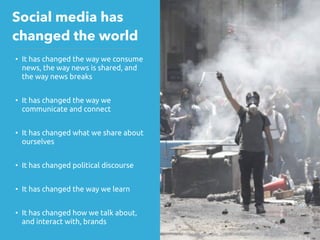
• It has changed the way we consume
news, the way news is shared, and
the way news breaks
• It has changed the way we
communicate and connect
• It has changed what we share about
ourselves
• It has changed political discourse
• It has changed the way we learn
• It has changed how we talk about,
and interact with, brands
Social media has
changed the world
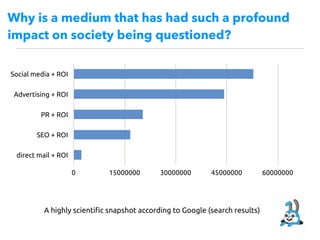
Why is a medium that has had such a profound
impact on society being questioned?
Social media + ROI
Advertising + ROI
PR + ROI
SEO + ROI
direct mail + ROI
0 15000000 30000000 45000000 60000000
A highly scienti!c snapshot according to Google (search results)
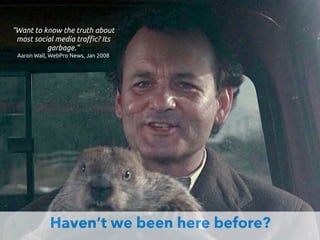
Haven’t we been here before?
“Want to know the truth about
most social media tra!c? Its
garbage.”
Aaron Wall, WebPro News, Jan 2008
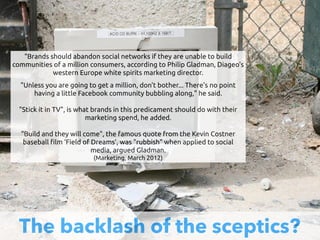
The backlash of the sceptics?
“Brands should abandon social networks if they are unable to build
communities of a million consumers, according to Philip Gladman, Diageo's
western Europe white spirits marketing director.
"Unless you are going to get a million, don't bother... There's no point
having a little Facebook community bubbling along," he said.
"Stick it in TV", is what brands in this predicament should do with their
marketing spend, he added. 
"Build and they will come", the famous quote from the Kevin Costner
baseball !lm ‘Field of Dreams’, was "rubbish" when applied to social
media, argued Gladman. 
(Marketing, March 2012)
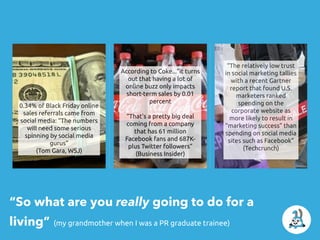
“So what are you really going to do for a
living” (my grandmother when I was a PR graduate trainee)
0.34% of Black Friday online
sales referrals came from
social media: “The numbers
will need some serious
spinning by social media
gurus”
(Tom Gara, WSJ)
According to Coke...”it turns
out that having a lot of
online buzz only impacts
short-term sales by 0.01
percent
“That's a pretty big deal
coming from a company
that has 61 million
Facebook fans and 687K-
plus Twitter followers”
(Business Insider)
“The relatively low trust
in social marketing tallies
with a recent Gartner
report that found U.S.
marketers ranked
spending on the
corporate website as
more likely to result in
“marketing success” than
spending on social media
sites such as Facebook”
(Techcrunch)
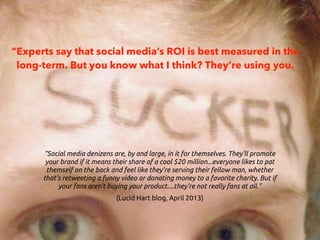
“Social media denizens are, by and large, in it for themselves. They’ll promote
your brand if it means their share of a cool $20 million...everyone likes to pat
themself on the back and feel like they’re serving their fellow man, whether
that’s retweeting a funny video or donating money to a favorite charity. But if
your fans aren’t buying your product....they’re not really fans at all.”
(Lucid Hart blog, April 2013)
“Experts say that social media’s ROI is best measured in the
long-term. But you know what I think? They’re using you.
Why is this even news?
1 - No, a post on Coke’s Facebook page won’t make its 60+ million fans
stop whatever they are doing, and run out to the nearest supermarket
clutching their wallets
2 - No, by and large a tweet about a brand generally won’t immediately
cause someone to leave Twitter and start going through the online
check-out
3 - No, people don’t like to see ads in their social media news stream (just
ask teens and Facebook), and they don’t like it when brands try and go
for the hard sell in ‘me’ time
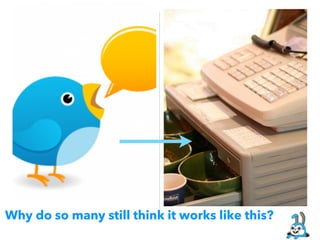
Why do so many still think it works like this?
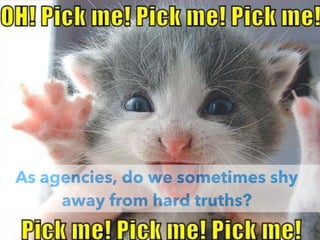
As agencies, do we sometimes shy
away from hard truths?
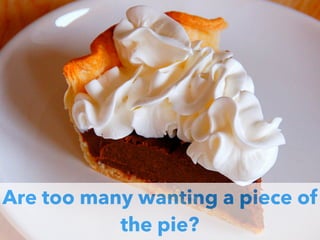
Are too many wanting a piece of
the pie?
We need to shift
the debate
• If you really want instant
grati!cation, there are ways of
doing so (for example -
@jetbluecheeps)
• But if that’s the aim, let’s admit it,
sometimes other routes (e.g. a
targeted email campaign to your
database) may be better
• Why are we even talking as if
social media / social media
marketing operates in a vacuum -
it doesn’t
• No, social media doesn’t always
drive short-term sales. Here’s
what it does do
It’s the most trusted source of brand
advertising
Nielsen's global trust in advertising study involving 28,000
consumers across 56 countries tells us that consumer
opinions online, very often from complete strangers, have
the second highest trust factor behind word of mouth
recommendations, and ahead of editorial coverage.
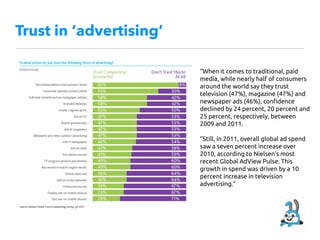
Trust in ‘advertising’
“When it comes to traditional, paid
media, while nearly half of consumers
around the world say they trust
television (47%), magazine (47%) and
newspaper ads (46%), con!dence
declined by 24 percent, 20 percent and
25 percent, respectively, between
2009 and 2011.
“Still, in 2011, overall global ad spend
saw a seven percent increase over
2010, according to Nielsen’s most
recent Global AdView Pulse. This
growth in spend was driven by a 10
percent increase in television
advertising.”
Over time advocates = sales
Being exposed to a brand's social media feed won't make you go out and buy on
the spot, but it will over time make you spend more - 20%+ more according to
Bain & Company.
And if you are really engaged, you end up becoming almost an uno"cial sales
agent for a brand. Taking care of your most engaged followers makes
commercial sense. According to Napkin Labs, one super fan is worth 75 'normal'
fans in generating likes, comments and engagement on your behalf.
It’s an incredibly good customer retention
and acquisition tool
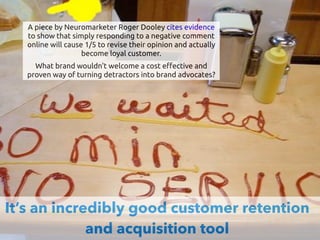
A piece by Neuromarketer Roger Dooley cites evidence
to show that simply responding to a negative comment
online will cause 1/5 to revise their opinion and actually
become loyal customer.
What brand wouldn't welcome a cost e#ective and
proven way of turning detractors into brand advocates?
• From SEO to advertising, it
increases the e#ectiveness of
marketing campaigns
• It’s a crucial issues and crisis
management tool - many brands
have learned that one the hard
way
• It’s a good way to target speci!c
communities and groups
And there’s more
The last word goes to Coke
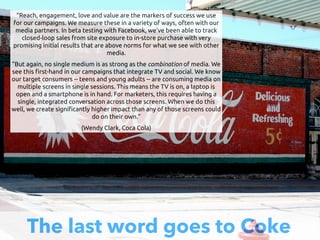
“Reach, engagement, love and value are the markers of success we use
for our campaigns. We measure these in a variety of ways, often with our
media partners. In beta testing with Facebook, we've been able to track
closed-loop sales from site exposure to in-store purchase with very
promising initial results that are above norms for what we see with other
media.
“But again, no single medium is as strong as the combination of media. We
see this !rst-hand in our campaigns that integrate TV and social. We know
our target consumers -- teens and young adults -- are consuming media on
multiple screens in single sessions. This means the TV is on, a laptop is
open and a smartphone is in hand. For marketers, this requires having a
single, integrated conversation across those screens. When we do this
well, we create signi!cantly higher impact than any of those screens could
do on their own.”
(Wendy Clark, Coca Cola)

Dirk Singer - #SocialCloud Presentation on Social Media and ROI

  • 1.
    Social media andROI @dirktherabbit the!verrproject.tumblr.com
  • 2.
    • It haschanged the way we consume news, the way news is shared, and the way news breaks • It has changed the way we communicate and connect • It has changed what we share about ourselves • It has changed political discourse • It has changed the way we learn • It has changed how we talk about, and interact with, brands Social media has changed the world
  • 3.
    Why is amedium that has had such a profound impact on society being questioned? Social media + ROI Advertising + ROI PR + ROI SEO + ROI direct mail + ROI 0 15000000 30000000 45000000 60000000 A highly scienti!c snapshot according to Google (search results)
  • 4.
    Haven’t we beenhere before? “Want to know the truth about most social media tra!c? Its garbage.” Aaron Wall, WebPro News, Jan 2008
  • 5.
    The backlash ofthe sceptics? “Brands should abandon social networks if they are unable to build communities of a million consumers, according to Philip Gladman, Diageo's western Europe white spirits marketing director. "Unless you are going to get a million, don't bother... There's no point having a little Facebook community bubbling along," he said. "Stick it in TV", is what brands in this predicament should do with their marketing spend, he added.  "Build and they will come", the famous quote from the Kevin Costner baseball !lm ‘Field of Dreams’, was "rubbish" when applied to social media, argued Gladman.  (Marketing, March 2012)
  • 6.
    “So what areyou really going to do for a living” (my grandmother when I was a PR graduate trainee) 0.34% of Black Friday online sales referrals came from social media: “The numbers will need some serious spinning by social media gurus” (Tom Gara, WSJ) According to Coke...”it turns out that having a lot of online buzz only impacts short-term sales by 0.01 percent “That's a pretty big deal coming from a company that has 61 million Facebook fans and 687K- plus Twitter followers” (Business Insider) “The relatively low trust in social marketing tallies with a recent Gartner report that found U.S. marketers ranked spending on the corporate website as more likely to result in “marketing success” than spending on social media sites such as Facebook” (Techcrunch)
  • 7.
    “Social media denizensare, by and large, in it for themselves. They’ll promote your brand if it means their share of a cool $20 million...everyone likes to pat themself on the back and feel like they’re serving their fellow man, whether that’s retweeting a funny video or donating money to a favorite charity. But if your fans aren’t buying your product....they’re not really fans at all.” (Lucid Hart blog, April 2013) “Experts say that social media’s ROI is best measured in the long-term. But you know what I think? They’re using you.
  • 8.
    Why is thiseven news? 1 - No, a post on Coke’s Facebook page won’t make its 60+ million fans stop whatever they are doing, and run out to the nearest supermarket clutching their wallets 2 - No, by and large a tweet about a brand generally won’t immediately cause someone to leave Twitter and start going through the online check-out 3 - No, people don’t like to see ads in their social media news stream (just ask teens and Facebook), and they don’t like it when brands try and go for the hard sell in ‘me’ time
  • 9.
    Why do somany still think it works like this?
  • 10.
    As agencies, dowe sometimes shy away from hard truths?
  • 11.
    Are too manywanting a piece of the pie?
  • 12.
    We need toshift the debate • If you really want instant grati!cation, there are ways of doing so (for example - @jetbluecheeps) • But if that’s the aim, let’s admit it, sometimes other routes (e.g. a targeted email campaign to your database) may be better • Why are we even talking as if social media / social media marketing operates in a vacuum - it doesn’t • No, social media doesn’t always drive short-term sales. Here’s what it does do
  • 13.
    It’s the mosttrusted source of brand advertising Nielsen's global trust in advertising study involving 28,000 consumers across 56 countries tells us that consumer opinions online, very often from complete strangers, have the second highest trust factor behind word of mouth recommendations, and ahead of editorial coverage.
  • 14.
    Trust in ‘advertising’ “Whenit comes to traditional, paid media, while nearly half of consumers around the world say they trust television (47%), magazine (47%) and newspaper ads (46%), con!dence declined by 24 percent, 20 percent and 25 percent, respectively, between 2009 and 2011. “Still, in 2011, overall global ad spend saw a seven percent increase over 2010, according to Nielsen’s most recent Global AdView Pulse. This growth in spend was driven by a 10 percent increase in television advertising.”
  • 15.
    Over time advocates= sales Being exposed to a brand's social media feed won't make you go out and buy on the spot, but it will over time make you spend more - 20%+ more according to Bain & Company. And if you are really engaged, you end up becoming almost an uno"cial sales agent for a brand. Taking care of your most engaged followers makes commercial sense. According to Napkin Labs, one super fan is worth 75 'normal' fans in generating likes, comments and engagement on your behalf.
  • 16.
    It’s an incrediblygood customer retention and acquisition tool A piece by Neuromarketer Roger Dooley cites evidence to show that simply responding to a negative comment online will cause 1/5 to revise their opinion and actually become loyal customer. What brand wouldn't welcome a cost e#ective and proven way of turning detractors into brand advocates?
  • 17.
    • From SEOto advertising, it increases the e#ectiveness of marketing campaigns • It’s a crucial issues and crisis management tool - many brands have learned that one the hard way • It’s a good way to target speci!c communities and groups And there’s more
  • 18.
    The last wordgoes to Coke “Reach, engagement, love and value are the markers of success we use for our campaigns. We measure these in a variety of ways, often with our media partners. In beta testing with Facebook, we've been able to track closed-loop sales from site exposure to in-store purchase with very promising initial results that are above norms for what we see with other media. “But again, no single medium is as strong as the combination of media. We see this !rst-hand in our campaigns that integrate TV and social. We know our target consumers -- teens and young adults -- are consuming media on multiple screens in single sessions. This means the TV is on, a laptop is open and a smartphone is in hand. For marketers, this requires having a single, integrated conversation across those screens. When we do this well, we create signi!cantly higher impact than any of those screens could do on their own.” (Wendy Clark, Coca Cola)