
D irect Versus Indirect Persuasion in Advertising A strategic recommendation for the most effective FMCG communication model in Asian developing economies
What is the issue? Unilever’s have asked JWT a question that relates specifically to the television commercial break and specifically whether Asian/Chinese cultures respond more measurably to a direct or indirect message.
What influences receptivity? The mindset of the viewer, the time of day,  the progra m just watched, the  program anticip ated ,  relevance, fre quency ,  mess age decay, overall inte rest, engagement,   environment,   people   present, sound volume, continuity, competitive set activity, context,   supporting messages , salience, creativity, creativity, creativity
What does   that  mean? It means we should articulate the media environmental variables before moving on  to  execution and cultural nuance
Worth Weighing Up With the discussion between direct and indirect messages, it’s worth considering implicit memory versus the explicit memory trade off in FMCG heavy-flighting media patterns. Implicit memory – Low involvement processing Explicit memory – Conscious recollection
Elaboration Direct – Sacrificing creativity over clarity, unambiguous use of the proposition or key messages. A call for action, price advantage, USP Indirect – Sacrificing immediacy over complexity, an advocate for subtlety and engagement, emphasis on emotional take-out rather than message hierarchy
Scientific Recommendation In the absence of empirical and a priori evidence and given the size of media budgets in this segment, the only recommendation is to trial with a pilot campaign to determine the efficacy of literal over emotionally weighted messages. It’s cost effective and quantifiable strategic planning. Theorize, hypothesize, synthesize, execute, measure, feedback and improve.
Caution with Research Interpretations The Millward Brown research has some shortcomings. They point out the propensity for ‘new-news’ oriented communications to work well within Asian developing economies This is self evident. In any economy that has yet to catch up with over 60 years of mass-market product-portfolio development, diversification and extension.
Why does ‘new-news’ work so well in developing economies? When China has 3 types of Rye Bread with two types of Prawns on Avocado selling in Marks & Spencer or it’s Chinese equivalent; that will be the time to wonder why new product messages are the norm in marketing communications –  Adversus solem ne loquitor - Don’t speak against the sun
While N Asia seeks novelty, the  kind  of news value sought is different across markets Established  Brand New  Product New  Information New  Treatment Profile of strong (top performing) ads in each country in relation  to Asia average for all ads COMM. STRATEGY News Value Indonesia Korea India Shanghai Malaysia Philippines Thailand Taiwan Japan
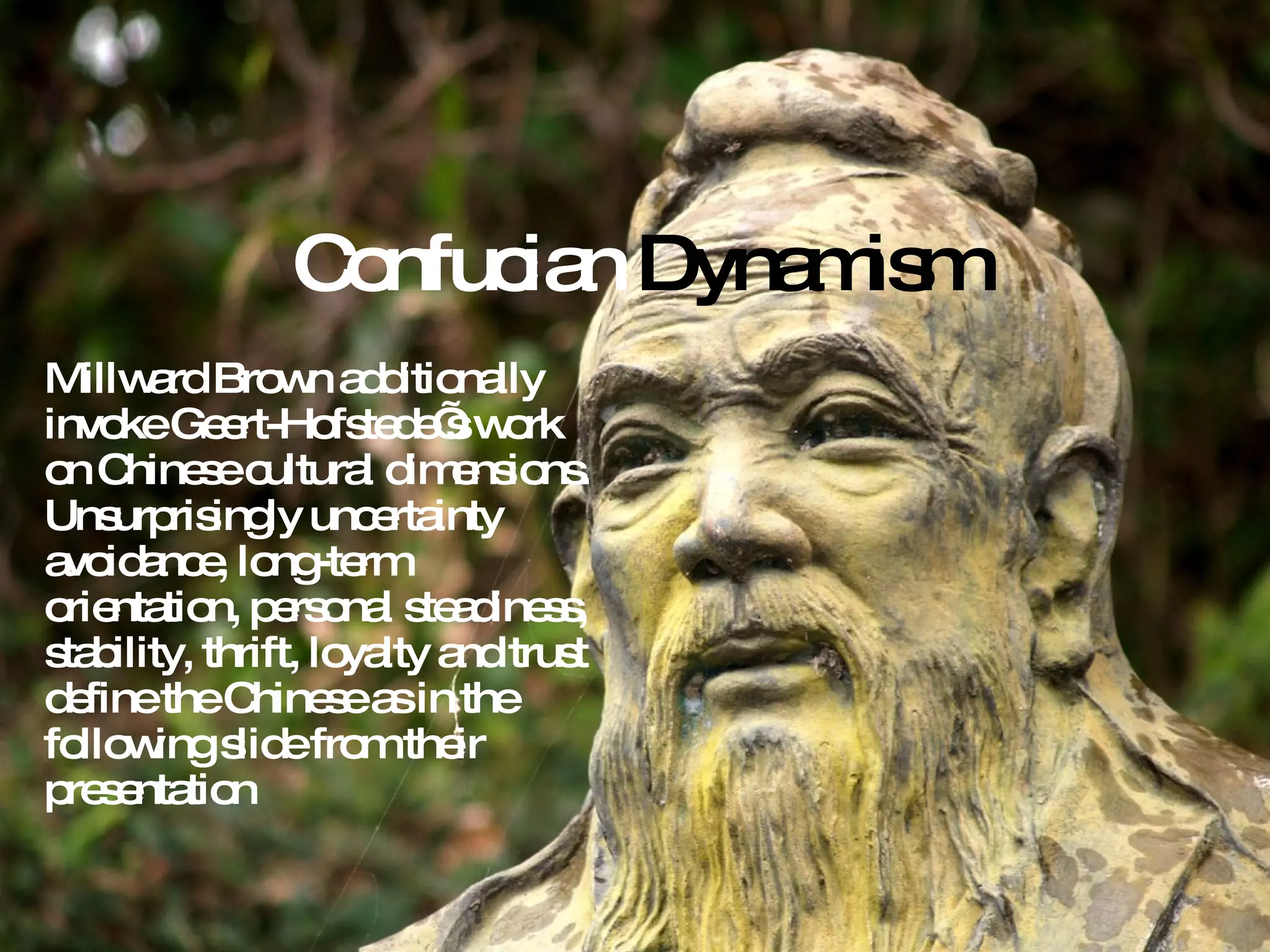
Confucian  Dynamism Millward Brown additionally invoke Geert-Hofstede’s work on Chinese cultural dimensions. Unsurprisingly uncertainty avoidance, long-term orientation, personal steadiness, stability, thrift, loyalty and trust define the Chinese as in the following slide from their presentation
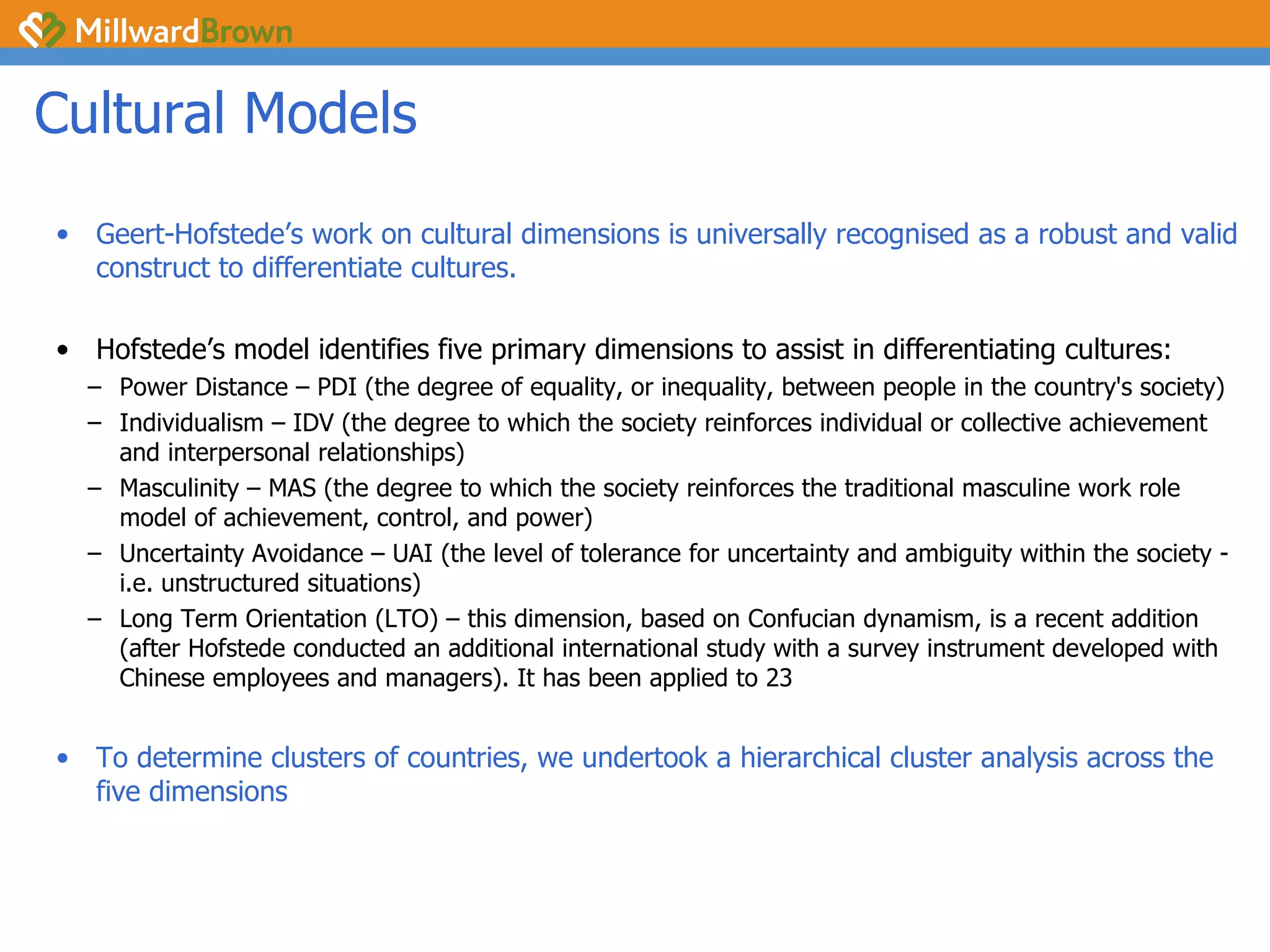
Geert-Hofstede’s work on cultural dimensions is universally recognised as a robust and valid construct to differentiate cultures. Hofstede’s model identifies five primary dimensions to assist in differentiating cultures:  Power Distance – PDI (the degree of equality, or inequality, between people in the country's society)  Individualism – IDV (the degree to which the society reinforces individual or collective achievement and interpersonal relationships)  Masculinity – MAS (the degree to which the society reinforces the traditional masculine work role model of achievement, control, and power) Uncertainty Avoidance – UAI (the level of tolerance for uncertainty and ambiguity within the society - i.e. unstructured situations) Long Term Orientation (LTO) – this dimension, based on Confucian dynamism, is a recent addition (after Hofstede conducted an additional international study with a survey instrument developed with Chinese employees and managers). It has been applied to 23 To determine clusters of countries, we undertook a hierarchical cluster analysis across the five dimensions  Cultural Models
Big cultural differences on ‘Individualism’ Brazil Russia India China Europe 50% 46% 58% 70% 35% “ It is more important to do your duty than to live for your own gain” Source: TGI database
This is way too  broad  for 2006 Think about it,  challenge convention and  consensual  opinion and really ask  yourselves  if the following  statement is   true and  then see if we can  reconcile it   with  the original.
Confucian Olympian Task China has a long cultural affinity towards Confucius. There’s no escaping the legacy of Chinese Philosophy around his teachings  but  Metropolitan China is now: short term, environmentally irresponsible, money oriented, ostentatious, short-term-thinking, style over content culture that ignores the wise teachings of Confucius. The real picture is to to see what’s happening in the larger agrarian Chinese Economy?
Rural Uprising This is modern post-communism China, not Geert Hofstede’s ‘Confucian Dynamism’ cited by Millward Brown in the previous slide.
What's our point? Quite simple, We could have taken a literal message direction to explain the points and  eased up on the hyperbole. However by adding a little drama, Emotion was brought in, and thus hopefully supporting the case for engaging advertising over and above literal messages
One Last thing Hofstede’s work to measure the different dynamics across cultures used a sample collected using IBM employees between 1967 and 1973 covering more than 70 countries.
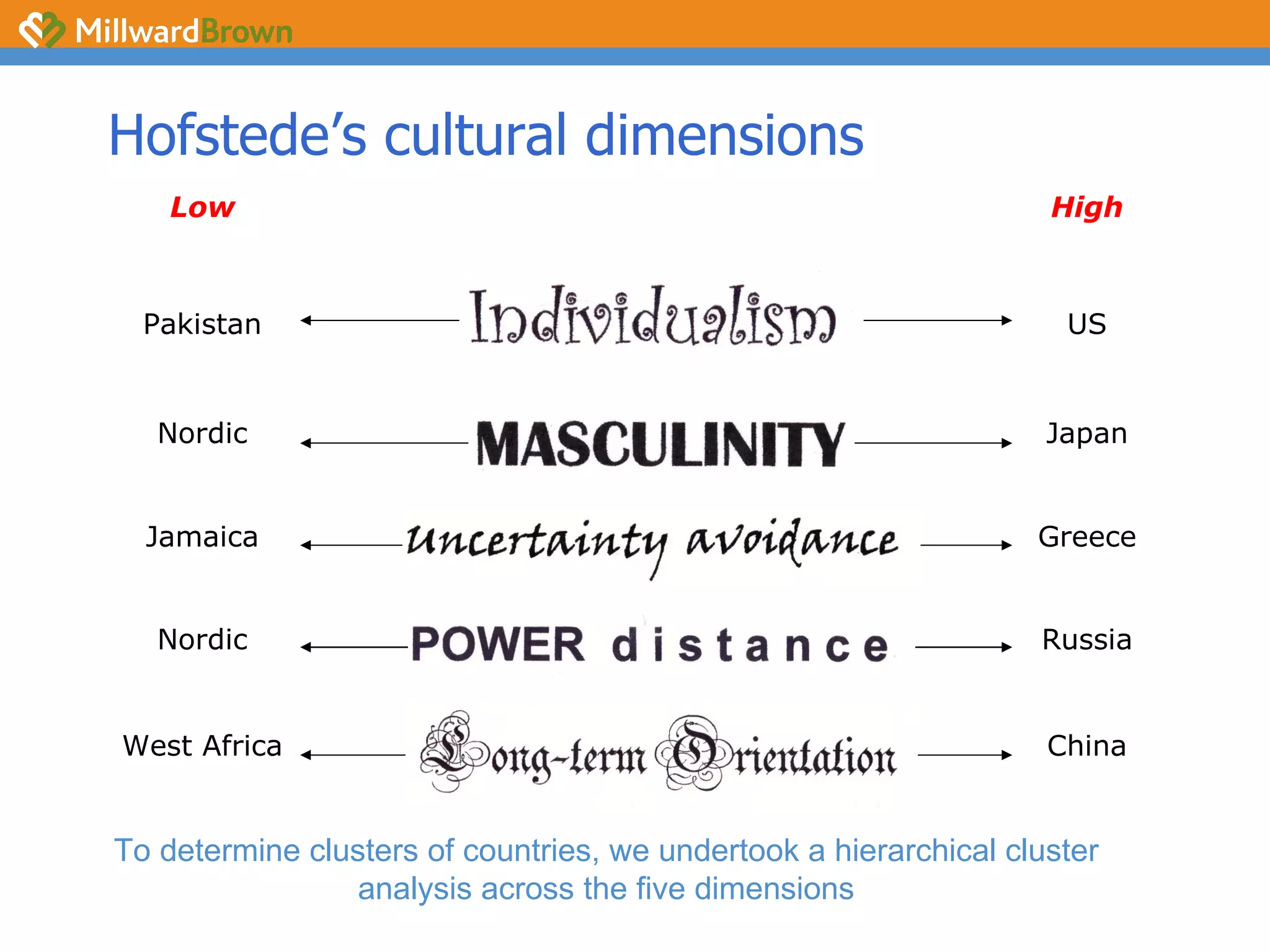
Hofstede’s cultural dimensions Low High Pakistan Individualism US Nordic Masculinity Japan Jamaica Uncertainty Avoidance Greece Nordic Power D i s t a n c e Russia West Africa Long-term Orientation China To determine clusters of countries, we undertook a hierarchical cluster analysis across the five dimensions
The Chinese Sample For China, which Hofstede researched some time later, the sample were University students
Recommendations Do a pilot campaign split with direct and indirect messages in the category If reluctant, communicate direct selling messages with layers of complexity and indirect creative messages Leverage creativity not quantitative research

Direct versus Indirect Advertising

  • 1.
    D irect VersusIndirect Persuasion in Advertising A strategic recommendation for the most effective FMCG communication model in Asian developing economies
  • 2.
    What is theissue? Unilever’s have asked JWT a question that relates specifically to the television commercial break and specifically whether Asian/Chinese cultures respond more measurably to a direct or indirect message.
  • 3.
    What influences receptivity?The mindset of the viewer, the time of day, the progra m just watched, the program anticip ated , relevance, fre quency , mess age decay, overall inte rest, engagement, environment, people present, sound volume, continuity, competitive set activity, context, supporting messages , salience, creativity, creativity, creativity
  • 4.
    What does that mean? It means we should articulate the media environmental variables before moving on to execution and cultural nuance
  • 5.
    Worth Weighing UpWith the discussion between direct and indirect messages, it’s worth considering implicit memory versus the explicit memory trade off in FMCG heavy-flighting media patterns. Implicit memory – Low involvement processing Explicit memory – Conscious recollection
  • 6.
    Elaboration Direct –Sacrificing creativity over clarity, unambiguous use of the proposition or key messages. A call for action, price advantage, USP Indirect – Sacrificing immediacy over complexity, an advocate for subtlety and engagement, emphasis on emotional take-out rather than message hierarchy
  • 7.
    Scientific Recommendation Inthe absence of empirical and a priori evidence and given the size of media budgets in this segment, the only recommendation is to trial with a pilot campaign to determine the efficacy of literal over emotionally weighted messages. It’s cost effective and quantifiable strategic planning. Theorize, hypothesize, synthesize, execute, measure, feedback and improve.
  • 8.
    Caution with ResearchInterpretations The Millward Brown research has some shortcomings. They point out the propensity for ‘new-news’ oriented communications to work well within Asian developing economies This is self evident. In any economy that has yet to catch up with over 60 years of mass-market product-portfolio development, diversification and extension.
  • 9.
    Why does ‘new-news’work so well in developing economies? When China has 3 types of Rye Bread with two types of Prawns on Avocado selling in Marks & Spencer or it’s Chinese equivalent; that will be the time to wonder why new product messages are the norm in marketing communications – Adversus solem ne loquitor - Don’t speak against the sun
  • 10.
    While N Asiaseeks novelty, the kind of news value sought is different across markets Established Brand New Product New Information New Treatment Profile of strong (top performing) ads in each country in relation to Asia average for all ads COMM. STRATEGY News Value Indonesia Korea India Shanghai Malaysia Philippines Thailand Taiwan Japan
  • 11.
    Confucian DynamismMillward Brown additionally invoke Geert-Hofstede’s work on Chinese cultural dimensions. Unsurprisingly uncertainty avoidance, long-term orientation, personal steadiness, stability, thrift, loyalty and trust define the Chinese as in the following slide from their presentation
  • 12.
    Geert-Hofstede’s work oncultural dimensions is universally recognised as a robust and valid construct to differentiate cultures. Hofstede’s model identifies five primary dimensions to assist in differentiating cultures: Power Distance – PDI (the degree of equality, or inequality, between people in the country's society) Individualism – IDV (the degree to which the society reinforces individual or collective achievement and interpersonal relationships) Masculinity – MAS (the degree to which the society reinforces the traditional masculine work role model of achievement, control, and power) Uncertainty Avoidance – UAI (the level of tolerance for uncertainty and ambiguity within the society - i.e. unstructured situations) Long Term Orientation (LTO) – this dimension, based on Confucian dynamism, is a recent addition (after Hofstede conducted an additional international study with a survey instrument developed with Chinese employees and managers). It has been applied to 23 To determine clusters of countries, we undertook a hierarchical cluster analysis across the five dimensions Cultural Models
  • 13.
    Big cultural differenceson ‘Individualism’ Brazil Russia India China Europe 50% 46% 58% 70% 35% “ It is more important to do your duty than to live for your own gain” Source: TGI database
  • 14.
    This is waytoo broad for 2006 Think about it, challenge convention and consensual opinion and really ask yourselves if the following statement is true and then see if we can reconcile it with the original.
  • 15.
    Confucian Olympian TaskChina has a long cultural affinity towards Confucius. There’s no escaping the legacy of Chinese Philosophy around his teachings but Metropolitan China is now: short term, environmentally irresponsible, money oriented, ostentatious, short-term-thinking, style over content culture that ignores the wise teachings of Confucius. The real picture is to to see what’s happening in the larger agrarian Chinese Economy?
  • 16.
    Rural Uprising Thisis modern post-communism China, not Geert Hofstede’s ‘Confucian Dynamism’ cited by Millward Brown in the previous slide.
  • 17.
    What's our point?Quite simple, We could have taken a literal message direction to explain the points and eased up on the hyperbole. However by adding a little drama, Emotion was brought in, and thus hopefully supporting the case for engaging advertising over and above literal messages
  • 18.
    One Last thingHofstede’s work to measure the different dynamics across cultures used a sample collected using IBM employees between 1967 and 1973 covering more than 70 countries.
  • 19.
    Hofstede’s cultural dimensionsLow High Pakistan Individualism US Nordic Masculinity Japan Jamaica Uncertainty Avoidance Greece Nordic Power D i s t a n c e Russia West Africa Long-term Orientation China To determine clusters of countries, we undertook a hierarchical cluster analysis across the five dimensions
  • 20.
    The Chinese SampleFor China, which Hofstede researched some time later, the sample were University students
  • 21.
    Recommendations Do apilot campaign split with direct and indirect messages in the category If reluctant, communicate direct selling messages with layers of complexity and indirect creative messages Leverage creativity not quantitative research