DIRECT LINE – WINSTON WOLF ADVERT CAMPAIGN
The aims and objectives of the Direct Line campaign which features fictional character,
Winston Wolf, were to showcase the company’s new proposition. On the television adverts
this proposition is “We’re on it”, which focuses on fixing its customers” problems, faster and
more efficiently and also provides them with reliable insurance. In the adverts, Winston
Wolfe always features, stating that he can solve a problem, as he is playing the character,
created by Quentin Tarantino for the film Pulp Fiction, in which he solves an issue for two of
the main protagonists. The opening line he often uses is “I’m Winston Wolf, I fix problems”.
The adverts feature the iconic character, especially for fans of the film from which he
originates, fixing people’s insurance dilemmas using Direct Line’s new propositions. The
adverts also make the audience question other insurance companies by challenging
consumers to question their insurance policy, with the simple, but effective tag line which
states: “Can your insurance do that?” According the Ipswich Star, published in 2014, an
article featured with the title “Pulp Fiction star in £40m Direct Line ad campaign”. This is
followed by the statement “Direct Line is challenging rival insurance firms to match its
customer offering with a new £40million campaign starring Harvey Keitel as the character
Winston Wolf from cult movie Pulp Fiction”. The campaign was produced by Saatchi &
Saatchi, who have produced a large number of campaigns for many companies, many of
which are very successful in their advertising. According to the Saatchi & Saatchi website,
the campaign listed in the top ten campaigns that feature a celebrity.
The target audience for this campaign would most likely be home owners, who are
potentially parents, or at the least family orientated. Their age will range from about 30-40+
on the basis that Winston Wolf was a fictional character taken from a popular film from the
early 1990s (1994 to be exact). Therefore, this would attract people of similar age or people
who are familiar with the character and the film, and so this would draw them in to want to
watch the adverts. The target audience would see the advert pop up on the screen, and so
would be immediately familiar with the character and connotations. Referring to the 4C’s
scale, I would say that the target audience is either the succeeder or aspirer. This is due to
the fact that most people interested in this advert already own a house, started a family and
settled into family life. Therefore, insurance, especially on home ad cars would be applicable
to them. However, they could also be people who are looking to buy a home and plan to
settle down in the near future and so this insurance applies to them too. Referring to the
NRS scale, the demographic will be ranging from C2 to B on the scale. This is due to the fact
that the film from which the character originates, is a particularly intellectual film compared
with a lot of other films. Therefore, you would expect the middle class to be the main
category who apply to this sort of advert. Furthermore, considering that the target audience
will most likely have a home and family, or working towards to it, you would consider these
factors to be mainly middle class values.
The product is represented in a particularly tongue-in-cheek way but it is not meant to make
the viewer laugh. However, this only really applies to fans of Pulp Fiction, because they will
know that Wolf fixes much more serious and dramatic problems than things such as leaks.
Therefore, this drastic change may entice the fan of the film to watch more Direct Line
advertisements and buy their product. In the film, Wolf is called to the aid of a gang leader to
fix an accidental murder in which the victim’s head gets blown off by a pistol. The car which it
occurred in consequently had to be cleaned up. Thus, you can see how a fan of the film may
find that amusing however, not laugh out loud.
The campaign’s unique selling point is the fact that they decided to use a celebrity to
advertise their product – Harvey Keitel, who portrays Wolf, is an A-list Hollywood celebrity
being used for an advertisement in the UK, which makes it even more unique. In addition to
this, Direct Line were clearly confident that they would make the money back from using the
character. This is despite the fact that the company would have to pay millions to Quentin
Tarantino, writer and director of Pulp Fiction, a salary for Keitel to do the adverts and on top
of this, the overall production costs. Furthermore, what also makes the adverts so unique is
the character itself; although he has a small role in the film, he is one of the most
memorable. Therefore, would be a favourite among fans of the film which would encourage
them to buy Direct Line’s product, having seen him on the television and radio.
The campaign used a range of methods to promote the company’s product. These include
the form of television, radio (audio) and print. Here are the links to the television and radio
adverts.
Radio (audio): https://soundcloud.com/user-644648288/home-direct-line-30s-home
Television (audio-visual): https://www.youtube.com/watch?v=jQirllj_0QA
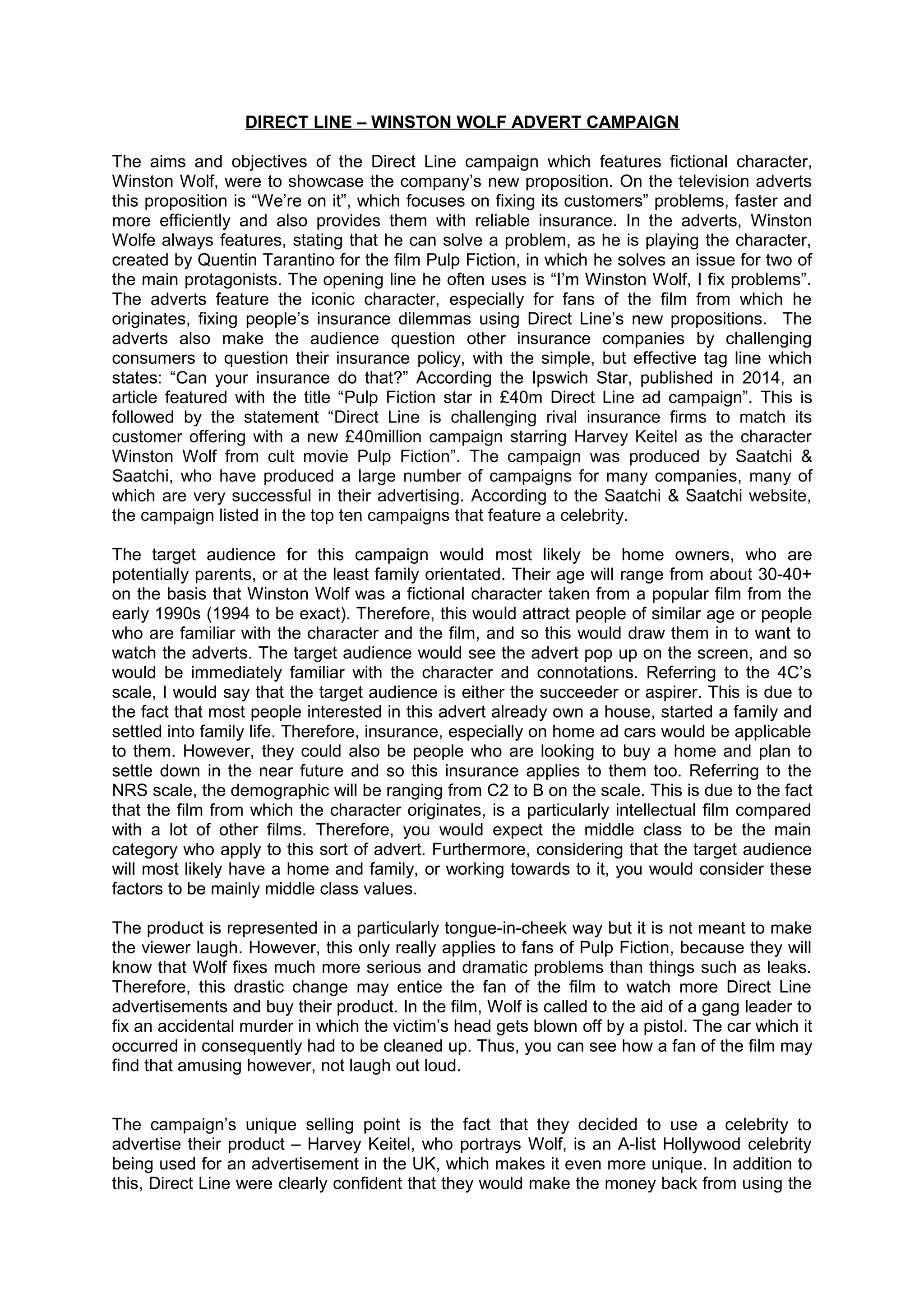
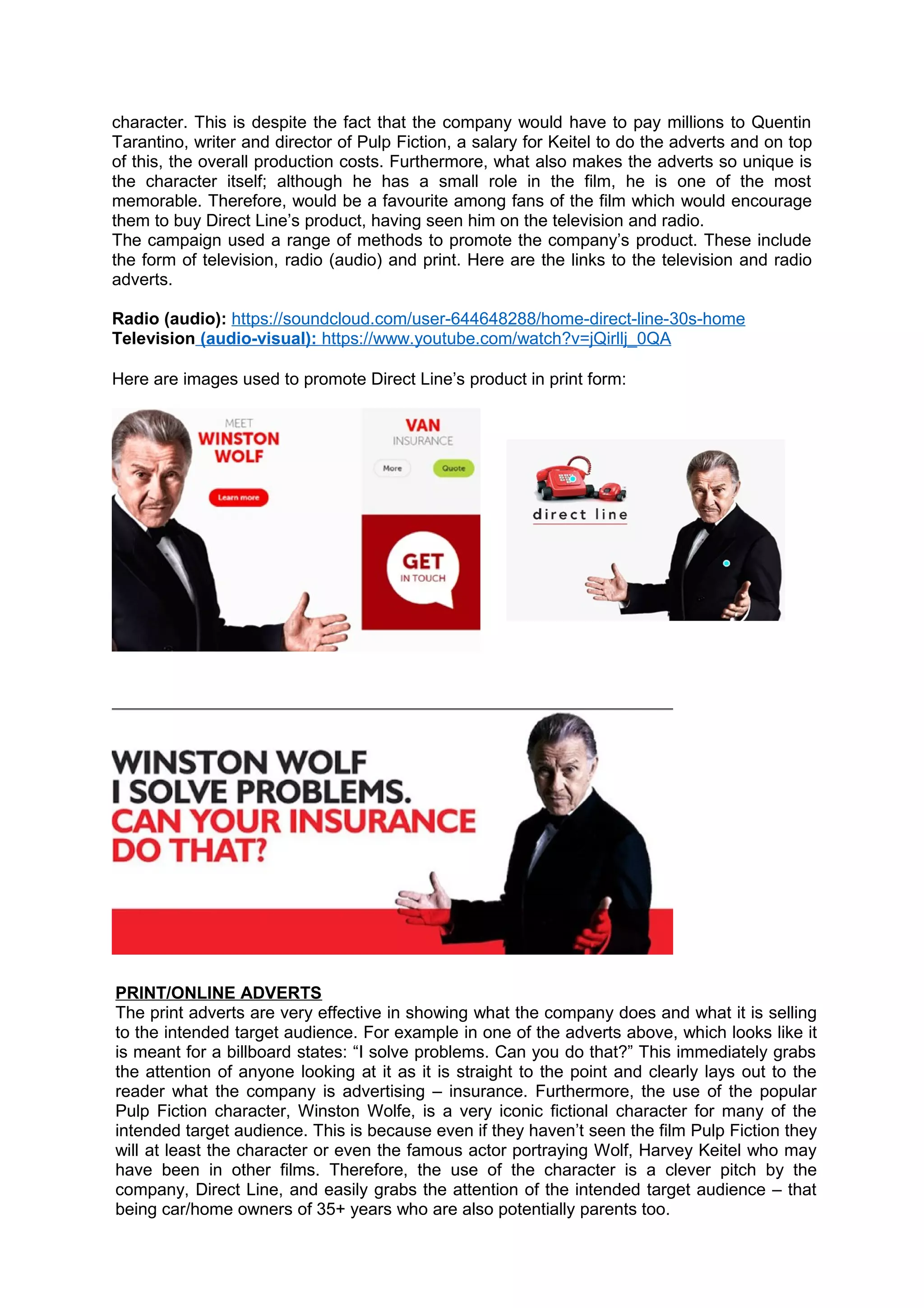
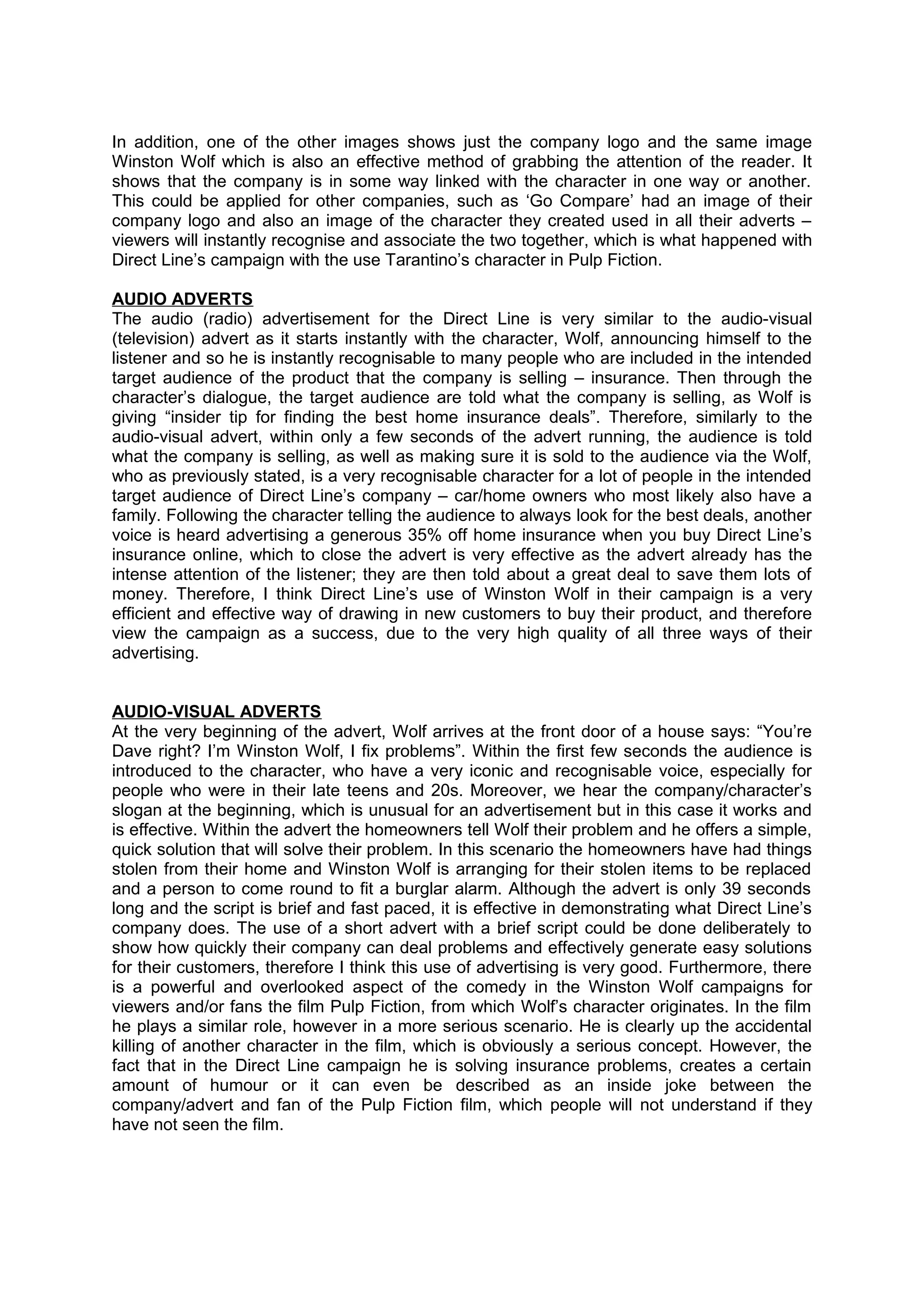
Here are images used to promote Direct Line’s product in print form:
PRINT/ONLINE ADVERTS
The print adverts are very effective in showing what the company does and what it is selling
to the intended target audience. For example in one of the adverts above, which looks like it
is meant for a billboard states: “I solve problems. Can you do that?” This immediately grabs
the attention of anyone looking at it as it is straight to the point and clearly lays out to the
reader what the company is advertising – insurance. Furthermore, the use of the popular
Pulp Fiction character, Winston Wolfe, is a very iconic fictional character for many of the
intended target audience. This is because even if they haven’t seen the film Pulp Fiction they
will at least the character or even the famous actor portraying Wolf, Harvey Keitel who may
have been in other films. Therefore, the use of the character is a clever pitch by the
company, Direct Line, and easily grabs the attention of the intended target audience – that
being car/home owners of 35+ years who are also potentially parents too.
In addition, one of the other images shows just the company logo and the same image
Winston Wolf which is also an effective method of grabbing the attention of the reader. It
shows that the company is in some way linked with the character in one way or another.
This could be applied for other companies, such as ‘Go Compare’ had an image of their
company logo and also an image of the character they created used in all their adverts –
viewers will instantly recognise and associate the two together, which is what happened with
Direct Line’s campaign with the use Tarantino’s character in Pulp Fiction.
AUDIO ADVERTS
The audio (radio) advertisement for the Direct Line is very similar to the audio-visual
(television) advert as it starts instantly with the character, Wolf, announcing himself to the
listener and so he is instantly recognisable to many people who are included in the intended
target audience of the product that the company is selling – insurance. Then through the
character’s dialogue, the target audience are told what the company is selling, as Wolf is
giving “insider tip for finding the best home insurance deals”. Therefore, similarly to the
audio-visual advert, within only a few seconds of the advert running, the audience is told
what the company is selling, as well as making sure it is sold to the audience via the Wolf,
who as previously stated, is a very recognisable character for a lot of people in the intended
target audience of Direct Line’s company – car/home owners who most likely also have a
family. Following the character telling the audience to always look for the best deals, another
voice is heard advertising a generous 35% off home insurance when you buy Direct Line’s
insurance online, which to close the advert is very effective as the advert already has the
intense attention of the listener; they are then told about a great deal to save them lots of
money. Therefore, I think Direct Line’s use of Winston Wolf in their campaign is a very
efficient and effective way of drawing in new customers to buy their product, and therefore
view the campaign as a success, due to the very high quality of all three ways of their
advertising.
AUDIO-VISUAL ADVERTS
At the very beginning of the advert, Wolf arrives at the front door of a house says: “You’re
Dave right? I’m Winston Wolf, I fix problems”. Within the first few seconds the audience is
introduced to the character, who have a very iconic and recognisable voice, especially for
people who were in their late teens and 20s. Moreover, we hear the company/character’s
slogan at the beginning, which is unusual for an advertisement but in this case it works and
is effective. Within the advert the homeowners tell Wolf their problem and he offers a simple,
quick solution that will solve their problem. In this scenario the homeowners have had things
stolen from their home and Winston Wolf is arranging for their stolen items to be replaced
and a person to come round to fit a burglar alarm. Although the advert is only 39 seconds
long and the script is brief and fast paced, it is effective in demonstrating what Direct Line’s
company does. The use of a short advert with a brief script could be done deliberately to
show how quickly their company can deal problems and effectively generate easy solutions
for their customers, therefore I think this use of advertising is very good. Furthermore, there
is a powerful and overlooked aspect of the comedy in the Winston Wolf campaigns for
viewers and/or fans the film Pulp Fiction, from which Wolf’s character originates. In the film
he plays a similar role, however in a more serious scenario. He is clearly up the accidental
killing of another character in the film, which is obviously a serious concept. However, the
fact that in the Direct Line campaign he is solving insurance problems, creates a certain
amount of humour or it can even be described as an inside joke between the
company/advert and fan of the Pulp Fiction film, which people will not understand if they
have not seen the film.
ASA
The ASA is an independent regulator of advertising across all media in the UK; its purpose is
to make advertisements responsible for material they produce and its aim to make sure all
adverts are responsible, meaning there is no inappropriate content within the adverts.
OFCOM
OFCOM is just short for ‘Office of Communications – its job is to represent the interests of
citizens and consumers by promoting competition and protecting the public from harmful or
offensive material within advertisements broadcasted over multiple platforms of media. It
regulates the TV and radio sectors, ensuring that no harmful or offensive material is
broadcasted.
BBFC
The BBFC are a British organisation that view new films and give them age certificates
according to the content within the film. It stands for: ‘British Board of Film Classification’.
Their purpose is to make sure a film is certified the appropriate certificate so that it may not
offend or upset the audience. For example, most horrors are given a ‘15’ or ‘18’ rating, due
to its graphic content that is not suitable for young children. According to the BBFC website,
the organisation has two main principles:
• To protect children and vulnerable adults from potentially harmful or otherwise
unsuitable content
• To help children and families choose what’s right for them and avoid what’s not
LEGAL AND ETHICAL ISSUES
There are various legal and ethical issues when it comes to broadcasting material to the
public, whether it is on television or on the radio. The ASA set out guidelines to ensure
nothing offensive or harmful is broadcast that may offend or upset some of the viewers.
Therefore, they set out a list of ‘broadcasting codes’ on their website that help to ensure that
all material produced for advertisements is suitable for all viewers. On the website they refer
to it as the UK Code of Broadcast Advertising (BCAP Code) Some of the most
important/relevant ‘codes’ relating to advertising include:
• Misleading advertising – this effectively means evidence to prove claims to ensure
that companies do not lie or exaggerate anything to improve the sale of the product,
or include any information that can confuse or misinform a costumer deliberately
• Harm and offense - Rules to ensure that adverts do not cause harm or offense to
any viewers, such as shock tactics used on adverts (for example on a charity
advertisement aimed towards improvements for people in Africa – Water Aid in this
instance). Rules surrounding harm and offense can also relate to things such as
photosensitive epilepsy.
• Children – Individuals under the age of 18 must be protected from exposure to
media that could potentially cause physical, mental or moral harm and influence them
to act in a certain manner.
• Political and controversial matters – This is a very important rule as should an
advert include political matters that could potentially sway or influence members of
the public to act or behave in a certain way, it could be potentially considered
propaganda.
Direct line case study

Direct line case study

  • 1.
    DIRECT LINE –WINSTON WOLF ADVERT CAMPAIGN The aims and objectives of the Direct Line campaign which features fictional character, Winston Wolf, were to showcase the company’s new proposition. On the television adverts this proposition is “We’re on it”, which focuses on fixing its customers” problems, faster and more efficiently and also provides them with reliable insurance. In the adverts, Winston Wolfe always features, stating that he can solve a problem, as he is playing the character, created by Quentin Tarantino for the film Pulp Fiction, in which he solves an issue for two of the main protagonists. The opening line he often uses is “I’m Winston Wolf, I fix problems”. The adverts feature the iconic character, especially for fans of the film from which he originates, fixing people’s insurance dilemmas using Direct Line’s new propositions. The adverts also make the audience question other insurance companies by challenging consumers to question their insurance policy, with the simple, but effective tag line which states: “Can your insurance do that?” According the Ipswich Star, published in 2014, an article featured with the title “Pulp Fiction star in £40m Direct Line ad campaign”. This is followed by the statement “Direct Line is challenging rival insurance firms to match its customer offering with a new £40million campaign starring Harvey Keitel as the character Winston Wolf from cult movie Pulp Fiction”. The campaign was produced by Saatchi & Saatchi, who have produced a large number of campaigns for many companies, many of which are very successful in their advertising. According to the Saatchi & Saatchi website, the campaign listed in the top ten campaigns that feature a celebrity. The target audience for this campaign would most likely be home owners, who are potentially parents, or at the least family orientated. Their age will range from about 30-40+ on the basis that Winston Wolf was a fictional character taken from a popular film from the early 1990s (1994 to be exact). Therefore, this would attract people of similar age or people who are familiar with the character and the film, and so this would draw them in to want to watch the adverts. The target audience would see the advert pop up on the screen, and so would be immediately familiar with the character and connotations. Referring to the 4C’s scale, I would say that the target audience is either the succeeder or aspirer. This is due to the fact that most people interested in this advert already own a house, started a family and settled into family life. Therefore, insurance, especially on home ad cars would be applicable to them. However, they could also be people who are looking to buy a home and plan to settle down in the near future and so this insurance applies to them too. Referring to the NRS scale, the demographic will be ranging from C2 to B on the scale. This is due to the fact that the film from which the character originates, is a particularly intellectual film compared with a lot of other films. Therefore, you would expect the middle class to be the main category who apply to this sort of advert. Furthermore, considering that the target audience will most likely have a home and family, or working towards to it, you would consider these factors to be mainly middle class values. The product is represented in a particularly tongue-in-cheek way but it is not meant to make the viewer laugh. However, this only really applies to fans of Pulp Fiction, because they will know that Wolf fixes much more serious and dramatic problems than things such as leaks. Therefore, this drastic change may entice the fan of the film to watch more Direct Line advertisements and buy their product. In the film, Wolf is called to the aid of a gang leader to fix an accidental murder in which the victim’s head gets blown off by a pistol. The car which it occurred in consequently had to be cleaned up. Thus, you can see how a fan of the film may find that amusing however, not laugh out loud. The campaign’s unique selling point is the fact that they decided to use a celebrity to advertise their product – Harvey Keitel, who portrays Wolf, is an A-list Hollywood celebrity being used for an advertisement in the UK, which makes it even more unique. In addition to this, Direct Line were clearly confident that they would make the money back from using the
  • 2.
    character. This isdespite the fact that the company would have to pay millions to Quentin Tarantino, writer and director of Pulp Fiction, a salary for Keitel to do the adverts and on top of this, the overall production costs. Furthermore, what also makes the adverts so unique is the character itself; although he has a small role in the film, he is one of the most memorable. Therefore, would be a favourite among fans of the film which would encourage them to buy Direct Line’s product, having seen him on the television and radio. The campaign used a range of methods to promote the company’s product. These include the form of television, radio (audio) and print. Here are the links to the television and radio adverts. Radio (audio): https://soundcloud.com/user-644648288/home-direct-line-30s-home Television (audio-visual): https://www.youtube.com/watch?v=jQirllj_0QA Here are images used to promote Direct Line’s product in print form: PRINT/ONLINE ADVERTS The print adverts are very effective in showing what the company does and what it is selling to the intended target audience. For example in one of the adverts above, which looks like it is meant for a billboard states: “I solve problems. Can you do that?” This immediately grabs the attention of anyone looking at it as it is straight to the point and clearly lays out to the reader what the company is advertising – insurance. Furthermore, the use of the popular Pulp Fiction character, Winston Wolfe, is a very iconic fictional character for many of the intended target audience. This is because even if they haven’t seen the film Pulp Fiction they will at least the character or even the famous actor portraying Wolf, Harvey Keitel who may have been in other films. Therefore, the use of the character is a clever pitch by the company, Direct Line, and easily grabs the attention of the intended target audience – that being car/home owners of 35+ years who are also potentially parents too.
  • 3.
    In addition, oneof the other images shows just the company logo and the same image Winston Wolf which is also an effective method of grabbing the attention of the reader. It shows that the company is in some way linked with the character in one way or another. This could be applied for other companies, such as ‘Go Compare’ had an image of their company logo and also an image of the character they created used in all their adverts – viewers will instantly recognise and associate the two together, which is what happened with Direct Line’s campaign with the use Tarantino’s character in Pulp Fiction. AUDIO ADVERTS The audio (radio) advertisement for the Direct Line is very similar to the audio-visual (television) advert as it starts instantly with the character, Wolf, announcing himself to the listener and so he is instantly recognisable to many people who are included in the intended target audience of the product that the company is selling – insurance. Then through the character’s dialogue, the target audience are told what the company is selling, as Wolf is giving “insider tip for finding the best home insurance deals”. Therefore, similarly to the audio-visual advert, within only a few seconds of the advert running, the audience is told what the company is selling, as well as making sure it is sold to the audience via the Wolf, who as previously stated, is a very recognisable character for a lot of people in the intended target audience of Direct Line’s company – car/home owners who most likely also have a family. Following the character telling the audience to always look for the best deals, another voice is heard advertising a generous 35% off home insurance when you buy Direct Line’s insurance online, which to close the advert is very effective as the advert already has the intense attention of the listener; they are then told about a great deal to save them lots of money. Therefore, I think Direct Line’s use of Winston Wolf in their campaign is a very efficient and effective way of drawing in new customers to buy their product, and therefore view the campaign as a success, due to the very high quality of all three ways of their advertising. AUDIO-VISUAL ADVERTS At the very beginning of the advert, Wolf arrives at the front door of a house says: “You’re Dave right? I’m Winston Wolf, I fix problems”. Within the first few seconds the audience is introduced to the character, who have a very iconic and recognisable voice, especially for people who were in their late teens and 20s. Moreover, we hear the company/character’s slogan at the beginning, which is unusual for an advertisement but in this case it works and is effective. Within the advert the homeowners tell Wolf their problem and he offers a simple, quick solution that will solve their problem. In this scenario the homeowners have had things stolen from their home and Winston Wolf is arranging for their stolen items to be replaced and a person to come round to fit a burglar alarm. Although the advert is only 39 seconds long and the script is brief and fast paced, it is effective in demonstrating what Direct Line’s company does. The use of a short advert with a brief script could be done deliberately to show how quickly their company can deal problems and effectively generate easy solutions for their customers, therefore I think this use of advertising is very good. Furthermore, there is a powerful and overlooked aspect of the comedy in the Winston Wolf campaigns for viewers and/or fans the film Pulp Fiction, from which Wolf’s character originates. In the film he plays a similar role, however in a more serious scenario. He is clearly up the accidental killing of another character in the film, which is obviously a serious concept. However, the fact that in the Direct Line campaign he is solving insurance problems, creates a certain amount of humour or it can even be described as an inside joke between the company/advert and fan of the Pulp Fiction film, which people will not understand if they have not seen the film.
  • 4.
    ASA The ASA isan independent regulator of advertising across all media in the UK; its purpose is to make advertisements responsible for material they produce and its aim to make sure all adverts are responsible, meaning there is no inappropriate content within the adverts. OFCOM OFCOM is just short for ‘Office of Communications – its job is to represent the interests of citizens and consumers by promoting competition and protecting the public from harmful or offensive material within advertisements broadcasted over multiple platforms of media. It regulates the TV and radio sectors, ensuring that no harmful or offensive material is broadcasted. BBFC The BBFC are a British organisation that view new films and give them age certificates according to the content within the film. It stands for: ‘British Board of Film Classification’. Their purpose is to make sure a film is certified the appropriate certificate so that it may not offend or upset the audience. For example, most horrors are given a ‘15’ or ‘18’ rating, due to its graphic content that is not suitable for young children. According to the BBFC website, the organisation has two main principles: • To protect children and vulnerable adults from potentially harmful or otherwise unsuitable content • To help children and families choose what’s right for them and avoid what’s not LEGAL AND ETHICAL ISSUES There are various legal and ethical issues when it comes to broadcasting material to the public, whether it is on television or on the radio. The ASA set out guidelines to ensure nothing offensive or harmful is broadcast that may offend or upset some of the viewers. Therefore, they set out a list of ‘broadcasting codes’ on their website that help to ensure that all material produced for advertisements is suitable for all viewers. On the website they refer to it as the UK Code of Broadcast Advertising (BCAP Code) Some of the most important/relevant ‘codes’ relating to advertising include: • Misleading advertising – this effectively means evidence to prove claims to ensure that companies do not lie or exaggerate anything to improve the sale of the product, or include any information that can confuse or misinform a costumer deliberately • Harm and offense - Rules to ensure that adverts do not cause harm or offense to any viewers, such as shock tactics used on adverts (for example on a charity advertisement aimed towards improvements for people in Africa – Water Aid in this instance). Rules surrounding harm and offense can also relate to things such as photosensitive epilepsy. • Children – Individuals under the age of 18 must be protected from exposure to media that could potentially cause physical, mental or moral harm and influence them to act in a certain manner. • Political and controversial matters – This is a very important rule as should an advert include political matters that could potentially sway or influence members of the public to act or behave in a certain way, it could be potentially considered propaganda.