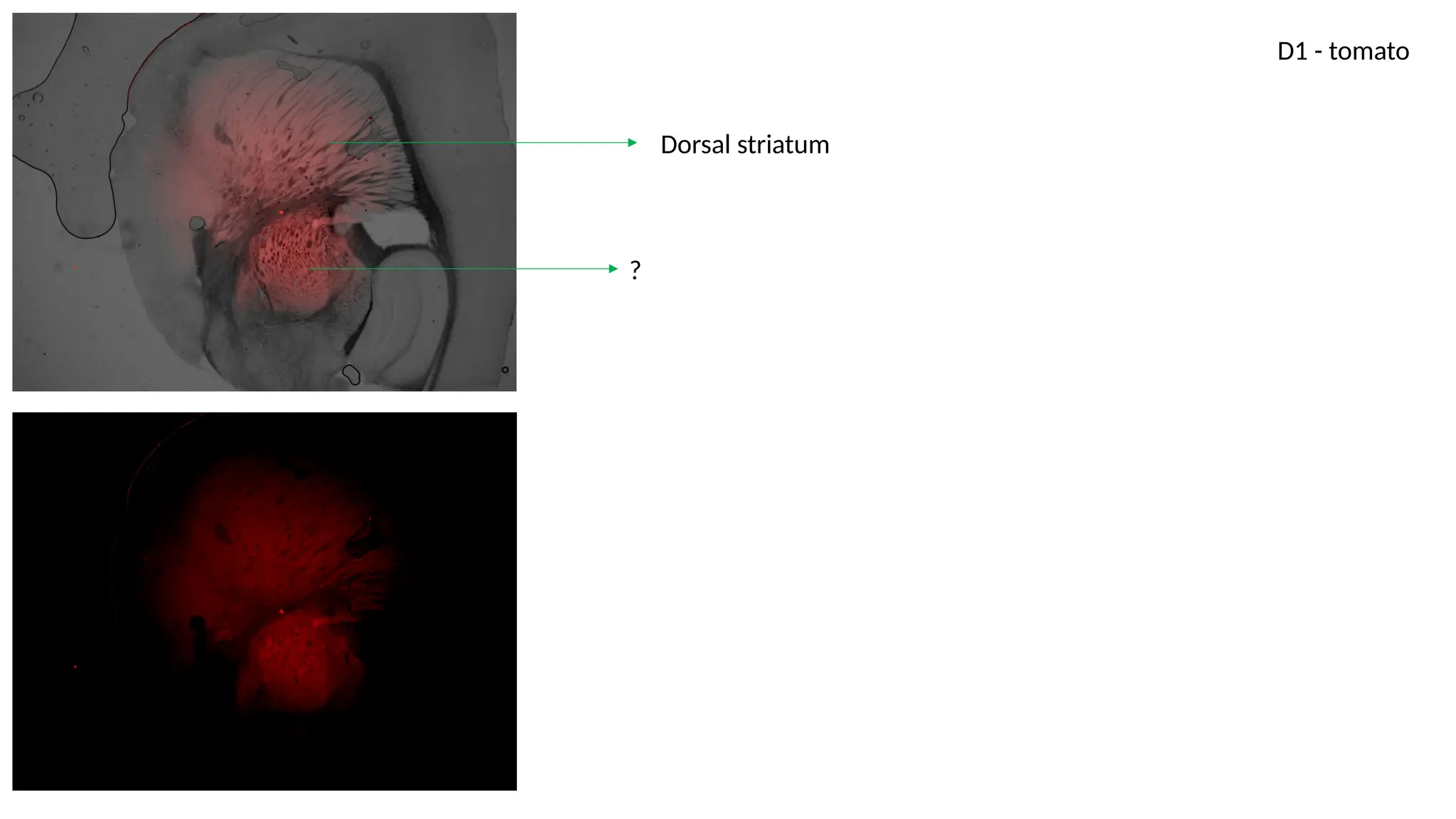
D1 - tomato
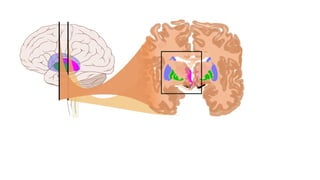
Dorsal striatum
?
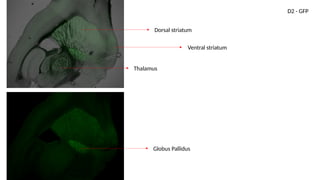
Dorsal striatum
Ventral striatum
Globus Pallidus
Thalamus
D2 - GFP
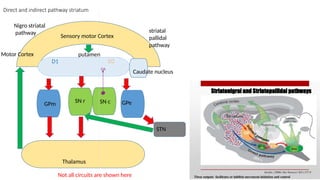
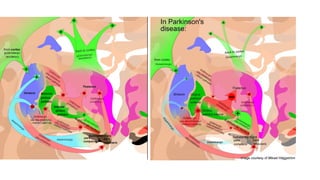
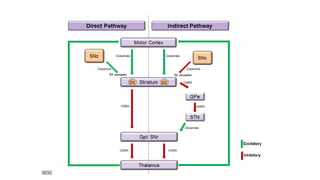
Direct and indirect pathway striatum
Sensory motor Cortex
putamen
GPm
Thalamus
SN r SN c
STN
Caudate nucleus
GPe
Motor Cortex
Nigro striatal
pathway striatal
pallidal
pathway
D1 D2
DA
Not all circuits are shown here
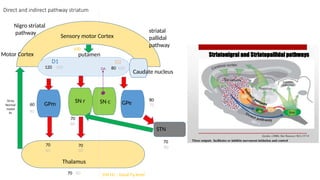
Direct and indirect pathway striatum
Sensory motor Cortex
putamen
GPm
Thalamus
SN r SN c
STN
Caudate nucleus
GPe
Motor Cortex
Nigro striatal
pathway striatal
pallidal
pathway
70
80
60
70
70
70
80
80
60
90
60 60
70
70
120 80
100
100
100 Hz – basal Fq level
D1 D2
100
70 Hz
Normal
motor
fn
DA
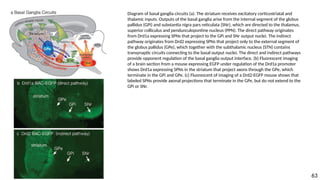
Diagram of basal ganglia circuits (a). The striatum receives excitatory corticostriatal and
thalamic inputs. Outputs of the basal ganglia arise from the internal segment of the globus
pallidus (GPi) and substantia nigra pars reticulata (SNr), which are directed to the thalamus,
superior colliculus and pendunculopontine nucleus (PPN). The direct pathway originates
from Drd1a expressing SPNs that project to the GPi and SNr output nuclei. The indirect
pathway originates from Drd2 expressing SPNs that project only to the external segment of
the globus pallidus (GPe), which together with the subthalamic nucleus (STN) contains
transynaptic circuits connecting to the basal output nuclei. The direct and indirect pathways
provide opponent regulation of the basal ganglia output interface. (b) Fluorescent imaging
of a brain section from a mouse expressing EGFP under regulation of the Drd1a promoter
shows Drd1a expressing SPNs in the striatum that project axons through the GPe, which
terminate in the GPi and GPe. (c) Fluorescent of imaging of a Drd2-EGFP mouse shows that
labeled SPNs provide axonal projections that terminate in the GPe, but do not extend to the
GPi or SNr.
63
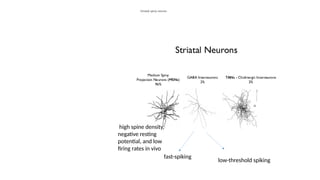
Striatal spiny neuron
fast-spiking
low-threshold spiking
high spine density,
negative resting
potential, and low
firing rates in vivo
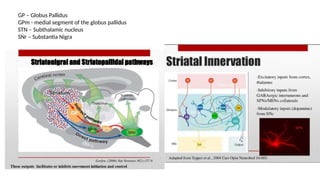
GP – Globus Pallidus
GPm - medial segment of the globus pallidus
STN – Subthalamic nucleus
SNr – Substantia Nigra
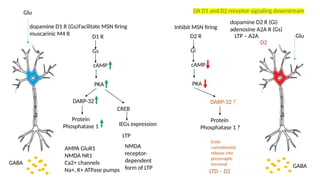
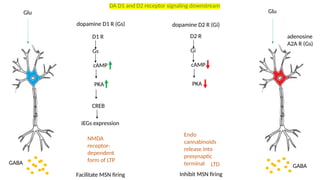
D1
D1 R
Gs
cAMP
PKA
DARP-32
Protein
Phosphatase 1
D2 R
Gi
cAMP
PKA
DARP-32 ?
Protein
Phosphatase 1 ?
AMPA GluR1
NMDA NR1
Ca2+ channels
Na+, K+ ATPase pumps
GABA
CREB
GABA
IEGs expression
LTP
D2
Glu
Glu
dopamine D1 R (Gs)
muscarinic M4 R
dopamine D2 R (Gi)
adenosine A2A R (Gs)
Facilitate MSN firing Inhibit MSN firing
Endo
cannabinoids
release into
presynaptic
terminal
NMDA
receptor-
dependent
form of LTP
LTP – A2A
LTD – D2
DA D1 and D2 receptor signaling downstream
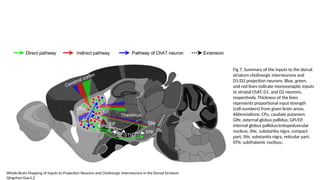
Fig 7. Summary of the inputs to the dorsal
striatum cholinergic interneurons and
D1/D2 projection neurons. Blue, green,
and red lines indicate monosynaptic inputs
to striatal ChAT, D1, and D2 neurons,
respectively. Thickness of the lines
represents proportional input strength
(cell numbers) from given brain areas.
Abbreviations: CPu, caudate putamen;
GPe, external globus pallidus; GPi/EP,
internal globus pallidus/entopeduncular
nucleus; SNc, substantia nigra, compact
part; SNr, substantia nigra, reticular part;
STN, subthalamic nucleus;.
Whole-Brain Mapping of Inputs to Projection Neurons and Cholinergic Interneurons in the Dorsal Striatum
Qingchun Guo1,2
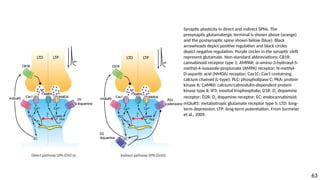
Synaptic plasticity in direct and indirect SPNs. The
presynaptic glutamatergic terminal is shown above (orange)
and the postsynaptic spine shown below (blue). Black
arrowheads depict positive regulation and black circles
depict negative regulation. Purple circles in the synaptic cleft
represent glutamate. Non-standard abbreviations: CB1R:
cannabinoid receptor type 1; AMPAR: α-amino-3-hydroxyl-5-
methyl-4-isoxazole-propionate (AMPA) receptor; N-methyl-
D-aspartic acid (NMDA) receptor; Cav1C: Cav1 containing
calcium channel (L-type); PLC: phospholipase C; PKA: protein
kinase A; CaMKII: calcium/calmodulin-dependent protein
kinase type II; IP3: inositol trisphosphate; D1R: D1 dopamine
receptor; D2R: D2 dopamine receptor; EC: endocannabinoid;
mGluR5: metabotropic glutamate receptor type 5; LTD: long-
term depression; LTP: long-term potentiation. From Surmeier
et al., 2009.
63
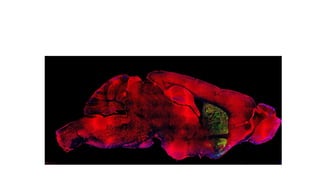
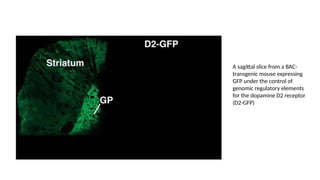
A sagittal slice from a BAC-
transgenic mouse expressing
GFP under the control of
genomic regulatory elements
for the dopamine D2 receptor
(D2-GFP)
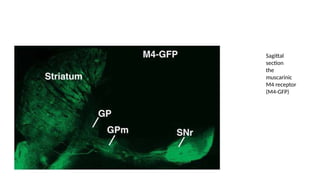
Sagittal
section
the
muscarinic
M4 receptor
(M4-GFP)
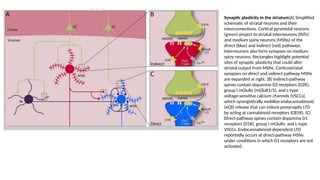
Synaptic plasticity in the striatum(A) Simplified
schematic of striatal neurons and their
interconnections. Cortical pyramidal neurons
(green) project to striatal interneurons (INTs)
and medium spiny neurons (MSNs) of the
direct (blue) and indirect (red) pathways.
Interneurons also form synapses on medium
spiny neurons. Rectangles highlight potential
sites of synaptic plasticity that could alter
striatal output from MSNs. Corticostriatal
synapses on direct and indirect pathway MSNs
are expanded at right. (B) Indirect-pathway
spines contain dopamine D2 receptors (D2R),
group I mGluRs (mGluR1/5), and L-type
voltage-sensitive calcium channels (VSCCs),
which synergistically mobilize endocannabinoid
(eCB) release that can induce presynaptic LTD
by acting at cannabinoid receptors (CB1R). (C)
Direct-pathway spines contain dopamine D1
receptors (D1R), group I mGluRs, and L-type
VSCCs. Endocannabinoid-dependent LTD
reportedly occurs at direct-pathway MSNs
under conditions in which D1 receptors are not
activated.
D1 D2
D1
D1 R
Gs
cAMP
PKA
D2 R
Gi
cAMP
PKA
GABA
CREB
GABA
IEGs expression
Glu Glu
dopamine D1 R (Gs) dopamine D2 R (Gi)
Facilitate MSN firing Inhibit MSN firing
Endo
cannabinoids
release into
presynaptic
terminal
NMDA
receptor-
dependent
form of LTP
LTD
DA D1 and D2 receptor signaling downstream
adenosine
A2A R (Gs)

Direct and Indirect Pathways in Striatum.pptx

  • 1.
  • 2.
    Dorsal striatum Ventral striatum GlobusPallidus Thalamus D2 - GFP
  • 3.
    Direct and indirectpathway striatum Sensory motor Cortex putamen GPm Thalamus SN r SN c STN Caudate nucleus GPe Motor Cortex Nigro striatal pathway striatal pallidal pathway D1 D2 DA Not all circuits are shown here
  • 4.
    Direct and indirectpathway striatum Sensory motor Cortex putamen GPm Thalamus SN r SN c STN Caudate nucleus GPe Motor Cortex Nigro striatal pathway striatal pallidal pathway 70 80 60 70 70 70 80 80 60 90 60 60 70 70 120 80 100 100 100 Hz – basal Fq level D1 D2 100 70 Hz Normal motor fn DA
  • 5.
    Diagram of basalganglia circuits (a). The striatum receives excitatory corticostriatal and thalamic inputs. Outputs of the basal ganglia arise from the internal segment of the globus pallidus (GPi) and substantia nigra pars reticulata (SNr), which are directed to the thalamus, superior colliculus and pendunculopontine nucleus (PPN). The direct pathway originates from Drd1a expressing SPNs that project to the GPi and SNr output nuclei. The indirect pathway originates from Drd2 expressing SPNs that project only to the external segment of the globus pallidus (GPe), which together with the subthalamic nucleus (STN) contains transynaptic circuits connecting to the basal output nuclei. The direct and indirect pathways provide opponent regulation of the basal ganglia output interface. (b) Fluorescent imaging of a brain section from a mouse expressing EGFP under regulation of the Drd1a promoter shows Drd1a expressing SPNs in the striatum that project axons through the GPe, which terminate in the GPi and GPe. (c) Fluorescent of imaging of a Drd2-EGFP mouse shows that labeled SPNs provide axonal projections that terminate in the GPe, but do not extend to the GPi or SNr. 63
  • 7.
    Striatal spiny neuron fast-spiking low-thresholdspiking high spine density, negative resting potential, and low firing rates in vivo
  • 8.
    GP – GlobusPallidus GPm - medial segment of the globus pallidus STN – Subthalamic nucleus SNr – Substantia Nigra
  • 10.
    D1 D1 R Gs cAMP PKA DARP-32 Protein Phosphatase 1 D2R Gi cAMP PKA DARP-32 ? Protein Phosphatase 1 ? AMPA GluR1 NMDA NR1 Ca2+ channels Na+, K+ ATPase pumps GABA CREB GABA IEGs expression LTP D2 Glu Glu dopamine D1 R (Gs) muscarinic M4 R dopamine D2 R (Gi) adenosine A2A R (Gs) Facilitate MSN firing Inhibit MSN firing Endo cannabinoids release into presynaptic terminal NMDA receptor- dependent form of LTP LTP – A2A LTD – D2 DA D1 and D2 receptor signaling downstream
  • 12.
    Fig 7. Summaryof the inputs to the dorsal striatum cholinergic interneurons and D1/D2 projection neurons. Blue, green, and red lines indicate monosynaptic inputs to striatal ChAT, D1, and D2 neurons, respectively. Thickness of the lines represents proportional input strength (cell numbers) from given brain areas. Abbreviations: CPu, caudate putamen; GPe, external globus pallidus; GPi/EP, internal globus pallidus/entopeduncular nucleus; SNc, substantia nigra, compact part; SNr, substantia nigra, reticular part; STN, subthalamic nucleus;. Whole-Brain Mapping of Inputs to Projection Neurons and Cholinergic Interneurons in the Dorsal Striatum Qingchun Guo1,2
  • 13.
    Synaptic plasticity indirect and indirect SPNs. The presynaptic glutamatergic terminal is shown above (orange) and the postsynaptic spine shown below (blue). Black arrowheads depict positive regulation and black circles depict negative regulation. Purple circles in the synaptic cleft represent glutamate. Non-standard abbreviations: CB1R: cannabinoid receptor type 1; AMPAR: α-amino-3-hydroxyl-5- methyl-4-isoxazole-propionate (AMPA) receptor; N-methyl- D-aspartic acid (NMDA) receptor; Cav1C: Cav1 containing calcium channel (L-type); PLC: phospholipase C; PKA: protein kinase A; CaMKII: calcium/calmodulin-dependent protein kinase type II; IP3: inositol trisphosphate; D1R: D1 dopamine receptor; D2R: D2 dopamine receptor; EC: endocannabinoid; mGluR5: metabotropic glutamate receptor type 5; LTD: long- term depression; LTP: long-term potentiation. From Surmeier et al., 2009. 63
  • 14.
    A sagittal slicefrom a BAC- transgenic mouse expressing GFP under the control of genomic regulatory elements for the dopamine D2 receptor (D2-GFP)
  • 15.
  • 16.
    Synaptic plasticity inthe striatum(A) Simplified schematic of striatal neurons and their interconnections. Cortical pyramidal neurons (green) project to striatal interneurons (INTs) and medium spiny neurons (MSNs) of the direct (blue) and indirect (red) pathways. Interneurons also form synapses on medium spiny neurons. Rectangles highlight potential sites of synaptic plasticity that could alter striatal output from MSNs. Corticostriatal synapses on direct and indirect pathway MSNs are expanded at right. (B) Indirect-pathway spines contain dopamine D2 receptors (D2R), group I mGluRs (mGluR1/5), and L-type voltage-sensitive calcium channels (VSCCs), which synergistically mobilize endocannabinoid (eCB) release that can induce presynaptic LTD by acting at cannabinoid receptors (CB1R). (C) Direct-pathway spines contain dopamine D1 receptors (D1R), group I mGluRs, and L-type VSCCs. Endocannabinoid-dependent LTD reportedly occurs at direct-pathway MSNs under conditions in which D1 receptors are not activated.
  • 17.
  • 18.
    D1 D1 R Gs cAMP PKA D2 R Gi cAMP PKA GABA CREB GABA IEGsexpression Glu Glu dopamine D1 R (Gs) dopamine D2 R (Gi) Facilitate MSN firing Inhibit MSN firing Endo cannabinoids release into presynaptic terminal NMDA receptor- dependent form of LTP LTD DA D1 and D2 receptor signaling downstream adenosine A2A R (Gs)

Editor's Notes

  • #3 Dorsal striatum – Putamen and Caudate nucleus Ventral striatum – nucleus accumbens and olfactory tubercle The primary input nucleus is the striatum, which receives excitatory afferents from the cortex and thalamus, as well as dense innervation from midbrain dopamine neurons, and represents a major site of synaptic plasticity in the basal ganglia. The output from the striatum to downstream basal ganglia nuclei thus reflects a complex interplay between intrinsic properties of MSNs and their excitatory and inhibitory synaptic inputs.
  • #4 Dorsal striatum – Putamen and Caudate nucleus Ventral striatum – nucleus accumbens and olfactory tubercle The primary input nucleus is the striatum, which receives excitatory afferents from the cortex and thalamus, as well as dense innervation from midbrain dopamine neurons, and represents a major site of synaptic plasticity in the basal ganglia. The output from the striatum to downstream basal ganglia nuclei thus reflects a complex interplay between intrinsic properties of MSNs and their excitatory and inhibitory synaptic inputs. Normal – enhanced activity in D1 MSN, suppressed activity in D2 MSN PD – suppressed activity in D1 MSN, enhanced activity in D2 MSN
  • #10 Striatal plasticity alters the transfer of information throughout basal ganglia circuits and may represent a key neural substrate for adaptive motor control and procedural memory. 
  • #16 There are several postsynaptic membrane proteins that are required to elicit eCB release sufficient to induce indirect pathway eCB-LTD: group I (Gq-coupled) metabotropic glutamate receptors (mGluRs), Ltype voltage-gated calcium channels (L-VGCCs), and dopamine D2 receptors that a GTPaseactivating protein called Regulator of G-protein Signaling 4 (RGS4) links D2 and A2A signaling to group I mGluR signaling.
  • #18 Striatal plasticity alters the transfer of information throughout basal ganglia circuits and may represent a key neural substrate for adaptive motor control and procedural memory.