Unit I
Diploma Course
B.Sc III
Introduction of Nanocoating
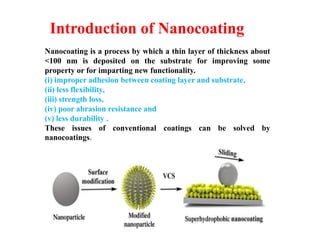
Nanocoating is a process by which a thin layer of thickness about
<100 nm is deposited on the substrate for improving some
property or for imparting new functionality.
(i) improper adhesion between coating layer and substrate,
(ii) less flexibility,
(iii) strength loss,
(iv) poor abrasion resistance and
(v) less durability .
These issues of conventional coatings can be solved by
nanocoatings.
There are several nanocoating techniques which
mainly are
(1) Sol-gel
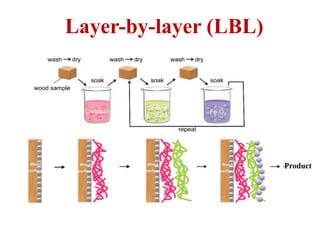
(2) Layer-by-layer (LBL)
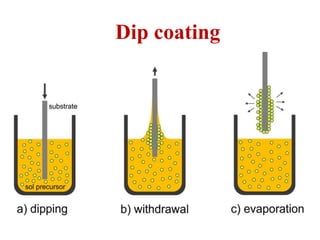
(3) Dip coating
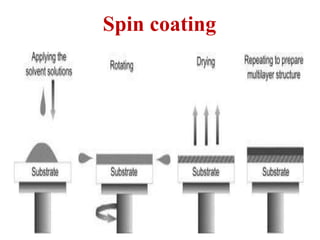
(4) Spin coating
(5) Plasma or ion-beam assisted techniques
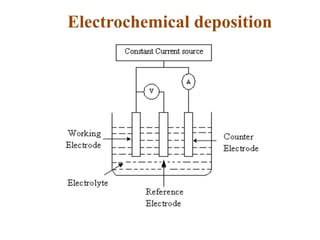
(6) Electrochemical deposition
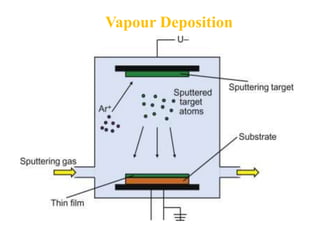
(7) Vapour deposition
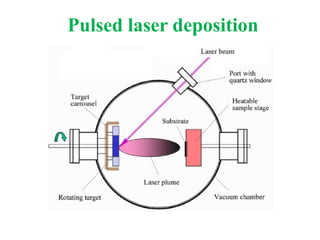
(8) Pulsed laser deposition
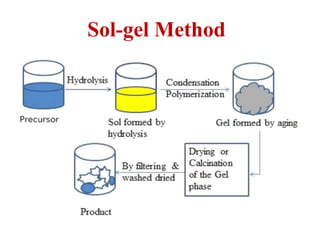
Sol-gel Method
Layer-by-layer (LBL)
Product
Dip coating
Spin coating
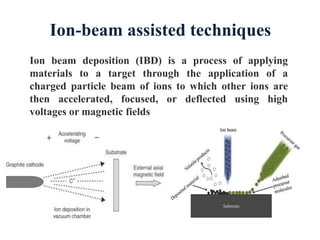
Ion beam deposition (IBD) is a process of applying
materials to a target through the application of a
charged particle beam of ions to which other ions are
then accelerated, focused, or deflected using high
voltages or magnetic fields
Ion-beam assisted techniques
Electrochemical deposition
Vapour Deposition
Pulsed laser deposition
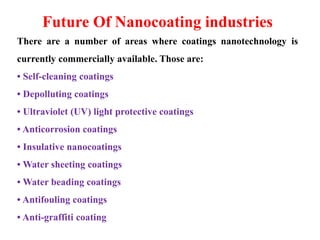
Future Of Nanocoating industries
There are a number of areas where coatings nanotechnology is
currently commercially available. Those are:
• Self-cleaning coatings
• Depolluting coatings
• Ultraviolet (UV) light protective coatings
• Anticorrosion coatings
• Insulative nanocoatings
• Water sheeting coatings
• Water beading coatings
• Antifouling coatings
• Anti-graffiti coating
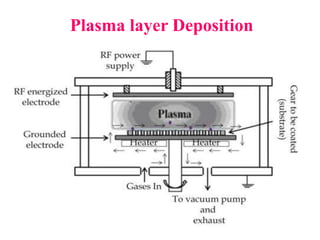
Plasma layer Deposition
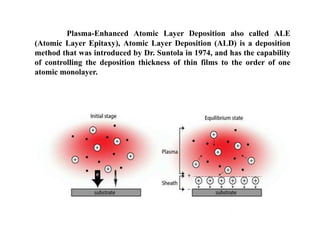
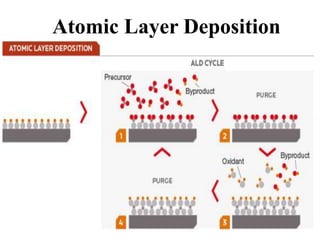
Plasma-Enhanced Atomic Layer Deposition also called ALE
(Atomic Layer Epitaxy), Atomic Layer Deposition (ALD) is a deposition
method that was introduced by Dr. Suntola in 1974, and has the capability
of controlling the deposition thickness of thin films to the order of one
atomic monolayer.
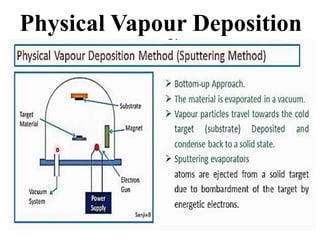
Physical Vapour Deposition
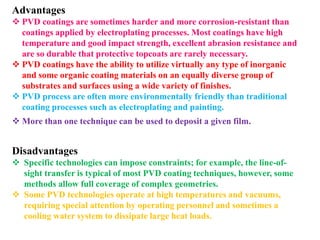
Advantages
 PVD coatings are sometimes harder and more corrosion-resistant than
coatings applied by electroplating processes. Most coatings have high
temperature and good impact strength, excellent abrasion resistance and
are so durable that protective topcoats are rarely necessary.
 PVD coatings have the ability to utilize virtually any type of inorganic
and some organic coating materials on an equally diverse group of
substrates and surfaces using a wide variety of finishes.
 PVD process are often more environmentally friendly than traditional
coating processes such as electroplating and painting.
 More than one technique can be used to deposit a given film.
Disadvantages
 Specific technologies can impose constraints; for example, the line-of-
sight transfer is typical of most PVD coating techniques, however, some
methods allow full coverage of complex geometries.
 Some PVD technologies operate at high temperatures and vacuums,
requiring special attention by operating personnel and sometimes a
cooling water system to dissipate large heat loads.
Applications
 Decorative applications
 Cutting tools
 Aerospace industry
 Architectural ironmongery, panels, and sheets
 Automotive industry
 Dyes and molds
 Firearms
 Optics
 Watches
 Jewelry
 Thin film applications
Atomic Layer Deposition
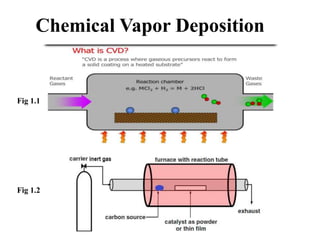
Chemical Vapor Deposition
Fig 1.1
Fig 1.2
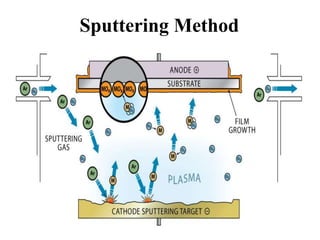
Sputtering Method
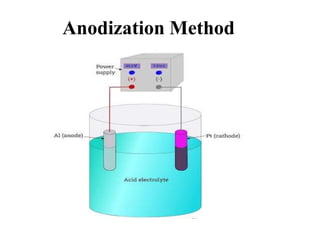
Anodization Method
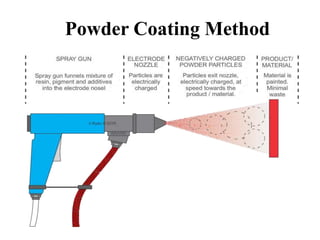
Powder Coating Method
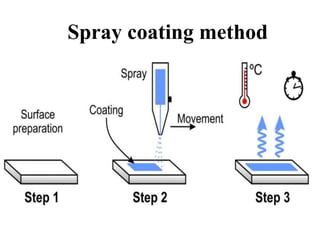
Spray coating method
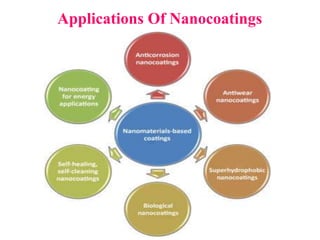
Applications Of Nanocoatings
diploma course III.pptx

diploma course III.pptx

  • 1.
  • 3.
    Introduction of Nanocoating Nanocoatingis a process by which a thin layer of thickness about <100 nm is deposited on the substrate for improving some property or for imparting new functionality. (i) improper adhesion between coating layer and substrate, (ii) less flexibility, (iii) strength loss, (iv) poor abrasion resistance and (v) less durability . These issues of conventional coatings can be solved by nanocoatings.
  • 4.
    There are severalnanocoating techniques which mainly are (1) Sol-gel (2) Layer-by-layer (LBL) (3) Dip coating (4) Spin coating (5) Plasma or ion-beam assisted techniques (6) Electrochemical deposition (7) Vapour deposition (8) Pulsed laser deposition
  • 5.
  • 6.
  • 7.
  • 8.
  • 9.
    Ion beam deposition(IBD) is a process of applying materials to a target through the application of a charged particle beam of ions to which other ions are then accelerated, focused, or deflected using high voltages or magnetic fields Ion-beam assisted techniques
  • 10.
  • 11.
  • 12.
  • 13.
    Future Of Nanocoatingindustries There are a number of areas where coatings nanotechnology is currently commercially available. Those are: • Self-cleaning coatings • Depolluting coatings • Ultraviolet (UV) light protective coatings • Anticorrosion coatings • Insulative nanocoatings • Water sheeting coatings • Water beading coatings • Antifouling coatings • Anti-graffiti coating
  • 15.
  • 16.
    Plasma-Enhanced Atomic LayerDeposition also called ALE (Atomic Layer Epitaxy), Atomic Layer Deposition (ALD) is a deposition method that was introduced by Dr. Suntola in 1974, and has the capability of controlling the deposition thickness of thin films to the order of one atomic monolayer.
  • 17.
  • 18.
    Advantages  PVD coatingsare sometimes harder and more corrosion-resistant than coatings applied by electroplating processes. Most coatings have high temperature and good impact strength, excellent abrasion resistance and are so durable that protective topcoats are rarely necessary.  PVD coatings have the ability to utilize virtually any type of inorganic and some organic coating materials on an equally diverse group of substrates and surfaces using a wide variety of finishes.  PVD process are often more environmentally friendly than traditional coating processes such as electroplating and painting.  More than one technique can be used to deposit a given film. Disadvantages  Specific technologies can impose constraints; for example, the line-of- sight transfer is typical of most PVD coating techniques, however, some methods allow full coverage of complex geometries.  Some PVD technologies operate at high temperatures and vacuums, requiring special attention by operating personnel and sometimes a cooling water system to dissipate large heat loads.
  • 19.
    Applications  Decorative applications Cutting tools  Aerospace industry  Architectural ironmongery, panels, and sheets  Automotive industry  Dyes and molds  Firearms  Optics  Watches  Jewelry  Thin film applications
  • 20.
  • 21.
  • 22.
  • 23.
  • 24.
  • 25.
  • 26.