DIPECHO Newsletter Nepal
                                                                                   Fourth Edition
        MASS SENSITIZATION                                                         January 2010


                                          action “Better Knowledge Manage-          Inside this issue:
                                          ment for Building a Culture of
Nepal has been classified as one of
                                          Safety” (please see page 7 ) focuses
the global ‘hot-spots’ for natural dis-                                            Action Aid:                 2
                                          on awareness raising.                    Acuity, attitudes and
asters (World Bank, 2005). Reducing
                                                                                   actions – transformation
the impact of Natural disasters in        The theme of this fourth edition of
Nepal is a big challenge for govern-      the newsletter is “Mass Sensitiza-
mental as well as non-governmental        tion” for awareness raising in the 19    Danish Red Cross :          2
institutions.                             districts supported under the fifth      Mass Sensitization for
                                          DIPECHO Action Plan. Inside this         Safer Communities
A wide array of measures has to be        issue, DIPECHO Partners in Nepal
taken, ranging from the development       provides a brief of mass sensitiza-                                  3
                                                                                   Handicap International:
of Disaster Management and Risk           tion activities implemented as part      Sensitization on disabil-
Reduction legal framework, to overall     of their contribution towards fulfill-   ity and to persons with
infrastructural interventions, coordi-    ment of the third priority of the        disabilities
nation between agencies, research         NSDRM.
and development of early warning          These initiatives include among          Mission East:           4
systems and capacity building and         others, radio and TV programs,           Mass sensitization in
                                                                                   remote      mountainous
strengthening of search and rescue        street dramas and community              areas
teams.                                    meetings. The articles in this edition
                                          provide only a brief of the various
The National Strategy for Disaster
                                          sensitization activities carried out     Oxfam:                      4
Risk Management (NSDRM) devel-
                                          by DIPECHO Partners in Nepal. For        Mass Media—Mass sen-
oped with support from UNDP under         further details of the different ini-    sitization
the third and fourth DIPECHO Action       tiatives, please contact the
Plans recognizes the potential contri-    DIPECHO Project Managers directly.
bution of local communities in disas-                                              Practical Action:           5
ter risk reduction and preparedness.                                               Early Warning—Mass
                                                                                   sensitization
The strategy further recognizes a
strong need for awareness raising
and dissemination of disaster risk                                                 Mercy Corps:                6
                                                                                   Changing practices
reduction information to build resil-
                                                                                   through mass sensitiza-
ience of the nation as well as the
                                                                                   tion
communities to disasters.
The NSDRM in line with the Hyogo
Framework for Action (HFA) has iden-
tified five priorities for action, of                                              NSDRM Priority 3            7
which especially the third priority for
Page 2                                                                                         DIPECHO Newsletter Nepal


Inside Story Headline
ACTION AID: Acuity, attitudes and actions – transformation through
sensitization
                                           changes individual behavior and in-        and information gathered through
                                           fluences collective attitudes. In the      participatory vulnerability analysis
                                           DIPECHO projects, AA is trying to          are feeding the community dis-
                                           influence thinking and practices           courses. Appropriate and cultural
                                           within vulnerable communities to
                                                                                      friendly media like street theatre, FM
                                           adopt a risk-resilience culture.
                                                                                      radio broadcast, video documenta-
                                           Identification of risks and under-         ries and facilitated group discussions
                                           standing vulnerability are crucial         have been initiated to disseminate
                                           primary steps in a sensitization proc-
                                                                                      information. A pool of resource per-
                                           ess, including physical, social, politi-
                                                                                      sons, trained by the project, act as
                                           cal and economic causes of vulner-
                                                                                      local facilitators and change agents
                                           ability. Situational assessment and
                                           analysis of local capacities and re-       in the community. The volunteers
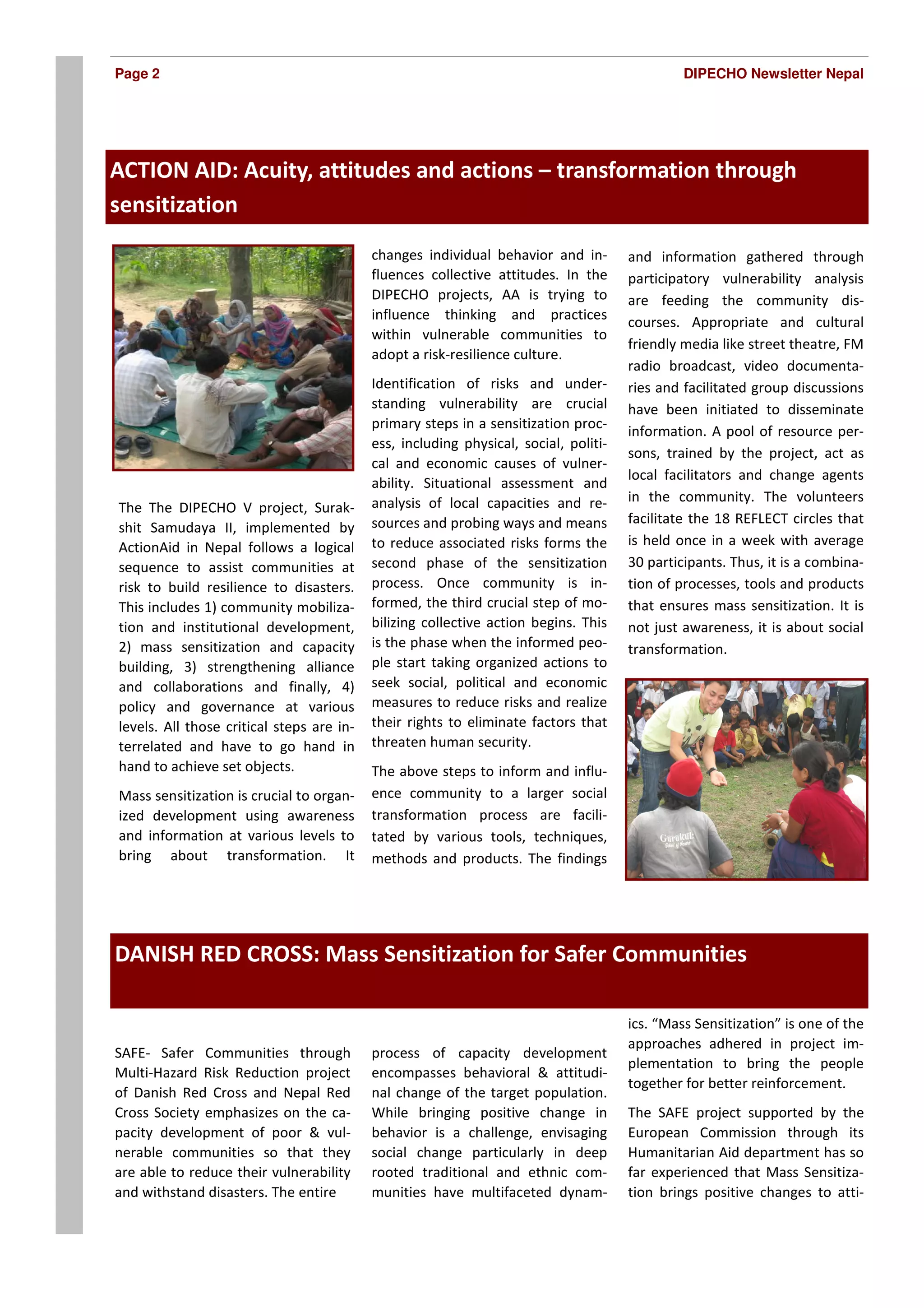
The The DIPECHO V project, Surak-
                                           sources and probing ways and means         facilitate the 18 REFLECT circles that
shit Samudaya II, implemented by
ActionAid in Nepal follows a logical       to reduce associated risks forms the       is held once in a week with average
sequence to assist communities at          second phase of the sensitization          30 participants. Thus, it is a combina-
risk to build resilience to disasters.     process. Once community is in-             tion of processes, tools and products
This includes 1) community mobiliza-       formed, the third crucial step of mo-      that ensures mass sensitization. It is
tion and institutional development,        bilizing collective action begins. This    not just awareness, it is about social
2) mass sensitization and capacity         is the phase when the informed peo-        transformation.
building, 3) strengthening alliance        ple start taking organized actions to
and collaborations and finally, 4)         seek social, political and economic
policy and governance at various           measures to reduce risks and realize
levels. All those critical steps are in-   their rights to eliminate factors that
terrelated and have to go hand in          threaten human security.
hand to achieve set objects.               The above steps to inform and influ-
Mass sensitization is crucial to organ-    ence community to a larger social
ized development using awareness           transformation process are facili-
and information at various levels to       tated by various tools, techniques,
bring about transformation. It             methods and products. The findings


Inside Story Headline
DANISH RED CROSS: Mass Sensitization for Safer Communities

                                                                                      ics. “Mass Sensitization” is one of the
                                                                                      approaches adhered in project im-
SAFE- Safer Communities through            process of capacity development
                                                                                      plementation to bring the people
Multi-Hazard Risk Reduction project        encompasses behavioral & attitudi-
                                                                                      together for better reinforcement.
of Danish Red Cross and Nepal Red          nal change of the target population.
Cross Society emphasizes on the ca-        While bringing positive change in          The SAFE project supported by the
pacity development of poor & vul-          behavior is a challenge, envisaging        European Commission through its
nerable communities so that they           social change particularly in deep         Humanitarian Aid department has so
are able to reduce their vulnerability     rooted traditional and ethnic com-         far experienced that Mass Sensitiza-
and withstand disasters. The entire        munities have multifaceted dynam-          tion brings positive changes to atti-
Fourth Edition                                                                                                       Page 3


audience conscious of changes. It          by housewives in mothers’ meetings,
further brings into focus the positive     teachers and community trainers in
effects of changes, and possible           schools, as well as volunteers in
measures to be taken to address the        community organizations – in es-
unmet needs of the communities.            sence, wherever teamwork is desir-
                                           able and achievable.
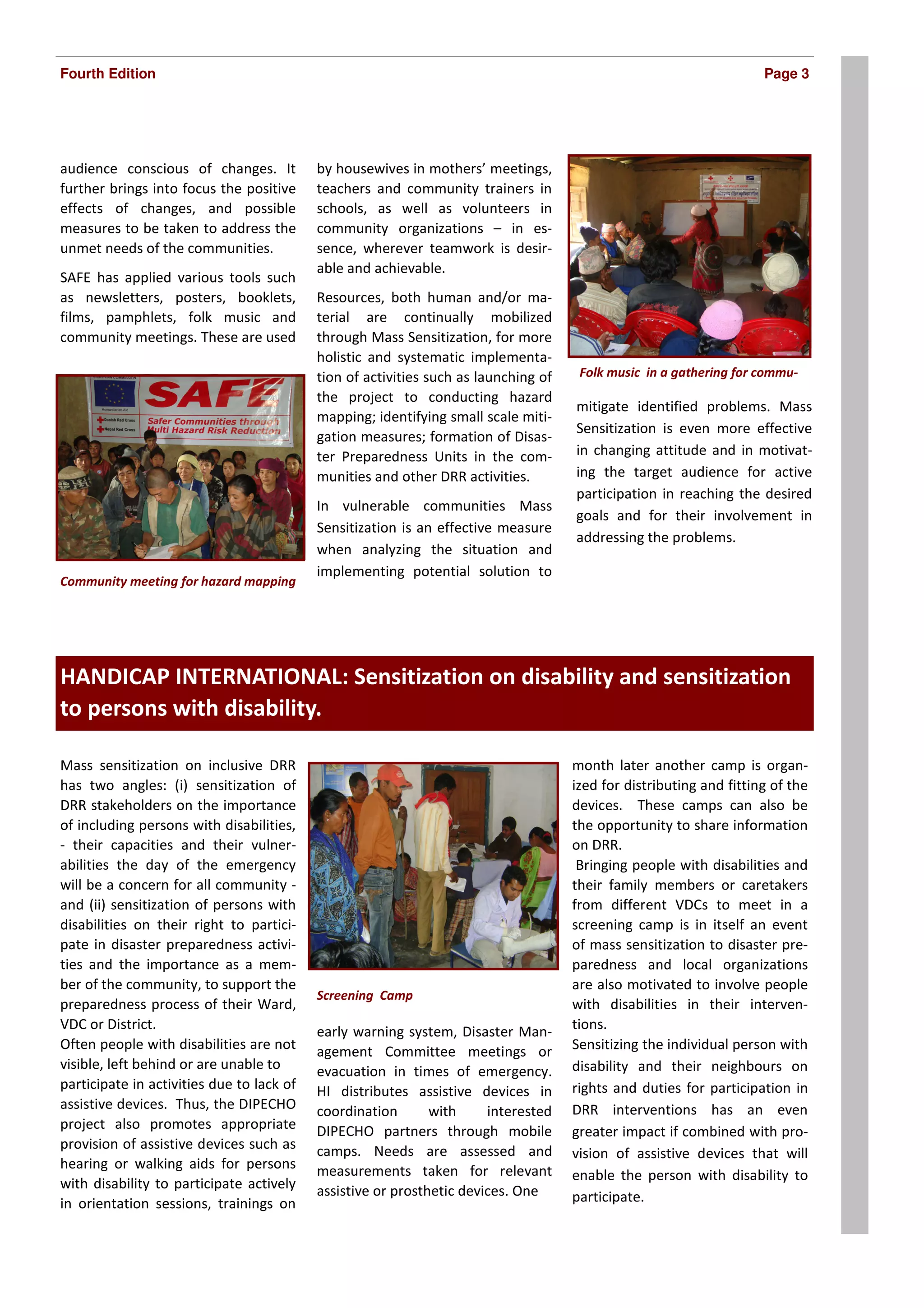
SAFE has applied various tools such
as newsletters, posters, booklets,         Resources, both human and/or ma-
films, pamphlets, folk music and           terial are continually mobilized
community meetings. These are used         through Mass Sensitization, for more
                                           holistic and systematic implementa-
                                           tion of activities such as launching of    Folk music in a gathering for commu-
                                           the project to conducting hazard
                                                                                     mitigate identified problems. Mass
                                           mapping; identifying small scale miti-
                                                                                     Sensitization is even more effective
                                           gation measures; formation of Disas-
                                           ter Preparedness Units in the com-        in changing attitude and in motivat-
                                           munities and other DRR activities.        ing the target audience for active
                                                                                     participation in reaching the desired
                                           In vulnerable communities Mass
                                                                                     goals and for their involvement in
                                           Sensitization is an effective measure
                                                                                     addressing the problems.
                                           when analyzing the situation and
                                           implementing potential solution to
Community meeting for hazard mapping


Inside Story Headline
HANDICAP INTERNATIONAL: Sensitization on disability and sensitization
to persons with disability.

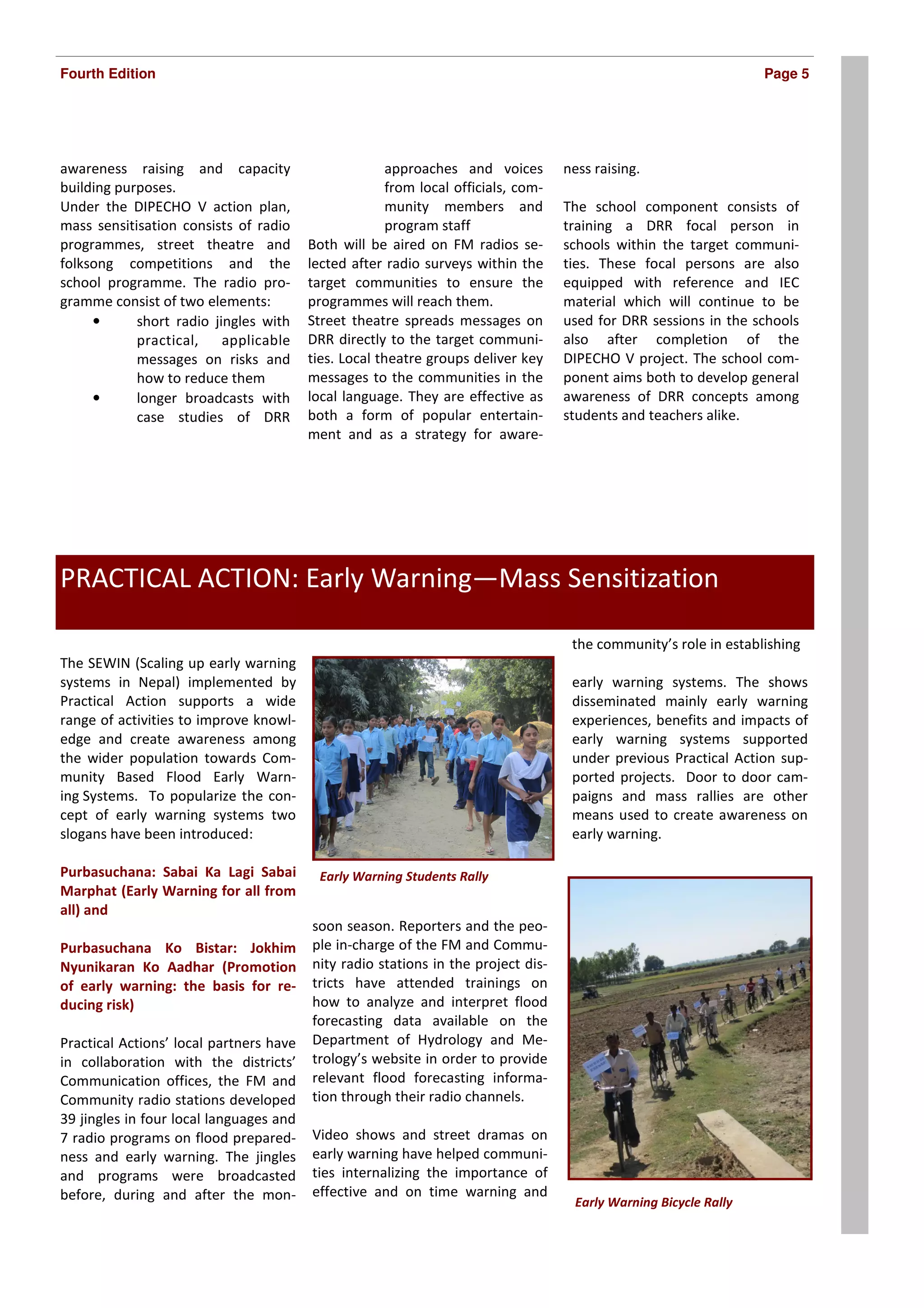
Mass sensitization on inclusive DRR                                                  month later another camp is organ-
has two angles: (i) sensitization of                                                 ized for distributing and fitting of the
DRR stakeholders on the importance                                                   devices. These camps can also be
of including persons with disabilities,                                              the opportunity to share information
- their capacities and their vulner-                                                 on DRR.
abilities the day of the emergency                                                    Bringing people with disabilities and
will be a concern for all community -                                                their family members or caretakers
and (ii) sensitization of persons with                                               from different VDCs to meet in a
disabilities on their right to partici-                                              screening camp is in itself an event
pate in disaster preparedness activi-                                                of mass sensitization to disaster pre-
ties and the importance as a mem-                                                    paredness and local organizations
ber of the community, to support the                                                 are also motivated to involve people
                                           Screening Camp
preparedness process of their Ward,                                                  with disabilities in their interven-
VDC or District.                           early warning system, Disaster Man-       tions.
Often people with disabilities are not     agement Committee meetings or             Sensitizing the individual person with
visible, left behind or are unable to      evacuation in times of emergency.         disability and their neighbours on
participate in activities due to lack of   HI distributes assistive devices in       rights and duties for participation in
assistive devices. Thus, the DIPECHO       coordination       with     interested    DRR interventions has an even
project also promotes appropriate          DIPECHO partners through mobile           greater impact if combined with pro-
provision of assistive devices such as     camps. Needs are assessed and             vision of assistive devices that will
hearing or walking aids for persons        measurements taken for relevant           enable the person with disability to
with disability to participate actively    assistive or prosthetic devices. One
in orientation sessions, trainings on                                                participate.
Page 4                                                                                         DIPECHO Newsletter Nepal


MISSION EAST: Mass sensitization in remote mountainous areas.
Inside Story Headline


In remote mountainous areas of the       lessons learned from similar actions
Karnali region, FM Radio is the only     – that active communities informed
available and possible media for         through broad FM radio dialogues
mass sensitization. Most households      will improve the possibilities of long-
have a radio tuned on the local FM       term and sustainable mitigation of
station or on the national Radio Ne-     adverse disaster effects on liveli-
pal station. In that perspective, the    hoods and development processes.
majority of beneficiaries supported      By initiating two-way dialogue on
by Mission East’s DIPECHO project        disaster and disaster preparedness
will be reached by a radio program       issues, MISSION EAST aims to in-
planned to be aired on Radio Karnali     crease positive participation in DRR
(105.2 MHZ) from Jumla (covering 18      decision-making at community, VDC             Listening to the radio magazine
VDCs) for a period of 7 months. Ra-      and district levels. Such initiative is in     © KIRDARC
dio Karnali, a project of Mission        accordance with the Hyogo Frame-             ment in reducing the effects of natu-
East’s partner KIRDARC, has broad        work for Action that considers active        ral disaster.
experience of community-based ra-        community participation a key ele-
dio programming. MISSION EAST will                                                    The 30 minutes radio magazine aired
thus benefit from their 5-years’ of                                                   every week is expected to reach out
experience creating and broadcast-                                                    to an audience of 70,000 people. It
ing interactive radio magazines on                                                    will include field testimonies, vox box
contemporary issues such as pro-                                                      calls, guest interviews, recall of disas-
moting peace, democracy, human                                                        ter situations and will as well focus
rights, good governance, and devel-
                                                                                      on disasters in a national perspec-
opment, during the time of conflict
                                                                                      tive. The content will be adapted to
and in the post conflict situation. It
                                                                                      the local context in order to address
also helps disadvantaged community
groups such as women, children,                                                       people’s daily concerns.
IDPs, dalit, indigenous and conflict
affected people to bring forward
their own concerns and problems.
                                          Interview for radio magazine
MISSION EAST assumes – based on           © KIRDARC


Inside Story Headline
OXFAM: Mass media – Mass sensitization

                                         For Oxfam mass sensitisation aims            awareness on DRR.
                                         both to create and sustain support at        Under the DIPECHO III action plan,
                                         the government level for the integra-        Oxfam collaborated with ActionAid
                                         tion of DRR into development plan-           and ECO Nepal to develop the Disas-
                                         ning as to raise awareness among the         ter Knowledge Series, a 15 booklets
                                         communities on the nature of disas-          series covering all aspects of DRR.
                                         ters. Throughout its programming,            These booklets aimed at schools,
                                         Oxfam uses mass media such as tele-          local partners and social mobilizers
                                         vision, radio programmes, monthly            continue to prove useful both for
Fourth Edition                                                                                                     Page 5


awareness raising and capacity                         approaches and voices        ness raising.
building purposes.                                     from local officials, com-
Under the DIPECHO V action plan,                       munity members and           The school component consists of
mass sensitisation consists of radio                   program staff                training a DRR focal person in
programmes, street theatre and           Both will be aired on FM radios se-        schools within the target communi-
folksong competitions and the            lected after radio surveys within the      ties. These focal persons are also
school programme. The radio pro-         target communities to ensure the           equipped with reference and IEC
gramme consist of two elements:          programmes will reach them.                material which will continue to be
     •      short radio jingles with     Street theatre spreads messages on         used for DRR sessions in the schools
            practical,    applicable     DRR directly to the target communi-        also after completion of the
            messages on risks and        ties. Local theatre groups deliver key     DIPECHO V project. The school com-
            how to reduce them           messages to the communities in the         ponent aims both to develop general
     •      longer broadcasts with       local language. They are effective as      awareness of DRR concepts among
            case studies of DRR          both a form of popular entertain-          students and teachers alike.
                                         ment and as a strategy for aware-


PRACTICAL ACTION: Early Warning—Mass Sensitization

                                                                                     the community’s role in establishing
The SEWIN (Scaling up early warning
systems in Nepal) implemented by                                                     early warning systems. The shows
Practical Action supports a wide                                                     disseminated mainly early warning
range of activities to improve knowl-                                                experiences, benefits and impacts of
edge and create awareness among                                                      early warning systems supported
the wider population towards Com-                                                    under previous Practical Action sup-
munity Based Flood Early Warn-                                                       ported projects. Door to door cam-
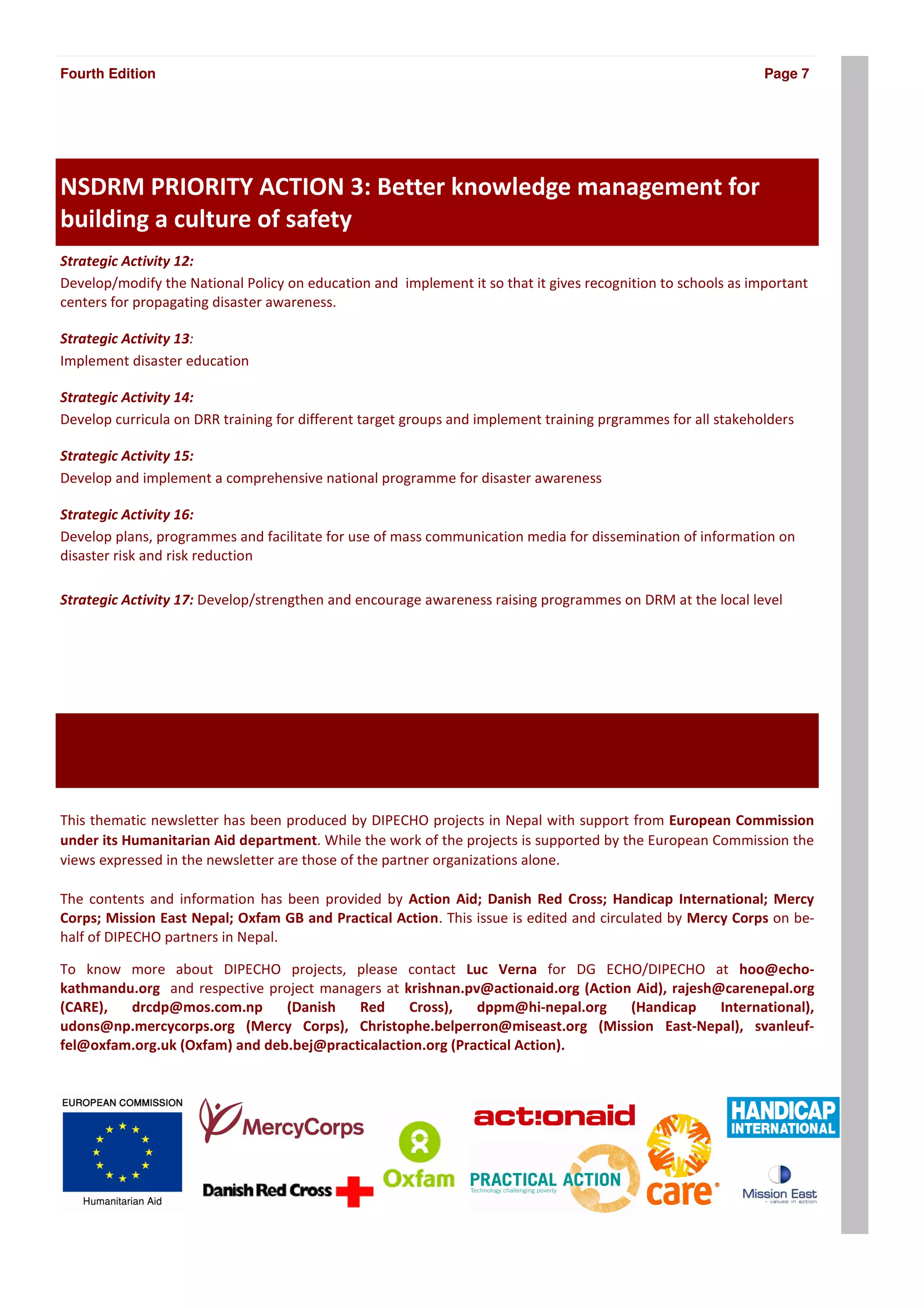
ing Systems. To popularize the con-                                                  paigns and mass rallies are other
cept of early warning systems two                                                    means used to create awareness on
slogans have been introduced:                                                        early warning.

Purbasuchana: Sabai Ka Lagi Sabai          Early Warning Students Rally
Marphat (Early Warning for all from
all) and
                                         soon season. Reporters and the peo-
Purbasuchana Ko Bistar: Jokhim           ple in-charge of the FM and Commu-
Nyunikaran Ko Aadhar (Promotion          nity radio stations in the project dis-
of early warning: the basis for re-      tricts have attended trainings on
ducing risk)                             how to analyze and interpret flood
                                         forecasting data available on the
Practical Actions’ local partners have   Department of Hydrology and Me-
in collaboration with the districts’     trology’s website in order to provide
Communication offices, the FM and        relevant flood forecasting informa-
Community radio stations developed       tion through their radio channels.
39 jingles in four local languages and
7 radio programs on flood prepared-      Video shows and street dramas on
ness and early warning. The jingles      early warning have helped communi-
and programs were broadcasted            ties internalizing the importance of
before, during and after the mon-        effective and on time warning and
                                                                                     Early Warning Bicycle Rally
Page 6                                                                                         DIPECHO Newsletter Nepal


Practical Action has observed a sig-      of project period and for the
nificant change in practices among        DIPECHO-V project the VDCs have
the local governments tracked from        allocated funds for preparedness
the DIPECHO-III to the DIPECHO-V          right from the beginning of the pro-
projects due to sensitization initia-     ject.
tives. The Village Development Com-
mittees (VDC) allocated at the end of
the DIPECHO-III project a tiny budget
for flood preparedness out of their
annual budget, for the DIPECHO-IV
project this happened in the middle


MERCY CORPS – Changing practices through mass sensitization


Mercy Corps has undertaken differ-                                                 district.
ent media for effective mass sensiti-
                                                                                   To further enhance awareness on
zation and dissemination of DRR in-
                                                                                   DRR options and modalities for local
formation among various segments
of the communities, students, and                                                  conditions, KDRRI promotes cross
government organizations. Mercy                                                    visits and facilitates interactions be-
Corps’ Kailali Disaster Risk Reduction                                             tween different communities and
Initiative Project (KDRRI) creates                                                 stakeholders. Furthermore, to impart
awareness on floods and their risks                                                DRR knowledge and information, IEC
as well as protection mechnisms and                                                materials are disseminated using
coping strategies among the local                                                  household visits by a trained team of
people in the project area and in                                                  40 young community facilitators.
neighboring communities.                   Street drama for mass sensitization
                                                                                   Various techniques as games, essays,
Street drama is an important tool          and changing practices. The project     arts, simulations and DP awareness
used by KDRRI to sensitize and com-        uses video documentations to galva-     campaigns are used to fill gaps in
municate key messages to commu-            nize viewers into reducing disaster     knowledge about DP and DRR among
nity members who are unable to             risks and documentary films to show     teachers and students in the project
read and write. Dramas are pre-            various coping mechanisms adopted       areas.
sented in the local Tharu language by      by people in high risk situation. En-
two teams of local youth one trained       forcement of rules like zero grazing
under the previous DIPECHO project         on the river banks and soil conversa-
and another under the current pro-         tion are some of the particular risk
ject. That the street dramas are ef-       reduction activities that are commu-
fective in sensitization can be seen as    nicated effectively through the vid-
stated by a community member say-          eos and are emulated on the ground.
ing that his community was able to         Furthermore, during the monsoon
evacuate and rescue all community          seasons short disaster preparedness
members because of what they have          messages and radio magazines are
learned from the street drama.             broadcasted by local FM stations and
Electronic media are another effec-        published in the daily newspapers in
tive tool used for raising awareness       two languages to raise awareness
                                           among a wider audience in Kailali
                                                                                   Radio magazine being produced
Fourth Edition                                                                                                Page 7


NSDRM PRIORITY ACTION 3: Better knowledge management for
building a culture of safety
Strategic Activity 12:
Develop/modify the National Policy on education and implement it so that it gives recognition to schools as important
centers for propagating disaster awareness.

Strategic Activity 13:
Implement disaster education

Strategic Activity 14:
Develop curricula on DRR training for different target groups and implement training prgrammes for all stakeholders

Strategic Activity 15:
Develop and implement a comprehensive national programme for disaster awareness

Strategic Activity 16:
Develop plans, programmes and facilitate for use of mass communication media for dissemination of information on
disaster risk and risk reduction

Strategic Activity 17: Develop/strengthen and encourage awareness raising programmes on DRM at the local level


This thematic newsletter has been produced by DIPECHO projects in Nepal with support from European Commission
under its Humanitarian Aid department. While the work of the projects is supported by the European Commission the
views expressed in the newsletter are those of the partner organizations alone.

The contents and information has been provided by Action Aid; Danish Red Cross; Handicap International; Mercy
Corps; Mission East Nepal; Oxfam GB and Practical Action. This issue is edited and circulated by Mercy Corps on be-
half of DIPECHO partners in Nepal.

To know more about DIPECHO projects, please contact Luc Verna for DG ECHO/DIPECHO at hoo@echo-
kathmandu.org and respective project managers at krishnan.pv@actionaid.org (Action Aid), rajesh@carenepal.org
(CARE),  drcdp@mos.com.np       (Danish   Red     Cross),    dppm@hi-nepal.org    (Handicap     International),
udons@np.mercycorps.org (Mercy Corps), Christophe.belperron@miseast.org (Mission East-Nepal), svanleuf-
fel@oxfam.org.uk (Oxfam) and deb.bej@practicalaction.org (Practical Action).

Dipecho v news letter 4th edition- january10

  • 1.
    DIPECHO Newsletter Nepal Fourth Edition MASS SENSITIZATION January 2010 action “Better Knowledge Manage- Inside this issue: ment for Building a Culture of Nepal has been classified as one of Safety” (please see page 7 ) focuses the global ‘hot-spots’ for natural dis- Action Aid: 2 on awareness raising. Acuity, attitudes and asters (World Bank, 2005). Reducing actions – transformation the impact of Natural disasters in The theme of this fourth edition of Nepal is a big challenge for govern- the newsletter is “Mass Sensitiza- mental as well as non-governmental tion” for awareness raising in the 19 Danish Red Cross : 2 institutions. districts supported under the fifth Mass Sensitization for DIPECHO Action Plan. Inside this Safer Communities A wide array of measures has to be issue, DIPECHO Partners in Nepal taken, ranging from the development provides a brief of mass sensitiza- 3 Handicap International: of Disaster Management and Risk tion activities implemented as part Sensitization on disabil- Reduction legal framework, to overall of their contribution towards fulfill- ity and to persons with infrastructural interventions, coordi- ment of the third priority of the disabilities nation between agencies, research NSDRM. and development of early warning These initiatives include among Mission East: 4 systems and capacity building and others, radio and TV programs, Mass sensitization in remote mountainous strengthening of search and rescue street dramas and community areas teams. meetings. The articles in this edition provide only a brief of the various The National Strategy for Disaster sensitization activities carried out Oxfam: 4 Risk Management (NSDRM) devel- by DIPECHO Partners in Nepal. For Mass Media—Mass sen- oped with support from UNDP under further details of the different ini- sitization the third and fourth DIPECHO Action tiatives, please contact the Plans recognizes the potential contri- DIPECHO Project Managers directly. bution of local communities in disas- Practical Action: 5 ter risk reduction and preparedness. Early Warning—Mass sensitization The strategy further recognizes a strong need for awareness raising and dissemination of disaster risk Mercy Corps: 6 Changing practices reduction information to build resil- through mass sensitiza- ience of the nation as well as the tion communities to disasters. The NSDRM in line with the Hyogo Framework for Action (HFA) has iden- tified five priorities for action, of NSDRM Priority 3 7 which especially the third priority for
  • 2.
    Page 2 DIPECHO Newsletter Nepal Inside Story Headline ACTION AID: Acuity, attitudes and actions – transformation through sensitization changes individual behavior and in- and information gathered through fluences collective attitudes. In the participatory vulnerability analysis DIPECHO projects, AA is trying to are feeding the community dis- influence thinking and practices courses. Appropriate and cultural within vulnerable communities to friendly media like street theatre, FM adopt a risk-resilience culture. radio broadcast, video documenta- Identification of risks and under- ries and facilitated group discussions standing vulnerability are crucial have been initiated to disseminate primary steps in a sensitization proc- information. A pool of resource per- ess, including physical, social, politi- sons, trained by the project, act as cal and economic causes of vulner- local facilitators and change agents ability. Situational assessment and analysis of local capacities and re- in the community. The volunteers The The DIPECHO V project, Surak- sources and probing ways and means facilitate the 18 REFLECT circles that shit Samudaya II, implemented by ActionAid in Nepal follows a logical to reduce associated risks forms the is held once in a week with average sequence to assist communities at second phase of the sensitization 30 participants. Thus, it is a combina- risk to build resilience to disasters. process. Once community is in- tion of processes, tools and products This includes 1) community mobiliza- formed, the third crucial step of mo- that ensures mass sensitization. It is tion and institutional development, bilizing collective action begins. This not just awareness, it is about social 2) mass sensitization and capacity is the phase when the informed peo- transformation. building, 3) strengthening alliance ple start taking organized actions to and collaborations and finally, 4) seek social, political and economic policy and governance at various measures to reduce risks and realize levels. All those critical steps are in- their rights to eliminate factors that terrelated and have to go hand in threaten human security. hand to achieve set objects. The above steps to inform and influ- Mass sensitization is crucial to organ- ence community to a larger social ized development using awareness transformation process are facili- and information at various levels to tated by various tools, techniques, bring about transformation. It methods and products. The findings Inside Story Headline DANISH RED CROSS: Mass Sensitization for Safer Communities ics. “Mass Sensitization” is one of the approaches adhered in project im- SAFE- Safer Communities through process of capacity development plementation to bring the people Multi-Hazard Risk Reduction project encompasses behavioral & attitudi- together for better reinforcement. of Danish Red Cross and Nepal Red nal change of the target population. Cross Society emphasizes on the ca- While bringing positive change in The SAFE project supported by the pacity development of poor & vul- behavior is a challenge, envisaging European Commission through its nerable communities so that they social change particularly in deep Humanitarian Aid department has so are able to reduce their vulnerability rooted traditional and ethnic com- far experienced that Mass Sensitiza- and withstand disasters. The entire munities have multifaceted dynam- tion brings positive changes to atti-
  • 3.
    Fourth Edition Page 3 audience conscious of changes. It by housewives in mothers’ meetings, further brings into focus the positive teachers and community trainers in effects of changes, and possible schools, as well as volunteers in measures to be taken to address the community organizations – in es- unmet needs of the communities. sence, wherever teamwork is desir- able and achievable. SAFE has applied various tools such as newsletters, posters, booklets, Resources, both human and/or ma- films, pamphlets, folk music and terial are continually mobilized community meetings. These are used through Mass Sensitization, for more holistic and systematic implementa- tion of activities such as launching of Folk music in a gathering for commu- the project to conducting hazard mitigate identified problems. Mass mapping; identifying small scale miti- Sensitization is even more effective gation measures; formation of Disas- ter Preparedness Units in the com- in changing attitude and in motivat- munities and other DRR activities. ing the target audience for active participation in reaching the desired In vulnerable communities Mass goals and for their involvement in Sensitization is an effective measure addressing the problems. when analyzing the situation and implementing potential solution to Community meeting for hazard mapping Inside Story Headline HANDICAP INTERNATIONAL: Sensitization on disability and sensitization to persons with disability. Mass sensitization on inclusive DRR month later another camp is organ- has two angles: (i) sensitization of ized for distributing and fitting of the DRR stakeholders on the importance devices. These camps can also be of including persons with disabilities, the opportunity to share information - their capacities and their vulner- on DRR. abilities the day of the emergency Bringing people with disabilities and will be a concern for all community - their family members or caretakers and (ii) sensitization of persons with from different VDCs to meet in a disabilities on their right to partici- screening camp is in itself an event pate in disaster preparedness activi- of mass sensitization to disaster pre- ties and the importance as a mem- paredness and local organizations ber of the community, to support the are also motivated to involve people Screening Camp preparedness process of their Ward, with disabilities in their interven- VDC or District. early warning system, Disaster Man- tions. Often people with disabilities are not agement Committee meetings or Sensitizing the individual person with visible, left behind or are unable to evacuation in times of emergency. disability and their neighbours on participate in activities due to lack of HI distributes assistive devices in rights and duties for participation in assistive devices. Thus, the DIPECHO coordination with interested DRR interventions has an even project also promotes appropriate DIPECHO partners through mobile greater impact if combined with pro- provision of assistive devices such as camps. Needs are assessed and vision of assistive devices that will hearing or walking aids for persons measurements taken for relevant enable the person with disability to with disability to participate actively assistive or prosthetic devices. One in orientation sessions, trainings on participate.
  • 4.
    Page 4 DIPECHO Newsletter Nepal MISSION EAST: Mass sensitization in remote mountainous areas. Inside Story Headline In remote mountainous areas of the lessons learned from similar actions Karnali region, FM Radio is the only – that active communities informed available and possible media for through broad FM radio dialogues mass sensitization. Most households will improve the possibilities of long- have a radio tuned on the local FM term and sustainable mitigation of station or on the national Radio Ne- adverse disaster effects on liveli- pal station. In that perspective, the hoods and development processes. majority of beneficiaries supported By initiating two-way dialogue on by Mission East’s DIPECHO project disaster and disaster preparedness will be reached by a radio program issues, MISSION EAST aims to in- planned to be aired on Radio Karnali crease positive participation in DRR (105.2 MHZ) from Jumla (covering 18 decision-making at community, VDC Listening to the radio magazine VDCs) for a period of 7 months. Ra- and district levels. Such initiative is in © KIRDARC dio Karnali, a project of Mission accordance with the Hyogo Frame- ment in reducing the effects of natu- East’s partner KIRDARC, has broad work for Action that considers active ral disaster. experience of community-based ra- community participation a key ele- dio programming. MISSION EAST will The 30 minutes radio magazine aired thus benefit from their 5-years’ of every week is expected to reach out experience creating and broadcast- to an audience of 70,000 people. It ing interactive radio magazines on will include field testimonies, vox box contemporary issues such as pro- calls, guest interviews, recall of disas- moting peace, democracy, human ter situations and will as well focus rights, good governance, and devel- on disasters in a national perspec- opment, during the time of conflict tive. The content will be adapted to and in the post conflict situation. It the local context in order to address also helps disadvantaged community groups such as women, children, people’s daily concerns. IDPs, dalit, indigenous and conflict affected people to bring forward their own concerns and problems. Interview for radio magazine MISSION EAST assumes – based on © KIRDARC Inside Story Headline OXFAM: Mass media – Mass sensitization For Oxfam mass sensitisation aims awareness on DRR. both to create and sustain support at Under the DIPECHO III action plan, the government level for the integra- Oxfam collaborated with ActionAid tion of DRR into development plan- and ECO Nepal to develop the Disas- ning as to raise awareness among the ter Knowledge Series, a 15 booklets communities on the nature of disas- series covering all aspects of DRR. ters. Throughout its programming, These booklets aimed at schools, Oxfam uses mass media such as tele- local partners and social mobilizers vision, radio programmes, monthly continue to prove useful both for
  • 5.
    Fourth Edition Page 5 awareness raising and capacity approaches and voices ness raising. building purposes. from local officials, com- Under the DIPECHO V action plan, munity members and The school component consists of mass sensitisation consists of radio program staff training a DRR focal person in programmes, street theatre and Both will be aired on FM radios se- schools within the target communi- folksong competitions and the lected after radio surveys within the ties. These focal persons are also school programme. The radio pro- target communities to ensure the equipped with reference and IEC gramme consist of two elements: programmes will reach them. material which will continue to be • short radio jingles with Street theatre spreads messages on used for DRR sessions in the schools practical, applicable DRR directly to the target communi- also after completion of the messages on risks and ties. Local theatre groups deliver key DIPECHO V project. The school com- how to reduce them messages to the communities in the ponent aims both to develop general • longer broadcasts with local language. They are effective as awareness of DRR concepts among case studies of DRR both a form of popular entertain- students and teachers alike. ment and as a strategy for aware- PRACTICAL ACTION: Early Warning—Mass Sensitization the community’s role in establishing The SEWIN (Scaling up early warning systems in Nepal) implemented by early warning systems. The shows Practical Action supports a wide disseminated mainly early warning range of activities to improve knowl- experiences, benefits and impacts of edge and create awareness among early warning systems supported the wider population towards Com- under previous Practical Action sup- munity Based Flood Early Warn- ported projects. Door to door cam- ing Systems. To popularize the con- paigns and mass rallies are other cept of early warning systems two means used to create awareness on slogans have been introduced: early warning. Purbasuchana: Sabai Ka Lagi Sabai Early Warning Students Rally Marphat (Early Warning for all from all) and soon season. Reporters and the peo- Purbasuchana Ko Bistar: Jokhim ple in-charge of the FM and Commu- Nyunikaran Ko Aadhar (Promotion nity radio stations in the project dis- of early warning: the basis for re- tricts have attended trainings on ducing risk) how to analyze and interpret flood forecasting data available on the Practical Actions’ local partners have Department of Hydrology and Me- in collaboration with the districts’ trology’s website in order to provide Communication offices, the FM and relevant flood forecasting informa- Community radio stations developed tion through their radio channels. 39 jingles in four local languages and 7 radio programs on flood prepared- Video shows and street dramas on ness and early warning. The jingles early warning have helped communi- and programs were broadcasted ties internalizing the importance of before, during and after the mon- effective and on time warning and Early Warning Bicycle Rally
  • 6.
    Page 6 DIPECHO Newsletter Nepal Practical Action has observed a sig- of project period and for the nificant change in practices among DIPECHO-V project the VDCs have the local governments tracked from allocated funds for preparedness the DIPECHO-III to the DIPECHO-V right from the beginning of the pro- projects due to sensitization initia- ject. tives. The Village Development Com- mittees (VDC) allocated at the end of the DIPECHO-III project a tiny budget for flood preparedness out of their annual budget, for the DIPECHO-IV project this happened in the middle MERCY CORPS – Changing practices through mass sensitization Mercy Corps has undertaken differ- district. ent media for effective mass sensiti- To further enhance awareness on zation and dissemination of DRR in- DRR options and modalities for local formation among various segments of the communities, students, and conditions, KDRRI promotes cross government organizations. Mercy visits and facilitates interactions be- Corps’ Kailali Disaster Risk Reduction tween different communities and Initiative Project (KDRRI) creates stakeholders. Furthermore, to impart awareness on floods and their risks DRR knowledge and information, IEC as well as protection mechnisms and materials are disseminated using coping strategies among the local household visits by a trained team of people in the project area and in 40 young community facilitators. neighboring communities. Street drama for mass sensitization Various techniques as games, essays, Street drama is an important tool and changing practices. The project arts, simulations and DP awareness used by KDRRI to sensitize and com- uses video documentations to galva- campaigns are used to fill gaps in municate key messages to commu- nize viewers into reducing disaster knowledge about DP and DRR among nity members who are unable to risks and documentary films to show teachers and students in the project read and write. Dramas are pre- various coping mechanisms adopted areas. sented in the local Tharu language by by people in high risk situation. En- two teams of local youth one trained forcement of rules like zero grazing under the previous DIPECHO project on the river banks and soil conversa- and another under the current pro- tion are some of the particular risk ject. That the street dramas are ef- reduction activities that are commu- fective in sensitization can be seen as nicated effectively through the vid- stated by a community member say- eos and are emulated on the ground. ing that his community was able to Furthermore, during the monsoon evacuate and rescue all community seasons short disaster preparedness members because of what they have messages and radio magazines are learned from the street drama. broadcasted by local FM stations and Electronic media are another effec- published in the daily newspapers in tive tool used for raising awareness two languages to raise awareness among a wider audience in Kailali Radio magazine being produced
  • 7.
    Fourth Edition Page 7 NSDRM PRIORITY ACTION 3: Better knowledge management for building a culture of safety Strategic Activity 12: Develop/modify the National Policy on education and implement it so that it gives recognition to schools as important centers for propagating disaster awareness. Strategic Activity 13: Implement disaster education Strategic Activity 14: Develop curricula on DRR training for different target groups and implement training prgrammes for all stakeholders Strategic Activity 15: Develop and implement a comprehensive national programme for disaster awareness Strategic Activity 16: Develop plans, programmes and facilitate for use of mass communication media for dissemination of information on disaster risk and risk reduction Strategic Activity 17: Develop/strengthen and encourage awareness raising programmes on DRM at the local level This thematic newsletter has been produced by DIPECHO projects in Nepal with support from European Commission under its Humanitarian Aid department. While the work of the projects is supported by the European Commission the views expressed in the newsletter are those of the partner organizations alone. The contents and information has been provided by Action Aid; Danish Red Cross; Handicap International; Mercy Corps; Mission East Nepal; Oxfam GB and Practical Action. This issue is edited and circulated by Mercy Corps on be- half of DIPECHO partners in Nepal. To know more about DIPECHO projects, please contact Luc Verna for DG ECHO/DIPECHO at hoo@echo- kathmandu.org and respective project managers at krishnan.pv@actionaid.org (Action Aid), rajesh@carenepal.org (CARE), drcdp@mos.com.np (Danish Red Cross), dppm@hi-nepal.org (Handicap International), udons@np.mercycorps.org (Mercy Corps), Christophe.belperron@miseast.org (Mission East-Nepal), svanleuf- fel@oxfam.org.uk (Oxfam) and deb.bej@practicalaction.org (Practical Action).