The 1st heart drug
for women


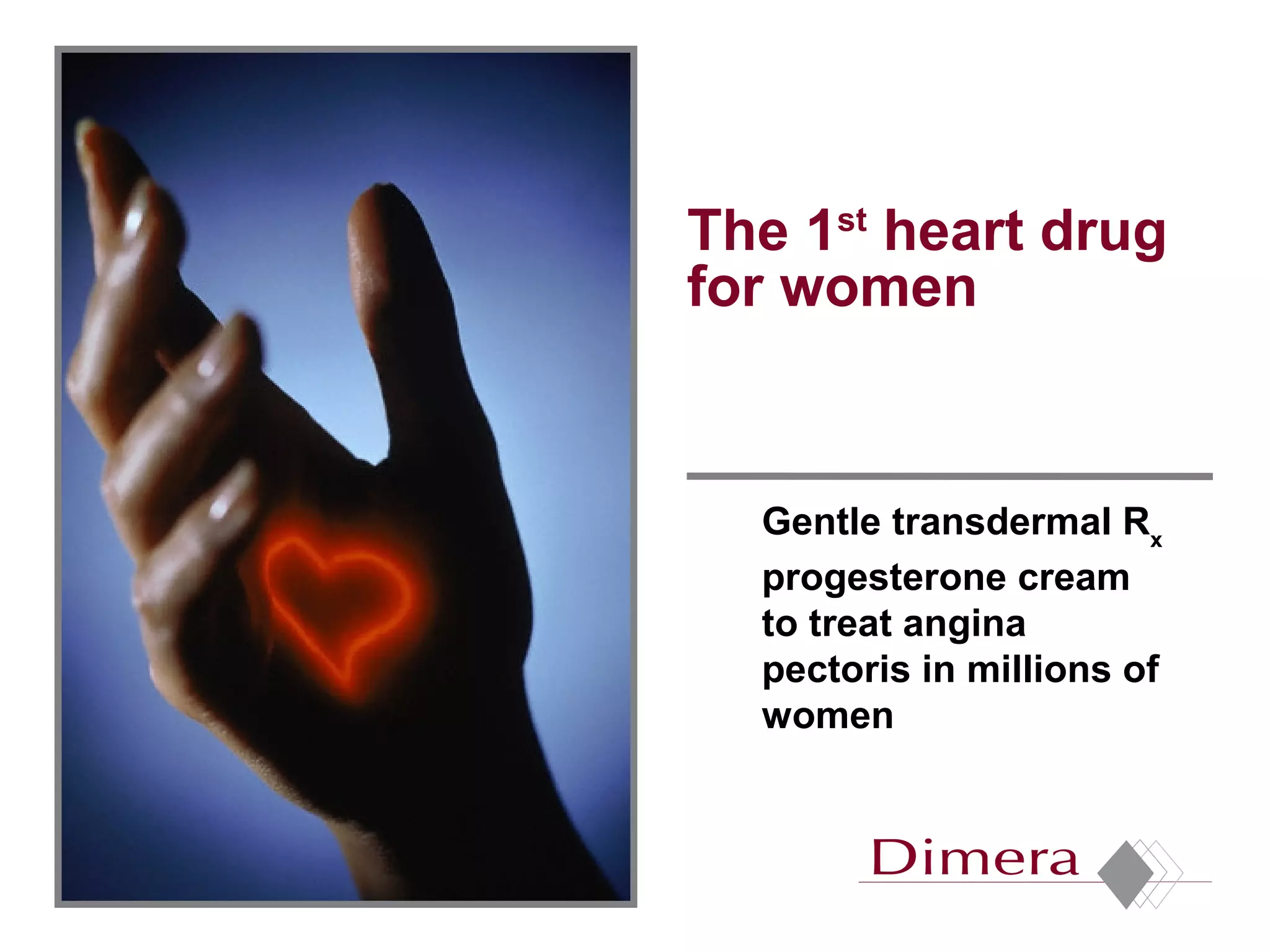
  Gentle transdermal Rx
  progesterone cream
  to treat angina
  pectoris in millions of
  women
Unmet Need:
                         Angina Pectoris in Women
 In the US, ~500,000 women die annually from
cardiovascular (CV) disease
    7.2 million have coronary disease
                                                               Deaths from
    4.6 million suffer from angina pectoris (AP), a         cardiovascular
        symptom of coronary ischemia                     disease are twice the
                                                              number from
                (source: CDC and AHA data)                 all kinds of cancer
                                                                combined
 3.2 million (70% of the 4.6 M women) treated for
angina pectoris find no relief

 Current drugs do not provide effective treatment for
menopausal women
  Their symptoms persist, despite all available
      anti-anginal treatments, even if used
simultaneously
                (source: NIH WISE data)
Key question—how does heart disease in women
differ from heart disease in men?

    Portion of AP women treated with non-obstructive coronary
         disease (from cath lab) is 70% (WISE data)

    Portion predicted with coronary hyperreactivity (CH) and
         progesterone deficit may be 70% (Dimera discoveries
         published in 1997, 1998, 2001, 2004, and 2008)

    Randomized Clinical Trials will investigate this as the 1st
        CV human study of progesterone therapy ever performed
Dimera’s 1st discovery – the link between
angina pectoris and coronary hyperreactivity
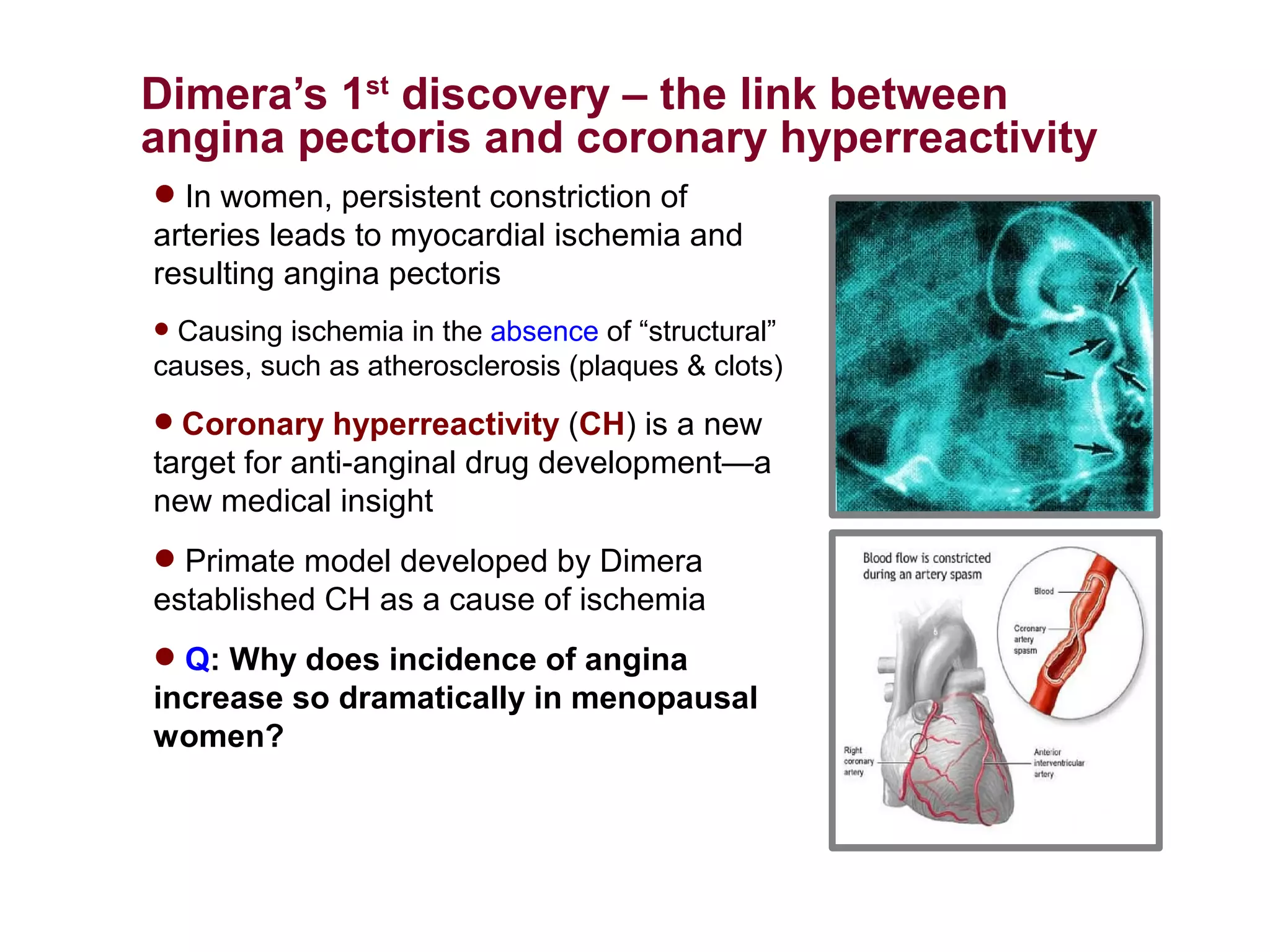
 In women, persistent constriction of
arteries leads to myocardial ischemia and
resulting angina pectoris
 Causing ischemia in the absence of “structural”
causes, such as atherosclerosis (plaques & clots)
 Coronary hyperreactivity (CH) is a new
target for anti-anginal drug development—a
new medical insight
 Primate model developed by Dimera
established CH as a cause of ischemia
 Q: Why does incidence of angina
increase so dramatically in menopausal
women?
Dimera's 2nd discovery—
   Progesterone (DP9) controls the thromboxane receptor
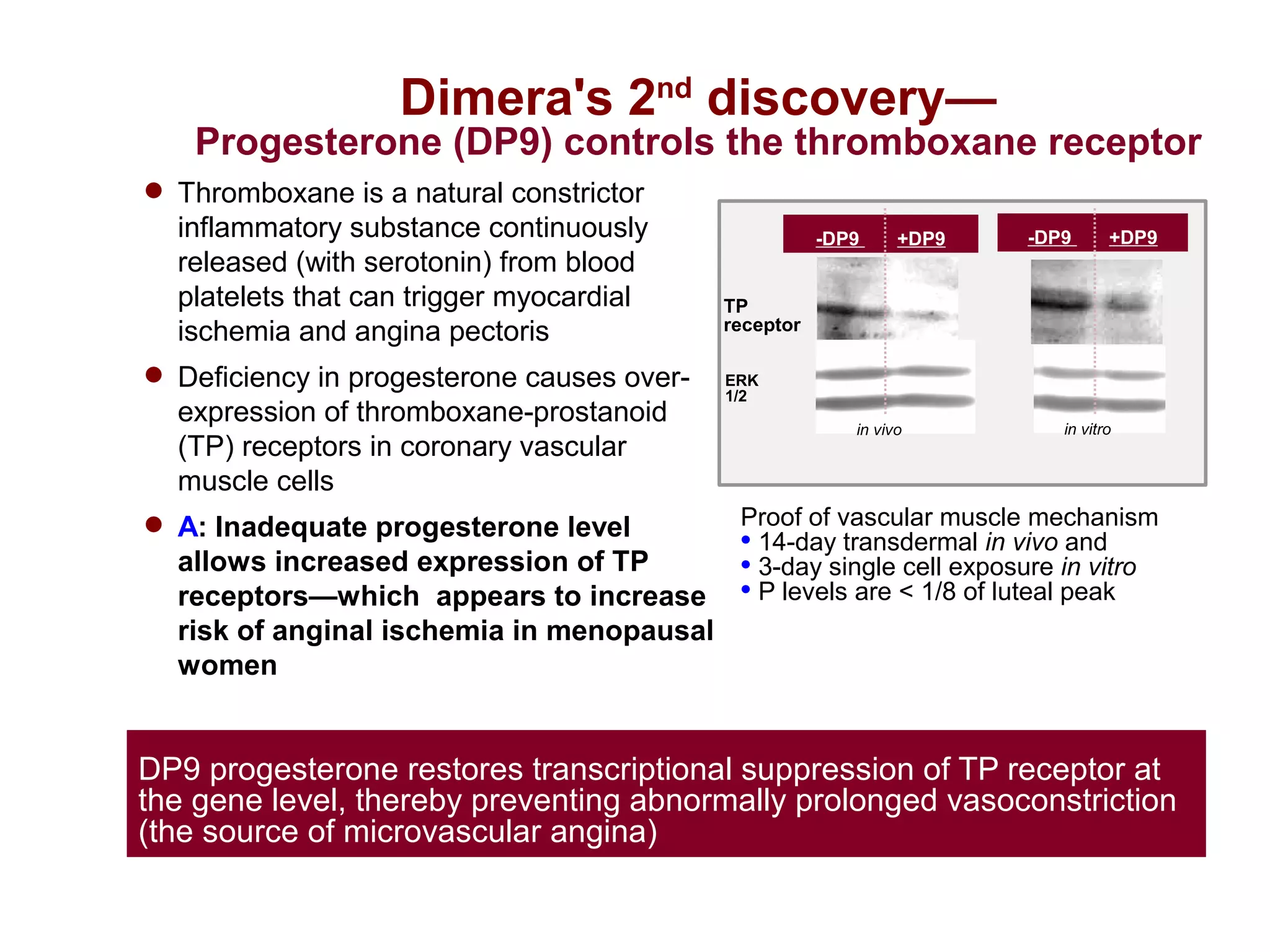
 Thromboxane is a natural constrictor
  inflammatory substance continuously                  -DP9     +DP9   -DP9      +DP9
  released (with serotonin) from blood
  platelets that can trigger myocardial     TP
  ischemia and angina pectoris              receptor

 Deficiency in progesterone causes over-   ERK
                                            1/2
  expression of thromboxane-prostanoid                    in vivo         in vitro
  (TP) receptors in coronary vascular
  muscle cells
 A: Inadequate progesterone level           Proof of vascular muscle mechanism
                                              14-day transdermal in vivo and
  allows increased expression of TP           3-day single cell exposure in vitro
                                              P levels are < 1/8 of luteal peak
  receptors—which appears to increase
  risk of anginal ischemia in menopausal
  women


DP9 progesterone restores transcriptional suppression of TP receptor at
the gene level, thereby preventing abnormally prolonged vasoconstriction
(the source of microvascular angina)
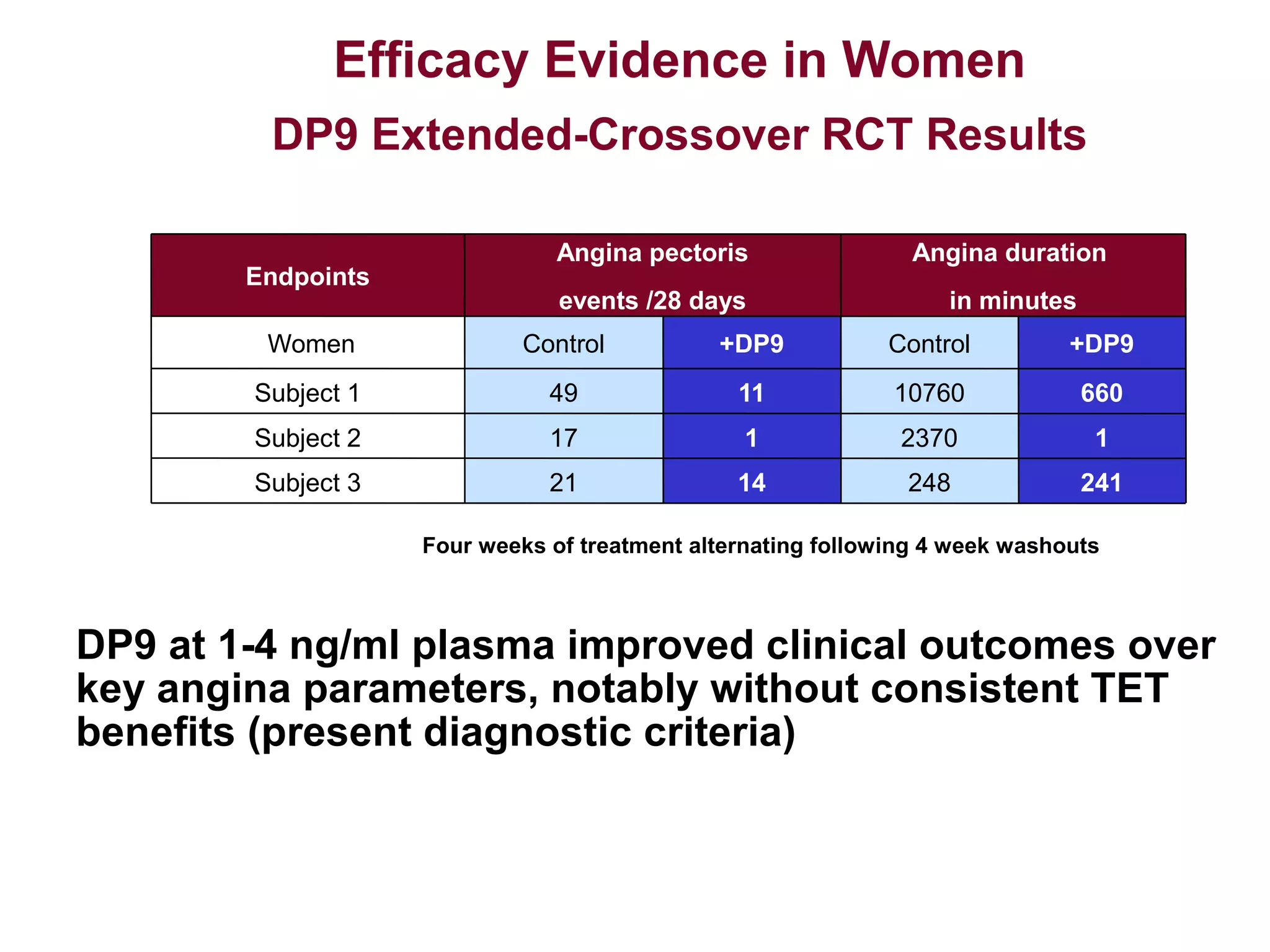
Efficacy Evidence in Women
         DP9 Extended-Crossover RCT Results

                                Angina pectoris                 Angina duration
        Endpoints
                                events /28 days                    in minutes
          Women              Control          +DP9           Control          +DP9
        Subject 1              49               11            10760             660
        Subject 2              17                1             2370              1
        Subject 3              21               14             248              241

                    Four weeks of treatment alternating following 4 week washouts


DP9 at 1-4 ng/ml plasma improved clinical outcomes over
key angina parameters, notably without consistent TET
benefits (present diagnostic criteria)
Solution to the unmet need—DP9
 DP9 is the 1st heart drug for women—who
  predominantly experience atypical, non-exercise
  (microvascular) angina; DP9 is unlike synthetics
 DP9 modulates (down regulates) expression of TP
  receptors—a new epigenetic (DNA level) treatment
  modality aimed at the cause
 DP9 is a proprietary low-dose, slow-release (>8 hr)
  topical 2% progesterone cream optimized to treat and
  prevent AP and CV maladies in women
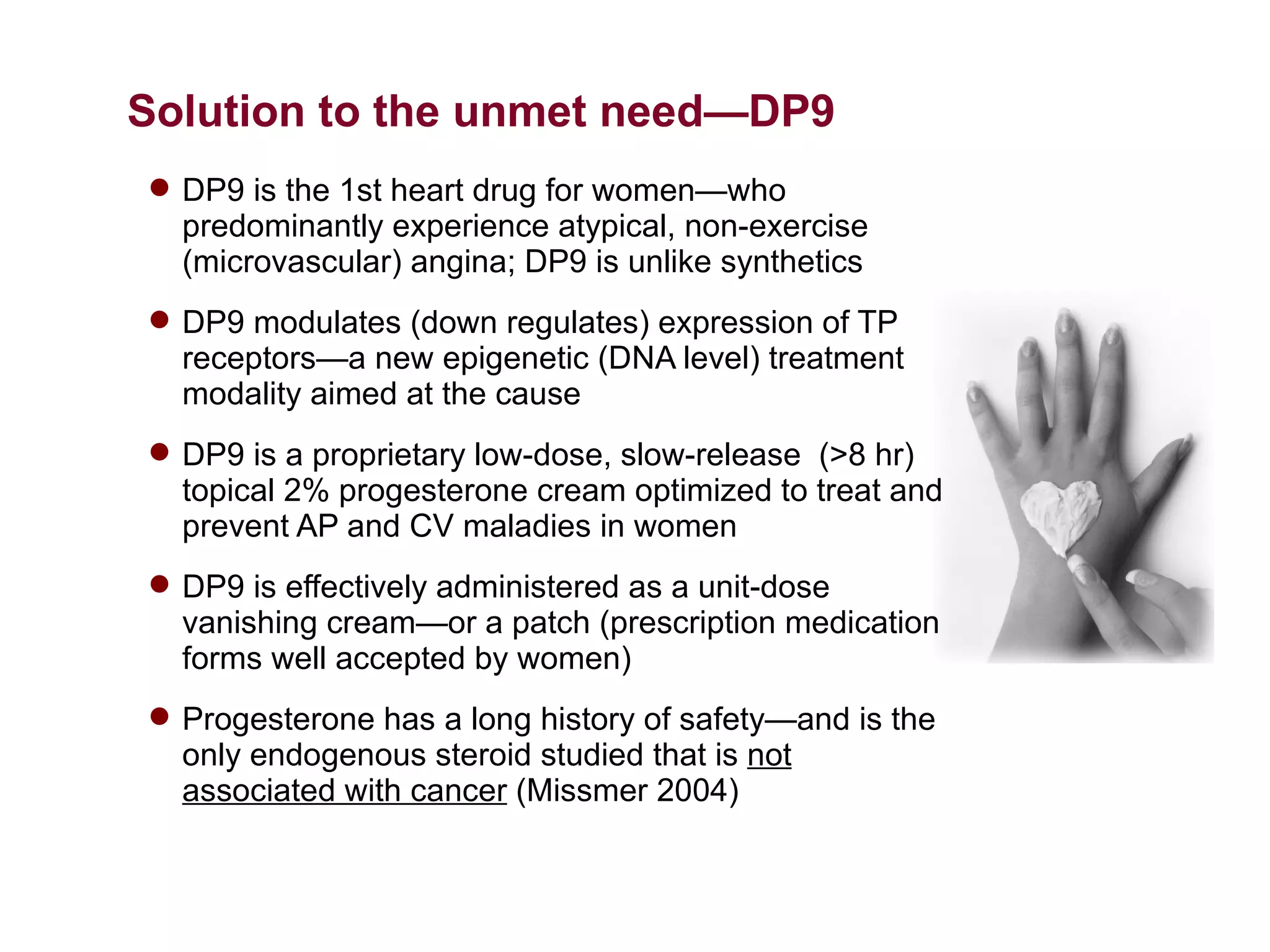
 DP9 is effectively administered as a unit-dose
  vanishing cream—or a patch (prescription medication
  forms well accepted by women)
 Progesterone has a long history of safety—and is the
  only endogenous steroid studied that is not
  associated with cancer (Missmer 2004)
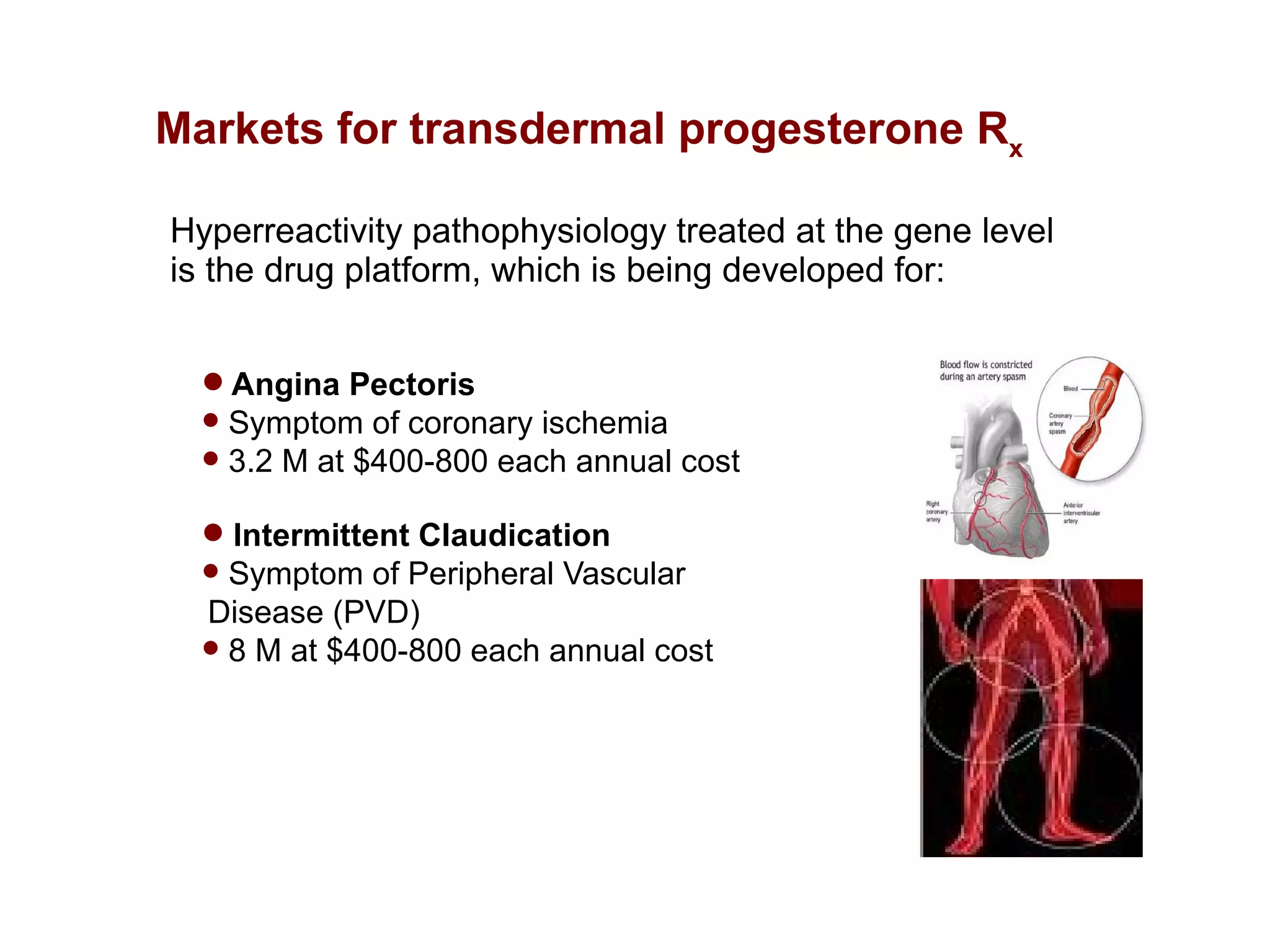
Markets for transdermal progesterone Rx

Hyperreactivity pathophysiology treated at the gene level
is the drug platform, which is being developed for:


   Angina Pectoris
   Symptom of coronary ischemia
   3.2 M at $400-800 each annual cost


   Intermittent Claudication
   Symptom of Peripheral Vascular
  Disease (PVD)
   8 M at $400-800 each annual cost
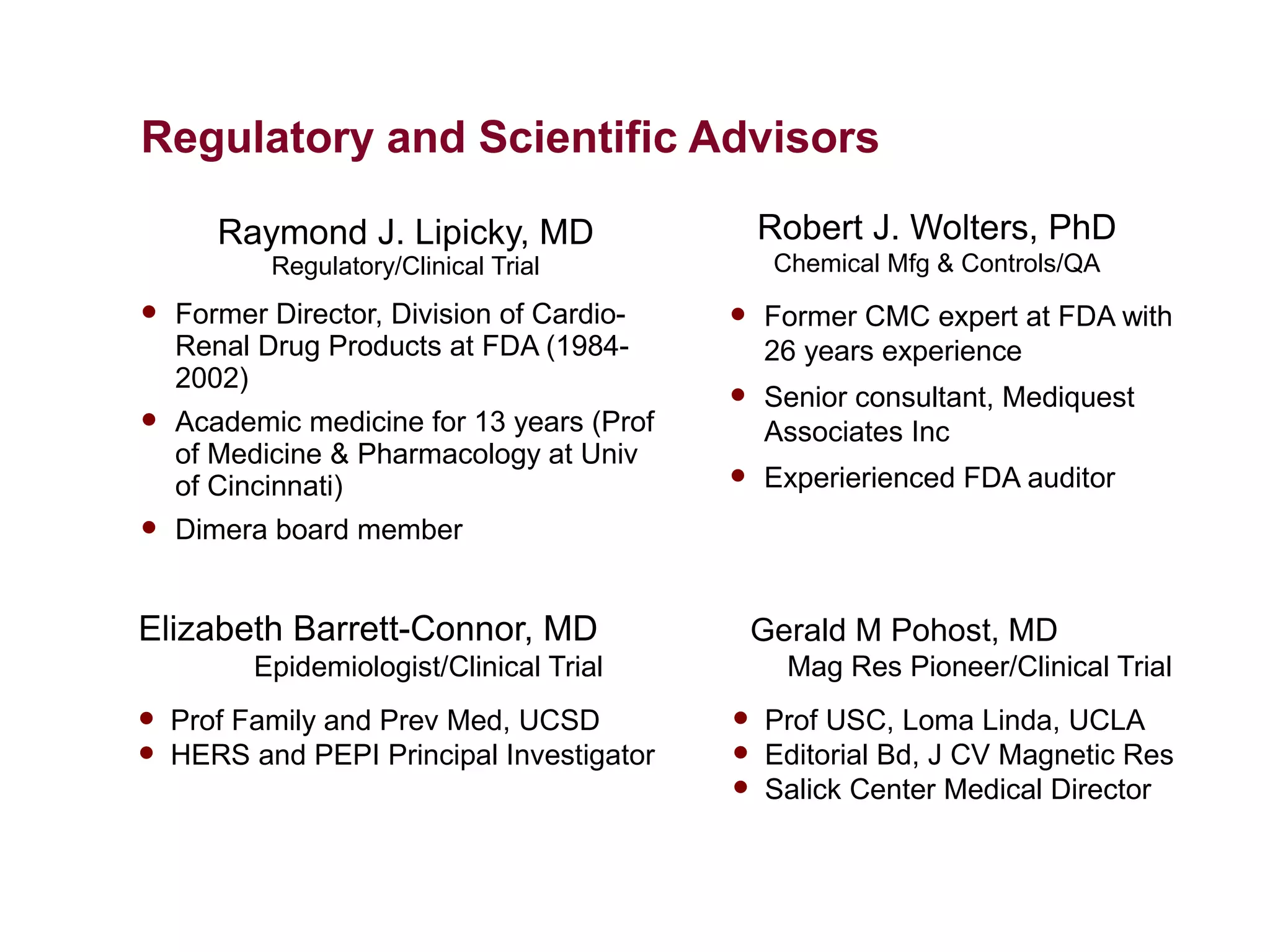
Regulatory and Scientific Advisors

       Raymond J. Lipicky, MD                  Robert J. Wolters, PhD
           Regulatory/Clinical Trial            Chemical Mfg & Controls/QA
   Former Director, Division of Cardio-      Former CMC expert at FDA with
    Renal Drug Products at FDA (1984-          26 years experience
    2002)
                                              Senior consultant, Mediquest
   Academic medicine for 13 years (Prof       Associates Inc
    of Medicine & Pharmacology at Univ
    of Cincinnati)                            Experierienced FDA auditor
   Dimera board member


Elizabeth Barrett-Connor, MD                   Gerald M Pohost, MD
          Epidemiologist/Clinical Trial          Mag Res Pioneer/Clinical Trial
   Prof Family and Prev Med, UCSD            Prof USC, Loma Linda, UCLA
   HERS and PEPI Principal Investigator      Editorial Bd, J CV Magnetic Res
                                              Salick Center Medical Director
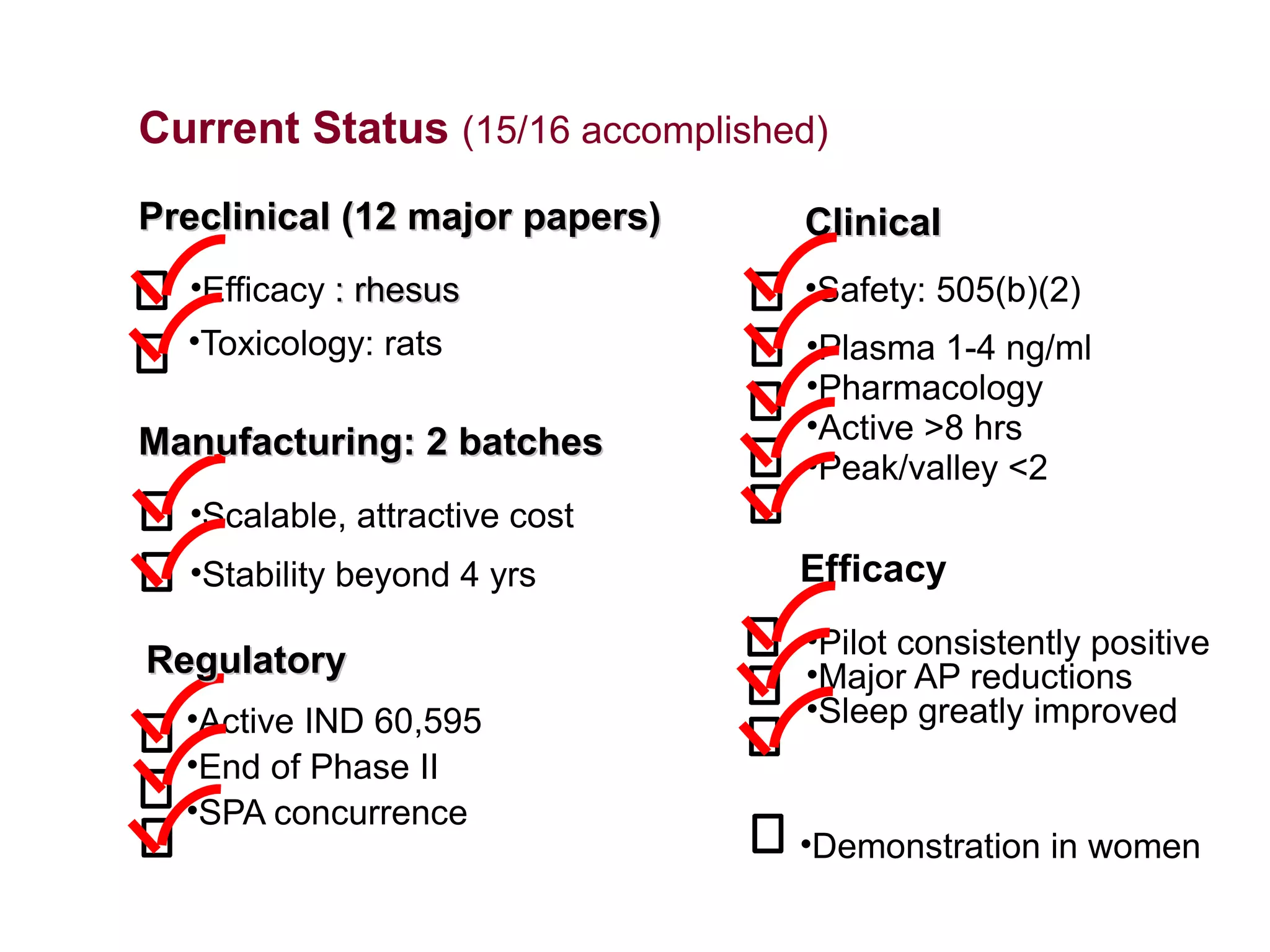
Current Status (15/16 accomplished)
Preclinical (12 major papers)    Clinical
  •Efficacy : rhesus             •Safety: 505(b)(2)
  •Toxicology: rats              •Plasma 1-4 ng/ml
                                 •Pharmacology
Manufacturing: 2 batches         •Active >8 hrs
                                 •Peak/valley <2
  •Scalable, attractive cost
  •Stability beyond 4 yrs        Efficacy
                                 •Pilot consistently positive
Regulatory                       •Major AP reductions
  •Active IND 60,595             •Sleep greatly improved
  •End of Phase II
  •SPA concurrence
                                 •Demonstration in women
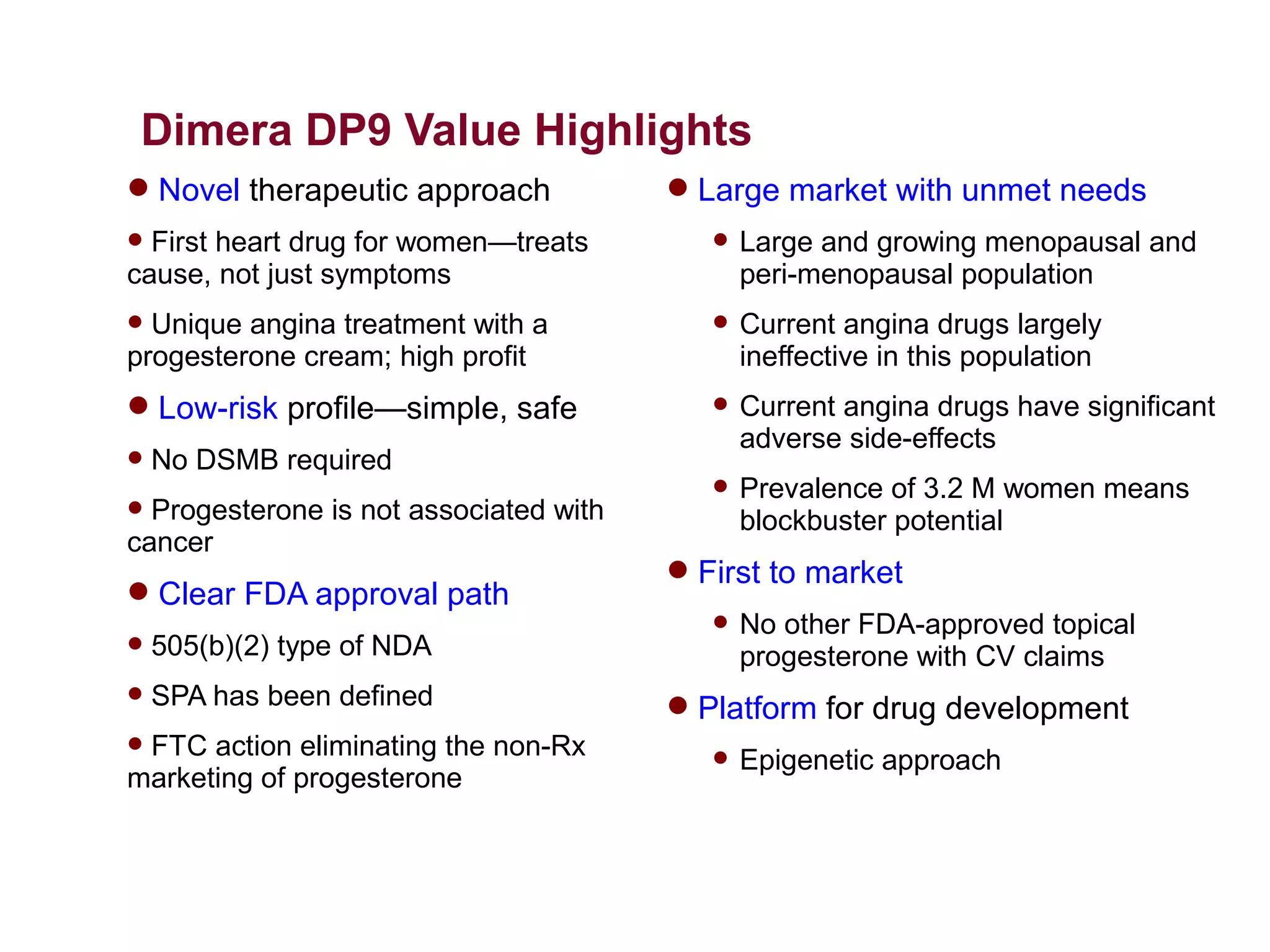
Dimera DP9 Value Highlights
 Novel therapeutic approach             Large market with unmet needs
 First heart drug for women—treats           Large and growing menopausal and
cause, not just symptoms                       peri-menopausal population
 Unique angina treatment with a              Current angina drugs largely
progesterone cream; high profit                ineffective in this population
 Low-risk profile—simple, safe               Current angina drugs have significant
                                               adverse side-effects
   No DSMB required
                                              Prevalence of 3.2 M women means
 Progesterone is not associated with          blockbuster potential
cancer
                                         First to market
 Clear FDA approval path
                                              No other FDA-approved topical
   505(b)(2) type of NDA                      progesterone with CV claims
   SPA has been defined                 Platform for drug development
FTC action eliminating the non-Rx            Epigenetic approach
marketing of progesterone
Dimera Incorporated
PO Box 56600
Portland OR 97238
www.dimera.net


503 295 2775 desk
503 295 2757 FAX

Dimera Dp9 Ppt 8 Min

  • 1.
    The 1st heartdrug for women Gentle transdermal Rx progesterone cream to treat angina pectoris in millions of women
  • 2.
    Unmet Need: Angina Pectoris in Women  In the US, ~500,000 women die annually from cardiovascular (CV) disease  7.2 million have coronary disease Deaths from  4.6 million suffer from angina pectoris (AP), a cardiovascular symptom of coronary ischemia disease are twice the number from (source: CDC and AHA data) all kinds of cancer combined  3.2 million (70% of the 4.6 M women) treated for angina pectoris find no relief  Current drugs do not provide effective treatment for menopausal women  Their symptoms persist, despite all available anti-anginal treatments, even if used simultaneously (source: NIH WISE data)
  • 3.
    Key question—how doesheart disease in women differ from heart disease in men?  Portion of AP women treated with non-obstructive coronary disease (from cath lab) is 70% (WISE data)  Portion predicted with coronary hyperreactivity (CH) and progesterone deficit may be 70% (Dimera discoveries published in 1997, 1998, 2001, 2004, and 2008)  Randomized Clinical Trials will investigate this as the 1st CV human study of progesterone therapy ever performed
  • 4.
    Dimera’s 1st discovery– the link between angina pectoris and coronary hyperreactivity  In women, persistent constriction of arteries leads to myocardial ischemia and resulting angina pectoris  Causing ischemia in the absence of “structural” causes, such as atherosclerosis (plaques & clots)  Coronary hyperreactivity (CH) is a new target for anti-anginal drug development—a new medical insight  Primate model developed by Dimera established CH as a cause of ischemia  Q: Why does incidence of angina increase so dramatically in menopausal women?
  • 5.
    Dimera's 2nd discovery— Progesterone (DP9) controls the thromboxane receptor  Thromboxane is a natural constrictor inflammatory substance continuously -DP9 +DP9 -DP9 +DP9 released (with serotonin) from blood platelets that can trigger myocardial TP ischemia and angina pectoris receptor  Deficiency in progesterone causes over- ERK 1/2 expression of thromboxane-prostanoid in vivo in vitro (TP) receptors in coronary vascular muscle cells  A: Inadequate progesterone level Proof of vascular muscle mechanism  14-day transdermal in vivo and allows increased expression of TP  3-day single cell exposure in vitro  P levels are < 1/8 of luteal peak receptors—which appears to increase risk of anginal ischemia in menopausal women DP9 progesterone restores transcriptional suppression of TP receptor at the gene level, thereby preventing abnormally prolonged vasoconstriction (the source of microvascular angina)
  • 6.
    Efficacy Evidence inWomen DP9 Extended-Crossover RCT Results Angina pectoris Angina duration Endpoints events /28 days in minutes  Women Control +DP9 Control +DP9 Subject 1 49 11 10760 660 Subject 2 17 1 2370 1 Subject 3 21 14 248 241 Four weeks of treatment alternating following 4 week washouts DP9 at 1-4 ng/ml plasma improved clinical outcomes over key angina parameters, notably without consistent TET benefits (present diagnostic criteria)
  • 7.
    Solution to theunmet need—DP9  DP9 is the 1st heart drug for women—who predominantly experience atypical, non-exercise (microvascular) angina; DP9 is unlike synthetics  DP9 modulates (down regulates) expression of TP receptors—a new epigenetic (DNA level) treatment modality aimed at the cause  DP9 is a proprietary low-dose, slow-release (>8 hr) topical 2% progesterone cream optimized to treat and prevent AP and CV maladies in women  DP9 is effectively administered as a unit-dose vanishing cream—or a patch (prescription medication forms well accepted by women)  Progesterone has a long history of safety—and is the only endogenous steroid studied that is not associated with cancer (Missmer 2004)
  • 8.
    Markets for transdermalprogesterone Rx Hyperreactivity pathophysiology treated at the gene level is the drug platform, which is being developed for:  Angina Pectoris  Symptom of coronary ischemia  3.2 M at $400-800 each annual cost  Intermittent Claudication  Symptom of Peripheral Vascular Disease (PVD)  8 M at $400-800 each annual cost
  • 9.
    Regulatory and ScientificAdvisors Raymond J. Lipicky, MD Robert J. Wolters, PhD Regulatory/Clinical Trial Chemical Mfg & Controls/QA  Former Director, Division of Cardio-  Former CMC expert at FDA with Renal Drug Products at FDA (1984- 26 years experience 2002)  Senior consultant, Mediquest  Academic medicine for 13 years (Prof Associates Inc of Medicine & Pharmacology at Univ of Cincinnati)  Experierienced FDA auditor  Dimera board member Elizabeth Barrett-Connor, MD Gerald M Pohost, MD Epidemiologist/Clinical Trial Mag Res Pioneer/Clinical Trial  Prof Family and Prev Med, UCSD  Prof USC, Loma Linda, UCLA  HERS and PEPI Principal Investigator  Editorial Bd, J CV Magnetic Res  Salick Center Medical Director
  • 10.
    Current Status (15/16accomplished) Preclinical (12 major papers) Clinical •Efficacy : rhesus •Safety: 505(b)(2) •Toxicology: rats •Plasma 1-4 ng/ml •Pharmacology Manufacturing: 2 batches •Active >8 hrs •Peak/valley <2 •Scalable, attractive cost •Stability beyond 4 yrs Efficacy •Pilot consistently positive Regulatory •Major AP reductions •Active IND 60,595 •Sleep greatly improved •End of Phase II •SPA concurrence •Demonstration in women
  • 11.
    Dimera DP9 ValueHighlights  Novel therapeutic approach  Large market with unmet needs  First heart drug for women—treats  Large and growing menopausal and cause, not just symptoms peri-menopausal population  Unique angina treatment with a  Current angina drugs largely progesterone cream; high profit ineffective in this population  Low-risk profile—simple, safe  Current angina drugs have significant adverse side-effects  No DSMB required  Prevalence of 3.2 M women means  Progesterone is not associated with blockbuster potential cancer  First to market  Clear FDA approval path  No other FDA-approved topical  505(b)(2) type of NDA progesterone with CV claims  SPA has been defined  Platform for drug development FTC action eliminating the non-Rx  Epigenetic approach marketing of progesterone
  • 12.
    Dimera Incorporated PO Box56600 Portland OR 97238 www.dimera.net 503 295 2775 desk 503 295 2757 FAX