Optimizing Availability Using a Digital-Twin Implementation -
a CERN Case Study
Lukas Felsberger, Benjamin Todd
Digital Twins
11/5/2022 lukas.felsberger@cern.ch 2
“A digital twin is an integrated multi-physics, multi-scale, probabilistic
simulation of a complex product and uses the best available physical
models, sensor updates, etc., to mirror the life of its corresponding twin…
…Once the vehicle is launched, the Digital Twin will increase the reliability of
the flying vehicle because of its ability to continuously monitor and
mitigate degradation and anomalous event”
Glaessgen, Edward, and David Stargel. "The digital twin paradigm for future NASA and US Air Force vehicles." 53rd
AIAA/ASME/ASCE/AHS/ASC Structures, Structural Dynamics and Materials Conference 20th AIAA/ASME/AHS Adaptive Structures
Conference 14th AIAA. 2012.
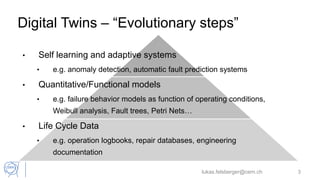
Digital Twins – “Evolutionary steps”
• Self learning and adaptive systems
• e.g. anomaly detection, automatic fault prediction systems
• Quantitative/Functional models
• e.g. failure behavior models as function of operating conditions,
Weibull analysis, Fault trees, Petri Nets…
• Life Cycle Data
• e.g. operation logbooks, repair databases, engineering
documentation
lukas.felsberger@cern.ch 3
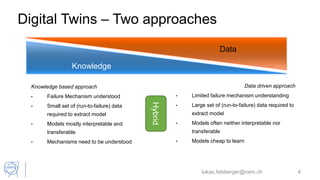
Digital Twins – Two approaches
lukas.felsberger@cern.ch 4
Knowledge based approach
• Failure Mechanism understood
• Small set of (run-to-failure) data
required to extract model
• Models mostly interpretable and
transferable
• Mechanisms need to be understood
Knowledge
Data
Data driven approach
• Limited failure mechanism understanding
• Large set of (run-to-failure) data required to
extract model
• Models often neither interpretable nor
transferable
• Models cheap to learn
Hybrid
Digital Reliability Twins
• Our experience in electronics: Failures in operation usually rare complex
emergent phenomena.
• Complex failure mechanisms, little to no data, little to no models
lukas.felsberger@cern.ch 5
6
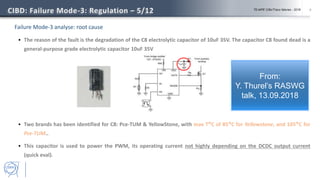
Failure Mode-3 analyse: root cause
 The reason of the fault is the degradation of the C8 electrolytic capacitor of 10uF 35V. The capacitor C8 found dead is a
general-purpose grade electrolytic capacitor 10uF 35V
 Two brands has been identified for C8: Pce-TUM & YellowStone, with max T°C of 85°C for Yellowstone, and 105°C for
Pce-TUM..
 This capacitor is used to power the PWM, its operating current not highly depending on the DCDC output current
(quick eval).
CIBD: Failure Mode-3: Regulation – 5/12 TE-MPE CIBx/Traco failures - 2018
From:
Y. Thurel’s RASWG
talk, 13.09.2018
Digital Reliability Twins
• Our experience in electronics: Failures in operation usually rare
complex emergent phenomena.
• Complex failure mechanisms, little to no data, little to no models
• Possible to predict/prevent/mitigate such behavior?
•  mostly by learning from failure (in tests/existing operations) and
generalizing to new operating conditions (in future operations)
• To do so, requires data-efficient flexible framework
lukas.felsberger@cern.ch 7
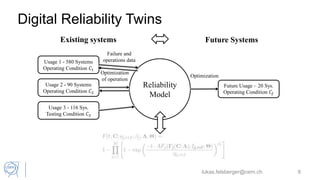
Digital Reliability Twins
lukas.felsberger@cern.ch 8
Optimization
of operation
Reliability
Model
Usage 1 - 580 Systems
Operating Condition 𝐶1
Usage 2 - 90 Systems
Operating Condition 𝐶2
Usage 3 - 116 Sys.
Testing Condition 𝐶3
Failure and
operations data
Future Usage – 20 Sys.
Operating Condition 𝐶𝑓
Optimization
Existing systems Future Systems
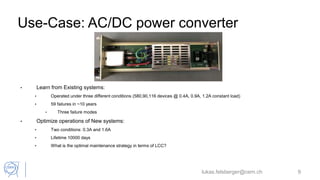
Use-Case: AC/DC power converter
• Learn from Existing systems:
• Operated under three different conditions (580,90,116 devices @ 0.4A, 0.9A, 1.2A constant load)
• 59 failures in ~10 years
• Three failure modes
• Optimize operations of New systems:
• Two conditions: 0.3A and 1.6A
• Lifetime 10000 days
• What is the optimal maintenance strategy in terms of LCC?
lukas.felsberger@cern.ch 9
Simulation
Results
lukas.felsberger@cern.ch 10
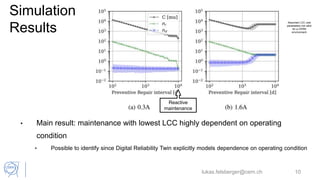
• Main result: maintenance with lowest LCC highly dependent on operating
condition
• Possible to identify since Digital Reliability Twin explicitly models dependence on operating condition
Reactive
maintenance
Assumed LCC cost
parameters not valid
for a CERN
environment
Criticism
• Generated “Digital Twin” after accumulating knowledge
over 10 years of operation
• BUT: should be possible within first years or even earlier
• BUT: Not sufficient accumulated knowledge
• Reliability testing
• Re-use knowledge from older systems (same/similar)
lukas.felsberger@cern.ch 11
11/5/2022
Summary & Conclusions
In electronics:
• Digital twin paradigm can be valuable in practice iff compatible with a limited data & knowledge scenario
(as typically found in electronics reliability problems)
• Should allow to integrate all available knowledge and data from past and current systems
• Should be able to function across different operating conditions
• Should allow for uncertainty propagation
For technical details of presented method:
Felsberger, Lukas, Benjamin Todd, and Dieter Kranzlmüller. "Power Converter Maintenance Optimization Using
a Model-Based Digital Reliability Twin Paradigm" International Conference on System Reliability and Safety 2019
lukas.felsberger@cern.ch 12
Backup slides
lukas.felsberger@cern.ch 13
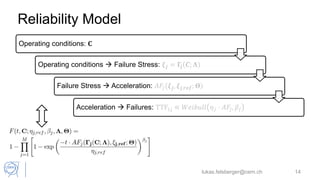
Reliability Model
lukas.felsberger@cern.ch 14
Operating conditions: 𝐂
Operating conditions  Failure Stress: 𝝃𝒋 = 𝚪𝐣 𝑪; 𝚲
Failure Stress  Acceleration: 𝐴𝐹𝑗(𝝃𝒋, 𝝃𝒋,𝒓𝒆𝒇; 𝚯)
Acceleration  Failures: TTFi,j ∝ 𝑊𝑒𝑖𝑏𝑢𝑙𝑙 𝜂𝑗 ⋅ 𝐴𝐹
𝑗, 𝛽𝑗
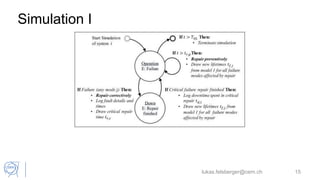
Simulation I
lukas.felsberger@cern.ch 15
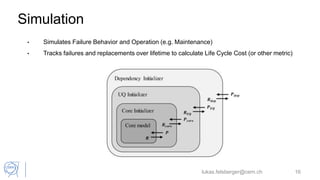
Simulation
lukas.felsberger@cern.ch 16
• Simulates Failure Behavior and Operation (e.g. Maintenance)
• Tracks failures and replacements over lifetime to calculate Life Cycle Cost (or other metric)
Use-Case: Data Analysis
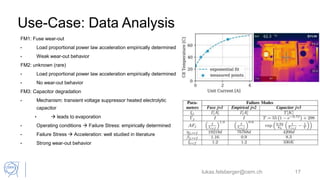
FM1: Fuse wear-out
• Load proportional power law acceleration empirically determined
• Weak wear-out behavior
FM2: unknown (rare)
• Load proportional power law acceleration empirically determined
• No wear-out behavior
FM3: Capacitor degradation
• Mechanism: transient voltage suppressor heated electrolytic
capacitor
•  leads to evaporation
• Operating conditions  Failure Stress: empirically determined
• Failure Stress  Acceleration: well studied in literature
• Strong wear-out behavior
lukas.felsberger@cern.ch 17
Use-Case: Discussion
lukas.felsberger@cern.ch 18
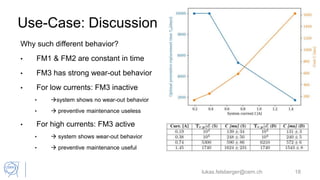
Why such different behavior?
• FM1 & FM2 are constant in time
• FM3 has strong wear-out behavior
• For low currents: FM3 inactive
• system shows no wear-out behavior
•  preventive maintenance useless
• For high currents: FM3 active
•  system shows wear-out behavior
•  preventive maintenance useful
Methodology Overview
lukas.felsberger@cern.ch 19
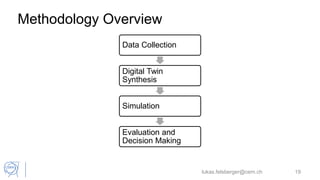
Data Collection
Digital Twin
Synthesis
Simulation
Evaluation and
Decision Making
Introduction - Availability
The proportion of time a unit U is in a functional state
• 𝐴𝑣𝑎𝑖𝑙𝑎𝑏𝑖𝑙𝑖𝑡𝑦 =
𝐸[𝑈𝑝𝑡𝑖𝑚𝑒]
𝐸[𝑈𝑝𝑡𝑖𝑚𝑒]+𝐸[𝐷𝑜𝑤𝑛𝑡𝑖𝑚𝑒]
11/5/2022 lukas.felsberger@cern.ch 20
U
I O
E
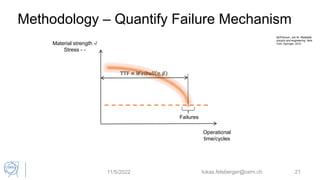
Methodology – Quantify Failure Mechanism
11/5/2022 21
Operational
time/cycles
Material strength -/
Stress - -
Failures
TTF ∝ 𝑊𝑒𝑖𝑏𝑢𝑙𝑙 𝜂, 𝛽
McPherson, Joe W. Reliability
physics and engineering. New
York: Springer, 2010.
lukas.felsberger@cern.ch
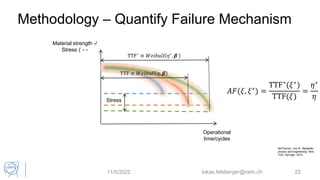
Methodology – Quantify Failure Mechanism
11/5/2022 22
Operational
time/cycles
Material strength -/
Stress 𝜉 - -
TTF ∝ 𝑊𝑒𝑖𝑏𝑢𝑙𝑙 𝜂, 𝜷
TTF∗
∝ 𝑊𝑒𝑖𝑏𝑢𝑙𝑙 𝜂∗
, 𝜷
Stress
𝐴𝐹(𝜉, 𝜉∗
) =
TTF∗(𝜉∗)
TTF(𝜉)
=
𝜂∗
𝜂
McPherson, Joe W. Reliability
physics and engineering. New
York: Springer, 2010.
lukas.felsberger@cern.ch

digit_twin.pptx

  • 1.
    Optimizing Availability Usinga Digital-Twin Implementation - a CERN Case Study Lukas Felsberger, Benjamin Todd
  • 2.
    Digital Twins 11/5/2022 lukas.felsberger@cern.ch2 “A digital twin is an integrated multi-physics, multi-scale, probabilistic simulation of a complex product and uses the best available physical models, sensor updates, etc., to mirror the life of its corresponding twin… …Once the vehicle is launched, the Digital Twin will increase the reliability of the flying vehicle because of its ability to continuously monitor and mitigate degradation and anomalous event” Glaessgen, Edward, and David Stargel. "The digital twin paradigm for future NASA and US Air Force vehicles." 53rd AIAA/ASME/ASCE/AHS/ASC Structures, Structural Dynamics and Materials Conference 20th AIAA/ASME/AHS Adaptive Structures Conference 14th AIAA. 2012.
  • 3.
    Digital Twins –“Evolutionary steps” • Self learning and adaptive systems • e.g. anomaly detection, automatic fault prediction systems • Quantitative/Functional models • e.g. failure behavior models as function of operating conditions, Weibull analysis, Fault trees, Petri Nets… • Life Cycle Data • e.g. operation logbooks, repair databases, engineering documentation lukas.felsberger@cern.ch 3
  • 4.
    Digital Twins –Two approaches lukas.felsberger@cern.ch 4 Knowledge based approach • Failure Mechanism understood • Small set of (run-to-failure) data required to extract model • Models mostly interpretable and transferable • Mechanisms need to be understood Knowledge Data Data driven approach • Limited failure mechanism understanding • Large set of (run-to-failure) data required to extract model • Models often neither interpretable nor transferable • Models cheap to learn Hybrid
  • 5.
    Digital Reliability Twins •Our experience in electronics: Failures in operation usually rare complex emergent phenomena. • Complex failure mechanisms, little to no data, little to no models lukas.felsberger@cern.ch 5
  • 6.
    6 Failure Mode-3 analyse:root cause  The reason of the fault is the degradation of the C8 electrolytic capacitor of 10uF 35V. The capacitor C8 found dead is a general-purpose grade electrolytic capacitor 10uF 35V  Two brands has been identified for C8: Pce-TUM & YellowStone, with max T°C of 85°C for Yellowstone, and 105°C for Pce-TUM..  This capacitor is used to power the PWM, its operating current not highly depending on the DCDC output current (quick eval). CIBD: Failure Mode-3: Regulation – 5/12 TE-MPE CIBx/Traco failures - 2018 From: Y. Thurel’s RASWG talk, 13.09.2018
  • 7.
    Digital Reliability Twins •Our experience in electronics: Failures in operation usually rare complex emergent phenomena. • Complex failure mechanisms, little to no data, little to no models • Possible to predict/prevent/mitigate such behavior? •  mostly by learning from failure (in tests/existing operations) and generalizing to new operating conditions (in future operations) • To do so, requires data-efficient flexible framework lukas.felsberger@cern.ch 7
  • 8.
    Digital Reliability Twins lukas.felsberger@cern.ch8 Optimization of operation Reliability Model Usage 1 - 580 Systems Operating Condition 𝐶1 Usage 2 - 90 Systems Operating Condition 𝐶2 Usage 3 - 116 Sys. Testing Condition 𝐶3 Failure and operations data Future Usage – 20 Sys. Operating Condition 𝐶𝑓 Optimization Existing systems Future Systems
  • 9.
    Use-Case: AC/DC powerconverter • Learn from Existing systems: • Operated under three different conditions (580,90,116 devices @ 0.4A, 0.9A, 1.2A constant load) • 59 failures in ~10 years • Three failure modes • Optimize operations of New systems: • Two conditions: 0.3A and 1.6A • Lifetime 10000 days • What is the optimal maintenance strategy in terms of LCC? lukas.felsberger@cern.ch 9
  • 10.
    Simulation Results lukas.felsberger@cern.ch 10 • Mainresult: maintenance with lowest LCC highly dependent on operating condition • Possible to identify since Digital Reliability Twin explicitly models dependence on operating condition Reactive maintenance Assumed LCC cost parameters not valid for a CERN environment
  • 11.
    Criticism • Generated “DigitalTwin” after accumulating knowledge over 10 years of operation • BUT: should be possible within first years or even earlier • BUT: Not sufficient accumulated knowledge • Reliability testing • Re-use knowledge from older systems (same/similar) lukas.felsberger@cern.ch 11 11/5/2022
  • 12.
    Summary & Conclusions Inelectronics: • Digital twin paradigm can be valuable in practice iff compatible with a limited data & knowledge scenario (as typically found in electronics reliability problems) • Should allow to integrate all available knowledge and data from past and current systems • Should be able to function across different operating conditions • Should allow for uncertainty propagation For technical details of presented method: Felsberger, Lukas, Benjamin Todd, and Dieter Kranzlmüller. "Power Converter Maintenance Optimization Using a Model-Based Digital Reliability Twin Paradigm" International Conference on System Reliability and Safety 2019 lukas.felsberger@cern.ch 12
  • 13.
  • 14.
    Reliability Model lukas.felsberger@cern.ch 14 Operatingconditions: 𝐂 Operating conditions  Failure Stress: 𝝃𝒋 = 𝚪𝐣 𝑪; 𝚲 Failure Stress  Acceleration: 𝐴𝐹𝑗(𝝃𝒋, 𝝃𝒋,𝒓𝒆𝒇; 𝚯) Acceleration  Failures: TTFi,j ∝ 𝑊𝑒𝑖𝑏𝑢𝑙𝑙 𝜂𝑗 ⋅ 𝐴𝐹 𝑗, 𝛽𝑗
  • 15.
  • 16.
    Simulation lukas.felsberger@cern.ch 16 • SimulatesFailure Behavior and Operation (e.g. Maintenance) • Tracks failures and replacements over lifetime to calculate Life Cycle Cost (or other metric)
  • 17.
    Use-Case: Data Analysis FM1:Fuse wear-out • Load proportional power law acceleration empirically determined • Weak wear-out behavior FM2: unknown (rare) • Load proportional power law acceleration empirically determined • No wear-out behavior FM3: Capacitor degradation • Mechanism: transient voltage suppressor heated electrolytic capacitor •  leads to evaporation • Operating conditions  Failure Stress: empirically determined • Failure Stress  Acceleration: well studied in literature • Strong wear-out behavior lukas.felsberger@cern.ch 17
  • 18.
    Use-Case: Discussion lukas.felsberger@cern.ch 18 Whysuch different behavior? • FM1 & FM2 are constant in time • FM3 has strong wear-out behavior • For low currents: FM3 inactive • system shows no wear-out behavior •  preventive maintenance useless • For high currents: FM3 active •  system shows wear-out behavior •  preventive maintenance useful
  • 19.
    Methodology Overview lukas.felsberger@cern.ch 19 DataCollection Digital Twin Synthesis Simulation Evaluation and Decision Making
  • 20.
    Introduction - Availability Theproportion of time a unit U is in a functional state • 𝐴𝑣𝑎𝑖𝑙𝑎𝑏𝑖𝑙𝑖𝑡𝑦 = 𝐸[𝑈𝑝𝑡𝑖𝑚𝑒] 𝐸[𝑈𝑝𝑡𝑖𝑚𝑒]+𝐸[𝐷𝑜𝑤𝑛𝑡𝑖𝑚𝑒] 11/5/2022 lukas.felsberger@cern.ch 20 U I O E
  • 21.
    Methodology – QuantifyFailure Mechanism 11/5/2022 21 Operational time/cycles Material strength -/ Stress - - Failures TTF ∝ 𝑊𝑒𝑖𝑏𝑢𝑙𝑙 𝜂, 𝛽 McPherson, Joe W. Reliability physics and engineering. New York: Springer, 2010. lukas.felsberger@cern.ch
  • 22.
    Methodology – QuantifyFailure Mechanism 11/5/2022 22 Operational time/cycles Material strength -/ Stress 𝜉 - - TTF ∝ 𝑊𝑒𝑖𝑏𝑢𝑙𝑙 𝜂, 𝜷 TTF∗ ∝ 𝑊𝑒𝑖𝑏𝑢𝑙𝑙 𝜂∗ , 𝜷 Stress 𝐴𝐹(𝜉, 𝜉∗ ) = TTF∗(𝜉∗) TTF(𝜉) = 𝜂∗ 𝜂 McPherson, Joe W. Reliability physics and engineering. New York: Springer, 2010. lukas.felsberger@cern.ch

Editor's Notes

  • #23 TTF models usually follow power law or exponential model  same for acceleration factor If acceleration is carried out properly  beta does not change