Video is a fast-growing, accessible
and powerful storytelling tool
YOUR OPPORTUNITY
TO BE A DRIVING FORCE
LOOK FOR VALUE
AND NOT VOLUME
MOBILE-OPTIMISED
WEBSITES ARE GO
CHATBOTS GET A
VOICE ONLINE
Conversational commerce is
transforming online businessBusinesses that stand still in today’s digital world risk failure
A mobile site for smartphones is
a must for any business online
03 08 12 14
DIGITAL OPTIMISATION
08 / 09 / 2016INDEPENDENT PUBLICATION BY #0400raconteur.net
W
hen it comes to digi-
tal, you’re never really
finished. In fact, the
launch of a website, an
app, a campaign or other digital ini-
tiative marks the beginning, not the
end, of the hard work.
Why? Technology doesn’t stand
still. Consumer demands and be-
haviours keep evolving. The com-
petitive environment is turbulent
and full of disruption. And every
day and every interaction your cus-
tomers have with your brand, you
learn a little bit more. Consider each
of these ideas for a moment.
Right now there are people all
around the world dreaming up new
ways to do and improve things.
These could be micro-innovations,
such as the development of a new
tool for measuring social data. Or
they could be bigger innovations,
as we’re seeing with augmented re-
ality, virtual reality and artificial
intelligence. It could involve ad-
vances in cognitive computing and
machine-learning or breakthroughs
in connected living and the inter-
net of things. Or it could be a minor
search algorithm change by Google
or advertising algorithm change by
Facebook, with major ramifications
for marketers.
These changes are real and
they’re going on all around us,
all the time. The question is what
will they mean for your business
and its digital endeavours? Even
if you don’t think the rise of chat-
bots on Facebook messenger –
more than 11,000 of them within
three months of launching earlier
this year – has a role to play for
your business, do you know how it
will affect consumer behaviour
and expectations?
As digital innovations continue
to permeate the world we live and
work in, at pace, the more con-
sumers experience the art of the
possible. Encounters with a brand,
even one in a completely different
sector to your own, shape people’s
understanding of technology in our
digital world, and
how they choose
to use and interact
with it.
Amazon is per-
haps one of the
best examples of
this effect, where
experiencing the
online retailer’s da-
ta-driven approach
to personalisation,
targeting and rec-
ommendations of-
ten left consumers
wondering why it
was so hard to re-
ceive the same rele-
vant content and engagement from
other businesses with rich data,
such as their bank, grocery retailer,
telecoms or utility providers.
One of the biggest impacts of dig-
ital advancement has been com-
petitive disruption. From sector to
sector, established businesses have
been upended by new entrants lev-
eraging digital to innovate business
models. Even if you don’t believe
that your sector or category could
fall victim to an Uber or Airbnb
equivalent, no business is immune
to the industry-agnostic force that
is digital technology or the ripple ef-
fects of competitors’ actions.
The post-millennial “iGenera-
tion” are the first group to have
been brought up as true digital na-
tives and they’re now entering the
workforce. Many will have had the
chance to learn to code in school
and some will already be thinking
of “hacks” to the establishment
that could impact your business
or your value chain from out of
nowhere. Then there’s the known
competition. Dig-
ital often favours
the first or the
fast-mover, and if
your competitors
are more agile
and pacey than
your business,
you risk being left
in their wake or,
in the very least,
suffering from the
knock-on effects of
their actions.
Lastly, con-
sider one of the
much-lauded ben-
efits of digital – its
real-time nature and rich pool of
data on which to base your deci-
sions. In theory, every interaction
your customers have with your
brand, from navigating your website
to engaging with social media con-
tent to opening an e-mail, and much
more, is telling you something. In
reality, businesses need to be ready
and resourced to listen, and to act
on it.
Fundamentally, there’s noth-
ing static about digital. Constant
fine-tuning, tweaking, adapting and
optimisation of your digital pres-
ence and digital strategy are essen-
tial. To launch a digital initiative,
from a website to an app or beyond,
and then walk away in the hope the
prevailing forces won’t apply to your
business is risky at best and foolish
at worst. There’s simply too much
change and too many forces at play.
The notion of continuously re-
viewing and iterating plans and ac-
tivities may spark concerns about
the level of resources needed to do
them justice, but in reality the im-
portance of digital optimisation
isn’t rooted in the risk of getting
it wrong and falling behind, but
in the upside potential for getting
it right.
Operating in an agile, responsive
way to the signals that you know to
look out for, be they from custom-
ers, competitors or digital leaders,
can yield tremendous value. Having
a finger on the digital pulse of your
organisation and the ability to make
course-corrections, however subtle,
based on real intelligence can un-
lock significant improvements in
performance.
The more attuned you are to cus-
tomer behaviour and expectations,
the more likely you’ll be to engen-
der their favour and loyalty. The
more sensitive you are to compet-
itive pressures and market forc-
es, the better placed you’ll be to
respond appropriately and not get
outmanoeuvred. Ultimately, digital
optimisation is your opportunity to
get behind the wheel of your digital
investments, rather than simply be
a passenger.
DISTRIBUTED IN
SIMON BROOKE
Award-winning freelance
journalist, who writes for
a number of international
publications, he
specialises in lifestyle
trends, health, business
and marketing.
THOMAS BROWN
Consultant, executive
adviser and co-author
of the forthcoming book
Building Digital Culture,
he is the former CIM
marketing director.
GRAHAM
CHARLTON
Editor in chief at ClickZ
Global and Search Engine
Watch, he is a specialist
in online retail and
digital marketing, and
has written several best
practice guides.
HAZEL DAVIS
Freelance business writer,
she contributes to The
Times, Financial Times,
The Daily Telegraph and
The Guardian.
FINBARRTOESLAND
Freelance journalist, he
specialises in technology,
business and economic
issues, and contributes to a
wide range of publications.
RACONTEUR
PUBLISHING MANAGER
Michelle Ingham
DIGITAL CONTENT MANAGER
Sarah Allidina
HEAD OF PRODUCTION
Natalia Rosek
DESIGN
Samuele Motta
Grant Chapman
Kellie Jerrard
PRODUCTION EDITOR
Benjamin Chiou
MANAGING EDITOR
Peter Archer
BUSINESS CULTURE FINANCE HEALTHCARE LIFESTYLE SUSTAINABILITY TECHNOLOGY INFOGRAPHICS raconteur.net/digital-optimisation
CONTRIBUTORS
Although this publication is funded through advertising and
sponsorship,alleditorialiswithoutbiasandsponsoredfeatures
are clearly labelled. For an upcoming schedule, partnership in-
quiries orfeedback, please call +44 (0)20 8616 7400 ore-mail
info@raconteur.net
Raconteur is a leading publisher of special-interest content
and research. Its publications and articles cover a wide range
of topics, including business, finance, sustainability, health-
care, lifestyle and technology. Raconteur special reports are
published exclusively in The Times and The Sunday Times as well
as online at raconteur.net
The information contained in this publication has been ob-
tained from sources the Proprietors believe to be correct.
However, no legal liability can be accepted for any errors. No
part of this publication may be reproduced without the prior
consent of the Publisher. © Raconteur Media
Your opportunity
to be a driving force
In today’s digital world where the only constant
is change itself, businesses that stand still risk
being left behind in the slow lane
OVERVIEW
THOMAS BROWN
Share this article online via
Raconteur.net
HughPeterswald/PacificPress/LightRocketviaGettyImages
of chief executives said
technological advances were
amongthetop-threetrendsmost
likely to transform businesses
over the next five years
Source: PwC 2016
77%
RACONTEUR raconteur.net 03DIGITAL OPTIMISATION08 / 09 / 2016
#1 FASTEST GROWING SOFTWARE
COMPANY IN THE US IS COMING TO THE UK
BounceX.com/raconteur
Available for download until 11/30/2016
the
Learn why Behavioral Marketing is the direction
your company should be headed & how your customers’ digital
body language is the blueprint for growing your business.
Raconteur Reader Exclusive
Access this revenue-changing blueprint now
DIGITAL
OPTIMISATION
COMMERCIAL FEATURE
INTERNET USERS IN THE UK (%)
PERCENTAGE WHO HAD USED THE INTERNET IN THE LAST THREE MONTHS
W
hen she stood in
Downing Street to
make her first speech
as prime minister,
Theresa May gave an impassioned
vision of a more inclusive nation.
“We believe in a Union not just of
the nations of the United King-
dom, but between all of our citi-
zens. Every one of us, whoever we
are and wherever we are from,” she
said, talking about, “the mission to
make Britain a country that works
for everyone.”
Mrs May didn’t actually mention
the internet, but given that it af-
fects every aspect of our lives these
days, the issue was perhaps implic-
it. Certainly, in recent years efforts
have been made to open up the
digital world to those from poorer
backgrounds, and people with dis-
abilities and educational difficul-
ties. The Web Content Accessibility
Guidelines are part of a series of
advice published by the Web Acces-
sibility Initiative, which is part of
the World Wide Web Consortium,
the main international standards
organisation for the internet.
These guidelines specify how
companies, organisations and gov-
ernment should make content ac-
cessible, primarily for people with
disabilities. In the UK the last gov-
ernment launched its Digital Inclu-
sion Strategy in 2014 with the aim of
partnering with the public, private
and voluntary sectors to reduce the
number of people without basic
digital skills and capabilities by
a quarter.
The strategy identified four main
obstacles. The first is access, in
other words the ability to actually
go online and connect to the in-
ternet. Online skills are second,
followed by motivation or under-
standing why using the internet
can be a good thing and, finally,
trust or in other words concerns
about cyber crime and safety. The
success of the project will be re-
viewed this year.
The initiative aims to counter what
is known as the “digital divide”. Al-
though this phrase is often used to
refer to physical access to the net
and broadband skills, campaigners
also apply it to inequality of inter-
net skills. You can have super-fast
cable, but if you don’t how to search
for a good local dentist or where to
find the necessary information for a
job application, then megabytes per
second are irrelevant.
Recent research by the BBC re-
vealed that around one in five (21
per cent) of the UK population lack
the basic digital skills necessary to
benefit from the internet. Accord-
ing to a study by Dr Ellen Helsper
of the London School of Econom-
ics (LSE) and Dutch researcher Dr
Alexander van Deursen, educated
people on high incomes derive the
greatest benefits from using the in-
ternet, getting better deals online
for products and holidays, using
the internet more successfully to
expand their social life and becom-
ing more informed.
In contrast, low-income people
from socially deprived back-
grounds do not receive the same
benefits, regardless of access. The
study of more than 1,100 people
was conducted in the Netherlands,
a country with a well-developed
digital infrastructure and near-uni-
versal access. Disabled people,
along with retired and unemployed
individuals and care-givers, receive
the fewest benefits overall by being
online. According to the LSE re-
search, 12 per cent of people don’t
know how to go back to the previ-
ous page.
“Governments and others have
focused too much on pipes and
infrastructure, and have taken the
‘build them and they will come’
approach, but that’s not the case.
There is a risk of a digital under-
class. Access to and use of the in-
ternet might exacerbate existing
inequalities offline,” says Dr Hel-
sper. “While more and more people
might be online these days, the in-
ternet clearly benefits those with a
higher social status.”
In the United States there have
been a growing number of high-pro-
file court cases in which large or-
ganisations have been successfully
sued for millions of dollars because
their sites are deemed to be inac-
cessible and therefore contrary to
US law.
Small and medium-sized enter-
prises (SMEs) are most at risk of
either being subject to legal action
or simply losing business from
what the Department for Work and
Pensions calculates is a disability
market worth £212 billion. “SMEs
ACCESSIBILITY
SIMON BROOKE
are not intentionally excluding
these customers – some have just
not explicitly considered their
needs,” says Adam Rowse, head of
business banking at Barclays Bank.
“Unlike a shop where it’s obvious
to see the challenges that disa-
bled or older customers face en-
tering, getting around and paying
for stuff, it’s less obvious for an
online shop.”
He cites new research from the
Click-Away Pound Survey, which
is designed to explore the online
shopping experience of people with
disabilities, showing that 71 per
cent of disabled people with access
needs who shop online chose to
click-away from a site that present-
ed barriers in favour of finding a
more accessible one.
“Technology has provided mas-
sive opportunities for people with
disability and massive opportuni-
ties for companies, service provid-
ers and government to serve them,”
says Steve Tyler, head of solu-
tions, strategy and planning at the
Royal National Institute of Blind
People (RNIB).
Blind himself, Mr Tyler controls
his music system at home through
an app on his iPhone. He shops on
Amazon, Ocado and John Lewis
through an accessible app or website,
as well as buying coffee with an app
that delivers an accessible receipt.
“Today websites can be written in
such a way that specialist technolo-
gies like screen-readers that render
websites into speech or magnify the
site can access them,” he says.
The charity runs a project called
Online Today, which aims to pro-
vide digital skills to 125,000 people
with sight or hearing loss, or both.
Internet use by those who need en-
hanced accessibility mirrors that
by the wider public, except that
the age difference is even more
pronounced. According to recent
survey by the RNIB, while almost
two thirds of those aged 75 did not
use a computer, the internet, a
tablet or a smartphone, 86 per cent
of 18 to 29 year olds said they could
make the most of new technolo-
gy. The majority of people who do
not currently use technology, the
survey reported, would like to use it
if obstacles were removed.
The trend implied by these find-
ings is positive – the challenge for
companies, government bodies
and other organisations is to take a
long hard look at their online pres-
ence and make sure they’re playing
their part.
Source: Office for National Statistics 2016
*Those who self-assess that they have a disability in line with the Equality Act definition
of disability
While more and
more people might
be online these
days, the internet
clearly benefits
those with a higher
social status
Digital access is a right
and not a privilege
The UK is in danger of witnessing a digital underclass where
disadvantaged people fail to benefit from the internet
Share this article online via
raconteur.net
21%
of the UK
population
lack the basic
digital skills
necessary to
benefit from
the internet
Source:
Office for
National
Statistics 2016
UK average Disabled* Aged 75+
90
80
70
60
50
40
30
20
2014 2015 2016
85 86.2
67.8
33
87.9
71
38.7
64.9
31.9
DIGITAL OPTIMISATION raconteur.net04 RACONTEUR RACONTEUR raconteur.net 05DIGITAL OPTIMISATION08 / 09 / 2016 08 / 09 / 2016
ABOVE
Some 38.7 per
cent of UK adults
aged over 75
regularly use the
internet, accord-
ing to recent data
RACONTEUR raconteur.net 2XXXXxx xx xxxx
COMMERCIAL FEATURE
WEB ACCESSIBILITY:
NOW IT’S BUSINESS CRITICAL
Once regarded as merely a useful add-on to a website, today accessibility is required not only by UK law, but by an
increasingly vocal and demanding public. Organisations need to develop an accessibility policy and act now to avoid legal
action – and to prove they value all their customers
T
he last few years have seen
increasing legal action on web
accessibility. Since the first
litigation was initiated around 2000 in
the United States against high-profile
brands such as Target and Netflix,
the threat of private legal action and
the imperative to address disability
discrimination is relevant to companies
of all sizes across all industries.
In the UK, the 2010 Equality Act and
its statutory code, in force since April
2011, explicitly states that websites
are included within the ambit of
the legislation. There are 12 million
disabled people in the UK, representing
annual spending power of £212 billion.
To compound the importance of
accessibility, the digital needs of an
ageing population should also be taken
into consideration. Some 50 per cent
of the UK population will be over 50
in 2020 and there are currently more
than 2,250,000 people in the UK living
with a visual impairment.
As one of the most web-enabled
societies in the world with an active
disability rights lobby, the UK is
experiencing an increase in pressure
to comply with the WCAG 2.0 (Web
Content Accessibility Guidelines)
standard published by the World Wide
Web Consortium,the main international
standards organisation forthe internet.
“Business is increasingly digital and
access to digital content is recognised
as a basic right. Web accessibility
has become an important business
consideration in light of stronger
enforcement of accessibility regulation,
ramped up discrimination litigation
and the growing importance of
smartphones as the gateway device
to access the internet,” says Carin Van
Vuuren, chief marketing officer at
Usablenet,aleadingtechnologyservices
company which has been focused on
usability and web accessibility for the
last 16 years, and whose clients include
Topshop, Carphone Warehouse, The
Ritz Carlton and FedEx.
Legal requirements aside, Ms Van
Vuuren argues companies should
consider the accessibility of their
websites because it can have a positive
effect on customer engagement and
brand reputation.
“UKcompanieslikeTescoandASOS
have demonstrated their commitment
by putting good accessibility policies
in place. In the US, retailers like The
Container Store and travel companies
such as Amtrak, have shown that a
commitment to accessibility is not only
goodforyourbrandreputation,butcan
also affect the bottom line in a positive
way,” she says. “But accessibility isn’t a
destination, it’s a journey. You can’t just
stop worrying about it once your site
is web accessible. You need to build all
sites and apps with accessibilityin mind,
and you should strive to constantly
ensure and improve access and
usability for users living with various
forms of disability.”
Forward-thinking companies are
taking the initiative ratherthan waiting
for regulations to require them to take
action, according to Ms Van Vuuren.
“Users living with disability should
not be left out, and companies have a
social, legal and increasingly a business
reason to ensure that their sites and
apps are built with access in mind. In
the end, an investment in accessibility
improves the quality of an experience
for everyone.”
The good news, says Ms Van
Vuuren, is making online services
accessible on desktop, tablet and
mobile is relatively straightforward
if organisations have a strategy that
they’re ready to put into place. She
says: “Once they have an accessibility
policy, companies find they gain
competitive advantage and that which
might have seemed like a nagging
legal requirement can become a key
marketing tool and deliver a positive
return on investment.”
More information on how Usablenet
supports organisations to develop
and implement an accessibility
policy can be found in their blog or
at www.usablenet.com
Web accessibility is essential, but it
doesn’t need to be costly, distracting and
time consuming to do. Here are the key
steps to take:
01 Establishacompany-wide
accessibilitypolicythatoutlinesroles,
effortsandtimelinesforallthoseinvolved.
02Anaccessibilitypolicyshould
coverallpublic-facingdigitalchannels
includingdesktopandmobilesites,plus
apps.Itshouldbedevelopedwithlegal
advicesothatitcomplieswithappropriate
regulationsuchastheEqualityActand
its2011statutorycode.Allcontractswith
third-partydevelopersshouldexpressly
statethatyourequirethemtocomplywith
youraccessibilitypolicy.
03 Add a page to all your sites showing
your disability statement. This should
include an e-mail address and free phone
number offering support.
04“Web accessibility is a board-level
responsibility,” says Usablenet’s chief
marketing officer Carin Van Vuuren.
“The directors should discuss it, approve
the company policy and establish
reporting mechanisms to ensure that it’s
being implemented.”
05 Having established the policy,
companies need to recruit accessibility
team members from all areas of the
organisation. An accessibility co-
ordinator, who could be a contractor,
should conduct a full accessibility audit
of all digital channels for WCAG2.0
compliance. Once accessibility
revisions and fixes are implemented,
it could be appropriate to conduct
research and testing with disabled
users to validate the usability and
accessibility of the channel.
06 Reports on accessibility, including
documentation showing problems plus
fixes and improvements, should be
updated on a regular basis.
07From its experience of working
with companies, Usablenet calculates
that establishing and implementing
a policy can take between 12 and
24 months. “This will protect most
organisations against the threat of
legal action and will allow them to
demonstrate to customers that they’re
taking the issue seriously,” says Ms Van
Vuuren. “Accessibility is a constantly
evolving process not a one-off project.
However, it can provide a business and
commercial opportunity rather than
simply protection against a legal threat
for those who embrace it fully.”
TAKE ACTION: PUT YOUR ACCESSIBILITY POLICY IN PLACE NOW
Companies should
consider web
accessibility because
it can have a positive
effect on customer
engagement and brand
reputation
WHAT DOES A ROADMAP TO WEB
ACCESSIBILITY COMPLIANCE LOOK LIKE?
Involve in-house
legal department or
outside council
Create a company-
wide accessibility
policy
Post accessibility
statements on web
and mobile
Create a simple way
for disabled users to
contact the company
for help
Identify an accessibility
co-ordinator (can be
contractor)
Establish and communicate
timelines of web
accessibility efforts
Train people (if
needed) on how to fix
accessibility issues
Plan fixing of issues
over a given timeline
Continue to monitor and
report all digital channels
for accessibility
Test all desktop,
mobile sites
and apps
06
07
05
04
09
10
08
03 02
01
15%
212bn
of the world’s
population have
some form of
disability
annual spending
power from 12
million disabled
people in the UK
Source: Business Disability Forum
THE BUSINESS CASE
FOR ACCESSIBILITY
75%of disabled
people walk away
from making a
purchase because
they are unable or
unwilling to do so
COMMERCIAL FEATURE
DIGITAL OPTIMISATION raconteur.net06 RACONTEUR RACONTEUR raconteur.net 07DIGITAL OPTIMISATION08 / 09 / 2016 08 / 09 / 2016
To celebrate Valentine’s Day,
car-maker Fiat commissioned
Mullen Lowe and KR Media
to develop a fun, tongue-in-
cheek digital brand campaign
to launch the new Fiat 500
in France.
The campaign began by
initially targeting women who
had shown an interest in the
Fiat 500 ahead of the launch.
These women were shown
ads which encouraged them
to visit the Fiat 500 website
where they could find further
information. With Valentine’s
Day approaching, on visiting
the website, each woman was
invited to enlist Fiat’s help
persuading their partners to
buy them a new car.
Participants were invited to
enter their partner’s e-mail
address, a pet nickname
that was personal to their
relationship, another personal
message and also a picture
of themselves. This additional
information was then used to
deliver a creative, personalised
campaign to each of the
women’s partners.
Each partner was sent an
e-mail so they could provide
consent to be involved in the
campaign. Using ADventori
technology, the men were
targeted with personalised
ads, including images of their
partner and pet names.
“With such a personalised
campaign, it’s vital to protect
consumers’ privacy, so for this
reason, the campaign was done
as a strictly opt-in exercise,”
says Will Bishop, ADventori’s
country manager. “The
ADventori technology ensured
privacy by storing all the
personal information belonging
to each consumer in a cookie
stored on their device. It also
gave the consumer full control
to opt out of the campaign as
they could delete the cookie at
any time.”
The campaign drove 237
consumers to the Fiat 500
website and secured an
incredible 26 car pre-orders
from men who were tracked
in just the first week of
the campaign.
CASE STUDY: FIAT
Getting to know everything about you
Analysing big data to tailor bespoke offers to customers is a win-win for consumers who enjoy a personalised
service and businesses that increase their sales
T
he new “expectation econ-
omy” is consumer-led and
data driven. Customers
these days demand as
much of a personalised service from
digital suppliers as they used to
from the corner shop. But they also
now expect to be able to control it.
Companies not offering personal-
ised digital experiences are missing
out, but those adopting too much of a
Big Brother pose risk alienating con-
sumers. It’s a fine line and one that
businesses are treading carefully.
Scott Symonds, managing director
of media at ideas and innovation
agency AKQA, says: “I think of per-
sonalisation as respecting the rela-
tionship we have with the consumer
by recognising and honouring the
level of investment they have made
to our client brands. The attrac-
tive by-product of creating more
relevant and respectful marketing
moments is that it qualitatively
builds brand consideration and
enhances the business/revenue
return on investment from a perfor-
mance perspective.”
Some marketing is still stuck in the
20th century broadcast age, says Mr
Symonds, “with overly generalised
messaging shouted out to under-dif-
ferentiated audiences. This limits
consumer engagement,” he says.
Products have become increasing-
ly commoditised, and “this requires
organisations to shift their focus
towards ensuring the customer ex-
perience becomes their biggest dif-
ferentiator,” says Mike Blanchard,
SAS’s head of customer intelligence
solutions for Northern Europe.
Previously, the customer-experi-
ence journey was a string of static,
one-dimensional encounters. But
now, thanks to big data and the
resulting innovations, custom-
er experiences can be a seamless
exchange over different channels
between people and the organisa-
tions with which they choose to
do business.
At the heart of this approach, says
Mr Blanchard, “is using data to un-
derstand what drives the customer
and what doesn’t through holistic
customer intelligence”.
But delivering a data-driven cus-
tomer experience doesn’t happen
overnight. It requires a mix of activ-
ities and competencies, from data
integration to technology imple-
mentations, to training and rethink-
ing processes.
“What is becoming clear is demand
from the always-on consumer for
more personal and relevant com-
munications,” says Mr Blanchard.
“Brands need to serve up the right
offers at the right time via the right
channel.” This could be an offer for
a product that is highly targeted and
appears straightaway on a smart-
phone screen, without the need for
endless scrolling to find a more suit-
able item.
Today’s customer journey requires
a combination of individualised in-
sights and connected interactions,
as well as an agile approach. It’s not
enough to be doing the same things
via new channels.
With consumer data flooding in
across mobile, social, e-mail and
wearable technologies, it can be diffi-
cult for businesses to navigate the big
data landscape and use it effectively
to personalise messaging.
Gigya’s 2015 State of Consumer Pri-
vacy & Personalisation survey found
that 44 per cent of UK consumers
ignore all future communications
from brands that do not target
them correctly.
“To manage data effectively and
gain customer loyalty, organisa-
tions must move beyond anony-
mous and siloed user data to create
known, unified profiles that power
one-to-one customer relation-
ships,” says Richard Lack, Gigya’s
Europe, Middle East and Africa
director of sales. “The answer is
seeing people, not just numbers,
all based on digital identity. By
identifying site visitors at the point
of site entry via registration and
social authentication, business-
es can tie demographic, interest
and behavioural data to individual
user identities.”
The benefit of properly collect-
ing, organising and leveraging
consumer data is simple, says Mr
Lack. “Brands that use actiona-
ble, permission-based data to pro-
vide personalised, relevant offers
and experiences will develop an
in-depth understanding of their
respective customer bases and
be rewarded with significantly
higher conversion rates and
longer-lasting customer relation-
ships,” he says.
PERSONALISATION
HAZEL DAVIS
The Royal Shakespeare Company
(RSC) operates three theatres at its
Stratford-upon-Avon home. In 2014,
the company decided to upgrade the
RSC website and overall its digital
brand in response to the growth of
mobile and overall changing custom-
er behaviour. This meant creating
an all-new responsive website that
would, in time, provide a completely
unique and personalised experience
for each customer.
It has done this using Progress’s
Sitefinity web content management
system, which allows it to develop a
complete picture of users and serve
them with individual content based
on past behaviour and individual
profile. The platform has also al-
lowed the RSC to track the return
on investment on individual mar-
keting assets and their effective-
ness on different demographics, for
example learning that video trailers
are more effective on new custom-
ers than existing ones.
Richard Adams, RSC’s digital pro-
gramme manager, says: “Our cus-
tomers come to the RSC and expect
the world’s best theatre, so the rest
of our brand needs to reflect that.
Working with Sitefinity has allowed
us to make our digital presence more
engaging and more personal.”
Personalisation is an art, says
Rachel Barton, managing director of
advanced customer strategy at Accen-
ture Strategy. “There is a fine balance
between knowing too much about
your customers and acting on it – at
whichpointthebrandcanfeel‘creepy’
– compared with knowing too little
and spamming all customers with
the same untailored offers and mes-
sages, which can also be frustrating,”
she says.
Brands that successfully deliv-
er personalised experiences al-
ready have a trusted relationship
with their customers. Ms Barton
adds: “When customers fully trust
a company, they will impart huge
amounts of personal and behav-
ioural information, which can help
brands build longer-term loyalty,
as opposed to purely transactional
relationships.”
Brands hold details such as your
buying habits, your interests, your
friends’ interests, where you’ve
been on holiday or where you might
be going on holiday. But what mat-
ters, says Dr Mark K. Smith, chief
executive of business communi-
Share this article online via
raconteur.net
Brands need
to serve up
the right offers at
the right time via
the right channel
cation company ContactEngine,
is: “Organisations hold one ‘single
you’ where all your data is held in
one place, not fractured across dif-
ferent silos.
“When that happens then com-
munications can be both reac-
tive, instantly resolving customer
issues with the minimum of fuss,
and proactive where organisa-
tions can begin to predict what
you might want from a relevant
product or to warn you of an out-
come that you won’t like, such as a
large bill.”
It’s also about not abusing the in-
formation exchange. According to
Accenture Strategy’s 11th annual
Global Consumer Pulse Research,
just 9 per cent of UK consumers
strongly trust the companies they do
business with to do the right thing
with their personal information.
However, 36 per cent would be will-
ing to share personal information if
it resulted in more tailored, person-
alised experiences.
AKQA’s Mr Symonds concludes:
“Personalisation should feel like
concierge service, not creepy. We
like it when our local restaurant re-
members our name and favourite
dish. We like it when Amazon rec-
ommends something that we actual-
ly do have interest in. We do not like
it when we see a banner 100 times
in a week for an item we left in an
online shopping cart because we did
not want it after all.”
UK CONSUMER RESPONSE TO IRRELEVANT INFORMATION
OR PRODUCT RECOMMENDATIONS
Source: Gigya 2015
IRRELEVANT
COMMUNICATIONS
Number of brand messages UK
consumers usually receive a day
Source: Gigya 2015
11+
14%
6-10
14%
4-5
18%
1-3
35%
Under 1
19%
LEFT
The Royal Shake-
speare Company
upgraded its
website to serve
customers with
individual content
based on past
behaviour and
individual profiles
Unsubscribed from
the e-mail list
Ignored future communications
from the company
Marked the message as spam
Stopped visiting the company’s
website or mobile app
Stopped buying products
from the company
Complained about the company to
others in person/on social media
57%
44%
24%
20%
15%
7%
RACONTEUR raconteur.net 2XXXXxx xx xxxx
I
f you walked into a particular
clothing store for the first time
and a salesperson immediately
asked you for your e-mail address
before you could continue browsing,
you would be likely to leave.
Thispersonisnotonlyinterrupting
your shopping experience, but they
also have no idea what you want. It
would probably be better for them
to leave you alone, let you browse,
get some insight into what you’re
looking for and then approach.
So, if businesses are not supposed to
make such mistakes in the real world,
why are they doing it in the digital
space? The answer is that it is really
hard to know what people want online.
Any good marketer knows that
to be successful they need to pay
attention to the cues of the customer.
They need to find them, attract them
and get to know them, so they can
give them what they want. But how
do they give them what they want, if
they don’t know who they are?
Theycanusebehaviouralmarketing.
This is a new channel based around
the principle of identifying previously
unidentifiable website traffic and
enabling businesses to target their
traffic on a people-based level.
With behavioural software,
businesses can identify and address
the friction points in the conversion
funnel as visitors experience them in
real time, both on and off a website,
ultimately driving incremental
revenue and increasing return
across all marketing channels.
The primary objective, and the key
functionofbehaviouralmarketing,boils
down to identifying all website traffic,
particularly anonymous prospects. This
can be accomplished with a single, but
very powerful, identifier and the best
one is the e-mail address.
Through this, people-based
behavioural profiles can be created
and linked to a specific e-mail
address, allowing businesses to
track consumer behaviour across
any device and channel, and at any
moment in time.
Each behavioural profile is a
representation of how an individual
has interacted with the business – the
actionstheytook while onthe website
and their method of engagement
with e-mails and advertisements,
including opens, clicks, browsing
patterns, disengagement reviews
read and so on.
This empowers marketers with the
abilitytocreatecustomisedexperiences
that are reflective of the individual and
their preferences, rather than having a
one-size-fits-all approach.
Finally, businesses have the
ability to decode the intention of
customers. Whether they are just
browsing, have a high intention to
The primary objective,
and the key function of
behavioural marketing,
boils down to identifying
and profiling anonymous
website visitors
COMMERCIAL FEATURE
BEHAVIOURAL
MARKETING: THE PEOPLE
-BASED APPROACH
Few businesses have a clear idea of each web visitor’s intention or
historical behaviour. Such factors are essential in effectively converting
them into customers, says Ryan Urban, chief executive at BounceX
convert or are returning customers,
behavioural marketing and people-
based marketing allow businesses to
adapt digital experiences based on
what each customer wants.
As a result, marketers are able to
reduce the friction points that exist
onthepathtoconversionandexecute
true one-to-one communications
that are based on customer intention.
This approach creates a ubiquitous
marketing command centre for any
marketer looking to enhance their
digital spending and truly impact
their bottom line.
All this is possible with the
technology from behavioural
marketing companies such as BounceX.
Recently named the fastest-growing
software company in the United
States by Inc. magazine, BounceX has
been able to create the behavioural
marketing blueprint that has proven to
be a top-performing channel for some
of the largest enterprises in the world,
including Lufthansa, Comcast and
Hearst Magazines.
According to a study conducted
by Forrester Consulting on behalf of
BounceX, businessesthat have adopted
behavioural marketing see returns of
more than 11 times their investment.
People-based behavioural marketing
is the evolution of technologies that
enables marketersto capitalise on and
monetise the customer experience.
It is essential to the future of
online commerce.
To get started with
behavioural marketing, visit
BounceX.com/Raconteur
It’s value,
not volume
that counts
Video is a fast-growing and
powerful storytelling tool, but
understanding true business impact
means looking beyond views alone
VIDEO
THOMAS BROWN
V
ideo is hot property
these days. It’s one of the
fastest-growing types
of online content and
that growth comes on an already
strong foundation. There’s no
shortage of statistics supporting
the meteoric rise of video as a tool
for individuals and businesses to
communicate, from Facebook’s
reported eight billion daily video
views to the hundreds of hours
of content uploaded to YouTube
every minute.
What’s more, this growth is set
to continue, with Cisco predicting
that video will account for more
than 80 per cent of consumer in-
ternet traffic by 2020, at which
point it would take you more than
five million years to watch the
amount of vid-
eo that will cross
global IP networks
every month.
Why wouldn’t
businesses want to
capitalise on this?
The power of sto-
rytelling, inform-
ing and entertain-
ing is at the heart
of how brands can
connect with their
customers, and
the social nature
of video offers op-
portunities not
just to reach the
customers you
know, but to have
them share your content with au-
diences you don’t.
What’s more, production costs
have fallen as new tools and tech-
nologies make the process of video
creation, editing and publishing
ever simpler, while the platforms
to ensure your content reaches its
intended audience have increased
dramatically. Today’s marketer
has a wealth of options at their
disposal, from video platforms
such as YouTube and Vimeo, to
social networks such as Facebook,
LinkedIn and Instagram, and
new live broadcasting platforms
such as Periscope, Vine and Face-
book Live.
“The most successful brands are
those that can be great publishers
and content creators, and provide
innovative, relevant content for
their audiences to consume,” says
Thierry Campet, global head of
marketing communications at UBS
Wealth Management. “At UBS we
have created a new thought-leader-
ship platform called UNLIMITED*,
designed to create compelling con-
tent that echoes with our clients’
daily priorities in life, beyond in-
vestment. Video has played a sig-
nificant role in helping us achieve
this, extending our reach and al-
lowing us to broach innovative
topics like Iceland’s new digital
currency, Auroracoin, in a beauti-
fully engaging and creative way.”
While few would question the
volume of video content being cre-
ated and consumed, many remain
uncertain of how to assess the val-
ue of this medium for businesses.
Yes, most of us
will have heard
of viral video hits
such as Evian’s
dancing baby,
Jean-Claude Van
Damme and Volvo
Trucks or Volkswa-
gen’s Darth Vader
commercial. Most
of us can acknowl-
edge that they are
entertaining and
their audience fig-
ures are impres-
sive. But not every
business wants or
needs millions of
video views, nor
is it realistic to
expect every business to be able to
leverage video content to achieve
viral success or social fame.
In the quest to reach new audi-
ences, views and shares have often
been used as a proxy for success
and return on investment (ROI),
yet in many cases these figures
alone don’t tell the whole story.
Video views on their own may be
impressive, but if they’re based on
the wrong people watching your
content, or not enough of them
taking the desired action after-
wards, the investment won’t deliv-
er the desired outcome.
One of the main stumbling blocks
in creating video content is start-
ing with the idea first, rather than
the business challenge you’re try-
ing to solve. Businesses can often
be tempted into investing in online
video content because competitors
have done so, because an internal
stakeholder is keen on it or simply
because it’s considered in vogue.
Video may indeed be part of the
right solution, but starting with
the business issue at hand will en-
sure you set the right key perfor-
mance indicators for your video in-
vestments and connect them back
to the challenge they are designed
to address.
“Shared ownership is a complex
subject matter,” says Alice Turn-
er, marketing and property events
manager for housing association
and Property Marketing Awards
winner L&Q. “Before creating our
PricedIn website, we found that a
large proportion of our buyers were
left feeling somewhat bamboozled
by shared ownership and often
none the wiser as to whether it was
right for them.
“Video allows us to convey de-
tailed information quickly and
effectively through an engaging
medium, ensuring viewers are fully
clued up on the subject and know
that they are eligible, prior to reg-
istering. Buying your first home is
a very personal experience, it can
also be overwhelming; being able
to gather impartial hands-on in-
formation from a mortgage adviser
through a video shared on Face-
book, or hearing vox pops from real
buyers on YouTube, really eases
that process for our buyers.
“Visitors who watch video con-
tent spend three times longer on
our website, demonstrating high
engagement levels, and since incor-
porating video content, we’ve seen
a significant increase in the quality
of our leads. The majority of people
who now register for shared owner-
ship via our website are eligible for
the scheme, purely as a result of our
audience being better informed.
Our video advert from March 2016,
which was virally seeded and pro-
moted via social media, contrib-
uted to an 11-fold increase in leads
from our website compared to the
previous year.”
It’s also important to remember
that online video isn’t just a me-
dium that can be used to increase
product or brand awareness, or
generate sales leads and inquir-
ies. One of the most powerful
uses of video in recent years has
been customer support and cus-
tomer service.
Online survey software platform
SurveyGizmo avoids the cost and
operational complexity of tele-
phone-based customer support by
combining an online chat facility
Share this article online via
raconteur.net
with a bank of “how to” videos, de-
signed to help customers to self-
serve. This helps to focus contact
with advisers on the more complex
or technical queries and enables
customers to get the answers to
more straightforward questions
without having to wait for advis-
ers to be available during fixed
office hours.
Starting with the business chal-
lenge that in the case of customer
support may be reducing call or
e-mail volumes or waiting times,
a business can evaluate its invest-
ment in customer support video
beyond volume-based metrics,
such as views or likes, and look at
whether this corresponds with an
improvement in wider metrics,
which is ultimately what the video
content is there to achieve.
Whatever the business driver is
for creating video content, how-
ever, there’s one critical ingre-
dient to generating ROI: integra-
tion. While businesses may look
at channels and media in isola-
tion, consumers rarely have the
same perspective.
For most businesses, video con-
tent will be part of a campaign
tapestry which might include web-
site, digital advertising, paid and
organic social media, as well as
potential offline channels, such
as a salesforce or events. Attempt-
ing to evaluate the ROI of any of
these activities in isolation may
yield distorted results and lead to
ill-advised decisions about future
investment because customers
simply don’t navigate campaigns
in that way.
You may watch an online video
seeded on Facebook, but navi-
gate directly to that brand’s web-
site sometime later rather than
through a promoted link or you
may avoid the website and instead
look up other social channels for
the brand. You may not “like” a
video on YouTube, but you may
share it on Twitter or Facebook of
your own accord.
While there may be common
paths that consumers take through
your content, it’s important to rec-
ognise that different people will
engage in different ways – and that
creates a challenge for evaluating
ROI on video alone. It’s therefore
essential to have a single, holistic
view of how online video works in
concert with other channels and
media, to ensure you’re seeing the
full picture. After all, knowing I
watched your video is one thing,
but knowing what I did next is even
more important.
While few would
question the
volume of video
content being
created and
consumed, many
remain uncertain
of how to assess
the value of
this medium
for businesses
With four fifths of all consumer internet traffic expected to come from video by 2020, companies
are capitalising on this growing area of opportunity by creating entertaining and shareable content.
However, the pursuit of “viral” status remains the Holy Grail in such a saturated and expansive market
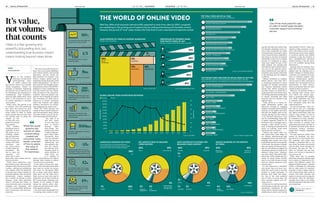
THE WORLD OF ONLINE VIDEO
One of the most powerful uses
of video in recent years has been
customer support and customer
service
1/3
Source: Insivia
of all online activity is spent
watching video
Source: Unbounce
80%
increase in conversion rates
reported by including video on
a landing page
Source: YouTube
500hrs
of video is uploaded to YouTube
every minute
Source: Jun Group
<15s
Videos shorter than 15 seconds
are shared 37 per cent more than
thosebetween30and60seconds
Source: Convince and Convert
52x
more likely to get a front-page
Google search result by adding
video to your website
Source: Syndacast
19%
boost in e-mail open rates by
using the word “video” in the
e-mail subject line
Source: Cisco
80%
of consumer internet traffic will
come from video by 2020
200-
300%
Source: Forrester
Source: IHS 2015 Source: Tubular Insights 2016
Source: CMA 2016
Source: Unruly Media/IAB 2015
Source: CMA 2016 Source: GlobalWebIndex 2016
increase in click-through rates
experienced by including video
in an e-mail
Source: Facebook
videos are viewed on Facebook
every day
8bn
TOP ONLINE VIDEO CREATORS ON SOCIAL MEDIA IN JULY 2016
Almost 383 billion video views were generated across the four major social video
platforms in July 2016 alone. These platforms are YouTube, Facebook, Vine and Instagram
TOP VIRAL VIDEO ADS OF ALL TIME
Number of shares by UK internet users, June 2015 (m)
MAIN PURPOSE OF VIDEO IN CONTENT MARKETING
Global survey of marketers
PERCENTAGE OF INTERNET USERS
WHO WATCH VIDEO, BY AGE
Number of shares by UK internet users, June 2015
55%
Brand
storytelling
11%
Inspiration
17%
Information
16%
Entertainment
1%
Utility
GLOBAL ONLINE VIDEO ADVERTISING REVENUES
16-24
25-34
35-44
45-54
55-64
93%
94%
90%
87%
81%
1
The Force: Volkswagen commercial
5.29
2
Dove Real Beauty Sketches
4.64
3 Evian Baby & Me
4
4 DC Shoes: Ken Block’s Gymkhana Five
3.55
5 Evian Roller Babies (Arabic version)
3.16
6 DC Shoes: Ken Block’s Gymkhana Three (part two)
3.11
7 2CELLOS – Thunderstruck
2.93
8 Pepsi MAX & Jeff Gordon Present: TestDrive
2.77
9 DC Shoes: Ken Block’s Gymkhana Four
2.45
10 Devil Baby Attack
2.18
1 UNILAD - ENTERTAINMENT
2,710
2
The LAD Bible - ENTERTAINMENT
2,341
3 Tasty - FOOD
1,757
4 NowThis - NEWS
1.082
5 Met Daan - STYLE AND BEAUTY
947
6 PlayGround - ENTERTAINMENT
735
7
AJ+ - NEWS
706
8 Nifty - HOME AND DIY
704
9
FailArmy - ENTERTAINMENT
690
10
Tastemade - FOOD
683
20,000
18,000
REVENUE($M)
GROWTH(%)
16,000
14,000
12,000
10,000
8,000
2004 2005 2006 2007 2008 2009 2010 2011 2012 2013 2014 2015 2016 2017
0
10
20
30
40
50
60
70
6,000
4,000
2,000
0
Revenue Growth
MARKETING SPENDING ON VIDEO KEY METRICS USED TO MEASURE
VIDEO SUCCESS
BIGGEST BARRIERS TO THE GROWTH
OF VIDEO
MOST IMPORTANT PLATFORM FOR
BRANDED VIDEO CONTENT
DIGITAL OPTIMISATION raconteur.net08 RACONTEUR RACONTEUR raconteur.net 09DIGITAL OPTIMISATION08 / 09 / 2016 08 / 09 / 2016
Are you planning on increasing spending on
video content over the next year in terms of the
proportion of the overall marketing budget?
Maybe
28%7%
58%
Maybe
Yes
65%
Views
29%
Social sharing
4%
Lead to action,
such as click-
through rates
2%
View
completions
2%
Lenght of
engagement
46%
YouTube
39%
Facebook
1%
Vine
1%
Snapchat
1%
Vimeo
3%
Instagram
9%
Twitter Ad blocking
14%
View ability
4%
Mobile
formatting
14%
43%
Return on
investment
25%
Quality of
production
01
IMAGES WON’T LOAD
02
TROUBLE INTERACTING
WITH IT ON THE DEVICE
03
TAKES TOO LONG
TO LOAD
04
NOT DISPLAYING WELL
ON THE DEVICE
05
EXPERIENCE WOULD BE
IMPROVED ON BIGGER DEVICE
TOP REASONS CONSUMERS
SWITCH DEVICES OR
GIVE UP ON CONTENT
ALTOGETHER
Personal life Professional life
DIGITAL OPTIMISATION raconteur.net10 RACONTEUR RACONTEUR raconteur.net 11DIGITAL OPTIMISATION08 / 09 / 2016 08 / 09 / 2016
A
great online experience
means visitors can find
the information or prod-
ucts they need easily,
whatever device they use and with
the minimum of hassle.
This is also about retention. It
can cost up to seven times more
to acquire a new customer than to
keep an existing one, so a focus on
customer experience can pay off
over time.
The flip side is that it can be very
easy to deter website visitors with
frustrating experiences. Sites still
make some very obvious mistakes in
this area.
As print advertising revenues have
dropped, online advertising has not
taken up the slack, leaving many
publishers with a gap in their financ-
es. This has led some sites to use
evermore intrusive ad formats to in-
crease revenues.
There’s nothing wrong with adver-
tising, but intrusive ads which take
over the screen, videos that play
audio automatically and low-rent
content recommendations all have
the potential to deter visitors.
Many users have responded to ads
by installing ad-blocking software.
According to the Interactive Ad-
vertising Bureau, 21 per cent of UK
adults used an ad blocker in July
2016. Others will just leave the site if
advertising annoys them.
Some sites have more ads than con-
tent and, with plenty of competition
online, there’s a real risk that chasing
ad revenue will deter traffic in the
long term.
According to comScore, mobile de-
vices now account for two of every
three minutes spent online, so a
mobile website is essential.
Many brands now have mobile sites,
but some have yet to catch up. For
example, Playmobil just has a desk-
top site, meaning mobile visitors will
struggle to read and navigate through
the site without a lot of effort.
People make snap decisions about
a site once they arrive. They need to
be able to trust it and find what they
need easily. It’s a subjective judg-
ment, but if users feel the site looks
unprofessional, then they’ll just click
away and find an alternative.
A survey from Adobe found that 38
per cent of people will stop engaging
with a website if the content or layout
is unattractive. Design matters.
Broadband speeds have improved
in the last few years, as has mobile
internet access, with 4G more
common. There is now very little
excuse for slow loading sites.
Slow sites frustrate users and lead
directly to lost sales. Google says 40
per cent of consumers will leave a
page that takes longer than three sec-
onds to load.
Accessibility is about ensuring
that your website can be used by
disabled visitors.
The Global Economics of Disabil-
ity Annual Report 2014 estimated
the global population of people
with disabilities at 1.3 billion. This
equates to almost 18 per cent of
the world’s population or one in
five people. With a combined dis-
posable income of more than $1.2
trillion, it’s a significant market
to exclude.
Many companies are making basic
errors which limit the accessibility
of their sites. For example, a recent
travel accessibility report by Sigma
claimed that both British Airways
and Co-operative Travel had a lot to
do to improve accessibility.
For e-commerce sites, the checkout
process is the single biggest source
of frustration for users and one par-
ticular potential barrier to purchase
is registration.
According to statistics from
UK firm SaleCycle, having to create
an account is the second big-
gest reason for abandonment of
shopping sessions.
Registration is a problem for many
shoppers as it seems like extra work
for them to do before making a pur-
chase and represents a level of com-
mitment that not all visitors want
to take.
It used to be common practice for
retailers to ask customers to register
and create an account before going
on to pay for items. Some, such as
Boots, still insist that customers
register, but the answer for many
retailers has been the introduction
of guest checkout. This encourages
more people to go through the pay-
ment process, while the option of
creating an account can be offered at
a later stage.
For example, ASOS removed its
registration option and reduced
checkout abandonment rates by 50
per cent.
Online shoppers want to know
the costs of their purchase upfront,
so retailers should be very clear
about total product and delivery
charges before customers enter pay-
ment details.
Even Ryanair, infamous for the
pre-ticked boxes on its website
for extras such as insurance, has
cleaned up its act online in response
to user frustration. There are still
sites that do this though, such as
ticketing sites which add inexpli-
cable processing fees on to the cost
of tickets.
It’s an approach which may in-
crease revenues in the short term,
ONLINE TURN-OFFS
GRAHAM CHARLTON
but if you are seen to be deceiving
users, it’s a poor long-term strategy
for customer retention.
We’ve come a long way from the
early days of online retail, when
shoppers were yet to be convinced
about the security of their payment
details, but some customers are
still wary.
There is no shortcut to earning
customer trust. It comes from a mix-
ture of brand recognition, the look
and feel of a website, security reas-
surances and factors such as posi-
tive reviews.
Clear contact details also build
confidence in users. KoMarketing
found that 44 per cent of visitors
will leave a company’s website if
there’s no contact information or
phone number.
Websites have a short time to
convince visitors to stay, and a
common problem for websites is a
failure quickly to convey to visitors
what their product or service does –
the value proposition.
This can be more of an issue for
business-to-business companies,
where products and services are
often more complex, requiring
greater explanation. Visitors need
to know how the product or service
can help them, the value it deliv-
ers and what it offers compared to
the competition.
A frustrating experience when
completing forms online is a
common reason for customers
to abandon a website. Informa-
tion such as address and payment
details is required, and it’s impor-
tant to make data entry as easy
as possible.
Common problems include asking
for too much or unnecessary infor-
mation, confusing form fields and
unclear error messages. For exam-
ple, Boots requires passwords in a
certain format, but doesn’t explain
this until users make an attempt to
create one.
How to make your
website user friendly
No business wants a potential customer to click away from
its website, so it’s important to eliminate the online turn-offs
Share this article online via
raconteur.net
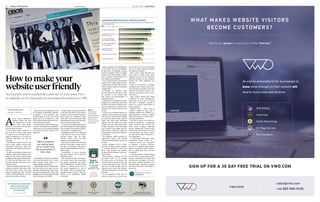
CONSUMER EXPECTATIONS IN VIEWING CONTENT
Consumers prioritise display and design when viewing content across both personal
and professional life
Source: Adobe 2015
Many companies
are making basic
errors which limit
the accessibility of
their sites
21%
of UK adults
used an ad
blocker in July
Source:
Interactive
Advertising
Bureau 2016
ABOVE
Online fashion
retailer ASOS
reduced checkout
abandonment by
50 per cent by
removing its regis-
tration option
JonathanNicholson/NurPhotoviaGettyImages
Source: Adobe 2015
It holds my attention
It displays well on the
device I’m using
Overall good design,
such as layout/imagery
It is personalised based
on my interests
I can view it across
multiple devices
I can share it with others
I can interact with it
80%
73%
73%
72%
64%
68%
56%
53%
55%
57%
52%
56%
53%
48%
CONVERSATIONAL COMMERCE
FINBARR TOESLAND
COMMERCIAL FEATURE
raconteur.net 2XXXX
COMMERCIAL FEATURE
You’ve been in business forover
half a century, you have around 7,000
employees in 60 countries and clients
including Shell, Microsoft and EDF
Energy, and yet you like to describe
yourselves at Wunderman as an
“underdog” or “a startup”. Why is this?
It’s important to retain the
sense of hunger, energy and fun, of
wanting to break new ground and
find smarter ways of doing things.
By retaining an entrepreneurial
mindset our eyes are always open
to how marketing is changing
and how new techniques could
solve clients’ problems. It’s about
spotting opportunities, like new
data APIs [application programming
interfaces], machine-learning,
content and experience design-
thinking, and making them part of
how we work.
You’re also very keen on
diversity. For many organisations this
is still a box-ticking exercise for the
human resources department. Why
is it so important to you and how do
you use it differently?
It’s not only about fairness,
though that’s of fundamental
importance. It’s about ensuring a
diversity of opinion too. Having a
range of different viewpoints helps
us to stay fresh and to keep evolving.
‘IT’S ABOUT SPOTTING
OPPORTUNITIES’
Why would a global advertising and marketing agency with an
impressive heritage of nearly 60 years behave as if it was the new kid
on the block? Because it’s good for our clients, says Mel Edwards,
Europe, Middle East and Africa chief executive at Wunderman
Making sure we keep these diverse
perspectives in the business means
two things: ensuring all existing staff
feel comfortable speaking out and
contributing; and making sure diversity
is part of our recruitment process. We
recruit based on skills, attitude and
experience, not where someone isfrom
or how they were educated.
At Wunderman you’ve got a
wealthofdatathankstoyourmanyyears
as a leader in digital marketing. How
do you optimise it in a way that others
fail to? Can you give me an example?
We connect it with a kind
of creative thinking that benefits
from the diversity that I mentioned.
It might sound simple, but many
businesses start with either data or
creativity and fail to make them work
together effectively. Wunderman has
grown up with both since our very
inception. We have a way of working,
called Collision, which brings
creative, strategic and data experts
together as a team from the start of
a project. A good example is our work
with the Sun’s Dream Team fantasy
football game. Data has helped us
understand the most valuable players
– those who recruit their friends into
mini-leagues – has helped us define
the creative story of the product –
when it’s fantasy football it’s OK to
“cheat” on your favourite team – and
helped us connect it all together in
super-smart data-informed creative
executions. Last year’s campaign
targeted supporters of real-life clubs
with stories of how much their fellow
fans “cheated” on the club. This year’s
campaign features cutting-edge
personalised videosforeverypotential
player. The videos pull in data on these
players’ previous activity and get them
to do the naughty on their club with
the line “It pays to experiment”.
We’re seeing an ever-greater
avalanche of data, an increasing
number of devices and channels,
and a more demanding, time-poor
customer base. Can you identify
some trends and offer some advice?
The volume of data will
get exponentially larger. With the
internet of things and the non-stop
barrage of sensor data around the
corner, organisations must get in
shape to handle it now. They need to
use machine-learning plus humans
together to unlock its potential.
The power of machine-learning
exemplified by IBM’s Watson and
Apple’s Siri will help connect vast
datasets and make them useable.
But by itself it is just a way to find
patterns. Pairing machine-learning’s
analytical power with smart, creative
data thinkers will help invent the
usage cases, and create real value for
businesses and brands.
For more information please visit
www.wunderman.co.uk
DIGITAL OPTIMISATION raconteur.net12 RACONTEUR RACONTEUR raconteur.net 13DIGITAL OPTIMISATION08 / 09 / 2016 08 / 09 / 2016
Chatbots
get a voice
in online
commerce
Shopping and doing business
with a chatbot or an online digital
assistant powered by artificial
intelligence is a growing trend
set to transform commerce
I
t may not be long before any
smartphone user will be
able to type or say “I want a
flight from London to New
York this Thursday” in a messag-
ing app and almost instantly a
message showing a list of flight
times, prices and carriers will be
received, with buying tickets and
checking-in all available within
the conversation.
The convergence of highly popu-
lar messaging apps and advanced
artificial intelligence (AI) is allow-
ing businesses to interact with their
customers in innovative new ways.
Chris Messina of taxi disrupter app
Uber popularised the phase “con-
versational commerce” to describe
the trend.
Messaging apps such as Facebook
Messenger, Slack and WhatsApp
have quickly become the most
popular way to communicate,
with more than 80 billion messages
sent every day, providing the per-
fect environment for conversation-
al commerce.
The Chinese messaging app
WeChat has been at the forefront of
conversational commerce with its
more than 700 million users being
able to do everything from ordering
food, booking a flight or hailing a
taxi, all in the app. Facebook recent-
ly made its move into conversational
commerce by partnering with Uber
in the United States to let users order
taxis through its Messenger app.
In a sign that we are only seeing
the very start of conversational com-
merce, Facebook’s director of plat-
form partnerships Julien Codorniou
said the Messenger app was just “1
per cent finished” and “one day there
will be companies built on Messen-
ger and we are at the beginning of
that ecosystem”.
Conversational commerce has
quickly become a major talking
point, but will it be able to meet con-
sumers’ ever-changing needs? Using
chatbots and digital assistants to in-
teract with businesses is by no means
a new phenomenon, but their in-
creasing popularity is attracting the
attention of a wide range of small to
medium-sized firms, as well as major
listed companies. The ability of these
technologies to deal with common
your life more shoppable,” says Ms
Greene.
When speech-recognition soft-
ware was initially released, it failed
to meet many users’ high expecta-
tions, due to widespread problems
around understanding even basic
responses. Thanks to advancements
in AI, voice-recognition technolo-
gy has made good progress in just a
few short years. “These systems have
become much more sophisticated.
They are now able to differentiate
between regional accents or even
detect if the customer has a cold.
This level of accuracy means they
can now offer fully automated ser-
vices for common requests, simple
applications and transactions,” says
Mr Long at KCOM.
“Having technology that manag-
es customer relationships securely,
conveniently and efficiently in any
language, with no extra effort from
the customer, ticks a lot of boxes
for multichannel retailers,” he says.
Voice-recognition software may still
have to deal with unresolved issues
such as background noise disrupting
speech and incorrectly interpreting
the context of similar sounding words,
but these difficulties are on course to
be resolved within the next year.
The expansion of conversational
commerce gives businesses access to
massive amounts of consumer data,
leading to more personalised user
interfaces. Creation of an interface
that reduces the user’s cognitive load
– the amount of mental effort being
used in the brain’s short-term work-
ing memory – is a common aim, but
is a fully cognitive website now ap-
proaching reality?
Frank Palermo, executive vice
president of global digital solutions
at VirtusaPolaris, a leading provid-
er of IT consulting and outsourcing
services, thinks the introduction
of cognitive websites will come
sooner than expected. Mr Palermo
is currently working with IBM on
the Watson project and is deeply in-
volved in cutting-edge AI technol-
ogy, similar to that powering Alexa
and Google Home.
Share this article online via
raconteur.net
The growth of
conversational
commerce means
that in the near
future it will
become a key part
of most companies’
digital approaches
“Retailers can build an exception-
al cognitive website, one that offers
a deeply personalised and ambient
experience to each customer as the
brand gets to know them,” he says.
“Creating such websites is no longer
an unrealistic ambition, but if con-
sumers are doing their purchasing
via digital assistants, such as Am-
azon’s Alexa or Google Home, they
will be rendered useless because
digital assistants don’t behave like
human shoppers.”
Whereas people can be influenced
by past brand experiences and visual
attraction when considering a pur-
chase, for digital assistants this is
irrelevant. “Businesses will need to
adapt to a new generation of consum-
ers who make purchases via a digital
assistant, intermediating the custom-
er experience,” says Mr Palermo.
Businesses need to adopt effective
conversational commerce strategies
if they want to capitalise on the op-
portunities this new market offers.
The revenue generated by these
platforms is no small change with
research and advisory firm Gartner
expecting a total of $2 billion in
sales will be driven by digital assis-
tants this year alone. The growth of
conversational commerce means
that in the near future it will become
a key part of most companies’
digital approaches.
This movement can provide an op-
portunity for businesses to reset how
they interact with customers, accord-
ing to Hero’s Mr Levene. “For centu-
ries, commerce was about relation-
ships between people. With the birth
of e-commerce in the late-1990s,
businesses traded the human touch
for unlimited choice. Conversation-
al commerce is paving the way for a
third wave of commerce, combining
the human touch with the conveni-
ence of digital,” he says.
High-touch industries such as retail
are expected to be the most impacted
bythisshift.“Conversationalshopping
reimagines the role of the store associ-
ate and empowers them with the tools
to become digital personal shoppers,”
says Mr Levene. These workers will be
able to make immediate recommenda-
tions through chat and showcase prod-
ucts on live video, creating a hybrid be-
tween browsing in-store and shopping
online. “Customers now have the best
of both worlds, with shopping becom-
ing as effortless as messaging a friend,”
he concludes.
inquiries or assisting users to shop
online whenever they want to is a
key feature.
“Once an interaction has begun
online, most people are reluctant to
shift format, so digital assistants and
chatbots come into their own when
users run up against a problem, have
a question or can’t find what they’re
looking for,” says Stephen Long, ex-
ecutive vice president at systems
integrations and unified commu-
nications provider KCOM. The con-
versational assistants of today can
understand complex sentences and
recognise abbreviations, so activities
can be carried on seamlessly and dig-
itally. But there may be a limit to the
application of these technologies.
Although chatbots have made
major advances in the past few years,
they still have a somewhat patchy
reputation. While these digital assis-
tants could prove useful for relatively
simplistic requests, when it comes
to customers looking for personal
recommendations or resolution to a
specific problem, they offer a disap-
pointing experience.
Adam Levene, founder and chief
executive of London-based conver-
sational commerce platform Hero,
believes people are far better suited
to providing support. “They offer far
more responsive assistance to custom-
ers than a bot could. When it comes to
artificial intelligence versus emotional
intelligence, there is no substitute for
the human touch,” says Mr Levene.
Voice search is also growing rap-
idly with the most recent Google
Mobile Voice Study finding a 61 per
cent growth in longer queries that
start with “who”, “what”, “where”
and “how”. Google analysts noted
that one in five queries on the mobile
Google app are voice-based and they
get about 30 times more action que-
ries by voice than by typing.
These changes in consumer be-
haviour will mean brands will need
to optimise their content in order to
appear in relevant results shown to
users. More than half of US teens and
41 per cent of adults now use voice
search on a daily basis, indicating
this functionality is already playing
an important role in search queries.
There is no shortage of voice search
services, such as Microsoft’s Cortana
and Android’s Ok Google, available
on both mobile and desktop devic-
es. “The interesting thing about
voice-recognition technology and
conversational commerce is the level
of intimacy it brings to interactions.
There’s an immediate feeling of per-
sonalisation, but also humanness as
you’re being given immediate verbal
feedback, just like a live conversa-
tion,” says Lucie Greene, worldwide
director of the Innovation Group, J.
Walter Thompson’s trend-forecast-
ing consultancy and innovation unit.
We are, of course, aware these ex-
changes are purely programmatic, but
it feels more like a real chat than any
other simulated conversation. “The
two-way interaction in commerce and
the fact that it’s an audio conversation
also makes shopping feel more expe-
riential,” adds Ms Greene.
This shift towards convenience
and personalisation removes barri-
ers that have traditionally hampered
consumer engagement, as the need
to physically interact with digital
devices can be completely removed.
Voice recognition allows users to
multitask like never before.
“It makes infinite situations shop-
pable for the first time. Instances
where you would be cooking and
unable to shop or driving and unable
to use a service are now connected
to commerce. They essentially make
MAIN REASONS MOBILE USERS USE VOICE SEARCH
WHAT PEOPLE USE VOICE SEARCH FOR
TEENAGERSADULTS
ASK FOR DIRECTIONS CALL SOMEONE
HELP WITH
HOMEWORK
FIND OUT
MOVIE TIMES
ASK FOR DIRECTIONS
PLAY A SONG
CHECK THE TIME
DICTATE TEXTS
Source: Google 2014Source: GlobalWebIndex 2015
It is quicker than going on a
website or using an app
It is more fun than other
search methods
It is easier than going to a
website or using an app
It is a more accurate
way of searching
I don’t like typing on
my mobile phone
I can use it while driving or at other times
when I can’t interact with my handset
43%
42%
38%
38%
28%
21%
What can I help
you with?
CHECK THE TIME
PLAY A SONG FIND OUT
MOVIE TIMES
CALL SOMEONE
40%
39%
11%
2
0%
13%11% 9%
31%
31%
30%
4
3%
38%
41%
of US adults
now use voice
search on a
daily basis
BetsieVanderMeer/GettyImages
DIGITAL OPTIMISATION raconteur.net14 RACONTEUR RACONTEUR raconteur.net 15DIGITAL OPTIMISATION08 / 09 / 2016 08 / 09 / 2016
www.raconteur.net
Jointhe
knowledge
economy
Share this article online via
raconteur.net
are they using? What is the target
demographic? What is the context
of their visit to your mobile site?
Which tasks are they looking to
carry out?
For example, banks provide apps
and mobile sites to allow custom-
ers to check their balances and
carry out key tasks on the move,
while some retailers will optimise
their sites according to the most
common user requirements.
There’s scope for increased sophis-
tication in future too, as mobile users
provide a lot of contextual cues which
brands can respond to. These include
location,timeofday,andfactorssuchas
the type of connection: wi-fi or mobile
internet.
Another example is a retailer
could detect that a user is near their
physical location and tailor content
to them, showing local product
availability, offers or directions and
store information.
Many of the brands that are now
seeing results from mobile spot-
ted its potential a few years ago
and invested time and resources
into the technology required. Two
such companies are Schuh and
Domino’s Pizza.
Domino’s recognised the context
in which many users ordered pizzas
and the importance of mobile to
this. It’s about convenience and
ease of use, and the company has
invested in mobile sites and apps to
provide this for customers.
These features include an “easy
order” system, whereby users can
place a pre-defined order with one
click, and the pizza tracker, which
tells hungry customers when their
order will arrive. Saved payment
and address details take the work
away from ordering and help to in-
crease customer loyalty.
This mobile focus has paid off for
Domino’s. In the 26 weeks to June
2016, mobile sales grew by 35 per
cent and mobile accounted for 62
per cent of total online sales.
Schuh has also thrived by en-
suring that the foundations of its
mobile strategy are solid before
adding more advanced features.
Its deputy head of e-commerce
Stuart McMillan says the biggest
untapped potential in mobile is ac-
tually pretty obvious as many mo-
bile-user experiences are broken
and most sites are leaving money
on the table through poor usability.
“Mobile web should be a shop-
ping experience par excellence,” he
says. “But it needs to start with the
basics. Is the site well construct-
ed, fast, accessible? Does it make
sense? Can your granny use it?”
Schuh’s mobile traffic has rock-
eted since around 2012 and now
represents perhaps the most im-
portant single channel. Some
42 per cent of its transactions
now come from mobile, while 89
per cent of mobile consumers
have only shopped through their
mobile devices.
However, no channel exists in
isoltation and mobile has a vital
role to play in a multichannel ex-
perience. Mr McMillan refers to
mobile as “multichannel glue”.
“While mobile conversions are
generally lower than desktop, our
data shows us that customers are
carrying out a wider variety of tasks
on mobile. They are more likely to
look at the store locator, and more
likely to use click-and-collect ser-
vices. Mobile customers are on the
move and their needs are often
more urgent,” he says.
The oft-mentioned customer
journey is key, though Schuh have
found that the typical journey
doesn’t exist and the aim should
be “a web experience that makes
sense no matter what journey you
take, connecting sessions across
devices and across time”, says
Mr McMillan.
He adds: “They want to browse
on desktop at lunchtime, continue
MOBILE ADDICTION IN THE UK
Survey of smartphone users, who self-assess on a scale of one (not at all hooked) to ten (completely hooked)
Source: Ofcom 2015
Mobile-optimised websites are on the march…
As younger generations lead the surge in smartphone usage, a mobile site is now a must for any online business
M
obile represents the
future for any business
with an online pres-
ence – it’s that simple.
PCs and laptops will still be signif-
icant for some time to come, but the
growth of mobile means that busi-
nesses which fail to cater for this
user group face losing half or more
of their potential customer base.
Mobile web has now overtaken
PC and laptop desktop use in much
of the world. A recent UK Ofcom
report found that since 2014 adults
are less likely to access the internet
using a computer (71 per cent com-
pared with 81 per cent in 2014) and
more likely to use a smartphone
(65 per cent against 61 per cent) or
tablet (45 per cent compared with
39 per cent).
Ofcom found that the 16 to 24 age
group is primarily responsible for
the growth in smartphone usage,
so the direction of travel is clear:
mobile internet usage is growing
and will continue to do so.
The two major ways in which
mobile optimisation matters are
visibility in search engines and the
conversion of visitors into custom-
ers. Search is the main acquisition
channel for most online businesses.
According to a Conductor study, 64
per cent of web traffic comes from
search engines.
Mobile search is growing too. Last
year Google announced that of the
100 billion searches it deals with
monthly, more than half now come
from mobile devices.
Google has been pushing mobile
optimisation in a big way recent-
ly and its dominance of the search
market means businesses must pay
attention. Google is sending clear
signals that visibility on mobile
MOBILE
GRAHAM CHARLTON
from third-party servers. Sites that
implement AMP will load faster
and publishers using it are fea-
tured more prominently in mobile
search results.
If businesses want to be found
by mobile users on search engines,
a mobile-optimised website is a
must. A good starting point here
is Google’s Mobile Friendly search
tool, which tests how your website
performs on mobile devices and
offers feedback on issues that may
harm mobile rankings.
The other key factor is the ability
to convert visitors into customers
and this will depend on how well
a site caters for different devic-
es. Typically, conversion rates on
mobile are lower than desktop, be-
cause it’s often easier to carry out
tasks such as completing forms
and entering payment details on a
larger screen.
Businesses need to identify points
of friction for mobile users and
find solutions to make it easier to
buy from mobile sites. Often the
solutions can be found in mobile
technology. For example, Booking.
com allows users to scan card de-
tails using a phone’s camera to take
some of the work out of form filling.
User intent is very important here
too. Effective mobile design doesn’t
simply seek to recreate the main
website to fit a smaller screen, but
looks at how and why people use a
mobile site or app.
Brands need to find out about
their users. Which mobile devices
HOW COMPANIES HAVE OPTIMISED THEIR
E-COMMERCE OFFERING
Survey of UK and European retailers, travel and tourism operators, and retail banks
Source: Urban Airship 2016
The two major ways
in which mobile
optimisation
matters are
visibility in search
engines and
the conversion
of visitors into
customers
search is dependent on optimising
for mobile users.
The biggest such signal was the
introduction of a mobile-friendly
algorithm in April 2015, which uses
factors such as whether text is easy
to read and the speed of loading
the site on mobile devices to rank
mobile search results.
The drive towards mobile has con-
tinued and Google launched the
Accelerated Mobile Pages (AMP)
project that strips out elements
which cause web pages to load
more slowly on mobile, such as ads
on the way home on mobile, then
place a click-and-collect order at
9pm that night on their tablet and
pick it up tomorrow lunchtime.
And so on.”
The lesson here for online busi-
nesses is that mobile is no longer
simply a box to be ticked. Instead
mobile should be at the centre
of any online strategy. A mobile
site or app needs to be effective in
converting visitors, but should
also work with other online and of-
fline channels.
Companies such as Schuh and
Domino’s have spotted this, and are
now in a position to improve the
omnichannel experience further. At
the same time, some of their rivals
are still working on the basics.
RIGHT
Google has
launched
Accelerated
Mobile Pages to
improve load time
for mobile news
search results
ALL
ADULTS
16-24
25-34
35-44
45-54
55+
LEVEL OF ADDICTION
AGERANGE
NOT HOOKED (1-3) 4-6 HOOKED (7-10)
19%
18%
27%
33%
8%
9%
33%
30%
32%
32%
35%
35%
48%
61%
59%
50%
37%
32%
Dedicated
mobile app
(transactional)
Fully responsive site
across all devices
Dedicated mobile
app (experience)
Mobile-friendly
site
61%
5% 8%
26%
DIGITAL OPTIMISATION raconteur.net16 RACONTEUR08 / 09 / 2016

Digital Optimisation [How To]

  • 1.
    Video is afast-growing, accessible and powerful storytelling tool YOUR OPPORTUNITY TO BE A DRIVING FORCE LOOK FOR VALUE AND NOT VOLUME MOBILE-OPTIMISED WEBSITES ARE GO CHATBOTS GET A VOICE ONLINE Conversational commerce is transforming online businessBusinesses that stand still in today’s digital world risk failure A mobile site for smartphones is a must for any business online 03 08 12 14 DIGITAL OPTIMISATION 08 / 09 / 2016INDEPENDENT PUBLICATION BY #0400raconteur.net
  • 2.
    W hen it comesto digi- tal, you’re never really finished. In fact, the launch of a website, an app, a campaign or other digital ini- tiative marks the beginning, not the end, of the hard work. Why? Technology doesn’t stand still. Consumer demands and be- haviours keep evolving. The com- petitive environment is turbulent and full of disruption. And every day and every interaction your cus- tomers have with your brand, you learn a little bit more. Consider each of these ideas for a moment. Right now there are people all around the world dreaming up new ways to do and improve things. These could be micro-innovations, such as the development of a new tool for measuring social data. Or they could be bigger innovations, as we’re seeing with augmented re- ality, virtual reality and artificial intelligence. It could involve ad- vances in cognitive computing and machine-learning or breakthroughs in connected living and the inter- net of things. Or it could be a minor search algorithm change by Google or advertising algorithm change by Facebook, with major ramifications for marketers. These changes are real and they’re going on all around us, all the time. The question is what will they mean for your business and its digital endeavours? Even if you don’t think the rise of chat- bots on Facebook messenger – more than 11,000 of them within three months of launching earlier this year – has a role to play for your business, do you know how it will affect consumer behaviour and expectations? As digital innovations continue to permeate the world we live and work in, at pace, the more con- sumers experience the art of the possible. Encounters with a brand, even one in a completely different sector to your own, shape people’s understanding of technology in our digital world, and how they choose to use and interact with it. Amazon is per- haps one of the best examples of this effect, where experiencing the online retailer’s da- ta-driven approach to personalisation, targeting and rec- ommendations of- ten left consumers wondering why it was so hard to re- ceive the same rele- vant content and engagement from other businesses with rich data, such as their bank, grocery retailer, telecoms or utility providers. One of the biggest impacts of dig- ital advancement has been com- petitive disruption. From sector to sector, established businesses have been upended by new entrants lev- eraging digital to innovate business models. Even if you don’t believe that your sector or category could fall victim to an Uber or Airbnb equivalent, no business is immune to the industry-agnostic force that is digital technology or the ripple ef- fects of competitors’ actions. The post-millennial “iGenera- tion” are the first group to have been brought up as true digital na- tives and they’re now entering the workforce. Many will have had the chance to learn to code in school and some will already be thinking of “hacks” to the establishment that could impact your business or your value chain from out of nowhere. Then there’s the known competition. Dig- ital often favours the first or the fast-mover, and if your competitors are more agile and pacey than your business, you risk being left in their wake or, in the very least, suffering from the knock-on effects of their actions. Lastly, con- sider one of the much-lauded ben- efits of digital – its real-time nature and rich pool of data on which to base your deci- sions. In theory, every interaction your customers have with your brand, from navigating your website to engaging with social media con- tent to opening an e-mail, and much more, is telling you something. In reality, businesses need to be ready and resourced to listen, and to act on it. Fundamentally, there’s noth- ing static about digital. Constant fine-tuning, tweaking, adapting and optimisation of your digital pres- ence and digital strategy are essen- tial. To launch a digital initiative, from a website to an app or beyond, and then walk away in the hope the prevailing forces won’t apply to your business is risky at best and foolish at worst. There’s simply too much change and too many forces at play. The notion of continuously re- viewing and iterating plans and ac- tivities may spark concerns about the level of resources needed to do them justice, but in reality the im- portance of digital optimisation isn’t rooted in the risk of getting it wrong and falling behind, but in the upside potential for getting it right. Operating in an agile, responsive way to the signals that you know to look out for, be they from custom- ers, competitors or digital leaders, can yield tremendous value. Having a finger on the digital pulse of your organisation and the ability to make course-corrections, however subtle, based on real intelligence can un- lock significant improvements in performance. The more attuned you are to cus- tomer behaviour and expectations, the more likely you’ll be to engen- der their favour and loyalty. The more sensitive you are to compet- itive pressures and market forc- es, the better placed you’ll be to respond appropriately and not get outmanoeuvred. Ultimately, digital optimisation is your opportunity to get behind the wheel of your digital investments, rather than simply be a passenger. DISTRIBUTED IN SIMON BROOKE Award-winning freelance journalist, who writes for a number of international publications, he specialises in lifestyle trends, health, business and marketing. THOMAS BROWN Consultant, executive adviser and co-author of the forthcoming book Building Digital Culture, he is the former CIM marketing director. GRAHAM CHARLTON Editor in chief at ClickZ Global and Search Engine Watch, he is a specialist in online retail and digital marketing, and has written several best practice guides. HAZEL DAVIS Freelance business writer, she contributes to The Times, Financial Times, The Daily Telegraph and The Guardian. FINBARRTOESLAND Freelance journalist, he specialises in technology, business and economic issues, and contributes to a wide range of publications. RACONTEUR PUBLISHING MANAGER Michelle Ingham DIGITAL CONTENT MANAGER Sarah Allidina HEAD OF PRODUCTION Natalia Rosek DESIGN Samuele Motta Grant Chapman Kellie Jerrard PRODUCTION EDITOR Benjamin Chiou MANAGING EDITOR Peter Archer BUSINESS CULTURE FINANCE HEALTHCARE LIFESTYLE SUSTAINABILITY TECHNOLOGY INFOGRAPHICS raconteur.net/digital-optimisation CONTRIBUTORS Although this publication is funded through advertising and sponsorship,alleditorialiswithoutbiasandsponsoredfeatures are clearly labelled. For an upcoming schedule, partnership in- quiries orfeedback, please call +44 (0)20 8616 7400 ore-mail info@raconteur.net Raconteur is a leading publisher of special-interest content and research. Its publications and articles cover a wide range of topics, including business, finance, sustainability, health- care, lifestyle and technology. Raconteur special reports are published exclusively in The Times and The Sunday Times as well as online at raconteur.net The information contained in this publication has been ob- tained from sources the Proprietors believe to be correct. However, no legal liability can be accepted for any errors. No part of this publication may be reproduced without the prior consent of the Publisher. © Raconteur Media Your opportunity to be a driving force In today’s digital world where the only constant is change itself, businesses that stand still risk being left behind in the slow lane OVERVIEW THOMAS BROWN Share this article online via Raconteur.net HughPeterswald/PacificPress/LightRocketviaGettyImages of chief executives said technological advances were amongthetop-threetrendsmost likely to transform businesses over the next five years Source: PwC 2016 77% RACONTEUR raconteur.net 03DIGITAL OPTIMISATION08 / 09 / 2016 #1 FASTEST GROWING SOFTWARE COMPANY IN THE US IS COMING TO THE UK BounceX.com/raconteur Available for download until 11/30/2016 the Learn why Behavioral Marketing is the direction your company should be headed & how your customers’ digital body language is the blueprint for growing your business. Raconteur Reader Exclusive Access this revenue-changing blueprint now DIGITAL OPTIMISATION
  • 3.
    COMMERCIAL FEATURE INTERNET USERSIN THE UK (%) PERCENTAGE WHO HAD USED THE INTERNET IN THE LAST THREE MONTHS W hen she stood in Downing Street to make her first speech as prime minister, Theresa May gave an impassioned vision of a more inclusive nation. “We believe in a Union not just of the nations of the United King- dom, but between all of our citi- zens. Every one of us, whoever we are and wherever we are from,” she said, talking about, “the mission to make Britain a country that works for everyone.” Mrs May didn’t actually mention the internet, but given that it af- fects every aspect of our lives these days, the issue was perhaps implic- it. Certainly, in recent years efforts have been made to open up the digital world to those from poorer backgrounds, and people with dis- abilities and educational difficul- ties. The Web Content Accessibility Guidelines are part of a series of advice published by the Web Acces- sibility Initiative, which is part of the World Wide Web Consortium, the main international standards organisation for the internet. These guidelines specify how companies, organisations and gov- ernment should make content ac- cessible, primarily for people with disabilities. In the UK the last gov- ernment launched its Digital Inclu- sion Strategy in 2014 with the aim of partnering with the public, private and voluntary sectors to reduce the number of people without basic digital skills and capabilities by a quarter. The strategy identified four main obstacles. The first is access, in other words the ability to actually go online and connect to the in- ternet. Online skills are second, followed by motivation or under- standing why using the internet can be a good thing and, finally, trust or in other words concerns about cyber crime and safety. The success of the project will be re- viewed this year. The initiative aims to counter what is known as the “digital divide”. Al- though this phrase is often used to refer to physical access to the net and broadband skills, campaigners also apply it to inequality of inter- net skills. You can have super-fast cable, but if you don’t how to search for a good local dentist or where to find the necessary information for a job application, then megabytes per second are irrelevant. Recent research by the BBC re- vealed that around one in five (21 per cent) of the UK population lack the basic digital skills necessary to benefit from the internet. Accord- ing to a study by Dr Ellen Helsper of the London School of Econom- ics (LSE) and Dutch researcher Dr Alexander van Deursen, educated people on high incomes derive the greatest benefits from using the in- ternet, getting better deals online for products and holidays, using the internet more successfully to expand their social life and becom- ing more informed. In contrast, low-income people from socially deprived back- grounds do not receive the same benefits, regardless of access. The study of more than 1,100 people was conducted in the Netherlands, a country with a well-developed digital infrastructure and near-uni- versal access. Disabled people, along with retired and unemployed individuals and care-givers, receive the fewest benefits overall by being online. According to the LSE re- search, 12 per cent of people don’t know how to go back to the previ- ous page. “Governments and others have focused too much on pipes and infrastructure, and have taken the ‘build them and they will come’ approach, but that’s not the case. There is a risk of a digital under- class. Access to and use of the in- ternet might exacerbate existing inequalities offline,” says Dr Hel- sper. “While more and more people might be online these days, the in- ternet clearly benefits those with a higher social status.” In the United States there have been a growing number of high-pro- file court cases in which large or- ganisations have been successfully sued for millions of dollars because their sites are deemed to be inac- cessible and therefore contrary to US law. Small and medium-sized enter- prises (SMEs) are most at risk of either being subject to legal action or simply losing business from what the Department for Work and Pensions calculates is a disability market worth £212 billion. “SMEs ACCESSIBILITY SIMON BROOKE are not intentionally excluding these customers – some have just not explicitly considered their needs,” says Adam Rowse, head of business banking at Barclays Bank. “Unlike a shop where it’s obvious to see the challenges that disa- bled or older customers face en- tering, getting around and paying for stuff, it’s less obvious for an online shop.” He cites new research from the Click-Away Pound Survey, which is designed to explore the online shopping experience of people with disabilities, showing that 71 per cent of disabled people with access needs who shop online chose to click-away from a site that present- ed barriers in favour of finding a more accessible one. “Technology has provided mas- sive opportunities for people with disability and massive opportuni- ties for companies, service provid- ers and government to serve them,” says Steve Tyler, head of solu- tions, strategy and planning at the Royal National Institute of Blind People (RNIB). Blind himself, Mr Tyler controls his music system at home through an app on his iPhone. He shops on Amazon, Ocado and John Lewis through an accessible app or website, as well as buying coffee with an app that delivers an accessible receipt. “Today websites can be written in such a way that specialist technolo- gies like screen-readers that render websites into speech or magnify the site can access them,” he says. The charity runs a project called Online Today, which aims to pro- vide digital skills to 125,000 people with sight or hearing loss, or both. Internet use by those who need en- hanced accessibility mirrors that by the wider public, except that the age difference is even more pronounced. According to recent survey by the RNIB, while almost two thirds of those aged 75 did not use a computer, the internet, a tablet or a smartphone, 86 per cent of 18 to 29 year olds said they could make the most of new technolo- gy. The majority of people who do not currently use technology, the survey reported, would like to use it if obstacles were removed. The trend implied by these find- ings is positive – the challenge for companies, government bodies and other organisations is to take a long hard look at their online pres- ence and make sure they’re playing their part. Source: Office for National Statistics 2016 *Those who self-assess that they have a disability in line with the Equality Act definition of disability While more and more people might be online these days, the internet clearly benefits those with a higher social status Digital access is a right and not a privilege The UK is in danger of witnessing a digital underclass where disadvantaged people fail to benefit from the internet Share this article online via raconteur.net 21% of the UK population lack the basic digital skills necessary to benefit from the internet Source: Office for National Statistics 2016 UK average Disabled* Aged 75+ 90 80 70 60 50 40 30 20 2014 2015 2016 85 86.2 67.8 33 87.9 71 38.7 64.9 31.9 DIGITAL OPTIMISATION raconteur.net04 RACONTEUR RACONTEUR raconteur.net 05DIGITAL OPTIMISATION08 / 09 / 2016 08 / 09 / 2016 ABOVE Some 38.7 per cent of UK adults aged over 75 regularly use the internet, accord- ing to recent data RACONTEUR raconteur.net 2XXXXxx xx xxxx COMMERCIAL FEATURE WEB ACCESSIBILITY: NOW IT’S BUSINESS CRITICAL Once regarded as merely a useful add-on to a website, today accessibility is required not only by UK law, but by an increasingly vocal and demanding public. Organisations need to develop an accessibility policy and act now to avoid legal action – and to prove they value all their customers T he last few years have seen increasing legal action on web accessibility. Since the first litigation was initiated around 2000 in the United States against high-profile brands such as Target and Netflix, the threat of private legal action and the imperative to address disability discrimination is relevant to companies of all sizes across all industries. In the UK, the 2010 Equality Act and its statutory code, in force since April 2011, explicitly states that websites are included within the ambit of the legislation. There are 12 million disabled people in the UK, representing annual spending power of £212 billion. To compound the importance of accessibility, the digital needs of an ageing population should also be taken into consideration. Some 50 per cent of the UK population will be over 50 in 2020 and there are currently more than 2,250,000 people in the UK living with a visual impairment. As one of the most web-enabled societies in the world with an active disability rights lobby, the UK is experiencing an increase in pressure to comply with the WCAG 2.0 (Web Content Accessibility Guidelines) standard published by the World Wide Web Consortium,the main international standards organisation forthe internet. “Business is increasingly digital and access to digital content is recognised as a basic right. Web accessibility has become an important business consideration in light of stronger enforcement of accessibility regulation, ramped up discrimination litigation and the growing importance of smartphones as the gateway device to access the internet,” says Carin Van Vuuren, chief marketing officer at Usablenet,aleadingtechnologyservices company which has been focused on usability and web accessibility for the last 16 years, and whose clients include Topshop, Carphone Warehouse, The Ritz Carlton and FedEx. Legal requirements aside, Ms Van Vuuren argues companies should consider the accessibility of their websites because it can have a positive effect on customer engagement and brand reputation. “UKcompanieslikeTescoandASOS have demonstrated their commitment by putting good accessibility policies in place. In the US, retailers like The Container Store and travel companies such as Amtrak, have shown that a commitment to accessibility is not only goodforyourbrandreputation,butcan also affect the bottom line in a positive way,” she says. “But accessibility isn’t a destination, it’s a journey. You can’t just stop worrying about it once your site is web accessible. You need to build all sites and apps with accessibilityin mind, and you should strive to constantly ensure and improve access and usability for users living with various forms of disability.” Forward-thinking companies are taking the initiative ratherthan waiting for regulations to require them to take action, according to Ms Van Vuuren. “Users living with disability should not be left out, and companies have a social, legal and increasingly a business reason to ensure that their sites and apps are built with access in mind. In the end, an investment in accessibility improves the quality of an experience for everyone.” The good news, says Ms Van Vuuren, is making online services accessible on desktop, tablet and mobile is relatively straightforward if organisations have a strategy that they’re ready to put into place. She says: “Once they have an accessibility policy, companies find they gain competitive advantage and that which might have seemed like a nagging legal requirement can become a key marketing tool and deliver a positive return on investment.” More information on how Usablenet supports organisations to develop and implement an accessibility policy can be found in their blog or at www.usablenet.com Web accessibility is essential, but it doesn’t need to be costly, distracting and time consuming to do. Here are the key steps to take: 01 Establishacompany-wide accessibilitypolicythatoutlinesroles, effortsandtimelinesforallthoseinvolved. 02Anaccessibilitypolicyshould coverallpublic-facingdigitalchannels includingdesktopandmobilesites,plus apps.Itshouldbedevelopedwithlegal advicesothatitcomplieswithappropriate regulationsuchastheEqualityActand its2011statutorycode.Allcontractswith third-partydevelopersshouldexpressly statethatyourequirethemtocomplywith youraccessibilitypolicy. 03 Add a page to all your sites showing your disability statement. This should include an e-mail address and free phone number offering support. 04“Web accessibility is a board-level responsibility,” says Usablenet’s chief marketing officer Carin Van Vuuren. “The directors should discuss it, approve the company policy and establish reporting mechanisms to ensure that it’s being implemented.” 05 Having established the policy, companies need to recruit accessibility team members from all areas of the organisation. An accessibility co- ordinator, who could be a contractor, should conduct a full accessibility audit of all digital channels for WCAG2.0 compliance. Once accessibility revisions and fixes are implemented, it could be appropriate to conduct research and testing with disabled users to validate the usability and accessibility of the channel. 06 Reports on accessibility, including documentation showing problems plus fixes and improvements, should be updated on a regular basis. 07From its experience of working with companies, Usablenet calculates that establishing and implementing a policy can take between 12 and 24 months. “This will protect most organisations against the threat of legal action and will allow them to demonstrate to customers that they’re taking the issue seriously,” says Ms Van Vuuren. “Accessibility is a constantly evolving process not a one-off project. However, it can provide a business and commercial opportunity rather than simply protection against a legal threat for those who embrace it fully.” TAKE ACTION: PUT YOUR ACCESSIBILITY POLICY IN PLACE NOW Companies should consider web accessibility because it can have a positive effect on customer engagement and brand reputation WHAT DOES A ROADMAP TO WEB ACCESSIBILITY COMPLIANCE LOOK LIKE? Involve in-house legal department or outside council Create a company- wide accessibility policy Post accessibility statements on web and mobile Create a simple way for disabled users to contact the company for help Identify an accessibility co-ordinator (can be contractor) Establish and communicate timelines of web accessibility efforts Train people (if needed) on how to fix accessibility issues Plan fixing of issues over a given timeline Continue to monitor and report all digital channels for accessibility Test all desktop, mobile sites and apps 06 07 05 04 09 10 08 03 02 01 15% 212bn of the world’s population have some form of disability annual spending power from 12 million disabled people in the UK Source: Business Disability Forum THE BUSINESS CASE FOR ACCESSIBILITY 75%of disabled people walk away from making a purchase because they are unable or unwilling to do so
  • 4.
    COMMERCIAL FEATURE DIGITAL OPTIMISATIONraconteur.net06 RACONTEUR RACONTEUR raconteur.net 07DIGITAL OPTIMISATION08 / 09 / 2016 08 / 09 / 2016 To celebrate Valentine’s Day, car-maker Fiat commissioned Mullen Lowe and KR Media to develop a fun, tongue-in- cheek digital brand campaign to launch the new Fiat 500 in France. The campaign began by initially targeting women who had shown an interest in the Fiat 500 ahead of the launch. These women were shown ads which encouraged them to visit the Fiat 500 website where they could find further information. With Valentine’s Day approaching, on visiting the website, each woman was invited to enlist Fiat’s help persuading their partners to buy them a new car. Participants were invited to enter their partner’s e-mail address, a pet nickname that was personal to their relationship, another personal message and also a picture of themselves. This additional information was then used to deliver a creative, personalised campaign to each of the women’s partners. Each partner was sent an e-mail so they could provide consent to be involved in the campaign. Using ADventori technology, the men were targeted with personalised ads, including images of their partner and pet names. “With such a personalised campaign, it’s vital to protect consumers’ privacy, so for this reason, the campaign was done as a strictly opt-in exercise,” says Will Bishop, ADventori’s country manager. “The ADventori technology ensured privacy by storing all the personal information belonging to each consumer in a cookie stored on their device. It also gave the consumer full control to opt out of the campaign as they could delete the cookie at any time.” The campaign drove 237 consumers to the Fiat 500 website and secured an incredible 26 car pre-orders from men who were tracked in just the first week of the campaign. CASE STUDY: FIAT Getting to know everything about you Analysing big data to tailor bespoke offers to customers is a win-win for consumers who enjoy a personalised service and businesses that increase their sales T he new “expectation econ- omy” is consumer-led and data driven. Customers these days demand as much of a personalised service from digital suppliers as they used to from the corner shop. But they also now expect to be able to control it. Companies not offering personal- ised digital experiences are missing out, but those adopting too much of a Big Brother pose risk alienating con- sumers. It’s a fine line and one that businesses are treading carefully. Scott Symonds, managing director of media at ideas and innovation agency AKQA, says: “I think of per- sonalisation as respecting the rela- tionship we have with the consumer by recognising and honouring the level of investment they have made to our client brands. The attrac- tive by-product of creating more relevant and respectful marketing moments is that it qualitatively builds brand consideration and enhances the business/revenue return on investment from a perfor- mance perspective.” Some marketing is still stuck in the 20th century broadcast age, says Mr Symonds, “with overly generalised messaging shouted out to under-dif- ferentiated audiences. This limits consumer engagement,” he says. Products have become increasing- ly commoditised, and “this requires organisations to shift their focus towards ensuring the customer ex- perience becomes their biggest dif- ferentiator,” says Mike Blanchard, SAS’s head of customer intelligence solutions for Northern Europe. Previously, the customer-experi- ence journey was a string of static, one-dimensional encounters. But now, thanks to big data and the resulting innovations, custom- er experiences can be a seamless exchange over different channels between people and the organisa- tions with which they choose to do business. At the heart of this approach, says Mr Blanchard, “is using data to un- derstand what drives the customer and what doesn’t through holistic customer intelligence”. But delivering a data-driven cus- tomer experience doesn’t happen overnight. It requires a mix of activ- ities and competencies, from data integration to technology imple- mentations, to training and rethink- ing processes. “What is becoming clear is demand from the always-on consumer for more personal and relevant com- munications,” says Mr Blanchard. “Brands need to serve up the right offers at the right time via the right channel.” This could be an offer for a product that is highly targeted and appears straightaway on a smart- phone screen, without the need for endless scrolling to find a more suit- able item. Today’s customer journey requires a combination of individualised in- sights and connected interactions, as well as an agile approach. It’s not enough to be doing the same things via new channels. With consumer data flooding in across mobile, social, e-mail and wearable technologies, it can be diffi- cult for businesses to navigate the big data landscape and use it effectively to personalise messaging. Gigya’s 2015 State of Consumer Pri- vacy & Personalisation survey found that 44 per cent of UK consumers ignore all future communications from brands that do not target them correctly. “To manage data effectively and gain customer loyalty, organisa- tions must move beyond anony- mous and siloed user data to create known, unified profiles that power one-to-one customer relation- ships,” says Richard Lack, Gigya’s Europe, Middle East and Africa director of sales. “The answer is seeing people, not just numbers, all based on digital identity. By identifying site visitors at the point of site entry via registration and social authentication, business- es can tie demographic, interest and behavioural data to individual user identities.” The benefit of properly collect- ing, organising and leveraging consumer data is simple, says Mr Lack. “Brands that use actiona- ble, permission-based data to pro- vide personalised, relevant offers and experiences will develop an in-depth understanding of their respective customer bases and be rewarded with significantly higher conversion rates and longer-lasting customer relation- ships,” he says. PERSONALISATION HAZEL DAVIS The Royal Shakespeare Company (RSC) operates three theatres at its Stratford-upon-Avon home. In 2014, the company decided to upgrade the RSC website and overall its digital brand in response to the growth of mobile and overall changing custom- er behaviour. This meant creating an all-new responsive website that would, in time, provide a completely unique and personalised experience for each customer. It has done this using Progress’s Sitefinity web content management system, which allows it to develop a complete picture of users and serve them with individual content based on past behaviour and individual profile. The platform has also al- lowed the RSC to track the return on investment on individual mar- keting assets and their effective- ness on different demographics, for example learning that video trailers are more effective on new custom- ers than existing ones. Richard Adams, RSC’s digital pro- gramme manager, says: “Our cus- tomers come to the RSC and expect the world’s best theatre, so the rest of our brand needs to reflect that. Working with Sitefinity has allowed us to make our digital presence more engaging and more personal.” Personalisation is an art, says Rachel Barton, managing director of advanced customer strategy at Accen- ture Strategy. “There is a fine balance between knowing too much about your customers and acting on it – at whichpointthebrandcanfeel‘creepy’ – compared with knowing too little and spamming all customers with the same untailored offers and mes- sages, which can also be frustrating,” she says. Brands that successfully deliv- er personalised experiences al- ready have a trusted relationship with their customers. Ms Barton adds: “When customers fully trust a company, they will impart huge amounts of personal and behav- ioural information, which can help brands build longer-term loyalty, as opposed to purely transactional relationships.” Brands hold details such as your buying habits, your interests, your friends’ interests, where you’ve been on holiday or where you might be going on holiday. But what mat- ters, says Dr Mark K. Smith, chief executive of business communi- Share this article online via raconteur.net Brands need to serve up the right offers at the right time via the right channel cation company ContactEngine, is: “Organisations hold one ‘single you’ where all your data is held in one place, not fractured across dif- ferent silos. “When that happens then com- munications can be both reac- tive, instantly resolving customer issues with the minimum of fuss, and proactive where organisa- tions can begin to predict what you might want from a relevant product or to warn you of an out- come that you won’t like, such as a large bill.” It’s also about not abusing the in- formation exchange. According to Accenture Strategy’s 11th annual Global Consumer Pulse Research, just 9 per cent of UK consumers strongly trust the companies they do business with to do the right thing with their personal information. However, 36 per cent would be will- ing to share personal information if it resulted in more tailored, person- alised experiences. AKQA’s Mr Symonds concludes: “Personalisation should feel like concierge service, not creepy. We like it when our local restaurant re- members our name and favourite dish. We like it when Amazon rec- ommends something that we actual- ly do have interest in. We do not like it when we see a banner 100 times in a week for an item we left in an online shopping cart because we did not want it after all.” UK CONSUMER RESPONSE TO IRRELEVANT INFORMATION OR PRODUCT RECOMMENDATIONS Source: Gigya 2015 IRRELEVANT COMMUNICATIONS Number of brand messages UK consumers usually receive a day Source: Gigya 2015 11+ 14% 6-10 14% 4-5 18% 1-3 35% Under 1 19% LEFT The Royal Shake- speare Company upgraded its website to serve customers with individual content based on past behaviour and individual profiles Unsubscribed from the e-mail list Ignored future communications from the company Marked the message as spam Stopped visiting the company’s website or mobile app Stopped buying products from the company Complained about the company to others in person/on social media 57% 44% 24% 20% 15% 7% RACONTEUR raconteur.net 2XXXXxx xx xxxx I f you walked into a particular clothing store for the first time and a salesperson immediately asked you for your e-mail address before you could continue browsing, you would be likely to leave. Thispersonisnotonlyinterrupting your shopping experience, but they also have no idea what you want. It would probably be better for them to leave you alone, let you browse, get some insight into what you’re looking for and then approach. So, if businesses are not supposed to make such mistakes in the real world, why are they doing it in the digital space? The answer is that it is really hard to know what people want online. Any good marketer knows that to be successful they need to pay attention to the cues of the customer. They need to find them, attract them and get to know them, so they can give them what they want. But how do they give them what they want, if they don’t know who they are? Theycanusebehaviouralmarketing. This is a new channel based around the principle of identifying previously unidentifiable website traffic and enabling businesses to target their traffic on a people-based level. With behavioural software, businesses can identify and address the friction points in the conversion funnel as visitors experience them in real time, both on and off a website, ultimately driving incremental revenue and increasing return across all marketing channels. The primary objective, and the key functionofbehaviouralmarketing,boils down to identifying all website traffic, particularly anonymous prospects. This can be accomplished with a single, but very powerful, identifier and the best one is the e-mail address. Through this, people-based behavioural profiles can be created and linked to a specific e-mail address, allowing businesses to track consumer behaviour across any device and channel, and at any moment in time. Each behavioural profile is a representation of how an individual has interacted with the business – the actionstheytook while onthe website and their method of engagement with e-mails and advertisements, including opens, clicks, browsing patterns, disengagement reviews read and so on. This empowers marketers with the abilitytocreatecustomisedexperiences that are reflective of the individual and their preferences, rather than having a one-size-fits-all approach. Finally, businesses have the ability to decode the intention of customers. Whether they are just browsing, have a high intention to The primary objective, and the key function of behavioural marketing, boils down to identifying and profiling anonymous website visitors COMMERCIAL FEATURE BEHAVIOURAL MARKETING: THE PEOPLE -BASED APPROACH Few businesses have a clear idea of each web visitor’s intention or historical behaviour. Such factors are essential in effectively converting them into customers, says Ryan Urban, chief executive at BounceX convert or are returning customers, behavioural marketing and people- based marketing allow businesses to adapt digital experiences based on what each customer wants. As a result, marketers are able to reduce the friction points that exist onthepathtoconversionandexecute true one-to-one communications that are based on customer intention. This approach creates a ubiquitous marketing command centre for any marketer looking to enhance their digital spending and truly impact their bottom line. All this is possible with the technology from behavioural marketing companies such as BounceX. Recently named the fastest-growing software company in the United States by Inc. magazine, BounceX has been able to create the behavioural marketing blueprint that has proven to be a top-performing channel for some of the largest enterprises in the world, including Lufthansa, Comcast and Hearst Magazines. According to a study conducted by Forrester Consulting on behalf of BounceX, businessesthat have adopted behavioural marketing see returns of more than 11 times their investment. People-based behavioural marketing is the evolution of technologies that enables marketersto capitalise on and monetise the customer experience. It is essential to the future of online commerce. To get started with behavioural marketing, visit BounceX.com/Raconteur
  • 5.
    It’s value, not volume thatcounts Video is a fast-growing and powerful storytelling tool, but understanding true business impact means looking beyond views alone VIDEO THOMAS BROWN V ideo is hot property these days. It’s one of the fastest-growing types of online content and that growth comes on an already strong foundation. There’s no shortage of statistics supporting the meteoric rise of video as a tool for individuals and businesses to communicate, from Facebook’s reported eight billion daily video views to the hundreds of hours of content uploaded to YouTube every minute. What’s more, this growth is set to continue, with Cisco predicting that video will account for more than 80 per cent of consumer in- ternet traffic by 2020, at which point it would take you more than five million years to watch the amount of vid- eo that will cross global IP networks every month. Why wouldn’t businesses want to capitalise on this? The power of sto- rytelling, inform- ing and entertain- ing is at the heart of how brands can connect with their customers, and the social nature of video offers op- portunities not just to reach the customers you know, but to have them share your content with au- diences you don’t. What’s more, production costs have fallen as new tools and tech- nologies make the process of video creation, editing and publishing ever simpler, while the platforms to ensure your content reaches its intended audience have increased dramatically. Today’s marketer has a wealth of options at their disposal, from video platforms such as YouTube and Vimeo, to social networks such as Facebook, LinkedIn and Instagram, and new live broadcasting platforms such as Periscope, Vine and Face- book Live. “The most successful brands are those that can be great publishers and content creators, and provide innovative, relevant content for their audiences to consume,” says Thierry Campet, global head of marketing communications at UBS Wealth Management. “At UBS we have created a new thought-leader- ship platform called UNLIMITED*, designed to create compelling con- tent that echoes with our clients’ daily priorities in life, beyond in- vestment. Video has played a sig- nificant role in helping us achieve this, extending our reach and al- lowing us to broach innovative topics like Iceland’s new digital currency, Auroracoin, in a beauti- fully engaging and creative way.” While few would question the volume of video content being cre- ated and consumed, many remain uncertain of how to assess the val- ue of this medium for businesses. Yes, most of us will have heard of viral video hits such as Evian’s dancing baby, Jean-Claude Van Damme and Volvo Trucks or Volkswa- gen’s Darth Vader commercial. Most of us can acknowl- edge that they are entertaining and their audience fig- ures are impres- sive. But not every business wants or needs millions of video views, nor is it realistic to expect every business to be able to leverage video content to achieve viral success or social fame. In the quest to reach new audi- ences, views and shares have often been used as a proxy for success and return on investment (ROI), yet in many cases these figures alone don’t tell the whole story. Video views on their own may be impressive, but if they’re based on the wrong people watching your content, or not enough of them taking the desired action after- wards, the investment won’t deliv- er the desired outcome. One of the main stumbling blocks in creating video content is start- ing with the idea first, rather than the business challenge you’re try- ing to solve. Businesses can often be tempted into investing in online video content because competitors have done so, because an internal stakeholder is keen on it or simply because it’s considered in vogue. Video may indeed be part of the right solution, but starting with the business issue at hand will en- sure you set the right key perfor- mance indicators for your video in- vestments and connect them back to the challenge they are designed to address. “Shared ownership is a complex subject matter,” says Alice Turn- er, marketing and property events manager for housing association and Property Marketing Awards winner L&Q. “Before creating our PricedIn website, we found that a large proportion of our buyers were left feeling somewhat bamboozled by shared ownership and often none the wiser as to whether it was right for them. “Video allows us to convey de- tailed information quickly and effectively through an engaging medium, ensuring viewers are fully clued up on the subject and know that they are eligible, prior to reg- istering. Buying your first home is a very personal experience, it can also be overwhelming; being able to gather impartial hands-on in- formation from a mortgage adviser through a video shared on Face- book, or hearing vox pops from real buyers on YouTube, really eases that process for our buyers. “Visitors who watch video con- tent spend three times longer on our website, demonstrating high engagement levels, and since incor- porating video content, we’ve seen a significant increase in the quality of our leads. The majority of people who now register for shared owner- ship via our website are eligible for the scheme, purely as a result of our audience being better informed. Our video advert from March 2016, which was virally seeded and pro- moted via social media, contrib- uted to an 11-fold increase in leads from our website compared to the previous year.” It’s also important to remember that online video isn’t just a me- dium that can be used to increase product or brand awareness, or generate sales leads and inquir- ies. One of the most powerful uses of video in recent years has been customer support and cus- tomer service. Online survey software platform SurveyGizmo avoids the cost and operational complexity of tele- phone-based customer support by combining an online chat facility Share this article online via raconteur.net with a bank of “how to” videos, de- signed to help customers to self- serve. This helps to focus contact with advisers on the more complex or technical queries and enables customers to get the answers to more straightforward questions without having to wait for advis- ers to be available during fixed office hours. Starting with the business chal- lenge that in the case of customer support may be reducing call or e-mail volumes or waiting times, a business can evaluate its invest- ment in customer support video beyond volume-based metrics, such as views or likes, and look at whether this corresponds with an improvement in wider metrics, which is ultimately what the video content is there to achieve. Whatever the business driver is for creating video content, how- ever, there’s one critical ingre- dient to generating ROI: integra- tion. While businesses may look at channels and media in isola- tion, consumers rarely have the same perspective. For most businesses, video con- tent will be part of a campaign tapestry which might include web- site, digital advertising, paid and organic social media, as well as potential offline channels, such as a salesforce or events. Attempt- ing to evaluate the ROI of any of these activities in isolation may yield distorted results and lead to ill-advised decisions about future investment because customers simply don’t navigate campaigns in that way. You may watch an online video seeded on Facebook, but navi- gate directly to that brand’s web- site sometime later rather than through a promoted link or you may avoid the website and instead look up other social channels for the brand. You may not “like” a video on YouTube, but you may share it on Twitter or Facebook of your own accord. While there may be common paths that consumers take through your content, it’s important to rec- ognise that different people will engage in different ways – and that creates a challenge for evaluating ROI on video alone. It’s therefore essential to have a single, holistic view of how online video works in concert with other channels and media, to ensure you’re seeing the full picture. After all, knowing I watched your video is one thing, but knowing what I did next is even more important. While few would question the volume of video content being created and consumed, many remain uncertain of how to assess the value of this medium for businesses With four fifths of all consumer internet traffic expected to come from video by 2020, companies are capitalising on this growing area of opportunity by creating entertaining and shareable content. However, the pursuit of “viral” status remains the Holy Grail in such a saturated and expansive market THE WORLD OF ONLINE VIDEO One of the most powerful uses of video in recent years has been customer support and customer service 1/3 Source: Insivia of all online activity is spent watching video Source: Unbounce 80% increase in conversion rates reported by including video on a landing page Source: YouTube 500hrs of video is uploaded to YouTube every minute Source: Jun Group <15s Videos shorter than 15 seconds are shared 37 per cent more than thosebetween30and60seconds Source: Convince and Convert 52x more likely to get a front-page Google search result by adding video to your website Source: Syndacast 19% boost in e-mail open rates by using the word “video” in the e-mail subject line Source: Cisco 80% of consumer internet traffic will come from video by 2020 200- 300% Source: Forrester Source: IHS 2015 Source: Tubular Insights 2016 Source: CMA 2016 Source: Unruly Media/IAB 2015 Source: CMA 2016 Source: GlobalWebIndex 2016 increase in click-through rates experienced by including video in an e-mail Source: Facebook videos are viewed on Facebook every day 8bn TOP ONLINE VIDEO CREATORS ON SOCIAL MEDIA IN JULY 2016 Almost 383 billion video views were generated across the four major social video platforms in July 2016 alone. These platforms are YouTube, Facebook, Vine and Instagram TOP VIRAL VIDEO ADS OF ALL TIME Number of shares by UK internet users, June 2015 (m) MAIN PURPOSE OF VIDEO IN CONTENT MARKETING Global survey of marketers PERCENTAGE OF INTERNET USERS WHO WATCH VIDEO, BY AGE Number of shares by UK internet users, June 2015 55% Brand storytelling 11% Inspiration 17% Information 16% Entertainment 1% Utility GLOBAL ONLINE VIDEO ADVERTISING REVENUES 16-24 25-34 35-44 45-54 55-64 93% 94% 90% 87% 81% 1 The Force: Volkswagen commercial 5.29 2 Dove Real Beauty Sketches 4.64 3 Evian Baby & Me 4 4 DC Shoes: Ken Block’s Gymkhana Five 3.55 5 Evian Roller Babies (Arabic version) 3.16 6 DC Shoes: Ken Block’s Gymkhana Three (part two) 3.11 7 2CELLOS – Thunderstruck 2.93 8 Pepsi MAX & Jeff Gordon Present: TestDrive 2.77 9 DC Shoes: Ken Block’s Gymkhana Four 2.45 10 Devil Baby Attack 2.18 1 UNILAD - ENTERTAINMENT 2,710 2 The LAD Bible - ENTERTAINMENT 2,341 3 Tasty - FOOD 1,757 4 NowThis - NEWS 1.082 5 Met Daan - STYLE AND BEAUTY 947 6 PlayGround - ENTERTAINMENT 735 7 AJ+ - NEWS 706 8 Nifty - HOME AND DIY 704 9 FailArmy - ENTERTAINMENT 690 10 Tastemade - FOOD 683 20,000 18,000 REVENUE($M) GROWTH(%) 16,000 14,000 12,000 10,000 8,000 2004 2005 2006 2007 2008 2009 2010 2011 2012 2013 2014 2015 2016 2017 0 10 20 30 40 50 60 70 6,000 4,000 2,000 0 Revenue Growth MARKETING SPENDING ON VIDEO KEY METRICS USED TO MEASURE VIDEO SUCCESS BIGGEST BARRIERS TO THE GROWTH OF VIDEO MOST IMPORTANT PLATFORM FOR BRANDED VIDEO CONTENT DIGITAL OPTIMISATION raconteur.net08 RACONTEUR RACONTEUR raconteur.net 09DIGITAL OPTIMISATION08 / 09 / 2016 08 / 09 / 2016 Are you planning on increasing spending on video content over the next year in terms of the proportion of the overall marketing budget? Maybe 28%7% 58% Maybe Yes 65% Views 29% Social sharing 4% Lead to action, such as click- through rates 2% View completions 2% Lenght of engagement 46% YouTube 39% Facebook 1% Vine 1% Snapchat 1% Vimeo 3% Instagram 9% Twitter Ad blocking 14% View ability 4% Mobile formatting 14% 43% Return on investment 25% Quality of production
  • 6.
    01 IMAGES WON’T LOAD 02 TROUBLEINTERACTING WITH IT ON THE DEVICE 03 TAKES TOO LONG TO LOAD 04 NOT DISPLAYING WELL ON THE DEVICE 05 EXPERIENCE WOULD BE IMPROVED ON BIGGER DEVICE TOP REASONS CONSUMERS SWITCH DEVICES OR GIVE UP ON CONTENT ALTOGETHER Personal life Professional life DIGITAL OPTIMISATION raconteur.net10 RACONTEUR RACONTEUR raconteur.net 11DIGITAL OPTIMISATION08 / 09 / 2016 08 / 09 / 2016 A great online experience means visitors can find the information or prod- ucts they need easily, whatever device they use and with the minimum of hassle. This is also about retention. It can cost up to seven times more to acquire a new customer than to keep an existing one, so a focus on customer experience can pay off over time. The flip side is that it can be very easy to deter website visitors with frustrating experiences. Sites still make some very obvious mistakes in this area. As print advertising revenues have dropped, online advertising has not taken up the slack, leaving many publishers with a gap in their financ- es. This has led some sites to use evermore intrusive ad formats to in- crease revenues. There’s nothing wrong with adver- tising, but intrusive ads which take over the screen, videos that play audio automatically and low-rent content recommendations all have the potential to deter visitors. Many users have responded to ads by installing ad-blocking software. According to the Interactive Ad- vertising Bureau, 21 per cent of UK adults used an ad blocker in July 2016. Others will just leave the site if advertising annoys them. Some sites have more ads than con- tent and, with plenty of competition online, there’s a real risk that chasing ad revenue will deter traffic in the long term. According to comScore, mobile de- vices now account for two of every three minutes spent online, so a mobile website is essential. Many brands now have mobile sites, but some have yet to catch up. For example, Playmobil just has a desk- top site, meaning mobile visitors will struggle to read and navigate through the site without a lot of effort. People make snap decisions about a site once they arrive. They need to be able to trust it and find what they need easily. It’s a subjective judg- ment, but if users feel the site looks unprofessional, then they’ll just click away and find an alternative. A survey from Adobe found that 38 per cent of people will stop engaging with a website if the content or layout is unattractive. Design matters. Broadband speeds have improved in the last few years, as has mobile internet access, with 4G more common. There is now very little excuse for slow loading sites. Slow sites frustrate users and lead directly to lost sales. Google says 40 per cent of consumers will leave a page that takes longer than three sec- onds to load. Accessibility is about ensuring that your website can be used by disabled visitors. The Global Economics of Disabil- ity Annual Report 2014 estimated the global population of people with disabilities at 1.3 billion. This equates to almost 18 per cent of the world’s population or one in five people. With a combined dis- posable income of more than $1.2 trillion, it’s a significant market to exclude. Many companies are making basic errors which limit the accessibility of their sites. For example, a recent travel accessibility report by Sigma claimed that both British Airways and Co-operative Travel had a lot to do to improve accessibility. For e-commerce sites, the checkout process is the single biggest source of frustration for users and one par- ticular potential barrier to purchase is registration. According to statistics from UK firm SaleCycle, having to create an account is the second big- gest reason for abandonment of shopping sessions. Registration is a problem for many shoppers as it seems like extra work for them to do before making a pur- chase and represents a level of com- mitment that not all visitors want to take. It used to be common practice for retailers to ask customers to register and create an account before going on to pay for items. Some, such as Boots, still insist that customers register, but the answer for many retailers has been the introduction of guest checkout. This encourages more people to go through the pay- ment process, while the option of creating an account can be offered at a later stage. For example, ASOS removed its registration option and reduced checkout abandonment rates by 50 per cent. Online shoppers want to know the costs of their purchase upfront, so retailers should be very clear about total product and delivery charges before customers enter pay- ment details. Even Ryanair, infamous for the pre-ticked boxes on its website for extras such as insurance, has cleaned up its act online in response to user frustration. There are still sites that do this though, such as ticketing sites which add inexpli- cable processing fees on to the cost of tickets. It’s an approach which may in- crease revenues in the short term, ONLINE TURN-OFFS GRAHAM CHARLTON but if you are seen to be deceiving users, it’s a poor long-term strategy for customer retention. We’ve come a long way from the early days of online retail, when shoppers were yet to be convinced about the security of their payment details, but some customers are still wary. There is no shortcut to earning customer trust. It comes from a mix- ture of brand recognition, the look and feel of a website, security reas- surances and factors such as posi- tive reviews. Clear contact details also build confidence in users. KoMarketing found that 44 per cent of visitors will leave a company’s website if there’s no contact information or phone number. Websites have a short time to convince visitors to stay, and a common problem for websites is a failure quickly to convey to visitors what their product or service does – the value proposition. This can be more of an issue for business-to-business companies, where products and services are often more complex, requiring greater explanation. Visitors need to know how the product or service can help them, the value it deliv- ers and what it offers compared to the competition. A frustrating experience when completing forms online is a common reason for customers to abandon a website. Informa- tion such as address and payment details is required, and it’s impor- tant to make data entry as easy as possible. Common problems include asking for too much or unnecessary infor- mation, confusing form fields and unclear error messages. For exam- ple, Boots requires passwords in a certain format, but doesn’t explain this until users make an attempt to create one. How to make your website user friendly No business wants a potential customer to click away from its website, so it’s important to eliminate the online turn-offs Share this article online via raconteur.net CONSUMER EXPECTATIONS IN VIEWING CONTENT Consumers prioritise display and design when viewing content across both personal and professional life Source: Adobe 2015 Many companies are making basic errors which limit the accessibility of their sites 21% of UK adults used an ad blocker in July Source: Interactive Advertising Bureau 2016 ABOVE Online fashion retailer ASOS reduced checkout abandonment by 50 per cent by removing its regis- tration option JonathanNicholson/NurPhotoviaGettyImages Source: Adobe 2015 It holds my attention It displays well on the device I’m using Overall good design, such as layout/imagery It is personalised based on my interests I can view it across multiple devices I can share it with others I can interact with it 80% 73% 73% 72% 64% 68% 56% 53% 55% 57% 52% 56% 53% 48%
  • 7.
    CONVERSATIONAL COMMERCE FINBARR TOESLAND COMMERCIALFEATURE raconteur.net 2XXXX COMMERCIAL FEATURE You’ve been in business forover half a century, you have around 7,000 employees in 60 countries and clients including Shell, Microsoft and EDF Energy, and yet you like to describe yourselves at Wunderman as an “underdog” or “a startup”. Why is this? It’s important to retain the sense of hunger, energy and fun, of wanting to break new ground and find smarter ways of doing things. By retaining an entrepreneurial mindset our eyes are always open to how marketing is changing and how new techniques could solve clients’ problems. It’s about spotting opportunities, like new data APIs [application programming interfaces], machine-learning, content and experience design- thinking, and making them part of how we work. You’re also very keen on diversity. For many organisations this is still a box-ticking exercise for the human resources department. Why is it so important to you and how do you use it differently? It’s not only about fairness, though that’s of fundamental importance. It’s about ensuring a diversity of opinion too. Having a range of different viewpoints helps us to stay fresh and to keep evolving. ‘IT’S ABOUT SPOTTING OPPORTUNITIES’ Why would a global advertising and marketing agency with an impressive heritage of nearly 60 years behave as if it was the new kid on the block? Because it’s good for our clients, says Mel Edwards, Europe, Middle East and Africa chief executive at Wunderman Making sure we keep these diverse perspectives in the business means two things: ensuring all existing staff feel comfortable speaking out and contributing; and making sure diversity is part of our recruitment process. We recruit based on skills, attitude and experience, not where someone isfrom or how they were educated. At Wunderman you’ve got a wealthofdatathankstoyourmanyyears as a leader in digital marketing. How do you optimise it in a way that others fail to? Can you give me an example? We connect it with a kind of creative thinking that benefits from the diversity that I mentioned. It might sound simple, but many businesses start with either data or creativity and fail to make them work together effectively. Wunderman has grown up with both since our very inception. We have a way of working, called Collision, which brings creative, strategic and data experts together as a team from the start of a project. A good example is our work with the Sun’s Dream Team fantasy football game. Data has helped us understand the most valuable players – those who recruit their friends into mini-leagues – has helped us define the creative story of the product – when it’s fantasy football it’s OK to “cheat” on your favourite team – and helped us connect it all together in super-smart data-informed creative executions. Last year’s campaign targeted supporters of real-life clubs with stories of how much their fellow fans “cheated” on the club. This year’s campaign features cutting-edge personalised videosforeverypotential player. The videos pull in data on these players’ previous activity and get them to do the naughty on their club with the line “It pays to experiment”. We’re seeing an ever-greater avalanche of data, an increasing number of devices and channels, and a more demanding, time-poor customer base. Can you identify some trends and offer some advice? The volume of data will get exponentially larger. With the internet of things and the non-stop barrage of sensor data around the corner, organisations must get in shape to handle it now. They need to use machine-learning plus humans together to unlock its potential. The power of machine-learning exemplified by IBM’s Watson and Apple’s Siri will help connect vast datasets and make them useable. But by itself it is just a way to find patterns. Pairing machine-learning’s analytical power with smart, creative data thinkers will help invent the usage cases, and create real value for businesses and brands. For more information please visit www.wunderman.co.uk DIGITAL OPTIMISATION raconteur.net12 RACONTEUR RACONTEUR raconteur.net 13DIGITAL OPTIMISATION08 / 09 / 2016 08 / 09 / 2016 Chatbots get a voice in online commerce Shopping and doing business with a chatbot or an online digital assistant powered by artificial intelligence is a growing trend set to transform commerce I t may not be long before any smartphone user will be able to type or say “I want a flight from London to New York this Thursday” in a messag- ing app and almost instantly a message showing a list of flight times, prices and carriers will be received, with buying tickets and checking-in all available within the conversation. The convergence of highly popu- lar messaging apps and advanced artificial intelligence (AI) is allow- ing businesses to interact with their customers in innovative new ways. Chris Messina of taxi disrupter app Uber popularised the phase “con- versational commerce” to describe the trend. Messaging apps such as Facebook Messenger, Slack and WhatsApp have quickly become the most popular way to communicate, with more than 80 billion messages sent every day, providing the per- fect environment for conversation- al commerce. The Chinese messaging app WeChat has been at the forefront of conversational commerce with its more than 700 million users being able to do everything from ordering food, booking a flight or hailing a taxi, all in the app. Facebook recent- ly made its move into conversational commerce by partnering with Uber in the United States to let users order taxis through its Messenger app. In a sign that we are only seeing the very start of conversational com- merce, Facebook’s director of plat- form partnerships Julien Codorniou said the Messenger app was just “1 per cent finished” and “one day there will be companies built on Messen- ger and we are at the beginning of that ecosystem”. Conversational commerce has quickly become a major talking point, but will it be able to meet con- sumers’ ever-changing needs? Using chatbots and digital assistants to in- teract with businesses is by no means a new phenomenon, but their in- creasing popularity is attracting the attention of a wide range of small to medium-sized firms, as well as major listed companies. The ability of these technologies to deal with common your life more shoppable,” says Ms Greene. When speech-recognition soft- ware was initially released, it failed to meet many users’ high expecta- tions, due to widespread problems around understanding even basic responses. Thanks to advancements in AI, voice-recognition technolo- gy has made good progress in just a few short years. “These systems have become much more sophisticated. They are now able to differentiate between regional accents or even detect if the customer has a cold. This level of accuracy means they can now offer fully automated ser- vices for common requests, simple applications and transactions,” says Mr Long at KCOM. “Having technology that manag- es customer relationships securely, conveniently and efficiently in any language, with no extra effort from the customer, ticks a lot of boxes for multichannel retailers,” he says. Voice-recognition software may still have to deal with unresolved issues such as background noise disrupting speech and incorrectly interpreting the context of similar sounding words, but these difficulties are on course to be resolved within the next year. The expansion of conversational commerce gives businesses access to massive amounts of consumer data, leading to more personalised user interfaces. Creation of an interface that reduces the user’s cognitive load – the amount of mental effort being used in the brain’s short-term work- ing memory – is a common aim, but is a fully cognitive website now ap- proaching reality? Frank Palermo, executive vice president of global digital solutions at VirtusaPolaris, a leading provid- er of IT consulting and outsourcing services, thinks the introduction of cognitive websites will come sooner than expected. Mr Palermo is currently working with IBM on the Watson project and is deeply in- volved in cutting-edge AI technol- ogy, similar to that powering Alexa and Google Home. Share this article online via raconteur.net The growth of conversational commerce means that in the near future it will become a key part of most companies’ digital approaches “Retailers can build an exception- al cognitive website, one that offers a deeply personalised and ambient experience to each customer as the brand gets to know them,” he says. “Creating such websites is no longer an unrealistic ambition, but if con- sumers are doing their purchasing via digital assistants, such as Am- azon’s Alexa or Google Home, they will be rendered useless because digital assistants don’t behave like human shoppers.” Whereas people can be influenced by past brand experiences and visual attraction when considering a pur- chase, for digital assistants this is irrelevant. “Businesses will need to adapt to a new generation of consum- ers who make purchases via a digital assistant, intermediating the custom- er experience,” says Mr Palermo. Businesses need to adopt effective conversational commerce strategies if they want to capitalise on the op- portunities this new market offers. The revenue generated by these platforms is no small change with research and advisory firm Gartner expecting a total of $2 billion in sales will be driven by digital assis- tants this year alone. The growth of conversational commerce means that in the near future it will become a key part of most companies’ digital approaches. This movement can provide an op- portunity for businesses to reset how they interact with customers, accord- ing to Hero’s Mr Levene. “For centu- ries, commerce was about relation- ships between people. With the birth of e-commerce in the late-1990s, businesses traded the human touch for unlimited choice. Conversation- al commerce is paving the way for a third wave of commerce, combining the human touch with the conveni- ence of digital,” he says. High-touch industries such as retail are expected to be the most impacted bythisshift.“Conversationalshopping reimagines the role of the store associ- ate and empowers them with the tools to become digital personal shoppers,” says Mr Levene. These workers will be able to make immediate recommenda- tions through chat and showcase prod- ucts on live video, creating a hybrid be- tween browsing in-store and shopping online. “Customers now have the best of both worlds, with shopping becom- ing as effortless as messaging a friend,” he concludes. inquiries or assisting users to shop online whenever they want to is a key feature. “Once an interaction has begun online, most people are reluctant to shift format, so digital assistants and chatbots come into their own when users run up against a problem, have a question or can’t find what they’re looking for,” says Stephen Long, ex- ecutive vice president at systems integrations and unified commu- nications provider KCOM. The con- versational assistants of today can understand complex sentences and recognise abbreviations, so activities can be carried on seamlessly and dig- itally. But there may be a limit to the application of these technologies. Although chatbots have made major advances in the past few years, they still have a somewhat patchy reputation. While these digital assis- tants could prove useful for relatively simplistic requests, when it comes to customers looking for personal recommendations or resolution to a specific problem, they offer a disap- pointing experience. Adam Levene, founder and chief executive of London-based conver- sational commerce platform Hero, believes people are far better suited to providing support. “They offer far more responsive assistance to custom- ers than a bot could. When it comes to artificial intelligence versus emotional intelligence, there is no substitute for the human touch,” says Mr Levene. Voice search is also growing rap- idly with the most recent Google Mobile Voice Study finding a 61 per cent growth in longer queries that start with “who”, “what”, “where” and “how”. Google analysts noted that one in five queries on the mobile Google app are voice-based and they get about 30 times more action que- ries by voice than by typing. These changes in consumer be- haviour will mean brands will need to optimise their content in order to appear in relevant results shown to users. More than half of US teens and 41 per cent of adults now use voice search on a daily basis, indicating this functionality is already playing an important role in search queries. There is no shortage of voice search services, such as Microsoft’s Cortana and Android’s Ok Google, available on both mobile and desktop devic- es. “The interesting thing about voice-recognition technology and conversational commerce is the level of intimacy it brings to interactions. There’s an immediate feeling of per- sonalisation, but also humanness as you’re being given immediate verbal feedback, just like a live conversa- tion,” says Lucie Greene, worldwide director of the Innovation Group, J. Walter Thompson’s trend-forecast- ing consultancy and innovation unit. We are, of course, aware these ex- changes are purely programmatic, but it feels more like a real chat than any other simulated conversation. “The two-way interaction in commerce and the fact that it’s an audio conversation also makes shopping feel more expe- riential,” adds Ms Greene. This shift towards convenience and personalisation removes barri- ers that have traditionally hampered consumer engagement, as the need to physically interact with digital devices can be completely removed. Voice recognition allows users to multitask like never before. “It makes infinite situations shop- pable for the first time. Instances where you would be cooking and unable to shop or driving and unable to use a service are now connected to commerce. They essentially make MAIN REASONS MOBILE USERS USE VOICE SEARCH WHAT PEOPLE USE VOICE SEARCH FOR TEENAGERSADULTS ASK FOR DIRECTIONS CALL SOMEONE HELP WITH HOMEWORK FIND OUT MOVIE TIMES ASK FOR DIRECTIONS PLAY A SONG CHECK THE TIME DICTATE TEXTS Source: Google 2014Source: GlobalWebIndex 2015 It is quicker than going on a website or using an app It is more fun than other search methods It is easier than going to a website or using an app It is a more accurate way of searching I don’t like typing on my mobile phone I can use it while driving or at other times when I can’t interact with my handset 43% 42% 38% 38% 28% 21% What can I help you with? CHECK THE TIME PLAY A SONG FIND OUT MOVIE TIMES CALL SOMEONE 40% 39% 11% 2 0% 13%11% 9% 31% 31% 30% 4 3% 38% 41% of US adults now use voice search on a daily basis BetsieVanderMeer/GettyImages
  • 8.
    DIGITAL OPTIMISATION raconteur.net14RACONTEUR RACONTEUR raconteur.net 15DIGITAL OPTIMISATION08 / 09 / 2016 08 / 09 / 2016 www.raconteur.net Jointhe knowledge economy Share this article online via raconteur.net are they using? What is the target demographic? What is the context of their visit to your mobile site? Which tasks are they looking to carry out? For example, banks provide apps and mobile sites to allow custom- ers to check their balances and carry out key tasks on the move, while some retailers will optimise their sites according to the most common user requirements. There’s scope for increased sophis- tication in future too, as mobile users provide a lot of contextual cues which brands can respond to. These include location,timeofday,andfactorssuchas the type of connection: wi-fi or mobile internet. Another example is a retailer could detect that a user is near their physical location and tailor content to them, showing local product availability, offers or directions and store information. Many of the brands that are now seeing results from mobile spot- ted its potential a few years ago and invested time and resources into the technology required. Two such companies are Schuh and Domino’s Pizza. Domino’s recognised the context in which many users ordered pizzas and the importance of mobile to this. It’s about convenience and ease of use, and the company has invested in mobile sites and apps to provide this for customers. These features include an “easy order” system, whereby users can place a pre-defined order with one click, and the pizza tracker, which tells hungry customers when their order will arrive. Saved payment and address details take the work away from ordering and help to in- crease customer loyalty. This mobile focus has paid off for Domino’s. In the 26 weeks to June 2016, mobile sales grew by 35 per cent and mobile accounted for 62 per cent of total online sales. Schuh has also thrived by en- suring that the foundations of its mobile strategy are solid before adding more advanced features. Its deputy head of e-commerce Stuart McMillan says the biggest untapped potential in mobile is ac- tually pretty obvious as many mo- bile-user experiences are broken and most sites are leaving money on the table through poor usability. “Mobile web should be a shop- ping experience par excellence,” he says. “But it needs to start with the basics. Is the site well construct- ed, fast, accessible? Does it make sense? Can your granny use it?” Schuh’s mobile traffic has rock- eted since around 2012 and now represents perhaps the most im- portant single channel. Some 42 per cent of its transactions now come from mobile, while 89 per cent of mobile consumers have only shopped through their mobile devices. However, no channel exists in isoltation and mobile has a vital role to play in a multichannel ex- perience. Mr McMillan refers to mobile as “multichannel glue”. “While mobile conversions are generally lower than desktop, our data shows us that customers are carrying out a wider variety of tasks on mobile. They are more likely to look at the store locator, and more likely to use click-and-collect ser- vices. Mobile customers are on the move and their needs are often more urgent,” he says. The oft-mentioned customer journey is key, though Schuh have found that the typical journey doesn’t exist and the aim should be “a web experience that makes sense no matter what journey you take, connecting sessions across devices and across time”, says Mr McMillan. He adds: “They want to browse on desktop at lunchtime, continue MOBILE ADDICTION IN THE UK Survey of smartphone users, who self-assess on a scale of one (not at all hooked) to ten (completely hooked) Source: Ofcom 2015 Mobile-optimised websites are on the march… As younger generations lead the surge in smartphone usage, a mobile site is now a must for any online business M obile represents the future for any business with an online pres- ence – it’s that simple. PCs and laptops will still be signif- icant for some time to come, but the growth of mobile means that busi- nesses which fail to cater for this user group face losing half or more of their potential customer base. Mobile web has now overtaken PC and laptop desktop use in much of the world. A recent UK Ofcom report found that since 2014 adults are less likely to access the internet using a computer (71 per cent com- pared with 81 per cent in 2014) and more likely to use a smartphone (65 per cent against 61 per cent) or tablet (45 per cent compared with 39 per cent). Ofcom found that the 16 to 24 age group is primarily responsible for the growth in smartphone usage, so the direction of travel is clear: mobile internet usage is growing and will continue to do so. The two major ways in which mobile optimisation matters are visibility in search engines and the conversion of visitors into custom- ers. Search is the main acquisition channel for most online businesses. According to a Conductor study, 64 per cent of web traffic comes from search engines. Mobile search is growing too. Last year Google announced that of the 100 billion searches it deals with monthly, more than half now come from mobile devices. Google has been pushing mobile optimisation in a big way recent- ly and its dominance of the search market means businesses must pay attention. Google is sending clear signals that visibility on mobile MOBILE GRAHAM CHARLTON from third-party servers. Sites that implement AMP will load faster and publishers using it are fea- tured more prominently in mobile search results. If businesses want to be found by mobile users on search engines, a mobile-optimised website is a must. A good starting point here is Google’s Mobile Friendly search tool, which tests how your website performs on mobile devices and offers feedback on issues that may harm mobile rankings. The other key factor is the ability to convert visitors into customers and this will depend on how well a site caters for different devic- es. Typically, conversion rates on mobile are lower than desktop, be- cause it’s often easier to carry out tasks such as completing forms and entering payment details on a larger screen. Businesses need to identify points of friction for mobile users and find solutions to make it easier to buy from mobile sites. Often the solutions can be found in mobile technology. For example, Booking. com allows users to scan card de- tails using a phone’s camera to take some of the work out of form filling. User intent is very important here too. Effective mobile design doesn’t simply seek to recreate the main website to fit a smaller screen, but looks at how and why people use a mobile site or app. Brands need to find out about their users. Which mobile devices HOW COMPANIES HAVE OPTIMISED THEIR E-COMMERCE OFFERING Survey of UK and European retailers, travel and tourism operators, and retail banks Source: Urban Airship 2016 The two major ways in which mobile optimisation matters are visibility in search engines and the conversion of visitors into customers search is dependent on optimising for mobile users. The biggest such signal was the introduction of a mobile-friendly algorithm in April 2015, which uses factors such as whether text is easy to read and the speed of loading the site on mobile devices to rank mobile search results. The drive towards mobile has con- tinued and Google launched the Accelerated Mobile Pages (AMP) project that strips out elements which cause web pages to load more slowly on mobile, such as ads on the way home on mobile, then place a click-and-collect order at 9pm that night on their tablet and pick it up tomorrow lunchtime. And so on.” The lesson here for online busi- nesses is that mobile is no longer simply a box to be ticked. Instead mobile should be at the centre of any online strategy. A mobile site or app needs to be effective in converting visitors, but should also work with other online and of- fline channels. Companies such as Schuh and Domino’s have spotted this, and are now in a position to improve the omnichannel experience further. At the same time, some of their rivals are still working on the basics. RIGHT Google has launched Accelerated Mobile Pages to improve load time for mobile news search results ALL ADULTS 16-24 25-34 35-44 45-54 55+ LEVEL OF ADDICTION AGERANGE NOT HOOKED (1-3) 4-6 HOOKED (7-10) 19% 18% 27% 33% 8% 9% 33% 30% 32% 32% 35% 35% 48% 61% 59% 50% 37% 32% Dedicated mobile app (transactional) Fully responsive site across all devices Dedicated mobile app (experience) Mobile-friendly site 61% 5% 8% 26%
  • 9.
    DIGITAL OPTIMISATION raconteur.net16RACONTEUR08 / 09 / 2016