The City as Interface
Nataliya Tkachenko, Xinyang Xie (Yang), Peta Mitchell, Maarten Groen,
Adrian Bertoli, Khwezi Magwaza, Naomi Bueno de Mesquita, Joe Shaw,
Alexander van Someren, Tim Leunissen, Michele Mauri, Philip Schuette,
Donato Ricci, Sabine Niederer
The city as interface
Background
The “parochial realm [is] characterized by a sense of commonality among
acquaintances and neighbors who are involved in interpersonal networks
that are located within ‘communities’” Lofland, Lyn. The Public Realm: Exploring the City’s
Quintessential Social Territory. New York: de Gruyter, 1998, p 10.
“[Cities] are not like suburbs, only denser. They differ from towns and
suburbs in basic ways, and one of these is that cities are, by definition,
full of strangers.” Jacobs, Jane. The Death and Life of Great American Cities. 1961.
#dmi14
The city as interface
Background
Martijn de Waal on parochial realms and urban media
“This raises the following questions: how do urban media enable us to shape these different
domains in new ways? How does the emergence of a new technology shift the balance
between parochial and public domains? Does the emergence of new technologies reinforce
the parochial domain, and do new technologies make it easier for city dwellers to withdraw to
their own ‘turf ’? Or can they actually reinforce the public domain, which is dominated by
mutual interchange?” (City as Interface, pp. 16–17)
“Urban spaces are becoming hybridized, meaning they are composed through a combination
of physical and digital practices”. (Gordon, Eric, and Adriana de Souza e Silva. Net Locality: Why Location
Matters in a Networked World. Chichester: Wiley Blackwell, 2011, p. 14.)
#dmi14
The city as interface
Research Question:
What kind of Amsterdam do geosocial media platforms (such as
Foursquare, Twitter, Pinterest, Flickr, Meet-up, and Geocaching) present?
… and can we identify the parochial and the public spaces of a city by looking at the places put
forward by these platforms?
#dmi14
The city as interface
Methodology & Data
Retrieve Amsterdam-specific posts/meetups/pins on (secondary) social media and plot on a map.
Data:
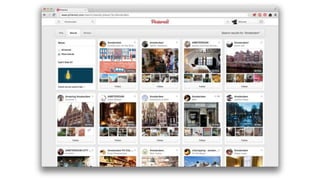
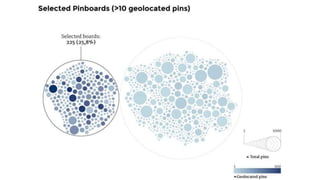
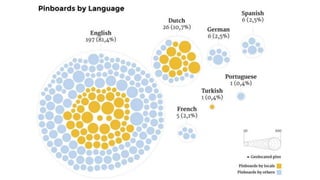
Pinterest: Term ‘Amsterdam’ in “place” boards = list of 781 boards, pulling first 100 pins per board,
total of 31479 pins (8274 geolocated)
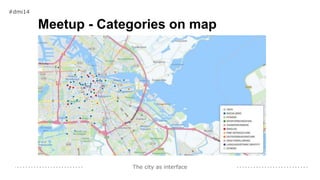
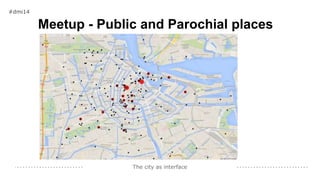
Meetup - 489 events in 258 locations from 172 community's over a 4 month period.
Twitter: keyword Amsterdam over a 10-day period (13–22 June), resulting in 4930
geotagged tweets in the Amsterdam area
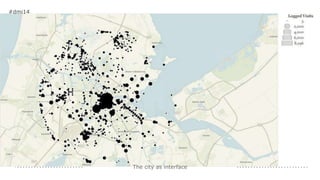
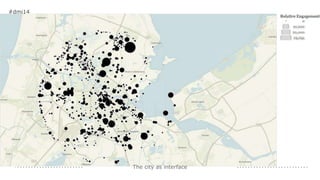
Geocaching: 700 of geocaches in Amsterdam (geocaching.nl)
Analyze first the type of Amsterdam the platform presents, and secondly identify stacks of
parochial spaces (within and cross platform); the more overlapping parochial spaces, the more
public this space is.
#dmi14
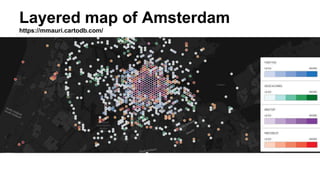
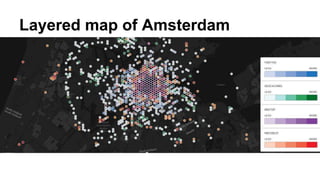
Layered map of Amsterdam
https://mmauri.cartodb.com/
link to interactive cartodb
change background
The city as interface
Meetup - Categories on map
#dmi14
The city as interface
Meetup - Public and Parochial places
#dmi14
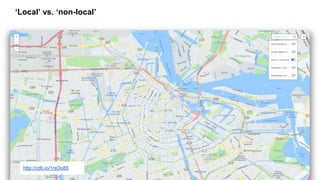
‘Local’ vs. ‘non-local’
http://cdb.io/1rsOo85
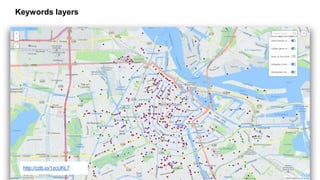
Keywords layers
http://cdb.io/1zcUKL7
Pinterest
Main Findings:
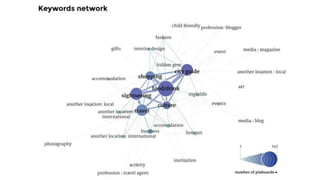
Pinterest produces the ‘Boutique view’ of Amsterdam
>where specialist interests like food, interior design, child-friendly & culture intersect
>Local pinners and boards described as ‘hidden gems’ in outskirts while travel and touristy hotspots in
city center
>Also an interesting view of retail culture in particular Haarlemmerstraat and Haarlemmerdijk which
feature concept stores plus smaller bars and restaurants, not the larger commercial predominate.
Proliferation of travel industry and local business and how they are leveraging the platform for
destination marketing and commercial promotion could provide for interesting extra study.
The city as interface
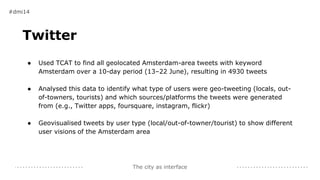
Twitter
● Used TCAT to find all geolocated Amsterdam-area tweets with keyword
Amsterdam over a 10-day period (13–22 June), resulting in 4930 tweets
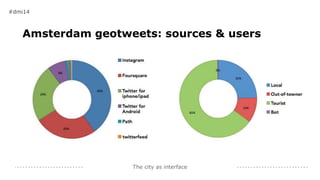
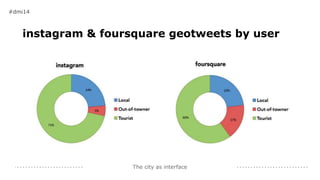
● Analysed this data to identify what type of users were geo-tweeting (locals, out-
of-towners, tourists) and which sources/platforms the tweets were generated
from (e.g., Twitter apps, foursquare, instagram, flickr)
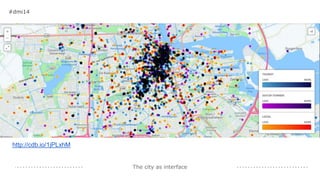
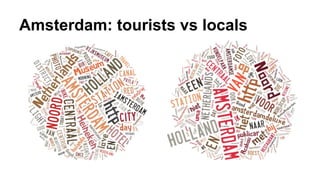
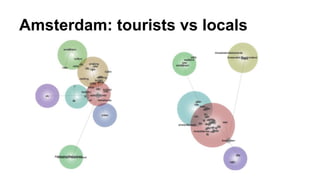
● Geovisualised tweets by user type (local/out-of-towner/tourist) to show different
user visions of the Amsterdam area
#dmi14
The city as interface
Amsterdam geotweets: sources & users
#dmi14
The city as interface
instagram & foursquare geotweets by user
#dmi14
The city as interface
#dmi14
http://cdb.io/1jPLxhM
Amsterdam: tourists vs locals
The city as interface
#dmi14
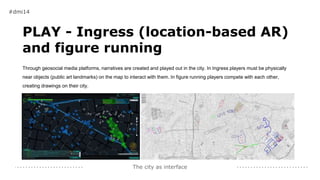
PLAY - Ingress (location-based AR)
and figure running
Through geosocial media platforms, narratives are created and played out in the city. In Ingress players must be physically
near objects (public art landmarks) on the map to interact with them. In figure running players compete with each other,
creating drawings on their city.
The city as interface
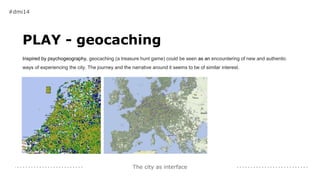
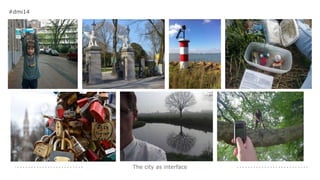
PLAY - geocaching
Inspired by psychogeography, geocaching (a treasure hunt game) could be seen as an encountering of new and authentic
ways of experiencing the city. The journey and the narrative around it seems to be of similar interest.
#dmi14
The city as interface
#dmi14
The city as interface
#dmi14
The city as interface
#dmi14
The city as interface
#dmi14
The city as interface
#dmi14
The city as interface
#dmi14
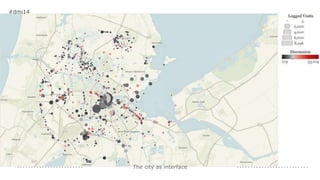
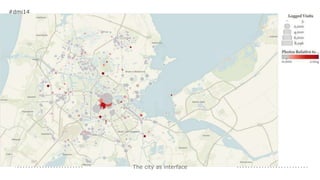
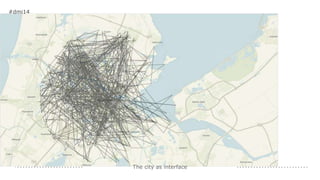
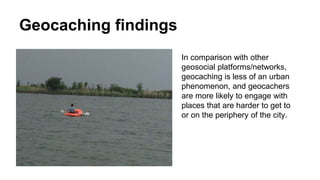
Geocaching findings
In comparison with other
geosocial platforms/networks,
geocaching is less of an urban
phenomenon, and geocachers
are more likely to engage with
places that are harder to get to
or on the periphery of the city.
The city as interface
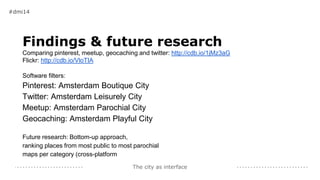
Findings & future research
Comparing pinterest, meetup, geocaching and twitter: http://cdb.io/1jMz3aG
Flickr: http://cdb.io/VloTIA
Software filters:
Pinterest: Amsterdam Boutique City
Twitter: Amsterdam Leisurely City
Meetup: Amsterdam Parochial City
Geocaching: Amsterdam Playful City
Future research: Bottom-up approach,
ranking places from most public to most parochial
maps per category (cross-platform
#dmi14
Layered map of Amsterdam
link to interactive cartodb
change background

Digital methods: the city as interface

  • 1.
    The City asInterface Nataliya Tkachenko, Xinyang Xie (Yang), Peta Mitchell, Maarten Groen, Adrian Bertoli, Khwezi Magwaza, Naomi Bueno de Mesquita, Joe Shaw, Alexander van Someren, Tim Leunissen, Michele Mauri, Philip Schuette, Donato Ricci, Sabine Niederer
  • 2.
    The city asinterface Background The “parochial realm [is] characterized by a sense of commonality among acquaintances and neighbors who are involved in interpersonal networks that are located within ‘communities’” Lofland, Lyn. The Public Realm: Exploring the City’s Quintessential Social Territory. New York: de Gruyter, 1998, p 10. “[Cities] are not like suburbs, only denser. They differ from towns and suburbs in basic ways, and one of these is that cities are, by definition, full of strangers.” Jacobs, Jane. The Death and Life of Great American Cities. 1961. #dmi14
  • 3.
    The city asinterface Background Martijn de Waal on parochial realms and urban media “This raises the following questions: how do urban media enable us to shape these different domains in new ways? How does the emergence of a new technology shift the balance between parochial and public domains? Does the emergence of new technologies reinforce the parochial domain, and do new technologies make it easier for city dwellers to withdraw to their own ‘turf ’? Or can they actually reinforce the public domain, which is dominated by mutual interchange?” (City as Interface, pp. 16–17) “Urban spaces are becoming hybridized, meaning they are composed through a combination of physical and digital practices”. (Gordon, Eric, and Adriana de Souza e Silva. Net Locality: Why Location Matters in a Networked World. Chichester: Wiley Blackwell, 2011, p. 14.) #dmi14
  • 4.
    The city asinterface Research Question: What kind of Amsterdam do geosocial media platforms (such as Foursquare, Twitter, Pinterest, Flickr, Meet-up, and Geocaching) present? … and can we identify the parochial and the public spaces of a city by looking at the places put forward by these platforms? #dmi14
  • 5.
    The city asinterface Methodology & Data Retrieve Amsterdam-specific posts/meetups/pins on (secondary) social media and plot on a map. Data: Pinterest: Term ‘Amsterdam’ in “place” boards = list of 781 boards, pulling first 100 pins per board, total of 31479 pins (8274 geolocated) Meetup - 489 events in 258 locations from 172 community's over a 4 month period. Twitter: keyword Amsterdam over a 10-day period (13–22 June), resulting in 4930 geotagged tweets in the Amsterdam area Geocaching: 700 of geocaches in Amsterdam (geocaching.nl) Analyze first the type of Amsterdam the platform presents, and secondly identify stacks of parochial spaces (within and cross platform); the more overlapping parochial spaces, the more public this space is. #dmi14
  • 6.
    Layered map ofAmsterdam https://mmauri.cartodb.com/ link to interactive cartodb change background
  • 7.
    The city asinterface Meetup - Categories on map #dmi14
  • 8.
    The city asinterface Meetup - Public and Parochial places #dmi14
  • 12.
  • 14.
  • 15.
    Pinterest Main Findings: Pinterest producesthe ‘Boutique view’ of Amsterdam >where specialist interests like food, interior design, child-friendly & culture intersect >Local pinners and boards described as ‘hidden gems’ in outskirts while travel and touristy hotspots in city center >Also an interesting view of retail culture in particular Haarlemmerstraat and Haarlemmerdijk which feature concept stores plus smaller bars and restaurants, not the larger commercial predominate. Proliferation of travel industry and local business and how they are leveraging the platform for destination marketing and commercial promotion could provide for interesting extra study.
  • 16.
    The city asinterface Twitter ● Used TCAT to find all geolocated Amsterdam-area tweets with keyword Amsterdam over a 10-day period (13–22 June), resulting in 4930 tweets ● Analysed this data to identify what type of users were geo-tweeting (locals, out- of-towners, tourists) and which sources/platforms the tweets were generated from (e.g., Twitter apps, foursquare, instagram, flickr) ● Geovisualised tweets by user type (local/out-of-towner/tourist) to show different user visions of the Amsterdam area #dmi14
  • 17.
    The city asinterface Amsterdam geotweets: sources & users #dmi14
  • 18.
    The city asinterface instagram & foursquare geotweets by user #dmi14
  • 19.
    The city asinterface #dmi14 http://cdb.io/1jPLxhM
  • 20.
  • 21.
  • 22.
    The city asinterface #dmi14 PLAY - Ingress (location-based AR) and figure running Through geosocial media platforms, narratives are created and played out in the city. In Ingress players must be physically near objects (public art landmarks) on the map to interact with them. In figure running players compete with each other, creating drawings on their city.
  • 23.
    The city asinterface PLAY - geocaching Inspired by psychogeography, geocaching (a treasure hunt game) could be seen as an encountering of new and authentic ways of experiencing the city. The journey and the narrative around it seems to be of similar interest. #dmi14
  • 24.
    The city asinterface #dmi14
  • 25.
    The city asinterface #dmi14
  • 26.
    The city asinterface #dmi14
  • 27.
    The city asinterface #dmi14
  • 28.
    The city asinterface #dmi14
  • 29.
    The city asinterface #dmi14
  • 30.
    Geocaching findings In comparisonwith other geosocial platforms/networks, geocaching is less of an urban phenomenon, and geocachers are more likely to engage with places that are harder to get to or on the periphery of the city.
  • 31.
    The city asinterface Findings & future research Comparing pinterest, meetup, geocaching and twitter: http://cdb.io/1jMz3aG Flickr: http://cdb.io/VloTIA Software filters: Pinterest: Amsterdam Boutique City Twitter: Amsterdam Leisurely City Meetup: Amsterdam Parochial City Geocaching: Amsterdam Playful City Future research: Bottom-up approach, ranking places from most public to most parochial maps per category (cross-platform #dmi14
  • 32.
    Layered map ofAmsterdam link to interactive cartodb change background

Editor's Notes

  • #4 - wat betekent de term
  • #5 How do geosocial media platforms remediate urban space, and can they be considered to constitute overlapping parochial or public domains? Can mapping/geovisualizing geosocial media platforms help us to answer these questions? Net locality (location awareness based on mobile technologies) makes different parochial realms meet and overlap in time and space. How is this played out in the same physical urban space?
  • #6 - wat betekent de term
  • #8 - wat betekent de term
  • #9 Platform can be used to find both public and parochial places. Due to the pre-set categories it is relatively easy to derive the degree of publicity/parochialisation. Most ‘public’ places are: Cafe Zilt - a small beer & whiskey bar close to central station and chinatown- (food/drink, socializing and singles) Cafe de Jaren - grand café in the city centre (government-politics, language, singles) Vondelpark Open Air Theatre - a stage in the heart of the Vondelpark (spirituality, socializing, and health/well-being) The most parochial are: Impact Hub Amsterdam - innovation lab, business Incubator, social enterprise community center (3 groups, 1 category), Café Balkon inside the Central Station (3 groups, 1 category), Glimworm HQ - Tech company (3 groups, 1 category) Pakhuis de Zwijger - Creative industry/Urban development ( 7 groups, 2 categories)
  • #17 - wat betekent de term
  • #18 - wat betekent de term
  • #19 - wat betekent de term
  • #20 - wat betekent de term
  • #23 - wat betekent de term
  • #24 - wat betekent de term
  • #25 - wat betekent de term
  • #26 - wat betekent de term
  • #27 - wat betekent de term
  • #28 - wat betekent de term
  • #29 - wat betekent de term
  • #30 - wat betekent de term
  • #32 - wat betekent de term