Introducing Digital
Methods
Tommaso Venturini
tomm.venturini@gmail.com
tommasoventurini.it
Digital Methods - Approaches
Data is the new oil!
(or maybe not)
Nigel Holmes
The Human Face
of Big Data
Data Mining &
unconventional oil
Data is the new
soil!
which makes us…
Tommaso Venturini
Training
• University of Bologna Communication Sciences (Umberto Eco)
• Web design and web development & Virtual communities
• Ph.D. in Society of Information at Milano Bicocca and Paris I
Sorbonne
• MACOSPOL and controversy mapping
Research
• Founder and coordinator of the SP médialab (with Bruno Latour)
• Principal investigator
- EMAPS (EU FP7 on controversy mapping)
- MEDEA (ANR on climate adaptation debate)
- Contropedia (EINS on Wikipedia versioning)
• Lecturer in “Digital Methods” at King’s College London
Selected Publications
Venturini, T., Jensen, P., & Latour, B. (2015). Fill in the Gap: A New Alliance for Social and Natural Sciences.
Journal of Artificial Societies and Social Simulation, 18(2), 11.
Venturini, T., Cardon, D., & Cointet, J.-P. (2015). Méthodes digitales: Approches quali/quanti des données
numériques - Curation and Presentation of the Special Issue. Réseaux, 188, 9.
Venturini, T. (2010). Diving in magma: how to explore controversies with actor-network theory. Public
Understanding of Science, 19(3), 258–273. Citations 185.
Venturini, T. (2012). Building on faults: how to represent controversies with digital methods. Public
Understanding of Science, 21(7), 796 – 812. Citations 85.
Venturini, T., Ricci, D., Mauri, M., Kimbell, L., & Meunier, A. (2015). Designing Controversies and their Publics.
Design Issues, 31(3).
Latour, B., Jensen, P., Venturini, T., Grauwin, S., & Boullier, D. (2012). “The whole is always smaller than its
parts”: a digital test of Gabriel Tardes’ monads. The British Journal of Sociology, 63(4), 590–615. Citations 169.
Jacomy, M., Venturini, T., Heymann, S., & Bastian, M. (2014). ForceAtlas2, a Continuous Graph Layout
Algorithm for Handy Network Visualization Designed for the Gephi Software. PloS One, 9(6). Citations 161.
Venturini, T., Baya Laffite, N., Cointet, J.-P., Gray, I., Zabban, V., & De Pryck, K. (2014). Three maps and three
misunderstandings: A digital mapping of climate diplomacy. Big Data & Society, 1(2).
Borra, E., Weltevrede, E., Ciuccarelli, P., Kaltenbrunner, A., Laniado, D., … Venturini, T. (2014). Contropedia - the
analysis and visualization of controversies in Wikipedia articles. In OpenSym 2014 Proceedings.
tommasoventurini.it
Module’s Outline
1. Introduction (avoiding a few misunderstandings)
2. Beyond qualitative and quantitative methods
3. The art of querying
4. The art of triangulating
5. Meet the network
6. Hands on networks
7. Visual network analysis
8. Extracting networks
9. The politics of digital methods
10. Conclusion and summary
4 Misunderstanding
1. Digital is not digitized
2. Tracing is not neutral
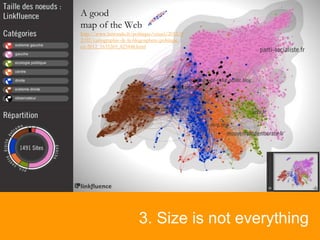
3. Size is not everything
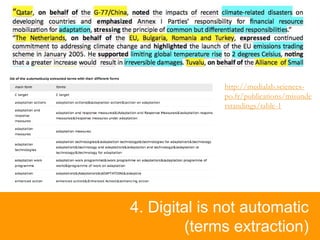
4. Digital is not automatic
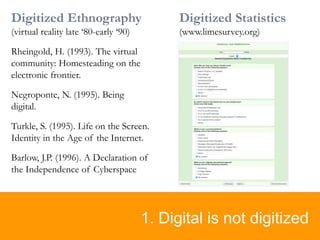
1. Digital is not digitized
Digitized Ethnography
(virtual reality late ‘80-early ‘90)
Rheingold, H. (1993). The virtual
community: Homesteading on the
electronic frontier.
Negroponte, N. (1995). Being
digital.
Turkle, S. (1995). Life on the Screen.
Identity in the Age of the Internet.
Barlow, J.P. (1996). A Declaration of
the Independence of Cyberspace
Digitized Statistics
(www.limesurvey.org)
1. Digital is not digitized
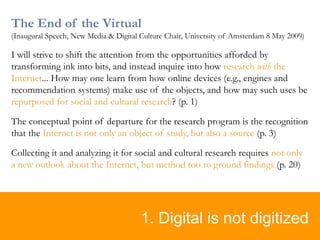
The End of the Virtual
(Inaugural Speech, New Media & Digital Culture Chair, University of Amsterdam 8 May 2009)
I will strive to shift the attention from the opportunities afforded by
transforming ink into bits, and instead inquire into how research with the
Internet... How may one learn from how online devices (e.g., engines and
recommendation systems) make use of the objects, and how may such uses be
repurposed for social and cultural research? (p. 1)
The conceptual point of departure for the research program is the recognition
that the Internet is not only an object of study, but also a source (p. 3)
Collecting it and analyzing it for social and cultural research requires not only
a new outlook about the Internet, but method too to ground findings (p. 20)
2. Tracing is not neutral
Lous Marin(2001)
On Representation
Stanford University Press
2. Tracing is not neutral
Jude Umeh (2007). The World Beyond Digital Rights Management
Tracing collective phenomena is not cheaper
The price is paid by someone else
2. Tracing is not neutral
Askitas, N., & Zimmermann, K. (2011). Health and Well-Being in the Crisis. IZA Discussion Paper
Digital traces are second-handed
2. Tracing is not neutral
Digital traces are second-handed
2. Tracing is not neutral
Digital traces are second-handed
3. Size is not everything
What happened on the September 25 2005?
3. Size is not everything
What happened on the September 25 2005?
3. Size is not everything
A pseudo-exhaustive
map of the Web
http://internet-map.net
3. Size is not everything
A good
map of the Web
http://www.lemonde.fr/politique/visuel/2012/0
2/02/cartographie-de-la-blogosphere-politique-
en-2012_1635269_823448.html
3. Size is not everything
Patrick Blanc
Two Gardens
4. Digital is not automatic
(corpus harvesting)
4. Digital is not automatic
(terms extraction)
http://medialab.sciences-
po.fr/publications/misunde
rstandings/table-1
4. Digital is not automatic
(extraction cleaning)
http://62.210.188.24/negociations/web_cop_simpler2new.html
4. Digital is not automatic
(terms merging)
http://medialab.sciences-po.fr/publications/misunderstandings/table-
2
4. Digital is not automatic
(terms clustering)
http://medialab.sciences-
po.fr/publications/misunde
rstandings/figure-1
4. Digital is not automatic
(time analysis)
http://medialab.sciences-
po.fr/publications/misunderstandings/figu
re-7
4. Digital is not automatic
(findings narration)
http://climaps.eu/#!/narrative/mitigation-and-adaptation-in-the-unfccc-debates
4. Digital is not automatic
(and back to square one)
www.climatenegotiations.org
4. Digital is not automatic
(and back again)
On digital traceability
Venturini, Tommaso, and Bruno Latour. 2010.
“The Social Fabric: Digital Traces and Quali-Quantitative Methods”
in Proceedings of Future En Seine 2009. Paris, pp. 87–101
Venturini, Tommaso. 2012.
“Building on Faults: How to Represent Controversies with Digital Methods”
in Public Understanding of Science 21(7):796–812.
Venturini, Tommaso et al. 2014.
“Three Maps and Three Misunderstandings: A Digital Mapping of Climate Diplomacy”
in Big Data & Society 1(2).
Tommaso Venturini
tommasoventurini.it

Digital methods - 1 : Introduction

  • 1.
  • 2.
    Data is thenew oil! (or maybe not) Nigel Holmes The Human Face of Big Data
  • 3.
  • 4.
    Data is thenew soil! which makes us…
  • 5.
    Tommaso Venturini Training • Universityof Bologna Communication Sciences (Umberto Eco) • Web design and web development & Virtual communities • Ph.D. in Society of Information at Milano Bicocca and Paris I Sorbonne • MACOSPOL and controversy mapping Research • Founder and coordinator of the SP médialab (with Bruno Latour) • Principal investigator - EMAPS (EU FP7 on controversy mapping) - MEDEA (ANR on climate adaptation debate) - Contropedia (EINS on Wikipedia versioning) • Lecturer in “Digital Methods” at King’s College London
  • 6.
    Selected Publications Venturini, T.,Jensen, P., & Latour, B. (2015). Fill in the Gap: A New Alliance for Social and Natural Sciences. Journal of Artificial Societies and Social Simulation, 18(2), 11. Venturini, T., Cardon, D., & Cointet, J.-P. (2015). Méthodes digitales: Approches quali/quanti des données numériques - Curation and Presentation of the Special Issue. Réseaux, 188, 9. Venturini, T. (2010). Diving in magma: how to explore controversies with actor-network theory. Public Understanding of Science, 19(3), 258–273. Citations 185. Venturini, T. (2012). Building on faults: how to represent controversies with digital methods. Public Understanding of Science, 21(7), 796 – 812. Citations 85. Venturini, T., Ricci, D., Mauri, M., Kimbell, L., & Meunier, A. (2015). Designing Controversies and their Publics. Design Issues, 31(3). Latour, B., Jensen, P., Venturini, T., Grauwin, S., & Boullier, D. (2012). “The whole is always smaller than its parts”: a digital test of Gabriel Tardes’ monads. The British Journal of Sociology, 63(4), 590–615. Citations 169. Jacomy, M., Venturini, T., Heymann, S., & Bastian, M. (2014). ForceAtlas2, a Continuous Graph Layout Algorithm for Handy Network Visualization Designed for the Gephi Software. PloS One, 9(6). Citations 161. Venturini, T., Baya Laffite, N., Cointet, J.-P., Gray, I., Zabban, V., & De Pryck, K. (2014). Three maps and three misunderstandings: A digital mapping of climate diplomacy. Big Data & Society, 1(2). Borra, E., Weltevrede, E., Ciuccarelli, P., Kaltenbrunner, A., Laniado, D., … Venturini, T. (2014). Contropedia - the analysis and visualization of controversies in Wikipedia articles. In OpenSym 2014 Proceedings.
  • 7.
  • 8.
    Module’s Outline 1. Introduction(avoiding a few misunderstandings) 2. Beyond qualitative and quantitative methods 3. The art of querying 4. The art of triangulating 5. Meet the network 6. Hands on networks 7. Visual network analysis 8. Extracting networks 9. The politics of digital methods 10. Conclusion and summary
  • 9.
    4 Misunderstanding 1. Digitalis not digitized 2. Tracing is not neutral 3. Size is not everything 4. Digital is not automatic
  • 10.
    1. Digital isnot digitized Digitized Ethnography (virtual reality late ‘80-early ‘90) Rheingold, H. (1993). The virtual community: Homesteading on the electronic frontier. Negroponte, N. (1995). Being digital. Turkle, S. (1995). Life on the Screen. Identity in the Age of the Internet. Barlow, J.P. (1996). A Declaration of the Independence of Cyberspace Digitized Statistics (www.limesurvey.org)
  • 11.
    1. Digital isnot digitized The End of the Virtual (Inaugural Speech, New Media & Digital Culture Chair, University of Amsterdam 8 May 2009) I will strive to shift the attention from the opportunities afforded by transforming ink into bits, and instead inquire into how research with the Internet... How may one learn from how online devices (e.g., engines and recommendation systems) make use of the objects, and how may such uses be repurposed for social and cultural research? (p. 1) The conceptual point of departure for the research program is the recognition that the Internet is not only an object of study, but also a source (p. 3) Collecting it and analyzing it for social and cultural research requires not only a new outlook about the Internet, but method too to ground findings (p. 20)
  • 12.
    2. Tracing isnot neutral Lous Marin(2001) On Representation Stanford University Press
  • 13.
    2. Tracing isnot neutral
  • 14.
    2. Tracing isnot neutral Jude Umeh (2007). The World Beyond Digital Rights Management Tracing collective phenomena is not cheaper The price is paid by someone else
  • 15.
    2. Tracing isnot neutral Askitas, N., & Zimmermann, K. (2011). Health and Well-Being in the Crisis. IZA Discussion Paper Digital traces are second-handed
  • 16.
    2. Tracing isnot neutral Digital traces are second-handed
  • 17.
    2. Tracing isnot neutral Digital traces are second-handed
  • 18.
    3. Size isnot everything What happened on the September 25 2005?
  • 19.
    3. Size isnot everything What happened on the September 25 2005?
  • 20.
    3. Size isnot everything A pseudo-exhaustive map of the Web http://internet-map.net
  • 21.
    3. Size isnot everything A good map of the Web http://www.lemonde.fr/politique/visuel/2012/0 2/02/cartographie-de-la-blogosphere-politique- en-2012_1635269_823448.html
  • 22.
    3. Size isnot everything
  • 23.
    3. Size isnot everything Patrick Blanc Two Gardens
  • 24.
    4. Digital isnot automatic
  • 25.
    4. Digital isnot automatic (corpus harvesting)
  • 26.
    4. Digital isnot automatic (terms extraction) http://medialab.sciences- po.fr/publications/misunde rstandings/table-1
  • 27.
    4. Digital isnot automatic (extraction cleaning) http://62.210.188.24/negociations/web_cop_simpler2new.html
  • 28.
    4. Digital isnot automatic (terms merging) http://medialab.sciences-po.fr/publications/misunderstandings/table- 2
  • 29.
    4. Digital isnot automatic (terms clustering) http://medialab.sciences- po.fr/publications/misunde rstandings/figure-1
  • 30.
    4. Digital isnot automatic (time analysis) http://medialab.sciences- po.fr/publications/misunderstandings/figu re-7
  • 31.
    4. Digital isnot automatic (findings narration) http://climaps.eu/#!/narrative/mitigation-and-adaptation-in-the-unfccc-debates
  • 32.
    4. Digital isnot automatic (and back to square one) www.climatenegotiations.org
  • 33.
    4. Digital isnot automatic (and back again)
  • 34.
    On digital traceability Venturini,Tommaso, and Bruno Latour. 2010. “The Social Fabric: Digital Traces and Quali-Quantitative Methods” in Proceedings of Future En Seine 2009. Paris, pp. 87–101 Venturini, Tommaso. 2012. “Building on Faults: How to Represent Controversies with Digital Methods” in Public Understanding of Science 21(7):796–812. Venturini, Tommaso et al. 2014. “Three Maps and Three Misunderstandings: A Digital Mapping of Climate Diplomacy” in Big Data & Society 1(2).
  • 35.

Editor's Notes

  • #13 Piero de la Francesca, Annunciazione Arezzo
  • #15 Two things to notice: the scale of the X axis is logarithmic It is not only the “reached number” but also the variety of media that increases
  • #16 Two things to notice: the scale of the X axis is logarithmic It is not only the “reached number” but also the variety of media that increases
  • #17 Two things to notice: the scale of the X axis is logarithmic It is not only the “reached number” but also the variety of media that increases
  • #18 Two things to notice: the scale of the X axis is logarithmic It is not only the “reached number” but also the variety of media that increases